• What is the outlook for Pilbara Minerals shares in April?

    A man wearing a hard hat and high visibility vest looks out over a vast plain where heavy mining equipment can be seen in the background.A man wearing a hard hat and high visibility vest looks out over a vast plain where heavy mining equipment can be seen in the background.

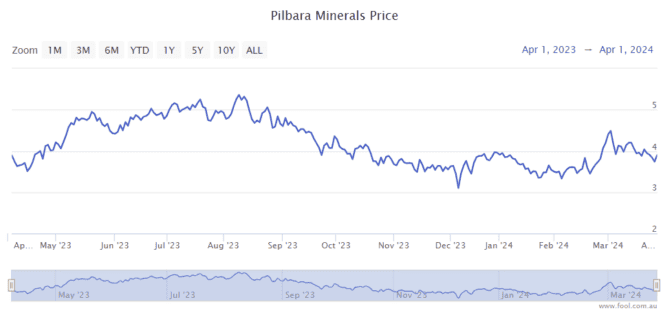
    The Pilbara Minerals Ltd (ASX: PLS) share price went down by around 9% in March 2024. Is the outlook more optimistic for the ASX lithium share?
    There are two key parts of the story for Pilbara Minerals in the shorter term – how much lithium (spodumene concentrate) it produces and what price it gets for that production.

    Production is growing

    In the first half of FY24, the business delivered a 4% increase in its production to 320.2kt.

    The company is aiming for a 70% increase in production as it constructs two projects.

    The first project is the P680 expansion, the primary rejection facility is operational while the crushing and ore-sorting facility is under construction.

    Pilbara Minerals’ second project is the P1000 expansion which aims to take the production to 1mt per annum. Earthworks and foundations have commenced.

    Growth of production will hopefully be supportive of the Pilbara Minerals share price.

    The company recently announced two expanded offtake agreements, growing its supply relationship with leading battery chemical companies Ganfeng Lithium and Chengxin Lithium. Between those two companies, they have customers that include Volkswagen, Hyundai, Tesla, BYD, CATL, Umicore, LG Chem and BMW.

    In the calendar years 2025 and 2026, those two companies could take between 410k to 460k of spodumene concentrate.

    Lithium price

    The FY24 first-half’s financial performance was impacted by lower lithium prices – the realised price (CIF China) was down 67% to US$1,645 per tonne.

    Is there going to be a recovery of the lithium price? It’s difficult to say – a key part of the situation will be supply and demand.

    Pilbara Minerals revealed numbers from Benchmark Mineral Intelligence which showed there were 13.8 million global electric vehicle sales in 2023 and this is predicted to grow to an estimated 36.1 million in 2028 and 59.1 million in 2033.

    The annual lithium demand is projected to grow at a compound annual growth rate (CAGR) of 24% between 2023 and 2028. Of course, supply is also growing, with Pilbara Minerals adding to that.

    Pilbara Minerals recently accepted a pre-auction offer for a 5,000 dry metric tonne (dmt) lithium spodumene concentrate cargo ahead of a scheduled digital auction of the Battery Material Exchange (BMX). The offer equated to an approximate price of US$1,200 per dmt on a SC6.0 China equivalent basis.

    The company is going to review a variety of sales avenues including offtake contracts, closed tenders, auctions and other commercial opportunities.

    UBS, a broker, recently suggested the average realised for the 2024 calendar year could be US$600 per tonne. It still sees the market in a surplus, though shrinking. Due to that, UBS has a sell rating on Pilbara Minerals shares.

    But, of course, it’s possible that the lithium price could positively surprise if demand is stronger than the pessimist expectations. In the longer term, Pilbara Minerals may be able to get exposure to more of the lithium supply chain.

    The post What is the outlook for Pilbara Minerals shares in April? appeared first on The Motley Fool Australia.

    Wondering where you should invest $1,000 right now?

    When investing expert Scott Phillips has a stock tip, it can pay to listen. After all, the flagship Motley Fool Share Advisor newsletter he has run for over ten years has provided thousands of paying members with stock picks that have doubled, tripled or even more.*

    Scott just revealed what he believes could be the ‘five best ASX stocks’ for investors to buy right now. We believe these stocks are trading at attractive prices and Scott thinks they could be great buys right now…

    See The 5 Stocks
    *Returns as of 1 February 2024

    (function() {
    function setButtonColorDefaults(param, property, defaultValue) {
    if( !param || !param.includes(‘#’)) {
    var button = document.getElementsByClassName(“pitch-snippet”)[0].getElementsByClassName(“pitch-button”)[0];
    button.style[property] = defaultValue;
    }
    }

    setButtonColorDefaults(“#0095C8”, ‘background’, ‘#5FA85D’);
    setButtonColorDefaults(“#0095C8”, ‘border-color’, ‘#43A24A’);
    setButtonColorDefaults(“#fff”, ‘color’, ‘#fff’);
    })()

    More reading

    Motley Fool contributor Tristan Harrison has no position in any of the stocks mentioned. The Motley Fool Australia’s parent company Motley Fool Holdings Inc. has no position in any of the stocks mentioned. The Motley Fool Australia has no position in any of the stocks mentioned. The Motley Fool has a disclosure policy. This article contains general investment advice only (under AFSL 400691). Authorised by Scott Phillips.

    from The Motley Fool Australia https://ift.tt/s0p6dnh

  • Why has the lithium price quietly risen 20% in 2024?

    A miner in a hardhat makes a sale on his tablet in the field.A miner in a hardhat makes a sale on his tablet in the field.

    The lithium price for carbonate is currently US$14,859 per tonne, up 10% in 2024.

    In the year to date, the highest price it has reached is US$15,965 per tonne.

    It got there mid-last month, and that was 20% above its starting value on 1 January.

    This is nice to see after the lithium price plummet of 2023 when carbonate’s value fell by a whopping 80%.

    But does this price bump signal a fundamental change in the outlook for lithium prices?

    Unfortunately not.

    The lithium carbonate price remains at its lowest level since August 2021 due to supply and demand dynamics that are going to take years to work their way through.

    Top broker Goldman Sachs reckons lithium prices won’t bottom til 2025.

    This has led to some Australian lithium miners scaling back production. For example, IGO Ltd (ASX: IGO), which co-owns the Greenbushes mine, is stockpiling lithium to sell when commodity prices rebound.

    On Thursday, ASX lithium shares were a mixed bag.

    Here’s a snapshot:

    • Core Lithium Ltd (ASX: CXO) shares closed steady at 15.5 cents, flat
    • Pilbara Minerals Ltd (ASX: PLS) shares closed up 0.52% to $3.85
    • IGO Ltd (ASX: IGO) shares closed up 0.71% to $7.12
    • Arcadium Lithium CDI Def (ASX: LTM) shares closed down 0.89% to $6.72

    What’s going on with lithium prices?

    According to Trading Economics, the Chinese electric vehicle (EV) market remains oversupplied.

    Government subsidies in China in 2022 encouraged greater production and consumer purchases of EVs.

    This drove up demand for lithium and caused the commodity’s price to skyrocket. Meantime, a wave of new investment in lithium production led to higher global supply, which weakened commodity prices.

    Slower adoption of EVs in the United States and European Union amid a cost of living crisis means car manufacturers and retailers are carrying higher inventories and are cutting prices to sell stock.

    According to Trading Economics:

    Sales of EVs rose by 18.2% in the first two months of the year in China, slowing from 20.8% in 2023 and the triple-digit growth rates commonly seen in late 2022.

    Lower demand from consumers amid the end of subsidies from Chinese authorities drove major car manufacturers to cut EV prices further, with giant BYD decreasing prices by an average of 17%.

    A reduction in Chinese demand for lithium is a big problem for Australia given it’s our biggest customer. In FY23, 98% of our spodumene was exported to China.

    Latest Federal Government forecasts

    Official forecasts for lithium prices can be found in the Federal Department of Industry’s March quarter resources and energy quarterly report released last week.

    The report explains that last year’s tumble in lithium commodity prices led some miners, especially the high-cost producers, to reduce their production.

    This is likely to support a “modest recovery in the lithium prices over 2024 and 2025”, according to the report.

    In February 2024, the lithium spodumene price fell to an average of US$1,000 a tonne, while the lithium hydroxide price fell to an average of US$13,350 a tonne.

    The lithium spodumene price is forecast to rise (in real terms) to about US$1,360 a tonne by 2026, before falling to about US$1,090 a tonne by 2029.

    The department predicts a fall because, “From 2026, alternate battery chemistries could place some price pressure on lithium-ion EV batteries …”.

    The lithium hydroxide price is forecast to rise (in real terms) to about US$18,330 a tonne by 2026, before falling to about US$13,890 a tonne by 2029.

    The department forecasts a fall because, “Rising LFP battery adoption is projected to continue to put lithium hydroxide prices under pressure.”

    The department reiterated that lithium price forecasts have a high degree of uncertainty.

    This is because they hinge on how many producers enter the global market, and the uptake rate of EVs by consumers.

    Lithium export earnings to fall…

    Since the December 2023 resources and energy quarterly, the department has downgraded its forecast for Australia’s lithium earnings in FY25 by 38% (from $15 billion to $9.5 billion in nominal terms).

    This is due to a lower price forecast for lithium spodumene, partially offset by higher production.

    The post Why has the lithium price quietly risen 20% in 2024? appeared first on The Motley Fool Australia.

    Wondering where you should invest $1,000 right now?

    When investing expert Scott Phillips has a stock tip, it can pay to listen. After all, the flagship Motley Fool Share Advisor newsletter he has run for over ten years has provided thousands of paying members with stock picks that have doubled, tripled or even more.*

    Scott just revealed what he believes could be the ‘five best ASX stocks’ for investors to buy right now. We believe these stocks are trading at attractive prices and Scott thinks they could be great buys right now…

    See The 5 Stocks
    *Returns as of 1 February 2024

    (function() {
    function setButtonColorDefaults(param, property, defaultValue) {
    if( !param || !param.includes(‘#’)) {
    var button = document.getElementsByClassName(“pitch-snippet”)[0].getElementsByClassName(“pitch-button”)[0];
    button.style[property] = defaultValue;
    }
    }

    setButtonColorDefaults(“#0095C8”, ‘background’, ‘#5FA85D’);
    setButtonColorDefaults(“#0095C8”, ‘border-color’, ‘#43A24A’);
    setButtonColorDefaults(“#fff”, ‘color’, ‘#fff’);
    })()

    More reading

    Motley Fool contributor Bronwyn Allen has positions in Core Lithium. The Motley Fool Australia’s parent company Motley Fool Holdings Inc. has positions in and has recommended Goldman Sachs Group. The Motley Fool Australia has no position in any of the stocks mentioned. The Motley Fool has a disclosure policy. This article contains general investment advice only (under AFSL 400691). Authorised by Scott Phillips.

    from The Motley Fool Australia https://ift.tt/EzRN1Zg

  • Here are the top 10 ASX 200 shares today

    rising gold share price represented by a green arrow on piles of gold block

    rising gold share price represented by a green arrow on piles of gold block

    It’s been a mixed return to trading for the S&P/ASX 200 Index (ASX: XJO) after the Easter break.

    This Tuesday saw the ASX 200 hit yet another new record high during intra-day trading – 7,910.5 points.

    However, investor sentiment cooled soon afterwards, and the index recorded a loss for the session, dropping 0.11% down to 7,887.9 points by the closing bell.

    This mixed bag for ASX shares follows a more dour night over on the US markets last night (which weren’t shut for Easter Monday).

    The Dow Jones Industrial Average Index (DJX: .DJI) convincingly retreated, shedding 0.6% of its value.

    However, the tech-heavy Nasdaq Composite Index (NASDAQ: .IXIC) fared much better, eking out a gain of 0.11%.

    But let’s get back to the local markets, and see how the different ASX sectors handled the resumption of trading.

    Winners and losers

    Leading the worst sectors on the market today were communication shares. The S&P/ASX 200 Communication Services Index (ASX: XTJ) certainly had a day to forget, tanking by 0.97%.

    Healthcare stocks didn’t do much better, with the S&P/ASX 200 Healthcare Index (ASX: XHJ) cratering 0.94%.

    Real estate investment trusts (REITs) were also in the firing line. The S&P/ASX 200 A-REIT Index (ASX: XPJ) endured a 0.88% sell-off today.

    Consumer discretionary stocks were on the nose too. The S&P/ASX 200 Consumer Discretionary Index (ASX: XDJ) ended up bucking by 0.84%.

    Industrial shares had a rough time as well, as you can see from the S&P/ASX 200 Industrials Index (ASX: XNJ)’s fall of 0.68%.

    Another loser was the consumer staples sector. The S&P/ASX 200 Consumer Staples Index (ASX: XSJ) wasn’t quite as shunned as its discretionary stablemate, but still dropped 0.62%.

    Tech stocks fared poorly as well. The S&P/ASX 200 Information Technology Index (ASX: XIJ) woke up on the wrong side of the bed, illustrated by its 0.6% decline.

    ASX financial shares weren’t making any new friends either. The S&P/ASX 200 Financials Index (ASX: XFJ) ended up falling 0.15% lower.

    That’s it for the red sectors. Turning now to today’s winners, our first port of call is gold stocks. The All Ordinaries Gold Index (ASX: XGD) had another corker. Fuelled by record-high gold prices, this index ballooned 3.47% higher today.

    Broader mining shares were also in hot demand. The S&P/ASX 200 Materials Index (ASX: XMJ) surged by a pleasing 1.08%.

    There was clearly a commodities theme today, with energy stocks taking out the third spot. The S&P/ASX 200 Energy Index (ASX: XEJ) had a strong day, pushing 0.62% higher.

    Our last winners were utilities shares. The S&P/ASX 200 Utilities Index (ASX: XUJ) had a decent day too, gaining 0.36%.

    Top 10 ASX 200 shares countdown

    As you can tell from the below list, ASX gold shares dominated today’s top ten list, thanks to record-high precious metal prices. But coming out on top was gold miner West African Resources Ltd (ASX: WAF).

    West African shares popped a pleasing 6.25% up to $1.275 each. That was despite no specific news out of the company itself today.

    Here’s the aforementioned list for your perusal:

    ASX-listed company Share price Price change
    West African Resources Ltd (ASX: WAF) $1.275 6.25%
    Evolution Mining Ltd (ASX: EVN) $3.79 5.87%
    Newmont Corporation (ASX: NEM) $56.35 4.92%
    Paladin Energy Ltd (ASX: PDN) $1.435 4.74%
    Gold Road Resources Ltd (ASX: GOR) $1.65 4.43%
    Genesis Minerals Ltd (ASX: GMD) $1.935 4.31%
    Emerald Resources N.L. (ASX: EMR) $3.05 4.10%
    Red 5 Ltd (ASX: RED) $0.395 3.95%
    De Grey Mining Ltd (ASX: DEG) $1.315 3.95%
    Nickel Industries Ltd (ASX: NIC) $0.835 3.09%

    Our top 10 shares countdown is a recurring end-of-day summary to let you know which companies were making big moves on the day. Check in at Fool.com.au after the weekday market closes to see which stocks make the countdown.

    The post Here are the top 10 ASX 200 shares today appeared first on The Motley Fool Australia.

    Wondering where you should invest $1,000 right now?

    When investing expert Scott Phillips has a stock tip, it can pay to listen. After all, the flagship Motley Fool Share Advisor newsletter he has run for over ten years has provided thousands of paying members with stock picks that have doubled, tripled or even more.*

    Scott just revealed what he believes could be the ‘five best ASX stocks’ for investors to buy right now. We believe these stocks are trading at attractive prices and Scott thinks they could be great buys right now…

    See The 5 Stocks
    *Returns as of 1 February 2024

    (function() {
    function setButtonColorDefaults(param, property, defaultValue) {
    if( !param || !param.includes(‘#’)) {
    var button = document.getElementsByClassName(“pitch-snippet”)[0].getElementsByClassName(“pitch-button”)[0];
    button.style[property] = defaultValue;
    }
    }

    setButtonColorDefaults(“#0095C8”, ‘background’, ‘#5FA85D’);
    setButtonColorDefaults(“#0095C8”, ‘border-color’, ‘#43A24A’);
    setButtonColorDefaults(“#fff”, ‘color’, ‘#fff’);
    })()

    More reading

    Motley Fool contributor Sebastian Bowen has positions in Newmont. The Motley Fool Australia’s parent company Motley Fool Holdings Inc. has no position in any of the stocks mentioned. The Motley Fool Australia has no position in any of the stocks mentioned. The Motley Fool has a disclosure policy. This article contains general investment advice only (under AFSL 400691). Authorised by Scott Phillips.

    from The Motley Fool Australia https://ift.tt/5K93RSQ

  • 3 ASX income shares to buy for a dividend boost

    Smiling woman with her head and arm on a desk holding $100 notes out, symbolising dividends.

    Smiling woman with her head and arm on a desk holding $100 notes out, symbolising dividends.

    If you’re on the lookout for some income options, then it could be worth checking out the ASX shares listed below.

    That’s because they have recently been named as buys by brokers and are expected to provide investors with a good source of income in the coming years.

    Here’s what analysts are saying about these ASX income shares:

    Endeavour Group Ltd (ASX: EDV)

    The first ASX income share for income investors to look at this week is Endeavour.

    It is the drinks giant behind the BWS and Dan Murphy’s brands, as well as a large network of hotels.

    Goldman Sachs is a fan of the company due to its “clear market leading position” and attractive valuation. It currently has a buy rating and $6.20 price target on the company’s shares.

    As for income, the broker is forecasting fully franked dividends of approximately 22 cents per share in FY 2024 and FY 2025. Based on the current Endeavour share price of $5.35, this will mean yields of 4.1% for both years.

    Super Retail Group Ltd (ASX: SUL)

    Another ASX income share that analysts at Goldman Sachs are positive on is Super Retail.

    It is the owner of popular retail brands BCF, Macpac, Rebel, and Super Cheap Auto. Goldman has a buy rating and $17.80 price target on its shares. It believes that “SUL will display resilience in a softer economic environment that is built upon its competitive advantage of high loyalty.”

    In respect to dividends, the broker is expecting the retailer to pay fully franked dividends per share of 67 cents in FY 2024 and then 73 cents in FY 2025. Based on the latest Super Retail share price of $15.86, this will mean good yields of 4.2% and 4.6%, respectively.

    Universal Store Holdings Ltd (ASX: UNI)

    A final ASX income share for investors to look at is Universal Store. It is the youth fashion retailer behind the Universal Store, Perfect Stranger, and Thrills brands.

    The team at Bell Potter is very positive on the company and believe it is well-placed for growth in the coming years. As a result, it recently put a buy rating and $5.65 price target on its shares.

    The broker is expecting Universal Store to pay fully franked dividends per share of 24 cents in FY 2024 and then 31 cents in FY 2025. Based on the current Universal Store share price of $5.39, this will mean attractive yields of 4.45% and 5.75%, respectively.

    The post 3 ASX income shares to buy for a dividend boost appeared first on The Motley Fool Australia.

    Wondering where you should invest $1,000 right now?

    When investing expert Scott Phillips has a stock tip, it can pay to listen. After all, the flagship Motley Fool Share Advisor newsletter he has run for over ten years has provided thousands of paying members with stock picks that have doubled, tripled or even more.*

    Scott just revealed what he believes could be the ‘five best ASX stocks’ for investors to buy right now. We believe these stocks are trading at attractive prices and Scott thinks they could be great buys right now…

    See The 5 Stocks
    *Returns as of 1 February 2024

    (function() {
    function setButtonColorDefaults(param, property, defaultValue) {
    if( !param || !param.includes(‘#’)) {
    var button = document.getElementsByClassName(“pitch-snippet”)[0].getElementsByClassName(“pitch-button”)[0];
    button.style[property] = defaultValue;
    }
    }

    setButtonColorDefaults(“#0095C8”, ‘background’, ‘#5FA85D’);
    setButtonColorDefaults(“#0095C8”, ‘border-color’, ‘#43A24A’);
    setButtonColorDefaults(“#fff”, ‘color’, ‘#fff’);
    })()

    More reading

    Motley Fool contributor James Mickleboro has positions in Endeavour Group and Universal Store. The Motley Fool Australia’s parent company Motley Fool Holdings Inc. has positions in and has recommended Goldman Sachs Group. The Motley Fool Australia has positions in and has recommended Super Retail Group. The Motley Fool has a disclosure policy. This article contains general investment advice only (under AFSL 400691). Authorised by Scott Phillips.

    from The Motley Fool Australia https://ift.tt/FIWixwt

  • If I invest $10,000 in Goodman shares, how much dividend income will I receive?

    Male hands holding Australian dollar banknotes, symbolising dividends.Male hands holding Australian dollar banknotes, symbolising dividends.

    Goodman Group (ASX: WOW) shares are $33.37, down 1.3% in late afternoon trading on Tuesday.

    Goodman is Australia’s largest real estate investment trust (REIT).

    The company specialises in industrial real estate. So, things like data centres, warehouses, logistics facilities, business parks, and so on.

    That’s hot property right now given the expanding digital economy and rising use of artificial intelligence.

    The stock is having a rocking year so far, up 33% already in 2024 and rising at nearly quadruple the rate of its property sector peers over the past 12 months.

    The ASX REIT capped off this performance with a new 52-week high of $34.07 last Thursday.

    So, shareholders are surely cheering these capital gains, but what about dividends (or distributions, in the case of REITs)? Are they rising, too?

    How much will Goodman shares pay in 2024?

    The consensus analyst forecast published on CommSec is for Goodman shares to pay 30 cents per share in total annual distributions this year and in 2025.

    That’s what Goodman has paid shareholders every year since 2019.

    The analysts expect a slight rise to 31.6 cents per share in 2026.

    A $10,000 budget (minus a brokerage fee of $5) will buy you 299 Goodman shares at the current price.

    Total spend = $9,977.63.

    If we multiply 299 shares by 30 cents, we get a total annual distribution of $89.70 and a yield of 0.89%.

    In 2026, the slightly higher payment will give us a total annual distribution of $94.50 and a yield of 0.95%.

    Why aren’t Goodman distributions rising?

    A significant reason is that Goodman prefers to use most of its retained earnings “to fund investment in the business to support the development growth in a financially sustainable manner”.

    In its 1H FY24 results, Goodman Group reported a 29% year-over-year increase in operating profit to $1.13 billion. Development earnings were a strong contributor, increasing by 33.6% to $804.7 million.

    In a statement, the company said many of its sites have been repurposed for larger scale and higher value projects. It has 85 property development projects worth $12.9 billion in the pipeline, with data centres making up 37%.

    CEO Greg Goodman said:

    Data centres will be a key area of growth and the acceleration of data centre activity is a
    catalyst for the Group to consider multiple opportunities to enhance its returns.

    We continue to assess the Group’s capital allocation to both existing and potential opportunities to provide the best risk-adjusted returns.

    Key to this will be the active rotation of our capital to fund sustained earnings growth over the
    long term.

    This strategy means shareholders are more likely to see growth in their earnings per share (EPS) instead of their dividends per share (DPS).

    The consensus analyst forecast for EPS is $1.07 per share in 2024.

    This is forecast to rise to an EPS of $1.188 per share in 2025 and $1.321 per share in 2026.

    The post If I invest $10,000 in Goodman shares, how much dividend income will I receive? appeared first on The Motley Fool Australia.

    Wondering where you should invest $1,000 right now?

    When investing expert Scott Phillips has a stock tip, it can pay to listen. After all, the flagship Motley Fool Share Advisor newsletter he has run for over ten years has provided thousands of paying members with stock picks that have doubled, tripled or even more.*

    Scott just revealed what he believes could be the ‘five best ASX stocks’ for investors to buy right now. We believe these stocks are trading at attractive prices and Scott thinks they could be great buys right now…

    See The 5 Stocks
    *Returns as of 1 February 2024

    (function() {
    function setButtonColorDefaults(param, property, defaultValue) {
    if( !param || !param.includes(‘#’)) {
    var button = document.getElementsByClassName(“pitch-snippet”)[0].getElementsByClassName(“pitch-button”)[0];
    button.style[property] = defaultValue;
    }
    }

    setButtonColorDefaults(“#0095C8”, ‘background’, ‘#5FA85D’);
    setButtonColorDefaults(“#0095C8”, ‘border-color’, ‘#43A24A’);
    setButtonColorDefaults(“#fff”, ‘color’, ‘#fff’);
    })()

    More reading

    Motley Fool contributor Bronwyn Allen has positions in Goodman Group. The Motley Fool Australia’s parent company Motley Fool Holdings Inc. has positions in and has recommended Goodman Group. The Motley Fool Australia has recommended Goodman Group. The Motley Fool has a disclosure policy. This article contains general investment advice only (under AFSL 400691). Authorised by Scott Phillips.

    from The Motley Fool Australia https://ift.tt/dLW10Hk

  • Happy Easter: ASX 200 hits another new record high

    Man raising both his arms in the air with a piggy bank on his lap, symbolising a record high.

    Man raising both his arms in the air with a piggy bank on his lap, symbolising a record high.

    ASX investors seem to have come back from their Easter break with a noticeable spring in their steps. How can we say that? Well, the S&P/ASX 200 Index (ASX: XJO) has today minted a fresh new all-time record high.

    Yes, despite a shaky start this morning, the ASX 200 rose up as high as 7,910.5 points in morning trading today – the highest the index has ever climbed to in its long history. What a way to kick off April.

    This high exceeds the new record we saw only last Thursday. As we covered at the time, Thursday trading saw the ASX 200 climb up to what was then a huge watermark of 7,901.2 points. So we’ve now had two new all-time highs in two trading days. Happy Easter indeed.

    At the time of writing, the ASX 200 has cooled off and pulled back from its new record. The index is presently down 0.25% at 7,877.5 points at the time of writing. Even so, most ASX investors will no doubt be feeling fairly chuffed right now.

    How is the ASX 200 at new record highs?

    The string of new all-time highs that ASX 200 shares have enjoyed in recent months have been driven by many corners of the market. Perhaps none more than ASX bank stocks though.

    Since November last year, all four of the big ASX 200 banks have climbed considerably. Commonwealth Bank of Australia (ASX: CBA) in particular, has soared substantially, printing several new all-time highs of its own.

    Investors have also been buoyed by encouraging economic statistics coming out of both Australia and around the globe. These generally show inflation moderating without resulting in a significant uptick in unemployment.

    This has in turn gotten investors excited about potential interest rate cuts. While central banks including our own Reserve Bank of Australia (RBA) have not given any decisive signs that they will cut rates this year, there’s no doubt that hopes that this will occur have helped drive global markets to the new heights we have recently seen.

    In terms of today’s new record though, it appears that it’s been mining and energy stocks doing most of the heavy lifting. The financial sector is actually showing a bit of weakness today, with many ASX banks, including CBA, in the red. But miners and drillers are on fire.

    The S&P/ASX 200 Energy Index (ASX: XEJ) is currently up 0.5%, while the S&P/ASX 200 Materials Index (ASX: XMJ) has gained 0.9%. But gold miners are really shining, as you can see from the All Ordinaries Gold Index (ASX: XGD)’s massive gain of 3.2%.

    Most commodities have seen an Easter bump in prices, which is at least partially what’s driving these sectors higher. But the ASX 200’s top shares so far today are almost exclusively gold stocks. This isn’t much of a surprise, considering the gold price has just clocked a new record high of its own.

    So thank miners and drillers for today’s new ASX 200 highs. Let’s see what the rest of the week brings for the Australian share market.

    The post Happy Easter: ASX 200 hits another new record high appeared first on The Motley Fool Australia.

    Wondering where you should invest $1,000 right now?

    When investing expert Scott Phillips has a stock tip, it can pay to listen. After all, the flagship Motley Fool Share Advisor newsletter he has run for over ten years has provided thousands of paying members with stock picks that have doubled, tripled or even more.*

    Scott just revealed what he believes could be the ‘five best ASX stocks’ for investors to buy right now. We believe these stocks are trading at attractive prices and Scott thinks they could be great buys right now…

    See The 5 Stocks
    *Returns as of 1 February 2024

    (function() {
    function setButtonColorDefaults(param, property, defaultValue) {
    if( !param || !param.includes(‘#’)) {
    var button = document.getElementsByClassName(“pitch-snippet”)[0].getElementsByClassName(“pitch-button”)[0];
    button.style[property] = defaultValue;
    }
    }

    setButtonColorDefaults(“#0095C8”, ‘background’, ‘#5FA85D’);
    setButtonColorDefaults(“#0095C8”, ‘border-color’, ‘#43A24A’);
    setButtonColorDefaults(“#fff”, ‘color’, ‘#fff’);
    })()

    More reading

    Motley Fool contributor Sebastian Bowen has no position in any of the stocks mentioned. The Motley Fool Australia’s parent company Motley Fool Holdings Inc. has no position in any of the stocks mentioned. The Motley Fool Australia has no position in any of the stocks mentioned. The Motley Fool has a disclosure policy. This article contains general investment advice only (under AFSL 400691). Authorised by Scott Phillips.

    from The Motley Fool Australia https://ift.tt/L3x69g7

  • 1 ASX dividend stock down over 34% to buy right now

    An Australian farmer wearing a beaten-up akubra hat and work shirt leans on a fence with livestock in the background and a blue sky above.An Australian farmer wearing a beaten-up akubra hat and work shirt leans on a fence with livestock in the background and a blue sky above.

    The ASX dividend stock Rural Funds Group (ASX: RFF) is down heavily from its peak. The Rural Funds share price has dropped 34% from the end of 2021.

    If you don’t know what this business is, it’s a real estate investment trust (REIT) that owns a farmland portfolio across a number of different sectors including cattle, almonds, macadamias, vineyards and cropping.

    Most of the ASX dividend stock’s properties are located in Queensland and NSW, but it also has a few farms in Victoria, South Australia and Western Australia.

    There are two main reasons why I think it’s a great buy today.

    Lower share price

    A share price does not tell us exactly how much a business is actually worth. It’s the market giving a rough estimation – sometimes that guess is a long way off the real underlying value, sometimes it’s too optimistic and sometimes too pessimistic.

    In each report, Rural Funds tells the market what its adjusted net asset value (NAV) is – that’s the value of the assets (including the farms) minus the liabilities (such as debt). The adjusted NAV recognises the value of the water entitlements at their market (sellable) value rather than the balance sheet value.

    At the end of December 2023, the Rural Funds’ adjusted NAV was $3.07, which was an increase of 4.8% for HY24 – the ASX dividend stock benefited from (independently) revalued assets, primarily in cattle and macadamia.

    The current Rural Funds share price is at a 32% discount to that adjusted NAV. We’d only know what the true NAV is if Rural Funds decided to sell all of its properties, but I think there is a potential appealing discount here, particularly with potential interest rate cuts getting closer.  

    The lower Rural Funds share price has also led to a higher distribution yield. It is expecting to pay a distribution of 11.73 cents per unit in FY24, which is a forward yield of 5.6%.

    Rental income growth

    The current yield is one thing, but I’m also hoping it can return to distribution growth in the longer term.

    There is a lot of rental growth built into its various contracts, with most having either a fixed annual rental increase, or inflation-linked increases, plus a market review.

    Rural Funds also regularly invests in its farms to increase productivity, rental potential and capital value, which is good for investors.

    While debt does cost more, the rental income growth can help offset this. Thankfully, a lot of Rural Funds’ debt is hedged at an interest rate of less than 3% for the next couple of years.

    With a weighted average lease expiry (WALE) of more than 12 years, the ASX dividend stock has a lot of rent already locked in.

    The post 1 ASX dividend stock down over 34% to buy right now appeared first on The Motley Fool Australia.

    Wondering where you should invest $1,000 right now?

    When investing expert Scott Phillips has a stock tip, it can pay to listen. After all, the flagship Motley Fool Share Advisor newsletter he has run for over ten years has provided thousands of paying members with stock picks that have doubled, tripled or even more.*

    Scott just revealed what he believes could be the ‘five best ASX stocks’ for investors to buy right now. We believe these stocks are trading at attractive prices and Scott thinks they could be great buys right now…

    See The 5 Stocks
    *Returns as of 1 February 2024

    (function() {
    function setButtonColorDefaults(param, property, defaultValue) {
    if( !param || !param.includes(‘#’)) {
    var button = document.getElementsByClassName(“pitch-snippet”)[0].getElementsByClassName(“pitch-button”)[0];
    button.style[property] = defaultValue;
    }
    }

    setButtonColorDefaults(“#0095C8”, ‘background’, ‘#5FA85D’);
    setButtonColorDefaults(“#0095C8”, ‘border-color’, ‘#43A24A’);
    setButtonColorDefaults(“#fff”, ‘color’, ‘#fff’);
    })()

    More reading

    Motley Fool contributor Tristan Harrison has positions in Rural Funds Group. The Motley Fool Australia’s parent company Motley Fool Holdings Inc. has no position in any of the stocks mentioned. The Motley Fool Australia has positions in and has recommended Rural Funds Group. The Motley Fool has a disclosure policy. This article contains general investment advice only (under AFSL 400691). Authorised by Scott Phillips.

    from The Motley Fool Australia https://ift.tt/9DBnw6T

  • With a 7% dividend yield, are NAB shares a buy?

    A woman looks questioning as she puts a coin into a piggy bank.A woman looks questioning as she puts a coin into a piggy bank.

    Is the National Australia Bank Ltd (ASX: NAB) share price a buy? I’m going to look at that question from a passive income perspective, with the ASX bank share offering a grossed-up dividend yield of 7%.

    What dividends could the ASX bank share pay?

    In the last 12 months, we have seen the company make sizeable increases in its dividends. The FY23 final dividend was increased by 7.7% to 84 cents per share, while the FY23 half-year dividend was increased by 13.7% to 83 cents per share.

    The last two dividend payments amount to $1.67 per share, which is a grossed-up dividend yield of 6.9%.

    However, those dividend payouts are history. The next 12 months are more important to focus on because they’re the next payments we’ll see.

    According to the projection on Commsec, owners of NAB shares are predicted to receive a slight increase of the annual payout to $1.68 per share – this would be a grossed-up dividend yield of roughly 7%.

    Is the NAB share price appealing?

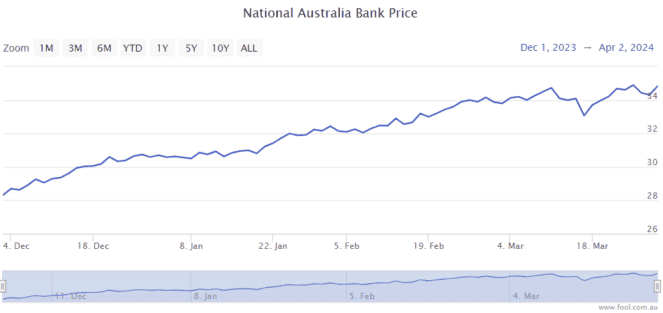
    As we can see on the chart above, the NAB share price has made rapid progress since the start of December 2023. This is great for existing shareholders, but prospective investors are now getting a lower potential dividend yield. How does that work? For example, if the NAB dividend yield was 8% and then the NAB share price rises 10%, the dividend yield reduces to roughly 7.3%.

    Not only is the dividend yield pushed down, but the price/earnings (P/E) ratio has increased, meaning we have to pay more for the same amount of earnings generated by the company.

    The projection on Commsec suggests NAB may generate earnings per share (EPS) of $2.25 in FY24, which means it’s now valued at 15 times FY24’s estimated earnings.

    This higher NAB share price comes at a time when household loan arrears are rising, there is strong competition in the lending space, NAB is paying more to savers and credit growth is slow.

    FY23 saw a credit impairment charge of $802 million, compared to an FY22 charge of $125 million. The increase in underlying charges primarily reflects “volume growth, a deterioration in asset quality and higher specific charges off a low base”.  

    I do rate NAB highly compared to other domestic ASX bank shares – I think it has been quality under the leadership of Ross McEwan, but it’s cheaper than Commonwealth Bank of Australia (ASX: CBA) on a P/E ratio basis.

    However, I wouldn’t call NAB a great buy today after the strong recent rise amid challenging economic conditions. Instead, there are other ASX dividend shares in different sectors I’d rather go for.

    The post With a 7% dividend yield, are NAB shares a buy? appeared first on The Motley Fool Australia.

    Wondering where you should invest $1,000 right now?

    When investing expert Scott Phillips has a stock tip, it can pay to listen. After all, the flagship Motley Fool Share Advisor newsletter he has run for over ten years has provided thousands of paying members with stock picks that have doubled, tripled or even more.*

    Scott just revealed what he believes could be the ‘five best ASX stocks’ for investors to buy right now. We believe these stocks are trading at attractive prices and Scott thinks they could be great buys right now…

    See The 5 Stocks
    *Returns as of 1 February 2024

    (function() {
    function setButtonColorDefaults(param, property, defaultValue) {
    if( !param || !param.includes(‘#’)) {
    var button = document.getElementsByClassName(“pitch-snippet”)[0].getElementsByClassName(“pitch-button”)[0];
    button.style[property] = defaultValue;
    }
    }

    setButtonColorDefaults(“#0095C8”, ‘background’, ‘#5FA85D’);
    setButtonColorDefaults(“#0095C8”, ‘border-color’, ‘#43A24A’);
    setButtonColorDefaults(“#fff”, ‘color’, ‘#fff’);
    })()

    More reading

    Motley Fool contributor Tristan Harrison has no position in any of the stocks mentioned. The Motley Fool Australia’s parent company Motley Fool Holdings Inc. has no position in any of the stocks mentioned. The Motley Fool Australia has no position in any of the stocks mentioned. The Motley Fool has a disclosure policy. This article contains general investment advice only (under AFSL 400691). Authorised by Scott Phillips.

    from The Motley Fool Australia https://ift.tt/s4jkbXH

  • Are Woolworths shares a buy or a sell at under $33?

    Woman thinking in a supermarket.

    Woman thinking in a supermarket.

    It’s been an unusually grim few months for the owners of Woolworths Group Ltd (ASX: WOW) shares. Woolworths investors might have gotten used to steadily rising share prices, as well as dividends in recent years.

    After all, this is a company that gained around 10% in share price value over the COVID-ravaged years of 2020 and 2021, delivering a rising dividend to boot.

    However, the last 12 months have seen some of these gains reversed. It was only in June last year that the Woolworths share price was sitting at over $40. Today, it is down to just $32.92 at the time of writing.

    This means that Woolies owners have seen their investment shed 17.8% since June last year. The grocer is also down by close to 12% over 2024 to date.

    Investors are often told that we should ‘buy low’ and ‘sell high’. We’re also regularly preached to ‘buy the dip’. So does this mean we should all be flocking in and purchasing Woolworths shares right now? Let’s discuss whether this ASX 200 blue-chip stock is a buy or a sell today.

    Lacklustre earnings dent this ASX 200 blue chip

    Firstly, it’s worth pointing out why Woolies shares have been in such a funk lately. Investors seemed to lose a lot of confidence in this stock following the release of Woolworths’ latest earnings report back in February.

    As we covered at the time, these earnings showed sluggish food sales growth of 1.5% over the six months to 31 December. That was in stark contrast to its arch-rival Coles Group Ltd (ASX: COL), which reported a 3.7% rise in sales over the same period. This may have implied some loss of market share for Woolworths.

    The best piece of news was perhaps the revelation that Woolworths’ interim dividend for 2024 would come in at 47 cents per share, fully franked. That was an increase of one cent over last year’s interim payout of 46 cents per share.

    But even so, investors were not impressed. On the day these results came out, Woolworths shares plunged more than 7%, likely unassisted by the abrupt departure of CEO Bradford Banducci, which was announced concurrently.

    Even today, the Woolworths share price remains down more than 8% from where it was before the earnings were released.

    But has this presented investors with a buying opportunity?

    Are Woolworths shares a buy or a sell at under $33?

    Well, one ASX expert thinks so. As reported by The Bull, Christopher Watt, of Bell Potter Securities, has recently given the supermarket operator a buy rating.

    Watt noted he expects the recent share price weakness to be shortlived, with the shares poised to stage a recovery. Here’s what he said in full:

    Shares in the supermarket giant have fallen from $37.51 on January 2 to trade at $33.25 on March 28. Sales moderated in the first seven weeks of the second half of fiscal year 2024 in response to lower inflation and a more cautious consumer…

    We believe the weaker share price provides a buying opportunity as we expect Woolworths shares to recover.

    However, not all experts possess such a positive outlook. Also speaking to The Bull on Woolworths was Damien Nguyen from ASX broker Morgans.

    Nguyen took a very divergent path after looking at Woolworths shares, labelling the company a ‘sell’ and seeing “limited potential upside” over the short to medium term.

    Here’s what he had to say:

    We see limited upside potential in the supermarket giant’s share price during the next 12 months. WOW’s first half result in fiscal year 2024 was in line with expectations. But commentary on sales for the first seven weeks in the second half of fiscal year 2024 was softer than anticipated. Investors may want to consider cashing in some gains.

    So there you have it, two contrasting views on where Woolies is heading next. No doubt some Woolworths investors will take comfort from the former views. But we’ll have to wait and see which of these ASX brokers proves to be on the money – only one will be right.

    In the meantime, the current Woolworths share price gives this company a market capitalisation of around $40.52 billion, with a trailing dividend yield of 3.2%.

    The post Are Woolworths shares a buy or a sell at under $33? appeared first on The Motley Fool Australia.

    Wondering where you should invest $1,000 right now?

    When investing expert Scott Phillips has a stock tip, it can pay to listen. After all, the flagship Motley Fool Share Advisor newsletter he has run for over ten years has provided thousands of paying members with stock picks that have doubled, tripled or even more.*

    Scott just revealed what he believes could be the ‘five best ASX stocks’ for investors to buy right now. We believe these stocks are trading at attractive prices and Scott thinks they could be great buys right now…

    See The 5 Stocks
    *Returns as of 1 February 2024

    (function() {
    function setButtonColorDefaults(param, property, defaultValue) {
    if( !param || !param.includes(‘#’)) {
    var button = document.getElementsByClassName(“pitch-snippet”)[0].getElementsByClassName(“pitch-button”)[0];
    button.style[property] = defaultValue;
    }
    }

    setButtonColorDefaults(“#0095C8”, ‘background’, ‘#5FA85D’);
    setButtonColorDefaults(“#0095C8”, ‘border-color’, ‘#43A24A’);
    setButtonColorDefaults(“#fff”, ‘color’, ‘#fff’);
    })()

    More reading

    Motley Fool contributor Sebastian Bowen has no position in any of the stocks mentioned. The Motley Fool Australia’s parent company Motley Fool Holdings Inc. has no position in any of the stocks mentioned. The Motley Fool Australia has positions in and has recommended Coles Group. The Motley Fool has a disclosure policy. This article contains general investment advice only (under AFSL 400691). Authorised by Scott Phillips.

    from The Motley Fool Australia https://ift.tt/JxB7e18

  • ASX 200 gold shares surging as gold price hits new records. Now what?

    ASX gold share price.

    ASX gold share price.

    S&P/ASX 200 Index (ASX: XJO) gold shares are soaring higher on Tuesday.

    In afternoon trade today the S&P/ASX All Ordinaries Gold Index (ASX: XGD) – which also contains some smaller gold stocks outside of the ASX 200 – is up 2.9%.

    Here’s how these top ASX 200 gold shares are tracking at this same time:

    • Northern Star Resources Ltd (ASX: NST) shares are up 1.7%
    • Newmont Corp (ASX: NEM) shares are up 4.9%
    • De Grey Mining Ltd (ASX: DEG) shares are up 3.6%
    • Ramelius Resources Ltd(ASX: RMS) shares are down 1.5%
    • Gold Road Resources Ltd (ASX: GOR) shares are up 4.9%
    • Evolution Mining Ltd (ASX: EVN) shares are up 3.9%
    • Bellevue Gold Ltd (ASX: BGL) shares are up 2.4%

    Not bad for a day’s work.

    And today’s outperformance follows on a very strong month.

    Over the past month, the ASX Gold Index has rocketed 12.6%.

    As for the ASX 200 gold shares performance over the last month:

    • Northern Star shares have gained 7.3%
    • Newmont shares have gained 15.6%
    • De Grey shares have gained 0.2%
    • Ramelius shares have gained 21.2%
    • Gold Road shares have gained 4.2%
    • Evolution Mining shares have gained 20.2%
    • Bellevue Gold shares have gained 20.6%

    That’s some great returns for investors.

    The question now, of course, is what can we expect next?

    What’s ahead for ASX 200 gold shares?

    Much of the boost for ASX 200 gold shares has come amid a surging gold price.

    With most of the miners’ costs fixed, higher gold prices tend to usher in higher profits.

    Bullion started March at an already historic high of US$2,083 per ounce.

    And throughout the month the yellow metal proceeded to set new record highs.

    Yesterday gold was fetching just shy of a never before seen US$2,266 per ounce. At the time of writing that’s retraced a touch to US$2,256 per ounce, more than 8% higher than this time last month.

    Bullion, and ASX 200 gold shares, have been enjoying a raft of tailwinds.

    Among them is gold’s classic haven status, which has seen increased interest during the ongoing geopolitical tensions embroiling the world.

    There’s also the increasing likelihood of lower interest rates in the United States, Australia and much of the developed world as inflation comes off the boil. Gold, which pays no yield, tends to perform better in lower and falling rate environments.

    “Inflation data, and [Fed chair Jerome] Powell’s comments in particular, have provided a further boost to gold, with the market becoming increasingly convinced that the Fed will start to cut rates in June,” Warren Patterson, head of commodities strategy at ING Groep noted (quoted by Bloomberg).

    And central banks have also continued to support demand with many, including China’s central bank, continuing to buy near-record amounts of physical gold.

    Now what?

    There are numerous factors that will impact how each ASX 200 gold share performs over the coming months and years. Those include the quality of their mining assets, management, and other factors like weather and potential tax changes in the countries where they operate.

    But the price of gold will certainly be one of the big factors that could potentially help propel ASX 200 gold shares to new heights.

    As for where the gold price is heading, JPMorgan Chase & Co came out with a bullish forecast in March, predicting bullion could trade for US$2,500 per ounce, almost 11% above current levels.

    The post ASX 200 gold shares surging as gold price hits new records. Now what? appeared first on The Motley Fool Australia.

    Wondering where you should invest $1,000 right now?

    When investing expert Scott Phillips has a stock tip, it can pay to listen. After all, the flagship Motley Fool Share Advisor newsletter he has run for over ten years has provided thousands of paying members with stock picks that have doubled, tripled or even more.*

    Scott just revealed what he believes could be the ‘five best ASX stocks’ for investors to buy right now. We believe these stocks are trading at attractive prices and Scott thinks they could be great buys right now…

    See The 5 Stocks
    *Returns as of 1 February 2024

    (function() {
    function setButtonColorDefaults(param, property, defaultValue) {
    if( !param || !param.includes(‘#’)) {
    var button = document.getElementsByClassName(“pitch-snippet”)[0].getElementsByClassName(“pitch-button”)[0];
    button.style[property] = defaultValue;
    }
    }

    setButtonColorDefaults(“#0095C8”, ‘background’, ‘#5FA85D’);
    setButtonColorDefaults(“#0095C8”, ‘border-color’, ‘#43A24A’);
    setButtonColorDefaults(“#fff”, ‘color’, ‘#fff’);
    })()

    More reading

    JPMorgan Chase is an advertising partner of The Ascent, a Motley Fool company. Motley Fool contributor Bernd Struben has no position in any of the stocks mentioned. The Motley Fool Australia’s parent company Motley Fool Holdings Inc. has positions in and has recommended JPMorgan Chase. The Motley Fool Australia has no position in any of the stocks mentioned. The Motley Fool has a disclosure policy. This article contains general investment advice only (under AFSL 400691). Authorised by Scott Phillips.

    from The Motley Fool Australia https://ift.tt/AQTOyCw