• The best ASX shares to invest $500 in right now

    If you have $500 burning a hole in your pocket and want to put it to work in the share market, then read on.

    That’s because listed below are two ASX shares that have been tipped to deliver big returns for investors over the next 12 months.

    Let’s see why they could be great options for a $500 investment right now:

    Camplify Holdings Ltd (ASX: CHL)

    Analysts at Morgans see significant value in Camplify’s shares and have them on the broker’s best ideas list.

    Camplify is the number one player in ANZ in the peer-to-peer recreational vehicle (RV) rental market. Morgans believes the company has a significant growth opportunity both at home and abroad. It explains:

    CHL is the #1 player in ANZ in the peer-to-peer RV rental space. We expect CHL to continue to grow into its large addressable market locally, with over 790k registered RVs in Australia and ~130k in NZ. CHL only has ~2% of these on its platform. It has broadly doubled its domestic fleet since listing and with its acquisition of Germany- based PaulCamper (PC) now has a total fleet of over 29,000, making it a true global player. Some key positive points worth noting and likely drivers of medium-term growth for CHL include: 1) it has a robust take-rate for its core platform of ~32% vs PC at ~20%. We expect PC to see a marked improvement in this take-rate in time due to the roll-out of CHL’s Premium Membership and insurance offering; 2) With the establishment of the MyWay MGA insurance business, CHL will likely see an overall increase in insurance revenue in Europe; 3) CHL has had 4 straight quarters of positive OCF, has ~A$26.6m cash on balance sheet and no debt.

    Morgans has an add rating and $2.55 price target on its shares. If this ASX share were to rise to this level, it would turn a $500 investment into approximately $820.

    Regal Partners Ltd (ASX: RPL)

    Bell Potter thinks that Regal Partners could be an ASX share to buy. It is a specialist alternative investment manager that was formed in 2022 following the merger of Regal Funds and VGI Partners.

    It manages a broad range of investment strategies covering long/short equities, private markets, real and natural assets, and credit and royalties on behalf of institutions, family offices, charitable groups, and private investors.

    Bell Potter believes the company’s shares are undervalued based on its positive growth outlook. It said:

    We continue to favour RPL, given its strong organic & inorganic growth potential, and entrepreneurial culture. Following the acquisition of PM Capital and Taurus (50%) last year, the firm has shown an acceleration of inflows, strong investment performance and success in marketing new funds. We feel this strong performance is not reflected in the share price and see considerable upside.

    The broker has a buy rating and $4.02 price target on its shares. This implies potential upside of 28% and would turn a $500 investment into approximately $640. It also expects 6%+ dividend yields through to FY 2026.

    The post The best ASX shares to invest $500 in right now appeared first on The Motley Fool Australia.

    Should you invest $1,000 in Camplify Holdings Limited right now?

    Before you buy Camplify Holdings Limited shares, consider this:

    Motley Fool investing expert Scott Phillips just revealed what he believes are the 5 best stocks for investors to buy right now… and Camplify Holdings Limited wasn’t one of them.

    The online investing service he’s run for over a decade, Motley Fool Share Advisor, has provided thousands of paying members with stock picks that have doubled, tripled or even more.*

    And right now, Scott thinks there are 5 stocks that may be better buys…

    See The 5 Stocks
    *Returns as of 5 May 2024

    More reading

    Motley Fool contributor James Mickleboro has no position in any of the stocks mentioned. The Motley Fool Australia’s parent company Motley Fool Holdings Inc. has recommended Camplify. The Motley Fool Australia has recommended Camplify. The Motley Fool has a disclosure policy. This article contains general investment advice only (under AFSL 400691). Authorised by Scott Phillips.

  • 22,000-year-old artifacts could rewrite ancient human history in North America

    A hand holding a stone tool
    One of the tools Darrin Lowery found on Parsons Island.

    • Darrin Lowery found a collection of tools in Maryland that may date to 22,000 years ago.
    • That would mean humans first arrived in North America thousands of years before we thought.
    • Most experts believe humans first arrived in North America between 15,000 and 20,000 years ago.

    North and South America were the last inhabited continents that modern humans settled thousands of years ago, but when and how they reached the Americas remains a mystery.

    "We don't know who these first peoples were," Todd Braje, executive director of the University of Oregon Museum of Natural and Cultural History, told Business Insider. We don't know "where they came from, when they arrived, the technologies that they had available," he added.

    For many years, archaeologists thought the first humans to set foot in the Americas did so around 13,000 years ago. But more recently, new findings have challenged that theory, pushing the timeline back even further.

    Now, a recent series of discoveries on Parsons Island, Maryland, could wind back the clock yet again. And it raises some difficult questions about early human migration across North America.

    Outside the mainstream

    Darrin Lowery has been hunting for artifacts on Maryland islands around the Chesapeake Bay since he was 9 years old. Over 40 years later, he's amassed a large collection of tools that he believes some of the earliest Americans used.

    He found nearly 300 tools on Parsons Island and says they're around 22,000 years old. That's thousands of years before many scientists think humans first journeyed to North America.

    If Lowery's hypothesis is correct, it would significantly change our ideas of how and when people started arriving in this part of the world.

    However, Lowery, who mainly works as an independent geologist, hasn't published his latest work in a peer-reviewed journal, making other experts skeptical of a theory that's already a bit outside the mainstream.

    Lowery doesn't mind the criticism, though. "If I'm wrong, I'm fine with that," he told Business Insider. "Prove me wrong."

    When did the first modern humans reach North America?

    Dark gray stone tools from the front and side
    Darrin Lowery found nearly 300 artifacts on Parsons Islands, some of which he dated to around 22,000 years old.

    Around 13,000 years ago something significant was happening across northern North America: The glaciers that had covered part of the continent for millennia were melting.

    Archaeologists thought humans needed to wait for those glaciers to melt to migrate across this region. Otherwise, the journey through what is now Canada would have been too dangerous, with little food available along the way.

    So, for most of the 20th century, the theory was that the first Americans came from Asia around 13,000 years ago, crossing the now-submerged Bering land bridge that connected Siberia and present-day Alaska. Then those humans and their ancestors made their way across the areas of the Americas with fewer glaciers.

    But by the second half of the 20th century, older sites were turning up, like a 14,500-year-old site in Chile, Monte Verde. If people were that far south at the time, it meant humans had to have traveled from North America to South America well before 13,000 years ago.

    "It really changed everything about what we understood about when and how people arrived to the Americas," Braje said of the Chile site. One alternative theory is that people followed the less icy Pacific Coast and then started moving east.

    While individual sites are often subjects of debate, the widely accepted range of humans' first arrival in the Americas is now between 20,000 to 15,000 years ago, Braje said.

    But Lowery said his artifacts are even older.

    Dating 22,000-year-old artifacts

    The embankment on Parsons Island
    Parsons Island has undergone a lot of erosion, so many of the artifacts are no longer in their original location.

    Over the course of 93 visits to Parsons Island, Lowery and other volunteers found a mix of chipped-off rock flakes, a stone for hammering, and knives.

    Due to erosion, most of the artifacts fell out of the embankment that once held them.

    However, nine were still stuck in the bank, and three of those dated to around 22,000 years ago.

    Dating ancient artifacts like this is tricky and is often the source of contention around these sites that question our understanding and timeline of ancient human history.

    For instance, most dating methods require organic material and won't work on stone tools. Instead, scientists test charcoal, pollen, and other matter found near stone artifacts.

    However, if a tool shifts from its original position — like if it falls out of the embankment that's holding it — it's difficult to date it reliably.

    That's why only a handful of Lowery's artifacts could be tested.

    Though Lowery doesn't want to publish a paper through peer review — a process he called "antiquated" — he said he did his due diligence in dating the artifacts.

    He used different methods to date the still-in-place artifacts and also sent samples to independent labs for verification.

    Using radiocarbon dating that measured the amount of carbon in flakes of charcoal, an independent lab estimated the artifacts' ages to be between 20,563 and 22,656 years old.

    If these artifacts are as old as the lab analysis suggests, then Lowery's discovery could rewrite our understanding of ancient American human history.

    The journey from Alaska to Maryland

    A map of North America covered in large glaciers 21,000 years ago
    Around 21,000 years ago, glaciers covered most of Canada.

    Around 21,000 years ago, nearly all of Canada was covered in glaciers. Therefore, one of the biggest questions with Lowery's theory is how humans could have made the trek from Alaska to Maryland 22,000 years ago when there was a vast, icy landscape in between.

    But Lowery said nearly 26,000 years ago, Beringian wolves traveled through a temporary corridor between ice sheets. Humans could have used the same route, he said.

    "I think this is largely a misconception that ice is an impediment," Lowery said. "It's a challenge, but humans are pretty damn smart."

    Lowery admitted this is just what he called "a story," but it's one some experts refuse to entertain. One archaeologist that The Washington Post spoke with refused to comment on the non-peer-reviewed paper.

    For Braje, Lowery's research is reminiscent of past debates when new discoveries pushed back the timeline for the first American arrivals.

    Braje didn't dismiss Lowery's ideas outright, but he thinks they need to go through the peer-review process. "I think all these ideas are valid ones that we should be talking about," he said, "but then we have to go to the scientific evidence."

    "To make big claims like this takes a lot of work, a lot of evidence, a lot of enduring critique, but that's part of the scientific process," Braje said.

    Read the original article on Business Insider
  • Nvidia stock: 4 reasons to buy, 4 reasons to sell

    An ASX investor in a business shirt and tie looks at his computer screen and scratches his head with one hand wondering if he should buy ASX shares yet

    This article was originally published on Fool.com. All figures quoted in US dollars unless otherwise stated.

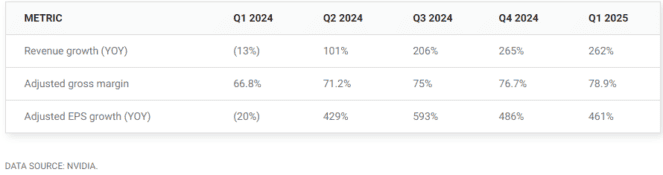
    Nvidia‘s (NASDAQ: NVDA) stock jumped 9% to a new all-time high on May 23, after the company posted its latest earnings report. In the first quarter of fiscal 2025, which ended on April 28, the chipmaker’s revenue surged 262% year over year to $26.0 billion and exceeded analysts’ estimates by $1.5 billion. Its adjusted earnings surged 461% to $6.12 per share and also cleared the consensus forecast by $0.54.

    Those growth rates were explosive, but does Nvidia’s stock still have room to run after rallying about 2,720% over the past five years? Let’s review the four reasons to buy Nvidia’s stock — as well as the four reasons to sell it — to decide.

    The key numbers

    Back in fiscal 2023, which ended in January of that year, Nvidia’s revenue flatlined as its adjusted EPS fell 25%. Its sales of gaming GPUs cooled off as PC shipments declined in a post-pandemic market, and the macro headwinds curbed its sales of data center chips. But in fiscal 2024, its revenue and adjusted EPS surged 126% and 288%, respectively.

    That abrupt acceleration was driven by the rapid expansion of the artificial intelligence (AI) market. Nvidia’s data center GPUs are used to process complex AI tasks, and the market’s demand for those chips quickly outstripped its available supply. Nvidia generated 87% of its revenue from its data center chips in the first quarter of fiscal 2025.

    Nvidia also announced a 10-for-1 stock split that will take effect on June 7. The split won’t alter Nvidia’s valuations, but it might attract some interest from smaller retail investors while boosting the stock’s liquidity through more options trading.

    The four reasons to buy Nvidia

    The bulls still love Nvidia for four reasons. First, they believe it will continue to dominate the AI market with its data center GPUs. The global AI market could still expand at a compound annual growth rate (CAGR) of 37% from 2023 to 2030, according to Markets and Markets, and Nvidia could be the simplest way to profit from that secular boom.

    Second, its first mover’s advantage in the AI space gives it tremendous pricing power. Its top-tier H100 GPUs cost more than $40,000, and it can keep raising those prices to boost its gross margin. Third, Nvidia’s gaming business, 10% of its first-quarter revenue, is gradually recovering as the PC market stabilizes.

    Lastly, Nvidia’s stock still looks reasonably valued relative to its growth potential. From fiscal 2024 to fiscal 2027, analysts expect its revenue to grow at a CAGR of 43% as its EPS increases at a CAGR of 49%.

    Based on those estimates, Nvidia’s stock trades at just 41 times forward earnings. Advanced Micro Devices (AMD -3.77%), which is growing at a much slower rate and has less exposure to the AI market, trades at 46 times forward earnings.

    The four reasons to sell Nvidia

    Meanwhile, the bears are skeptical about Nvidia for four reasons. First, they believe Nvidia will lose its first mover’s advantage in the data center GPU market as more competitors carve up the market. AMD’s new Instinct data center GPUs already cost less than Nvidia’s top-tier GPUs, and tech giants such as MicrosoftAlphabet‘s Google, and Meta Platforms have all been developing their own in-house AI chips to reduce their long-term dependence on Nvidia.

    Second, U.S. regulators recently barred Nvidia from shipping its top-tier AI GPUs to China. That pressure could drive Chinese chipmakers to accelerate their development of comparable AI accelerators. If those efforts are successful, Chinese companies could eventually flood the global market with cheaper AI chips and crush Nvidia’s gross margins.

    Third, Nvidia’s insiders sold about twice as many shares as they bought over the past 12 months. That cooling insider sentiment suggests that Nvidia could be running out of room to run as the market hovers near its all-time highs. Last but not least, the recent buying frenzy in AI chips could eventually lead to a supply glut if the market finally cools off.

    The strengths still outweigh the weaknesses

    Nvidia faces some long-term challenges, but I believe its strengths still clearly outweigh its weaknesses. Its business is still firing on all cylinders, its margin is expanding, and its stock still looks reasonably valued. Therefore, it’s not too late to accumulate more shares of Nvidia if you believe the AI market will continue flourishing over the next few decades.

    This article was originally published on Fool.com. All figures quoted in US dollars unless otherwise stated.

    The post Nvidia stock: 4 reasons to buy, 4 reasons to sell appeared first on The Motley Fool Australia.

    Should you invest $1,000 in Nvidia right now?

    Before you buy Nvidia shares, consider this:

    Motley Fool investing expert Scott Phillips just revealed what he believes are the 5 best stocks for investors to buy right now… and Nvidia wasn’t one of them.

    The online investing service he’s run for over a decade, Motley Fool Share Advisor, has provided thousands of paying members with stock picks that have doubled, tripled or even more.*

    And right now, Scott thinks there are 5 stocks that may be better buys…

    See The 5 Stocks
    *Returns as of 5 May 2024

    More reading

     Leo Sun has positions in Meta Platforms. Suzanne Frey, an executive at Alphabet, is a member of The Motley Fool’s board of directors. Randi Zuckerberg, a former director of market development and spokeswoman for Facebook and sister to Meta Platforms CEO Mark Zuckerberg, is a member of The Motley Fool’s board of directors. The Motley Fool Australia’s parent company Motley Fool Holdings Inc. has positions in and has recommended Advanced Micro Devices, Alphabet, Meta Platforms, Microsoft, and Nvidia. The Motley Fool Australia’s parent company Motley Fool Holdings Inc. has recommended the following options: long January 2026 $395 calls on Microsoft and short January 2026 $405 calls on Microsoft. The Motley Fool Australia has recommended Alphabet, Meta Platforms, Microsoft, and Nvidia. The Motley Fool has a disclosure policy. This article contains general investment advice only (under AFSL 400691). Authorised by Scott Phillips.

  • 2 of the best ASX dividend stocks for income investors to buy in June

    Do you have room for some new additions to your income portfolio in June?

    If you do, then it could be worth checking out the highly rated ASX dividend stocks listed below that analysts rate as buys. Here’s what you need to know about them:

    Dexus Industria REIT (ASX: DXI)

    The first ASX dividend stock that could be a top buy in June is Dexus Industria. It is a real estate investment trust with a portfolio of high quality industrial warehouses located across capital cities such as Sydney, Melbourne, and Adelaide.

    Morgans currently has the company on its best ideas list with an add rating and $3.18 price target. It commented:

    The portfolio is valued at $1.6bn across +90 properties with 89% of the portfolio weighted towards industrial assets (WACR 5.38%). The portfolio’s WALE is around 6 years and occupancy 97.5%. Across the portfolio 50% of leases are linked to CPI with the balance on fixed increases between 3-3.5%. While we expect cap rates to expand further in the near term, DXI’s industrial portfolio remains robust with the outlook positive for rental growth. The development pipeline also provides near and medium-term upside potential and post asset sales there is balance sheet capacity to execute.

    As for income, Morgans expects the company to pay dividends per share of 16.4 cents in FY 2024 and then 16.6 cents in FY 2025. Based on the current Dexus Industria share price of $2.93, this will mean dividend yields of 5.6% and 5.65%, respectively.

    Rural Funds Group (ASX: RFF)

    Another ASX dividend stock that is highly rated is Rural Funds. It is an agricultural REIT with a diversified farmland portfolio across five core sectors. Its properties, which are focused on almond orchards, vineyards, cattle, cotton and macadamias, are predominantly leased to corporate agricultural operators on long leases.

    Bell Potter thinks income investors should be buying the company’s shares and has named it on its Australian equities panel this month with a buy rating and $2.40 price target. It commented:

    RFF trades at a historical high discount to its market NAV per unit ($2.78 pu) at ~28%. While we are in general seeing large discounts to NAV in ASX listed farming and water assets to market NAV, the discount that RFF is trading appears excessive and we are seeing a value opportunity in RFF. While the timing of that value discount closing is difficult to call, investors are likely to be rewarded with a ~6% yield to hold the position until such a time as the asset class rerates. Furthermore, RFF aims to achieve income growth through productivity improvements, conversion of assets to higher and better use along with rental indexation which is built into all of its contracts with its tenants.

    The broker expects Rural Funds to pay dividends per share of 11.7 cents in both FY 2024 and FY 2025. Based on its current share price of $2.01, this would mean dividend yields of 5.8%.

    The post 2 of the best ASX dividend stocks for income investors to buy in June appeared first on The Motley Fool Australia.

    Should you invest $1,000 in Dexus Industria Reit right now?

    Before you buy Dexus Industria Reit shares, consider this:

    Motley Fool investing expert Scott Phillips just revealed what he believes are the 5 best stocks for investors to buy right now… and Dexus Industria Reit wasn’t one of them.

    The online investing service he’s run for over a decade, Motley Fool Share Advisor, has provided thousands of paying members with stock picks that have doubled, tripled or even more.*

    And right now, Scott thinks there are 5 stocks that may be better buys…

    See The 5 Stocks
    *Returns as of 5 May 2024

    More reading

    Motley Fool contributor James Mickleboro has no position in any of the stocks mentioned. The Motley Fool Australia’s parent company Motley Fool Holdings Inc. has no position in any of the stocks mentioned. The Motley Fool Australia has positions in and has recommended Rural Funds Group. The Motley Fool has a disclosure policy. This article contains general investment advice only (under AFSL 400691). Authorised by Scott Phillips.

  • Check out this soaring ASX stock, up 300% in 2 years, with more gains likely to come

    Life360 Inc (ASX: 360) shares have been soaring over the last couple of years.

    Thanks to its explosive revenue and earnings growth, the ASX tech stock has risen approximately 300% since this time in 2022.

    This means that if you had been lucky enough to have invested $10,000 into the location technology company’s shares two years ago, your investment would have grown to be worth $40,000 today.

    But if you thought this ASX stock was now peaking, think again. That’s the view of analysts at Bell Potter, which believe Life360 shares can keep rising from current levels.

    What is the broker saying about this high-flying ASX stock?

    According to a recent note, the broker has responded to Life360’s first quarter update by reiterating its buy rating with a price target of $17.75.

    Based on its current share price of $14.80, this implies potential upside of 20% for this ASX stock over the next 12 months. If this proves accurate, it would turn a $10,000 investment into approximately $12,000.

    Bell Potter likes Life360 due to the resilience of its business and potential to continue growing strongly in the future. It said:

    Life360 has c.1.9m paying circles – the best measure of subscriber numbers – and managed to grow this base by 39% in 2021, 23% in 2022 and 21% in 2023 despite the disruptions associated with COVID-19. This growth shows resilience in the subscriber base and, furthermore, the potential for continued strong growth in the base with market conditions now back to normal.

    In addition, the broker highlights that the ASX stock has the potential to enter and disrupt other markets. It adds:

    Life360 has the potential to leverage its large and growing user base to enter new markets and disrupt the legacy incumbents. An example is roadside assistance where Life360 launched a subscription-based product called Driver Protect which disrupted the market and helped enable monetisation of its user base. Other markets Life360 could potentially enter include insurance, item & pet tracking, senior monitoring, home security and/or identity theft.

    Potential re-rating

    In light of the above and given the valuation of a peer, the broker believes that this ASX stock deserves to trade on higher multiples. Particularly given its plan to list on Wall Street in the near future. It concludes:

    We have increased the multiple we apply in the EV/Revenue valuation from 5.5x to 6.5x given the proposed US listing and potential re-rating of the stock given the higher multiples of comps like Reddit (NYSE: RDDT). There is, however, no change in the 9.3% WACC we apply in the DCF. The net result is a 9% increase in our PT to $17.75 which is >15% premium to the share price so we maintain our BUY recommendation. Key potential catalysts for the stock include another strong quarter of paying circle growth in Q2 (April was another good month), a potential upgrade to the 2024 guidance sometime in H2 and a US listing at some stage in the next 12 months.

    The post Check out this soaring ASX stock, up 300% in 2 years, with more gains likely to come appeared first on The Motley Fool Australia.

    Should you invest $1,000 in Life360 right now?

    Before you buy Life360 shares, consider this:

    Motley Fool investing expert Scott Phillips just revealed what he believes are the 5 best stocks for investors to buy right now… and Life360 wasn’t one of them.

    The online investing service he’s run for over a decade, Motley Fool Share Advisor, has provided thousands of paying members with stock picks that have doubled, tripled or even more.*

    And right now, Scott thinks there are 5 stocks that may be better buys…

    See The 5 Stocks
    *Returns as of 5 May 2024

    More reading

    Motley Fool contributor James Mickleboro has positions in Life360. The Motley Fool Australia’s parent company Motley Fool Holdings Inc. has positions in and has recommended Life360. The Motley Fool Australia has no position in any of the stocks mentioned. The Motley Fool has a disclosure policy. This article contains general investment advice only (under AFSL 400691). Authorised by Scott Phillips.

  • Inside Henrik Fisker’s staff meeting, where the CEO announced more layoffs hitting his electric car company

    henrik fisker
    Henrik Fisker told staff there would be another round of layoffs on Wednesday, four sources confirmed to Business Insider.

    • Fisker announced another round of layoffs during an all-hands meeting Wednesday morning.
    • CEO Henrik Fisker said he wasn't directly involved in the decision, sources told BI.
    • Fisker recently appointed a chief restructuring officer who was given sole authority over some of the company's financial decision-making.

    Henrik Fisker had grim news for his staff when they logged on to a short all-hands meeting Wednesday morning. The electric carmaker was implementing yet another round of layoffs, he said.

    Four employees who attended the meeting told Business Insider that the CEO and founder attempted to shift responsibility for the latest staff cuts, frustrating some staff who felt he was failing to take accountability for how the company had gotten to the brink of bankruptcy.

    Henrik Fisker told employees he had not been directly involved in the decision to cut staff and instead said the choice to further reduce the company's workforce was made by chief restructuring officer John DiDonato, two employees who attended told BI.

    DiDonato, the restructuring officer, is the managing director of Huron Consulting Group and was brought in to help Fisker in April. Fisker was required to install a chief restructuring officer last month after the company missed an interest payment to an unnamed institutional investor and noteholder. The agreement gave the CRO, who reports directly to the company's recently established transaction committee, "sole authority" over decision-making related to a potential sale of the company and "oversight of cash management," according to an April 16 filing with the Securities and Exchange Commission.

    "The general gist of the meeting was Henrik was saying 'These are not my layoffs,'" said one worker, who witnessed the meeting and later found out that their role had been eliminated.

    Shortly after the meeting, dozens of workers found out they'd been impacted by the cut when they lost access to the company's internal systems, two workers who lost their jobs as part of the cuts told BI. The employees later received an email from human resources notifying them they'd been impacted by the cuts, they said.

    At least one Fisker employee took to the company's internal Microsoft Teams channel to criticize Henrik Fisker's comments.

    "You have not one time taken responsibility for what's going on at Fisker," the employee wrote in the Teams chat. "I am here for 8 months and not once did you acknowledge mistakes by our leadership. It's always others."

    Another employee wrote: "We love you Henrick!!!!! Keep fighting!"

    The recent layoffs represent the latest in a series of cuts at Fisker, including a round last week.

    The significant staff reductions are designed to eventually bring the workforce down to a group of about 100 employees, one former Fisker employee with knowledge of the issue said.

    It's not clear how many employees remain. Spokespeople for Fisker and its CRO DiDonato did not immediately respond to requests for comment ahead of publication.

    Fisker has repeatedly warned over the past few months that the company may go out of business within the year. On April 29, the company sent notices to staffers, in compliance with the Worker Adjustment and Retraining Notification Act, that they may be laid off in two months if the company can't find a buyer or additional funding.

    Do you work for Fisker or have a tip? Reach out to the reporter via a non-work email at gkay@insider.com

    Read the original article on Business Insider
  • Samuel Alito’s story about the upside-down flag fiasco isn’t fully adding up

    Samuel Alito being sworn in
    Samuel Alito is sworn in as Associate Justice of the US Supreme Court as his wife Martha-Ann Alito holds a bible during a ceremony in the East Room at the White House February 1, 2006, in Washington, DC.

    • Justice Samuel Alito is rejecting calls for his recusal from January 6-related cases.
    • Alito blamed his wife for flying two controversial flags that have ties to right-wing movements. 
    • But Alito's explanation for why and when his wife flew one of the flags isn't adding up. 

    Supreme Court Justice Samuel Alito is doubling down on blaming his wife for flying two flags that are associated with right-wing groups and ideas over the couple's homes in recent years.

    In a Wednesday letter to House and Senate Democrats, Alito rejected lawmakers' calls for him to recuse himself from two high-profile cases involving former President Donald Trump and January 6 rioters, saying he had nothing to do with the partisan flags flying over his properties.

    "My wife is fond of flying flags," Alito wrote. "I am not."

    But Alito's efforts to address the flag fiasco have left more questions than answers, all the while sparking another neutrality crisis for a high court already wracked by conflict of interest allegations.

    Neighborly dispute

    What began as a dispute over an anti-Trump sign in Alito's Virginia neighborhood back in 2021 has exploded into a national news story after The New York Times reported this month that an upside-down American flag was flown outside the justice's house soon after the January 6, 2021, Capitol riot.

    Upside-down American flags have been used as a symbol to protest slavery and the Vietnam War, but the practice has more recently been adopted by proponents of the "Stop the Steal" campaign, which erroneously claims Trump won the 2020 presidential election.

    Alito has repeatedly denied any part in flying the flag above his home, telling The Times earlier this month that his wife, Martha-Ann Alito, raised the flag in response to an ongoing fight with two residents in the neighborhood.

    In his Wednesday letter, Alito said his wife was involved in "nasty" fight with two neighbors, adding that she only raised the flag after a male neighbor "berated her" using "foul language, including what I regard as the vilest epithet that can be addressed to a woman."

    But Emily Baden, one of the neighbors involved in the dispute, told The Times this week that it was she — not her then-boyfriend — who used the curse word, saying the verbal altercation took place weeks after the flag was flown outside Alito's home. The outlet obtained a text message and police call that backed up Baden's timeline, calling into question Alito's version of events.

    The Supreme Court did not immediately respond to a request for comment from Business Insider.

    Alito said he asked his wife to take the flag down "as soon as I saw it," but for "several days," she refused. 

    samuel alito
    Samuel Alito

    "My wife and I own our Virginia home jointly. She, therefore, has the legal right to use the property as she sees fit, and there were no additional steps that I could have taken to have the flag taken down more promptly," he wrote. 

    Martha-Ann Alito appeared to have at least some awareness of the upside-down flag's meaning in 2021, telling a Washington Post reporter at the time that the flag was "an international signal of distress" and suggesting its presence at her home was in response to the neighborhood dispute.

    A second flag

    Alito's explanation for why his wife raised the upside-down flag in January 2021 also doesn't account for the second controversial flag now tied to the couple.

    The Times reported this month that an "Appeal to Heaven" flag was flown outside Alito's New Jersey beach house as recently as last summer. The flag also has ties to January 6, 2021, rioters and proponents of a more Christian government.

    Alito said he was not familiar with the "Appeal to Heaven" flag when his wife flew it, writing that he assumed it was expressing a religious and patriotic message. He said neither he nor his wife were aware the flag had any association with the "Stop the Steal" movement. 

    "She did not fly it to associate herself with that or any other group, and the use of an old historic flag by a new group does not necessarily drain that flag of all other meanings," Alito wrote. 

    In his letter to Democrats, Alito says he is "confident" that his explanations are sufficient cause for rejecting calls for his recusal.

    However, the Supreme Court's own code of conduct states justices shouldn't give the appearance of any political opinion or bias with regard to issues that could appear before the court. Alito and his colleagues will soon rule on two major cases related to the January 6, 2021, rioters and Trump in outcomes that could have an influence on the upcoming 2024 presidential election.

    A legal ethics professor told BI earlier this month that the flags would have almost certainly disqualified Alito from such cases if he were on a lower court, but the Supreme Court's code of conduct is "merely performative."

    Read the original article on Business Insider
  • We had cellphones, then feature phones, then smartphones. Now, ‘IntelliPhones’ are coming.

    Kosta Tsiriotakis holds a vintage analogue Motorola "brick" phone
    Kosta Tsiriotakis holds a vintage analogue Motorola "brick" phone

    • Bank of America analysts predict AI will create a new class of devices called 'IntelliPhones.'
    • AI enhancements could make phones more context-aware and proactive.
    • There's a new battle brewing over who will create the most useful AI-powered phone. 

    The first cellphone came out in the early 1980s. It was connected to a cellular radio system and didn't require a physical connection to a network.

    Then, we had feature phones. These connected to the internet and could store and play music.

    Apple ushered in the smartphone era, with location data, fancy cameras, and the all-important App Store.

    Is AI about to launch a new chapter? Analysts at Bank of America Securities think so. And they've come up with a new name for this future device.

    The "IntelliPhone."

    Yes, it's an awful name. Too many syllables. No one is ever going to say, "Ugh, I can't find my IntelliPhone. Have you seen it?"

    However, artificial intelligence models, chatbots, and other AI-powered applications could get so useful that our current smartphones might look kinda dumb in the future.

    Maybe no one will have to ask where their IntelliPhone is, because it will somehow find itself.

    "Context awareness will be the key differentiator," Wamsi Mohan, an analyst at Bank of America Securities, wrote in a research note on Wednesday that listed a number of future capabilities that may take these gadgets way beyond current handsets.

    Hype warning

    A word of caution here. The AI hype cycle is in overdrive right now, and Mohan and his colleagues were writing a research note about Apple ahead of its WWDC conference next month.

    The company is expected to unveil a slew of new AI features for iPhones at this event. It's common for Wall Street analysts to issue positive research and "buy" recommendations in instances like this.

    The mother of all upgrade cycles

    Still, Mohan makes some compelling arguments. If AI tools on phones can really set them apart from current devices, consumers have a new reason to buy a fresh handset.

    "We see the introduction of AI smartphones (IntelliPhones) as a once in a decade upgrade event," Mohan wrote.

    At Google's I/O conference earlier this month, the internet giant showed off several new AI capabilities for Pixel, Samsung, and other Android phones.

    "It's a once-in-a-generation moment to reinvent what phones can do," Android chief Sameer Samat told Business Insider. "We are going to seize that moment."

    Consumers will only embrace these new devices if they're actually useful in everyday situations. Google has already shown off some of these new killer applications for AI. Apple will have to show off more of these powerful use cases at WWDC if it's going to keep up.

    Mohan at BofA describes a wide range of new capabilities that could set IntelliPhones apart from smartphones and fire up the mother of all upgrade cycles.

    "We view the upcoming AI enabled phones (IntelliPhones) to drive a multi-year upgrade cycle similar to the step function improvement driven by the introduction of smartphones," he wrote, calling this a "once in a decade type of event."

    IntelliPhone capabilities

    Here are some of the potential capabilities of IntelliPhones, according to BofA:

    Context aware assistance: AI-enabled phones will offer more advanced personal assistants that understand context better and provide more relevant and timely responses.

    Proactive suggestions: These assistants could proactively suggest actions based on user patterns.

    Object and scene recognition: These phones can identify objects, people, and scenes in photos and suggest actions like sharing, searching for more information, or buying related products.

    Real-time translation: AI-capable phones offer real-time language translation making communication easier while traveling or interacting with people who speak different languages.

    Predictive health alerts: AI could predict potential health issues by analyzing patterns in collected data and alert users to seek medical advice if needed.

    AI driven content creation: Users may be able to create more immersive and engaging AR/VR content with the help of AI tools on phones that simplify the creation process and enhance the final output.

    Music Haptics: AI could refine vibrations from music to improve the experience for phone users who are deaf or hard of hearing.

    Vocal Shortcuts: AI could recognize speech patterns and improve speech recognition for users with conditions that affect speech such as cerebral palsy, or those who have suffered a stroke. Users could also assign custom utterances that Siri can understand to launch shortcuts and complete complex tasks.

    Read the original article on Business Insider
  • Elon Musk’s $55 billion Tesla pay package seems to be getting mounting pushback

    Elon Musk, Tesla Factory
    Tesla investors are voting on whether Elon Musk's pay package should be reinstated.

    • Telsa faces investor pushback on reinstating Elon Musk's $55 billion pay package.
    • The largest public pension fund in the US currently plans to vote against the pay plan.
    • Musk called out the pension fund for "breaking their word."

    Tesla is facing increasing pushback from investors regarding its bid to reinstate Elon Musk's $55 billion pay package.

    On Wednesday, there was yet another sign that Tesla might be facing an uphill battle when the CEO of the California Public Employees' Retirement System, Marcie Frost, told CNBC the fund plans to vote against the proposal to reinstate Musk's pay plan, pending any future conversations with Tesla.

    "We do not believe that the compensation is commensurate with the performance of the company," Frost said.

    CalPERS is the largest public pension fund in the US and is among one of Tesla's 30 largest investors with about 9.5 million shares, according to Bloomberg. The fund initially voted for Musk's pay package when it was taken to a shareholder vote in 2018.

    Musk does not receive a salary from Tesla and his pay package is centered on a series of goalposts around the carmaker's financial growth. The plan, which was valued at $55 billion by Bloomberg when it was struck down by a Delaware judge in January, involves a 10-year grant of 12 tranches of stock options that are vested when Tesla hits specific targets. When the company hits each milestone, Musk gets stock equal to 1% of outstanding shares at the time of the grant. Tesla said it hit all of the 12 targets as of 2023.

    Musk quickly posted on social media to criticize CalPERS's stance on the proposal on Wednesday.

    "What she's saying makes no sense, as all the contractual milestones were met. CalPERS is breaking their word," Musk wrote on X.

    CalPERS is joining a growing list of investment funds that are publicly expressing their desire to vote against Tesla's compensation plan for Musk. On May 21, a group of shareholders filed a letter with the Securities and Exchange Commission calling for investors to vote against both Musk's pay package and the proposal to reelect James Murdoch and Kimbal Musk. Separately, proxy advisory firm Glass Lewis said in a report on Saturday that the pay plan was "excessive" and presented investors with "uncertain benefits and additional risk."

    Meanwhile, Tesla has been pulling out all the stops to promote the proposal. On Wednesday, the company began offering investors the opportunity to tour the Texas gigafactory alongside Musk in exchange for proof they'd voted in Tesla's annual meeting. Tesla has also argued the compensation plan is "critical to the future success of Tesla" and has even paid for a handful of advertisements promoting the pay plan.

    The annual meeting for investors will take place on June 13. Shareholders will be asked to vote on several proposals in addition to the proposal to reinstate Musk's pay package, which was struck down by a Delaware judge earlier this year. The company is also asking investors to vote on a proposal to move Tesla's state of incorporation from Delaware to Texas and a separate proposal to reelect Tesla board members Kimbal Musk and Murdoch.

    A spokesperson for Tesla did not immediately respond to a request for comment.

    Are you a Tesla investor, do you work for the company, or have a tip? Reach out to the reporter via a non-work email and device at gkay@businessinsider.com or 248-894-6012

    Read the original article on Business Insider
  • Here’s the Coles dividend forecast through to 2026

    Family having fun while shopping for groceries.

    Coles Group Ltd (ASX: COL) shares have been a popular option for income investors since landing on the ASX boards in 2018 following a divestment by Wesfarmers Ltd (ASX: WES).

    It isn’t hard to see why the supermarket giant features in countless income portfolios and superannuation funds across the country.

    Given the nature of its business, Coles has defensive earnings. This means that its earnings are resilient and often grow even in the toughest economic environments.

    For example, the Coles dividend was one of only a handful that continued to grow during the COVID pandemic.

    It has continued to grow since then, with the Coles board declaring a 66 cents per share fully franked dividend in FY 2023.

    This represents an 80% payout ratio, which was in line with its dividend policy of paying out 80% to 90% of earnings. Management notes that this policy allows Coles to reward its shareholders while also enabling it to retain strategic flexibility.

    But that dividend has been paid now. So, what’s next for the Coles dividend? Let’s see what analysts are forecasting for the supermarket giant.

    Coles dividend forecast

    Interestingly, analysts actually expect the Coles dividend to be lower year on year in FY 2024 for the first time since its listing.

    For example, Goldman Sachs is forecasting a fully franked dividend of 65 cents per share for the financial year.

    Based on the current Coles share price of $16.07, this will mean a 4% dividend yield for investors.

    Goldman then expects another dividend cut to 64 cents per share in FY 2025 due to softening profit margins. This would mean a dividend yield of just under 4% for investors that year.

    The good news is that the broker believes that a return to growth will take place in FY 2026 thanks to a rebound in its profit margins.

    Goldman is expecting the Coles dividend to come in at a fully franked 72 cents per share. This represents a 12.5% increase year on year and equates to an attractive 4.5% dividend yield.

    Should you buy Coles shares?

    Goldman is currently sitting on the fence when it comes to Coles shares.

    The broker recently upgraded the retailer’s shares to a neutral rating with a $16.30 price target. This is a touch higher than where they trade today.

    The broker feels that the Coles share price is fairly valued at current levels. It said:

    In our opinion, whilst COL has under-invested in its digital transformation and omni-channel strategy, we believe 1) COL has made encouraging steps to address under-investment with key Witron facilities now operating 2) whilst Ocado facilties have been delayed, risks of further delay are more limited. We expect COL to report lower comps sales and EBIT margin growth in FY25/26 vs key competitor WOW, though execution under new CEO has been increasingly positive. COL is trading below long term 12m forward P/E but with double running cost associated with Witron/Ocado facilities alongside existing infrastructure, we believe this is fair value. We are Neutral rated on COL.

    The post Here’s the Coles dividend forecast through to 2026 appeared first on The Motley Fool Australia.

    Should you invest $1,000 in Coles Group Limited right now?

    Before you buy Coles Group Limited shares, consider this:

    Motley Fool investing expert Scott Phillips just revealed what he believes are the 5 best stocks for investors to buy right now… and Coles Group Limited wasn’t one of them.

    The online investing service he’s run for over a decade, Motley Fool Share Advisor, has provided thousands of paying members with stock picks that have doubled, tripled or even more.*

    And right now, Scott thinks there are 5 stocks that may be better buys…

    See The 5 Stocks
    *Returns as of 5 May 2024

    More reading

    Motley Fool contributor James Mickleboro has no position in any of the stocks mentioned. The Motley Fool Australia’s parent company Motley Fool Holdings Inc. has positions in and has recommended Goldman Sachs Group and Wesfarmers. The Motley Fool Australia has positions in and has recommended Coles Group and Wesfarmers. The Motley Fool has a disclosure policy. This article contains general investment advice only (under AFSL 400691). Authorised by Scott Phillips.