• Here’s the average Australian superannuation balance at age 80 in 2024

    An older gentleman leans over his partner's shoulder as she looks at a tablet device while seated at a table in their classic Australian old person's home, complete with comfortable furniture and family photographs on the walls.An older gentleman leans over his partner's shoulder as she looks at a tablet device while seated at a table in their classic Australian old person's home, complete with comfortable furniture and family photographs on the walls.

    Superannuation may be the key asset for funding the life expenses of someone in retirement. Therefore, the superannuation balance can make a big impact.

    We have looked at the average superannuation balance, the average for a 40-year-old and a number of other ages. In this article, we’re going to look at the financial picture of an 80-year-old.

    It’s interesting to look at how much an 80-year-old may have in their superannuation balance because superannuation was only introduced in Australia in July 1992. Hence, people in their 80s haven’t had a full lifetime of working whilst it has been applicable.

    The 80s are an important time of life, and it may be very useful to have a larger superannuation balance for necessary (or desired) costs such as healthcare expenditures, bills and holidays.

    What’s the average superannuation balance at age 80?

    Based on the Australian Taxation Office (ATO) Taxation Statistics report for FY21, the average balance for someone aged 80 was $475,422. This figure actually includes everyone aged 75 or more, which is the oldest age group of the ATO statistics.

    The median superannuation balance for someone aged 80 (or at least 75) was $171,716.

    Why is there such a big difference? The median number is what we can describe as the middle number. If all the people aged at least 75 were in a line based on their superannuation balance, the median number tells us what the person in the middle of the line has.

    The average balance includes people with large balances, such as high earners and those who have contributed a large amount to their superannuation.

    For example, if we had three people – one with a $100,000 balance, one with $200,000 and one with a $1 million balance, the average would be $433,333 and the median would be $200,000. That’s a big difference.

    The numbers I’ve given you are for all Australians. However, there can sometimes be sizeable differences between the amounts for male and female balances.

    The average female balance for an 80-year-old was $436,865, while the median superannuation balance was $168,973.

    Turning to the male balances, the average balance was $507,556 and the median superannuation balance was $174,179.

    What can we learn from these figures?

    It seems that the average 80-year-old, or people aged at least 75, have a sizeable nest egg. But is it enough for a comfortable retirement?

    According to the Association of Superannuation Funds of Australia, the superannuation balance required to achieve a comfortable retirement at 67 is $690,000 for a couple and $595,000 for a single.

    An average couple are probably doing quite well, but the people with a median balance may only have enough for a reasonably modest retirement. A modest financial retirement can still be very fulfilling of course – there’s more to life than money and how much we spend on something.

    I think it’s a good idea to periodically assess your superannuation balance to see the progress made toward a particular retirement goal.

    But, keep in mind that the last few years of working will have the biggest effect. A 65-year-old with a $500,000 balance that benefits from a 10% rise of the portfolio would mean they would become a 66-year-old with a $550,000 balance.

    There are a variety of things that we can do to ensure a healthy nest egg including adding more to superannuation each year and investing in growth-focused asset classes that can produce better returns over time.

    We’ve seen (ASX) shares beat the return of defensive assets of cash and bonds over the long term.

    The post Here’s the average Australian superannuation balance at age 80 in 2024 appeared first on The Motley Fool Australia.

    Wondering where you should invest $1,000 right now?

    When investing expert Scott Phillips has a stock tip, it can pay to listen. After all, the flagship Motley Fool Share Advisor newsletter he has run for over ten years has provided thousands of paying members with stock picks that have doubled, tripled or even more.*

    Scott just revealed what he believes could be the ‘five best ASX stocks’ for investors to buy right now. We believe these stocks are trading at attractive prices and Scott thinks they could be great buys right now…

    See The 5 Stocks
    *Returns as of 1 February 2024

    (function() {
    function setButtonColorDefaults(param, property, defaultValue) {
    if( !param || !param.includes(‘#’)) {
    var button = document.getElementsByClassName(“pitch-snippet”)[0].getElementsByClassName(“pitch-button”)[0];
    button.style[property] = defaultValue;
    }
    }

    setButtonColorDefaults(“#0095C8”, ‘background’, ‘#5FA85D’);
    setButtonColorDefaults(“#0095C8”, ‘border-color’, ‘#43A24A’);
    setButtonColorDefaults(“#fff”, ‘color’, ‘#fff’);
    })()

    More reading

    Motley Fool contributor Tristan Harrison has no position in any of the stocks mentioned. The Motley Fool Australia’s parent company Motley Fool Holdings Inc. has no position in any of the stocks mentioned. The Motley Fool Australia has no position in any of the stocks mentioned. The Motley Fool has a disclosure policy. This article contains general investment advice only (under AFSL 400691). Authorised by Scott Phillips.

    from The Motley Fool Australia https://ift.tt/70feVpa

  • New to investing? I’d invest my first $1,000 in ASX shares today!

    A young boy dressed in an old man-style cardigan with business shirt and bow tied wearing big spectacles smiles to himself as he sits at a laptop computer at a desk with hands on keys.A young boy dressed in an old man-style cardigan with business shirt and bow tied wearing big spectacles smiles to himself as he sits at a laptop computer at a desk with hands on keys.

    Everyone remembers their first time.

    If you have never done it before, buying ASX shares can be a scary experience.

    You don’t know whether you will lose money. You feel like you don’t have as much knowledge as the veterans. You’re concerned about being “fleeced”.

    However, it’s a lot easier to get started now than it used to be.

    Back in the days when you had to buy stocks through a human broker on the telephone, investors often needed to put in a decent whack of money to make the brokerage fees worthwhile.

    These days, with the advent of online broking platforms, just $1,000 can get your portfolio started.

    So if I were starting now, what would I buy?

    An easy way to begin for a new investor

    A great place to start is index exchange-traded funds (ETFs).

    Buying an ETF stock provides the beginner with instant diversification and all the risk management benefits that comes with it.

    And in modern times there are indices for every investment angle, so it’s not hard to find something that suits your tastes and judgments.

    ETF shares also save a lot of time and effort for novices, as they don’t need to be constantly following the news on particular companies to decide whether to buy or sell. The index, and therefore the fund, will automatically do that on their behalf.

    But — and you know it was coming — there is a catch.

    What index ETFs can’t give you

    The limitation of index funds is that it will never perform better than the market. That’s the trade-off one makes for the convenience it brings.

    Actively picking ASX shares is the only way an investor has a chance to do better than the average.

    And while that might be daunting to the first-timer, there are plenty of quality choices on the ASX to choose from.

    They need not be speculative. If you are convinced that the business will be in better shape in five years’ time than how it is now, you have a buy candidate.

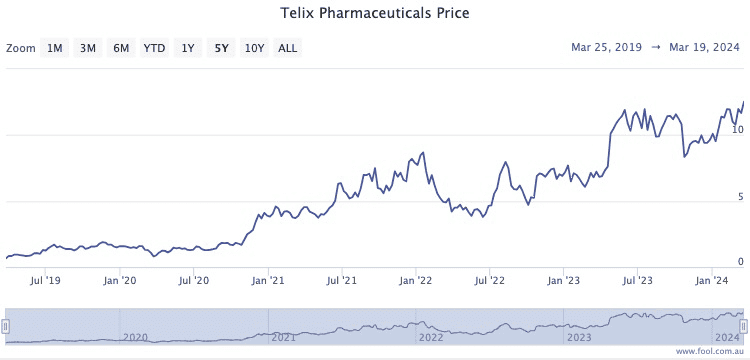
    Take three of my current favourites at the moment — Xero Ltd (ASX: XRO), Johns Lyng Group Ltd (ASX: JLG) and Telix Pharmaceuticals Ltd (ASX: TLX).

    They are in vastly different industries — software, construction and healthcare — but are all quality companies with an excellent track record of growing value for shareholders.

    The past five years has seen their share prices return 171%, 386%, and 1,900% respectively.

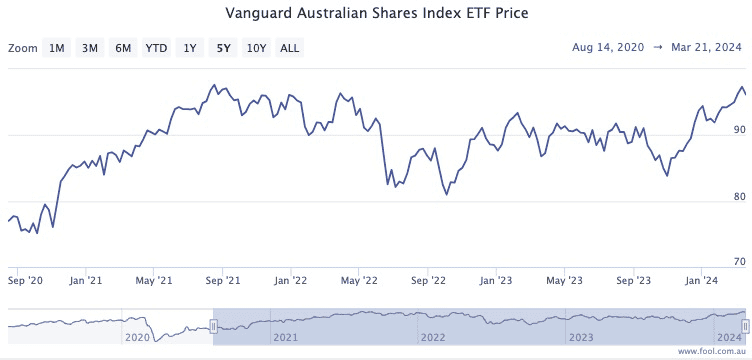
    No index fund could even come close to that sort of performance.

    Of course, not every stock you pick will do that well. But if the portfolio is properly diversified, these types of winners can make up for the losers, plus more.

    The post New to investing? I’d invest my first $1,000 in ASX shares today! appeared first on The Motley Fool Australia.

    Wondering where you should invest $1,000 right now?

    When investing expert Scott Phillips has a stock tip, it can pay to listen. After all, the flagship Motley Fool Share Advisor newsletter he has run for over ten years has provided thousands of paying members with stock picks that have doubled, tripled or even more.*

    Scott just revealed what he believes could be the ‘five best ASX stocks’ for investors to buy right now. We believe these stocks are trading at attractive prices and Scott thinks they could be great buys right now…

    See The 5 Stocks
    *Returns as of 1 February 2024

    (function() {
    function setButtonColorDefaults(param, property, defaultValue) {
    if( !param || !param.includes(‘#’)) {
    var button = document.getElementsByClassName(“pitch-snippet”)[0].getElementsByClassName(“pitch-button”)[0];
    button.style[property] = defaultValue;
    }
    }

    setButtonColorDefaults(“#0095C8”, ‘background’, ‘#5FA85D’);
    setButtonColorDefaults(“#0095C8”, ‘border-color’, ‘#43A24A’);
    setButtonColorDefaults(“#fff”, ‘color’, ‘#fff’);
    })()

    More reading

    Motley Fool contributor Tony Yoo has positions in Johns Lyng Group, Telix Pharmaceuticals, and Xero. The Motley Fool Australia’s parent company Motley Fool Holdings Inc. has positions in and has recommended Johns Lyng Group, Telix Pharmaceuticals, and Xero. The Motley Fool Australia has positions in and has recommended Xero. The Motley Fool Australia has recommended Johns Lyng Group and Telix Pharmaceuticals. The Motley Fool has a disclosure policy. This article contains general investment advice only (under AFSL 400691). Authorised by Scott Phillips.

    from The Motley Fool Australia https://ift.tt/eGnfrdP

  • Buy and hold these ASX ETFs until 2034

    A group of young ASX investors sitting around a laptop with an older lady standing behind them explaining how investing works.

    A group of young ASX investors sitting around a laptop with an older lady standing behind them explaining how investing works.

    If you would like to make some buy and hold investments but aren’t keen on stock picking, then it could be worth looking at the exchange-traded funds (ETFs) listed below.

    These four ASX ETFs are highly rated and could be good options for investors wanting long-term options.

    Here’s what you need to know about them:

    BetaShares Asia Technology Tigers ETF (ASX: ASIA)

    The BetaShares Asia Technology Tigers ETF could be a top ASX ETF to buy and hold. Particularly if you’re looking for exposure to the growing Asian economy. That’s because this popular ETF gives investors access to the best tech stocks in the region. Many of these are the region’s equivalents of the West’s biggest and best tech giants. Among its holdings are e-commerce giant Alibaba, search engine leader Baidu, iPhone manufacturer Taiwan Semiconductor Manufacturing Company, WeChat owner Tencent, and Temu owner Pinduoduo.

    Vanguard U.S. Total Market Shares Index ETF (ASX: VTS)

    If you’re more bullish on the US economy, then it could be worth looking at the Vanguard US Total Market Shares Index ETF. This fund allows investors to buy a part of ~4,000 US listed shares of all shapes and sizes. The fund manager, Vanguard, highlights that this allows investors to participate in the long-term growth potential of the US economy and its listed companies.

    BetaShares Global Cybersecurity ETF (ASX: HACK)

    Another ASX ETF to consider for a long-term investment is the BetaShares Global Cybersecurity ETF. It provides investors with access to a global cybersecurity sector that is forecast to grow materially over the next decade and beyond. This is being driven by the rising threat of cybercrime and more and more infrastructure moving to the cloud. Among the companies included in the fund are Accenture and Palo Alto Networks.

    BetaShares NASDAQ 100 ETF (ASX: NDQ)

    Finally, it would be remiss to not include the hugely popular BetaShares NASDAQ 100 ETF in this list. It provides access to the biggest and best companies that Wall Street’s NASDAQ index has to offer. This includes Amazon, Apple, Microsoft, and Nvidia. So, with these companies all having very bright futures, it certainly could pay to have them in your portfolio.

    The post Buy and hold these ASX ETFs until 2034 appeared first on The Motley Fool Australia.

    Wondering where you should invest $1,000 right now?

    When investing expert Scott Phillips has a stock tip, it can pay to listen. After all, the flagship Motley Fool Share Advisor newsletter he has run for over ten years has provided thousands of paying members with stock picks that have doubled, tripled or even more.*

    Scott just revealed what he believes could be the ‘five best ASX stocks’ for investors to buy right now. We believe these stocks are trading at attractive prices and Scott thinks they could be great buys right now…

    See The 5 Stocks
    *Returns as of 1 February 2024

    (function() {
    function setButtonColorDefaults(param, property, defaultValue) {
    if( !param || !param.includes(‘#’)) {
    var button = document.getElementsByClassName(“pitch-snippet”)[0].getElementsByClassName(“pitch-button”)[0];
    button.style[property] = defaultValue;
    }
    }

    setButtonColorDefaults(“#0095C8”, ‘background’, ‘#5FA85D’);
    setButtonColorDefaults(“#0095C8”, ‘border-color’, ‘#43A24A’);
    setButtonColorDefaults(“#fff”, ‘color’, ‘#fff’);
    })()

    More reading

    John Mackey, former CEO of Whole Foods Market, an Amazon subsidiary, is a member of The Motley Fool’s board of directors. Motley Fool contributor James Mickleboro has positions in BetaShares Nasdaq 100 ETF. The Motley Fool Australia’s parent company Motley Fool Holdings Inc. has positions in and has recommended Accenture Plc, Amazon, Apple, Baidu, BetaShares Global Cybersecurity ETF, BetaShares Nasdaq 100 ETF, Microsoft, Nvidia, Palo Alto Networks, Taiwan Semiconductor Manufacturing, and Tencent. The Motley Fool Australia’s parent company Motley Fool Holdings Inc. has recommended Alibaba Group and has recommended the following options: long January 2025 $290 calls on Accenture Plc, long January 2026 $395 calls on Microsoft, short January 2025 $310 calls on Accenture Plc, and short January 2026 $405 calls on Microsoft. The Motley Fool Australia has positions in and has recommended BetaShares Global Cybersecurity ETF and BetaShares Nasdaq 100 ETF. The Motley Fool Australia has recommended Amazon, Apple, Betashares Capital – Asia Technology Tigers Etf, and Nvidia. The Motley Fool has a disclosure policy. This article contains general investment advice only (under AFSL 400691). Authorised by Scott Phillips.

    from The Motley Fool Australia https://ift.tt/lemqMrh

  • These ASX 200 shares could rise 20% to 50%

    Group of six people in a modern office cheering at a computer screen.

    Group of six people in a modern office cheering at a computer screen.

    If you’re on the lookout for big returns for your portfolio, then look no further.

    That’s because the ASX 200 shares listed below have been named as buys by brokers and tipped to rise over 20% from current levels.

    Here’s what you need to know about these shares:

    Domino’s Pizza Enterprises Ltd (ASX: DMP)

    The team at Morgan Stanley sees significant value in this pizza chain operator’s shares at current levels.

    In response to its half-year results last month, the broker retained its overweight rating and $68.00 price target on its shares.

    Based on the current Domino’s share price of $43.52, this implies potential upside of approximately 56% for investors.

    South32 Ltd (ASX: S32)

    If you’re not averse to investing in the mining sector, then it could be worth considering diversified miner South32.

    This ASX 200 mining share produces ten commodities from operations across six countries and three regions.

    The good news is that the team at UBS believes the outlook for some of these commodities is becoming increasingly positive. This is particularly the case for copper, which could be heading for a supply crunch according to the broker.

    In light of this, its analysts recently retained their buy rating with a $4.00 price target. This suggests potential upside of 37% for investors from current levels.

    Telstra Group Ltd (ASX: TLS)

    Finally, analysts at Goldman Sachs believe that this telco giant’s shares could generate big returns for investors.

    The broker currently has a buy rating and $4.55 price target on the ASX 200 share. If the Telstra share price were to rise to this level, it would mean a 20% return for investors.

    In addition, the broker is forecasting fully franked dividends of 18 cents per share in FY 2024 and 19 cents per share in FY 2025. This will mean yields of 4.8% and 5%, respectively, which boosts the total potential 12-month return to approximately 25%.

    The post These ASX 200 shares could rise 20% to 50% appeared first on The Motley Fool Australia.

    Wondering where you should invest $1,000 right now?

    When investing expert Scott Phillips has a stock tip, it can pay to listen. After all, the flagship Motley Fool Share Advisor newsletter he has run for over ten years has provided thousands of paying members with stock picks that have doubled, tripled or even more.*

    Scott just revealed what he believes could be the ‘five best ASX stocks’ for investors to buy right now. We believe these stocks are trading at attractive prices and Scott thinks they could be great buys right now…

    See The 5 Stocks
    *Returns as of 1 February 2024

    (function() {
    function setButtonColorDefaults(param, property, defaultValue) {
    if( !param || !param.includes(‘#’)) {
    var button = document.getElementsByClassName(“pitch-snippet”)[0].getElementsByClassName(“pitch-button”)[0];
    button.style[property] = defaultValue;
    }
    }

    setButtonColorDefaults(“#0095C8”, ‘background’, ‘#5FA85D’);
    setButtonColorDefaults(“#0095C8”, ‘border-color’, ‘#43A24A’);
    setButtonColorDefaults(“#fff”, ‘color’, ‘#fff’);
    })()

    More reading

    Motley Fool contributor James Mickleboro has positions in Domino’s Pizza Enterprises. The Motley Fool Australia’s parent company Motley Fool Holdings Inc. has positions in and has recommended Domino’s Pizza Enterprises and Goldman Sachs Group. The Motley Fool Australia has positions in and has recommended Telstra Group. The Motley Fool Australia has recommended Domino’s Pizza Enterprises. The Motley Fool has a disclosure policy. This article contains general investment advice only (under AFSL 400691). Authorised by Scott Phillips.

    from The Motley Fool Australia https://ift.tt/IsMkOHA

  • 3 fantastic high-yield ASX dividend shares to buy next week

    Woman laying with $100 notes around her, symbolising dividends.

    Woman laying with $100 notes around her, symbolising dividends.

    Are you on the lookout for some new additions to your income portfolio?

    Well, I have some good news for you. Listed below are three ASX dividend shares that brokers have recently named as buys and tipped to offer very generous dividend yields.

    Here’s what you can expect from them in the medium term:

    ANZ Group Holdings Ltd (ASX: ANZ)

    Ord Minnett thinks that this banking giant could be an ASX dividend share to buy right now.

    Particularly given that its acquisition of Suncorp Bank is nearing completion. The broker believes the acquisition will add scale to areas where it currently trails the other big four banks.

    In respect to income, its analysts are forecasting fully franked dividends per share of $1.62 in FY 2024 and $1.65 in FY 2025. Based on the current ANZ share price of $29.04, this will mean dividend yields of 5.6% and 5.7%, respectively.

    Ord Minnett currently has an accumulate rating and $31.00 price target on its shares.

    GDI Property Group Ltd (ASX: GDI)

    The team at Bell Potter is tipping this property company’s shares as a buy. Especially given its expectation that GDI Property is well-positioned to pay some big dividends in the coming years.

    The broker is forecasting dividends per share of 5 cents across FY 2024, FY 2025, and FY 2026. Based on the current GDI Property share price of 60.5 cents, this implies dividend yields of 8.3% for the next three years.

    Bell Potter has a buy rating and 75 cents price target on its shares.

    Rural Funds Group (ASX: RFF)

    Another ASX dividend share that analysts at Bell Potter are bullish on is Rural Funds.

    It is a property company that owns a portfolio of high-quality assets across a number of agricultural industries. This includes orchards, vineyards, water entitlements, cropping, and cattle farms.

    In respect to dividends, the broker is forecasting dividends per share of 11.7 cents in both FY 2024 and FY 2025. Based on the current Rural Funds share price of $2.09, this will mean yields of 5.6% for investors.

    Bell Potter has a buy rating and $2.40 price target on its shares.

    The post 3 fantastic high-yield ASX dividend shares to buy next week appeared first on The Motley Fool Australia.

    Wondering where you should invest $1,000 right now?

    When investing expert Scott Phillips has a stock tip, it can pay to listen. After all, the flagship Motley Fool Share Advisor newsletter he has run for over ten years has provided thousands of paying members with stock picks that have doubled, tripled or even more.*

    Scott just revealed what he believes could be the ‘five best ASX stocks’ for investors to buy right now. We believe these stocks are trading at attractive prices and Scott thinks they could be great buys right now…

    See The 5 Stocks
    *Returns as of 1 February 2024

    (function() {
    function setButtonColorDefaults(param, property, defaultValue) {
    if( !param || !param.includes(‘#’)) {
    var button = document.getElementsByClassName(“pitch-snippet”)[0].getElementsByClassName(“pitch-button”)[0];
    button.style[property] = defaultValue;
    }
    }

    setButtonColorDefaults(“#0095C8”, ‘background’, ‘#5FA85D’);
    setButtonColorDefaults(“#0095C8”, ‘border-color’, ‘#43A24A’);
    setButtonColorDefaults(“#fff”, ‘color’, ‘#fff’);
    })()

    More reading

    Motley Fool contributor James Mickleboro has no position in any of the stocks mentioned. The Motley Fool Australia’s parent company Motley Fool Holdings Inc. has no position in any of the stocks mentioned. The Motley Fool Australia has positions in and has recommended Rural Funds Group. The Motley Fool has a disclosure policy. This article contains general investment advice only (under AFSL 400691). Authorised by Scott Phillips.

    from The Motley Fool Australia https://ift.tt/QFhbWnx

  • Here is the profit forecast to 2026 for BHP shares

    A man wearing a hard hat and high visibility vest looks out over a vast plain where heavy mining equipment can be seen in the background.A man wearing a hard hat and high visibility vest looks out over a vast plain where heavy mining equipment can be seen in the background.

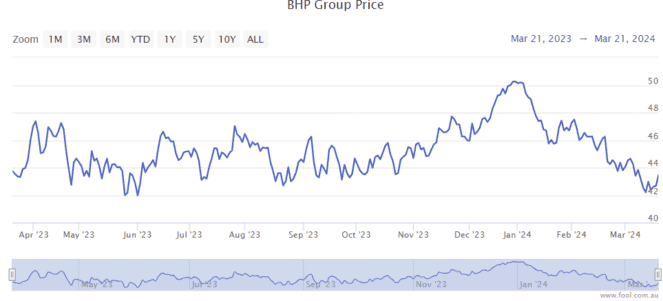
    BHP Group Ltd (ASX: BHP) shares have drifted lower this year, as we can see on the chart below.

    But what’s the outlook for the profit potential of the business?

    Commodity prices can have a big impact on the profitability of a mining company. We don’t know what resource prices are going to do next week, next month, or next year, so we can look at forecasts as a best guess. But, keep in mind that estimates can change.

    FY24

    We’re more than halfway through the 2024 financial year, and we recently saw the HY24 result.

    However, the 2024 full-year profit is still to be determined.

    The broker UBS’ latest estimate suggested that BHP could generate a net profit after tax (NPAT) of US$13.5 billion in FY24, earnings per share (EPS) of US2.66, and pay an annual dividend per share of US$1.47.

    UBS said it’s seeing a risk of the iron ore and Escondida falling short of production guidance in FY24, with a meaningful lift needed in the second half to meet the mid-point of the guidance.

    If the iron ore price stays at around US$100 per tonne then the business won’t be as profitable as it could have been, if the iron ore price had remained above US$120 per tonne.

    FY25

    In FY25, the company is expected by UBS to generate a net profit of US$13.9 billion, which would be a slight increase compared to FY24. The projected EPS could come to US$2.74 in FY25, an increase of 3%.

    UBS is also currently expecting a larger dividend per share of US$1.64 from the business, which would be a rise of 11.6%.

    FY26

    BHP is expected to see a profit decline in FY26 compared to FY25 (and FY24), with potential profit generation of US$12.1 billion. If that happened, the EPS could fall to US$2.38.

    UBS has pencilled a dividend per share of US$1.43 in FY26, which would be lower than both FY25 and FY24.

    Is this the right time to buy BHP shares?

    With a cyclical business like this ASX mining share, I think the right time to buy is when there’s a weakness with the commodity.

    The iron ore price (and nickel price) has plunged from above US$140 per tonne, so I think it’s much more appealing to buy BHP shares during this weaker period.

    It’s not as cheap as it could be, but I’m a bit more confident at this lower price. However, it should be said that miners aren’t likely to be consistent ASX dividend shares.

    The post Here is the profit forecast to 2026 for BHP shares appeared first on The Motley Fool Australia.

    Wondering where you should invest $1,000 right now?

    When investing expert Scott Phillips has a stock tip, it can pay to listen. After all, the flagship Motley Fool Share Advisor newsletter he has run for over ten years has provided thousands of paying members with stock picks that have doubled, tripled or even more.*

    Scott just revealed what he believes could be the ‘five best ASX stocks’ for investors to buy right now. We believe these stocks are trading at attractive prices and Scott thinks they could be great buys right now…

    See The 5 Stocks
    *Returns as of 1 February 2024

    (function() {
    function setButtonColorDefaults(param, property, defaultValue) {
    if( !param || !param.includes(‘#’)) {
    var button = document.getElementsByClassName(“pitch-snippet”)[0].getElementsByClassName(“pitch-button”)[0];
    button.style[property] = defaultValue;
    }
    }

    setButtonColorDefaults(“#0095C8”, ‘background’, ‘#5FA85D’);
    setButtonColorDefaults(“#0095C8”, ‘border-color’, ‘#43A24A’);
    setButtonColorDefaults(“#fff”, ‘color’, ‘#fff’);
    })()

    More reading

    Motley Fool contributor Tristan Harrison has no position in any of the stocks mentioned. The Motley Fool Australia’s parent company Motley Fool Holdings Inc. has no position in any of the stocks mentioned. The Motley Fool Australia has no position in any of the stocks mentioned. The Motley Fool has a disclosure policy. This article contains general investment advice only (under AFSL 400691). Authorised by Scott Phillips.

    from The Motley Fool Australia https://ift.tt/5NQegoj

  • How I’d generate a $20,000 second income from CBA shares

    A woman in a bright yellow jumper looks happily at her yellow piggy bank representing bank dividends and in particular the CBA dividend

    A woman in a bright yellow jumper looks happily at her yellow piggy bank representing bank dividends and in particular the CBA dividend

    Last month, Commonwealth Bank of Australia (ASX: CBA) released its half year results.

    For the six months ended 31 December, CBA posted a 0.2% increase in operating income to $13,649 million and a 3% decline in cash net profit after tax to $5,019 million.

    Nevertheless, this didn’t stop the CBA board from increasing its fully franked interim dividend by 2.4% to $2.15 per share.

    All the above was ahead of the market’s expectations. For example, Goldman Sachs commented:

    CBA’s 1H24 cash earnings (company basis) from continued operations grew by 2.6% hoh to A$5,019 mn, and was -0.8%/+1.6% versus GSe / Visible Alpha consensus expectations (VAe). The quality of the result was good, with PPOP +1.6/+1.3% vs. GSe/VAe, largely on account of expenses. […] The interim ordinary DPS of A215¢ was higher than GSe (A210¢), and implies a 1H24 payout ratio of 72% GSe: 70%).

    The good news is that a larger dividend is expected in the second half of the financial year.

    For example, Morgans is forecasting a fully franked final dividend of $2.40 per share, bringing the total dividends to $4.55 per share.

    Based on where CBA shares ended last week, this will mean a fully franked 3.9% yield for investors.

    How to generate a $20,000 second income from CBA shares

    If Morgans is on the money with its dividend forecast, investors looking for a $20,000 second income would need to own approximately 4,396 CBA shares.

    Unfortunately, though, with CBA shares currently changing hands for $117.48, this would come at a significant cost.

    An investment of $516,442.08 into the bank’s shares would be required to generate our target of $20,000 of income.

    The long way

    Most Australians don’t have half a million dollars available to sink into the share market.

    But don’t let that stop you from making it a longer term goal. After all, history shows investors can grow a portfolio to be worth $500,000 thanks to a combination of time, capital, and compounding.

    The share market has generated a return of 10% per annum historically. And while there’s no guarantee that this will remain the case in the future, I think it is fair to base our calculations on this level of return.

    With that in mind, making consistent investments into a balanced portfolio of high quality ASX shares could get you to $500,000 sooner than you might think.

    For example, by investing $10,000 per year into a portfolio of high-quality ASX shares, you would grow your portfolio to the target amount after 18 years if you matched the market return.

    And if you can contribute more, you can cut down the time that it takes.

    All else equal, investing $12,000 per annum into ASX shares would get you to $500,000 in just 16 years and $18,000 per annum would get you there in just over 13 years.

    Once it gets to that point, you could then switch your focus to income and build a portfolio yielding 4% to receive a $20,000 second income without lifting a finger.

    The key is to have a plan, stick to it, and let compounding do its thing.

    The post How I’d generate a $20,000 second income from CBA shares appeared first on The Motley Fool Australia.

    Wondering where you should invest $1,000 right now?

    When investing expert Scott Phillips has a stock tip, it can pay to listen. After all, the flagship Motley Fool Share Advisor newsletter he has run for over ten years has provided thousands of paying members with stock picks that have doubled, tripled or even more.*

    Scott just revealed what he believes could be the ‘five best ASX stocks’ for investors to buy right now. We believe these stocks are trading at attractive prices and Scott thinks they could be great buys right now…

    See The 5 Stocks
    *Returns as of 1 February 2024

    (function() {
    function setButtonColorDefaults(param, property, defaultValue) {
    if( !param || !param.includes(‘#’)) {
    var button = document.getElementsByClassName(“pitch-snippet”)[0].getElementsByClassName(“pitch-button”)[0];
    button.style[property] = defaultValue;
    }
    }

    setButtonColorDefaults(“#0095C8”, ‘background’, ‘#5FA85D’);
    setButtonColorDefaults(“#0095C8”, ‘border-color’, ‘#43A24A’);
    setButtonColorDefaults(“#fff”, ‘color’, ‘#fff’);
    })()

    More reading

    Motley Fool contributor James Mickleboro has no position in any of the stocks mentioned. The Motley Fool Australia’s parent company Motley Fool Holdings Inc. has positions in and has recommended Goldman Sachs Group. The Motley Fool Australia has no position in any of the stocks mentioned. The Motley Fool has a disclosure policy. This article contains general investment advice only (under AFSL 400691). Authorised by Scott Phillips.

    from The Motley Fool Australia https://ift.tt/sKGzNrV

  • Invest $15,000 in Accent stock and get $5,500 in passive income

    footwear asx share price on watch represented by look holding shoe and looking intentlyfootwear asx share price on watch represented by look holding shoe and looking intently

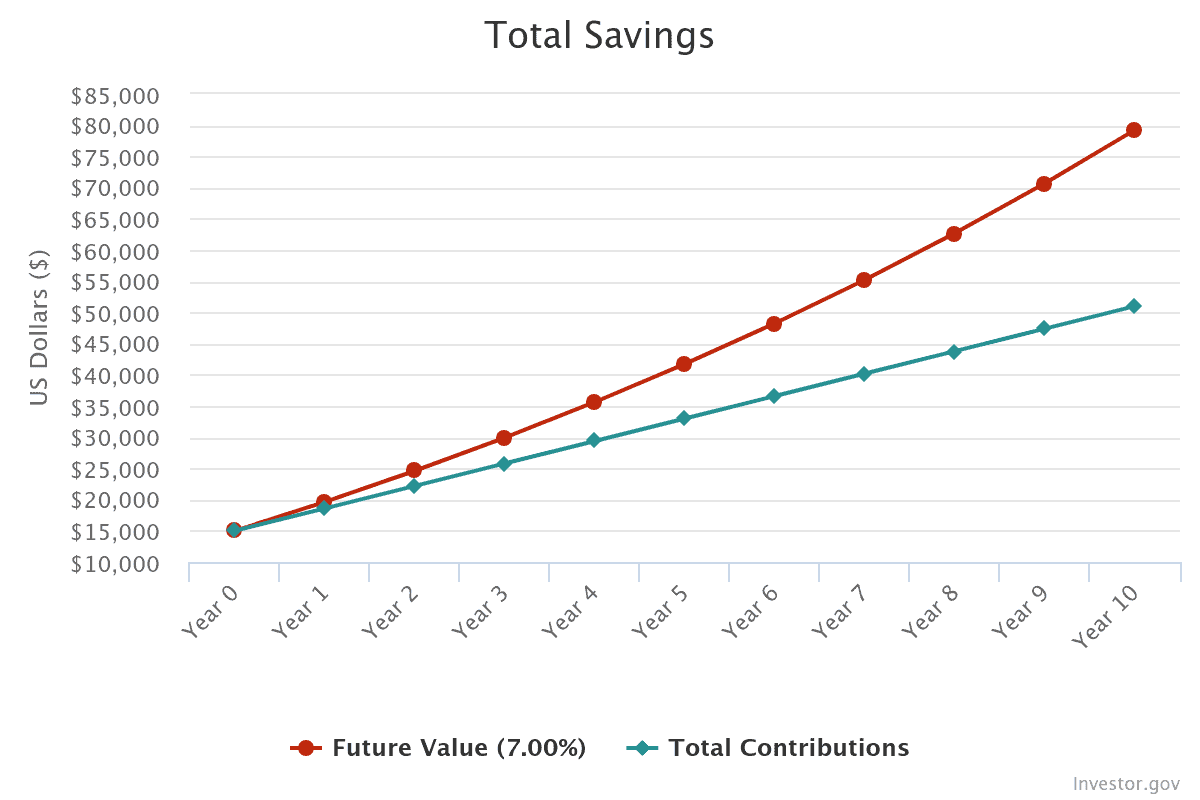
    Many Australians don’t realise that the power of compounding means that with just $15,000 worth of ASX shares it’s possible to generate thousands of dollars of passive income.

    Let’s take a look at how this can be achieved, using the popular dividend stock Accent Group Ltd (ASX: AX1).

    An excellent dividend payer

    Accent Group shares currently pay out a dividend yield of around 7% at the moment, which is fully franked.

    Imagine that you bought $15,000 worth of the stock.

    While past performance is never an indicator of the future, we’ll use history to demonstrate hypothetically what could happen.

    Assume there will be no capital gain and that a 7% yield will be the only source of returns.

    That is a conservative estimate as the footwear and fashion retailer has shown a decent capability to increase its share price over the long run. 

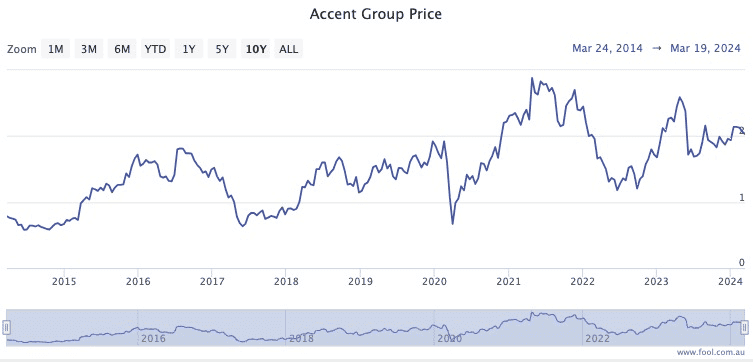
    For example, the Accent stock price has risen 146% over the past decade.

    Anyway, if that $15,000 grows at 7% while you’re able to save and add $300 to it each month, you’re on your way.

    After 10 years with Accent stock

    After 10 years of that investment regime, your Accent shares will be worth $79,246.

    From the 11th year, stop investing the dividend and try pocketing it.

    That’s an average passive income of $5,547 each year!

    That’s an overseas holiday each year paid for without lifting a finger.

    Now, in real life you would want to diversify your portfolio and not just put it all on Accent Group.

    That way, if anything goes horribly wrong for the retailer, you could be saved by other investments that have done a lot better.

    Also, realistically, the Accent Group share price could rise over the long run, providing annual returns higher than 7%.

    In that case, you could reach $5,500 of passive income much faster.

    That’s a lot of numbers to think about, I know. But if it means you start investing and make your money work for you, it’s worth thinking about.

    The post Invest $15,000 in Accent stock and get $5,500 in passive income appeared first on The Motley Fool Australia.

    Wondering where you should invest $1,000 right now?

    When investing expert Scott Phillips has a stock tip, it can pay to listen. After all, the flagship Motley Fool Share Advisor newsletter he has run for over ten years has provided thousands of paying members with stock picks that have doubled, tripled or even more.*

    Scott just revealed what he believes could be the ‘five best ASX stocks’ for investors to buy right now. We believe these stocks are trading at attractive prices and Scott thinks they could be great buys right now…

    See The 5 Stocks
    *Returns as of 1 February 2024

    (function() {
    function setButtonColorDefaults(param, property, defaultValue) {
    if( !param || !param.includes(‘#’)) {
    var button = document.getElementsByClassName(“pitch-snippet”)[0].getElementsByClassName(“pitch-button”)[0];
    button.style[property] = defaultValue;
    }
    }

    setButtonColorDefaults(“#0095C8”, ‘background’, ‘#5FA85D’);
    setButtonColorDefaults(“#0095C8”, ‘border-color’, ‘#43A24A’);
    setButtonColorDefaults(“#fff”, ‘color’, ‘#fff’);
    })()

    More reading

    Motley Fool contributor Tony Yoo has no position in any of the stocks mentioned. The Motley Fool Australia’s parent company Motley Fool Holdings Inc. has no position in any of the stocks mentioned. The Motley Fool Australia has recommended Accent Group. The Motley Fool has a disclosure policy. This article contains general investment advice only (under AFSL 400691). Authorised by Scott Phillips.

    from The Motley Fool Australia https://ift.tt/nRc84w5

  • Top ASX shares to buy instead of a term deposit in March 2024

    A couple are happy sitting on their yacht.A couple are happy sitting on their yacht.

    Risk-averse investors tend to favour term deposits for their perceived certainty. But, as we covered this week, the ‘safe’ returns delivered by term deposits can be eroded when inflation is running hot.

    It’s true that market volatility may not impact savings accounts and term deposits to the same degree as ASX shares. But, considering the S&P/ASX 200 Index (ASX: XJO)’s ability to deliver a net average annual return of 11.23% (over 10 years, including dividends), how much profit are you prepared to sacrifice for a smooth sail?

    The Aussie share market is home to many high-quality, well-established companies with proven track records for delivering growth. And while past performance is no guarantee of future outcomes, creating a diversified portfolio of ASX blue-chip stocks can go a long way to reducing your risk exposure.

    On that note, we asked our Foolish writers which ASX shares they think offer the best alternative investment to a term deposit right now.

    Here is what they told us:

    6 ASX stock tips for faint-hearted investors in March 2024

    • Rural Funds Group (ASX: RFF), $810.01 billion
    • Growthpoint Properties Australia Ltd (ASX: GOZ), $1.85 billion
    • New Hope Corporation Ltd (ASX: NHC), $3.72 billion
    • Metcash Ltd (ASX: MTS), $4.24 billion
    • Woolworths Group Ltd (ASX: WOW), $39.48 billion
    • Telstra Group Ltd (ASX: TLS), $43.44 billion

    (Market capitalisations as of market close 22 March 2024).

    Why our Foolish writers think you should buy these ASX shares instead of investing cash in the bank

    Rural Funds Group

    What it does: Rural Funds is a real estate investment trust (REIT) that owns different types of farms, including cattle, almonds, macadamias, and vineyards. 

    By Tristan Harrison: The farms owned by Rural Funds Group are spread across different states and climactic conditions, creating diversification for its portfolio. Furthermore, most of the REIT’s tenants are large entities, with some being listed on the ASX or on international bourses. 

    Rural Funds is currently paying an annualised distribution of 11.73 cents per unit, which translates into a distribution yield of 5.61% on current pricing.

    Attractively, rental income continues to grow through rent increases built into the company’s contracts. Rural Funds also invests in its farms to improve productivity, which in turn increases rental (and capital) value. 

    For all these reasons and more, I think the ASX 300 stock offers far better long-term investment prospects than a term deposit.

    Motley Fool contributor Tristan Harrison owns shares of Rural Funds Group.

    Growthpoint Properties Australia Ltd

    What it does: Growthpoint Properties is a real estate investment trust (REIT) that invests in industrial and office assets. 

    By Tony Yoo: With a stunning dividend yield of 8.27%, this stock flogs any term deposit for income returned each year.

    Admittedly the share price has dropped 17.45% over the past 12 months, but with interest rate relief possibly not too far away, optimism abounds about the property sector.

    Indeed, broking platform CMC Invest shows five out of seven analysts rating Growthpoint Properties as a strong buy right now.

    Last month’s business update showed the net tangible assets standing at $3.75 per share, which means the current stock price is trading at about a 34% discount.

    Motley Fool contributor Tony Yoo does not own shares of Growthpoint Properties Australia Ltd.

    New Hope Corporation Ltd

    What it does: New Hope is a leading Australian coal miner. The company currently operates two open-cut coal mines: New Acland in Queensland and Bengalla in New South Wales.

    By Bernd Struben: With coal prices coming down from their record highs, so too have New Hope’s dividend payments. But with shares in the ASX 200 miner also down 14.73% in 2024, I believe the stock represents good value. And it still offers term-deposit-busting yields.

    New Hope’s reduced interim dividend came out at 17 cents per share. Atop the 30 cents per share final dividend, the stock currently trades on a fully franked trailing yield of 15.91%.

    The miner remains well funded, with available cash of $480 million as at 31 January.

    And I believe coal prices will surprise to the upside in the half-year ahead. That’s based on my expectations of a soft landing for the global economy and a stronger-than-expected rebound from China’s industrial sector.

    Motley Fool contributor Bernd Struben does not own shares of New Hope Corporation Ltd.

    Metcash Ltd

    What it does: Metcash is the little-talked-about rival to the big dogs within the food, liquor, and hardware retailing space. Except, at 5,412 storefronts strong, Metcash is no small fry. You’ll know the company through brands such as IGA, Bottle-O, Cellarbrations, Mitre 10, Home Timber & Hardware, and Total Tools.

    By Mitchell Lawler: If I stashed my cash in something other than inflation-crippled savings, my go-to would be a company operating in a stable, needs-based industry – and hey, bingo! Food, beverages, and building goods are about as primitive and needs-driven as it gets. 

    I’d opt for Metcash over Woolworths or Coles Group Ltd (ASX: COL) as calls to break up the bigger players grow louder. A bill proposing stronger government powers to take a scalpel to corporations through divestiture powers will hit the Senate floor soon. 

    A smaller opponent like Metcash could benefit from such a move. Plus, Metcash’s 5.67% dividend yield puts a term deposit rate to shame. 

    Motley Fool contributor Mitchell Lawler does not own shares of Metcash Ltd.

    Woolworths Group Ltd

    What it does: Woolworths is the retail giant responsible for 1,400 stores across its Woolworths Supermarkets (Australia), Countdown Supermarkets (New Zealand), and BIG W brands.

    By James Mickleboro: With the supermarket giant’s shares dropping to a 52-week low last week, I think now is a great time for investors to invest. Particularly given that concerns over inquiries into price gouging and anti-competitive behaviour claims have driven this weakness.

    Goldman Sachs believes the selling has been an overreaction, noting that similar inquiries over a decade ago had no real impacts on the retailer’s earnings. In light of this, the broker continues to forecast solid earnings and dividend growth out to at least FY 2026.

    With respect to the latter, Goldman expects fully franked dividends per share of $1.09 in FY 2024, $1.17 in FY 2025, and $1.27 in FY 2026. And with Goldman having a conviction buy rating and a $40.40 price target on Woolworths shares, some big gains could be on the cards for investors.

    Motley Fool contributor James Mickleboro does not own shares of Woolworths Group Ltd.

    Telstra Group Ltd

    What it does: Telstra is the market-leading telco in Australia. It has the largest share of the mobile network, as well as fixed-line internet services.

    By Sebastian Bowen: I think Telstra is one of the most attractive income investments out of the entire ASX 20 right now. For one, this company has a highly defensive earnings base, with customers unlikely to stop paying for Telstra services, regardless of the economic weather. 

    After a few years of dividend stagnation, Telstra has been raising its payouts over the past two years. However, the telco’s share price has been subdued over the past few months. This has resulted in a fully franked dividend yield of more than 4.52% at recent pricing.

    I’d rather have that over a term deposit any day.

    Motley Fool contributor Sebastian Bowen owns shares of Telstra Group Ltd.

    The post Top ASX shares to buy instead of a term deposit in March 2024 appeared first on The Motley Fool Australia.

    Wondering where you should invest $1,000 right now?

    When investing expert Scott Phillips has a stock tip, it can pay to listen. After all, the flagship Motley Fool Share Advisor newsletter he has run for over ten years has provided thousands of paying members with stock picks that have doubled, tripled or even more.*

    Scott just revealed what he believes could be the ‘five best ASX stocks’ for investors to buy right now. We believe these stocks are trading at attractive prices and Scott thinks they could be great buys right now…

    See The 5 Stocks
    *Returns as of 1 February 2024

    (function() {
    function setButtonColorDefaults(param, property, defaultValue) {
    if( !param || !param.includes(‘#’)) {
    var button = document.getElementsByClassName(“pitch-snippet”)[0].getElementsByClassName(“pitch-button”)[0];
    button.style[property] = defaultValue;
    }
    }

    setButtonColorDefaults(“#0095C8”, ‘background’, ‘#5FA85D’);
    setButtonColorDefaults(“#0095C8”, ‘border-color’, ‘#43A24A’);
    setButtonColorDefaults(“#fff”, ‘color’, ‘#fff’);
    })()

    More reading

    The Motley Fool Australia’s parent company Motley Fool Holdings Inc. has positions in and has recommended Goldman Sachs Group. The Motley Fool Australia has positions in and has recommended Coles Group, Rural Funds Group, and Telstra Group. The Motley Fool Australia has recommended Metcash. The Motley Fool has a disclosure policy. This article contains general investment advice only (under AFSL 400691). Authorised by Scott Phillips.

    from The Motley Fool Australia https://ift.tt/aJbr06G

  • Do Block shares come with a dividend in 2024?

    A mature aged man with grey hair and glasses holds a fan of Australian hundred dollar bills up against his mouth and looks skywards with his eyes as though he is thinking what he might do with the cash.

    A mature aged man with grey hair and glasses holds a fan of Australian hundred dollar bills up against his mouth and looks skywards with his eyes as though he is thinking what he might do with the cash.

    In early 2022, Block Inc (ASX: SQ2) shares made one of the most dramatic ASX debuts in recent memory.

    The ASX regularly hosts its fair share of new listings and initial public offerings (IPOs). But before Block joined the ASX boards, the ASX had never welcomed what was then a US$64.77 billion ($99.22 billion at today’s currency rates) company onto the stock exchange.

    The dual nature of Block’s stock means that we don’t exactly have all of Block’s size available for trading on the ASX. Even so, the company’s ASX listing instantly put Block within the top 100 largest ASX shares by market capitalisation.

    But unlike the vast majority of large-cap ASX stocks, Block has never paid its investors a dividend – not in the United States or on the ASX. Even if you got given Block shares in exchange for your old Afterpay stock in early 2022, you have yet to see a dime of dividend income out of this company. Not in 2022, 2023 or 2024 to date.

    But could 2024 be the year this rather barren track record changes? Could Block pay investors income this year?

    Is Block going to become a divided stock in 2024?

    Right off the bat, let’s get something straight. On the ASX, it is unusual for any profitable company to refrain from paying dividends. Our unique system of franking encourages companies to fork out dividends far more than in other countries.

    Thanks to decades of this system, ASX investors have arguably come to expect dividends from their ASX shares.

    But over in the United States, it is a different story. There are plenty of dividend payers of course. But in the world of US tech stocks, paying a dividend is almost unfashionable.

    Tech giants like PayPal, Netflix, Amazon and Alphabet have never paid out a single dividend, despite their gargantuan cash piles and, in the latter two’s case, trillion-dollar market caps.

    It was only last month that Facebook-owner Meta Platforms announced its first-ever dividend. And that hasn’t even been paid out yet.

    But what about Block shares?

    Well, a look at the company’s financials should paint us a picture of this company’s income potential.

    Last month, Block revealed its latest earnings, covering the fourth quarter of 2023. The company revealed quarterly net revenue of US$5.77 billion, up 24% year on year.

    Adjusted earnings before interest, taxes, depreciation and amortisation (EBITDA) came in at $562 million, up 100% year on year. This helped the company to report a gross profit of US$2.03 billion, up 22% from the same quarter in 2022. Block revealed that its full-year profit for 2023 was US$7.5 billion, up 15% from 2022.

    However, Block also revealed an operating loss of US$131 million for the quarter.

    Of course, we can’t know if or when Block will pay a dividend until the moment we hear it from the company’s proverbial mouth.

    But I don’t think it’s likely. Block’s finances do seem to be in rude shape, especially compared to prior years. But a company that reports an operating loss is probably not going to be in a position to fund a dividend.

    For example, Meta has had billions of dollars on its balance sheet in surplus cash flow for years, and only just decided to start forking some of it out as dividends.

    As such, I think Block is more likely to keep any surplus cash within the business for now. Block’s ASX shareholders might be waiting a long time if they are hoping for a dividend.

    The post Do Block shares come with a dividend in 2024? appeared first on The Motley Fool Australia.

    Wondering where you should invest $1,000 right now?

    When investing expert Scott Phillips has a stock tip, it can pay to listen. After all, the flagship Motley Fool Share Advisor newsletter he has run for over ten years has provided thousands of paying members with stock picks that have doubled, tripled or even more.*

    Scott just revealed what he believes could be the ‘five best ASX stocks’ for investors to buy right now. We believe these stocks are trading at attractive prices and Scott thinks they could be great buys right now…

    See The 5 Stocks
    *Returns as of 1 February 2024

    (function() {
    function setButtonColorDefaults(param, property, defaultValue) {
    if( !param || !param.includes(‘#’)) {
    var button = document.getElementsByClassName(“pitch-snippet”)[0].getElementsByClassName(“pitch-button”)[0];
    button.style[property] = defaultValue;
    }
    }

    setButtonColorDefaults(“#0095C8”, ‘background’, ‘#5FA85D’);
    setButtonColorDefaults(“#0095C8”, ‘border-color’, ‘#43A24A’);
    setButtonColorDefaults(“#fff”, ‘color’, ‘#fff’);
    })()

    More reading

    John Mackey, former CEO of Whole Foods Market, an Amazon subsidiary, is a member of The Motley Fool’s board of directors. Randi Zuckerberg, a former director of market development and spokeswoman for Facebook and sister to Meta Platforms CEO Mark Zuckerberg, is a member of The Motley Fool’s board of directors. Suzanne Frey, an executive at Alphabet, is a member of The Motley Fool’s board of directors. Motley Fool contributor Sebastian Bowen has positions in Alphabet, Amazon, Netflix, PayPal and Meta Platforms. The Motley Fool Australia’s parent company Motley Fool Holdings Inc. has positions in and has recommended Alphabet, Amazon, Block, Meta Platforms, Netflix, and PayPal. The Motley Fool Australia’s parent company Motley Fool Holdings Inc. has recommended the following options: short March 2024 $67.50 calls on PayPal. The Motley Fool Australia has positions in and has recommended Block. The Motley Fool Australia has recommended Alphabet, Amazon, Meta Platforms, Netflix, and PayPal. The Motley Fool has a disclosure policy. This article contains general investment advice only (under AFSL 400691). Authorised by Scott Phillips.

    from The Motley Fool Australia https://ift.tt/GPOHEYk