• $20,000 invested in these ASX 200 shares 10 years ago is worth how much?

    a man wearing casual clothes fans a selection of Australian banknotes over his chin with an excited, widemouthed expression on his face.

    a man wearing casual clothes fans a selection of Australian banknotes over his chin with an excited, widemouthed expression on his face.

    I’m a big fan of buy and hold investing and believe it is one of the best ways to grow your wealth.

    To demonstrate just how successful this investment strategy can be with ASX 200 shares, I like to see how much a single $20,000 investment in certain ASX 200 shares 10 years ago would be worth today.

    Let’s see how investments in these shares have fared during this time:

    Breville Group Ltd (ASX: BRG)

    The first ASX 200 share that we’re going to look at is Breville. It is one of the world’s leading appliance manufacturers.

    Thanks to its investment in research and development, global expansion, and acquisitions, Breville has delivered strong sales and earnings growth over the last decade. This has unsurprisingly led to market-beating returns for its shares over the same period.

    Over the last 10 years, Breville’s shares have achieved an average total return of 12.95% per annum. This would have turned a $20,000 investment into almost $68,000 today.

    Goodman Group (ASX: GMG)

    Goodman is another ASX 200 share that has made its shareholders smile.

    Thanks to its strategy of investing in and developing high quality industrial properties in strategic locations close to large urban populations and in and around major gateway cities globally, Goodman has delivered consistently strong earnings growth.

    This has led to Goodman’s shares generating a total average return of 22% per annum since 2014. This would have turned a $20,000 investment into ~$146,000.

    NextDC Ltd (ASX: NXT)

    Finally, a third market-beater has been data centre operator NextDC.

    Due to strong demand for capacity in its world-class centres thanks to the structural shift to the cloud, its revenue and operating earnings have been growing at a rapid rate.

    This has helped underpin some very strong returns since 2014. For example, over the last decade, its shares have generated an average return of 24% per annum. This means that a $20,000 investment in NextDC shares would have grown to be worth ~$170,000 today.

    The post $20,000 invested in these ASX 200 shares 10 years ago is worth how much? appeared first on The Motley Fool Australia.

    Wondering where you should invest $1,000 right now?

    When investing expert Scott Phillips has a stock tip, it can pay to listen. After all, the flagship Motley Fool Share Advisor newsletter he has run for over ten years has provided thousands of paying members with stock picks that have doubled, tripled or even more.*

    Scott just revealed what he believes could be the ‘five best ASX stocks’ for investors to buy right now. We believe these stocks are trading at attractive prices and Scott thinks they could be great buys right now…

    See The 5 Stocks
    *Returns as of 1 February 2024

    (function() {
    function setButtonColorDefaults(param, property, defaultValue) {
    if( !param || !param.includes(‘#’)) {
    var button = document.getElementsByClassName(“pitch-snippet”)[0].getElementsByClassName(“pitch-button”)[0];
    button.style[property] = defaultValue;
    }
    }

    setButtonColorDefaults(“#0095C8”, ‘background’, ‘#5FA85D’);
    setButtonColorDefaults(“#0095C8”, ‘border-color’, ‘#43A24A’);
    setButtonColorDefaults(“#fff”, ‘color’, ‘#fff’);
    })()

    More reading

    Motley Fool contributor James Mickleboro has positions in Nextdc. The Motley Fool Australia’s parent company Motley Fool Holdings Inc. has positions in and has recommended Goodman Group. The Motley Fool Australia has recommended Goodman Group. The Motley Fool has a disclosure policy. This article contains general investment advice only (under AFSL 400691). Authorised by Scott Phillips.

    from The Motley Fool Australia https://ift.tt/rLRPnfz

  • How about buying these ASX dividend shares?

    Hand holding Australian dollar (AUD) bills, symbolising ex dividend day. Passive income.

    Hand holding Australian dollar (AUD) bills, symbolising ex dividend day. Passive income.

    Do you have room in your income portfolio for some new ASX dividend shares? If you do, then it could be worth checking out the buy-rated shares listed below.

    Both have been named as buys and tipped to provide investors with above-average dividend yields in the near term. Here’s what you can expect from them:

    ANZ Group Holdings Ltd (ASX: ANZ)

    A recent note out of Ord Minnett reveals that that its analysts are positive on this banking giant and see it as an ASX dividend share to buy right now.

    The broker was pleased to see that its proposed acquisition of Suncorp Bank is getting closer to completion. Its analysts expect the addition of the business to add scale to areas where the ANZ currently trails the rest of the big four banks.

    As for that all-important income, Ord Minnett is forecasting fully franked dividends per share of $1.62 in FY 2024 and then $1.65 per share in FY 2025. Based on the current ANZ share price of $28.69, this will mean dividend yields of 5.65% and 5.75%, respectively.

    The broker currently has a buy rating and $31.00 price target on ANZ’s shares.

    Super Retail Group Ltd (ASX: SUL)

    Over at Goldman Sachs, its analysts are feeling bullish about this retail conglomerate and believe it could be another ASX dividend shares to buy.

    As a reminder, Super Retail is the name behind the BCF, Macpac, Rebel, and Super Cheap Auto brands.

    Goldman was pleased with its half year results, noting that it “was high quality and the strategic growth plan is intact.” This is important given that the latter is “core to [the broker’s] Buy thesis.”

    In respect to dividends, the broker is forecasting fully franked dividends per share of 67 cents in FY 2024 and then 73 cents in FY 2025. Based on the latest Super Retail share price of $15.05, this will mean good yields of 4.5% and 4.9%, respectively.

    Goldman Sachs has a buy rating and $17.80 price target on its shares.

    The post How about buying these ASX dividend shares? appeared first on The Motley Fool Australia.

    Wondering where you should invest $1,000 right now?

    When investing expert Scott Phillips has a stock tip, it can pay to listen. After all, the flagship Motley Fool Share Advisor newsletter he has run for over ten years has provided thousands of paying members with stock picks that have doubled, tripled or even more.*

    Scott just revealed what he believes could be the ‘five best ASX stocks’ for investors to buy right now. We believe these stocks are trading at attractive prices and Scott thinks they could be great buys right now…

    See The 5 Stocks
    *Returns as of 1 February 2024

    (function() {
    function setButtonColorDefaults(param, property, defaultValue) {
    if( !param || !param.includes(‘#’)) {
    var button = document.getElementsByClassName(“pitch-snippet”)[0].getElementsByClassName(“pitch-button”)[0];
    button.style[property] = defaultValue;
    }
    }

    setButtonColorDefaults(“#0095C8”, ‘background’, ‘#5FA85D’);
    setButtonColorDefaults(“#0095C8”, ‘border-color’, ‘#43A24A’);
    setButtonColorDefaults(“#fff”, ‘color’, ‘#fff’);
    })()

    More reading

    Motley Fool contributor James Mickleboro has no position in any of the stocks mentioned. The Motley Fool Australia’s parent company Motley Fool Holdings Inc. has positions in and has recommended Goldman Sachs Group. The Motley Fool Australia has positions in and has recommended Super Retail Group. The Motley Fool has a disclosure policy. This article contains general investment advice only (under AFSL 400691). Authorised by Scott Phillips.

    from The Motley Fool Australia https://ift.tt/x4r9qvY

  • GLP-1 obesity medicines do the opposite of what ResMed stock investors feared

    A man wearing a white coat and glasses is wide-mouthed in surprise.A man wearing a white coat and glasses is wide-mouthed in surprise.

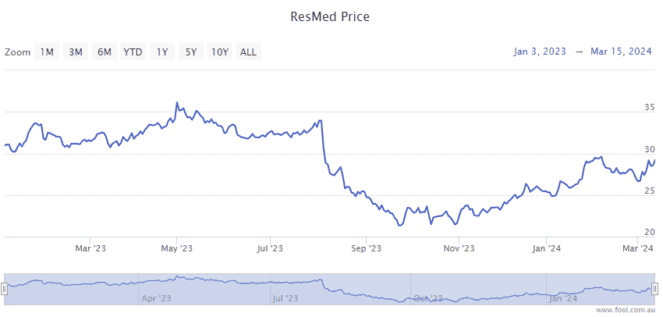
    ResMed Inc (ASX: RMD) stock closed at $29.15 on Friday, up 0.59% for the day.

    The sleep apnoea device maker has had a tumultuous time on the ASX boards over the past nine months.

    As the chart shows below, ResMed stock experienced a significant sell-off in the second half of 2023.

    The ASX 200 healthcare stalwart fell from $33.85 on 3 August to a four-year low of $21.14 on 13 October.

    What caused the ResMed stock tumble?

    The tumble was primarily caused by two things.

    Firstly, a broader sell-off in ASX healthcare stocks, which commenced in June 2023.

    Secondly, investors’ concerns over GLP-1 obesity drugs like Ozempic.

    Their fear was that the highly effective weight loss medicines would lower demand for sleep apnoea devices given obesity is a common precursor to sleep apnoea.

    During the height of this sell-off in October, ResMed CEO Mick Farrell sought to reassure investors.

    He reminded them that the sleep apnoea market was huge and that not all sufferers have obesity.

    He also told shares investors that RedMed was proactively tracking the potential future impact of Ozempic and GLP-1 medicines on the business, and even dared to quantify it.

    Based on internal modelling, Farrell said GLP-1s may reduce the total addressable market (TAM) for sleep apnoea and ResMed’s products from 1.4 billion to 1.2 billion by 2050.

    So, the company reckoned GLP-1s could cost them 200 million people in terms of TAM.

    But at that stage, he said they were not seeing any declining use of ResMed products among patients using both GLP-1s to treat their obesity and ResMed’s devices to treat their sleep apnoea.

    He pointed out that ResMed had 22.5 million customers using its devices at that time, which was a drop in the ocean of a 1.2 billion TAM.

    Farrell said the company would continue to monitor the impact of GLP-1s, and we got another update when the last set of results was released in January.

    And guess what?

    Surprise! GLP-1s increase the use of ResMed devices

    Farrell surprised analysts during their call by revealing that ResMed’s research was revealing a positive impact from GLP-1s.

    The CEO said:

    Our analysis of over 529,000 patients with GLP-1 prescriptions shows that not only is there not a reduction in the propensity to start positive airway pressure therapy, it is the exact opposite.

    For patients who have been prescribed a GLP-1, there is an increase of 10% of the absolute percentage of patients that commence positive airway pressure therapy.

    Farrell said another investor fear had been that patients on both therapies would quit their sleep devices use at a higher rate than the general population over time.

    He said:

    The real world data, again, with a cohort of over 0.5 million patients shows the exact opposite.

    At … 12 months after therapy commencement on PAP, the delta from general PAP population to a PAP plus GLP-1 prescribed population shows an increase in the resupply rate of 300 basis points.

    This delta actually increases over time going further with the delta from the general PAP population receiving resupply at 12 months being 500 basis points higher for a population prescribed both PAP and GLP-1s.

    ResMed stock price recovery

    ResMed stock began an impressive recovery during the Santa Rally that began in November 2023.

    Since 1 November, the ASX 200 healthcare stock has rebounded by 34%.

    The post GLP-1 obesity medicines do the opposite of what ResMed stock investors feared appeared first on The Motley Fool Australia.

    Wondering where you should invest $1,000 right now?

    When investing expert Scott Phillips has a stock tip, it can pay to listen. After all, the flagship Motley Fool Share Advisor newsletter he has run for over ten years has provided thousands of paying members with stock picks that have doubled, tripled or even more.*

    Scott just revealed what he believes could be the ‘five best ASX stocks’ for investors to buy right now. We believe these stocks are trading at attractive prices and Scott thinks they could be great buys right now…

    See The 5 Stocks
    *Returns as of 1 February 2024

    (function() {
    function setButtonColorDefaults(param, property, defaultValue) {
    if( !param || !param.includes(‘#’)) {
    var button = document.getElementsByClassName(“pitch-snippet”)[0].getElementsByClassName(“pitch-button”)[0];
    button.style[property] = defaultValue;
    }
    }

    setButtonColorDefaults(“#0095C8”, ‘background’, ‘#5FA85D’);
    setButtonColorDefaults(“#0095C8”, ‘border-color’, ‘#43A24A’);
    setButtonColorDefaults(“#fff”, ‘color’, ‘#fff’);
    })()

    More reading

    Motley Fool contributor Bronwyn Allen has no position in any of the stocks mentioned. The Motley Fool Australia’s parent company Motley Fool Holdings Inc. has positions in and has recommended ResMed. The Motley Fool Australia has positions in and has recommended ResMed. The Motley Fool has a disclosure policy. This article contains general investment advice only (under AFSL 400691). Authorised by Scott Phillips.

    from The Motley Fool Australia https://ift.tt/x1vXy8i

  • If I invest $10,000 into BHP shares, how much passive income will I receive?

    Miner holding cash which represents dividends.

    Miner holding cash which represents dividends.

    BHP Group Ltd (ASX: BHP) shares have come under pressure this month due to a pullback in the iron ore price.

    So much so, the mining giant’s shares are down almost 17% from the 52-week high they reached at the very end of December.

    While this is disappointing for shareholders, it could be a buying opportunity for the rest of us.

    This is particularly the case for passive income investors given that this weakness has boosted the potential dividend yield on offer with its shares.

    Generating passive income from BHP shares

    As a reminder, BHP released its half-year results last month and reported a 6% increase in revenue to US$27.2 billion and flat underlying earnings of US$6.6 billion.

    This allowed the BHP board to declare a fully franked interim dividend of 72 US cents per share (A$1.10 per share) for the period.

    Unfortunately, the company’s shares have already traded ex-dividend for this payout. As a result, the rights to the dividend are now settled and buying BHP’s shares won’t lead to you receiving it on pay day on 28 March.

    But never fear, there are plenty more dividends to come to earn passive income from. So, what would $10,000 earn investors?

    Firstly, if I were to invest $10,000 (and an additional $8.76) into the Big Australian, I would end up owning 236 shares.

    According to a note out of Citi from last week, its analysts are forecasting a $2.55 per share dividend in FY 2024. This will mean a fully franked final dividend of approximately $1.45 per share.

    From that dividend alone, my 236 shares would produce passive income of $342.20.

    Looking ahead, Citi then expects a 3.5% increase in the BHP dividend to $2.64 per share in FY 2025. If this proves accurate, my 236 shares would generate income of $623.04.

    In total, that’s $965.24 of passive income from my $10,000 investment.

    Don’t forget the gains

    It is also worth noting that Citi upgraded BHP’s shares to a buy rating with a $46.00 price target last week.

    If the BHP share price were to rise to that level, my 236 shares would have a market value of $10,856.

    That means a total return on investment of $1,821.24 could be on the cards between now and the payment of BHP’s final dividend of FY 2025.

    The post If I invest $10,000 into BHP shares, how much passive income will I receive? appeared first on The Motley Fool Australia.

    Wondering where you should invest $1,000 right now?

    When investing expert Scott Phillips has a stock tip, it can pay to listen. After all, the flagship Motley Fool Share Advisor newsletter he has run for over ten years has provided thousands of paying members with stock picks that have doubled, tripled or even more.*

    Scott just revealed what he believes could be the ‘five best ASX stocks’ for investors to buy right now. We believe these stocks are trading at attractive prices and Scott thinks they could be great buys right now…

    See The 5 Stocks
    *Returns as of 1 February 2024

    (function() {
    function setButtonColorDefaults(param, property, defaultValue) {
    if( !param || !param.includes(‘#’)) {
    var button = document.getElementsByClassName(“pitch-snippet”)[0].getElementsByClassName(“pitch-button”)[0];
    button.style[property] = defaultValue;
    }
    }

    setButtonColorDefaults(“#0095C8”, ‘background’, ‘#5FA85D’);
    setButtonColorDefaults(“#0095C8”, ‘border-color’, ‘#43A24A’);
    setButtonColorDefaults(“#fff”, ‘color’, ‘#fff’);
    })()

    More reading

    Citigroup is an advertising partner of The Ascent, a Motley Fool company. Motley Fool contributor James Mickleboro has no position in any of the stocks mentioned. The Motley Fool Australia’s parent company Motley Fool Holdings Inc. has no position in any of the stocks mentioned. The Motley Fool Australia has no position in any of the stocks mentioned. The Motley Fool has a disclosure policy. This article contains general investment advice only (under AFSL 400691). Authorised by Scott Phillips.

    from The Motley Fool Australia https://ift.tt/vlVwUZ9

  • Here’s what Westpac says the RBA will do with interest rates next week

    Animation of a man measuring a percentage sign, symbolising rising interest rates.

    Animation of a man measuring a percentage sign, symbolising rising interest rates.

    Next week will be a big one for homeowners and borrowers. That’s because the Reserve Bank of Australia (RBA) will be meeting for the second time in 2024 to decide on interest rates.

    In case you’re wondering, the central bank traditionally meets on the first Tuesday of the month. However, starting in 2024, the RBA has reduced the number of meetings from 11 to just 8.

    As part of this change, it will now be meeting on the first Tuesday in February, May, August, and November, and then during the second to last week of each quarter (March, June, September, and December).

    So, with a meeting coming on Tuesday and inflation recently showing signs of slowing, could interest rates be heading lower next week?

    Let’s see what the economics team at Westpac Banking Corp (ASX: WBC) are expecting the RBA to do at the meeting.

    Will the RBA cut interest rates next week?

    According to the latest weekly economic report from Westpac, its team are not expecting the RBA to make any changes to interest rates next week.

    In fact, its chief economist, Luci Ellis, believes that rates are staying on hold at 4.35% until September. At that point, Ellis is forecasting a 25 basis points cut to 4.1%. She said:

    Next week, the RBA Board will meet to discuss recent economic data, including the Q4 National Accounts and Wage Price Index, to decide whether it warrants a shift in policy. Our view is that the RBA will be comforted by recent developments, given the Board’s aim to bring demand back into line with supply and ensure inflation continues to trend toward and then into the target range. We continue to expect the RBA to remain on hold until September at which time they should have enough confidence in the inflation outlook to slowly begin easing policy.

    The good news for borrowers is that it may not take long for further easing after that first cut. Ellis is forecasting a series of cuts to take interest rates down to 3.1% by September 2025.

    So, while next week might be disappointing for homeowners, it does appear that relief is on the way.

    The post Here’s what Westpac says the RBA will do with interest rates next week appeared first on The Motley Fool Australia.

    Wondering where you should invest $1,000 right now?

    When investing expert Scott Phillips has a stock tip, it can pay to listen. After all, the flagship Motley Fool Share Advisor newsletter he has run for over ten years has provided thousands of paying members with stock picks that have doubled, tripled or even more.*

    Scott just revealed what he believes could be the ‘five best ASX stocks’ for investors to buy right now. We believe these stocks are trading at attractive prices and Scott thinks they could be great buys right now…

    See The 5 Stocks
    *Returns as of 1 February 2024

    (function() {
    function setButtonColorDefaults(param, property, defaultValue) {
    if( !param || !param.includes(‘#’)) {
    var button = document.getElementsByClassName(“pitch-snippet”)[0].getElementsByClassName(“pitch-button”)[0];
    button.style[property] = defaultValue;
    }
    }

    setButtonColorDefaults(“#0095C8”, ‘background’, ‘#5FA85D’);
    setButtonColorDefaults(“#0095C8”, ‘border-color’, ‘#43A24A’);
    setButtonColorDefaults(“#fff”, ‘color’, ‘#fff’);
    })()

    More reading

    Motley Fool contributor James Mickleboro has positions in Westpac Banking Corporation. The Motley Fool Australia’s parent company Motley Fool Holdings Inc. has no position in any of the stocks mentioned. The Motley Fool Australia has no position in any of the stocks mentioned. The Motley Fool has a disclosure policy. This article contains general investment advice only (under AFSL 400691). Authorised by Scott Phillips.

    from The Motley Fool Australia https://ift.tt/P0NxibZ

  • What’s the average Australian superannuation balance at age 40 in 2024?

    Woman calculating dividends on calculator and working on a laptop.Woman calculating dividends on calculator and working on a laptop.

    Superannuation balances are an important asset for people in retirement. It’s ironic how a lot of people in their 60s, with little time to retirement, are very interested in superannuation, while younger Aussies don’t pay much attention to super despite having loads of time for compounding and making a difference.

    It’s understandable why people start paying attention in their 60s, as that’s when people can start accessing their superannuation after reaching the preservation age.

    We have recently looked at the average superannuation balance, but this time we’re going to focus on the average balance for someone aged 40.

    The 40s can be a time of our highest earning power and lead to making the strongest superannuation contributions, so it’s a great stage to think about superannuation and which assets to invest in.

    What’s the average superannuation balance at age 40?

    Based on the Australian Taxation Office (ATO) Taxation Statistics report for FY21, the average balance for someone aged 40 to 44 was $123,993. The median superannuation balance was $91,590.

    The average balance is influenced by people with large balances, such as high earners and people who have simply contributed a lot to their superannuation fund.

    The median figure describes the ‘middle’ number as though we’ve lined up everybody and asked the person at the midpoint of the line what their superannuation balance is.

    Those numbers include all Aussies, but as you may know, there can be a gap between male and female superannuation balances.

    According to the ATO statistics, the average 40-year-old female superannuation balance was $107,538 and the median balance was $77,644.

    Meanwhile, the average balance for a 40-year-old male was $139,431, while the median balance was $106,771.

    For 50 to 54-year-old Aussies, the median male balance was 167,002, while the median female balance was $112,943.

    What can we learn from these figures?

    The average Australian has built up a decent nest egg, but there’s plenty of work to do to build it up to a large enough balance for a comfortable retirement.

    According to the Association of Superannuation Funds of Australia, the superannuation balance required to achieve a comfortable retirement at age 67 is $690,000 for a couple and $595,000 for a single retiree.

    It could be a good idea to check your superannuation balance currently so you know how much progress you’ve made towards your retirement goal. The last years of compounding will have the biggest effect. For example, a 66-year-old with a $600,000 balance who sees a 10% annual return can reach 67-years-old with a $660,000 balance.

    What are some ways to help boost the nest egg? Two of the main strategies could be to add more into superannuation, and to invest in assets that can produce stronger returns over the long term. For example, ASX shares have beaten the return of more defensive assets over the long term.

    The post What’s the average Australian superannuation balance at age 40 in 2024? appeared first on The Motley Fool Australia.

    Wondering where you should invest $1,000 right now?

    When investing expert Scott Phillips has a stock tip, it can pay to listen. After all, the flagship Motley Fool Share Advisor newsletter he has run for over ten years has provided thousands of paying members with stock picks that have doubled, tripled or even more.*

    Scott just revealed what he believes could be the ‘five best ASX stocks’ for investors to buy right now. We believe these stocks are trading at attractive prices and Scott thinks they could be great buys right now…

    See The 5 Stocks
    *Returns as of 1 February 2024

    (function() {
    function setButtonColorDefaults(param, property, defaultValue) {
    if( !param || !param.includes(‘#’)) {
    var button = document.getElementsByClassName(“pitch-snippet”)[0].getElementsByClassName(“pitch-button”)[0];
    button.style[property] = defaultValue;
    }
    }

    setButtonColorDefaults(“#0095C8”, ‘background’, ‘#5FA85D’);
    setButtonColorDefaults(“#0095C8”, ‘border-color’, ‘#43A24A’);
    setButtonColorDefaults(“#fff”, ‘color’, ‘#fff’);
    })()

    More reading

    Motley Fool contributor Tristan Harrison has no position in any of the stocks mentioned. The Motley Fool Australia’s parent company Motley Fool Holdings Inc. has no position in any of the stocks mentioned. The Motley Fool Australia has no position in any of the stocks mentioned. The Motley Fool has a disclosure policy. This article contains general investment advice only (under AFSL 400691). Authorised by Scott Phillips.

    from The Motley Fool Australia https://ift.tt/kW7ZRbL

  • Stock-split watch: Is Nvidia next?

    This article was originally published on Fool.com. All figures quoted in US dollars unless otherwise stated.

    Plate with coloured wedges being parcelled out like a slice of pie representing a share split

    This article was originally published on Fool.com. All figures quoted in US dollars unless otherwise stated.

    Nvidia (NASDAQ: NVDA) has had an incredible rise since the start of 2023, up around 500%. As a direct result of its huge stock price increase, the cost of one Nvidia share is nearing $1,000. This threshold may seem arbitrary, but it’s actually an important milestone with a special place in the stock market’s mass psychology. Therefore, management teams often consider splitting their stocks around this nice, round number. Furthermore, Nvidia’s management team has a history of enacting stock splits.

    Is Nvidia preparing for another split?

    The conditions are right

    Stock splits can have both real and artificial effects. On the artificial side, you’re essentially cutting the same-sized pizza into smaller slices. Investors with access to brokerages that offer fractional shares can already cut Nvidia’s stock into pieces as small as they want (usually down to one-thousandth of a share).

    However, not every investor (especially those outside the U.S.) has access to this capability. In that sense, Nvidia’s potential stock split becomes a real factor since more investors can purchase the stock without fear of overweighting their portfolio to one company. If you only have $100 to invest this month, a stock changing hands at $1,000 per share feels out of reach (even if fractional shares are available in your favorite stock brokerage).

    But will Nvidia do it? The company’s history of stock splits suggests that another one could be imminent.

    Nvidia has split its stock five times since it went on the market. The latest was in 2021, when it did a 4-for-1 split. The stock traded for around a pre-split price of $744 — cheaper than it is today.

    Before that, Nvidia last split its stock in 2007, when it would have traded at a split-adjusted price of just over $50. Stock splits were far more common back then, so the instances before the 2021 split may be less useful for forecasting purposes in 2024.

    Now that the stock price is above 2021 pre-split levels again, I’d say Nvidia is highly likely to enact a stock split.

    When will Nvidia announce another stock split?

    After Nvidia announced its stock split on May 21, 2021, the stock had a strong run-up until the split took effect on July 20, increasing nearly 40% at its peak.

    NVDA Chart

    NVDA data by YCharts.

    This same time frame would also make sense in 2024, as Nvidia’s annual meeting occurs in June. So if you’re looking for a stock split announcement, stay tuned to Nvidia’s Q1 FY 2025 results, which will be reported sometime in late May.

    Is right now a good time to buy the stock in anticipation of a run-up due to buying frenzies caused by a stock split? I’d say no. The only good reason to buy a stock is if the underlying business is worth owning. In Nvidia’s case, the answer to that question has been a resounding “yes,” as its graphics processing units (GPUs) have been in high demand due to interest in artificial intelligence (AI) computing.

    Nvidia has continuously posted amazing revenue growth figures. Its latest results (Q4 FY 2024, ending Jan. 28) included a revenue rise of 265% to $22.1 billion and a projection for another 234% rise to $24 billion in Q1 FY 2025.)

    That sounds like a great business. If the company continues to post results like that, management will likely enact a stock split. While some price movement may be associated with that announcement, don’t lose sight of the bigger picture: Nvidia has been one of the biggest winners so far in the AI movement.

    This article was originally published on Fool.com. All figures quoted in US dollars unless otherwise stated.

    The post Stock-split watch: Is Nvidia next? appeared first on The Motley Fool Australia.

    Wondering where you should invest $1,000 right now?

    When investing expert Scott Phillips has a stock tip, it can pay to listen. After all, the flagship Motley Fool Share Advisor newsletter he has run for over ten years has provided thousands of paying members with stock picks that have doubled, tripled or even more.*

    Scott just revealed what he believes could be the ‘five best ASX stocks’ for investors to buy right now. We believe these stocks are trading at attractive prices and Scott thinks they could be great buys right now…

    See The 5 Stocks
    *Returns as of 1 February 2024

    (function() {
    function setButtonColorDefaults(param, property, defaultValue) {
    if( !param || !param.includes(‘#’)) {
    var button = document.getElementsByClassName(“pitch-snippet”)[0].getElementsByClassName(“pitch-button”)[0];
    button.style[property] = defaultValue;
    }
    }

    setButtonColorDefaults(“#0095C8”, ‘background’, ‘#5FA85D’);
    setButtonColorDefaults(“#0095C8”, ‘border-color’, ‘#43A24A’);
    setButtonColorDefaults(“#fff”, ‘color’, ‘#fff’);
    })()

    More reading

    Keithen Drury has no position in any of the stocks mentioned. The Motley Fool Australia’s parent company Motley Fool Holdings Inc. has positions in and has recommended Nvidia. The Motley Fool Australia has recommended Nvidia. The Motley Fool has a disclosure policy. This article contains general investment advice only (under AFSL 400691). Authorised by Scott Phillips.

    This article was originally published on Fool.com. All figures quoted in US dollars unless otherwise stated.

    from The Motley Fool Australia https://ift.tt/rI8V1HN

  • 5 secrets of ASX millionaires

    Businesswoman whispering in male colleague's ear as he looks surprisedBusinesswoman whispering in male colleague's ear as he looks surprised

    Although ASX millionaires come from a diverse range of backgrounds and industries, there are some simple habits that many of them have in common.

    And it’s all behaviour that all of us can emulate to improve our finances.

    Let’s check out five of those millionaire secrets:

    1. Actively managing assets

    To grow your wealth you need to actually consciously manage it, rather than just letting it sit idle because it’s all too hard.

    This might sound obvious, but many Australians do not pay attention to their finances.

    This doesn’t necessarily mean going to the time and expense of establishing a family trust or a self-managed superannuation fund.

    It could be as simple as checking what your superannuation balance is and setting it to an appropriate risk-reward setting. For example, if you’re in your 20s, you might want to take it off “cash” and put it into “high growth” mode.

    There is also knowing how much and where you have money saved up in your various bank accounts. That’ll allow you to figure out how much you could set aside for investing and how much to reserve as backup funds.

    2. Manage your tax

    It wouldn’t surprise you that pretty much every millionaire and billionaire would be smart at minimising their tax obligations.

    Again, this doesn’t necessarily mean anything complicated like seeking out overseas tax havens. 

    It could be as simple as having a 30-minute chat with a tax professional. And knowing how much capital gains and losses you have racked up for the financial year. Or contributing to superannuation over other investment channels.

    And with ASX shares specifically, there are great devices like franking credits and the capital gains tax discount that you could take advantage of, depending on your circumstances.

    3. Plan for your retirement

    A recent international survey conducted by DeVere Group showed that 59% of its millionaire clients ranked planning for sufficient retirement funds as a top priority.

    Because of rapidly ageing populations in the developed world, DeVere chief executive Nigel Green warned punters they can’t count on a safety net.

    “In the future, it’s unlikely that governments will be in a position to support older people like they have done for previous generations,” he said.

    “As individuals accumulate wealth, the focus shifts towards preserving and enjoying that wealth during their later years, underscoring a strategic approach to financial longevity.”

    4. Spend less than you earn

    Again, this one seems obvious but we all know plenty of people who immediately burn all the cash they get in their paycheque. Then they spend some more on the credit card.

    Millionaires didn’t get to where they are by doing that.

    They ensured they spend less than they earn so that savings can go towards productive assets, such as ASX shares.

    Yes, plenty of wealthy folk have debt. But that leveraging is often to invest in an asset that could pay back the loan plus more over the long run, such as ASX shares or a private business.

    5. Think long term

    This one’s easier said than done.

    So many people invest in ASX shares with the best intentions, but end up checking their portfolios everyday and micromanaging it to underperformance.

    Successful investors understand the power of compounding over a number of years. And when they buy ASX shares because they think the business will be in better shape in five years, they have the discipline to hold onto the stock for a half-decade.

    Millionaires have long-term financial goals in mind. They want their investments to get from point A to B by the time it’s year Y.

    If you don’t set goals, then you will make inappropriate investment choices.

    The post 5 secrets of ASX millionaires appeared first on The Motley Fool Australia.

    Wondering where you should invest $1,000 right now?

    When investing expert Scott Phillips has a stock tip, it can pay to listen. After all, the flagship Motley Fool Share Advisor newsletter he has run for over ten years has provided thousands of paying members with stock picks that have doubled, tripled or even more.*

    Scott just revealed what he believes could be the ‘five best ASX stocks’ for investors to buy right now. We believe these stocks are trading at attractive prices and Scott thinks they could be great buys right now…

    See The 5 Stocks
    *Returns as of 1 February 2024

    (function() {
    function setButtonColorDefaults(param, property, defaultValue) {
    if( !param || !param.includes(‘#’)) {
    var button = document.getElementsByClassName(“pitch-snippet”)[0].getElementsByClassName(“pitch-button”)[0];
    button.style[property] = defaultValue;
    }
    }

    setButtonColorDefaults(“#0095C8”, ‘background’, ‘#5FA85D’);
    setButtonColorDefaults(“#0095C8”, ‘border-color’, ‘#43A24A’);
    setButtonColorDefaults(“#fff”, ‘color’, ‘#fff’);
    })()

    More reading

    Motley Fool contributor Tony Yoo has no position in any of the stocks mentioned. The Motley Fool Australia’s parent company Motley Fool Holdings Inc. has no position in any of the stocks mentioned. The Motley Fool Australia has no position in any of the stocks mentioned. The Motley Fool has a disclosure policy. This article contains general investment advice only (under AFSL 400691). Authorised by Scott Phillips.

    from The Motley Fool Australia https://ift.tt/KfOv8oF

  • Fund manager rates these 2 undervalued ASX All Ords shares as buys

    An ASX investor relaxes on her couch as the Harvey Norman share price drops due to the shares trading ex-dividend from today.An ASX investor relaxes on her couch as the Harvey Norman share price drops due to the shares trading ex-dividend from today.

    The fund manager Wilson Asset Management (WAM) has named two exciting All Ordinaries Index (ASX: XAO) shares with compelling futures.

    These stocks may not be the largest, but they have been called out as opportunities that could deliver good returns.

    The biggest listed investment company (LIC) that WAM manages is WAM Capital Limited (ASX: WAM), which looks for undervalued growth companies where there’s a catalyst that could send the share price higher.

    These are two stocks that the investment team picked out.

    Nick Scali Limited (ASX: NCK)

    WAM described Nick Scali as one of Australia’s largest furniture retailers.

    The company recently reported its FY24 first-half result which supposedly beat market expectations. Nick Scali achieved a net profit after tax (NPAT) of $43 million for the six-month period, which was above the $40 million to $42 million guidance given in late 2023.

    Nick Scali’s trading update also pleased the investment team. The company reported a 3.6% increase in sales orders in January year over year, which was more than what analysts were expecting from the ASX All Ords share.

    The WAM team said:

    We are pleased to see a solid half-year result from Nick Scali and we are positive on its ability to execute its long-term target of establishment 86 Nick Scali stores and 90 to 100 Plush stores. We also see the potential for earnings accretive acquisitions outside Australia given the company’s strong balance sheet.

    SG Fleet Group Ltd (ASX: SGF)

    This business provides fleet management, vehicle leasing and salary packaging services,

    ASX reporting season saw the company reveal its FY24 first-half result, which “materially beat” analyst estimates.

    In the FY24 first-half result, the ASX All Ords share reported an 8.5% increase in its NPAT year over year. This growth was driven by record delivery volumes and improved supply of new vehicles.

    Why is the WAM investment team positive on the business? They said:

    We remain positive on SG Fleet Group’s ability to maintain its positive momentum over the next 12 months as it finalises the completion of the Leaseplan acquisition made in 2021.            

    The company is trading on an attractive price-to-earnings multiple valuation of 9 times compared to its peer which trades on 15 times, therefore we see the potential for a re-rating of the share price.

    The post Fund manager rates these 2 undervalued ASX All Ords shares as buys appeared first on The Motley Fool Australia.

    Wondering where you should invest $1,000 right now?

    When investing expert Scott Phillips has a stock tip, it can pay to listen. After all, the flagship Motley Fool Share Advisor newsletter he has run for over ten years has provided thousands of paying members with stock picks that have doubled, tripled or even more.*

    Scott just revealed what he believes could be the ‘five best ASX stocks’ for investors to buy right now. We believe these stocks are trading at attractive prices and Scott thinks they could be great buys right now…

    See The 5 Stocks
    *Returns as of 1 February 2024

    (function() {
    function setButtonColorDefaults(param, property, defaultValue) {
    if( !param || !param.includes(‘#’)) {
    var button = document.getElementsByClassName(“pitch-snippet”)[0].getElementsByClassName(“pitch-button”)[0];
    button.style[property] = defaultValue;
    }
    }

    setButtonColorDefaults(“#0095C8”, ‘background’, ‘#5FA85D’);
    setButtonColorDefaults(“#0095C8”, ‘border-color’, ‘#43A24A’);
    setButtonColorDefaults(“#fff”, ‘color’, ‘#fff’);
    })()

    More reading

    Motley Fool contributor Tristan Harrison has no position in any of the stocks mentioned. The Motley Fool Australia’s parent company Motley Fool Holdings Inc. has no position in any of the stocks mentioned. The Motley Fool Australia has recommended Nick Scali. The Motley Fool has a disclosure policy. This article contains general investment advice only (under AFSL 400691). Authorised by Scott Phillips.

    from The Motley Fool Australia https://ift.tt/iF6c7Y8

  • Here are the top 10 ASX 200 shares today

    A woman's hand draws a stylised 'Top Ten' on a projected surface.

    A woman's hand draws a stylised 'Top Ten' on a projected surface.

    It’s been a horror end to the trading week for the S&P/ASX 200 Index (ASX: XJO) this Friday. The ASX 200 fell sharply at market open, dropping as much as 1.6% at one point before recovering slightly.

    By the closing bell, the index had given up 0.56% of its value and now stands at 7,670.3 points as we go into the weekend.

    Today’s horrid end to the trading week follows a correspondingly disappointing night up on the US markets last night (our time).

    The Dow Jones Industrial Average Index (DJX: .DJI) was in a foul mood, dropping 0.35%.

    The Nasdaq Composite Index (NASDAQ: .IXIC) returned a similar result, losing 0.3% of its value.

    But time now to get back to the local markets with a look at how the various ASX sectors ended their respective trading weeks.

    Winners and losers

    As you might expect, there were far more losers than winners for today’s session.

    Starting with the losers, gold shares were the worst place to be this Friday. The All Ordinaries Gold Index (ASX: XGD) had a shocker, tanking by 2.2%.

    Broader mining stocks didn’t fare much better. The S&P/ASX 200 Materials Index (ASX: XMJ) cratered by a nasty 1.91%.

    Consumer discretionary shares also had a day to forget, illustrated by the S&P/ASX 200 Consumer Discretionary Index (ASX: XDJ)’s drop of 1.03%.

    ASX tech stocks were on the nose too. The S&P/ASX 200 Information Technology Index (ASX: XIJ) saw its value cut by 0.86%.

    Industrial shares didn’t escape the pain either. The S&P/ASX 200 Industrials Index (ASX: XNJ) fell by 0.81%.

    The same can be said of healthcare stocks, as evidenced by the S&P/ASX 200 Healthcare Index (ASX: XHJ)’s 0.62% move down.

    Consumer staples shares were no safe haven. The S&P/ASX 200 Consumer Staples Index (ASX: XSJ) ended up retreating by 0.45%.

    Communications stocks weren’t providing any respite either, with the S&P/ASX 200 Communication Services Index (ASX: XTJ) sliding 0.36%.

    The final loser was the financial sector. The S&P/ASX 200 Financials Index (ASX: XFJ) slipped by 0.15% by the close of trade.

    But that’s it for the losers. Onto the winner now, and it was energy shares that led today’s rises. The S&P/ASX 200 Energy Index (ASX: XEJ) bounded up by a happy 2.01% this Friday.

    Utilities stocks also had a day to remember, with the S&P/ASX 200 Utilities Index (ASX: XUJ) vaulting 1.03% higher.

    Finally. real estate investment trusts (REITs) were in demand too. The S&P/ASX 200 A-REIT Index (ASX: XPJ) lept up 0.77%.

    Top 10 ASX 200 shares countdown

    The winner from this Friday’s session came in as energy stock Strike Energy Ltd (ASX: STX). Strike shares bounded 6.12% higher to 26 cents a share, despite no fresh news out of the company.

    It was a great day for most ASX energy stocks though, thanks to rising oil and gas prices.

    Here’s a look at the remaining winners from today’s trading:

    ASX-listed company Share price Price change
    Strike Energy Ltd (ASX: STX) $0.26 6.12%
    Telix Pharmaceuticals Ltd (ASX: TLX) $12.08 4.68%
    Centuria Capital Group (ASX: CNI) $1.79 4.07%
    HomeCo Daily Needs REIT (ASX: HDN) $1.315 3.54%
    Karoon Energy Ltd (ASX: KAR) $1.945 3.18%
    Data#3 Ltd (ASX: DTL) $8.61 2.99%
    Neuren Pharmaceuticals Ltd (ASX: NEU) $20.24 2.74%
    Beach Energy Ltd (ASX: BPT) $1.70 2.72%
    Helia Group Ltd (ASX: HLI) $3.64 2.54%
    Woodside Energy Group Ltd (ASX: WDS) $29.86 2.47%

    Our top 10 shares countdown is a recurring end-of-day summary to let you know which companies were making big moves on the day. Check in at Fool.com.au after the weekday market closes to see which stocks make the countdown.

    The post Here are the top 10 ASX 200 shares today appeared first on The Motley Fool Australia.

    Wondering where you should invest $1,000 right now?

    When investing expert Scott Phillips has a stock tip, it can pay to listen. After all, the flagship Motley Fool Share Advisor newsletter he has run for over ten years has provided thousands of paying members with stock picks that have doubled, tripled or even more.*

    Scott just revealed what he believes could be the ‘five best ASX stocks’ for investors to buy right now. We believe these stocks are trading at attractive prices and Scott thinks they could be great buys right now…

    See The 5 Stocks
    *Returns as of 1 February 2024

    (function() {
    function setButtonColorDefaults(param, property, defaultValue) {
    if( !param || !param.includes(‘#’)) {
    var button = document.getElementsByClassName(“pitch-snippet”)[0].getElementsByClassName(“pitch-button”)[0];
    button.style[property] = defaultValue;
    }
    }

    setButtonColorDefaults(“#0095C8”, ‘background’, ‘#5FA85D’);
    setButtonColorDefaults(“#0095C8”, ‘border-color’, ‘#43A24A’);
    setButtonColorDefaults(“#fff”, ‘color’, ‘#fff’);
    })()

    More reading

    Motley Fool contributor Sebastian Bowen has no position in any of the stocks mentioned. The Motley Fool Australia’s parent company Motley Fool Holdings Inc. has positions in and has recommended Telix Pharmaceuticals. The Motley Fool Australia has recommended HomeCo Daily Needs REIT and Telix Pharmaceuticals. The Motley Fool has a disclosure policy. This article contains general investment advice only (under AFSL 400691). Authorised by Scott Phillips.

    from The Motley Fool Australia https://ift.tt/8jWagyD