• I moved to Germany with plans to stay for 9 months. I’m still here — and married to a German man — 3 years later.

    The writer and her now-husband posing in Germany.
    caption

    • In 2022, I moved to Germany for nine months as part of my Master's program.
    • I fell in love with a German man, and we're still here — and married — over three years later.
    • Although I don't think this country is my forever home, it's great for now.

    When I moved to Germany in September 2022, it was under the assumption that I'd return home to Canada in nine months.

    Germany was the last stop of my Master's program that stretched across two years and three universities. I'd started out in Glasgow, then moved to Barcelona, and finally ended up in the small city of Göttingen, Germany.

    Fate had other plans for me, though. After downloading Bumble one evening, mostly out of boredom, I matched with Leo: a very cute German beekeeper, drummer, and artist. I was intrigued.

    It wasn't long after our first date that Leo and I knew we had something special, and soon, we were spending every single day together.

    There were just a few issues, though — mainly, the minor detail that he was born and raised in Germany, and I was from Canada.

    I didn't plan to stay in Germany, but meeting the love of my life made the choice a no-brainer

    The writer and her husband riding motorcycles in Germany.
    captiontk

    I had always planned to return to Canada at the end of my two-year program. Most of my friends and family were still there, and I had a few ideas of places I wanted to work after I had my Master's.

    I'd also been renting a beautiful, two-story apartment that I had planned to return to. To this day, though, my furniture and boxes of clothes are still in Canada.

    Germany wasn't exactly my dream destination, either. I was there because of the Master's program, but the country had never been high on my travel bucket list, and I spoke virtually no German.

    In my first month of dating Leo, the reality that my time in Germany would come to an end hung over both our heads. Given how serious we became in such a short amount of time, though, that didn't last for long.

    Truth be told, the decision to stay in Germany wasn't that difficult to make. I had met the love of my life. This was a once-in-a-lifetime kind of experience.

    Plus, knowing that we wouldn't necessarily be here forever helped me feel a lot more confident. Leo made it clear he wasn't married to the idea of staying in Germany; he still had a few years of university to finish, but then, he was open to moving elsewhere.

    By June 2023, we were engaged, and we moved in together shortly after that. Later that summer, he met my family when we traveled to Canada together, and our lives became increasingly intertwined.

    There are benefits and downsides to life here

    The writer and her husband sitting by the water, sharing a bottle of champagne.
    captiontk

    Now, it's been nearly three years since we met, and Leo and I live together on a retired farm in a small village outside Göttingen.

    In June, we got legally married, and just this past October, we had a huge celebration in France with all our friends and family.

    My life is wonderful, but Germany has its downsides. I miss the friendliness and more laid-back attitude of Canadians. Society here is highly rule-abiding, which can get tiring.

    When I first moved here, for example, someone angrily scolded me for crossing the street on a red light. I learned later from a friend that jaywalking is frowned upon — especially if done in front of children.

    I've also struggled with the language barrier. Try as I might, my German remains at a beginner level, even after three years. English isn't spoken often in our rural village, and this has led to many moments of isolation for me.

    On the other hand, my cost of living feels lower, and there is a certain charm to rural German life. One thing I've come to love is the mobile bakery that comes through our village twice a week, offering a wide range of baked goods.

    Also, everything closes on Sundays, and although that can be inconvenient, I appreciate the slower-paced lifestyle and emphasis on family that this helps Germany maintain.

    Germany isn't forever, but it's our best option for right now

    The writer and her husband posing with bandanas and sunglasses, with a grassy background.
    captiontk

    Our plan, for now, is to stay in Germany for another two years. We're expecting a baby in January, and we've found Germany's healthcare system to be mostly excellent.

    Staying here will give Leo the chance to finish school, allow us to take advantage of the German healthcare system, and help us save some money in a more affordable setting.

    After many conversations, we've planned to end up living in Canada in some capacity; maybe we'll move there in two years or split our time between both countries.

    My parents are getting older, and I miss living closer to them and my friends. I also desperately miss living in an English-speaking country.

    Even so, the fact that I don't know exactly what my future looks like doesn't scare me.

    My move to Germany has taught me that plans can change in the blink of an eye, and although looking ahead is important, staying flexible and open-minded can lead to all kinds of unexpectedly beautiful experiences.

    It has also taught me that my home is Leo, and whatever we do, we'll do it together. Soon, that will extend to our child, too.

    Read the original article on Business Insider
  • 9 mistakes to avoid making at a work event, according to etiquette experts

    An illustration presenting a scene from a work holiday party showing some of the mistakes to avoid when attending
    According to etiquette experts, there are a few things you should never do at a work event.

    • Business Insider asked etiquette experts about the mistakes to avoid when attending a work event.
    • Showing up dressed inappropriately and not greeting members of leadership are major faux pas.
    • Hiding behind your phone instead of socializing can also be seen as rude.

    No one wants to be that coworker. You know, the one everyone talks about after a work party.

    Work gatherings can be a great way to connect with your colleagues and celebrate your professional accomplishments together. However, inappropriate behaviors can harm your professional reputation.

    That's why Business Insider asked two etiquette experts to share the mistakes guests should avoid making at work events. Here's what they said.

    Showing up dressed inappropriately

    Two people dressed professionally staring at a person wearing a flamingo tube
    It's important to arrive dressed for the occasion.

    Pamela Eyring, owner of The Protocol School of Washington, which teaches business etiquette, told Business Insider that when it comes to work events, a big faux pas is dressing too informally for the business environment.

    "Before you go to the work party, think about what you're going to wear," she said. For example, you don't want to dress like you're going to a nightclub.

    When in doubt, avoid styles you'd be uncomfortable wearing to work during the day. You can also try checking the event's invitation for a dress code.

    In addition to dressing professionally, though, Eyring also emphasized the importance of communicating the dress code to any guests you bring.

    Making assumptions about what people celebrate

    At seasonal events and parties, it's especially important to steer clear of holiday-specific wishes unless you know exactly what your colleagues celebrate.

    When in doubt, Sheree Bryant Sekou, a business-etiquette expert and leadership consultant, said it's best to stick to broad, culturally sensitive greetings like "happy holidays."

    Skipping leadership greetings

    Two people standing in an elevator awkwardly
    It's never a good idea to ignore senior leadership.

    "A lot of people avoid senior leaders, like the president, CEO, or even their boss's boss" at work events and parties, Eyring said.

    But instead of being fearful of saying hello, she told BI that guests should use this opportunity to make their presence known to senior leaders.

    If you're unsure of what to say, try referencing something they've shared recently — or simply thank them for hosting the party.

    Sitting out on the fun and ignoring planned activities

    "If there's a DJ or band, prepare to get up and dance, even if you don't like to or don't think you are good at it," Eyring told BI. "If there are activities, participate."

    After all, this is your opportunity to connect with coworkers and show them a lighter side of you that they may not always get to experience in the workplace.

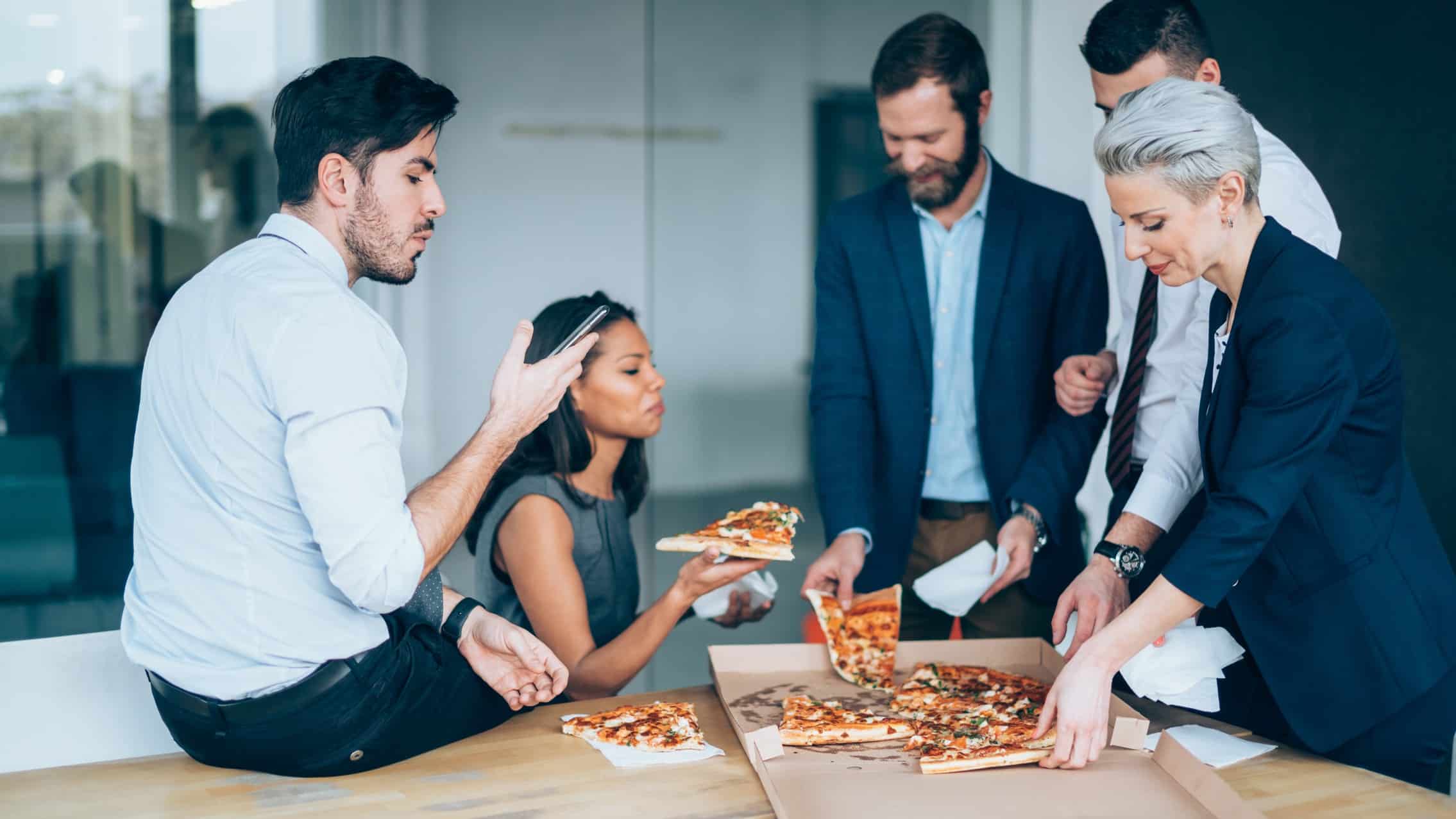
    Hiding behind your phone instead of socializing

    A person at a table with their phone in front of their face
    It's best to put your phone away during a special event.

    Eyring told BI that one of the biggest mistakes you can make at a work party is hiding behind your phone.

    "There are a lot of people who feel anxious when attending these events, and they don't really know many people," Eyring told BI. "Instead of mixing and mingling because they're introverted or feeling anxious, they sit behind their phone and scroll."

    However, by doing this, you're missing out on a valuable chance to network and get to know other people at the company.

    Of course, there are valid reasons to have a phone out during the party. But if you're showing colleagues photos on your phone, for example, do it quickly and then put it away, Eyring said.

    Taking photos of people without their permission

    Eyring said another appropriate use case for phones at a work party includes taking photos with coworkers — but only if permission is obtained first.

    "People don't always like having their photo taken when they aren't posed or haven't been asked to be a part of a photo," she told BI.

    Likewise, it's a good idea to ask for permission before posting or sharing the photo with others. "Some people also don't want to be seen on someone else's social media page drinking, or holding a glass, either," Eyring said.

    Discussing sensitive conversation topics

    Two speech bubbles showing cash and a cross
    Politics and religion are two topics that should be avoided at work events.

    At work events, it's best to steer clear of any topic that could be seen as delicate or controversial.

    "Proceed with caution when mentioning anything that falls into a category where people might have distinct or strong feelings about that topic. That includes politics, romantic relationships, money, and religion," Sekou told BI.

    Instead, she said, it's safer to have low-stakes conversations about family, vacations, and hobbies.

    Packing up leftovers to bring home without permission

    When extra food is left behind, it can be tempting to pack it up to take home. However, this can come across as rude at a party.

    "When you attend a work event, the goal is to connect and build relationships. Packing up food and other leftovers could be perceived as uncouth," Sekou said.

    She also suggests being mindful when it comes to how much you take to eat in general. If you're not served a pre-portioned plate, avoid taking more food than you plan to eat in the moment.

    Overstaying your welcome

    Company events can be a great excuse to get to know your coworkers on a deeper level. However, it's important that you don't let an engaging conversation cause you to overstay your welcome.

    According to Sekou, it's essential to pick up on social cues and leave at the appropriate time.

    "Pay attention to cues around exiting. Sometimes the music may go down, or the lights may come up. You might start to see people putting away dishes," Sekou said. "That's your sign to start winding it down."

    Read the original article on Business Insider
  • Uber is launching self-driving taxis in another city as the robotaxi race heats up

    Waymo Austin
    If you live in Austin and Atlanta, you can hail a Waymo on the Uber app.

    • Robotaxis are hitting the roads at a dizzying pace, and now Uber is rolling them out in Dallas.
    • Uber is partnering with robotaxi startup Avride to launch a fleet of self-driving Hyundais.
    • Dallas is the latest city to get robotaxis on Uber, but the Avride vehicles will have safety drivers for now.

    Dallas has become the latest city to get robotaxis on Uber.

    The ride-hailing giant announced on Wednesday that users can now access self-driving vehicles developed by startup Avride, as the race to introduce robotaxis across the US continues to heat up.

    The Dallas robotaxi fleet, which is made up of Hyundai Ioniq 5 EVs powered by Avride's self-driving tech, will initially include human monitors in the driver's seat. Uber said that fully driverless operations will be coming "sometime in the future."

    Customers requesting a ride on the Uber app may be matched with a robotaxi, Uber said, but they will have the option to switch to a human-operated vehicle.

    The launch comes as robotaxis roll out across the US at an increasingly dizzying pace.

    Dallas is the third US city in which Uber has launched autonomous ride-hailing options, with the company also partnering with Waymo in Austin and Atlanta.

    After spending years testing self-driving taxis, Waymo is also accelerating its rollout.

    The Google-owned company recently announced plans to introduce autonomous ride-hailing services in Dallas, Miami, Houston, San Antonio, and Orlando, adding to its existing operations in San Francisco, Los Angeles, Phoenix, Austin, and Atlanta. On Tuesday, Waymo said it had begun operating robotaxis without a driver in Dallas.

    After abandoning plans to build its own robotaxis, Uber has adopted a strategy of partnering with autonomous vehicle companies such as Waymo to roll out self-driving vehicles on its app — even as it faces competition from those same startups in markets like San Francisco.

    That strategy extends beyond the US. Uber has also partnered with Chinese robotaxi firms Pony.AI and WeRide, with the company launching fully driverless WeRide robotaxis on its app in Abu Dhabi last week.

    Read the original article on Business Insider
  • How does your Spotify Wrapped get made? 3 Spotify leaders break down the yearlong process.

    A billboard for Spotify Wrapped 2025 is pictured.
    Three Spotify leaders explained their yearlong process to build Wrapped.

    • Spotify Wrapped takes over a year to build, with work across designers, data scientists, marketers, and more.
    • Three Spotify leaders brought Business Insider into the process, which one called "the biggest thing we do every year."
    • After 2024's mixed reception, a Spotify leader said that they used what "underwhelmed" and "disappointed" fans as fuel.

    December brings candy canes, snow angels — and a reminder of just how much Lady Gaga you've listened to.

    Spotify Wrapped, an annual walk down memory lane available to the streaming platform's more than 713 million users, is now a hallmark for the company, flooding social feeds for one day every year and spawning copycats.

    The project has grown rapidly; by the December launch date, Spotify is already working on next year's Wrapped. What once took a handful now takes hundreds, from designers to engineers to data scientists.

    The annual wrap-up has also evolved over the years, assessing new mediums — podcasts, now audiobooks — and adding new "stories," Spotify's term for its slides. Some stories have scored off the charts, like 2023's Sound Towns, which told you which city shared your taste in music. Others, like last year's Your Music Evolution, have drawn a more mixed reception.

    But make no mistake, Spotify Wrapped is big business for the streamer. On the fourth-quarter earnings call, Spotify co-president Alex Norström said that it has "become a significant driver of our business," engaging 245 million users in 2024.

    Three Spotify leaders took Business Insider behind the scenes of the Wrapped process. It's an ever-growing project, one built off thousands of Slack messages and conversations a year, the executives said.

    "From a marketing perspective, this is the biggest thing we do every year," said Matthew Luhks, Spotify's senior director of global marketing. "It's the thing that's most looked forward to. It's also the thing that gets the most scrutiny."

    Inside the Wrapped timeline

    The minute Wrapped goes live, the Spotify team begins obsessively tracking social media.

    Spotify immediately goes trend-hunting through the hashtags and replies, said Laura Kirkpatrick, Spotify's senior director of channel marketing. (Her top artist of the year: Blood Orange.) The social team is one of the "tens of teams" inside Spotify that track reception across the globe.

    "We're talking about a massive footprint in the many, many hundreds, across the whole business, that are on standby that day," she said.

    Spotify Wrapped 2025
    Spotify Wrapped now includes audiobooks.

    Then begins the post-mortem, where Spotify employees across teams weed through what went right (or wrong) across each year's Wrapped.

    That includes last year, when feedback from Wrapped was unusually harsh. Users flooded the company's social media profiles with negative comments, calling the year's edition "boring" and "inaccurate."

    Luhks said that 2024 was a record-breaking year — 1 in 3 Spotify users engaged with Wrapped — but that feedback was mixed. Some users were disappointed, he said.

    "We listened to what they were underwhelmed with, disappointed with, and we used that for fuel and for inspiration," Luhks said.

    Some users also critiqued 2024's Wrapped for its use of generative AI. Stories included the Wrapped AI Podcast, powered by the buzzy Google NotebookLM. On the fourth-quarter earnings call, Spotify executives said that they came up with the feature six to eight weeks before Wrapped came out. That particular feature is not present in the 2025 edition.

    "Every insight, every story, every design choice is made by real, very talented people at the company," who would never "be comfortable letting machines do their work," Luhks said.

    After the post-mortem, the Spotify team starts to tinker, adjust, and ideate. That includes the data science team, which builds the algorithms that determine your top fives.

    Building those lists can be more challenging than expected. "What's Up?" by 4 Non Blondes had a major resurgence this year thanks to a TikTok trend. If you streamed the song endlessly, should their 1992 album "Bigger, Better, Faster, More!" be in your top albums? Likely not.

    The data scientists "construct the data" to make sure fans see themselves "mirrored back," said Lauren Saunders, Spotify's product director of personalization. (Top artist: Nirvana)

    This year, Saunders' team conducted a comprehensive review of the methodologies used for these classic rankings, including top songs and artists. They dug through piles of data points and sets before coming to the conclusion that the approach of years past was best.

    "We really went deep, and we were like, 'Actually, we have conviction,'" Saunders said.

    Spotify Wrapped share cards are pictured.
    Spotify Wrapped's data scientists reviewed their top albums and artists methodology for 2025.

    Given Wrapped's importance to the company, executives are involved throughout the process, Luhks said. (Top artist: Dean Blunt.) One new group-sharing feature, Wrapped Parties, helped bring senior leadership in.

    "We then start putting our execs into Wrapped Parties together, and they can actually play and experience it," Saunders said. "That's always really fun."

    Getting users in-person, off-social, and away from competitors

    As the scale of Wrapped grows, the way Spotify's users share the info has also changed.

    The recap became infamous for its shareable top fives, plastered across millions of Instagram Stories. Social media is less about posting these days. As the platforms move from "friends" to "followers," Spotify has taken note.

    "The biggest change we see is that there's less mass sharing, broadcast sharing, and more small-group sharing," Luhks said. The company creates moments for both wide audiences and group chats, he said.

    What about the digital detoxers, ready to pick up a dumb phone or stuff their device in a Yondr pouch? Spotify is also pushing toward this crowd with 50 in-person pop-ups. Check the GIMS-themed parade of Green Ferraris in Paris, or the 800-foot cascade of red hair at New York's Union Square subway stop honoring Chappell Roan.

    The intention of these events is to "bring fans together" and honor "listening offline," Kirkpatrick said.

    A Spotify Wrapped billboard is pictured in New York.
    Spotify is expanding its out-of-home bet for 2025.

    By now, Spotify isn't the only streamer in the game. Apple Music debuted its rival offering, Reply, on the web in 2019, and brought it to the mobile app five years later. Some users turn to more consistent recaps of their listening, like the Paramount Skydance-owned Last.fm.

    But Spotify's recap is likely the biggest — and helps fuel sign-ups. On the fourth-quarter earnings call, CEO Daniel Ek said that Wrapped was a "huge driver behind our MAU and subscriber growth." It boosted Q4 performance that year, as it always did, he said.

    "We do see similar campaigns, but believe that there is only one Wrapped," Luhks said. "Wrapped, we hope, sets the bar."

    Read the original article on Business Insider
  • Ex-Google CEO Eric Schmidt says AI isn’t overhyped — the biggest gains from automating corporate work are still ahead

    Former Google CEO Eric Schmidt at the America Business Forum at Kaseya Center in Miami on November 06, 2025.
    Ex-Google CEO Eric Schmidt says AI isn't overhyped because the real payoff — automating the costly, boring backbone of business — is only just getting started.

    • Eric Schmidt said AI is "under-hyped" because automating routine corporate work is still ahead.
    • He said firms use AI to automate the "boring" backbone of operations, such as billing.
    • Schmidt suggested that AI's potential in medicine, climate, and logistics remains largely untapped.

    If AI feels overhyped now, Eric Schmidt suggests that businesses should brace themselves — the real disruption hasn't even begun yet.

    In an interview with Professor Graham Allison at the John F. Kennedy Jr. Forum at Harvard University on Monday, the former Google CEO pushed back on the idea that AI's rapid growth is a speculative bubble, saying that the technology is actually under-hyped.

    "If anything, it's under-hyped because you are fundamentally automating businesses," he said.

    The real transformation, he said, is happening deep inside companies, where AI systems are beginning to take over the "boring" tasks that quietly consume billions in corporate spending.

    The biggest gains, he suggested, will come from automating the backbone of corporate work: the repeatable, time-consuming processes buried deep inside every organization.

    The former Google chief listed billing, accounting, product design, delivery, and inventory management as examples of this.

    "There's an awful lot there — it's extraordinary," he said, pointing to areas like medicine, climate solutions, and engineering as sectors where automation could accelerate breakthroughs.

    Schmidt, who helped steer Google's early investments in AI and later co-authored a book on AI with Henry Kissinger, implied the technology's economic impact will be far larger than markets or executives appreciate.

    Still, not everyone agrees with that perspective. Some economists are sounding alarm bells that the AI boom is overheated.

    In an interview this week, renowned economist Ruchir Sharma said the AI surge displays all four traits of a classic bubble and could unravel if interest rates rise, while tech leaders such as Sam Altman and Bill Gates have cautioned that parts of the market resemble the dot-com era.

    Far beyond coding

    To illustrate how quickly AI capabilities are advancing, Schmidt described watching an AI system generate an entire software program.

    "Holy crap. The end of me," he said.

    "I've been doing programming for 55 years. To see something start and end in front of your own life is really profound," he added.

    However, he said that AI's long-term upside extends far beyond coding.

    From back-office workflows to logistics and scientific discovery, Schmidt believes the automation curve is still in its early stages of scaling and that Wall Street is underestimating the magnitude of the shift.

    "The reason people are spending this amount of money," he said, "is to automate the boring parts of their business."

    Read the original article on Business Insider
  • A man called in a bomb threat to New Orleans airport after he couldn’t pay for parking, an affidavit says

    People wear face coverings inside the arrivals area at Louis Armstrong New Orleans International Airport on August 12, 2021 in Kenner, Louisiana.
    The interior of New Orleans Airport.

    • A man has been charged with making a bomb threat after he couldn't pay for airport parking.
    • The 35-year-old Louisiana native was arrested at New Orleans airport last month.
    • "We have the bomb," he told an airport phone operator during a "threatening" call.

    A man faces a maximum of up to a decade in prison after calling in a bomb threat when he couldn't pay for airport parking, prosecutors said.

    A 35-year-old man was indicted on November 20 and charged with one count of willfully making a threat.

    The incident came to light after the US attorney's office for the Eastern District of Louisiana issued a press release on Tuesday.

    The FBI's violent crime task force was called by the local sheriff's office after New Orleans Airport received a "threatening phone call" on November 7, per an FBI agent's affidavit.

    It added that the man from Alexandria, Louisiana — around 170 miles from New Orleans — demanded the operator "page Hassan" and said: "If you do not page him, we have the bomb."

    Less than an hour later, the airport received another call from the same number, in which the man was "attempting to disguise his voice," per the affidavit.

    He is said to have then threatened to cut the operator's throat in an expletive-laden message, adding, "I want him to bring the bomb to level three."

    Deputies from the sheriff's office then pinged the phone number and found the phone was located near the airport's north terminal, the affidavit said.

    When the number was then linked to the man, the deputies said they recognized his name from an incident earlier that evening.

    Two hours before the first phone call, the suspect tried to exit the short-term parking garage but "was unable to render payment," per the affidavit.

    He is said to have refused to move his vehicle from the exit lane after "multiple requests" from parking staff and airport police officers. He was then allowed to move his car to a surface parking lot until he could get the money to leave, the affidavit added.

    After the sheriff's deputies connected the man to the bomb threat, they found him still parked in the surface lot, where they arrested him.

    The affidavit says that the deputies also called the phone number that the threats came from, and saw his phone ringing.

    He was later released on a $5,000 unsecured appearance bond ahead of a preliminary hearing scheduled for Wednesday.

    The conditions of his release said he must participate in mental health treatment — and allowed him to retrieve his car from the airport parking lot.

    If convicted, the suspect faces up to 10 years in prison and up to a $250,000 fine.

    Read the original article on Business Insider
  • Tesla scored a win in China just as its biggest rival stumbled

    Tesla's Shanghai gigafactory
    Tesla's Shanghai gigafactory. The company has had a tough year in China.

    • Tesla scored a rare win in China, earning bragging rights over its biggest rival in the process.
    • Elon Musk's automaker saw its sales rise by nearly 10% in November, while its arch-rival BYD's fell.
    • Tesla has had a difficult year, with sales underwhelming in China and collapsing in Europe.

    Things are finally looking up for Tesla in China.

    The US automaker's sales rose 9.9% in November compared to the same month last year, according to data released by China's Passenger Car Association on Tuesday.

    That's a rare win for Tesla, which has had a difficult year in almost all of its biggest markets. The company has faced a sales collapse in Europe, been squeezed by intense competition in EV-friendly China, and is on track to see its overall sales decline for the second consecutive year.

    One bright spot for Tesla: it's not the only one with problems. The Elon Musk-run automaker's biggest Chinese rival, BYD, has hit some speed bumps in recent months.

    The Shenzhen-based EV giant, which has become one of China's largest carmakers thanks to a range of affordable and high-tech electric models, has had three straight months of sales declines.

    BYD said it sold just over 480,000 EVs and hybrids in November, its highest total this year, but still around 5.3% less than the same period in 2024.

    The Chinese automaker, which was once backed by Warren Buffett, has struggled in the face of a renewed price war in China's ultra-competitive EV market and a government crackdown on aggressive discounting.

    Despite these headwinds, BYD is still on course to take Tesla's crown as the world's largest seller of battery EVs this year, and the company is rapidly taking market share from Musk and co. outside China.

    BYD's overseas sales hit a record 131,935 in November. The Chinese auto giant is taking advantage of Tesla's woes in Europe, with BYD outselling its US rival by more than two to one in October.

    Read the original article on Business Insider
  • Big Four promotions depend more on politics and your boss having your back than your performance, researchers found

    The EY offices in London in 2018.
    A new study suggests that Big Four promotions are driven more by internal politics and the extent to which a manager is willing to advocate for their team members.

    • A study found Big Four promotions are shaped more by internal politics than auditors' performance.
    • Researchers from three universities say managers' reputations influence promotions as much as evaluations.
    • Even strong performers can be overruled unless influential managers defend them in committees.

    A new study suggests the Big Four's supposedly meritocratic promotion systems may rely far less on performance than on internal politics — and, crucially, on whether your manager is willing to put their own reputation on the line for you.

    Within the Big Four professional services firms — Deloitte, PwC, KPMG, and EY— auditors are evaluated throughout the year after each client assignment.

    Supervisors generally award A-to-D grades on technical competence, teamwork, leadership, and client relationships, creating a paper trail that appears — at least formally — to determine who gets promoted in the firms' "up-or-out" system.

    In theory, auditors who consistently exceed expectations should advance more quickly, while weaker performers may stay at the same level or even be asked to leave the firm.

    Inside the promotion room, politics override performance

    However, researchers from KEDGE Business School, ISG, and the University of Cambridge gained rare access to two promotion committees inside a Big Four audit firm's Paris office, observing 6.5 hours of deliberations and conducting 61 interviews with 49 auditors and managers between 2015 and 2021.

    What they found upends the idea that high performers naturally rise to the top.

    According to the paper, promotion committees function far less as objective reviews of auditors' work and far more as "political arenas" where managers lobby, trade favors, and defend their protégés.

    Instead of simply aggregating the year's performance evaluations, committees frequently reassess — and even overturn — those scores after heated debate.

    In some cases, auditors with solid ratings were downgraded because supervisors admitted their earlier evaluations had been "complacent."

    In other cases, strong performers were promoted above higher-scoring peers because influential managers went to bat for them — or because rivals stayed silent.

    Thomas Roulet, one of the study's authors and a professor of organizational sociology and leadership at the University of Cambridge, said one of the deeper paradoxes is that "audit firms believe they are particularly fair, square, and transparent, while the collective nature of the work and the collective nature of the evaluation make it opaque and political by nature."

    EY, Deloitte, and PwC did not respond to requests for comment from Business Insider.

    KPMG pointed to its 2024 Transparency Report, which stated that the firm's compensation and promotion policies are informed by market data and "are clear, simple, fair, and linked to the performance and talent review process."

    When managers themselves become the ones under evaluation

    The study also found that auditors are not the only ones being evaluated.

    Managers' judgment is also under scrutiny, creating a powerful incentive to play it safe in performance reviews and align with what they believe the committee wants.

    One senior manager told researchers he fought hard for an employee not just to keep her, but because he didn't want colleagues saying he "overestimates his protégés."

    The result, the authors said, is a system where second-order evaluations — evaluations of evaluations — outweigh actual performance.

    That dynamic "raises questions about whether promotion committees are fit for purpose," they wrote, and helps explain why many auditors feel the process is opaque, political, and fundamentally unfair.

    Roulet added that when managers lack influence — or choose not to expend political capital — high performers suffer.

    "Those auditors who don't get support," he said, "get stuck at the same level or, in general, get less recognition than what they deserve. This fosters a strong sense of injustice and unfairness."

    While he said Big Four firms "do recognize merit and hard work," he said, "the ranking system can disadvantage even high performers when everybody is a high performer."

    Fewer promotions

    Internal politics has always been a feature of rising up the ranks within the Big Four, as it is in most corporate jobs.

    The firms operate as limited liability partnerships (LLPs), a structure in which partners typically get a vote in strategic matters and a share of annual profits if they hold equity in the business. Making it to the top requires strong people skills, both in building an internal network and winning potential new clients.

    You can be technically good, but unless you invest time building those internal networks, you won't progress as quickly, James O'Dowd, founder of the global executive recruiter Patrick Morgan, which specializes in senior partner hiring and industry analysis, previously told Business Insider.

    Promotions at all levels of the Big Four have also become tougher to secure as firms struggle to manage sluggish revenue growth and AI disruption to their traditional work.

    In May, the UK branch of Deloitte told employees in an internal memo that it would only promote 25% of the workforce. The previous year, the firm promoted 28% of its employees. The same memo said that Deloitte had "faced a particularly challenging year and fell materially short of its performance goals."

    Read the original article on Business Insider
  • Lowe’s CEO says AI isn’t just about replacing jobs

    Marvin Ellison, chairman and CEP of Lowe's, speaks during the Business Roundtable CEO Workforce Forum in Washington, DC, on Tuesday, June 17, 2025.
    Lowe's CEO Marvin Ellison is bullish on AI in retail.

    • Lowe's CEO Marvin Ellison said AI is already reshaping how the home improvement retailer operates.
    • Ellison says he views tech less as a means to replace jobs and more as a way to increase revenue.
    • Walmart executives have likewise said AI is likely to affect practically every job in the industry.

    Home improvement retailer Lowe's is using AI for more and more tasks, but CEO Marvin Ellison says he isn't looking to the tech to cut labor costs.

    Ellison said he views tech less as a means to replace jobs and more as a way to increase revenue, speaking at Morgan Stanley's Consumer and Retail Conference on Tuesday.

    "Rather than thinking about it solely as a job replacement tool, how do you think about reducing someone's workload by 50%?" he said.

    "Can we now free a merchant up who's spending 50% of their time building spreadsheets, responding to emails, communicating with suppliers? If AI can take that task away, can you now take 50% of that merchant's time, and they can focus on sales-driving initiatives?" he continued. "That's what we're trying to understand."

    Ellison said that back when he took over as CEO in 2018, the home improvement industry was in an era of "binders and whiteboards" that has since been supplanted — at his company, at least — with a powerful suite of digital tools, including a partnership with OpenAI.

    Indeed, now the development of that very tech stack is seeing efficiency improvements thanks to AI-assisted coding and approval, he said. Ellison has also said AI resources enable store employees to be more helpful on the sales floor.

    The investments are also paying off directly with customers via the Mylow chatbot in the Lowe's app.

    "We had a couple of questions, like on Thanksgiving, 'My stove is not working. It will not heat." Ellison said. "Luckily, we were able to give them some really good advice on things they can do to check to determine how they can repair."

    "It's a lot more difficult than asking what aisle the shampoo is on," he added.

    While Ellison has been one of the more prominent retail executives engaging publicly with AI issues, he's by no means alone.

    "It's very clear that AI is going to change literally every job," outgoing Walmart CEO Doug McMillon said in September.

    At the same Morgan Stanley conference on Tuesday, Walmart CFO John David Rainey likened the adoption of AI to the advent of spreadsheet tools like Microsoft Excel a generation ago — albeit on a much broader and quicker timeline.

    "The best performers were those that learned it the most and used it to perform their job," he said.

    "AI is going to give people tools to improve their jobs," Rainey added. "In some cases, I think it's fair to say jobs may go away. In other cases, new jobs will be developed."

    Read the original article on Business Insider
  • I asked 6 executives which books have shaped their leadership

    The Hard Thing About Hard Things Book by Ben Horowitz, Quiet: The Power of Introverts in a World That Can't Stop Talking Paperback by Susan Cain, and Extreme Ownership: How U.S. Navy SEALs Lead and Win by Jocko Willink and Leif Babin.
    Six executives shared the books that shaped their leadership approach.

    • I asked six executives in November to share the books that shaped their leadership approach.
    • The list features a range of leaders from tech companies, like AWS, to style brands like Revlon.
    • The books they pick center on decision-making and leading with emotional intelligence.

    It's that time of year again, and if you're searching for the perfect book to gift a family member, spouse, or even your boss, you're in luck.

    Last month, I asked six executives from Big Tech companies like AWS, to financial firms like Mastercard, and style brands like Revlon and Mejuri, about the books that have influenced their leadership style.

    Their responses included management staples, like "Extreme Ownership: How US Navy Seals Lead," and books focused on soft skills, such as "Emotional Intelligence" or "Quiet."

    Read on for the full list:

    Sarah Cooper, Amazon Web Services director of AI Native
    Side by Side of Sarah Cooper and The Innovator's Dilemma by Clayton Christensen
    Sarah Cooper is AWS director of AI Native

    AWS executive Sarah Cooper said she's rereading Clayton Christensen's "The Innovator's Dilemma." She said the book is filled with guiding principles for capitalizing on disruptive innovation, which are lessons that resonate in today's workforce.

    She's also a fan of Daniel Goleman's "Emotional Intelligence," which explores why IQ alone doesn't guarantee success and why emotional awareness matters. Cooper said that leading with empathy is especially critical as AI reshapes the workforce.

    "I truly believe that the way we work could change dramatically," Cooper said.

    Jennifer Van Buskirk, AT&T head of business operations
    Side by Side of Jennifer Van Buskirk and Extreme Ownership: How US Navy Seals Lead" by Jocko Willink and Leif Babin
    Jennifer Van Buskirk has been at AT&T for over 25 years.

    AT&T's head of business operations, Jennifer Van Buskirk, told Business Insider that she's "a bit of an adrenaline junkie," and looks for signs of risk-taking when interviewing candidates. Her book picks reflect that intensity.

    The executive said "Extreme Ownership: How US Navy Seals Lead" by Jocko Willink and Leif Babin teaches people to take ownership and see things through.

    The second book she named, "Get Sh*t Done," by Lauris Liberts and motivational brand Startup Vitamins, was handed to her by the CIO of her former startup. She said it's filled with great quotes that reflect her style of thinking.

    Raj Seshadri, Mastercard chief commercial payments officer
    Side by Side of Mastercard chief commercial payments officer, Raj Seshadri and "Dare to Lead" by Brené Brown
    Raj Seshadri said "Dare to Lead" by Brené Brown influenced her leadership style.

    Mastercard's Raj Seshadri highlighted the book "Dare to Lead" by Brené Brown. Seshadri said that the book focuses on courage and vulnerability in leadership and argues that great leaders are defined by their ability to build trust and lead with empathy, rather than their titles.

    "It provides practical tools for creating brave cultures where people feel safe to take risks and innovate," Seshadri said.

    Michelle Peluso, Revlon CEO
    Side by Side of Revlon CEO Michelle Peluso and "Leonardo da Vinci" by Walter Isaacson

    Revlon CEO Michelle Peluso said she gravitates more toward biographies over traditional business books because "they offer a more human-centered perspective." A few of her favorites include:

    • "Team of Rivals" by Doris Kearns Goodwin
    • "Personal History" by Katharine Graham
    • "Leonardo da Vinci" by Walter Isaacson
    • "Long Walk to Freedom" by Nelson Mandela
    Christina Shim, IBM chief sustainability officer
    Side by Side of IBM chief sustainability officer Christina Shim and Quiet: The Power of Introverts in a World That Can't Stop by Susan Cain
    Christina Shim serves as IBM's Chief Sustainability Officer.

    IBM's chief sustainability officer said the company has rallied around the book, "The Geek Way" by Andrew McAfee. She said that IBM CEO Arvind Krishna is working to build a culture inspired by the book, which focuses on four core pillars, including science, ownership, speed, and openness.

    Shim said another book that has shaped her own leadership style is Susan Cain's "Quiet." The book explores how to navigate being an introvert in an extroverted world — and she thought it was so important that she bought copies for her entire team. She said that introverts often make up half a team, and understanding how to work effectively together is essential.

    Noura Sakkijha, Mejuri CEO
    Side by Side of Mejuri CEO Noura Sakkijha and The Hard Thing About Hard Things," by Ben Horowitz

    The CEO of jewelry brand Mejuri told Business Insider that many books have influenced her leadership style, but one that stuck with her was Ben Horowitz's "The Hard Thing About Hard Things."

    Sakkijha said it helped her understand that building a business is rarely a linear process. She said that sometimes reading other founders' stories made the process look easy. In contrast, Horowitz, who cofounded Andreessen Horowitz, offers practical advice for navigating the most challenging aspects of starting a business, based on his own experience.

    "It was really helpful to read his story, how they built the business, the challenges they went through, and the persistence," Sakkijha said.

    Read the original article on Business Insider