• 3 things ASX investors should watch this week

    Three people in a corporate office pour over a tablet, ready to invest.Three people in a corporate office pour over a tablet, ready to invest.

    It’s all happening in the land of ASX shares as reporting season ploughs ahead in earnest.

    eToro market analyst Josh Gilbert has picked out the three critical developments to watch this week:

    1. Australian quarterly wage index

    Wednesday will see the latest wage statistics, which will be crucial in determining which direction the Reserve Bank of Australia will go with interest rates.

    According to Gilbert, the wage index is expected to rise 1% quarter-on-quarter and to 4.1% year-on-year.

    “With capacity in Australia’s job market growing, wages should not see too much pressure to the upside from here, given that we will likely see the unemployment rate grow during 2024, all of which is good news for inflation.”
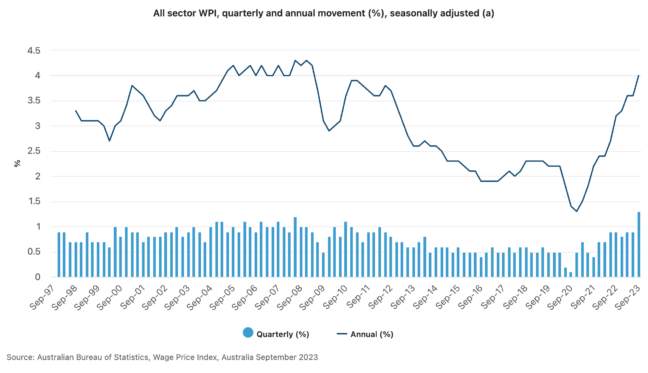
    He added that the signs have been positive for a peak in rates.

    “Unemployment last week [lifted] more than expected, showing the labour market is loosening.

    “Rising unemployment will be a significant reason for the RBA to cut rates, with market pricing looking to as early as June for the first cut.”

    2. Pilbara Minerals results

    There is no getting around the fact that ASX lithium shares have backed up their horrible 2023 with more losses in 2024.

    “It’s been a torrid few years for the price of lithium as it continues to freefall, weighing heavily on local miners that enjoyed a strong 2022 during peak prices for the asset.”

    Pilbara Minerals Ltd (ASX: PLS), which reports on Thursday, has been more resilient than others, only losing 6.9% so far this year.

    “That’s because it has a better balance sheet than most to get it through this lithium winter, allowing it to continue expanding and growing production.”
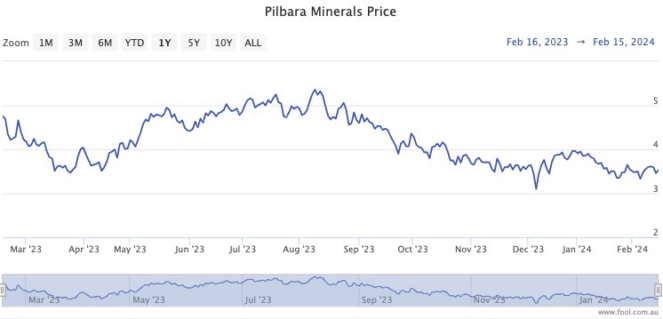
    It’s obvious income will plunge in the coming results, so Gilbert advises investors to focus on the comments regarding production.

    “Ultimately, Pilbara [Minerals] is at the whim of the lithium price, but the business looks the best positioned to navigate this challenging period.”

    He reminded investors that lithium will still see heavy demand in the long run.

    “While the pricing environment has softened for the time being, investors should not lose sight of the significant demand for lithium, with EV growth still high at around 30% this year.”

    3. Nvidia earnings

    On the other side of the Pacific, artificial intelligence (AI) darling Nvidia Corp (NASDAQ: NVDA) will report on Thursday morning Australian time.

    Gilbert pointed out that the stock has now returned 1,500% to investors in the past five years.

    “Last week, the artificial intelligence computing company claimed another feather in its cap, taking the title of the third largest company on the S&P 500 Index (SP: .INX). 

    “Within the last year, Jensen Huang and his team at Nvidia have grown its earnings by 500%, a remarkable feat that’s even more remarkable given Wall Street expects that growth to continue.”
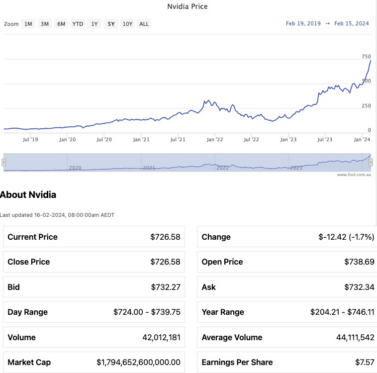
    Analyst consensus was that Nvidia would report earnings per share of US$4.56, said Gilbert, with a revenue of US$20.26 billion.

    “If the last three results are anything to go by, we could even expect numbers much higher than that.”

    But more than the raw numbers, the market will be watching the outlook guidance, as the stock is priced highly for future success.

    “Shareholders will want to hear that sales aren’t slowing down and that the AI boom is not just a flash in the pan. 

    “With such outsized gains in less-than-optimal conditions, anything but perfect will put shares on the back foot.”

    The post 3 things ASX investors should watch this week appeared first on The Motley Fool Australia.

    Wondering where you should invest $1,000 right now?

    When investing expert Scott Phillips has a stock tip, it can pay to listen. After all, the flagship Motley Fool Share Advisor newsletter he has run for over ten years has provided thousands of paying members with stock picks that have doubled, tripled or even more.*

    Scott just revealed what he believes could be the ‘five best ASX stocks’ for investors to buy right now. These stocks are trading at near dirt-cheap prices and Scott thinks they could be great buys right now…

    See The 5 Stocks
    *Returns as of 10 November 2023

    (function() {
    function setButtonColorDefaults(param, property, defaultValue) {
    if( !param || !param.includes(‘#’)) {
    var button = document.getElementsByClassName(“pitch-snippet”)[0].getElementsByClassName(“pitch-button”)[0];
    button.style[property] = defaultValue;
    }
    }

    setButtonColorDefaults(“#0095C8”, ‘background’, ‘#5FA85D’);
    setButtonColorDefaults(“#0095C8”, ‘border-color’, ‘#43A24A’);
    setButtonColorDefaults(“#fff”, ‘color’, ‘#fff’);
    })()

    More reading

    Motley Fool contributor Tony Yoo has no position in any of the stocks mentioned. The Motley Fool Australia’s parent company Motley Fool Holdings Inc. has positions in and has recommended Nvidia. The Motley Fool Australia has recommended Nvidia. The Motley Fool has a disclosure policy. This article contains general investment advice only (under AFSL 400691). Authorised by Scott Phillips.

    from The Motley Fool Australia https://ift.tt/aGAlo4F

  • Is 50 too late to start buying ASX shares for retirement?

    Smiling elderly couple looking at their superannuation account, symbolising retirement.

    Smiling elderly couple looking at their superannuation account, symbolising retirement.

    Is it too late to buy ASX shares when you’re 50 for retirement? Good question.

    The short answer is a most definite ‘no’. However, the long answer adds a little more complexity.

    The whole reason we invest in ASX shares, for retirement or not, is to harness the high returns that ASX shares have historically delivered compared to other assets.

    As our chief investment officer, Scott Phillips went through last year, Australian shares delivered an average return of 9.2% per annum between July 1993 and June 2023. That’s assuming dividends are reinvested.

    In contrast, cash investments (including savings accounts and term deposits) returned just 4.2% per annum over the same period.

    The longer you stay invested in high-returning shares, the longer you have to benefit from the exponential power of compounding.

    So I’m not going to pretend that anyone who’s only getting started investing in shares at age 50 wouldn’t have been ludicrously better off starting earlier.

    But saying that, you’ve still got plenty of time before retirement to get a big boost to your wealth from ASX shares.

    ASX shares at 50? Here’s how you can give your retirement a boost

    Let’s say you’re 50 years old, and you’ve amassed a life savings of $150,000 over your working life outside the value of the family home and superannuation.

    Let’s then assume that you invested that lump sum into cash investments. And that you are able to achieve that same 4.2% that has been average over the past 30 years. Well, you can expect to have approximately $305,940 by the time you retire at age 67.

    Not bad.

    But let’s say you instead invest that lump sum into ASX shares and enjoy a return of 9.2% per annum instead (not that that is guaranteed). You could reasonably expect to have a far more impressive $712,443 by the time you hit 67. That’s despite the inherent volatility that shares come with

    That’s 406,503 reasons why it’s not too late to buy ASX shares for your retirement at age 50.

    That’s an ‘ideal world’ scenario we’ve just discussed. Shares can be volatile, and there’s a significant chance that the Australian share market won’t continue to return an average of 9.2% over the next 17 years. It could be even higher, but it could also be lower.

    But I’m a firm believer in the power of taking lessons from history. And history does tell us that ASX shares are almost always one of the best assets to invest in over long periods of time.

    The post Is 50 too late to start buying ASX shares for retirement? appeared first on The Motley Fool Australia.

    Wondering where you should invest $1,000 right now?

    When investing expert Scott Phillips has a stock tip, it can pay to listen. After all, the flagship Motley Fool Share Advisor newsletter he has run for over ten years has provided thousands of paying members with stock picks that have doubled, tripled or even more.*

    Scott just revealed what he believes could be the ‘five best ASX stocks’ for investors to buy right now. These stocks are trading at near dirt-cheap prices and Scott thinks they could be great buys right now…

    See The 5 Stocks
    *Returns as of 10 November 2023

    (function() {
    function setButtonColorDefaults(param, property, defaultValue) {
    if( !param || !param.includes(‘#’)) {
    var button = document.getElementsByClassName(“pitch-snippet”)[0].getElementsByClassName(“pitch-button”)[0];
    button.style[property] = defaultValue;
    }
    }

    setButtonColorDefaults(“#0095C8”, ‘background’, ‘#5FA85D’);
    setButtonColorDefaults(“#0095C8”, ‘border-color’, ‘#43A24A’);
    setButtonColorDefaults(“#fff”, ‘color’, ‘#fff’);
    })()

    More reading

    Motley Fool contributor Sebastian Bowen has no position in any of the stocks mentioned. The Motley Fool Australia’s parent company Motley Fool Holdings Inc. has no position in any of the stocks mentioned. The Motley Fool Australia has no position in any of the stocks mentioned. The Motley Fool has a disclosure policy. This article contains general investment advice only (under AFSL 400691). Authorised by Scott Phillips.

    from The Motley Fool Australia https://ift.tt/2w1bdc0

  • No savings in 2024? I’d follow Warren Buffett and start building wealth

    Legendary share market investing expert and owner of Berkshire Hathaway Warren Buffett

    Legendary share market investing expert and owner of Berkshire Hathaway Warren Buffett

    If you don’t have any savings, but want to be wealthy, then read on.

    That’s because I’m going to explain how with ASX shares you could build significant wealth by following the lead of Warren Buffett.

    Over many decades at the helm of Berkshire Hathaway (NYSE: BRK.B), the Oracle of Omaha has demonstrated that wealth can be created through very simple investment principles. And the good news for us all is that by applying his time-tested methods with ASX shares, we could also pave our way to financial freedom.

    Investing like Warren Buffett with ASX shares

    A great starting point is to make consistent investments in ASX shares with a long-term perspective.

    For example, if you could invest $500 each month into the share market, then thanks to the power of compounding, you could build a sizeable investment portfolio by following Warren Buffett’s investment approach.

    Buffett likes to focus on investing in established companies with sustainable competitive advantages, strong business models, positive long-term growth outlooks, and fair valuations.

    Investing in companies that exhibit these qualities has allowed the Berkshire Hathaway leader to deliver an average annual return of 19.8% since 1965. This is double the market return over the same period. Clearly his methods work, you can’t fluke your way through almost 60 years of investing.

    Compounding your way to wealth

    As I mentioned above, the key is to make consistent investments to benefit from compounding. This is where you earn returns on top of your returns.

    Let’s imagine you can achieve a return in line with the market average since 1965, 9.9% per annum, if you were to invest $500 into ASX shares, you would have grown your portfolio to be worth approximately $360,000 in 20 years.

    But why stop there? If you keep going, you will see just how powerful compounding is the longer you leave it.

    For example, just five more years of the same, and that $360,000 would become approximately $610,000. That’s not a typo. An extra quarter of a million in just five years.

    And you keep going another five years, your portfolio would be worth over $1 million, all else equal.

    The above is based on the market return. If you can better this by following Buffett’s tenets, your portfolio could become even greater.

    Overall, I believe this shows that by following Warren Buffett’s investment style with ASX shares, you can build significant wealth even if you have no savings today.

    The post No savings in 2024? I’d follow Warren Buffett and start building wealth appeared first on The Motley Fool Australia.

    Wondering where you should invest $1,000 right now?

    When investing expert Scott Phillips has a stock tip, it can pay to listen. After all, the flagship Motley Fool Share Advisor newsletter he has run for over ten years has provided thousands of paying members with stock picks that have doubled, tripled or even more.*

    Scott just revealed what he believes could be the ‘five best ASX stocks’ for investors to buy right now. These stocks are trading at near dirt-cheap prices and Scott thinks they could be great buys right now…

    See The 5 Stocks
    *Returns as of 10 November 2023

    (function() {
    function setButtonColorDefaults(param, property, defaultValue) {
    if( !param || !param.includes(‘#’)) {
    var button = document.getElementsByClassName(“pitch-snippet”)[0].getElementsByClassName(“pitch-button”)[0];
    button.style[property] = defaultValue;
    }
    }

    setButtonColorDefaults(“#0095C8”, ‘background’, ‘#5FA85D’);
    setButtonColorDefaults(“#0095C8”, ‘border-color’, ‘#43A24A’);
    setButtonColorDefaults(“#fff”, ‘color’, ‘#fff’);
    })()

    More reading

    Motley Fool contributor James Mickleboro has no position in any of the stocks mentioned. The Motley Fool Australia’s parent company Motley Fool Holdings Inc. has positions in and has recommended Berkshire Hathaway. The Motley Fool Australia has recommended Berkshire Hathaway. The Motley Fool has a disclosure policy. This article contains general investment advice only (under AFSL 400691). Authorised by Scott Phillips.

    from The Motley Fool Australia https://ift.tt/vCjYGVP

  • Top brokers name 3 ASX shares to buy next week

    A man in trendy clothing sits on a bench in a shopping mall looking at his phone with interest and a surprised look on his face.

    A man in trendy clothing sits on a bench in a shopping mall looking at his phone with interest and a surprised look on his face.

    It was another busy week for Australia’s top brokers. This led to the release of a large number of broker notes.

    Three ASX broker buy ratings that you might want to know more about are summarised below. Here’s why brokers think these ASX shares are in the buy zone:

    AGL Energy Limited (ASX: AGL)

    According to a note out of UBS, its analysts have retained their buy rating on this energy giant’s shares with a slightly reduced price target of $11.25. UBS was pleased with AGL’s first half result, noting that it was well ahead of the broker’s expectations. It sees potential for further earnings outperformance in the coming years if its generation availability can be maintained. The AGL share price ended the week at $8.63.

    CSL Ltd (ASX: CSL)

    A note out of Morgans reveals that its analysts have retained their add rating on this biotechnology giant’s shares with a trimmed price target of $315.40. This follows the release of a solid half-year result which revealed earnings ahead of consensus expectations. Overall, Morgans was pleased with the result and especially the performance of the key CSL Behring business. And although the broker has trimmed its valuation to reflect the CSL112 trial failure, it continues to see a lot of value on offer. The CSL share price was trading at $284.00 at Friday’s close.

    Pro Medicus Limited (ASX: PME)

    Analysts at Macquarie have retained their outperform rating and $120.00 price target on this health imaging technology company’s shares. Macquarie notes that Pro Medicus fell short of the broker’s first-half expectations with both its revenue and earnings. However, it remains positive given new contract wins and its healthy sales pipeline. The Pro Medicus share price was trading at $87.24 on Friday.

    The post Top brokers name 3 ASX shares to buy next week appeared first on The Motley Fool Australia.

    Wondering where you should invest $1,000 right now?

    When investing expert Scott Phillips has a stock tip, it can pay to listen. After all, the flagship Motley Fool Share Advisor newsletter he has run for over ten years has provided thousands of paying members with stock picks that have doubled, tripled or even more.*

    Scott just revealed what he believes could be the ‘five best ASX stocks’ for investors to buy right now. These stocks are trading at near dirt-cheap prices and Scott thinks they could be great buys right now…

    See The 5 Stocks
    *Returns as of 10 November 2023

    (function() {
    function setButtonColorDefaults(param, property, defaultValue) {
    if( !param || !param.includes(‘#’)) {
    var button = document.getElementsByClassName(“pitch-snippet”)[0].getElementsByClassName(“pitch-button”)[0];
    button.style[property] = defaultValue;
    }
    }

    setButtonColorDefaults(“#0095C8”, ‘background’, ‘#5FA85D’);
    setButtonColorDefaults(“#0095C8”, ‘border-color’, ‘#43A24A’);
    setButtonColorDefaults(“#fff”, ‘color’, ‘#fff’);
    })()

    More reading

    Motley Fool contributor James Mickleboro has positions in CSL. The Motley Fool Australia’s parent company Motley Fool Holdings Inc. has positions in and has recommended CSL, Macquarie Group, and Pro Medicus. The Motley Fool Australia has positions in and has recommended Macquarie Group. The Motley Fool Australia has recommended CSL and Pro Medicus. The Motley Fool has a disclosure policy. This article contains general investment advice only (under AFSL 400691). Authorised by Scott Phillips.

    from The Motley Fool Australia https://ift.tt/SY4IrWa

  • This ASX passive income all-star just increased its dividend by 17%

    Young happy people on a farm raise bottles of orange juice in a big cheers to celebrate a dividends or financial win.Young happy people on a farm raise bottles of orange juice in a big cheers to celebrate a dividends or financial win.

    GQG Partners Inc (ASX: GQG) is an ASX passive income all-star in my opinion. It just grew its annual dividend per share by 17%, and I think it’s still one to watch.

    The GQG share price has taken its shareholders on an impressive run, rising by around 30% since the start of 2024. It has lifted by 48% since I called it “my pick for superior income in 2024“.

    Dividend growth

    GQG reported its 2023 annual result on Friday, which showed average funds under management (FUM) increased 14.7% to US$101.9 billion, net revenue increased 18.5% to US$517.6 million, net profit after tax (NPAT) grew 18.7% to US$282.5 million and distributable earnings rose 17.4% to US$297.9 million.

    All of those growth numbers helped GQG’s dividend per share increase 17.3% to US 9.1 cents. At the current GQG share price and foreign exchange rate, that translates into an FY23 dividend yield of 6.4%.

    There aren’t too many fund managers delivering double-digit profit growth and dividend growth at the moment.

    Could the ASX passive income payments keep growing?

    The ASX passive income all-star generates nearly all of its revenue from asset-based management fees as opposed to performance fees. If funds under management (FUM) grow, then revenue, net profit and dividends should be able to keep growing.

    The fund manager experienced an average FUM of $101.9 million in FY23, and it finished the year with a closing FUM of $120.6 million. If the US$120.6 billion closing FUM ends up being the average FUM for FY24, that would suggest a rise of another 18%. Ongoing net inflows can help here.

    Fund managers are very scalable businesses – it doesn’t necessarily take another 10% more people to manage 10% more FUM, so more FUM can translate into even faster earnings growth.

    But, let’s play with the idea that the GQG dividend could grow by 18% in FY24. At the current GQG share price, that would translate into a forward dividend yield of 7.5%.

    It’s quite possible the dividend could grow even more than that because at 31 January 2024, the FUM reached US$127 billion. So, we’ll have to see what the net inflows and investment performance are for the rest of 2024.

    But, I’m quite optimistic about the business, considering its investment funds have managed to deliver good returns over the long term.

    The post This ASX passive income all-star just increased its dividend by 17% appeared first on The Motley Fool Australia.

    Wondering where you should invest $1,000 right now?

    When investing expert Scott Phillips has a stock tip, it can pay to listen. After all, the flagship Motley Fool Share Advisor newsletter he has run for over ten years has provided thousands of paying members with stock picks that have doubled, tripled or even more.*

    Scott just revealed what he believes could be the ‘five best ASX stocks’ for investors to buy right now. These stocks are trading at near dirt-cheap prices and Scott thinks they could be great buys right now…

    See The 5 Stocks
    *Returns as of 10 November 2023

    (function() {
    function setButtonColorDefaults(param, property, defaultValue) {
    if( !param || !param.includes(‘#’)) {
    var button = document.getElementsByClassName(“pitch-snippet”)[0].getElementsByClassName(“pitch-button”)[0];
    button.style[property] = defaultValue;
    }
    }

    setButtonColorDefaults(“#0095C8”, ‘background’, ‘#5FA85D’);
    setButtonColorDefaults(“#0095C8”, ‘border-color’, ‘#43A24A’);
    setButtonColorDefaults(“#fff”, ‘color’, ‘#fff’);
    })()

    More reading

    Motley Fool contributor Tristan Harrison has no position in any of the stocks mentioned. The Motley Fool Australia’s parent company Motley Fool Holdings Inc. has no position in any of the stocks mentioned. The Motley Fool Australia has no position in any of the stocks mentioned. The Motley Fool has a disclosure policy. This article contains general investment advice only (under AFSL 400691). Authorised by Scott Phillips.

    from The Motley Fool Australia https://ift.tt/84AKQwv

  • 3 reasons why I’d buy small-cap shares over ASX blue chips in 2024

    Three young people in business attire sit around a desk and discuss.Three young people in business attire sit around a desk and discuss.

    ASX small-cap shares can deliver wonderful returns for investors who are brave enough to look at them. In fact, in 2024, I’d rather buy smaller businesses than ASX blue-chip shares.

    Don’t get me wrong, I think the ASX has many quality, large businesses such as Wesfarmers Ltd (ASX: WES), Washington H. Soul Pattinson and Co. Ltd (ASX: SOL), Sonic Healthcare Ltd (ASX: SHL), Brickworks Limited (ASX: BKW) and Xero Limited (ASX: XRO).

    And I’m not suggesting that every small-cap will do well — I don’t usually look at a business with a market capitalisation of less than $100 million.

    But if I want to achieve stronger returns (and I do), I think some of those smaller names could be good ideas for a few different reasons.

    1. Growth potential

    Smaller businesses are typically much earlier in their growth journey than blue chips.

    To give ourselves a good chance of beating the market return, I think we need to see potential revenue/profit growth that’s faster than the market’s growth over a longer time period (such as three or five years).

    It’s much easier for a company to double its revenue from $10 million to $20 million than it is to go from $1 billion to $2 billion.

    Every business has a growth ceiling – once it reaches a certain level, volume growth can slow (and be limited to population growth and inflation). The earlier we can identify these businesses with strong growth potential, the better the shareholder returns may be.

    Bear in mind that every big business was small once, including stocks like Amazon.com and Microsoft. But we can’t know for sure if an ASX small-cap share will do well, and it can take years for the growth to play out, so patience is critical.

    2. ASX small-cap shares are under-researched

    Many analysts and investors typically follow the performance of ASX blue-chip shares. This means the market rarely undervalues these companies by any significant amount. There aren’t many major surprises.

    But, a significantly smaller number of people are analysing those ASX small-cap shares, so they have less public attention and coverage. This can sometimes mean they trade on an attractive price/earnings (P/E) ratio even though they have a much larger growth runway ahead of them.

    I like finding ASX shares where the market underappreciates a company, and the smaller end is the right place to look, in my opinion.

    When a stock has a relatively low P/E ratio, it can also lead to a solid dividend yield. I was able to buy Altium Limited (ASX: ALU) shares roughly a decade ago with a dividend yield of more than 3%, simply because it wasn’t priced for how much growth it was about to achieve.

    3. Takeover potential

    As a bonus, a takeover offer can suddenly appear, rapidly increasing the return.

    There have been a number of ASX shares that I liked which received (and accepted) takeover offers, including Volpara Health Technologies Ltd (ASX: VHT), Pushpay and Healthia. If the overall market doesn’t recognise the potential, a bidder may swoop in and deliver the returns we’re looking for.

    Plenty of ASX small-caps have seen their share prices lift in the last few months, so there may not be as many cheap opportunities today. But I think there are still more than enough if you do your research.

    The post 3 reasons why I’d buy small-cap shares over ASX blue chips in 2024 appeared first on The Motley Fool Australia.

    Wondering where you should invest $1,000 right now?

    When investing expert Scott Phillips has a stock tip, it can pay to listen. After all, the flagship Motley Fool Share Advisor newsletter he has run for over ten years has provided thousands of paying members with stock picks that have doubled, tripled or even more.*

    Scott just revealed what he believes could be the ‘five best ASX stocks’ for investors to buy right now. These stocks are trading at near dirt-cheap prices and Scott thinks they could be great buys right now…

    See The 5 Stocks
    *Returns as of 10 November 2023

    (function() {
    function setButtonColorDefaults(param, property, defaultValue) {
    if( !param || !param.includes(‘#’)) {
    var button = document.getElementsByClassName(“pitch-snippet”)[0].getElementsByClassName(“pitch-button”)[0];
    button.style[property] = defaultValue;
    }
    }

    setButtonColorDefaults(“#0095C8”, ‘background’, ‘#5FA85D’);
    setButtonColorDefaults(“#0095C8”, ‘border-color’, ‘#43A24A’);
    setButtonColorDefaults(“#fff”, ‘color’, ‘#fff’);
    })()

    More reading

    John Mackey, former CEO of Whole Foods Market, an Amazon subsidiary, is a member of The Motley Fool’s board of directors. Motley Fool contributor Tristan Harrison has positions in Altium, Brickworks, and Washington H. Soul Pattinson and Company Limited. The Motley Fool Australia’s parent company Motley Fool Holdings Inc. has positions in and has recommended Altium, Amazon, Brickworks, Microsoft, Volpara Health Technologies, Washington H. Soul Pattinson and Company Limited, Wesfarmers, and Xero. The Motley Fool Australia’s parent company Motley Fool Holdings Inc. has recommended the following options: long January 2026 $395 calls on Microsoft and short January 2026 $405 calls on Microsoft. The Motley Fool Australia has positions in and has recommended Brickworks, Washington H. Soul Pattinson and Company Limited, Wesfarmers, and Xero. The Motley Fool Australia has recommended Amazon and Sonic Healthcare. The Motley Fool has a disclosure policy. This article contains general investment advice only (under AFSL 400691). Authorised by Scott Phillips.

    from The Motley Fool Australia https://ift.tt/h1m7VPY

  • How to build a $1 million superannuation fund

    Happy couple enjoying ice cream in retirement.

    Happy couple enjoying ice cream in retirement.

    If you want a comfortable retirement, then you will likely need a sizeable superannuation fund.

    While everybody’s needs are different, a $1 million superannuation fund is thought to be a good fit for most.

    That’s because having $1 million available in retirement means you could invest it in a group of ASX dividend shares that average 4% yields and earn $40,000 of passive income from dividends each year to fund your lifestyle.

    But how could you build such a nest egg? Let’s have a look at your options.

    Building a $1 million superannuation fund

    How you get to $1 million will largely depend on when you start the process.

    As with all investing, the sooner you start, the better. That’s because of the way that compounding supercharges your returns. The longer you leave it to do its thing, the more you benefit.

    For example, an investor with a $10,000 superannuation fund at the age of 30 could conceivably grow it to our target amount by the time they are 60 if they add $5,000 a year to their fund each year (based on a 10% per annum return).

    And if you’re living well within your means and have spare capital each month, you could consider making additional contributions to your super. Not only could this be a tax-efficient thing to do with your money, but it could accelerate your wealth building.

    If we circle back to our previous example and adjust our annual contribution to $10,000 per year, you would have a $1 million superannuation fund by the time you’re 53, all else being equal.

    What about if you’re older?

    If you’re in your 50s or 60s then you may need to make bigger contributions to your superannuation as you may not be able to leverage compounding as much as someone in their 20s to 40s.

    Let’s imagine you have just turned 55 and have $250,000 in your superannuation. To get that to $1 million, you will need to add $20,000 to your fund for 10 years and generate an average 10% per annum return.

    What else could you do?

    It’s important to keep an eye on the performance of your superannuation fund.

    While it may be unnecessary to switch funds if you have a year of underperformance, if you notice a trend of this happening, you might want to move your money to a new fund.

    After all, it could make a very big difference over the long term.

    For example, $100,000 compounding at 7% per annum would become $387,000 in 20 years.

    Whereas $100,000 compounding at 10% over the same period would become $673,000 million. That’s almost $300,000 more because of that 3% outperformance.

    Final thoughts

    Overall, it is entirely possible to build a $1 million superannuation fund. You just need to map out your path to that figure based on your age and capital.

    The post How to build a $1 million superannuation fund appeared first on The Motley Fool Australia.

    Wondering where you should invest $1,000 right now?

    When investing expert Scott Phillips has a stock tip, it can pay to listen. After all, the flagship Motley Fool Share Advisor newsletter he has run for over ten years has provided thousands of paying members with stock picks that have doubled, tripled or even more.*

    Scott just revealed what he believes could be the ‘five best ASX stocks’ for investors to buy right now. These stocks are trading at near dirt-cheap prices and Scott thinks they could be great buys right now…

    See The 5 Stocks
    *Returns as of 10 November 2023

    (function() {
    function setButtonColorDefaults(param, property, defaultValue) {
    if( !param || !param.includes(‘#’)) {
    var button = document.getElementsByClassName(“pitch-snippet”)[0].getElementsByClassName(“pitch-button”)[0];
    button.style[property] = defaultValue;
    }
    }

    setButtonColorDefaults(“#0095C8”, ‘background’, ‘#5FA85D’);
    setButtonColorDefaults(“#0095C8”, ‘border-color’, ‘#43A24A’);
    setButtonColorDefaults(“#fff”, ‘color’, ‘#fff’);
    })()

    More reading

    Motley Fool contributor James Mickleboro has no position in any of the stocks mentioned. The Motley Fool Australia’s parent company Motley Fool Holdings Inc. has no position in any of the stocks mentioned. The Motley Fool Australia has no position in any of the stocks mentioned. The Motley Fool has a disclosure policy. This article contains general investment advice only (under AFSL 400691). Authorised by Scott Phillips.

    from The Motley Fool Australia https://ift.tt/spL1Gnv

  • I’d need this many BHP shares for passive income of $10,000 a year

    Miner holding cash which represents dividends.

    Miner holding cash which represents dividends.

    BHP Group Ltd (ASX: BHP) shares are traditionally a popular option for passive income investors.

    And it isn’t hard to see why.

    The mining giant regularly shares a large portion of its profits with its shareholders through the distribution of both an interim and final dividend.

    This has seen the Big Australian cumulatively return tens of billions of dollars to investors over the past few years.

    The good news for investors looking for a passive income boost is that the next BHP dividend is only days away from being announced. On Tuesday 20 February, the miner will be releasing its half year results and declaring its interim dividend for FY 2024.

    $10,000 a year of passive income from BHP shares

    If you want to generate $10,000 of income from BHP shares, then you would need to make a reasonably large investment. Though, analysts believe it could be well worth doing.

    According to a note out of Goldman Sachs, its analysts are expecting the miner to pay a fully franked US$1.49 per share (A$2.28 per share) dividend in FY 2024. Based on the current BHP share price of $45.61, this equates to an attractive 5% yield for investors.

    This means that you would need to own 4,386 BHP shares to pull in passive income of $10,000. That’s an investment of approximately $200,000.

    But as I said above, it could be worth the investment.

    As well as getting $10,000 of income from its BHP dividends, Goldman expects your shares to increase in value meaningfully.

    It has a buy rating and $49.40 price target on them. If they were to rise to this level, they would have a market value of almost $217,000.

    Throw in the passive income and you’re looking at a ~$27,000 return on your investment. Not bad if you ask me!

    The post I’d need this many BHP shares for passive income of $10,000 a year appeared first on The Motley Fool Australia.

    Wondering where you should invest $1,000 right now?

    When investing expert Scott Phillips has a stock tip, it can pay to listen. After all, the flagship Motley Fool Share Advisor newsletter he has run for over ten years has provided thousands of paying members with stock picks that have doubled, tripled or even more.*

    Scott just revealed what he believes could be the ‘five best ASX stocks’ for investors to buy right now. These stocks are trading at near dirt-cheap prices and Scott thinks they could be great buys right now…

    See The 5 Stocks
    *Returns as of 10 November 2023

    (function() {
    function setButtonColorDefaults(param, property, defaultValue) {
    if( !param || !param.includes(‘#’)) {
    var button = document.getElementsByClassName(“pitch-snippet”)[0].getElementsByClassName(“pitch-button”)[0];
    button.style[property] = defaultValue;
    }
    }

    setButtonColorDefaults(“#0095C8”, ‘background’, ‘#5FA85D’);
    setButtonColorDefaults(“#0095C8”, ‘border-color’, ‘#43A24A’);
    setButtonColorDefaults(“#fff”, ‘color’, ‘#fff’);
    })()

    More reading

    Motley Fool contributor James Mickleboro has no position in any of the stocks mentioned. The Motley Fool Australia’s parent company Motley Fool Holdings Inc. has positions in and has recommended Goldman Sachs Group. The Motley Fool Australia has no position in any of the stocks mentioned. The Motley Fool has a disclosure policy. This article contains general investment advice only (under AFSL 400691). Authorised by Scott Phillips.

    from The Motley Fool Australia https://ift.tt/y94hLcI

  • How long would it take to turn $20,000 into $100,000 with ASX dividend stocks

    Woman laying with $100 notes around her, symbolising dividends.

    Woman laying with $100 notes around her, symbolising dividends.

    The share market has historically been a great place to grow your wealth.

    Over many decades, it has delivered investors an average annual return of approximately 10%.

    This has allowed investors to turn their excess capital into something significant.

    But how long would it take to turn $20,000 into $100,00 with ASX dividend stocks? Let’s find out.

    Turning $20k into $100k with ASX dividend stocks

    Firstly, if you’re not in immediate need for the income generated from ASX dividend stocks, then it would pay to reinvest your dividends.

    By doing so, you can take advantage of compounding fully to supercharge your returns.

    Secondly, a return of 10% is what share markets have generated historically. I would expect the same again over the long term, but it is not a guarantee.

    With that in mind, a single investment of $20,000 earning a 10% per annum would take 17 years to turn into $100,000.

    But you don’t necessarily have to settle for that. If you want to get to your goal sooner, you could make additional contributions.

    For example, a $20,000 investment earning 10% per annum with $500 monthly contributions takes 7 years to turn into $100,000.

    Beating the market

    The 10% return is based on historic averages. Some investors will outperform the index if they can unearth market-beating ASX dividend stocks.

    For example, the shares of footwear retailer Accent Group Ltd (ASX: AX1) have achieved an average total return of 14.8% per annum since 2014.

    This would have turned $20,000 into approximately $80,000 over the last decade.

    A company that has delivered even stronger returns for investors is computer hardware and software distributor Dicker Data Ltd (ASX: DDR). This ASX dividend stock has recorded an average total return of 27% per annum over the last 10 years.

    That would have turned a $20,000 investment into approximately $220,000.

    The key is to identify high quality ASX dividend stocks that have strong long-term growth potential, competitive advantages, and robust business models. If you can find these shares, you may get to $100,000 quicker than you think.

    The post How long would it take to turn $20,000 into $100,000 with ASX dividend stocks appeared first on The Motley Fool Australia.

    Wondering where you should invest $1,000 right now?

    When investing expert Scott Phillips has a stock tip, it can pay to listen. After all, the flagship Motley Fool Share Advisor newsletter he has run for over ten years has provided thousands of paying members with stock picks that have doubled, tripled or even more.*

    Scott just revealed what he believes could be the ‘five best ASX stocks’ for investors to buy right now. These stocks are trading at near dirt-cheap prices and Scott thinks they could be great buys right now…

    See The 5 Stocks
    *Returns as of 10 November 2023

    (function() {
    function setButtonColorDefaults(param, property, defaultValue) {
    if( !param || !param.includes(‘#’)) {
    var button = document.getElementsByClassName(“pitch-snippet”)[0].getElementsByClassName(“pitch-button”)[0];
    button.style[property] = defaultValue;
    }
    }

    setButtonColorDefaults(“#0095C8”, ‘background’, ‘#5FA85D’);
    setButtonColorDefaults(“#0095C8”, ‘border-color’, ‘#43A24A’);
    setButtonColorDefaults(“#fff”, ‘color’, ‘#fff’);
    })()

    More reading

    Motley Fool contributor James Mickleboro has no position in any of the stocks mentioned. The Motley Fool Australia’s parent company Motley Fool Holdings Inc. has positions in and has recommended Dicker Data. The Motley Fool Australia has positions in and has recommended Dicker Data. The Motley Fool Australia has recommended Accent Group. The Motley Fool has a disclosure policy. This article contains general investment advice only (under AFSL 400691). Authorised by Scott Phillips.

    from The Motley Fool Australia https://ift.tt/kaigbPt

  • What can ASX investors learn from Warren Buffett’s latest buys and sells?

    A group of young ASX investors sitting around a laptop with an older lady standing behind them explaining how investing works.

    A group of young ASX investors sitting around a laptop with an older lady standing behind them explaining how investing works.

    Well, it’s that time of year again. Every three months, US companies are required to file a 10F report, which details their financial moves over the preceding quarter.

    The 10F filing from Warren Buffett’s Berkshire Hathaway Inc (NYSE: BRK.A)(NYSE: BRK.B) is probably one of, if not the, most anticipated on the entire American stock market.

    The last time Berkshire Hathaway filed a 10F report, we covered some of Buffett’s significant stock sales, as well as the far fewer buys.

    So what does the latest report tell us?

    What has Berkshire Hathaway been buying (and selling)?

    Compared to the November 10F, this February’s report was far tamer. However, Buffett was still a net seller of stocks over the three months to 31 December.

    Here are some of Berkshire’s major sales, according to WhaleWisdom:

    • HP Inc (NYSE: HPQ), with Berkshire selling US$2.4 billion worth of stock
    • Apple Inc (NASDAQ: AAPL), US$1.93 billion sold
    • D.R. Horton Inc (NYSE: DHI), with US$710 million sold
    • Paramount Global Inc (NASDAQ: PARA) with US$450 million sold
    • Markel Group Inc (NYSE: MKL) with US$259 million sold

    In contrast, Buffett’s buys were a lot less enthusiastic:

    • Chevron Corp (NYSE: CVX), with Berkshire buying US$2.36 billion worth of stock
    • Occidental Petroleum Corp (NYSE: OXY), US$1.17 billion purchase
    • Sirius XM Holdings Inc (NASDAQ: SIRI), US$167 million purchase

    Buffett doubles down on big oil

    This is an interesting report to go through. Buffett is famous for his buy-and-hold investing, once commenting that his favourite holding time for an investment is “forever”. So it’s interesting to see Berkshire trim its largest position (accounting for more than 50% of Berkshire’s portfolio) in Apple. Of Course, US$1.9 billion is something of a drop in the bucket – Berkshire still owns almost US$166.5 billion worth of Apple stock.

    But the sale is still significant, given what Buffett has previously said.

    Also significant is Buffett’s buyup of oil giant Chevron, as well as Occidental. Last quarter’s 10F filing revealed that Berkshire had offloaded shares in Chevron. As such, it’s notable to see Buffett buying them back up, as well as shares in fellow oil stock Occidental. The recent volatility in oil prices (and thus the share prices of oil stocks) could have something to do with this.

    Buffett’s other major sale was in tech company HP. HP shares haven’t gone anywhere for a while but did rally around 20% between October and December last year. So perhaps this gave Buffett an excuse to sell a big chunk of shares.

    Foolish takeaway

    Buffett’s portfolio moves often seem to contradict the advice that he so generously showers on ordinary investors. Because we rarely get explanations or insights into Buffett’s thinking (and if so, they usually come months later), I tend to think it’s best to take what Buffett says as gospel advice, rather than what he does.

    The post What can ASX investors learn from Warren Buffett’s latest buys and sells? appeared first on The Motley Fool Australia.

    Wondering where you should invest $1,000 right now?

    When investing expert Scott Phillips has a stock tip, it can pay to listen. After all, the flagship Motley Fool Share Advisor newsletter he has run for over ten years has provided thousands of paying members with stock picks that have doubled, tripled or even more.*

    Scott just revealed what he believes could be the ‘five best ASX stocks’ for investors to buy right now. These stocks are trading at near dirt-cheap prices and Scott thinks they could be great buys right now…

    See The 5 Stocks
    *Returns as of 10 November 2023

    (function() {
    function setButtonColorDefaults(param, property, defaultValue) {
    if( !param || !param.includes(‘#’)) {
    var button = document.getElementsByClassName(“pitch-snippet”)[0].getElementsByClassName(“pitch-button”)[0];
    button.style[property] = defaultValue;
    }
    }

    setButtonColorDefaults(“#0095C8”, ‘background’, ‘#5FA85D’);
    setButtonColorDefaults(“#0095C8”, ‘border-color’, ‘#43A24A’);
    setButtonColorDefaults(“#fff”, ‘color’, ‘#fff’);
    })()

    More reading

    Motley Fool contributor Sebastian Bowen has positions in Apple and Berkshire Hathaway. The Motley Fool Australia’s parent company Motley Fool Holdings Inc. has positions in and has recommended Apple, Berkshire Hathaway, Chevron, HP, and Markel Group. The Motley Fool Australia’s parent company Motley Fool Holdings Inc. has recommended Occidental Petroleum. The Motley Fool Australia has recommended Apple, Berkshire Hathaway, and Markel Group. The Motley Fool has a disclosure policy. This article contains general investment advice only (under AFSL 400691). Authorised by Scott Phillips.

    from The Motley Fool Australia https://ift.tt/CjgRFbw