• What all-time high chocolate prices can tell us about the ASX share market

    Woman thinking in a supermarket.Woman thinking in a supermarket.

    It’s Valentine’s Day! You know what everyone probably wants to do today? Talk about inflation! Chocolate prices recently hit all-time highs. I think that can tell us a number of things about today’s ASX share market.

    Chocolate prices see an unwelcome spike

    According to reporting by CNBC, cocoa prices hit an all-time high last week because of deteriorating weather conditions and disease challenges, which hurt crop production in the African countries of Ghana and the Ivory Coast.

    Those two countries are responsible for almost two-thirds of global production.

    Cocoa futures have reportedly jumped around 40% since the start of 2024, reaching an all-time high of US$5,874 per metric tonne.

    David Branch, senior vice president at Wells Fargo Agri-Food Institute, said:

    What’s really driving all of this is basically this El Nino that’s in place right now. It’s really affecting the crop.

    Chocolate prices are going to be higher. Product manufacturers are just raising the margins and telling the retailers to eat it, and they have to try to sell it at a higher price.

    What this tells me about the ASX share market

    Firstly, I think it says that the inflation story is not completely over yet.

    We heard earlier this week that the US consumer price index rose by 0.3% in January, according to CNBC, which was more than expected. It was driven by shelter prices increasing by 0.6% over the month, which made up more than two-thirds of the increase. Excluding volatile elements, the core CPI went up 0.4% for the month and 3.9% (compared to expectations of 0.3% and 3.7%, respectively). The US Federal Reserve is aiming at a target of 2% annual inflation.

    With (ASX) share market investors seemingly pinning their hopes on multiple rate cuts this year, that view may end up premature. It’s possible there could be multiple cuts in Australia this year, but it’s also possible there may be no cuts at all. Remember, Australia’s interest rate is materially lower than the US, the UK, New Zealand and Canada.

    Ultimately, share prices should be representative of what’s happening with a company’s profit and growth. A lot of share prices have risen over the last few months, so they need to report numbers that justify the valuation.

    Look at what happened to Commonwealth Bank of Australia (ASX: CBA), it reported that net profit after tax (NPAT) declined amid strong competition, and that sent the CBA share price lower. Some retailers have managed to beat forecasts.

    Also, remember interest rates should be influential on asset prices. We haven’t seen this RBA cash rate for a long time, yet share prices are generally at/close to all-time highs. Even a reduction of the RBA cash rate to 4% or 3.5% would mean it’s much higher than where it was in 2019.

    I do think business profits (and share prices) can climb over the longer term, and I continue to see long-term opportunities in certain places. But, I also believe investors should be careful about some industries and some valuations if the aim is to beat the market’s return.

    If we look carefully, there are definitely still some appealing ASX share market opportunities.

    The post What all-time high chocolate prices can tell us about the ASX share market appeared first on The Motley Fool Australia.

    Wondering where you should invest $1,000 right now?

    When investing expert Scott Phillips has a stock tip, it can pay to listen. After all, the flagship Motley Fool Share Advisor newsletter he has run for over ten years has provided thousands of paying members with stock picks that have doubled, tripled or even more.*

    Scott just revealed what he believes could be the ‘five best ASX stocks’ for investors to buy right now. These stocks are trading at near dirt-cheap prices and Scott thinks they could be great buys right now…

    See The 5 Stocks
    *Returns as of 10 November 2023

    (function() {
    function setButtonColorDefaults(param, property, defaultValue) {
    if( !param || !param.includes(‘#’)) {
    var button = document.getElementsByClassName(“pitch-snippet”)[0].getElementsByClassName(“pitch-button”)[0];
    button.style[property] = defaultValue;
    }
    }

    setButtonColorDefaults(“#0095C8”, ‘background’, ‘#5FA85D’);
    setButtonColorDefaults(“#0095C8”, ‘border-color’, ‘#43A24A’);
    setButtonColorDefaults(“#fff”, ‘color’, ‘#fff’);
    })()

    More reading

    Motley Fool contributor Tristan Harrison has no position in any of the stocks mentioned. The Motley Fool Australia’s parent company Motley Fool Holdings Inc. has no position in any of the stocks mentioned. The Motley Fool Australia has no position in any of the stocks mentioned. The Motley Fool has a disclosure policy. This article contains general investment advice only (under AFSL 400691). Authorised by Scott Phillips.

    from The Motley Fool Australia https://ift.tt/Mc4BSKt

  • Are Metcash shares worth buying for that fat 6% dividend yield?

    A woman has a thoughtful look on her face as she studies a fan of Australian 20 dollar bills she is holding on one hand while he rest her other hand on her chin in thought.

    A woman has a thoughtful look on her face as she studies a fan of Australian 20 dollar bills she is holding on one hand while he rest her other hand on her chin in thought.

    Looking at the Metcash Limited (ASX: MTS) share price today, and it’s likely that the first thing that will catch your eye with this ASX 200 consumer staples stock is Metcash’s current dividend yield.

    Metcash is having a pretty awful Wednesday, alongside the rest of the ASX 200 Index today. At present, the company has lost a painful 1.91% and is down to $3.59 a share. This fall has given the company’s dividend yield a boost though. At this pricing, Metcash is trading on a whopping trailing dividend yield of 6.13%.

    This dividend yield comes with full franking credits attached too, so grossed-up, investors are looking at a yield of 8.76%.

    Compare Metcash’s raw dividend yield to that of its peers in the grocery and hardware spaces.

    Woolworths Group Ltd (ASX: WOW) currently trades with a dividend yield of just 2.95%.

    Coles Group Ltd (ASX: COL) does better with its yield of 4.14%.

    Bunnings owner Wesfarmers Ltd (ASX: WES) meets in the middle, with its present yield of 3.25%.

    All of those yields come fully franked too. However, they don’t really hold up against Metcash’s monstrous yield.

    So should dividend investors sell out of Coles and Woolies and flock into Metcash shares for dividend income today?

    Is Metcash’s 6% dividend yield too good to ignore?

    I think there are two factors investors looking at Metcash shares for dividend income today need to consider.

    Firstly, Metcash has a long history as a reliable dividend payer. It has paid a dividend every six months since 2017 and has usually delivered an annual pay rise too. In 2017, the company dished out 10.5 cents per share in dividends. But this had risen to 22 cents per share by 2023.

    2023’s payouts were a little behind those of 2022 (22.5 cents per share). But the company’s overall income history tells a good story in my view.

    Secondly, Metcash is, in my view, not nearly as strong a company compared with Coles, Woolworths or Wesfarmers.

    To illustrate, last August saw Coles report a 5.9% rise in revenues for the 2023 financial year to $10.5 billion. Earnings from continuing operations rose 1.8% to $1.86 billion.

    Woolies reported revenue growth of 5.7% over the same period to $64.29 billion, with earnings rising 15.8% to $3.12 billion.

    Metcash unfortunately runs on a different calendar to these two businesses. But in December, the company revealed that its revenues for the six months to 31 October were up 1.3% to $7.84 billion. Earnings over the same period were down 3.4% to $246.5 million.

    In the long term, Metcash has failed to grow revenues and compound earnings at anywhere near the same rate as its larger competitors.

    This probably explains why the Metcash share price today trades at the same levels as it was back in mid-2005. Coles wasn’t listed in its current form back then, but Woolworths shares have grown by 260% over the same period. Wesfarmers shares have also more than doubled since mid-2005.

    Foolish takeaway

    So all in all, I think there is a place for Metcash shares in an investor who relies on dividend income to live off. Retirees, for example, will probably appreciate the stonking dividend yield currently attached to the Metcash share price.

    But there’s a reason this dividend yield is so high – investors are simply pricing Metcash at a lower valuation than its better-performing rivals. So I think most investors who aren’t at the stage of living off of their dividends can find better options elsewhere.

    The post Are Metcash shares worth buying for that fat 6% dividend yield? appeared first on The Motley Fool Australia.

    Wondering where you should invest $1,000 right now?

    When investing expert Scott Phillips has a stock tip, it can pay to listen. After all, the flagship Motley Fool Share Advisor newsletter he has run for over ten years has provided thousands of paying members with stock picks that have doubled, tripled or even more.*

    Scott just revealed what he believes could be the ‘five best ASX stocks’ for investors to buy right now. These stocks are trading at near dirt-cheap prices and Scott thinks they could be great buys right now…

    See The 5 Stocks
    *Returns as of 10 November 2023

    (function() {
    function setButtonColorDefaults(param, property, defaultValue) {
    if( !param || !param.includes(‘#’)) {
    var button = document.getElementsByClassName(“pitch-snippet”)[0].getElementsByClassName(“pitch-button”)[0];
    button.style[property] = defaultValue;
    }
    }

    setButtonColorDefaults(“#0095C8”, ‘background’, ‘#5FA85D’);
    setButtonColorDefaults(“#0095C8”, ‘border-color’, ‘#43A24A’);
    setButtonColorDefaults(“#fff”, ‘color’, ‘#fff’);
    })()

    More reading

    Motley Fool contributor Sebastian Bowen has positions in Wesfarmers. The Motley Fool Australia’s parent company Motley Fool Holdings Inc. has positions in and has recommended Wesfarmers. The Motley Fool Australia has positions in and has recommended Coles Group and Wesfarmers. The Motley Fool Australia has recommended Metcash. The Motley Fool has a disclosure policy. This article contains general investment advice only (under AFSL 400691). Authorised by Scott Phillips.

    from The Motley Fool Australia https://ift.tt/l1WzXid

  • How are Woodside shares avoiding the market selloff today?

    Happy man standing in front of an oil rig.

    Happy man standing in front of an oil rig.

    Woodside Energy Group Ltd (ASX: WDS) shares are having a better day that most on Wednesday.

    In afternoon trade, the energy giant’s shares are trading flat.

    As a comparison, the ASX 200 index is currently down 1%.

    Why are Woodside shares avoiding the selloff?

    There are a couple of reasons why Woodside shares are faring well today. The first is an increase in oil prices overnight despite the hotter than expected inflation reading.

    Another reason is that the company has released an announcement relating to the Trion oil and gas project in Mexico.

    According to the release, the company has received approval for its Social Impact Assessment from the Mexican Ministry for Energy.

    Woodside’s Social Impact Assessment was submitted in May 2023. It provides a comprehensive assessment of the project and outlines the ways in which the company will manage social impacts.

    Management believes that the approval is an important milestone for Trion. Woodside Executive Vice President of Projects, Matthew Ridolfi, said:

    This approval marks an important milestone on the pathway to developing this nationally significant resource project. We appreciate the ongoing support we have received from the Mexican government for Trion.

    The approval also validates Woodside’s approach to how we engage with communities wherever we work and recognises our high operating standards. It reflects the excellent work of our technical team, our consultants, and the strong professional relationships we have established with Mexico’s regulatory authorities.

    What is Trion?

    Trion is a greenfield development that would represent the first oil production from Mexico’s deepwater once operational.

    It is located in the Gulf of Mexico at a water depth of 2,500m, approximately 180km off the Mexican coastline.

    It is being developed by Woodside Energy in a joint venture with PEMEX, with first oil targeted for 2028.

    The post How are Woodside shares avoiding the market selloff today? appeared first on The Motley Fool Australia.

    Wondering where you should invest $1,000 right now?

    When investing expert Scott Phillips has a stock tip, it can pay to listen. After all, the flagship Motley Fool Share Advisor newsletter he has run for over ten years has provided thousands of paying members with stock picks that have doubled, tripled or even more.*

    Scott just revealed what he believes could be the ‘five best ASX stocks’ for investors to buy right now. These stocks are trading at near dirt-cheap prices and Scott thinks they could be great buys right now…

    See The 5 Stocks
    *Returns as of 10 November 2023

    (function() {
    function setButtonColorDefaults(param, property, defaultValue) {
    if( !param || !param.includes(‘#’)) {
    var button = document.getElementsByClassName(“pitch-snippet”)[0].getElementsByClassName(“pitch-button”)[0];
    button.style[property] = defaultValue;
    }
    }

    setButtonColorDefaults(“#0095C8”, ‘background’, ‘#5FA85D’);
    setButtonColorDefaults(“#0095C8”, ‘border-color’, ‘#43A24A’);
    setButtonColorDefaults(“#fff”, ‘color’, ‘#fff’);
    })()

    More reading

    Motley Fool contributor James Mickleboro has positions in Woodside Energy Group. The Motley Fool Australia’s parent company Motley Fool Holdings Inc. has no position in any of the stocks mentioned. The Motley Fool Australia has no position in any of the stocks mentioned. The Motley Fool has a disclosure policy. This article contains general investment advice only (under AFSL 400691). Authorised by Scott Phillips.

    from The Motley Fool Australia https://ift.tt/pvSb7os

  • How price cuts on the shelves could hurt Coles shares

    A man looks a little perplexed as he holds his hand to his head as if thinking about something as he stands in the aisle of a supermarket.A man looks a little perplexed as he holds his hand to his head as if thinking about something as he stands in the aisle of a supermarket.

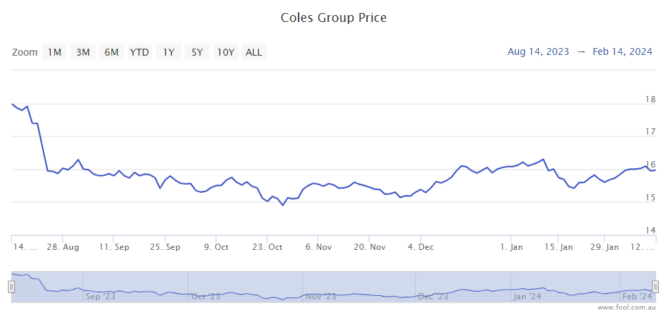
    Coles Group Ltd (ASX: COL) shares are down more than 10% in the last six months, and the economic pain for the ASX supermarket share may not be over if shelf prices fall.

    In the last two years, there have been periods of time where the market was excited by Coles’ ability to pass on price rises to consumers. During FY23, we did see the company’s gross profit margin slightly increase, meaning it seemed to have increased prices a little more than what suppliers had charged.

    If the company’s earnings before interest tax (EBIT) margin stays the same (or rises), then revenue growth due to inflation is helpful. For example, if Coles’ EBIT margin were 5%, it’d make $5 of EBIT on a $100 basket of goods. If the EBIT margin stays at 5% and the basket price rises to $110, Coles would make $5.50 of EBIT. That’s a stronger bottom line from inflation, even though the margin hasn’t changed. I think this is why Coles shares rose a couple of times during 2022 and 2023.

    Food prices to fall?

    We’ve already seen Coles reduce lamb prices in supermarkets by a significant amount and there are potentially more cuts for some products under consideration.

    Reporting by The Australian this week suggested that supermarkets are wanting to cut prices amid political pressure from a federal Senate inquiry into supermarket prices.  

    Coles has reportedly asked some suppliers for price cuts to reflect a decline in inflation and a reduction of input costs such as logistics and raw materials, which are now cheaper than recent peaks. However, The Australian reported that some suppliers may not give in easily to those price-cut requests because they want to protect their own profits.

    In a submission to the Senate inquiry, Coles said its energy, labour logistics and packaging costs had increased by $1.4 billion between 2019 to 2023, with $600 million of that being because of higher employee costs, driven by wage increases. It said:

    Significant increases in global commodity prices have flowed through to Australia and impacted Coles and its suppliers, resulting in the pass-through of increasing input costs to fresh and packaged goods.

    Lower profits for Coles?

    If the company sees lower profit, that could be a headwind for Coles shares.

    While some input costs may have reduced, wage and rent costs are increasing for Coles.

    Plus, even if its EBIT margin somehow stays the same, Coles’ profit may suffer from deflation if the (above example of) $110 basket of goods heads back towards a cost of $100.

    The broker UBS thinks Coles is likely to lose market share over the next six months, with Aldi best-placed to take market share, while Woolworths Group Ltd (ASX: WOW) also has the potential to gain share.

    Coles could see increased costs from its new Witron and Ocado automated warehouses.

    UBS thinks the Coles EBIT will fall to $1.85 billion and net profit after tax (NPAT) could fall by around 10% to $997 million, leading to an approximate 10% fall in the dividend per share. However, Coles is then expected to see earnings recover to almost FY23 levels in FY25 and eclipse FY23 in FY26.

    The post How price cuts on the shelves could hurt Coles shares appeared first on The Motley Fool Australia.

    Wondering where you should invest $1,000 right now?

    When investing expert Scott Phillips has a stock tip, it can pay to listen. After all, the flagship Motley Fool Share Advisor newsletter he has run for over ten years has provided thousands of paying members with stock picks that have doubled, tripled or even more.*

    Scott just revealed what he believes could be the ‘five best ASX stocks’ for investors to buy right now. These stocks are trading at near dirt-cheap prices and Scott thinks they could be great buys right now…

    See The 5 Stocks
    *Returns as of 10 November 2023

    (function() {
    function setButtonColorDefaults(param, property, defaultValue) {
    if( !param || !param.includes(‘#’)) {
    var button = document.getElementsByClassName(“pitch-snippet”)[0].getElementsByClassName(“pitch-button”)[0];
    button.style[property] = defaultValue;
    }
    }

    setButtonColorDefaults(“#0095C8”, ‘background’, ‘#5FA85D’);
    setButtonColorDefaults(“#0095C8”, ‘border-color’, ‘#43A24A’);
    setButtonColorDefaults(“#fff”, ‘color’, ‘#fff’);
    })()

    More reading

    Motley Fool contributor Tristan Harrison has no position in any of the stocks mentioned. The Motley Fool Australia’s parent company Motley Fool Holdings Inc. has no position in any of the stocks mentioned. The Motley Fool Australia has positions in and has recommended Coles Group. The Motley Fool has a disclosure policy. This article contains general investment advice only (under AFSL 400691). Authorised by Scott Phillips.

    from The Motley Fool Australia https://ift.tt/XBpdsCy

  • I’d grow my wealth by buying these so-called ‘expensive’ ASX stocks

    High fashion look. glamor closeup portrait of beautiful sexy stylish Caucasian young woman model with bright makeup, with red lips, with perfect clean skin.High fashion look. glamor closeup portrait of beautiful sexy stylish Caucasian young woman model with bright makeup, with red lips, with perfect clean skin.

    All too often, we’re led to believe the money is made by buying cheap ASX stocks. The problem is the term ‘cheap’ is usually tied to crude yardsticks.

    One measure considered to be a trusty steed among experts for valuation is the price-to-earnings (P/E) ratio. Presenting a multiple of a company’s share price to earnings per share (EPS), the metric is rather simple to apply. The value is typically compared against the average for its industry or benchmark index to determine value — cheap or expensive.

    I’m here to say that sometimes you get what you pay for in the world of investing. Even a few stock-picking greats tend to agree.

    When ASX stocks are ‘expensive’ by name, not by nature

    Have you ever purchased a cheap product and been disappointed by its lack of performance or longevity? Or maybe there’s something you never skimp out on, knowing the higher upfront cost works out less expensive over the life of ownership.

    In those moments, you are calculating the sticker price and the intrinsic value over the life of the purchase. This is why the P/E ratio can lead an investor astray, in my opinion.

    Think of it like this… say you’re shopping for some fresh footwear. You probably know two variables: the asking price and probably a rough idea of how many times you’ll wear them — call it a 12-month forward price-to-wear ratio.

    This is somewhat similar to a P/E ratio for an ASX stock. You roughly know the multiple you will pay for the near-term (12-month) value as a function of price and estimated number of wears (or earnings) over the next year. However, what isn’t so obvious is how long each of those shoes might last.

    Shoes Product price Number of wears Forward price-to-wear ratio
    Jaguar Max 4 $180.00 50 3.6
    Leap 400 $240.00 50 4.8
    NoCap Retro $150.00 50 3.0
    Fictional shoes for demonstration purposes

    The table above suggests a pair of Leap 400s is the most expensive option, with a price-to-wear of 4.8 times.

    But let’s say the other two pairs only last a year while the dearer pair stays in good shape for three years or 150 wears. Suddenly, the justifiable price-to-wear ratio of the more expensive shoes is 9 times for it to be on par with the cheapest option.

    Lifetime intrinsic value → $450 (justifiable price) / 150 wears = 3.0 price-to-wear ratio

    Therefore, the next 12-months valuation → $450 / 50 wears = 9.0 price-to-wear ratio

    In short, this means any price below $450 would suggest better value than even the cheapest choice.

    This is how quality at a premium near-term valuation can still represent greater value than cheaper, poor-quality ASX stocks. That is why it’s important to consider a company’s long-term earning potential, not just the next year.

    Justified quality on the ASX

    An extremely successful investor by the name of Terry Smith is a beacon of knowledge when it comes to this notion of paying up for quality.

    Smith has run the Fundsmith Equity Fund since 2010, achieving an annualised return of 15.4% since inception, outperforming the MSCI World Index. Yet, more often than not, the fund’s holdings appear expensive based on a P/E ratio.

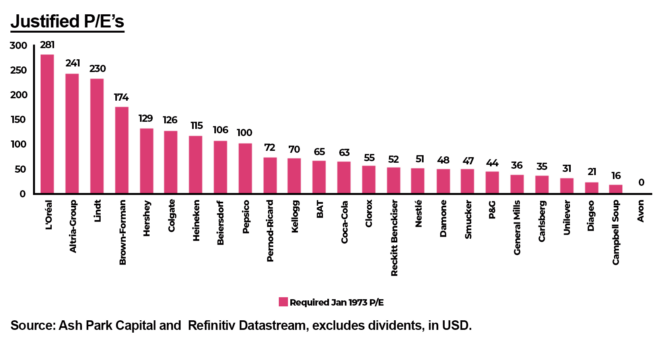
    Smith has addressed concerns among his investors in the past by drawing upon history. For example, he showed the earnings multiple you could have paid in 1973 for companies and still have beaten the index, as depicted above.

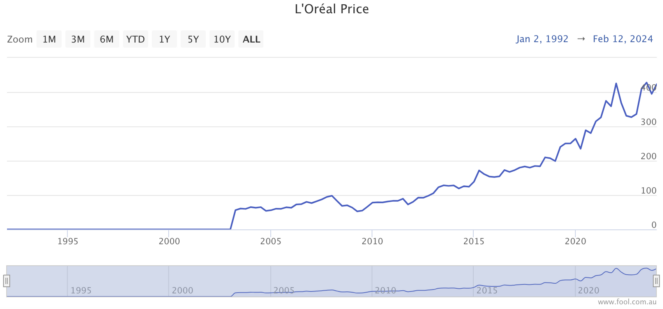
    Yes, buying L’Oreal shares at 281 times earnings in 1973 ended up making sense despite its seemingly obscene valuation. Why? Because of the even more insane amount of growth that occurred over the next 50 years.

    So, which ASX stocks do I think could be the L’Oreals of the world a decade from now?

    • WiseTech Global Ltd (ASX: WTC) — P/E of 116 times
    • Altium Ltd (ASX: ALU) — P/E of 67 times
    • Lovisa Holdings Ltd (ASX: LOV) — P/E of 40 times

    Although expectations might already be high for these three companies, I believe each has the potential to expand their businesses vastly over the next five to 10 years.

    The post I’d grow my wealth by buying these so-called ‘expensive’ ASX stocks appeared first on The Motley Fool Australia.

    Wondering where you should invest $1,000 right now?

    When investing expert Scott Phillips has a stock tip, it can pay to listen. After all, the flagship Motley Fool Share Advisor newsletter he has run for over ten years has provided thousands of paying members with stock picks that have doubled, tripled or even more.*

    Scott just revealed what he believes could be the ‘five best ASX stocks’ for investors to buy right now. These stocks are trading at near dirt-cheap prices and Scott thinks they could be great buys right now…

    See The 5 Stocks
    *Returns as of 10 November 2023

    (function() {
    function setButtonColorDefaults(param, property, defaultValue) {
    if( !param || !param.includes(‘#’)) {
    var button = document.getElementsByClassName(“pitch-snippet”)[0].getElementsByClassName(“pitch-button”)[0];
    button.style[property] = defaultValue;
    }
    }

    setButtonColorDefaults(“#0095C8”, ‘background’, ‘#5FA85D’);
    setButtonColorDefaults(“#0095C8”, ‘border-color’, ‘#43A24A’);
    setButtonColorDefaults(“#fff”, ‘color’, ‘#fff’);
    })()

    More reading

    Motley Fool contributor Mitchell Lawler has positions in Lovisa. The Motley Fool Australia’s parent company Motley Fool Holdings Inc. has positions in and has recommended Altium, Lovisa, and WiseTech Global. The Motley Fool Australia has positions in and has recommended WiseTech Global. The Motley Fool Australia has recommended Lovisa. The Motley Fool has a disclosure policy. This article contains general investment advice only (under AFSL 400691). Authorised by Scott Phillips.

    from The Motley Fool Australia https://ift.tt/nFVwrUH

  • Why AMP, Core Lithium, Downer EDI, and IDP Education shares are racing higher

    A couple are shocked and elated at the good news they've just seen on their devices.

    A couple are shocked and elated at the good news they've just seen on their devices.

    The S&P/ASX 200 Index (ASX: XJO) is having a tough time on Wednesday. In afternoon trade, the benchmark index is down 0.95% to 7,532.1 points.

    Four ASX shares that have avoided the selloff today are listed below. Here’s why they are rising:

    AMP Ltd (ASX: AMP)

    The AMP share price has jumped 10% to $1.07. Investors have been buying the financial services company’s shares following the release of its full year results. AMP reported a 6.5% increase in underlying net profit after tax to $196 million. It also revealed that a $295 million share buyback is in the works.

    Core Lithium Ltd (ASX: CXO)

    The Core Lithium share price is up 11% to 20.5 cents. This is despite there being no news out of the lithium miner today. However, with its shares down by 80% since this time last year, some investors may believe that value is emerging. Alternatively, short sellers could be buying shares to close their sizeable positions.

    Downer EDI Ltd (ASX: DOW)

    The Downer share price is up almost 14% to $4.90. This follows news that the integrated services company has returned to profit growth during the first half of FY 2024. Downer reported a 1% decline in revenue but an 11.9% increase in underlying NPATA to $76.1 million. This allowed the company’s board to increase its interim dividend by 20% to 6 cents per share.

    IDP Education Ltd (ASX: IEL)

    The IDP Education share price is up 9% to $22.11. This morning, this student placement and language testing company released its half-year results and revealed strong revenue and earnings growth. The latter saw its EBIT increase 25% to $159 million, which was comfortably ahead of the market’s expectations for the half.

    The post Why AMP, Core Lithium, Downer EDI, and IDP Education shares are racing higher appeared first on The Motley Fool Australia.

    Wondering where you should invest $1,000 right now?

    When investing expert Scott Phillips has a stock tip, it can pay to listen. After all, the flagship Motley Fool Share Advisor newsletter he has run for over ten years has provided thousands of paying members with stock picks that have doubled, tripled or even more.*

    Scott just revealed what he believes could be the ‘five best ASX stocks’ for investors to buy right now. These stocks are trading at near dirt-cheap prices and Scott thinks they could be great buys right now…

    See The 5 Stocks
    *Returns as of 10 November 2023

    (function() {
    function setButtonColorDefaults(param, property, defaultValue) {
    if( !param || !param.includes(‘#’)) {
    var button = document.getElementsByClassName(“pitch-snippet”)[0].getElementsByClassName(“pitch-button”)[0];
    button.style[property] = defaultValue;
    }
    }

    setButtonColorDefaults(“#0095C8”, ‘background’, ‘#5FA85D’);
    setButtonColorDefaults(“#0095C8”, ‘border-color’, ‘#43A24A’);
    setButtonColorDefaults(“#fff”, ‘color’, ‘#fff’);
    })()

    More reading

    Fetching Disclosure…

    from The Motley Fool Australia https://ift.tt/tfAJvkQ

  • Why Fletcher Building, Graincorp, GUD, and Seek shares are sinking today

    A young male investor wearing a white business shirt screams in frustration with his hands grasping his hair after ASX 200 shares fell rapidly today and appear to be heading into a stock market crash

    A young male investor wearing a white business shirt screams in frustration with his hands grasping his hair after ASX 200 shares fell rapidly today and appear to be heading into a stock market crash

    In afternoon trade, the S&P/ASX 200 Index (ASX: XJO) is on course to record a disappointing decline. At the time of writing, the benchmark index is down 1% to 7,529.3 points.

    Four ASX shares that are falling more than most today are listed below. Here’s why they are sinking:

    Fletcher Building Ltd (ASX: FBU)

    The Fletcher Building share price is down over 7% to $3.43. This morning, Fletcher Building released its half-year results and reported a 1% decline in revenue to NZ$4,248 million and a net loss after tax of NZ$120 million. In addition, the building products company announced that its CEO, Ross Taylor, and chair, Bruce Hassall, will be standing down.

    Graincorp Ltd (ASX: GNC)

    The Graincorp share price is down almost 14% to $7.09. This follows the release of the grain exporter’s guidance for FY 2024 at its annual general meeting. Graincorp expects underlying EBITDA in the range of $270 million to $310 million and underlying net profit after tax of $65 million to $95 million. This will be down from $565 million and $250 million, respectively, in FY 2023.

    GUD Holdings Limited (ASX: GUD)

    The GUD share price is down 8.5% to $11.00. This follows the release of the diversified products company’s half-year results. GUD reported an 11.6% increase in underlying EBITA to $98 million thanks to strong growth from the APG business and the ongoing resilience of the Automotive business. However, it warned that its APG business will be impacted by “short-term deferrals of replenishment orders (Toyota).” This means that “H2 EBITA is expected to be slightly below H1.”

    Seek Ltd (ASX: SEK)

    The Seek share price is down a further 6% to $24.07. This job listings company’s shares have come under pressure since the release of its results on Tuesday. Not even a broker upgrade by Macquarie has stopped the rot. Its analysts upgraded Seek’s shares to an outperform rating with a $29.00 price target this morning.

    The post Why Fletcher Building, Graincorp, GUD, and Seek shares are sinking today appeared first on The Motley Fool Australia.

    Wondering where you should invest $1,000 right now?

    When investing expert Scott Phillips has a stock tip, it can pay to listen. After all, the flagship Motley Fool Share Advisor newsletter he has run for over ten years has provided thousands of paying members with stock picks that have doubled, tripled or even more.*

    Scott just revealed what he believes could be the ‘five best ASX stocks’ for investors to buy right now. These stocks are trading at near dirt-cheap prices and Scott thinks they could be great buys right now…

    See The 5 Stocks
    *Returns as of 10 November 2023

    (function() {
    function setButtonColorDefaults(param, property, defaultValue) {
    if( !param || !param.includes(‘#’)) {
    var button = document.getElementsByClassName(“pitch-snippet”)[0].getElementsByClassName(“pitch-button”)[0];
    button.style[property] = defaultValue;
    }
    }

    setButtonColorDefaults(“#0095C8”, ‘background’, ‘#5FA85D’);
    setButtonColorDefaults(“#0095C8”, ‘border-color’, ‘#43A24A’);
    setButtonColorDefaults(“#fff”, ‘color’, ‘#fff’);
    })()

    More reading

    Motley Fool contributor James Mickleboro has positions in Seek. The Motley Fool Australia’s parent company Motley Fool Holdings Inc. has no position in any of the stocks mentioned. The Motley Fool Australia has recommended Seek. The Motley Fool has a disclosure policy. This article contains general investment advice only (under AFSL 400691). Authorised by Scott Phillips.

    from The Motley Fool Australia https://ift.tt/qCBvzgS

  • Why are ASX 200 tech shares taking a beating today?

    Man on a laptop thinking.

    Man on a laptop thinking.

    S&P/ASX 200 Index (ASX: XJO) tech shares are having a tough time of it today.

    Though they’re not alone.

    In early afternoon trade the ASX 200 is down 1.0%.

    As for the big tech stocks:

    • Cloud-based software solutions provider WiseTech Global Ltd (ASX: WTC) shares are down 1.4%
    • Accounting software provider Xero Ltd (ASX: XRO) shares are down 1.3%
    • Data centre operator NextDc Ltd (ASX: NXT) shares are down 1.5%

    So, why are investors pressuring these ASX 200 tech shares on Wednesday?

    ASX 200 tech shares eyeing sticky global inflation

    The good news is that none of these companies have reported anything that might cause concern with their specific business models.

    The bad news is that ASX 200 tech shares tend to be relatively sensitive to interest rates. And they look to be succumbing to headwinds blowing out of the United States.

    With the latest inflation data from the world’s biggest economy coming in higher than expected, the tech-heavy Nasdaq Composite Index (INDEXSP: .INX) closed down 1.8% yesterday (overnight Aussie time).

    And ASX 200 tech shares are following the US market’s lead lower.

    Consensus estimates had pencilled in a 0.2% month on month increase in the US consumer price index (CPI) and a 2.9% year on year increase. That proved optimistic, with CPI increasing 0.3% in January and 3.1% over the past 12 months.

    The data all but negated the chance of an interest rate cut from the US Fed in March, as some investors had still been hoping.

    Commenting on investors’ reactions to the US inflation print, Chris Zaccarelli, chief investment officer at Independent Advisor Alliance, said (quoted by Bloomberg):

    Today’s CPI report caught a lot of people off guard. Many investors were expecting the Fed to begin cutting rates and were spending a lot of time arguing that the Fed was taking too long to get started – not appreciating that inflation could be sticky and not continue down in a straight line.

    But that doesn’t mean investors should rush to hit the sell button on their ASX 200 tech shareholdings.

    While the world’s most watched central bank may hold rates steady in March, most analysts still expect the Fed to start easing in 2024, possibly in the second quarter.

    Brian Rose, head of asset allocation at UBS Global Wealth Management, said the latest US inflation print “doesn’t change our positive fundamental outlook for 2024 of solid growth, further disinflation, and the start of Fed rate cuts in Q2 that is supportive of risk assets”.

    The post Why are ASX 200 tech shares taking a beating today? appeared first on The Motley Fool Australia.

    Wondering where you should invest $1,000 right now?

    When investing expert Scott Phillips has a stock tip, it can pay to listen. After all, the flagship Motley Fool Share Advisor newsletter he has run for over ten years has provided thousands of paying members with stock picks that have doubled, tripled or even more.*

    Scott just revealed what he believes could be the ‘five best ASX stocks’ for investors to buy right now. These stocks are trading at near dirt-cheap prices and Scott thinks they could be great buys right now…

    See The 5 Stocks
    *Returns as of 10 November 2023

    (function() {
    function setButtonColorDefaults(param, property, defaultValue) {
    if( !param || !param.includes(‘#’)) {
    var button = document.getElementsByClassName(“pitch-snippet”)[0].getElementsByClassName(“pitch-button”)[0];
    button.style[property] = defaultValue;
    }
    }

    setButtonColorDefaults(“#0095C8”, ‘background’, ‘#5FA85D’);
    setButtonColorDefaults(“#0095C8”, ‘border-color’, ‘#43A24A’);
    setButtonColorDefaults(“#fff”, ‘color’, ‘#fff’);
    })()

    More reading

    Motley Fool contributor Bernd Struben has no position in any of the stocks mentioned. The Motley Fool Australia’s parent company Motley Fool Holdings Inc. has positions in and has recommended WiseTech Global and Xero. The Motley Fool Australia has positions in and has recommended WiseTech Global and Xero. The Motley Fool has a disclosure policy. This article contains general investment advice only (under AFSL 400691). Authorised by Scott Phillips.

    from The Motley Fool Australia https://ift.tt/Q19zVmJ

  • Everything you need to know about the CBA dividend

    Happy man in a holiday shirt holding out Australian dollar notes, symbolising dividends.Happy man in a holiday shirt holding out Australian dollar notes, symbolising dividends.

    Commonwealth Bank of Australia (ASX: CBA) just reported a fairly underwhelming FY24 half-year result. But, pleasingly, the CBA dividend got a slight boost. Let’s find out what you need to know.

    In terms of the actual result, it reported a 3% fall of the cash net profit after tax (NPAT) to $5 billion and an 8% decline in the statutory NPAT to $4.8 billion. But, it made enough profit to justify a larger payout than last year.

    CBA dividend

    The ASX bank share declared a fully franked half-year dividend of $2.15 per share, which was 2% higher than the FY23 first-half dividend.

    This payout represented a dividend payout ratio of 72% of cash NPAT, meaning the bank is keeping 28% of its profit to re-invest into the business and/or improve the balance sheet.

    The dividend reinvestment plan (DRP) is still active and is available for shareholders, though no discount will be applied to the shares allocated under the plan for the interim dividend. CBA expects to buy all of the shares on the market to satisfy the shares needed for the DRP.

    The ex-dividend date for this upcoming dividend is 21 February 2024, so investors will need to own shares by the end of trading on 20 February 2024 to gain entitlement to this dividend. The DRP participation date is 23 February 2024.

    The CBA dividend is expected to be paid on 28 March 2024, which is a month and a half away.

    The bank has also been returning cash to shareholders via its share buyback. It said it had completed $154 million of the $1 billion share buyback.

    How big is the dividend yield?

    At the current CBA share price, the $2.15 per share payout represents a fully franked dividend yield of 1.9% and a grossed-up dividend yield of 2.7%.

    The latest two dividends – this one and the one six months ago – amount to a fully franked dividend yield of 4% and a grossed-up dividend yield of 5.75%.

    CBA share price snapshot

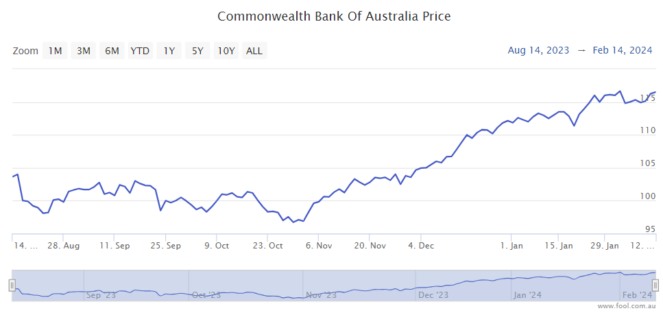
    Over the past six months, CBA shares have gone up 9%.

    The post Everything you need to know about the CBA dividend appeared first on The Motley Fool Australia.

    Wondering where you should invest $1,000 right now?

    When investing expert Scott Phillips has a stock tip, it can pay to listen. After all, the flagship Motley Fool Share Advisor newsletter he has run for over ten years has provided thousands of paying members with stock picks that have doubled, tripled or even more.*

    Scott just revealed what he believes could be the ‘five best ASX stocks’ for investors to buy right now. These stocks are trading at near dirt-cheap prices and Scott thinks they could be great buys right now…

    See The 5 Stocks
    *Returns as of 10 November 2023

    (function() {
    function setButtonColorDefaults(param, property, defaultValue) {
    if( !param || !param.includes(‘#’)) {
    var button = document.getElementsByClassName(“pitch-snippet”)[0].getElementsByClassName(“pitch-button”)[0];
    button.style[property] = defaultValue;
    }
    }

    setButtonColorDefaults(“#0095C8”, ‘background’, ‘#5FA85D’);
    setButtonColorDefaults(“#0095C8”, ‘border-color’, ‘#43A24A’);
    setButtonColorDefaults(“#fff”, ‘color’, ‘#fff’);
    })()

    More reading

    Motley Fool contributor Tristan Harrison has no position in any of the stocks mentioned. The Motley Fool Australia’s parent company Motley Fool Holdings Inc. has no position in any of the stocks mentioned. The Motley Fool Australia has no position in any of the stocks mentioned. The Motley Fool has a disclosure policy. This article contains general investment advice only (under AFSL 400691). Authorised by Scott Phillips.

    from The Motley Fool Australia https://ift.tt/t6aLCYh

  • 3 things to love about ASX uranium shares right now

    One of the biggest trends in our share market in 2023 was the rise of ASX uranium shares. Thanks to a number of factors, mostly a rocketing uranium price, uranium shares had a cracking year last year.

    Take popular uranium stock Paladin Energy Ltd (ASX: PDN). Paladin shares spent the first half of last year essentially going nowhere. But between June and September, the company rocketed by more than 100%.

    That trend continued into 2024, with Paladin shares gaining another 42.5% between 1 January and 7 February.

    The gains were even more pronounced with the Boss Energy Ltd (ASX: BOE) share price. The period from March 2023 to February 2024 has seen the Boss Energy share price rise more than 200%.

    But given the scope of these delightful share price rises, some investors might be thinking that the party is over for ASX uranium shares. Especially considering that Paladin Energy stock has lost more than 8% over the past week alone (Boss is down more than 10%).

    Well, that’s not the view of one ASX expert.

    David Haddad, portfolio manager at Eiger Capital, recently penned a piece discussing the advantages of uranium-based electricity. It makes for some compelling reading for anyone with an interest in ASX uranium shares.

    Expert gives three reasons why ASX uranium shares are still a buy

    Haddad starts off by listing several advantages that nuclear power has, in his opinion, over other renewable energy sources:

    Besides being a low-carbon source of power, it offers several other advantages over most other renewables: long life; high reliability/efficiency; competitive life-time cost; less intensive use of raw materials; and lower physical footprint.

    He goes on to list three reasons why Eiger Capital sees nuclear energy as an important player in the energy needs of the future.

    Firstly, Haddad argues that nuclear reactors are relatively small, as “a 1GW nuclear power plant covers approximately 3.5 [square kilometres] while a coal plant of the same size is almost twice that”.

    Next, the Eiger Capital report notes that “the mining of uranium does not take much space relative to the output of a nuclear power plant”. He estimates that a 1-gigawatt coal-fired power plant would burn 2.5 million tonnes of bituminous coal every year, or 6.5 million tonnes of brown coal. Haddad argues that a nuclear power plant of the same size would use just 27 tonnes per annum of uranium.

    Thirdly, Haddad posits that nuclear power plants are highly efficient compared to other power sources, with “plant availability of more than 90% over long life spans”.

    As a result of this research, Eiger Captial concludes with this:

    We continue to believe that nuclear energy will play an increasingly important role in providing the world with clean power and maintain significant positions in near-term uranium producers, Boss Energy and Paladin Energy.

    No doubt fans of ASX uranium shares like Boss And Paladin will appreciate these insights. Let’s see how they all play out this year and beyond.

    The post 3 things to love about ASX uranium shares right now appeared first on The Motley Fool Australia.

    Wondering where you should invest $1,000 right now?

    When investing expert Scott Phillips has a stock tip, it can pay to listen. After all, the flagship Motley Fool Share Advisor newsletter he has run for over ten years has provided thousands of paying members with stock picks that have doubled, tripled or even more.*

    Scott just revealed what he believes could be the ‘five best ASX stocks’ for investors to buy right now. These stocks are trading at near dirt-cheap prices and Scott thinks they could be great buys right now…

    See The 5 Stocks
    *Returns as of 10 November 2023

    (function() {
    function setButtonColorDefaults(param, property, defaultValue) {
    if( !param || !param.includes(‘#’)) {
    var button = document.getElementsByClassName(“pitch-snippet”)[0].getElementsByClassName(“pitch-button”)[0];
    button.style[property] = defaultValue;
    }
    }

    setButtonColorDefaults(“#0095C8”, ‘background’, ‘#5FA85D’);
    setButtonColorDefaults(“#0095C8”, ‘border-color’, ‘#43A24A’);
    setButtonColorDefaults(“#fff”, ‘color’, ‘#fff’);
    })()

    More reading

    Motley Fool contributor Sebastian Bowen has no position in any of the stocks mentioned. The Motley Fool Australia’s parent company Motley Fool Holdings Inc. has no position in any of the stocks mentioned. The Motley Fool Australia has no position in any of the stocks mentioned. The Motley Fool has a disclosure policy. This article contains general investment advice only (under AFSL 400691). Authorised by Scott Phillips.

    from The Motley Fool Australia https://ift.tt/YtB8i9U