• Better ASX bank buy: ANZ or NAB shares?

    Two people comparing and analysing material.Two people comparing and analysing material.

    Even though the US and Europe have seen troubles in their banking sector, the major ASX banks have been going gangbusters.

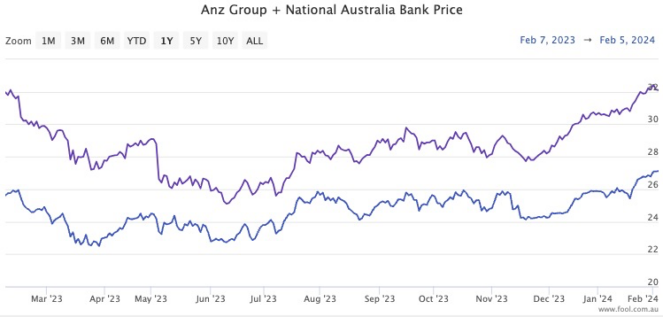
    The ANZ Group Holdings Ltd (ASX: ANZ) share price, for example, has rocketed 22.5% since late March last year, and National Australia Bank Ltd (ASX: NAB) has lifted more than 27% since June.

    So, right now, which is the better buy?

    Let’s break it down:

    ANZ vs NAB shares

    Firstly, let’s compare the dividends.

    ANZ hands out a better dividend yield of 6.4% but it is only 56% franked. While NAB shares currently pay out 5.2%, they are fully franked. 

    So ultimately there is not a huge difference on that metric.

    In the 2023 financial year that ended September, ANZ made $7 billion net profit on 1.7% net interest margin (NIM). NAB managed $7.4 billion on 1.5% NIM.

    Again, not much in it.

    What do the experts think?

    According to CMC Invest, a lukewarm 6 out of 17 analysts rate NAB shares as a buy. ANZ’s endorsement rate is only marginally better with 7 buy ratings from 16 analysts.

    It’s a tough choice.

    Do you even have to buy a bank?

    Perhaps the bigger question is whether it is currently worth buying bank shares at all.

    The analysts at VanEck recently pointed out that “the rally in bank [stock] prices has stretched their valuations”. 
    “Australia’s banks, when compared globally, are also the most expensive in the developed world by 12-month forward price to earnings and price to book,” they said on the VanEck blog.

    “While Australia’s prospects for a soft landing have improved for 2024, the market seems to be pricing a dream scenario for the banks despite the risks of increased mortgage stress in a prolonged higher interest rate environment.”

    Also, the banking sector can be irrationally competitive.

    The VanEck memo reminded investors that only a few months ago, Australian banks waged a vicious home loan price war against each other. 

    This ate into their NIMs at a time when interest rates had increased 12 times in just over a year.

    “Each of Australia’s ‘Big 4’ banks face continuing headwinds in 2024. 

    “A subdued economic outlook and potential RBA rate cuts could see the Big 4 banks’ net interest margins continue to deteriorate.”

    So which is the better bank buy? 

    Maybe neither.

    The post Better ASX bank buy: ANZ or NAB shares? appeared first on The Motley Fool Australia.

    Wondering where you should invest $1,000 right now?

    When investing expert Scott Phillips has a stock tip, it can pay to listen. After all, the flagship Motley Fool Share Advisor newsletter he has run for over ten years has provided thousands of paying members with stock picks that have doubled, tripled or even more.*

    Scott just revealed what he believes could be the ‘five best ASX stocks’ for investors to buy right now. These stocks are trading at near dirt-cheap prices and Scott thinks they could be great buys right now…

    See The 5 Stocks
    *Returns as of 10 November 2023

    (function() {
    function setButtonColorDefaults(param, property, defaultValue) {
    if( !param || !param.includes(‘#’)) {
    var button = document.getElementsByClassName(“pitch-snippet”)[0].getElementsByClassName(“pitch-button”)[0];
    button.style[property] = defaultValue;
    }
    }

    setButtonColorDefaults(“#0095C8”, ‘background’, ‘#5FA85D’);
    setButtonColorDefaults(“#0095C8”, ‘border-color’, ‘#43A24A’);
    setButtonColorDefaults(“#fff”, ‘color’, ‘#fff’);
    })()

    More reading

    Motley Fool contributor Tony Yoo has no position in any of the stocks mentioned. The Motley Fool Australia’s parent company Motley Fool Holdings Inc. has no position in any of the stocks mentioned. The Motley Fool Australia has no position in any of the stocks mentioned. The Motley Fool has a disclosure policy. This article contains general investment advice only (under AFSL 400691). Authorised by Scott Phillips.

    from The Motley Fool Australia https://ift.tt/K2XNOYx

  • How do you know which ASX shares your superannuation is invested in?

    A mature age woman with a groovy short haircut and glasses, sits at her computer, pen in hand thinking about information she is seeing on the screen.

    A mature age woman with a groovy short haircut and glasses, sits at her computer, pen in hand thinking about information she is seeing on the screen.

    Most Australians would be aware that they have a superannuation fund. After all, that’s where 11% of our salary gets deposited every time we get paid – certainly not a trivial sum of cash. But if you asked most Australians where their super is actually invested, whether that be in ASX shares or not, I’d wager that most would have no clue.

    Normally, when we start our first, or even a new job, we’re asked what super fund we’d like our money deposited into. You will then be likely asked by whatever fund you’ve chosen which risk profile you’d like to be in. The most common option is a ‘balanced’ fund. But there are usually other choices such as ‘conservative’ or ‘high growth’ available.

    And for most Australians, that’s where the dedicated thought tends to end – at least until you reach a certain age and turn your thoughts to retirement planning.

    But I think it’s a good idea for every Australian to have at least a fair idea of where their money is being invested. After all, your super fund is the best shot at a comfortable retirement for most of us. So paying attention to where 11% of your salary is going is probably a sound move.

    So how do you know which ASX shares your superannuation is invested in?

    Finding the ASX shares your super fund is invested in

    For most people, your first and last stop will be the superannuation fund itself.

    Every super fund runs a slightly different investment portfolio for its members. But for most superannuation funds, you can bet that a good chunk of your money is being used to buy shares – both ASX shares and international stocks.

    Super funds have a duty to maximise the potential returns of their members, accounting for their risk profiles. And the asset class that consistently delivers the highest returns are ASX and international shares.

    As an example, we’ll look at the largest super fund in Australia – AustralianSuper.

    Like almost all funds, AustralianSuper offers a range of different investing options. But the most popular is the ‘balanced fund’.

    Balanced funds are named due to their exposure to a variety of different asset classes. These typically include ASX and international shares but also cash, bonds and property. This is done to balance the search for high returns with a desire to reduce portfolio volatility.

    In AustralianSuper’s case, the fund tells us that currently (as of 30 September), its balanced superannuation portfolio is weighted 21.2% to ASX shares. A further 25.5% is weighted to international shares.

    You have to dig a little deeper to find out exactly which investments these asset classes are made up of. But the fund’s most recent data tells us that the largest holdings in the AustralianSuper balanced portfolio come down to BHP Group Ltd (ASX: BHP), Commonwealth Bank of Australia (ASX: CBA), CSL Limited (ASX: CSL), Microsoft Corporation (NASDAQ: MSFT) and National Australia Bank Ltd (ASX: NAB).

    Other significant holdings include Amazon.com Inc (NASDAQ: AMZN), Woodside Energy Group Ltd (ASX: WDS) and Woolworths Group Ltd (ASX: WOW).

    Every portfolio is different

    AustralianSuper employs an actively managed strategy, meaning a team of investors decide which individual stocks will be included in its super funds. Both other superannuation providers might offer a simpler approach that just uses index funds and exchange-traded funds (ETFs). Indeed, many give us the choice of which strategy to pursue.

    So if you’re wondering which ASX shares are in your own super portfolio, head to its website. And if that fails, give your fund a call. Chances are, you’ll be able to find out without too much hassle.

    The post How do you know which ASX shares your superannuation is invested in? appeared first on The Motley Fool Australia.

    Wondering where you should invest $1,000 right now?

    When investing expert Scott Phillips has a stock tip, it can pay to listen. After all, the flagship Motley Fool Share Advisor newsletter he has run for over ten years has provided thousands of paying members with stock picks that have doubled, tripled or even more.*

    Scott just revealed what he believes could be the ‘five best ASX stocks’ for investors to buy right now. These stocks are trading at near dirt-cheap prices and Scott thinks they could be great buys right now…

    See The 5 Stocks
    *Returns as of 10 November 2023

    (function() {
    function setButtonColorDefaults(param, property, defaultValue) {
    if( !param || !param.includes(‘#’)) {
    var button = document.getElementsByClassName(“pitch-snippet”)[0].getElementsByClassName(“pitch-button”)[0];
    button.style[property] = defaultValue;
    }
    }

    setButtonColorDefaults(“#0095C8”, ‘background’, ‘#5FA85D’);
    setButtonColorDefaults(“#0095C8”, ‘border-color’, ‘#43A24A’);
    setButtonColorDefaults(“#fff”, ‘color’, ‘#fff’);
    })()

    More reading

    John Mackey, former CEO of Whole Foods Market, an Amazon subsidiary, is a member of The Motley Fool’s board of directors. Motley Fool contributor Sebastian Bowen has positions in Amazon, CSL, Microsoft, and National Australia Bank. The Motley Fool Australia’s parent company Motley Fool Holdings Inc. has positions in and has recommended Amazon, CSL, and Microsoft. The Motley Fool Australia has recommended Amazon and CSL. The Motley Fool has a disclosure policy. This article contains general investment advice only (under AFSL 400691). Authorised by Scott Phillips.

    from The Motley Fool Australia https://ift.tt/INokDVp

  • Here are the top 10 ASX 200 shares today

    Smiling man working on his laptop.

    Smiling man working on his laptop.

    This Wednesday heralded a return to form for the S&P/ASX 200 Index (ASX: XJO) and ASX shares. After two days of hefty falls, it was back to the races today.

    By the closing bell, the ASX 200 had added a rosy 0.45%, leaving the index at 7,615.8 points.

    This ASX bounceback comes after an equally enthusiastic turnaround up on Wall Street last night.

    The Dow Jones Industrial Average Index (DJX: .DJI) was in a good mood, rising by 0.37%.

    The Nasdaq Composite Index (NASDAQ: .IXIC) wasn’t quite as sunny, but still inched 0.073% higher.

    But let’s dig a little deeper now into the pleasing day the markets enjoyed today with a look at the various ASX sectors.

    Winners and losers

    It was a fairly positive day for ASX shares across the board this Wednesday. But not all sectors enjoyed the rising tide.

    The most unfortunate of those were ASX energy stocks. The S&P/ASX 200 Energy Index (ASX: XEJ) reversed yesterday’s gains with a decline of 0.95%.

    Also on the nose were consumer discretionary shares. The S&P/ASX 200 Consumer Discretionary Index (ASX: XDJ) ended up losing 0.72% of its value today.

    Our next loser was the communications sector, evidenced by the S&P/ASX 200 Communication Services Index (ASX: XTJ)’s loss of 0.35%.

    Rounding out the red sectors were consumer staples stocks. The S&P/ASX 200 Consumer Staples Index (ASX: XSJ) ended up slipping by 0.03%.

    But that was it for the retreaters. Let’s now turn to the advancers.

    No sector advanced more than utilties shares today. The S&P/ASX 200 Utilities Index (ASX: XUJ) had a ball, rocketing 1.74%.

    Mining stocks also had a great time, with the S&P/ASX 200 Materials Index (ASX: XMJ) shooting up 1.06%.

    Real estate investment trusts (REITs) were also in demand, with the S&P/ASX 200 A-REIT Index (ASX: XPJ) gaining 0.99%.

    As were healthcare shares. The S&P/ASX 200 Healthcare Index (ASX: XHJ) soared 0.73% by the end of trading.

    Industrial stocks didn’t miss out, with the S&P/ASX 200 Industrials Index (ASX: XNJ) surging 0.68%.

    The same could be said of tech shares, illustrated by the S&P/ASX 200 Information Technology Index (ASX: XIJ)’s rise of 0.63%.

    Gold shares got an invitation to the party too. The All Ordinaries Gold Index (ASX: XGD) vaulted 0.61% higher.

    Our final winner was the financial space. The S&P/ASX 200 Financials Index (ASX: XFJ) had bounced by a pleasing 0.32% by the closing bell.

    Top 10 ASX 200 shares countdown

    Today’s top stock came in as miner Chalice Mining Ltd (ASX: CHN).

    Chalice shares had a glorious day, bolting 8.52% higher to 95.5 cents each. There was no price-sensitive news from the company today, but we did get a look at a new corporate presentation from the company this morning.

    Here’s a look at the rest of this hump day’s winners:

    ASX-listed company Share price Price change
    Chalice Mining Ltd (ASX: CHN) $0.955 8.52%
    Alumina Limited (ASX: AWC) $1.115 5.69%
    Pilbara Minerals Ltd (ASX: PLS) $3.57 5.62%
    Liontown Resources Ltd (ASX: LTR) $0.95 5.56%
    Champion Iron Ltd (ASX: CIA) $8.29 5.54%
    Iluka Resources Ltd (ASX: ILU) $7.23 5.09%
    Virgin Money UK plc (ASX: VUK) $3.08 4.41%
    BWP Trust (ASX: BWP) $3.49 4.18%
    Lifestyle Communities Ltd (ASX: LIC) $18.22 4.17%
    IGO Ltd (ASX: IGO) $7.05 3.98%

    Our top 10 shares countdown is a recurring end-of-day summary to let you know which companies were making big moves on the day. Check in at Fool.com.au after the weekday market closes to see which stocks make the countdown.

    The post Here are the top 10 ASX 200 shares today appeared first on The Motley Fool Australia.

    Wondering where you should invest $1,000 right now?

    When investing expert Scott Phillips has a stock tip, it can pay to listen. After all, the flagship Motley Fool Share Advisor newsletter he has run for over ten years has provided thousands of paying members with stock picks that have doubled, tripled or even more.*

    Scott just revealed what he believes could be the ‘five best ASX stocks’ for investors to buy right now. These stocks are trading at near dirt-cheap prices and Scott thinks they could be great buys right now…

    See The 5 Stocks
    *Returns as of 10 November 2023

    (function() {
    function setButtonColorDefaults(param, property, defaultValue) {
    if( !param || !param.includes(‘#’)) {
    var button = document.getElementsByClassName(“pitch-snippet”)[0].getElementsByClassName(“pitch-button”)[0];
    button.style[property] = defaultValue;
    }
    }

    setButtonColorDefaults(“#0095C8”, ‘background’, ‘#5FA85D’);
    setButtonColorDefaults(“#0095C8”, ‘border-color’, ‘#43A24A’);
    setButtonColorDefaults(“#fff”, ‘color’, ‘#fff’);
    })()

    More reading

    Motley Fool contributor Sebastian Bowen has no position in any of the stocks mentioned. The Motley Fool Australia’s parent company Motley Fool Holdings Inc. has no position in any of the stocks mentioned. The Motley Fool Australia has no position in any of the stocks mentioned. The Motley Fool has a disclosure policy. This article contains general investment advice only (under AFSL 400691). Authorised by Scott Phillips.

    from The Motley Fool Australia https://ift.tt/QV4dOwL

  • Why the GQG share price is up 7% to a 52-week high and could keep rising

    A young woman holding her phone smiles broadly and looks excited, after receiving good news.

    A young woman holding her phone smiles broadly and looks excited, after receiving good news.

    The GQG Partners Inc (ASX: GQG) share price is charging higher on Wednesday.

    In afternoon trade, the fund manager’s shares are 7% to a 52-week high of $2.13.

    Why is the GQG share price racing higher?

    Investors have been bidding the company’s shares higher today in response to the release of its latest funds under management (FUM) update.

    According to the release, GQG’s FUM increased by an impressive 5.3% in January to US$127 billion.

    This comprises International Equity FUM of US$49.2 billion (up 5.8%), Global Equity FUM of US$33 billion (up 5.75%), Emerging Markets Equity FUM of US$35.1 billion (up 4.5%), and US Equity FUM of US$9.7 billion (up 4.3%).

    As a comparison, as we covered here on Tuesday, fellow fund manager Magellan Financial Group Ltd (ASX: MFG) released its FUM update for January and revealed just a 1.4% increase to A$36.3 billion. That is only modestly better than the performance of the ASX 200 index, which rose 1.2% for the month.

    Should you invest?

    Ord Minnett sees a lot of value in the GQG share price at the current level.

    And while it hasn’t yet responded to this update, which means its recommendation could change in the coming days (for better or worse), it currently has a buy rating and $2.40 price target on it shares.

    If Ord Minnett is on the money with this recommendation, it would mean upside of approximately 13% for investors over the next 12 months.

    In addition, the broker has pencilled in a 16 cents per share dividend in FY 2024. This equates to a very generous 7.5% dividend yield at current prices, which boosts the total potential return beyond 20%.

    The post Why the GQG share price is up 7% to a 52-week high and could keep rising appeared first on The Motley Fool Australia.

    Wondering where you should invest $1,000 right now?

    When investing expert Scott Phillips has a stock tip, it can pay to listen. After all, the flagship Motley Fool Share Advisor newsletter he has run for over ten years has provided thousands of paying members with stock picks that have doubled, tripled or even more.*

    Scott just revealed what he believes could be the ‘five best ASX stocks’ for investors to buy right now. These stocks are trading at near dirt-cheap prices and Scott thinks they could be great buys right now…

    See The 5 Stocks
    *Returns as of 10 November 2023

    (function() {
    function setButtonColorDefaults(param, property, defaultValue) {
    if( !param || !param.includes(‘#’)) {
    var button = document.getElementsByClassName(“pitch-snippet”)[0].getElementsByClassName(“pitch-button”)[0];
    button.style[property] = defaultValue;
    }
    }

    setButtonColorDefaults(“#0095C8”, ‘background’, ‘#5FA85D’);
    setButtonColorDefaults(“#0095C8”, ‘border-color’, ‘#43A24A’);
    setButtonColorDefaults(“#fff”, ‘color’, ‘#fff’);
    })()

    More reading

    Motley Fool contributor James Mickleboro has no position in any of the stocks mentioned. The Motley Fool Australia’s parent company Motley Fool Holdings Inc. has no position in any of the stocks mentioned. The Motley Fool Australia has no position in any of the stocks mentioned. The Motley Fool has a disclosure policy. This article contains general investment advice only (under AFSL 400691). Authorised by Scott Phillips.

    from The Motley Fool Australia https://ift.tt/AUa1yQL

  • Latin Resources shares up 18% as Maverick lithium IPO nears

    Two happy excited friends in euphoria mood after winning in a bet with a smartphone in hand.

    Two happy excited friends in euphoria mood after winning in a bet with a smartphone in hand.

    Latin Resources Ltd (ASX: LRS) shares are having a stunning session.

    In afternoon trade, the lithium developer’s shares are up almost 18% to 16.5 cents.

    Though, this doesn’t change much on a six-month basis, with the company’s shares still down by over 50% since this time in August.

    Why are Latin Resources shares surging?

    Investors have been buying Latin Resources and other ASX lithium shares today following improving sentiment in the industry.

    This appears to have been driven by a strong night of trade on global markets for lithium stocks. This saw Ganfeng Lithium jump 8%, Tianqi Lithium leap 7%, Albemarle rise 4%, and Lithium Americas Corp climb 7%.

    In addition, there has been some news related to Latin Resources that could be catching the eye of investors.

    The AFR is reporting that the terms are now out for the company’s spin-off of its exploration projects under the name of Maverick Minerals.

    Maverick Minerals is reportedly seeking to raise $5 million at 20 cents per share. This will give it a market capitalisation of $8.6 million at listing.

    Latin Resources will still hold onto 16% of the lithium explorer, with its existing shareholders given first dibs on up to 50% of Maverick stock under its IPO book build.

    Which projects does it own?

    Following the completion of its IPO, Maverick Minerals will own projects in Western Australia, New South Wales, Victoria, and Ontario, Canada.

    Its Western Australian projects include the Laverton Downs Project, the Shelby Project, the Kathleen Project, and the Albert Project.

    Whereas its New South Wales and Victoria projects include the Lachlan Fold Belt Project. And finally, its Canadian Projects include the Luka Lithium Project, the Marion Project, the Sollas Lake Lithium Project, and the Muriel Lithium Project.

    Maverick Minerals shares are scheduled to commence trade on the ASX boards on 6 March.

    The post Latin Resources shares up 18% as Maverick lithium IPO nears appeared first on The Motley Fool Australia.

    Wondering where you should invest $1,000 right now?

    When investing expert Scott Phillips has a stock tip, it can pay to listen. After all, the flagship Motley Fool Share Advisor newsletter he has run for over ten years has provided thousands of paying members with stock picks that have doubled, tripled or even more.*

    Scott just revealed what he believes could be the ‘five best ASX stocks’ for investors to buy right now. These stocks are trading at near dirt-cheap prices and Scott thinks they could be great buys right now…

    See The 5 Stocks
    *Returns as of 10 November 2023

    (function() {
    function setButtonColorDefaults(param, property, defaultValue) {
    if( !param || !param.includes(‘#’)) {
    var button = document.getElementsByClassName(“pitch-snippet”)[0].getElementsByClassName(“pitch-button”)[0];
    button.style[property] = defaultValue;
    }
    }

    setButtonColorDefaults(“#0095C8”, ‘background’, ‘#5FA85D’);
    setButtonColorDefaults(“#0095C8”, ‘border-color’, ‘#43A24A’);
    setButtonColorDefaults(“#fff”, ‘color’, ‘#fff’);
    })()

    More reading

    Motley Fool contributor James Mickleboro has no position in any of the stocks mentioned. The Motley Fool Australia’s parent company Motley Fool Holdings Inc. has no position in any of the stocks mentioned. The Motley Fool Australia has no position in any of the stocks mentioned. The Motley Fool has a disclosure policy. This article contains general investment advice only (under AFSL 400691). Authorised by Scott Phillips.

    from The Motley Fool Australia https://ift.tt/wk9DiJ0

  • Top brokers name 3 ASX shares to buy today

    A female broker in a red jacket whispers in the ear of a man who has a surprised look on his face as she explains which two ASX 200 shares should do well in today's volatile climate

    A female broker in a red jacket whispers in the ear of a man who has a surprised look on his face as she explains which two ASX 200 shares should do well in today's volatile climate

    Many of Australia’s top brokers have been busy adjusting their financial models again, leading to the release of a number of broker notes this week.

    Three ASX shares brokers have named as buys this week are listed below. Here’s why they are bullish on them:

    Domain Holdings Australia Ltd (ASX: DHG)

    According to a note out of Bell Potter, its analysts have initiated coverage on this property listings company’s shares with a buy rating and $3.95 price target. The broker highlights that Domain’s shares are trading at an all-time high discount to its main rival on the ASX. It sees this as a buying opportunity, particularly given the positive operating environment. The Domain share price is trading at $3.51 today.

    Lovisa Holdings Ltd (ASX: LOV)

    Another note out of Bell Potter reveals that its analysts have retained their buy rating on this fashion jewellery retailer’s shares with an improved price target of $26.50. The broker has been looking into the company’s opportunity in China and likes what it sees. It notes that the market is 25 times larger than Australia. It also highlights that the latest customer reviews for Lovisa from Mainland China on the dominant social media app, Xiaohongshu, have been positive. The Lovisa share price is fetching $23.74 on Wednesday.

    Virgin Money UK (ASX: VUK)

    Analysts at Macquarie have retained their outperform rating on this UK bank’s shares with an increased price target of $3.70. This follows the release of a quarterly update that was in line with expectations. In addition, the broker highlights that the UK economy has been improving steadily. In light of this, it feels that Virgin Money UK’s shares are looking attractive at current levels. The Virgin Money UK share price is trading at $3.10 today.

    The post Top brokers name 3 ASX shares to buy today appeared first on The Motley Fool Australia.

    Wondering where you should invest $1,000 right now?

    When investing expert Scott Phillips has a stock tip, it can pay to listen. After all, the flagship Motley Fool Share Advisor newsletter he has run for over ten years has provided thousands of paying members with stock picks that have doubled, tripled or even more.*

    Scott just revealed what he believes could be the ‘five best ASX stocks’ for investors to buy right now. These stocks are trading at near dirt-cheap prices and Scott thinks they could be great buys right now…

    See The 5 Stocks
    *Returns as of 10 November 2023

    (function() {
    function setButtonColorDefaults(param, property, defaultValue) {
    if( !param || !param.includes(‘#’)) {
    var button = document.getElementsByClassName(“pitch-snippet”)[0].getElementsByClassName(“pitch-button”)[0];
    button.style[property] = defaultValue;
    }
    }

    setButtonColorDefaults(“#0095C8”, ‘background’, ‘#5FA85D’);
    setButtonColorDefaults(“#0095C8”, ‘border-color’, ‘#43A24A’);
    setButtonColorDefaults(“#fff”, ‘color’, ‘#fff’);
    })()

    More reading

    Motley Fool contributor James Mickleboro has positions in Lovisa. The Motley Fool Australia’s parent company Motley Fool Holdings Inc. has positions in and has recommended Lovisa and Macquarie Group. The Motley Fool Australia has positions in and has recommended Macquarie Group. The Motley Fool Australia has recommended Lovisa. The Motley Fool has a disclosure policy. This article contains general investment advice only (under AFSL 400691). Authorised by Scott Phillips.

    from The Motley Fool Australia https://ift.tt/49gperO

  • How Charlie Munger used $1,500 to make a $107k-a-year passive income

    A man wearing only boardshorts stretches back on a deck chair with his arms behind his head and a hat pulled down over his face amid an idyllic beach background.

    A man wearing only boardshorts stretches back on a deck chair with his arms behind his head and a hat pulled down over his face amid an idyllic beach background.

    A great deal has been written about Charlie Munger, former investing partner of the legendary Warren Buffett, since his much-mourned death in November last year, at the ripe old age of 99.

    As an army lieutenant, meteorologist, lawyer, and finally, investor, Munger lived the fullest of lives. And while he wasn’t quite as famous as his long-term partner, Buffett credits Munger with much of his success at the company they jointly ran – Berkshire Hathaway Inc (NYSE: BRK.A)(NYSE: BRK.B).

    So this is clearly a man that was worth listening to whenever he opened his mouth.

    But today, we’re going to discuss one of Munger’s most lucrative, and yet least publicised, passive income investments.

    As reported by our Fool colleagues over in the United Kingdom, Munger only revealed what he called his most lucrative investment at Berkshire’s 2023 annual meeting (and tragically, Munger’s last).

    This investment set Munger back US$1,000 (about $1,500). Yet in his last years, Munger was bagging an annual passive income of US$70,000 (roughly $107,000) from said investment.

    It was none other than a set of royalty entitlements from an oil well. Here’s how our Fool colleagues described it:

    Back in 1962, just three years after Munger first met Buffett, the two men hatched a plan.

    Using savings of $1,000 each, they outbid oil brokers at auction on a set of royalty interests on oil-producing fields. These royalty agreements gave Munger an interest in any oil produced at those sites.

    That $1,000 would have around the same purchasing power as $10,000 today. Markets Insider estimates that Munger made over $1m from this bet over the course of the next 61 years. So even accounting for inflation, it was still a 1,000-bagger investment.

    What can we learn about passive income from Charlie Munger?

    I think there are a couple of lessons we can glean from this envy-inspiring passive income tale.

    Firstly, it pays to have an in-depth knowledge of something and bet big when the odds are in your favour. Munger was also a prodigious poker player and, according to The New York Times, likened poker to investing:

    Playing poker in the Army and as a young lawyer honed my business skills… What you have to learn is to fold early when the odds are against you… or if you have a big edge, back it heavily, because you don’t get a big edge often, so seize it when it does come.

    Munger certainly seized it and later commented that “the only problem with this investment is that it only happened once”.

    Secondly, it displayed the value of thinking long-term. Back in the 1960s, it’s clear that Munger and Buffett considered the value of owning a resource that the world needed for industrial development and, indeed, everyday life.

    Correctly discerning that the world’s appetite for crude oil would only grow over the rest of their lifetime proved salient. Not to mention lucrative in terms of passive income.

    Perhaps if Munger were a young man today, he might not jump to the same conclusion. But that’s a whole different kettle of fish.

    The post How Charlie Munger used $1,500 to make a $107k-a-year passive income appeared first on The Motley Fool Australia.

    Wondering where you should invest $1,000 right now?

    When investing expert Scott Phillips has a stock tip, it can pay to listen. After all, the flagship Motley Fool Share Advisor newsletter he has run for over ten years has provided thousands of paying members with stock picks that have doubled, tripled or even more.*

    Scott just revealed what he believes could be the ‘five best ASX stocks’ for investors to buy right now. These stocks are trading at near dirt-cheap prices and Scott thinks they could be great buys right now…

    See The 5 Stocks
    *Returns as of 10 November 2023

    (function() {
    function setButtonColorDefaults(param, property, defaultValue) {
    if( !param || !param.includes(‘#’)) {
    var button = document.getElementsByClassName(“pitch-snippet”)[0].getElementsByClassName(“pitch-button”)[0];
    button.style[property] = defaultValue;
    }
    }

    setButtonColorDefaults(“#0095C8”, ‘background’, ‘#5FA85D’);
    setButtonColorDefaults(“#0095C8”, ‘border-color’, ‘#43A24A’);
    setButtonColorDefaults(“#fff”, ‘color’, ‘#fff’);
    })()

    More reading

    Motley Fool contributor Sebastian Bowen has positions in Berkshire Hathaway. The Motley Fool Australia’s parent company Motley Fool Holdings Inc. has positions in and has recommended Berkshire Hathaway. The Motley Fool Australia has recommended Berkshire Hathaway. The Motley Fool has a disclosure policy. This article contains general investment advice only (under AFSL 400691). Authorised by Scott Phillips.

    from The Motley Fool Australia https://ift.tt/7XAd3xU

  • This ASX All Ords stock is surging 6% amid multiple broker upgrades

    A woman and two children leap up and over a sofa.A woman and two children leap up and over a sofa.

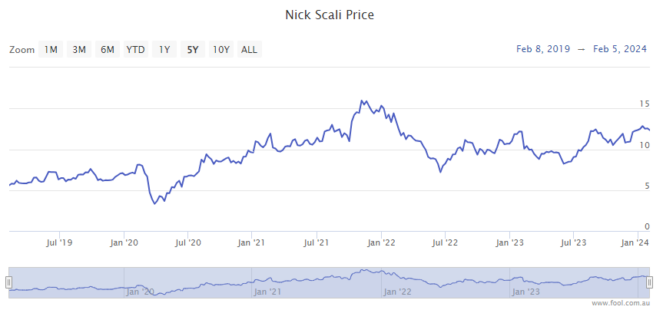
    The All Ordinaries Index (ASX: XAO), or All Ords, stock Nick Scali Limited (ASX: NCK) continues to climb following its FY24 first-half result and multiple broker upgrades. The Nick Scali share price is up 6% at $14.84 at the time of writing after reaching a 52-month high of $15.09 this morning.

    The furniture retailer surprised and delighted the market yesterday after its report for the first six months of FY24 beat expectations.

    And brokers have been busy upgrading their views on Nick Scali shares.

    Broker upgrades

    According to reporting by The Australian, the ASX retail share has seen three brokers increase their ratings on the ASX All Ords stock.

    Broker Jarden Securities raised its rating to overweight (which is positive) and increased the price target to $13.87. A price target is where the broker thinks the share price will be in 12 months.

    Macquarie analysts have raised their price target on the company to $14.90, which is slightly higher than where the Nick Scali share price is currently trading.

    Wilsons increased its rating to overweight on Nick Scali shares and bumped up the price target by 36% to $15.40.

    Why has the Nick Scali share price responded so positively?

    The Nick Scali FY24 first-half result saw revenue fall 20.2% to $226.6 million, and net profit after tax (NPAT) sank 29% to $43 million. However, group written sales orders for the period were $212.7 million, up 1.1% year over year, and the net profit was above its guidance range of between $40 million and $42 million.

    Revenue in the prior period of $226.6 million was consistent with written sales order levels and typical delivery lead times. Revenue in the prior period benefited from increased deliveries as the elevated June 2022 order bank reduced with lead times returning to pre-COVID levels.

    So, the ASX All Ord stock’s underlying revenue actually slightly increased during the period. Nick Scali also reported the group gross profit margin of 65.6% was much higher than 62% in HY23. Operating expenses were $4.8 million lower in HY24 than HY23, thanks to “tight cost control and lower logistic costs.”

    Other positives included a strong dividend of 35 cents per share, an additional $20 million of corporate debt repaid and ongoing progress of its new Queensland distribution centre. It also continues to steadily open new stores – it opened a new, larger Nick Scali store in South Australia, and opened two Plush stores (in Queensland and South Australia) and closed one.

    The company has a long-term target of operating 86 Nick Scali stores and between 90 and 100 Plush stores.

    January 2024 saw written sales orders of $58.9 million, which was up 3.6% year over year. The good performance seems to be continuing into the 2024 calendar year.

    Nick Scali share price snapshot

    Shares in the company have lifted around 20% since the start of 2024.

    The post This ASX All Ords stock is surging 6% amid multiple broker upgrades appeared first on The Motley Fool Australia.

    Wondering where you should invest $1,000 right now?

    When investing expert Scott Phillips has a stock tip, it can pay to listen. After all, the flagship Motley Fool Share Advisor newsletter he has run for over ten years has provided thousands of paying members with stock picks that have doubled, tripled or even more.*

    Scott just revealed what he believes could be the ‘five best ASX stocks’ for investors to buy right now. These stocks are trading at near dirt-cheap prices and Scott thinks they could be great buys right now…

    See The 5 Stocks
    *Returns as of 10 November 2023

    (function() {
    function setButtonColorDefaults(param, property, defaultValue) {
    if( !param || !param.includes(‘#’)) {
    var button = document.getElementsByClassName(“pitch-snippet”)[0].getElementsByClassName(“pitch-button”)[0];
    button.style[property] = defaultValue;
    }
    }

    setButtonColorDefaults(“#0095C8”, ‘background’, ‘#5FA85D’);
    setButtonColorDefaults(“#0095C8”, ‘border-color’, ‘#43A24A’);
    setButtonColorDefaults(“#fff”, ‘color’, ‘#fff’);
    })()

    More reading

    Motley Fool contributor Tristan Harrison has no position in any of the stocks mentioned. The Motley Fool Australia’s parent company Motley Fool Holdings Inc. has no position in any of the stocks mentioned. The Motley Fool Australia has recommended Nick Scali. The Motley Fool has a disclosure policy. This article contains general investment advice only (under AFSL 400691). Authorised by Scott Phillips.

    from The Motley Fool Australia https://ift.tt/uAy5cP1

  • Should I buy the Vanguard Australian Shares Index ETF (VAS) now or wait for an ASX dip?

    A smiling woman with a satisfied look on her face lies on a rug in her home with her laptop open and a large cup on the floor nearby, gazing at the screen. researching new ETFsA smiling woman with a satisfied look on her face lies on a rug in her home with her laptop open and a large cup on the floor nearby, gazing at the screen. researching new ETFs

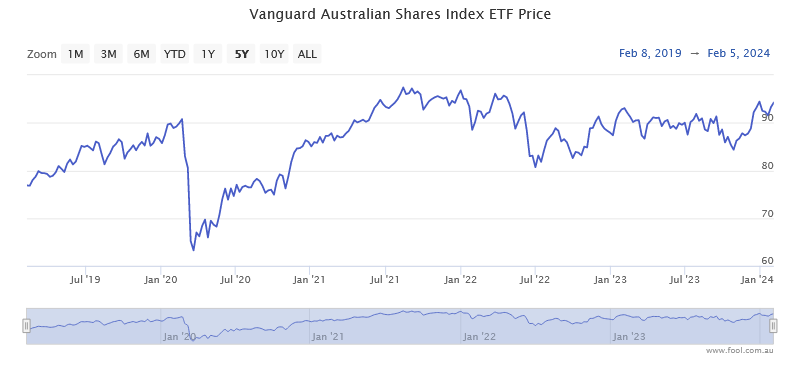
    The Vanguard Australian Shares Index ETF (ASX: VAS) is today sitting pretty close to a new 52-week high. VAS units are going for $94.16 each at the time of writing. That’s less than a dollar away from this exchange-traded fund (ETF)‘s current all-time, record high of $95.06 which we saw only earlier this month. 

    Last week, we covered the S&P/ASX 200 Index (ASX: XJO) hitting a fresh new record high. This, by extension, means that any index fund that covers ASX shares would also be close to, or at, new all-time highs as well.

    Even though the Vanguard Australian Shares ETF tracks the S&P/ASX 300 Index (ASX: XKO) rather than the ASX 200, VAS evidently falls into this category.

    But these new highs beg the question: Is it worth buying up this ETF today, or should investors wait for a dip? After all, we’re all told to ‘buy low’ and ‘sell high’. The present situation seems to fall into the latter scenario.

    Should we be buying or selling VAS units on the ASX?

    This is a tricky question to tackle. On one hand, buying shares or index funds, at or near record prices increases the risk that returns will be lower in the long run.

    We’ve often seen indexes like the ASX 200 or ASX 300 hit a new all-time high, only to subsequently pull back. That’s what happened the last time the ASX 200 hit a new record back in 2021.

    It took more than three years for the index to get back to where it was in August of that year, a fate that the Vanguard Australian Shares ETF has shared, as you can see below:

    VAS ASX  five-year unit price

    Saying that, I’m of the belief that if you are an index investor, particularly a passive investor who perhaps employs a dollar-cost averaging strategy to your investing, you should not be put off buying VAS units on the ASX today.

    This is due to two reasons. Firstly, history has proved time and time again that trying to time the market by only buying low is a fool’s errand. No one knows what an index like the ASX 300 will do tomorrow, next week, next month or next year.

    As such, the likelihood of you buying the Vanguard Australian Shares ETF only ever at its most opportune moments is very low. What’s more likely is that you’ll hold off in the hopes that you can get a better price in the future. If you can’t, then you’ve just missed out.

    A better way is to buy periodically and consistently. That way, you never have to worry about what price you’re getting, fase in the knowledge that the markets tend to go up over time.

    Don’t forget about the dividends

    Secondly, whilst the VAS ETF’s unit prices haven’t moved too much between August 2021 and today, it’s not like investors haven’t been enjoying returns.

    As a composite of the majority of the ASX stock market, the Vanguard Australian Shares ETF is a prolific dividend payer. Investors receive a dividend distribution every quarter from this ETF. Since 2021, the annual dividend distribution yield of this index fund has fluctuated between 3% and 7%.

    Until recently, that yield alone would have probably netted you more than what you could have received if you’d kept the cash at the bank. Especially considering the franking credits you would have received as well.

    So all in all, I think investors shouldn’t hold off from buying the Vanguard Australian Shares ETF today if they have the propensity and the cash to do so.

    The post Should I buy the Vanguard Australian Shares Index ETF (VAS) now or wait for an ASX dip? appeared first on The Motley Fool Australia.

    Wondering where you should invest $1,000 right now?

    When investing expert Scott Phillips has a stock tip, it can pay to listen. After all, the flagship Motley Fool Share Advisor newsletter he has run for over ten years has provided thousands of paying members with stock picks that have doubled, tripled or even more.*

    Scott just revealed what he believes could be the ‘five best ASX stocks’ for investors to buy right now. These stocks are trading at near dirt-cheap prices and Scott thinks they could be great buys right now…

    See The 5 Stocks
    *Returns as of 10 November 2023

    (function() {
    function setButtonColorDefaults(param, property, defaultValue) {
    if( !param || !param.includes(‘#’)) {
    var button = document.getElementsByClassName(“pitch-snippet”)[0].getElementsByClassName(“pitch-button”)[0];
    button.style[property] = defaultValue;
    }
    }

    setButtonColorDefaults(“#0095C8”, ‘background’, ‘#5FA85D’);
    setButtonColorDefaults(“#0095C8”, ‘border-color’, ‘#43A24A’);
    setButtonColorDefaults(“#fff”, ‘color’, ‘#fff’);
    })()

    More reading

    Motley Fool contributor Sebastian Bowen has positions in Vanguard Australian Shares Index ETF. The Motley Fool Australia’s parent company Motley Fool Holdings Inc. has no position in any of the stocks mentioned. The Motley Fool Australia has no position in any of the stocks mentioned. The Motley Fool has a disclosure policy. This article contains general investment advice only (under AFSL 400691). Authorised by Scott Phillips.

    from The Motley Fool Australia https://ift.tt/DFLKP1X

  • Santos shares incinerate 8% as Woodside walks away

    a sad looking engineer or miner wearing a high visibility jacket and a hard hat stands alone with his head bowed and hand to his forehead as he speaks on a mobile telephone out front of what appears to be an on site work shed.a sad looking engineer or miner wearing a high visibility jacket and a hard hat stands alone with his head bowed and hand to his forehead as he speaks on a mobile telephone out front of what appears to be an on site work shed.

    It’s mid-week madness in the ASX energy sector as an explosive development derails hopes of Australia’s two largest oil and gas companies joining forces. Consequently, Santos Ltd (ASX: STO) shares are caught in today’s damaging fallout.

    The Santos share price is bucking the broader optimism among Australian shares in afternoon trading. Before publishing, the oil and gas titan shares were swapping hands at a wounded rate of $7.46, down 5.2% from its previous close. However, at their low, shares had lost a painful 8.6%.

    The dismal performance — worst of all companies inside the S&P/ASX 200 Index (ASX: XJO) — descends from Woodside Energy Group Ltd‘s (ASX: WDS) verdict on combining with its smaller energy peer.

    Sayonara to oil and gas mega-merger

    Thirteen days ago, Santos noted it was “in early-stage discussions to evaluate the merits of a potential merger with Woodside.” in its fourth-quarter report. However, those talks have now been concluded as Woodside Energy revealed discussions have now ceased.

    Before today, the Santos share price had rallied 15% after confirmed merger discussions on 7 December 2023.

    Little detail is provided in Woodside’s announcement as to how the verdict reached its uneventful conclusion. Rather than elaborating on the rationale, Woodside CEO Meg O’Neill plainly stated:

    We continue to be disciplined in our approach to mergers and acquisitions and capital management to create and deliver value for shareholders. While the discussions with Santos did not result in a transaction, Woodside considers that the global LNG sector provides significant potential for value creation.

    Furthermore, O’Neill noted that the company conducts thorough due diligence, only pursuing a transaction that creates value for shareholders. Inadvertently, this would suggest Woodside couldn’t see the value in tying the knot with Santos.

    Whether this decision was based on the price demanded by Santos, the synergises (or lack thereof), or a combination of the two, we won’t know unless further details are shared.

    Some industry experts were left scratching their heads when the merger talks were first confirmed. One possible pinch point highlighted was the price. Specifically, the difficulty in striking an offer that appeases Santos shareholders in light of its depressed price-to-earnings (P/E) ratio of around 9 times earnings.

    Santos shares left in the lurch

    The question now for holders of Santos shares is where to from here.

    Investors valued the oil and gas company at $6.78 before merger talks were public knowledge. Now swapping hands at $7.49, there’s plenty of space between the current share price and what it traded for before all of this started.

    Uncertainty around whether another suitor will be pursued will hang about until Santos provides clarity.

    Until then, the company’s official results on 21 February will mark the next checkpoint for shareholders.

    Woodside shares are up 1.4% to $32.73 at the time of writing.

    The post Santos shares incinerate 8% as Woodside walks away appeared first on The Motley Fool Australia.

    Wondering where you should invest $1,000 right now?

    When investing expert Scott Phillips has a stock tip, it can pay to listen. After all, the flagship Motley Fool Share Advisor newsletter he has run for over ten years has provided thousands of paying members with stock picks that have doubled, tripled or even more.*

    Scott just revealed what he believes could be the ‘five best ASX stocks’ for investors to buy right now. These stocks are trading at near dirt-cheap prices and Scott thinks they could be great buys right now…

    See The 5 Stocks
    *Returns as of 10 November 2023

    (function() {
    function setButtonColorDefaults(param, property, defaultValue) {
    if( !param || !param.includes(‘#’)) {
    var button = document.getElementsByClassName(“pitch-snippet”)[0].getElementsByClassName(“pitch-button”)[0];
    button.style[property] = defaultValue;
    }
    }

    setButtonColorDefaults(“#0095C8”, ‘background’, ‘#5FA85D’);
    setButtonColorDefaults(“#0095C8”, ‘border-color’, ‘#43A24A’);
    setButtonColorDefaults(“#fff”, ‘color’, ‘#fff’);
    })()

    More reading

    Motley Fool contributor Mitchell Lawler has no position in any of the stocks mentioned. The Motley Fool Australia’s parent company Motley Fool Holdings Inc. has no position in any of the stocks mentioned. The Motley Fool Australia has no position in any of the stocks mentioned. The Motley Fool has a disclosure policy. This article contains general investment advice only (under AFSL 400691). Authorised by Scott Phillips.

    from The Motley Fool Australia https://ift.tt/bpmGnOl