• 5 things to watch on the ASX 200 on Wednesday

    Smiling man with phone in wheelchair watching stocks and trends on computer

    Smiling man with phone in wheelchair watching stocks and trends on computer

    On Tuesday the S&P/ASX 200 Index (ASX: XJO) was out of form and tumbled for a second day in a row. The benchmark index ended the day 0.6% lower at 7,581.6 points.

    Will the market be able to bounce back from this on Wednesday? Here are five things to watch:

    ASX 200 expected to rebound

    The Australian share market looks set for a better day on Wednesday despite a mixed night on Wall Street. According to the latest SPI futures, the ASX 200 is expected to open the day 51 points or 0.7% higher. In late trade on Wall Street, the Dow Jones is up 0.1%, the S&P 500 has fallen 0.1%, and the Nasdaq is 0.4% lower.

    Oil prices push higher

    It could be a decent session for ASX 200 energy shares including Beach Energy Ltd (ASX: BPT) and Woodside Energy Group Ltd (ASX: WDS) after oil prices pushed higher overnight. According to Bloomberg, the WTI crude oil price is up 0.9% to US$73.45 a barrel and the Brent crude oil price is up 0.95% to US$78.66 a barrel. This was driven by US tensions with Iran.

    Seven Group rated as a hold

    The Seven Group Holdings Ltd (ASX: SVW) share price could be close to being fully valued according to analysts at Bell Potter. This morning, the broker has retained its hold rating and $38.00 price target on the diversified investment company’s shares. It notes: “Dealer unit sales for Resource Industries in the APAC region have declined 10% and 1% YoY in the September and December 2023 quarters, respectively.”

    Gold price rises

    ASX 200 gold shares including Newmont Corporation (ASX: NEM) and Northern Star Resources Ltd (ASX: NST) could have a good session on Wednesday after the gold price rose overnight. According to CNBC, the spot gold price is up 0.45% to US$2,052.2 an ounce. A softer US dollar boosted the precious metal.

    Centuria Industrial update

    Centuria Industrial REIT (ASX: CIP) shares will be on watch on Wednesday when the industrial property company releases its half year results. Morgans commented: “We expect portfolio metrics to remain stable vs Jun-23. We note occupancy slightly trended up during the 1Q. WALE around 7 years.” This result could have implications for Goodman Group (ASX: GMG) shares.

    The post 5 things to watch on the ASX 200 on Wednesday appeared first on The Motley Fool Australia.

    Wondering where you should invest $1,000 right now?

    When investing expert Scott Phillips has a stock tip, it can pay to listen. After all, the flagship Motley Fool Share Advisor newsletter he has run for over ten years has provided thousands of paying members with stock picks that have doubled, tripled or even more.*

    Scott just revealed what he believes could be the ‘five best ASX stocks’ for investors to buy right now. These stocks are trading at near dirt-cheap prices and Scott thinks they could be great buys right now…

    See The 5 Stocks
    *Returns as of 10 November 2023

    (function() {
    function setButtonColorDefaults(param, property, defaultValue) {
    if( !param || !param.includes(‘#’)) {
    var button = document.getElementsByClassName(“pitch-snippet”)[0].getElementsByClassName(“pitch-button”)[0];
    button.style[property] = defaultValue;
    }
    }

    setButtonColorDefaults(“#0095C8”, ‘background’, ‘#5FA85D’);
    setButtonColorDefaults(“#0095C8”, ‘border-color’, ‘#43A24A’);
    setButtonColorDefaults(“#fff”, ‘color’, ‘#fff’);
    })()

    More reading

    Motley Fool contributor James Mickleboro has positions in Woodside Energy Group. The Motley Fool Australia’s parent company Motley Fool Holdings Inc. has positions in and has recommended Goodman Group. The Motley Fool Australia has recommended Goodman Group. The Motley Fool has a disclosure policy. This article contains general investment advice only (under AFSL 400691). Authorised by Scott Phillips.

    from The Motley Fool Australia https://ift.tt/9JYp6rD

  • Own Telstra shares? Here’s your half-year results preview

    A woman uses her mobile phone to make a purchase.

    A woman uses her mobile phone to make a purchase.

    All eyes will be on Telstra Group Ltd (ASX: TLS) shares next week.

    That’s because the telco giant will be releasing its half-year results on 15 February.

    But what should investors expect from Telstra’s first half? Let’s take a look and find out.

    Telstra half-year results preview

    According to a note out of Goldman Sachs, its analysts are expecting Telstra to report EBITDA of $4,054 million and earnings per share of 9 cents. This is broadly in line with the consensus estimate of $4,038 million and 9 cents, respectively.

    If Telstra delivers on expectations, it will mean a healthy ~15% increase on what was recorded during the prior corresponding period. For that period, Telstra posted EBITDA of approximately $3,500 million.

    As for dividends, Goldman is forecasting an increase to 18 cents per share for the full year (from 17 cents per share). This is likely to mean an 8.5 cents per share interim dividend next week.

    Should you buy Telstra shares?

    Goldman believes investors should be snapping up the company’s shares while they can.

    This is due to its low risk earnings and dividend growth, attractive valuation, and potential asset divestments. It said:

    We believe the low risk earnings (and dividend) growth that Telstra is delivering across FY22-25, underpinned through its mobile business, is attractive. We also believe that Telstra has a meaningful medium term opportunity to crystallise value through commencing the process to monetize its InfraCo Fixed assets – which we estimate could be worth between A$22-33bn. […] Hence in an uncertain 2023 we rate Telstra Buy.

    The broker has a buy rating and $4.65 price target on its shares.

    The post Own Telstra shares? Here’s your half-year results preview appeared first on The Motley Fool Australia.

    Wondering where you should invest $1,000 right now?

    When investing expert Scott Phillips has a stock tip, it can pay to listen. After all, the flagship Motley Fool Share Advisor newsletter he has run for over ten years has provided thousands of paying members with stock picks that have doubled, tripled or even more.*

    Scott just revealed what he believes could be the ‘five best ASX stocks’ for investors to buy right now. These stocks are trading at near dirt-cheap prices and Scott thinks they could be great buys right now…

    See The 5 Stocks
    *Returns as of 10 November 2023

    (function() {
    function setButtonColorDefaults(param, property, defaultValue) {
    if( !param || !param.includes(‘#’)) {
    var button = document.getElementsByClassName(“pitch-snippet”)[0].getElementsByClassName(“pitch-button”)[0];
    button.style[property] = defaultValue;
    }
    }

    setButtonColorDefaults(“#0095C8”, ‘background’, ‘#5FA85D’);
    setButtonColorDefaults(“#0095C8”, ‘border-color’, ‘#43A24A’);
    setButtonColorDefaults(“#fff”, ‘color’, ‘#fff’);
    })()

    More reading

    Motley Fool contributor James Mickleboro has no position in any of the stocks mentioned. The Motley Fool Australia’s parent company Motley Fool Holdings Inc. has positions in and has recommended Goldman Sachs Group. The Motley Fool Australia has positions in and has recommended Telstra Group. The Motley Fool has a disclosure policy. This article contains general investment advice only (under AFSL 400691). Authorised by Scott Phillips.

    from The Motley Fool Australia https://ift.tt/r5m2pvP

  • Want to buy ASX 200 bank shares? You need to read this

    A woman looks questioning as she puts a coin into a piggy bank.A woman looks questioning as she puts a coin into a piggy bank.

    The big bank shares are a major presence in the Australian stock market, especially the S&P/ASX 200 Index (ASX: XJO).

    Even if you don’t hold any directly, if you own an Australian index exchange-traded fund (ETF) there is a good chance that your portfolio is exposed to the sector.

    After 13 interest rate rises over the past couple of years, the big banks have all had a great excuse to boost their margins.

    And investors have been flocking to them in recent weeks.

    “Despite some grim economic forecasts, the share prices of Australian banks have performed well over the past three months,” read a recent VanEck blog post.

    Commonwealth Bank of Australia (ASX: CBA) for example, recently hit an all-time high of $115.98 per share.”

    So is it a great time to buy, or even hold, bank shares right now?

    Bank shares priced for perfection

    The opinion of the VanEck analysts is that the valuations for the major banks are now “stretched”.

    “Australian banks, on a global basis, are the most expensive in the developed world on a 12-month forward price-to-earnings and price-to-book basis.”

    The worry is that this latest rally indicates investors are pricing in the best-case scenario for the sector.

    “While Australia’s prospects for a soft landing have improved for 2024, the market seems to be pricing a dream scenario for the banks despite the risks of increased mortgage stress in a prolonged higher interest rate environment. 

    “It was also only a few months ago that banks were consumed by a mortgage price war.”

    Higher interest rates haven’t been the party that investors were expecting

    CBA is easily the best-performed bank stock in recent years. But it’s not just that one that seems overcooked.

    “Each of Australia’s ‘Big 4’ banks face continuing headwinds in 2024,” read the blog post. 

    “A subdued economic outlook and potential RBA rate cuts could see the Big 4 banks’ net interest margins (NIMs) continue to deteriorate.”

    Despite the rate hikes, hot competition has meant margins haven’t actually expanded that much. If anything, they’re already on the way down.

    “A reduction in NIMs results in a reduction in cash earnings and will impair the Big 4’s ability to increase dividend payments.”

    Indeed this is why the major banks are on the nose with professional investors at the moment.

    CMC Invest currently shows:

    • 0 out of 16 analysts rating CBA as a buy
    • 6 of 17 analysts rating Westpac Banking Corp (ASX: WBC) as a buy
    • 6 of 17 analysts rating National Australia Bank Ltd (ASX: NAB) as a buy
    • 7 of 16 analysts rating ANZ Group Holdings Ltd (ASX: ANZ) as a buy

    The post Want to buy ASX 200 bank shares? You need to read this appeared first on The Motley Fool Australia.

    Wondering where you should invest $1,000 right now?

    When investing expert Scott Phillips has a stock tip, it can pay to listen. After all, the flagship Motley Fool Share Advisor newsletter he has run for over ten years has provided thousands of paying members with stock picks that have doubled, tripled or even more.*

    Scott just revealed what he believes could be the ‘five best ASX stocks’ for investors to buy right now. These stocks are trading at near dirt-cheap prices and Scott thinks they could be great buys right now…

    See The 5 Stocks
    *Returns as of 10 November 2023

    (function() {
    function setButtonColorDefaults(param, property, defaultValue) {
    if( !param || !param.includes(‘#’)) {
    var button = document.getElementsByClassName(“pitch-snippet”)[0].getElementsByClassName(“pitch-button”)[0];
    button.style[property] = defaultValue;
    }
    }

    setButtonColorDefaults(“#0095C8”, ‘background’, ‘#5FA85D’);
    setButtonColorDefaults(“#0095C8”, ‘border-color’, ‘#43A24A’);
    setButtonColorDefaults(“#fff”, ‘color’, ‘#fff’);
    })()

    More reading

    Motley Fool contributor Tony Yoo has no position in any of the stocks mentioned. The Motley Fool Australia’s parent company Motley Fool Holdings Inc. has no position in any of the stocks mentioned. The Motley Fool Australia has no position in any of the stocks mentioned. The Motley Fool has a disclosure policy. This article contains general investment advice only (under AFSL 400691). Authorised by Scott Phillips.

    from The Motley Fool Australia https://ift.tt/n4ueytp

  • 2 ASX growth stocks that could turn $10,000 into $30,000 by 2030

    Elegant lady with make up wearing jewellery and sitting on a chair.Elegant lady with make up wearing jewellery and sitting on a chair.

    Do you want to triple your money in six years?

    Who doesn’t, right? 

    While no one can make any guarantees, every investor can, after careful research, make some educated buys to attempt this goal.

    My favoured method of reaping such spectacular gains would be through ASX growth stocks.

    I think they have more potential for big gains — at a higher risk — than, say, dividend stocks, which might be better for nerves.

    Here are two ASX growth shares that currently have the potential to turn your $10,000 into $30,000 by the start of the next decade:

    The growth stock that heals the world

    Avita Medical Inc (ASX: AVH) is a biotechnology company founded by 2005 Australian of The Year Dr Fiona Wood.

    The company’s flagship product is a spray-on skin for burns patients.

    Like most stocks in that industry, Avita shares have swung wildly up and down over the years.

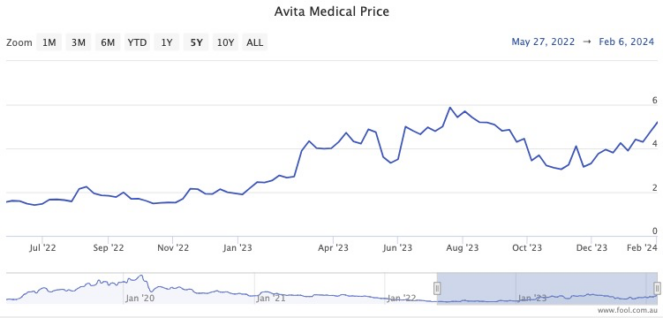
    However, enough has gone right in recent times to push the stock 292% upwards since June 2022.

    Even going back five years, the Avita share price has doubled.

    The compound annual growth rate (CAGR) over the past 20 months is well over 100%, and the five-year rate is just under 15%.

    To grow $10,000 to $30,000 by 2030, your investment needs to expand at around 20% per annum.

    Remembering past performance is no indicator of the future, a replication of Avita’s recent history could easily take investors to our end-of-decade target.

    Professional investors are convinced Avita shares will make a decent run-up, with CMC Invest showing nine out of 10 analysts rating it as a buy.

    I want my Jimmy Choos, regardless of inflation

    Cettire Ltd (ASX: CTT) is an online retail platform for selling luxury goods.

    Apparently the economic downturn in the west and in China over the past two years hasn’t dented the global demand for expensive fashion.

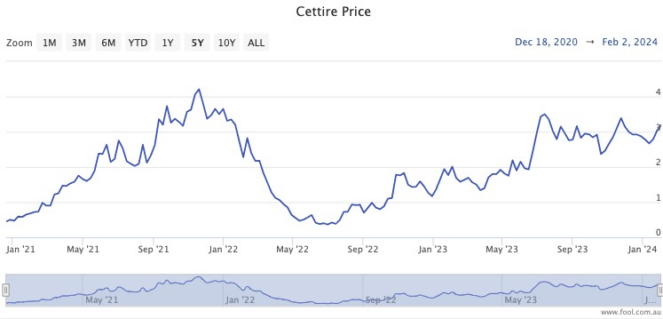
    Again, like Avita Medical, this growth stock has definitely had massive peaks and troughs.

    However, since listing in December 2020, overall the result is that Cettire shares are now trading 529% higher.

    That’s an impressive CAGR of 79%.

    Even as the business matures, making 20% a year until 2030 is not out of the question.

    Three of four analysts believe Cettire shares are a buy right now, according to CMC Invest.

    The post 2 ASX growth stocks that could turn $10,000 into $30,000 by 2030 appeared first on The Motley Fool Australia.

    Wondering where you should invest $1,000 right now?

    When investing expert Scott Phillips has a stock tip, it can pay to listen. After all, the flagship Motley Fool Share Advisor newsletter he has run for over ten years has provided thousands of paying members with stock picks that have doubled, tripled or even more.*

    Scott just revealed what he believes could be the ‘five best ASX stocks’ for investors to buy right now. These stocks are trading at near dirt-cheap prices and Scott thinks they could be great buys right now…

    See The 5 Stocks
    *Returns as of 10 November 2023

    (function() {
    function setButtonColorDefaults(param, property, defaultValue) {
    if( !param || !param.includes(‘#’)) {
    var button = document.getElementsByClassName(“pitch-snippet”)[0].getElementsByClassName(“pitch-button”)[0];
    button.style[property] = defaultValue;
    }
    }

    setButtonColorDefaults(“#0095C8”, ‘background’, ‘#5FA85D’);
    setButtonColorDefaults(“#0095C8”, ‘border-color’, ‘#43A24A’);
    setButtonColorDefaults(“#fff”, ‘color’, ‘#fff’);
    })()

    More reading

    Motley Fool contributor Tony Yoo has positions in Avita Medical. The Motley Fool Australia’s parent company Motley Fool Holdings Inc. has positions in and has recommended Avita Medical. The Motley Fool Australia has recommended Avita Medical and Cettire. The Motley Fool has a disclosure policy. This article contains general investment advice only (under AFSL 400691). Authorised by Scott Phillips.

    from The Motley Fool Australia https://ift.tt/gzV4mLY

  • If you’d put $20,000 in this ASX healthcare stock in December 2021, you’d have $257,000 now

    Male Lab Worker Wearing White Coat Recording Test Results On Computer.Male Lab Worker Wearing White Coat Recording Test Results On Computer.

    Even though you buy every ASX stock full of hope, the harsh reality is that not every investment will make you money.

    In fact, one must mentally prepare for the inevitability that some stocks will lose you money.

    This is not defeatist or alarmist. It’s the truth.

    But there is good news.

    It’s that if you diversify your portfolio competently, there might be a few winners that can balance out the losers.

    Those winners can sometimes go further than merely cancel out the losses. They could carry the portfolio to huge gains.

    I’ve spoken to many professional investors over the years, and even they all admit they don’t achieve anywhere near a 100% success rate. 

    Fund managers would happily accept 6 of their 10 stock picks returning a profit.

    So with this in mind, let’s take a look at an example of a huge winner that’s had the heft to carry many losers:

    Revenue coming in, R&D continuing

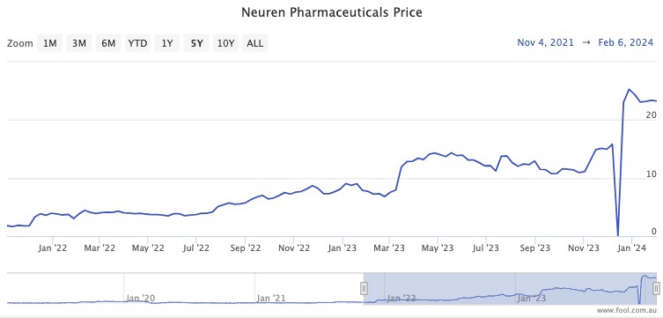
    Back on 3 December 2021, Neuren Pharmaceuticals Ltd (ASX: NEU) shares closed the day at $1.77.

    Let’s say you bought $20,000 of the healthcare stock on that day.

    Since then the company has gone from strength to strength.

    First it was the commercial release of its Daybue product, which is still the only approved therapy in the world for Rett Syndrome.

    A licensing agreement with Acadia Pharmaceuticals Inc (NASDAQ: ACAD) allows the US giant to manufacture Daybue, in return for royalties paid to Neuren.

    So that created a flow of cash coming in for the Australian outfit to work on other drugs.

    In the past year, favourable testing and regulatory developments for its NNZ-2591 product has sent the stock price soaring.

    In fact, Neuren Pharmaceuticals ended up as the best performer on the S&P/ASX 200 Index (ASX: XJO) in 2023.

    How one healthcare stock could cure the ailments of others

    Now, back to that $20,000 you invested just over two years ago.

    That’s now worth a cool $257,062.

    Showing you such an example isn’t meant to send you scrambling to speculate on overnight winners.

    The lesson you should be getting out of this is that a few winners in your portfolio will absolutely obliterate the losses.

    On 3 December 2021, no one knew how Neuren shares would have turned out in 2024.

    So imagine that, in order to diversify your risk, you also bought nine other stocks for $20,000 each.

    Incredibly, in an absolute disaster, those other stocks all sank to $0.

    Guess what? Your portfolio is still 29% up.

    By the way, even now all five analysts surveyed on CMC Invest rate Neuren shares as a buy.

    The post If you’d put $20,000 in this ASX healthcare stock in December 2021, you’d have $257,000 now appeared first on The Motley Fool Australia.

    Wondering where you should invest $1,000 right now?

    When investing expert Scott Phillips has a stock tip, it can pay to listen. After all, the flagship Motley Fool Share Advisor newsletter he has run for over ten years has provided thousands of paying members with stock picks that have doubled, tripled or even more.*

    Scott just revealed what he believes could be the ‘five best ASX stocks’ for investors to buy right now. These stocks are trading at near dirt-cheap prices and Scott thinks they could be great buys right now…

    See The 5 Stocks
    *Returns as of 10 November 2023

    (function() {
    function setButtonColorDefaults(param, property, defaultValue) {
    if( !param || !param.includes(‘#’)) {
    var button = document.getElementsByClassName(“pitch-snippet”)[0].getElementsByClassName(“pitch-button”)[0];
    button.style[property] = defaultValue;
    }
    }

    setButtonColorDefaults(“#0095C8”, ‘background’, ‘#5FA85D’);
    setButtonColorDefaults(“#0095C8”, ‘border-color’, ‘#43A24A’);
    setButtonColorDefaults(“#fff”, ‘color’, ‘#fff’);
    })()

    More reading

    Motley Fool contributor Tony Yoo has no position in any of the stocks mentioned. The Motley Fool Australia’s parent company Motley Fool Holdings Inc. has no position in any of the stocks mentioned. The Motley Fool Australia has no position in any of the stocks mentioned. The Motley Fool has a disclosure policy. This article contains general investment advice only (under AFSL 400691). Authorised by Scott Phillips.

    from The Motley Fool Australia https://ift.tt/r2Wdkvi

  • Here are the top 10 ASX 200 shares today

    Modern accountant woman in a light business suit in modern green office with documents and laptop.

    Modern accountant woman in a light business suit in modern green office with documents and laptop.

    The S&P/ASX 200 Index (ASX: XJO) endured another tough day today, as ASX investors gave the share market a thumbs down following the Reserve Bank’s decision to leave interest rates on hold this Tuesday.

    After a rough day yesterday, the ASX 200 doubled down. The index ended up losing another 0.58% to finish up at 7,581.6 points.

    This red day follows an equally depressing night over on Wall Street last night.

    The Dow Jones Industrial Average Index (DJX: .DJI) kicked off the American trading week with a hefty 0.71% loss.

    The Nasdaq Composite Index (NASDAQ: .IXIC) didn’t quite fare that poorly, but still retreated by 0.2%.

    But time now to return to the local markets, with a look at how the different ASX sectors came out of the wash today.

    Winners and losers

    It was another near wipeout for the different corners of the market, with again only one ASX sector escaping with a rise.

    But first, the biggest losers from today’s trading were tech shares. The S&P/ASX 200 Information Technology Index (ASX: XIJ) had a terrible time today, cratering by 1.8%.

    ASX gold stocks also had a bad hair day. The All Ordinaries Gold Index (ASX: XGD) tanked by a chunky 1.24%.

    Then we have broader mining shares. The S&P/ASX 200 Materials Index (ASX: XMJ) was close behind gold, losing 1.13% of its value.

    Utilities stocks were also on the nose, evidenced by the S&P/ASX 200 Utilities Index (ASX: XUJ)’s slump of 0.9%.

    Real estate investment trusts (REITs) were another source of disappointment. The S&P/ASX 200 A-REIT Index (ASX: XPJ) was eroded by 0.89%.

    Industrial shares had a doozy too, with the S&P/ASX 200 Industrials Index (ASX: XNJ) retreating by 0.59%.

    Healthcare stocks came next, with the S&P/ASX 200 Healthcare Index (ASX: XHJ) unable to replicate yesterday’s gains with its fall of 0.43%.

    Then we had the financial sector. The S&P/ASX 200 Financials Index (ASX: XFJ) took a 0.41% hit this Tuesday.

    Communications stocks went backward today as well, illustrated by the S&P/ASX 200 Communication Services Index (ASX: XTJ)’s drop of 0.31%.

    Consumer staples shares didn’t escape the pain either. The S&P/ASX 200 Consumer Staples Index (ASX: XSJ) slid down 0.24%.

    Finally, consumer discretionary stocks finished lower too, with the S&P/ASX 200 Consumer Discretionary Index (ASX: XDJ) slipping 0.03%.

    The only space that proved safe for investors today was energy. The S&P/ASX 200 Energy Index (ASX: XEJ) bucked the pessimism to close 0.43% higher.

    Top 10 ASX 200 shares countdown

    Today’s best index performer turned out to be auto dealership company Eagers Automotive Ltd (ASX: APE).

    Eagers shares had a decent, if unspectacular, time today, rising 2.91% to $14.50 a share. That was despite a lack of any fresh news or developments with the company.

    Here’s how the rest of the winners from today’s trading turned out:

    ASX-listed company Share price Price change
    Eagers Automotive Ltd (ASX: APE) $14.50 2.91%
    Lynas Rare Earths Ltd (ASX: LYC) $5.84 2.82%
    Inghams Group Ltd (ASX: ING) $4.44 2.78%
    Graincorp Ltd (ASX: GNC) $8.48 2.42%
    Harvey Norman Holdings Limited (ASX: HVN) $4.44 2.30%
    Paladin Energy Ltd (ASX: PDN) $1.395 2.20%
    AMP Ltd (ASX: AMP) $0.965 2.12%
    Chorus Ltd (ASX: CNU) $7.56 2.02%
    Orora Ltd (ASX: ORA) $2.83 1.80%
    ARB Corporation Ltd (ASX: ARB) $35.48 1.66%

    Our top 10 shares countdown is a recurring end-of-day summary to let you know which companies were making big moves on the day. Check in at Fool.com.au after the weekday market closes to see which stocks make the countdown.

    The post Here are the top 10 ASX 200 shares today appeared first on The Motley Fool Australia.

    Wondering where you should invest $1,000 right now?

    When investing expert Scott Phillips has a stock tip, it can pay to listen. After all, the flagship Motley Fool Share Advisor newsletter he has run for over ten years has provided thousands of paying members with stock picks that have doubled, tripled or even more.*

    Scott just revealed what he believes could be the ‘five best ASX stocks’ for investors to buy right now. These stocks are trading at near dirt-cheap prices and Scott thinks they could be great buys right now…

    See The 5 Stocks
    *Returns as of 10 November 2023

    (function() {
    function setButtonColorDefaults(param, property, defaultValue) {
    if( !param || !param.includes(‘#’)) {
    var button = document.getElementsByClassName(“pitch-snippet”)[0].getElementsByClassName(“pitch-button”)[0];
    button.style[property] = defaultValue;
    }
    }

    setButtonColorDefaults(“#0095C8”, ‘background’, ‘#5FA85D’);
    setButtonColorDefaults(“#0095C8”, ‘border-color’, ‘#43A24A’);
    setButtonColorDefaults(“#fff”, ‘color’, ‘#fff’);
    })()

    More reading

    Motley Fool contributor Sebastian Bowen has no position in any of the stocks mentioned. The Motley Fool Australia’s parent company Motley Fool Holdings Inc. has positions in and has recommended ARB Corporation. The Motley Fool Australia has positions in and has recommended Harvey Norman. The Motley Fool Australia has recommended ARB Corporation, Eagers Automotive Ltd, and Orora. The Motley Fool has a disclosure policy. This article contains general investment advice only (under AFSL 400691). Authorised by Scott Phillips.

    from The Motley Fool Australia https://ift.tt/WyCRQuS

  • How the changed interest rate outlook is turbocharging shares vs. property

    Interest rates written on top of pictures of houses on a computer.Interest rates written on top of pictures of houses on a computer.

    As expected, the Reserve Bank (RBA) left interest rates on hold at 4.35% today, further stoking optimism that the rate hiking cycle may be over following a significant fall in inflation in the December quarter.

    Market optimism on rates was a primary driver of the Santa Rally in ASX shares and US shares at the end of 2023 after the US Federal Reserve hinted that it expected to start cutting rates in the new year.

    We then saw a new record high for the ASX 200 last Wednesday, which was superseded on Friday, as speculation grew that interest rates in Australia would also be cut in 2024, but later in the year.

    And we’ve just seen an amazing start to the 2024 auction season, with the second-highest number of homes going to auction since 2008 and an astounding preliminary national clearance rate of 74%.

    CoreLogic economist Kaytlin Ezzy says the possibility of rate cuts likely contributed to this very strong start.

    Why did the Reserve Bank keep interest rates on hold?

    In a statement released at 2.30pm, the Reserve Bank said higher interest rates were working to bring down economic demand, and household consumption growth was now weak.

    However, it left the door open to another rate hike, warning that inflation was still too high and it “needs to be confident that inflation is moving sustainably towards the target range” of 2% to 3%.

    This appears to have spooked investors today, with ASX 200 shares falling after the news and closing the session 0.58% lower.

    The Reserve Bank said:

    Inflation is still high, but we are making progress towards a better balance between supply and demand in the economy. While there are encouraging signs, the economic outlook is uncertain and the Board expects it will be some time before inflation is sustainably low and stable.

    The Board’s decision today balances the objectives of bringing inflation down while also preserving the gains in employment. The Board’s future decisions will depend upon the data and evolving risks, and a further increase in interest rates cannot be ruled out.

    However, NAB chief economist Alan Oster reckons the RBA is “pretty much done” with interest rate rises, according to news.com.au. Oster said the cash rate would now remain “on hold for quite a while”.

    Oster is not alone in his outlook on interest rates.

    In a recent note, CBA head economist Gareth Aird said he expects the next move on rates to be down, but the RBA may choose to keep a tightening bias in its communication strategy for a while.

    Aird explained:

    The Governor and Deputy Governor do not just communicate with market participants. They communicate with households, businesses and policymakers (i.e. government).

    Maintaining a tightening bias will signal to the fiscal authorities that it’s too early to declare the inflation fight over. The RBA would not wish to see fiscal settings loosened until further progress on inflation has been made towards the target band.

    CBA is tipping that the RBA will start cutting interest rates in September. NAB is tipping November.

    Aird said he expects total cuts of 75 basis points this year and another 75 points in the first half of 2025.

    The size of the annual inflation rate decline — from 5.4% in the September quarter to 4.1% in the December quarter — seems to have supercharged analysts’ confidence that rates will be cut.

    There are also expectations that the US Fed Reserve will cut rates in the US aggressively this year.

    How rates optimism is turbocharging shares vs. property

    ASX 200 shares beat their August 2021 high of 7,632.8 points last Wednesday when the index reached an intraday peak of 7,682.3 points.

    The ASX 200 index went even higher on Friday, clocking 7,703.6 at the intraday peak.

    As my Fool colleague Seb explained, investors are feeling confident due to falling inflation, continuing low unemployment, expectations of rate cuts later in the year, and surging US stocks.

    Meantime, Australian home values are continuing to rise in 2024, and the official auction season began with a bang on Saturday.

    CoreLogic data shows 1,671 homes went to auction across Australia’s combined capital cities on Saturday, which was the second-biggest auction season start since CoreLogic began tracking auctions in 2008.

    The high volume of auctions indicates greater confidence among sellers. This follows an extraordinary year in 2023 when we saw surprisingly strong rises in home values while interest rates were going up.

    Not only was it a big day in terms of auction numbers, but we also saw extraordinary clearance rates across the capital cities and in regional areas, too.

    A balanced market typically delivers an auction clearance rate of 60%. Anything higher indicates there is more demand than supply, and 80% or thereabouts is considered boom-time conditions.

    On Saturday, the national preliminary clearance rate came in at an impressive 73.9% across the cities.

    The individual clearance rates were Canberra 80%, Adelaide 77.6%, Sydney 76.3%, Melbourne 71.9%, and Brisbane 68.5%. Regional results included Newcastle and Lake Macquarie 77.8%, and the Gold Coast at 65.3%.  

    CoreLogic economist Kaytlin Ezzy said optimism about interest rates was potentially contributing to some early-year market exuberance.

    Ezzy said:

    Overall, it looks like auction markets are starting the year on a strong footing.

    Potentially, the news of low inflation and the possibility of early rate cuts is already boosting sentiment. The next few weeks should provide further guidance on whether this strong result is simply some early-year exuberance or a trend that can persist.

    The post How the changed interest rate outlook is turbocharging shares vs. property appeared first on The Motley Fool Australia.

    Wondering where you should invest $1,000 right now?

    When investing expert Scott Phillips has a stock tip, it can pay to listen. After all, the flagship Motley Fool Share Advisor newsletter he has run for over ten years has provided thousands of paying members with stock picks that have doubled, tripled or even more.*

    Scott just revealed what he believes could be the ‘five best ASX stocks’ for investors to buy right now. These stocks are trading at near dirt-cheap prices and Scott thinks they could be great buys right now…

    See The 5 Stocks
    *Returns as of 10 November 2023

    (function() {
    function setButtonColorDefaults(param, property, defaultValue) {
    if( !param || !param.includes(‘#’)) {
    var button = document.getElementsByClassName(“pitch-snippet”)[0].getElementsByClassName(“pitch-button”)[0];
    button.style[property] = defaultValue;
    }
    }

    setButtonColorDefaults(“#0095C8”, ‘background’, ‘#5FA85D’);
    setButtonColorDefaults(“#0095C8”, ‘border-color’, ‘#43A24A’);
    setButtonColorDefaults(“#fff”, ‘color’, ‘#fff’);
    })()

    More reading

    Motley Fool contributor Bronwyn Allen has positions in Commonwealth Bank Of Australia. The Motley Fool Australia’s parent company Motley Fool Holdings Inc. has no position in any of the stocks mentioned. The Motley Fool Australia has no position in any of the stocks mentioned. The Motley Fool has a disclosure policy. This article contains general investment advice only (under AFSL 400691). Authorised by Scott Phillips.

    from The Motley Fool Australia https://ift.tt/Zd032Ec

  • Unpacking some big economic changes

    Woman and man calculating a dividend yield.

    Woman and man calculating a dividend yield.

    For a time of year when not much usually happens, economically or politically, January was pretty busy.

    And, for investors, too. January is usually ‘confession season’, where companies do a quick sum of their last six months and, if the numbers have come in light, share the bad news with the market in advance of the release of their formal earnings announcements, in February.

    Then, of course, the RBA starts its new meeting regime this month.

    Rather than a half-day meeting, on the first Tuesday of every month (bar January) as has been the tradition, they’ll now meet for two half-days at a time, but only eight times a year.

    That’s yesterday and today, with an announcement on rates due at 2.30pm AEDT this afternoon.

    Me? I like that they’re spending more time discussing each rates decision. But I’d far prefer they met 11 (or even 12) times a year. During occasional times of particular economic uncertainty or change, having fewer meetings could tend to mean the RBA is less agile in responding, has to wait longer to respond, and/or has to make bigger movements, when it does.

    Turns out neither the Treasurer or the RBA Governor asked me, of course, so they’re going with eight!

    But back to January.

    We got some important economic data, notably retail sales (down 2.7% for December, but off an unusually big November) and inflation (down to a still-too-high 4.1%, from 5.4% the previous quarter).

    We are, it seems, potentially at an inflection point (which is why many think the RBA will keep rates on hold this month, and that the first cuts in this cycle are now likely to be sooner than previously expected). I’ll return to predictions in a minute.

    A couple of economic thoughts, first, if I may.

    The government’s decision to change the legislated Stage 3 tax cuts – which they voted for, in opposition – took up a lot of airtime over the last few weeks.

    I tweeted about it, at the time. Here are my thoughts:

    First, let’s review the state of play. I’ve repeatedly said that Stage 3, as legislated, was

    – Irresponsible, because it was unfunded
    – Inflationary, by adding to demand when the RBA is trying to cool the economy; and
    – Unfair

    Based on the changes, where are we?

    First, the good. The government has resisted the urge (and urgings of some) to increase the cost of the tax cuts by any significant amount. That’s very good news, economically-speaking. More cash splashed would have made debt and inflation worse, and locked in a higher structural deficit.

    The better: Given the current cost of living pressures, it is axiomatic (based on the maths) that lower and middle income earners need support more than high(er) income earners. I think the reported reallocation across the tax brackets is fairer.

    (A parenthesis here: I would have benefited more from Stage 3 as legislated than from the planned changes. On a personal level, this new proposal makes me worse off than I would otherwise have been. I don’t love that. But it’s the right policy, fairness-wise).

    The bad: My issues with Stage 3 were and are three-fold, per the above. The government has taken steps to address ‘fairness’ (though everyone will have their take on what fairness means, and might disagree with my assessment), but has ducked the economically important issues of debt/deficit and the inflationary impacts.

    And that’s very bad. ANZ reportedly thinks Stage 3 is worth about 0.5% of rate cuts (in other words, the RBA could likely reduce rates by that much, if Stage 3 was cancelled). Plus, it locks in an irresponsible Budget position and does nothing for national debt.

    So if you’re going to do Stage 3, and spend $20b this year, this is better than the original proposal, but it’s like choosing between economic illnesses, rather than trying to return to health. So it’s decently better than the original plan, but nowhere near good enough.

    The inflationary impacts are probably worse than planned, despite reports that Treasury advice says they won’t be. I trust the boffins, but if you give Twiggy $1, he probably won’t spend it. If you give it to someone on welfare, they absolutely will.

    That’s not a bad thing – the lower income earner will spend it because they need to – but it absolutely lays bare the economic impact of these unfunded tax cuts and directly works against the RBA’s efforts. The cuts should be funded or cancelled. At least reduced.

    They won’t be, of course. Because of politics. But that doesn’t change the economics.

    Speaking of politics, there’s been a lot of angst about lies and broken promises.

    For what it’s worth, I don’t think the government lied. My strong sense is that they were scared of the political implications of a ‘broken promise’, which is why they waited so long to finally decide to change the mix of the Stage 3 tax cuts.

    But it’s also clearly a broken promise.

    Now, it’s better to break a bad promise than to stay with bad policy, in my view. (We can argue about whether Stage 3 is bad policy – as mentioned above, but that’s a different discussion.)

    As I tweeted this week:

    “If you think a promise is more important than good policy, you’re partisan or bloody-minded.

    And if you think breaking a promise doesn’t matter, you’re partisan or unprincipled.”

    So, what implications does all of this have for investing?

    Well, as I said above, Stage 3 is bad for inflation, and that’ll have an impact on interest rates. That matters if you’re borrowing money to invest, if the companies you own have significant amounts of debt, and interest rates matter for share prices, too.

    (Also, a reminder that many companies have fixed rate loans, many of which still haven’t rolled over. So keep an eye out for that.)

    The changes to Stage 3 are probably good for spending, particularly for discretionary retailers. As long term investors, it’ll likely not be a particularly important boost, measured over years, but it will put some extra air in the tyres of those companies over the next 6 or 12 months.

    And the ‘promises’ thing has some import, too. Not the political implications themselves, but as a reminder of the way things can change, and the folly of promises or expectations based on predictions.

    We’ve already heard from some companies who over-egged their profit guidance, and have had to walk it back. I’d bet we haven’t heard the last of it, yet.

    As I tweeted in relation to the political machinations, an Opposition Leader (and, frankly, a PM), should, when asked for a promise, reply:

    “I understand why you’re asking. But I’m not going to play the game of ruling things in or out. Australia deserves a competent government that will do what’s required, when it’s required… not a government that plays political games.”

    Which is exactly the same sentiment a CEO should express when asked to give profit guidance. Will that make her unpopular for a while? Maybe. Will it lead to headlines and criticism? Probably. For a bit.

    That doesn’t mean it’s the wrong thing to do, either for our pollies or the managers of our companies.

    It also applies to economics, too. I’ve lost count of the number of times I’ve been asked to make a prediction on interest rates, economic growth, or the level of the ASX.

    Each time, I simply say ‘I don’t do predictions, because no-one knows’. I do then go on to outline some of the risks and opportunities, and ranges of outcomes, to help inform my audience, but I flatly refuse to predict. It’s a parlour game that owes far, far more to luck than skill, and so is all-but useless.

    We should prepare, not predict (or promise). It’s an approach that I’m convinced is far, far more useful – and profitable – for investors, economists and politicians alike!

    Fool on!

    The post Unpacking some big economic changes appeared first on The Motley Fool Australia.

    Wondering where you should invest $1,000 right now?

    When investing expert Scott Phillips has a stock tip, it can pay to listen. After all, the flagship Motley Fool Share Advisor newsletter he has run for over ten years has provided thousands of paying members with stock picks that have doubled, tripled or even more.*

    Scott just revealed what he believes could be the ‘five best ASX stocks’ for investors to buy right now. These stocks are trading at near dirt-cheap prices and Scott thinks they could be great buys right now…

    See The 5 Stocks
    *Returns as of 10 November 2023

    (function() {
    function setButtonColorDefaults(param, property, defaultValue) {
    if( !param || !param.includes(‘#’)) {
    var button = document.getElementsByClassName(“pitch-snippet”)[0].getElementsByClassName(“pitch-button”)[0];
    button.style[property] = defaultValue;
    }
    }

    setButtonColorDefaults(“#0095C8”, ‘background’, ‘#5FA85D’);
    setButtonColorDefaults(“#0095C8”, ‘border-color’, ‘#43A24A’);
    setButtonColorDefaults(“#fff”, ‘color’, ‘#fff’);
    })()

    More reading

    Motley Fool contributor Scott Phillips has no position in any of the stocks mentioned. The Motley Fool Australia’s parent company Motley Fool Holdings Inc. has no position in any of the stocks mentioned. The Motley Fool Australia has no position in any of the stocks mentioned. The Motley Fool has a disclosure policy. This article contains general investment advice only (under AFSL 400691). Authorised by Scott Phillips.

    from The Motley Fool Australia https://ift.tt/JxF1gS7

  • These ASX tech shares could rise 18% to 30% this year

    Woman on her phone with diagrams of tech sector related elements linking with each other.

    Woman on her phone with diagrams of tech sector related elements linking with each other.

    The technology sector has been having a prosperous time of late.

    For example, over the last 12 months, the S&P ASX All Technology index is up approximately 21%.

    This compares extremely favourably to a gain of almost 1% by the benchmark ASX 200 index over the same period.

    But if you thought all the gains were gone now, think again.

    That’s because Goldman Sachs is tipping the following ASX tech shares as buys with considerable upside potential. Here’s what the broker is saying:

    Macquarie Technology Group Ltd (ASX: MAQ)

    The first ASX tech share that could be a buy according to Goldman Sachs is Macquarie Technology.

    It is a leading cloud, data centre, cyber security, and telecommunications company with a focus on the corporate and government sectors.

    According to a recent note, the broker has a buy rating and $82.10 price target on its shares. This implies potential upside of 18% for investors over the next 12 months. It commented:

    Data centre demand has reached an inflection point, both in the near-term (cloud) and long-term (AI), in our view driving an improvement in MAQ’s growth, earnings mix and ultimately valuation multiple over time. Backed by management’s track record of execution, and trading at a discount to other DC and Cloud Services peers, we maintain Buy.

    Xero Limited (ASX: XRO)

    Another ASX tech share that could generate big returns according to the broker is Xero.

    It is a leading cloud accounting platform provider to small and medium-sized businesses (SMBs) globally.

    Goldman has a buy rating and $141.00 price target on its shares, which suggests potential upside of 30% for investors from current levels. It commented:

    We see Xero as very well-placed to take advantage of the digitisation of SMBs globally, driven by compelling efficiency benefits and regulatory tailwinds, with >100mn SMBs worldwide representing a >NZ$76bn TAM. Given the company’s pivot to profitable growth and corresponding faster earnings ramp, we see an attractive entry point into a global growth story with Xero our preferred large-cap technology name in ANZ – we are Buy rated.

    The post These ASX tech shares could rise 18% to 30% this year appeared first on The Motley Fool Australia.

    Wondering where you should invest $1,000 right now?

    When investing expert Scott Phillips has a stock tip, it can pay to listen. After all, the flagship Motley Fool Share Advisor newsletter he has run for over ten years has provided thousands of paying members with stock picks that have doubled, tripled or even more.*

    Scott just revealed what he believes could be the ‘five best ASX stocks’ for investors to buy right now. These stocks are trading at near dirt-cheap prices and Scott thinks they could be great buys right now…

    See The 5 Stocks
    *Returns as of 10 November 2023

    (function() {
    function setButtonColorDefaults(param, property, defaultValue) {
    if( !param || !param.includes(‘#’)) {
    var button = document.getElementsByClassName(“pitch-snippet”)[0].getElementsByClassName(“pitch-button”)[0];
    button.style[property] = defaultValue;
    }
    }

    setButtonColorDefaults(“#0095C8”, ‘background’, ‘#5FA85D’);
    setButtonColorDefaults(“#0095C8”, ‘border-color’, ‘#43A24A’);
    setButtonColorDefaults(“#fff”, ‘color’, ‘#fff’);
    })()

    More reading

    Motley Fool contributor James Mickleboro has positions in Xero. The Motley Fool Australia’s parent company Motley Fool Holdings Inc. has positions in and has recommended Goldman Sachs Group and Xero. The Motley Fool Australia has positions in and has recommended Xero. The Motley Fool has a disclosure policy. This article contains general investment advice only (under AFSL 400691). Authorised by Scott Phillips.

    from The Motley Fool Australia https://ift.tt/qkTbAKH

  • ASX 200 drops as RBA leaves interest rates unchanged at 4.35%

    A blockchain investor sits at his desk with a laptop computer open and a phone checking information from a booklet in a home office setting.

    A blockchain investor sits at his desk with a laptop computer open and a phone checking information from a booklet in a home office setting.

    Things have gone from bad to worse for the S&P/ASX 200 Index (ASX: XJO) this Tuesday following the latest decision on interest rates from the Reserve Bank of Australia (RBA).

    The ASX 200 was already having a pretty lacklustre time of it this session. By 2:30 pm, the index had dropped around 0.5%.

    But when the RBA’s latest interest rate move became public, investors started selling again. At present, the ASX 200 is nursing a 0.6% loss and is down to 7,580 points.

    ASX 200 drops as RBA leaves interest rates at 4.35%

    In a move most commentators expected, the RBA has left the cash rate unchanged at 4.35% at its February meeting – its first for the 2024 calendar year. It’s the second month in a row that the RBA has left rates unchanged, following December’s pause. That pause followed the last hike that Australians were subjected to. This occurred following the RBA’s November meeting.

    Some ASX 200 investors might have been hoping that today’s RBA meeting would result in an interest rate cut. After all, we did see better-than-expected inflation numbers in December.

    But in its statement today, the Bank arguably poured some old water on that sentiment. Here’s some of what the Bank had to say on its decision today:

    Inflation continued to ease in the December quarter. Despite this progress, inflation remains high at 4.1 per cent. Goods price inflation was lower than the RBA’s November forecasts… Services price inflation, however, declined at a more gradual pace in line with the RBA’s earlier forecasts and remains high. This is consistent with continuing excess demand in the economy and strong domestic cost pressures, both for labour and non-labour inputs.

    Higher interest rates are working to establish a more sustainable balance between aggregate demand and supply in the economy. Accordingly, conditions in the labour market continue to ease gradually, although they remain tighter than is consistent with sustained full employment and inflation at target…

    While there are encouraging signs, the economic outlook is uncertain and the Board remains highly attentive to inflation risks. The central forecasts are for inflation to return to the target range of 2–3 per cent in 2025, and to the midpoint in 2026…

    While recent data indicate that inflation is easing, it remains high. The Board expects that it will be some time yet before inflation is sustainably in the target range. The path of interest rates that will best ensure that inflation returns to target in a reasonable timeframe will depend upon the data and the evolving assessment of risks, and a further increase in interest rates cannot be ruled out…

    The Board remains resolute in its determination to return inflation to target and will do what is necessary to achieve that outcome.

    So if you’ve picked up a definite bias towards the notion that the next interest rate move could be higher rather than lower in this statement, you’re probably not alone. This statement is arguably more hawkish than the one that followed the RBA’s last decision in December.

    This is probably what has spooked ASX 200 investors today. As we touched on earlier, the decision to leave rates at 4.35% was expected. But it’s likely that the market wasn’t expecting such a cautious tone from the RBA regarding its assessment of its next move.

    It was only last week that we saw ASX 200 shares making new all-time highs, possibly due to euphoria over possible interest rate cuts in 2024. Today, that euphoria is nowhere to be seen.

    The post ASX 200 drops as RBA leaves interest rates unchanged at 4.35% appeared first on The Motley Fool Australia.

    Wondering where you should invest $1,000 right now?

    When investing expert Scott Phillips has a stock tip, it can pay to listen. After all, the flagship Motley Fool Share Advisor newsletter he has run for over ten years has provided thousands of paying members with stock picks that have doubled, tripled or even more.*

    Scott just revealed what he believes could be the ‘five best ASX stocks’ for investors to buy right now. These stocks are trading at near dirt-cheap prices and Scott thinks they could be great buys right now…

    See The 5 Stocks
    *Returns as of 10 November 2023

    (function() {
    function setButtonColorDefaults(param, property, defaultValue) {
    if( !param || !param.includes(‘#’)) {
    var button = document.getElementsByClassName(“pitch-snippet”)[0].getElementsByClassName(“pitch-button”)[0];
    button.style[property] = defaultValue;
    }
    }

    setButtonColorDefaults(“#0095C8”, ‘background’, ‘#5FA85D’);
    setButtonColorDefaults(“#0095C8”, ‘border-color’, ‘#43A24A’);
    setButtonColorDefaults(“#fff”, ‘color’, ‘#fff’);
    })()

    More reading

    Motley Fool contributor Sebastian Bowen has no position in any of the stocks mentioned. The Motley Fool Australia’s parent company Motley Fool Holdings Inc. has no position in any of the stocks mentioned. The Motley Fool Australia has no position in any of the stocks mentioned. The Motley Fool has a disclosure policy. This article contains general investment advice only (under AFSL 400691). Authorised by Scott Phillips.

    from The Motley Fool Australia https://ift.tt/Xf5bzxG