• Lindsey Graham wants more bombs for Israel, saying the US was right to nuke Nagasaki and Hiroshima

    Lindsey Graham
    Sen. Lindsey Graham of South Carolina.

    • Sen. Lindsey Graham hailed the bombings of Nagasaki and Hiroshima as an example of why Israel needs more munitions.
    • Graham has been arguing against Biden's pausing of weapons to Israel.
    • He said the atomic bombings in Japan helped end WWII, arguing that Israel also needs firepower.

    GOP Sen. Lindsey Graham of South Carolina on Sunday urged the US to keep supplying munitions to Israel, comparing the war in Gaza with World War II and saying dropping atomic bombs on Japan was the "right decision" to ending the conflict.

    Speaking to NBC's Kristen Welker, Graham drew the comparison to say that Israel was facing an "existential threat" against enemies like Hamas and needed more firepower to resolve the war.

    In his view, the US also faced an existential threat from Japan and Germany in the 1940s.

    "So when we were faced with destruction as a nation after Pearl Harbor fighting the Germans and the Japanese, we decided to end the war by bombing Hiroshima and Nagasaki with nuclear weapons," Graham said.

    "That was the right decision," he continued. "Give Israel the bombs they need to end the war. They can't afford to lose, and work with them to minimize casualties."

    The senator's comments come as President Joe Biden threatened to cut off the US supply of bombs and artillery shells to Israeli leaders if they invaded Rafah without a concrete plan to protect civilians. The city is Gaza's southernmost urban center, and has recently filled with over a million Palestinians fleeing the violence.

    Biden's threat was blasted by Republicans in Congress — including Graham, who repeatedly referred to the atomic bombings in his interview.

    "Why is it OK for America to drop two nuclear bombs on Hiroshima and Nagasaki to end their existential threat war?" Graham told Welker. "Why was it OK for us to do that? I thought it was OK."

    "To Israel, do whatever you have to do to survive as a Jewish state," he added.

    Welker challenged Graham by saying that military officials attest to weapons technology now being more precise and able to reduce civilian casualties.

    The senator dismissed Welker's remark. "Yeah, these military officials that you're talking about are full of crap," Graham said.

    It's not the first time Graham has referenced Nagasaki and Hiroshima to advocate for the flow of munitions to Tel Aviv.

    "We saved a million Americans from having to go and invade Japan," Graham said during a press conference on Friday responding to Biden's weapons supply threat. "So, no. Israel's tactics are not my problem."

    He made a similar comment during a congressional hearing on Wednesday.

    Israel began launching incursions into Rafah earlier this month, despite the White House's warning.

    The Biden administration has since paused a shipment of about 3,500 bombs to Israel amid concerns that the weapons could be used in Rafah, and as the president faces growing backlash among Democrats in Congress for his support of Tel Aviv.

    The US gives Israel an estimated $3.8 billion in weapons and defense systems a year. Congress voted through a $15 billion military aid package for Israel in April, which includes about $5 billion to replenish weapons stocks.

    A representative for Graham did not immediately respond to a request for comment sent outside regular business hours by Business Insider.


    Read the original article on Business Insider
  • Why is the Macquarie share price getting hammered on Monday?

    Australian notes and coins symbolising dividends.

    It’s been a fairly bleak start to the trading week so far this Monday. At the time of writing, the S&P/ASX 200 Index (ASX: XJO) has lost 0.22% of its value, pulling the index down to just over 7,730 points. But it’s looking like it’s a lot worse for the Macquarie Group Ltd (ASX: MQG) share price.

    Last Friday, Macquarie shares closed at $193.27 each. But this morning, the ASX 200 financial stock and investment bank opened at $190.09 and is currently trading at $190.38, apparently down a hefty 1.5%.

    So why are Macquarie shares seemingly getting hammered by double the broader market falls this Monday?

    Well, fortunately, investors have nothing to complain about. The Macquarie share price is taking a beating for possibly the best reason a share drops in value – it has just traded ex-dividend for its upcoming shareholder payment.

    It was only at the start of this month that Macquarie investors got a look at their company’s latest full-year earnings, covering the 12 months to 31 March.

    As we went through at the time, these earnings were a little tough for investors to go through. Macquarie reported a 12% drop in operating income at $16.89 billion. The company’s net profits dropped even more, falling 32% to $3.52 billion.

    This led to Macquarie revealing that its final dividend for the period would come in at $3.85 per share, partially franked at 40%.

    Macquarie share price drops as ex-dividend date arrives

    That might also have been a disappointing announcement for investors, considering Macquarie’s final dividend from 2023 was worth $4.50 per share (also 40% franked).

    However, this latest dividend is worth much more than the interim payout of $2.55 that shareholders enjoyed in December.

    But last Friday was the last day that anyone who didn’t already own Macquarie shares could have bought them with the rights to receive this dividend attached. Today, the company has traded-ex-dividend, which means that any new investors who buy shares from today onwards miss out on this round.

    This is why we are seeing such a decisive drop in the Macquarie share price compared to where it was last Friday. There are no free rides on the ASX, so this fall simply reflects the loss of value of this dividend for new investors. It’s the conventional share price reaction for any ASX dividend share that goes ‘ex-div’.

    Eligible Macquarie investors can now look forward to receiving this latest payout from the bank on 2 July later this year.

    This ASX 200 financial stock has a trailing dividend yield of 3.36% at the current Macquarie share price. Despite today’s falls, Macquarie shares remain up a decent 3.06% year to date.

    The post Why is the Macquarie share price getting hammered on Monday? appeared first on The Motley Fool Australia.

    Should you invest $1,000 in Macquarie Group Limited right now?

    Before you buy Macquarie Group Limited shares, consider this:

    Motley Fool investing expert Scott Phillips just revealed what he believes are the 5 best stocks for investors to buy right now… and Macquarie Group Limited wasn’t one of them.

    The online investing service he’s run for over a decade, Motley Fool Share Advisor, has provided thousands of paying members with stock picks that have doubled, tripled or even more.*

    And right now, Scott thinks there are 5 stocks that may be better buys…

    See The 5 Stocks
    *Returns as of 5 May 2024

    More reading

    Motley Fool contributor Sebastian Bowen has no position in any of the stocks mentioned. The Motley Fool Australia’s parent company Motley Fool Holdings Inc. has positions in and has recommended Macquarie Group. The Motley Fool Australia has positions in and has recommended Macquarie Group. The Motley Fool has a disclosure policy. This article contains general investment advice only (under AFSL 400691). Authorised by Scott Phillips.

  • 2 ASX 200 shares to buy at ‘attractive levels’

    A happy couple drinking red wine in a vineyard as the Treasury Wine share price rises today

    S&P/ASX 200 Index (ASX: XJO) shares are often the leader in Australia or the local region – we can find compelling businesses on the ASX. But, we just need to buy them at the right price.

    Banks like Commonwealth Bank of Australia (ASX: CBA) and miners such as BHP Group Ltd (ASX: BHP) often get all of the attention, but every other business is capable of producing good returns. Experts have revealed why the below two ASX 200 shares are buys.

    Worley Ltd (ASX: WOR)

    Worley describes itself as a global professional services company of energy, chemicals and resources experts. It partners with customers to “deliver projects and create value over the life of their assets.” Worley says:

    We’re bridging two worlds, moving towards more sustainable energy sources, while helping to provide the energy, chemicals and resources needed now.

    Writing on The Bull, Toby Grimm from Baker Young said recent Worley share price weakness (see below) presents an opportunity to buy a quality engineering services company at “attractive levels”.

    Grimm pointed out that major shareholder Sidara, formerly Dar Group, recently sold 19% of the ASX 200 share. The underwritten block trade ends an “extensive and potential takeover play”. The expert noted the transaction doesn’t impact Worley’s operations or valuation.

    The ASX 200 share continues to generate growth – the FY24 first-half result saw aggregated revenue increase 22% to $5.6 million and underlying net profit after tax (NPATA) grow 30% to $188 million.

    Treasury Wine Estates Ltd (ASX: TWE)

    Treasury Wine Estates describes itself as one of the world’s largest wine companies, with 11,300 hectares and winemaking facilities in the world’s leading wine regions. Its products are consumed in over 70 countries. It has a number of brands, including Penfolds, Wolf Blass, Blossom Hill, Pepperjack, Squealing Pig and DAOU Vineyards.

    Jed Richards from Shaw and Partners calls Treasury Wine Estates a buy following the removal of Chinese tariffs on imported Australian wine. Richards notes the iconic Penfolds brand “remains prominent in China”. He then said:

    As the world’s second largest economy, China is a most attractive market for TWE, enabling this wine giant to diversify its revenue base moving forward. Share price weakness provides an attractive entry point.

    The ASX 200 share is reallocating a portion of the Penfolds Bin and Icon tiers from other global markets to progressively re-build distribution to China while maintaining the “strong momentum in those other markets where Penfolds has successfully grown in recent years.” It intends to expand its sales, marketing resources and brand investment in China.

    Thanks to the removal of Chinese tariffs, demand for the Penfolds bin and Icon portfolio is expected to exceed availability in the short term, so it will implement price increases, which are expected to be effective from early FY25.

    The post 2 ASX 200 shares to buy at ‘attractive levels’ appeared first on The Motley Fool Australia.

    Wondering where you should invest $1,000 right now?

    When investing expert Scott Phillips has a stock tip, it can pay to listen. After all, the flagship Motley Fool Share Advisor newsletter he has run for over ten years has provided thousands of paying members with stock picks that have doubled, tripled or even more.*

    Scott just revealed what he believes could be the ‘five best ASX stocks’ for investors to buy right now. We believe these stocks are trading at attractive prices and Scott thinks they could be great buys right now…

    See The 5 Stocks
    *Returns as of 5 May 2024

    More reading

    Motley Fool contributor Tristan Harrison has no position in any of the stocks mentioned. The Motley Fool Australia’s parent company Motley Fool Holdings Inc. has no position in any of the stocks mentioned. The Motley Fool Australia has recommended Treasury Wine Estates. The Motley Fool has a disclosure policy. This article contains general investment advice only (under AFSL 400691). Authorised by Scott Phillips.

  • Why these ASX mining shares have ‘got some huge advantages’: Chalmers

    A range of ASX mining shares look set to get further support from the Australian government.

    When Treasurer Jim Chalmers releases the Federal budget tomorrow night, ASX mining shares focused on critical minerals will be flagged to get a fresh boost.

    That would come atop the $566 million the government already tipped into the strategic and critical minerals sector to encourage exploration and spur domestic production.

    The government’s Future Made in Australia program, intended to increase sustainable manufacturing, partly relies on reliable and affordable supplies of critical minerals.

    And ASX mining shares are well-positioned, with the Department of Industry, Science and Resources noting that, “Australia is home to some of the largest recoverable critical minerals deposits on earth.”

    These include high-quality cobalt, lithium, manganese, rare earth elements, tungsten and vanadium.

    Western nations, led by the United States and European Union, are pressing for secure supply chains of critical minerals outside of China. China has long dominated the mining and production of these technology critical metals, vital in EVs, solar panels, batteries, and a wide variety of military applications.

    Chalmers flags support for ASX mining shares

    According to Bloomberg, Chalmers indicated over the weekend that ASX mining shares in the critical mineral space will see more support from the federal government.

    He labelled the sector a “golden opportunity”.

    Chalmers said, “The critical minerals space is one of the reasons why there is so much attention from global and domestic investors, but we need to make sure we can attract and deploy that.”

    He added:

    We’ve got some huge advantages. We’ve been dealt some incredible cards: our resources base, our industrial base, energy, our human capital base, our attractiveness as an investment destination.

    Chalmers said the policy would include “tax incentives, targeted grants, making sure that we’ve got the architecture to attract and absorb and deploy all of this private investment”.

    The Department of Industry, Science and Resources concurs.

    It states, “We are growing our critical minerals sector to make Australia a world-leading producer of raw and processed critical minerals.”

    The government notes that Australia’s critical and strategic minerals “are important for Australia’s modern technologies, economies and national security”.

    Their critical values include:

    • Supporting Australia’s transition to net zero emissions
    • Advanced manufacturing
    • Defence technologies and capabilities
    • Broader strategic applications

    Which miners stand to benefit?

    The list of ASX mining shares that could stand to benefit from further government support measures is lengthy.

    I recommend investors interested in tapping into this “golden opportunity” dig in for some deep research time. Or reach out for some expert advice.

    To get you started, in the lithium space, there are a number of S&P/ASX 200 Index (ASX: XJO) listed miners that remain well down from their highs amid languishing global lithium prices.

    These include Pilbara Minerals Ltd (ASX: PLS), Core Lithium Ltd (ASX: CXO), IGO Ltd (ASX: IGO) and Liontown Resources Ltd (ASX: LTR).

    If you’d prefer to target ASX mining shares with a focus on critical mineral cobalt, you can have a look into beaten down Cobalt Blue Holdings Ltd (ASX: COB), or resurgent Ardea Resources Ltd (ASX: ARL).

    The post Why these ASX mining shares have ‘got some huge advantages’: Chalmers appeared first on The Motley Fool Australia.

    Wondering where you should invest $1,000 right now?

    When investing expert Scott Phillips has a stock tip, it can pay to listen. After all, the flagship Motley Fool Share Advisor newsletter he has run for over ten years has provided thousands of paying members with stock picks that have doubled, tripled or even more.*

    Scott just revealed what he believes could be the ‘five best ASX stocks’ for investors to buy right now. We believe these stocks are trading at attractive prices and Scott thinks they could be great buys right now…

    See The 5 Stocks
    *Returns as of 5 May 2024

    More reading

    Motley Fool contributor Bernd Struben has no position in any of the stocks mentioned. The Motley Fool Australia’s parent company Motley Fool Holdings Inc. has no position in any of the stocks mentioned. The Motley Fool Australia has no position in any of the stocks mentioned. The Motley Fool has a disclosure policy. This article contains general investment advice only (under AFSL 400691). Authorised by Scott Phillips.

  • Amazon employee suspected of shooting at Ohio fulfillment center dead: reports

    Amazon fulfillment center
    Police say the unnamed suspected shooter was an Amazon employee.

    • A man suspected of shooting at an Amazon facility in Ohio died after a police standoff, reports say.
    • The suspect, presumed to be an Amazon employee by police, also reportedly shot and injured a police officer.
    • No injuries were reported at the fulfillment center, police said.

    An Amazon employee suspected of firing a gun at an Amazon facility in Ohio is dead following a standoff with police, per local reports.

    Per a press release from the West Jefferson Police Department and the Madison County Sheriff's Office, law enforcement began receiving calls at 4:42 p.m. EDT that someone had fired at the Amazon CMH5 Fulfillment Center.

    The police said no injuries were reported at the center. The suspect, who police said was confirmed to be an Amazon employee, per the press release, fled in a vehicle. West Jefferson Police Chief Brandon Smith told local station WSYX that the suspect did not "go any further than the front area of the building."

    According to information provided by Amazon to Business Insider, all Amazon employees at the facility went home with pay, evening shifts were canceled with pay, and counseling services were offered.

    "We're thankful that no one at our facility was injured during this incident and for the work of our team on the ground and first responders," Steve Kelly, an Amazon spokesperson, told Business Insider in a statement. "As this is an active investigation, we're cooperating with the West Jefferson Police Department and will defer further comment to them at this time."

    The Madison County Sheriff's Department declined to comment. The West Jefferson Police Department referred Business Insider to a press release on their Facebook page but offered no additional comment on the incident, pending investigation.

    Per WSYX, the suspect, who police believe to be an Amazon employee, died two hours later after a confrontation with police in Columbus — though WSYX said it could not confirm if a police officer had shot the man.

    The ABC station also reported that the man shot at and injured a police officer who remains in stable condition.

    The Sunday shooting isn't the first time an Amazon facility has been the location of gun violence. In January, a 20-year-old man survived a single gunshot wound after a shooting at an Amazon warehouse in Vacaville, California, CBS reported. Last August, a local ABC outlet reported that 19-year-old Javonte Moon was killed following a shooting at an Amazon fulfillment center in Chattanooga, Tennessee.

    Additional shootings, some fatal, have been reported at Amazon locations in Lakeville, Minnesota; Little Rock, Arkansas; and Chandler, Arizona, in recent years.

    Read the original article on Business Insider
  • Buy CSL shares for growing dividends and ‘compelling long-term tailwinds’

    A woman reclines in a comfortable chair while she donates blood holding a pumping toy in one hand and giving the thumbs up in the other as she is attached to a medical machine to collect her blood donation.

    CSL Ltd (ASX: CSL) shares derive their revenue from three operating segments.

    Namely CSL Behring (the company’s blood plasma segment), CSL Vifor, and its Seqirus businesses.

    The S&P/ASX 200 Index (ASX: XJO) biotech stock acquired CSL Vifor, a global leader in iron deficiency therapies, in 2022 for US$11.7 billion. Vifor has been struggling to achieve growth over the past two years.

    However, with the end of the global pandemic, CSL’s Behring division has seen elevated costs come down along with an improving outlook for plasma collections.

    Since 2021, CSL has increased both its interim and final dividend every year.

    At the current share price of $$279.98, CSL shares trade on a fully franked trailing yield of 1.4%.

    Here’s what these experts are saying about the Aussie biotech giant.

    Why now is a good time to buy CSL shares

    Jed Richards, financial advisor at Shaw and Partners, has a ‘buy’ rating on CSL shares.

    According to Richards (courtesy of The Bull), “This well managed blood products company offers compelling long-term tailwinds. CSL is steadily growing its dividend stream.”

    Richards continues:

    The company usually under-promises and over-delivers when it comes to profit. The stock has underperformed on the back of a slower recovery in margins.

    Also behind a weaker share price was a phase 3 study which found its CSL112 drug was unable meet its primary efficacy endpoint of reducing the risk of major adverse cardiovascular events in patients at 90 days following a first heart attack.

    And with CSL shares down 9% over the past 12 months, Richards believes now could be an opportune time to buy.

    “The recent share price presents an attractive entry level for investors,” he said.

    Emma Fisher, portfolio manager at Airlie Funds Management, is also a fan of the ASX 200 biotech company.

    Addressing her investment philosophy more broadly, Fisher said (quoted by The Australian Financial Review):

    Investing is not about having epiphanies. It’s not lightning-bolt moments in the shower where you realise that some secular megatrend is going to make you all this money. It’s about the nuts and bolts – talking to companies, having an open mind, reading widely.

    As for CSL shares, she said these “should be in any Aussie portfolio”.

    How has the ASX 200 biotech stock been tracking?

    CSL shares are bucking the wider market sell-down today to be up 0.3% at the time of writing.

    As mentioned above, the ASX 200 biotech share is down 9% over the past 12 months.

    But in the past months, we have seen a marked uptrend. Since market close on 30 October, shares are up 21%.

    The post Buy CSL shares for growing dividends and ‘compelling long-term tailwinds’ appeared first on The Motley Fool Australia.

    Should you invest $1,000 in CSL right now?

    Before you buy CSL shares, consider this:

    Motley Fool investing expert Scott Phillips just revealed what he believes are the 5 best stocks for investors to buy right now… and CSL wasn’t one of them.

    The online investing service he’s run for over a decade, Motley Fool Share Advisor, has provided thousands of paying members with stock picks that have doubled, tripled or even more.*

    And right now, Scott thinks there are 5 stocks that may be better buys…

    See The 5 Stocks
    *Returns as of 5 May 2024

    More reading

    Motley Fool contributor Bernd Struben has no position in any of the stocks mentioned. The Motley Fool Australia’s parent company Motley Fool Holdings Inc. has positions in and has recommended CSL. The Motley Fool Australia has recommended CSL. The Motley Fool has a disclosure policy. This article contains general investment advice only (under AFSL 400691). Authorised by Scott Phillips.

  • How much money should I put in one ASX ETF?

    Cubes placed on a Notebook with the letters "ETF" which stands for "Exchange traded funds".

    There are a number of excellent ASX-listed exchange-traded funds (ETFs) from which to choose. So how do we pick what to invest in?

    Many share brokers require a minimum (first) investment of $500, which is likely to be what’s needed for a starting position.

    When Aussies start investing, they may put that beginning investment into an individual ASX share like Telstra Group Ltd (ASX: TLS) or Woolworths Group Ltd (ASX: WOW). That wouldn’t be a bad choice, but it would mean all of someone’s portfolio is allocated to just one business.

    It would take multiple investments in individual ASX shares to start being diversified.

    Instead, an ASX ETF can provide instant diversification because you’re getting access to a whole portfolio with just one buy. For example, the iShares S&P 500 ETF (ASX: IVV) is invested in 500 businesses.

    ETFs can enable us to generate portfolio manager-like (or better) returns, for very low costs.

    How much can be invested in one ASX ETF?

    There are no rules saying how much you can invest. If someone wanted to invest $1 million in a particular ASX ETF, they could.

    The important thing, I think, is to attain good returns and solid diversification. That doesn’t mean going out and buying 20 different ETFs – I believe there is power in simplicity. It may be best to just stick to a few names.

    Some funds can seem appealing on the diversification side of things, but they may not be the best choice in the long term if the returns are underwhelming.

    For example, Vanguard Diversified High Growth Index ETF (ASX: VDHG) is highly diversified – it’s invested in ASX shares, large global businesses, smaller global businesses, emerging market shares and bonds.

    In theory, the VDHG ETF could provide all the required diversification, meaning it could be the only investment someone needs. However, it’s invested in so many different things, that its returns have been hampered by the lower-performing assets in the portfolio (such as bonds and the ASX share market). The VDHG ETF has returned an average of 8.7% per annum over the last three years.

    I’d consider putting most of my portfolio into the Vanguard MSCI Index International Shares ETF (ASX: VGS). It invests in the global share market and owns over 1,400 businesses in its portfolio. The VGS ETF has delivered an average return of 14.2% per year over the last five years thanks to the larger allocation to strong, globally growing businesses like Microsoft, Nvidia and Alphabet. It also has a pleasingly low management fee of just 0.18% per annum.

    Ideally, we want to find ETFs that can give diversification, without noticeably hurting our potential long-term returns.

    Of course, people can mix and match ETFs to get exposure to the global share market in different ways. We can decide how much we want allocated to the US share market, the non-US part of the global market, the ASX share market and so on.

    We could have $50,000 invested in the VGS, or spread across a few different funds, such as:

    • The IVV ETF or Vanguard US Total Market Shares Index ETF (ASX: VTS)
    • The Vanguard All-World ex-US Shares Index ETF (ASX: VEU)
    • The Vanguard Australian Shares Index ETF (ASX: VAS) or BetaShares Australia 200 ETF (ASX: A200)

    Investors may also like to include a smaller, tactical allocation to quality-focused ASX ETFs such as VanEck Morningstar Wide Moat ETF (ASX: MOAT) or Betashares Global Quality Leaders ETF (ASX: QLTY), which have outperformed the global benchmark over the longer-term.

    It’s possible to find funds that provide exposure to particular investment themes, but I wouldn’t make these a large part of the portfolio because they’re concentrated on just one area of the economy. Betashares Global Cybersecurity ETF (ASX: HACK) is one example I’d point to with growth potential.

    Should I put all my money in ASX-focused funds?

    Australia is a great country, with plenty of good businesses. The large ASX bank shares and ASX mining shares have become huge players; however, it’s hard for them to ‘move the needle’ and grow profit consistently over a sustained period because of the competitive nature of banking and mining and the price-focused nature of customers.

    On the other hand, the VAS ETF has delivered an average return per year of 8.2% in the past decade. That’s not bad for an ASX ETF, but the global share market has done significantly better over the long term. Past performance is not a guarantee of future performance, of course.

    The US market is where a large number of the strongest global businesses are, and collectively they keep developing new services and products to continue that growth.

    I like the ASX for finding individual stocks, but keep in mind the ASX is only 2%-ish of the global share market. The S&P/ASX 200 Index (ASX: XJO) has plenty of large businesses that are helpful for passive income, but I’d want to have a (large) majority of my ETF money invested in global shares, as well as owning some individual ASX shares.

    The post How much money should I put in one ASX ETF? appeared first on The Motley Fool Australia.

    Wondering where you should invest $1,000 right now?

    When investing expert Scott Phillips has a stock tip, it can pay to listen. After all, the flagship Motley Fool Share Advisor newsletter he has run for over ten years has provided thousands of paying members with stock picks that have doubled, tripled or even more.*

    Scott just revealed what he believes could be the ‘five best ASX stocks’ for investors to buy right now. We believe these stocks are trading at attractive prices and Scott thinks they could be great buys right now…

    See The 5 Stocks
    *Returns as of 5 May 2024

    More reading

    Suzanne Frey, an executive at Alphabet, is a member of The Motley Fool’s board of directors. Motley Fool contributor Tristan Harrison has no position in any of the stocks mentioned. The Motley Fool Australia’s parent company Motley Fool Holdings Inc. has positions in and has recommended Alphabet, BetaShares Global Cybersecurity ETF, Microsoft, Nvidia, and iShares S&P 500 ETF. The Motley Fool Australia’s parent company Motley Fool Holdings Inc. has recommended the following options: long January 2026 $395 calls on Microsoft and short January 2026 $405 calls on Microsoft. The Motley Fool Australia has positions in and has recommended BetaShares Global Cybersecurity ETF and Telstra Group. The Motley Fool Australia has recommended Alphabet, Microsoft, Nvidia, VanEck Morningstar Wide Moat ETF, Vanguard Msci Index International Shares ETF, and iShares S&P 500 ETF. The Motley Fool has a disclosure policy. This article contains general investment advice only (under AFSL 400691). Authorised by Scott Phillips.

  • A beginner’s guide to Google Cloud Platform, the pay-as-you-go cloud computing services vendor with a free tier

    The red, blue, green, and yellow Google Cloud logo stands in front of the building during the opening of the new Google Cloud data center.
    Google Cloud Platform offers the IT infrastructure businesses need to perform cloud data storage, and deploy applications on a global scale. 

    • Google Cloud Platform is a cloud computing services vendor like AWS or Microsoft Azure.
    • Google Cloud Platform offers products in categories like computing, storage, data analytics, etc.
    • Google Cloud Platform has a free tier, but most users will need the pay-as-you-go subscription.

    Despite being among the biggest and most important cloud service providers in the world, Google's cloud computing service — called Google Cloud Platform — may not be as well known as some of its top competitors.

    Even so, Google commands nearly 10% of the global cloud computing market with customers that include heavy hitters like Verizon, LinkedIn, Intel, Yahoo, and PayPal, just to name a few. 

    What is Google Cloud Platform?

    The Google Cloud Platform is a cloud computing services vendor. It offers a large array of computing resources to businesses that need access to servers, computing power, and storage space without incurring the expense and complexity of maintaining those IT resources themselves. In other words, Google Cloud Platform offers businesses a piece of the cloud.  

    In this sense, Google Cloud Platform is very similar to competitors like Amazon Web Services (AWS), Microsoft Azure, and Alibaba Cloud. All of these companies offer the IT infrastructure needed to manage large databases, perform cloud data storage, and deploy applications on a global scale. 

    Google Cloud Platform is focusing more on incorporating AI into its core products, much like Google DeepMind or Gemini.

    In 2023, Google CEO Sundar Pichai announced upgrades to its generative AI model used in Google Cloud Platform, allowing customers to use AI to write code.

    Why use Google Cloud Platform?

    Two blurry figures holding a smartphone stand in front of the Google Cloud logo on a wall.
    Some businesses prefer to use a vendor like Google Cloud Platform to avoid managing their own data centers or server farms.

    Much like Google Ads, Google Cloud Platform is designed to help businesses build and optimize their online presence without necessarily becoming computing or advertising experts.

    In fact, Google offers dozens of products through its Google Cloud Platform in categories that include computing, storage, databases, operations, developer tools, data analytics, and more.

    It's appealing to many businesses because it offers scalability and reach without the need to own or maintain their own data centers or server farms. It also offloads the headaches and responsibility for security and compliance from businesses, since Google handles all of that. 

    There's a wealth of options within the Google Cloud Platform. GCP's App Engine lets you build and host applications on the same systems where Google's own applications live, with the advantages of fast development and deployment, easy scalability, and simple administration. 

    Among Google's storage offerings is its Cloud Storage service, which lets you store and access your data on Google's infrastructure. It combines scalability with Google's integrated security and sharing. There are a variety of networking tools, including Cloud CDN, Cloud DNS, Cloud Firewall, Cloud VPN, and Virtual Private Cloud — a completely secure and private network topology that delivers a secure environment for your deployments. 

    And if you need data analytics, GCP offers BigQuery, a data analysis service that lets businesses analyze big data that measures in the hundreds of terabytes.

    The difference between Google Cloud Platform and Google Cloud

    With all those offerings, it's easy to confuse Google Cloud Platform with Google Cloud — they have deceptively similar names, and Google itself sometimes uses the terms interchangeably. That said, one is not always just a shorthand for the other. 

    Instead, Google Cloud represents the full suite of public cloud computing services offered by the search giant, of which GCP is just one component. Google Cloud, for example, includes Google Workspace (the suite of productivity tools like Google Docs or Google Sheets that were formerly known as G Suite and Google Apps). 

    Is Google Cloud Platform free?

    A group of office workers huddle near a computer on a desk.
    Google Cloud Platform has a pay-as-you-go pricing model, but offers a free trial and an "Always Free" tier with usage limits.

    You can get started with Google Cloud Platform at a relatively low cost. Google offers a 90-day free trial with $300 in credit that includes everything most businesses need to build and run apps, websites, and services, including access to Firebase and the Google Maps API. 

    After the first 90 days, Google offers a pay-as-you-go pricing model with no upfront or termination fees, and monthly billing based on actual usage.

    If your cloud computing needs are modest, you may even qualify for the Always Free tier — stay under Google's certain usage limits, and GCP is truly free with no billing against the resources you use. 

    Google Cloud Platform's disadvantages

    There's a lot here to tempt businesses, but Google Cloud Platform has its disadvantages as well. 

    While cloud platforms like GCP dramatically reduce the upfront costs and complexity associated with servers, in the long run, the costs can add up and might exceed the expense of maintaining your own data center. 

    And if you ever decide to change cloud services or switch to an in-house IT model, you might find that the proprietary nature of GCP services makes migrating away from Google difficult. 

    Read the original article on Business Insider
  • This ASX 200 stock just slashed its earnings guidance by 17%

    falling down house signifying falling fletcher building share price

    The Australian share market is tipping into the red this morning but nowhere near the extent of one hard-hit ASX 200 stock.

    Fletcher Building Ltd (ASX: FBU) sent out a market update before the market lurched into motion. With shares down 9.6% to $2.91, shareholders are evidently not pleased with the contents. For context, the S&P/ASX 200 Index (ASX: XJO) is starting the week 0.13% lower.

    Let’s look at the negative nudge hurting Fletcher Building today.

    ‘Challenging conditions’ cut down forecast

    Investors are reassessing the home builder as light is shed on the current industry landscape.

    As per the release, Fletcher highlighted ‘weakened’ market conditions in its materials and distribution divisions — think insulation, plasterboard, roofing, and retailing said products — sending the ASX 200 stock into freefall.

    Volumes in New Zealand are down approximately 5% to date in the second half of FY2024 compared to the second quarter. Meanwhile, Australia is the harder hit of the two, with volumes impacted to the tune of 10%.

    Fletcher pointed out a ‘notable slowdown’ in house sales and ‘an end to the house price momentum’ previously witnessed throughout the first half in New Zealand as a cause for the weakness.

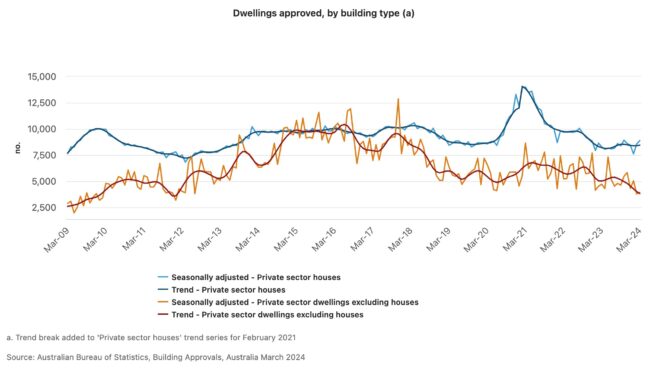
    Today’s update lands 11 days after Australian building approvals data published by the Australian Bureau of Statistics.

    The March figures show a 2.2% decline in seasonally adjusted total dwelling units approved year-on-year. Meanwhile, the fall for private sector dwellings excluding houses deepens to 16.8%, as depicted below.

    Source: Australian Bureau of Statistics, March 2024 Building Approvals, Australia

    In light of the sector’s softening, the ASX 200 stock has revised its FY2024 earnings before interest and taxes (EBIT) guidance.

    The company’s previous estimate was between $540 million to $640 million. Now, Fletcher expects FY24 EBIT before significant items to land between $500 million and $530 million. It marks a 17% reduction from the top-bound estimate.

    Furthermore, Fletcher highlighted gross margin pressure across Iplex NZ and Steel.

    What could be next for this ASX 200 stock?

    Citi analysts have quickly cast their judgment following Fletcher’s guidance downgrade.

    The team believes there is a risk that the building company may tap investors for money through a capital raise, stating:

    A soft trading update that appears to increase leverage outside the range expected.

    Given the potential quantum of the unknowns, we retain our sell rating and believe it may be prudent for a new CEO to shore up the balance sheet.

    As of 31 December 2023, Fletcher held NZ$2.18 billion of debt on its balance sheet. Whereas the cash pile stood at a relatively meagre NZ$215 million.

    Citi is sticking to its sell rating despite the ASX 200 stock being down 34.5% from a year ago.

    The post This ASX 200 stock just slashed its earnings guidance by 17% appeared first on The Motley Fool Australia.

    Should you invest $1,000 in Fletcher Building Limited right now?

    Before you buy Fletcher Building Limited shares, consider this:

    Motley Fool investing expert Scott Phillips just revealed what he believes are the 5 best stocks for investors to buy right now… and Fletcher Building Limited wasn’t one of them.

    The online investing service he’s run for over a decade, Motley Fool Share Advisor, has provided thousands of paying members with stock picks that have doubled, tripled or even more.*

    And right now, Scott thinks there are 5 stocks that may be better buys…

    See The 5 Stocks
    *Returns as of 5 May 2024

    More reading

    Citigroup is an advertising partner of The Ascent, a Motley Fool company. Motley Fool contributor Mitchell Lawler has no position in any of the stocks mentioned. The Motley Fool Australia’s parent company Motley Fool Holdings Inc. has no position in any of the stocks mentioned. The Motley Fool Australia has no position in any of the stocks mentioned. The Motley Fool has a disclosure policy. This article contains general investment advice only (under AFSL 400691). Authorised by Scott Phillips.

  • What’s happening with the Sayona Mining share price on Monday?

    Miner looking at a tablet.

    The Sayona Mining Ltd (ASX: SYA) share price is starting the week on a bit of a roller coaster.

    Shares in the S&P/ASX 300 Index (ASX: XKO) lithium stock closed on Friday trading for 4.4 cents. In early trade on Monday, shares were changing hands for 4.6 cents apiece, up 4.5%.

    But the embattled miner wasn’t able to hold onto those gains. At the time of writing, in later morning trade, shares are trading for 4.2 cents apiece, down 4.6%.

    For some context, the ASX 300 is down 0.3% at this same time.

    Here’s what’s happening.

    ASX lithium stock drops despite promising discoveries

    The Sayona Mining share price is failing to lift off today despite the company reporting on some promising exploration results at its North American Lithium (NAL) project, located in Quebec, Canada.

    NAL is a joint venture project. Sayona Mining owns 75% of the project, and Piedmont Lithium Inc (ASX: PLL) holds the other 25%.

    According to the release, results from 91 drill holes and wedges totalling 26,605 metres have identified high-grade lithium mineralisation to the northwest, northeast, southeast and below the Mineral Resource Estimate (MRE) pit shell.

    Management said the newly discovered zones will become a focal point for assessing future mining options at NAL.

    The Sayona Mining share price may not be responding positively today, however, as investors await more certainty.

    While the miner said that initial assessments indicated the presence of high-grade lithium mineralisation outside the MRE pit shell, it cannot yet confirm that these will substantially increase NAL’s resource portfolio or contribute to extending the lithium project’s life of mine.

    Investors should gain more certainty on the size of NAL’s resource and its life of mine estimates as more results come in. Assay results are pending for 24 additional drill holes, totalling 4,592 metres, conducted during the 2023 exploratory drilling campaign.

    Commenting on the results that have yet to boost the Sayona Mining share price, interim CEO James Brown said:

    We are very excited by these new discoveries at North American Lithium which highlights the potential of this asset with high-grade mineralisation defined to the north-west, north-east, south-east and below the existing MRE.

    The team at NAL will now be working to update the Mineral Resource incorporating these significant results. We look forward to continue testing the mineralisation at NAL with further drilling underway.

    Sayona Mining share price snapshot

    Despite rocketing 33% last week, the Sayona Mining share price remains deep in the red in 2024, down 40%.

    Pressured in part by weak lithium prices and a tepid medium-term price outlook for the battery-critical metal, shares in the ASX 300 lithium miner are down 82% over 12 months.

    The post What’s happening with the Sayona Mining share price on Monday? appeared first on The Motley Fool Australia.

    Should you invest $1,000 in Sayona Mining Limited right now?

    Before you buy Sayona Mining Limited shares, consider this:

    Motley Fool investing expert Scott Phillips just revealed what he believes are the 5 best stocks for investors to buy right now… and Sayona Mining Limited wasn’t one of them.

    The online investing service he’s run for over a decade, Motley Fool Share Advisor, has provided thousands of paying members with stock picks that have doubled, tripled or even more.*

    And right now, Scott thinks there are 5 stocks that may be better buys…

    See The 5 Stocks
    *Returns as of 5 May 2024

    More reading

    Motley Fool contributor Bernd Struben has no position in any of the stocks mentioned. The Motley Fool Australia’s parent company Motley Fool Holdings Inc. has no position in any of the stocks mentioned. The Motley Fool Australia has no position in any of the stocks mentioned. The Motley Fool has a disclosure policy. This article contains general investment advice only (under AFSL 400691). Authorised by Scott Phillips.