• Why one fund manager is backing this ASX share after 76% revenue growth

    A man with long hair and tattoos holds out an EFTPOS payment machine from behind a shop counter.A man with long hair and tattoos holds out an EFTPOS payment machine from behind a shop counter.

    A leading fund manager has identified the ASX share Smartpay Holdings Ltd (ASX: SMP) as a small-cap opportunity.

    The Wilson Asset Management (WAM) investment team likes the outlook for the financial technology company, which is one of Australia and New Zealand’s largest independent full-service EFTPOS providers.

    Smartpay says it services more than 30,000 merchants with more than 40,000 secure and feature-rich EFTPOS terminals. In New Zealand, it’s the largest direct connector of EFTPOS terminals to Paymark, the central electronic payment processing platform.

    Recently, the ASX share provided a trading update so let’s have a look at some of those numbers.

    Sales recap

    Smartpay said its Australian acquiring transactional revenue for the three months to 31 March 2023 was up 76% year over year, while the Australian total transaction value was up 64% year over year. The company reported consolidated revenue was up 54% year over year.

    The business said ts full trans-Tasman network of terminals is now over 46,000.

    During the three months to March 2023, it added another 1,200 new transacting terminals in Australia while seeing continued stability in its New Zealand terminal fleet.

    Smartpay also reported it has entered into a non-binding letter of intent with its Australian processing partner to “unlock the strategic value” of its NZ fleet of over 30,000 terminals. This provides a path to present its next-generation android terminal and acquiring solution to its NZ customer base.

    On the company’s outlook, Smartpay said:

    With a strong finish to the 2023 financial year we are now looking forward to the 2024 financial year.

    Our recent NPS (Net Promotor Score) surveys have again rewarded our focus on customer experience with Australia at 70 and NZ 49.

    We remain committed to the ongoing execution into the Australian opportunity, development of the New Zealand opportunity and leveraging the strategic value of both our New Zealand and Australian businesses.

    With preparations underway for the realisation of a truly trans-Tasman payments business, where we will deliver our market leading payments solution and customer experience to our entire network of customers, we look forward with anticipation to the year ahead and beyond.

    The Smartpay share price jumped when it reported these numbers on 26 April 2023, as seen on the chart below.

    What does WAM think of the ASX share?

    The fund manager suggested the ongoing growth of Smartpay “demonstrated its continued success at capturing market share from its key competitors”.

    WAM also said that a “shift from their traditional rental model to a transaction acquiring model in New Zealand should be more profitable for the business, however, the company is still in the early stages of exploring this new opportunity”.

    The investment team is looking forward to hearing more as the initiative progresses.

    In Smartpay’s FY23 half-year result, it saw revenue rise by 68% while earnings before interest, tax, depreciation and amortisation (EBITDA) grew by 119% to $8.1 million. Net profit before tax improved 637% to $2.7 million. The company also saw positive operating cash flow of $10.1 million generated in the half-year period.

    The post Why one fund manager is backing this ASX share after 76% revenue growth appeared first on The Motley Fool Australia.

    Should you invest $1,000 in Smartpay Holdings Limited right now?

    Before you consider Smartpay Holdings Limited, you’ll want to hear this.

    Motley Fool Investing expert Scott Phillips just revealed what he believes are the 5 best stocks for investors to buy right now… and Smartpay Holdings Limited wasn’t one of them.

    The online investing service he’s run for over a decade, Motley Fool Share Advisor, has provided thousands of paying members with stock picks that have doubled, tripled or even more.* And right now, Scott thinks there are 5 stocks that are better buys.

    See The 5 Stocks
    *Returns as of April 3 2023

    (function() {
    function setButtonColorDefaults(param, property, defaultValue) {
    if( !param || !param.includes(‘#’)) {
    var button = document.getElementsByClassName(“pitch-snippet”)[0].getElementsByClassName(“pitch-button”)[0];
    button.style[property] = defaultValue;
    }
    }

    setButtonColorDefaults(“#43B02A”, ‘background’, ‘#5FA85D’);
    setButtonColorDefaults(“#43B02A”, ‘border-color’, ‘#43A24A’);
    setButtonColorDefaults(“#fff”, ‘color’, ‘#fff’);
    })()

    More reading

    Motley Fool contributor Tristan Harrison has no position in any of the stocks mentioned. The Motley Fool Australia’s parent company Motley Fool Holdings Inc. has no position in any of the stocks mentioned. The Motley Fool Australia has no position in any of the stocks mentioned. The Motley Fool has a disclosure policy. This article contains general investment advice only (under AFSL 400691). Authorised by Scott Phillips.

    from The Motley Fool Australia https://ift.tt/LBciQR9

  • ‘Welcome improvement’: 3 ASX small-cap shares to grab right now

    three children wearing superhero costumes, complete with masks, pose with hands on hips wearing capes and sneakers on a running track.three children wearing superhero costumes, complete with masks, pose with hands on hips wearing capes and sneakers on a running track.

    With so much economic uncertainty still ahead of us, many ASX small caps are still suffering.

    Eleven interest rate rises in the space of a year has forced consumers to close their wallets. This means that the larger businesses with more pricing power and economies of scale have an advantage.

    But this year the market has seen some green shoots from the small cap garden bed.

    The Celeste Australian Small Companies Fund is a specialist in that field.

    The team there noticed three particular ASX shares that had an excellent April, which it is holding onto for further returns:

    Political anxiety dissipating

    MA Financial Group Ltd (ASX: MAF) shares rallied a whopping 16.7% last month, and have pushed up another 4.8% so far in May.

    The finance stock had suffered in the past year due to concerns that Canberra would clamp down on Significant Investors Visa (SIV) entries into Australia. 

    The Celeste team noted those worries seem to be passing after a government review.

    “Investors’ concerns regarding the future of Significant Investment Visa inflows eased,” read its memo to clients.

    “The review noted the relative strength of outcomes of the SIV program relative to the broader Business Innovation and Investment Program.”

    MA Financial also pulled off a major takeover deal.

    “MAF also announced the acquisition of the d’Albora marina portfolio for $225 million as part of the launch of their new MA Marina Fund,” read the memo.

    “The sellers, Balmain Corp, chose to remain invested via the new fund, underwriting the attractiveness of the proposal.”

    Cyberattack wasn’t as bad as first thought

    Shares for intellectual property services provider IPH Ltd (ASX: IPH) enjoyed a 9.7% climb in April.

    A cybersecurity incident had understandably struck fear into investors in March, but the company has since provided “better-than-expected updates” about the intrusion.

    “IPH’s investigation found downloaded data was limited to a small number of Spruson & Ferguson clients with most IPH member firms unaffected,” read the Celeste memo.

    “Further to this, IPH was able to quickly return to normal operations with key system functionality restored on new network infrastructure.”

    Management quantified the financial impact of the security breach at $4.4 million for March and $2 to $2.5 million one-off costs for the current financial year.

    A past acquisition has also borne fruit.

    “IPH also confirmed Smart & Biggar achieved the full earn-out payment of C$66 million, reflecting strong performance post-acquisition.”

    New business is great for the stock price and country

    Private health insurer ​​NIB Holdings Limited (ASX: NHF) saw its shares rise 9.5% in April then another 5.7% this month.

    Investors are bullish about its recent foray into the National Disability Insurance Scheme (NDIS) industry.

    “NIB Holdings purchased Brisbane-based Connect Plan Management and entered into an agreement to purchase All Disability Plan Management,” the Celeste team stated. 

    “The company expects to be the plan manager of approximately 50,000 participants by FY25 under their nib Thrive banner.”

    NDIS has been under fire in recent months due to media reports of rorting by service providers.

    The Celeste analysts believe entry into the industry by a well-established business like NIB is beneficial for disabled Australians.

    “Given the increased scrutiny of the NDIS, NIB’s entry into the space should provide a welcome improvement in oversight, controls, and the overall quality of outcomes for participants.”

    The post ‘Welcome improvement’: 3 ASX small-cap shares to grab right now appeared first on The Motley Fool Australia.

    FREE Beginners Investing Guide

    Despite what some people may say – we believe investing in shares doesn’t have to be overwhelming or complicated…

    For over a decade, we’ve been helping everyday Aussies get started on their journey.

    And to help even more people cut through some of the confusion “experts’” seem to want to perpetuate – we’ve created a brand-new “how to” guide.

    Yes, Claim my FREE copy!
    *Returns as of April 3 2023

    (function() {
    function setButtonColorDefaults(param, property, defaultValue) {
    if( !param || !param.includes(‘#’)) {
    var button = document.getElementsByClassName(“pitch-snippet”)[0].getElementsByClassName(“pitch-button”)[0];
    button.style[property] = defaultValue;
    }
    }

    setButtonColorDefaults(“#0095C8”, ‘background’, ‘#5FA85D’);
    setButtonColorDefaults(“#0095C8”, ‘border-color’, ‘#43A24A’);
    setButtonColorDefaults(“#fff”, ‘color’, ‘#fff’);
    })()

    More reading

    Motley Fool contributor Tony Yoo has no position in any of the stocks mentioned. The Motley Fool Australia’s parent company Motley Fool Holdings Inc. has no position in any of the stocks mentioned. The Motley Fool Australia has recommended IPH, Ma Financial Group, and NIB Holdings. The Motley Fool has a disclosure policy. This article contains general investment advice only (under AFSL 400691). Authorised by Scott Phillips.

    from The Motley Fool Australia https://ift.tt/8UguwMn

  • Brokers expect big gains and huge dividends from these ASX 200 mining shares

    Miner looking at his notes.

    Miner looking at his notes.

    Are you looking for options in the mining sector? If you are, you might want to consider the two ASX 200 mining shares listed below.

    Both have recently been named as buys by brokers and tipped to provide an attractive combination of capital returns and dividends.

    Here’s what you need to know about them:

    Mineral Resources Ltd (ASX: MIN)

    Morgans remains very positive on Mineral Resources. It is a mining and mining services company which has exposure to lithium, iron ore, and energy.

    The broker currently has the company on its best ideas list with an add rating and $103.00 price target. This compares favourably to the latest Mineral Resources share price of $73.39. In addition, its analysts are expecting a $5.59 per share dividend in FY 2024. This equates to a massive 7.9% dividend yield at current prices.

    Morgans commented:

    MIN is a founder-led business and top tier miner and crusher that has grown consistently despite barely issuing a share over the last decade. Also helping our investment view is that MIN’s diversification leaves it far more capable of tolerating volatility in lithium markets than its peers in the sector. We see MIN’s lithium / iron ore market exposures as an ideal combination to benefit from the China re-opening increase in demand during 1H’CY23. We also see MIN as well placed to grow into its valuation, even if we see unexpected metal price volatility, given the magnitude of organic growth in the pipeline.

    South32 Ltd (ASX: S32)

    Another ASX 200 mining share that has been named as a buy is South32. It is a diversified miner with a portfolio of world class operations across many commodities such as aluminium and copper.

    Goldman Sachs is a fan of the company and recently upgraded its shares to a buy rating with a $4.90 price target. This compares favourably to the current South32 share price of $4.06.

    In addition, the broker is expecting a 60 cents per share dividend in FY 2024, which would mean a whopping dividend yield of 14.8% for investors.

    Goldman Sachs explained its bullish stance. It said:

    We upgrade S32 to Buy (from Neutral) on attractive valuation: Trading at ~0.95xNAV (A$4.6/sh) and on an implied TSR of ~29%, and an attractive NTM EV/EBITDA multiple of ~2.1x vs. the sector average of 4.5x. We assume the share buyback continues (at ~US$250mn p.a) and S32 pays out 50% of earnings (40% ordinary, 10% special dividend component) with the FY23 full year result. On our estimates, S32 is on a supportive dividend yield of c. 5% in FY23, increasing to 14% in FY24.

    The post Brokers expect big gains and huge dividends from these ASX 200 mining shares appeared first on The Motley Fool Australia.

    FREE Investing Guide for Beginners

    Despite what some people may say – we believe investing in shares doesn’t have to be overwhelming or complicated…

    For over a decade, we’ve been helping everyday Aussies get started on their journey.

    And to help even more people cut through some of the confusion “experts’” seem to want to perpetuate – we’ve created a brand-new “how to” guide.

    Yes, Claim my FREE copy!
    *Returns as of April 3 2023

    (function() {
    function setButtonColorDefaults(param, property, defaultValue) {
    if( !param || !param.includes(‘#’)) {
    var button = document.getElementsByClassName(“pitch-snippet”)[0].getElementsByClassName(“pitch-button”)[0];
    button.style[property] = defaultValue;
    }
    }

    setButtonColorDefaults(“#0095C8”, ‘background’, ‘#5FA85D’);
    setButtonColorDefaults(“#0095C8”, ‘border-color’, ‘#43A24A’);
    setButtonColorDefaults(“#fff”, ‘color’, ‘#fff’);
    })()

    More reading

    Motley Fool contributor James Mickleboro has no position in any of the stocks mentioned. The Motley Fool Australia’s parent company Motley Fool Holdings Inc. has no position in any of the stocks mentioned. The Motley Fool Australia has no position in any of the stocks mentioned. The Motley Fool has a disclosure policy. This article contains general investment advice only (under AFSL 400691). Authorised by Scott Phillips.

    from The Motley Fool Australia https://ift.tt/FDc23E8

  • Invested $11,000 in Magellan shares 5 years ago? Here’s how much passive income you’ve earned

    A young woman sits at her desk in deep contemplation with her hand to her chin while seriously considering information she is reading on her laptopA young woman sits at her desk in deep contemplation with her hand to her chin while seriously considering information she is reading on her laptop

    The last five years have been the best of times and the worst of times for the Magellan Financial Group Ltd (ASX: MFG) share price. The stock leapt to an all-time high of around $65.50 in early 2020 before plummeting to a recent low of $7.52 earlier this year.

    But how has the investment played out for those who bought into the stock in May 2018?

    An $11,000 investment in the funds management business back then likely would have seen a buyer walk away with 515 stocks, paying $21.33 apiece.

    Today, that parcel would be worth just $4,392.95. The Magellan share price last traded at $8.53, marking a 60% tumble over the last five years.

    For comparison, the S&P/ASX 200 Index (ASX: XJO) has risen 19% in that time.

    But have the dividends on offer from Magellan shares helped numb the pain brought by the stock’s tumble? Let’s take a look.

    All dividends paid to those holding Magellan shares since 2018

    Here is all the passive income offered to those holding a single Magellan share since this time five years ago:

    Magellan dividend pay date Type Dividend amount
    March 2023 Interim 46.9 cents
    September 2022 Final 68.9 cents
    March 2022 Interim $1.101
    September 2021 Final $1.141
    February 2021 Interim 97.1 cents
    August 2020 Final $1.22
    February 2020 Interim 92.9 cents
    August 2019 Final $1.114
    February 2019 Interim 73.8 cents
    August 2018 Final 90 cents
    Total:   $9.272

    As readers can see, each Magellan share has yielded $9.272 of dividends since May 2018.

    That means our figurative investment has provided $4,775.08 of passive income over its life, likely reducing the sting felt as a result of the stock’s suffering.

    Indeed, if we consider those dividends and the stock’s whopping fall, the return on investment (ROI) from our imagined $11,000 purchase comes out to a loss of nearly 16.5% – a far better outcome than it otherwise could have been.

    Not to mention, all the dividends paid by the ASX 200 company in that time have been at least partially franked. That means they might have brought additional benefits for some shareholders at tax time.

    And there’s another silver lining to the stock’s tumble. Right now, Magellan shares are trading with an outwardly impressive 13.6% dividend yield.

    The post Invested $11,000 in Magellan shares 5 years ago? Here’s how much passive income you’ve earned appeared first on The Motley Fool Australia.

    Should you invest $1,000 in Magellan Financial Group right now?

    Before you consider Magellan Financial Group, you’ll want to hear this.

    Motley Fool Investing expert Scott Phillips just revealed what he believes are the 5 best stocks for investors to buy right now… and Magellan Financial Group wasn’t one of them.

    The online investing service he’s run for over a decade, Motley Fool Share Advisor, has provided thousands of paying members with stock picks that have doubled, tripled or even more.* And right now, Scott thinks there are 5 stocks that are better buys.

    See The 5 Stocks
    *Returns as of April 3 2023

    (function() {
    function setButtonColorDefaults(param, property, defaultValue) {
    if( !param || !param.includes(‘#’)) {
    var button = document.getElementsByClassName(“pitch-snippet”)[0].getElementsByClassName(“pitch-button”)[0];
    button.style[property] = defaultValue;
    }
    }

    setButtonColorDefaults(“#43B02A”, ‘background’, ‘#5FA85D’);
    setButtonColorDefaults(“#43B02A”, ‘border-color’, ‘#43A24A’);
    setButtonColorDefaults(“#fff”, ‘color’, ‘#fff’);
    })()

    More reading

    Motley Fool contributor Brooke Cooper has no position in any of the stocks mentioned. The Motley Fool Australia’s parent company Motley Fool Holdings Inc. has no position in any of the stocks mentioned. The Motley Fool Australia has no position in any of the stocks mentioned. The Motley Fool has a disclosure policy. This article contains general investment advice only (under AFSL 400691). Authorised by Scott Phillips.

    from The Motley Fool Australia https://ift.tt/Fd3iWLf

  • A $3k investment in ASX cannabis stock Incannex 5 years ago is now worth $15,000. Here’s why

    Man in the green house growing medical cannabisMan in the green house growing medical cannabis

    It’s been a while since ASX cannabis stocks have been popular with ASX investors. They were all the rage a few years ago with many cannabis shares recording triple-digit gains over 2020 and 2021.

    But the hype has decidedly died down over 2022 and 2023 so far. Yet that doesn’t mean ASX cannabis stocks like Incannex Healthcare Ltd (ASX: IHL) haven’t been worth owning.

    In fact, Incannex shares have been one of the best investments on the ASX in recent years. Five years ago, this cannabis stock was going for just 2 cents a share. Today, the Incannex share price is sitting at 10 cents a share, up a whopping 425% from where it was back in May 2018.

    We won’t dwell on the fact that back in March last year, Incannex was going for as much as 60 cents a share though. Yep, between May 2018 and March 2022, investors enjoyed a 2,900% return:

    Even so, 425% is a stonking return for five years of waiting. It means that an investor who put just $3,000 into Incannex shares back in May 2018 would be looking after a $15,000 investment today.

    So what’s been the secret behind the success of this ASX cannabis stock?

    Why has ASX cannabis stock Incannex shot the lights out?

    Well, it’s difficult to pinpoint why investors have lit up Incannex shares over the past five years. The company undoubtedly rode the ASX cannabis stock mania over 2021 and into 2022. Sentiment regarding ASX cannabis stocks may have dimmed but Incannex has still made some positive developments that have probably helped it to stay at the forefront of investors’ minds.

    Last year, Incannex shares got a major boost when the company was selected for inclusion into the S&P/ASX 300 Index (ASX: XKO). The ASX 300 is one of the major stock market indexes on the ASX and is tracked by exchange-traded funds (ETFs) like the Vanguard Australian Shares Index ETF (ASX: VAS).

    Mushrooms and the ASX 300

    When a share is included in an index like the ASX 300, the ETFs that track it have to buy that share. This can lead to an increase in trading and liquidity, and a boost in valuation. That’s probably why we saw the Inannex share price rise by 20% in the lead-up to its ASX 300 initiation last year.

    2022 also saw Incannex make some big moves in its own space too, which might have gotten more investors on board with the company’s vision. Incannex finalised the acquisition of APIRx Pharmaceuticals in August last year.

    This enabled the company to add 22 clinical and pre-clinical projects to its books. Following the acquisition, Incannex declared that it now had the “world’s largest portfolio of patented medicinal cannabinoid drug formulations and psychedelic treatment protocols”.

    And it was only back in March this year that Incannex announced that it would be developing and manufacturing its own psilocybin-based drug for clinical trials. Psilocybin is the active chemical in ‘magic mushrooms’. Incannex hopes that its drug will help patients suffering from anxiety disorders.

    So it looks like Incannex’s success over the past five years can be put down to a combination of all of these factors. No doubt long-term investors in this ASX cannabis stock will be pleased with its share price growth over this period. But let’s see how the company fares going forward.

    At the current Incannex share price, this ASX cannabis stock has a market capitalisation of around $160 million.

    The post A $3k investment in ASX cannabis stock Incannex 5 years ago is now worth $15,000. Here’s why appeared first on The Motley Fool Australia.

    Wondering where you should invest $1,000 right now?

    When investing expert Scott Phillips has a stock tip, it can pay to listen. After all, the flagship Motley Fool Share Advisor newsletter he has run for over ten years has provided thousands of paying members with stock picks that have doubled, tripled or even more.*

    Scott just revealed what he believes could be the ‘five best ASX stocks’ for investors to buy right now. These stocks are trading at near dirt-cheap prices and Scott thinks they could be great buys right now…

    See The 5 Stocks
    *Returns as of April 3 2023

    (function() {
    function setButtonColorDefaults(param, property, defaultValue) {
    if( !param || !param.includes(‘#’)) {
    var button = document.getElementsByClassName(“pitch-snippet”)[0].getElementsByClassName(“pitch-button”)[0];
    button.style[property] = defaultValue;
    }
    }

    setButtonColorDefaults(“#0095C8”, ‘background’, ‘#5FA85D’);
    setButtonColorDefaults(“#0095C8”, ‘border-color’, ‘#43A24A’);
    setButtonColorDefaults(“#fff”, ‘color’, ‘#fff’);
    })()

    More reading

    Motley Fool contributor Sebastian Bowen has positions in Vanguard Australian Shares Index ETF. The Motley Fool Australia’s parent company Motley Fool Holdings Inc. has no position in any of the stocks mentioned. The Motley Fool Australia has no position in any of the stocks mentioned. The Motley Fool has a disclosure policy. This article contains general investment advice only (under AFSL 400691). Authorised by Scott Phillips.

    from The Motley Fool Australia https://ift.tt/gj7aIs5

  • Why the BHP dividend forecast has caught my attention!

    A mining employee in a white hard hat cheers with fists pumped as the Hot Chili share price rises higher today

    A mining employee in a white hard hat cheers with fists pumped as the Hot Chili share price rises higher today

    If you’re an income investor, then you will no doubt have considered the BHP Group Ltd (ASX: BHP) dividend at some point.

    After all, the mining behemoth is one of the world’s biggest dividend payers. Each year, it returns billions of dollars of its profits back to its shareholders, lining their pockets with cash and boosting their passive income.

    However, it is fair to say that some investors have an aversion to investing in the mining sector. This is due to finding it difficult to predict mining cycles and the unpredictability of earnings.

    While this is understandable if you’re wanting a consistent and predictable level of passive income each year, you could still be doing yourself a disservice by missing out on some big dividend yields that are being offered by BHP shares.

    BHP dividend forecast

    For example, Goldman Sachs is predicting that the BHP dividend will be large enough to provide above-average yields this year and next.

    According to a recent note, its analysts expect the Big Australian to be in a position to pay fully franked dividends per share of US$2.05 in FY 2023 and then US$1.63 in FY 2024. This currently equates to A$3.08 per share and A$2.45 per share at current exchange rates.

    Based on the current BHP share price of $44.08, this will mean yield of 7% and 5.6%, respectively, for income investors. Both yields are well ahead of the traditional market average dividend yield of 4%.

    In addition to the generous BHP dividend yield, Goldman also sees scope for sizeable capital returns.

    The broker’s buy rating and $49.90 price target implies potential upside of 13.2% for investors over the next 12 months. This stretches the total potential return to approximately 20%.

    The post Why the BHP dividend forecast has caught my attention! appeared first on The Motley Fool Australia.

    Should you invest $1,000 in Bhp Group right now?

    Before you consider Bhp Group, you’ll want to hear this.

    Motley Fool Investing expert Scott Phillips just revealed what he believes are the 5 best stocks for investors to buy right now… and Bhp Group wasn’t one of them.

    The online investing service he’s run for over a decade, Motley Fool Share Advisor, has provided thousands of paying members with stock picks that have doubled, tripled or even more.* And right now, Scott thinks there are 5 stocks that are better buys.

    See The 5 Stocks
    *Returns as of April 3 2023

    (function() {
    function setButtonColorDefaults(param, property, defaultValue) {
    if( !param || !param.includes(‘#’)) {
    var button = document.getElementsByClassName(“pitch-snippet”)[0].getElementsByClassName(“pitch-button”)[0];
    button.style[property] = defaultValue;
    }
    }

    setButtonColorDefaults(“#43B02A”, ‘background’, ‘#5FA85D’);
    setButtonColorDefaults(“#43B02A”, ‘border-color’, ‘#43A24A’);
    setButtonColorDefaults(“#fff”, ‘color’, ‘#fff’);
    })()

    More reading

    Motley Fool contributor James Mickleboro has no position in any of the stocks mentioned. The Motley Fool Australia’s parent company Motley Fool Holdings Inc. has no position in any of the stocks mentioned. The Motley Fool Australia has no position in any of the stocks mentioned. The Motley Fool has a disclosure policy. This article contains general investment advice only (under AFSL 400691). Authorised by Scott Phillips.

    from The Motley Fool Australia https://ift.tt/GS5Hw0U

  • Macquarie shares are going for cheap. Buy the dip?

    A blockchain investor sits at his desk with a laptop computer open and a phone checking information from a booklet in a home office setting.A blockchain investor sits at his desk with a laptop computer open and a phone checking information from a booklet in a home office setting.

    Investment bank Macquarie Group Ltd (ASX: MQG) has been an investors’ darling over the years, but the stock price has slumped in recent weeks.

    Macquarie shares are down about 8.5% since 7 March.

    One could wonder why this was happening, considering the finance giant had not announced any adverse news.

    Shaw and Partners portfolio manager James Gerrish explored the reasons for this dip and whether Macquarie is worth buying and holding.

    Diversification within one stock

    Firstly, Gerrish felt like the latest earnings result was positive.

    “It was a good result [but] I suspect the market was slightly concerned by the proportion of their earnings that came from the commodities division as a result of volatility caused in part by Russia,” he told a Market Matters Q&A.

    “If that’s an anomaly, they won’t have that tailwind again.”

    The great feature of Macquarie’s business model is that it has fingers in many pies. That means even if the benefits from the Ukraine crisis ebb away, other parts of the company will pick up the slack.

    “There are offsets, insofar as less volatility from a broader markets perspective will generally mean more M&A and deal flow, which was soft in the result they delivered,” said Gerrish.

    “Ultimately, it’s the reason we like the stock. Different divisions perform differently at different times and that creates a nice level of diversification in their earnings.”

    Long term wealth creator

    For Gerrish’s team, Macquarie shares are worth grabbing now.

    “We own Macquarie and intend to hold it.”

    For perspective, the Macquarie share price is down 1.8% over the past year while the broader S&P/ASX 200 Index (ASX: XJO) has gained 2.3%.

    Macquarie shares have gained 53.75% over the past five years, and currently pay out a dividend yield of 4.3%.

    The finance giant was recently revealed as the ninth most held stock in the portfolios of millionaires.

    The post Macquarie shares are going for cheap. Buy the dip? appeared first on The Motley Fool Australia.

    Should you invest $1,000 in Macquarie Group Limited right now?

    Before you consider Macquarie Group Limited, you’ll want to hear this.

    Motley Fool Investing expert Scott Phillips just revealed what he believes are the 5 best stocks for investors to buy right now… and Macquarie Group Limited wasn’t one of them.

    The online investing service he’s run for over a decade, Motley Fool Share Advisor, has provided thousands of paying members with stock picks that have doubled, tripled or even more.* And right now, Scott thinks there are 5 stocks that are better buys.

    See The 5 Stocks
    *Returns as of April 3 2023

    (function() {
    function setButtonColorDefaults(param, property, defaultValue) {
    if( !param || !param.includes(‘#’)) {
    var button = document.getElementsByClassName(“pitch-snippet”)[0].getElementsByClassName(“pitch-button”)[0];
    button.style[property] = defaultValue;
    }
    }

    setButtonColorDefaults(“#0095C8”, ‘background’, ‘#5FA85D’);
    setButtonColorDefaults(“#0095C8”, ‘border-color’, ‘#43A24A’);
    setButtonColorDefaults(“#fff”, ‘color’, ‘#fff’);
    })()

    More reading

    Motley Fool contributor Tony Yoo has positions in Macquarie Group. The Motley Fool Australia’s parent company Motley Fool Holdings Inc. has no position in any of the stocks mentioned. The Motley Fool Australia has positions in and has recommended Macquarie Group. The Motley Fool has a disclosure policy. This article contains general investment advice only (under AFSL 400691). Authorised by Scott Phillips.

    from The Motley Fool Australia https://ift.tt/px3OBud

  • Is it time to be a bull or a bear on NAB shares?

    Tug of WarTug of War

    The market responded unforgivingly to the latest figures from National Australia Bank Ltd (ASX: NAB). Shares in the banking major are now down more than 9% since entering 2023, despite a continued uptick in earnings.

    In light of the reaction, we asked two of the Foolish team to explain the bull and bear stance for this ASX bank share.

    Here’s what they had to say.

    Why I won’t be buying NAB shares

    By Mitchell Lawler: The NAB share price has been the worst-performing of the big four banks over the past year, with its share price falling 15%. Strangely, this underwhelming performance has occurred while net interest margins (NIMs) have expanded amid rising interest rates

    After a boom period for profits, investors will be looking to what comes next. I think the next year or so won’t be as fruitful as the last. I’m rarely pessimistic, but the outlook appears mediocre at best for ASX bank shares whichever way you slice it. 

    Credit quality will be tested across all forms of lending if the Reserve Bank of Australia determines rates need to go higher for longer. Meanwhile, if rates begin falling, we’re likely to see a reduction in NIM. Both ways, the outcome is most probably lower earnings for the big banks. 

    In my opinion, Macquarie Group Ltd (ASX: MQG) is a much higher quality alternative to NAB shares. Both trade on earnings multiples of around 12 to 13 times, however, Macquarie is less reliant on banking and financial services.

    NAB and Macquarie Group Return on Equity over time. Data by Trading View.

    Furthermore, Macquarie has a history of delivering a greater return on equity (ROE) than NAB. The investment bank’s ROE has been trending higher since 2015. In contrast, NAB has been unable to deliver a return on equity above 13% and trending sideways.

    Lastly, as competition remains stiff between the big four, keeping expenses in check will become more critical.

    Out of the four, NAB let its expenses blow out the most compared to the prior corresponding period (pcp), according to the latest round of updates. Total expenses grew by 11.5% pcp, with the next worst offender being the Commonwealth Bank of Australia (ASX: CBA), up 5% pcp.

    The considerable jump in costs is another reason why I am not on board with buying NAB shares at this point in time.

    Motley Fool contributor Mitchell Lawler does not own shares in National Australia Bank Ltd

    Heated competition beginning to settle

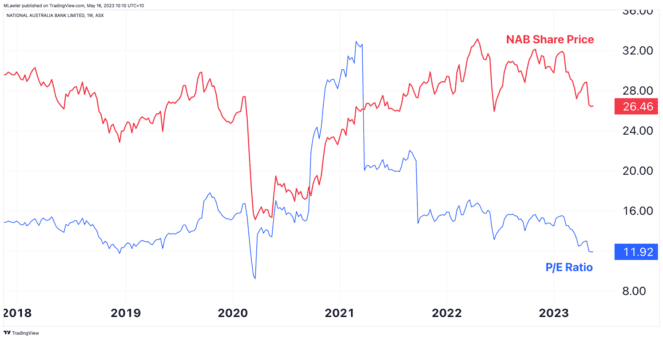
    By Tristan Harrison: The NAB share price has declined close to 20% since February 2023, despite reporting an impressive 17% rise in cash earnings in the first half of FY23.

    This has led to the NAB price-to-earnings (P/E) ratio being the lowest it has been since the COVID-19 crash.

    We can see on the chart below that the (blue) P/E ratio line generally tracks the (red) share price line. But, while the NAB share price briefly dropped lower last year, it’s at the lowest earnings multiple because of its higher profits.

    NAB P/E ratio and share price. Data by Trading View.

    So, the key question is: will earnings hold up?

    There has reportedly been intense competition in the banking space, which has been lowering the net interest margin from its potential peak after the run of interest rate rises.

    However, we’ve recently heard the home loan battle could soon be softening, with NAB (and Commonwealth Bank of Australia) ending cash-back offers at the end of June.

    This could be a very promising step for NAB’s NIM and overall profitability if it doesn’t need to compete as hard to retain and win customers.

    In the meantime, NAB’s business bank continues to perform very well. During HY23, the bank’s business and private banking division saw a 20% increase in cash earnings to $1.7 billion. It was NAB’s most profitable division and saw a big improvement in profit.

    NAB’s profit doesn’t need to grow much for NAB shares to do well from here, partly because the lower valuation has boosted the grossed-up dividend yield to 9% for FY23, according to Commsec.

    I also think the bank can continue to perform well through this uncertain period under the stewardship of skilled banker and CEO Ross McEwan.

    Motley Fool contributor Tristan Harrison does not own shares in National Australia Bank Ltd

    The post Is it time to be a bull or a bear on NAB shares? appeared first on The Motley Fool Australia.

    Should you invest $1,000 in National Australia Bank Limited right now?

    Before you consider National Australia Bank Limited, you’ll want to hear this.

    Motley Fool Investing expert Scott Phillips just revealed what he believes are the 5 best stocks for investors to buy right now… and National Australia Bank Limited wasn’t one of them.

    The online investing service he’s run for over a decade, Motley Fool Share Advisor, has provided thousands of paying members with stock picks that have doubled, tripled or even more.* And right now, Scott thinks there are 5 stocks that are better buys.

    See The 5 Stocks
    *Returns as of April 3 2023

    (function() {
    function setButtonColorDefaults(param, property, defaultValue) {
    if( !param || !param.includes(‘#’)) {
    var button = document.getElementsByClassName(“pitch-snippet”)[0].getElementsByClassName(“pitch-button”)[0];
    button.style[property] = defaultValue;
    }
    }

    setButtonColorDefaults(“#0095C8”, ‘background’, ‘#5FA85D’);
    setButtonColorDefaults(“#0095C8”, ‘border-color’, ‘#43A24A’);
    setButtonColorDefaults(“#fff”, ‘color’, ‘#fff’);
    })()

    More reading

    The Motley Fool Australia’s parent company Motley Fool Holdings Inc. has no position in any of the stocks mentioned. The Motley Fool Australia has positions in and has recommended Macquarie Group. The Motley Fool has a disclosure policy. This article contains general investment advice only (under AFSL 400691). Authorised by Scott Phillips.

    from The Motley Fool Australia https://ift.tt/QLKJGT5

  • Citi says these ASX 200 dividend shares are buys for passive income

    Happy man holding Australian dollar notes, representing dividends.

    Happy man holding Australian dollar notes, representing dividends.

    Are you looking to bolster your passive income with some new dividend shares this month?

    If you are, you may want to look at the two listed below that have been forecast to provide attractive yields by Citi. Here’s what you need to know about these buy-rated ASX 200 dividend shares:

    ANZ Group Holdings Ltd (ASX: ANZ)

    The first ASX 200 dividend share that Citi has named as a buy is banking giant ANZ Bank.

    The broker was pleased with ANZ’s recent first-half results, which were in-line with expectations. And while it acknowledges that the bank is facing the same competitive pressures on both sides of its balance sheet as the other big banks, it continues to believe ANZ is the top pick in the sector.

    This is because it sees “ANZ’s unique capabilities as set to deliver relative outperformance in the current market conditions.”

    As for dividends, Citi is forecasting fully franked dividends of $1.64 per share in FY 2023 and then $1.66 per share in FY 2024. Based on the current ANZ share price of $23.54, this will mean yields of 7% and 7%, respectively.

    Citi has a buy rating and $26.50 price target on the bank’s shares.

    Stockland Corporation Ltd (ASX: SGP)

    Another ASX 200 dividend share that Citi rates as a buy is Stockland. It is a residential and land lease developer and retail, logistics and office real estate property manager.

    Citi believes it could be a top option for income investors right now. Particularly given how it sees a recent “sharp pickup in residential enquiries in 3Q23 (up c. 50% from 1H23 run-rate and inline with pre-Covid levels) as an early sign of a recovery in demand.”

    All in all, the broker believes this positions Stockland to pay dividends per share of 27 cents in FY 2023 and FY 2024. Based on the current Stockland share price of $4.48, this will mean yields of 6% in both years.

    Citi has a buy rating and $4.70 price target on Stockland’s shares.

    The post Citi says these ASX 200 dividend shares are buys for passive income appeared first on The Motley Fool Australia.

    Looking to buy dividend shares to help fight inflation?

    If you’re looking to buy dividend shares to help fight inflation then you’ll need to get your hands on this… Our FREE report revealing 3 stocks not only boasting inflation-fighting dividends…

    They also have strong potential for massive long-term returns…

    See the 3 stocks
    *Returns as of April 3 2023

    (function() {
    function setButtonColorDefaults(param, property, defaultValue) {
    if( !param || !param.includes(‘#’)) {
    var button = document.getElementsByClassName(“pitch-snippet”)[0].getElementsByClassName(“pitch-button”)[0];
    button.style[property] = defaultValue;
    }
    }

    setButtonColorDefaults(“#0095C8”, ‘background’, ‘#5FA85D’);
    setButtonColorDefaults(“#0095C8”, ‘border-color’, ‘#43A24A’);
    setButtonColorDefaults(“#fff”, ‘color’, ‘#fff’);
    })()

    More reading

    Motley Fool contributor James Mickleboro has no position in any of the stocks mentioned. The Motley Fool Australia’s parent company Motley Fool Holdings Inc. has no position in any of the stocks mentioned. The Motley Fool Australia has no position in any of the stocks mentioned. The Motley Fool has a disclosure policy. This article contains general investment advice only (under AFSL 400691). Authorised by Scott Phillips.

    from The Motley Fool Australia https://ift.tt/oOJTGuE

  • Warren Buffett is dumping bank stocks. Should you?

    A man wearing a blue jumper and a hat looks at his laptop with a distressed and fearful look on his face.

    A man wearing a blue jumper and a hat looks at his laptop with a distressed and fearful look on his face.

    Warren Buffett’s Berkshire Hathaway has recently revealed some major share sales. Interestingly, among the sell-offs were notable sales of bank stocks. So could this suggest that Aussie investors should consider the situation for ASX bank shares?

    First, let’s take a look at what moves Berkshire Hathaway has made.

    Berkshire Hathaway sells out of two bank stocks

    The giant US business has grown enormously over the last five decades, thanks to the stewardship of Warren Buffett and his partner Charlie Munger.

    While Buffett makes a lot of the stock portfolio changes, there are also two other investors who manage their own portfolios within the business. So not every investment decision will be Buffett’s, but it’s likely these large bank stock decisions came from him.

    Berkshire Hathaway sold out of its long-term holdings of Bank of New York Mellon and US Bancorp. This comes after the banking problems with names like Silicon Valley Bank and First Republic Bank.

    However, Berkshire Hathaway didn’t completely sell out of the financial sector. In fact, Buffett’s business added to its position in Bank of America shares to the tune of around 22.75 million shares, while also buying 9.9 million Capital One Financial shares.

    I think the Bank of America investment shows Buffett hasn’t lost complete confidence in the US bank stock sector, but he’s being more selective about which banks to be invested in. Credit card business Capital One could be more well-equipped to deal with the current economic climate. For one, it doesn’t have a huge deposit base which could be a problem if there were massive withdrawals, and it can benefit from higher interest rates.

    What to make of this for ASX bank shares?

    The situation is tricky in the US for smaller banks. If most depositors of a financial institution tried to withdraw their money in quick succession, it can cause major problems for that bank.

    The biggest US banks actually saw deposit inflows during that uncertainty a couple of months ago.

    If there were to be concerns over an Australian bank, I think we would see a similar outcome. Depositors might seek the safety of the biggest institutions, with money flowing out of the smaller banks.

    However, I think that Australian banks are in a strong financial position when it comes to their balance sheets. The Australian Prudential Regulation Authority (APRA) has set high minimum requirements for banks with their common equity tier 1 (CET1) ratios.

    Australian banks seem to be in a stronger financial position than many of their peers in the US, so I’m not worried about that side of things.

    However, it could be a good time to consider an investor’s weighting to ASX bank shares. All the banks face similar risks – Commonwealth Bank of Australia (ASX: CBA), Australia and New Zealand Banking Group Ltd (ASX: ANZ), and Bank of Queensland Ltd (ASX: BOQ) could all be hurt if there’s a material rise in loan arrears and bad debts.

    Of course, interest rates are now a lot higher than they were a year ago, which could spell trouble for heavily indebted businesses and households.

    I think there are some higher-quality bank stock names, such as National Australia Bank Ltd (ASX: NAB) and Macquarie Group Ltd (ASX: MQG), which have conservative operating settings, strong balance sheets, and very effective leadership. They’d be my top two choices in the sector.

    But if I had three or more banks in my portfolio, I’d certainly want to consider if owning multiple names in the same industry is providing me with enough diversification.

    The post Warren Buffett is dumping bank stocks. Should you? appeared first on The Motley Fool Australia.

    FREE Guide for New Investors

    Despite what some people may say – we believe investing in shares doesn’t have to be overwhelming or complicated…

    For over a decade, we’ve been helping everyday Aussies get started on their journey.

    And to help even more people cut through some of the confusion “experts’” seem to want to perpetuate – we’ve created a brand-new “how to” guide.

    Yes, Claim my FREE copy!
    *Returns as of April 3 2023

    (function() {
    function setButtonColorDefaults(param, property, defaultValue) {
    if( !param || !param.includes(‘#’)) {
    var button = document.getElementsByClassName(“pitch-snippet”)[0].getElementsByClassName(“pitch-button”)[0];
    button.style[property] = defaultValue;
    }
    }

    setButtonColorDefaults(“#0095C8”, ‘background’, ‘#5FA85D’);
    setButtonColorDefaults(“#0095C8”, ‘border-color’, ‘#43A24A’);
    setButtonColorDefaults(“#fff”, ‘color’, ‘#fff’);
    })()

    More reading

    Bank of America is an advertising partner of The Ascent, a Motley Fool company. Motley Fool contributor Tristan Harrison has no position in any of the stocks mentioned. The Motley Fool Australia’s parent company Motley Fool Holdings Inc. has positions in and has recommended Bank of America and Berkshire Hathaway. The Motley Fool Australia has positions in and has recommended Macquarie Group. The Motley Fool Australia has recommended Berkshire Hathaway. The Motley Fool has a disclosure policy. This article contains general investment advice only (under AFSL 400691). Authorised by Scott Phillips.

    from The Motley Fool Australia https://ift.tt/M6N7bEJ