• Should I buy this week’s slump on Telstra shares?

    Two laughing male executives wearing dark suits chat across a timber lunch room table while one of them holds up his phone to show information.Two laughing male executives wearing dark suits chat across a timber lunch room table while one of them holds up his phone to show information.

    It’s been a relatively tough week for Telstra Group Ltd (ASX: TLS) shares so far. Telstra closed out last week at $4.38 a share, before building on that during Monday’s trading with a new 52-week high of $4.40.

    But the rest of the week has told a different story. Tuesday’s trading saw the Telstra share price lose a nasty 2.28%. The ASX 200 telco has recovered somewhat over Wednesday and Thursday’s sessions and closed trading yesterday at $4.33.

    But the hard numbers don’t lie – Telstra has gone backwards this week.

    This is quite a change of pace for Telstra. The company has had a strong year so far, almost tripling the returns of the S&P/ASX 200 Index (ASX: XJO) with its year-to-date gain of 9.6%. Telstra shares have also booked quite a few new 52-week highs over the past couple of months too:

    So the value investors out there might be asking if this pullback for Telstra shares is a good chance to jump in.

    Well, let’s see what some of the ASX’s top brokers have to say about that.

    Are Telstra shares a buy after this week’s slump?

    First up is Macquarie. As we covered last month, Macquarie currently rates Telstra shares as outperform. This broker has given the ASX 200 telco a 12-month share price target of $4.68. It is expecting Telstra to continue to outperform expectations when it comes to earnings over the next few years after the company’s recent mobile price hikes.

    That’s one notch on the belt.

    But another ASX broker in Goldman Sachs is also positive on Telstra. This expert rates Telstra shares as a buy, with an even better share price target of $4.70. Goldman is also eyeing off Telstra’s ability to generate strong earnings down the road, together with higher dividends.

    Finally, let’s go over the views of yet another broker in Morgans. As we covered last month, Morgans is our third ASX broker to recommend Telstra. It currently has an add rating on the telco, and shares Goldman’s $4.70 price target.

    Morgans reckons the Telstra share price is sporting an attractive valuation, and anticipates further value if the company proceeds with asset divestment.

    So that’s three out of three brokers that are currently recommending Telstra shares for investors today. No doubt Telstra shareholders will be exceptionally pleased with that outcome.

    At Telstra shares’ current pricing, this ASX 200 telco has a market capitalisation of $50.03 billion, with a dividend yield of 3.93%.


    The post Should I buy this week’s slump on Telstra shares? appeared first on The Motley Fool Australia.

    Should you invest $1,000 in Telstra Corporation Limited right now?

    Before you consider Telstra Corporation Limited, you’ll want to hear this.

    Motley Fool Investing expert Scott Phillips just revealed what he believes are the 5 best stocks for investors to buy right now… and Telstra Corporation Limited wasn’t one of them.

    The online investing service he’s run for over a decade, Motley Fool Share Advisor, has provided thousands of paying members with stock picks that have doubled, tripled or even more.* And right now, Scott thinks there are 5 stocks that are better buys.

    See The 5 Stocks
    *Returns as of April 3 2023

    (function() {
    function setButtonColorDefaults(param, property, defaultValue) {
    if( !param || !param.includes(‘#’)) {
    var button = document.getElementsByClassName(“pitch-snippet”)[0].getElementsByClassName(“pitch-button”)[0];
    button.style[property] = defaultValue;
    }
    }

    setButtonColorDefaults(“#0095C8”, ‘background’, ‘#5FA85D’);
    setButtonColorDefaults(“#0095C8”, ‘border-color’, ‘#43A24A’);
    setButtonColorDefaults(“#fff”, ‘color’, ‘#fff’);
    })()

    More reading

    Motley Fool contributor Sebastian Bowen has positions in Telstra Group. The Motley Fool Australia’s parent company Motley Fool Holdings Inc. has positions in and has recommended Goldman Sachs Group. The Motley Fool Australia has positions in and has recommended Macquarie Group and Telstra Group. The Motley Fool has a disclosure policy. This article contains general investment advice only (under AFSL 400691). Authorised by Scott Phillips.

    from The Motley Fool Australia https://ift.tt/G7ouNYc

  • Why these ASX 300 retail shares could be immune to rising interest rates

    Three woman pulling faces.Three woman pulling faces.

    Some S&P/ASX 300 Index (ASX: XKO) retail shares facing an uncertain time. Households are facing painful inflation and elevated interest rates. This could be difficult for a number of retailers if households spend less.

    Plenty of businesses saw excellent retail conditions during COVID as households had more savings and fewer other places where they could spend their discretionary money.

    However, now that the RBA has ramped up the cash rate to lower economic demand in the Australian economy, retailers may see subdued conditions.

    But, according to Australian Financial Review reporting on comments from Josh Clark, portfolio manager of QVG Capital’s long short fund, there are a few pockets of the retail industry that could keep performing.

    Pockets of strength

    Clark is cautious about housing-related retailers, asking the question “how many couches, cushions and coffee machines can you fit in your house?”. There are certainly a few ASX shares that specialise in those sorts of products.

    But, while he believes that cost of living pressures make it “inevitable” that spending will slow, the economy is “only just starting to see evidence of consumer softness from early this year”.

    Clark acknowledged that the portfolio he manages has minimal exposure to the consumer sector, but he does like the look of retailers who are focused on younger shoppers.

    He pointed out that customers aged between 18 to 25 years old are “reaping the benefits of low unemployment without the headwinds of higher mortgage rates.”

    There was one ASX share in particular that he called out with this younger demographic angle in mind – Lovisa Holdings Ltd (ASX: LOV).

    What does Lovisa do?

    Lovisa is an affordable jewellery retailer. It has a strong market presence in Australia, with 163 stores.

    However, the company is rapidly growing in a number of different markets. In the first half of FY22, it had 81 USA stores and by the first half of FY23, it had 155 stores.

    The business has only recently entered a number of regions that I think offer compelling growth potential including Italy, Poland, Hong Kong, Romania, Canada, Mexico and South America.

    Some day, the business may decide to enter the huge population markets of mainland China and India.

    In the first half of FY23, it saw net profit after tax (NPAT) grow by 31.9%. In the second half of FY23, it had opened 31 net new stores by the time it announced its HY23 result.

    The ASX 300 retail share is expecting to deliver growth in “existing and new markets, and expect rollout momentum to increase going forward.”

    Any other ASX retail share ideas?

    While Lovisa was the only one that he named, there are a few other retailers that are aimed at younger shoppers that could perform better.

    Shoe retailer Accent Group Ltd (ASX: AX1) has a number of brands that are targeted at younger shoppers such as Glue Store and Beyond Her.

    Universal Store Holdings Ltd (ASX: UNI) owns three different brands that are “premium youth fashion brands” – Universal Store, THRILLS and Perfect Stranger.

    So, it could be worthwhile to look more into these ASX retail shares.

    The post Why these ASX 300 retail shares could be immune to rising interest rates appeared first on The Motley Fool Australia.

    Our Favorite E-Commerce Stocks

    Why these four e-commerce stocks may be the perfect buy for the “new normal” facing the retail industry

    See the 4 stocks
    *Returns as of April 3 2023

    (function() {
    function setButtonColorDefaults(param, property, defaultValue) {
    if( !param || !param.includes(‘#’)) {
    var button = document.getElementsByClassName(“pitch-snippet”)[0].getElementsByClassName(“pitch-button”)[0];
    button.style[property] = defaultValue;
    }
    }

    setButtonColorDefaults(“#0095C8”, ‘background’, ‘#5FA85D’);
    setButtonColorDefaults(“#0095C8”, ‘border-color’, ‘#43A24A’);
    setButtonColorDefaults(“#fff”, ‘color’, ‘#fff’);
    })()

    More reading

    Motley Fool contributor Tristan Harrison has no position in any of the stocks mentioned. The Motley Fool Australia’s parent company Motley Fool Holdings Inc. has positions in and has recommended Lovisa. The Motley Fool Australia has recommended Accent Group and Lovisa. The Motley Fool has a disclosure policy. This article contains general investment advice only (under AFSL 400691). Authorised by Scott Phillips.

    from The Motley Fool Australia https://ift.tt/aqQ3ZWp

  • Why this broker just upgraded Flight Centre shares to a buy rating

    Kid with arm spread out on a luggage bag, riding a skateboard.

    Kid with arm spread out on a luggage bag, riding a skateboard.

    Flight Centre Travel Group Ltd (ASX: FLT) shares could be great value right now.

    That’s the view of analysts at Morgans, which have just upgraded the travel agent giant’s shares following the release of its quarterly update.

    Flight Centre share price tipped to soar

    According to the note, the broker has upgraded Flight Centre’s shares to an add rating with a significantly improved price target of $26.25.

    Based on the current Flight Centre share price of $21.05, this implies potential upside of 25% for investors over the next 12 months.

    In addition, the broker is expecting the company to be in a position to resume paying dividends in FY 2024. It has pencilled in a 50 cents per share dividend that year, followed by an 88 cents per share dividend in FY 2025.

    This will mean dividend yields of 2.4% and 4.2%, respectively, for investors in those financial years.

    Why is Morgans bullish?

    There were a couple of reason why Morgans has upgraded its rating and valuation of the Flight Centre share price.

    One was the strong trading update it released which has led to the broker lifting its earnings estimates through to FY 2025. The other is a change in its valuation model to a sum of the parts (SOTP) methodology, which it feels is now a more appropriate way to value its shares. Morgans explained:

    Given FLT’s stronger FY23 EBITDA guidance and it bringing forward its FY25 margin target, we have upgraded our EBITDA forecasts by 2.8%/4.3%14.2% in FY23/24/25. Our new FY25 EBITDA forecast of A$295.5m is slightly ahead of the top end of FLT’s guidance range as we think it will prove to be conservative and wouldn’t be surprised if it was upgraded following its key trading period.

    Given the company’s operating and financial leverage, the upgrades at the NPAT level are greater. Our forecasts are now well ahead of consensus estimates. To better account for FLT’s different business units and compare it to peers, we now value the company using a SOTP methodology. Our SOTP is A$26.26 per share.

    The post Why this broker just upgraded Flight Centre shares to a buy rating appeared first on The Motley Fool Australia.

    Should you invest $1,000 in Flight Centre Travel Group Limited right now?

    Before you consider Flight Centre Travel Group Limited, you’ll want to hear this.

    Motley Fool Investing expert Scott Phillips just revealed what he believes are the 5 best stocks for investors to buy right now… and Flight Centre Travel Group Limited wasn’t one of them.

    The online investing service he’s run for over a decade, Motley Fool Share Advisor, has provided thousands of paying members with stock picks that have doubled, tripled or even more.* And right now, Scott thinks there are 5 stocks that are better buys.

    See The 5 Stocks
    *Returns as of April 3 2023

    (function() {
    function setButtonColorDefaults(param, property, defaultValue) {
    if( !param || !param.includes(‘#’)) {
    var button = document.getElementsByClassName(“pitch-snippet”)[0].getElementsByClassName(“pitch-button”)[0];
    button.style[property] = defaultValue;
    }
    }

    setButtonColorDefaults(“#43B02A”, ‘background’, ‘#5FA85D’);
    setButtonColorDefaults(“#43B02A”, ‘border-color’, ‘#43A24A’);
    setButtonColorDefaults(“#fff”, ‘color’, ‘#fff’);
    })()

    More reading

    Motley Fool contributor James Mickleboro has no position in any of the stocks mentioned. The Motley Fool Australia’s parent company Motley Fool Holdings Inc. has no position in any of the stocks mentioned. The Motley Fool Australia has recommended Flight Centre Travel Group. The Motley Fool has a disclosure policy. This article contains general investment advice only (under AFSL 400691). Authorised by Scott Phillips.

    from The Motley Fool Australia https://ift.tt/ja9ZCfI

  • Here’s how I’d aim for $200 a month in passive income using ASX 200 bank shares

    Woman holding out $20 dollar Australian notes, symbolising dividends.Woman holding out $20 dollar Australian notes, symbolising dividends.

    Investors hoping to earn some handy passive income on the side could take a look at ASX 200 bank shares.

    Two ASX 200 bank shares that could provide monthly passive income are Commonwealth Bank of Australia (ASX: CBA) and National Australia Bank Ltd (ASX: NAB). In fact, these two have already announced interim dividends for FY23.

    ANZ Group Holdings Ltd (ASX: ANZ) is due to report its financial results today, while Westpac Banking Corporation (ASX: WBC) is due to report next week.

    Let’s take a look at how I could receive $200 monthly income with Commonwealth Bank and NAB shares.

    Could I receive $200 monthly income from CBA and NAB?

    Firstly, it’s worth noting the calculations I am looking at reflect dividend payments announced in the last year. Of course, the dividends for these ASX 200 bank shares could change in the future.

    Secondly, a $200 monthly income equates to $2,400 in annual income.

    Taking a look at Commonwealth Bank of Australia, the biggest of the big four paid an interim dividend of $2.10 in the first half of this year. This followed a $2.10 final dividend in the second half of 2022.

    This equates to $4.20 in dividend payments from the CBA overall in the year.

    The bank’s share price dropped 7% in the last year and last closed at $95.76.

    Based on CBA’s latest share price, this represents a trailing dividend yield of about 4.4%.

    Let’s now take a look at the NAB dividend. NAB yesterday announced an interim dividend to shareholders of 83 cents per share fully franked. This will be paid on 5 July 2023.

    NAB paid a 78 cents per share final dividend in the second half of last year.

    In total, this means NAB is paying $1.61 worth of dividends to investors in a year.

    National Australia Bank shares fell 6.41% on Thursday following the release of the company’s results and closed at $26.72 each. NAB shares have fallen nearly 18% in a year.

    However, based on Thursday’s closing price, NAB’s dividend yield is 6%.

    What would I need to invest to get $200 a month?

    If I invest the same amount in both NAB and CBA shares, my average dividend yield would be 5.2%.

    So, to generate $200 a month (or $2,400 a year) in passive income with a 5.2% average dividend yield, I would need to invest $46,153.85 in these two shares overall.

    Another approach would be to invest $3,846 a month for the next 12 months in these two ASX bank shares.

    The post Here’s how I’d aim for $200 a month in passive income using ASX 200 bank shares appeared first on The Motley Fool Australia.

    Looking to buy dividend shares to help fight inflation?

    If you’re looking to buy dividend shares to help fight inflation then you’ll need to get your hands on this… Our FREE report revealing 3 stocks not only boasting inflation-fighting dividends…

    They also have strong potential for massive long-term returns…

    See the 3 stocks
    *Returns as of April 3 2023

    (function() {
    function setButtonColorDefaults(param, property, defaultValue) {
    if( !param || !param.includes(‘#’)) {
    var button = document.getElementsByClassName(“pitch-snippet”)[0].getElementsByClassName(“pitch-button”)[0];
    button.style[property] = defaultValue;
    }
    }

    setButtonColorDefaults(“#0095C8”, ‘background’, ‘#5FA85D’);
    setButtonColorDefaults(“#0095C8”, ‘border-color’, ‘#43A24A’);
    setButtonColorDefaults(“#fff”, ‘color’, ‘#fff’);
    })()

    More reading

    Motley Fool contributor Monica O’Shea has no position in any of the stocks mentioned. The Motley Fool Australia’s parent company Motley Fool Holdings Inc. has no position in any of the stocks mentioned. The Motley Fool Australia has no position in any of the stocks mentioned. The Motley Fool has a disclosure policy. This article contains general investment advice only (under AFSL 400691). Authorised by Scott Phillips.

    from The Motley Fool Australia https://ift.tt/l2SWc7q

  • Keep the faith: 2 ASX shares to buy now at a temporary dip

    A female athlete in green spandex leaps from one cliff edge to another representing 3 ASX shares that are destined to rise and be greatA female athlete in green spandex leaps from one cliff edge to another representing 3 ASX shares that are destined to rise and be great

    Long-term buy-and-hold investing is straightforward in theory but in practice, it can be testing for even the most disciplined investors.

    That’s especially so in turbulent times for the market, such as the past 18 months.

    After all, it’s only human nature to feel disappointed when they see one of their ASX shares fall off a cliff in any given month.

    QVG analysts recently saw this happen to two stocks in their Long Short Fund, but explained why investors need to look past the calamity:

    Recent troubles don’t change ‘long-term outlook’

    The Imdex Limited (ASX: IMD) share price has plunged almost 10% since 30 March. It’s a 20% fall if you go back to 23 January.

    The QVG team attributed this to the fortunes of Imdex’s clientele.

    “It appears their clients (miners & drillers) have had a slow start to the year.”

    But with revenue, operating income, and cash holdings consistently growing, the analysts are backing Imdex shares to rise in the long run.

    “We don’t see [the current slowdown] as changing the long-term outlook for the business.”

    QVG is not the only one who thinks this.

    According to CMC Markets, seven out of eight analysts currently rate Imdex shares as a buy.

    The Motley Fool’s Mitchell Lawler last month rated the stock as his top pick, on the back of recent acquisitions.

    “I believe the addition of Devico sweetens the investment case for Imdex, adding a higher earnings before interest, taxes, depreciation and amortisation (EBITDA) margin business and cementing the company’s global position in the sensor and directional drilling tech markets.”

    Production hiccup is just temporary

    It’s been an ugly 2023 for Mineral Resources Ltd (ASX: MIN), with its share price sinking 28% since 24 January.

    April was especially distressing for the mining service provider.

    “Mineral Resources… saw their share price decline 9% for the month as their lithium production expansion delivered less tonnes than expected and at a higher cost.”

    The recent drop in lithium prices isn’t helping either.

    And of course, the prospects of recession or an economic slowdown always hits the resources industry hard.

    QVG analysts are keeping the faith with a long-term horizon.

    “We believe the mining services volume dip and production ramp at Mt Marion are temporary in nature.”

    The team at Morgans is also a fan of Mineral Resources’ long-term prospects.

    Based on the Thursday trading price of $69.05, Morgans’ $103 price target implies an amazing upside of 49%. 

    “But it gets better!” reported The Motley Fool’s James Mickleboro.

    “The broker is also forecasting a $5.79 per share fully franked dividend in FY 2024. This represents a [sizable] 8% forward dividend yield for investors that buy shares at today’s price.”

    The post Keep the faith: 2 ASX shares to buy now at a temporary dip appeared first on The Motley Fool Australia.

    Our pullback stock hit list…

    Motley Fool Share Advisor has released a hit list of stocks that investors should be paying close attention to right now…

    As the market continues to sell off, we think some stocks have become extreme buying opportunities.

    In five years’ time, we think you’ll probably wish you’d bought these 4 ‘pullback’ stocks…

    See The 4 Stocks
    *Returns as of April 3 2023

    (function() {
    function setButtonColorDefaults(param, property, defaultValue) {
    if( !param || !param.includes(‘#’)) {
    var button = document.getElementsByClassName(“pitch-snippet”)[0].getElementsByClassName(“pitch-button”)[0];
    button.style[property] = defaultValue;
    }
    }

    setButtonColorDefaults(“#0095C8”, ‘background’, ‘#5FA85D’);
    setButtonColorDefaults(“#0095C8”, ‘border-color’, ‘#43A24A’);
    setButtonColorDefaults(“#fff”, ‘color’, ‘#fff’);
    })()

    More reading

    Motley Fool contributor Tony Yoo has no position in any of the stocks mentioned. The Motley Fool Australia’s parent company Motley Fool Holdings Inc. has positions in and has recommended Imdex. The Motley Fool Australia has positions in and has recommended Imdex. The Motley Fool has a disclosure policy. This article contains general investment advice only (under AFSL 400691). Authorised by Scott Phillips.

    from The Motley Fool Australia https://ift.tt/L28vidM

  • ‘Revenues up 59%’: 3 small-cap ASX shares rocketing right now (and set for more gains)

    three children wearing superhero costumes, complete with masks, pose with hands on hips wearing capes and sneakers on a running track.three children wearing superhero costumes, complete with masks, pose with hands on hips wearing capes and sneakers on a running track.

    Small-cap ASX shares were thoroughly demolished in the past 18 months, but there are now some green shoots showing up.

    In a memo to clients, the team at QVG Capital Long Short Fund named three such stocks that have rocketed in recent times, which it is still backing for further gains:

    ‘High energy, entrepreneurial culture’

    Mader Group Ltd (ASX: MAD) is an outsourcer for clients in the mining industry.

    On the back of its latest numbers, the stock has soared an eye-opening 37% year to date.

    “Their update showed revenues up 59% and was particularly pleasing given their March quarter is typically seasonally weak.”

    There are two reasons why the QVG analysts reckon Mader shares are set for further rises.

    “Firstly, their customer is paying a discount to what an OEM would charge and only a small premium to what it would cost to do it ‘in house’,” read the memo.

    “Considering the additional quality and flexibility this means good value for the customer.”

    The other tailwind is that, despite it now having a $1 billion market capitalisation, Mader has maintained a “high energy, entrepreneurial culture” first established by founder and chair Luke Mader.

    “A highly incentivised and fast paced team is exactly what’s required to expand successfully into new markets, as is Mader’s strategy.”

    73% gain already this year

    Dental centre network Pacific Smiles Group Ltd (ASX: PSQ) has seen its share price take off 28% over the past three weeks.

    The QVG team noted that the company last month reaffirmed its earnings guidance.

    “When people talk about stocks being cheap on a price-to-earnings or PE ratio, we remind ourselves this is only true if you use the right ‘E’,” read the memo.

    “This update confirms that trading has improved and removes uncertainty around the ‘E’.” 

    Mader and Pacific Smiles have done pretty well in 2023, but they are not even in the same ballpark as Duratec Ltd (ASX: DUR).

    The share price for the infrastructure maintenance contractor has gained a spectacular 73% since the start of the year.

    The QVG note mentioned that in April the company boosted its earnings guidance by 12%.

    “The rate of contract wins, the performance of their recent acquisition WPF and the absence of problem projects underpins Duratec’s guidance and outlook.”

    The conservative nature of the projects Duratec’s management takes on is a big bonus for QVG analysts.

    “We are only aware of a few problem projects in their history, which is testament to their internal controls and the nature of the jobs and customers they’re willing to take on.”

    The post ‘Revenues up 59%’: 3 small-cap ASX shares rocketing right now (and set for more gains) appeared first on The Motley Fool Australia.

    FREE Beginners Investing Guide

    Despite what some people may say – we believe investing in shares doesn’t have to be overwhelming or complicated…

    For over a decade, we’ve been helping everyday Aussies get started on their journey.

    And to help even more people cut through some of the confusion “experts’” seem to want to perpetuate – we’ve created a brand-new “how to” guide.

    Yes, Claim my FREE copy!
    *Returns as of April 3 2023

    (function() {
    function setButtonColorDefaults(param, property, defaultValue) {
    if( !param || !param.includes(‘#’)) {
    var button = document.getElementsByClassName(“pitch-snippet”)[0].getElementsByClassName(“pitch-button”)[0];
    button.style[property] = defaultValue;
    }
    }

    setButtonColorDefaults(“#0095C8”, ‘background’, ‘#5FA85D’);
    setButtonColorDefaults(“#0095C8”, ‘border-color’, ‘#43A24A’);
    setButtonColorDefaults(“#fff”, ‘color’, ‘#fff’);
    })()

    More reading

    Motley Fool contributor Tony Yoo has no position in any of the stocks mentioned. The Motley Fool Australia’s parent company Motley Fool Holdings Inc. has positions in and has recommended Mader Group. The Motley Fool Australia has positions in and has recommended Mader Group. The Motley Fool has a disclosure policy. This article contains general investment advice only (under AFSL 400691). Authorised by Scott Phillips.

    from The Motley Fool Australia https://ift.tt/YpP7jih

  • Is the Qantas share price at risk over the airline’s $12 billion renewal plans?

    A corporate-looking woman looks at her mobile phone as she pulls along her suitcase in another hand while walking through an airport terminal with high glass panelled walls.A corporate-looking woman looks at her mobile phone as she pulls along her suitcase in another hand while walking through an airport terminal with high glass panelled walls.

    The Qantas Airways Ltd (ASX: QAN) share price closed down 2.5% on Thursday.

    Shares in the S&P/ASX 200 Index (ASX: XJO) airline stock finished the day trading for $6.35 apiece.

    But even with that retrace, the Qantas share price continues to outperform the ASX 200 in 2023, up 7% compared to a 4% gain posted by the benchmark index.

    The flying kangaroo has been buoyed by a rebound in travel demand, fuelled by pent up demand following years of pandemic  border closures.

    ASX 200 investors have also been attracted by the company’s recently reported strong half-year results.

    Qantas revenue over the six months surged 222% year on year to $9.9 billion. The airline also returned to profit, reporting a net profit of $1.4 billion. That helped to reduce net debt by $2.4 billion.

    But could the Qantas share price be in for some headwinds amid massive planned expenditures to renew its ageing fleet of aircraft?

    299 new airplanes over the next decade

    According to UBS the average age of Qantas airplanes has reached 13.6 years. Meaning a lot of the aircraft are due for renewal.

    Qantas expects to purchase 299 new airplanes over the coming decade. And UBS puts a price tag of just over $12 billion on the renewal plan over the next five years.

    That’s no chump change.

    And it has some analysts wondering if the Qantas share price could come under pressure if the company can no longer fund share buybacks or return to dividend payments, which have been suspended since 2020.

    Newly appointed CEO Vanessa Hudson expressed confidence the airline can do both.

    According to Hudson (courtesy of The Australian Financial Review), “Not only can we afford the capital expenditure that is coming, but we can also continue to reward our shareholders through the cycle.”

    Managing director at White Funds Management Angus Gluskie pointed to the potential for increased risk for the Qantas share price down the road.

    According to Gluskie (quoted by the AFR):

    Any large capital expenditure program like that increases the risk into the future. As they embark on that program, they are running the risks that if there is a downturn in the market they may have over committed and lose any flexibility in being able to adjust.

    However, he noted this as a “normal business risk”, adding that the new airplanes would improve the airline’s product line.

    Citi analyst Samuel Seow said he expects Qantas should be able to fund its new aircraft while still engaging in buybacks and potentially returning to dividend payouts.

    According to Seow:

    While the cost of the renewal is material, at the end of the day, Qantas can flex the order to align with earnings. In particular, the airline has the ability to scale up or down the number of planes it receives per year and spread the renewal over an extended timeframe.

    Additionally, the majority of the cash is only required to be paid on delivery of the plane, and terms were agreed before the rise in narrow body prices.

    Qantas share price snapshot

    The Qantas share price is up 12% over the past 12 months, handily beating the 2% loss posted by the ASX 200 over that same time.

    The post Is the Qantas share price at risk over the airline’s $12 billion renewal plans? appeared first on The Motley Fool Australia.

    Should you invest $1,000 in Qantas Airways Limited right now?

    Before you consider Qantas Airways Limited, you’ll want to hear this.

    Motley Fool Investing expert Scott Phillips just revealed what he believes are the 5 best stocks for investors to buy right now… and Qantas Airways Limited wasn’t one of them.

    The online investing service he’s run for over a decade, Motley Fool Share Advisor, has provided thousands of paying members with stock picks that have doubled, tripled or even more.* And right now, Scott thinks there are 5 stocks that are better buys.

    See The 5 Stocks
    *Returns as of April 3 2023

    (function() {
    function setButtonColorDefaults(param, property, defaultValue) {
    if( !param || !param.includes(‘#’)) {
    var button = document.getElementsByClassName(“pitch-snippet”)[0].getElementsByClassName(“pitch-button”)[0];
    button.style[property] = defaultValue;
    }
    }

    setButtonColorDefaults(“#43B02A”, ‘background’, ‘#5FA85D’);
    setButtonColorDefaults(“#43B02A”, ‘border-color’, ‘#43A24A’);
    setButtonColorDefaults(“#fff”, ‘color’, ‘#fff’);
    })()

    More reading

    Motley Fool contributor Bernd Struben has no position in any of the stocks mentioned. The Motley Fool Australia’s parent company Motley Fool Holdings Inc. has no position in any of the stocks mentioned. The Motley Fool Australia has no position in any of the stocks mentioned. The Motley Fool has a disclosure policy. This article contains general investment advice only (under AFSL 400691). Authorised by Scott Phillips.

    from The Motley Fool Australia https://ift.tt/16wzbXu

  • Aussie Broadband shares: Bull vs. Bear

    Woman in business suit holds both hands out with a question mark above each hand.Woman in business suit holds both hands out with a question mark above each hand.

    Aussie Broadband Ltd (ASX: ABB) shares made their debut on the ASX in October 2020 and have since had a wild ride on the bourse.

    The internet service retailer has seen its share price rocket from $1.90 on its first day to almost $6 just over a year ago. It was trading at $3.16 at market close on Thursday, a far cry from its former glory.

    So, which way is the stock headed long term? Could it be worth buying right now?

    How long can the little guy take the fight to the giants?

    By Tony Yoo: The NBN resale industry is one of the most commoditised markets in Australia.

    Many consumers will simply seek out the best deal – what speed and volume of internet data they will receive for the cost paid each month.

    However, Aussie Broadband has bucked the industry trend by carving out a niche as a quality provider.

    The company has managed to lure customers away from bigger rivals with deeper pockets by touting an Australian call centre and promising consistently faster speeds, all in return for more expensive monthly fees.

    Is this a sustainable strategy?

    I say no. 

    Sooner or later, Aussie Broadband will hit a cap on the number of people who are interested in paying more for better service. The simple fact is that most Australians just want the best value internet plans.

    Internet connections, especially for the residential market, have become a utility, much like electricity or water. The reality is that no one chooses a more expensive electricity provider because they like the local call centre.

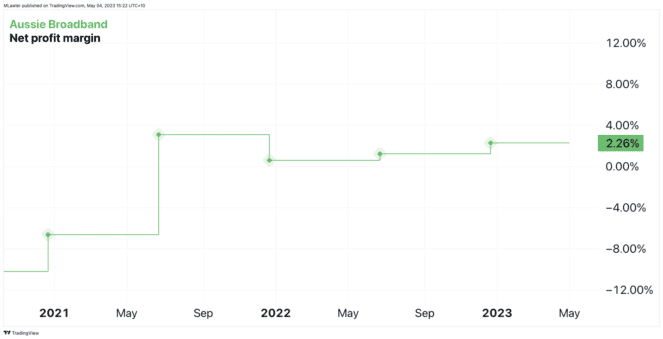
    Already Aussie Broadband exists on a tiny net profit margin of 2.26% for the December quarter, as shown below.

    Aussie Broadband semi-annual net profit margin since listing. Data by Trading View

    To its credit, the Victorian company has expanded its offerings for business clientele to open up new avenues for growth.

    However, the big players like Telstra Group Ltd (ASX: TLS) and Optus enjoy a huge advantage in this domain too, with existing relationships and a large network of face-to-face customer service personnel.

    This is not to say Aussie Broadband cannot succeed in the future. It’s just the risk is too much for me to buy the shares right now.

    Motley Fool contributor Tony Yoo does not own shares in Aussie Broadband Ltd.

    A classic disruption story with more growth in its sights

    By Brooke Cooper: Aussie Broadband is my pick of the ASX telecommunication shares, for one distinct reason: customer service.

    The company oozes a culture of customer service. Indeed, it’s topped the Ray Morgan Trusted Brand Awards in its category since 2020, beating out 20 rivals for the crown of Australia’s most trusted telco.

    Judging from my own experiences, and the company’s growth, plenty of telco customers seek value for money but stay for customer service. By providing both, Aussie Broadband has successfully disrupted the Aussie telecommunications industry.

    Just look at how fast its broadband customers have grown in recent years:

    Financial year Total Broadband services (approx.) Year-on-year % increase
    FY20 261,361
    FY21 400,848 53%
    FY22 584,793 46%

    At the end of the first half of this financial year, the company had more than 635,000 broadband connections – a 27% increase on the prior comparable period.

    It also boasted 7% of the NBN broadband market share and had just 1.2% of monthly residential customer churn over the period.

    On top of that, the company has been expanding into neighbouring markets. Its growing list of enterprise and government customers ­is a factor QVG Capital analysts expect could drive “a re-rating of the company”.

    But, as we know, past performance isn’t an indication of future performance. Not to mention, most disruption stories are also volatile ones with plenty of risks.

    Still, I’m confident the company has the ‘stickiness’ and proven ability to continue growing its market share and offerings from here.

    It’s currently Australia’s fifth-largest telco, with aspirations to enter the top four by 2025. To do so, it plans to polish its marketing strategy, develop and launch new products, and improve operational efficiencies.

    I admit, Aussie Broadband will probably never take on the market share boasted by the likes of Telstra, but I still think it’s a company worth investing in for growth. And the fall in its share price over the last year makes it a more affordable buy.

    Motley Fool contributor Brooke Cooper does not own shares in Aussie Broadband Ltd.

    The post Aussie Broadband shares: Bull vs. Bear appeared first on The Motley Fool Australia.

    Should you invest $1,000 in Aussie Broadband Limited right now?

    Before you consider Aussie Broadband Limited, you’ll want to hear this.

    Motley Fool Investing expert Scott Phillips just revealed what he believes are the 5 best stocks for investors to buy right now… and Aussie Broadband Limited wasn’t one of them.

    The online investing service he’s run for over a decade, Motley Fool Share Advisor, has provided thousands of paying members with stock picks that have doubled, tripled or even more.* And right now, Scott thinks there are 5 stocks that are better buys.

    See The 5 Stocks
    *Returns as of April 3 2023

    (function() {
    function setButtonColorDefaults(param, property, defaultValue) {
    if( !param || !param.includes(‘#’)) {
    var button = document.getElementsByClassName(“pitch-snippet”)[0].getElementsByClassName(“pitch-button”)[0];
    button.style[property] = defaultValue;
    }
    }

    setButtonColorDefaults(“#43B02A”, ‘background’, ‘#5FA85D’);
    setButtonColorDefaults(“#43B02A”, ‘border-color’, ‘#43A24A’);
    setButtonColorDefaults(“#fff”, ‘color’, ‘#fff’);
    })()

    More reading

    The Motley Fool Australia’s parent company Motley Fool Holdings Inc. has positions in and has recommended Aussie Broadband. The Motley Fool Australia has positions in and has recommended Telstra Group. The Motley Fool Australia has recommended Aussie Broadband. The Motley Fool has a disclosure policy. This article contains general investment advice only (under AFSL 400691). Authorised by Scott Phillips.

    from The Motley Fool Australia https://ift.tt/et6m08F

  • Is the NAB share price in the buy zone after crashing?

    A man sitting at a computer is blown away by what he's seeing on the screen, hair and tie whooshing back as he screams argh in panic.

    A man sitting at a computer is blown away by what he's seeing on the screen, hair and tie whooshing back as he screams argh in panic.

    The National Australia Bank Ltd (ASX: NAB) share price took an almighty beating on Thursday.

    The banking giant’s shares ended the day over 6% lower at $26.72.

    This leaves NAB’s shares trading within throwing distance of their 52-week low.

    Why was the NAB share price sold off?

    Investors were hitting the sell button yesterday after the bank’s half-year results fell short of expectations.

    Goldman Sachs summarised what went wrong for NAB. It commented:

    NAB’s 1H23 cash earnings were up 17% on pcp but 4% below GSe, driven by lower-than-expected NIMs. While headline NIM was underwhelming, we note that a driver of this was a reclassification of net interest income into trading income.

    Is this a buying opportunity?

    While Goldman Sachs clearly wasn’t impressed with the bank’s results, it does still see a lot of value in the NAB share price.

    As a result, the broker has retained its buy rating on its shares with a reduced price target of $30.69. This implies potential upside of almost 15% for investors over the next 12 months.

    In addition, Goldman is now forecasting a $1.66 per share fully franked dividend in FY 2023. This represents a 6.2% yield, which boosts the total return on offer with NAB shares to 21%.

    What did the broker say?

    Goldman remains positive on the NAB share price for five key reasons. It explains:

    Our Buy rating on NAB is predicated on: i) we see volume momentum over the next 12 months as favouring commercial volumes over housing volumes, and we believe NAB provides the best exposure to this thematic, ii) NAB has delivered the highest levels of productivity over the last three years and its investments continue to yield benefits (A$400 mn expected in FY23E), which we think leaves it well positioned for an environment of elevated inflationary pressure, iii) NAB’s strong capital surplus position (A$3.1 bn of surplus capital above the top-end of its target CET1 range of 11.0-11.5%) allows flexibility for further buy-backs, v) NAB returns improvements vs. peers is not reflected in valuations (details within), and vi) our revised TP offers c. 21% TSR.

    The post Is the NAB share price in the buy zone after crashing? appeared first on The Motley Fool Australia.

    Should you invest $1,000 in National Australia Bank Limited right now?

    Before you consider National Australia Bank Limited, you’ll want to hear this.

    Motley Fool Investing expert Scott Phillips just revealed what he believes are the 5 best stocks for investors to buy right now… and National Australia Bank Limited wasn’t one of them.

    The online investing service he’s run for over a decade, Motley Fool Share Advisor, has provided thousands of paying members with stock picks that have doubled, tripled or even more.* And right now, Scott thinks there are 5 stocks that are better buys.

    See The 5 Stocks
    *Returns as of April 3 2023

    (function() {
    function setButtonColorDefaults(param, property, defaultValue) {
    if( !param || !param.includes(‘#’)) {
    var button = document.getElementsByClassName(“pitch-snippet”)[0].getElementsByClassName(“pitch-button”)[0];
    button.style[property] = defaultValue;
    }
    }

    setButtonColorDefaults(“#0095C8”, ‘background’, ‘#5FA85D’);
    setButtonColorDefaults(“#0095C8”, ‘border-color’, ‘#43A24A’);
    setButtonColorDefaults(“#fff”, ‘color’, ‘#fff’);
    })()

    More reading

    Motley Fool contributor James Mickleboro has no position in any of the stocks mentioned. The Motley Fool Australia’s parent company Motley Fool Holdings Inc. has no position in any of the stocks mentioned. The Motley Fool Australia has no position in any of the stocks mentioned. The Motley Fool has a disclosure policy. This article contains general investment advice only (under AFSL 400691). Authorised by Scott Phillips.

    from The Motley Fool Australia https://ift.tt/CBGDuPS

  • Goldman Sachs is selling off its Liontown shares. Here’s the lowdown

    A man in his 30s holds his laptop and operates it with his other hand as he has a look of pleasant surprise on his face as though he is learning something new or finding hidden value in something on the screen.A man in his 30s holds his laptop and operates it with his other hand as he has a look of pleasant surprise on his face as though he is learning something new or finding hidden value in something on the screen.

    Liontown Resources Ltd (ASX: LTR) shares finished the session flat yesterday at $2.75 each.

    It’s been an exciting six weeks for Liontown shareholders since the company announced it had received another takeover bid from US lithium giant Albemarle (NYSE: ALB) in late March.

    The ASX lithium share has skyrocketed 81% since the company revealed its rejection of the $2.50 per share offer.

    All of this has prompted some serious institutional investor trading, and Goldman Sachs is among it.

    Let’s investigate.

    Liontown shares roar on Albermarle offer

    On 27 March, the day before the big announcement, Liontown shares closed at $1.525.

    Then came the news pre-open the next day, and off they went to the stratosphere.

    Liontown shares closed the day on 28 March at $2.57.

    And they’ve kept on rising since.

    Since the announcement, several institutional brokers have been jumping in and out of Liontown shares seeking to generate short-term profits while the upward momentum is strong.

    One of them is top broker Goldman Sachs.

    Let’s check out their activity.

    How ‘instos’ operate

    First, a quick lesson on how institutional investors work.

    The ‘instos’ often duck and weave in and out of ASX shares looking to make profits on short-term price movements (up or down).

    Because they are investing enormous sums of money each time they trade, just a few cents of movement can generate a significant capital gain for them and their clients.

    Sometimes their trading activity breaches the 5% ‘substantial holder’ threshold, which has to be declared on the ASX for all of us to see. From there, we can watch to see what they do with their holdings.

    This gives us ordinary investors an idea as to what price to buy and sell a particular ASX share.

    Handy, huh?

    So, let’s see what Goldman Sachs has been doing with Liontown shares of late.

    Goldman profits on the big announcement

    How’s this for timing?

    Goldman became a substantial holder of Liontown shares just a week before the Albemarle announcement. They took a 5.08% stake on 22 March.

    On the day Liontown announced the Albemarle offer, Goldman took some profits. It ceased to be a substantial holder on the day.

    A couple of weeks later on 11 April, Goldman once again became a substantial holder with a 5.28% stake.

    The ASX disclosure doesn’t tell us at what price Goldman rebought Liontown shares.

    But the ASX lithium share opened that day at $2.60, hit a low of $2.575, a high of $2.71, and then closed at $2.62.

    Goldman held the stock for just two days before ceasing to be a substantial holder on 13 April.

    On that day, Liontown shares opened at $2.70, hit a low of $2.67, a high of $2.73, and then closed at $2.73.

    Over the past six weeks, the highest price that Liontown shares have traded at is $2.84.

    What does Goldman really think of Liontown shares?

    Interestingly enough, Goldman analysts actually aren’t that keen on Liontown shares.

    In fact, they foresee a 45% drop from here.

    In its most recent broker note on Liontown shares, published one day after the takeover news, Goldman issued a neutral rating with an unchanged 12-month share price target of $1.50.

    Goldman noted the key risks included construction and commissioning risk, cost inflation, lithium prices, macro risks, growth, and mergers and acquisitions.

    In the note, Goldman said:

    While we like the outlook for the ramped up [flagship Kathleen Valley Lithium Project] and future optionality, we rate LTR a Neutral on:

    (1) Valuation: LTR is trading at a discount to our NAV following recent share price performance, and remains at a discount to peers on both implied LT spodumene price and EV/reserves, while also having the second highest valuation sensitivity to our LT lithium pricing

    (2) Strong capacity outlook, though pre-construction: Once ramped up to 500ktpa, Kathleen Valley will have a competitive scale (before expanding to 700ktpa toward the end of the decade)

    (3) Rapid de-leveraging post-ramp up supports future growth and capital returns: We expect LTR to return to net cash by FY27E, and see optionality around the proposed timing of a downstream development, though capital returns lag peers with already operating projects.

    At the time of writing, Goldman is no longer a substantial holder of Liontown shares.

    This does not necessarily mean it has sold out of Liontown completely.

    What’s the latest on Albemarle?

    Two days after Liontown announced its rejection of the offer, the company issued a statement revealing Albemarle had near doubled its stake from about 2.2% to 4.3% (that’s less than Goldman has held recently).

    Liontown said Albemarle had requested a copy of the register in order to contact shareholders directly about its offer.

    On Tuesday, Liontown hosed down media speculation that it had received an offer from another suitor.

    Broker Bell Potter has a $3.35 price target on Liontown shares.

    As my Fool colleague James reports, the broker reckons Albemarle’s bid was “reasonable, but not full”.

    Liontown released a new investor presentation on Tuesday.

    The post Goldman Sachs is selling off its Liontown shares. Here’s the lowdown appeared first on The Motley Fool Australia.

    Should you invest $1,000 in Liontown Resources right now?

    Before you consider Liontown Resources, you’ll want to hear this.

    Motley Fool Investing expert Scott Phillips just revealed what he believes are the 5 best stocks for investors to buy right now… and Liontown Resources wasn’t one of them.

    The online investing service he’s run for over a decade, Motley Fool Share Advisor, has provided thousands of paying members with stock picks that have doubled, tripled or even more.* And right now, Scott thinks there are 5 stocks that are better buys.

    See The 5 Stocks
    *Returns as of April 3 2023

    (function() {
    function setButtonColorDefaults(param, property, defaultValue) {
    if( !param || !param.includes(‘#’)) {
    var button = document.getElementsByClassName(“pitch-snippet”)[0].getElementsByClassName(“pitch-button”)[0];
    button.style[property] = defaultValue;
    }
    }

    setButtonColorDefaults(“#0095C8”, ‘background’, ‘#5FA85D’);
    setButtonColorDefaults(“#0095C8”, ‘border-color’, ‘#43A24A’);
    setButtonColorDefaults(“#fff”, ‘color’, ‘#fff’);
    })()

    More reading

    Motley Fool contributor Bronwyn Allen has no position in any of the stocks mentioned. The Motley Fool Australia’s parent company Motley Fool Holdings Inc. has positions in and has recommended Goldman Sachs Group. The Motley Fool Australia has no position in any of the stocks mentioned. The Motley Fool has a disclosure policy. This article contains general investment advice only (under AFSL 400691). Authorised by Scott Phillips.

    from The Motley Fool Australia https://ift.tt/V8dAb0W