
• Capital deities and destroyers: The best and worst at putting money to work among ASX 200 shares

    A smiling businessman sits at a desk with bags of mony, indicating a share price rise after funding has been approvedA smiling businessman sits at a desk with bags of mony, indicating a share price rise after funding has been approved

    Trawling through shares in the S&P/ASX 200 Index (ASX: XJO), we can at times forget what actually creates wealth for shareholders in the long run.

    While the share price moves arbitrarily in the short term, the decisions on how to invest company capital are what truly drive value creation over a prolonged holding period. You won’t find many businesses sustaining their existence if tipping in $1 means getting 20 cents in return — that’s fundamentally what return on capital employed (ROCE) measures.

    In simplistic terms, return on capital shows investors how profitable and capital efficient a company is. Unlike return on assets or return on equity, ROCE takes into account both debt and equity for funding operations, providing a more complete picture.

    All that’s left to do now is find out which ASX 200 shares ranked the best and worst at providing a return on their capital.

    Wizards of capital deployment

    Before we get underway, it’s probably helpful to provide a baseline to put the following data into perspective. A 20% return on capital is generally considered ‘good’. Though, this differs from industry to industry.

    Popping the locks on the highest return on capital across ASX 200 shares over the past year, we are inundated by commodity-focused companies.

    Although many commodities — such as lithium and coal — have drastically retreated recently, these materials are still fetching prices far above historical averages. As long as expenses haven’t grown at the same rate, the outcome is boosted returns on capital.

    The index constituents taking out top spots on the podium are listed in the table below:

    Company Return on capital Market capitalisation
    Deterra Royalties Ltd (ASX: DRR) 250.4% $2.55 billion
    Pilbara Minerals Ltd (ASX: PLS) 76.0% $11.96 billion
    Whitehaven Coal Ltd (ASX: WHC) 68.1% $6.12 billion

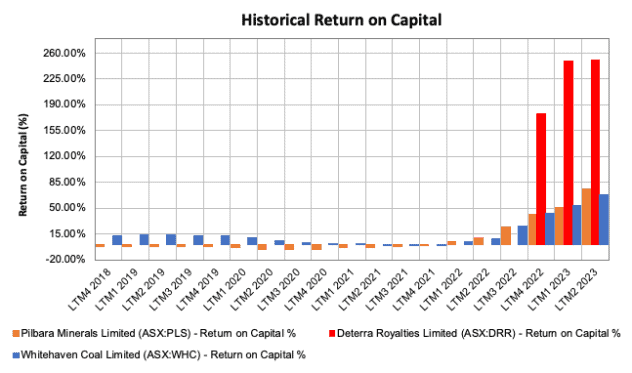
    By digging up historical return on capital data for these three ASX 200 shares, it becomes even more evident that the face-melting returns are only a recent feature of these particular companies.

    Prior to commodities booming, Pilbara Minerals and Whitehaven Coal were achieving subpar returns on capital, as depicted below.
    Source: S & P Market Intelligence

    Boasting a return on capital percentage above 175% for three years running, Deterra Royalties is an extreme outlier among the bunch. We can attribute this to the lucrative business model of royalties.

    Once royalty rights are acquired, there is very little in the way of additional capital needed to derive considerable profits.

    ASX 200 shares igniting capital

    Unfortunately, not every company’s capital efficiency is as healthy.

    Whether through poor choices or playing the long game, many ASX-listed companies are pouring capital into the engine to no avail — at least not in the past 12 months…

    The worst returns on capital among ASX 200 shares are the following:

    Company Return on capital Market capitalisation
    Telix Pharmaceuticals Ltd (ASX: TLX) -96.1% $2.97 billion
    Brainchip Holdings Ltd (ASX: BRN) -60.6% $777.8 million
    Chalice Mining Ltd (ASX: CHN) -32.7% $3.01 billion

    There’s a common denominator between the three poorest performers — all of them are still exploring.

    While Telix Pharmaceuticals is exploring new cancer detection methods and treatments, Chalice Mining is exploring for more minerals in Western Australia. Meanwhile, AI-chip developer Brainchip is exploring new technologies.

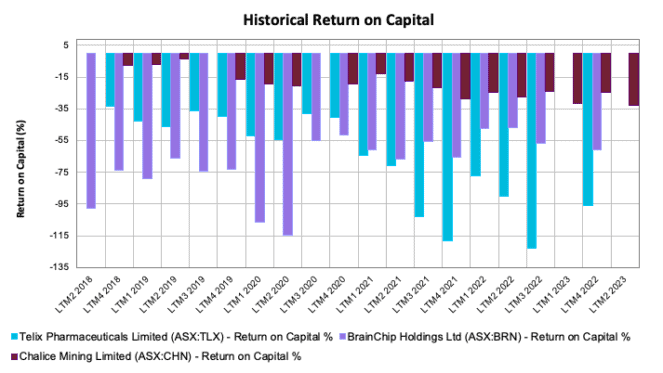
    The process of exploration for any company comes at a high cost. If the business does not already have a profitable revenue source, the return on capital suffers.
    Source: S & P Market Intelligence

    A quick look at the historical return on capital data for the worst names on the list shows a track record of chewing up capital, as shown above.

    However, this doesn’t mean these ASX 200 shares can’t be wealth creators in the future. For example, Telix’s trailing 12-month revenues have surged to $160 million from $7.6 million in the space of one year. Additionally, the company recently reported its second consecutive quarter of positive cash flow.

    Foolish takeaway

    It can be interesting to look at which companies are posting great, and not-so-great, returns on capital as of right now.

    Despite the usefulness of this fundamental metric, it’s important not to necessarily invest in certain ASX 200 shares purely based on the latest return on capital figures. I say this because the metric can change over time, and what is wildly capital efficient at present may not be five years from now.

    The key is to identify those few high-quality companies that could deliver consistently high returns on capital. As they say, consistency is key, as opposed to a one-hit-wonder.

    The post Capital deities and destroyers: The best and worst at putting money to work among ASX 200 shares appeared first on The Motley Fool Australia.

    Our 4 Favourite ‘Value’ Stocks

    Trends are showing growth stocks interest is declining. See why people are turning to value stocks and why Motley Fool has just released four value plays that could be great buying opportunities right now.

    Here’s how to get the full story…

    Learn more about our Value Stocks report
    *Returns as of April 3 2023

    (function() {
    function setButtonColorDefaults(param, property, defaultValue) {
    if( !param || !param.includes(‘#’)) {
    var button = document.getElementsByClassName(“pitch-snippet”)[0].getElementsByClassName(“pitch-button”)[0];
    button.style[property] = defaultValue;
    }
    }

    setButtonColorDefaults(“#0095C8”, ‘background’, ‘#5FA85D’);
    setButtonColorDefaults(“#0095C8”, ‘border-color’, ‘#43A24A’);
    setButtonColorDefaults(“#fff”, ‘color’, ‘#fff’);
    })()

    More reading

    Motley Fool contributor Mitchell Lawler has no position in any of the stocks mentioned. The Motley Fool Australia’s parent company Motley Fool Holdings Inc. has no position in any of the stocks mentioned. The Motley Fool Australia has no position in any of the stocks mentioned. The Motley Fool has a disclosure policy. This article contains general investment advice only (under AFSL 400691). Authorised by Scott Phillips.

    from The Motley Fool Australia https://ift.tt/KOFmkDN

  • Star Casino share price crumbles 8% on ‘significant and rapid deterioration’

    three sad face icons on a gaming machinethree sad face icons on a gaming machine

    The Star Entertainment Group Ltd (ASX: SGR) share price is collapsing after the casino operator revealed “a significant and rapid deterioration in operating conditions”.

    In response, it’s cutting 500 jobs, freezing salaries, scrapping bonuses, and has downgraded its earnings outlook for this financial year.

    Additionally, a strategic review of The Star Sydney, conducted with Barrenjoey Capital Partners, has been launched in a bid to maximise shareholder value.

    The Star Entertainment share price is plummeting 7.99% to trade at $1.265 at the time of writing.

    Let’s take a closer look at the news driving the Star Casino operator’s stock lower on Wednesday.

    Star stock crashes as casinos struggle

    The Star Entertainment share price is tumbling on Wednesday. Its fall comes as the company revealed its casinos – particularly its Sydney and Gold Coast operations – are suffering under the weight of regulatory restrictions and weak consumer spending.

    As a result, its earnings performance is at unprecedented low levels, excluding the COVID-19 period.

    If that continues without reprieve, its full-year underlying earnings before interest, tax, depreciation, and amortisation (EBITDA) will likely be between $280 million and $310 million.

    That’s down from previous guidance of between $330 million and $360 million. It compares against the $200 million EBITDA the company posted for the first half.

    Today’s downgraded guidance includes the impact borne by employees. However, it excludes provisions for fines, costs from ongoing regulatory reviews, and expenses from its cost initiatives.

    The casino operator was hit with two $100 million fines from Queensland and NSW last year. Its casino licence was suspended in both states and a manager was appointed to operate the casinos while it remediates its businesses.

    Star Entertainment said job cuts and a freeze on salaries and bonuses, along with $40 million of operational initiatives, should reduce its operating expenditure by $100 million annually.

    The steps are “independent of any potential impact from the proposed casino duty rate increases in NSW,” the company said.

    And that’s not all.

    The ASX 200 casino operator is also progressing with the sale of the Sheraton Grand Mirage Resort Gold Coast. Bids from interested parties are expected to be received shortly.

    On top of that, it’s working to refinance its debt.

    Finally, it plans to discuss casino duty taxes and flexible payment terms for penalties with state governments in NSW and QLD, as well as AUSTRAC.

    Star Entertainment underperforms ASX 200

    Today’s tumble is just the latest to dint the Star Entertainment share price.

    It’s dumped 25% so far this year. It’s also currently 57% lower than it was this time last year.

    For comparison, the ASX 200 has risen 6% year to date and has fallen 3% over the last 12 months.

    The post Star Casino share price crumbles 8% on ‘significant and rapid deterioration’ appeared first on The Motley Fool Australia.

    Should you invest $1,000 in The Star Entertainment Group Limited right now?

    Before you consider The Star Entertainment Group Limited, you’ll want to hear this.

    Motley Fool Investing expert Scott Phillips just revealed what he believes are the 5 best stocks for investors to buy right now… and The Star Entertainment Group Limited wasn’t one of them.

    The online investing service he’s run for over a decade, Motley Fool Share Advisor, has provided thousands of paying members with stock picks that have doubled, tripled or even more.* And right now, Scott thinks there are 5 stocks that are better buys.

    See The 5 Stocks
    *Returns as of April 3 2023

    (function() {
    function setButtonColorDefaults(param, property, defaultValue) {
    if( !param || !param.includes(‘#’)) {
    var button = document.getElementsByClassName(“pitch-snippet”)[0].getElementsByClassName(“pitch-button”)[0];
    button.style[property] = defaultValue;
    }
    }

    setButtonColorDefaults(“#0095C8”, ‘background’, ‘#5FA85D’);
    setButtonColorDefaults(“#0095C8”, ‘border-color’, ‘#43A24A’);
    setButtonColorDefaults(“#fff”, ‘color’, ‘#fff’);
    })()

    More reading

    Motley Fool contributor Brooke Cooper has no position in any of the stocks mentioned. The Motley Fool Australia’s parent company Motley Fool Holdings Inc. has no position in any of the stocks mentioned. The Motley Fool Australia has no position in any of the stocks mentioned. The Motley Fool has a disclosure policy. This article contains general investment advice only (under AFSL 400691). Authorised by Scott Phillips.

    from The Motley Fool Australia https://ift.tt/pGxFgst

  • Why are ASX 200 mining shares like Fortescue smashing the index today?

    A group of three men in hard hats and high visibility vests stand together at a mine site while one points and the others look on with piles of dirt and mining equipment in the background.A group of three men in hard hats and high visibility vests stand together at a mine site while one points and the others look on with piles of dirt and mining equipment in the background.

    ASX 200 mining shares including Fortescue Metals Group Ltd (ASX: FMG) are outperforming the benchmark index today.

    Fortescue shares are up 1.57% to $22.935 in early afternoon trading. BHP Group Ltd (ASX: BHP) shares are lifting 1.75%, while Rio Tinto Ltd (ASX: RIO) shares are up 1.91%. The S&P/ASX 200 Materials Index (ASX: XMJ) is up 1.3% at the time of writing.

    Let’s take a look at what could be impacting these ASX 200 mining shares today.

    What’s happening?

    Fortescue, BHP, and Rio Tinto are all major iron ore producers. BHP and Rio Tinto also have exposure to multiple other commodities.

    The iron ore price lifted 2.54% to US$121 a tonne overnight, Trading Economics data shows. Nickel also rose 2.36% on the London Metal Exchange. Meantime, aluminium jumped 2.5% to US$2,438 a tonne.

    Commenting on these gains in a research note today, ANZ economist Madeline Dunk said investors were “buoyed by signs of stronger demand”. She said:

    Upside surprises continue in China, with economic data pointing to positive momentum amid the reopening of its economy.

    The stronger than expected economic data also boosted sentiment in the iron ore market. Signs of improvement in the property sector garnered the most interest. 

    ANZ’s Dunk noted that steel output in China rose 6.9% year on year to 95.3 mt in March. Iron ore is the major ingredient used to make steel.

    China’s gross domestic product (GDP) rose 4.5% in the first quarter of 2023, as noted yesterday afternoon. This had a muted impact on BHP, Rio, and Fortescue shares yesterday, however, the rise in iron ore price overnight on the back of this data appears to be providing these shares with a boost today.

    BHP has also recently received regulatory and shareholder approval to take over copper miner OZ Minerals Ltd (ASX: OZL).

    Share price snapshot

    The Fortescue share price has returned 5.32% in the last 12 months. BHP shares have climbed 0.16% over the same period, while RIO shares have jumped 1.98%.

    The post Why are ASX 200 mining shares like Fortescue smashing the index today? appeared first on The Motley Fool Australia.

    FREE Guide for New Investors

    Despite what some people may say – we believe investing in shares doesn’t have to be overwhelming or complicated…

    For over a decade, we’ve been helping everyday Aussies get started on their journey.

    And to help even more people cut through some of the confusion “experts’” seem to want to perpetuate – we’ve created a brand-new “how to” guide.

    Yes, Claim my FREE copy!
    *Returns as of April 3 2023

    (function() {
    function setButtonColorDefaults(param, property, defaultValue) {
    if( !param || !param.includes(‘#’)) {
    var button = document.getElementsByClassName(“pitch-snippet”)[0].getElementsByClassName(“pitch-button”)[0];
    button.style[property] = defaultValue;
    }
    }

    setButtonColorDefaults(“#0095C8”, ‘background’, ‘#5FA85D’);
    setButtonColorDefaults(“#0095C8”, ‘border-color’, ‘#43A24A’);
    setButtonColorDefaults(“#fff”, ‘color’, ‘#fff’);
    })()

    More reading

    Motley Fool contributor Monica O’Shea has no position in any of the stocks mentioned. The Motley Fool Australia’s parent company Motley Fool Holdings Inc. has no position in any of the stocks mentioned. The Motley Fool Australia has no position in any of the stocks mentioned. The Motley Fool has a disclosure policy. This article contains general investment advice only (under AFSL 400691). Authorised by Scott Phillips.

    from The Motley Fool Australia https://ift.tt/5p9al3j

  • If house prices have bottomed, should I buy property-related ASX shares?

    A man sits at a desk holding a small replica house in his hand, upset at the sale of his property.A man sits at a desk holding a small replica house in his hand, upset at the sale of his property.

    Australia’s housing prices may have hit a bottom and could start recovering. Could this be a promising sign for ASX property shares?

    Earlier this month, property price data business CoreLogic revealed that national home prices increased 0.6% in March. CoreLogic executive research director Tim Lawless said:

    While we aren’t certain if March marks a turning point for housing values, it’s clear that low advertised supply, the tightest rental conditions on record and surging overseas migration are providing some positive momentum to housing markets.

    It may be surprising that house prices have already bottomed considering borrowing costs have soared significantly and ASX bank share arrears haven’t even registered a noticeable uptick yet.

    The investment bank Morgan Stanley has suggested that any bounce could be premature for property and related businesses, according to reporting by the Australian Financial Review.

    Why is Morgan Stanley being cautious?

    The Reserve Bank of Australia (RBA) has significantly hiked the interest rate in Australia, but recently paused the increases. However, the investment bank is expecting the RBA could increase the interest rate with two 25 basis point (0.25%) increases in August and September to take the cash rate to 4.1%.

    Morgan Stanley said that while the RBA has paused interest rates, it could be a while before interest rates start falling. It also noted ASX retail shares have gone up before the worst of a downturn in sales had even started.

    Morgan Stanley’s head of Australian strategy and economics Chris Nicol said:

    We detect a bias in positioning to consider the interest rate pause as a precursor to ultimate easing of conditions and the start of the next housing cycle – hence the bounce in cash rate-sensitive sectors.

    To us this looks somewhat premature – our conclusion is that buying into housing and consumer-facing stocks has poor risk-reward at this juncture.

    When looking at prior housing cycles – the bulk of price declines occur when the RBA is on hold. And given our expectation of a prolonged period before policy actually eases, a return to price weakness cannot be ruled out.

    One of the factors that suggests to the investment bank that the RBA will need to increase interest rates further is because the jobs market continues to be stronger than expected, with the March report showing 53,000 found work, compared to expectations of 20,000. The unemployment rate is still at 3.5%.

    Are ASX property share values going up?

    Since 2 March 2023, the REA Group Limited (ASX: REA) share price has risen 18%, the Domain Holdings Australia Ltd (ASX: DHG) share price has gone up 10%, the CSR Limited (ASX: CSR) share price has risen 3.75%, the JB Hi-Fi Limited (ASX: JBH) share price has risen 6.7%, and the Wesfarmers Ltd (ASX: WES) share price has gone up 8.4%.

    Should they be going up? That’s an entirely different question.

    Morgan Stanley is saying it’s too early – we haven’t even seen how bad the effects of the interest rates are going to be.

    The COVID-19 recovery seemed to start when central banks around the world started providing enormous support. Interest rates are probably not going down for quite a while yet, and could stay a lot higher than pre-COVID times for a while after that.

    Valuations typically follow earnings over time. I think businesses like REA Group and Wesfarmers will be capable of producing higher earnings over the long term as they grow their market position and margins.

    I’d guess there’s a chance that share prices will fall noticeably below where they are now over the next six to 12 months — if/when there’s a deterioration of trading conditions because of the higher interest rates.

    However, I’d also say the share prices earlier this year were very good buying opportunities and those shares are still down materially from their COVID-19 peaks.

    The post If house prices have bottomed, should I buy property-related ASX shares? appeared first on The Motley Fool Australia.

    Wondering where you should invest $1,000 right now?

    When investing expert Scott Phillips has a stock tip, it can pay to listen. After all, the flagship Motley Fool Share Advisor newsletter he has run for over ten years has provided thousands of paying members with stock picks that have doubled, tripled or even more.*

    Scott just revealed what he believes could be the ‘five best ASX stocks’ for investors to buy right now. These stocks are trading at near dirt-cheap prices and Scott thinks they could be great buys right now…

    See The 5 Stocks
    *Returns as of April 3 2023

    (function() {
    function setButtonColorDefaults(param, property, defaultValue) {
    if( !param || !param.includes(‘#’)) {
    var button = document.getElementsByClassName(“pitch-snippet”)[0].getElementsByClassName(“pitch-button”)[0];
    button.style[property] = defaultValue;
    }
    }

    setButtonColorDefaults(“#0095C8”, ‘background’, ‘#5FA85D’);
    setButtonColorDefaults(“#0095C8”, ‘border-color’, ‘#43A24A’);
    setButtonColorDefaults(“#fff”, ‘color’, ‘#fff’);
    })()

    More reading

    Motley Fool contributor Tristan Harrison has no position in any of the stocks mentioned. The Motley Fool Australia’s parent company Motley Fool Holdings Inc. has no position in any of the stocks mentioned. The Motley Fool Australia has positions in and has recommended Wesfarmers. The Motley Fool Australia has recommended Jb Hi-Fi and REA Group. The Motley Fool has a disclosure policy. This article contains general investment advice only (under AFSL 400691). Authorised by Scott Phillips.

    from The Motley Fool Australia https://ift.tt/24gQfxB

  • Why have investors fallen out of love with Lynas shares?

    A man sits uncomfortably at his laptop computer in an outdoor location at a table with trees in the background as he clutches the back of his neck with a wincing look on his face.A man sits uncomfortably at his laptop computer in an outdoor location at a table with trees in the background as he clutches the back of his neck with a wincing look on his face.

    Lynas Rare Earths Ltd (ASX: LYC) shares were among the market’s biggest success stories of 2021.

    The rare earths producer’s share price rocketed more than 150% that year, seemingly largely driven by soaring investor sentiment. But both the stock’s gains and the market’s optimism proved slippery to hold.

    The Lynas share price has tumbled 39% since early 2022 to trade at $6.77 right now – flat with its previous close.

    Today’s moves (or lack thereof) come amid news the company will welcome John Beevers to its board next month.

    Comparatively, the S&P/ASX 200 Index (ASX: XJO) has slipped just 1% since January last year.

    So, what turned the market away from its former darling? Before we get to that, let’s look at what spurred investors’ love for Lynas to begin with.

    Investors loved Lynas shares …

    As tensions between China and the rest of the world heated up in 2021, market watchers worried about the future supply of rare earths. Particularly, as the materials have an important role to play in the decarbonisation movement.

    Lynas is the largest rare earths producer outside of China. It’s that fact that likely led many market participants to bid its share price sky-high in recent years.

    The company mines rare earth oxides in Western Australia before shipping the product to Malaysia, where it operates the world’s largest rare earths processing plant.

    However, recent happenings appear to have weighed on the market’s appreciation for Lynas and its shares.

    … until they didn’t

    Perhaps unsurprisingly, falling commodity prices are likely to blame for much of Lynas’ downturn.

    The company realised an average selling price of $52.50 a kilogram in the first half of financial year 2023. That was lower than its peak of $68.90 a kilogram in the second half of financial year 2022.

    But major blows dinting the Lynas share price this year appear to have been outside the company’s control.

    The stock is currently 30% lower than its January peak amid news from electric vehicle giant Tesla Inc (NASDAQ: TSLA) and Malaysian authorities.

    Tesla revealed plans to scrap rare earths from its next generation motor at its 2023 investor day. While experts assured investors the change likely won’t impact demand for rare earths, it probably led some to worry that prior demand forecasts could have been overstated.

    Meanwhile, Malaysia’s Atomic Energy Licensing Board doubled down on banning the company from importing and processing lanthanide concentrate, starting in July. That means Lynas will be forced to close the cracking and leaching component of its Malaysia plant if its unsuccessful in appealing the decision.

    All that appears to have weighed on the market’s love for Lynas shares. But the stock hasn’t lost the affection of Bell Potter.

    What might the future look like for Lynas stock?

    The broker recently upgraded the ASX 200 stock to a buy rating with an $8.06 price target, my Fool colleague James reports.

    It believes the market overreacted to Tesla’s announcement and notes the company still offers plenty of growth prospects.

    The post Why have investors fallen out of love with Lynas shares? appeared first on The Motley Fool Australia.

    4 ways to prepare for the next bull market

    It’s a scary market. But staying in cash when inflation is surging likely won’t do investors any good either.

    And when some world-class companies have pulled back considerably from their recent highs… All while their fundamentals remain unchanged…

    It begs the question…

    Do you have these 4 stocks in your portfolio?

    See The 4 Stocks
    *Returns as of April 3 2023

    (function() {
    function setButtonColorDefaults(param, property, defaultValue) {
    if( !param || !param.includes(‘#’)) {
    var button = document.getElementsByClassName(“pitch-snippet”)[0].getElementsByClassName(“pitch-button”)[0];
    button.style[property] = defaultValue;
    }
    }

    setButtonColorDefaults(“#0095C8”, ‘background’, ‘#5FA85D’);
    setButtonColorDefaults(“#0095C8”, ‘border-color’, ‘#43A24A’);
    setButtonColorDefaults(“#fff”, ‘color’, ‘#fff’);
    })()

    More reading

    Motley Fool contributor Brooke Cooper has no position in any of the stocks mentioned. The Motley Fool Australia’s parent company Motley Fool Holdings Inc. has positions in and has recommended Tesla. The Motley Fool Australia has no position in any of the stocks mentioned. The Motley Fool has a disclosure policy. This article contains general investment advice only (under AFSL 400691). Authorised by Scott Phillips.

    from The Motley Fool Australia https://ift.tt/9x5wOzR

  • CSL shares dip despite new FDA approval

    A doctor in a white coat sits at her computer with finger on mouth thinking about something in her office with medical equipment in the background.A doctor in a white coat sits at her computer with finger on mouth thinking about something in her office with medical equipment in the background.

    The CSL Ltd (ASX: CSL) share price is slightly in the red today despite some positive news from the company.

    CSL shares are sliding 0.34% and are currently fetching $299.22. For perspective, the S&P/ASX 200 Health Care Index (ASX: XHJ) is sliding 0.25% today.

    Let’s take a look at what is going on with CSL today.

    FDA approval for Hizentra

    CSL is not the only ASX healthcare share in the red today. Ramsay Health Care Ltd (ASX: RHC) shares are down 0.7%, Pro Medicus Ltd (ASX: PME) shares are sliding 0.18%, and Resmed Inc (ASX: RMD) shares are down 0.48%.

    In news out of the company, CSL Behring today advised the U.S. Food and Drug Administration (FDA) has approved a 50mL/10gm prefilled syringe for Hizentra.

    Hizentra is the only immune globulin (Ig) that is accessible in a convenient ready-to-use prefilled syringe.

    The 50mL syringe will be available in early 2024, providing the company with time to provide enough supply to meet demand.

    This will help people with Primary Immunodeficiency (PI) and Chronic Inflammatory Demyelinating Polyneuropathy (CIDP).

    Hizentra will still be available in 5mL, 10mL, and 20mL prefilled syringes and 5mL, 10mL, 20mL, and 50mL vials in the meantime.

    Commenting on the news, CSL Behring senior vice president and general manager for North America Bob Lojewski said:

    We are proud to be at the forefront of delivering effective treatment options that also provide flexibility by allowing those with PI or CIDP to self-administer their treatments based on their specific needs and lifestyles.

    As part of our promise to meet the needs of people who rely on our life-saving therapies, we recognize the important value of offering people with PI or CIDP a larger prefilled syringe size option to effectively manage their condition

    As my Foolish colleague James reported today, multiple brokers are positive on the CSL share price going forward. Citi, Macquarie and Morgans all have a “buy” rating on CSL. Citi has a $350 price target on the company’s share price, Macquarie forecasts CSL to hit $344 and Morgans has a $337.92 prediction for CSL. This is all significant upside on CSL’s current share price.

    Share price snapshot

    CSL shares have gained 13.68% in the last year.

    CSL has a market cap of about $143.9 billion based on the current share price.

    The post CSL shares dip despite new FDA approval appeared first on The Motley Fool Australia.

    Our pullback stock hit list…

    Motley Fool Share Advisor has released a hit list of stocks that investors should be paying close attention to right now…

    As the market continues to sell off, we think some stocks have become extreme buying opportunities.

    In five years’ time, we think you’ll probably wish you’d bought these 4 ‘pullback’ stocks…

    See The 4 Stocks
    *Returns as of April 3 2023

    (function() {
    function setButtonColorDefaults(param, property, defaultValue) {
    if( !param || !param.includes(‘#’)) {
    var button = document.getElementsByClassName(“pitch-snippet”)[0].getElementsByClassName(“pitch-button”)[0];
    button.style[property] = defaultValue;
    }
    }

    setButtonColorDefaults(“#0095C8”, ‘background’, ‘#5FA85D’);
    setButtonColorDefaults(“#0095C8”, ‘border-color’, ‘#43A24A’);
    setButtonColorDefaults(“#fff”, ‘color’, ‘#fff’);
    })()

    More reading

    Motley Fool contributor Monica O’Shea has no position in any of the stocks mentioned. The Motley Fool Australia’s parent company Motley Fool Holdings Inc. has positions in and has recommended CSL, Pro Medicus, and ResMed. The Motley Fool Australia has positions in and has recommended Pro Medicus and ResMed. The Motley Fool has a disclosure policy. This article contains general investment advice only (under AFSL 400691). Authorised by Scott Phillips.

    from The Motley Fool Australia https://ift.tt/c53L2Ti

  • AMP share price marching higher as net outflows ebb

    A mature age woman with a groovy short haircut and glasses, sits at her computer, pen in hand thinking about information she is seeing on the screen.A mature age woman with a groovy short haircut and glasses, sits at her computer, pen in hand thinking about information she is seeing on the screen.

    The AMP Ltd (ASX: AMP) share price is marching higher today, up 2.5% in late morning trade.

    The diversified ASX financial share closed yesterday trading for $1.10. Shares are currently changing hands for $1.12 apiece.

    Here’s what investors are considering today.

    What did AMP report?

    The AMP share price is in the green after the company released a first-quarter update on its cash flows and assets under management.

    While AMP still saw net cash outflows of $600 million in Q1 2023, this was a 30% improvement on the $900 million outflows reported in Q1 2022. The wealth manager attributed the improvement to “further stabilisation of Master Trust outflows”.

    Also on the positive side of the ledger, AMP’s loan book increased by $200 million to reach $24.2 billion. The company said it’s been seeing improving momentum in loan applications and growth.

    And the company’s Australian Wealth Management (AWM) assets under management increased by $2 billion to hit $126.2 billion. AMP noted that positive investment markets had been partly offset by net cash outflows and pension payments.

    Commenting on the results that look to be supporting the AMP share price today, CEO Alexis George said:

    We continue to take an active approach to managing the bank’s loan book, being disciplined in our growth in a highly competitive market to maintain strong credit quality and margin. We are conscious of the impact of rising interest rates on customers and continue to focus on providing competitive loan and deposit rates.

    George added that in New Zealand, “We continue to consolidate our strong position in the KiwiSaver market with increased inflows into AMP KiwiSaver.”

    With the sale of the final AMP Capital business completed last month, George said AMP has sharpened its “focus on driving the performance of our banking and wealth management businesses”.

    AMP share price snapshot

    As you can see in the chart below, the AMP share price has recovered from a rough start to 2023 and is now up 4% since this time last year.

    The post AMP share price marching higher as net outflows ebb appeared first on The Motley Fool Australia.

    Should you invest $1,000 in Amp Limited right now?

    Before you consider Amp Limited, you’ll want to hear this.

    Motley Fool Investing expert Scott Phillips just revealed what he believes are the 5 best stocks for investors to buy right now… and Amp Limited wasn’t one of them.

    The online investing service he’s run for over a decade, Motley Fool Share Advisor, has provided thousands of paying members with stock picks that have doubled, tripled or even more.* And right now, Scott thinks there are 5 stocks that are better buys.

    See The 5 Stocks
    *Returns as of April 3 2023

    (function() {
    function setButtonColorDefaults(param, property, defaultValue) {
    if( !param || !param.includes(‘#’)) {
    var button = document.getElementsByClassName(“pitch-snippet”)[0].getElementsByClassName(“pitch-button”)[0];
    button.style[property] = defaultValue;
    }
    }

    setButtonColorDefaults(“#43B02A”, ‘background’, ‘#5FA85D’);
    setButtonColorDefaults(“#43B02A”, ‘border-color’, ‘#43A24A’);
    setButtonColorDefaults(“#fff”, ‘color’, ‘#fff’);
    })()

    More reading

    Motley Fool contributor Bernd Struben has no position in any of the stocks mentioned. The Motley Fool Australia’s parent company Motley Fool Holdings Inc. has no position in any of the stocks mentioned. The Motley Fool Australia has no position in any of the stocks mentioned. The Motley Fool has a disclosure policy. This article contains general investment advice only (under AFSL 400691). Authorised by Scott Phillips.

    from The Motley Fool Australia https://ift.tt/O39tvg2

  • Here’s the latest forecast for ASX 200 lithium stocks from UBS

    A man holds his hand under his chin as he concentrates on his laptop screen and reads about the ANZ share price

    A man holds his hand under his chin as he concentrates on his laptop screen and reads about the ANZ share price

    S&P/ASX 200 Index (ASX: XJO) lithium stocks, with one notable exception, have had a tough slog over the past months.

    The big lithium shares were broadly rocketing higher into November, as lithium prices hit all-time highs.

    But as near-term supplies of the battery critical mineral caught up with demand and China ended its EV subsidies (among other headwinds), the lithium price cratered, currently trading for less than half its November peak.

    That, as you’d expect, spooked a fair number of investors into hitting the sell button.

    Here’s how these leading ASX 200 lithium stocks have performed over the past six months:

    • Pilbara Minerals Ltd (ASX: PLS) shares are down 22%
    • Core Lithium Ltd (ASX: CXO) shares are down 29%
    • Allkem Ltd (ASX: AKE) shares are down 21%
    • IGO Ltd (ASX: IGO) shares are down 14%
    • Mineral Resources Ltd (ASX: MIN) shares are up 14%
    • Liontown Resources Ltd (ASX: LTR) shares are up 50%

    Mineral Resources has managed to evade the sell-off, perhaps buoyed by significant positive broker coverage in recent months. The company is also more diversified than most of its competition, deriving significant revenue from mining services and iron ore.

    The real standout, of course, is Liontown Resources.

    The ASX 200 lithium stock was also well into the red over a six-month period heading into the end of March. That’s when news broke that the miner had received, and rejected, a $2.50 per share takeover offer from international industry giant Albemarle. Shares are up 81% since then.

    Of course, that’s all water under the bridge now.

    Here’s what UBS expects from ASX 200 lithium stocks now.

    What’s next for ASX 200 lithium stocks?

    As reported by The Australian, broker UBS has reduced its earnings forecasts for lithium miners by 10% to 40%. Price forecasts for 2023 and 2024 were decreased by 10% to 30%.

    Long-term investors should note, however, that UBS upgraded its long-term lithium spodumene, concentrate, and hydroxide price forecasts by 20%, which it said will largely offset lower near-term earnings.

    Addressing the current demand weakness in China that’s depressing the lithium price and throwing up headwinds for ASX 200 lithium stocks, UBS analysts noted:

    This sentiment was further backed up by our global EV/battery team’s 7th annual EV consumer survey which reported its first sequential decline in EV popularity, driven by European markets on affordability concerns, and forcing downgrades to UBS’s near-term EV outlook.

    Citing the “increasing cost of supply response” over the longer term, the analysts said, “Our review of the currently slated supply response suggests higher prices are required and we have increased our long-term prices across the board by about 20%.”

    The UBS analysts added:

    This revised long-term price deck sits comfortably and conservatively against new sources of supply, Chinese lepidolite production, industry participant feedback, and consensus forecasts.

    Rating changes

    Despite the shorter-term price pressures, the broker remains quite bullish on many ASX 200 lithium stocks.

    UBS upgraded Pilbara Minerals to a buy with a price target of $4.60 per share, some 16% above the current share price of $3.97. The broker labelled Pilbara Minerals a “preferred high beta play to any near-term bounce”.

    IGO retained its buy rating with a boosted price target of $19.10 per share, a whopping 36% above the current $14.07 per share. UBS said IGO “remains a preferred quality, long-term option, something only reinforced by its latest nickel downstream venture with Wyloo”.

    As for some of the other ASX 200 lithium stocks, UBS maintained its buy rating on Allkem and Mineral Resources, with a neutral rating on Liontown.

    The post Here’s the latest forecast for ASX 200 lithium stocks from UBS appeared first on The Motley Fool Australia.

    FREE Beginners Investing Guide

    Despite what some people may say – we believe investing in shares doesn’t have to be overwhelming or complicated…

    For over a decade, we’ve been helping everyday Aussies get started on their journey.

    And to help even more people cut through some of the confusion “experts’” seem to want to perpetuate – we’ve created a brand-new “how to” guide.

    Yes, Claim my FREE copy!
    *Returns as of April 3 2023

    (function() {
    function setButtonColorDefaults(param, property, defaultValue) {
    if( !param || !param.includes(‘#’)) {
    var button = document.getElementsByClassName(“pitch-snippet”)[0].getElementsByClassName(“pitch-button”)[0];
    button.style[property] = defaultValue;
    }
    }

    setButtonColorDefaults(“#0095C8”, ‘background’, ‘#5FA85D’);
    setButtonColorDefaults(“#0095C8”, ‘border-color’, ‘#43A24A’);
    setButtonColorDefaults(“#fff”, ‘color’, ‘#fff’);
    })()

    More reading

    Motley Fool contributor Bernd Struben has no position in any of the stocks mentioned. The Motley Fool Australia’s parent company Motley Fool Holdings Inc. has no position in any of the stocks mentioned. The Motley Fool Australia has no position in any of the stocks mentioned. The Motley Fool has a disclosure policy. This article contains general investment advice only (under AFSL 400691). Authorised by Scott Phillips.

    from The Motley Fool Australia https://ift.tt/Io6u27Q

  • Own NAB shares? Here’s why the bank’s CEO just personally emailed 4m customers

    A man sits in deep thought with a pen held to his lips as he ponders his computer screen with a laptop open next to him on his desk in a home office environment.A man sits in deep thought with a pen held to his lips as he ponders his computer screen with a laptop open next to him on his desk in a home office environment.

    If you own National Australia Bank Ltd (ASX: NAB) shares but bank elsewhere, you might have missed a mass email sent by the S&P/ASX 200 Index (ASX: XJO) bank’s CEO.

    NAB boss Ross McEwan reached out to 4 million customers earlier this week to assure them of the bank’s commitment to cyber security and easing the burden during tough times.

    The letter, titled ‘you have our support’ has been sent ahead of what could be a deluge of fixed-rate mortgages expiring amid the current high-interest rate environment.

    Right now, the NAB share price is $28.76.

    NAB CEO addresses financial hardship and scams

    Own NAB shares? The bank’s leader has offered support to struggling customers as it prepares for the majority of its fixed-price mortgage book to expire amid a cost-of-living crisis.

    It comes on the back of ten consecutive rate hikes put forward by the Reserve Bank of Australia (RBA) in the lead-up to April. The official cash rate is currently at a decade-high of 3.6%, with NAB expecting it to have peaked.

    Right now, an owner-occupier with a $500,000 mortgage could be paying $983 a month more than they were in April 2022, according to RateCity.

    McEwan reassured customers that protecting their cash and supporting them through tough times is the bank’s “top priority”, continuing:

    You might not find yourself in this situation, but I want you to know what help is available.

    The best thing you can do is reach out to our NAB Assist team or your banker early. In fact, over 90% of customers who do this are back on their feet in 90 days.

    Of the $108 billion of fixed-rate mortgages on NAB’s lending book as of September, $15.6 billion expired over the six months to March, according to its latest full-year results. Meanwhile, another $54.5 billion of its fixed-rate mortgages are set to expire over the coming 12 months.

    McEwan also comforted customers’ concerns about scams and cybersecurity, saying:

    It’s clear that the rise in scams is a growing problem in Australia and globally. To tackle this issue, it takes ongoing collaboration with government, business sectors, the community, and customers. And that’s what we’re doing.

    He said NAB invests “millions of dollars” into technology and expertise every year, allowing it to monitor for cybercrime.

    The topi of cybercrime is likely on the minds of many Australians following recent breaches facing Medibank Private Ltd (ASX: MPL) and Latitude Group Holdings Ltd (ASX: LFS).

    NAB share price snapshot

    The NAB share price has underperformed the ASX 200 so far this year.

    The stock has dumped 2% year to date. It’s also 13% lower than it was this time last year.

    For comparison, the ASX 200 has gained 6% since the start of 2023 and has fallen 3% since this time last year.

    The post Own NAB shares? Here’s why the bank’s CEO just personally emailed 4m customers appeared first on The Motley Fool Australia.

    Should you invest $1,000 in National Australia Bank Limited right now?

    Before you consider National Australia Bank Limited, you’ll want to hear this.

    Motley Fool Investing expert Scott Phillips just revealed what he believes are the 5 best stocks for investors to buy right now… and National Australia Bank Limited wasn’t one of them.

    The online investing service he’s run for over a decade, Motley Fool Share Advisor, has provided thousands of paying members with stock picks that have doubled, tripled or even more.* And right now, Scott thinks there are 5 stocks that are better buys.

    See The 5 Stocks
    *Returns as of April 3 2023

    (function() {
    function setButtonColorDefaults(param, property, defaultValue) {
    if( !param || !param.includes(‘#’)) {
    var button = document.getElementsByClassName(“pitch-snippet”)[0].getElementsByClassName(“pitch-button”)[0];
    button.style[property] = defaultValue;
    }
    }

    setButtonColorDefaults(“#0095C8”, ‘background’, ‘#5FA85D’);
    setButtonColorDefaults(“#0095C8”, ‘border-color’, ‘#43A24A’);
    setButtonColorDefaults(“#fff”, ‘color’, ‘#fff’);
    })()

    More reading

    Motley Fool contributor Brooke Cooper has no position in any of the stocks mentioned. The Motley Fool Australia’s parent company Motley Fool Holdings Inc. has no position in any of the stocks mentioned. The Motley Fool Australia has no position in any of the stocks mentioned. The Motley Fool has a disclosure policy. This article contains general investment advice only (under AFSL 400691). Authorised by Scott Phillips.

    from The Motley Fool Australia https://ift.tt/BE2TIbU

  • Here are the ASX 200 dividend shares to buy: analysts

    A woman has a thoughtful look on her face as she studies a fan of Australian 20 dollar bills she is holding on one hand while he rest her other hand on her chin in thought.

    A woman has a thoughtful look on her face as she studies a fan of Australian 20 dollar bills she is holding on one hand while he rest her other hand on her chin in thought.

    Are you looking for dividend shares to buy? If you are, then the two listed below could be quality options.

    Analysts have recently rated these ASX 200 dividend shares as buys. Here’s what you need to know about them:

    Coles Group Ltd (ASX: COL)

    The first ASX 200 dividend share that analysts rate as a buy is supermarket operator Coles.

    The team at Morgans is very positive on the company and has an add rating and $19.60 price target on its shares.

    Morgans believes Coles’ shares are attractively priced given its defensive characteristics and favourable tailwinds. The broker explained:

    Trading on 22.5x FY24F PE and 3.6% yield, we continue to see COL as offering good value with the company’s healthy balance sheet and defensive characteristics putting it in a good position to navigate through a weaker economic environment. In our view, the unwinding of local shopping trends should continue to be a tailwind and further trading down from consumers will also be positive given COL’s strong Own Brand offering. Add rating retained.

    As for dividends, Morgans is forecasting a 66 cents per share dividend in both FY 2023 and FY 2024. Based on the current Coles share price of $18.00, this will mean yields of 3.65% in both years.

    Super Retail Group Ltd (ASX: SUL)

    Another ASX 200 dividend share that has been tipped as a buy is Super Retail. It is the retail conglomerate behind brands such as Macpac, Rebel, and Super Cheap Auto.

    Goldman Sachs is positive on the company and has a buy rating and $14.60 price target on its shares.

    The broker likes Super Retail due to its strong position in the outdoor category, its high-quality loyalty program, and its omni-channel capabilities. It recently said:

    SUL is our preferred pick in discretionary apparel/footwear space given outdoor/functional category resilience as well as the company’s focus on driving consumer experience via loyalty (~70% of sales) and unique omni-channel experience.

    In respect to dividends, Goldman is forecasting fully franked dividends per share of 67 cents in FY 2023 and 63 cents in FY 2024. Based on the latest Super Retail share price of $13.30, this will mean yields of 5% and 4.7%, respectively.

    The post Here are the ASX 200 dividend shares to buy: analysts appeared first on The Motley Fool Australia.

    Where should you invest $1,000 right now? 3 dividend stocks to help beat inflation

    This FREE report reveals 3 stocks not only boasting sustainable dividends but that also have strong potential for massive long term returns…

    See the 3 stocks
    *Returns as of April 3 2023

    (function() {
    function setButtonColorDefaults(param, property, defaultValue) {
    if( !param || !param.includes(‘#’)) {
    var button = document.getElementsByClassName(“pitch-snippet”)[0].getElementsByClassName(“pitch-button”)[0];
    button.style[property] = defaultValue;
    }
    }

    setButtonColorDefaults(“#0095C8”, ‘background’, ‘#5FA85D’);
    setButtonColorDefaults(“#0095C8”, ‘border-color’, ‘#43A24A’);
    setButtonColorDefaults(“#fff”, ‘color’, ‘#fff’);
    })()

    More reading

    Motley Fool contributor James Mickleboro has no position in any of the stocks mentioned. The Motley Fool Australia’s parent company Motley Fool Holdings Inc. has positions in and has recommended Super Retail Group. The Motley Fool Australia has positions in and has recommended Coles Group and Super Retail Group. The Motley Fool has a disclosure policy. This article contains general investment advice only (under AFSL 400691). Authorised by Scott Phillips.

    from The Motley Fool Australia https://ift.tt/6PwSQKc