• 2 reasons I think Fortescue shares are still cheap

    A female worker in a hard hat smiles in an oil field.A female worker in a hard hat smiles in an oil field.

    The Fortescue Metals Group Limited (ASX: FMG) share price has done very well since the end of October 2022. It has risen by around 50% since then. But here are a couple of key reasons why I think the ASX mining share could still be cheap.

    Don’t get me wrong, I’d much rather invest in the ASX iron ore share at a price under $17 compared to its current price of around $22.50.

    Certainly, buying at a lower price would give us a better margin of safety.

    However, it’s good for Fortescue shareholders that the company’s share price has recovered so much, despite the iron ore price only trading at around US$120 per tonne currently. It is possible that the commodity price could rise if China’s economy keeps recovering, though I wouldn’t count on the iron price going up.

    However, there are two good reasons why the Fortescue share price could keep rising even if the iron ore price doesn’t go any higher.

    More production

    There are a few elements to how much profit that Fortescue can make from its iron division.

    It doesn’t have much control over the iron ore price. This is heavily impacted by the relationship between supply and demand for the commodity. Certainly, it would be beneficial for Fortescue if another country, such as India, wanted to buy more iron ore.

    The next element is the cost of mining the iron ore per tonne. Fortescue has done a good job of keeping its costs low, with automation playing its part (such as automated trucks). C1 costs were US$17.43 per wet metric tonne (wmt) in the first half of FY23, compared to average revenue of US$87.18 per dry metric tonne.

    But what I’m excited about for Fortescue is that its production can keep growing. Its HY23 ore shipments rose 4% to 96.9 million tonnes (mt). Fortescue’s market capitalisation could rise if its operations keep producing more. BHP Group Ltd (ASX: BHP) produced 132 mt in the HY23 result, though BHP produces other commodities as well.

    Fortescue is now very close to production at its higher-grade Iron Bridge project which aims to produce 22mt per annum of iron. The increased earnings from this could provide a real boost for the Fortescue share price, as long as the iron ore price doesn’t drop.

    Green energy efforts

    Fortescue is also making excellent progress on its green hydrogen project plans, with a number of projects getting close to the go-ahead.

    At this early stage, there are still plenty of risks involved in executing these projects. But Fortescue says it has lined up customers to buy its production of green hydrogen, including E-ON, JCB, and Ryze.   

    Why does this make Fortescue cheap? Company founder and chair Andrew Forrest revealed last year that Fortescue had been approached by investment banks suggesting Fortescue Future Industries (FFI) could be worth US$20 billion if it went through an initial public offering (IPO) process.

    It’s anyone’s guess what FFI may be worth right now. But if we said the investment banks were being too ambitious and that FFI could instead be worth A$20 billion (after the last six months of progress), that would represent more than a quarter of the current Fortescue market capitalisation of $69 billion, according to the ASX.

    Certainly, I think the Fortescue share price would look cheap if it were reduced by the underlying FFI value.

    The post 2 reasons I think Fortescue shares are still cheap appeared first on The Motley Fool Australia.

    Should you invest $1,000 in Fortescue Metals Group Limited right now?

    Before you consider Fortescue Metals Group Limited, you’ll want to hear this.

    Motley Fool Investing expert Scott Phillips just revealed what he believes are the 5 best stocks for investors to buy right now… and Fortescue Metals Group Limited wasn’t one of them.

    The online investing service he’s run for over a decade, Motley Fool Share Advisor, has provided thousands of paying members with stock picks that have doubled, tripled or even more.* And right now, Scott thinks there are 5 stocks that are better buys.

    See The 5 Stocks
    *Returns as of April 3 2023

    (function() {
    function setButtonColorDefaults(param, property, defaultValue) {
    if( !param || !param.includes(‘#’)) {
    var button = document.getElementsByClassName(“pitch-snippet”)[0].getElementsByClassName(“pitch-button”)[0];
    button.style[property] = defaultValue;
    }
    }

    setButtonColorDefaults(“#43B02A”, ‘background’, ‘#5FA85D’);
    setButtonColorDefaults(“#43B02A”, ‘border-color’, ‘#43A24A’);
    setButtonColorDefaults(“#fff”, ‘color’, ‘#fff’);
    })()

    More reading

    Motley Fool contributor Tristan Harrison has positions in Fortescue Metals Group. The Motley Fool Australia’s parent company Motley Fool Holdings Inc. has no position in any of the stocks mentioned. The Motley Fool Australia has no position in any of the stocks mentioned. The Motley Fool has a disclosure policy. This article contains general investment advice only (under AFSL 400691). Authorised by Scott Phillips.

    from The Motley Fool Australia https://ift.tt/XaCZkwl

  • Here are the 3 most heavily traded ASX 200 shares on Monday

    blue arrows representing a rising share price ASX 200

    blue arrows representing a rising share price ASX 200

    The S&P/ASX 200 Index (ASX: XJO) has clearly gotten out of bed on the right side this morning, with a positive start to the week’s trading so far this Monday. After what was a fairly positive week for ASX shares last week, the ASX 200 has kept the party going so far today. The Index is presently enjoying a decent 0.17% lift, putting it back over 7,370 points. 

    Let’s hope this goodwill holds for the rest of the week. But time now to delve a little deeper into today’s gains. So let’s check out the ASX 200 shares that are topping the share market’s trading volume charts right now, according to investing.com. See if you can spot a trend today.

    The 3 most traded ASX 200 shares by volume this Monday

    Pilbara Minerals Ltd (ASX: PLS)

    First up we have ASX 200 lithium stock Pilbara Minerals. So far this Monday, a sizeable 18.95 million Pilbara shares have been bought and sold on the markets. There hasn’t been any news or announcements out of Pilbara itself today. So this volume looks like it might be being caused by the movements of Pilbara shares themselves.

    Pilbara has indeed had a rather volatile session so far. The company is presently up by 0.53% at $3.77 a share, but has had several stints in both positive and negative territory over the trading day, and has fluctuated between $3.66 and $3.79 a share. This bouncy showing is the likely cause behind the high volumes on display here.

    Lake Resources N.L. (ASX: LKE)

    Next up we have another ASX 200 lithium share in Lake Resources, with a hefty 26.53 million shares that have changed hands as it currently stands. It’s a bit easier to see what is behind the volumes of this company. This morning, Lake revealed that it has hit a “major milestone” at its Argentinian Kachi Project.

    Kachi has produced 2,500 kilograms of lithium carbonate, successfully using ion exchange technology for the first time. Investors have responded with unbridled enthusiasm, adding almost 19% to the Lake share price to 55 cents a share. No wonder so many shares are flying around.

    Sayona Mining Ltd (ASX: SYA)

    Last up this Monday is yet another ASX 200 lithium share in Sayona Mining. Sayiona has seen a whopping 71.2 million of its shares bought and sold at this point of the trading day. It’s been a big day for ASX 200 lithium stocks today, with Sayona revealing that it has significantly expanded its Canadian lithium operations.

    The company now estimates that its Moblan Lithium Project is now one of the largest lithium resources in North America. Investors have also flocked to Sayona shares today, sending the company up an eye-watering 15% at one point.

    Right now, Sayona is sitting on a 10.3% gain at 22 cents a share. This is almost certainly why the company has had so many of its shares bouncing around the ASX boards.

    The post Here are the 3 most heavily traded ASX 200 shares on Monday appeared first on The Motley Fool Australia.

    Wondering where you should invest $1,000 right now?

    When investing expert Scott Phillips has a stock tip, it can pay to listen. After all, the flagship Motley Fool Share Advisor newsletter he has run for over ten years has provided thousands of paying members with stock picks that have doubled, tripled or even more.*

    Scott just revealed what he believes could be the ‘five best ASX stocks’ for investors to buy right now. These stocks are trading at near dirt-cheap prices and Scott thinks they could be great buys right now…

    See The 5 Stocks
    *Returns as of April 3 2023

    (function() {
    function setButtonColorDefaults(param, property, defaultValue) {
    if( !param || !param.includes(‘#’)) {
    var button = document.getElementsByClassName(“pitch-snippet”)[0].getElementsByClassName(“pitch-button”)[0];
    button.style[property] = defaultValue;
    }
    }

    setButtonColorDefaults(“#0095C8”, ‘background’, ‘#5FA85D’);
    setButtonColorDefaults(“#0095C8”, ‘border-color’, ‘#43A24A’);
    setButtonColorDefaults(“#fff”, ‘color’, ‘#fff’);
    })()

    More reading

    Motley Fool contributor Sebastian Bowen has no position in any of the stocks mentioned. The Motley Fool Australia’s parent company Motley Fool Holdings Inc. has no position in any of the stocks mentioned. The Motley Fool Australia has no position in any of the stocks mentioned. The Motley Fool has a disclosure policy. This article contains general investment advice only (under AFSL 400691). Authorised by Scott Phillips.

    from The Motley Fool Australia https://ift.tt/BS4FLuf

  • What to know before giving up on growth and going all-in on ASX dividend shares

    A woman sits at a table with notebook on lap and pen in hand as she gazes off to the side with the pen resting on the side of her face as though she is thinking and contemplating while a glass of orange juice and a pair of red sunglasses rests on the table beside her.A woman sits at a table with notebook on lap and pen in hand as she gazes off to the side with the pen resting on the side of her face as though she is thinking and contemplating while a glass of orange juice and a pair of red sunglasses rests on the table beside her.

    Extra income is an appetising proposition that is hard to pass up. The idea of getting paid to hold an asset while doing no direct work for it entices many of us who are seeking financial freedom. It’s no wonder ASX dividend shares can often be found in the average Aussie’s portfolio.

    However, like the sweetness of sugar, there can be too much of a good thing. Right now, swathes of investors are prioritising near-term returns (such as dividends) over future growth.

    In response, ‘growth‘ companies are getting booted to make room for dividend-paying alternatives. This move might look good on paper, for now, but I believe there are potential downsides to a completely dividend-centric portfolio.

    Let’s unpack some important considerations before going ‘all-in’ on ASX dividend shares and abandoning growth altogether.

    All the rage right now

    It’s hardly a surprise that people are turning more toward dividend stocks at a time when money is tight. Inflation is still eroding the purchasing power of our currency and the uptick in interest rates has put those with a mortgage in a stranglehold.

    The reality is, a stake in a company doesn’t help pay the bills unless it is sold or provides dividends. As such, investors who still want exposure to the stock market — but are in need of additional cash — are more likely to turn to ASX dividend shares.

    I’m not going to say whether that is a right or wrong choice. The truth is such decisions are highly dependent on individual financial circumstances. Though, investors could be switching to a sole dividend focus on what could be short-term conditions.

    A bribe in exchange for accepting mediocrity

    There’s a great quote from Charlie Munger (Warren Buffett’s right-hand man at Berkshire Hathaway), which reads:

    Using volatility as a measure of risk is nuts. Risk to us is 1) the risk of permanent loss of capital, or 2) the risk of inadequate return.

    I think there is a common misconception that simply because a company pays a dividend it is ‘less risky’ than more volatile shares such as those in the growth bracket. Management can destroy capital regardless if a dividend is being paid or not.

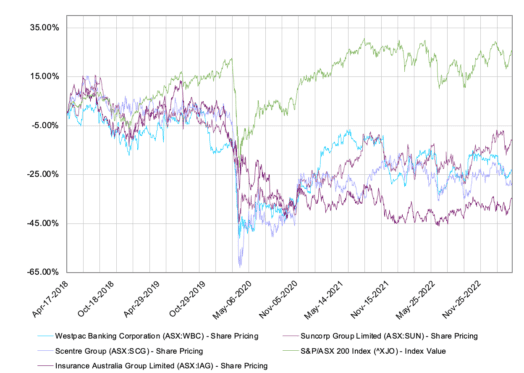
    Take for example the ASX dividend shares shown in the chart below. Each of these companies could be considered relatively ‘safe’ dividend-paying investments. Yet, all of them have underperformed the S&P/ASX 200 Index (ASX: XJO) over the past five years — even when dividend returns are included.

    Source: S & P Market Intelligence

    Ultimately, this reveals the durability — or lack thereof — of a company’s economic moat or competitive advantage. If dividends can’t be paid while also retaining a high return on equity (ROE), then more purposeful uses for those funds should probably be found.

    Not all ASX dividend shares are poor compounders

    Don’t get me wrong, there are plenty of high-quality dividend shares on the ASX. Such companies are able to pay out profits while simultaneously growing them.

    The point is I wouldn’t invest in a company purely based on whether or not it pays a dividend.

    In my opinion, it is far more important to make a decision based on the fundamental quality of the business and the potential for long-term compounding. In some cases that will be a company that pays a dividend. At other times, it possibly might not.

    For reference, 26 out of the 50 best-performing ASX shares over the last decade did not pay a dividend in the last year.

    The ASX shares I’m eager to buy (dividends or not)

    Personally, I much prefer high growth over high yield. As such, a large runway for growing profits is the first characteristic I look for when hunting for investments. From there, dividends are treated as the cream on top if they’re offered.

    The track record of growth, management experience and ownership, balance sheet health, and competitive edge take the front seat over dividends. Right now, ASX shares that are catching my eye include:

    I’m doubtful that some of the ASX dividend shares known for their ‘safeness’ could outperform these growing businesses over the next decade — let alone beat the index. That’s why I believe it’s important to remain diversified and maintain a balanced portfolio of growth and income.

    The post What to know before giving up on growth and going all-in on ASX dividend shares appeared first on The Motley Fool Australia.

    Wondering where you should invest $1,000 right now?

    When investing expert Scott Phillips has a stock tip, it can pay to listen. After all, the flagship Motley Fool Share Advisor newsletter he has run for over ten years has provided thousands of paying members with stock picks that have doubled, tripled or even more.*

    Scott just revealed what he believes could be the ‘five best ASX stocks’ for investors to buy right now. These stocks are trading at near dirt-cheap prices and Scott thinks they could be great buys right now…

    See The 5 Stocks
    *Returns as of April 3 2023

    (function() {
    function setButtonColorDefaults(param, property, defaultValue) {
    if( !param || !param.includes(‘#’)) {
    var button = document.getElementsByClassName(“pitch-snippet”)[0].getElementsByClassName(“pitch-button”)[0];
    button.style[property] = defaultValue;
    }
    }

    setButtonColorDefaults(“#43B02A”, ‘background’, ‘#5FA85D’);
    setButtonColorDefaults(“#43B02A”, ‘border-color’, ‘#43A24A’);
    setButtonColorDefaults(“#fff”, ‘color’, ‘#fff’);
    })()

    More reading

    Motley Fool contributor Mitchell Lawler has positions in Propel Funeral Partners. The Motley Fool Australia’s parent company Motley Fool Holdings Inc. has positions in and has recommended Altium, Berkshire Hathaway, Imdex, and Nanosonics. The Motley Fool Australia has positions in and has recommended Imdex and Nanosonics. The Motley Fool Australia has recommended Berkshire Hathaway, Propel Funeral Partners, and Westpac Banking. The Motley Fool has a disclosure policy. This article contains general investment advice only (under AFSL 400691). Authorised by Scott Phillips.

    from The Motley Fool Australia https://ift.tt/OlG24uR

  • Why did ASX All Ords share AMA just crash 30%?

    a man weraing a suit sits nervously at his laptop computer biting into his clenched hand with nerves, and perhaps fear.a man weraing a suit sits nervously at his laptop computer biting into his clenched hand with nerves, and perhaps fear.

    It’s been a rather pleasant start to the trading week so far this Monday for the All Ordinaries Index (ASX: XAO). At this point of today’s session, the All Ords has gained a decent 0.14%. But one All Ords share isn’t joining this party. That would be the AMA Group Ltd (ASX: AMA) share price. 

    AMA shares have had an absolute clanger so far today. This automotive care and servicing company closed at 25 cents a share last week. But today, the AMA share price opened at 22 cents before falling as low as 16 cents a share, a drop of roughly 34%.

    Right now, AMA shares have stabilised at 17 cents each, but that still puts the company down a painful 30.6%.

    So what on earth has gone so wrong for AMA this Monday?

    Why did the AMA share price tank 30% today?

    Well, it seems the culprit is a quarterly cash flow and activities report that AMA released to investors this morning before market open.

    This report revealed that AMA has been forced to revise its previous earnings guidance for FY2023.
    Previously, the company had guided for an earnings before interest, tax, depreciation and amortisation (EBITDA) figure of between $70-90 million for FY2023.

    But today, AMA has revised this guidance to between $60-68 million.

    The company has blamed “ongoing margin compression adverse to expectations” for the downgrade.

    It noted the following causes of its expected lower earnings:

    • Strong repair volume demand adversely impacted by industry-wide labour constraint related
      throughput challenges.
    • Elevated lateral hiring activity as industry participants seek to fill vacancies from a limited
      labour pool contributing to higher employee costs per hour and operational disruption.
    • Many industry contracts still do not contain appropriate dynamic adjustment mechanisms
      that insulate parties from external pressures such as inflation or increasing repair severity.
    • Supply strategy progressing slower than anticipated.

    So this is almost certainly why investors are selling out of AMA shares today and have sent the company’s shares down by such a dramatic margin.

    AMA also reported that it was sitting on a cash balance of $20.5 million at the end of the March quarter (the three months ended 31 March 2023). That’s after the company generated a net cash from operating activities of $0.3 million over the period. AMA is also anticipating that it can be operating cash flow-positive over the second half of FY2023.

    Even so, it’s clear investors are disappointed (to say the least) over what AMA has revealed today. Here’s some of what AMA CEO Carl Bizon had to tell investors:

    We are disappointed that we no longer expect to meet the previously stated guidance range as a result of a number of short- to medium-term challenges.

    However, we remain confident in the strategy in place, the fundamentals of the business, and, consequently, the business’s ability to realise our medium-term operating margin target.

    We have made significant progress across all the areas which are key to the long-term success of the business after weathering the very real challenges of the COVID-19 period and I look forward to the future of AMA Group.

    Today’s share price falls puts AMA shares at a loss of 19% in 2023: 

    The post Why did ASX All Ords share AMA just crash 30%? appeared first on The Motley Fool Australia.

    Should you invest $1,000 in Ama Group right now?

    Before you consider Ama Group, you’ll want to hear this.

    Motley Fool Investing expert Scott Phillips just revealed what he believes are the 5 best stocks for investors to buy right now… and Ama Group wasn’t one of them.

    The online investing service he’s run for over a decade, Motley Fool Share Advisor, has provided thousands of paying members with stock picks that have doubled, tripled or even more.* And right now, Scott thinks there are 5 stocks that are better buys.

    See The 5 Stocks
    *Returns as of April 3 2023

    (function() {
    function setButtonColorDefaults(param, property, defaultValue) {
    if( !param || !param.includes(‘#’)) {
    var button = document.getElementsByClassName(“pitch-snippet”)[0].getElementsByClassName(“pitch-button”)[0];
    button.style[property] = defaultValue;
    }
    }

    setButtonColorDefaults(“#43B02A”, ‘background’, ‘#5FA85D’);
    setButtonColorDefaults(“#43B02A”, ‘border-color’, ‘#43A24A’);
    setButtonColorDefaults(“#fff”, ‘color’, ‘#fff’);
    })()

    More reading

    Motley Fool contributor Sebastian Bowen has no position in any of the stocks mentioned. The Motley Fool Australia’s parent company Motley Fool Holdings Inc. has no position in any of the stocks mentioned. The Motley Fool Australia has no position in any of the stocks mentioned. The Motley Fool has a disclosure policy. This article contains general investment advice only (under AFSL 400691). Authorised by Scott Phillips.

    from The Motley Fool Australia https://ift.tt/xyOLatk

  • Why is ASX lithium share Latin Resources on ice today?

    A person wrapped in warm clothing with head, eyes and face covered by a hat, glasses and a scarf is coated in a layer of snow and ice. representing Strike Energy's trading halt todayA person wrapped in warm clothing with head, eyes and face covered by a hat, glasses and a scarf is coated in a layer of snow and ice. representing Strike Energy's trading halt today

    ASX lithium share Latin Resources Ltd (ASX: LRS) gained 5% in last week’s trade, closing Friday at 11 cents per share.

    But you won’t see the Latin Resources share price moving today.

    Here’s why the ASX lithium stock is on ice.

    Why was trading in the ASX lithium share halted?

    Latin Resources entered a trading halt this morning at the company’s request.

    According to the ASX release, the company’s management asked for the trading halt pending the release of a capital raising announcement.

    Investors can expect the ASX lithium share to resume trading by Wednesday or once that capital raise announcement is made, whichever is sooner.

    It was only last Wednesday that Latin Resources updated the market on promising drilling results at its 100% owned Salinas Lithium Project in Brazil.

    The miner said the results provided additional confidence in a significant resource upgrade in June.

    Commenting on those results, Latin Resources’ geology manager Tony Greenaway said:

    We continue to see great results coming out of the resource definition drilling at our Colina Deposit.

    The consistency in both the pegmatite thickness and lithium grades is extremely encouraging, bolstering our confidence to be able to deliver what we believe will be a significant upgrade to the Colina mineral resource in June.

    Is Latin Resources a good investment?

    The Latin Resources share price, pictured below, is up 10% in 2023 but down a painful 45% over the past 12 months.

    As for what’s ahead, Bell Potter sees significant upside potential for the ASX lithium share.

    The broker notes that Salina has an initial mineral resource estimate of 13.3Mt @ 1.2% Li2O. But citing prior positive drilling results at the project’s Colina Deposit, Bell Potter believes that MRE could be significantly increased.

    Bell Potter has a speculative buy rating on the ASX lithium share.

    The broker has a price target of 22 cents per share, representing a 100% upside to Latin Resources’ current halted share price.

    The post Why is ASX lithium share Latin Resources on ice today? appeared first on The Motley Fool Australia.

    Should you invest $1,000 in Latin Resources Limited right now?

    Before you consider Latin Resources Limited, you’ll want to hear this.

    Motley Fool Investing expert Scott Phillips just revealed what he believes are the 5 best stocks for investors to buy right now… and Latin Resources Limited wasn’t one of them.

    The online investing service he’s run for over a decade, Motley Fool Share Advisor, has provided thousands of paying members with stock picks that have doubled, tripled or even more.* And right now, Scott thinks there are 5 stocks that are better buys.

    See The 5 Stocks
    *Returns as of April 3 2023

    (function() {
    function setButtonColorDefaults(param, property, defaultValue) {
    if( !param || !param.includes(‘#’)) {
    var button = document.getElementsByClassName(“pitch-snippet”)[0].getElementsByClassName(“pitch-button”)[0];
    button.style[property] = defaultValue;
    }
    }

    setButtonColorDefaults(“#0095C8”, ‘background’, ‘#5FA85D’);
    setButtonColorDefaults(“#0095C8”, ‘border-color’, ‘#43A24A’);
    setButtonColorDefaults(“#fff”, ‘color’, ‘#fff’);
    })()

    More reading

    Motley Fool contributor Bernd Struben has no position in any of the stocks mentioned. The Motley Fool Australia’s parent company Motley Fool Holdings Inc. has no position in any of the stocks mentioned. The Motley Fool Australia has no position in any of the stocks mentioned. The Motley Fool has a disclosure policy. This article contains general investment advice only (under AFSL 400691). Authorised by Scott Phillips.

    from The Motley Fool Australia https://ift.tt/uWvG2sq

  • What can ASX 200 investors expect from the US Fed in 2023?

    A man sits in deep thought with a pen held to his lips as he ponders his computer screen with a laptop open next to him on his desk in a home office environment.

    A man sits in deep thought with a pen held to his lips as he ponders his computer screen with a laptop open next to him on his desk in a home office environment.

    The S&P/ASX 200 Index (ASX: XJO) is up 0.23% in early afternoon trade on Monday.

    Australia’s benchmark index is bucking the selling trend that took hold in the United States on Friday, which saw all the major US indices close in the red.

    The reason?

    Despite the ongoing banking turmoil impacting regional US banks, investors are upping their bets on another rate hike from the Fed in May.

    And ASX 200 shares have been pressured this past year not just from increasing rates by the Reserve Bank of Australia, but also from past tightening by the Fed.

    With that in mind, here’s what some industry experts are expecting from the world’s most influential central bank (that’s the Fed not the RBA, sorry Philip Lowe!) over the rest of 2023.

    First up, we turn to Morgan Stanley’s chief US economist Ellen Zentner.

    If Zentner is correct, ASX 200 investors should expect another 0.25% rate increase from the Fed in May before the central bank potentially enters into a holding pattern in June.

    According to Zentner (quoted by The Australian Financial Review):

    Leading up to the June meeting, we think further slowing in employment and core inflation, alongside the judgment that cumulative effects of past policy actions and tighter credit means policy is sufficiently in restrictive territory, and will keep the Fed comfortable with holding rates steady.

    Our preliminary forecast for May job gains at 136,000 and core CPI at 0.25 month, we think extends the evidence of slowing momentum, and policymakers will be able to extrapolate from recent trends.

    But if US jobs numbers come in stronger than expected, labour costs would continue to fuel inflation in the world’s biggest economy.

    “More resilience in the labour market could put another hike in June on the table,” Zentner said.

    Oxford Economics US chief economist Bob Schwartz said that with “an economy that is rapidly losing steam amid growing signs of slowing inflation”, ASX 200 investors can likely expect the last rate hike of 2023 from the Fed next month.

    “The odds that the next increase will be the last of the rate-hiking cycle are also increasing,” he said.

    According to Schwartz (quoted by the AFR):

    Understandably, the Fed is frustrated that inflation has not retreated as quickly as it hoped, given the aggressive policy tightening over the past year. But the disinflationary trend is well underway and questions about whether more rate hikes are needed to nudge it along are bound to gain traction after the May 3 meeting.

    But Schwartz admitted that taking the US inflation rate from the current 5% down to the Fed’s 2% target range could be more difficult than the success the central bank has had to date in bringing inflation down from the earlier sky-high level of 9%.

    “The question is, how much pain is the Fed willing to inflict on the economy to reach that target?” he said.

    And, speaking to Bloomberg TV, Frances Stacy, director of strategy at Optimal Capital Advisors, also expects ASX 200 investors will see at least one more rate hike from the Fed next month.

    “I don’t think all of the rate hikes have worked their way through the system and it looks as though the Fed is going to continue to tighten,” Stacy said.

    Though, judging by today’s solid performance, the ASX 200 may prove resilient to the next Federal Reserve rate increase.

    The post What can ASX 200 investors expect from the US Fed in 2023? appeared first on The Motley Fool Australia.

    Should you invest $1,000 in S&P/ASX 200 right now?

    Before you consider S&P/ASX 200, you’ll want to hear this.

    Motley Fool Investing expert Scott Phillips just revealed what he believes are the 5 best stocks for investors to buy right now… and S&P/ASX 200 wasn’t one of them.

    The online investing service he’s run for over a decade, Motley Fool Share Advisor, has provided thousands of paying members with stock picks that have doubled, tripled or even more.* And right now, Scott thinks there are 5 stocks that are better buys.

    See The 5 Stocks
    *Returns as of April 3 2023

    (function() {
    function setButtonColorDefaults(param, property, defaultValue) {
    if( !param || !param.includes(‘#’)) {
    var button = document.getElementsByClassName(“pitch-snippet”)[0].getElementsByClassName(“pitch-button”)[0];
    button.style[property] = defaultValue;
    }
    }

    setButtonColorDefaults(“#0095C8”, ‘background’, ‘#5FA85D’);
    setButtonColorDefaults(“#0095C8”, ‘border-color’, ‘#43A24A’);
    setButtonColorDefaults(“#fff”, ‘color’, ‘#fff’);
    })()

    More reading

    Motley Fool contributor Bernd Struben has no position in any of the stocks mentioned. The Motley Fool Australia’s parent company Motley Fool Holdings Inc. has no position in any of the stocks mentioned. The Motley Fool Australia has no position in any of the stocks mentioned. The Motley Fool has a disclosure policy. This article contains general investment advice only (under AFSL 400691). Authorised by Scott Phillips.

    from The Motley Fool Australia https://ift.tt/4yBUJAN

  • I’d buy 12,000 Westpac shares for $150 in monthly passive income

    Young boy in a suit and red tie standing on a skateboard with a rocket on his back, arms in the air showing confidence.Young boy in a suit and red tie standing on a skateboard with a rocket on his back, arms in the air showing confidence.

    Building passive income is a common motive for investing in ASX shares, and for that, one needs dividends. I think S&P/ASX 200 Index (ASX: XJO) bank Westpac Banking Corp (ASX: WBC) could be a winning dividend share.

    The big four bank currently offers a healthy dividend yield and could be on track to post notable growth in the coming years, according to brokers.

    Let’s take a look at how I’d aim to realise $150 of monthly passive income by investing in Westpac shares today.

    Does the future look bright for Westpac shares?

    The Westpac share price has been volatile in recent months, ultimately falling 9% over the last 12 months to trade at $22.235 right now. That’s compared to the ASX 200’s 2% dip over the same period.

    That makes it the second-best performer among the big four over that time.

    Of course, recent calamity among global banks might have weighed on their ASX 200 counterparts. Fortunately, the chaos appears to have abated for now, perhaps helped by reassurances that the big four are the world’s most capitalised.

    Now the future looks bright for Westpac shares, according to one top broker.

    Goldman Sachs rates Westpac a buy and forecasts its share price to soar to $27.74, my Fool colleague James reports – a potential 25% upside.

    Building a $150 monthly passive income

    The broker also tips Westpac shares to provide $1.47 of dividends this financial year. That would leave the bank stock boasting a 6.6% dividend yield, considering its current share price.

    At that rate, I’d need a stake worth around $27,250 to receive $1,800 of annual passive income, or $150 each month. Today, that sum would see me walking away with 1,226 Westpac shares.

    But what if I don’t have a $27,250 lump sum to invest?

    By regularly and consistently investing a smaller amount – say, $200 a month – and reinvesting any dividends I receive, I think I could build such a parcel in nine years. That’s the power of compounding.

    And that doesn’t consider any potential share price gains. Though, it does assume Westpac shares will offer a consistent 6.6% dividend yield over the years.

    If the stock’s actual yield is lower, I might have to build a larger stake to realise a $150-a-month income stream. Additionally, investing a smaller amount each month might extend the time it takes to build my parcel.

    And, of course, no investment is guaranteed to provide returns, and past performance isn’t an indication of future performance.

    Understanding and reducing risks

    Now, it’s unlikely that Westpac shares will consistently provide a 6.6% dividend yield over the years.

    Companies’ dividends typically rise and fall alongside their earnings, expenses, and broader market happenings, to name a few potential influences.

    Thus, I’d diversify my investments across a variety of companies, sectors, and even asset types. Doing so can reduce some of the risks associated with investing.

    The post I’d buy 12,000 Westpac shares for $150 in monthly passive income appeared first on The Motley Fool Australia.

    Should you invest $1,000 in Westpac Banking Corporation right now?

    Before you consider Westpac Banking Corporation, you’ll want to hear this.

    Motley Fool Investing expert Scott Phillips just revealed what he believes are the 5 best stocks for investors to buy right now… and Westpac Banking Corporation wasn’t one of them.

    The online investing service he’s run for over a decade, Motley Fool Share Advisor, has provided thousands of paying members with stock picks that have doubled, tripled or even more.* And right now, Scott thinks there are 5 stocks that are better buys.

    See The 5 Stocks
    *Returns as of April 3 2023

    (function() {
    function setButtonColorDefaults(param, property, defaultValue) {
    if( !param || !param.includes(‘#’)) {
    var button = document.getElementsByClassName(“pitch-snippet”)[0].getElementsByClassName(“pitch-button”)[0];
    button.style[property] = defaultValue;
    }
    }

    setButtonColorDefaults(“#43B02A”, ‘background’, ‘#5FA85D’);
    setButtonColorDefaults(“#43B02A”, ‘border-color’, ‘#43A24A’);
    setButtonColorDefaults(“#fff”, ‘color’, ‘#fff’);
    })()

    More reading

    Motley Fool contributor Brooke Cooper has no position in any of the stocks mentioned. The Motley Fool Australia’s parent company Motley Fool Holdings Inc. has positions in and has recommended Goldman Sachs Group. The Motley Fool Australia has recommended Westpac Banking. The Motley Fool has a disclosure policy. This article contains general investment advice only (under AFSL 400691). Authorised by Scott Phillips.

    from The Motley Fool Australia https://ift.tt/KdD4InF

  • If I’d invested $1,000 in Liontown shares at the start of 2023, here’s what I’d have now

    ASX share price rise represented by investor riding atop leaping lionASX share price rise represented by investor riding atop leaping lion

    ASX 200 lithium shares have been popular with ASX investors for a few years now. And Liontown Resources Ltd (ASX: LTR) shares are no different.

    This is a share that gave investors close to a 300% gain in 2020, and another 390% rise in 2021, after all:

    Sadly, 2022 saw Liontown retreat by around 20%. But given the performance of the previous two years, there’s probably not a lot of sympathy out there for this pullback.

    So that’s 2020, 2021 and 2022 covered. But what about 2023? How has Liontown done this year to date? To answer that, let’s analyse how much an investor would have today if they ploughed $1,000 into Liontown shares at the start of 2023.

    Let’s begin then. So Liontown shares ended 2022 at $1.32 each. On the first trading day of 2023, the company closed at $1.23 a share. If we use the latter price, a $1,000 investment at the start of the year would have netted a prospective buyer 813 Liontown shares.

    How much are 813 Liontown shares worth today?

    Today, Liontown is training at $2.70 a share at the time of writing, down 0.55% for the day so far. This means that Liontown share price has risen a whopping 120% or so in 2023 from that starting price of $1.23.

    Therefore, those 813 shares that our hypothetical investor bought at the start of the year would have a value of $2,195.10 right now. Not a bad return for just over four months of waiting.

    Liontown doesn’t pay its investors dividends right now though, so all of the gains investors have enjoyed from the company this year come from that capital appreciation alone. Even so, this company has certainly netted investors a tidy return in 2023 thus far.

    That’s especially the case compared with other lithium shares. By comparison, popular ASX lithium stock Pilbara Minerals Ltd (ASX: PLS) is currently looking at a year-to-date gain of just 4.4%.

    Investors probably have one event to thank in particular for this stellar performance. Back in late March, it was revealed that the US lithium share Albemarle (NYSE: ALB) had lobbed a $2.50 per share takeover offer for the company. Even though Liontown rejected this offer out of the gate, this news saw the Liotnown share price rocket an extraordinary 60% or so.

    We haven’t heard much more in terms of takeover news out of Liotown or Albemarle since, although Albemarle has continued to buy up more Liontown shares. But investors have clearly taken a valuation guide from this offer, which persists today.

    So, all in all, Liontown Resources shares have been impressive winners for ASX investors over 2023 so far. Let’s see what the rest of the year has in stock for this ASX 200 lithium share.


    The post If I’d invested $1,000 in Liontown shares at the start of 2023, here’s what I’d have now appeared first on The Motley Fool Australia.

    Wondering where you should invest $1,000 right now?

    When investing expert Scott Phillips has a stock tip, it can pay to listen. After all, the flagship Motley Fool Share Advisor newsletter he has run for over ten years has provided thousands of paying members with stock picks that have doubled, tripled or even more.*

    Scott just revealed what he believes could be the ‘five best ASX stocks’ for investors to buy right now. These stocks are trading at near dirt-cheap prices and Scott thinks they could be great buys right now…

    See The 5 Stocks
    *Returns as of April 3 2023

    (function() {
    function setButtonColorDefaults(param, property, defaultValue) {
    if( !param || !param.includes(‘#’)) {
    var button = document.getElementsByClassName(“pitch-snippet”)[0].getElementsByClassName(“pitch-button”)[0];
    button.style[property] = defaultValue;
    }
    }

    setButtonColorDefaults(“#0095C8”, ‘background’, ‘#5FA85D’);
    setButtonColorDefaults(“#0095C8”, ‘border-color’, ‘#43A24A’);
    setButtonColorDefaults(“#fff”, ‘color’, ‘#fff’);
    })()

    More reading

    Motley Fool contributor Sebastian Bowen has no position in any of the stocks mentioned. The Motley Fool Australia’s parent company Motley Fool Holdings Inc. has no position in any of the stocks mentioned. The Motley Fool Australia has no position in any of the stocks mentioned. The Motley Fool has a disclosure policy. This article contains general investment advice only (under AFSL 400691). Authorised by Scott Phillips.

    from The Motley Fool Australia https://ift.tt/5XRFmZl

  • Here’s why Bank of Queensland shares are making news again this week

    sad party goer sitting alone after celebrationsad party goer sitting alone after celebration

    The S&P/ASX 200 Index (ASX: XJO) had an incredible week last week. Even though it was a shorter trading week, the ASX 200 rose an impressive 1.98%.

    When the ASX 200 has such a strong showing, you can bet that most of the ASX 200 bank shares did, too, thanks to their massive weighting in the index. But one ASX bank share didn’t join the party last week. That would be Bank of Queensland Ltd (ASX: BOQ).

    Bank of Queensland shares rose by just 0.16% last week. And that was despite the big news we heard on Friday, which saw the BoQ share price lose almost 1% alone when it gave investors a glimpse into its finances. Sadly, there was little good news to celebrate.

    Bank profits take a hit

    The bank revealed it expected to book a $260 million write-down in earnings. This is a result of a $60 million provision for an integrated risk program and another $200 million in goodwill.

    As a result, Bank of Queensland expects to report a statutory net profit after tax (NPAT) of just $4 million for the first half of FY2023. In contrast, last year’s corresponding earnings report had BoQ reveal a statutory NPAT of $212 million.

    As a result of these lower profits, the bank also revealed its intentions to fund an interim dividend of 20 cents per share, fully franked, for the six months ending 31 December 2022.

    Income investors might have found this especially disappointing. Last year, Bank of Queensland shares paid an interim dividend worth 22 cents per share. And 2022’s final dividend came to 24 cents per share. That means that if this upcoming dividend indeed comes in at 20 cents per share, it will represent a drop of 9% and 16.6% over those respective past payouts.

    Bank of Queensland shares falter on dividend cut news

    So Bank of Queensland will again be making news this week when the official earnings report is released on Thursday, 20 April.

    Of course, it seems the juiciest parts of this earnings report have already been revealed. But who knows, maybe the bank has another surprise awaiting investors this week.

    As my Fool colleague Brooke covered on Friday, a few ASX brokers were expecting a lot more out of BoQ.

    Broker Goldman Sachs commented that a 20 cents per share dividend would represent an extremely low payout ratio (for an ASX bank, anyway) of just 51%. Goldman still has a neutral rating on BoQ shares but with a share price target of $7.21.

    Earlier this month, we also covered another broker, Ord Minnet, and its $8.40 share price target for Bank of Queensland.

    So we’ll have to wait and see what Bank of Queensland has in store for investors on Thursday. Perhaps it has saved the best for last. But it might be prudent to hope for the best but prepare for something less impressive.

    So far today, Bank of Queensland shares have slipped by 1.4% to $6.34 each.


    The post Here’s why Bank of Queensland shares are making news again this week appeared first on The Motley Fool Australia.

    FREE Beginners Investing Guide

    Despite what some people may say – we believe investing in shares doesn’t have to be overwhelming or complicated…

    For over a decade, we’ve been helping everyday Aussies get started on their journey.

    And to help even more people cut through some of the confusion “experts’” seem to want to perpetuate – we’ve created a brand-new “how to” guide.

    Yes, Claim my FREE copy!
    *Returns as of April 3 2023

    (function() {
    function setButtonColorDefaults(param, property, defaultValue) {
    if( !param || !param.includes(‘#’)) {
    var button = document.getElementsByClassName(“pitch-snippet”)[0].getElementsByClassName(“pitch-button”)[0];
    button.style[property] = defaultValue;
    }
    }

    setButtonColorDefaults(“#0095C8”, ‘background’, ‘#5FA85D’);
    setButtonColorDefaults(“#0095C8”, ‘border-color’, ‘#43A24A’);
    setButtonColorDefaults(“#fff”, ‘color’, ‘#fff’);
    })()

    More reading

    Motley Fool contributor Sebastian Bowen has positions in Bank of Queensland. The Motley Fool Australia’s parent company Motley Fool Holdings Inc. has no position in any of the stocks mentioned. The Motley Fool Australia has no position in any of the stocks mentioned. The Motley Fool has a disclosure policy. This article contains general investment advice only (under AFSL 400691). Authorised by Scott Phillips.

    from The Motley Fool Australia https://ift.tt/2KXa9Li

  • The CBA share price just surged past $100. Too late to buy?

    A woman sits at her computer with her hand to her mouth and a contemplative smile on her face as she reads about the performance of Allkem shares on her computerA woman sits at her computer with her hand to her mouth and a contemplative smile on her face as she reads about the performance of Allkem shares on her computer

    The Commonwealth Bank of Australia (ASX: CBA) share price is up another 1% today, marking an impressive $5, or 5.5%, rise from 27 March 2023 to today.

    ASX bank shares have seen plenty of volatility over the past year as investors weigh up what the current economic environment means for the banking industry.

    Higher interest rates have really changed the picture for banks.

    Bigger profits?

    The main part of CBA’s profit comes from lending. In the FY23 half-year result, it generated $11.6 billion of net interest income, while just under $2 billion came from other sources.

    Changes in the net interest margin (NIM) can have a major impact on how much profit the loan book makes.

    The NIM measures the profitability of the lending by comparing the overall loan rate (which includes mortgages) to the cost of funding the loans (such as savings accounts). If the NIM increases, that shows stronger profitability.

    CBA and the other ASX bank shares have been passing on the Reserve Bank of Australia (RBA) interest rate hikes to borrowers quickly while taking longer to pass that on to savers.

    In the first half of FY23, CBA saw its NIM increase by 23 basis points (or 0.23%) to 2.10% compared to the second half of FY22. This helped HY23’s cash net profit after tax (NPAT) rise by 9% to $5.15 billion and pre-provision profit go up 18% to $7.82 billion. Profit growth can be a key factor for CBA share price growth.

    However, the bank did note that some of the gains of higher interest rates have been offset by “competitive pricing pressure”.

    The CBA CEO Matt Comyn commented in February:

    We believe home loan pricing across the industry is below the cost of capital.

    In other words, banks (and non-banks) are/were competing away the profit boost they’d gained from the higher interest rate environment.

    It will be interesting to see what CBA says its NIM was for the second half of FY23. There may still be a substantial benefit from existing borrowers who are being slugged with those higher rates and not willing (or able) to move banks and get a lower rate.

    Competition lessening?

    Investors may be getting more confident on news that mortgage competition may be easing. That could be promising for the CBA share price, if the market hasn’t already factored that in.

    According to the Australian Financial Review, the major ASX bank shares have just increased interest rates for new borrowers.

    The AFR reported that Rate City director Sally Tindall said rising funding costs, as banks paid up for deposits and navigated more volatile offshore markets, had probably prompted the move to increase prices:

    For months the big banks have been fighting tooth and nail for new customers. However, this competitive streak is starting to wane. All four big banks have now walked back some of their new customer discounts as they feel the heat from the rising cost of funding.

    This is a promising sign for future profitability. Not only is the NIM less likely to decrease, but this is a sign that monthly NIM could rise if the ASX bank shares are increasing lending rates.

    Is the CBA share price a buy?

    I don’t think it’s a strong buy. Online banking has meant competitors don’t need a bank branch network to compete with the big players. A loan isn’t a unique offering, there are many loan providers these days, which can compete on price. This suggests to me that margins could be lower in the future than in the 2010s.

    However, CBA is a very powerful business and it’s down 10% since early February. It’s more appealing. But, if I were investing in an ASX bank share, I think there are cheaper choices than CBA shares.

    The post The CBA share price just surged past $100. Too late to buy? appeared first on The Motley Fool Australia.

    Should you invest $1,000 in Commonwealth Bank Of Australia right now?

    Before you consider Commonwealth Bank Of Australia, you’ll want to hear this.

    Motley Fool Investing expert Scott Phillips just revealed what he believes are the 5 best stocks for investors to buy right now… and Commonwealth Bank Of Australia wasn’t one of them.

    The online investing service he’s run for over a decade, Motley Fool Share Advisor, has provided thousands of paying members with stock picks that have doubled, tripled or even more.* And right now, Scott thinks there are 5 stocks that are better buys.

    See The 5 Stocks
    *Returns as of April 3 2023

    (function() {
    function setButtonColorDefaults(param, property, defaultValue) {
    if( !param || !param.includes(‘#’)) {
    var button = document.getElementsByClassName(“pitch-snippet”)[0].getElementsByClassName(“pitch-button”)[0];
    button.style[property] = defaultValue;
    }
    }

    setButtonColorDefaults(“#43B02A”, ‘background’, ‘#5FA85D’);
    setButtonColorDefaults(“#43B02A”, ‘border-color’, ‘#43A24A’);
    setButtonColorDefaults(“#fff”, ‘color’, ‘#fff’);
    })()

    More reading

    Motley Fool contributor Tristan Harrison has no position in any of the stocks mentioned. The Motley Fool Australia’s parent company Motley Fool Holdings Inc. has no position in any of the stocks mentioned. The Motley Fool Australia has no position in any of the stocks mentioned. The Motley Fool has a disclosure policy. This article contains general investment advice only (under AFSL 400691). Authorised by Scott Phillips.

    from The Motley Fool Australia https://ift.tt/25beHEz