• ASX 200 mining stocks underperforming as Andrew Forrest shutters WA nickel mines

    a mine worker holds his phone in one hand and a tablet in the other as he stands in front of heavy machinery at a mine site.

    a mine worker holds his phone in one hand and a tablet in the other as he stands in front of heavy machinery at a mine site.

    S&P/ASX 200 Index (ASX: XJO) mining stocks are underperforming the benchmark on Monday.

    This comes amid news that Andrew “Twiggy” Forrest is temporarily shuttering the West Australian nickel mines at his privately owned company Wyloo, pressuring other mining companies with nickel operations.

    In early afternoon trade today the ASX 200 is up 0.7%.

    As for the big three ASX 200 mining stocks:

    • Fortescue Metals Group Ltd (ASX: FMG) shares are down 0.1%
    • BHP Group Ltd (ASX: BHP) shares are up 0.2%
    • Rio Tinto Ltd (ASX: RIO) shares are down 0.3%

    Here’s what’s happening.

    Headwinds for ASX 200 mining stocks

    As The Australian Financial Review reports, Wyloo, which Forrest acquired for $760 million in mid-2023, will enter care and maintenance at the end of May.

    That news looks to be pressuring ASX 200 mining stocks amid ongoing weakness in the nickel price.

    As we reported over the weekend, nickel prices have fallen some 50% over the past 12 months as supplies from both Indonesia and Russia have ramped up. However, the nickel produced by both of those nations, while selling for a cheaper price, also comes with a much larger environmental footprint.

    And that’s something that Forrest wants to change, seeking a global distinction between so-called clean nickel and the “dirty nickel” that comes from Indonesia. A distinction that could, if adopted, benefit ASX 200 mining stocks that produce the metal under higher ESG standards.

    Commenting on the nickel markets last week, Wyloo Metals CEO Luca Giacovazzi said:

    The industry needs a more appropriate and transparent pricing mechanism, that distinguishes between clean and dirty nickel, so consumers can be confident their EV really is a better choice for the environment.

    Over the weekend Giacovazzi upped his criticism of “pollutive nickel”.

    “The LME [London Metals Exchange] is awash with pollutive nickel, which is squeezing out clean nickel from Australian producers,” he said (quoted by the AFR).

    “We need to see structural change in nickel pricing that distinguishes between nickel products as well as their ESG credentials,” he added.

    However, this is likely not an end to nickel mining operations at Wyloo, but rather a pause.

    According to Giacovazzi:

    The decision to temporarily pause our operations in the current nickel market will allow us to develop and assess these options as we move towards our long-term strategy to mine and process nickel from our own facilities in Kambalda and Kwinana.

    It’s not just Wyloo

    While revenue from nickel is only a fraction of what iron ore brings in for ASX 200 mining stocks like BHP, Rio Tinto and Fortescue, the impact of cratering prices shouldn’t be discounted.

    At BHP’s quarterly production update, released last week, the company noted, “At Nickel West, we are evaluating options to mitigate the impacts of the sharp fall in nickel prices.”

    The ASX 200 mining stock’s quarterly nickel production was up 4% to 40,000 tonnes. But the average realised price of US$18,602 per tonne it received for the metal was down 24%.

    The post ASX 200 mining stocks underperforming as Andrew Forrest shutters WA nickel mines appeared first on The Motley Fool Australia.

    Wondering where you should invest $1,000 right now?

    When investing expert Scott Phillips has a stock tip, it can pay to listen. After all, the flagship Motley Fool Share Advisor newsletter he has run for over ten years has provided thousands of paying members with stock picks that have doubled, tripled or even more.*

    Scott just revealed what he believes could be the ‘five best ASX stocks’ for investors to buy right now. These stocks are trading at near dirt-cheap prices and Scott thinks they could be great buys right now…

    See The 5 Stocks
    *Returns as of 10 November 2023

    (function() {
    function setButtonColorDefaults(param, property, defaultValue) {
    if( !param || !param.includes(‘#’)) {
    var button = document.getElementsByClassName(“pitch-snippet”)[0].getElementsByClassName(“pitch-button”)[0];
    button.style[property] = defaultValue;
    }
    }

    setButtonColorDefaults(“#0095C8”, ‘background’, ‘#5FA85D’);
    setButtonColorDefaults(“#0095C8”, ‘border-color’, ‘#43A24A’);
    setButtonColorDefaults(“#fff”, ‘color’, ‘#fff’);
    })()

    More reading

    Motley Fool contributor Bernd Struben has no position in any of the stocks mentioned. The Motley Fool Australia’s parent company Motley Fool Holdings Inc. has no position in any of the stocks mentioned. The Motley Fool Australia has no position in any of the stocks mentioned. The Motley Fool has a disclosure policy. This article contains general investment advice only (under AFSL 400691). Authorised by Scott Phillips.

    from The Motley Fool Australia https://ift.tt/g3f7U69

  • Leading brokers name 3 ASX shares to buy today

    A female broker in a red jacket whispers in the ear of a man who has a surprised look on his face as she explains which two ASX 200 shares should do well in today's volatile climate

    A female broker in a red jacket whispers in the ear of a man who has a surprised look on his face as she explains which two ASX 200 shares should do well in today's volatile climate

    With so many shares to choose from on the ASX, it can be difficult to decide which ones to buy. The good news is that brokers across the country are doing a lot of the hard work for you.

    Three top ASX shares that leading brokers have named as buys this week are listed below. Here’s why they are bullish on them:

    Arcadium Lithium (ASX: LTM)

    According to a note out of Bell Potter, its analysts have initiated coverage on this lithium miner’s shares with a buy rating and $12.10 price target. The broker is a fan of Arcadium Lithium, which is the result of the Allkem-Livent merger, due to it having the largest, most diversified exposure to lithium. The Arcadium Lithium share price is trading at $7.53 today.

    Macquarie Technology Group Ltd (ASX: MAQ)

    A note out of Goldman Sachs reveals that its analysts have retained their buy rating and $77.70 price target on this data centre, cloud, cyber security, and telecom company’s shares. It notes that the company’s development application for the IC3 Super West data centre at its Macquarie Park campus has been approved. The broker sees this as an important milestone in the acceleration of the company’s data centre growth ambitions. The Macquarie Technology share price is fetching $72.32 this afternoon.

    QBE Insurance Group Ltd (ASX: QBE)

    Another note out of Goldman Sachs reveals that its analysts have retained their buy rating and $18.52 price target on this insurance giant’s shares. This follows the release of an update from industry peer Travelers Companies Inc (NYSE: TRV). Goldman notes that Travelers smashed its expectations during the fourth quarter. It believes this bodes well for QBE’s performance during the quarter. The QBE share price is trading at $15.62 on Monday.

    The post Leading brokers name 3 ASX shares to buy today appeared first on The Motley Fool Australia.

    Wondering where you should invest $1,000 right now?

    When investing expert Scott Phillips has a stock tip, it can pay to listen. After all, the flagship Motley Fool Share Advisor newsletter he has run for over ten years has provided thousands of paying members with stock picks that have doubled, tripled or even more.*

    Scott just revealed what he believes could be the ‘five best ASX stocks’ for investors to buy right now. These stocks are trading at near dirt-cheap prices and Scott thinks they could be great buys right now…

    See The 5 Stocks
    *Returns as of 10 November 2023

    (function() {
    function setButtonColorDefaults(param, property, defaultValue) {
    if( !param || !param.includes(‘#’)) {
    var button = document.getElementsByClassName(“pitch-snippet”)[0].getElementsByClassName(“pitch-button”)[0];
    button.style[property] = defaultValue;
    }
    }

    setButtonColorDefaults(“#0095C8”, ‘background’, ‘#5FA85D’);
    setButtonColorDefaults(“#0095C8”, ‘border-color’, ‘#43A24A’);
    setButtonColorDefaults(“#fff”, ‘color’, ‘#fff’);
    })()

    More reading

    Motley Fool contributor James Mickleboro owns Arcadium Lithium shares. The Motley Fool Australia’s parent company Motley Fool Holdings Inc. has positions in and has recommended Goldman Sachs Group. The Motley Fool Australia has no position in any of the stocks mentioned. The Motley Fool has a disclosure policy. This article contains general investment advice only (under AFSL 400691). Authorised by Scott Phillips.

    from The Motley Fool Australia https://ift.tt/BnUvRur

  • I’m buying cheap ASX shares to build my wealth in 2024 and beyond

    A woman peers through a bunch of recycled clothes on hangers and looks amazed.

    A woman peers through a bunch of recycled clothes on hangers and looks amazed.

    Knowing when, and how much, to invest in ASX shares can be a tricky process. On one hand, we’re told to invest in cheap ASX shares by ‘buying low’ and ‘selling high’. But on the other, we’re told not to ‘time the markets’ and that ‘time in the market beats timing the market’.

    So how does one reconcile these two seemingly opposed pieces of advice?

    Well, to hopefully shed some light on this question, let’s discuss how I’m planning on investing in 2024.

    I’m an investor who loves getting quality ASX shares for cheap, bargain basement prices. It was Warren Buffett who told us that price and value aren’t the same thing on the stock market. His exact quote was “price is what you pay, value is what you get”. So if you do manage to snag a cheap ASX share below what it’s actually worth, you’re doing something right.

    His late, great business partner, Charlie Munger, expanded on this by stating that, “No matter how wonderful a business is, it’s not worth an infinite price”. So these two great men are clearly telling us that successful investing involves looking out for quality businesses that are also cheap shares.

    However, there are periods when the market is booming and cheap ASX shares become harder and harder to find. Investors like Buffett typically stop buying shares altogether during these periods.

    How to build wealth by buying cheap ASX shares

    Saying that, I think that most of us mere mortals shouldn’t do this because it is a form of market timing. Buffett is an investing master, so he can afford to do as he sees fit. But market timing doesn’t work well for the vast majority of other investors.

    So here’s what I do. I have a list of quality ASX shares that I’d be happy to load up on at the right price. Often, at least one of these ASX shares is cheap, or at least going for a reasonable value, at any given moment. So if I have funds to spare for my investing portfolio, that’s where I’ll put them.

    Some of my favourite names include Washington H. Soul Pattinson and Co Ltd (ASX: SOL), National Australia Bank Ltd (ASX: NAB), Wesfarmers Ltd (ASX: WES) and CSL Limited (ASX: CSL). I might also consider some US shares too, such as Apple Inc (NASDAQ: AAPL), Adobe Inc (NASDAQ: ADBE) or Airbnb Inc (NASDAQ: ABNB). Perhaps even Buffett’s own Berkshire Hathaway Inc (NYSE: BRK.A)(NYSE: BRK.B)

    However, if there are no cheap ASX shares that take my fancy, I invest the money in index funds instead. I think putting extra cash in an index fund like the Vanguard Australian Shares Index ETF (ASX: VAS) or the Vanguard MSCI Australian Small Companies ETF (ASX: VSO) is a better long-term bet than leaving it in the bank.

    This is how I’ll continue to invest in 2024. I’ll look for cheap ASX shares, and if that fails, I’ll turn to some trusty index funds. In my view, this investing strategy is a good bet for building long-term wealth.

    The post I’m buying cheap ASX shares to build my wealth in 2024 and beyond appeared first on The Motley Fool Australia.

    Wondering where you should invest $1,000 right now?

    When investing expert Scott Phillips has a stock tip, it can pay to listen. After all, the flagship Motley Fool Share Advisor newsletter he has run for over ten years has provided thousands of paying members with stock picks that have doubled, tripled or even more.*

    Scott just revealed what he believes could be the ‘five best ASX stocks’ for investors to buy right now. These stocks are trading at near dirt-cheap prices and Scott thinks they could be great buys right now…

    See The 5 Stocks
    *Returns as of 10 November 2023

    (function() {
    function setButtonColorDefaults(param, property, defaultValue) {
    if( !param || !param.includes(‘#’)) {
    var button = document.getElementsByClassName(“pitch-snippet”)[0].getElementsByClassName(“pitch-button”)[0];
    button.style[property] = defaultValue;
    }
    }

    setButtonColorDefaults(“#0095C8”, ‘background’, ‘#5FA85D’);
    setButtonColorDefaults(“#0095C8”, ‘border-color’, ‘#43A24A’);
    setButtonColorDefaults(“#fff”, ‘color’, ‘#fff’);
    })()

    More reading

    Motley Fool contributor Sebastian Bowen has positions in Adobe, Airbnb, Apple, Berkshire Hathaway, CSL, National Australia Bank, Vanguard Australian Shares Index ETF, Vanguard Msci Australian Small Companies Index ETF, Wesfarmers, and Washington H. Soul Pattinson and Company Limited. The Motley Fool Australia’s parent company Motley Fool Holdings Inc. has positions in and has recommended Adobe, Airbnb, Apple, Berkshire Hathaway, CSL, Washington H. Soul Pattinson and Company Limited, and Wesfarmers. The Motley Fool Australia has positions in and has recommended Washington H. Soul Pattinson and Company Limited and Wesfarmers. The Motley Fool Australia has recommended Adobe, Airbnb, Apple, Berkshire Hathaway, and CSL. The Motley Fool has a disclosure policy. This article contains general investment advice only (under AFSL 400691). Authorised by Scott Phillips.

    from The Motley Fool Australia https://ift.tt/MylKbWq

  • South32 share price falls after disappointing December update

    two men in hard hats and high visibility jackets look together at a laptop screen that one of the men in holding at a mine site.two men in hard hats and high visibility jackets look together at a laptop screen that one of the men in holding at a mine site.

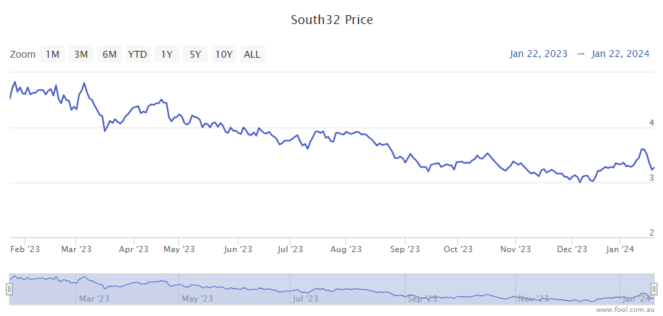
    The South32 Ltd (ASX: S32) share price is down 3% after the ASX mining share delivered its update for the period ending 31 December 2023, including its production numbers.

    Production performance

    South32 revealed how its production performed for all of its commodities in the second quarter of FY24 and the first half of FY24 (HY24).

    Alumina production was 1,284kt in the second quarter, flat quarter over quarter. HY24 saw a 1% drop year over year in alumina production to 2,574kt.

    Aluminium production was 287kt for the second quarter and flat quarter over quarter. In HY24, aluminium production of 575kt was up 1% year over year.

    Payable copper production was 15.6kt in the FY24 second quarter, down 3% quarter over quarter. The HY24 copper production was 31.6kt, a drop of 17% year over year.

    Payable silver production was 3,624kt for the FY24 second quarter, up 7% quarter over quarter. The HY24 silver production was 6,999k ounces, an increase of 20% year over year.

    Payable lead production in the FY24 second quarter was 30.3kt, up 6% quarter over quarter. The HY24 lead production was 58.8kt, up 12% year over year.

    Payable zinc production for the FY24 second quarter was 15.8kt, up 20% quarter over year. HY24 zinc production was down 5% year over year to 29kt.

    Payable nickel production in the FY24 second quarter was 10kt, up 20% quarter over quarter. HY24 production of nickel amounted to 18.3kt, down 10% year over year.

    Metallurgical coal production in the FY24 second quarter was 744kt, down 29% quarter over quarter. HY24 coal production of 1,787kt was down 35% year over year.

    Manganese ore production for the FY24 first quarter was 1,272k wet metric tonnes (wmt), down 16% quarter over quarter. HY24 manganese ore production was 2,790k wmt, down 5% year over year.

    Production (and guidance) can obviously have an impact on the South32 share price.

    Guidance and costs

    A highlight, or lowlight, of the update was that South32 reduced its FY24 group copper equivalent production guidance by 3%, reflecting “revised guidance for Brazil Alumina, Mozal Aluminium and molybdenum output from Sierra Gorda.”

    However, it also said it’s well-positioned to capture the benefit of improved market conditions through expected production growth of 7% in the second half of FY24 and its ongoing focus on cost efficiencies.

    South32 reported its FY24 first-half operating unit costs are expected to be “in line or below” FY24 guidance for the majority of its operations.

    The business has been progressing with a group-wide review focused on “delivering a reduction in expenditure in FY24 and FY25 through cost efficiencies and capital prioritisation.”

    Management comments

    The South32 CEO Graham Kerr said:

    As we enter the second half, strengthening market conditions for many of our commodities, our planned 7 per cent production growth and ongoing cost management focus, position us well to capture higher margins.

    We continued to invest to increase our exposure to commodities critical to a low-carbon future. At our Hermosa project, we progressed critical path infrastructure and remain on track to make a final investment decision for the Taylor zinc-lead-silver deposit in the March 2024 quarter. Sierra Gorda also continued work on the fourth grinding line expansion project, which has the potential to sustainably increase copper production.

    South32 share price snapshot

    Over the last 12 months, South32 shares have dropped around 30%.

    The post South32 share price falls after disappointing December update appeared first on The Motley Fool Australia.

    Wondering where you should invest $1,000 right now?

    When investing expert Scott Phillips has a stock tip, it can pay to listen. After all, the flagship Motley Fool Share Advisor newsletter he has run for over ten years has provided thousands of paying members with stock picks that have doubled, tripled or even more.*

    Scott just revealed what he believes could be the ‘five best ASX stocks’ for investors to buy right now. These stocks are trading at near dirt-cheap prices and Scott thinks they could be great buys right now…

    See The 5 Stocks
    *Returns as of 10 November 2023

    (function() {
    function setButtonColorDefaults(param, property, defaultValue) {
    if( !param || !param.includes(‘#’)) {
    var button = document.getElementsByClassName(“pitch-snippet”)[0].getElementsByClassName(“pitch-button”)[0];
    button.style[property] = defaultValue;
    }
    }

    setButtonColorDefaults(“#0095C8”, ‘background’, ‘#5FA85D’);
    setButtonColorDefaults(“#0095C8”, ‘border-color’, ‘#43A24A’);
    setButtonColorDefaults(“#fff”, ‘color’, ‘#fff’);
    })()

    More reading

    Motley Fool contributor Tristan Harrison has no position in any of the stocks mentioned. The Motley Fool Australia’s parent company Motley Fool Holdings Inc. has no position in any of the stocks mentioned. The Motley Fool Australia has no position in any of the stocks mentioned. The Motley Fool has a disclosure policy. This article contains general investment advice only (under AFSL 400691). Authorised by Scott Phillips.

    from The Motley Fool Australia https://ift.tt/BIVrezl

  • Buying Droneshield shares? Here’s how the company is harnessing the AI revolution

    A silhouette shot of a man holding a control in his hands and watching as a drone hovers overhead with sunrays coming from the sky.A silhouette shot of a man holding a control in his hands and watching as a drone hovers overhead with sunrays coming from the sky.

    Droneshield Ltd (ASX: DRO) shares have flown between small gains and small losses in morning trade today.

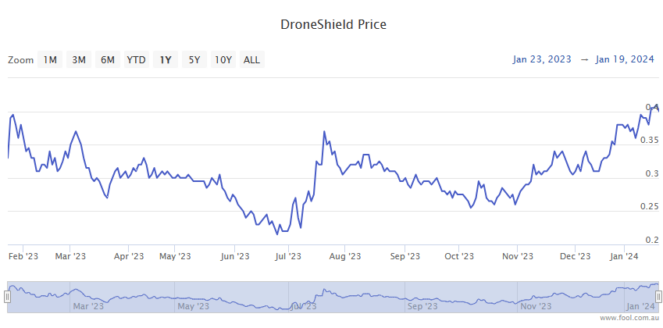
    Shares in the ASX drone defence tech company closed on Friday trading for 38.5 cents. At time of writing on Monday, shares are swapping hands for 38.2 cents apiece, down 0.8%. In earlier trade shares were up as much as 3.9%.

    For some context, the All Ordinaries Index (ASX: XAO) is up 0.4% at this same time.

    Here’s what investors are mulling over today.

    What did the tech company announce?

    Droneshield shares are in the spotlight after the company reported (in a non-price sensitive announcement) that it has commenced the release of a “major update” across its global fleet of counterdrone (C-UAS) devices.

    All devices that carry Droneshield’s artificial intelligence (AI) based drone detection engine, RFAI, will receive the update. Those include portable, vehicle/ship, and fixed site devices.

    The company says this will provide “a complete refinement” of the products software and user experience.

    Aspects of those upgrades that could impact Droneshield shares in the months ahead include a 25% improvement in emitter detection accuracy and tracking in cases where multiple emitters are present.

    The release also noted that the ASX tech company’s DroneLocator detections will now provide horizontal distance to detection, vertical distance to detection, true bearing of detection, and relative bearing of detection.

    Commenting on the AI updates that could support Droneshield shares longer-term, CEO Oleg Vornik said, “As drones continue to rapidly evolve, there is an ongoing race to detect and respond to those threats.”

    Vornik added:

    Firmware upgrades enable our global community of customers to deal with the latest threats, and we actively collaborate with our end users to receive the latest field intelligence to base our algorithms on.

    These updates (together with our computervision AI engine and the sensorfusion engine) grow our SaaS subscriber base and are expected to become a major driver of Droneshield revenue over coming years.

    Angus Bean, chief technology officer, said, “Droneshield has grown into a global leader in the C-UAS solutions, driven by our cross-disciplinary engineering teams, listening to our end user community and consistently delivering better performance, usability, and reliability.”

    How have Droneshield shares been tracking?

    Droneshield shares are up 4% over the past full year.

    The ASX tech share has gained 13% over the last six months.

    The post Buying Droneshield shares? Here’s how the company is harnessing the AI revolution appeared first on The Motley Fool Australia.

    Wondering where you should invest $1,000 right now?

    When investing expert Scott Phillips has a stock tip, it can pay to listen. After all, the flagship Motley Fool Share Advisor newsletter he has run for over ten years has provided thousands of paying members with stock picks that have doubled, tripled or even more.*

    Scott just revealed what he believes could be the ‘five best ASX stocks’ for investors to buy right now. These stocks are trading at near dirt-cheap prices and Scott thinks they could be great buys right now…

    See The 5 Stocks
    *Returns as of 10 November 2023

    (function() {
    function setButtonColorDefaults(param, property, defaultValue) {
    if( !param || !param.includes(‘#’)) {
    var button = document.getElementsByClassName(“pitch-snippet”)[0].getElementsByClassName(“pitch-button”)[0];
    button.style[property] = defaultValue;
    }
    }

    setButtonColorDefaults(“#0095C8”, ‘background’, ‘#5FA85D’);
    setButtonColorDefaults(“#0095C8”, ‘border-color’, ‘#43A24A’);
    setButtonColorDefaults(“#fff”, ‘color’, ‘#fff’);
    })()

    More reading

    Motley Fool contributor Bernd Struben has no position in any of the stocks mentioned. The Motley Fool Australia’s parent company Motley Fool Holdings Inc. has positions in and has recommended DroneShield. The Motley Fool Australia has recommended DroneShield. The Motley Fool has a disclosure policy. This article contains general investment advice only (under AFSL 400691). Authorised by Scott Phillips.

    from The Motley Fool Australia https://ift.tt/ZrzSI84

  • Lynas share price sinks alongside 50% quarterly revenue fall

    Female miner in hard hat and safety vest on laptop with mining drill in background.Female miner in hard hat and safety vest on laptop with mining drill in background.

    The Lynas Rare Earths Ltd (ASX: LYC) share price is in the red today.

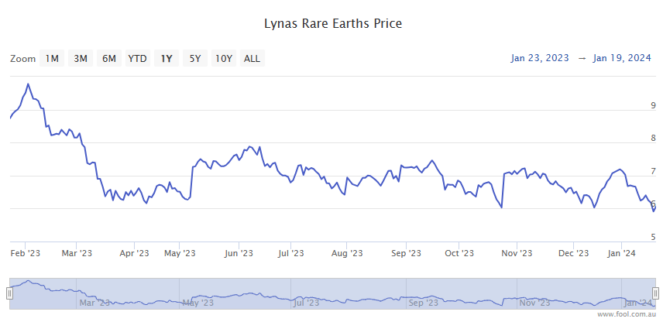
    Shares in the S&P/ASX 200 Index (ASX: XJO) rare earths miner closed Friday trading for $5.95. In morning trade on Monday, shares are swapping hands for $5.84 apiece, down 1.9%.

    For some context, the ASX 200 is up 0.5% at this same time.

    This comes following the release of Lynas’ quarterly update for the three months ending 31 December (Q2 FY 2024).

    Here are the highlights.

    Lynas share price hit by falling production

    The Lynas share price is sliding after the miner reported a 40% year on year fall in rare earths production.

    Over the three months Lynas produced 901 tonnes of neodymium and praseodymium (NdPr), down from 1,508 tonnes in Q2 FY 2023.

    Total rare earth oxide (REO) production during the quarter came in at 1,566 tonnes, down from 4,457 tonnes in the prior corresponding period.

    Investors could also be pressuring the Lynas share price today with quarterly sales revenue coming in at $113 million, down from $233 million year on year. Lynas reported sales receipts of $107 million, down from $168 million in Q2 FY 2023.

    However, management noted this slowdown was due to a temporary shutdown for upgrade works at its Lynas Malaysia facility, with production forecast to ramp back up over the coming quarters.

    “During the shutdown, the works to modify and increase separation capacity and improve the reliability of cracking and leaching at Lynas Malaysia were successfully and safely completed,” the miner stated.

    Lynas now expects production in the March quarter to be around 1,500 tonnes. Production across the six months to June 2024 is forecast to increase slightly from its previous guidance to be in the range of 3,200 to 3,400 tonnes.

    NdPr production capacity is expected to increase to approximately 10,500 tonnes a year by December 2024.

    The three months also saw Lynas receive a variation for its Lynas Malaysia’s operating licence from the Malaysian government, a variation which boosted the Lynas share price at the time.

    This now allows the ASX 200 miner to keep importing and processing Lanthanide Concentrate from its Mt Weld mine in Western Australia. The amended operating licence is valid until 2 March 2026.

    As for the balance sheet, as at 31 December, Lynas held cash and short-term deposits of $686 million.

    In other news relating to the current quarter, Lynas also reported on the successful completion of its exploratory drilling program at Mt Weld.

    Lynas share price snapshot

    The Lynas share price has struggled over the past year, down 34%.

    Shares remain up 33% over three years.

    The post Lynas share price sinks alongside 50% quarterly revenue fall appeared first on The Motley Fool Australia.

    Wondering where you should invest $1,000 right now?

    When investing expert Scott Phillips has a stock tip, it can pay to listen. After all, the flagship Motley Fool Share Advisor newsletter he has run for over ten years has provided thousands of paying members with stock picks that have doubled, tripled or even more.*

    Scott just revealed what he believes could be the ‘five best ASX stocks’ for investors to buy right now. These stocks are trading at near dirt-cheap prices and Scott thinks they could be great buys right now…

    See The 5 Stocks
    *Returns as of 10 November 2023

    (function() {
    function setButtonColorDefaults(param, property, defaultValue) {
    if( !param || !param.includes(‘#’)) {
    var button = document.getElementsByClassName(“pitch-snippet”)[0].getElementsByClassName(“pitch-button”)[0];
    button.style[property] = defaultValue;
    }
    }

    setButtonColorDefaults(“#0095C8”, ‘background’, ‘#5FA85D’);
    setButtonColorDefaults(“#0095C8”, ‘border-color’, ‘#43A24A’);
    setButtonColorDefaults(“#fff”, ‘color’, ‘#fff’);
    })()

    More reading

    Motley Fool contributor Bernd Struben has no position in any of the stocks mentioned. The Motley Fool Australia’s parent company Motley Fool Holdings Inc. has no position in any of the stocks mentioned. The Motley Fool Australia has no position in any of the stocks mentioned. The Motley Fool has a disclosure policy. This article contains general investment advice only (under AFSL 400691). Authorised by Scott Phillips.

    from The Motley Fool Australia https://ift.tt/Yeatmcw

  • How I’d create investment cash flow in retirement from ASX ETFs

    Smiling elderly couple looking at their superannuation account, symbolising retirement.Smiling elderly couple looking at their superannuation account, symbolising retirement.

    ASX-listed exchange-traded funds (ETFs) can be an effective investment choice for retirement.

    An ETF essentially gives us the ability to buy a basket of different shares in just one investment, creating good diversification. You don’t need to worry about which individual stocks to pick for your portfolio.

    If I were investing in ASX ETFs for retirement, there are two different investment strategies I’d consider to create good annual cash flow.

    ASX ETFs that pay dividends

    Plenty of retirees are attracted to individual ASX dividend shares for the dividend yield.

    In contrast, many ASX ETFs invest in good businesses that don’t necessarily pay large dividends (or any dividends at all). Blue chip international shares, for example, don’t typically offer a strong dividend yield because they have a lower dividend payout ratio compared to ASX shares.

    This is why the Vanguard Australian Shares Index ETF (ASX: VAS) – which invests in 300 of the biggest businesses on the ASX – could be a decent option for dividends. It has a sizeable allocation to names like BHP Group Ltd (ASX: BHP), Commonwealth Bank of Australia (ASX: CBA) and Fortescue Ltd (ASX: FMG), all of which produce good dividend yields.

    According to Vanguard, the VAS ETF has a dividend yield of 3.8% (excluding franking credits).

    Vanguard Australian Shares High Yield ETF (ASX: VHY) takes investing in high-yield stocks to another level. It only invests in high-yield ASX shares. It has 72 holdings, with companies like BHP, CBA, National Australia Bank Ltd (ASX: NAB) and Wesfarmers Ltd (ASX: WES) being the biggest allocations. And it has a dividend yield of 4.9% (excluding franking credits), according to Vanguard.

    The one non-ASX-focused ETF I’ll mention is Betashares FTSE 100 ETF (ASX: F100). It invests in 100 of the biggest businesses in the United Kindom’s share market. In this portfolio, we’ve got names like Shell, HSBC, Unilever and GSK. The F100 ETF has a 12-month distribution yield of 3.1%.

    What about growth ETFs?

    Dividends aren’t the only way to create cash flow.

    If someone is in retirement (or thinking about it), I expect they have a sizeable portfolio balance.

    Imagine if an investor had $100,000 invested in a growth-focused ASX ETF. If the value of that ETF went up 10%, it’d grow to $110,000 in value. If they sold $5,000, they’d generate a 5% ‘yield’ on that initial $100,000 and be left with $105,000.

    In year two, if it rose by 10% again, it’d reach $115,500 – and if we aim for a 5% yield (of $105,000), it would deliver a cash flow of $5,250 and a remaining balance of $110,250.

    Of course, no investment is guaranteed to go up over a year or any particular length of time. However, I think a few ASX ETFs have a better chance of delivering strong capital growth than many ASX share-focused ETFs.

    If the capital value of the ETF falls one year, that is likely to be okay. It could rebound afterwards in the following year. We regularly see this happen after a bear market. That’s why, in my opinion, it’s good to stick to a sustainable withdrawal ‘yield’ of, say, 4% (or 5% for a strong-performing ASX ETF).

    Keep in mind that past performance is not a guarantee of future performance.

    Big hitters

    Vaneck Morningstar Wide Moat ETF (ASX: MOAT) focuses on United States companies with strong, durable competitive advantages, and those businesses are currently valued at an attractive price (according to Morningstar). Since its inception in June 2015, the MOAT ETF has achieved an average return per annum of 15.5%.

    VanEck MSCI International Quality ETF (ASX: QUAL) invests in global shares that have a high return on equity (ROE), low negative earnings variability and low levels of debt. Since the ETF’s inception in October 2014, it has delivered an average return of 15.1% per annum.

    These two are the sorts of growth ETFs I’d look at to create cash flow for my own retirement. They offer diversification, a strong investment framework and have a solid track record of long-term success.

    The post How I’d create investment cash flow in retirement from ASX ETFs appeared first on The Motley Fool Australia.

    Wondering where you should invest $1,000 right now?

    When investing expert Scott Phillips has a stock tip, it can pay to listen. After all, the flagship Motley Fool Share Advisor newsletter he has run for over ten years has provided thousands of paying members with stock picks that have doubled, tripled or even more.*

    Scott just revealed what he believes could be the ‘five best ASX stocks’ for investors to buy right now. These stocks are trading at near dirt-cheap prices and Scott thinks they could be great buys right now…

    See The 5 Stocks
    *Returns as of 10 November 2023

    (function() {
    function setButtonColorDefaults(param, property, defaultValue) {
    if( !param || !param.includes(‘#’)) {
    var button = document.getElementsByClassName(“pitch-snippet”)[0].getElementsByClassName(“pitch-button”)[0];
    button.style[property] = defaultValue;
    }
    }

    setButtonColorDefaults(“#0095C8”, ‘background’, ‘#5FA85D’);
    setButtonColorDefaults(“#0095C8”, ‘border-color’, ‘#43A24A’);
    setButtonColorDefaults(“#fff”, ‘color’, ‘#fff’);
    })()

    More reading

    HSBC Holdings is an advertising partner of The Ascent, a Motley Fool company. Motley Fool contributor Tristan Harrison has positions in Fortescue. The Motley Fool Australia’s parent company Motley Fool Holdings Inc. has positions in and has recommended Wesfarmers. The Motley Fool Australia’s parent company Motley Fool Holdings Inc. has recommended GSK, HSBC Holdings, and Unilever Plc. The Motley Fool Australia has positions in and has recommended Wesfarmers. The Motley Fool Australia has recommended VanEck Morningstar Wide Moat ETF and Vanguard Australian Shares High Yield ETF. The Motley Fool has a disclosure policy. This article contains general investment advice only (under AFSL 400691). Authorised by Scott Phillips.

    from The Motley Fool Australia https://ift.tt/NvQ2e57

  • Why are Liontown shares crashing 26% on Monday?

    A woman screams and holds her hands up in frustration.

    A woman screams and holds her hands up in frustration.

    Liontown Resources Ltd (ASX: LTR) shares are having another day to forget on Monday.

    In morning trade, the lithium developer’s shares are down 26% to a 52-week low of 88.5 cents.

    This means its shares are now down 70% since the start of October.

    Why are Liontown shares crashing again?

    The catalyst for today’s weakness has been the release of an update on the Kathleen Valley Lithium Project.

    Let’s start with the positives. The company revealed that the Kathleen Valley Lithium Project remains on-track for first production in the middle of this calendar year. Management also advised that it remains focused on delivering to that schedule and on budget.

    Now let’s see what is putting pressure on Liontown shares today.

    According to the release, the material decline in spodumene prices has triggered significant reductions in short and medium-term lithium price forecasts.

    As a result, the company has commenced a review of the planned expansion and associated ramp-up of Kathleen Valley to preserve capital and reduce the near-term funding requirements of the Project. It explains:

    The Project Review includes examining options to defer the timing of the previously announced 4 million tonne per annum underground development work, sequencing adjustments to the mine plan, and scope for additional cost optimisations. There is no change to the 3 million tonne per annum plant capacity design which the Company is currently constructing.

    Funding blow

    Also putting pressure on Liontown shares is news that a recently announced $760 million debt funding package has been terminated due to lithium price weakness.

    The company explains:

    The finalisation of the debt package has been impacted by recent reductions in the independent forecast pricing for spodumene upon which the lenders’ credit approvals were based. Accordingly, the Company has now commenced discussions on a revised, smaller debt facility that will reflect the Project Review. As a result, the commitment letter announced on 19 October 2023 will terminate.

    Liontown had approximately $515 million cash at the end of December, having fully drawn the $300 million project funding package secured from Ford (NYSE: F). This is expected to fund construction activities required for first production in the middle of 2024.

    Management expects to make an announcement on its debt funding within the first quarter. It also concluded by reiterating that it “remains confident in the long-term outlook of the lithium market and Kathleen Valley’s status as a Tier 1 long-life producer.”

    The post Why are Liontown shares crashing 26% on Monday? appeared first on The Motley Fool Australia.

    Wondering where you should invest $1,000 right now?

    When investing expert Scott Phillips has a stock tip, it can pay to listen. After all, the flagship Motley Fool Share Advisor newsletter he has run for over ten years has provided thousands of paying members with stock picks that have doubled, tripled or even more.*

    Scott just revealed what he believes could be the ‘five best ASX stocks’ for investors to buy right now. These stocks are trading at near dirt-cheap prices and Scott thinks they could be great buys right now…

    See The 5 Stocks
    *Returns as of 10 November 2023

    (function() {
    function setButtonColorDefaults(param, property, defaultValue) {
    if( !param || !param.includes(‘#’)) {
    var button = document.getElementsByClassName(“pitch-snippet”)[0].getElementsByClassName(“pitch-button”)[0];
    button.style[property] = defaultValue;
    }
    }

    setButtonColorDefaults(“#0095C8”, ‘background’, ‘#5FA85D’);
    setButtonColorDefaults(“#0095C8”, ‘border-color’, ‘#43A24A’);
    setButtonColorDefaults(“#fff”, ‘color’, ‘#fff’);
    })()

    More reading

    Motley Fool contributor James Mickleboro has no position in any of the stocks mentioned. The Motley Fool Australia’s parent company Motley Fool Holdings Inc. has no position in any of the stocks mentioned. The Motley Fool Australia has no position in any of the stocks mentioned. The Motley Fool has a disclosure policy. This article contains general investment advice only (under AFSL 400691). Authorised by Scott Phillips.

    from The Motley Fool Australia https://ift.tt/wgYftSB

  • Zip shares rocket 17% on ‘outstanding’ quarter

    Happy couple doing online shopping.

    Happy couple doing online shopping.

    Zip Co Ltd (ASX: ZIP) shares are starting the week with a bang.

    In morning trade, the buy now pay later provider’s shares are up 16% to 73.5 cents.

    Why are Zip shares jumping?

    Investors have been buying the company’s shares this morning after responding positively to the release of a quarterly and half year update.

    According to the release, for the second quarter, Zip delivered an 8.5% lift in transaction value over the prior corresponding period to $2.8 billion.

    And thanks to a material improvement in its revenue margin to 8.2% (from 7.1%), Zip’s revenue was up 26.1% to $225.6 million for the quarter. This was driven by strong performances across both the Americas and ANZ markets, which reported revenue growth of 35.5% and 20.4%, respectively.

    This ultimately supported “outstanding” cash EBTDA during the quarter according to management. Zip’s Group CEO and Managing Director, Cynthia Scott, said:

    Zip delivered an outstanding Group cash EBTDA result for the second quarter, underpinned by a particularly strong seasonal performance in US TTV, the resilience of the ANZ business, improved margins and continued cost discipline.

    As a result, the company’s group cash EBTDA for the first half of FY 2024 is expected to be between $29 million and $33 million. This compares favourably to a cash EBTDA loss of $33.2 million during the first half of FY 2023.

    Another positive potentially given Zip’s shares a boost was its bad debts. It advised that US bad debts continued to perform well with monthly cohort loss rates approximately 1.3% – 1.4% of total transaction value. This is below the target range of 1.5% -to 2.0%. In Australia, net bad debts improved by 54bps quarter on quarter to 3.64% of receivables.

    Self-sustaining business

    Scott believes that this result demonstrates that Zip is now a self-sustaining business. She adds:

    Today’s result reinforces that Zip is delivering as a self-sustaining business. Group revenue grew by 26.1% and revenue margins were 8.2%, up 110bps versus 2Q23. Cash transaction margin improved 70bps versus 2Q23 to 3.5%, demonstrating the strength of the business model in a challenging external environment.

    At the end of the period, Zip had $81.3 million in available cash and liquidity, which is an increase from $53.2 million on 30 September 2023.

    The post Zip shares rocket 17% on ‘outstanding’ quarter appeared first on The Motley Fool Australia.

    Wondering where you should invest $1,000 right now?

    When investing expert Scott Phillips has a stock tip, it can pay to listen. After all, the flagship Motley Fool Share Advisor newsletter he has run for over ten years has provided thousands of paying members with stock picks that have doubled, tripled or even more.*

    Scott just revealed what he believes could be the ‘five best ASX stocks’ for investors to buy right now. These stocks are trading at near dirt-cheap prices and Scott thinks they could be great buys right now…

    See The 5 Stocks
    *Returns as of 10 November 2023

    (function() {
    function setButtonColorDefaults(param, property, defaultValue) {
    if( !param || !param.includes(‘#’)) {
    var button = document.getElementsByClassName(“pitch-snippet”)[0].getElementsByClassName(“pitch-button”)[0];
    button.style[property] = defaultValue;
    }
    }

    setButtonColorDefaults(“#0095C8”, ‘background’, ‘#5FA85D’);
    setButtonColorDefaults(“#0095C8”, ‘border-color’, ‘#43A24A’);
    setButtonColorDefaults(“#fff”, ‘color’, ‘#fff’);
    })()

    More reading

    Motley Fool contributor James Mickleboro has no position in any of the stocks mentioned. The Motley Fool Australia’s parent company Motley Fool Holdings Inc. has positions in and has recommended Zip Co. The Motley Fool Australia has no position in any of the stocks mentioned. The Motley Fool has a disclosure policy. This article contains general investment advice only (under AFSL 400691). Authorised by Scott Phillips.

    from The Motley Fool Australia https://ift.tt/JYNLBk8

  • Are TPG shares an unloved buying opportunity?

    A woman sits at her computer with her hand to her mouth and a contemplative smile on her face as she reads about the performance of Allkem shares on her computerA woman sits at her computer with her hand to her mouth and a contemplative smile on her face as she reads about the performance of Allkem shares on her computer

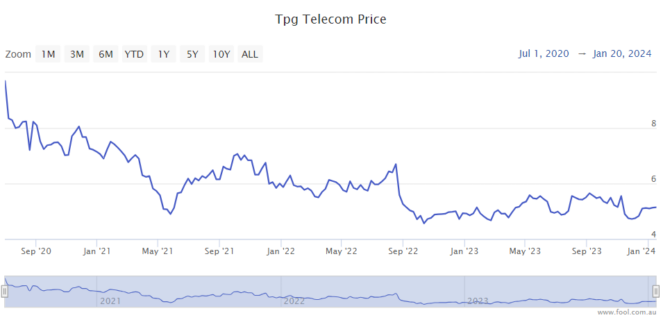
    TPG Telecom Ltd (ASX: TPG) shares are down 40% from July 2020 and have dropped 22% from August 2022. Are investors underlying this ASX telco share?

    This company is responsible for a number of brands including TPG, Vodafone, iiNet, AAPT and others. All these businesses came together after a merger between TPG and Vodafone Australia.

    There are a few good factors about the business to keep in mind.

    A growing dividend

    TPG has grown its annual dividend each year since 2021 when the merged company started paying cash to shareholders.

    We can’t control what the TPG share price does, but receiving a growing dividend can offset some of that market uncertainty and share price volatility.

    The last 12 months of dividends amount to 18 cents per share, which is a grossed-up dividend yield of around 5%.

    TPG’s annual dividend per share in 2024 could be 18.8 cents, which would be a grossed-up dividend yield of 5.2%, according to Commsec. The annual dividend per share could then grow to 20 cents per share in FY25 and 21.4 cents per share in FY26.

    For investors that focus on dividends, it looks like an appealing option.

    Rising prices and subscribers to help profitability?

    Vodafone has recently increased prices, though it reportedly only applies to new customers.

    In the first half of FY23, TPG reported that its postpaid average revenue per user (ARPU) rose to $44.6 – this was an increase of 6.2% year over year and a rise of 4.4% half over year. However, the prepaid ARPU dropped to $18.9, which was a year-over-year decline of 2.5% and a drop of 1.6% half-on-half.

    Subscriber numbers continue to increase, which I believe helps its underlying profitability. Postpaid subscribers rose 5,000 in the six months of the FY23 first half to 3.23 million, and an increase of 2.2% year over year.

    Total prepaid subscribers rose 35,000 half over half, and went up 167,000 year over year, to 2.07 million.

    TPG’s fixed costs are essentially, you guessed it, fixed. So, an increase of revenue can help increase the underlying profitability of the business. In HY23, service revenue rose 4.5% to $2.3 billion and the earnings before interest, tax, depreciation and amortisation (EBITDA) grew quicker, going up 12.4% to $941 million. Stronger profit is supportive for the TPG share price.

    Profitability can also rise from the company’s ‘simplification’ efforts, which it’s expecting to achieve $140 million per annum of cash benefits.

    Investing for growth

    The business is putting a lot of money towards capital expenditure, which will hopefully unlock additional earnings in the coming years. Growing the capabilities of its 5G network is a key focus.

    With 5G, TPG’s brands (particularly Vodafone) can offer Aussies a 5G-powered wireless home broadband option. NBN currently takes a lot of the broadband margin, but Vodafone customers using 5G wireless broadband would mean TPG gets a lot more margin.

    Investing in 5G is important because it will make sure TPG and Vodafone are keeping up with competition.

    Foolish takeaway

    Things are looking promising for TPG, but it’s not exactly delivering growth that’s shooting the lights out. I think it could be a solid ASX dividend share, but it’s not cheap.

    According to Commsec, the TPG share price is valued at 31x FY24’s estimated earnings and 27x FY25’s estimated earnings.

    The post Are TPG shares an unloved buying opportunity? appeared first on The Motley Fool Australia.

    Wondering where you should invest $1,000 right now?

    When investing expert Scott Phillips has a stock tip, it can pay to listen. After all, the flagship Motley Fool Share Advisor newsletter he has run for over ten years has provided thousands of paying members with stock picks that have doubled, tripled or even more.*

    Scott just revealed what he believes could be the ‘five best ASX stocks’ for investors to buy right now. These stocks are trading at near dirt-cheap prices and Scott thinks they could be great buys right now…

    See The 5 Stocks
    *Returns as of 10 November 2023

    (function() {
    function setButtonColorDefaults(param, property, defaultValue) {
    if( !param || !param.includes(‘#’)) {
    var button = document.getElementsByClassName(“pitch-snippet”)[0].getElementsByClassName(“pitch-button”)[0];
    button.style[property] = defaultValue;
    }
    }

    setButtonColorDefaults(“#0095C8”, ‘background’, ‘#5FA85D’);
    setButtonColorDefaults(“#0095C8”, ‘border-color’, ‘#43A24A’);
    setButtonColorDefaults(“#fff”, ‘color’, ‘#fff’);
    })()

    More reading

    Motley Fool contributor Tristan Harrison has no position in any of the stocks mentioned. The Motley Fool Australia’s parent company Motley Fool Holdings Inc. has no position in any of the stocks mentioned. The Motley Fool Australia has recommended Tpg Telecom. The Motley Fool has a disclosure policy. This article contains general investment advice only (under AFSL 400691). Authorised by Scott Phillips.

    from The Motley Fool Australia https://ift.tt/8Z2N4fx