• Top 10 superannuation funds for growth in 2023 revealed: Chant West

    Ten smiling business people wave to the camera after receiving some winning company news.Ten smiling business people wave to the camera after receiving some winning company news.

    Chant West has revealed the top 10 Australian superannuation funds with growth strategies in 2023.

    Workers can choose between a variety of funds with varying investment strategies offered by their preferred superannuation provider.

    For example, the classic ‘balanced’ super fund offers more exposure to defensive assets such as cash and bonds. A ‘growth’ fund is typically comprised of a higher portion of ASX shares and international shares.

    Balanced funds are popular with workers close to retirement who want to preserve their super savings.

    Growth funds are more suited to younger workers who are willing to take more risk to build up their super monies faster, with time available to them to offset the bad years.

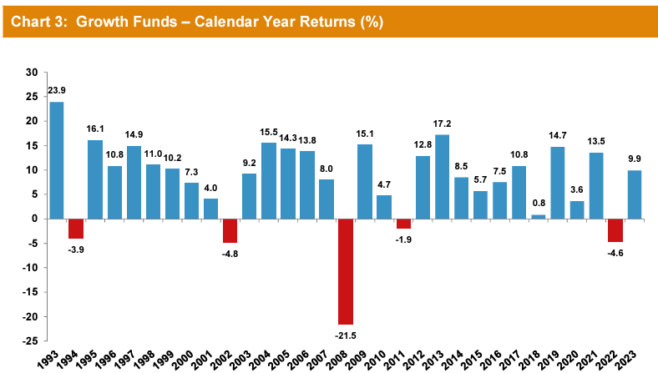
    Chant West says the standard ‘growth’ superannuation funds, which are comprised of 61% to 80% growth assets like ASX shares, delivered a median 9.9% return in 2023.

    This follows a 4.6% loss in 2022 and is the 11th positive return in the past 12 years. This return also comes in well above the typical target return of 6% adopted by most growth super funds.

    Chant West also reported a median 11.4% return among ‘high growth’ superannuation funds, which have 81% to 95% exposure to growth assets like ASX shares.

    Balanced funds, with 41% to 60% growth assets, delivered a median 8.1% return in 2023.

    Shares drive strong 2023 returns

    Chant West senior investment research manager Mano Mohankumar says strong share markets created superior results for superannuation funds with growth strategies last year.

    Mohankumar explains:

    With share markets performing so well in 2023, the better performing funds over the year were generally those that had higher allocations to shares, particularly international shares.

    International shares was the standout asset class with a tremendous 23% return over the year, led by the tech sector which benefitted from advancements in [artificial intelligence] AI.

    While Australian shares didn’t reach the same level, it still delivered a healthy 12.1% over the same period.

    Mohankumar noted that bonds also performed well in 2023. Australian bonds returned 5.1% and international bonds delivered 5.3%. Cash returned 3.9%.

    Top 10 performing growth superannuation funds for 2023

    Here are the top 10 superannuation growth funds of 2023, according to Chant West.

    These returns are net of investment fees and tax but before administration fees and advisor commissions.

    Fund name Returns
    Mine Super Growth 11.8%
    Vision Super Balanced Growth 11.7%
    IOOF Balanced Investor Trust 11.2%
    Aware Super Balanced 11%
    TWUSUPER Balanced (MySuper) 10.6%
    HESTA Balanced Growth 10.5%
    Brighter Super MySuper 10.4%
    UniSuper Balanced 10.3%
    Prime Super MySuper 10.3%
    Australian Retirement Trust – Super Savings Balanced 10.2%

    Patience is a virtue for superannuation investors

    Mohankumar reminded investors that superannuation investing was a long-term game, saying:

    The 2023 result is also a reward for those fund members who have remained patient and maintained a long-term focus.

    And that patience has certainly been tested at various points over the past four years, a period over which super funds’ investment portfolios have proven their resilience and robustness.

    They’ve shown their ability to limit the damage during periods of share market weakness …

    At the same time, they’re able to still capture a meaningful proportion of the upswing when markets perform strongly, as we saw this past year.

    The following chart shows the long-term performance of ‘growth’ superannuation funds with 61% to 80% exposure to growth assets like ASX shares.
    We recently reported the average Aussie superannuation balance at ages 60, 65, and 70.

    The post Top 10 superannuation funds for growth in 2023 revealed: Chant West appeared first on The Motley Fool Australia.

    Wondering where you should invest $1,000 right now?

    When investing expert Scott Phillips has a stock tip, it can pay to listen. After all, the flagship Motley Fool Share Advisor newsletter he has run for over ten years has provided thousands of paying members with stock picks that have doubled, tripled or even more.*

    Scott just revealed what he believes could be the ‘five best ASX stocks’ for investors to buy right now. These stocks are trading at near dirt-cheap prices and Scott thinks they could be great buys right now…

    See The 5 Stocks
    *Returns as of 10 November 2023

    (function() {
    function setButtonColorDefaults(param, property, defaultValue) {
    if( !param || !param.includes(‘#’)) {
    var button = document.getElementsByClassName(“pitch-snippet”)[0].getElementsByClassName(“pitch-button”)[0];
    button.style[property] = defaultValue;
    }
    }

    setButtonColorDefaults(“#0095C8”, ‘background’, ‘#5FA85D’);
    setButtonColorDefaults(“#0095C8”, ‘border-color’, ‘#43A24A’);
    setButtonColorDefaults(“#fff”, ‘color’, ‘#fff’);
    })()

    More reading

    from The Motley Fool Australia https://ift.tt/Xjt26Py

  • Want $1 million in retirement? 3 ASX shares I think could make it happen

    A mature-aged couple high-five each other as they celebrate a financial win and early retirementA mature-aged couple high-five each other as they celebrate a financial win and early retirement

    Many readers are hoping to enjoy a strong ASX share portfolio in retirement. It’s certainly a goal for me, even if it is many years away — reaching a cool $1 million would be wonderful.

    We each will have a different timeline on when we might be able to retire with $1 million. It depends on a range of factors, such as age and the amount of money we are able to invest.

    Starting from scratch with $0 would obviously take longer than starting with $100,000 or $250,000. The first $100,000 is usually the most difficult. Once the ball is rolling, it’s easier to grow wealth. A $10,000 portfolio that rises 10% only adds $1,000. A $100,000 portfolio that rises 10% would add $10,000 in value.

    I’m going to talk about three of my favourite picks that could deliver good growth over the long term.

    TechnologyOne Ltd (ASX: TNE)

    This ASX tech share describes itself as Australia’s largest enterprise software company, with locations across six countries. It provides a global software as a service (SaaS) enterprise resource planning (EPR) solution that “transforms business and makes life simple” for customers.

    TechnologyOne has 1,300 leading corporations, government agencies, local councils and universities as clients.

    The company aims to double in size (meaning its profit) every five years. This can come from both revenue and profit growth. Not only is the number of customers increasing, but the company is doing well at growing revenue from its existing customers. The net revenue retention (NRR) was 119% in FY23, which is a strong organic growth rate. Gaining an extra 19% of revenue from existing customers is a promising sign.

    At the last update, its total annual recurring revenue (ARR) was $392.2 million and it aims to grow its underlying profit before tax margin of 30% to 35% in the coming years.

    The company has also steadily grown its dividend over the past decade, which is a bonus.

    Over the past five years, TechnologyOne shares have delivered total shareholder returns (TSR) of an average of 18% per annum.

    Betashares Global Quality Leaders ETF (ASX: QLTY)

    This exchange-traded fund (ETF) is all about investing in quality businesses from around the world.

    I think the global share market has proven what a good wealth-creator it can be. I’d encourage most investors to get exposure to businesses outside Australia, and the QLTY ETF could be the way to do it.

    It invests in businesses that rank well on four characteristics – return on equity (ROE), debt to capital, cash flow generation ability and earnings stability. I think this is a powerful combination.

    Around two-thirds of the portfolio is from the United States, with other countries like Japan, the Netherlands, France and Denmark having good representation with the allocations.

    Past performance is not a guarantee of future returns, but the index the QLTY ETF tracks has returned an average of 14.6% per annum over the past decade, and the ETF has returned 15.4% per annum in the last five years.

    Johns Lyng Group Ltd (ASX: JLG)

    This ASX share specialises in rebuilding and restoring a variety of properties and contents after damage by insured events, including impact, weather and fire events.

    With Johns Lyng growing its exposure to catastrophe work, its scale, revenue and profits are increasing. There are strong tailwinds here, considering there seems to be an increasing number of damaging and costly storms.

    I also like that the business is expanding into areas where it can create synergies, such as body corporate/strata services and repairs, as well as electrical, gas and fire safety and compliance. These areas also come with more defensive and consistent earnings.

    Over the past three years, Johns Lyng shares have delivered an average return per annum of around 30%.

    Get to $1 million in retirement with ASX shares

    I’m not sure what the returns of these three potential investments will be in the future – and it’s important to build a diversified portfolio – but I do think they all have the ability to outperform over the long term.

    Starting at $0, if someone can invest $1,500 per month and the portfolio returns an average of, say, 12% per annum, it would be worth $1 million in 18 years. That sounds like an exciting possibility to me.

    The post Want $1 million in retirement? 3 ASX shares I think could make it happen appeared first on The Motley Fool Australia.

    Wondering where you should invest $1,000 right now?

    When investing expert Scott Phillips has a stock tip, it can pay to listen. After all, the flagship Motley Fool Share Advisor newsletter he has run for over ten years has provided thousands of paying members with stock picks that have doubled, tripled or even more.*

    Scott just revealed what he believes could be the ‘five best ASX stocks’ for investors to buy right now. These stocks are trading at near dirt-cheap prices and Scott thinks they could be great buys right now…

    See The 5 Stocks
    *Returns as of 10 November 2023

    (function() {
    function setButtonColorDefaults(param, property, defaultValue) {
    if( !param || !param.includes(‘#’)) {
    var button = document.getElementsByClassName(“pitch-snippet”)[0].getElementsByClassName(“pitch-button”)[0];
    button.style[property] = defaultValue;
    }
    }

    setButtonColorDefaults(“#0095C8”, ‘background’, ‘#5FA85D’);
    setButtonColorDefaults(“#0095C8”, ‘border-color’, ‘#43A24A’);
    setButtonColorDefaults(“#fff”, ‘color’, ‘#fff’);
    })()

    More reading

    Motley Fool contributor Tristan Harrison has positions in Johns Lyng Group. The Motley Fool Australia’s parent company Motley Fool Holdings Inc. has positions in and has recommended Johns Lyng Group and Technology One. The Motley Fool Australia has recommended Johns Lyng Group and Technology One. The Motley Fool has a disclosure policy. This article contains general investment advice only (under AFSL 400691). Authorised by Scott Phillips.

    from The Motley Fool Australia https://ift.tt/jQhOsbY

  • Could AMP shares crash to 80 cents in 2024?

    A man looking at his laptop and thinking.A man looking at his laptop and thinking.

    Is there a more maligned S&P/ASX 200 Index (ASX: XJO) stock this century than AMP Ltd (ASX: AMP)?

    The financial services provider, especially in the past half-dozen years, has lurched from one scandal to another.

    There were unfavourable findings from the financial industry Royal Commission, legal action from multiple parties, and the retention of an executive accused of sexual harassment, just to name a few of the bad memories.

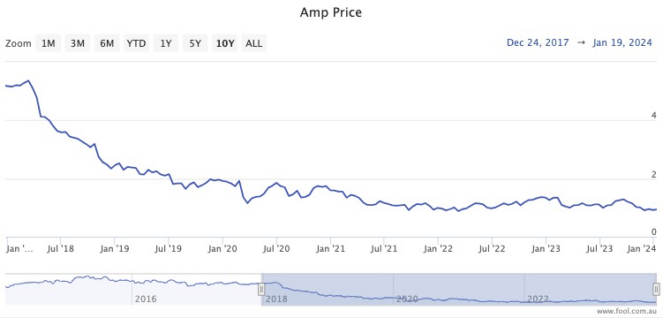
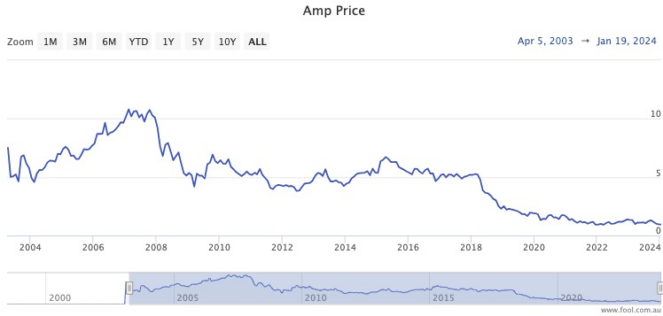
    The market has responded accordingly, sending the AMP share price plunging more than 80% since February 2018. The stock now trades in the mid-90 cent zone.

    Due to all these troubles, the leadership at AMP is occupied by different faces to what it was just five years ago.

    So can investors look forward to a turnaround in 2014, or will AMP shares set a new all-time low?

    Not much love for AMP shares, even at this price

    Probably the biggest observation to make for AMP shares is that hardly any fund manager or analyst talks about it these days.

    It seems very few professional portfolios have the stock on their books.

    AMP has always had a disproportionately high number of retail investors. That’s because when it demutualised and listed on the ASX in 1998, all previous customer-owners received shares.

    Nevertheless, it’s not a great sign when no professional investor is willing to give an ASX 200 stock a run, even as a contrarian play.

    This aversion is reflected on CMC Invest, which surveys the sentiment of analysts that keep an eye on AMP.

    Currently, there is only one out of 10 experts rating the stock as a buy, and even that’s a low-conviction “moderate” buy.

    The rest are either urging sell or hold.

    How low can it go?

    So how bearish is the market on AMP?

    Will it crash to just 80 cents this year, which would mark a new all-time low?

    It could get close.

    In November, UBS Group AG (SWX: UBSG) analysts downgraded its target price for AMP shares to just 82 cents.

    At about the same time, the team at Citigroup Inc (NYSE: C) reduced its 12-month expectations to 90 cents, which is not far off the mark already.

    The post Could AMP shares crash to 80 cents in 2024? appeared first on The Motley Fool Australia.

    Wondering where you should invest $1,000 right now?

    When investing expert Scott Phillips has a stock tip, it can pay to listen. After all, the flagship Motley Fool Share Advisor newsletter he has run for over ten years has provided thousands of paying members with stock picks that have doubled, tripled or even more.*

    Scott just revealed what he believes could be the ‘five best ASX stocks’ for investors to buy right now. These stocks are trading at near dirt-cheap prices and Scott thinks they could be great buys right now…

    See The 5 Stocks
    *Returns as of 10 November 2023

    (function() {
    function setButtonColorDefaults(param, property, defaultValue) {
    if( !param || !param.includes(‘#’)) {
    var button = document.getElementsByClassName(“pitch-snippet”)[0].getElementsByClassName(“pitch-button”)[0];
    button.style[property] = defaultValue;
    }
    }

    setButtonColorDefaults(“#0095C8”, ‘background’, ‘#5FA85D’);
    setButtonColorDefaults(“#0095C8”, ‘border-color’, ‘#43A24A’);
    setButtonColorDefaults(“#fff”, ‘color’, ‘#fff’);
    })()

    More reading

    Citigroup is an advertising partner of The Ascent, a Motley Fool company. Motley Fool contributor Tony Yoo has no position in any of the stocks mentioned. The Motley Fool Australia’s parent company Motley Fool Holdings Inc. has no position in any of the stocks mentioned. The Motley Fool Australia has no position in any of the stocks mentioned. The Motley Fool has a disclosure policy. This article contains general investment advice only (under AFSL 400691). Authorised by Scott Phillips.

    from The Motley Fool Australia https://ift.tt/Zu5dh18

  • Why these ASX 200 shares could rise 20% to 50%

    A woman's hair is blown back and her face is in shock at this big news.

    A woman's hair is blown back and her face is in shock at this big news.

    If you’re looking for big returns, then your search could be coming to an end.

    That’s because the three ASX 200 shares below have been named as buys and tipped to rise more than 20% over the next 12 months.

    To put that into context, if these analysts are on the money with their recommendations, this would turn a $20,000 investment into at least $24,000 by the end of the year.

    Let’s now see which ASX 200 shares are being tipped as buys:

    Flight Centre Travel Group Ltd (ASX: FLT)

    The team at Morgans sees plenty of upside potential for this travel agent giant.

    Particularly given its “confidence that the travel recovery has much further to go and the benefits of FLT’s transformed business model emerging, we think the company is well placed over coming years.”

    Morgans has an add rating and $26.00 price target on its shares. This implies that its shares could rise almost 24% from current levels.

    Lifestyle Communities Ltd (ASX: LIC)

    Another ASX 200 share that has been tipped to rise strongly is Lifestyle Communities. It is one Australia’s leading land lease communities developers.

    Goldman Sachs is feeling very bullish about its outlook over the coming years. It notes that “significant cash flow is poised to be unlocked as LIC moves from net development to net settlement in 2H24E.

    Goldman has a buy rating and $25.25 price target on its shares. This equates to a return of almost 50% for investors over the next 12 months.

    Mineral Resources Ltd (ASX: MIN)

    Finally, analysts at Bell Potter continue to believe that mining and mining services company Mineral Resources is an ASX 200 share to buy.

    It points out that “MINs businesses are in a period of significant growth. Over the next two-years Lithium and Iron Ore production quantities will grow substantially, accompanied by associated increases in contracted Mining Services volumes.”

    Bell Potter has a buy rating and $90.00 price target on its shares. This implies potential upside of 55% for investors.

    The post Why these ASX 200 shares could rise 20% to 50% appeared first on The Motley Fool Australia.

    Wondering where you should invest $1,000 right now?

    When investing expert Scott Phillips has a stock tip, it can pay to listen. After all, the flagship Motley Fool Share Advisor newsletter he has run for over ten years has provided thousands of paying members with stock picks that have doubled, tripled or even more.*

    Scott just revealed what he believes could be the ‘five best ASX stocks’ for investors to buy right now. These stocks are trading at near dirt-cheap prices and Scott thinks they could be great buys right now…

    See The 5 Stocks
    *Returns as of 10 November 2023

    (function() {
    function setButtonColorDefaults(param, property, defaultValue) {
    if( !param || !param.includes(‘#’)) {
    var button = document.getElementsByClassName(“pitch-snippet”)[0].getElementsByClassName(“pitch-button”)[0];
    button.style[property] = defaultValue;
    }
    }

    setButtonColorDefaults(“#0095C8”, ‘background’, ‘#5FA85D’);
    setButtonColorDefaults(“#0095C8”, ‘border-color’, ‘#43A24A’);
    setButtonColorDefaults(“#fff”, ‘color’, ‘#fff’);
    })()

    More reading

    Motley Fool contributor James Mickleboro has no position in any of the stocks mentioned. The Motley Fool Australia’s parent company Motley Fool Holdings Inc. has positions in and has recommended Goldman Sachs Group. The Motley Fool Australia has recommended Flight Centre Travel Group. The Motley Fool has a disclosure policy. This article contains general investment advice only (under AFSL 400691). Authorised by Scott Phillips.

    from The Motley Fool Australia https://ift.tt/5gFrcsT

  • 5 excellent ASX ETFs to buy when the market reopens

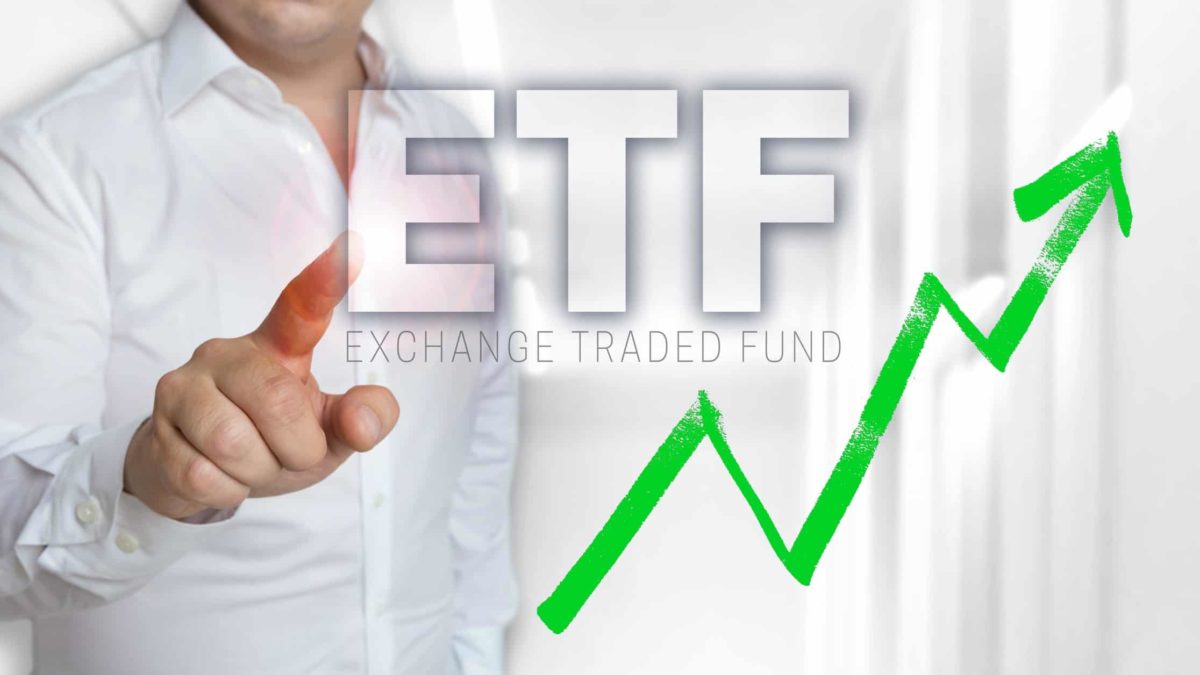
    ETF spelt out with a rising green arrow.

    ETF spelt out with a rising green arrow.

    If you have room for some new exchange-traded funds (ETFs) in your portfolio, then read on!

    Listed below are five ASX ETFs that are highly rated right now and could be good options for investors in 2024.

    Here’s what you need to know about them:

    BetaShares Asia Technology Tigers ETF (ASX: ASIA)

    The BetaShares Asia Technology Tigers ETF could be a top ASX ETF to buy right now. It provides investors with super-easy access to many of the best tech stocks from China and the rest of Asia (but not Japan). Many of these are the region’s equivalents of the West’s biggest and best tech companies and appear well-positioned for long-term growth.

    BetaShares Global Cybersecurity ETF (ASX: HACK)

    Another ASX ETF to consider buying is the BetaShares Global Cybersecurity ETF. As you might have guessed from its name, it provides investors with access to the global cybersecurity sector. And this could be a great place to be given that it is predicted to grow materially over the next decade or two. This is being driven by the rising threat of cybercrime and more infrastructure moving to the cloud.

    BetaShares NASDAQ 100 ETF (ASX: NDQ)

    It would be remiss to not name the hugely popular BetaShares NASDAQ 100 ETF on this list. It gives investors access to many of the most iconic and highest quality companies that the world has to offer. These are the companies behind the phones, the search engines, the social media platforms, and the spreadsheets many of us use on a daily basis.

    Vanguard MSCI Australian Small Companies Index ETF (ASX: VSO)

    Another ASX ETF for investors to consider is the Vanguard MSCI Australian Small Companies Index ETF. This ASX ETF gives investors access to approximately 200 small and mid-cap ASX shares. This could be a good time to pick up the ETF as small-caps have been tipped to rebound when interest rates fall after a couple of years of underperformance.

    Vanguard MSCI Index International Shares ETF (ASX: VGS)

    A final ASX ETF for investors to consider buying and holding is the Vanguard MSCI Index International Shares ETF. This massively popular ETF gives investors access to more than 1,000 of the world’s largest listed companies. Many of these are absolute behemoths and household names.

    The post 5 excellent ASX ETFs to buy when the market reopens appeared first on The Motley Fool Australia.

    Wondering where you should invest $1,000 right now?

    When investing expert Scott Phillips has a stock tip, it can pay to listen. After all, the flagship Motley Fool Share Advisor newsletter he has run for over ten years has provided thousands of paying members with stock picks that have doubled, tripled or even more.*

    Scott just revealed what he believes could be the ‘five best ASX stocks’ for investors to buy right now. These stocks are trading at near dirt-cheap prices and Scott thinks they could be great buys right now…

    See The 5 Stocks
    *Returns as of 10 November 2023

    (function() {
    function setButtonColorDefaults(param, property, defaultValue) {
    if( !param || !param.includes(‘#’)) {
    var button = document.getElementsByClassName(“pitch-snippet”)[0].getElementsByClassName(“pitch-button”)[0];
    button.style[property] = defaultValue;
    }
    }

    setButtonColorDefaults(“#0095C8”, ‘background’, ‘#5FA85D’);
    setButtonColorDefaults(“#0095C8”, ‘border-color’, ‘#43A24A’);
    setButtonColorDefaults(“#fff”, ‘color’, ‘#fff’);
    })()

    More reading

    Motley Fool contributor James Mickleboro has positions in BetaShares Nasdaq 100 ETF. The Motley Fool Australia’s parent company Motley Fool Holdings Inc. has positions in and has recommended BetaShares Global Cybersecurity ETF and BetaShares Nasdaq 100 ETF. The Motley Fool Australia has positions in and has recommended BetaShares Global Cybersecurity ETF and BetaShares Nasdaq 100 ETF. The Motley Fool Australia has recommended Betashares Capital – Asia Technology Tigers Etf and Vanguard Msci Index International Shares ETF. The Motley Fool has a disclosure policy. This article contains general investment advice only (under AFSL 400691). Authorised by Scott Phillips.

    from The Motley Fool Australia https://ift.tt/0u5cwBy

  • Which had the better year in 2023: Telstra, Woodside or Wesfarmers shares?

    An older woman clasps her hands with joy, smiling at the news on her computer as she sits at her kitchen bench..An older woman clasps her hands with joy, smiling at the news on her computer as she sits at her kitchen bench..

    The S&P/ASX 200 Index (ASX: XJO) experienced much volatility in 2023 due to fears over the impact of high inflation and interest rates. It eventually came good and delivered an 8.1% gain by 31 December.

    In this article, we look at the performance of three of the top 15 ASX 200 shares by market capitalisation.

    On the basis of share price movement, did Telstra Group Ltd (ASX: TLS), Woodside Energy Group Ltd (ASX: WDS) or Wesfarmers Ltd (ASX: WES) shares have a better year in 2023?

    On share price movement, Wesfarmers shares win

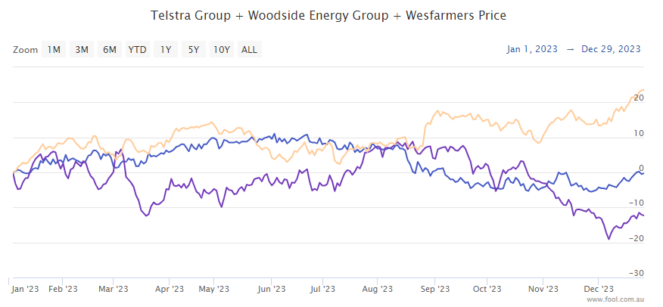
    As the chart below shows, Wesfarmers shares delivered superior gains last year.

    The Wesfarmers share price rose by 24.2% to close 2023 at $57.04. Yesterday, the Wesfarmers share price was trading for $57.17 at the close.

    Telstra shares fell 0.75% to close 2023 at $3.96. The Telstra share price finished the week trading at $3.97.

    The Woodside share price fell by 12.4% to close 2023 at $31.06. Woodside shares were trading for $30.91 at Friday’s close.

    On dividends, Woodside shares win… or do they?

    In 2023, Woodside shares delivered a $2.15 interim dividend in April. The ASX 200 energy share paid a $1.24 final dividend in September for a total annual dividend of $3.49 plus full franking credits.

    Wesfarmers shares paid an interim dividend of 88 cents in March. They paid a final dividend of $1.03 in October. That’s a total annual dividend of $1.91 fully franked.

    Telstra shares paid an interim dividend of 8.5 cents in March and a final dividend of 8.5 cents in September. This totalled 17 cents in annual dividends, fully franked.

    So, in dollar value terms, Woodside shares win.

    But what about yield terms?

    Heck, yes, they win! By a mile, in fact.

    The trailing Woodside dividend yield is currently a staggering 11.24%.

    Telstra shares are on a trailing dividend yield of 4.28%.

    Wesfarmers shares are paying a trailing dividend yield of 3.24%.

    As always, a trailing dividend yield like Woodside’s is cause for alarm bells. After all, the average ASX 200 stock delivers a yield of 4%.

    Plus, Woodside is an oil and gas company, which means it’s a ‘price-taker’ stock. That means commodity prices for gas and oil have a fundamental impact on the company’s earnings, and hence, dividends.

    We took a peek at the consensus analyst forecast for Woodside’s dividend in 2024, as published today on CommSec, and it is much lower than the $3.49 paid in 2023.

    The forecast dividend is $1.77, which equates to a still healthy yield of 5.74%.

    The post Which had the better year in 2023: Telstra, Woodside or Wesfarmers shares? appeared first on The Motley Fool Australia.

    Wondering where you should invest $1,000 right now?

    When investing expert Scott Phillips has a stock tip, it can pay to listen. After all, the flagship Motley Fool Share Advisor newsletter he has run for over ten years has provided thousands of paying members with stock picks that have doubled, tripled or even more.*

    Scott just revealed what he believes could be the ‘five best ASX stocks’ for investors to buy right now. These stocks are trading at near dirt-cheap prices and Scott thinks they could be great buys right now…

    See The 5 Stocks
    *Returns as of 10 November 2023

    (function() {
    function setButtonColorDefaults(param, property, defaultValue) {
    if( !param || !param.includes(‘#’)) {
    var button = document.getElementsByClassName(“pitch-snippet”)[0].getElementsByClassName(“pitch-button”)[0];
    button.style[property] = defaultValue;
    }
    }

    setButtonColorDefaults(“#0095C8”, ‘background’, ‘#5FA85D’);
    setButtonColorDefaults(“#0095C8”, ‘border-color’, ‘#43A24A’);
    setButtonColorDefaults(“#fff”, ‘color’, ‘#fff’);
    })()

    More reading

    Motley Fool contributor Bronwyn Allen has positions in Woodside Energy Group. The Motley Fool Australia’s parent company Motley Fool Holdings Inc. has positions in and has recommended Wesfarmers. The Motley Fool Australia has positions in and has recommended Telstra Group and Wesfarmers. The Motley Fool has a disclosure policy. This article contains general investment advice only (under AFSL 400691). Authorised by Scott Phillips.

    from The Motley Fool Australia https://ift.tt/lfMhNuS

  • Forget term deposits and get rich the Warren Buffett way

    A head shot of legendary investor Warren Buffett speaking into a microphone at an event.

    A head shot of legendary investor Warren Buffett speaking into a microphone at an event.

    Due to the Reserve Bank’s battle with inflation, interest rates have risen strongly over the last 12 months.

    This has been great news for users of term deposits, which have gone from offering barely a flicker of interest to something semi-reasonable.

    For example, at present, Australia’s biggest bank, Commonwealth Bank of Australia (ASX: CBA), is offering 4% per annum on 36-month term deposits.

    While this is better than what you would have received 12 months ago, it pales in comparison to the returns that ASX shares have delivered in the past.

    Furthermore, with many economists predicting that the next move for interest rates will be lower, this may be as good as it gets for term deposits for the foreseeable future.

    In light of this, it could be better to make investments like Warren Buffett instead of sinking your money into a term deposit.

    ASX shares versus term deposits

    To demonstrate why ASX shares could be superior to term deposits, let’s take a look at what a $100,000 investment could generate from both.

    Imagine you were to invest $100,000 into a term deposit that yields 4% per annum. In 20 years, your investment would have grown to almost $220,000 if you reinvested the proceeds each year.

    Whereas, if you were able to generate a 10% per annum return from the share market, your $100,000 investment would have become almost $675,000 in two decades.

    That’s a ~$450,000 difference!

    And while there are of course risks to investing in the share market, unlike risk-free term deposits, and past performance is not a guarantee of future returns, the risk/reward on offer is arguably compelling enough to choose ASX shares over term deposits.

    How to invest like Warren Buffett

    If you want to invest like Warren Buffett, I have some good news for you.

    The Oracle of Omaha has achieved market-beating returns for his company Berkshire Hathaway (NYSE: BRK.B) for decades through an investment style that anyone can replicate.

    Buffett likes to focus on buying high-quality companies with competitive advantages, strong business models, and fair valuations.

    He then holds onto them for the long term, allowing compounding to work its magic and grow his wealth.

    If you’re not a fan of stock-picking, then you could consider the very popular VanEck Morningstar Wide Moat ETF (ASX: MOAT). It allows investors to buy a collection of Buffett-type stocks through a single investment.

    Over the last decade, the index the ETF tracks has generated a return of 16.3% per annum. That would have turned a $100,000 investment into $450,000 in just 10 years.

    The post Forget term deposits and get rich the Warren Buffett way appeared first on The Motley Fool Australia.

    Wondering where you should invest $1,000 right now?

    When investing expert Scott Phillips has a stock tip, it can pay to listen. After all, the flagship Motley Fool Share Advisor newsletter he has run for over ten years has provided thousands of paying members with stock picks that have doubled, tripled or even more.*

    Scott just revealed what he believes could be the ‘five best ASX stocks’ for investors to buy right now. These stocks are trading at near dirt-cheap prices and Scott thinks they could be great buys right now…

    See The 5 Stocks
    *Returns as of 10 November 2023

    (function() {
    function setButtonColorDefaults(param, property, defaultValue) {
    if( !param || !param.includes(‘#’)) {
    var button = document.getElementsByClassName(“pitch-snippet”)[0].getElementsByClassName(“pitch-button”)[0];
    button.style[property] = defaultValue;
    }
    }

    setButtonColorDefaults(“#0095C8”, ‘background’, ‘#5FA85D’);
    setButtonColorDefaults(“#0095C8”, ‘border-color’, ‘#43A24A’);
    setButtonColorDefaults(“#fff”, ‘color’, ‘#fff’);
    })()

    More reading

    Motley Fool contributor James Mickleboro has no position in any of the stocks mentioned. The Motley Fool Australia’s parent company Motley Fool Holdings Inc. has positions in and has recommended Berkshire Hathaway. The Motley Fool Australia has recommended Berkshire Hathaway and VanEck Morningstar Wide Moat ETF. The Motley Fool has a disclosure policy. This article contains general investment advice only (under AFSL 400691). Authorised by Scott Phillips.

    from The Motley Fool Australia https://ift.tt/sEMdomC

  • Why the BHP share price has a nickel thorn in its side

    Female worker sitting desk with head in hand and looking fed upFemale worker sitting desk with head in hand and looking fed up

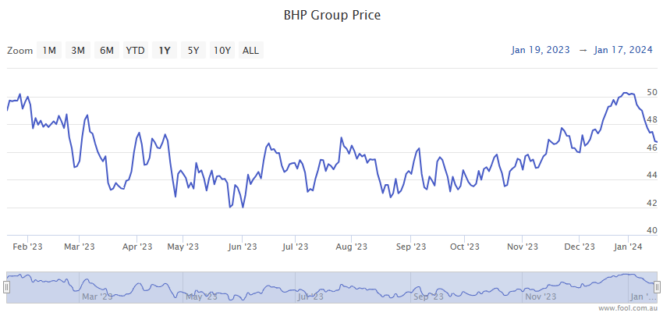
    The BHP Group Ltd (ASX: BHP) share price has struggled so far in 2024.

    As at Friday’s close, shares in the S&P/ASX 200 Index (ASX: XJO) mining giant were down 9.4% since the opening bell sounded on 2 January.

    For some context, the ASX 200 is down 2.7% so far in 2024.

    Much of the headwinds dragging on the BHP share price have come from a slumping iron ore price, the miner’s top revenue earner. The price of copper, BHP’s number two revenue earner, is down sharply too.

    But it looks to be nickel, which accounts for a much smaller percentage of BHP’s revenue, that’s putting an extra thorn in the ASX 200 miner’s side.

    What’s happening with the ASX 200 miner’s nickel operations?

    The BHP share price closed down 1.8% on Thursday following the release of the company’s quarterly production update. (The ASX 200 fell 0.6% on the day.)

    Investors may not have been overly focused on the miner’s nickel operations, yet a 50% year-on-year fall in nickel prices didn’t go unnoticed.

    “At Nickel West, we are evaluating options to mitigate the impacts of the sharp fall in nickel prices,” BHP said.

    The miner’s quarterly nickel production was up 4% to 40,000 tonnes. But the average realised price of US$18,602 per tonne was down 24%.

    According to BHP:

    The nickel industry is undergoing a number of structural changes and is at a cyclical low in realised pricing. Nickel West is not immune to these challenges. Operations are being actively optimised, and options are being evaluated to mitigate the impacts of the sharp fall in nickel prices.

    BHP said that under the existing market conditions, “a carrying value assessment of the group’s nickel assets is ongoing”. Investors can expect more details on 20 February with the release of its financial results.

     Nickel prices have been under pressure amid a big increase in supply from Indonesia, whose nickel carries a bigger carbon footprint but comes with a cheaper price tag.

    Commenting on that situation, Wyloo Metals CEO Luca Giacovazzi said (quoted by The Australian Financial Review):

    The industry needs a more appropriate and transparent pricing mechanism, that distinguishes between clean and dirty nickel, so consumers can be confident their EV really is a better choice for the environment.

    BHP Nickel West Asset president Jessica Farrell said, “We are working hard to remain globally competitive in a very tough operating environment.”

    She noted, “Costs have risen sharply and continue to go up while prices have fallen as new supply comes into the market.”

    BHP share price snapshot

    The BHP share price is down 7% over 12 months. Shares are up 3% over the past six months.

    The post Why the BHP share price has a nickel thorn in its side appeared first on The Motley Fool Australia.

    Wondering where you should invest $1,000 right now?

    When investing expert Scott Phillips has a stock tip, it can pay to listen. After all, the flagship Motley Fool Share Advisor newsletter he has run for over ten years has provided thousands of paying members with stock picks that have doubled, tripled or even more.*

    Scott just revealed what he believes could be the ‘five best ASX stocks’ for investors to buy right now. These stocks are trading at near dirt-cheap prices and Scott thinks they could be great buys right now…

    See The 5 Stocks
    *Returns as of 10 November 2023

    (function() {
    function setButtonColorDefaults(param, property, defaultValue) {
    if( !param || !param.includes(‘#’)) {
    var button = document.getElementsByClassName(“pitch-snippet”)[0].getElementsByClassName(“pitch-button”)[0];
    button.style[property] = defaultValue;
    }
    }

    setButtonColorDefaults(“#0095C8”, ‘background’, ‘#5FA85D’);
    setButtonColorDefaults(“#0095C8”, ‘border-color’, ‘#43A24A’);
    setButtonColorDefaults(“#fff”, ‘color’, ‘#fff’);
    })()

    More reading

    Motley Fool contributor Bernd Struben has no position in any of the stocks mentioned. The Motley Fool Australia’s parent company Motley Fool Holdings Inc. has no position in any of the stocks mentioned. The Motley Fool Australia has no position in any of the stocks mentioned. The Motley Fool has a disclosure policy. This article contains general investment advice only (under AFSL 400691). Authorised by Scott Phillips.

    from The Motley Fool Australia https://ift.tt/Fcjp7kJ

  • Are Pilbara Minerals shares a buy for that 7% dividend yield?

    A woman has a thoughtful look on her face as she studies a fan of Australian 20 dollar bills she is holding on one hand while he rest her other hand on her chin in thought.

    A woman has a thoughtful look on her face as she studies a fan of Australian 20 dollar bills she is holding on one hand while he rest her other hand on her chin in thought.

    Looking at the Pilbara Minerals Ltd (ASX: PLS) share price today, one thing might stand out to you, especially if you’re an income investor. That would be Pilbara shares’ stonking dividend yield.

    The ASX 200 lithium stock was going for $3.47 a share at the close of trade yesterday. At this share price, Pilbara has a trailing dividend yield of 7.20% on the table.

    Now, 7.20% is obviously a massive dividend yield for any ASX 200 share to possess. Heck, it even comes in above what all four of the major ASX bank shares are currently offering.

    So does this yield make Pilbara shares a no-brainer buy today?

    Should you buy Pilbara Minerals shares for that 7% yield?

    At face value, this dividend yield checks out. It comes from the two dividend payments Pilbara Minerals made to investors over 2023, which was a first for the company.

    The first of these payments was the March interim (and Pilbara’s maiden) dividend worth 11 cents per share. The second is the final dividend from September worth 14 cents per share. Both dividends came with full franking credits attached.

    That 2023 total of 25 cents per share works out to be worth a 7.17% yield at the current $3.48 share price.

    However, as any good dividend investor knows, a company’s trailing dividend yield does not guarantee any future income whatsoever.

    There’s absolutely nothing stopping Pilbara Minerals from halving or even eliminating its dividend for 2024 and beyond.

    And I happen to think there’s a strong possibility that this will happen.

    A lithium dividend trap?

    Like any commodity company, Pilbara’s ability to fund dividends is almost entirely dependent on what it can sell its commodity for. A boom in lithium prices over 2022 and 2023 enabled the company to fund these bumper dividends. However, the back half of last year saw lithium prices dramatically come off the boil.

    That’s partially why Pilbara Minerals shares have lost so much steam in recent months, falling around 35% from more than $5.30 a share in August last year to the current levels.

    Unless lithium prices rebound this year, it seems unlikely Pilbara will be able to fund those kinds of dividend payments again in 2024.

    ASX broker Goldman Sachs would probably agree. Earlier this week, my Fool colleague James covered Goldman’s recent sell rating on Pilbara shares. The broker gave the miner a 12-month share price target of $3.20 and stated the following:

    With our view of ongoing supply pressure in the lithium market, and PLS recently outperforming peers despite near-term FCF [free cash flow] continuing to decline on lithium prices and increasing growth spend… we see PLS as relatively expensive on fundamentals, and downgrade to Sell.

    So, all in all, I think Pilbara shares are a high-risk investment for dividend seekers today. There are simply more reliable dividend stocks on the ASX to choose from in my view.

    Pilbara Minerals may still have a bright future ahead of it. But I wouldn’t say it’s a buy for dividend income today.

    The post Are Pilbara Minerals shares a buy for that 7% dividend yield? appeared first on The Motley Fool Australia.

    Wondering where you should invest $1,000 right now?

    When investing expert Scott Phillips has a stock tip, it can pay to listen. After all, the flagship Motley Fool Share Advisor newsletter he has run for over ten years has provided thousands of paying members with stock picks that have doubled, tripled or even more.*

    Scott just revealed what he believes could be the ‘five best ASX stocks’ for investors to buy right now. These stocks are trading at near dirt-cheap prices and Scott thinks they could be great buys right now…

    See The 5 Stocks
    *Returns as of 10 November 2023

    (function() {
    function setButtonColorDefaults(param, property, defaultValue) {
    if( !param || !param.includes(‘#’)) {
    var button = document.getElementsByClassName(“pitch-snippet”)[0].getElementsByClassName(“pitch-button”)[0];
    button.style[property] = defaultValue;
    }
    }

    setButtonColorDefaults(“#0095C8”, ‘background’, ‘#5FA85D’);
    setButtonColorDefaults(“#0095C8”, ‘border-color’, ‘#43A24A’);
    setButtonColorDefaults(“#fff”, ‘color’, ‘#fff’);
    })()

    More reading

    Motley Fool contributor Sebastian Bowen has no position in any of the stocks mentioned. The Motley Fool Australia’s parent company Motley Fool Holdings Inc. has positions in and has recommended Goldman Sachs Group. The Motley Fool Australia has no position in any of the stocks mentioned. The Motley Fool has a disclosure policy. This article contains general investment advice only (under AFSL 400691). Authorised by Scott Phillips.

    from The Motley Fool Australia https://ift.tt/bdhvOTM

  • Should I buy ASX shares or top up my superannuation?

    Woman and man calculating a dividend yield.

    Woman and man calculating a dividend yield.

    It’s a choice facing so many Australians: should I buy ASX shares, or top up my superannuation account? Investing is always about choices and opportunity costs. As it is with this particular question.

    There is no right or wrong answer here, but both options have both upsides and downsides.

    So let’s talk about whether you should invest in ASX shares, or your super fund in 2024.

    Super vs shares

    To be clear, investing in shares and your super is really two sides of the same coin. Most super funds allocate most of their members’ cash to shares anyway. And even if you have a self-managed super fund, chances are you’ll have at least some of the fund invested in the share market.

    But that doesn’t mean we don’t have a real contest here.

    Let’s start with superannuation.

    As most of us would be aware, superannuation exists in order to provide an avenue for a comfortable, self-funded retirement for Australians. It involves locking up our money in a tax-sheltered account until we reach retirement age. Whilst we wait, that capital sits invested in assets like ASX shares.

    And that gives us both the main advantage and the main disadvantage of choosing the super route.

    Is topping up your superannuation your best bet?

    The main advantage of super is that you will never find a better (legal) tax dodge for your investing. Funds going into superannuation accounts are usually taxed at just 15%. And once you’re in pension mode, any earnings are normally tax-free. Of course, this depends on individual circumstances, but that’s the general rule (make sure you check with a tax adviser though).

    However, the main disadvantage is that you can’t actually enjoy the benefits of this tax shelter until you reach your preservation age. This will range from 55 to 60, depending on your year of birth. Until then, your investments will be held under lock and key. Bad news if you are trying to FIRE your way to an early retirement.

    If you are planning to retire early, using the passive income from your ASX shares to do so, you might want to think about investing in ASX shares outside your superannuation instead.

    Of course, you won’t get those lucrative super tax perks. However, you can still take advantage of some of the other significant tax advantages that investing in ASX shares still offers.

    So when it comes to choosing to invest in ASX shares or topping up your super, it really depends on your work and life goals.

    If early retirement is something you want to pursue, you might want to maximise your non-super assets. But if you just wish to build wealth as effectively as possible, a super top-up might be your best bet.

    The post Should I buy ASX shares or top up my superannuation? appeared first on The Motley Fool Australia.

    Wondering where you should invest $1,000 right now?

    When investing expert Scott Phillips has a stock tip, it can pay to listen. After all, the flagship Motley Fool Share Advisor newsletter he has run for over ten years has provided thousands of paying members with stock picks that have doubled, tripled or even more.*

    Scott just revealed what he believes could be the ‘five best ASX stocks’ for investors to buy right now. These stocks are trading at near dirt-cheap prices and Scott thinks they could be great buys right now…

    See The 5 Stocks
    *Returns as of 10 November 2023

    (function() {
    function setButtonColorDefaults(param, property, defaultValue) {
    if( !param || !param.includes(‘#’)) {
    var button = document.getElementsByClassName(“pitch-snippet”)[0].getElementsByClassName(“pitch-button”)[0];
    button.style[property] = defaultValue;
    }
    }

    setButtonColorDefaults(“#0095C8”, ‘background’, ‘#5FA85D’);
    setButtonColorDefaults(“#0095C8”, ‘border-color’, ‘#43A24A’);
    setButtonColorDefaults(“#fff”, ‘color’, ‘#fff’);
    })()

    More reading

    Motley Fool contributor Sebastian Bowen has no position in any of the stocks mentioned. The Motley Fool Australia’s parent company Motley Fool Holdings Inc. has no position in any of the stocks mentioned. The Motley Fool Australia has no position in any of the stocks mentioned. The Motley Fool has a disclosure policy. This article contains general investment advice only (under AFSL 400691). Authorised by Scott Phillips.

    from The Motley Fool Australia https://ift.tt/bS81T9C