• Four years, and still not back to normal

    man and woman discussing superannuation

    man and woman discussing superannuation

    I’m writing this from Tamworth, where my young bloke and I are taking in a few days of a school holiday road trip for the Country Music Festival.

    We saw Troy Cassar-Daley play yesterday, The Bushwackers at lunchtime, and we’re off to John Williamson tonight and Colin Buchanan tomorrow.

    I haven’t seen any numbers, but the place has been packed. And, as ever, the drive itself was wonderful.

    Of course, business and investing is never far from my mind.

    More changes mooted for Super

    This week, we’ve seen more mooted changes to Superannuation.

    Yes, more.

    This time, the potential changes do seem reasonable – to legislate a ‘single purpose’ test to make sure Super isn’t misused, and to limit the size of Super funds, with apparently some 10,000+ funds having balances of more than $5m.

    Super is a wonderful system to both relieve pressure on the pension system, and to improve standards of living in retirement.

    But it’s too easily seen as a honeypot by pollies and vested interests, and the ‘single purpose’ legislation should hopefully reduce that risk.

    And while more is better than less when it comes to Super, the cost to the Federal Budget of multi-million dollar Super balances, taxed at remarkably generous rates, is too high a price to pay. ‘Enough’ is important. But over that level, I think fairness dictates that people with very high balances contribute more.

    (And, yet again, we’ve seen an OpEd from former MPs Tim Wilson and Jason Falinski, continuing their argument for undermining Super to use for housing – something that would all-but hollow out the enormous benefits of Superannuation. Yes, we have housing problems, but Super isn’t the answer. I’ve still never seen them explain why there are no other solutions to that problem…)

    Retail sales surge

    I’ve written already this week about a strong set of retail results, after a bumper Christmas. DJs was the latest to add to that, though in its case, the sales growth was strongest earlier in the company’s first half.

    It’s a reminder that, even as we emerge from the worst of COVID, the year-on-year comparisons are still impacted by the ebbs and flows of the economy this time last year (largely the impacts of the Delta and Omicron waves).

    So be careful what you read, and make sure you take those impacts into account. We’re more than halfway through the 2023 financial year, and 2019 remains the last ‘clean’ year, from which to make comparisons.

    We’ve been doing just that, recently, comparing retailer share prices to their 2019 earnings bases (and applying a conservative ‘business as usual’ growth rate since then).

    The good news is that there appears to be some good value still in this sector, despite some of the share price gains over the past couple of weeks.

    Beware the ‘honeymoon’

    Many savers will be excited to see the banks finally pumping up their interest rates for deposits.

    Many home-buyers will be encouraged by getting some money from the plethora of ‘cashback’ mortgages being offered.

    But both groups should be very, very careful.

    On the deposits front, some of those higher rates are just honeymoon rates for a few months before they then fall, in some cases precipitously.

    When it comes to cashback mortgages, banks are presumably hoping that a little cash in the hand might make us less likely to focus on the interest rate. I wouldn’t call it a bribe, exactly, but…

    Or maybe they’re just being kind? No? I don’t think so, either.

    On one hand, banks are entitled to do whatever they want (within the law) to attract customers. On the other… well, they might just realise that we don’t change banks as often as we should.

    And don’t get me started on those products that sell themselves as akin to bank deposits (with higher yields on offer). If it looks too good to be true…

    So be careful.

    Quick takes

    Overblown: Most investors and commentators will congratulate companies for making the tough decisions to lay off staff when necessary (even as they sympathise with those workers). But few ask how those same companies were allowed to become so bloated that they could sack so many without adversely impacting operations. The better company is the one that didn’t over-hire in the first place.

    Underappreciated: This one is just a reminder. Remember how, maybe 12 or 15 months ago, people were saying rates would never rise again, and could never get to 3% or more? Yep, we know how that ended — so far, at least. Things can move faster and further than you expect, in both directions. The more certain someone is, the more wary we should be.

    Fascinating: This isn’t new to anyone who looks at news with a critical eye, but I googled ‘unemployment news’ when the numbers came out this week. From the same set of headlines, our major mastheads and news outlets managed 5 or 6 different takes. None was factually wrong, but each was different. “Jobs lost”. “Unemployment steady”. “Record low”. “Vacant jobs crisis”. My advice: Read widely, and critically. Challenge your own preconceptions and biases.

    Where I’ve been looking: As I mentioned, above, the team and I have been spending some time looking deeper into the complex recent retail history to see what we can find. And we’ve been looking at property managers, too, to see if there’s a similar theme. No conclusions, yet, but worth a look.

    Quote: “But what are we gonna do for the world today?” – The World Today, by 40-time Golden Guitar winner, Troy Cassar-Daley

    Fool on!

    The post Four years, and still not back to normal appeared first on The Motley Fool Australia.

    FREE Investing Guide for Beginners

    Despite what some people may say – we believe investing in shares doesn’t have to be overwhelming or complicated…

    For over a decade, we’ve been helping everyday Aussies get started on their journey.

    And to help even more people cut through some of the confusion “experts’” seem to want to perpetuate – we’ve created a brand-new “how to” guide.

    Yes, Claim my FREE copy!
    *Returns as of January 5 2023

    (function() {
    function setButtonColorDefaults(param, property, defaultValue) {
    if( !param || !param.includes(‘#’)) {
    var button = document.getElementsByClassName(“pitch-snippet”)[0].getElementsByClassName(“pitch-button”)[0];
    button.style[property] = defaultValue;
    }
    }

    setButtonColorDefaults(“#0095C8”, ‘background’, ‘#5FA85D’);
    setButtonColorDefaults(“#0095C8”, ‘border-color’, ‘#43A24A’);
    setButtonColorDefaults(“#fff”, ‘color’, ‘#fff’);
    })()

    More reading

    Motley Fool contributor Scott Phillips has no position in any of the stocks mentioned. The Motley Fool Australia’s parent company Motley Fool Holdings Inc. has no position in any of the stocks mentioned. The Motley Fool Australia has no position in any of the stocks mentioned. The Motley Fool has a disclosure policy. This article contains general investment advice only (under AFSL 400691). Authorised by Scott Phillips.

    from The Motley Fool Australia https://ift.tt/IH5eXLs

  • Will AMP shares regain their dividend sparkle in 2023?

    asx share price growth represented by hand holding hourglass surrounded by dollar signsasx share price growth represented by hand holding hourglass surrounded by dollar signs

    AMP Ltd (ASX: AMP) shares were once an S&P/ASX 200 Index (ASX: XJO) dividends favourite. But that was many years ago.

    The last time investors saw a regular payout from the financial services stock was in March 2019.

    Meanwhile, the AMP share price has tumbled 75% over the last five years to trade at $1.32 today.

    At the same time, the ASX 200 has gained 21.5%.

    But AMP is a vastly different company today than it was in 2019. In fact, it’s currently in the process of selling its funds management business and will return $1.1 billion to shareholders.

    Does that mean the company is approaching its return to dividends? Let’s take a look.

    Could 2023 be the year AMP shares regain a dividend?

    Sadly, as patient as investors have been, they’re no closer to knowing when AMP’s next regular dividend will come.

    Though, management says they’re working on it. Speaking at the company’s 2022 annual general meeting, chair Debra Hazelton said:

    We acknowledge the disappointing shareholder experience – in terms of share price and a lack of dividends – reflecting a period of disruption in the financial services industry, and internally within AMP.

    The company was scathed by 2018’s Financial Services Royal Commission, which left a notable reputational and financial dint.

    In the aftermath, AMP launched a transformation program to improve its performance by increasing profits and reducing costs. And it appears to have made good progress.  

    The company’s most recent full-year results saw a 53% increase in underlying after-tax profits, reaching $356 million. However, its statutory post-tax profits came in at a $252 million loss, down from a $177 million profit in the prior year.

    Additionally, AMP plans to return to shareholders most of the proceeds from its sale of Collimate Capital. Having said that, the sale of Collimate Capital’s domestic real estate and infrastructure equity business might be up in the air if Chinese regulatory approval isn’t received by the end of February.

    Hazelton continued in May:

    At the conclusion of these activities, we will review our regular dividend policy. We intend to hold a strong capital position and balance sheet as we head into this period of global economic uncertainty.

    So, long-suffering investors might not have to wait much longer to realise a dividend from AMP shares. Though, whether a payout will be declared in 2023 is hard to say.

    The post Will AMP shares regain their dividend sparkle in 2023? appeared first on The Motley Fool Australia.

    Looking to buy dividend shares to help fight inflation?

    If you’re looking to buy dividend shares to help fight inflation then you’ll need to get your hands on this… Our FREE report revealing 3 stocks not only boasting inflation-fighting dividends…

    They also have strong potential for massive long-term returns…

    See the 3 stocks
    *Returns as of January 5 2023

    (function() {
    function setButtonColorDefaults(param, property, defaultValue) {
    if( !param || !param.includes(‘#’)) {
    var button = document.getElementsByClassName(“pitch-snippet”)[0].getElementsByClassName(“pitch-button”)[0];
    button.style[property] = defaultValue;
    }
    }

    setButtonColorDefaults(“#0095C8”, ‘background’, ‘#5FA85D’);
    setButtonColorDefaults(“#0095C8”, ‘border-color’, ‘#43A24A’);
    setButtonColorDefaults(“#fff”, ‘color’, ‘#fff’);
    })()

    More reading

    Motley Fool contributor Brooke Cooper has no position in any of the stocks mentioned. The Motley Fool Australia’s parent company Motley Fool Holdings Inc. has no position in any of the stocks mentioned. The Motley Fool Australia has no position in any of the stocks mentioned. The Motley Fool has a disclosure policy. This article contains general investment advice only (under AFSL 400691). Authorised by Scott Phillips.

    from The Motley Fool Australia https://ift.tt/vJHA5Df

  • Here are the 3 most heavily traded ASX 200 shares on Friday

    top written ion silver and 3 in gold.

    top written ion silver and 3 in gold.

    It’s been a rather busy day of trading to round out the week so far this Friday. At the time of writing, the S&P/ASX 200 Index (ASX: XJO) is up, but only just, having gained an anaemic 0.11% at just over 7,440 points 

    But the ASX 200 has been in both positive and negative territory over the session so far, so who knows where we’ll end up.

    So rather than trying to figure all of that out, let’s instead look at the shares currently topping the ASX 200’s share trading volume charts, according to investing.com.

    The 3 most traded ASX 200 shares by volume this Friday

    Core Lithium Ltd (ASX: CXO)

    First up this Friday is the ASX 200 lithium share Core Lithium. So far this session, a hefty 16.05 million Core Lithium shares have flown across the ASX boards. There’s been no major news out of Core Lithium this Friday. So this volume looks to be a result of the company’s volatile share price today.

    Core Lithium is currently down by 1.43% at $1.04 a share. But, just like the ASX 200, this company has bounced around between positive and negative territory all day. This probably explains the high volumes we are seeing.

    Pilbara Minerals (ASX: PLS)

    Next up today we have another ASX 200 lithium producer in Pilbara Minerals. This Friday has seen a sizeable 30.22 million shares bought and sold on the markets thus far. This is almost certainly a consequence of PIlbara’s quarterly update coming out today.

    As we covered earlier, it was a very positive update indeed, with sales volume, production and lithium prices all rising for the company. Investors have been climbing over themselves to get a hold of Pilbara shares, with the company up an extraordinary 9.1% to $4.38 a share.

    Liontown Resources Ltd (ASX: LTR)

    Our third, final and most traded ASX 200 share this Friday is yet another lithium stock in Liontown Resources. This session has seen a whopping 38.4 million shares finding a new ASX home so far. Liontown seems to be having quite a different day compared to Pilbara.

    The company also released an update today. But this one revealed a cost blowout in the company’s Kathleen Valley Lithium Project. This is the second time the company has raised its cost estimates.

    Investors have not reacted kindly, sending Liontown down a nasty 14% to $1.29 a share. No wonder so many shares have been flying around today.

    The post Here are the 3 most heavily traded ASX 200 shares on Friday appeared first on The Motley Fool Australia.

    Wondering where you should invest $1,000 right now?

    When investing expert Scott Phillips has a stock tip, it can pay to listen. After all, the flagship Motley Fool Share Advisor newsletter he has run for over ten years has provided thousands of paying members with stock picks that have doubled, tripled or even more.*

    Scott just revealed what he believes could be the ‘five best ASX stocks’ for investors to buy right now. These stocks are trading at near dirt-cheap prices and Scott thinks they could be great buys right now…

    See The 5 Stocks
    *Returns as of January 5 2023

    (function() {
    function setButtonColorDefaults(param, property, defaultValue) {
    if( !param || !param.includes(‘#’)) {
    var button = document.getElementsByClassName(“pitch-snippet”)[0].getElementsByClassName(“pitch-button”)[0];
    button.style[property] = defaultValue;
    }
    }

    setButtonColorDefaults(“#43B02A”, ‘background’, ‘#5FA85D’);
    setButtonColorDefaults(“#43B02A”, ‘border-color’, ‘#43A24A’);
    setButtonColorDefaults(“#fff”, ‘color’, ‘#fff’);
    })()

    More reading

    Motley Fool contributor Sebastian Bowen has no position in any of the stocks mentioned. The Motley Fool Australia’s parent company Motley Fool Holdings Inc. has no position in any of the stocks mentioned. The Motley Fool Australia has no position in any of the stocks mentioned. The Motley Fool has a disclosure policy. This article contains general investment advice only (under AFSL 400691). Authorised by Scott Phillips.

    from The Motley Fool Australia https://ift.tt/85rDz6n

  • Brokers name 3 ASX shares to buy now

    Broker written in white with a man drawing a yellow underline.

    Broker written in white with a man drawing a yellow underline.

    It has been a busy week for Australia’s top brokers after the holiday period. This has led to the release of a large number of broker notes.

    Three broker buy ratings that you might want to know more about are summarised below. Here’s why brokers think these ASX shares are in the buy zone:

    Allkem Ltd (ASX: AKE)

    According to a note out of Citi, its analysts have retained their buy rating but trimmed their price target on this lithium miner’s shares to $17.30. This follows a solid quarterly update which revealed an impressive performance from the company’s Olaroz operation. The broker was also pleased to see the company guide to strong lithium pricing in the third quarter. The Allkem share price is trading at $12.69 on Friday.

    Dicker Data Ltd (ASX: DDR)

    A note out of Morgan Stanley reveals that its analysts have retained their overweight rating and $13.00 price target on this computer hardware and software distributor’s shares. Ahead of earnings season, Morgan Stanley has been looking at the prospects of companies under coverage in the mid cap space. The good news is that the broker believes Dicker Data is well-placed to deliver on its estimates this year thanks to easing supply chain headwinds and strong momentum. The Dicker Data share price is fetching $10.96 this afternoon.

    Pilbara Minerals Ltd (ASX: PLS)

    Analysts at Macquarie have retained their outperform rating and $7.50 price target on this lithium miner’s shares. This follows the release a strong second quarter update which revealed production and shipments ahead of the broker’s estimates. Macquarie was also pleased with its lithium price realisation and cost reductions. Combined, it notes that this has underpinned a big boost to its cash balance. The Pilbara Minerals share price is trading at $4.42 on Friday.

    The post Brokers name 3 ASX shares to buy now appeared first on The Motley Fool Australia.

    FREE Guide for New Investors

    Despite what some people may say – we believe investing in shares doesn’t have to be overwhelming or complicated…

    For over a decade, we’ve been helping everyday Aussies get started on their journey.

    And to help even more people cut through some of the confusion “experts’” seem to want to perpetuate – we’ve created a brand-new “how to” guide.

    Yes, Claim my FREE copy!
    *Returns as of January 5 2023

    (function() {
    function setButtonColorDefaults(param, property, defaultValue) {
    if( !param || !param.includes(‘#’)) {
    var button = document.getElementsByClassName(“pitch-snippet”)[0].getElementsByClassName(“pitch-button”)[0];
    button.style[property] = defaultValue;
    }
    }

    setButtonColorDefaults(“#0095C8”, ‘background’, ‘#5FA85D’);
    setButtonColorDefaults(“#0095C8”, ‘border-color’, ‘#43A24A’);
    setButtonColorDefaults(“#fff”, ‘color’, ‘#fff’);
    })()

    More reading

    Motley Fool contributor James Mickleboro has positions in Allkem. The Motley Fool Australia’s parent company Motley Fool Holdings Inc. has positions in and has recommended Dicker Data. The Motley Fool Australia has positions in and has recommended Dicker Data. The Motley Fool has a disclosure policy. This article contains general investment advice only (under AFSL 400691). Authorised by Scott Phillips.

    from The Motley Fool Australia https://ift.tt/Q9TV206

  • Could the coal price cap hold BHP shares hostage?

    A man is trapped inside a glass jar.A man is trapped inside a glass jar.

    BHP Group Ltd (ASX: BHP) shares are up 0.2% today to $49.75 amid news that all NSW mines will be included in the temporary one-year scheme that caps the coal price at $125 per tonne.

    Not only that, but most NSW mines will have to reserve 7% to 10% of their supply for domestic electricity generation. In recent years, BHP has sold almost all of its coal to foreign buyers.

    The NSW Government announced the expanded plan yesterday as BHP released its December 2022 half-year activities report.

    The update showed increased running costs at its coal mines due to inflation and inclement weather.

    BHP has told the Australian Financial Review that in the case of its Mt Arthur Mine in the Hunter Valley, costs might soon exceed the cap.

    How much is coal production costing BHP?

    In its update released to the ASX yesterday, BHP said they had increased full-year unit cost guidance for BMA metallurgical coal and New South Wales Energy Coal (NSWEC).

    Average costs were now between A$144 and A$151 per tonne for BMA and between A$121 and A$131 per tonne for NSWEC.

    The report said:

    Unit cost guidance for BMA has been increased to between US$100 and US$105 per tonne (at
    guidance exchange rates) reflecting full year volumes tracking to the low end of production
    guidance due to significant wet weather, inventory movements and inflationary pressures.

    Unit cost guidance for NSWEC has been increased to between US$84 and US$91 per tonne
    (at guidance exchange rates) reflecting production impacts from record wet weather,
    inflationary pressures and price-linked logistics costs.

    BHP also reported its average realised coal prices for the December 2022 half.

    Thermal coal sold for A$511 per tonne, up from A$436 in the June 2022 half. Metallurgical coal sold for A$386 per tonne, substantially down from A$610 per tonne in the June 2022 half.

    A BHP spokesman told the Financial Review:

    Clearly there are a number of commercial and practical implications that would have to be managed under an extended direction, along with the potential long-term impacts on market dynamics and investment in more energy supply.

    What will the price cap do to BHP shares?

    In short, the cap will do nothing to BHP shares directly. What it will likely do is reduce BHP’s profits in its coal division — and of course, the market won’t like that if it eventuates.

    At the moment, commodity prices are high, but BHP says costs are also rising substantially due to inflation and lost days of production due to weather.

    We’ll see some numbers from BHP as to how its coal division is tracking now on 21 February when it releases its FY23 half-year results.

    Why is the price cap being extended to all NSW mines?

    As reported on smh.com.au, NSW Treasurer Matt Kean said the expansion levelled the playing field:

    I know those currently providing coal for the local market will appreciate that companies enjoying super profits on the back of the war in Ukraine will now do their part for the domestic market.

    These new arrangements will help even the playing field among coal producers.

    In a statement, Stephen Galilee, CEO of the NSW Minerals Council, said:

    Extending the policy to coal producers not currently involved in domestic coal supply is a radical change of approach that highlights how extremely rushed this policy process has been.

    Forcing mines designed and approved for export to supply the domestic market will have significant impacts on existing supply chains and the transport system, pushing up costs and risks.

    More broadly, the price cap policy undermines the reputation of NSW as an investment destination, and as trading partner and supplier to our critical export markets overseas.

    The post Could the coal price cap hold BHP shares hostage? appeared first on The Motley Fool Australia.

    FREE Investing Guide for Beginners

    Despite what some people may say – we believe investing in shares doesn’t have to be overwhelming or complicated…

    For over a decade, we’ve been helping everyday Aussies get started on their journey.

    And to help even more people cut through some of the confusion “experts’” seem to want to perpetuate – we’ve created a brand-new “how to” guide.

    Yes, Claim my FREE copy!
    *Returns as of January 5 2023

    (function() {
    function setButtonColorDefaults(param, property, defaultValue) {
    if( !param || !param.includes(‘#’)) {
    var button = document.getElementsByClassName(“pitch-snippet”)[0].getElementsByClassName(“pitch-button”)[0];
    button.style[property] = defaultValue;
    }
    }

    setButtonColorDefaults(“#0095C8”, ‘background’, ‘#5FA85D’);
    setButtonColorDefaults(“#0095C8”, ‘border-color’, ‘#43A24A’);
    setButtonColorDefaults(“#fff”, ‘color’, ‘#fff’);
    })()

    More reading

    Motley Fool contributor Bronwyn Allen has positions in BHP Group. The Motley Fool Australia’s parent company Motley Fool Holdings Inc. has no position in any of the stocks mentioned. The Motley Fool Australia has no position in any of the stocks mentioned. The Motley Fool has a disclosure policy. This article contains general investment advice only (under AFSL 400691). Authorised by Scott Phillips.

    from The Motley Fool Australia https://ift.tt/NXP7h12

  • Telstra share price is ‘undervalued’ right now: broker

    A man casually dressed looks to the side in a pensive, thoughtful manner with one hand under his chin, holding a mobile phone in his hand while thinking about something.

    A man casually dressed looks to the side in a pensive, thoughtful manner with one hand under his chin, holding a mobile phone in his hand while thinking about something.The Telstra Group Ltd (ASX: TLS) share price has been reasonably subdued over the last 12 months.

    As you can see on the chart below, the telco giant’s shares are trading largely in line with where they were a year ago.

    Is the Telstra share price undervalued?

    Firstly, while investors like to use earnings per share or price to earnings multiples to value a share, this would be a mistake with the Telstra share price.

    That’s because Telstra’s free cash flow has been and is expected to remain higher than its net profit. As a result, its earnings per share metric doesn’t accurately represent its financial performance.

    For example, in FY 2022, Telstra reported net profit after tax of $1.8 billion but free cash flow of $4 billion.

    Based on Telstra’s outstanding shares, this means that Telstra generated earnings per share of 15.3 cents in FY 2022.

    As a result, on paper this makes it look like the Telstra share price is trading at 27x trailing earnings, which is reasonably expensive. However, on a free cash flow basis, the multiples it trades on are significantly lower.

    What is Morgans saying?

    According to a note out of Morgans, its analysts estimate that Telstra generated free cash flow (after lease payments) per share of 26 cents in FY 2022.

    And while the broker expects Telstra’s free cash flow per share to fall to 20.8 cents in FY 2023, it believes it will still be 22% higher than the company’s earnings per share of 17 cents.

    In light of this, it makes more sense to value Telstra’s shares on its free cash flow rather than its earnings.

    Together with its belief that potential divestments could unlock value, this explains why Morgans thinks the Telstra share price is undervalued at the current level. It commented:

    After a major turnaround, TLS has emerged in good shape with strong earnings momentum and a strong balance sheet. In late CY22 shareholders vote on Telstra’s legal restructure, which opens the door for value to be released. TLS currently trades on ~7x EV/EBITDA. However some of TLS’s high quality long life assets like InfraCo are worth substantially more, in our view. We don’t think this is in the price so see it as value generating for TLS shareholders. This, free option, combined with likely reputational damage to its closest peer, following a major cybersecurity incident, means TLS looks well placed for the year ahead.

    Morgans has an add rating and $4.60 price target on Telstra’s shares. It is also expecting a 4% fully franked dividend yield in FY 2023.

    The post Telstra share price is ‘undervalued’ right now: broker appeared first on The Motley Fool Australia.

    FREE Investing Guide for Beginners

    Despite what some people may say – we believe investing in shares doesn’t have to be overwhelming or complicated…

    For over a decade, we’ve been helping everyday Aussies get started on their journey.

    And to help even more people cut through some of the confusion “experts’” seem to want to perpetuate – we’ve created a brand-new “how to” guide.

    Yes, Claim my FREE copy!
    *Returns as of January 5 2023

    (function() {
    function setButtonColorDefaults(param, property, defaultValue) {
    if( !param || !param.includes(‘#’)) {
    var button = document.getElementsByClassName(“pitch-snippet”)[0].getElementsByClassName(“pitch-button”)[0];
    button.style[property] = defaultValue;
    }
    }

    setButtonColorDefaults(“#0095C8”, ‘background’, ‘#5FA85D’);
    setButtonColorDefaults(“#0095C8”, ‘border-color’, ‘#43A24A’);
    setButtonColorDefaults(“#fff”, ‘color’, ‘#fff’);
    })()

    More reading

    Motley Fool contributor James Mickleboro has no position in any of the stocks mentioned. The Motley Fool Australia’s parent company Motley Fool Holdings Inc. has no position in any of the stocks mentioned. The Motley Fool Australia has positions in and has recommended Telstra Group. The Motley Fool has a disclosure policy. This article contains general investment advice only (under AFSL 400691). Authorised by Scott Phillips.

    from The Motley Fool Australia https://ift.tt/6FztkW4

  • The Netflix share price just popped. Here’s one way to buy in on the ASX

    A girl lies on her bed in her room while using laptop and listening to headphones.A girl lies on her bed in her room while using laptop and listening to headphones.

    Local investors might be wondering where they can get a piece of Netflix Inc (NASDAQ: NFLX) shares on the ASX today.

    Shares in the on-demand streaming service took flight in after-hours trading as investors flicked through the company’s fourth-quarter report. A mostly positive reception pushed Netflix shares 7.1% higher to $338.25 apiece, taking its 6-month gain to 56%.

    Let’s take a look at what went down and one way of getting exposure via the ASX.

    Eyes set on better times

    If you were to only look at a few key metrics from Netflix’s latest result, you might wonder what everyone is getting so excited about.

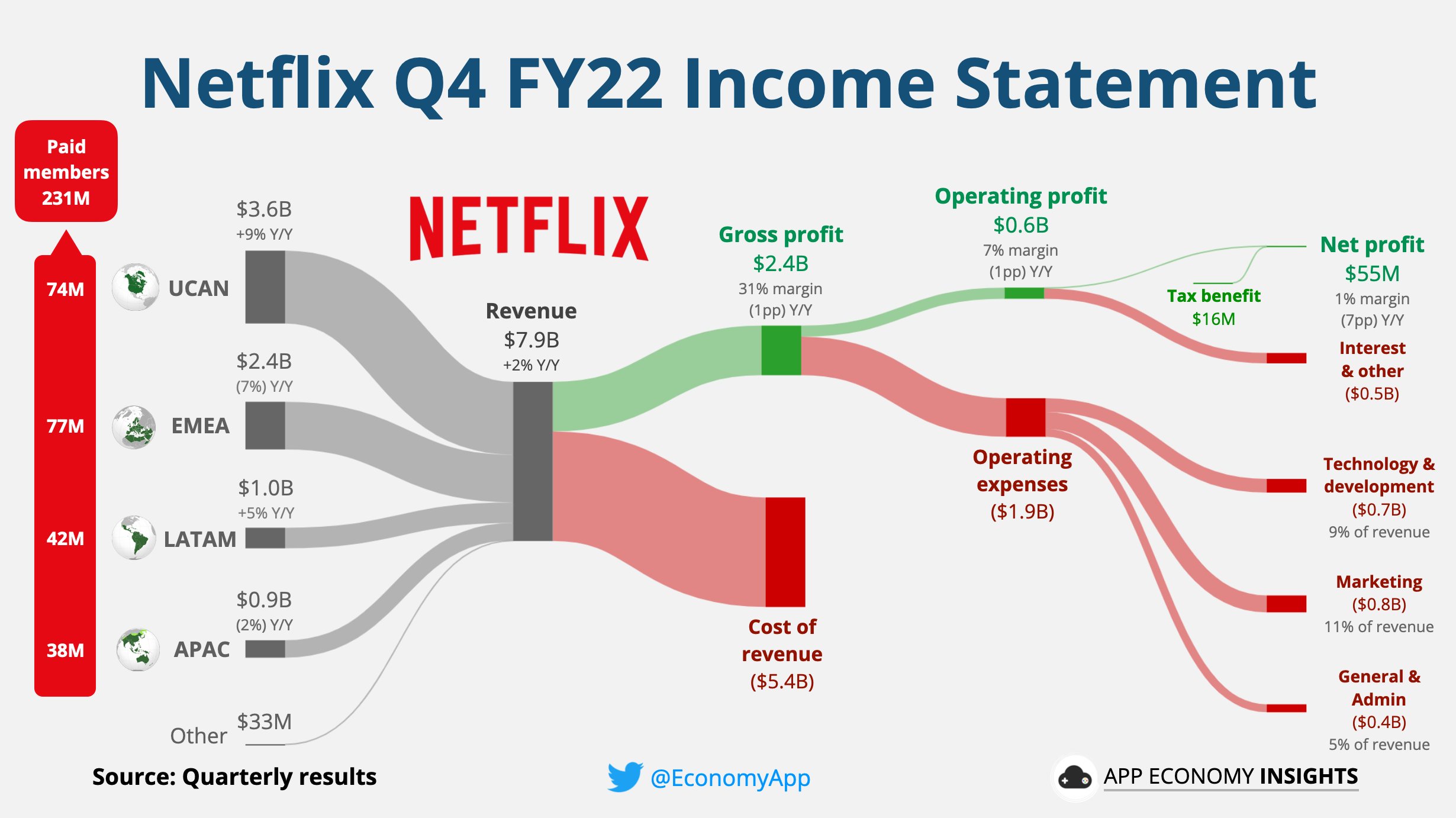
    In the Q4 2022 letter, it quickly becomes clear that the final three months of the year weren’t quite a homerun:

    • Revenue grew increased 1.9% year on year to US$7,852 million
    • Operation income fell 13% to US$550 million
    • Operating margin decreased from 8.2% to 7%
    • Net income plummeted 91% to US$55 million

    An in-depth breakdown of the financials is shown below, courtesy of App Economy Insights.

    Image

    Although, a positive to take from the quarter include the launch of Netflix’s ad-supported plan. While the company did not specify the exact details of its success so far, it is possible it partly fuelled the 7.7 million net member additions in Q4 — beating analyst estimates of 4.6 million.

    The strong period for additions brought the streaming giant’s total global membership base to 230.75 million at the end of 2022. Yet another feather in the company’s cap bolstering the Netflix share price.

    Where the enthusiasm really begins to shine is in the forward outlook. According to its release, Netflix intends to reaccelerate revenue growth in 2023.

    The catalysts for this growth reinvigoration are expected to be the new ad-supported offering and the rolling out of paid sharing — the latter being a way for Netflix to monetise the popularity of password sharing.

    Lastly, management is expecting to land US$3 billion in free cash flow in 2023. The tantalising proposition would be almost double the free cash flow achieved in 2022.

    How can ASX investors get in on Netflix shares?

    The easiest and most direct way to obtain Netflix shares as an Australian is to create an international trading account via a supporting broker. However, that can come with higher fees as the trade is not handled on the ASX.

    Another way to gain some exposure to the Netflix share price via the ASX is to invest in the company through an exchange-traded fund (ETF). A popular option is the Betashares Nasdaq 100 ETF (ASX: NDQ), which tracks the performance of the 100 largest non-financial companies on the Nasdaq.

    Be aware that while Netflix is the 17th largest position in the ETF, it’s still only a minute 1.2% weighting. The largest weightings are dominated by Apple Inc (NASDAQ: AAPL), Microsoft Corp (NASDAQ: MSFT), and Amazon.com Inc (NASDAQ: AMZN).

    The post The Netflix share price just popped. Here’s one way to buy in on the ASX appeared first on The Motley Fool Australia.

    FREE Guide for New Investors

    Despite what some people may say – we believe investing in shares doesn’t have to be overwhelming or complicated…

    For over a decade, we’ve been helping everyday Aussies get started on their journey.

    And to help even more people cut through some of the confusion “experts’” seem to want to perpetuate – we’ve created a brand-new “how to” guide.

    Yes, Claim my FREE copy!
    *Returns as of January 5 2023

    (function() {
    function setButtonColorDefaults(param, property, defaultValue) {
    if( !param || !param.includes(‘#’)) {
    var button = document.getElementsByClassName(“pitch-snippet”)[0].getElementsByClassName(“pitch-button”)[0];
    button.style[property] = defaultValue;
    }
    }

    setButtonColorDefaults(“#0095C8”, ‘background’, ‘#5FA85D’);
    setButtonColorDefaults(“#0095C8”, ‘border-color’, ‘#43A24A’);
    setButtonColorDefaults(“#fff”, ‘color’, ‘#fff’);
    })()

    More reading

    John Mackey, former CEO of Whole Foods Market, an Amazon subsidiary, is a member of The Motley Fool’s board of directors. Motley Fool contributor Mitchell Lawler has positions in Apple. The Motley Fool Australia’s parent company Motley Fool Holdings Inc. has positions in and has recommended Amazon.com, Apple, BetaShares Nasdaq 100 ETF, Microsoft, and Netflix. The Motley Fool Australia’s parent company Motley Fool Holdings Inc. has recommended the following options: long March 2023 $120 calls on Apple and short March 2023 $130 calls on Apple. The Motley Fool Australia has positions in and has recommended BetaShares Nasdaq 100 ETF. The Motley Fool Australia has recommended Amazon.com, Apple, and Netflix. The Motley Fool has a disclosure policy. This article contains general investment advice only (under AFSL 400691). Authorised by Scott Phillips.

    from The Motley Fool Australia https://ift.tt/8w67Fk3

  • Wesfarmers shares: A potential source of secondary income

    A happy investor sits at his desk in front of his laptop and does the mexican wave with his arms to celebrate the returns from his ASX dividend sharesA happy investor sits at his desk in front of his laptop and does the mexican wave with his arms to celebrate the returns from his ASX dividend shares

    I’m sure we’d all like another source of income to add to our day jobs. And there is no better kind of secondary income than passive income.

    Luckily for investors, ASX shares can be a great way to secure a secondary stream of passive income. Dividends from shares are truly passive – requiring zero effort aside from buying the shares themselves. So let’s discuss one ASX 200 blue-chip share that might be a great place to start: Wesfarmers Ltd (ASX: WES).

    Wesfarmers is a giant of the ASX. This company has been around since 1914, and today is one of the largest businesses in the country. It boasts ownership of several high-profile retailers, including Target, OfficeWorks, Kmart and its crown jewel, Bunnings:

    About Wesfarmers

    Last updated 20-01-2023, 12:45:20pm AEDT

    Current Price
    $49.18
    Change
    $-0.14 (-0.3%)
    Close Price
    $49.32
    Open Price
    $49.02
    Bid
    $49.18
    Ask
    $49.19
    Day Range
    $48.87 – $49.32
    Year Range
    $40.03 – $55.19
    Volume
    862,165
    Average Volume
    1,519,963
    Market Cap
    $56,158,458,345.00
    Earnings Per Share
    $1.95

    But Wesfarmers also has stakes in a vast array of other businesses. These include Covalent Lithium, Workwear Group, Priceline Pharmacies and Wesfarmers Chemicals, Energy and Fertilisers.

    But let’s get down to how Wesfarmers shares could be a source of secondary, passive income.

    How to use Wesfarmers shares for a secondary income

    Wesfarmers is a dividend-paying company and has been for decades. However, Wesfarmers’ earnings base can be quite cyclical. Especially so considering this company is more active in the mergers and acquisitions space than most.

    It was only in 2018 that Wesfarmers offloaded Coles Group Ltd (ASX: COL) from its portfolio, which substantially changed the company’s dividend profile.

    But despite this, Wesfarmers is still a pretty solid long-term income share. In COVID-ravaged 2020, the company managed to fork out $1.70 in fully-franked dividends per share. This rose to $1.78 per share in 2021 and lifted again to $1.80 per share in 2022.

    At the current Wesfarmers share price of $49.21 (at the time of writing), those latest dividends give Wesfarmers a trailing yield of 3.66%. That’s 5.23% grossed-up with the full franking.

    Some ASX brokers expect Wesfarmers to keep the dividend pay rises coming over the next few years too.

    So while Wesfarmers might not have the highest dividend yield on the share market today, it is still undoubtedly a solid dividend share and one that any investor can use to build up a secondary and passive source of income.

    The post Wesfarmers shares: A potential source of secondary income appeared first on The Motley Fool Australia.

    Where should you invest $1,000 right now? 3 dividend stocks to help beat inflation

    This FREE report reveals 3 stocks not only boasting sustainable dividends but that also have strong potential for massive long term returns…

    Yes, Claim my FREE copy!
    *Returns as of January 5 2023

    (function() {
    function setButtonColorDefaults(param, property, defaultValue) {
    if( !param || !param.includes(‘#’)) {
    var button = document.getElementsByClassName(“pitch-snippet”)[0].getElementsByClassName(“pitch-button”)[0];
    button.style[property] = defaultValue;
    }
    }

    setButtonColorDefaults(“#0095C8”, ‘background’, ‘#5FA85D’);
    setButtonColorDefaults(“#0095C8”, ‘border-color’, ‘#43A24A’);
    setButtonColorDefaults(“#fff”, ‘color’, ‘#fff’);
    })()

    More reading

    Motley Fool contributor Sebastian Bowen has positions in Wesfarmers. The Motley Fool Australia’s parent company Motley Fool Holdings Inc. has no position in any of the stocks mentioned. The Motley Fool Australia has positions in and has recommended Coles Group and Wesfarmers. The Motley Fool has a disclosure policy. This article contains general investment advice only (under AFSL 400691). Authorised by Scott Phillips.

    from The Motley Fool Australia https://ift.tt/sZRfbmU

  • Why Fisher & Paykel, Pilbara Minerals, Resolute, and Whitehaven Coal are storming higher

    a man raises his fists to the air in joyous celebration while learning some exciting good news via his computer screen in an office setting.

    a man raises his fists to the air in joyous celebration while learning some exciting good news via his computer screen in an office setting.

    The S&P/ASX 200 Index (ASX: XJO) is on course to end the week with the smallest of gains. In afternoon trade, the benchmark index is up a fraction to 7,436.6 points.

    Four ASX shares that are climbing more than most today are listed below. Here’s why they are rising:

    Fisher & Paykel Healthcare Corp Ltd (ASX: FPH)

    The Fisher & Paykel Healthcare share price is up 6% to $24.60. This follows the release of the medical device company’s FY 2023 guidance this morning. According to the release, the company expects full year operating revenue for the 2023 financial year to be within the range of approximately NZ$1.55 billion to NZ$1.60 billion. While this will be down slightly on FY 2022’s operating revenue of NZ$1.68 billion, it still appears to be better than feared.

    Pilbara Minerals Ltd (ASX: PLS)

    The Pilbara Minerals share price is up 8.5% to $4.36. Investors have been scrambling to buy this lithium miner’s shares following the release of a strong quarterly update. Pilbara Minerals’ production, sales volumes, lithium prices, and unit costs all improved quarter on quarter. It also revealed that it is swimming in cash. The company’s cash balance lifted from $1.375 billion at the end of September to $2.226 billion at the end of December.

    Resolute Mining Ltd (ASX: RSG)

    The Resolute share price is up 8% to 28 cents. This follows a decent rise in the gold price overnight. It isn’t just Resolute Mining that is rising today. Plenty of other ASX gold miners are climbing with it. This has seen the S&P/ASX All Ordinaries Gold index rise almost 2% on Friday afternoon.

    Whitehaven Coal Ltd (ASX: WHC)

    The Whitehaven Coal share price is up over 6% to $9.51. This morning, this coal miner released its second quarter update and revealed further strong prices. As a result, the company commanded a record high coal price for the first half. In light of this, management expects to more than quadruple its first half operating earnings.

    The post Why Fisher & Paykel, Pilbara Minerals, Resolute, and Whitehaven Coal are storming higher appeared first on The Motley Fool Australia.

    FREE Guide for New Investors

    Despite what some people may say – we believe investing in shares doesn’t have to be overwhelming or complicated…

    For over a decade, we’ve been helping everyday Aussies get started on their journey.

    And to help even more people cut through some of the confusion “experts’” seem to want to perpetuate – we’ve created a brand-new “how to” guide.

    Yes, Claim my FREE copy!
    *Returns as of January 5 2023

    (function() {
    function setButtonColorDefaults(param, property, defaultValue) {
    if( !param || !param.includes(‘#’)) {
    var button = document.getElementsByClassName(“pitch-snippet”)[0].getElementsByClassName(“pitch-button”)[0];
    button.style[property] = defaultValue;
    }
    }

    setButtonColorDefaults(“#0095C8”, ‘background’, ‘#5FA85D’);
    setButtonColorDefaults(“#0095C8”, ‘border-color’, ‘#43A24A’);
    setButtonColorDefaults(“#fff”, ‘color’, ‘#fff’);
    })()

    More reading

    Motley Fool contributor James Mickleboro has no position in any of the stocks mentioned. The Motley Fool Australia’s parent company Motley Fool Holdings Inc. has no position in any of the stocks mentioned. The Motley Fool Australia has no position in any of the stocks mentioned. The Motley Fool has a disclosure policy. This article contains general investment advice only (under AFSL 400691). Authorised by Scott Phillips.

    from The Motley Fool Australia https://ift.tt/WqcCKJp

  • ANZ’s cheat sheet: How can ASX investors make the most of ‘ample opportunity’ in 2023?

    A young man sits at his desk with a laptop and documents with a gas heater visible behind him as though he is considering the information in front of him. about the BHP share priceA young man sits at his desk with a laptop and documents with a gas heater visible behind him as though he is considering the information in front of him. about the BHP share price

    Last year was a rough one for equity markets around the globe, and the ASX wasn’t spared. The S&P/ASX 200 Index (ASX: XJO) plummeted more than 5% last year as key Wall Street indices entered bear market territory.

    Fortunately, the tide appears to have turned in 2023, with the ASX 200 lifting 7% year to date.

    And while pressures dragging on stocks haven’t yet abated, experts at ANZ Group Holdings Ltd (ASX: ANZ)’s private banking business appear optimistic there will be “ample opportunity” among ASX shares this year.

    ANZ Private Banking head of investing strategy Lakshman Anantakrishnan commented on the bank’s 2023 Global Market Outlook, released yesterday, saying:

    With challenges but also potential across most sectors in 2023, for investors, remaining nimble within portfolios might be most important of all. But there will be opportunities.

    Here’s how the bank advises investors to dodge potential challenges to make the most of the new year.

    A better year is upon us: ANZ

    Inflation, growth concerns, and potential recessionary impacts will likely dint shares, including those on the ASX, this year as earnings look set to reflect the challenging environment. But ASX investors might find respite amid such struggles, according to Anantakrishnan. He said:

    2023 will be hard pressed to outdo the challenges that financial markets faced in 2022, however this year is unlikely to be a smooth ride for investors …

    Unlike 2022 there should be ample opportunity for investors this year — where and when remains the question.

    The bank tips inflation to moderate as supply chains normalise as well as for China’s reopening to aid manufacturers and, hopefully, help Australia dodge a recession.

    In a less positive vein, the impact of successive rate hikes should catch up with companies and consumers, lessening demand.

    It tips shares to “test a new bottom” before any sustained rally occurs.

    How might ASX investors make the most of 2023?

    On that note, the first half might be rough for those invested in the market as consumers reject rising costs, thereby putting pressure on companies’ margins and potentially dinting valuations.

    But, as the bank notes, back-to-back annual falls are a market rarity. That means the ASX’s 2022 tumble has likely set the stage for a recovery.

    ANZ tips ASX shares to gain 8.2% annually between 2022 and 2032 and prefers the look of Aussie stocks over their New York-listed peers in 2023. Thus, the future appears bright for ASX investors.

    Though, the current half could be a bleak one, according to ANZ, with the bank favouring bonds over shares in the period. Anantakrishnan continued:

    We would look for any sell-off prior to an eventual pivot as an opportunity to build back equity exposure.

    Conversely, any rallies in H1 are likely to be taken as further opportunity to reduce equities, before building back exposure once they have bottomed.

    The post ANZ’s cheat sheet: How can ASX investors make the most of ‘ample opportunity’ in 2023? appeared first on The Motley Fool Australia.

    FREE Guide for New Investors

    Despite what some people may say – we believe investing in shares doesn’t have to be overwhelming or complicated…

    For over a decade, we’ve been helping everyday Aussies get started on their journey.

    And to help even more people cut through some of the confusion “experts’” seem to want to perpetuate – we’ve created a brand-new “how to” guide.

    Yes, Claim my FREE copy!
    *Returns as of January 5 2023

    (function() {
    function setButtonColorDefaults(param, property, defaultValue) {
    if( !param || !param.includes(‘#’)) {
    var button = document.getElementsByClassName(“pitch-snippet”)[0].getElementsByClassName(“pitch-button”)[0];
    button.style[property] = defaultValue;
    }
    }

    setButtonColorDefaults(“#0095C8”, ‘background’, ‘#5FA85D’);
    setButtonColorDefaults(“#0095C8”, ‘border-color’, ‘#43A24A’);
    setButtonColorDefaults(“#fff”, ‘color’, ‘#fff’);
    })()

    More reading

    Motley Fool contributor Brooke Cooper has no position in any of the stocks mentioned. The Motley Fool Australia’s parent company Motley Fool Holdings Inc. has no position in any of the stocks mentioned. The Motley Fool Australia has no position in any of the stocks mentioned. The Motley Fool has a disclosure policy. This article contains general investment advice only (under AFSL 400691). Authorised by Scott Phillips.

    from The Motley Fool Australia https://ift.tt/vH95mzY