One Australian billionaire has sold off a major coal asset and reportedly plans to funnel the proceeds into Aussie-born electric vehicle (EV) charging giant Tritium DCFC Ltd (NASDAQ: DCFC) shares.
Trevor St Baker and business partner Brian Flannery have agreed to sell New South Wales’ Vales Point Power Station â responsible for 11% of the state’s energy Ââ to Czech group Sev.en Global Investments.
The sale is worth more than $200 million, The Australian reports. St Baker is said to be planning to put the proceeds towards upping his stake in Tritium.
The Tritium share price last traded at US$5.87.
Let’s take a closer look at the billionaire’s apparent plan to increase his holding in the EV charging favourite.
Could this coal sale fuel Tritium’s fire?
Energy billionaire St Barker has sold off a major coal fired power station and apparently intends to reinvest the proceeds into Tritium â a favourite for the energy transition.
St Barker and Flannery reportedly bought the station for $1 million in 2015. They are also said to have pocketed $130 million of dividends from its activities over the three years to 2022.
The billionaire told The Australian he will invest some of the cash generated from the sale into Tritium.
Another portion of the proceeds has also been earmarked to go to Aussie EV fast charging stations business Evie Networks.
St Barker has also held a seat on the Tritium board since 2013.
Despite his apparent interest in the energy transition, St Barker remains confident coal will play an important role in Australia in the years to come. He commented on the sale of Vales Point, saying:
We continue to have a firm view that around the clock dispatchable generation will be necessary for the NEM well into the future.
Sev.en already has a presence in Australia, holding interests in Queensland’s Millmerran and Callide power stations.
Tritium has been continuing its growth story this year. It opened its first factory in the United States last month, just five months after announcing its planned build.
When investing expert Scott Phillips has a stock tip, it can pay to listen. After all, the flagship Motley Fool Share Advisor newsletter he has run for over ten years has provided thousands of paying members with stock picks that have doubled, tripled or even more.* Scott just revealed what he believes could be the “five best ASX stocks” for investors to buy right now. These stocks are trading at near dirt-cheap prices and Scott thinks they could be great buys right now
Motley Fool contributor Brooke Cooper has no position in any of the stocks mentioned. The Motley Fool Australia’s parent company Motley Fool Holdings Inc. has no position in any of the stocks mentioned. The Motley Fool Australia has no position in any of the stocks mentioned. The Motley Fool has a disclosure policy. This article contains general investment advice only (under AFSL 400691). Authorised by Scott Phillips.
from The Motley Fool Australia https://ift.tt/1H6T3o8
The Zip Co Ltd (ASX: ZIP) share price is down 1.83% in early afternoon trade on Monday.
Zip shares closed on Friday trading for 82 cents and are currently trading for 80.5 cents apiece.
With the benchmark indexes broadly flat at the time of writing, the ASX buy now, pay later (BNPL) share is underperforming on its first day of trading outside the S&P/ASX 200 Index (ASX: XJO).
What are ASX investors considering today?
There look to be two factors throwing up some headwinds for Zip shares today.
First, as mentioned, today is the first day the stock is trading outside of the ASX 200.
That came as part of S&P Dow Jones Indices September quarterly review.
With Zip shares having suffered a horror year, down 82% in 2022 so far, the companyâs market cap has fallen to $561 million, no longer qualifying it among the top 200 listed companies.
Getting ousted from the ASX 200 could hamper the BNPL stock, in part because many fund managers are restricted to trading shares listed on the blue-chip index. Those fund managers still holding shares now may find themselves having to sell Zip while others will not be able to snap them up.
Investors are also likely eyeing the upcoming interest rate decision by the US Federal Reserve.
The Fed board will announce its decision on Wednesday (early Thursday morning Aussie time).
Following an uptick in Augustâs inflation figures in the worldâs largest economy â while economists had largely been forecasting a downturn â analysts now predict the Fed will continue to hike rates aggressively to tame fast-rising prices.
Higher rates are bad news for loss-making companies like Zip, which are priced with future earnings in mind. As interest rates climb, so too does the cost of those future earnings. Higher rates will also pressure Zipâs customers and could see an increase in the level of bad debts the company is already struggling with.
How have Zip shares performed longer-term?
Although Zip shares are up 83% from their 23 June lows, the stock remains down a painful 88% over the past 12 months. That compares to a 7.8% loss posted by the All Ordinaries Index (ASX: XAO), its new benchmark index.
When investing expert Scott Phillips has a stock tip, it can pay to listen. After all, the flagship Motley Fool Share Advisor newsletter he has run for over ten years has provided thousands of paying members with stock picks that have doubled, tripled or even more.* Scott just revealed what he believes could be the “five best ASX stocks” for investors to buy right now. These stocks are trading at near dirt-cheap prices and Scott thinks they could be great buys right now
Motley Fool contributor Bernd Struben has no position in any of the stocks mentioned. The Motley Fool Australia’s parent company Motley Fool Holdings Inc. has positions in and has recommended ZIPCOLTD FPO. The Motley Fool Australia has no position in any of the stocks mentioned. The Motley Fool has a disclosure policy. This article contains general investment advice only (under AFSL 400691). Authorised by Scott Phillips.
from The Motley Fool Australia https://ift.tt/2zC7fAb
This article was originally published on Fool.com. All figures quoted in US dollars unless otherwise stated.
This article was originally published on Fool.com. All figures quoted in US dollars unless otherwise stated.
I believe you should buy stocks right now, and I’ll support this position with insights from people far more qualified to walk us through this than I am.
With so much uncertainty in the world and in the economy, I know that now can seem like a poor time to invest. But stock pickers could be in a more advantageous position now than they’ve been for over a decade.
Bull market geniuses or ducks in the rain?
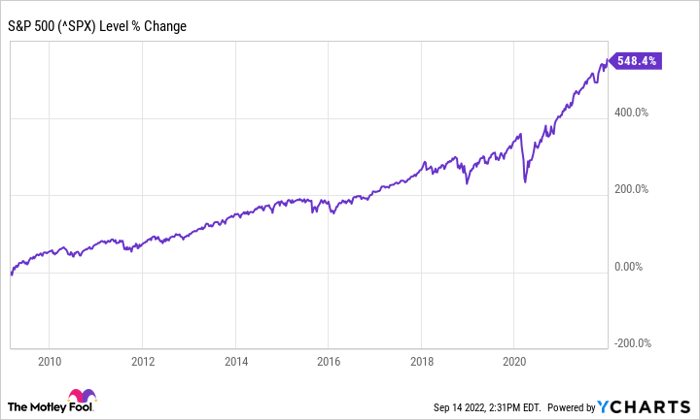
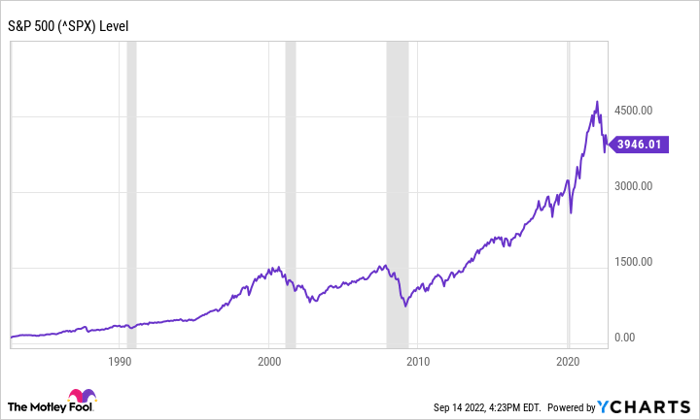
From March 2009 through the end of 2021, the S&P 500 was up over 500%. The march upward only had a couple of brief interruptions, as this chart shows.
If you were buying and holding stocks during this period, it was almost difficult to lose money.
It reminds me of something Berkshire Hathaway Inc.(NYSE: BRKB) CEO Warren Buffett once said. Referencing Berkshire’s 34% gain in 1997 in his letter to shareholders, Buffett wrote: “Last year’s performance was no great triumph: Any investor can chalk up large returns when stocks soar, as they did in 1997. In a bull market, one must avoid the error of the preening duck that quacks boastfully after a torrential rainstorm, thinking that its paddling skills have caused it to rise in the world.”Â
To restate Buffett’s point, almost all investors look like geniuses in a bull market because stocks are going up everywhere — just buy something. And this is partly due to the broader economy, since there’s a strong correlation between that and the market. When the economy is strong, many businesses do well and their stocks go up.
However, we are entering a whole new world in 2022. The U.S. economy has declined for two consecutive quarters. And things could slow further because of the Federal Reserve, as it raises interest rates to combat inflation. As Fed Chairman Jerome Powell recently said, “Reducing inflation is likely to require a sustained period of below-trend growth.”
According to Powell, increasing interest rates will continue to slow the economy. But it’s also causing the cost of capital to increase, hurting businesses that need financing.
The clock is ticking (for some)
The situation I’ve described is real. Even companies that have historically burned cash, like Snap Inc.(NYSE: SNAP), are pivoting. When it comes to profits, CEO Evan Spiegel recently said, “We must adapt our strategy accordingly.” For this reason, the company is making several changes, including trying to better monetize its augmented-reality (AR) technology by launching an enterprise business.
But many unprofitable companies won’t be able to adapt. The dot-com bubble more than two decades ago was a similar situation. The market hit its high in early 2000, but the writing was already on the wall. Talking to Forbes at the time, Ron Sege, then the Lycos CEO, said, “There is a certain sense of desperation and anxiety.” Specifically, Sege was talking about insiders’ desire to cash out and leave their companies in light of market conditions.
Insiders want out when their ability to generate shareholder value goes down. I believe that’s the case right now for structurally unprofitable companies in light of changing economic conditions. As Etsy, Inc.(NASDAQ: ETSY) CEO Josh Silverman recently said, “I think we’re going to see a reckoning.” The torrential rain for Buffett’s ducks is over.
However, if you’re thinking about waiting to buy stocks until the shakeout is over, that might not be the best idea. The stock market looks ahead, and it sometimes starts recovering from rock bottom before the economy improves. So unless you know exactly when the economy will recover (you don’t), you risk missing the stock market bottom.
To summarize up to this point, bull markets produce stock winners everywhere. Bearish market conditions like right now prioritize profits and disproportionately hurt weaker companies. And finally, timing the market bottom isn’t easy. Now, here’s what to do with this information.
The strong will get stronger
Sequoia Capital’s Alfred Lin recently wrote in a presentation, “The slower growing companies that were doing it profitably now have the financial flexibility to take advantage of the pullback from cash burning companies.”
It’s like what Motley Fool contributor Brian Stoffel says with his Antifragile Framework for investing: Stocks that are antifragile “get stronger when stress is applied.” In other words, the present situation is going to be a long-termbenefit for a handful of companies. And if you can identify these opportunities while the market is down, it can lead to some market-crushing results, which is why I believe now is a great time to still be buying stocks.
For instance, investors might take a look at PayPal Holdings, Inc.(NASDAQ: PYPL) stock. With so many unprofitable financial-technology companies out there, PayPal could be in a position of strength. The company has already curtailed spending to boost profits. And at a conference on Sept. 12, CEO Dan Schulman said that earnings per share (EPS) for the current quarter were “coming in a bit stronger than expected.” And it’s pivoting to greater profitability while still maintaining revenue growth north of 10%.Â
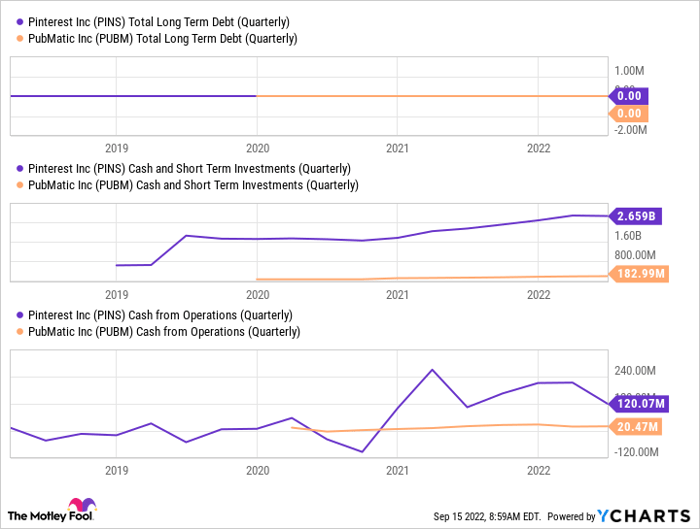
Image-browsing app Pinterest(NYSE: PINS) and advertising-technology company PubMatic, Inc. (NASDAQ: PUBM) are two more businesses that can still thrive in the current market. Both companies are debt-free, are in cash-rich positions, and generate positive cash from operations, as this chart shows.
Granted, both Pinterest and PubMatic generate revenue from ads. And the advertising industry will likely struggle in a slowing economy. But that’s kind of the point. As Lin said, these two have the financial flexibility to grab market share from cash-burning rivals.
In conclusion, investors will need to be more discerning than ever when picking stocks in 2022 and beyond. There are lots of problems, and many businesses will consequently be permanently impaired.
However, this will create amazing long-term opportunities for a select group of companies that I believe will result in life-changing gains over the years to come. I might not accurately identify all of these stocks. But it’s why I want to be picking stocks now more than ever.
This article was originally published on Fool.com. All figures quoted in US dollars unless otherwise stated.
When investing expert Scott Phillips has a stock tip, it can pay to listen. After all, the flagship Motley Fool Share Advisor newsletter he has run for over ten years has provided thousands of paying members with stock picks that have doubled, tripled or even more.* Scott just revealed what he believes could be the “five best ASX stocks” for investors to buy right now. These stocks are trading at near dirt-cheap prices and Scott thinks they could be great buys right now
Jon Quast has positions in Etsy, PayPal Holdings, Pinterest, and PubMatic, Inc. The Motley Fool Australia’s parent company Motley Fool Holdings Inc. has positions in and has recommended Etsy, PayPal Holdings, Pinterest, and PubMatic, Inc. The Motley Fool Australia has recommended PayPal Holdings and Pinterest. The Motley Fool has a disclosure policy. This article contains general investment advice only (under AFSL 400691). Authorised by Scott Phillips.
This article was originally published on Fool.com. All figures quoted in US dollars unless otherwise stated.
from The Motley Fool Australia https://ift.tt/bST5hjE
The S&P/ASX 200 Materials Index (ASX: XMJ) is climbing 1.27% in early afternoon trade, but one ASX copper share is soaring far higher.
The Demetallica Ltd (ASX: DRM) share price is currently up 40% at 28 cents a share after hitting an intraday high of 29.5 cents apiece — a jump of almost 48%.
Let’s take a look at why this ASX copper share is on the move today.
Takeover offer
Demetallica shares are taking off on Monday after the company received an off-market takeover offer from AIC Mines Limited (ASX: A1M).
Under the deal, Demetallica shareholders will be offered one AIC Mines share for every 1.5 Demetallica shares. The offer values Dematallica at about $36 million or 33.7 cents per share. This is a 68.5% upside on the company’s last closing price of 20 cents a share.
Demetallica listed on the ASX on 26 May this year after completing an initial public offering (IPO) of 60 million shares. The company’s major project is the Chimera Polymetal Project. This hosts the Jericho, Sandy Creek, and Altia deposits.
The Jericho deposit is adjacent to AIC Mines’ Eloise copper mine. AIC forecasts it will produce about 12,500 tonnes of copper and 6,000 ounces of gold concentrate in FY23. However, this production could increase by 60% should the merger go ahead.
Commenting on the proposed deal, AIC managing director Aaron Colleran said:
Combining AIC Mines and Demetallica is a logical consolidation. The tenement holdings of the two companies adjoin. The Eloise processing facility is only 4 kilometres from Demetallicaâs Jericho deposit.
Combining these assets will provide the quickest and most efficient means of developing and mining the Jericho deposit â to the shared benefit of both AIC Mines and Demetallica shareholders.
The deal is conditional on AIC Mines obtaining an interest in at least 50.1% of Dematallica shares and other market conditions being met.
Share price snapshot
The Demetallica share price has risen 10% year to date, adding 22% in the past month.
For perspective, the ASX 200 Materials Index has lost nearly 7% in 2022 so far.
The ASX copper share has a market capitalisation of about $24 million based on its current share price.
Before you consider Aic Mines Limited, you’ll want to hear this.
Motley Fool Investing expert Scott Phillips just revealed what he believes are the 5 best stocks for investors to buy right now… and Aic Mines Limited wasn’t one of them.
The online investing service heâs run for over a decade, Motley Fool Share Advisor, has provided thousands of paying members with stock picks that have doubled, tripled or even more.* And right now, Scott thinks there are 5 stocks that are better buys.
Motley Fool contributor Monica O’Shea has no position in any of the stocks mentioned. The Motley Fool Australia’s parent company Motley Fool Holdings Inc. has no position in any of the stocks mentioned. The Motley Fool Australia has no position in any of the stocks mentioned. The Motley Fool has a disclosure policy. This article contains general investment advice only (under AFSL 400691). Authorised by Scott Phillips.
from The Motley Fool Australia https://ift.tt/wTNGViI
If youâre interested in gaining exposure to the energy sector, then Santos could be the way to do it.
Morgans believes it is a great option for investors due to its diversified earnings base and strong growth profile.
The broker currently has an add rating and $9.30 price target on the companyâs shares. Based on the current Santos share price of $7.76, this implies potential upside of 20% for investors.
Morgans explained:
The resilience of STO’s growth profile and diversified earnings base see it well placed to outperform against a backdrop of a broader sector recovery. While pre-FEED, we see Dorado as likely to provide attractive growth for STO, while its recent acquisition increasing its stake in Darwin LNG has increased our confidence in Barossa’s development. PNG growth meanwhile remains a riskier proposition, with the government adamant it will keep a larger share of economic rents while operator Exxon has significantly deferred growth plans across its global portfolio
Another ASX share that Morgans rates highly is Webjet. The broker believes that its shares are trading at an attractive level based on its earnings estimate for the recovery year of FY 2024.
Morgans currently has an add rating and $6.40 price target on its shares. Based on the current Webjet share price of $5.26, this suggests potential upside of 22% over the next 12 months.
The broker commented:
Based on our forecasts, WEB is trading on an FY24 recovery year PE which is at a discount to its five-year average PE (pre-COVID). Its WebBeds (B2B) business is highly leveraged to the northern hemisphere summer holiday season which is forecast to be strong. Webjet OTA is leveraged to ANZ domestic and international travel. Management also wasted a crisis and cost reduction initiatives will reduce its cost base by 20% across the group once the business returns to scale.
When investing expert Scott Phillips has a stock tip, it can pay to listen. After all, the flagship Motley Fool Share Advisor newsletter he has run for over ten years has provided thousands of paying members with stock picks that have doubled, tripled or even more.* Scott just revealed what he believes could be the “five best ASX stocks” for investors to buy right now. These stocks are trading at near dirt-cheap prices and Scott thinks they could be great buys right now
Motley Fool contributor James Mickleboro has no position in any of the stocks mentioned. The Motley Fool Australia’s parent company Motley Fool Holdings Inc. has no position in any of the stocks mentioned. The Motley Fool Australia has recommended Webjet Ltd. The Motley Fool has a disclosure policy. This article contains general investment advice only (under AFSL 400691). Authorised by Scott Phillips.
from The Motley Fool Australia https://ift.tt/qCjtMwh
Shares in Australian lithium player Pilbara Minerals Ltd (ASX: PLS) are pushing up into the green today on no news.
At the time of writing, the Pilbara Minerals share price is trading nearly 6% higher at $4.86 apiece.
As seen below, the share took off in near-vertical fashion from June/July.
Investors have rallied the share in 2022 after an initially difficult period on the chart earlier in the year.
Pilbara shares first reached highs of $3.76 back on 18 January. They then bottomed at $2.04 on 20 June before the market took a turn to the upside.
Equities caught a strong bid across the board in the June/July bounce amid more certainty around inflation and interest rates.
Central Banks around the world have now stepped up to the task of reducing inflation. And it is clarity on this stance that’s given investors short-term confidence.
However, Pilbara has far outpaced the majority of its ASX constituents in the back end of 2022. The stock now trades at 52-week highs at the time of writing.
Are there tailwinds for Pilbara?
Helping spur the upside has been a multivariate equation comprising lithium, batteries, electric vehicles (EVs) and general market activity.
In particular, the surge in demand for EVs has been a net positive for both Pilbara and the price of lithium, with each now trading at all-time highs.
Meanwhile, the United States Government’s recent Inflation Reduction Act also provides further tax breaks for those owning an EV.
This is coupled with a wind-back in internal combustion engine production and usage throughout Europe. Some areas are mandating the use of electric mobility in certain zones.
Alas, the landscape for mobility is shifting before our eyes, and it appears to be a lithium-electric vehicle battery-driven story.
This is also relevant to Pilbara considering its battery metals exchange (BMX) auction that takes place on a routine basis.
In addition, the price Pilbara hopes to receive from its own lithium production will directly impact factors such as earnings, return on invested capital and free cash flows. Three critical components in growing corporate value.
It therefore stands to reason that with an expanding price differential in the market for lithium [carbonate, spodumene, battery grade], this will continue to inflect positively on the Pilbara Minerals share price.
Pilbara Minerals share price snapshot
In the meantime, the Pilbara Minerals share price has gained more than 51% this year to date. Pilbara shares are up more than 112% for the past 12 months.
The Pilbara share price trades on a price-to-earnings (P/E) ratio of 24.8x and is priced at more than 10.6x its own book value of equity.
These multiples are each ahead of the GICS Materials Industry peer median scores of 7.25x and 2.9x respectively, according to Refinitiv Eikon data.
As a result, looking at these valuations, questions arise as to whether Pilbara is overvalued relative to its peers at present.
When investing expert Scott Phillips has a stock tip, it can pay to listen. After all, the flagship Motley Fool Share Advisor newsletter he has run for over ten years has provided thousands of paying members with stock picks that have doubled, tripled or even more.* Scott just revealed what he believes could be the “five best ASX stocks” for investors to buy right now. These stocks are trading at near dirt-cheap prices and Scott thinks they could be great buys right now
Motley Fool contributor Zach Bristow has no position in any of the stocks mentioned. The Motley Fool Australia’s parent company Motley Fool Holdings Inc. has no position in any of the stocks mentioned. The Motley Fool Australia has no position in any of the stocks mentioned. The Motley Fool has a disclosure policy. This article contains general investment advice only (under AFSL 400691). Authorised by Scott Phillips.
from The Motley Fool Australia https://ift.tt/jiDcUrV
This article was originally published on Fool.com. All figures quoted in US dollars unless otherwise stated.
This article was originally published on Fool.com. All figures quoted in US dollars unless otherwise stated.
Warren Buffett’s Berkshire Hathaway Inc.(NYSE: BRKB) has long taken an interest in retail stocks and has often succeeded in the sector. One example is Costco Wholesale Corporation(NASDAQ: COST), which he bought more than 20 years ago and sold last year for a massive gain.
Today, Buffett holds positions in retailers such as Amazon.com, Inc. (NASDAQ: AMZN) and RH (NYSE: RH), formerly Restoration Hardware. Still, given the state of the companies and current conditions, only one of these Warren Buffett investments is likely to be more suitable for new buyers.
The state of Amazon
Amazon pioneered the e-commerce industry, eventually developing a reputation for “selling everything.” However, with the development of Amazon Web Services (AWS), it also established the cloud computing industry, making this company a conglomerate.
Buffett took an interest in Amazon in 2019, buying roughly 10.6 million shares in two different lots. Soon after, the company prospered during the pandemic. Locked-down consumers preferred shopping online, while more remote business activity increased the demand for cloud services. But its retail operations experienced slower growth as consumers returned to more offline activities.
Amazon reported $222 billion in revenue in the first half of 2022, a gain of 7% versus the same time frame in 2021. It made modest gains in North America, though international revenue fell. Still, AWS continued to prosper as its revenue surged 35% over the same time frame to $38 billion, about 16% of Amazon’s total.
Also, AWS was the only segment to report positive operating income. It earned $12 billion in operating income in the first two quarters of 2022 versus $7 billion for the company. Higher operating expenses led to a combined operating loss of $5 billion for the North America and international segments. Such results could partly explain why Amazon stock has fallen by nearly one-third from its 52-week high.
However, its price-to-sales (P/S) ratio is less than 3. While it is still pricier than Wal-mart Stores, Inc. (NYSE: WMT)at 0.6 times sales, it is near multiyear lows for the company, which could still make Amazon a buy.
How RH fares
Buffett began buying RH stock in November 2019. He started with about 1.2 million shares. The stock surged amid the pandemic, and early in 2022, he added another 1 million shares.
Still, luxury furnishings might not hold as much appeal in a time of high inflation and sluggish economic growth. RH’s recent performance seems to reflect that softness.
Revenue of about $1.95 billion in the first half of the year rose 5% compared to the same period last year. Still, most of that gain came in the first quarter as second-quarter revenue grew by under 1% year over year. Net income fell 10% during that time frame to $323 million. Higher selling, general, and administrative expenses, as well as losses on the extinguishment of debt, lowered profitability.
Investors have also heavily sold off RH. It has fallen by more than 60% since peaking in August 2021. Nonetheless, Buffett still holds a profit on his original positions in RH. Also, its P/E ratio of 9 is down from more than 75 early last year. That gives it a valuation that could draw the Oracle of Omaha to buy more shares.
Amazon or RH?
In the current environment, Amazon seems like a more profitable choice for investors. It is a more expensive stock by any measure and has not fallen by as much as RH. These two factors might make it seem like less of a Buffett stock.
However, unlike RH, it sells items that tend to appeal to consumers in a struggling economy. Moreover, its fast-growing AWS could still perform well since it cuts costs for its clients. That diversity and appeal in a variety of economic circumstances make it a more suitable choice.
This article was originally published on Fool.com. All figures quoted in US dollars unless otherwise stated.
When investing expert Scott Phillips has a stock tip, it can pay to listen. After all, the flagship Motley Fool Share Advisor newsletter he has run for over ten years has provided thousands of paying members with stock picks that have doubled, tripled or even more.* Scott just revealed what he believes could be the “five best ASX stocks” for investors to buy right now. These stocks are trading at near dirt-cheap prices and Scott thinks they could be great buys right now
John Mackey, CEO of Whole Foods Market, an Amazon subsidiary, is a member of The Motley Foolâs board of directors. Will Healy has positions in Berkshire Hathaway (B shares). The Motley Fool Australia’s parent company Motley Fool Holdings Inc. has positions in and has recommended Amazon, Costco Wholesale, RH, and Walmart Inc. The Motley Fool Australia has recommended Amazon. The Motley Fool has a disclosure policy. This article contains general investment advice only (under AFSL 400691). Authorised by Scott Phillips.
This article was originally published on Fool.com. All figures quoted in US dollars unless otherwise stated.
from The Motley Fool Australia https://ift.tt/mFtgJVe
For me, Lovisa has been an ASX share that got away. And it could very well continue to do so.
After tumbling to $3.31 in the depths of the COVID crash, Lovisa shares have catapulted 580% to currently sit at $22.51 each.
Itâs also one of the few ASX 200 shares sitting comfortably in the green this year. Despite concerns of soaring inflation and rising interest rates, the Lovisa share price has raced 14% higher since the start of the year.
Itâs left other ASX 200 shares in the dust, with the broader market printing an 11% fall across the same period.
As Lovisa shares continue to soar to new heights, here are a couple of reasons why I like this ASX 200 retail share.
Terrific economics
Lovisa has great business economics, which are made all the more impressive given the industry it operates in.
Retailing is traditionally a low-margin industry, but Lovisaâs vertically-integrated business model and small store footprint spin up superb margins.
In terms of vertical integration, Lovisa develops, designs, sources, and manufactures all of its products in-house.
This allows the company to quickly respond to changing consumer trends and double down on whatâs working. But perhaps even more impressively for investors, it gives the company cost advantages that underpin juicy gross margins.
In FY22, Lovisa boasted gross margins of 79%, enough to even make some ASX 200 tech shares envious. In other words, for every pair of $10 earrings flying off the shelves, it paid suppliers on average just $2.10.
Another beauty of Lovisa is its small store footprint. Being a fast-fashion jewellery retailer, it doesnât need much space to display, nor stock, its products. Plus, its stores are relatively inexpensive and easy to fit out.
Once up and running, these stores are highly productive, ushering in customers in high-foot-traffic areas looking to indulge on a budget.
As a result, new stores become profitable very quickly, typically paying for themselves within a year.
This helps Lovisa to flaunt strong operating margins, which sat at 18% in FY22.
A global growth story
Lovisa opened its very first store in Chermside, Queensland in 2010. Within a few months, it expanded into New Zealand. And the following year, it entered the South African market.
Fast forward a decade or so and Lovisa is truly a global force, with a store network spanning nearly 20 countries across the globe.
Prior to COVID, around half of Lovisaâs revenue came from its local Australian and New Zealand markets.
A few years on, international revenue made up 62% of Lovisaâs sales in FY22, growing 118% from the prior year.
Underpinning this growth were 85 net new stores opened during the year, all in international markets but particularly the US. This takes the companyâs current total to 629 stores, a number that is only set to continue heading north.
Given the terrific economics we discussed above, it makes sense for Lovisa to be expanding its store network at pace.
It doesnât always get it right, exiting the Spanish market in 2020, but management has shown its prowess to date.
Amid the chaos, Lovisa bought 84 store locations from European jewellery and accessories distributor Beeline. The company then converted these stores to its own format and brand, suddenly commanding a significant presence in Europe in one fell swoop.
The acquisition came with nearly â¬10 million and no debt aside from lease liabilities.
All this for a grand purchase price of⦠â¬60. Yes, just 60 euros! Plus, Lovisa also received the option to acquire Beelineâs 30 stores in France for an extra â¬10, which it later went through with.
Beeline was motivated to keep its workforce employed, so Lovisa inherited the staff of these stores along with the leases.
Lovisa share price snapshot
In my eyes, Lovisa is a high-quality ASX retail share with an impressive track record and a healthy pipeline for growth in new and existing markets.
What’s more, against a backdrop of rising interest rates and inflation, Lovisa’s younger customer base and low price point could see it being more resilient than other ASX retail shares in a downturn.
The market reacted positively to Lovisa’s FY22 results, bidding up the company’s shares by almost 20% in the last month.
When investing expert Scott Phillips has a stock tip, it can pay to listen. After all, the flagship Motley Fool Share Advisor newsletter he has run for over ten years has provided thousands of paying members with stock picks that have doubled, tripled or even more.* Scott just revealed what he believes could be the “five best ASX stocks” for investors to buy right now. These stocks are trading at near dirt-cheap prices and Scott thinks they could be great buys right now
Motley Fool contributor Cathryn Goh has no position in any of the stocks mentioned. The Motley Fool Australia’s parent company Motley Fool Holdings Inc. has no position in any of the stocks mentioned. The Motley Fool Australia has recommended Lovisa Holdings Ltd. The Motley Fool has a disclosure policy. This article contains general investment advice only (under AFSL 400691). Authorised by Scott Phillips.
from The Motley Fool Australia https://ift.tt/P4ND08p
China’s ‘zero-COVID‘ policy â including stringent lockdowns, travel restrictions and mass testing â has taken a heavy toll on the country’s economy. The government’s crackdown on big technology companies has also had an outsized effect on the young workforce.
Unemployment among people aged 16 to 24 stands at almost 19%, after hitting a record 20% in July, according to government data. Some young people have been forced to take pay cuts⦠Almost 60% of people are now inclined to save more, rather than consume or invest more, according to the most recent quarterly survey by the People’s Bank of China (PBOC), China’s central bank. That figure was 45% three years ago.
Why ASX 200 mining shares could be okay
Wealth manager Ken Fisher writes in The Australianthat some market commentators are suggesting Australia could suffer because China buys so much of Australia’s resources. That demand could reduce if China’s economy grows at a slower price.
He did acknowledge that 40% of exports went to China in 2021. Compared to 27% in 2011 and 6% in 2001.
But there’s a question worth asking. How come Australian exports to China are down 11.3%, yet Australian exports are up 30.3%?
The answer is that exports to Japan, Europe and India have all more than doubled. Exports to South Korea are up 64.7%. Natural gas is one factor that can help Australia, with energy demand rising. Metals that help electrification can also “support metal prices and expand export markets”.
His main point is that “Australia simply isn’t China-reliant”.
But, even with all the uncertainty and volatility, he notes that headlines are focused on recession fears, yet “very little suggests a deep downturn”. This could be positive news for ASX 200 mining shares.
Manufacturing indicators suggest growth for both the world as a whole and Australia. The manufacturing new orders index reportedly expanded as well, which Fisher said was “great news, given today’s orders are tomorrow’s production”.
Optimistic outlook
In concluding his thoughts about China, Fisher writes:
Inflated China fears have stalked Australian stocks for years. But remember: False fears are bullish, always and everywhere. So is depressed sentiment. Don’t let today’s gloomy headlines scare you from the coming recovery.
ASX 200 mining share snapshot
At the time of writing, the Fortescue Metals Group Limited (ASX: FMG) share price is up 0.99% today, the BHP Group Ltd (ASX: BHP) share price is up 0.63% and the Rio Tinto Limited (ASX: RIO) share price is up 0.89%.
When investing expert Scott Phillips has a stock tip, it can pay to listen. After all, the flagship Motley Fool Share Advisor newsletter he has run for over ten years has provided thousands of paying members with stock picks that have doubled, tripled or even more.* Scott just revealed what he believes could be the “five best ASX stocks” for investors to buy right now. These stocks are trading at near dirt-cheap prices and Scott thinks they could be great buys right now
Motley Fool contributor Tristan Harrison has positions in Fortescue Metals Group Limited. The Motley Fool Australia’s parent company Motley Fool Holdings Inc. has no position in any of the stocks mentioned. The Motley Fool Australia has no position in any of the stocks mentioned. The Motley Fool has a disclosure policy. This article contains general investment advice only (under AFSL 400691). Authorised by Scott Phillips.
from The Motley Fool Australia https://ift.tt/D5KGh8t
The Liontown Resources Limited(ASX: LTR) share price is starting the week strongly.
In morning trade, the lithium developerâs shares are up 4% to $1.70.
Why is the Liontown share price pushing higher?
The Liontown share price is pushing higher on Monday despite there being no news out of the company.
However, it is worth noting that there are a number of lithium shares pushing higher today after investor sentiment in the industry rebounded following a tough week.
Hereâs a quick summary of some of the movers and shakers in the industry today:
The Core Lithium Ltd (ASX: CXO) share price is up 4.5%
The Pilbara Minerals Ltd (ASX: PLS) share price is up 5.5%
Where next for Liontownâs shares?
The good news for investors is that one leading broker believes the Liontown share price still has huge upside potential.
A recent note out of Bell Potter reveals that its analysts have a speculative buy rating and $2.87 price target on its shares. Based on the current Liontown share price, this implies potential upside of almost 70% over the next 12 months.
The broker commented:
LTR is fully funded to develop Kathleen Valley and has binding lithium offtake agreements in place with Ford, Tesla and LG Energy Solution covering around 90% of initial production. With construction underway, we expect LTR to award further development contracts with a focus building the assetâs best in class ESG credentials. Studies into lithium refining are underway and could bring further strategic partnerships from major lithium groups. Optimisation of this downstream project will complement Kathleen Valley development news flow.
When investing expert Scott Phillips has a stock tip, it can pay to listen. After all, the flagship Motley Fool Share Advisor newsletter he has run for over ten years has provided thousands of paying members with stock picks that have doubled, tripled or even more.* Scott just revealed what he believes could be the “five best ASX stocks” for investors to buy right now. These stocks are trading at near dirt-cheap prices and Scott thinks they could be great buys right now
Motley Fool contributor James Mickleboro has positions in Allkem Limited. The Motley Fool Australia’s parent company Motley Fool Holdings Inc. has no position in any of the stocks mentioned. The Motley Fool Australia has no position in any of the stocks mentioned. The Motley Fool has a disclosure policy. This article contains general investment advice only (under AFSL 400691). Authorised by Scott Phillips.
from The Motley Fool Australia https://ift.tt/dQjJphP