• Brokers rate these ASX dividend shares as buys

    A woman looks excited as she holds Australian dollars in the air.

    A woman looks excited as she holds Australian dollars in the air.

    Looking for dividends shares to buy for your income portfolio this month? Then take a look at the two listed below which brokers currently rate as buys.

    Here’s what you need to know about them:

    Dicker Data Ltd (ASX: DDR)

    The first ASX dividend share to look at is Dicker Data. It is a leading technology hardware, software, and cloud distributor.

    It has been growing at a solid rate for a decade and shows no signs of stopping. For example, during the first quarter, the company reported a 50.5% increase in revenue to $673.6 million and a 22.7% lift in profit before tax to $23.8 million.

    Last week, the team at Morgan Stanley retained its overweight rating and $16.00 price target on the company’s shares.

    In addition, the broker reaffirmed its forecast for fully franked dividends per share of 41.4 cents in FY 2022 and 48.5 cents in FY 2023. Based on the current Dicker Data share price of $13.04, this will mean yields of 3.2% and 3.7%, respectively.

    Westpac Banking Corp (ASX: WBC)

    Another dividend share that could be in the buy zone is Westpac.

    The team at Citi are positive on Australia’s oldest bank and are forecasting a growing stream of dividends in the coming years.

    The broker is currently forecasting fully franked dividend of $1.23 in FY 2022, $1.53 in FY 2023, and then $1.85 in FY 2024. Based on the current Westpac share price of $21.07, if Citi is on the money with these forecasts, it will mean generous yields of 5.8%, 7.25%, and 8.8%, respectively.

    But it gets better. The broker sees significant upside for the bank’s shares, with its buy rating and $29.00 price target. This price target is almost 40% higher than where Westpac’s shares currently trade.

    The post Brokers rate these ASX dividend shares as buys appeared first on The Motley Fool Australia.

    Wondering where you should invest $1,000 right now?

    When investing expert Scott Phillips has a stock tip, it can pay to listen. After all, the flagship Motley Fool Share Advisor newsletter he has run for over ten years has provided thousands of paying members with stock picks that have doubled, tripled or even more.* Scott just revealed what he believes could be the “five best ASX stocks” for investors to buy right now. These stocks are trading at near dirt-cheap prices and Scott thinks they could be great buys right now

    See The 5 Stocks
    *Returns as of July 7 2022

    (function() {
    function setButtonColorDefaults(param, property, defaultValue) {
    if( !param || !param.includes(‘#’)) {
    var button = document.getElementsByClassName(“pitch-snippet”)[0].getElementsByClassName(“pitch-button”)[0];
    button.style[property] = defaultValue;
    }
    }

    setButtonColorDefaults(“#0095C8”, ‘background’, ‘#5FA85D’);
    setButtonColorDefaults(“#0095C8”, ‘border-color’, ‘#43A24A’);
    setButtonColorDefaults(“#fff”, ‘color’, ‘#fff’);
    })()

    More reading

    Motley Fool contributor James Mickleboro has positions in Westpac Banking Corporation. The Motley Fool Australia’s parent company Motley Fool Holdings Inc. has positions in and has recommended Dicker Data Limited. The Motley Fool Australia has positions in and has recommended Dicker Data Limited. The Motley Fool Australia has recommended Westpac Banking Corporation. The Motley Fool has a disclosure policy. This article contains general investment advice only (under AFSL 400691). Authorised by Scott Phillips.

    from The Motley Fool Australia https://ift.tt/fFH608b

  • 2 important investing metrics you won’t find on a financial statement

    This article was originally published on Fool.com. All figures quoted in US dollars unless otherwise stated.

    A woman sits in front of a computer and does some calculations.

    This article was originally published on Fool.com. All figures quoted in US dollars unless otherwise stated.

    When analyzing the quality of companies, investors often focus on financial metrics such as earnings growth or the strength of the balance sheet. And while financial metrics are certainly an integral part of any investment analysis, investors can benefit by looking at nontraditional statistics to find high-quality businesses.

    Two areas that are often indicators of an excellent company are employee and customer satisfaction. Great businesses aim to maximize value for all stakeholders, not just the shareholders.

    Two metrics investors can use to measure customer and employee loyalty are net promoter scores and Glassdoor ratings.

    Net promoter scores

    The net promoter score (NPS) is a measurement of how likely a brand’s customers are to promote it to others. It’s produced by conducting a simple survey asking how likely a customer is to recommend the product or service to a friend.

    Not every company will take the time to conduct these surveys, but those serious about their brand image will hire outside marketing firms to survey their customers on an annual or semi-annual basis. 

    The NPS is derived by subtracting the percentage of detractors (not likely to recommend the product) from the percentage of promoters (very likely to recommend). The resulting score ranges from negative 100 to 100.

    A negative score is a big red flag as that means the majority of customers would not recommend the product, while a score of greater than 60 is generally considered the mark of a highly regarded brand.

    Marketing firm Invesp estimates word-of-mouth promotion accounts for $6 trillion in annual consumer spending and is five times more effective than paid marketing. So, a high NPS score not only indicates customers love a company’s products, but also means the business likely needs to spend less on marketing to drive sales.

    To find a company’s NPS, you’ll have to do some digging. The company’s investor relations page is a good place to start, as businesses with high scores will often share them in presentations or shareholder letters.

    There are also companies like Comparably, which conducts its own independent NPS surveys on hundreds of major brands.

    Footwear apparel company Allbirds (NASDAQ: BIRD) shared its impressive net promoter score of 86 in its most recent investor presentation. The customer loyalty for this brand is best in class, which is why the company reports over 50% of its revenue comes from repeat customers.

    The strength of a company’s brand can be difficult to measure by simply looking at financials. But fortunately, net promoter scores offer investors an alternative metric to gauge customer sentiment.

    Glassdoor ratings

    Employee happiness is another great indicator of a strong business.

    Glassdoor provides incredibly valuable insights into a company’s employee sentiment. You can read employee reviews, see how likely they are to recommend their employer to a friend, and even find the percentage of employees who approve of the CEO.

    This is a wealth of data that many investors miss by exclusively looking at financial statements during their research. Many of the top companies in the world, such as Alphabet (NASDAQ: GOOG) and Amazon.com (NASDAQ: AMZN), have remained industry leaders for years because of their ability to attract top talent to their employee ranks.

    In 2021, Gartner (NYSE: IT) found that 48% of companies in a survey had serious concerns about mass turnover. Employee turnover is not only extremely costly, but it can also be highly disruptive to the company’s execution.

    Thus, positive Glassdoor reviews and ratings can give investors confidence that a business is both attracting and, more importantly, retaining top talent.

    Zoom Video Communications (NASDAQ: ZM) is a perfect example of a business with incredibly high Glassdoor metrics. Some 88% of employees say they would recommend the company to a friend, and a staggering 94% of employees approve of CEO Eric Yuan.

    While the company’s stock has taken a beating due to the recent risk-off sentiment in the market, the Glassdoor reviews show a strong company beloved by its employees.

    Outside-the-box thinking

    Long-term investors can give themselves an edge by thinking outside the box when conducting their research. Net promoter scores and Glassdoor reviews are two ways you can gain unique insights into the strength of a business in pursuit of market-beating returns.

    Just remember, as with traditional metrics like those found on the balance sheet or income statement, it’s important to consider the whole picture of a business and not make investment decisions based on a single attribute or number.

    This article was originally published on Fool.com. All figures quoted in US dollars unless otherwise stated.

    The post 2 important investing metrics you won’t find on a financial statement appeared first on The Motley Fool Australia.

    Wondering where you should invest $1,000 right now?

    When investing expert Scott Phillips has a stock tip, it can pay to listen. After all, the flagship Motley Fool Share Advisor newsletter he has run for over ten years has provided thousands of paying members with stock picks that have doubled, tripled or even more.* Scott just revealed what he believes could be the “five best ASX stocks” for investors to buy right now. These stocks are trading at near dirt-cheap prices and Scott thinks they could be great buys right now

    See The 5 Stocks *Returns as of July 7 2022

    (function() { function setButtonColorDefaults(param, property, defaultValue) { if( !param || !param.includes(‘#’)) { var button = document.getElementsByClassName(“pitch-snippet”)[0].getElementsByClassName(“pitch-button”)[0]; button.style[property] = defaultValue; } } setButtonColorDefaults(“#43B02A”, ‘background’, ‘#5FA85D’); setButtonColorDefaults(“#43B02A”, ‘border-color’, ‘#43A24A’); setButtonColorDefaults(“#fff”, ‘color’, ‘#fff’); })()

    More reading

    Suzanne Frey, an executive at Alphabet, is a member of The Motley Fool’s board of directors. John Mackey, CEO of Whole Foods Market, an Amazon subsidiary, is a member of The Motley Fool’s board of directors. The Motley Fool Australia’s parent company Motley Fool Holdings Inc. has positions in and has recommended Alphabet (A shares), Alphabet (C shares), Amazon, and Zoom Video Communications. The Motley Fool Australia has recommended Alphabet (A shares), Alphabet (C shares), Amazon, and Zoom Video Communications. The Motley Fool has a disclosure policy. This article contains general investment advice only (under AFSL 400691). Authorised by Scott Phillips.

    This article was originally published on Fool.com. All figures quoted in US dollars unless otherwise stated.


    from The Motley Fool Australia https://ift.tt/DbIUM1B
  • Should investors buy Wesfarmers shares for dividends?

    Couple counting out moneyCouple counting out money

    The Wesfarmers Ltd (ASX: WES) share price has risen by 11% over the last month. After a quick rise in a short amount of time, is the business worth owning for income?

    Dividends can be an attractive way to benefit from the net profit after tax (NPAT) and cash flow that is generated by a business each day.

    For readers that aren’t sure what Wesfarmers does, it’s the parent company of many recognisable retail names in Australia, including Bunnings, Kmart, Officeworks, Catch, and Target.

    But, simply being a large S&P/ASX 200 Index (ASX: XJO) share that pays a dividend doesn’t automatically mean Wesfarmers shares are a buy.

    Let’s have a look at the recent performance by Wesfarmers.

    Last three dividends

    The latest dividend from Wesfarmers was the interim dividend for the first half of FY22.

    It decided to decrease the half-year dividend by 9.1% to 80 cents per share. This came after a 12.7% fall in NPAT to $1.2 billion and a 29.8% decline in the operating cash flow to $1.56 billion.

    However, in the FY21 result, it increased the full-year dividend by 17.1% to $1.78 per share. This was funded by a 16.2% increase in underlying earnings per share (EPS) to $2.14.

    If the earnings rise, then Wesfarmers can fund a higher dividend for shareholders.

    The company says that “Wesfarmers’ primary objective is to provide a satisfactory return to shareholders”.

    How will Wesfarmers drive its profit higher?

    Wesfarmers says it believes it’s only possible to grow its profit over the long-term by:

    • Anticipating the needs of customers and delivering competitive goods and services
    • Looking after team members and providing a safe, fulfilling work environment
    • Engaging fairly with suppliers and sourcing ethically and sustainably
    • Supporting the communities where it operates
    • Taking care of the environment
    • Acting with integrity and honesty in all its dealings

    Wesfarmers is looking to invest in a number of different areas of its business to grow earnings into the future.

    I think Bunnings can continue to generate good earnings, even during this difficult period of inflation and rising interest rates.

    What’s most interesting to me is the new Wesfarmers Health division. It started this after acquiring Australian Pharmaceutical Industries (API), which includes Priceline, Soul Pattinson Chemists, Clear Skincare Clinics and more.

    There could be useful tailwinds to drive Wesfarmers Health earnings higher and also be helpful for Wesfarmers shares.

    Wesfarmers pointed out that health is an important, large sector. The population of Aussies aged 65 and over is expected to double to 8.9 million by 2061. Customers are reportedly becoming more interested in health and wellness, with an increased focus on preventative health measures and treatment.

    Data and digital can “transform” customer journeys in healthcare, improving health outcomes.

    Wesfarmers said:

    With strong fundamentals and the ability to leverage group capabilities, Wesfarmers Health can deliver superior returns over the long term.

    It’ll be interesting to see what Wesfarmers does in healthcare and what other acquisitions it makes.

    Wesfarmers dividend expectations

    In FY22, according to CMC Markets, Wesfarmers is expected to pay an annual dividend of $1.66 per share. That translates into a grossed-up dividend yield of 5%.

    In FY24, the projection for the dividend is $1.88 per share. That translates into a potential grossed-up dividend yield of 5.6%.

    The near-term dividends seem reasonably attractive. However, I’m even more interested in Wesfarmers because of its diversification and expanding portfolio in areas with growth. For example, not only has it recently invested in healthcare, but it’s also working on a lithium mining project.

    I think it would be a solid long-term pick at the current Wesfarmers share price of $47.53.

    The post Should investors buy Wesfarmers shares for dividends? appeared first on The Motley Fool Australia.

    Wondering where you should invest $1,000 right now?

    When investing expert Scott Phillips has a stock tip, it can pay to listen. After all, the flagship Motley Fool Share Advisor newsletter he has run for over ten years has provided thousands of paying members with stock picks that have doubled, tripled or even more.* Scott just revealed what he believes could be the “five best ASX stocks” for investors to buy right now. These stocks are trading at near dirt-cheap prices and Scott thinks they could be great buys right now

    See The 5 Stocks
    *Returns as of July 7 2022

    (function() {
    function setButtonColorDefaults(param, property, defaultValue) {
    if( !param || !param.includes(‘#’)) {
    var button = document.getElementsByClassName(“pitch-snippet”)[0].getElementsByClassName(“pitch-button”)[0];
    button.style[property] = defaultValue;
    }
    }

    setButtonColorDefaults(“#43B02A”, ‘background’, ‘#5FA85D’);
    setButtonColorDefaults(“#43B02A”, ‘border-color’, ‘#43A24A’);
    setButtonColorDefaults(“#fff”, ‘color’, ‘#fff’);
    })()

    More reading

    Motley Fool contributor Tristan Harrison has no position in any of the stocks mentioned. The Motley Fool Australia’s parent company Motley Fool Holdings Inc. has no position in any of the stocks mentioned. The Motley Fool Australia has positions in and has recommended Wesfarmers Limited. The Motley Fool has a disclosure policy. This article contains general investment advice only (under AFSL 400691). Authorised by Scott Phillips.

    from The Motley Fool Australia https://ift.tt/lB6CNbW

  • ‘Simply too cheap’ ASX share that could plough ahead in a recession: expert

    Happy healthcare workers in a labsHappy healthcare workers in a labs

    With interest rates rising, many experts are urging investors to buy ASX shares that can maintain revenue through tough times.

    One such sector is health, where the logic is that Australians will still need to treat their illnesses and injuries even if the economy is depressed.

    Medical imaging provider Capitol Health Ltd (ASX: CAJ) is one company that’s seen its share price drop significantly, to the tune of 32% so far in 2022.

    Quality business that’s too cheap

    For Shaw and Partners portfolio manager James Gerrish, this dip has opened up a nice buying opportunity.

    “We continue to like Capitol Health on valuation grounds,” he said in a Market Matters Q&A.

    “We think it’s simply too cheap for the quality of their business.”

    While it is not widely covered by fund managers, on CMC Markets, three of the four surveyed analysts rate Capitol Health shares as a buy.

    Gerrish likes the revenue profile of the company, considering the economic downturn we’re heading into.

    “It’s… important to note that in a recessionary environment, 80%+ of Capitol Health’s spending is Medicare based, providing downside protection alongside a balance sheet that has very minimal debt.”

    The ASX share also pays out a decent income, currently handing out a 3.7% dividend yield.

    Healthcare is the hot industry right now

    Switzer Financial Group director Paul Rickard noted last week that the health sector was enjoying a nice comeback in July after plunging this year.

    The S&P/ASX 200 Health Care (ASX: XHJ) index is indeed up a whopping 9% this month, after dropping 12 % from January to June.

    Rickard attributed this to recent weakness in the dominant banking and mining sectors, as well as a weaker Australian dollar.

    “Banks, there are question marks about whether high interest rates will really impact profits and bad debts in the long term,” he said on Switzer TV Investing.

    “In the resources sector, people are still worried about commodity prices and the ‘R’ word — recession — and what that might do.”

    Financial results season is another consideration, Rickard added.

    “We’re coming into reporting season, and healthcare companies have traditionally done really well in reporting season.”

    The post ‘Simply too cheap’ ASX share that could plough ahead in a recession: expert appeared first on The Motley Fool Australia.

    Wondering where you should invest $1,000 right now?

    When investing expert Scott Phillips has a stock tip, it can pay to listen. After all, the flagship Motley Fool Share Advisor newsletter he has run for over ten years has provided thousands of paying members with stock picks that have doubled, tripled or even more.* Scott just revealed what he believes could be the “five best ASX stocks” for investors to buy right now. These stocks are trading at near dirt-cheap prices and Scott thinks they could be great buys right now

    See The 5 Stocks
    *Returns as of July 7 2022

    (function() {
    function setButtonColorDefaults(param, property, defaultValue) {
    if( !param || !param.includes(‘#’)) {
    var button = document.getElementsByClassName(“pitch-snippet”)[0].getElementsByClassName(“pitch-button”)[0];
    button.style[property] = defaultValue;
    }
    }

    setButtonColorDefaults(“#43B02A”, ‘background’, ‘#5FA85D’);
    setButtonColorDefaults(“#43B02A”, ‘border-color’, ‘#43A24A’);
    setButtonColorDefaults(“#fff”, ‘color’, ‘#fff’);
    })()

    More reading

    Motley Fool contributor Tony Yoo has no position in any of the stocks mentioned. The Motley Fool Australia’s parent company Motley Fool Holdings Inc. has no position in any of the stocks mentioned. The Motley Fool Australia has no position in any of the stocks mentioned. The Motley Fool has a disclosure policy. This article contains general investment advice only (under AFSL 400691). Authorised by Scott Phillips.

    from The Motley Fool Australia https://ift.tt/i3mAPpx

  • Goldman Sachs names 2 ASX shares as conviction buys

    A group of business people face the camera clapping after investors voted to give Mirvac control of an AMP office fund which will likely move the AMP share price today

    A group of business people face the camera clapping after investors voted to give Mirvac control of an AMP office fund which will likely move the AMP share price today

    Looking for new ASX shares to buy? If you are, then you may want to check out the two listed below that are highly rated by the team at Goldman Sachs.

    In fact, its analysts rate them so highly that they have them on their conviction list. Here’s what you need to know:

    Iluka Resources Limited (ASX: ILU)

    Goldman Sachs is a big fan of this mineral sands and rare earths company and has named it as an ASX share to buy.

    Last week the broker retained its conviction buy rating and lifted its price target to $14.40. This implies potential upside of over 40% for investors over the next 12 months.

    Goldman likes Iluka due to its attractive valuation and “compelling Mineral Sands and Rare Earth growth potential.” It commented:

    Trading at ~0.6x NAV (A$15.04/sh). We think the market is ascribing only some value to ILU’s Wimmera and Eneabba RE projects and the high grade zircon Balranald development project. We think ILU is undervalued (on just c.3.5x EBITDA NTM) vs. key rare earth (c.13x) and mineral sands/pigment (c.5x) industry peers.

    Compelling Mineral Sands and Rare Earth growth potential: We are positive on ILU’s project pipeline and forecast >40% production growth in mineral sands volumes, c.18ktpa of Rare Earths (~3.5-4ktpa of high value NdPr).

    Lifestyle Communities Limited (ASX: LIC)

    Another ASX share that Goldman rates highly is retirement communities company Lifestyle Communities.

    Last week Goldman Sachs retained its conviction buy rating with a slightly trimmed price target of $24.30. This implies potential upside of over 50% for investors over the next 12 months.

    Its analysts believe the company is well-placed to benefit from Australia’s ageing population and structural growth in demand for land lease. The broker commented:

    LIC is well-placed to provide supply to a growing cohort of over 50’s with limited savings outside the family home seeking to free up equity. In the near term, we see potential modest house price declines offset by LIC’s favourable pipeline and inventory position, coupled with a strong value proposition for incoming home-owners, with the cost of an LIC home currently sitting at c.65% of the median house price (vs. company feasibility of up to 80%), thus providing pricing support.

    The post Goldman Sachs names 2 ASX shares as conviction buys appeared first on The Motley Fool Australia.

    Wondering where you should invest $1,000 right now?

    When investing expert Scott Phillips has a stock tip, it can pay to listen. After all, the flagship Motley Fool Share Advisor newsletter he has run for over ten years has provided thousands of paying members with stock picks that have doubled, tripled or even more.* Scott just revealed what he believes could be the “five best ASX stocks” for investors to buy right now. These stocks are trading at near dirt-cheap prices and Scott thinks they could be great buys right now

    See The 5 Stocks
    *Returns as of July 7 2022

    (function() {
    function setButtonColorDefaults(param, property, defaultValue) {
    if( !param || !param.includes(‘#’)) {
    var button = document.getElementsByClassName(“pitch-snippet”)[0].getElementsByClassName(“pitch-button”)[0];
    button.style[property] = defaultValue;
    }
    }

    setButtonColorDefaults(“#0095C8”, ‘background’, ‘#5FA85D’);
    setButtonColorDefaults(“#0095C8”, ‘border-color’, ‘#43A24A’);
    setButtonColorDefaults(“#fff”, ‘color’, ‘#fff’);
    })()

    More reading

    Motley Fool contributor James Mickleboro has no position in any of the stocks mentioned. The Motley Fool Australia’s parent company Motley Fool Holdings Inc. has no position in any of the stocks mentioned. The Motley Fool Australia has no position in any of the stocks mentioned. The Motley Fool has a disclosure policy. This article contains general investment advice only (under AFSL 400691). Authorised by Scott Phillips.

    from The Motley Fool Australia https://ift.tt/ohZ26xr

  • 3 steps you’ll regret not taking during this bear market

    This article was originally published on Fool.com. All figures quoted in US dollars unless otherwise stated.

    A child covering his eyes hiding from a toy bear representing a bear market for ASX shares

    This article was originally published on Fool.com. All figures quoted in US dollars unless otherwise stated.

    If your portfolio is teetering amid a turbulent bear market — as pretty much everyone’s is at the moment — you need a plan to come out ahead, and you need to act on it.

    Fruitful investments made today could have the benefit of a very long run-up once the bear market subsides, and mistakes made out of fear could have consequences for a long time, too. 

    With those consequences in mind, let’s look at three quick steps you can take to make the best out of the market as it is right now. 

    1. Build on your high-confidence positions

    The first thing to do when the market gets rough is to use it as an opportunity to gobble up shares of companies in your portfolio you think will continue to appreciate in value for a long time, even if their stock price is falling in the short term.

    Think about a business like Pfizer (NYSE: PFE), which has seen its shares fall by 11% so far this year despite widespread successes with hit products like Comirnaty, its coronavirus vaccine, and Paxlovid, its antiviral pill for COVID.

    If you have a position in it and the recent drop scares you off from adding more, you’re missing out on a sale — assuming that you actually believe it’ll eventually recover. 

    So, especially for an investment like Pfizer, which is steadily growing its sales and net income, it makes more sense to be buying shares than sitting on the sidelines. The real trick is to keep investing even when high-confidence picks get rocked.

    And as long as your investing thesis is still as valid as when you started buying the shares, you’ll be getting the biggest discounts when things look like they’re crashing the hardest. Just be aware that you might need to wait a few years before your spending starts to pay off with outsized returns.

    2. Set up a dividend reinvestment plan

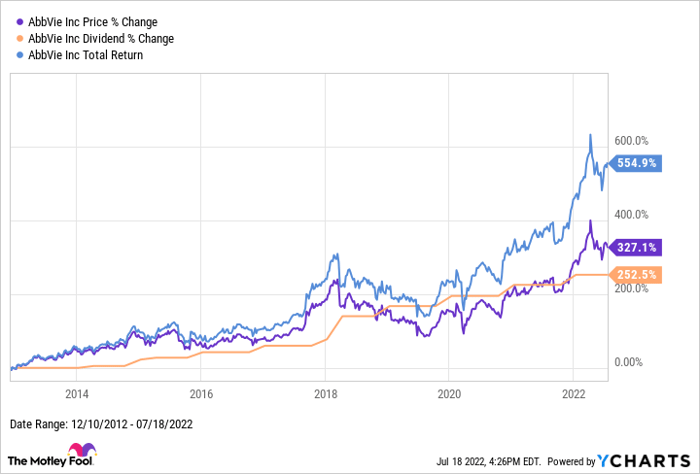
    Another great action to take to weather the bear market is to enable a dividend reinvestment plan (DRIP) for your dividend-paying stocks. Take the returns from AbbVie (NYSE: ABBV) over the last 10 years, for example:

    ABBV Chart

    ABBV data by YCharts

    As the chart shows, the price returns from AbbVie shares are nowhere near the total return that’s possible by retaining and reinvesting each of its quarterly dividend payments. When you reinvest your dividends instead of accepting them in cash and spending them elsewhere, your position compounds in value much faster.

    And when share prices dip during a bear market, the stock’s dividend yield increases accordingly, meaning that if you aren’t reinvesting your dividends at that moment, you’re missing out on securing some higher-yield shares for the remaining years of your long hold. 

    Plus, biopharma companies like AbbVie often have significant cash flows that are enough to keep hiking their dividend even when there’s a bear market, recession, or other economic issues.

    That means if you don’t set your shares to reinvest their dividends now, then by the time the bear market is over, you might have missed out on quite a bit of compounding at a very attractive rate. And it would be a shame to lose out on this bonus that’s there for the taking. 

    3. Talk yourself out of panic selling (or buying)

    Perhaps the most important step to take during a bear market or market crash is to take a deep breath and talk yourself out of selling your shares in a panic. (It’s also helpful to avoid frantically buying the dip on stocks you aren’t fully confident in but seem priced like a bargain.)

    Selling your shares locks in whatever losses you’ve sustained, regardless of whether there is a valid business reason for the underlying company to experience additional headwinds. 

    In the current market, it’s true that there are quite a few economic headwinds making things difficult, but it’s also true that buying high and selling low is a losing strategy.

    Eventually, the market will recover, and when it does, the stock you’re itching to sell could easily come back with a vengeance. Therefore, when you get tempted to pull the plug on some of your investments, you’ll regret not stepping back, especially if you don’t have a need for the money you invested anytime soon.

    When I get tempted to sell due to market chaos, I find that it’s often helpful to simply close my browser tab displaying my portfolio and take a walk outside. 

    This article was originally published on Fool.com. All figures quoted in US dollars unless otherwise stated.

    The post 3 steps you’ll regret not taking during this bear market appeared first on The Motley Fool Australia.

    Wondering where you should invest $1,000 right now?

    When investing expert Scott Phillips has a stock tip, it can pay to listen. After all, the flagship Motley Fool Share Advisor newsletter he has run for over ten years has provided thousands of paying members with stock picks that have doubled, tripled or even more.* Scott just revealed what he believes could be the “five best ASX stocks” for investors to buy right now. These stocks are trading at near dirt-cheap prices and Scott thinks they could be great buys right now

    See The 5 Stocks *Returns as of July 7 2022

    (function() { function setButtonColorDefaults(param, property, defaultValue) { if( !param || !param.includes(‘#’)) { var button = document.getElementsByClassName(“pitch-snippet”)[0].getElementsByClassName(“pitch-button”)[0]; button.style[property] = defaultValue; } } setButtonColorDefaults(“#43B02A”, ‘background’, ‘#5FA85D’); setButtonColorDefaults(“#43B02A”, ‘border-color’, ‘#43A24A’); setButtonColorDefaults(“#fff”, ‘color’, ‘#fff’); })()

    More reading

    Motley Fool contributor Alex Carchidi has no position in any of the stocks mentioned. The Motley Fool Australia’s parent company Motley Fool Holdings Inc. has no position in any of the stocks mentioned. The Motley Fool Australia has no position in any of the stocks mentioned. The Motley Fool has a disclosure policy. This article contains general investment advice only (under AFSL 400691). Authorised by Scott Phillips.

    This article was originally published on Fool.com. All figures quoted in US dollars unless otherwise stated.


    from The Motley Fool Australia https://ift.tt/tuYXR5Q
  • Running out of cash in retirement? 4 better options than taking on debt

    This article was originally published on Fool.com. All figures quoted in US dollars unless otherwise stated.

    An older couple use a calculator to work out what money they have to spend.

    This article was originally published on Fool.com. All figures quoted in US dollars unless otherwise stated.

    Inflation is making life tough on everyone right now, but it’s especially hard for retirees who have to make their nest eggs last an indefinite amount of time without a job bringing in steady income.

    When your financial accounts are dwindling, borrowing money to tide you over can feel like your only option. But it often leads to longer-term problems, especially if you wind up with high-interest debt.

    You may have other choices available to you, though. Here are four options to consider before you apply for a loan or charge a bunch to your credit card.

    1. Get a job

    Yeah, I know. Retirement is supposed to mean not working, but if you’re in serious financial trouble, getting a job can be one of the surest ways to get out of it. You’ll have a steady paycheck again, and you may even be able to add to your retirement accounts over time.

    Getting a job doesn’t have to mean going back to some corporate cubicle you hate, either. You can choose something that’s a little more laid-back or in line with your interests. You can even start your own business.

    2. Sell items you no longer want

    If you have a lot of unused possessions, consider selling them to make a quick buck. This might not help you out long-term, unless you own valuable artwork, antiques, or something similar. But it could help you make ends meet for a little while until you can work out a better long-term plan.

    It’s pretty easy to sell most items these days. Just create a profile on a marketplace website or post the item on social media and await offers.

    3. Look into government assistance programs

    You might qualify for government assistance programs that can help you cover your essential costs. For example, blind, disabled, and low-income seniors may qualify for supplemental income from the federal government. If you’re not sure if you qualify, check out the government’s eligibility screening tools.

    Explore the resources available to you at state and local levels as well. You may be able to get help paying for food, housing, medical care, and more.

    4. Consider a reverse mortgage

    A reverse mortgage is a kind of debt, but it might be a better choice for some than other types of debt, like credit card debt. Essentially, a reverse mortgage allows homeowners aged 62 or older to borrow against the equity they have in their homes. They can receive the cash as a lump sum, monthly payments, or a line of credit. And they don’t have to repay the loan as long as they’re alive and living in the home.

    But there are a few catches. First, you need substantial equity in your home in order to be able to do a reverse mortgage. Also, when you die or permanently move out of your home, the balance of the loan comes due. This could make it impossible to pass your home on to your heirs if they’re not able to pay it off.

    You will still face fees and interest with a reverse mortgage, but you don’t need an income or decent credit to get one. So it could be a good option if you don’t think you could affordably borrow money elsewhere.

    Sometimes, borrowing money might actually be a smart option for you. But don’t rule out these other income sources without checking them out.

    This article was originally published on Fool.com. All figures quoted in US dollars unless otherwise stated.

    The post Running out of cash in retirement? 4 better options than taking on debt appeared first on The Motley Fool Australia.

    Should you invest $1,000 in Asx:xjo right now?

    Before you consider Asx:xjo, you’ll want to hear this. Motley Fool Investing expert Scott Phillips just revealed what he believes are the 5 best stocks for investors to buy right now… and Asx:xjo wasn’t one of them. The online investing service he’s run for over a decade, Motley Fool Share Advisor, has provided thousands of paying members with stock picks that have doubled, tripled or even more.* And right now, Scott thinks there are 5 stocks that are better buys.

    See The 5 Stocks *Returns as of July 7 2022

    (function() { function setButtonColorDefaults(param, property, defaultValue) { if( !param || !param.includes(‘#’)) { var button = document.getElementsByClassName(“pitch-snippet”)[0].getElementsByClassName(“pitch-button”)[0]; button.style[property] = defaultValue; } } setButtonColorDefaults(“#0095C8”, ‘background’, ‘#5FA85D’); setButtonColorDefaults(“#0095C8”, ‘border-color’, ‘#43A24A’); setButtonColorDefaults(“#fff”, ‘color’, ‘#fff’); })()

    More reading

    The Motley Fool Australia’s parent company Motley Fool Holdings Inc. has no position in any of the stocks mentioned. The Motley Fool Australia has no position in any of the stocks mentioned. The Motley Fool has a disclosure policy. This article contains general investment advice only (under AFSL 400691). Authorised by Scott Phillips.

    This article was originally published on Fool.com. All figures quoted in US dollars unless otherwise stated.


    from The Motley Fool Australia https://ift.tt/nR0JDFr
  • How might China’s $6b Mineral Resources Group impact the iron ore price?

    Three Argosy miners stand together at a mine site studying documents with equipment in the backgroundThree Argosy miners stand together at a mine site studying documents with equipment in the background

    There’s a new global iron ore player on the circuit. Chinese authorities have officially established a new, nationalised iron-ore company called China Mineral Resources Group.

    The group was established this week with a paid-up capital of $US4.3 billion ($6.2 billion), according to Bloomberg,

    The new company is set to become China’s central purchaser of iron ore. Chinese steel mills would then source iron ore from the group.

    The move could see China tighten its control on the global steel market – at least, that is the intention.

    What does this mean for the iron ore price?

    Well, apparently not much, although it’s early days.

    The price of iron ore didn’t budge on the news and was trading sideways at US$100 per tonne at the time of writing, back at its December 2021 levels. It remains 51% down on the year.

    Meanwhile, large Aussie miners don’t appear too fazed by the news either. For instance, BHP Group Ltd (ASX: BHP) CFO David Lamont said the mining giant isn’t too convinced the entity will influence price action.

    Speaking at The Australian’s Strategic Business Forum, Lamont believes “markets will sort out where prices need to be based on supply and demand”.

    “[O]bviously [we] will meet what overall prices the overall economy and the world puts forward, so we’re not worried about that,” he added.

    Meanwhile, Fortescue Metals Group Limited (ASX: FMG) non-executive director Penny Bingham-Hall was more upbeat on the news.

    Bingham-Hall said the industry “has got a new customer”.

    “I’m a great believer that markets are defined by supply and demand and China is an incredibly important market for Australia,” she added.

    A spokesman for Rio Tinted Limited (ASX: RIO) said the company looked forward to ­“engaging with the new China Mineral Resources Group, government and our customers to understand more”.

    Looking forward, it will be interesting to see where the iron ore price heads from here.

    The post How might China’s $6b Mineral Resources Group impact the iron ore price? appeared first on The Motley Fool Australia.

    Wondering where you should invest $1,000 right now?

    When investing expert Scott Phillips has a stock tip, it can pay to listen. After all, the flagship Motley Fool Share Advisor newsletter he has run for over ten years has provided thousands of paying members with stock picks that have doubled, tripled or even more.* Scott just revealed what he believes could be the “five best ASX stocks” for investors to buy right now. These stocks are trading at near dirt-cheap prices and Scott thinks they could be great buys right now

    See The 5 Stocks
    *Returns as of July 7 2022

    (function() {
    function setButtonColorDefaults(param, property, defaultValue) {
    if( !param || !param.includes(‘#’)) {
    var button = document.getElementsByClassName(“pitch-snippet”)[0].getElementsByClassName(“pitch-button”)[0];
    button.style[property] = defaultValue;
    }
    }

    setButtonColorDefaults(“#0095C8”, ‘background’, ‘#5FA85D’);
    setButtonColorDefaults(“#0095C8”, ‘border-color’, ‘#43A24A’);
    setButtonColorDefaults(“#fff”, ‘color’, ‘#fff’);
    })()

    More reading

    Motley Fool contributor Zach Bristow has no position in any of the stocks mentioned. The Motley Fool Australia’s parent company Motley Fool Holdings Inc. has no position in any of the stocks mentioned. The Motley Fool Australia has no position in any of the stocks mentioned. The Motley Fool has a disclosure policy. This article contains general investment advice only (under AFSL 400691). Authorised by Scott Phillips.

    from The Motley Fool Australia https://ift.tt/Cf3npGs

  • Analysts name 2 ASX dividend shares to buy next week

    The Australian share market is home to a good number of shares offering attractive dividend yields.

    But which ones should you buy over others? Here are two that analysts rate as buys right now:

    Bapcor Ltd (ASX: BAP)

    The first ASX dividend share to look at is Bapcor. It is the company behind the Autobarn, Burson Auto Parts and Midas brands and Asia Pacific’s leading provider of vehicle parts, accessories, equipment, service and solutions.

    The team at Citi is positive on Bapcor despite the tough operating environment. In fact, its analysts see little risk around its FY 2022 earnings and upside to consensus FY 2023 net profit estimates of $140 million. This is due to its belief that Bapcor should benefit from DC efficiencies, cost outs, and acquisitions.

    As for dividends, its analysts are forecasting fully franked dividends of 22 cents per share in FY 2022 and then 24 cents per share in FY 2023. Based on the current Bapcor share price of $6.68, this will mean yields of 3.3% and 3.6%, respectively.

    The broker currently has a buy rating and $8.03 price target on the company’s shares.

    South32 Ltd (ASX: S32)

    Another ASX dividend share to look at is this mining giant. It could be a top option for income investors that are not averse to investing in the resources sector.

    This is due to the company’s attractive valuation, strong free cash flow generation, and positive dividend outlook.

    In respect to the latter, thanks to its exposure to a number of in-demand commodities such as aluminium, the team at Macquarie believe South32’s shares will provide investors with big fully franked dividend yields in the coming years.

    It is forecasting dividends per share of 34.5 cents in FY 2022 and 40.6 cents in FY 2023. Based on the current South32 share price of $3.53, this will mean yields of 9.8% and 11.5%, respectively.

    Macquarie has an outperform rating and $6.00 price target on the miner’s shares.

    The post Analysts name 2 ASX dividend shares to buy next week appeared first on The Motley Fool Australia.

    Wondering where you should invest $1,000 right now?

    When investing expert Scott Phillips has a stock tip, it can pay to listen. After all, the flagship Motley Fool Share Advisor newsletter he has run for over ten years has provided thousands of paying members with stock picks that have doubled, tripled or even more.* Scott just revealed what he believes could be the “five best ASX stocks” for investors to buy right now. These stocks are trading at near dirt-cheap prices and Scott thinks they could be great buys right now

    See The 5 Stocks
    *Returns as of July 7 2022

    (function() {
    function setButtonColorDefaults(param, property, defaultValue) {
    if( !param || !param.includes(‘#’)) {
    var button = document.getElementsByClassName(“pitch-snippet”)[0].getElementsByClassName(“pitch-button”)[0];
    button.style[property] = defaultValue;
    }
    }

    setButtonColorDefaults(“#0095C8”, ‘background’, ‘#5FA85D’);
    setButtonColorDefaults(“#0095C8”, ‘border-color’, ‘#43A24A’);
    setButtonColorDefaults(“#fff”, ‘color’, ‘#fff’);
    })()

    More reading

    Motley Fool contributor James Mickleboro has no position in any of the stocks mentioned. The Motley Fool Australia’s parent company Motley Fool Holdings Inc. has no position in any of the stocks mentioned. The Motley Fool Australia has recommended Bapcor. The Motley Fool has a disclosure policy. This article contains general investment advice only (under AFSL 400691). Authorised by Scott Phillips.

    from The Motley Fool Australia https://ift.tt/QiwFcgA

  • Have ASX shares bottomed yet?

    A baby reaches into the bottom drawer of a chest of drawers.A baby reaches into the bottom drawer of a chest of drawers.

    After a turbulent 2022 with wars, inflation and interest rate rises, it might surprise you that the S&P/ASX 200 Index (ASX: XJO) has actually risen 5% since 20 June.

    So some investors are asking now whether we have passed a trough? Are there brighter times from here onwards?

    After all, everything outside of the energy sector has been savagely sold off. Surely it gets to a point where selling is exhausted?

    Ophir Asset Management co-founders Steven Ng and Andrew Mitchell set out to answer this question in their latest letter to investors.

    More declines could come, but for how long?

    The first point to note, according to Ng and Mitchell, is that no one knows for sure whether the market has bottomed.

    But their hunch at the moment is “not yet”.

    “Why? Because we have not yet seen the earnings downgrades caused by central banks, most notably the [US] Fed, seeking to suppress demand through rapid rate hikes,” read the letter.

    “It would be highly unusual if earnings growth were not materially revised down because of the Fed likely compressing most rate hikes for this cycle into 2022.”

    They cited Goldman Sachs research showing that historically stock prices started their recovery about six to nine months before earnings pick up.

    “The market is forward looking and attempts to price in the coming earnings fall. This is essentially what we have seen so far in 2022,” said Ng and Mitchell.

    “But what happens next? This is where the great mystery lies.”

    Hard vs soft landing

    From here there are two possible scenarios, according to the Ophir team.

    Steep rises in interest rates could bring along a recession, which means significant falls in company earnings. This would mean stock prices have further falls coming.

    The alternative is that central banks miraculously achieve a “soft landing”, which would see just “minor revisions” downwards in earnings. That would bring a stock price recovery reasonably soon.

    “The reality is no one knows which it will be. Not the Fed, not your favourite economist and certainly not the press,” read the Ophir letter.

    “Take Goldman Sachs themselves. Early in July, its non-recessionary year-end forecast for the S&P 500 Index (SP: .INX) index is 4,300 (+14%), while its recessionary scenario forecast would see the index fall to 3,150 (-17%). Such a wide range as to be almost useless to anyone!”

    The trick is to remain vigilant of opportunities and to practise dollar-cost averaging.

    Veye director Varun Ratra said this week to “never give up in bear markets”.

    “Biggest gains are made in the early stages of the new uptrend,” he said. 

    “The smartest opportunities appear in the young bull markets.”

    The post Have ASX shares bottomed yet? appeared first on The Motley Fool Australia.

    Wondering where you should invest $1,000 right now?

    When investing expert Scott Phillips has a stock tip, it can pay to listen. After all, the flagship Motley Fool Share Advisor newsletter he has run for over ten years has provided thousands of paying members with stock picks that have doubled, tripled or even more.* Scott just revealed what he believes could be the “five best ASX stocks” for investors to buy right now. These stocks are trading at near dirt-cheap prices and Scott thinks they could be great buys right now

    See The 5 Stocks
    *Returns as of July 7 2022

    (function() {
    function setButtonColorDefaults(param, property, defaultValue) {
    if( !param || !param.includes(‘#’)) {
    var button = document.getElementsByClassName(“pitch-snippet”)[0].getElementsByClassName(“pitch-button”)[0];
    button.style[property] = defaultValue;
    }
    }

    setButtonColorDefaults(“#43B02A”, ‘background’, ‘#5FA85D’);
    setButtonColorDefaults(“#43B02A”, ‘border-color’, ‘#43A24A’);
    setButtonColorDefaults(“#fff”, ‘color’, ‘#fff’);
    })()

    More reading

    Motley Fool contributor Tony Yoo has no position in any of the stocks mentioned. The Motley Fool Australia’s parent company Motley Fool Holdings Inc. has no position in any of the stocks mentioned. The Motley Fool Australia has no position in any of the stocks mentioned. The Motley Fool has a disclosure policy. This article contains general investment advice only (under AFSL 400691). Authorised by Scott Phillips.

    from The Motley Fool Australia https://ift.tt/mljQFgo