• Is the Adairs share price outlook brightening for July?

    A woman sets flowers on a side table in a beautifully furnished bedroom.

    A woman sets flowers on a side table in a beautifully furnished bedroom.

    The Adairs Ltd (ASX: ADH) share price has seen a lot of volatility over the past six months. But, with shares going up 12% over the past week, is the outlook looking better for the homewares and furniture business?

    Adairs now operates three businesses – Adairs, Mocka and Focus on Furniture. There are question marks about what will happen with the economy considering inflation is elevated and interest rates are rising. How much impact will this have on demand for Adairs? Time will tell.

    Let’s look at the latest sales update from the business.

    Trading update

    The company gave a trading update for the first seven weeks of the second half of FY22. It noted that it had continued to see online growth for both Adairs and Mocka, despite cycling record growth rates in the prior corresponding period. Growth can have an important influence on the Adairs share price.

    It noted that store sales softened as customers limited their “discretionary outings” in regards to the COVID-19 variant called Omicron.

    Adairs store sales were down 1.8%, while Adairs online sales were up 9.7%. Mocka sales were up 14.8%. While Focus sales were down 7.3% year on year, that comparison was against a period before Adairs’ ownership. Including Focus sales, total group sales were up 33.8%.

    In February 2022, which was quite a while ago considering everything that has happened since, Adairs said its businesses have good stock levels and “clear opportunities for growth” in the second half. It also said “the macro-economic environment is supportive with strong employment and emerging wages growth.”

    What do brokers think of the Adairs share price?

    One of the latest views comes from UBS. It currently has a rating of buy on the business.

    UBS has a price target of $3.70 – that’s where the broker believes the Adairs share price could be in 12 months from now. But, remember that UBS (probably) doesn’t have a crystal ball.

    If the Adairs share price were to rise to $3.70, that would be a rise of more than 80% over the next year.

    UBS is now expecting less revenue from Adairs in the next few financial years as the toughening economic environment is expected to hurt demand. The goal of the Reserve Bank of Australia (RBA) is essentially to reduce demand and bring down inflation by raising interest rates.

    However, despite the challenges, UBS thinks that the Adairs share price is good value at the current forward price/earnings ratio.

    Using UBS’ estimates, Adairs is valued at 7 times FY23’s estimated earnings.

    The post Is the Adairs share price outlook brightening for July? appeared first on The Motley Fool Australia.

    Wondering where you should invest $1,000 right now?

    When investing expert Scott Phillips has a stock tip, it can pay to listen. After all, the flagship Motley Fool Share Advisor newsletter he has run for over ten years has provided thousands of paying members with stock picks that have doubled, tripled or even more.* Scott just revealed what he believes could be the “five best ASX stocks” for investors to buy right now. These stocks are trading at near dirt-cheap prices and Scott thinks they could be great buys right now

    See The 5 Stocks
    *Returns as of June 1 2022

    (function() {
    function setButtonColorDefaults(param, property, defaultValue) {
    if( !param || !param.includes(‘#’)) {
    var button = document.getElementsByClassName(“pitch-snippet”)[0].getElementsByClassName(“pitch-button”)[0];
    button.style[property] = defaultValue;
    }
    }

    setButtonColorDefaults(“#0095C8”, ‘background’, ‘#5FA85D’);
    setButtonColorDefaults(“#0095C8”, ‘border-color’, ‘#43A24A’);
    setButtonColorDefaults(“#fff”, ‘color’, ‘#fff’);
    })()

    More reading

    Motley Fool contributor Tristan Harrison has no position in any of the stocks mentioned. The Motley Fool Australia’s parent company Motley Fool Holdings Inc. has positions in and has recommended ADAIRS FPO. The Motley Fool Australia has positions in and has recommended ADAIRS FPO. The Motley Fool has a disclosure policy. This article contains general investment advice only (under AFSL 400691). Authorised by Scott Phillips.

    from The Motley Fool Australia https://ift.tt/dMkWo7Q

  • Why is the Woodside share price sliding today?

    A surprised man sits at his desk in his study staring at his computer screen with his hands up while he watched the Sezzle share price fall despite the company accepting a takeover offer from Zip CoA surprised man sits at his desk in his study staring at his computer screen with his hands up while he watched the Sezzle share price fall despite the company accepting a takeover offer from Zip Co

    The Woodside Energy Group Ltd (ASX: WDS) share price is in the red today.

    Woodside shares are currently swapping hands at $31.97 apiece, a 2.59% fall. For perspective, the S&P/ASX 200 Index (ASX: XJO) is down 0.76% today.

    So what is going on with this ASX oil and gas share?

    Oil prices slide

    Woodside shares are down today, but they are not alone among ASX energy shares. The Santos Ltd (ASX: STO) share price is down 0.73%, while the Beach Energy Ltd (ASX: BPT) share price is falling 3.07%. The S&P/ASX 200 Energy Index (ASX: XEJ) is declining 1.77% at the time of writing.

    The Woodside share price appears to be falling amid declining oil prices in global markets overnight.

    WTI crude oil price dropped 2.1% to US$109.37 a barrel, while Brent crude oil fell 2.4% to US$115.20 a barrel.

    The oil price fell amid rising US gasoline and distillate inventories, Reuters reported. The rise in the US dollar also had an impact, according to the news agency. A higher US dollar means oil costs more for those purchasing with alternative currencies.

    A report from the Energy Information Administration in the United States put a “damper on the market”, according to Again Capital LLC partner John Kilduff. In quotes cited by Reuters, he said:

    The rise in gasoline and distillate inventories eases the pressure a bit and the uptick in US production also factored into the price decline.

    Woodside merged with BHP Group Ltd (ASX: BHP)’s oil and gas portfolio at the beginning of June, making it a top-10 global energy company by hydrocarbon production. The company also recently listed on the London and New York stock exchanges under the ticker WDS.

    Woodside’s New York listing descended 1.56% overnight, while the London listing fell 1.09%.

    Woodside share price snapshot

    The Woodside share price has exploded 44% in the past year while it has surged ahead 46% in the year to date.

    In contrast, the benchmark S&P/ASX 200 Index (ASX: XJO) has descended 9% over the past year.

    Woodside has a market capitalisation of about $60.9 billion based on today’s share price.

    The post Why is the Woodside share price sliding today? appeared first on The Motley Fool Australia.

    Should you invest $1,000 in Woodside Energy Group Ltd right now?

    Before you consider Woodside Energy Group Ltd, you’ll want to hear this.

    Motley Fool Investing expert Scott Phillips just revealed what he believes are the 5 best stocks for investors to buy right now… and Woodside Energy Group Ltd wasn’t one of them.

    The online investing service he’s run for over a decade, Motley Fool Share Advisor, has provided thousands of paying members with stock picks that have doubled, tripled or even more.* And right now, Scott thinks there are 5 stocks that are better buys.

    See The 5 Stocks
    *Returns as of June 1 2022

    (function() {
    function setButtonColorDefaults(param, property, defaultValue) {
    if( !param || !param.includes(‘#’)) {
    var button = document.getElementsByClassName(“pitch-snippet”)[0].getElementsByClassName(“pitch-button”)[0];
    button.style[property] = defaultValue;
    }
    }

    setButtonColorDefaults(“#43B02A”, ‘background’, ‘#5FA85D’);
    setButtonColorDefaults(“#43B02A”, ‘border-color’, ‘#43A24A’);
    setButtonColorDefaults(“#fff”, ‘color’, ‘#fff’);
    })()

    More reading

    Motley Fool contributor Monica O’Shea has no position in any of the stocks mentioned. The Motley Fool Australia’s parent company Motley Fool Holdings Inc. has no position in any of the stocks mentioned. The Motley Fool Australia has no position in any of the stocks mentioned. The Motley Fool has a disclosure policy. This article contains general investment advice only (under AFSL 400691). Authorised by Scott Phillips.

    from The Motley Fool Australia https://ift.tt/zODdcNj

  • Why is the PointsBet share price storming 13% higher today?

    Three businesspeople leap high with the CBD in the background.

    Three businesspeople leap high with the CBD in the background.

    The PointsBet Holdings Ltd (ASX: PBH) share price has been a very strong performer on Thursday.

    At the time of writing, the sports betting company’s shares are up 13% to $2.73.

    This means the PointsBet share price is now up 35% over the last two weeks.

    Why is the PointsBet share price racing higher?

    Investors have been bidding the PointsBet share price higher today despite there being no news out of the company.

    Though, it is worth remembering that there has been some very promising news out of PointsBet this month, which could be supporting its shares.

    That news was SIG Sports Investment Corp (SIG) investing $94.16 million into the company via a placement of shares at a significant premium to the PointsBet share price at the time.

    SIG co-founder and managing director Jeff Yass commented: “After several years of thoroughly evaluating the North American sports betting market for the right partner, SIG Sports is pleased to have made what we consider to be a long-term investment in PointsBet.”

    This purchase meant SIG became PointsBet’s largest shareholder with a 12.8% stake.

    The response

    The response to this investment was positive in the broker community.

    For example, Goldman Sachs, which has a buy rating and $5.78 price target, said:

    We see strategic merit in today’s events for PBH given the addition of a long-term strategic investor (with voluntary lock up period) to its register and the potential operating upside from further widening its margin/tech gap to peers through its partnership with [SIG’s] Nellie Analytics.

    Elsewhere, Bell Potter, which has a speculative buy rating and $5.25 price target, highlights the boost this has given to the company’s balance sheet. It said:

    The other key change, of course, is the cash which we now forecast to be around $445m and $175m at the end of FY22 and FY23 (both net of around $50m in player cash accounts). This suggests the company has sufficient cash for at least another year and then has the ability to raise funds in FY24 through the deferred bonus equity options if necessary.

    The post Why is the PointsBet share price storming 13% higher today? appeared first on The Motley Fool Australia.

    Should you invest $1,000 in Pointsbet Holdings Ltd right now?

    Before you consider Pointsbet Holdings Ltd, you’ll want to hear this.

    Motley Fool Investing expert Scott Phillips just revealed what he believes are the 5 best stocks for investors to buy right now… and Pointsbet Holdings Ltd wasn’t one of them.

    The online investing service he’s run for over a decade, Motley Fool Share Advisor, has provided thousands of paying members with stock picks that have doubled, tripled or even more.* And right now, Scott thinks there are 5 stocks that are better buys.

    See The 5 Stocks
    *Returns as of June 1 2022

    (function() {
    function setButtonColorDefaults(param, property, defaultValue) {
    if( !param || !param.includes(‘#’)) {
    var button = document.getElementsByClassName(“pitch-snippet”)[0].getElementsByClassName(“pitch-button”)[0];
    button.style[property] = defaultValue;
    }
    }

    setButtonColorDefaults(“#43B02A”, ‘background’, ‘#5FA85D’);
    setButtonColorDefaults(“#43B02A”, ‘border-color’, ‘#43A24A’);
    setButtonColorDefaults(“#fff”, ‘color’, ‘#fff’);
    })()

    More reading

    Motley Fool contributor James Mickleboro has no position in any of the stocks mentioned. The Motley Fool Australia’s parent company Motley Fool Holdings Inc. has positions in and has recommended Pointsbet Holdings Ltd. The Motley Fool Australia has recommended Pointsbet Holdings Ltd. The Motley Fool has a disclosure policy. This article contains general investment advice only (under AFSL 400691). Authorised by Scott Phillips.

    from The Motley Fool Australia https://ift.tt/seAzcMr

  • These 3 ASX gold mining shares are digging new 52-week lows today

    A boy holds a gold bar with a surprised look on his face due to falling ASX gold mining shares todayA boy holds a gold bar with a surprised look on his face due to falling ASX gold mining shares today

    It’s a pretty depressing day and end to the month so far for the S&P/ASX 200 Index (ASX: XJO).

    So far this Thursday, the ASX 200 has lost another 0.8% of its value and is now back under 6,650 points.

    But it’s an even worse day for a few ASX gold mining shares that have hit new 52-week lows today.

    Which ASX gold mining shares are digging new troughs?

    The first is Northern Star Resources Ltd (ASX: NST).

    Shares in this ASX 200 gold miner have fallen 0.21%, down to $7.02 each at the time of writing.

    Earlier in today’s trading session, Northern Star shares went as low as $6.96. That’s the company’s new 52-week low. Northern Star shares haven’t consistently traded below $7 since back in 2018.

    Fellow ASX gold miner St Barbara Ltd (ASX: SBM) is currently down by 0.4% at 77 cents a share.

    Earlier today, St Barbara shares went as low as 76 cents, which is the company’s new 52-week low.

    This is an especially bleak milestone for St Barbara, which hasn’t seen its share price at these kinds of levels since way back in 2015.

    Another ASX gold miner to check out is Silver Lake Resources Limited (ASX: SLR).

    Despite its name, Silver Lake is a gold producer as well. And just like Northern Star and St Barbara, we’ve seen this company hit a new 52-week low today, too.

    Silver Lake shares are sitting at their new 52-week low of $1.22 after losing 0.81% so far today. You have to go back to the worst of the COVID-19 crash of 2020 to find the last time Silver Lake was at these levels.

    What’s spooking this ‘safe haven’ sector?

    ASX gold shares have been under pressure all week, thanks in most part to the disappointing update given by ASX 200 gold miner Evolution Mining Ltd (ASX: EVN) on Monday.

    Evolution flagged falling production and higher costs, which seems to have spooked gold investors in recent days. That’s despite the price of gold itself remaining relatively steady in recent weeks.

    The yellow metal is asking US$1,825 an ounce at the time of writing, relatively close to its average price over the past 12 months (although down from the US$2,000-plus levels we saw back in March).

    The post These 3 ASX gold mining shares are digging new 52-week lows today appeared first on The Motley Fool Australia.

    Wondering where you should invest $1,000 right now?

    When investing expert Scott Phillips has a stock tip, it can pay to listen. After all, the flagship Motley Fool Share Advisor newsletter he has run for over ten years has provided thousands of paying members with stock picks that have doubled, tripled or even more.* Scott just revealed what he believes could be the “five best ASX stocks” for investors to buy right now. These stocks are trading at near dirt-cheap prices and Scott thinks they could be great buys right now

    See The 5 Stocks
    *Returns as of June 1 2022

    (function() {
    function setButtonColorDefaults(param, property, defaultValue) {
    if( !param || !param.includes(‘#’)) {
    var button = document.getElementsByClassName(“pitch-snippet”)[0].getElementsByClassName(“pitch-button”)[0];
    button.style[property] = defaultValue;
    }
    }

    setButtonColorDefaults(“#0095C8”, ‘background’, ‘#5FA85D’);
    setButtonColorDefaults(“#0095C8”, ‘border-color’, ‘#43A24A’);
    setButtonColorDefaults(“#fff”, ‘color’, ‘#fff’);
    })()

    More reading

    Motley Fool contributor Sebastian Bowen has no position in any of the stocks mentioned. The Motley Fool Australia’s parent company Motley Fool Holdings Inc. has no position in any of the stocks mentioned. The Motley Fool Australia has no position in any of the stocks mentioned. The Motley Fool has a disclosure policy. This article contains general investment advice only (under AFSL 400691). Authorised by Scott Phillips.

    from The Motley Fool Australia https://ift.tt/sYveulL

  • What’s the outlook for the CSL share price in July?

    A doctor appears shocked as he looks through binoculars on a blue background.A doctor appears shocked as he looks through binoculars on a blue background.

    The CSL Limited (ASX: CSL) share price was almost flat in June, but could it have better days ahead in July?

    CSL shares have gained 0.04% since market close on 31 May and are currently trading at $271.96. For perspective, the  S&P/ASX 200 Index (ASX: XJO) has shed 7% in the same time.

    Let’s take a look at the outlook for the CSL share price in the next month.

    Could CSL go higher?

    CSL is a global biotechnology company specialising in plasma products and flu vaccines.

    Several analysts are tipping the company’s share price to go higher. Citi analysts have recently placed a $330 price target on the company’s shares and maintained the buy rating. This is a 21% upside on the current share price.

    Analysts at Citi highlighted there is “strong” demand for plasma products, while supply is constrained due to low collection volume. Citi said:

    With plasma collections now back to pre-pandemic levels, we expect the market to shift its focus to the strong underlying plasma product demand.

    Meanwhile, Ben Clark from TMS Capital recently named CSL as one of a number of “high-quality growth businesses” that could be an opportunity. He said the CSL share price and other quality ASX shares are lower than where they should be and will be “significantly bigger” from this point.

    Wilsons analysts have also highlighted CSL as one of three shares the team has added to their “focus list” of desirable ASX shares. The team screened the S&P/ASX 300 Index (ASX: XKO) list for shares that look like “value”, as my Foolish colleague Tony reported.

    CSL delivered a net profit after tax (NPAT) of $1.76 billion in the first half of FY22, down 5% on a constant currency basis. The company predicts a total net profit after tax for FY22 of between $2.15 and $2.25 billion.

    CSL share price snapshot

    The CSL share price has descended nearly 5% in the past 12 months, while it is down almost 7% this year to date.

    In comparison, the benchmark ASX 200 has shed close to 9% over the past year.

    CSL has a market capitalisation of more than $130 billion based on today’s share price.

    The post What’s the outlook for the CSL share price in July? appeared first on The Motley Fool Australia.

    Wondering where you should invest $1,000 right now?

    When investing expert Scott Phillips has a stock tip, it can pay to listen. After all, the flagship Motley Fool Share Advisor newsletter he has run for over ten years has provided thousands of paying members with stock picks that have doubled, tripled or even more.* Scott just revealed what he believes could be the “five best ASX stocks” for investors to buy right now. These stocks are trading at near dirt-cheap prices and Scott thinks they could be great buys right now

    See The 5 Stocks
    *Returns as of June 1 2022

    (function() {
    function setButtonColorDefaults(param, property, defaultValue) {
    if( !param || !param.includes(‘#’)) {
    var button = document.getElementsByClassName(“pitch-snippet”)[0].getElementsByClassName(“pitch-button”)[0];
    button.style[property] = defaultValue;
    }
    }

    setButtonColorDefaults(“#0095C8”, ‘background’, ‘#5FA85D’);
    setButtonColorDefaults(“#0095C8”, ‘border-color’, ‘#43A24A’);
    setButtonColorDefaults(“#fff”, ‘color’, ‘#fff’);
    })()

    More reading

    Citigroup is an advertising partner of The Ascent, a Motley Fool company. Motley Fool contributor Monica O’Shea has no position in any of the stocks mentioned. The Motley Fool Australia’s parent company Motley Fool Holdings Inc. has positions in and has recommended CSL Ltd. The Motley Fool Australia has no position in any of the stocks mentioned. The Motley Fool has a disclosure policy. This article contains general investment advice only (under AFSL 400691). Authorised by Scott Phillips.

    from The Motley Fool Australia https://ift.tt/VWqghsI

  • Own Rio Tinto shares? Here’s how the company is ‘canning’ carbon emissions

    Two men sit in garden on chairs facing each other and fist bump while holding a beer.Two men sit in garden on chairs facing each other and fist bump while holding a beer.

    Those invested in Rio Tinto Limited (ASX: RIO) shares can celebrate after the company announced its made having a cold one more environmentally friendly.

    Beer cans made using aluminium produced by Rio Tinto and leveraging ELYSIS technology have hit shelves in Canada. The cans can boast 30% fewer carbon emissions than those made using traditional manufacturing techniques in North America.

    At the time of writing, the Rio Tinto share price is $105.11, 1.05% lower than its previous close.

    For context, the broader market is also struggling on Thursday. The S&P/ASX 200 Index (ASX: XJO) is down 0.62% right now while the All Ordinaries Index (ASX: XAO) has slipped 0.62%.

    Let’s take a closer look at the latest renewables-related news from the resources giant.

    Low emissions aluminium cans hit shelves

    Own Rio Tinto shares? The company’s partnership with Corona Canada has borne a pilot low carbon beverage can.

    Aluminium made using ELYSIS technology has been shaped into 1.2 million cans and filled with Corona beer.

    ELYSIS technology can remove all direct greenhouse gas emissions from the aluminium smelting process, emitting oxygen as a by-product. The tech was produced through a partnership between aluminium giants Rio Tinto and Alcoa.

    Rio Tinto notes around 70% of aluminium used to produce cans in North America is already made with recycled aluminium. Pairing such recycled metal with Rio Tinto aluminium – made with renewable hydropower – and metal produced using ELYSIS technology reduces carbon emissions by more than 30%.

    The limited release drinks cans can be purchased in Canada. Shoppers can also scan a QR code on the can to trace how the product was made.

    Rio Tinto plans to utilise its START initiative to allow customers insight into the mine-to-market creation of more beverage cans in the future.

    The successful pilot follows a memorandum of understanding signed between Rio Tinto and Corona Canada’s parent company AB InBev in 2020.

    Rio Tinto share price snapshot

    Despite today’s dip, the Rio Tinto share price is outperforming the broader market in 2022.

    It has gained 5% year to date. Meanwhile, the ASX 200 has slipped 12.5%.

    Though, the resource giant’s stock has slumped 17% over the last 12 months. The ASX 200 has only dipped 9% in that time.

    The post Own Rio Tinto shares? Here’s how the company is ‘canning’ carbon emissions appeared first on The Motley Fool Australia.

    Should you invest $1,000 in Rio Tinto Limited right now?

    Before you consider Rio Tinto Limited, you’ll want to hear this.

    Motley Fool Investing expert Scott Phillips just revealed what he believes are the 5 best stocks for investors to buy right now… and Rio Tinto Limited wasn’t one of them.

    The online investing service he’s run for over a decade, Motley Fool Share Advisor, has provided thousands of paying members with stock picks that have doubled, tripled or even more.* And right now, Scott thinks there are 5 stocks that are better buys.

    See The 5 Stocks
    *Returns as of June 1 2022

    (function() {
    function setButtonColorDefaults(param, property, defaultValue) {
    if( !param || !param.includes(‘#’)) {
    var button = document.getElementsByClassName(“pitch-snippet”)[0].getElementsByClassName(“pitch-button”)[0];
    button.style[property] = defaultValue;
    }
    }

    setButtonColorDefaults(“#43B02A”, ‘background’, ‘#5FA85D’);
    setButtonColorDefaults(“#43B02A”, ‘border-color’, ‘#43A24A’);
    setButtonColorDefaults(“#fff”, ‘color’, ‘#fff’);
    })()

    More reading

    Motley Fool contributor Brooke Cooper has no position in any of the stocks mentioned. The Motley Fool Australia’s parent company Motley Fool Holdings Inc. has no position in any of the stocks mentioned. The Motley Fool Australia has no position in any of the stocks mentioned. The Motley Fool has a disclosure policy. This article contains general investment advice only (under AFSL 400691). Authorised by Scott Phillips.

    from The Motley Fool Australia https://ift.tt/VRD6cie

  • Companies with high free cash flow margins and high free cash flow yields massively outperform the market over time

    This article was originally published on Fool.com. All figures quoted in US dollars unless otherwise stated.

    a water tap is turned on and showering out banknotes into the open hand of a woman below it.

    This article was originally published on Fool.com. All figures quoted in US dollars unless otherwise stated.

    In our prior dispatch, we learned that return on invested capital (ROIC) is the most important financial metric because:

    1. An increase in ROIC always increases intrinsic business value but revenue growth does not always increase intrinsic value. Revenue growth only increases intrinsic value when ROIC is greater than the weighted average cost of capital (WACC).
    2. Companies with high ROIC outperform the stock market by a country mile.
    3. And companies with rising ROIC (and high incremental returns on invested capital) outperform the market by even more!

    Return on invested capital is calculated as net operating profit after tax (NOPAT) divided by average invested capital, so it has a robust profitability metric in the numerator and a balance sheet measure in the denominator. In this way, it is the linchpin that connects a company’s profitability (income statement), balance sheet, and free cash flow (FCF).

    And strong and growing free cash flow (particularly FCF per share) is ultimately what we are after as investors. As we stated (and repeated) in the linked article and are restating again now, businesses with higher ROIC generate more FCF per dollar of earnings, and growth of free cash flow is what drives growth of intrinsic value! In fact, the definition of intrinsic value (also referred to as fair or fundamental value) is the present value of future free cash flows. Fair value can also be thought of as the price you can pay for a stock and roughly earn your required rate of return (or hurdle rate in your discounted cash flow model).

    The great Michael Mauboussin says (100% correctly, I might add) that all of the quantitative and qualitative work (due diligence) that we do as analysts serves one purpose and one job only: to help us estimate (with a high-enough degree of conviction) the free cash flows a company will generate from now until the end of the life of that business and then to compare our estimates for free cash flow growth to the expectations for free cash flow priced into the stock. Then, when we think the expectations for future free cash flow growth are too low, we buy the stock. And when we think the expectations for future free cash flow growth priced into the stock are too high (and even extreme and insane like we saw in 2020-2021), we can choose to trim or sell the stock.

    That’s it, Fools. All of the weeks and months (and sometimes years) of research and analysis that we do as investors is only so that we can make educated guesses about how much free cash flow the company will generate and at what rate that free cash flow will grow over the forecast period in our discounted cash flow models.

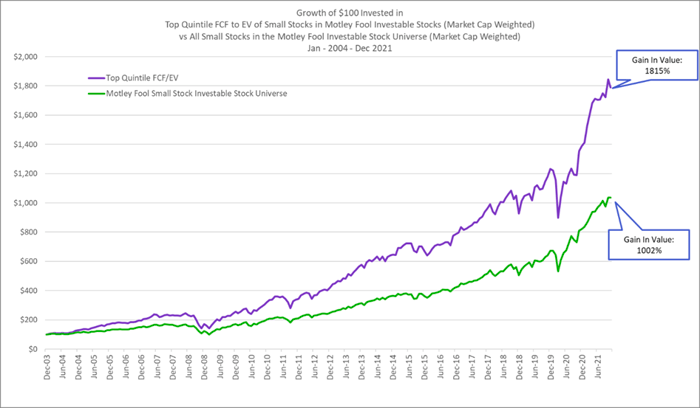
    So, if everything boils down to free cash flow, it may come as no surprise that companies that generate high free cash flow margins (FCF divided by revenue) and companies that provide high free cash flow yields (FCF divided by enterprise value) also outperform the market by light-years.

    Chart showing how stocks in the top FCF/EV quintile outperform other stocks.

    Free cash flow margin measures the true economic profitability and cash-generating power of a business and is simply the number of pennies of FCF a company generates for every dollar of sales. And free cash flow yield is the inverse of the enterprise value-to-FCF multiple. Thinking in terms of yield allows investors to compare a stock’s FCF yield to the risk-free rate (the yield on the 10-year U.S. Treasury bond), to the yields of other stocks and bonds, and to the yields from investing in real estate (a real estate’s cap rate is calculated as annual net cash flow divided by the purchase price of the property). All else being equal, whether you are dealing with stocks, bonds, or real estate, higher yields indicate cheaper purchase prices. 

    Here is how I like to think about free cash flow yield: a company’s dividend yield is how much cash the company actually pays out as a dividend, but free cash flow yield is how much cash the company could potentially pay out as a dividend if it chose to pay out all excess free cash flow as a dividend. As Bill Miller told me: “Empirically, free cash flow yield is the most useful metric. If a company is earning above its cost of capital, free cash flow yield plus growth is a good rough proxy for expected annual return.” Several of the world’s best investors use this FCF total return formula (FCF yield + expected growth of FCF over the next 5 years) when picking stocks.

    Said another way, FCF yield is the amount of cash (as a percentage of the firm value) a sole owner could take out of the business every year to pay themselves. This is the excess, unencumbered free cash that is left over after investing to maintain and grow the business, and it is calculated as NOPAT less new invested capital, where invested capital is any form of investment including working capital, capital expenditures (property, plant and equipment), or acquisitions. Research and development (R&D) and sales and marketing (S&M) is also subtracted out (accounted for) on the income statement to get NOPAT. So all growth investments are accounted for and free cash flow is what is left over to pay all claim holders after investing in paying all bills and growing the business. Hence, the term “free.” To understand more on free cash flow, this article from Michael Mauboussin is a must-read.

    This free cash flow is what we care most about because it can be used to reward shareowners by either (1) paying down debt (which reduces the claim that debtholders have on the business and strengthens the company’s financial position), (2) paying a dividend, or (3) buying back stock at attractive prices. Then any leftover free cash that isn’t used to pay down debt, pay a dividend, or repurchase stock can sit on the balance sheet and be used at a later date (i.e., large cash and net cash positions create optionality value).

    So, now that you know that companies with high and/or rising ROIC and strong and growing FCF selling at attractive prices outperform the market, why would you not focus your largest positions on companies that have high and/or rising ROIC with high and/or rising FCF margins selling at high FCF yields?

    I’ve said it at least 100 times and I’m going to say it again: Strong free cash flow generation, a long runway of free cash flow growth, and the price we pay for it is really all that matters to long-term investing success. If you want to live the free cash flow way, read Expectations Investing by Michael Mauboussin and Al Rappaport. It’s the best investing book I’ve ever read, and it could change your life. This is the way to investing nirvana, Fools. 

    This article was originally published on Fool.com. All figures quoted in US dollars unless otherwise stated.

    The post Companies with high free cash flow margins and high free cash flow yields massively outperform the market over time appeared first on The Motley Fool Australia.

    Should you invest $1,000 in right now?

    Before you consider , you’ll want to hear this.

    Motley Fool Investing expert Scott Phillips just revealed what he believes are the 5 best stocks for investors to buy right now… and wasn’t one of them.

    The online investing service he’s run for over a decade, Motley Fool Share Advisor, has provided thousands of paying members with stock picks that have doubled, tripled or even more.* And right now, Scott thinks there are 5 stocks that are better buys.

    See The 5 Stocks
    *Returns as of June 1 2022

    (function() {
    function setButtonColorDefaults(param, property, defaultValue) {
    if( !param || !param.includes(‘#’)) {
    var button = document.getElementsByClassName(“pitch-snippet”)[0].getElementsByClassName(“pitch-button”)[0];
    button.style[property] = defaultValue;
    }
    }

    setButtonColorDefaults(“#0095C8”, ‘background’, ‘#5FA85D’);
    setButtonColorDefaults(“#0095C8”, ‘border-color’, ‘#43A24A’);
    setButtonColorDefaults(“#fff”, ‘color’, ‘#fff’);
    })()

    More reading

    The Motley Fool Australia’s parent company Motley Fool Holdings Inc. has no position in any of the stocks mentioned. The Motley Fool Australia has no position in any of the stocks mentioned. The Motley Fool has a disclosure policy. This article contains general investment advice only (under AFSL 400691). Authorised by Scott Phillips.

    This article was originally published on Fool.com. All figures quoted in US dollars unless otherwise stated.

    from The Motley Fool Australia https://ift.tt/QxAsc2e

  • Why is the Cann share price smoking out the ASX by 20% today

    Rising cannabis share price.Rising cannabis share price.

    The Cann Group Ltd (ASX: CAN) share price is rocketing on Thursday.

    This comes after the cannabis company announced a positive update regarding its Mildura facility.

    At the time of writing, Cann shares are fetching at 27.5 cents, up 19.57%.

    Cann secures GMP licence

    Investors are bidding up the Cann share price following the company’s approval to manufacture active pharmaceutical ingredients (API).

    According to its release, Cann advised it has received a GMP manufacturing licence from the Therapeutic Goods Administration (TGA).

    This allows Cann to produce API and hard capsules and conduct GMP-approved activities at its existing chemistry and microbiology laboratories.

    The milestone certification could lead to an expanded sales base as the company can now perform in-house tests to meet domestic and overseas regulatory requirements.

    Cann noted that obtaining the GMP licence enables medicinal cannabis products to be sold in Australia and for export markets. The latter however is subject to further approvals.

    Cann CEO, Peter Crock touched on the achievement, saying:

    GMP licencing is the regulatory capstone of the Mildura facility, allowing us to cultivate, extract, manufacture, test, and supply finished products entirely in-house. With the licence in place, we can now add additional GMP capabilities in response to market demands.

    About the Cann share price

    Despite today’s strong gains, the Cann share price is down 7% in 2022.

    When looking further out, the company’s shares are down 20% over the last 12 months.

    Based on valuation metrics, Cann presides a market capitalisation of around $87.28 million.

    The post Why is the Cann share price smoking out the ASX by 20% today appeared first on The Motley Fool Australia.

    Should you invest $1,000 in Cann Group Limited right now?

    Before you consider Cann Group Limited, you’ll want to hear this.

    Motley Fool Investing expert Scott Phillips just revealed what he believes are the 5 best stocks for investors to buy right now… and Cann Group Limited wasn’t one of them.

    The online investing service he’s run for over a decade, Motley Fool Share Advisor, has provided thousands of paying members with stock picks that have doubled, tripled or even more.* And right now, Scott thinks there are 5 stocks that are better buys.

    See The 5 Stocks
    *Returns as of June 1 2022

    (function() {
    function setButtonColorDefaults(param, property, defaultValue) {
    if( !param || !param.includes(‘#’)) {
    var button = document.getElementsByClassName(“pitch-snippet”)[0].getElementsByClassName(“pitch-button”)[0];
    button.style[property] = defaultValue;
    }
    }

    setButtonColorDefaults(“#0095C8”, ‘background’, ‘#5FA85D’);
    setButtonColorDefaults(“#0095C8”, ‘border-color’, ‘#43A24A’);
    setButtonColorDefaults(“#fff”, ‘color’, ‘#fff’);
    })()

    More reading

    Motley Fool contributor Aaron Teboneras has no position in any of the stocks mentioned. The Motley Fool Australia’s parent company Motley Fool Holdings Inc. has no position in any of the stocks mentioned. The Motley Fool Australia has no position in any of the stocks mentioned. The Motley Fool has a disclosure policy. This article contains general investment advice only (under AFSL 400691). Authorised by Scott Phillips.

    from The Motley Fool Australia https://ift.tt/JzEPNFa

  • ASX 200 midday update: Energy shares drop, PointsBet jumps

    A group of market analysts sit and stand around their computers in an open-plan office environment. The central figures are deep in thought about Megaport's recent earnings release

    A group of market analysts sit and stand around their computers in an open-plan office environment. The central figures are deep in thought about Megaport's recent earnings release

    At lunch on Thursday, the S&P/ASX 200 Index (ASX: XJO) is on course to record another decline. The benchmark index is currently down 0.8% to 6,645.2 points.

    Here’s what is happening on the ASX 200 today:

    Energy shares drop

    The energy sector is weighing on the ASX 200 index on Thursday. The likes of Beach Energy Ltd (ASX: BPT) and Woodside Energy Group Ltd (ASX: WDS) are tumbling following a pullback in oil prices overnight. This was driven by fears that a recession could lessen demand for oil. The S&P/ASX 200 Energy index is down 1.7% at the time of writing.

    CSR announces share buyback

    The CSR Limited (ASX: CSR) share price is trading lower today despite the company announcing a share buyback. The building products company is planning to return $100 million to shareholders via an on-market buyback. CSR notes that its strong balance sheet has positioned it to repurchase shares. A broker downgrade by Ord Minnett to “hold” appears to be offsetting this positive news.

    OZ Minerals upgraded

    The OZ Minerals Limited (ASX: OZL) share price is pushing higher today. This appears to have been driven by a broker note out of UBS. This morning the broker upgraded the company’s shares to a buy rating with a $23.65 price target. It believes that OZ Minerals’ shares have dropped to an attractive level for investors to invest.

    Best and worst ASX 200 performers

    The best performer on the ASX 200 on Thursday has been the Pointsbet Holdings Ltd (ASX: PBH) share price with a 12% gain. This is despite there being no news out of the sports betting company. Going the other way, the worst performer has been the Coronado Global Resources Inc (ASX: CRN) share price with a 6% decline. This is likely to have been driven by a pullback in coal prices overnight.

    The post ASX 200 midday update: Energy shares drop, PointsBet jumps appeared first on The Motley Fool Australia.

    Wondering where you should invest $1,000 right now?

    When investing expert Scott Phillips has a stock tip, it can pay to listen. After all, the flagship Motley Fool Share Advisor newsletter he has run for over ten years has provided thousands of paying members with stock picks that have doubled, tripled or even more.* Scott just revealed what he believes could be the “five best ASX stocks” for investors to buy right now. These stocks are trading at near dirt-cheap prices and Scott thinks they could be great buys right now

    See The 5 Stocks
    *Returns as of June 1 2022

    (function() {
    function setButtonColorDefaults(param, property, defaultValue) {
    if( !param || !param.includes(‘#’)) {
    var button = document.getElementsByClassName(“pitch-snippet”)[0].getElementsByClassName(“pitch-button”)[0];
    button.style[property] = defaultValue;
    }
    }

    setButtonColorDefaults(“#0095C8”, ‘background’, ‘#5FA85D’);
    setButtonColorDefaults(“#0095C8”, ‘border-color’, ‘#43A24A’);
    setButtonColorDefaults(“#fff”, ‘color’, ‘#fff’);
    })()

    More reading

    Motley Fool contributor James Mickleboro has no position in any of the stocks mentioned. The Motley Fool Australia’s parent company Motley Fool Holdings Inc. has positions in and has recommended Pointsbet Holdings Ltd. The Motley Fool Australia has recommended Pointsbet Holdings Ltd. The Motley Fool has a disclosure policy. This article contains general investment advice only (under AFSL 400691). Authorised by Scott Phillips.

    from The Motley Fool Australia https://ift.tt/y48D6Vx

  • What’s in store for the ANZ share price in July?

    a group of people stand examining a large glowing cystral ball held in the hands of one of the group members while the others regard it with various expressions of wonder, curiousity and scepticism.a group of people stand examining a large glowing cystral ball held in the hands of one of the group members while the others regard it with various expressions of wonder, curiousity and scepticism.

    Since we’re almost at the end of June, today is a good day to look at some of the ASX 200’s most popular shares and see what the next month might hold in store. So let’s see how the Australia and New Zealand Banking Group Ltd (ASX: ANZ) share price is looking right now.

    ANZ shares have had a rough June, as has most of the S&P/ASX 200 Index (ASX: XJO).

    Since 31 May, the ANZ share price has lost a painful 11.2% of its value from a starting share price of $25.04. That’s including the 1.77% loss to $22.23 a share this ASX 200 bank has lost so far today.

    However, it could have been even worse. On 17 June, ANZ shares hit a new 52-week low of $20.95. That represented a June loss of more than 15% at the time. But even though ANZ shares have bounced back since then, it’s still been a rough month for this ASX bank.

    That was despite an absence of any real news out of ANZ over June. Perhaps the biggest development was a rumour that ANZ might be in the wings to purchase the accounting software provider MYOB.

    What does July hold in store for the ANZ share price?

    But now that June is all but over, what’s next for the ANZ share price?

    Well, predicting what one ASX share might do in one month is extremely difficult. But let’s look at the outlook that brokers are pencilling in.

    As we covered earlier this month, one broker bullish on ANZ shares is Macquarie. It is tipping ANZ shares as a buy, with a 12-month share price target of $34.

    The broker is anticipating that ASX banks such as ANZ are about to reap some success from rising interest rates. Macquarie points out that ASX banks tend to raise their lending rates very quickly after an interest rate rise but are far slower in hiking deposit interest rates, leading to higher margins.

    If this prediction turns out to be accurate, ANZ shares could be heading more than 50% higher over the coming 12 months. That could bode well for ANZ next month. But we’ll have to see what happens.

    At the current ANZ share price, this ASX 200 bank share has a market capitalisation of $62.67 billion, with a dividend yield of 6.42%.

    The post What’s in store for the ANZ share price in July? appeared first on The Motley Fool Australia.

    Should you invest $1,000 in Australia And New Zealand Banking Group Ltd right now?

    Before you consider Australia And New Zealand Banking Group Ltd, you’ll want to hear this.

    Motley Fool Investing expert Scott Phillips just revealed what he believes are the 5 best stocks for investors to buy right now… and Australia And New Zealand Banking Group Ltd wasn’t one of them.

    The online investing service he’s run for over a decade, Motley Fool Share Advisor, has provided thousands of paying members with stock picks that have doubled, tripled or even more.* And right now, Scott thinks there are 5 stocks that are better buys.

    See The 5 Stocks
    *Returns as of June 1 2022

    (function() {
    function setButtonColorDefaults(param, property, defaultValue) {
    if( !param || !param.includes(‘#’)) {
    var button = document.getElementsByClassName(“pitch-snippet”)[0].getElementsByClassName(“pitch-button”)[0];
    button.style[property] = defaultValue;
    }
    }

    setButtonColorDefaults(“#43B02A”, ‘background’, ‘#5FA85D’);
    setButtonColorDefaults(“#43B02A”, ‘border-color’, ‘#43A24A’);
    setButtonColorDefaults(“#fff”, ‘color’, ‘#fff’);
    })()

    More reading

    Motley Fool contributor Sebastian Bowen has no position in any of the stocks mentioned. The Motley Fool Australia’s parent company Motley Fool Holdings Inc. has no position in any of the stocks mentioned. The Motley Fool Australia has recommended Macquarie Group Limited. The Motley Fool has a disclosure policy. This article contains general investment advice only (under AFSL 400691). Authorised by Scott Phillips.

    from The Motley Fool Australia https://ift.tt/FdsXwZu