• Here are the 5 worst-performing ASX ETFs over the March quarter

    Falling asx share price represented by young male investor sitting sadly in front of laptop

    Falling asx share price represented by young male investor sitting sadly in front of laptop

    Since we are now in April, the first quarter of 2022 has officially wrapped up. That means it’s a good time to take stock of the year to date and take note of the winners and losers that are starting to emerge in 2022. So today, let’s check out which ASX exchange-traded funds (ETFs) have proven to be most disappointing over the year so far.

    The 5 worst-performing ASX ETFs of the March quarter

    BetaShares Crypto Innovators ETF (ASX: CRYP)

    This ETF is a relatively new one on the ASX, having only started life in November last year. CRYP is designed to track a basket of companies that all deal with cryptocurrencies and the emerging crypto economy. Some of CRYP’s top holdings include Riot Blockchain, Coinbase Global, and Silvergate Capital Corp. This ETF has not had a pleasant few months though. Over the quarter ending 31 March, CRYP units lost 18.3% of their value.

    BetaShares Cloud Computing ETF (ASX: CLDD)

    Another relative newbie to the ASX, the BetaShares Cloud Computing ETF is our next fund. CLDD began trading in February 2021. It’s a fund designed to give investors access to the theme of cloud computing. Most of its holdings are US companies, which include Dropbox, Akamai Technologies, and Workday. Sadly, CLDD has also had a rough run of late, with this ETF reporting a loss of 18.6% over the quarter just passed.

    BetaShares Global Robotics and Artificial Intelligence ETF (ASX: RBTZ)

    We can see a theme emerging with this list today as we look at another tech-based ETF in RBTZ. The name says it all with this fund, which has companies hailing from the US, Japan, and Switzerland, amongst others. With RBTZ, you’ll find companies like NVIDIA Corp, Yaskawa Electric, and Upstart Holdings here. But the tech selloffs of the last few months have not spared this ETF. During the March quarter, we saw RBTZ units shed a nasty 20.68% of their value.

    ETFS Ultra Long Nasdaq 100 Hedge Fund (ASX: LNAS)

    This ETF is a little different. It tracks the Nasdaq 100 Index, but not in the same way an index fund does. Rather, it offers geared (or leveraged) exposure to the Nasdaq. In other words, it’s designed to use borrowings to magnify the gains of the index. But, as we see now, gearing also amplifies losses. We can see this in action by looking at the Nasdaq 100 March quarter loss. While the index lost a tad over 10% over the three months to 31 March, LNAS units lost a hefty 22.58% of their value.

    ETFS S&P Biotech ETF (ASX: CURE)

    This biotech-themed ETF may be having a strong day so far today (up 2.73% at the time of writing) but, unfortunately, that doesn’t change CURE’s dreadful March quarter. In fact, this ETF takes out the top spot for the worst-performing ETFs over the quarter just gone. The fund returned a loss of 24.8% between New Year’s Day and 31 March. CURE tracks a portfolio of biotech shares, mostly hailing from the US. Some of its top holdings include Moderna, Ocugen, and Iovance Biothera.

    The post Here are the 5 worst-performing ASX ETFs over the March quarter appeared first on The Motley Fool Australia.

    Should you invest $1,000 in the BetaShares Crypto Innovators ETF right now?

    Before you consider the BetaShares Crypto Innovators ETF, you’ll want to hear this.

    Motley Fool Investing expert Scott Phillips just revealed what he believes are the 5 best stocks for investors to buy right now… and the BetaShares Crypto Innovators ETF wasn’t one of them.

    The online investing service he’s run for over a decade, Motley Fool Share Advisor, has provided thousands of paying members with stock picks that have doubled, tripled or even more.* And right now, Scott thinks there are 5 stocks that are better buys.

    *Returns as of January 13th 2022

    More reading

    Motley Fool contributor Sebastian Bowen owns Coinbase Global, Inc., Dropbox, Inc., and Nvidia. The Motley Fool Australia’s parent company Motley Fool Holdings Inc. owns and has recommended Betashares Crypto Innovators ETF, Coinbase Global, Inc., and Nvidia. The Motley Fool Australia’s parent company Motley Fool Holdings Inc. has recommended Moderna Inc. and Silvergate Capital Corporation. The Motley Fool Australia has recommended Nvidia. The Motley Fool has a disclosure policy. This article contains general investment advice only (under AFSL 400691). Authorised by Bruce Jackson.

    from The Motley Fool Australia https://ift.tt/BXKM5Co

  • Why Allkem, Iluka, Pendal, and Sayona Mining shares are charging higher

    a man looks down at his phone with a look of happy surprise on his face as though he is thrilled with good news.

    a man looks down at his phone with a look of happy surprise on his face as though he is thrilled with good news.

    In afternoon trade, the S&P/ASX 200 Index (ASX: XJO) is on course to start the week with a decent gain. At the time of writing, the benchmark index is up 0.4% to 7,524.7 points.

    Four ASX shares that are climbing more than most today are listed below. Here’s why they are charging higher:

    Allkem Ltd (ASX: AKE)

    The Allkem share price is up over 8% to $13.45. Investors have been buying this lithium miner’s shares after brokers responded positively to its lithium pricing update from the end of last week. The team at Morgans, for example, retained their add rating and lifted their price target to $15.24.

    Iluka Resources Limited (ASX: ILU)

    The Iluka share price has charged 5% higher to $12.08. Investors have been buying this mineral sands and rare earths company’s shares after it announced a final investment decision on phase three of the Eneabba Rare Earths Refinery. Iluka will push ahead with phase three after its feasibility study demonstrated solid economics and significant potential for growth.

    Pendal Group Ltd (ASX: PDL)

    The Pendal share price has jumped 19% to $5.33. The catalyst for this has been news that rival Perpetual Limited (ASX: PPT) has made a takeover offer. According to the release, Perpetual has put forward a $6.23 per share scrip and cash takeover proposal to acquire the fund manager. This values Pendal at approximately $2.4 billion.

    Sayona Mining Ltd (ASX: SYA)

    The Sayona Mining share price has rocketed 26% higher to 31.5 cents. This morning the lithium developer revealed that lithium hydroxide made from the company’s Authier spodumene product has been found to be the same quality as commercial battery-grade material. The company is working with Novonix Ltd (ASX: NVX) on the conversion of its spodumene product.

    The post Why Allkem, Iluka, Pendal, and Sayona Mining shares are charging higher appeared first on The Motley Fool Australia.

    Wondering where you should invest $1,000 right now?

    When investing expert Scott Phillips has a stock tip, it can pay to listen. After all, the flagship Motley Fool Share Advisor newsletter he has run for over ten years has provided thousands of paying members with stock picks that have doubled, tripled or even more.*

    Scott just revealed what he believes could be the five best ASX stocks for investors to buy right now. These stocks are trading at near dirt-cheap prices and Scott thinks they could be great buys right now.

    *Returns as of January 12th 2022

    More reading

    Motley Fool contributor James Mickleboro owns Allkem Limited. The Motley Fool Australia’s parent company Motley Fool Holdings Inc. has no position in any of the stocks mentioned. The Motley Fool Australia has no position in any of the stocks mentioned. The Motley Fool has a disclosure policy. This article contains general investment advice only (under AFSL 400691). Authorised by Bruce Jackson.

    from The Motley Fool Australia https://ift.tt/2Cheajt

  • ASX lithium shares set to deliver next positive surprise to investors

    A wide-smiling businessman in suit and tie rips open his shirt to reveal a green t-shirt underneathA wide-smiling businessman in suit and tie rips open his shirt to reveal a green t-shirt underneath

    ASX lithium shares have delivered stellar gains on the back of the bullish outlook for battery materials. But the sector could have another surprise up its sleeve to entice investors.

    As lithium prices continue to break records, Credit Suisse believes some could launch capital management initiatives as the next catalyst for their share prices.

    Such a move could provide ASX lithium shares with another tailwind after their strong performances. The Allkem Ltd (ASX: AKE) share price, Pilbara Minerals Ltd (ASX: PLS) share price and Global Lithium Resources Ltd (ASX: GL1) share price are just some examples of miners that have rocketed over the past several weeks.

    Price guidance fires up ASX lithium shares

    Allkem’s latest announcement on lithium carbonate and spodumene concentrate pricing is adding to the bullish outlook for the sector.

    The company expects the price for lithium carbonate to reach around US$35,000 per tonne free on board in the June quarter. It adds that its spodumene is set to reach approximately US$5,000 per tonne in the same period.

    The price for guidance for lithium carbonate is 26% ahead of Credit Suisse’s expectations. The broker was also expecting spodumene prices of around US$4,000 a tonne.

    Earnings upgrades powering the sector

    “The pricing backdrop continues to outpace CS/consensus anticipation,” said the broker. “We have increased price forecasts for CY22/23 to better reflect the market dynamics.”

    As a result of the upgrade, Credit Suisse’s 12-month price target for the Allkem share price jumps by 60 cents a share to $15.30.

    Its target for the Pilbara share price increases by a more impressive 70 cents a share to $3.90.

    Capital returns could recharge ASX lithium shares

    But the good times for ASX lithium shares may not stop there. The way lithium prices are going, one shouldn’t be surprised if we see further valuation upgrades if the commodity keeps running higher.

    What’s more, the amount of cash these miners will be generating could allow them to undertake capital management initiatives. And Allkem could be the first out of the blocks.

    “We see scope for dividends or buybacks to be announced within the next year, perhaps as early as the AKE Strategy Day next week,” said Credit Suisse.

    “Forecast ~19% [free cash flow] for AKE, and net cash position of ~US$1.1bn by June FY23 (even after growth capex) indicate ample room for cash returns to shareholders to begin, we think.”

    The broker is recommending both the Allkem share price and Pilbara Minerals share price as “outperform”.

    The post ASX lithium shares set to deliver next positive surprise to investors appeared first on The Motley Fool Australia.

    Wondering where you should invest $1,000 right now?

    When investing expert Scott Phillips has a stock tip, it can pay to listen. After all, the flagship Motley Fool Share Advisor newsletter he has run for over ten years has provided thousands of paying members with stock picks that have doubled, tripled or even more.*

    Scott just revealed what he believes could be the five best ASX stocks for investors to buy right now. These stocks are trading at near dirt-cheap prices and Scott thinks they could be great buys right now.

    *Returns as of January 12th 2022

    More reading

    Motley Fool contributor Brendon Lau owns Orocobre Limited. The Motley Fool Australia’s parent company Motley Fool Holdings Inc. has no position in any of the stocks mentioned. The Motley Fool Australia has no position in any of the stocks mentioned. The Motley Fool has a disclosure policy. This article contains general investment advice only (under AFSL 400691). Authorised by Bruce Jackson.

    from The Motley Fool Australia https://ift.tt/aBwXYS1

  • Why Air NZ, Bank of Queensland, Domain, and Perpetual shares are dropping

    Red arrow going down on a stock market table which symbolises a falling share price.

    Red arrow going down on a stock market table which symbolises a falling share price.

    In afternoon trade, the S&P/ASX 200 Index (ASX: XJO) is on course to start the week with a decent gain. At the time of writing, the benchmark index is up 0.3% to 7,517.7 points.

    Four ASX shares that have failed to follow the market higher today are listed below. Here’s why they are dropping:

    Air New Zealand Limited (ASX: AIZ)

    The Air New Zealand share price has crashed 20% to 92 cents. The catalyst for this decline has been the airline operator’s shares trading ex-rights this morning. Last week Air New Zealand announced a $1.2 billion 2 for 1 rights offer. This meant that shareholders owning shares prior to the open, will now have the right to pick up new shares at a huge discount of 49 Australian cents.

    Bank of Queensland Limited (ASX: BOQ)

    The Bank of Queensland share price is down 3% to $8.26. This follows a couple of recent broker downgrades. On Friday, the team at Macquarie downgraded its shares to a neutral rating from outperform. This morning, Ord Minnett followed suit and downgraded the bank’s shares to a hold rating.

    Domain Holdings Australia Ltd (ASX: DHG)

    The Domain share price is down 2% to $3.93. This has been driven by the completion of the institutional component of the property listings company’s entitlement offer. Domain raised $162 million from institutional investors at a 5.2% discount of $3.80 per new share. These funds, together with an accompanying share purchase plan, are being used to acquire Realbase for $180 million. It is a leading campaign management technology platform in the Australia and New Zealand region.

    Perpetual Limited (ASX: PPT)

    The Perpetual share price has fallen 6% to $32.19. Investors have responded negatively to news that Perpetual has tabled a takeover offer for rival Pendal Group Ltd (ASX: PDL). According to the release, Perpetual has offered the equivalent of a $6.23 per share in scrip and cash to acquire Pendal. This values Pendal at $2.4 billion.

    The post Why Air NZ, Bank of Queensland, Domain, and Perpetual shares are dropping appeared first on The Motley Fool Australia.

    Wondering where you should invest $1,000 right now?

    When investing expert Scott Phillips has a stock tip, it can pay to listen. After all, the flagship Motley Fool Share Advisor newsletter he has run for over ten years has provided thousands of paying members with stock picks that have doubled, tripled or even more.*

    Scott just revealed what he believes could be the five best ASX stocks for investors to buy right now. These stocks are trading at near dirt-cheap prices and Scott thinks they could be great buys right now.

    *Returns as of January 12th 2022

    More reading

    Motley Fool contributor James Mickleboro has no position in any of the stocks mentioned. The Motley Fool Australia’s parent company Motley Fool Holdings Inc. has no position in any of the stocks mentioned. The Motley Fool Australia has recommended Macquarie Group Limited. The Motley Fool has a disclosure policy. This article contains general investment advice only (under AFSL 400691). Authorised by Bruce Jackson.

    from The Motley Fool Australia https://ift.tt/s8qwr9P

  • The Liontown (ASX:LTR) share price is surging 11% on Monday

    a male lion with a large mane sits atop a rocky mountain outcrop surveying the view.a male lion with a large mane sits atop a rocky mountain outcrop surveying the view.

    It’s a good day to own Liontown Resources Limited (ASX: LTR) stock as the company’s share price launches higher to sit among the S&P/ASX 200 Index (ASX: XJO)’s top performers.

    Interestingly, there’s been no news from the battery metals exploration and development company today.

    However, the S&P/ASX 200 Resources Index (ASX: XJR) is among the market’s leading sectors.  

    At the time of writing, the Liontown share price is $2.15, 10.54% higher than its previous close.

    However, that’s dipped from its intraday — and all-time — high of $2.19, which represented a 12.3% gain.

    Let’s take a closer look at how Liontown’s stock is performing in comparison to the broader market on Monday.

    Liontown share price hits new all-time high

    The Liontown share price is surging higher as the ASX 200 records a strong start to the week.

    Right now, the index is up 0.33% while all but two of its sectors trade in the green.

    Perhaps unsurprisingly, Liontown’s stomping ground – the ASX 200 resource sector – is among the better performers, recording a 0.87% gain.

    It’s closely followed by the S&P/ASX 200 Materials Index (ASX: XMJ)’s with a 0.81% gain.

    Only one ASX 200 share is outperforming Liontown on Monday. The Pendal Group Ltd (ASX: PDL) share price is launching 20% on news it’s received a $2.4 billion takeover offer.

    Other ASX 200 lithium shares in the green today include Allkem Ltd (ASX: AKE) and Pilbara Minerals Ltd (ASX: PLS). They’re currently up 8.15% and 6.27% respectively.

    Today’s gains included, the Liontown share price is 27% higher than it was at the start of 2022. It has also gained 440% since this time last year.

    The post The Liontown (ASX:LTR) share price is surging 11% on Monday appeared first on The Motley Fool Australia.

    Should you invest $1,000 in Liontown right now?

    Before you consider Liontown, you’ll want to hear this.

    Motley Fool Investing expert Scott Phillips just revealed what he believes are the 5 best stocks for investors to buy right now… and Liontown wasn’t one of them.

    The online investing service he’s run for over a decade, Motley Fool Share Advisor, has provided thousands of paying members with stock picks that have doubled, tripled or even more.* And right now, Scott thinks there are 5 stocks that are better buys.

    *Returns as of January 13th 2022

    More reading

    Motley Fool contributor Brooke Cooper has no position in any of the stocks mentioned. The Motley Fool Australia’s parent company Motley Fool Holdings Inc. has no position in any of the stocks mentioned. The Motley Fool Australia has no position in any of the stocks mentioned. The Motley Fool has a disclosure policy. This article contains general investment advice only (under AFSL 400691). Authorised by Bruce Jackson.

    from The Motley Fool Australia https://ift.tt/uYsCwqE

  • Should you buy fractional shares of Tesla before the potential stock split?

    This article was originally published on Fool.com. All figures quoted in US dollars unless otherwise stated.

    a family of parents and two children stand at a kitchen counter with a slice of pizza each held to their mouths as they smile at each other with an open pizza box on the counter in front of them.

    This article was originally published on Fool.com. All figures quoted in US dollars unless otherwise stated.

    Tesla‘s (NASDAQ: TSLA) stock price shot up 8% on March 28 after the company announced its intentions to pursue a stock split. Nothing is set in stone yet, but many investors are sitting on the edge of their seats trying to figure out their next move. If Tesla’s potential stock split is anything like its previous split in August 2020, it could mean a victory for investors. 

    Tesla’s four-figure share price may be too expensive for some investors right now, and that’s where fractional shares may come in. We’ll dive into how a stock split works and the power of fractional shares in your portfolio. 

    Tesla’s stock split intentions

    Although full details about Tesla’s stock split haven’t been disclosed, here’s some information that’s on the table so far:

    • Tesla filed a Form 8-K on March 28. This form is filed with the Securities and Exchange Commission (SEC) to alert investors about major announcements that could impact the company. 
    • The electric-car maker plans to ask shareholders for permission to move forward with a stock split at the 2022 Annual Meeting of Stockholders. Last year’s meeting took place in October. 
    • The stock split would be delivered to shareholders after final board approval. 

    Although stock splits tend to stir up a lot of excitement in the marketplace, it’s really not a big deal when you look at the full picture. A stock split in itself doesn’t make the company more valuable. The intrinsic value of the shares will remain the same. But for investors without huge amounts to invest, a lower per-share price can help them get whole shares if they want.

    Fractional shares can help you get a bite of Tesla 

    If you’re bullish on Tesla, you don’t have to wait until the company makes a final decision about its stock split before you load up on shares. You can get a piece of the action now with fractional shares. This provides a convenient way to gain access to your favorite stocks without breaking the bank. 

    Tesla is trading around $1,000 per share. If you don’t want to dole out $1,000 for a whole share, you can set aside a smaller amount (say, $100) to add Tesla to your portfolio. Fractional shares allow you choose a dollar amount that you feel most comfortable with to gain access to a portion of the company’s profits. 

    Although fractional shares lower the barrier to entry, you should do your research before buying any stock. Here are some questions to consider before you give Tesla your hard-earned money:

    • Does Tesla have the potential to continue its growth streak over the next five to 10 years? 
    • Can the company stay ahead of electric vehicle competition? 
    • Could Tesla’s expenses hinder the company’s growth capabilities? 
    • What external factors could impact Tesla’s performance? 

    The impact of buying Tesla before the potential stock split 

    While everyone waits to hear more about the split logistics for Tesla’s stock, you may be able to make moves now that could position you to have a whole share after the stock split.

    Let’s say Tesla moves forward with a 2-for-1 stock split. If you’re an investor before the cut-off date, you’ll end up doubling your shares of Tesla after the stock split. 

    Suppose you have a 1/2 fractional share of Tesla in your account. If a 2-for-1 stock split happened, you would have a whole share after the stock split. 

    Don’t base your buy decision on stock splits

    Stock splits can make a company look attractive to many investors, but it’s only a cosmetic change for the company’s stock. Therefore, you shouldn’t base your investment decisions solely on a company’s plans to do a stock split.

    However, if you’ve done your research and think Tesla is a buy, it wouldn’t hurt to start buying fractional shares. It’s a great way to diversify your portfolio and invest in the stock at a dollar amount that works best for your finances. You’ll also be positioned to receive extra shares in your account if the shareholders and board approve a stock split. 

    This article was originally published on Fool.com. All figures quoted in US dollars unless otherwise stated.

    The post Should you buy fractional shares of Tesla before the potential stock split? appeared first on The Motley Fool Australia.

    Should you invest $1,000 in Tesla right now?

    Before you consider Tesla, you’ll want to hear this.

    Motley Fool Investing expert Scott Phillips just revealed what he believes are the 5 best stocks for investors to buy right now… and Tesla wasn’t one of them.

    The online investing service he’s run for over a decade, Motley Fool Share Advisor, has provided thousands of paying members with stock picks that have doubled, tripled or even more.* And right now, Scott thinks there are 5 stocks that are better buys.

    *Returns as of January 13th 2022

    More reading

    Charlene Rhinehart, CPA owns Tesla. The Motley Fool Australia’s parent company Motley Fool Holdings Inc. owns and recommends Tesla. The Motley Fool Australia has no position in any of the stocks mentioned. The Motley Fool has a disclosure policy. This article contains general investment advice only (under AFSL 400691). Authorised by Bruce Jackson.

    This article was originally published on Fool.com. All figures quoted in US dollars unless otherwise stated.


    from The Motley Fool Australia https://ift.tt/PDpIfdL
  • Jumbo (ASX:JIN) share price edges lower following $12.7m founder share sale

    jumbo share pricejumbo share price

    The Jumbo Interactive Ltd (ASX: JIN) share price is in reverse despite the S&P/ASX 200 Index (ASX: XJO) lifting today.

    At the time of writing, the lottery ticket seller’s shares are swapping hands for $18.77, down 0.79%.

    In contrast, the benchmark index is trading at 7,524.9 points, up 0.42%.

    Jumbo shares retreat

    Investors appear uneased by the company’s latest announcement, sending the Jumbo share price into negative territory.

    According to the release, Jumbo CEO and founder, Mike Veverka sold $12.7 million of his Jumbo shares between 28 March and 1 April.

    In total, 688,455 Jumbo shares were offloaded in an on-market trade for an average price of $18.42 per share.

    Whilst this isn’t uncommon as CEOs sell for various reasons, the company noted the sale was driven by “diversification purposes”.

    The transaction represents roughly 1.1% of Jumbo’s share registry and reduced Mr Veverka’s entire holding to around 8.85 million shares. This equates to 14.1% of the total issued capital.

    Furthermore, the company noted that Mr Veverka intends to remain a substantial and long-term shareholder of Jumbo.

    In addition, the CEO noted he has no plans to sell any more of his Jumbo shares within the next 12 months.

    Mr Veverka commented:

    I remain fully committed to leading Jumbo through the exciting future ahead.

    The global lottery industry continues to grow, underpinned by the ongoing structural shift to digital and Jumbo is uniquely placed to help our lottery partners and clients through this change by providing our best-in-class lottery software and our continuously improving player experience.

    It’s worth noting that Mr Veverka spent almost $100,000 on 23 February, buying 5,680 Jumbo shares through an on-market trade. This was a day after the company’s shares slumped to $17.04 following its 52-week high of $19.94 on 9 February.

    Jumbo share price snapshot

    Despite today’s slight drop, the Jumbo share price is up 43% over the last 12 months.

    Although the same can’t be said when looking at year to date, with the company’s shares down 2%.

    Based on today’s price, Jumbo commands a market capitalisation of approximately $1.18 billion, with about 62.76 million shares on hand.

    The post Jumbo (ASX:JIN) share price edges lower following $12.7m founder share sale appeared first on The Motley Fool Australia.

    Should you invest $1,000 in Jumbo right now?

    Before you consider Jumbo, you’ll want to hear this.

    Motley Fool Investing expert Scott Phillips just revealed what he believes are the 5 best stocks for investors to buy right now… and Jumbo wasn’t one of them.

    The online investing service he’s run for over a decade, Motley Fool Share Advisor, has provided thousands of paying members with stock picks that have doubled, tripled or even more.* And right now, Scott thinks there are 5 stocks that are better buys.

    *Returns as of January 13th 2022

    More reading

    Motley Fool contributor Aaron Teboneras has no position in any of the stocks mentioned. The Motley Fool Australia’s parent company Motley Fool Holdings Inc. owns and has recommended Jumbo Interactive Limited. The Motley Fool Australia has recommended Jumbo Interactive Limited. The Motley Fool has a disclosure policy. This article contains general investment advice only (under AFSL 400691). Authorised by Bruce Jackson.

    from The Motley Fool Australia https://ift.tt/jK32AJc

  • The Santos share price has gained 26% this year. Is it too late to buy?

    a group of four engineers stand together smiling widely wearing hard hats, overalls and protective eye glasses with the setting of a refinery plant in the background.a group of four engineers stand together smiling widely wearing hard hats, overalls and protective eye glasses with the setting of a refinery plant in the background.

    The Santos (ASX: STO) share price has had a brilliant start to the year, but could it still be a buying opportunity?

    Santos shares have gained 25.52% since the start of 2022 and are currently trading at $7.93, a 0.38% gain on Friday’s close.

    Let’s take a look at how experts rate the Santos share price.

    Could the Santos share price still gain more?

    Analysts at Morgan Stanley have retained their overweight rating on the share with a $10.40 price target. That’s 31% more than the current share price. Following the release of Santos’s climate report on Wednesday, Morgan Stanley highlighted the company’s carbon credit plans could help it create new revenue streams.

    Meanwhile, Wavestone Capital principal and portfolio manager Raaz Bhuyan marked Santos as a company with a management team that stands out, in a Livewire episode of Buy Hold Sell. Bhuyan noted Santos is trying to bring down its carbon footprint while growing production. He added:

    We’ve owned Santos and Kevin Gallagher who’s the CEO – and has been the CEO since 2016 – has done an exceptional job. He obviously bought Oil Search right before the oil price took off. He’s got a diversified business. He’s done an exceptional job with the way he’s taking the business forward.

    Perpetual portfolio manager James Rutledge agrees. He said Gallagher has done a great job taking out costs in the business since 2016. He also added the following assessment:

    He has ‘high-graded’ the portfolio through the acquisition of the Oil Search assets. He needs to divest some assets and improve the free cash flow over the medium term, but we will back him to do it.

    Santos share price snapshot

    The Santos share price has climbed 11.24% in the past 12 months while it has gained 1% in a month.

    In comparison, S&P/ASX 200 Index (ASX: XJO) has returned 10% in the past year.

    In the last week, Santos shares have slid marginally — down by 0.25%.

    Santos has a market capitalisation of about $26.8 billion based on the current share price.

    The post The Santos share price has gained 26% this year. Is it too late to buy? appeared first on The Motley Fool Australia.

    Wondering where you should invest $1,000 right now?

    When investing expert Scott Phillips has a stock tip, it can pay to listen. After all, the flagship Motley Fool Share Advisor newsletter he has run for over ten years has provided thousands of paying members with stock picks that have doubled, tripled or even more.*

    Scott just revealed what he believes could be the five best ASX stocks for investors to buy right now. These stocks are trading at near dirt-cheap prices and Scott thinks they could be great buys right now.

    *Returns as of January 12th 2022

    More reading

    The Motley Fool Australia’s parent company Motley Fool Holdings Inc. has no position in any of the stocks mentioned. The Motley Fool Australia has no position in any of the stocks mentioned. The Motley Fool has a disclosure policy. This article contains general investment advice only (under AFSL 400691). Authorised by Bruce Jackson.

    from The Motley Fool Australia https://ift.tt/7m8nCa0

  • Why dividend stocks with low payout ratios can be better than those with high yields

    This article was originally published on Fool.com. All figures quoted in US dollars unless otherwise stated.

    a man sits in a home environment on a sofa while writing in a book with a pen, a plant on the table nearby and curtains open in the background.

    This article was originally published on Fool.com. All figures quoted in US dollars unless otherwise stated.

    Dividend-paying stocks in the S&P 500 have historically outperformed their non-dividend-paying index peers. Dividend-growing companies in the index have performed even better. 

    So should we buy the highest-yielding dividend-growth stocks in the S&P 500 and call it a day?

    Maybe, but there is one last (and less popular) metric that has historically led to outperformance — the payout ratio. Specifically, dividend-growing stocks that maintain a payout ratio below 50% help create the exact type of stocked pond people like to fish in, offering investors a healthy balance between returning cash to shareholders and funding company growth.

    As a result, it’s not the top quintile of highest-yield stocks (and their 74% average payout ratio) that outperform at the highest rate, but the second quintile (and its 41% average payout ratio), according to data from Wellington Management.

    Let’s find out what this means for investors interested in optimizing their dividend strategy.

    High-yield dividends, low growth prospects

    While high-yield dividend stocks may be alluring at first glance, many tend to have higher payout ratios. The payout ratio is a stock’s dividend payout as a percentage of its net income, and it can quickly tell investors how much of a company’s profits are going directly back to shareholders.

    When these high-yield stocks continue to increase their dividend payments over time, they eventually begin to test the limits of their financial security, paying out bigger portions of their earnings.

    High payout ratios typically mean two things.

    First, the company will have less money to reinvest back into the business, spending which could have fueled future sales growth, eventually growing the bottom line. Sales growth is a strong indicator of a stock’s long-term performance, putting companies with high payout ratios at a disadvantage thanks to their hampered growth prospects.

    Furthermore, if a company has a high payout ratio, its dividend growth potential is similarly restricted — or worse yet, it may need to cut its payout to maintain financial security. While dividend cuts are far from death knells (sometimes even wise decisions), they generally lead to a sell-off in the stock as income-focused investors flee.

    S&P 500 companies that cut their dividend not only underperformed their peers over a 48-year period but produced a negative annual return overall, reinforcing the importance of a well-funded dividend.

    Low payout ratios, long-term growth potential

    On the flip side, stocks with low payout ratios offer a balanced approach between returning cash to shareholders and funding future growth. Thanks to this extra cash available to reinvest in the business, a flywheel effect can take hold.

    First, a portion of the excess profits go back into the business, creating new sales that flow through to the bottom line. With this rising net income, the company can increase its dividend, often without raising its payout ratio as profits and dividends paid out rise at a similar rate.

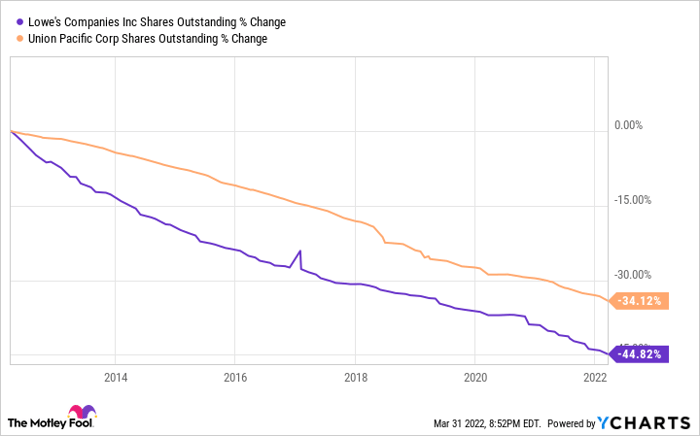
    Additionally, if the company still has earnings to spare, management can also consider lowering its share count through share repurchase programs. For example, consider the declining share counts for two great low payout ratio stocks, Lowe’s and Union Pacific.

    LOW Shares Outstanding Chart

    Data by YCharts.

    Despite the capital required to maintain their respective operations, these two have not only funded many years of annual dividend increases but rapidly lowered their total shares outstanding over the last decade. Fewer shares make the dividends cheaper to maintain while boosting earnings per share (EPS) — furthering the flywheel effect.

    Because of these benefits, looking for low payout ratios over high yields is akin to choosing longer-term cash flow potential over higher near-term income. 

    The best of both worlds

    Best yet for investors, a handful of stocks offer relatively high dividend yields and low payout ratios. Let’s look at three here:

    MetricCumminsIntelTarget
    Dividend yield2.9%3.0%1.7%
    Payout ratio38.3%28.6%22.4%
    Maximum dividend potential7.6%10.5%7.6%
    Consecutive years of dividend increases81953

    Source: Yahoo! Finance. Maximum dividend potential = dividend yield/payout ratio. 

    Notice that despite not having the highest dividend yield, Intel has the highest maximum dividend potential based on its dividend yield divided by its payout ratio. Similarly, Target has a dividend yield about one percentage point lower than Cummins, but they have comparable maximums.

    I bring these three companies up to illuminate the power of a low payout ratio. Yes, you may be sacrificing some near-term dividend income by forgoing high-yield stocks, but your long-term dividend potential should one day dwarf that high initial income if you hold for the long haul.

    This article was originally published on Fool.com. All figures quoted in US dollars unless otherwise stated.

    The post Why dividend stocks with low payout ratios can be better than those with high yields appeared first on The Motley Fool Australia.

    Wondering where you should invest $1,000 right now?

    When investing expert Scott Phillips has a stock tip, it can pay to listen. After all, the flagship Motley Fool Share Advisor newsletter he has run for over ten years has provided thousands of paying members with stock picks that have doubled, tripled or even more.*

    Scott just revealed what he believes could be the five best ASX stocks for investors to buy right now. These stocks are trading at near dirt-cheap prices and Scott thinks they could be great buys right now.

    *Returns as of January 12th 2022

    More reading

    Josh Kohn-Lindquist has no position in any of the stocks mentioned. The Motley Fool owns and recommends Intel. The Motley Fool recommends Cummins, Lowe’s, and Union Pacific and recommends the following options: long January 2023 $57.50 calls on Intel and short January 2023 $57.50 puts on Intel. The Motley Fool has a disclosure policy.

    This article was originally published on Fool.com. All figures quoted in US dollars unless otherwise stated.


    from The Motley Fool Australia https://ift.tt/P3zfcJX
  • Here’s why the Sayona (ASX:SYA) share price is surging 34% on Monday

    A group of people in suits and hard hats celebrate the rising BHP share price with champagne.A group of people in suits and hard hats celebrate the rising BHP share price with champagne.

    The Sayona Mining Ltd (ASX: SYA) share price is rocketing higher on more positive spodumene testing results.

    Lithium hydroxide made from the company’s Authier spodumene product has been found to be of the same quality as commercial battery-grade material.

    At the time of writing, the Sayona share price is 33.5 cents, 34% higher than its previous close.

    However, that’s fallen from its intraday – and new 52-week — high of 34 cents. That represented a 36% increase.

    Let’s take a closer look at today’s news from the emerging lithium producer.

    Positive test results send Sayona shares soaring 34%

    The Sayona share price is launching upwards after testing conducted by lithium-ion battery technology giant Novonix Ltd (ASX: NVX) confirmed the quality of the company’s spodumene product.

    Scientists at Novonix have found the discharge capacity of cathode cells made using lithium hydroxide from Sayona’s spodumene concentrates was the same as benchmark cathode cells.

    The spodumene concentrate was produced at the company’s Authier Lithium Project – located in Québec, Canada.

    The company states the results show its Authier product performs as well as commercially available battery-grade lithium hydroxide.

    Additionally, when combined with Québec’s hydroelectric power, the company’s product comes with environmental competitive advantages.

    The positive results from Novonix’s testing follow analysis completed at CSIRO’s Mineral Resources Laboratories in Perth.

    There, Authier spodumene was found to be able to be processed into high purity, 99.99% lithium hydroxide.

    Sayona managing director Brett Lynch said the results further verify that Authier spodumene is suitable to be converted into highly demanded lithium hydroxide.

    “Sayona has committed to downstream processing in Québec, including lithium carbonate or hydroxide,” Lynch continued.

    “These results by an industry-leading battery tester have further increased confidence in our strategy.”

    Also potentially boosting the Sayona share price today, the company has updated the market on its recent activities.

    Drilling at its Moblan Lithium Project is ongoing and expected to finish in the middle of this month. The results are predicted to expand Sayona’s lithium resource base.

    Additionally, Sayona was recently added to the S&P/ASX 300 Index (ASX: XKO). The company said its inclusion followed significant growth in its market value, which is expected to increase institutional investments in Sayona.

    “Sayona has made an extremely bright start to 2022, despite significant geopolitical and market instability, amid a continued focus on the electrification of transport to curb emissions,” said Lynch. 

    Sayona share price snapshot

    Today’s gains have boosted the Sayona share price even higher into the ASX green.

    Right now, the company’s stock is trading for 157% more than it was at the start of 2022. It has also gained 807% over the last 12 months.

    The post Here’s why the Sayona (ASX:SYA) share price is surging 34% on Monday appeared first on The Motley Fool Australia.

    Should you invest $1,000 in Sayona right now?

    Before you consider Sayona, you’ll want to hear this.

    Motley Fool Investing expert Scott Phillips just revealed what he believes are the 5 best stocks for investors to buy right now… and Sayona wasn’t one of them.

    The online investing service he’s run for over a decade, Motley Fool Share Advisor, has provided thousands of paying members with stock picks that have doubled, tripled or even more.* And right now, Scott thinks there are 5 stocks that are better buys.

    *Returns as of January 13th 2022

    More reading

    Motley Fool contributor Brooke Cooper has no position in any of the stocks mentioned. The Motley Fool Australia’s parent company Motley Fool Holdings Inc. has no position in any of the stocks mentioned. The Motley Fool Australia has no position in any of the stocks mentioned. The Motley Fool has a disclosure policy. This article contains general investment advice only (under AFSL 400691). Authorised by Bruce Jackson.

    from The Motley Fool Australia https://ift.tt/H0iVUEB