• 1 red flag for precious metals stocks

    This article was originally published on Fool.com. All figures quoted in US dollars unless otherwise stated.

    Two miners examine things they have taken out the ground.

    This article was originally published on Fool.com. All figures quoted in US dollars unless otherwise stated.

    Geopolitical tensions have gold and silver back in the limelight, as investors often view them as a safe haven. And high levels of inflation fuel the view that precious metals, as hard assets, can help protect against swiftly rising prices.

    That’s the good news, given that gold and silver have been rallying. But there’s another factor to consider when you look at precious metals miners, and if you don’t pay attention to it, you could end up getting hurt.

    The basic model

    Gold and silver mining is a fairly simple business to understand. First, find a place that has material deposits of these precious metals. Then get approval to build a mine. Build the mine. Extract the gold and silver and sell it.

    Conceptually, that’s pretty easy to get your head around. However, building a mine is a long and expensive process with material difficulties possible all along the way.

    Indeed, there are only just so many places with enough of these precious metals to build a mine, and getting approval can be a headache. For example, Barrick Gold (NYSE: GOLD) has been trying to get approval for its Pascua-Lama mine on the Chile/Argentina border for roughly a decade and still doesn’t have the final green light.

    And the cost of building and running a mine is massive. Cleaning up when a company is done with the asset, meanwhile, is also complex and fraught with uncertainty.

    Leverage

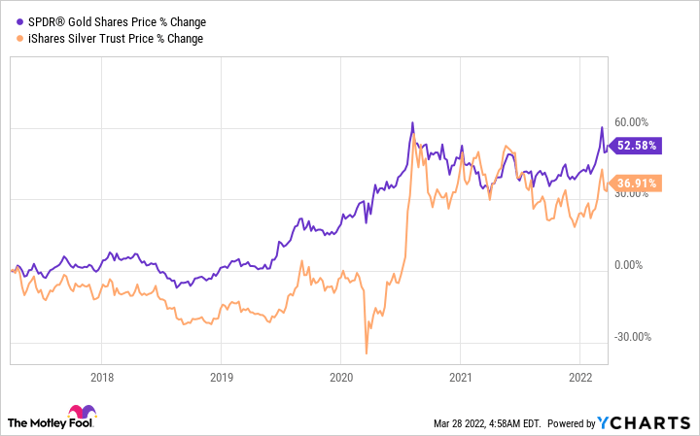
    That said, the cost of a mine, once operational, is something of a line in the sand. When gold and silver prices are close to the line, miners can eke out a profit or dip into the red. But when precious metals prices are materially higher than the cost of production, profits flow swiftly to the bottom line.

    For example, the gross profit margin for industry giants Barrick and Newmont (NYSE: NEM) has risen dramatically since mid-2019, along with the price of gold. To put some numbers on that, both companies had gross profit margin in the mid-20% range, but Newmont’s is now in the mid-30% area while Barrick’s is touching 40%.
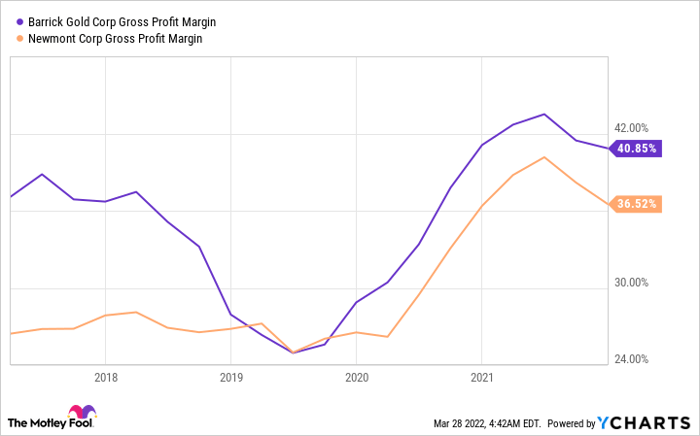
    GOLD Gross Profit Margin Chart

    GOLD Gross Profit Margin data by YCharts

    Smaller miners tend to benefit even more from high prices since many have higher cost structures. And yet, in that statement comes the risk. Gold and silver are commodities subject to supply and demand. Rallies are generally followed by pullbacks.

    When prices fall, the profitability of miners can fall materially, too. That is why investors need to pay close attention to all-in sustaining costs, which is an industry metric that takes into account operating costs and the investment needed to maintain production levels. Lower costs are better because they make it easier to turn a profit.
    GLD Chart

    GLD data by YCharts

    The problem today is that inflation is spreading throughout the world. That means operating costs for miners are likely to be heading higher. For example, all-in sustaining costs for Gold Fields (NYSE: GFI), another large precious metals miner, rose from $977 per ounce in 2020 to $1,063 per ounce in 2021, a nearly 9% year-over-year increase. 

    To be fair, all-in sustaining costs can be impacted by capital spending plans, so investors need to dig in a little to see what’s going on. However, with inflation hitting everything from commodities to labor, price increases are a red flag that investors can’t afford to ignore. In some ways, the rising gold price, which is a major tailwind for miners, is just a sign of this problem. 

    Don’t get carried away

    Wall Street tends to go to extremes, and it is easy to get caught up in the stories that drive the mood swings.

    Right now, gold and silver are being looked at as safe-haven assets, providing protection from geopolitical tensions and inflationary pressures. But, on the inflation side, the companies that mine for precious metals are not immune to the impact.

    If you are investing in gold and silver miners, you need to pay attention to their costs. Not only will rising all-in sustaining costs crimp profitability, but they could also increase the pain when gold and silver prices fall in the future. 

    This article was originally published on Fool.com. All figures quoted in US dollars unless otherwise stated.

    The post 1 red flag for precious metals stocks appeared first on The Motley Fool Australia.

    Wondering where you should invest $1,000 right now?

    When investing expert Scott Phillips has a stock tip, it can pay to listen. After all, the flagship Motley Fool Share Advisor newsletter he has run for over ten years has provided thousands of paying members with stock picks that have doubled, tripled or even more.*

    Scott just revealed what he believes could be the five best ASX stocks for investors to buy right now. These stocks are trading at near dirt-cheap prices and Scott thinks they could be great buys right now.

    *Returns as of January 12th 2022

    More reading

    Reuben Gregg Brewer has no position in any of the stocks mentioned.  The Motley Fool Australia’s parent company Motley Fool Holdings Inc. has no position in any of the stocks mentioned. The Motley Fool Australia has no position in any of the stocks mentioned. The Motley Fool has a disclosure policy. This article contains general investment advice only (under AFSL 400691). Authorised by Bruce Jackson.

    This article was originally published on Fool.com. All figures quoted in US dollars unless otherwise stated.


    from The Motley Fool Australia https://ift.tt/9qa6sQI

  • Why Solana jumped again today

    This article was originally published on Fool.com. All figures quoted in US dollars unless otherwise stated.

    Person pointing at an increasing blue graph which represents a rising share price.

    This article was originally published on Fool.com. All figures quoted in US dollars unless otherwise stated.

    What happened 

    Cryptocurrency Solana (CRYPTO: SOL) jumped double digits in early trading on Thursday following a big gain on Wednesday. As of 11:45 a.m. ET the value of the cryptocurrency was up 4.1% in the last 24 hours and had traded as much as 6.2% higher. 

    Solana is up 25.1% over the last week, so this has been a strong run and the value is rising as other cryptocurrencies fall today. 

    So what 

    Investors continue to pour into Solana as businesses begin to take it more seriously. Cryptocurrency exchange Coinbase Global recently started trading for some Solana-based tokens and yesterday OpenSea said it will start carrying about 50 Solana non-fungible tokens. 

    A lot of investors who primarily trade in Bitcoin or Ethereum may not realize what’s being built on Solana so these moves bring exposure to the ecosystem. In time, that should lead to even more investment and higher values for Solana and its tokens as real businesses are built on the blockchain. 

    Now what 

    Volatility continues to be standard for cryptocurrencies and at times like this, it’s working for Solana investors. But keep in mind that the rise in values could reverse as quickly as it came. 

    What I do like is how much is being built on Solana and I think in time that utility will drive tremendous value for investors. So, long-term this is a cryptocurrency I like, which is why I’m holding and ignoring volatile days like today, even if they are working in my favor. 

    This article was originally published on Fool.com. All figures quoted in US dollars unless otherwise stated.

    The post Why Solana jumped again today appeared first on The Motley Fool Australia.

    Wondering where you should invest $1,000 right now?

    When investing expert Scott Phillips has a stock tip, it can pay to listen. After all, the flagship Motley Fool Share Advisor newsletter he has run for over ten years has provided thousands of paying members with stock picks that have doubled, tripled or even more.*

    Scott just revealed what he believes could be the five best ASX stocks for investors to buy right now. These stocks are trading at near dirt-cheap prices and Scott thinks they could be great buys right now.

    *Returns as of January 12th 2022

    More reading

    Travis Hoium owns Coinbase Global, Inc., Ethereum, and Solana. The Motley Fool Australia’s parent company Motley Fool Holdings Inc. owns and has recommended Bitcoin, Coinbase Global, Inc., Ethereum, and Solana. The Motley Fool Australia owns and has recommended Bitcoin and Ethereum. The Motley Fool has a disclosure policy. This article contains general investment advice only (under AFSL 400691). Authorised by Bruce Jackson. 

    This article was originally published on Fool.com. All figures quoted in US dollars unless otherwise stated.

    from The Motley Fool Australia https://ift.tt/cL0mBte

  • Why is the Firefinch (ASX:FFX) share price charging higher again?

    Man with rocket wings which have flames coming out of them.

    Man with rocket wings which have flames coming out of them.

    The Firefinch Ltd (ASX: FFX) share price is on course to end the week on a positive note.

    In morning trade, the gold and lithium explorer’s shares are up over 3% to a new multi-year high of $1.08.

    Why is the Firefinch share price pushing higher again?

    Investors have been bidding the Firefinch share price on Friday following the release of a positive update on its Goulamina Lithium Project in Mali.

    According to the release, Firefinch’s Goulamina Lithium Project Joint Venture Company has received cash funding of US$130 million from fellow 50% partner Jiangxi Ganfeng Lithium.

    The release notes that the US$130 million of equity funding provided to the joint venture by Ganfeng comprises US$39million that was released from escrow and a further US$91 million second tranche investment.

    But it won’t stop there. Ganfeng is further obliged to provide either US$40 million of Ganfeng direct debt or source US$64 million of third-party debt to complete its investment.

    This means that combined, Ganfeng’s equity and debt funding package will be a total of at least US$170 million. This is expected to substantially fund the Goulamina Lithium Project through the development phase.

    Though, this project will not actually be part of Firefinch for much longer. The company is in the process of pushing ahead with a demerger of the Goulamina Lithium Project into a separately listed company, Leo Lithium. This will be completed in accordance with regulatory timeframes

    Earlier this year, Firefinch appointed Simon Hay to lead the Leo Lithium business. He has great experience in taking a lithium miner through from development to production from his time leading Galaxy Resources.

    Mr Hay exited the role as CEO of Galaxy Resources following the completion of the A$5 billion merger of equals with Orocobre to create the world’s fifth largest lithium producer Allkem Ltd (ASX: AKE).

    Time will tell if Leo Lithium is as successful as Galaxy was.

    The post Why is the Firefinch (ASX:FFX) share price charging higher again? appeared first on The Motley Fool Australia.

    Should you invest $1,000 in Firefinch right now?

    Before you consider Firefinch, you’ll want to hear this.

    Motley Fool Investing expert Scott Phillips just revealed what he believes are the 5 best stocks for investors to buy right now… and Firefinch wasn’t one of them.

    The online investing service he’s run for over a decade, Motley Fool Share Advisor, has provided thousands of paying members with stock picks that have doubled, tripled or even more.* And right now, Scott thinks there are 5 stocks that are better buys.

    *Returns as of January 13th 2022

    More reading

    Motley Fool contributor James Mickleboro owns Orocobre Limited. The Motley Fool Australia’s parent company Motley Fool Holdings Inc. has no position in any of the stocks mentioned. The Motley Fool Australia has no position in any of the stocks mentioned. The Motley Fool has a disclosure policy. This article contains general investment advice only (under AFSL 400691). Authorised by Bruce Jackson.

    from The Motley Fool Australia https://ift.tt/LG9wFDy

  • What happened to the Wesfarmers share price in March?

    Group of thoughtful business people with eyeglasses reading documents in the office.Group of thoughtful business people with eyeglasses reading documents in the office.

    The Wesfarmers Ltd (ASX: WES) share price underperformed the broader market in March despite the company signing the deed to its latest acquisition.

    That’s right, the retail conglomerate is now the official owner of the ASX-listed (though, not for much longer) Australian Pharmaceutical Industries Ltd (ASX: API).  

    As of the final close of the month, the Wesfarmers share price was trading at $50.41. That’s 4.61% higher than it was at the end of February.

    However, over that same period the S&P/ASX 200 Index (ASX: XJO) gained 6.3%. That means the Wesfarmers share price underperformed the majority of its ASX 200 peers last month.

    Let’s take a closer look at all that Wesfarmers got up to in March.

    What happened to Wesfarmers last month?

    The Wesfarmers share price was in focus for much of March as the company’s acquisition of API came together.

    The takeover, first tabled in July 2021, was initially rejected by API’s board. A revised offer promising $1.55 per API share was accepted later that year.

    However, the takeover was thrown off course twice. Firstly, when Sigma Healthcare Ltd (ASX: SIG) posed a merger offer and again when Wesfarmers’ fellow ASX 200 giant Woolworths Group Ltd (ASX: WOW) threw its hat in the ring.

    Fortunately for Wesfarmers, it ultimately won out. API shareholders voted in favour of the company’s takeover on 17 March.

    The acquisition was given the green light from the Federal Court days later, with the API share price suspended from 22 March.

    The only price-sensitive news the market heard from Wesfarmers in March was released yesterday, sending the company’s share price 1.49% lower.

    Then, the ASX 200 staple announced it had officially taken over API.

    It ended up paying $1.50 per share for the company since API had paid out 5 cents per share worth of dividends since the conglomerate posed its bid.

    Wesfarmers managing director Rob Scott said the acquisition’s completion was an “exciting milestone”.

    “API will be the foundation business of our new health division as we develop capabilities and invest in the growing health, wellbeing, and beauty sector,” Scott continued.

    API will delist when the market closes today.

    Additionally, Wesfarmers shareholders received the company’s interim dividend last month.

    The fully franked 80 cents per share payout hit investors’ bank accounts on 30 March.

    Wesfarmers share price snapshot

    The Wesfarmers share price’s recent gains haven’t been enough to boost it back into the long-term green.

    Right now, the company’s stock is trading for 16% less than it was at the start of 2022. It has also fallen nearly 5% since this time last year.

    The post What happened to the Wesfarmers share price in March? appeared first on The Motley Fool Australia.

    Should you invest $1,000 in Wesfarmers right now?

    Before you consider Wesfarmers, you’ll want to hear this.

    Motley Fool Investing expert Scott Phillips just revealed what he believes are the 5 best stocks for investors to buy right now… and Wesfarmers wasn’t one of them.

    The online investing service he’s run for over a decade, Motley Fool Share Advisor, has provided thousands of paying members with stock picks that have doubled, tripled or even more.* And right now, Scott thinks there are 5 stocks that are better buys.

    *Returns as of January 13th 2022

    More reading

    Motley Fool contributor Brooke Cooper has no position in any of the stocks mentioned. The Motley Fool Australia’s parent company Motley Fool Holdings Inc. has no position in any of the stocks mentioned. The Motley Fool Australia owns and has recommended Wesfarmers Limited. The Motley Fool has a disclosure policy. This article contains general investment advice only (under AFSL 400691). Authorised by Bruce Jackson.

    from The Motley Fool Australia https://ift.tt/2CkAugM

  • Motley Fool announces new BNPL-style offering

    man happily kissing a $50 noteman happily kissing a $50 note

    PRESS RELEASE (For immediate distribution)

    MOTLEY FOOL ANNOUNCES NEW BNPL-STYLE OFFERING

    Hopes to capitalise on huge and growing trend

    And, of course, in keeping with the current trend, the two new products will charge no interest.

    Motley Fool spokesperson Lira Fopol said:

    “The trend of consumers adopting new payment methods, particularly Buy-Now-Pay-Later and pay advances, has ballooned in recent years. We think the time is ripe to launch two new products into this exciting market, in order to capitalise on the profit to be made from consumers who are unable or unwilling to wait for their new pair of jeans.”

    True, it’s an abrupt about face from the criticism Motley Fool Chief Investment Officer Scott Phillips has made of some of these new finance products, noting the lack of appropriate regulation, the move towards pushing people onto a debt treadmill, and the discouragement of sensible financial literacy and discipline, but he was deliberately kept out of the loop while we worked on these products.

    Addressing the fact that the sector is currently regulated much more lightly than other credit products, Fopol added:

    “While banks, credit card companies and traditional lenders are constrained by pesky rules that require them to make sure they understand the borrower and that they can repay the loan, this new category carries nowhere near the same annoying consumer protections, making it ripe for exploitation and serving the needs of new customers.”

    While some would suggest The Motley Fool has been too late to the party on the app-based ‘get it now’ segment, the company believes that the arrival of products to let you pay for your groceries in instalments, and get an advance on your pay (for a fee, of course), means the sector is just getting going.

    “Imagine what the future could bring”, said The Motley Fool’s intern and head of new product ideation and whizbangery, Ralf Ofpio. “There’s no limit to what consumers can have now, if they’re prepared to commit money they might otherwise need later. And if they find themselves short, come repayment time, we’ll be able to offer them a loan at hyper-profitable interest rates. Talk about upsell!”

    While the company has yet to finalise its full product suite (that will, in all likelihood end up in credit cards, personal loans and mortgages like other BNPL providers), The Motley Fool today announces its first two products, helpfully described with cool acronyms, because that’s what people expect these days.

    motley fool bnpn(™)

    (Editors, please note the deliberate lower-case in the product name if referring to this in print. All the cool kids are doing it)

    Announcing motley fool bnpn(™); the payment choice for a new generation!

    We think the abundance of BNPL players has left a yawning gap in the market. While ‘buy now pay later’ has been saturated with dozens of overlapping offerings, there is a huge opportunity in BNPN – buy now, pay now – which none of those players is currently offering.

    Buy-now-pay-now, through motley fool bnpn(™), will revolutionise this market by giving consumers the opportunity to buy things with the money they already have.

    Importantly, this payment method dispenses with future payment obligations (installments) by allowing the consumer to pay in full, up front, thus better managing their cash flows, and avoiding them accidentally overspending, meaning late fees or having an instalment deducted from their account the day before the rent is due.

    “We think this is a huge step forward” said The Motley Fool’s Ofpio. “Paying up front is simpler, easier, and interest-free. Plus, there’s no risk of a late fee.”

    motley fool blpl (™)

    To complement the new motley fool bnpn (™) offering, The Motley Fool also announces the launch of motley fool blpl (™), exploiting yet another gap in the new finance market.

    blpl – ‘buy later, pay later’ is an innovative concept allowing consumers to delay their purchase of fashion clothing, computer games and/or new furniture until they actually have the money.

    Acknowledging that the company will have a hard time combatting the FOMO encouraged by its competitors, Ofpio commented “We know people love BNPL, and the various providers are only too happy to encourage people to live it up now and let their future selves worry about making payments, but we are hopeful that motley fool blpl (™) will take off, even if only slowly at first.”

    In keeping with this new launch, The Motley Fool has also invented some new lexicon which it hopes will take off. We have created three new terms: ‘living within your means’, ‘savings’ and ‘delayed gratification’.

    While acknowledging that these new terms might struggle to catch on, General Manager Lira Fopol commented:

    “There are some people who genuinely need credit products to deal with unexpected crises in their lives, and those people should be served by low-cost providers, whose aim isn’t to get consumers hooked on rolling credit.

    “For everyone else, the BNPL craze has become an addiction that too many companies are aiming to profit from. We hope to join them with motley fool bnpn (™) and motley fool blpl (™)!”

    motley fool bnpn(™) and motley fool blpl(™) will start rolling out on April 1, 2023.

    Until then, the finance industry will try to convince you that their debt solutions are better for you, convincing you (and maybe themselves) that they’re doing you a favour.

    Makes you feel warm and fuzzy, doesn’t it?

    Media contact:

    Flora Pilo
    info@fool.com.au

    ——————————————————-
    Returns as of 1 April 2022. And only 1 April 2022. For obvious reasons. We hope.

    This article would usually contain general investment advice only (under AFSL 400691). But not this time. Well, except for our commitment to great investing advice. That’s legit. (There is some general financial advice, though, if you check the calendar, and read between the lines.)

    Authorised by Scott Phillips.

    (Also, written by Scott, acted by Scott and he did the lighting and costume design. Also, the hand-drawn signs out the front. But just today.)

    Didn’t find the article funny? That’s okay. It’s not supposed to have you rolling in the aisles. We’re just using today to make a serious point, with a smile. And a little irreverence.

    Regular programming will resume tomorrow.

    Happy April Fool’s Day, Fools!

    The post Motley Fool announces new BNPL-style offering appeared first on The Motley Fool Australia.

    Wondering where you should invest $1,000 right now?

    When investing expert Scott Phillips has a stock tip, it can pay to listen. After all, the flagship Motley Fool Share Advisor newsletter he has run for over ten years has provided thousands of paying members with stock picks that have doubled, tripled or even more.*

    Scott just revealed what he believes could be the five best ASX stocks for investors to buy right now. These stocks are trading at near dirt-cheap prices and Scott thinks they could be great buys right now.

    *Returns as of January 12th 2022

    More reading

    Motley Fool contributor Scott Phillips has no position in any of the stocks mentioned. The Motley Fool Australia’s parent company Motley Fool Holdings Inc. has no position in any of the stocks mentioned. The Motley Fool Australia has no position in any of the stocks mentioned. The Motley Fool has a disclosure policy. This article contains general investment advice only (under AFSL 400691). Authorised by Bruce Jackson.

    from The Motley Fool Australia https://ift.tt/rXcDsgV

  • Here’s how top brokers think the Rio Tinto share price will perform in April

    a mine worker holds his phone in one hand and a tablet in the other as he stands in front of heavy machinery at a mine site.

    a mine worker holds his phone in one hand and a tablet in the other as he stands in front of heavy machinery at a mine site.

    The Rio Tinto Limited (ASX: RIO) share price edged higher in March 2022. But what’s next for the ASX mining share in April?

    Rio Tinto shares start the month at $119.11. The share price has gone up almost 20% in 2022 year to date, amid the strengthening of prices for many commodities.

    The iron ore price remains around 50% higher compared to where it was at the start of November 2021. Iron ore remains a key profit generator for the company.

    Without a working crystal ball, it’s difficult to say what will happen to the miner this week, this month, or even this year. However, some analysts have given their opinions on what they think the ASX mining share could be worth in the future with their price targets.

    What do brokers think of the Rio Tinto share price?

    UBS

    The broker UBS, which has been negative on iron ore miners in recent times, has upgraded its rating on Rio Tinto from a sell to neutral. This change was because of the improving outlook for the iron ore price over the coming months.

    UBS thinks that China could help continue the party for the iron ore price as the country looks to pursue growth. It now believes that the iron ore price in 2023 could be US$105 per tonne and US$135 per tonne in 2022.

    Based on UBS numbers, the Rio Tinto share price is valued at under 7x FY22’s estimated earnings and under 9x FY23’s estimated earnings.

    Morgan Stanley

    The broker Morgan Stanley recently said that Reuters had reported that Guinea had reached a deal with miners to resume activities on the Simandou iron ore development, after resolving disputes relating to infrastructure. Rio Tinto is one of those miners.

    Simandou has more than 4 billion tonnes of ore according to Guinea’s government.

    Morgan Stanley doesn’t think it will be until 2028 when the first ore happens, though the Guinea government is hoping for 2025.

    Morgan Stanley rates the Rio Tinto share price as a buy, with a price target of $130.50. That implies a potential upside of around 10%.

    The broker is expecting another big year of cash flow and dividends from Rio Tinto. Morgan Stanley’s numbers put the Rio Tino share price at 6x FY22’s estimated earnings, with a grossed-up dividend yield of 18.4%.

    Macquarie

    Macquarie is one of the most positive brokers on Rio Tinto, with a buy rating and a price target of $140.

    While the strength of iron ore is one part of Rio Tinto, Macquarie also points out that alumina prices have also gone up significantly, which is helping its thoughts about the underlying value of the ASX mining share.

    Using Macquarie’s numbers, the Rio Tinto share price is valued at 6x FY22’s estimated earnings, with a grossed-up dividend yield of 15.3%.

    Rio Tinto share price snapshot

    The mining giant is starting the month with a market capitalisation of $43.4 billion, according to the ASX.

    The post Here’s how top brokers think the Rio Tinto share price will perform in April appeared first on The Motley Fool Australia.

    Should you invest $1,000 in Rio Tinto right now?

    Before you consider Rio Tinto, you’ll want to hear this.

    Motley Fool Investing expert Scott Phillips just revealed what he believes are the 5 best stocks for investors to buy right now… and Rio Tinto wasn’t one of them.

    The online investing service he’s run for over a decade, Motley Fool Share Advisor, has provided thousands of paying members with stock picks that have doubled, tripled or even more.* And right now, Scott thinks there are 5 stocks that are better buys.

    *Returns as of January 13th 2022

    More reading

    Motley Fool contributor Tristan Harrison has no position in any of the stocks mentioned. The Motley Fool Australia’s parent company Motley Fool Holdings Inc. has no position in any of the stocks mentioned. The Motley Fool Australia has recommended Macquarie Group Limited. The Motley Fool has a disclosure policy. This article contains general investment advice only (under AFSL 400691). Authorised by Bruce Jackson.

    from The Motley Fool Australia https://ift.tt/AioedYS

  • The NAB share price almost doubled the ASX 200’s return in March

    Happy man at an ATM.Happy man at an ATM.

    The National Australia Bank Ltd (ASX: NAB) share price outperformed the S&P/ASX 200 Index (ASX: XJO) in March.

    In fact, NAB shares almost doubled the return of the ASX 200.

    The NAB share price climbed by almost 12% in March, ending the month at $32.35. That compares favourably to the return of the ASX 200, which rose by just over 6%.

    A lot has happened over the past month. Most of the global headlines have been dominated by the Russian invasion of Ukraine.

    War can unsettle markets. But there has also been speculation about what will happen with interest rates to combat widespread inflation.

    What happened in March?

    There was only one market-sensitive piece of news from NAB during the period.

    Towards the end of March, the big four ASX bank announced it had completed its $2.5 billion on-market share buyback and announced a further on-market buyback of up to $2.5 billion. The NAB share price edged slightly higher by the close of trade on the day of the announcement.

    NAB said it had bought back almost 87 million ordinary shares. The additional buyback would bring the total potential combined size of the share buyback to $5 billion.

    The further buyback will allow NAB to continue managing its common equity tier 1 (CET1) capital ratio towards its target range of 10.75% to 11.25% over time.

    NAB noted that it continues to “operate well above” APRA’s unquestionably strong benchmark of 10.5%, under current APRA capital standards. It had a reported CET1 capital ratio of 12.4% as at 31 December 2021.

    The further buyback is expected to reduce the bank’s CET1 capital ratio by approximately 58 basis points. Its pro forma CET1 capital ratio as at 31 December 2021, reflecting that further buyback and other adjustments, is 11.3%.

    Subject to market conditions, NAB expects to commence the further buyback after the release of its FY22 half-year result announcement on 5 May.

    When the additional buyback was announced, NAB CEO Ross McEwan said:

    Our capital management strategy reflects the importance of maintaining a strong balance sheet through the cycle while allowing us to continue to support growth and deliver improved shareholder returns.

    The further $2.5 billion on-market buyback announced today supports our ambition to reduce the share count and increase sustainable ROE (return on equity) benefits for our shareholders.

    What do brokers make of the NAB share price?

    One of the latest brokers to give an opinion on the bank is Morgan Stanley, which is “equal weight” on NAB, with a price target of $31.50.

    The broker is expecting the Reserve Bank of Australia (RBA) to increase interest rates, which will help NAB. However, some negatives may offset the benefit, such as more expensive funding and strong competition in the lending space. Morgan Stanley likes NAB compared to some other banks in the sector.

    On Morgan Stanley’s numbers, the NAB share price is valued at 17x FY22’s estimated earnings with a projected grossed-up dividend yield of 6.2%.

    The post The NAB share price almost doubled the ASX 200’s return in March appeared first on The Motley Fool Australia.

    Should you invest $1,000 in NAB right now?

    Before you consider NAB, you’ll want to hear this.

    Motley Fool Investing expert Scott Phillips just revealed what he believes are the 5 best stocks for investors to buy right now… and NAB wasn’t one of them.

    The online investing service he’s run for over a decade, Motley Fool Share Advisor, has provided thousands of paying members with stock picks that have doubled, tripled or even more.* And right now, Scott thinks there are 5 stocks that are better buys.

    *Returns as of January 13th 2022

    More reading

    Motley Fool contributor Tristan Harrison has no position in any of the stocks mentioned. The Motley Fool Australia’s parent company Motley Fool Holdings Inc. has no position in any of the stocks mentioned. The Motley Fool Australia has no position in any of the stocks mentioned. The Motley Fool has a disclosure policy. This article contains general investment advice only (under AFSL 400691). Authorised by Bruce Jackson.

    from The Motley Fool Australia https://ift.tt/mefo29l

  • These were the best performing ASX 200 shares in March

    A couple are shocked and elated at the good news they've just seen on their devices.

    A couple are shocked and elated at the good news they've just seen on their devices.It certainly was a great month for the S&P/ASX 200 Index (ASX: XJO) in March. During the period, the benchmark index rose an impressive 6.4% to end it at 7,499.6 points.

    While a good number of shares pushed higher with the market, some climbed more than most. Here’s why these were the best performers on the ASX 200 last month:

    Uniti Group Ltd (ASX: UWL)

    The Uniti share price was the best performer on the ASX 200 in March with a 43.3% gain. Investors were fighting to get hold of this telco’s shares amid speculation that it was in takeover talks. Uniti eventually confirmed this speculation, revealing that Morrison & Co. had tabled a non-binding $4.50 cash per share offer to acquire the company. However, following a higher bid from Macquarie Group Ltd (ASX: MQG), Morrison later bumped its offer by 11% to $5.00 per share.

    AVZ Minerals Ltd (ASX: AVZ)

    The AVZ Minerals share price wasn’t too far behind with a gain of 35%. Last month this lithium developer’s shares were added to the ASX 200 index at the quarterly rebalance. In addition, positive sentiment in the lithium industry and recent developments at its Manono Lithium and Tin Project in the Democratic Republic of the Congo may have supported its shares. The latter includes the company committing to invest $25 million to advance the drilling program at the project.

    EML Payments Ltd (ASX: EML)

    The EML share price was on form and charged 27% higher over the period. A rebound in the tech sector and its expansion into a new market may have been the drivers of this gain. In respect to the latter, the payments company announced that it has entered the Employee Benefits Market (EBM) in Europe through a multi-year agreement with Up Spain. The EBM is worth over A$88 billion globally.

    Computershare Limited (ASX: CPU)

    The Computershare share price was a strong performer and rose 17.7% during the month. This was despite there being no news out of the stock transfer company. Though, with the outlook for interest rate increases becoming even more positive, investors may be expecting this to be a big boost to Computershare’s income. In addition, a note out of UBS last month saw the broker retain its buy rating and increase its price target to $27.00.

    The post These were the best performing ASX 200 shares in March appeared first on The Motley Fool Australia.

    Wondering where you should invest $1,000 right now?

    When investing expert Scott Phillips has a stock tip, it can pay to listen. After all, the flagship Motley Fool Share Advisor newsletter he has run for over ten years has provided thousands of paying members with stock picks that have doubled, tripled or even more.*

    Scott just revealed what he believes could be the five best ASX stocks for investors to buy right now. These stocks are trading at near dirt-cheap prices and Scott thinks they could be great buys right now.

    *Returns as of January 12th 2022

    More reading

    Motley Fool contributor James Mickleboro has no position in any of the stocks mentioned. The Motley Fool Australia’s parent company Motley Fool Holdings Inc. owns and has recommended EML Payments. The Motley Fool Australia owns and has recommended EML Payments. The Motley Fool Australia has recommended Uniti Group Limited. The Motley Fool has a disclosure policy. This article contains general investment advice only (under AFSL 400691). Authorised by Bruce Jackson.

    from The Motley Fool Australia https://ift.tt/AYGIBCf

  • Guess what $10,000 worth of CSR (ASX:CSR) shares bought a decade ago looks like today

    Calculator on top of Australian 4100 notes and next to Australian gold coins.Calculator on top of Australian 4100 notes and next to Australian gold coins.

    Despite achieving mediocre gains in 2022, the CSR Ltd (ASX: CSR) share price has rocketed higher over the long term.

    Below, we take a look and see how much an investor would have made if they had invested $10,000 in CSR shares 10 years ago.

    How much would your initial investment be worth now?

    Let’s say you spent $10,000 on CSR shares 10 years ago on this day. You would have bought them for $1.755 each. The purchase would have given you 5,698 shares without topping up along the way.

    Looking at yesterday’s closing price, the CSR share price finished at $6.15. This means those 5,698 shares would be worth a staggering $35,042.70.

    In percentage terms, the initial investment implies a return of about 250% or an average return of 13.36% per year.

    On the other hand, if you had invested the same amount in the S&P/ASX 200 Index (ASX: XJO), this would have given you $17,322.89. Going back to percentages, this equates to a gain of roughly 73% or a yearly average of 5.63% across a 10-year period.

    And the dividends?

    Over the course of the last decade, CSR has made a total of 19 bi-annual dividend payments to shareholders.

    Adding those 19 dividends payments gives us an amount of $2.086 per share. Calculating the number of shares owned against the total dividend payment gives us a figure of $11,886.02.

    When putting both the initial investment gains and dividend distribution, an investor would have roughly $46,928.73.

    As you can see, investing in CSR would have almost tripled what you would have gotten from investing in the ASX 200.

    CSR share price summary

    Glancing at the shorter term, the CSR share price has nudged up almost 5% in value in 2022.

    However, when looking at this time last year, its shares have edged 6% higher.

    CSR has a price-to-earnings (P/E) ratio of 20.43 and commands a market capitalisation of roughly $2.98 billion.

    The post Guess what $10,000 worth of CSR (ASX:CSR) shares bought a decade ago looks like today appeared first on The Motley Fool Australia.

    Should you invest $1,000 in CSR right now?

    Before you consider CSR, you’ll want to hear this.

    Motley Fool Investing expert Scott Phillips just revealed what he believes are the 5 best stocks for investors to buy right now… and CSR wasn’t one of them.

    The online investing service he’s run for over a decade, Motley Fool Share Advisor, has provided thousands of paying members with stock picks that have doubled, tripled or even more.* And right now, Scott thinks there are 5 stocks that are better buys.

    *Returns as of January 13th 2022

    More reading

    Motley Fool contributor Aaron Teboneras has no position in any of the stocks mentioned. The Motley Fool Australia’s parent company Motley Fool Holdings Inc. has no position in any of the stocks mentioned. The Motley Fool Australia has no position in any of the stocks mentioned. The Motley Fool has a disclosure policy. This article contains general investment advice only (under AFSL 400691). Authorised by Bruce Jackson.

    from The Motley Fool Australia https://ift.tt/oRughZ1

  • These were the worst performing ASX 200 shares in March

    asx share price falling lower represented by investor wearing paper bag on head with sad face

    asx share price falling lower represented by investor wearing paper bag on head with sad face

    The S&P/ASX 200 Index (ASX: XJO) was well and truly on form in March. The benchmark index stormed 6.4% higher over the month to end at 7,499.6 points.

    Unfortunately, not all shares were able to follow the market’s lead. Here’s why these were the worst performers on the ASX 200 last month:

    Nickel Mines Ltd (ASX: NIC)

    The Nickel Mines share price was the worst performer on the ASX 200 last month with a 21.2% decline. Investors were selling this nickel miner’s shares amid concerns over its ties with stainless steel giant Tsingshan. During the month, Tsingshan was caught up in a huge nickel short squeeze, which reportedly could have led to billions in losses. As Tsingshan is the company’s largest shareholder and one of its biggest customers, there were fears that this could lead to share sales or sales contract terminations.

    Westgold Resources Ltd (ASX: WGX)

    The Westgold share price wasn’t far behind with a 17.4% decline last month. This was driven largely by the gold miner’s $100 million institutional placement. Westgold raised the funds at a 13.9% discount of $2.44 per new share. These funds will be used to accelerate the company’s Murchison and Bryah growth strategy. This strategy is focused on establishing a systematic pathway towards a +400,000 ounce per annum gold production rate from FY 2024.

    Zip Co Ltd (ASX: Z1P)

    The Zip share price was out of form again in March and dropped 13.4%. Ongoing bearish investor sentiment in the buy now pay later industry continues to weigh on the company’s shares. Among the most bearish is the team at UBS, which downgraded Zip’s shares to a sell rating and cut the price target on them by 80% to just $1.00 at the start of the month. Not even heavy insider buying was enough to take the Zip share price higher in March.

    Fisher & Paykel Healthcare Corp Ltd (ASX: FPH)

    The Fisher & Paykel Healthcare share price was a poor performer and tumbled 12.8% last month. This was driven by the release of a trading update out of the medical device company. Fisher & Paykel Healthcare advised that easing COVID tailwinds mean that it expects FY 2022 operating revenue in the range of NZ$1.675 billion to NZ$1.70 billion. This represents a 13.7% to 15% year on year decline from NZ$1.97 billion in FY 2021. It also warned that higher freight costs would impact margins.

    The post These were the worst performing ASX 200 shares in March appeared first on The Motley Fool Australia.

    Wondering where you should invest $1,000 right now?

    When investing expert Scott Phillips has a stock tip, it can pay to listen. After all, the flagship Motley Fool Share Advisor newsletter he has run for over ten years has provided thousands of paying members with stock picks that have doubled, tripled or even more.*

    Scott just revealed what he believes could be the five best ASX stocks for investors to buy right now. These stocks are trading at near dirt-cheap prices and Scott thinks they could be great buys right now.

    *Returns as of January 12th 2022

    More reading

    Motley Fool contributor James Mickleboro has no position in any of the stocks mentioned. The Motley Fool Australia’s parent company Motley Fool Holdings Inc. owns and has recommended ZIPCOLTD FPO. The Motley Fool Australia has no position in any of the stocks mentioned. The Motley Fool has a disclosure policy. This article contains general investment advice only (under AFSL 400691). Authorised by Bruce Jackson.

    from The Motley Fool Australia https://ift.tt/yXsmdpf