• Watch this ASX share now doing what Apple did in 1996

    man looks up at apple on his headman looks up at apple on his headman looks up at apple on his head

    Key points

    • Back in 1996 Apple was put back on track by the return of its founder, Steve Jobs.
    • One ASX software share is taking similar action after merging with another one of its founder’s companies
    • A portfolio manager has shared his prediction for at least a 65% upside in the medium term

    There is one ASX share currently walking a similar path to what Apple Inc (NASDAQ: AAPL) did before it became a US$2.83 trillion icon.

    For those of you unfamiliar with the Apple of 1996, it was the year the late and great Steve Jobs made a return to the US tech company. At that time, the business was a far cry from the iconic electronic consumer device maker that is known for being today. Instead, the company was in turmoil after Jobs left years earlier.

    After struggling for years in Jobs’ absence, the Apple board struck a deal to merge with the computer company Jobs had created after leaving Apple known as NeXT. Following this, the visionary brilliance of Jobs went on to shine — and the rest is history.

    However, it is an ASX share that is resembling a modern-day equivalent of Apple.

    Which ASX share is using Apple’s 1996 playbook?

    While the name Matthew Sandblom may not be as recognisable as Steve Jobs, his return to 3P Learning Ltd (ASX: 3PL) is reminiscent.

    Sandblom originally founded the teaching software company back in 2003 with Shane Hill and Tim Power. From its inception, the educational product provider took off with its Mathletics offering, landing deals across Australia and internationally.

    Unfortunately, momentum unraveled following the departure of the company’s original founders. In 2014 3P Learning made its debut on the ASX. Since then, profitability has been patchy despite a steady top-line throughout the years.

    This lack of direction for the company’s educational products and growth was reflected in the share price. Between 2018 and 2020, the 3P Learning share price fell approximately 50%.

    In an attempt to avoid an opportunistic takeover from competitors, Sandblom took action and merged his second education venture — Blake Elearning — with 3P Learning. In the process, the original founder has resumed the position as chair. Additionally, Sandblom is now 3P Learning’s largest shareholder with a 49% holding in the company.

    Taking a leaf out of Jobs’ book, Sandblom has shaken things up since his reunion with 3P. For example, around $9 million worth of synergies have been realised and co-founder Shane Hill has rejoined the business.

    Already, the entrepreneur has mapped out a more ambitious future for this ASX share. The merged company is targeting a less price-sensitive market through direct-to-consumer (parents). On top of that, the company plans to overhaul Mathletics with updates — preparing the educational product for market share growth.

    A fundies price forecast on this Apple-like hopeful

    In an article published on Livewire, Schroders portfolio manager Ray David took a stab at what 3P Learning could be worth in the medium term.

    While the company is projecting revenue of $92.3 million to $97.2 million in FY22, David sees the potential for 3P to be pulling $130 million to $150 million in the medium term. This is based on the company landing a few countrywide deals for its software.

    From there, the fundie applies an earnings before interest and tax (EBIT) margin of 25%. On an EBIT multiple of 20 times this would place this ASX share between $2.40 to $2.80 apiece. For reference, the current 3P Learning share price is $1.70 — suggesting a potential upside of ~65%.

    The post Watch this ASX share now doing what Apple did in 1996 appeared first on The Motley Fool Australia.

    Should you invest $1,000 in 3P Learning right now?

    Before you consider 3P Learning, you’ll want to hear this.

    Motley Fool Investing expert Scott Phillips just revealed what he believes are the 5 best stocks for investors to buy right now… and 3P Learning wasn’t one of them.

    The online investing service he’s run for over a decade, Motley Fool Share Advisor, has provided thousands of paying members with stock picks that have doubled, tripled or even more.* And right now, Scott thinks there are 5 stocks that are better buys.

    *Returns as of January 13th 2022

    More reading

    Motley Fool contributor Mitchell Lawler owns Apple. The Motley Fool Australia’s parent company Motley Fool Holdings Inc. has no position in any of the stocks mentioned. The Motley Fool Australia has recommended Apple. The Motley Fool has a disclosure policy. This article contains general investment advice only (under AFSL 400691). Authorised by Bruce Jackson.

    from The Motley Fool Australia https://ift.tt/3rtgQdu

  • Top 10 lithium stocks in LIT, the world’s first lithium ETF

    This article was originally published on Fool.com. All figures quoted in US dollars unless otherwise stated.

    A woman smiles as she powers up her electric car

    This article was originally published on Fool.com. All figures quoted in US dollars unless otherwise stated.

    Long-term demand for lithium is likely to be strong. This stems largely from the electric-vehicle (EV) revolution, led by Tesla (NASDAQ: TSLA), and the increasing popularity of energy-storage products. Lithium is a key component of lithium-ion batteries, which are the most common type of batteries for EVs and are also used in energy-storage products.

    Let’s take a look at the Lithium & Battery Tech ETF (NYSEMKT: LIT), which became the world’s first lithium-focused exchange-traded fund (ETF) when it launched in 2010. You might decide that one or more of this fund’s holdings are worth at least putting on your watch list or that you want to buy the ETF itself. 

    The Lithium & Battery Tech ETF: Long-term performance and the basics 

    This ETF began trading in July 2010. Since its inception, it’s gained 204% through Jan. 14, 2022. This performance lags that of the broader market, as the S&P 500 index returned 448% over this period. However, over the five-year period, this ETF has handily outperformed the S&P 500, as the below chart shows.

    The Lithium & Battery Tech ETF is an index fund that’s designed to track the performance of the Solactive Global Lithium Index, which consists of stocks involved in the full lithium cycle, from mining and refining the metal through battery production. It had 41 holdings as of Jan. 13. The fund has an expense ratio of 0.75%, which is a little high for an index fund, in general, but in line with thematic index-based ETFs. 

    Shares of companies based in China accounted for about 45% of the fund’s total value, as of Jan. 13. The United States follows right after with a 22% weighting.

    This ETF is not a pure play. Many of the companies in its portfolio are involved in some operations that have nothing to do with the lithium life cycle.

    The Lithium & Battery Tech ETF: Top 10 stock holdings

    Holding No.   Company Market Cap  Country Projected Annualized EPS Growth Over Next 5 Years** Weight (% of Portfolio) 1-Year / 5-Year Returns 
     1 Albemarle (NYSE: ALB) $27.3 billion U.S. 29.8% 11.00% 29.2% / 167%
     2 Tesla $1.1 trillion U.S. 79.3% 5.92% 24.2% / 2,110%
     3 TDK (OTC: TTDKY)   $15.0 billion Japan 23.2% 5.83% (28.8%) / 85.6%
     4 EVE Energy* 212.99 billion Chinese yuan (CNY) = approximately $33.5 billion China N/A 4.86% 26% / 611%
     5 Contemporary Amperex Technology* (often called CATL) 1.346 trillion CNY = approx. $212 billion  China 57.1% 4.85% 56.5% /  N/A 
     6 BYD (OTC: BYDDY) $98.9 billion China 11% 4.60% (6.5%) / 518%
     7 Panasonic (OTC: PCRFY) $27.0 billion Japan 26% 4.51% (6.2%) / 22.3%
     8 Samsung SDI* 42.817 trillion South Korean won (KRW) = approx. $36.0 billion S. Korea 51.3% 4.50% (13.6%) / 460%
    9 Yunnan Energy New Material*  229.616 billion CNY = $36.1 billion China 69.1% 4.42% 93.7% / 1,554%
     10 LG Chem* 52.77 trillion KRW = approx. $44.3 billion  S. Korea 6.9% 4.34% (29.1%) / N/A
    Overall LIT ETF N/A $5.5 billion (assets under management) N/A N/A 100% 20.9% / 242%
    N/A S&P 500 N/A N/A N/A N/A 24.6% / 125%

    Data sources: LIT ETF, Yahoo! Finance, and YCharts. *Not traded on a U.S. exchange; market caps for these stocks calculated by writer using current exchange rates. **Analyst consensus estimates. EPS = earnings per share. Bolded returns = outperformed the S&P 500. Data to Jan. 14, 2022.

    Below is a brief description of the ETF’s top-six holdings.

    Albemarle (No. 1) is one of the world’s largest lithium miners. Its primary lithium sources are brine in Chile and Nevada and hard rock (via a joint venture) in Australia. In the third quarter of 2021, its lithium business accounted for about 43% of total revenue, while its bromine and catalysts businesses contributed 33% and 23%, respectively.

    What other lithium miners are in this ETF? China’s Ganfeng Lithium (No. 12), Chile’s SQM (14), Australia’s Pilbara Minerals (18), the U.S.’s Livent (22), Canada’s Lithium Americas (27), Canada’s Standard Lithium (35), Australia’s Ioneer (36), and Australia’s Piedmont Lithium (37). Ganfeng, SQM, and Livent are larger, well-established lithium producers. The others are junior miners, mostly in the development stage. Some are more speculative than others. 

    Tesla, No. 2, is best known for pioneering premium electric cars. It also has a residential solar-energy business and an energy-storage business targeting a variety of markets. The company and its partner Panasonic produce lithium-ion batteries at its Gigafactory in Nevada.

    TDK (No. 3) is an electronics-component manufacturer that has four business segments: passive components, sensor-application products, magnetic-application products, and energy-application products. In its fiscal year ending March 2021, its energy-application business accounted for 50% of its total sales. One of this business’ two main products is lithium-ion batteries for PCs and smartphones, including Apple‘s iPhone.  

    EVE Energy and Contemporary Amperex Technology (CATL) round out the fund’s top five holdings. Both make lithium batteries. CATL is the world’s largest maker of electric-car batteries, according to The New York Times.

    I had originally planned to stop at No. 5, but couldn’t resist including one more — BYD — because it’s worth putting on your watch list. Investing legend Warren Buffett would surely agree, as his Berkshire Hathaway owns a big stake in the company. BYD is one of the world’s largest manufacturers of EVs and sold the most electric cars in China in 2021. It also makes other products, including rechargeable batteries for various applications. 

    A decent way to invest in the lithium life cycle with a big caveat

    The Lithium & Battery Tech ETF looks like a decent way for investors to get exposure to the lithium life cycle from mining through the production of lithium-ion batteries. Keep in mind the downside of ETFs is the same as their advantage: diversification. 

    The “big caveat” mentioned in the subheading? The ETF’s heavy concentration in Chinese stocks means it’s only a good fit for investors comfortable with relatively high volatility and risk. China is an emerging market (or developing country), which increases its economic and currency risk relative to the U.S. and other developed nations. Moreover, trade issues are a concern, as U.S.-China trade relations have been particularly contentious in recent years.

    In my view, Albemarle is the best lithium stock for most investors. It’s well-established and even pays a modest dividend, currently yielding about 0.7%. (I’m not including Tesla as a “lithium stock,” as it’s much better classified as an EV stock.) 

    This article was originally published on Fool.com. All figures quoted in US dollars unless otherwise stated.

    The post Top 10 lithium stocks in LIT, the world’s first lithium ETF appeared first on The Motley Fool Australia.

    Wondering where you should invest $1,000 right now?

    When investing expert Scott Phillips has a stock tip, it can pay to listen. After all, the flagship Motley Fool Share Advisor newsletter he has run for over ten years has provided thousands of paying members with stock picks that have doubled, tripled or even more.*

    Scott just revealed what he believes could be the five best ASX stocks for investors to buy right now. These stocks are trading at near dirt-cheap prices and Scott thinks they could be great buys right now.

    *Returns as of January 12th 2022

    More reading

    Beth McKenna has no position in any of the stocks mentioned. The Motley Fool Australia’s parent company Motley Fool Holdings Inc. recommends the following options: long January 2023 $200 calls on Berkshire Hathaway (B shares), long March 2023 $120 calls on Apple, short January 2023 $200 puts on Berkshire Hathaway (B shares), short January 2023 $265 calls on Berkshire Hathaway (B shares), and short March 2023 $130 calls on Apple. The Motley Fool Australia has recommended Apple and Berkshire Hathaway (B shares). The Motley Fool has a disclosure policy. This article contains general investment advice only (under AFSL 400691). Authorised by Bruce Jackson.

    This article was originally published on Fool.com. All figures quoted in US dollars unless otherwise stated.

    from The Motley Fool Australia https://ift.tt/3IiDTP1

  • Woodside (ASX:WPL) share price struggles amid Hydrogen project update

    sad looking petroleum worker standing next to oil drillsad looking petroleum worker standing next to oil drillsad looking petroleum worker standing next to oil drill

    Key points

    • Woodside released an update on its H20K hydrogen plant today
    • The company says it has signed a contract for FEED engineering services at the site
    • Woodside hopes to have an investment decision by 2022 and first liquid hydrogen by 2025
    • Shares in the hydrocarbons giant are edging higher today less than 1% in the green.

    Shares in hydrocarbons giant Woodside Petroleum Limited (ASX: WPL) are struggling today, trading 0.28% in the red at $25.17.

    Investors are showing a muted reaction to an update released out of Woodside’s camp today covering its H2OK liquid hydrogen production facility proposed for operation in Oklahoma.

    Whilst the update isn’t price-sensitive at all, the Woodside share price has regained momentum these past few weeks. So let’s take a look at what was announced.

    Woodside awards contract for FEED engineering

    Woodside advised today that it has entered front-end engineering design (FEED) on a hydrogen project for the first time. The move comes after it awarded a contract in late December for FEED engineering services to Kellogg, Brown & Root LLC for its proposed H2OK project.

    Phase 1 of the project involves construction of a 290-megawatt (MW) facility, producing up to 90 tonnes per day (tpd) of “liquid hydrogen through electrolysis, targeting the heavy transport sector”.

    Woodside says the location offers the capacity to expand production up to 550 MW and 180 tpd, and that the “FEED phase” is a significant project development milestone.

    Advancing the project past this point activates a series of milestone triggers that further mature the project scope, cost and schedule to make a final investment decision, per the release.

    The company says it is targeting a final investment decision on H2OK in 2H 2022 and is aiming to produce the first liquid hydrogen in 2025.

    The FEED update follows a suite of series of updates outlining Woodside’s expansion into the US, where it has recently signed collaborations with Hyzon Motors and green energy technology player Heliogen.

    Aside from that, the price of Brent Crude oil spot and futures – where more than 90% of oil is priced from – has climbed more than 11% since the beginning of 2022.

    Oil is now trading back above 3-year highs and is at multi-year highs when separating out the 2018 rally, a fact that bodes in well for the Woodside share price.

    Management commentary

    Speaking on the announcement, Woodside CEO Meg O’Neill said:

    We are excited about the H2OK opportunity, given H2OK’s strategic location close to national highways and
    the supply chain infrastructure of major companies already looking for reliable, affordable and lower carbon
    sources of energy. Coupled with our recently announced target to invest US$5 billion in new energy products and lower carbon services by 2030, this FEED entry supports Woodside’s strategy to thrive through the energy transition.

    The Woodside share price has started the year strongly, having climbed more than 15% in that time and rallying 8% in the last week alone.

    The post Woodside (ASX:WPL) share price struggles amid Hydrogen project update appeared first on The Motley Fool Australia.

    Should you invest $1,000 in Woodside Petroleum right now?

    Before you consider Woodside Petroleum, you’ll want to hear this.

    Motley Fool Investing expert Scott Phillips just revealed what he believes are the 5 best stocks for investors to buy right now… and Woodside Petroleum wasn’t one of them.

    The online investing service he’s run for over a decade, Motley Fool Share Advisor, has provided thousands of paying members with stock picks that have doubled, tripled or even more.* And right now, Scott thinks there are 5 stocks that are better buys.

    *Returns as of January 13th 2022

    More reading

    The author has no positions in any of the stocks mentioned. The Motley Fool Australia’s parent company Motley Fool Holdings Inc. has no position in any of the stocks mentioned. The Motley Fool Australia has no position in any of the stocks mentioned. The Motley Fool has a disclosure policy. This article contains general investment advice only (under AFSL 400691). Authorised by Bruce Jackson.

    from The Motley Fool Australia https://ift.tt/3fBHGKV

  • Why is EML payments (ASX:EML) share price having a rollercoaster start to the year?

    people with crazy faces of fear, terror and exhileration clutch at a rollercoaster as it goes into a steep downward descentpeople with crazy faces of fear, terror and exhileration clutch at a rollercoaster as it goes into a steep downward descentpeople with crazy faces of fear, terror and exhileration clutch at a rollercoaster as it goes into a steep downward descent

    Key points

    • The EML Payments share price is zigzagging so far in 2022
    • ASX 200 buy now, pay later shares are following a similar pattern
    • The company’s share price is in the green after a shocking 2021

    The EML Payments Ltd (ASX: EML) share price has been up and down since the start of the year.

    The company’s shares are currently swapping hands at $3.245, up less than 1% since 31 December. However, the EML Payments share price fell to $3.09 on 6 January before bouncing back to $3.29 on 12 January.

    Let’s take a look at what’s been happening with the company lately.

    Tech volatility

    EML Payments’ shares have had a rocky ride so far in January. Between market close on 4 January and 6 January, the company’s shares dropped 6.65%.

    Then, between market close on 6 and 12 January, they rebounded 6.47% before dropping another 3.43% between 12 and 14 January. Since then, EML Payment shares have gained 2.52%.

    The company’s share price has followed a similar pattern to the S&P/ASX All Technology Index (ASX: XTX) as well as fellow buy now, pay later shares, including Afterpay Ltd (ASX: APT) and Zip Co Ltd (ASX: Z1P).

    In fact, the shape of the curves for these shares look almost identical in January.

    Technology shares have been responding to the movements of the NASDAQ-100 Technology Sector Index in the United States. Speculation of interest rate rises in the US led to a tech sell-off in early January.

    It triggered ASX 200 tech shares to follow a similar trend. The Afterpay share price was hammered along with that of EML Payments. But since then, ASX technology shares, including EML Payments, have recovered in line with their US counterparts.

    Two non-price sensitive news announcements on EML Payments have also been released in recent days. Firstly, the company has partnered with international fintech company REPX to provide a payment product for European soccer fans.

    Secondly, the company’s Nuapay business has partnered with payment platform Cocoon on a technology solution to save processing fees on automotive purchases.

    Not all EML Payments’ international ventures have fared so smoothly, however. The EML Payments share price fell 23% in the past year on the back of regulatory concerns from the Central Bank of Ireland (CBI).

    However, news in November that the CBI would permit the business to sign new customers and launch new programs helped the share price to recover towards the end of the year.

    EML Payments share price snap shot

    The EML Payments share price suffered a 12% drop in the past 12 months. By comparison, the benchmark S&P/ASX 200 Index (ASX: XJO) has returned around 12% in the same time period.

    In the past month, the company’s shares are up 7.24%, climbing 1.24% in the last week alone.

    The company commands a market capitalisation of roughly $1.2 billion at its current share price.

    The post Why is EML payments (ASX:EML) share price having a rollercoaster start to the year? appeared first on The Motley Fool Australia.

    Should you invest $1,000 in EML Payments right now?

    Before you consider EML Payments , you’ll want to hear this.

    Motley Fool Investing expert Scott Phillips just revealed what he believes are the 5 best stocks for investors to buy right now… and EML Payments wasn’t one of them.

    The online investing service he’s run for over a decade, Motley Fool Share Advisor, has provided thousands of paying members with stock picks that have doubled, tripled or even more.* And right now, Scott thinks there are 5 stocks that are better buys.

    *Returns as of January 13th 2022

    More reading

    The author has no position in any of the stocks mentioned. The Motley Fool Australia’s parent company Motley Fool Holdings Inc. owns and has recommended Afterpay Limited, EML Payments, and ZIPCOLTD FPO. The Motley Fool Australia owns and has recommended Afterpay Limited and EML Payments. The Motley Fool has a disclosure policy. This article contains general investment advice only (under AFSL 400691). Authorised by Bruce Jackson.

    from The Motley Fool Australia https://ift.tt/34TyrU5

  • Why Allkem, BrainChip, Data#3, and JB Hi-Fi shares are charging higher

    Five people in an office high five each other.

    Five people in an office high five each other.Five people in an office high five each other.

    In afternoon trade, the S&P/ASX 200 Index (ASX: XJO) is on course to record a small gain. At the time of writing, the benchmark index is up 0.1% to 7,423.4 points.

    Four ASX shares that are climbing more than most today are listed below. Here’s why they are charging higher:

    Allkem Ltd (ASX: AKE)

    The Allkem share price is up 4% to $11.80. This follows the release of the lithium miner’s second quarter update. According to the release, thanks to strong production and high prices, Allkem reported quarterly group revenue of approximately US$107 million and a group gross operating cash margin of US$70 million.

    BrainChip Holdings Ltd (ASX: BRN)

    The BrainChip share price has jumped 20% to $1.78. Investors have been buying this artificial intelligence technology company’s shares after it revealed that it has begun taking orders for the first commercially available Mini PCIe board leveraging its Akida neural networking processor.

    Data#3 Limited (ASX: DTL)

    The Data#3 share price is up 14% to $6.63 following the release of its half year trading update. The leading IT services and solutions provider revealed that it expects its first half profit before tax to be slightly ahead of the top end of its $15 million to $18 million guidance range. This is expected to lead to earnings per share growth of 30% during the first half.

    JB Hi-Fi Limited (ASX: JBH)

    The JB Hi-Fi share price is up 7% to $50.03. This follows the release of a better than expected trading update from the retail giant. JB Hi-Fi recorded modest sales growth during the second quarter, which led to sales falling just 1.6% during the first half despite cycling a very strong prior period. On the bottom line, its first half net profit of $287.9 million was down 9.4% year on year but 12.4% ahead of the consensus estimate.

    The post Why Allkem, BrainChip, Data#3, and JB Hi-Fi shares are charging higher appeared first on The Motley Fool Australia.

    Wondering where you should invest $1,000 right now?

    When investing expert Scott Phillips has a stock tip, it can pay to listen. After all, the flagship Motley Fool Share Advisor newsletter he has run for over ten years has provided thousands of paying members with stock picks that have doubled, tripled or even more.*

    Scott just revealed what he believes could be the five best ASX stocks for investors to buy right now. These stocks are trading at near dirt-cheap prices and Scott thinks they could be great buys right now.

    *Returns as of January 12th 2022

    More reading

    Motley Fool contributor James Mickleboro owns Orocobre Limited. The Motley Fool Australia’s parent company Motley Fool Holdings Inc. has no position in any of the stocks mentioned. The Motley Fool Australia has no position in any of the stocks mentioned. The Motley Fool has a disclosure policy. This article contains general investment advice only (under AFSL 400691). Authorised by Bruce Jackson.

    from The Motley Fool Australia https://ift.tt/3AabeZF

  • Is it a buy? Why Morgan Stanley is bullish on the Adbri (ASX:ABC) share price

    bull market encapsulated by bull running up a rising stock market pricebull market encapsulated by bull running up a rising stock market pricebull market encapsulated by bull running up a rising stock market price

    Key points

    • Last year was a difficult one for Adbri shareholders who saw considerable downside
    • Yet, Morgan Stanley is bullish on the direction of Adbri and advocate it as a buy
    • The broker values Adbri shares at $3.30, which are less than 1% down on the day.

    Shares in construction materials company Adbri Ltd (ASX: ABC) are inching lower today and now trade less than 1% in the red at $2.98.

    Last year was a difficult one for Adbri shareholders, who witnessed the company’s share price glide down off a closing high of $3.84 in August.

    Why then is the team at Morgan Stanley bullish on the direction of Adbri and advocate it as a buy in 2022? Let’s take a look.

    Is Adbri a buy in 2022?

    According to analysts at leading broker Morgan Stanley, that could be the case. The broker reaffirmed its bullish stance and recommended it as a buy in a note sent out to investors today.

    Morgan Stanley notes Adbri has extended its lime contract with Alcoa, which it feels adds further weight to the company’s growth prospects in 2022.

    Under the revised agreement, Adbri will continue supplying a portion of contracted volumes for the next 12 months. Previously, the contract was expected to cease all supply in January this year.

    The broker also highlights that the extension is worth around $25 million to $35 million in revenue, which comes in at approximately 2% of its revenue modelling for FY22.

    Morgan Stanley reckons the renewed contract is confirmation that its “overweight thesis for Adbri is playing out”, helping it to remain bullish on the stock.

    The firm also reckons the macro-economic environment is set for Adbri as well, given the turbulence to global supply and manufacturing chains that has ensued since COVID-19 started.

    Analysts at the firm note that it expects “domestic manufacturers, such as Adbri, to benefit from tightness in import supply chains” given its pricing power and location within the construction materials value chain.

    Meanwhile, Macquarie and Morgans are both bullish as well, whereas Credit Suisse has it as a sell right now. In notes sent out to clients last month, each broker values the company at $4.05, $3.80 and $2.90 per share respectively.

    Adbri share price summary

    In the last 12 months, the Adbri share price has slipped 1% in the red. It has started the year off well however, climbing almost 6% since January 1 after allying 6% in the last month.

    Given its struggles last year, Adbri has lagged the benchmark S&P/ASX 200 Index (ASX: XJO)’s return in the last year.

    The post Is it a buy? Why Morgan Stanley is bullish on the Adbri (ASX:ABC) share price appeared first on The Motley Fool Australia.

    Should you invest $1,000 in Adbri right now?

    Before you consider Adbri , you’ll want to hear this.

    Motley Fool Investing expert Scott Phillips just revealed what he believes are the 5 best stocks for investors to buy right now… and Adbri wasn’t one of them.

    The online investing service he’s run for over a decade, Motley Fool Share Advisor, has provided thousands of paying members with stock picks that have doubled, tripled or even more.* And right now, Scott thinks there are 5 stocks that are better buys.

    *Returns as of January 13th 2022

    More reading

    The author has no positions in any of the stocks mentioned. The Motley Fool Australia’s parent company Motley Fool Holdings Inc. has no position in any of the stocks mentioned. The Motley Fool Australia has no position in any of the stocks mentioned. The Motley Fool has a disclosure policy. This article contains general investment advice only (under AFSL 400691). Authorised by Bruce Jackson.

    from The Motley Fool Australia https://ift.tt/3qKYFAZ

  • Top broker just rated these 3 ASX shares as buys

    a man with a wide, eager smile on his face holds up three fingers.a man with a wide, eager smile on his face holds up three fingers.a man with a wide, eager smile on his face holds up three fingers.

    Key points

    • The benchmark index has started the year well after a choppy period these past few months
    • The team at RBC Capital Markets reckon these three ASX shares are poised to deliver upside in 2022
    • Analysts at the firm recently upgraded each company to outperform in updates today

    The S&P/ASX 200 Index (ASX: XJO) has started the day up and is now trading 0.24% in the green at 7,435 points.

    With the new year now well underway, the team at RBC Capital Markets has tipped these 3 ASX shares to outperform in 2022. Interestingly, each company has exposure to COVID-19 testing in some way.

    The broker believes this could benefit their clinical diagnostics segments. Let’s take a look.

    Sonic Healthcare Ltd (ASX: SHL)

    Sonic Healthcare came into the new year trading down, falling from closing highs of $46.70 on 30 December.

    This drop has occurred in tandem with the broader S&P/ASX 200 Health Care Index (ASX: XHJ) which has plunged almost 7% since 2022.

    Hence, in the absence of any price-sensitive information from the company, weakness in the sector appears to be impacting Sonic Healthcare’s share price.

    Shares in the $19 billion company by market cap outperformed last year, benefitting from the earnings surprise in the company’s Q1 FY22 trading update.

    However, support fell away in December with government policy shifting away from Sonic’s COVID-19 test offerings in favour of rapid antigen testing (RAT). This was a development analysts at Credit Suisse recently highlighted.

    Despite these potential headwinds, RBC Capital Markets disagrees and is bullish on the direction of Sonic’s share price.

    The broker initiated coverage of Sonic Healthcare with a ‘buy’ today and values the company at $47 per share, implying an upside potential of 15% at the time of writing.

    The team at Morgan Stanley agrees with RBC and also raised its price target by around 4% to a valuation of $48.10 today.

    Healius Ltd (ASX: HLS)

    Shares in healthcare player Healius also took a beating during the transition into the new year. The company’s share price has plunged more than 15% since 29 December.

    Healius was boosted by the demand for COVID-19 testing during the last 2 years. The company recently noted it was completing more than 40,000 tests a day. This helped it recognise a 179% year on year gain in after-tax profits.

    However, as with Sonic Healthcare, new language from the government in pushing RATs is weighing on the outlook for Healius’ shares.

    As such, the Helius share price has come off a high of $5.52 last year and is now trading sideways so far on Tuesday. At the time of writing, it is $4.705, a gain of 0.53% on yesterday’s close.

    Nevertheless, the team at RBC Capital Markets has initiated coverage on the ASX share with a ‘sector perform’ recommendation. It values the company at $5 a share.

    At the time of writing, this implies an approximate 6.2% upside potential should the broker’s forecast be correct.

    Analysts at fellow brokers Morgan Stanley and Jefferies concur with this sentiment. Both raised their price targets — Morgan Stanley by 4% to $5.10 and Jefferies by 2.5% to $6.40 respectively.

    Australian Clinical Labs Ltd (ASX: ACL)

    Shares in Australian Clinical Labs gained considerable momentum in December and the pulse of investor buying has continued into 2022.

    Over the last month, shares have climbed almost 14%, even after falling from an all-time closing high of $6.20 on the first trading day of 2022.

    Underpinning ACL’s share price performance is the guidance upgrade released to the market last month. Management now forecasts net profit after tax (NPAT) of between $116.3-$128 million. That’s a 35-36% upward revision on previous guidance.

    It now also expects revenue to rise by another 13-14% on top of previous estimates. It’s looking at $497-$517 million at the top versus its previous guidance of $437-$455 million.

    Management notes the uptick in sales is underscored by strong COVID-19 testing demand.

    Despite the move towards RAT, the company is optimistic around its COVID-19 testing, anticipating “heightened volumes of COVID-19 testing to continue during the remainder of FY22 due to the impact of new variants and outbreaks”.

    RBC Capital Markets agrees and has given the company a $6.50 per share valuation, indicating its bullish stance.

    At the time of writing, this price target signifies a 15% upside potential. Goldman Sachs also recently rated Australian Clinical Labs as a buy with a $6.60 price target.

    The post Top broker just rated these 3 ASX shares as buys appeared first on The Motley Fool Australia.

    Wondering where you should invest $1,000 right now?

    When investing expert Scott Phillips has a stock tip, it can pay to listen. After all, the flagship Motley Fool Share Advisor newsletter he has run for over ten years has provided thousands of paying members with stock picks that have doubled, tripled or even more.*

    Scott just revealed what he believes could be the five best ASX stocks for investors to buy right now. These stocks are trading at near dirt-cheap prices and Scott thinks they could be great buys right now.

    *Returns as of January 12th 2022

    More reading

    The author Zach Bristow has no position in any of the stocks mentioned. The Motley Fool Australia’s parent company Motley Fool Holdings Inc. has no position in any of the stocks mentioned. The Motley Fool Australia has recommended Australian Clinical Labs Limited and Sonic Healthcare Limited. The Motley Fool has a disclosure policy. This article contains general investment advice only (under AFSL 400691). Authorised by Bruce Jackson.

    from The Motley Fool Australia https://ift.tt/3GCsOYs

  • Beforepay (ASX:B4P) share price recovers 11% after disastrous IPO

    a man in a business suit rides a graphic image of an arrow that is rebounding after hitting the low point on a grid pattern that serves as a background to the image.a man in a business suit rides a graphic image of an arrow that is rebounding after hitting the low point on a grid pattern that serves as a background to the image.a man in a business suit rides a graphic image of an arrow that is rebounding after hitting the low point on a grid pattern that serves as a background to the image.

    Key points

    • The Beforepay share price is rebounding after tumbling 44% on its IPO yesterday
    • Beforepay is a fintech pay-on-demand company offering users salary advances
    • Right now, its stock is still trading at $2.11 – 38% lower than its prospectus’ offer price

    The Beforepay Group Ltd (ASX: B4P) share price seems to be getting back on the horse after crashing 44% on its float.

    The pay-on-demand company debuted on the ASX at 11 am yesterday after offering its shares for $3.41 under its prospectus. Unfortunately, after finalising its initial public offering (IPO), its stock tumbled to close yesterday’s session at $1.905.

    However, Tuesday seems to be a brighter day. At the time of writing, the Beforepay share price is $2.11, 11.02% higher than its previous close.

    Let’s take a look at the ASX newbie’s rollercoaster start to its time on the market.

    But first, what is Beforepay?

    Beforepay is a financial tech company providing those who use it with advances on their salary.

    According to Beforepay chair and former Westpac Banking Corp (ASX: WBC) managing director and CEO, Brian Hartzer, the company is filling a gap for on-demand access to credit.

    Hartzer says that the company’s technology provides a “suite of budgeting tools”, delivered through formats including smartphone and online applications, custom budgeting tools, and a “pay-cycle detection algorithm”.

    Additionally, between its launch in August 2020 and October 2021, Beforepay had a 25.3% compound monthly growth in active users and advanced $170.5 million of pay.

    On its debut, the company released an operating update on its December quarter wherein it provided $77 million of pay advances – up 361% on the prior comparable period.

    On top of that, its default rates had more than halved, reaching 3% in the quarter.

    What sent the Beforepay share price tumbling after its IPO?

    It’s hard to say what made the market turn its nose up at Beforepay’s stock’s float.

    As part of its IPO, the company raised $35 million and was left with 46.4 million shares.

    That saw it with an expected market capitalisation of $158 million. However, come yesterday’s close, the Beforepay share price saw the company with a valuation of around $88 million.

    The proceeds of the offer will help the company acquire more customers, grow its Cash Outs, refine its products and models, explore overseas opportunities, and pay for the costs of the offer.

    The post Beforepay (ASX:B4P) share price recovers 11% after disastrous IPO appeared first on The Motley Fool Australia.

    Should you invest $1,000 in Beforepay right now?

    Before you consider Beforepay, you’ll want to hear this.

    Motley Fool Investing expert Scott Phillips just revealed what he believes are the 5 best stocks for investors to buy right now… and Beforepay wasn’t one of them.

    The online investing service he’s run for over a decade, Motley Fool Share Advisor, has provided thousands of paying members with stock picks that have doubled, tripled or even more.* And right now, Scott thinks there are 5 stocks that are better buys.

    *Returns as of January 13th 2022

    More reading

    Motley Fool contributor Brooke Cooper has no position in any of the stocks mentioned. The Motley Fool Australia’s parent company Motley Fool Holdings Inc. has no position in any of the stocks mentioned. The Motley Fool Australia has no position in any of the stocks mentioned. The Motley Fool has a disclosure policy. This article contains general investment advice only (under AFSL 400691). Authorised by Bruce Jackson.

    from The Motley Fool Australia https://ift.tt/3KjUiUW

  • What will AGL (ASX:AGL)’s 2022 dividend yield look like?

    Young boy wearing suit and glasses adds up on calculator with coins on tableYoung boy wearing suit and glasses adds up on calculator with coins on tableYoung boy wearing suit and glasses adds up on calculator with coins on table

    Key points

    • AGL has long been known as a dividned heavyweight
    • This company had a dreadful year last year, losing 48% in 2021
    • Is AGL’s 9% dividend too good to be true?

    Watchers of the AGL Energy Limited (ASX: AGL) share price over the past few years would know that this is a company that hasn’t exactly been a great investment during that time.

    One of the largest energy generators and retailers in the country, AGL shares have been having an awful time of it lately. Since last peaking in 2017 at close to $28 a share, AGL has been in a steady decline ever since. 2021 saw this company lose 48% of its value alone, and saw the company reach a new 52-week low of just $5.10 a share back in November.

    While that means, at today’s pricing of $7.33 a share (at the time of writing), AGL is now more than 40% above those lows, we still can’t forget that longer-term shareholders are likely down in a significant way on their investment. But 2022 is a new year, so let’s look forward and not back. So what might 2022 hold in store for AGL? Is the company’s near-9% trailing dividend yield really on the table?

    Is AGL really offering a 9% dividend yield today?

    Well, let’s start by uncovering where that yield figure comes from. So AGL paid out three dividends last year. The first was an interim payment of 31 cents a share that was doled out in March. That was supplemented by an additional 10 cents per share special dividend, paid out at the same time. Then, the company distributed its final dividend of 34 cents per share back in September. None of these payouts came with franking credits.

    Those ordinary dividends combine to give AGL a trailing yield of 8.88% on current pricing. Factoring in the special dividend as well, and the trailing yield hits 10.25%.

    But we shouldn’t really factor in the special dividend, as it was part of AGL’s since-wound-up ‘special dividend program’ that was supplanted by the company’s demerger plans. This program aimed to temporarily bump up AGL’s underlying profits after tax payout ratio policy from the current 75% to 100% over FY2021 and FY2022.

    So AGL is still committed to this 75% payout ratio policy. Thus, its dividends over 2022 (until at least the demerger goes through) should be contingent on what kind of profits AGL can pull in. Unfortunately, that picture isn’t looking too bright, going off what the company itself has said. 

    2022 could see the dividend belt tighten…

    So FY2021 resulted in AGL reporting $537 million in underlying profits after tax. But in the release of its full-year results for FY21 last year, AGL also issued guidance for FY2022. And this revealed that the company is only expecting to pull in between $220 and $340 million in profits after tax. That represents a 36.7%-59% drop in underlying profits year on year. Thus, if these predictions prove accurate and AGL keeps its dividend payout policy consistent, investors can arguably expect a 36.7%-59% drop in their dividends for FY22.

    A 59% drop in AGL’s dividend would roughly equate to an annual payout of 26.5 cents per share. That would give AGL shares a hypothetical forward yield of approximately 3.62% on current pricing. That’s not objectively a terrible yield, but it is certainly nothing close to the near-9% trailing yield currently on display.

    No doubt shareholders will be hoping that the company can pull a rabbit or two out of its hat and put up something better. But we’ll have to wait and see what happens.

    At the current AGL Energy share price, this company has a market capitalisation of $4.82 billion.

    The post What will AGL (ASX:AGL)’s 2022 dividend yield look like? appeared first on The Motley Fool Australia.

    Should you invest $1,000 in AGL right now?

    Before you consider AGL, you’ll want to hear this.

    Motley Fool Investing expert Scott Phillips just revealed what he believes are the 5 best stocks for investors to buy right now… and AGL wasn’t one of them.

    The online investing service he’s run for over a decade, Motley Fool Share Advisor, has provided thousands of paying members with stock picks that have doubled, tripled or even more.* And right now, Scott thinks there are 5 stocks that are better buys.

    *Returns as of January 13th 2022

    More reading

    Motley Fool contributor Sebastian Bowen has no position in any of the stocks mentioned. The Motley Fool Australia’s parent company Motley Fool Holdings Inc. has no position in any of the stocks mentioned. The Motley Fool Australia has no position in any of the stocks mentioned. The Motley Fool has a disclosure policy. This article contains general investment advice only (under AFSL 400691). Authorised by Bruce Jackson.

    from The Motley Fool Australia https://ift.tt/3KiSdZA

  • Can 2021’s best-performing FAANG stock do it gain in 2022?

    This article was originally published on Fool.com. All figures quoted in US dollars unless otherwise stated.

    Search toolbar with a finger pointing to it.

    This article was originally published on Fool.com. All figures quoted in US dollars unless otherwise stated.

    If you had invested in any one of the FAANG stocks 10 years ago, you’d be pleased. On average, FAANG stocks have returned an astounding 1782% over the last 10 years versus the market’s 325%. Each has changed the world in a different way, and all are continuing to do it.  These companies have become engrained in daily life and in many investment portfolios. The stocks making up the FAANG acronym are large tech companies that have dominated the market recently. These stocks are:

    • F-Meta Platforms (NASDAQ: FB) (Formerly known as Facebook, thus the “F”)
    • A-Amazon (NASDAQ: AMZN)
    • A-Apple (NASDAQ: AAPL)
    • N-Netflix (NASDAQ: NFLX)
    • G-Alphabet (NASDAQ: GOOG) (Formerly known as Google, thus the “G”)

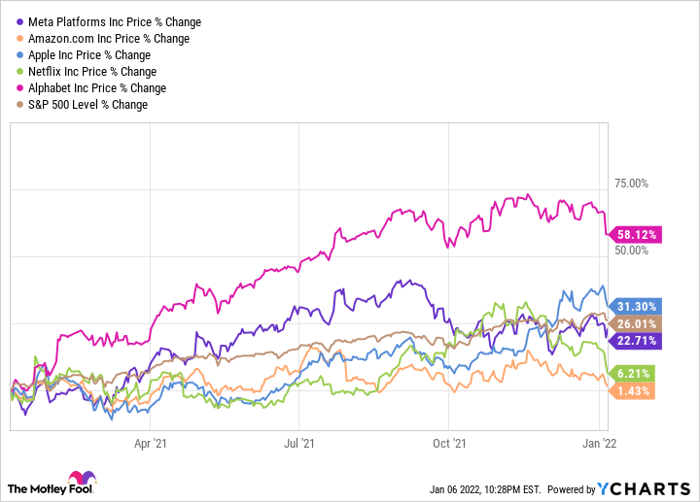
    Three of the five lost to the market during 2021, but one stood out above the rest.

    FB Chart

    FB data by YCharts


    After more than doubling the growth of the market in 2021 , Alphabet seems primed to outperform the rest again.

    Two dominant segments, one laggard

    Alphabet’s dominance in its primary businesses is astounding. The Google search engine has a 92% worldwide market share. It makes almost no sense for businesses to spend search engine optimization (SEO) advertising dollars anywhere besides Google. With nearly every business having an online presence, advertising on Google is necessary so that the website isn’t buried beneath others. This segment accounts for over half of total revenue, making it the most important for Alphabet.

    YouTube — the popular video-sharing platform — also falls under the Alphabet umbrella. Once again, it holds a significant online video platforms market share at 76%. Additonally 74% of U.S. adults accessed YouTube in 2020, more than any other social media site including second-place Facebook (68%). While video ads may be annoying, they represent a significant targeted advertising opportunity. For example, someone looking up home improvement videos may see tool or material supply ads. Because the advertisers aren’t broadcasting to a wide audience — like on TV or a billboard — Alphabet can ensure the ads reach the intended viewer.

    One race Alphabet isn’t winning is cloud computing. This is a competitive market with juggernauts like Amazon Web Services and Microsoft‘s(NASDAQ: MSFT) Azure leading Google Cloud.

    Cloud Infrastructure Market Share
    Amazon Web Services Microsoft Azure Google Cloud
    32% 19% 7%

    Data source: ParkMyCloud.

    The cloud computing market is valued at $455.3 billion but is expected to grow to $947.3 billion by 2026. This is a gigantic industry where many winners can succeed. However, Google will need to step up its game if it hopes to close the gap Amazon and Microsoft have created. During the third-quarter conference call, management noted they are aggressively hiring in its cloud division to better complete. One differentiator that might elevate Google Cloud is its minimal carbon footprint. Alphabet claims it is the world’s “cleanest cloud” with two-thirds of the energy consumed by data centers coming from carbon-free sources and plans to go completely carbon-free by 2030. While this isn’t a technological advantage, it is an attractive bullet point when attempting to win a contract. 

    Alphabet generates massive piles of cash and is stockpiling it too

    As an almost $2 trillion company, sheer size makes it difficult to grow quickly. However, Alphabet’s growth numbers buck this trend. Its Q3 revenue increased 41% to $65.1 billion. 29% of revenue was converted to net income, giving Alphabet plenty of financial resources.

    Its balance sheet has an astounding $142 billion in cash, equivalents, and marketable securities and only $14.2 billion in debt. With a snap of a finger, Alphabet could scoop up several sizable companies. However, Alphabet has been in the federal government’s crosshairs for some time for antitrust behavior.

    A group of states — led by Texas — is suing Google for antitrust behaviors in its advertising business. This comes after the company paid a $2.8 billion fine to the European Union for prioritizing its price comparison service over competitors. Multiple other lawsuits are pending against Alphabet for similar behavior, but with the cash it generates, Alphabet can continue paying the fines. Investors must decide if they can live with owning a company that consistently violates standards governments set or if they want to look somewhere else.

    Channeling the cash pile into buybacks

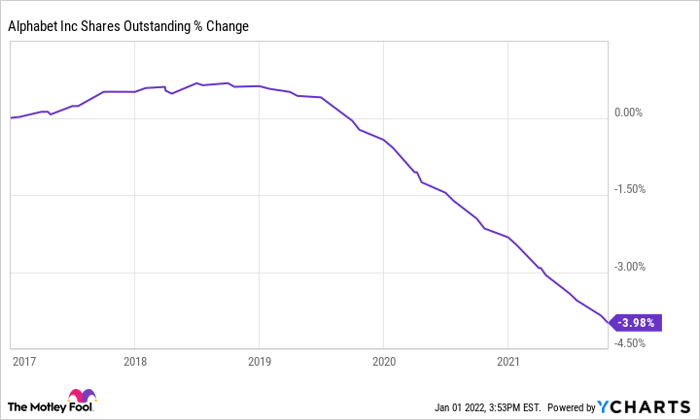
    Besides outright growth, Alphabet is reducing its share count by repurchasing stock. It approved an additional $50 billion buyback program in April, augmenting an already ongoing one. Over the last nine months, Alphabet has retired $36.8 billion in shares, or about 2% of its current market cap. Alphabet has been repurchasing shares for a few years and will probably continue that practice, as regulators will likely shut down any acquisitions, leaving few options for management. Plus, Alphabet generated more than $65 billion in free cash flow over the last 12 months, so it can easily finance continued buyback operations.

    Chart showing large drop in Alphabet's shares outstanding since 2017.

    GOOG Shares Outstanding data by YCharts

    After reducing the outstanding share count, each existing share owns a larger slice of Alphabet, making them more valuable.

    The cloud computing market is far from mature and represents a huge opportunity. Once a company begins using the service, the recurring revenue model generates more revenue as the customer stays on the platform. Alphabet needs to step up its game to catch the other two, but this will still be a revenue-huge segment even if it isn’t the leader.

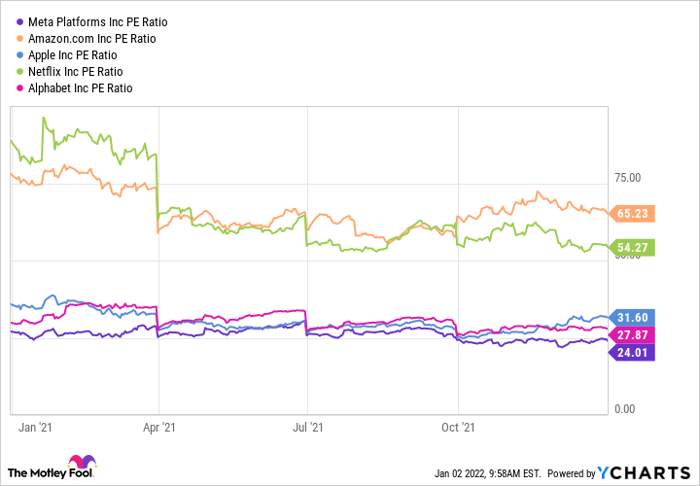
    The valuation is also reasonable compared to the others when assessed from a price-to-earnings (PE) standpoint.

    Chart showing fall in the FAANG stocks' PE ratio in 2021.

    FB PE Ratio data by YCharts

    With only Meta Platforms valued lower, I believe the valuation risk is minimized. Even retailers like Costco (NASDAQ: COST) and Walmart (NYSE: WMT) both have a PE multiple around 50, yet Alphabet’s margin profile is much stronger than the other two. Alphabet is undervalued, and multiple expansions could push the stock price higher.

    At the end of the day, Alphabet has the two most visited websites in the U.S. Ads are not going away, and both Google and YouTube have a successful model in place to monetize them. Alphabet will continue to grow rapidly in both these areas, driving more revenue, and it will use that cash flow to repurchase stock. I believe this mechanism will drive Alphabet to outperform the other FAANG stocks, not only this year but over the next five as well. Alphabet is a great cornerstone stock in a portfolio, and investors would be wise to add it to theirs. 

    This article was originally published on Fool.com. All figures quoted in US dollars unless otherwise stated.

    The post Can 2021’s best-performing FAANG stock do it gain in 2022? appeared first on The Motley Fool Australia.

    Wondering where you should invest $1,000 right now?

    When investing expert Scott Phillips has a stock tip, it can pay to listen. After all, the flagship Motley Fool Share Advisor newsletter he has run for over ten years has provided thousands of paying members with stock picks that have doubled, tripled or even more.*

    Scott just revealed what he believes could be the five best ASX stocks for investors to buy right now. These stocks are trading at near dirt-cheap prices and Scott thinks they could be great buys right now.

    *Returns as of January 12th 2022

    More reading

    Keithen Drury owns Alphabet (C shares) and Costco Wholesale. Suzanne Frey, an executive at Alphabet, is a member of The Motley Fool’s board of directors. Randi Zuckerberg, a former director of market development and spokeswoman for Facebook and sister to Meta Platforms CEO Mark Zuckerberg, is a member of The Motley Fool’s board of directors. John Mackey, CEO of Whole Foods Market, an Amazon subsidiary, is a member of The Motley Fool’s board of directors. The Motley Fool Australia’s parent company Motley Fool Holdings Inc. owns and recommends Alphabet (A shares), Alphabet (C shares), Amazon, Apple, Costco Wholesale, Meta Platforms, Inc., Microsoft, and Netflix. Motley Fool Holdings Inc. recommends the following options: long January 2022 $1,920 calls on Amazon, long March 2023 $120 calls on Apple, short January 2022 $1,940 calls on Amazon, and short March 2023 $130 calls on Apple. The Motley Fool Australia has recommended Alphabet (A shares), Alphabet (C shares), Amazon, Apple, Meta Platforms, Inc., and Netflix. The Motley Fool has a disclosure policy. This article contains general investment advice only (under AFSL 400691). Authorised by Bruce Jackson.

    This article was originally published on Fool.com. All figures quoted in US dollars unless otherwise stated.

    from The Motley Fool Australia https://ift.tt/3GT6SbX