• How does the CBA (ASX:CBA) earnings result compare to Bendigo Bank?

    woman looks surprised at laptop as share price falls

    The Commonwealth Bank of Australia (ASX: CBA) reported its earnings for the 2021 financial year (FY21) last week. Not only did CBA report significant growth and a boosted dividend, but the big bank also announced a $6 billion off-market share buy-back. In response, the market pushed the CBA share price to a new record high.

    But how did it compare to its smaller, locally focused competitor, Bendigo and Adelaide Bank Ltd (ASX: BEN)?

    While the two banks work in the same sector, their businesses and market capitalisation differ significantly. Therefore, it may be a useful exercise to compare how they performed over FY21.

    So, how did the CBA earnings stack up against those of Australia’s fifth-largest retail bank? Let’s take a look.

    CBA share price soars on FY21 earnings

    If you missed CBA’s earnings, here are the highlights of the bank’s FY21:

    • Net profit after tax of around $8.84 billion – 19.7% more than that of FY20
    • Approximately $8.65 billion worth of cash earnings, up 19.8%
    • Net interest margin down 4 basis points to 2.03%
    • Common Equity Tier 1 ratio up 150 basis points to 13.1%
    • $2 fully franked final dividend
    • Off-market share buy-back which is expected to reduce its share count by around 3.5%

    As you can see, FY21 was a successful period for CBA, and its share price reacted positively.

    The CBA share price gained 1.5% after the bank released its earnings. Not to mention, it hit a record high of $109.03 during intraday trade.

    However, it has since fallen 8.2% to trade at $99.27.

    How does this compare to Bendigo Bank’s FY21 earnings?

    Bendigo Bank released its earnings for the financial year just been slightly after CBA. However, its results weren’t received with the warm welcome CBA’s were. The Bendigo Bank share price slumped by 9.9% in response to its FY21 earnings.

    Here’s a sample of what Bendigo Bank reported:

    • Statutory net profit after tax of $524.0 million – up 172%
    • $457.2 million of cash earnings after tax, 51.5% higher than those of the prior corresponding period
    • Net interest margin down 7 basis points to 2.26%
    • Common Equity Tier 1 ratio up 32 basis points to 9.57%
    • 50-cent fully franked final dividend 

    As the Motley Fool Australia reported at the time, while Bendigo Bank recorded exceptional growth, its net interest margin and common equity tier ratio likely let it down.

    While the CBA earnings also outlined a decreased net interest margin, it was a far lesser drop.

    All in all, both banks reported significant growth in profits and earnings, with CBA bringing up the comparative rear.

    CBA share price snapshot

    Despite the market’s enthusiastic reception to the CBA earnings, the bank’s shares have since dipped.

    Right now, the CBA share price is 18% higher than it was at the start of 2021. It has also gained 42% since this time last year.

    The post How does the CBA (ASX:CBA) earnings result compare to Bendigo Bank? appeared first on The Motley Fool Australia.

    Should you invest $1,000 in Commonwealth Bank of Australia right now?

    Before you consider Commonwealth Bank of Australia, you’ll want to hear this.

    Motley Fool Investing expert Scott Phillips just revealed what he believes are the 5 best stocks for investors to buy right now… and Commonwealth Bank of Australia wasn’t one of them.

    The online investing service he’s run for nearly a decade, Motley Fool Share Advisor, has provided thousands of paying members with stock picks that have doubled, tripled or even more.* And right now, Scott thinks there are 5 stocks that are better buys.

    *Returns as of August 16th 2021

    More reading

    Motley Fool contributor Brooke Cooper has no position in any of the stocks mentioned. The Motley Fool Australia’s parent company Motley Fool Holdings Inc. has no position in any of the stocks mentioned. The Motley Fool Australia has no position in any of the stocks mentioned. The Motley Fool has a disclosure policy. This article contains general investment advice only (under AFSL 400691). Authorised by Bruce Jackson.

    from The Motley Fool Australia https://ift.tt/3y0Aj6l

  • These were the best performing ASX 200 shares last week

    Young woman in yellow striped top with laptop raises arm in victory

    Weakness in the resources sector weighed heavily on the S&P/ASX 200 Index (ASX: XJO) last week. This led to the benchmark index falling 2.2% over the five days to end at 7,460.9 points.

    Thankfully, not all shares dropped with the market. Here’s why these were the best performers on the ASX 200 last week:

    Pro Medicus Limited (ASX: PME)

    The Pro Medicus share price was the best performer on the ASX 200 last week with a gain of 17.5%. Investors were buying the healthcare technology company’s shares following the release of a solid full year result. In FY 2021, Pro Medicus reported a 19.5% increase in revenue to $67.9 million and a 33.7% jump in net profit after tax to $30.9 million. Strong demand for its technology from major healthcare institutions has been driving its growth. The Pro Medicus share price is now up 93% year to date.

    Kogan.com Ltd (ASX: KGN)

    The Kogan share price wasn’t far behind with a gain of 15.1%. This is despite there being no news out of the ecommerce company. However, with one of its peers releasing a strong result, investors may be expecting something similar next week from Kogan. That peer was Redbubble Ltd (ASX: RBL), which reported a 58% revenue increase to $553 million. And thanks to operating leverage, Redbubble swung from a loss of $9 million in FY 2020 to a profit of $31 million in FY 2021.

    Chorus Ltd (ASX: CNU)

    The Chorus share price was on form and jumped 12% over the five days. This followed the release of the NZ Commerce Commission’s draft regulatory asset base (RAB) decision for its fibre business. The draft decision values Chorus’ fibre network at NZ$5.427 billion. This is important as the value of the network is a key building block in determining the revenues Chorus can earn over the first three years of the new regulatory regime starting 1 January.

    Domain Holdings Australia Ltd (ASX: DHG)

    The Domain share price was a strong performer and rose 11.1% last week. This was driven by the release of the property listings company’s full year results. For the 12 months ended 30 June, Domain reported a 66% increase in net profit to $37.9 million. Domain also revealed that its unique digital audience increased to a record of more than 9 million during the year. This went down well with UBS, which upgraded its shares to a buy rating with an improved price target of $5.70.

    The post These were the best performing ASX 200 shares last week appeared first on The Motley Fool Australia.

    Wondering where you should invest $1,000 right now?

    When investing expert Scott Phillips has a stock tip, it can pay to listen. After all, the flagship Motley Fool Share Advisor newsletter he has run for more than eight years has provided thousands of paying members with stock picks that have doubled, tripled or even more.*

    Scott just revealed what he believes could be the five best ASX stocks for investors to buy right now. These stocks are trading at near dirt-cheap prices and Scott thinks they could be great buys right now.

    *Returns as of August 16th 2021

    More reading

    Motley Fool contributor James Mickleboro has no position in any of the stocks mentioned. The Motley Fool Australia’s parent company Motley Fool Holdings Inc. owns shares of and has recommended Kogan.com ltd and Pro Medicus Ltd. The Motley Fool Australia owns shares of and has recommended Kogan.com ltd and Pro Medicus Ltd. The Motley Fool has a disclosure policy. This article contains general investment advice only (under AFSL 400691). Authorised by Bruce Jackson.

    from The Motley Fool Australia https://ift.tt/2UAZ6Al

  • These were the worst performing ASX 200 shares last week

    Investor covering eyes in front of laptop

    The S&P/ASX 200 Index (ASX: XJO) was out of form last week due largely to weakness in the resources sector. This led to the benchmark index falling 2.2% over the five days to end at 7,460.9 points.

    While a good number of shares tumbled lower, some fell more than most. Here’s why these were the worst performing ASX 200 last week:

    Lynas Rare Earths Ltd (ASX: LYC)

    The Lynas share price was the worst performer on the ASX 200 last week with a disappointing 18.2% decline. This appears to have been driven by profit taking and a pullback in a range of commodity prices. It is also worth noting that last month Ord Minnett put a lighten rating and $4.30 price target on its shares. This compares to the current Lynas share price of $6.33. The Lynas share price is still up 59% since the start of the year despite this decline.

    Sims Ltd (ASX: SGM)

    The Sims share price wasn’t far behind with a decline of 17.4% over the five days. This is despite the scrap metal company delivering earnings ahead of its guidance range in FY 2021. Though, one broker that wasn’t overly impressed was UBS. In response to the result, the broker downgraded the company’s shares to a neutral rating and cut the price target on them to $17.30.

    Mineral Resources Limited (ASX: MIN)

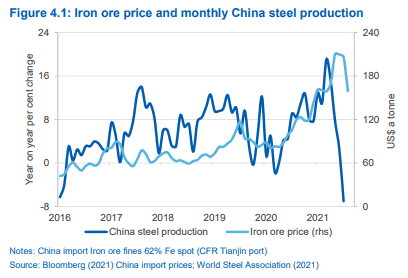
    The Mineral Resources share price was out of form and tumbled 17% lower last week. This decline appears to have been driven by a sharp pullback in iron ore prices last week. The spot iron ore price crashed 15% on Friday to US$130.2 a tonne. This meant it was down approximately 45% from the record high of US$237.57 it reached in May. The Mineral Resources share price is still up 36.2% year to date.

    BHP Group Ltd (ASX: BHP)

    The BHP share price was a disappointing performer and dropped 16% over the five days. This was driven by a combination of the weakness in iron ore prices and the mining giant’s full year results. Although BHP delivered earnings in line with expectations and a dividend ahead of estimates, investors appear disappointed with its plan to merge its oil and gas operations with Woodside Petroleum Limited (ASX: WPL). Some analysts saw these operations as a key growth driver in the future.

    The post These were the worst performing ASX 200 shares last week appeared first on The Motley Fool Australia.

    Wondering where you should invest $1,000 right now?

    When investing expert Scott Phillips has a stock tip, it can pay to listen. After all, the flagship Motley Fool Share Advisor newsletter he has run for more than eight years has provided thousands of paying members with stock picks that have doubled, tripled or even more.*

    Scott just revealed what he believes could be the five best ASX stocks for investors to buy right now. These stocks are trading at near dirt-cheap prices and Scott thinks they could be great buys right now.

    *Returns as of August 16th 2021

    More reading

    Motley Fool contributor James Mickleboro has no position in any of the stocks mentioned. The Motley Fool Australia’s parent company Motley Fool Holdings Inc. has no position in any of the stocks mentioned. The Motley Fool Australia has no position in any of the stocks mentioned. The Motley Fool has a disclosure policy. This article contains general investment advice only (under AFSL 400691). Authorised by Bruce Jackson.

    from The Motley Fool Australia https://ift.tt/3yfYtu1

  • How do the Sydney Airport (ASX:SYD) results compare to Auckland Airport?

    Woman holds up hands to compare two things with question marks above hands

    Just yesterday, Sydney Airport Holdings Pty Ltd (ASX: SYD) released its FY21 first-half result to the ASX. The airport operator reported a decline in passenger numbers, after which its share price took a downward turn.

    Meanwhile, Auckland International Airport Limited (ASX: AIA) also delivered its FY21 earnings on Thursday, announcing a full-year underlying loss. Its share price also edged slightly lower on the result for the day.

    Comparing the financial numbers of two companies can give investors a clearer picture of how the industry is travelling.

    It’s no secret that COVID-19 has impacted the aviation market like never before. However, all eyes are on how quickly the airport operators can reopen and rebound to pre-pandemic levels.

    Below, we take a look at how Sydney Airport’s recent results stack up against Auckland Airport.

    How has Australia’s biggest airport been performing?

    Here’s a summary of the financial details that Sydney Airport posted for the 6 months ending 30 June 2021.

    The weak result came as 6 million total passengers were recorded for the period. This represented a 36.4% drop.

    Yesterday, Sydney Airport shares fell 0.26% to end Friday’s session at $7.70.

    How does this compare to the Auckland Airport earnings result?

    Auckland Airport revealed its own numbers on Thursday, highlighting the struggling travel market. Here’s a recap on the company’s performance for the 12 months ending 30 June 2021:

    • Total revenue of NZ$281.1 million (A$267.46 million), down 50.4% on the prior corresponding period;
    • Earnings before interest, tax, depreciation, fair value adjustments and investments in associates (EBITDAFI) of NZ$171.5 million (A$163.19 million), down 45% on the prior year;
    • Underlying net loss after tax of NZ$41.8 million (A$39.77 million), down 122.2% on the prior year; and
    • No full-year dividend declared.

    Auckland Airport recorded a stark fall in passenger numbers as a result of the COVID-19 border restrictions. In total, 6.4 million passengers walked through, reflecting a 58.5% drop on the previous financial year.

    After dipping following the announcement on Thursday, the company’s shares bounced back yesterday. At the closing bell on Friday, Auckland Airport shares were up 2.69% to $6.87.

    Comparing the two companies’ performance and financial reports, there are similarities in terms of total passengers, and cash earnings. Both Sydney Airport and Auckland Airport fell in revenue, and posted a loss while declaring no dividend.

    Given the uncertain market, neither company dished up an earnings guidance for the foreseeable future.

    However, the travel industry is forecast to fully recover in the coming years as COVID-19 vaccinations are rolled out. 

    Sydney Airport share price snapshot

    It’s been a challenging 12 months for Sydney Airport shares. Although posting a 40% gain over the period, the company has faced severe disruptions within the travel industry.

    In mid-July, the Sydney Airport share price rocketed following a takeover bid by a consortium of infrastructure investors. Since then, the airport operator has received a new offer from the Sydney Aviation Alliance, valuing its shares at $8.45 apiece.

    Based on today’s price, Sydney Airport commands a market capitalisation of $21 billion, with approximately 2.7 billion shares on issue.

    The post How do the Sydney Airport (ASX:SYD) results compare to Auckland Airport? appeared first on The Motley Fool Australia.

    Should you invest $1,000 in Sydney Airport right now?

    Before you consider Sydney Airport, you’ll want to hear this.

    Motley Fool Investing expert Scott Phillips just revealed what he believes are the 5 best stocks for investors to buy right now… and Sydney Airport wasn’t one of them.

    The online investing service he’s run for nearly a decade, Motley Fool Share Advisor, has provided thousands of paying members with stock picks that have doubled, tripled or even more.* And right now, Scott thinks there are 5 stocks that are better buys.

    *Returns as of August 16th 2021

    More reading

    Motley Fool contributor Aaron Teboneras has no position in any of the stocks mentioned. The Motley Fool Australia’s parent company Motley Fool Holdings Inc. has no position in any of the stocks mentioned. The Motley Fool Australia has no position in any of the stocks mentioned. The Motley Fool has a disclosure policy. This article contains general investment advice only (under AFSL 400691). Authorised by Bruce Jackson.

    from The Motley Fool Australia https://ift.tt/3kg5SV5

  • How is the ASX 200 Index (ASX:XJO) share list compiled?

    A boy with question mark on his forehead looking up as if watching an ASX share price

    If you’re an investor in, or at least have an abiding interest in, ASX shares, you will have no doubt heard of the S&P/ASX 200 Index (ASX: XJO).

    The ASX 200 is the ASX’s most prominent share market index, and is frequently quoted alongside the older All Ordinaries Index (ASX: XAO) as an all-encompassing benchmark for the Australian share market.

    If someone says, “the ASX was down 2% yesterday”, they are probably talking about the ASX 200.

    But how exactly are the shares in this list compiled to give us such a good read on the share market as a whole?

    It’s more complicated than you might think.

    So to start off with, let’s get the elephant out of the room. Yes, the ASX 200 has… 200 companies within it. These companies represent the 200 largest shares on the ASX boards by market capitalisation. So size does matter when it comes to how this list is compiled.

    So apart from market capitalisation, what other requirements need to be filled for a company to appear on the ASX 200?

    How does the ASX 200 work?

    Well, according to S&P Global, the company which operates the ASX 200 Index, there are a few other considerations as well. These include liquidity and whether the company is domiciled in Australia.

    Investment vehicles that primarily invest in other companies’ shares, such as exchange-traded funds (ETFs), listed investment companies (LICs) or managed funds, are generally not eligible for inclusion in the ASX 200.

    When determining a company’s market capitalisation, obviously this can change day to day, sometimes dramatically. As such, S&P Global uses the “daily average market capitalisation of a security over the last six months” to determine a longer-term average.

    Every 3 months, the ASX 200 is rebalanced, which means that it is readjusted based on each of its constituents’ updated market capitalisations and other eligibility criteria. This inevitably means that every 3 months, some companies are kicked out of the ASX 200 and replaced with new entrants.

    For example, the ASX 200’s latest rebalance was effective on 21 June 2021. This saw Orocobre Limited (ASX: ORE) added to the ASX 200, whilst Resolute Mining Limited (ASX: RSG) was kicked out.

    But of the top 200 companies are selected for the ASX 200, how are they then apportioned? Well, it’s not equal. In a market capitalisation-weighted index, each company is assigned a ‘weighting’ based on its size. Thus, the larger companies (such as the ASX banks or BHP Group Ltd (ASX: BHP) are assigned a larger weighting than the smaller ones, such as Zip Co Ltd (ASX: Z1P).

    What do the top ASX 200 shares look like today?

    Here is a look at the ASX 200’s current 10 largest companies, and their respective ASX 200 weightings (the latter according to BlackRock):

    ASX 200 Share Current Market Capitalisation ASX 200 Weighting
    Commonwealth Bank of Australia (ASX: CBA) $176.02 billion 8.29%
    BHP Group Ltd (ASX: BHP) $131.59 billion 6.58%
    CSL Limited (ASX: CSL) $137.82 billion 6.26%
    Westpac Banking Corp (ASX: WBC) $94.72 billion 4.44%
    Australia and New Zealand Bnking GrpLtd (ASX: ANZ) $80.73 billion 4.27%
    National Australia Bank Ltd (ASX: NAB) $90.71 billion 3.8%
    Wesfarmers Ltd (ASX: WES) $74.82 billion 3.45%
    Macquarie Group Ltd (ASX: MQG) $60.84 billion 2.61%
    Woolworths Group Ltd (ASX: WOW) $52.6 billion 2.46%
    Telstra Corproation Ltd (ASX: TLS) $47.21 billion 2.21%

    Size does matter…

    As you can see, the weightings generally correspond with each company’s market cap. Of course, this isn’t always perfect. You can see that BHP currently has a larger weighting than CSL, even though it has a smaller market cap as it stands today.

    BHP shares have fallen steeply over the past week or so. But as the ASX 200 is only rebalanced every 3 months, we will have to wait until the next rebalance to see this new paradigm reflected in the weighting. That’s assuming BHP’s market cap remains below CSL’s until then, of course.

    So now you know how the ASX 200 sausage is made, so to speak. It’s a complicated business, but one that ends up giving us an easy and fairly accurate glimpse of how the entire ASX share market is performing at any given time.

    The post How is the ASX 200 Index (ASX:XJO) share list compiled? appeared first on The Motley Fool Australia.

    Wondering where you should invest $1,000 right now?

    When investing expert Scott Phillips has a stock tip, it can pay to listen. After all, the flagship Motley Fool Share Advisor newsletter he has run for more than eight years has provided thousands of paying members with stock picks that have doubled, tripled or even more.*

    Scott just revealed what he believes could be the five best ASX stocks for investors to buy right now. These stocks are trading at near dirt-cheap prices and Scott thinks they could be great buys right now.

    *Returns as of August 16th 2021

    More reading

    Motley Fool contributor Sebastian Bowen owns shares of National Australia Bank Limited and Telstra Corporation Limited. The Motley Fool Australia’s parent company Motley Fool Holdings Inc. owns shares of and has recommended CSL Ltd. and ZIPCOLTD FPO. The Motley Fool Australia owns shares of and has recommended Macquarie Group Limited, Telstra Corporation Limited, and Wesfarmers Limited. The Motley Fool has a disclosure policy. This article contains general investment advice only (under AFSL 400691). Authorised by Bruce Jackson.

    from The Motley Fool Australia https://ift.tt/3D49SjU

  • The Adairs (ASX:ADH) dividend more than doubled in FY21

    A smiling woman with a handful of $100 notes, indicating strong dividend payment by Thorn Group

    A record FY21 result has helped double the Adairs Ltd (ASX: ADH) dividend for FY21.

    The company’s strong financial and operational result witnessed a 10.3% surge to $4.07 within the first hour of trade before selling pressure would see it close 1.63% higher to $3.75.

    Despite a relatively weak intraday performance, investors can look forward to a generous Adairs dividend.

    How did Adairs perform in FY21?

    Adairs delivered a record financial performance in FY21, with highlights including:

    • Group sales rose 28.5% against the prior corresponding period (pcp) to $499.8 million
    • Group online sales increased 33.2% to $187 million, representing 37.4% of total sales
    • Group underlying earnings before interest and tax (EBIT) surging 97.3% to $109.1 million
    • Statutory net profit after tax (NPAT) lifting 80.7% to $63.7 million

    However, its FY22 update and forecasts painted a cautionary tone against the record levels it achieved in FY21.

    The company said that in the first 7 weeks of FY22, total group sales were down 11.7% compared to FY21. While in dollar terms, group sales for the period were lagging approximately $7 million against prior-year figures.

    In addition to weaker sales so far this year, the company also expects gross margins to moderate from record FY21 levels.

    Adairs dividend more than doubles in FY21

    Adairs Chair Brett Chenoweth commented on the increase in shareholder returns:

    Given the underlying NPAT achieved in FY21 and the strong cash generation of the business, I am pleased to advise that the Board have declared a final fully franked dividend of 10.0 cents per share. This takes the total dividend payout for the year to 23.0 cents per share.

    This represents a 109% increase compared to the 11 cents per share paid out in FY20.

    Adairs dividend key dates

    The Adairs share price will go ex-dividend on Wednesday, 8 September and paid out on Thursday, 23 September.

    The post The Adairs (ASX:ADH) dividend more than doubled in FY21 appeared first on The Motley Fool Australia.

    Should you invest $1,000 in Adairs right now?

    Before you consider Adairs, you’ll want to hear this.

    Motley Fool Investing expert Scott Phillips just revealed what he believes are the 5 best stocks for investors to buy right now… and Adairs wasn’t one of them.

    The online investing service he’s run for nearly a decade, Motley Fool Share Advisor, has provided thousands of paying members with stock picks that have doubled, tripled or even more.* And right now, Scott thinks there are 5 stocks that are better buys.

    *Returns as of August 16th 2021

    More reading

    Motley Fool contributor Kerry Sun has no position in any of the stocks mentioned. The Motley Fool Australia’s parent company Motley Fool Holdings Inc. has recommended ADAIRS FPO. The Motley Fool Australia owns shares of and has recommended ADAIRS FPO. The Motley Fool has a disclosure policy. This article contains general investment advice only (under AFSL 400691). Authorised by Bruce Jackson.

    from The Motley Fool Australia https://ift.tt/3DeDLyn

  • August has been a great month so far for the Afterpay (ASX:APT) share price

    A drawing of a white rocket streaking up, indicating a surging share pirce movement

    The Afterpay Ltd (ASX: APT) share price has seen a very strong increase during August 2021.

    The buy now, pay later (BNPL) business has seen a lot of volatility over the last six months. In May it saw a low of $84.50. Six months ago it was at almost $150.  

    But since the start of the month, Afterpay shares have risen around 34%.

    What’s driving the Afterpay share price?

    It all kicked off after Afterpay received a takeover bid from Square Inc (NYSE: SQ) at the start of August 2021.

    The buy now, pay later business announced that it had entered into a scheme implementation deed where Square will acquire all of Afterpay’s shares.

    At the time of the announcement Afterpay said that the transaction had an implied value of approximately US$29 billion, or $39 billion in Australian dollars based on the closing Square share price.

    Why did the Square share price matter? Under the terms of the deal, which the boards of directors of both companies have agreed, Afterpay shareholders will receive a fixed exchange ratio of 0.375 shares of Square shares.

    If the Square share price goes up, then Afterpay shareholders will get more value. But the opposite is true. If the Square share price goes down, then Afterpay share price could also follow.

    The closing of the deal is expected in the first quarter of the 2022 calendar year.

    What is the point of the deal?

    The deal aims to enable the companies to better deliver “compelling” financial products and services that expand access to more consumers and drive incremental revenue for merchants of all sizes.

    Jack Dorsey, the co-founder and CEO of Square, said:

    Square and Afterpay have a shared purpose. We built our business to make the financial system more fair, accessible, and inclusive, and Afterpay has built a trusted brand aligned with those principles. Together, we can better connect our cash app and seller ecosystems to deliver even more compelling products and services for merchants and consumers, putting the power back in their hands.

    Afterpay’s co-founders and co-CEOs will join Square after the transaction is completed and help lead Afterpay’s respective merchant and consumer businesses.

    Afterpay share price snapshot

    Whilst Afterpay shares have risen 1.3% since 3 August 2021, it has actually drifted lower by 3.6% since 10 August 2021.

    The post August has been a great month so far for the Afterpay (ASX:APT) share price appeared first on The Motley Fool Australia.

    Should you invest $1,000 in Afterpay right now?

    Before you consider Afterpay, you’ll want to hear this.

    Motley Fool Investing expert Scott Phillips just revealed what he believes are the 5 best stocks for investors to buy right now… and Afterpay wasn’t one of them.

    The online investing service he’s run for nearly a decade, Motley Fool Share Advisor, has provided thousands of paying members with stock picks that have doubled, tripled or even more.* And right now, Scott thinks there are 5 stocks that are better buys.

    *Returns as of August 16th 2021

    More reading

    Motley Fool contributor Tristan Harrison has no position in any of the stocks mentioned. The Motley Fool Australia’s parent company Motley Fool Holdings Inc. owns shares of and has recommended AFTERPAY T FPO. The Motley Fool Australia owns shares of and has recommended AFTERPAY T FPO. The Motley Fool has a disclosure policy. This article contains general investment advice only (under AFSL 400691). Authorised by Bruce Jackson.

    from The Motley Fool Australia https://ift.tt/3mlk8P2

  • August has been a great month so far for the NAB (ASX:NAB) share price

    Group of people cheer around tablets in office

    The National Australia Bank Ltd (ASX: NAB) share price is having an August to remember.

    At close of trade on Friday, shares in the big four bank were trading for $27.41 – down 0.36%.

    For context, the S&P/ASX 200 Index (ASX: XJO) ended 0.29% higher. Since the beginning of the month, NAB shares have risen 5.78% while the benchmark index is 0.85% higher.

    This golden August comes off the back of NAB announcing a $2.5 billion share buyback at the end of July. The news saw the NAB share price lift by the end of the day.

    Let’s see what’s been affecting NAB this month.

    The month so far for NAB

    The first significant story that was material to the NAB share price was its confirmation it would purchase the Citigroup Inc (NYSE: C) Australian consumer business for $1.2 billion.

    As Motley Fool previously reported, NAB announced it would buy Citi’s home lending portfolio, unsecured lending business, retail deposits business, and private wealth management business for the value of the net assets plus a premium of $250 million.

    Citigroup’s Australian consumer business has lending assets of approximately $12.2 billion ($7.9 billion in residential mortgages and $4.3 billion in unsecured debt) and deposits of about $9 billion.

    As part of the deal, Citibank senior management and around 800 staff will join NAB on completion. Citigroup’s institutional business in Australia is not a part of the deal.

    The purchase is subject to regulatory approval including from the federal Treasurer, the Australian Prudential Regulation Authority (APRA), and the Australian Competition and Consumer Commission (ACCC). If all goes as planned, the deal should be completed by March 2022.

    Other news that affected the NAB share price included the results out of competitor Commonwealth Bank of Australia (ASX: CBA). In fact, most ASX bank shares lifted that day.

    Finally, NAB released a third-quarter trading update. This was not price-sensitive.

    NAB’s revenue fell 1% as declines in markets and treasury (M&T) income outweighed higher volumes and margins in its lending businesses.

    The bank’s net interest margin (NIM) was broadly stable, reflecting lower deposit and funding costs, partly offset by the impact of low-interest rates and home lending competition.

    NAB share price snapshot

    Over the past 12 months, the NAB share price has increased by 55.3%. It has outperformed the ASX 200 by 30 percentage points over the period. Year-to-date, however, it has underperformed the ASX 200 by about 3 percentage points.

    NAB has a market capitalisation of approximately $90.7 billion.

    The post August has been a great month so far for the NAB (ASX:NAB) share price appeared first on The Motley Fool Australia.

    Should you invest $1,000 in NAB right now?

    Before you consider NAB, you’ll want to hear this.

    Motley Fool Investing expert Scott Phillips just revealed what he believes are the 5 best stocks for investors to buy right now… and NAB wasn’t one of them.

    The online investing service he’s run for nearly a decade, Motley Fool Share Advisor, has provided thousands of paying members with stock picks that have doubled, tripled or even more.* And right now, Scott thinks there are 5 stocks that are better buys.

    *Returns as of August 16th 2021

    More reading

    Citigroup is an advertising partner of The Ascent, a Motley Fool company. Motley Fool contributor Marc Sidarous has no position in any of the stocks mentioned. The Motley Fool Australia’s parent company Motley Fool Holdings Inc. has no position in any of the stocks mentioned. The Motley Fool Australia has no position in any of the stocks mentioned. The Motley Fool has a disclosure policy. This article contains general investment advice only (under AFSL 400691). Authorised by Bruce Jackson.

    from The Motley Fool Australia https://ift.tt/3z1nTMW

  • What happened to the Next Science (ASX:NXS) share price last earnings season?

    A man scratches his head in confusion.

    The Next Science Ltd (ASX: NXS) share price has staged a remarkable recovery on Friday afternoon. Shares in the Aussie medical device company were down 4.1% before closing 1% higher at $1.48 per share despite no new announcements.

    Next Science’s half-year results release is looming on 30 August and investors will be watching the Aussie biotech closely.

    Let’s take a look at how the Aussie biotech company’s shares have performed in previous earnings seasons.

    What happened to the Next Science share price last earnings season?

    Last earnings season was in February when Next Science reported its full-year earnings for the period ended 31 December 2021 (FY20).

    The Aussie biotech reported earnings on 22 February including the below highlights:

    • Fourth quarter revenue growth up 75% compared to Q4 2019
    • Patent portfolio increased to 31 patents
    • 2 CE Marks awarded (Bactisure and BlastX)
    • Successful $15 million capital raised to fund the commercialisation of XPerience in the US and support long-term growth

    The Next Science share price charged higher in the lead-up to (and immediately after) the earnings release. That included an 18.6% surge from February 18 through to February 24.

    However, shares in the Aussie biotech didn’t return to that $1.40 per share closing price level again until mid-April.

    As it stands currently, the company has a market capitalisation of $293 million based on Friday’s closing Next Science share price of $1.48 per share. The Aussie biotech share fell lower in June after it lowered earnings guidance for the second half of FY21.

    Next Science said it is forecasting revenue of between $3.5 million and $4 million through to 30 June 2021. That was lower than initially predicted in the February earnings season with hopes for a similar growth trajectory to continue.

    Foolish takeaway

    The Next Science share price was smashed on Friday before pulling off a late-afternoon recovery. The ASX biotech share ultimately closed the day up 1% having been down 4.1% around lunchtime.

    Investors will be hoping the group’s half-year result on 30 August will be enough to kickstart the Aussie biotech share similar to what we saw in February.

    The post What happened to the Next Science (ASX:NXS) share price last earnings season? appeared first on The Motley Fool Australia.

    Should you invest $1,000 in Next Science right now?

    Before you consider Next Science, you’ll want to hear this.

    Motley Fool Investing expert Scott Phillips just revealed what he believes are the 5 best stocks for investors to buy right now… and Next Science wasn’t one of them.

    The online investing service he’s run for nearly a decade, Motley Fool Share Advisor, has provided thousands of paying members with stock picks that have doubled, tripled or even more.* And right now, Scott thinks there are 5 stocks that are better buys.

    *Returns as of August 16th 2021

    More reading

    Motley Fool contributor Ken Hall has no position in any of the stocks mentioned. The Motley Fool Australia’s parent company Motley Fool Holdings Inc. owns shares of and has recommended Next Science Limited. The Motley Fool Australia has no position in any of the stocks mentioned. The Motley Fool has a disclosure policy. This article contains general investment advice only (under AFSL 400691). Authorised by Bruce Jackson.

    from The Motley Fool Australia https://ift.tt/2W9Zjv2

  • Brokers name 2 mid cap ASX shares as buys

    A hand holding a graph trending up, indicating a surging share price on the ASX

    Are you looking for some options in the mid cap space? If you are, you might want to check out the ones listed below.

    Here’s why analysts think these ASX mid cap shares could be in the buy zone right now:

    Audinate Group Limited (ASX: AD8)

    The first mid cap ASX share to look at is this digital audio-visual networking technologies provider. Audinate is the company behind the industry-leading Dante audio over IP networking solution. This solution is used widely across a number of industries and is currently dominating the competition.

    Dante replaces traditional analogue audio cables by transmitting perfectly synchronised audio signals across large distances, to multiple locations at once, using nothing more than an Ethernet cable.

    Although demand softened during the height of the pandemic, it has rebounded strongly in recent months. For example, Audinate’s fourth quarter revenue jumped 74% over the prior corresponding period. This led to the company reporting a 23% increase in full year revenue to US$25 million in FY 2021.

    UBS is positive on Audinate. It currently has a buy rating and $11.30 price target on its shares.

    Hipages Group Holdings Ltd (ASX: HPG)

    Another mid cap ASX share to look at is Hipages. It is a leading Australian-based online platform and software as a service (SaaS) provider.

    Its platform connects tradies with residential and commercial consumers. Furthermore, the Hipages platform not only helps tradies grow their businesses by providing job leads, it also allows them to communicate with customers and run general admin duties.

    Hipages has been growing very quickly in FY 2021 despite lockdowns. It ended the fourth quarter with Monthly Recurring Revenue (MRR) of $5.2 million, which was a 27% increase on the prior corresponding period. It also revealed a 12% increase in total subscription tradies to 31,200, and a 27% jump in average revenue per tradie to $1,638.

    Goldman Sachs is positive on the company and sees it as a great long term option. It notes that the company currently captures around 5% of total industry advertising spend. However, it sees potential for this to increase to 40% to 60% in the future as the company builds out its ecosystem.

    Goldman Sachs has a buy rating and $4.10 price target on its shares.

    The post Brokers name 2 mid cap ASX shares as buys appeared first on The Motley Fool Australia.

    Wondering where you should invest $1,000 right now?

    When investing expert Scott Phillips has a stock tip, it can pay to listen. After all, the flagship Motley Fool Share Advisor newsletter he has run for more than eight years has provided thousands of paying members with stock picks that have doubled, tripled or even more.*

    Scott just revealed what he believes could be the five best ASX stocks for investors to buy right now. These stocks are trading at near dirt-cheap prices and Scott thinks they could be great buys right now.

    *Returns as of August 16th 2021

    More reading

    Motley Fool contributor James Mickleboro has no position in any of the stocks mentioned. The Motley Fool Australia’s parent company Motley Fool Holdings Inc. owns shares of and has recommended AUDINATEGL FPO and Hipages Group Holdings Ltd. The Motley Fool Australia owns shares of and has recommended AUDINATEGL FPO. The Motley Fool has a disclosure policy. This article contains general investment advice only (under AFSL 400691). Authorised by Bruce Jackson.

    from The Motley Fool Australia https://ift.tt/3AVppki