• Top broker gives its verdict on the Fortescue (ASX:FMG) share price

    Female worker sitting desk with head in hand and looking fed up

    The Fortescue Metals Group Limited (ASX: FMG) share price is trading lower on Tuesday.

    At the time of writing, the iron ore giant’s shares are down 1% to $21.08.

    Why is the Fortescue share price trading lower?

    One thing that could be weighing on the Fortescue share price today is a bearish broker note out of Goldman Sachs.

    In response to the company’s full year results release, the broker has retained its sell rating and $19.90 price target.

    Based on the current Fortescue share price, this implies potential downside of 5.5% over the next 12 months.

    Why is Goldman bearish on Fortescue?

    According to the note, there are four key reasons why Goldman Sachs doesn’t see value in the Fortescue share price at the current level.

    One is its valuation in comparison to fellow mining giant Rio Tinto Limited (ASX: RIO). Its analysts note that Fortescue trades at ~1.7x net asset value (NAV) compared to Rio Tinto at ~0.85x NAV.

    Another concern the broker has is the widening of low grade 58% iron ore product realisations. Current spot realisations for Fortescue 58% product is at ~75% of the 62% Index versus 84% in the June quarter. It feels that this could worsen as China cuts steel production in the second half of the year.

    What else?

    Another reason the broker is bearish on the Fortescue is its capital expenditure risks at the Iron Bridge project.

    Goldman explained: “Capex has increased to US$3.3-3.5bn (100% basis), c. +US1bn higher since the initial cost when it was approved in April 2019, with a 6-month delay and a slower expected ramp up. We model capex of US$3.7bn and first ore in Q1 2023 (FMG: by Dec 2022), and an 18-24 month ramp up.”

    Finally, the broker also has concerns over its diversification plans with the Fortescue Future Industries business.

    All in all, the Fortescue share price may be down 14% in 2021, but this leading broker feels it can still go lower.

    The post Top broker gives its verdict on the Fortescue (ASX:FMG) share price appeared first on The Motley Fool Australia.

    Should you invest $1,000 in Fortescue right now?

    Before you consider Fortescue, you’ll want to hear this.

    Motley Fool Investing expert Scott Phillips just revealed what he believes are the 5 best stocks for investors to buy right now… and Fortescue wasn’t one of them.

    The online investing service he’s run for nearly a decade, Motley Fool Share Advisor, has provided thousands of paying members with stock picks that have doubled, tripled or even more.* And right now, Scott thinks there are 5 stocks that are better buys.

    *Returns as of August 16th 2021

    More reading

    Motley Fool contributor James Mickleboro has no position in any of the stocks mentioned. The Motley Fool Australia’s parent company Motley Fool Holdings Inc. has no position in any of the stocks mentioned. The Motley Fool Australia has no position in any of the stocks mentioned. The Motley Fool has a disclosure policy. This article contains general investment advice only (under AFSL 400691). Authorised by Bruce Jackson.

    from The Motley Fool Australia https://ift.tt/3t3SuHI

  • Bitcoin vs Ethereum: Which is better for me?

    a planet surrounded by cryptocurrency symbols

    Many investors, including professionals, are now starting to consider cryptocurrencies.

    The 2 most well-known names in that world are Bitcoin (CRYPTO: BTC) and Ethereum (CRYPTO: ETH).

    For a first-timer, which cryptocurrency do you invest in? Do they have different purposes? Do they gain or lose value in different ways?

    The Motley Fool asked a couple of experts.

    Aus Merchant co-founder Sean Tolkin told The Motley Fool there is a very easy way for traditional investors to make a distinction between the two cryptocurrencies.

    “Bitcoin is to gold what Ethereum is to equities.”

    Bitcoin is gold

    Tolkin, who is also the chief executive of the digital currency provider, said that Bitcoin’s main purpose is to be a store of value.

    “Bitcoin is sound money in a digital format. Bitcoin may be the world’s greatest savings system and is open to anyone, without the need for any trusted intermediaries such as banks or lawyers.”

    Bitcoin has been programmed to eventually reach a limit of 21 million coins. Tolkin said that this scarcity holds up the value.

    “This is in stark contrast to the traditional fiat monetary system that allows governments to inflate the monetary supply (to fund government debt), which in turn erodes the purchasing power of one’s hard-earned savings.”

    Ethereum is shares

    According to Tolkin, Ethereum — or more accurately, Ether — is “a complete paradigm shift from Bitcoin”. 

    “While Bitcoin’s mission is simply to be an effective store of value and immutable medium of exchange, Ethereum is a platform that facilitates a myriad of other businesses and applications.”

    Ethereum uses blockchain technology to facilitate “decentralised finance”, or “defi” as it is known these days.

    “Defi allows anyone with a smartphone to trade, lend, loan, become a market maker and much more,” said Tolkin.

    “The Ethereum blockchain has also enabled the creation of: play to earn games, supply chain management protocols, digital art curation (NFTs) and can theoretically facilitate an almost infinite amount of other applications.”

    So the value of Ether is more dependent on real-life activities and the usefulness of the technology.

    “Many of these applications have cash flows and P/E earnings etc. that are familiar to anyone in the traditional finance space,” Tolkin said. 

    “This parallel financial system is made possible by the smart contract functionality native to the Ethereum blockchain.”

    Why bother with either cryptocurrency (or any)?

    According to Aus Merchant co-founder and managing director Darren Abrams, the blockchain industry is already showing up how inefficient old-world database systems are.

    “Finance and supply chain management are both primed for blockchain disruption,” he said.

    “However, we believe that the blockchains that best facilitate these decentralised financial applications will capture the majority of the digital asset market capital.”

    Abrams had a tip for those who wanted to start investing in cryptocurrency but didn’t know where to start.

    “There are two approaches I’d recommend. First, simply invest in… ‘layer 1’ blockchains (ie Bitcoin, Ether, Polkadot (CRYPTO: DOT), Solana (CRYPTO: SOL), Terra (CRYPTO: LUNA)) or find a professional fund manager in the space.”

    Aus Merchant is a cryptocurrency investment manager, so its founders obviously have an interest in investors seeking professional assistance.

    But Abrams reckons either approach will work fine.

    “Although we believe the former option will yield fantastic returns in the long run, the middleware and applications built on top of these blockchains have the potential to generate asymmetrical returns,” he said. 

    “However, spotting the difference between a pets.com and an Amazon takes a discerning expert.”

    The post Bitcoin vs Ethereum: Which is better for me? appeared first on The Motley Fool Australia.

    Should you invest $1,000 in Bitcoin right now?

    Before you consider Bitcoin, you’ll want to hear this.

    Motley Fool Investing expert Scott Phillips just revealed what he believes are the 5 best stocks for investors to buy right now… and Bitcoin wasn’t one of them.

    The online investing service he’s run for nearly a decade, Motley Fool Share Advisor, has provided thousands of paying members with stock picks that have doubled, tripled or even more.* And right now, Scott thinks there are 5 stocks that are better buys.

    *Returns as of August 16th 2021

    More reading

    Motley Fool contributor Tony Yoo owns shares of Bitcoin and Ethereum. The Motley Fool Australia’s parent company Motley Fool Holdings Inc. owns shares of and has recommended Bitcoin and Ethereum. The Motley Fool Australia has no position in any of the stocks mentioned. The Motley Fool has a disclosure policy. This article contains general investment advice only (under AFSL 400691). Authorised by Bruce Jackson.

    from The Motley Fool Australia https://ift.tt/3mMbRUl

  • Woolworths (ASX:WOW) share price history: What caused the biggest ups and downs?

    a woman pushes a man standing in a shopping trolley pointing ahead far off into the distance.

    The Woolworths Group Ltd (ASX: WOW) share price has long been a stable presence on the ASX share market. Since its listing on the ASX boards back in 1993, Woolworths shares have been traded and owned for decades.

    But what can we learn from the recent Woolworths share price history? What have been its biggest ups and downs over the past 5 years?

    That’s what we’ll be looking to today.

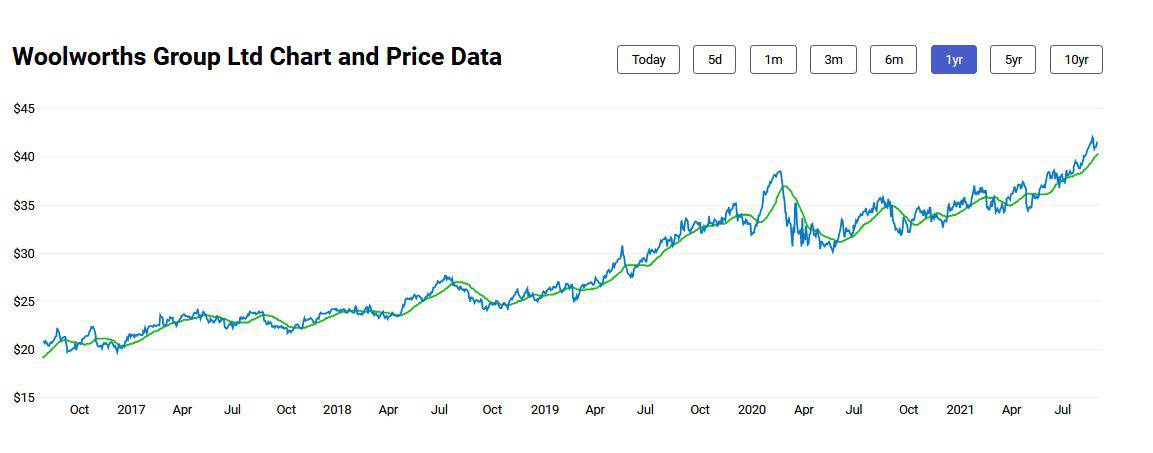
    So, to kick things off, here is a share price graph of the Woolworths share price over the past 5 years:

    WOW share price
    Woolworths 5-year Share Price Data | Source: fool.com.au

    It’s clearly been a pretty smooth run for investors in Woolworths over the past 5 years. Back at the end of August 2016, this company was asking a share price of roughly $21.80 a share. Today, at the time of writing, the Woolworths share price is sitting at $41.56. up 0.29% for the day so far.

    That means that over the past 5 years, Woolworths shares have delivered a capital return of approximately 90.6%. That compares very favourably against the S&P/ASX 200 Index (ASX: XJO) which has returned around 40% over the same period.

    But what have been the company’s biggest ups and downs over this period?

    Some ups and downs for the Woolworths share price

    Well, to start things off, it’s important to remember that in late August of 2016, Woolworths shares had just reached the bottom of what we can now call a 2-year slump.

    In August 2014, Woolies was going for around $30 a share. Yet, by July 2016, the company was under $18 a share. Looking back, we can blame this slump on the resurgence of Woolies’ arch-rival Coles Group Ltd (ASX: COL) which was beginning to fire under the management of its old parent company Wesfarmers Ltd (ASX: WES).

    But it was also the time of Woolworths’ disastrous foray into the world of hardware. Remember Masters? Woolworths’ doomed attempt to compete with Wesfarmers’ uber-successful hardware chain Bunnings?

    Well, this was around the time Woolworths was hemorrhaging cash from its expansion plans. The company ended up pulling the plug on the whole thing in December 2016, at an enormous cost to shareholders. We can see this being built into Woolies shares between 2014 and 2016. Indeed, it was only in the August of 2019 that Woolworths shares would eventually rise back to the level they were in 2014.

    Kaufland exits, and COVID enters

    In 2019 and early 2020, we saw the Woolworths share price explode. 2019 saw the company add around 25% to its value, while the period between 1 January 2020 and 14 February 2020 saw another near-20% put on top.

    At the time, we all thought that the German supermarket giant Kaufland would be entering the Australian retail space, given the company had publically announced expansion plans. But when Kaufland announced that it would be pulling the plug on its Australian plans in January 2020, the Woolworths share price rocketed.

    It was only brought back to Earth by the subsequent outbreak of the coronavirus pandemic a month later. For the first year or so of life with COVID, Woolworths shares largely trod water.

    Woolies was more or less left out of the COVID-induced share market crash of early 2020 – largely thanks to the well-publicised panic buying of essential groceries that we saw last year.

    How does the Woolworths share price look today?

    But in the past 3 months or so, investors have broken the mould and sent Woolworths shares to new heights. After a robust FY21 earnings report, the successful demerger of Endeavour Group Ltd (ASX: EDV) and a new share buyback program, things have never been better for Woolworths share price. Today, it sits pretty close to its post-spin off all-time high as we speak.

    Who knows what the future will hold for Woolworths going forward. But we do know that there is still an army of shareholders who will be paying attention!

    At the current Woolworths share price, the company has a market capitalisation of $52.53 billion. a price-to-earnings (P/E) ratio of 34 and a dividend yield of 2.61%.

    The post Woolworths (ASX:WOW) share price history: What caused the biggest ups and downs? appeared first on The Motley Fool Australia.

    Should you invest $1,000 in Woolworths right now?

    Before you consider Woolworths, you’ll want to hear this.

    Motley Fool Investing expert Scott Phillips just revealed what he believes are the 5 best stocks for investors to buy right now… and Woolworths wasn’t one of them.

    The online investing service he’s run for nearly a decade, Motley Fool Share Advisor, has provided thousands of paying members with stock picks that have doubled, tripled or even more.* And right now, Scott thinks there are 5 stocks that are better buys.

    *Returns as of August 16th 2021

    More reading

    Motley Fool contributor Sebastian Bowen has no position in any of the stocks mentioned. The Motley Fool Australia’s parent company Motley Fool Holdings Inc. has no position in any of the stocks mentioned. The Motley Fool Australia owns shares of and has recommended COLESGROUP DEF SET and Wesfarmers Limited. The Motley Fool has a disclosure policy. This article contains general investment advice only (under AFSL 400691). Authorised by Bruce Jackson.

    from The Motley Fool Australia https://ift.tt/3tdjCnL

  • Why the Qantas (ASX:QAN) share price has beaten the ASX 200 in the last year

    A woman holds her arms out as a plane flies overhead

    Despite an outbreak of the Delta variant and nationwide lockdowns, the Qantas Airways Limited (ASX: QAN) share price has flourished in the last year.

    In the past 52-weeks, shares in the airliner have soared more than 31%.

    By comparison, the broader S&P/ASX200 (ASX: XJO) Index has only climbed 26.5% higher in the same period.

    Let’s take a look at why the Qantas share price has beaten the ASX 200.

    Qantas share price rallies into reporting season

    Much of the gains in the Qantas share price have been realised in the last week.

    Since last Monday, shares in the airliner rallied more than 19% as the company approached its reporting date.

    In addition, the Qantas share price also received a boost from its incentive scheme to get more Australians vaccinated.

    As part of the program, the airliner aims to reward Australian’s who get the COVID-19 vaccine with bonus points, credits and travel vouchers.

    The incentive follows the company’s decision to mandate that Qantas employees receive the vaccine by 15 November 2021.

    How did Qantas perform in FY21?

    Qantas released its full-year results for FY21 late last week.

    The airliner’s report was headlined by a statutory loss before tax of $2.35 billion.

    Other highlights from Qantas’ full-year results included;

    The airliners management cited the difficult domestic and international conditions for the dire result.

    Qantas noted that in FY21, only 30 days were free of any state domestic border restrictions.

    The outlook for Qantas

    The Qantas share price has continued its bullish price action heading into this week.

    Shares in the airliner have been buoyed by plans to potentially resume international travel by December of 2021.

    In line with the National Cabinet’s plan, Qantas expects the resumption of the trans-Tasman travel bubble and other routes in the Asia Pacific.

    Leading broker Citi has also painted an optimistic outlook on the Qantas share price.

    Analysts recently retained their buy rating and increased their price target on the airliners shares.

    Notwithstanding a disappointing FY21, analysts noted that guidance for FY21 implies market share gains.

    The broker acknowledged that despite uncertainty around COVID-19, Qantas is well placed to meet pent-up demand.

    At the time of writing, the Qantas share price is trading 6% for the year at $5.11.

    The post Why the Qantas (ASX:QAN) share price has beaten the ASX 200 in the last year appeared first on The Motley Fool Australia.

    Should you invest $1,000 in Qantas right now?

    Before you consider Qantas, you’ll want to hear this.

    Motley Fool Investing expert Scott Phillips just revealed what he believes are the 5 best stocks for investors to buy right now… and Qantas wasn’t one of them.

    The online investing service he’s run for nearly a decade, Motley Fool Share Advisor, has provided thousands of paying members with stock picks that have doubled, tripled or even more.* And right now, Scott thinks there are 5 stocks that are better buys.

    *Returns as of August 16th 2021

    More reading

    Motley Fool contributor Nikhil Gangaram has no position in any of the stocks mentioned. The Motley Fool Australia’s parent company Motley Fool Holdings Inc. has no position in any of the stocks mentioned. The Motley Fool Australia has no position in any of the stocks mentioned. The Motley Fool has a disclosure policy. This article contains general investment advice only (under AFSL 400691). Authorised by Bruce Jackson.

    from The Motley Fool Australia https://ift.tt/3gHyju7

  • The latest ASX shares to be hit by a broker downgrade

    ASX shares downgrade A young woman with tattoos puts both thumbs down and scrunches her face with the bad news.

    We might be emerging from one of the best reporting seasons in history, but this hasn’t brokers from downgrading ASX shares.

    The S&P/ASX 200 Index (Index:^AXJO) gained 0.5% over the past month as several ASX shares posted record earnings and dividends.

    But it isn’t all good news for the Healius Ltd (ASX: HLS) share price. Even after the medical services group posted strong growth for FY21, Goldman Sachs downgraded the Healius share price to “neutral” from “buy”.

    ASX shares downgraded for lack of new surprises

    This is largely because the broker reckons management has run out of rabbits to pull out its hat! Delivering positive surprises is key to driving outperformance for the Healius share price.

    “Commentary that the base pathology business remains ‘slightly up’ in FY22 to date is encouraging, but is likely no longer sufficient to generate positive surprise,” said Goldman.

    “Meanwhile, the Imaging business is currently held back by ongoing lockdowns but also continues to lag peers.”

    How much is the Healius share price worth?

    Sure, increased PCR testing for COVID-19 will bolster the company’s bottom line, but that’s arguably priced into the Healius share price, which is up around 65% since the start of the pandemic.

    What’s more, management has ruled out further corporate restructure in the near-term.

    Goldman’s 12-month price target on the Healius share price is $4.90 a share.

    Too much of a good thing

    Another to suffer a broker downgrade is the Mincor Resources NL (ASX: MCR) share price. The analysts at Macquarie Group Ltd (ASX: MQG) lowered its rating on the Mincor share price to “neutral” from “outperform”.

    The move comes even after the nickel miner announced two impressive exploration results at Golden Mile and Location 1.

    “We believe Golden Mile has the potential to add tonnes to our five-year production scenario with Location 1 requiring more drilling to better define its potential,” said Macquarie.

    “MCR’s share price is up ~40% since the beginning of July [vs index ASX 200 up 3%], equivalent to an increase in market capitalisation of +$170m.

    “We believe this move largely captures the potential of the discoveries at this stage.”

    Downgraded ASX shares despite positive nickel outlook

    Mincor’s production ramp-up and costs assumptions are the key risks to the broker’s forecasts for the miner.

    Macquarie’s 12-month price target on the Mincor share price is $1.40 a share.

    But this doesn’t mean the broker is turning bearish on nickel. If anything, the supply of the metal remained tight with only 273,000 tonnes of ferronickel imported to China in July.

    This is against the backdrop of the global deficit and ramp-up of Indonesian stainless output.

    The post The latest ASX shares to be hit by a broker downgrade appeared first on The Motley Fool Australia.

    Wondering where you should invest $1,000 right now?

    When investing expert Scott Phillips has a stock tip, it can pay to listen. After all, the flagship Motley Fool Share Advisor newsletter he has run for more than eight years has provided thousands of paying members with stock picks that have doubled, tripled or even more.*

    Scott just revealed what he believes could be the five best ASX stocks for investors to buy right now. These stocks are trading at near dirt-cheap prices and Scott thinks they could be great buys right now.

    *Returns as of August 16th 2021

    More reading

    Motley Fool contributor Brendon Lau owns shares of Macquarie Group Limited. The Motley Fool Australia’s parent company Motley Fool Holdings Inc. has no position in any of the stocks mentioned. The Motley Fool Australia owns shares of and has recommended Macquarie Group Limited. The Motley Fool has a disclosure policy. This article contains general investment advice only (under AFSL 400691). Authorised by Bruce Jackson.

    from The Motley Fool Australia https://ift.tt/38rA8a8

  • Regis Resources (ASX:RRL) share price slides as profits fall 27% in FY21

    Female worker sitting desk with head in hand and looking fed up

    The Regis Resources Limited (ASX: RRL) share price has dipped into the red on Tuesday after the company reported its FY21 earnings.

    Regis shares are now changing hands at $2.49 apiece, a 2.73% drop from the open.

    Let’s take a closer look.

    Regis Resources share price slumps after NPAT, dividend drop

    Here’s how the gold producer performed in FY21:

    • Revenue of $819.2 million from sale of 367,285 ounces of gold, an 8% year-on-year increase
    • Gross profit of $236.5 million, down from $304.6 million in FY20
    • Earnings before interest, taxes, depreciation and a mortisation (EBITDA) of $403 million, up 2.3% on the year, on a margin of 49%
    • Net profit after tax (NPAT) $146 million, a decrease of 27% from the year prior
    • Profit before income tax (PBIT) of $212 million, down from $285 million a year ago
    • Total dividend payout of $61.3 million, a 25% down-step from the $81.3 million paid out in the year prior
    • Dividend of 7 cents per share in FY21, a 56% decrease from the 16 cents per share in FY20.

    What happened in FY21 for Regis Resources?

    The gold production company reported a mixed bag of results, which could potentially weigh in on the Regis Resources share price.

    Firstly, Regis produced a total of 372,870 ounces of gold in FY21, a 6% increase from FY20. From this, Regis recognised an 8% year-on-year increase in revenue to $819 million, all from the sale of 367,285 ounces of gold.

    The average realised price on these sales was $2,229 per ounce, up from $2,200 a year ago.

    Despite the growth in revenue, Regis recognised a 22% decrease in gross profit to $236.5 million. This carried through to a decline in profit before tax of 26% to $212 million.

    As a result, the company also recorded a 27% decrease in NPAT for the year, down from almost $200 million in the year prior.

    All-in sustaining costs (ASIC) were also higher in FY21 at $1,372 an ounce versus $1,246 a year ago.

    Regis also completed the 30% acquisition of the Tropicana Gold Project in Western Australia. The transaction was funded through a “$650 million equity raising and $300 million debt facility”.

    Group mineral resources expanded by 35% whereas the group ore reserves increased by 33% in FY21. The company also “commenced development” at the Garden Well underground mine in Western Australia.

    Finally, one other point that could weigh in on the Regis Resources share price, is the declared final dividend of 3 cents per share. This brings the total FY21 dividend to 7 cents per share, fully franked, and represents a significant 56% down-step from the FY20 dividend of 16 cents per share.

    What did management say?

    Speaking on the results which could be affecting the Regis Resources share price, managing director Jim Beyer said:

    Regis Resources has delivered another year of solid production for FY21 generating an EBITDA of $403 million, a net profit after tax of $146 million, a net profit after tax margin of 18% and operating cash flows of $276 million. While delivering this result, Regis executed a genuinely transformational transaction through the acquisition of a 30% interest in the Tropicana Gold project which delivers on our strategic objectives to grow as a safe, responsible, reliable, long-life, low-cost gold producer, generating strong financial returns.

    What’s next for Regis Resources?

    There are a few projections that could affect the Regis Resources share price going forward.

    Regis expects “a solid year of production at Duketon” in FY22, driven by the company’s 30% interest in the Tropicana Gold Project.

    Management sees gold production in the range of 460,000–515,000 ounces for the group in FY22 on an AISC of $1,290–$1,365/ounce.

    It also sees growth capital of $155 million to $165 million, including open pit and underground mining costs.

    Regis management notes that the “September quarter is expected to be soft” from “major mill shutdowns”. It also sees a weak upcoming quarter from “pit rescheduling requirements” and rebasing into steady state production at its Rosemont site.

    Regis Resources share price snapshot

    The Regis Resources share price has struggled this year to date, posting a loss of 30% since January 1. It has also fallen about 50% over the last 12 months.

    These results have lagged the S&P/ASX 200 index (ASX: XJO)’s return of around 25% over the past year.

    The post Regis Resources (ASX:RRL) share price slides as profits fall 27% in FY21 appeared first on The Motley Fool Australia.

    Should you invest $1,000 in Regis Resources right now?

    Before you consider Regis Resources, you’ll want to hear this.

    Motley Fool Investing expert Scott Phillips just revealed what he believes are the 5 best stocks for investors to buy right now… and Regis Resources wasn’t one of them.

    The online investing service he’s run for nearly a decade, Motley Fool Share Advisor, has provided thousands of paying members with stock picks that have doubled, tripled or even more.* And right now, Scott thinks there are 5 stocks that are better buys.

    *Returns as of August 16th 2021

    More reading

    The author Zach Bristow has no positions in any of the stocks mentioned. The Motley Fool Australia’s parent company Motley Fool Holdings Inc. has no position in any of the stocks mentioned. The Motley Fool Australia has no position in any of the stocks mentioned. The Motley Fool has a disclosure policy. This article contains general investment advice only (under AFSL 400691). Authorised by Bruce Jackson.

    from The Motley Fool Australia https://ift.tt/2Y0yNF1

  • Creso Pharma (ASX:CPH) share price jumps 16% on merger termination & NASDAQ plans

    A hipster dude leaps in the air with glee, seeing positive news on his tablet.

    The Creso Pharma Ltd (ASX: CPH) share price has been among the best performers on Tuesday.

    At the time of writing, the cannabis and psychedelics company’s shares are up 16% to 14 cents.

    Why is the Creso Pharma share price rocketing higher?

    Investors have been bidding the Creso Pharma share price higher today after it announced the termination of its proposed merger with Red Light Holland. Instead, the company will seek to list on the NASDAQ index.

    According to the release, the decision to mutually terminate the merger plans follows Creso Pharma’s ongoing review of market conditions, COVID limitations, and consultation with shareholders and institutional investors.

    The latter is likely to have been the biggest factor in the merger breakdown. The response to the merger was very negative and the Creso Pharma share price had been on a downward trajectory since its announcement.

    Why list on the NASDAQ?

    Management believes that listing on the NASDAQ will unlock growth. It notes that it is expecting a number of favourable regulatory shifts to materialise in North America, which will provide a favourable operating environment for Creso Pharma to expand into the US market.

    This following the introduction of the Marijuana Opportunity Reinvestment and Expungement (MORE) Act, the Marijuana Regulation and Taxation Act (MRTA), and the Cannabis Administration and Opportunity Act. These are all aimed at legalising, taxing, and regulating recreational cannabis.

    By having the Creso Pharma share price listed on the NASDAQ, it feels it will be positioned to capitalise on a number of opportunities.

    Creso Pharma’s Non-Executive Chairman, Adam Blumenthal, explained: “We are now shifting our resources and focus to the proposed NASDAQ dual listing. The Company anticipates that this development will allow for easier comparisons to our North American listed peers and allow Creso Pharma to be valued accordingly. Following potentially favourable legislative shifts, a NASDAQ listing will also provide us with access to the world’s largest recreational cannabis market and a growing psychedelic medicines sector.

    But don’t worry, there will still be a Creso Pharma share price on the Australian share market.

    Mr Blumenthal said: “Pleasingly, a dual listing opportunity will also allow Creso Pharma to retain its ASX listing, which we believe is in the best interests of our longstanding and faithful shareholders. The Company remains well capitalised, with considerable financial flexibility to pursue these initiatives.”

    The Creso Pharma share price is down over 20% in 2021.

    The post Creso Pharma (ASX:CPH) share price jumps 16% on merger termination & NASDAQ plans appeared first on The Motley Fool Australia.

    Should you invest $1,000 in Creso Pharma right now?

    Before you consider Creso Pharma, you’ll want to hear this.

    Motley Fool Investing expert Scott Phillips just revealed what he believes are the 5 best stocks for investors to buy right now… and Creso Pharma wasn’t one of them.

    The online investing service he’s run for nearly a decade, Motley Fool Share Advisor, has provided thousands of paying members with stock picks that have doubled, tripled or even more.* And right now, Scott thinks there are 5 stocks that are better buys.

    *Returns as of August 16th 2021

    More reading

    Motley Fool contributor James Mickleboro has no position in any of the stocks mentioned. The Motley Fool Australia’s parent company Motley Fool Holdings Inc. has no position in any of the stocks mentioned. The Motley Fool Australia has no position in any of the stocks mentioned. The Motley Fool has a disclosure policy. This article contains general investment advice only (under AFSL 400691). Authorised by Bruce Jackson.

    from The Motley Fool Australia https://ift.tt/3Duxs9V

  • Why Apple stock jumped to a new all-time high on Monday

    This article was originally published on Fool.com. All figures quoted in US dollars unless otherwise stated.

    share price rise

    This article was originally published on Fool.com. All figures quoted in US dollars unless otherwise stated.

    What happened

    Apple‘s (NASDAQ: AAPL) stock price climbed 3% to a record closing high of $153.12 on Monday, following an intriguing analyst report.

    So what

    Alphabet‘s (NASDAQ: GOOGL) (NASDAQ: GOOG) Google could pay Apple roughly $15 billion this year to retain its place as the default search option on iOS, according to Bernstein analyst Toni Sacconaghi. That’s up from an estimated $10 billion in 2020.

    Apple’s shares popped on reports of a lucrative new deal with Google.

    Sacconaghi posits that the deal with Google will boost Apple’s services revenue growth by 8.5 percentage points — and account for as much as 9% of the iPhone maker’s gross profits in fiscal 2021.  

    Now what 

    It’s not hard to see why Google would be willing to pay such large sums. Despite its efforts to diversify its business, advertising revenue still represents the lion’s share of its profits. And while Google remains the dominant search engine in the U.S. and many other areas of the world, the last thing it wants to do is let rival Microsoft outbid it and claw back market share.

    As for Apple, there’s little to lose and much to gain. Google is clearly the most popular search engine, and the great majority of its users would probably choose Google for their search needs. Apple also lets its users choose among different search providers, such as Microsoft’s Bing, if they prefer a different option. So for simply doing something most of its customers would do anyway, Apple reportedly earns billions of dollars of high-margin revenue.

    The risk, however, is that regulators will move to block these payments to curb Google’s ability to stifle competition. Yet for today, at least, investors appear to be taking a more optimistic view — and are bidding Apple’s shares up in kind.

    This article was originally published on Fool.com. All figures quoted in US dollars unless otherwise stated.

    The post Why Apple stock jumped to a new all-time high on Monday appeared first on The Motley Fool Australia.

    Should you invest $1,000 in Apple right now?

    Before you consider Apple, you’ll want to hear this.

    Motley Fool Investing expert Scott Phillips just revealed what he believes are the 5 best stocks for investors to buy right now… and Apple wasn’t one of them.

    The online investing service he’s run for nearly a decade, Motley Fool Share Advisor, has provided thousands of paying members with stock picks that have doubled, tripled or even more.* And right now, Scott thinks there are 5 stocks that are better buys.

    *Returns as of August 16th 2021

    More reading

    Joe Tenebruso has no position in any of the stocks mentioned. Suzanne Frey, an executive at Alphabet, is a member of The Motley Fool’s board of directors. Teresa Kersten, an employee of LinkedIn, a Microsoft subsidiary, is a member of The Motley Fool’s board of directors. The Motley Fool Australia’s parent company Motley Fool Holdings Inc. owns shares of and has recommended Alphabet (A shares), Alphabet (C shares), Apple, and Microsoft. The Motley Fool Australia’s parent company Motley Fool Holdings Inc. has recommended the following options: long March 2023 $120 calls on Apple and short March 2023 $130 calls on Apple. The Motley Fool Australia has recommended Alphabet (A shares), Alphabet (C shares), and Apple. The Motley Fool has a disclosure policy. This article contains general investment advice only (under AFSL 400691). Authorised by Bruce Jackson.

    This article was originally published on Fool.com. All figures quoted in US dollars unless otherwise stated.

    from The Motley Fool Australia https://ift.tt/2WBJIog

  • Soaring profits and record dividends…what’s next for ASX 200 shares?

    person thinking with another person's hand drawing a question mark on a blackboard in the background.

    The S&P/ASX 200 Index (ASX: XJO) is gaining in late morning trade, up 0.3%.

    The ASX 200 has largely managed to shrug off concerns over the ongoing pandemic and renewed lockdowns. It’s up 12.5% in 2021, a stellar 8 months by any standards.

    August saw most ASX 200 companies reporting their full year (or in some cases half year) results for the 2021 financial year.

    This month also saw the index hit a new record closing high of 7,628.9 points on 13 August.

    While it’s down 1.3% from the all-time high, the index remains up 0.4% since reporting season kicked off at the beginning of the month.

    Now, with earnings season all but done and dusted, investors are wondering, what’s next for ASX 200 shares?

    The experts’ outlook for the ASX 200

    To get an idea of what’s ahead, we turn to the experts who say lockdowns are likely to impact revenue and drive up costs for some ASX 200 companies. At the same time, very few are willing to offer guidance in today’s uncertain environment.

    Catherine Allfrey, principal and portfolio manager at WaveStone Capital, says, “The numbers don’t lie.”

    According to Allfrey, (quoted by the Australian Financial Review):

    There’s been a clear revision in the market’s earnings expectations for the 2022 financial year… We’ve seen CEOs come out and warn the market to expect a tough first half, with many companies not operating due to lockdowns and others dealing with margin pressure due to factors such as elevated freight costs.

    Shane Oliver, head of investment strategy at AMP Capital, highlighted the lack of guidance for FY22. He says, “An air of uncertainty is hanging around because even though results were solid and there were good payouts, which is normally a good sign, the outlook statements were either lacking or non-committal.”

    The AFR notes that Macquarie’s market’s forecast for earnings per share (EPS) growth in FY21 is down to 10.5% from 13% before earnings season commenced.

    Morgan Stanley’s chief Australian equity strategist Chris Nicol also noted many companies had not provided guidance, saying just 39% of companies had done so.

    “Supply chain and cost friction was a key theme to watch going into the season,” he said, noting that  with more companies mentioning terms like ‘headwinds’, ‘wages’, and ‘inflation’, “this makes the set-up for the first half of financial year 2022 earnings more challenged”.

    ASX 200 companies exposed to potential increased supply chain costs could find their shares under pressure.

    The upsides and downsides of FY21 reporting season

    According to AMP’s Oliver, 40% of the ASX reporting results “have surprised on the upside“. While that’s slightly below the average of 44%, he noted that only 18% “surprised on the downside which is well below the norm of 26%”.

    Oliver also said that 75% of companies reported increased earnings year-on-year while 88% upped or maintained their dividends.

    Citing analysis from Richard Coppleson at Bell Potter, he said shareholders are looking at a record $30 billion plus in dividend payments along with more than $20 billion in buybacks.

    He estimated dividend growth of roughly 57% from FY20 levels, certainly welcome news in today’s low interest rate environment.

    What’s next for ASX 200 shares?

    So what can we expect in the months ahead for ASX 200 shares?

    According to Oliver:

    Shares remain vulnerable to a short-term correction with possible triggers being coronavirus, the inflation scare and US taper talk, likely US tax hikes and a debt ceiling standoff and geopolitical risks. But looking through the short-term noise, the combination of improving global growth and earnings helped by more fiscal stimulus, vaccines ultimately allowing a more sustained reopening and still low interest rates augurs well for shares over the next 12 months.

    The remarkable bounce back from the early pandemic lows isn’t something we’re likely to see repeated on the ASX 200. But if Oliver’s right, the outlook remains solid.

    The post Soaring profits and record dividends…what’s next for ASX 200 shares? appeared first on The Motley Fool Australia.

    Wondering where you should invest $1,000 right now?

    When investing expert Scott Phillips has a stock tip, it can pay to listen. After all, the flagship Motley Fool Share Advisor newsletter he has run for more than eight years has provided thousands of paying members with stock picks that have doubled, tripled or even more.*

    Scott just revealed what he believes could be the five best ASX stocks for investors to buy right now. These stocks are trading at near dirt-cheap prices and Scott thinks they could be great buys right now.

    *Returns as of August 16th 2021

    More reading

    The Motley Fool Australia’s parent company Motley Fool Holdings Inc. has no position in any of the stocks mentioned. The Motley Fool Australia has no position in any of the stocks mentioned. The Motley Fool has a disclosure policy. This article contains general investment advice only (under AFSL 400691). Authorised by Bruce Jackson.

    from The Motley Fool Australia https://ift.tt/38nAQ8e

  • The Aussie Broadband (ASX:ABB) share price is up 40% in a month. What’s next?

    Four people gather around laptop and cheer

    The Aussie Broadband Ltd (ASX: ABB) share price has been a standout performer, surging almost 40% in the past month.

    The winning spree is continuing on Tuesday, with the company’s shares this morning leaping to an all-time high of $4.14.

    At the time of writing, they have partially retreated to $3.95, still a gain of 5.33% on yesterday’s closing price.

    Aussie Broadband share price rallies after FY21 results

    The Aussie Broadband share price is on the rise after the company released its FY21 results on Monday.

    Despite a well-rounded FY21 performance, Monday’s trading session proved to be a volatile one for the Aussie Broadband share price.

    At the morning bell, it opened 4% higher to an intraday high of $3.84, before selling pressure dragged it well into negative territory, down 2.4% to lows of $3.60 by lunchtime.

    Aussie Broadband shares finished the bumpy session 1.63% higher at $3.75.

    While its shares might have whipsawed back and forth, the company delivered a strong FY21 performance and an uplift in market share across internet and mobile services. Highlights include:

    What’s next for Aussie Broadband?

    Looking ahead, Aussie Broadband managing director Phillip Britt commented, “We will continue our marketing and sales focus on organic growth of our residential and business/enterprise segments, as well as exploring new channels for growth. We will continue to review merger and acquisition opportunities that are aligned with our strategy and culture and would deliver value for our shareholders.”

    Britt highlighted the company’s fibre build as a catalyst to drive cost savings and growth.

    “We anticipate that our fibre network will start to show financial benefits not only through offloading existing leased infrastructure but also through the opportunity to directly connect customers to our own network,” Britt said.

    According to the results, the fibre build will be complete this financial year. The company said more than 1,200 km of Aussie Broadband-owned fibre will be in the ground on completion.

    The fibre build is expected to result in more than $15 million per year saving in backhaul charges from FY23 onwards.

    Changing to be solutions focused

    Aussie Broadband aspires to become a “one-stop-shop” for customers’ communications and IT requirements. Instead of selling connections to customers or third parties, the company said it wants to become an “expert [in] design, advice and implementation of solutions”.

    The company’s results highlight a number of solutions-focused products under development. This could see the company branch out into cloud services, managed hardware and security in the near term.

    Aussie Broadband share price snapshot

    The Aussie Broadband share price has delivered a four-fold increase from its initial public offering price of $1.

    From a year-to-date perspective, the company’s shares have almost doubled from their closing price of $2.00 on 31 December 2020.

    The post The Aussie Broadband (ASX:ABB) share price is up 40% in a month. What’s next? appeared first on The Motley Fool Australia.

    Should you invest $1,000 in Aussie Broadband right now?

    Before you consider Aussie Broadband, you’ll want to hear this.

    Motley Fool Investing expert Scott Phillips just revealed what he believes are the 5 best stocks for investors to buy right now… and Aussie Broadband wasn’t one of them.

    The online investing service he’s run for nearly a decade, Motley Fool Share Advisor, has provided thousands of paying members with stock picks that have doubled, tripled or even more.* And right now, Scott thinks there are 5 stocks that are better buys.

    *Returns as of August 16th 2021

    More reading

    Motley Fool contributor Kerry Sun owns shares of Aussie Broadband Limited. The Motley Fool Australia’s parent company Motley Fool Holdings Inc. owns shares of and has recommended Aussie Broadband Limited. The Motley Fool Australia has recommended Aussie Broadband Limited. The Motley Fool has a disclosure policy. This article contains general investment advice only (under AFSL 400691). Authorised by Bruce Jackson.

    from The Motley Fool Australia https://ift.tt/3gKvI2q