• Auckland Airport (ASX:AIA) share price edges lower in company’s first full-year of underlying loss

    A trendy man sinks down in an airport terminal chair, waiting.

    The Auckland International Airport Limited (ASX: AIA) share price is backtracking today following the airport operator’s full-year FY21 results. The company announced its first full-year underlying loss in its 48-year history

    At the time of writing, Auckland Airport shares are swapping hands for $6.69 a pop, down 1.47%.

    Auckland Airport share price falters on expected negative result

    The Auckland Airport share price slightly dropped after the company delivered its result for the 12 months ending 30 June 2021. Here are some of the key highlights:

    What happened in FY21 for Auckland Airport?

    Auckland Airport recorded a stark fall in passenger numbers as a result of the current COVID-19 border restrictions. In total, 6.4 million passengers walked through, reflecting a 58.5% drop on the previous financial year. This consists of 5.8 million in domestic passenger numbers and 0.6 million in international passenger numbers.

    In positive news, Auckland Airport’s investment property division continued to perform strongly despite the impact of COVID-19. Investment property annual rent roll increased 12.5% to $117 million and the portfolio value grew 29% to $2.6 billion

    The company announced its recovery strategy which involves scaling back operations to cut costs, and repaying outstanding debt. Currently, the airport operator is owing US$425 million in United States Private Placement (USPP) borrowings.

    Furthermore, $700 million of debt facilities are due to mature between January and April 2022. Auckland Airport is conversing with the banks to renew its loans, with agreed interest cover being waived by lenders from January 2022.

    Lastly, the company revealed plans to boost its retail business profile with the development of a 23,000 square meter outlet centre. Located on the north-eastern edge of the precinct, the fashion outlet will hold over 100 stores and food outlets.

    What did management say?

    Auckland Airport chair, Patrick Strange touched on the company’s performance, saying:

    It has been a year of disruption, resilience and adaptation for Auckland Airport as we worked through the pandemic to keep New Zealand safely connected to the world. Our results continue to reflect the serious impact that COVID-19 has had on our business and the wider aviation sector.

    This week’s national lockdown is a reminder that while there is still a great deal of uncertainty, the accelerating vaccination programme allows us to plan beyond the current phase of the pandemic with increasing confidence.

    What’s next for Auckland Airport?

    Looking ahead, Auckland Airport will maintain to adopt more conservative planning assumptions than the International Air Travel Association (IATA). The latter is forecasting global travel to fully recover and exceed pre-pandemic levels in 2023.

    The company believes the global aviation market will begin to gradually rebuild in 2022.

    Due to the uncertainty in the market, Auckland Airport stated it is unable to provide underlying earnings guidance for FY22.

    The post Auckland Airport (ASX:AIA) share price edges lower in company’s first full-year of underlying loss appeared first on The Motley Fool Australia.

    Should you invest $1,000 in Auckland Airport right now?

    Before you consider Auckland Airport, you’ll want to hear this.

    Motley Fool Investing expert Scott Phillips just revealed what he believes are the 5 best stocks for investors to buy right now… and Auckland Airport wasn’t one of them.

    The online investing service he’s run for nearly a decade, Motley Fool Share Advisor, has provided thousands of paying members with stock picks that have doubled, tripled or even more.* And right now, Scott thinks there are 5 stocks that are better buys.

    *Returns as of August 16th 2021

    More reading

    Motley Fool contributor Aaron Teboneras has no position in any of the stocks mentioned. The Motley Fool Australia’s parent company Motley Fool Holdings Inc. has no position in any of the stocks mentioned. The Motley Fool Australia has no position in any of the stocks mentioned. The Motley Fool has a disclosure policy. This article contains general investment advice only (under AFSL 400691). Authorised by Bruce Jackson.

    from The Motley Fool Australia https://ift.tt/2WalVLu

  • Redbubble (ASX:RBL) share price bounces 40% off Thursday lows

    Two men laughing while bouncing on bouncy balls

    The Redbubble Ltd (ASX: RBL) share price cratered to 52-week lows on Thursday morning after the company released its FY21 results.

    Shares in the online marketplace slid 14.38% to $2.62 within the first five minutes of trade. But if an investor had the courage to buy the dip, that position is now up by 40%.

    The Redbubble share price has staged a V-shape recovery, lifting 40% from today’s $2.62 lows to $3.67 at the time of writing. Or nearly 20% higher than Wednesday’s closing price of $3.06.

    Why the Redbubble share price tumbled on open

    At face value, Redbubble delivered a well-rounded result, with highlights including:

    The Redbubble share price might have sold off sharply this morning due to the company’s FY22 forecasts which flagged:

    1H FY22 marketplace revenue growth will likely be negative year-on-year (YoY) as the business cycles a particularly strong prior period (due to COVID and including masks, 1H FY21 saw 96% growth and 105% on a constant currency basis).

    From 2H FY22, Redbubble expects a steady return to YoY growth rates consistent with meeting its medium term aspirations.

    In addition, Redbubble flagged that its EBITDA margin as a percentage of marketplace revenue is expected to be in the mid-single-digit range for FY22.

    To further drive growth, the company was going to focus on investing in key aspects of the customer experience, both digital and physical, which would have an impact on gross margin, marketing spend, and operating expenses.

    Buyers step up

    Sustained buying activity saw the Redbubble share price come back to break even within the first hour of trade before rallying higher into the afternoon.

    At the time of writing, more than 11.36 million shares have traded hands, compared to its 10-day average of 3.16 million shares.

    Despite an anticipated weaker 1H FY22, the company delivered a record FY21 financial result and an encouraging step towards profitability.

    The net profit of $31 million would give the $840 million company a price-to-earnings (P/E) ratio of approximately 27. That’s a similar valuation as e-commerce peer Kogan.com Ltd (ASX: KGN), which trades at a P/E of approximately 28.7.

    Redbubble CEO Michael Ilczynski looked past the near-term volatility in earnings to say:

    We remain focused on the tremendous opportunity we have as a business, and on our medium term aspirations to grow GTV [gross transaction value] to more than $1.5 billion, to grow artist revenue to $250 million, and to produce marketplace revenue of $1.25 billion per annum.

    Redbubble share price still in deep red in 2021

    Despite a strong reversal on Thursday, the Redbubble share price is still down 38% year-to-date.

    Its underperformance was primarily driven by a 23% selloff on 22 April following a third-quarter and year-to-date update.

    This update flagged similar challenges as today’s full-year results, citing weaker margins due to higher marketing expenditure and operating expenses.

    The post Redbubble (ASX:RBL) share price bounces 40% off Thursday lows appeared first on The Motley Fool Australia.

    Should you invest $1,000 in Redbubble right now?

    Before you consider Redbubble, you’ll want to hear this.

    Motley Fool Investing expert Scott Phillips just revealed what he believes are the 5 best stocks for investors to buy right now… and Redbubble wasn’t one of them.

    The online investing service he’s run for nearly a decade, Motley Fool Share Advisor, has provided thousands of paying members with stock picks that have doubled, tripled or even more.* And right now, Scott thinks there are 5 stocks that are better buys.

    *Returns as of August 16th 2021

    More reading

    Motley Fool contributor Kerry Sun has no position in any of the stocks mentioned. The Motley Fool Australia’s parent company Motley Fool Holdings Inc. owns shares of and has recommended Kogan.com ltd. The Motley Fool Australia owns shares of and has recommended Kogan.com ltd. The Motley Fool has a disclosure policy. This article contains general investment advice only (under AFSL 400691). Authorised by Bruce Jackson.

    from The Motley Fool Australia https://ift.tt/3xV6hkp

  • Will the ASX 200 follow the S&P 500 to double its March 2020 lows?

    School boy wearing glasses standing in front of chalk board with maths and share price calculations on it

    After a strong run of consecutive gains last week, the S&P/ASX 200 Index (ASX: XJO) is in the red today, down 0.47% in afternoon trading.

    Barring a late-day break higher, today will mark 4 days in a row of losses for the ASX 200 this week.

    But that’s not necessarily anything to be concerned about. These kinds of retraces are part and parcel of investing in share markets.

    We’ve seen the same thing happening on the US exchanges this week. And the Aussie market often follows where US markets lead.

    ASX 200 slips from record closing high

    After hitting record highs on Monday, the S&P 500 (INDEXSP: .INX) has given back some gains over the past 2 trading days, down 1.8%.

    The ASX 200 hit its own all time closing high on Friday. It’s currently down 2.2% from that peak.

    But remember, year-to-date the ASX 200 remains up just shy of 12%.

    Over the past 12 months, it’s up 21%.

    And since the post pandemic low on 20 March 2020, the index is up an eyewatering 55%.

    That’s not just 1 company were talking about. It’s the average gain of the 200 largest listed companies in Australia.

    Remarkable as that 55% gain is, however, it falls well shy of the 100% gain posted by the S&P 500.

    Stock market records are meant to be broken

    Commenting on the meteoric rise of the S&P 500 since 23 March 2020, multi-asset investment platform eToro’s global markets strategist Ben Laidler said, “This has been the fastest start to a bull market of the last century, and we see room for more.”

    Materials, financials and technology shares led the broad rebound on US exchanges, much as they did on the ASX 200. Laidler says this rapid rebound was “driven by unprecedented fiscal and monetary response to the unique virus crisis”.

    Defensive shares “such as staples, healthcare and real estate” broadly lagged behind.

    Looking at the top gainers, Biotech company Moderna Inc (NASDAQ: MRNA) is up some 1,600% since the post pandemic lows, with Caesars Entertainment Inc (NASDAQ: CZR) soaring 864% and Tesla Inc (NASDAQ: TSLA) up 706%.

    In case you’re wondering, Pilbara Minerals Ltd (ASX: PLS) led the charge higher on the ASX 200, up 1,333% since 20 March 2020.

    But, in the US markets, it was shares like Moderna, and a host of others, that helped drive the S&P 500 to 49 new all-time highs this year. And, as Laidler points out, this puts it on “pace to challenge the longstanding 1995 record of 77” all-time highs.

    This is another indicator of how unusually strong performance this year has been already. This is not inevitable. The S&P 500 did not see a new high in 24 years from 1930-1954 and only 9 new highs from 2001-2012.

    Despite the near record pace of the current bull run, e-Toro remains optimistic shares could have much further to go. According to Laidler:

    We see further broad gains ahead as stronger earnings expectations continue to offset the risk of the Delta variant, Fed tapering, and lower valuations. We think 2022 earnings growth ends up double the 9% consensus, as leverage to reopening economies is under-estimated.

    This is also an insurance policy to valuations falling from current high 21x P/E valuations as the Fed tightens policy. We expect more volatility ahead, with the VIX low and a pullback statistically overdue. But see markets well supported as they were to the 2013 Fed taper tantrum and the recent bond yield spike seen in Q1.

    Can the ASX 200 follow suit and double its post pandemic lows?

    On 20 March 2020, the ASX 200 closed at 4,816 points. At time of writing it’s at 7,466 points. That means it needs to gain another 2,166 points, or some 29%, to achieve the doubling that the S&P 500 has scored.

    As with the S&P 500, whether or not it reaches that milestone in the months ahead will greatly depend on strong earnings results offsetting resurgent concerns about the Delta variant derailing the economic recovery.

    You can follow along with the FY21 earnings results of the leading ASX 200 companies right here.

    The post Will the ASX 200 follow the S&P 500 to double its March 2020 lows? appeared first on The Motley Fool Australia.

    Wondering where you should invest $1,000 right now?

    When investing expert Scott Phillips has a stock tip, it can pay to listen. After all, the flagship Motley Fool Share Advisor newsletter he has run for more than eight years has provided thousands of paying members with stock picks that have doubled, tripled or even more.*

    Scott just revealed what he believes could be the five best ASX stocks for investors to buy right now. These stocks are trading at near dirt-cheap prices and Scott thinks they could be great buys right now.

    *Returns as of August 16th 2021

    More reading

    The Motley Fool Australia’s parent company Motley Fool Holdings Inc. owns shares of and has recommended Tesla. The Motley Fool Australia’s parent company Motley Fool Holdings Inc. has recommended Moderna Inc. The Motley Fool Australia has no position in any of the stocks mentioned. The Motley Fool has a disclosure policy. This article contains general investment advice only (under AFSL 400691). Authorised by Bruce Jackson.

    from The Motley Fool Australia https://ift.tt/3CYVKZc

  • Why the Netwealth (ASX:NWL) share price is up 9% on Thursday

    share price up

    The Netwealth Group Ltd (ASX: NWL) share price has walked through Thursday’s session firmly in the green.

    Netwealth shares are now exchanging hands at $15.47 apiece, a 9% jump from the open.

    What’s up with the Netwealth share price today?

    There is no market sensitive information for the company today. However, it is likely that Netwealth shares are on the move in response to its FY21 earnings release on Wednesday.

    In it, Netwealth recognised an approximate 20% year on year increase in revenue, in addition to net profit after tax (NPAT) growth of 24% from the year prior.

    Moreover, the company saw its platform revenue increase to $142 million, a 17% year on year increase. This coincided with a 50% increase to funds under administration (FUA) to $47.1 billion.

    Finally, Netwealth declared a 9.5 cents per share final dividend, taking the annual dividend payment to 18.56 cents a share. This signifies a 26% increase from the year prior.

    There were other takeouts too, like a 9% increase in transaction fee revenue, and the average account size grew from $385,000 to $481,000.

    In addition, the company recorded the largest quarterly FUA inflows “for the thirteenth consecutive quarter” for its Plan For Life platform, of $2.3 billion.

    Initially, the share price reaction to the news was mixed, and Netwealth ended up finishing the day in the red.

    However, today’s moves in the Netwealth share price suggest that investors see the upside in the company’s healthy financial performance, including the dividend increase.

    Netwealth share price snapshot

    The Netwealth share price has struggled this year to date, posting a loss of 3% since January 1. Despite this, Netwealth shares are still around 8.5% in the green over the last 12 months of trading.

    Moreover, in the last month, Netwealth shares have given away a further 8% on the charts.

    Nonetheless, these returns have lagged the S&P/ASX 200 index (ASX: XJO)’s return of around 25% over the last year.

    The post Why the Netwealth (ASX:NWL) share price is up 9% on Thursday appeared first on The Motley Fool Australia.

    Wondering where you should invest $1,000 right now?

    When investing expert Scott Phillips has a stock tip, it can pay to listen. After all, the flagship Motley Fool Share Advisor newsletter he has run for more than eight years has provided thousands of paying members with stock picks that have doubled, tripled or even more.*

    Scott just revealed what he believes could be the five best ASX stocks for investors to buy right now. These stocks are trading at near dirt-cheap prices and Scott thinks they could be great buys right now.

    *Returns as of August 16th 2021

    More reading

    The author Zach Bristow has no positions in any of the stocks mentioned. The Motley Fool Australia’s parent company Motley Fool Holdings Inc. owns shares of and has recommended Netwealth. The Motley Fool Australia owns shares of and has recommended Netwealth. The Motley Fool has a disclosure policy. This article contains general investment advice only (under AFSL 400691). Authorised by Bruce Jackson.

    from The Motley Fool Australia https://ift.tt/3k9j0uT

  • Why the A2 Milk (ASX:A2M) share price has underperformed the ASX 200 in the last year

    person holding hand to head in despair while holding a glass of milk with the other hand.

    It certainly has been a sour 12 months for the A2 Milk Company Ltd (ASX: A2M) share price.

    Since this time last year, the fresh milk and infant formula company’s shares have lost a massive 64% of their value.

    This means that if you had invested $10,000 into A2 Milk shares in August 2020, your investment would only be worth $3,600 today.

    But that’s not the full story. During this time, the S&P/ASX 200 Index (ASX: XJO) has recorded a 21% gain. This means that a $10,000 in an ASX 200 tracking ETF would have grown to be worth $12,100 over the 12 months.

    That’s a different of $8,500, which unfortunately rubs more salt into the wounds.

    Why is the A2 Milk share price underperforming the ASX 200?

    The weakness in the A2 Milk share price has been driven by its abject performance over the period and management’s even more abject failure to accurately predict the extent of the tough trading conditions.

    A year ago, management was predicting strong FY 2021 revenue growth, with an earnings before interest, depreciation and amortisation (EBITDA) margin of 30% to 31% in FY 2021.

    This compares to FY 2020’s revenue of NZ$1.73 billion and EBITDA of NZ$549.7 million.

    Downgrade one

    After reaffirming its guidance on 9 September, less than three weeks later management warned that it now expected revenue of NZ$1.8 billion to NZ$1.9 billion. This represents modest growth of 4% to 10% year on year.

    Despite this, it held firm with its EBITDA margin guidance of ~31%, representing EBITDA of NZ$558 million to NZ$589 million.

    Number Two

    In the middle of December, the cracks really started to show. At that point, management warned that the recovery in the daigou channel was not happening as planned.

    This led to a revenue guidance downgrade of almost half a billion dollars to NZ$1.4 billion to NZ$1.55 billion. Management also took a hammer to its margin guidance, downgrading it to 26% and 29%. This implies EBITDA of NZ$364 million to NZ$450 million.

    The A2 Milk share price lost around a third of its value that day.

    Strike three

    The A2 Milk share then lost almost 20% of its value on 25 February when it released its half year results and downgraded its FY 2021 guidance again.

    At that point, management was expecting revenue of NZ$1.4 billion with an EBITDA margin of 24% to 26% (excluding acquisition costs). The latter represents EBITDA of NZ$336 million to NZ$364 million.

    Fourth time lucky

    Finally, on 10 May, the company downgraded its guidance for a fourth time to revenue of NZ$1.2 billion to NZ$1.25 billion with an EBITDA margin of just 11% to 12% (excluding acquisition costs). The latter implies EBITDA of just NZ$132 million to NZ$150 million. This be a reduction of 73% to 76% year on year.

    The company’s guidance includes an inventory provision of approximately NZ$80 million to NZ$90 million, in addition to the NZ$23 million provision recognised in the first half.

    Where next for the A2 Milk share price?

    Opinion remains incredibly divided on where the A2 Milk share price is heading next.

    For example, analysts at UBS appear to believe the worst is behind the company. They have a buy rating and NZ$12.00 (A$11.42) price target on its shares.

    Whereas the team at Credit Suisse have an underperform rating and $5.50 price target on its shares.

    Based on the current A2 Milk share price of $6.61, these price targets imply potential upside of 73% and downside of 17%, respectively.

    Which broker makes the right call, time will tell. A2 Milk is due to release its full year results on 26 August.

    The post Why the A2 Milk (ASX:A2M) share price has underperformed the ASX 200 in the last year appeared first on The Motley Fool Australia.

    Should you invest $1,000 in A2 Milk right now?

    Before you consider A2 Milk, you’ll want to hear this.

    Motley Fool Investing expert Scott Phillips just revealed what he believes are the 5 best stocks for investors to buy right now… and A2 Milk wasn’t one of them.

    The online investing service he’s run for nearly a decade, Motley Fool Share Advisor, has provided thousands of paying members with stock picks that have doubled, tripled or even more.* And right now, Scott thinks there are 5 stocks that are better buys.

    *Returns as of August 16th 2021

    More reading

    Motley Fool contributor James Mickleboro has no position in any of the stocks mentioned. The Motley Fool Australia’s parent company Motley Fool Holdings Inc. has no position in any of the stocks mentioned. The Motley Fool Australia has recommended A2 Milk. The Motley Fool has a disclosure policy. This article contains general investment advice only (under AFSL 400691). Authorised by Bruce Jackson.

    from The Motley Fool Australia https://ift.tt/3AL33C2

  • The Macquarie Group (ASX:MQG) share price just hit an all-time high!

    red arrow representing a rise of the share price with a man wearing a cape holding it at the top

    Although the S&P/ASX 200 Index (ASX: XJO) hit its most recent all-time high just last week, this week has brought the ASX’s flagship index back to earth. Since reaching the current high watermark of 7,632.8 points last week, the ASX 200 has since given up more than 2%. It is currently sitting at 7,462 points, having lost 0.53% this Thursday so far. But with the Macquarie Group Ltd (ASX: MQG) share price, we have a rather different story today.

    Macquarie has today hit a new all-time high. This ASX bank started the trading day at $162.97 a share, but rose all the way up to $165.35 by afternoon trading – the company’s new all-time high. As it stands at the time of writing, Macquarie has retreated slightly, going for $165.08, up 0.88% for the day.

    So with the ASX 200 going backwards today, what’s pushing Macquarie higher?

    How are the other ASX banks looking today?

    Well, it’s not a sector-wide move in ASX bank shares, that’s for sure. In contrast to Macquarie, the big four major banks are all either flat or down today. As it stands presently, Commonwealth Bank of Australia (ASX: CBA) is currently trading for $99.55 a share, down 0.22%. The Westpac Banking Corp (ASX: WBC) share price is flat at $25.81. National Australia Bank Ltd. (ASX: NAB) is down 0.5% to $27.49 a share. And Australia and New Zealand Banking Group Limited (ASX: ANZ) has lost 0.14% to $28.43.

    Yet the Macquarie share price is up. What’s going on?

    Well, it’s not immediately clear. There’s not even a recent earnings report we can point to. Unlike the vast majority of ASX 200 shares, Macquarie reported its FY21 earnings back in May. Its next appointment with investors is in October. However, there could be another factor at play here. Last week was an especially strong week for ASX bank shares. This was sparked by CBA releasing its own FY21 earnings report on Wednesday.

    Whilst announcing a big surge in earnings and profits, CBA also announced a large dividend increase, as well as a $6 billion share buyback program. This resulted in ASX bank shares exploding, with CBA rising to a new all-time high of $109.03 soon after. All four of the major banks, as well as Macquarie, had robust weeks last week. And while the majors have since experienced share price pullbacks this week, Macquarie has been left out in the… heat (for want of a better expression).

    Brokers choose Macquarie shares over CBA

    CBA has lost more than 6% over the past 5 trading days, yet Macquarie shares have gained 0.71%. It is worth noting the CBA went ex-dividend on Tuesday, but even so, the share price loss over this period extends beyond the value of this dividend.

    This may be the result of a more favourable position from brokers on Macquarie than on CBA and some of the other major banks. As my Fool colleague James covered earlier this month, broker Morgans has Macquarie as an ‘add’, with a 12-month share price target of $172.30 a share. That implies a potential upside of around 4.5% on current pricing. In contrast, CBA shares have been recently rated as a ‘sell’ by fellow broker Credit Suisse.

    At the current Macquarie share price, the bank has a market capitalisation of $60.84 billion, a price-to-earnings (P/E) ratio of 20, and a trailing dividend yield of 2.85%.

    The post The Macquarie Group (ASX:MQG) share price just hit an all-time high! appeared first on The Motley Fool Australia.

    Should you invest $1,000 in Macquarie Group right now?

    Before you consider Macquarie Group, you’ll want to hear this.

    Motley Fool Investing expert Scott Phillips just revealed what he believes are the 5 best stocks for investors to buy right now… and Macquarie Group wasn’t one of them.

    The online investing service he’s run for nearly a decade, Motley Fool Share Advisor, has provided thousands of paying members with stock picks that have doubled, tripled or even more.* And right now, Scott thinks there are 5 stocks that are better buys.

    *Returns as of August 16th 2021

    More reading

    Motley Fool contributor Sebastian Bowen owns shares of National Australia Bank Limited. The Motley Fool Australia’s parent company Motley Fool Holdings Inc. has no position in any of the stocks mentioned. The Motley Fool Australia owns shares of and has recommended Macquarie Group Limited. The Motley Fool has a disclosure policy. This article contains general investment advice only (under AFSL 400691). Authorised by Bruce Jackson.

    from The Motley Fool Australia https://ift.tt/3j0qktA

  • IOUPay (ASX:IOU) share price soars 10% on news of BNPL offering

    three happy shoppers pose together with their shopping bags thanks on a street.

    The IOUPay Ltd (ASX: IOU) share price is gaining after the company released an update on its buy now, pay later (BNPL) offering.

    IOUPay released its myIOU BNPL service at the end of the June quarter. Today, the payments provider announced it has already seen nearly $3.5 million worth of transactions processed through myIOU.

    Right now, the IOUPay share price is 9.43% higher than its previous closing price. The company’s shares are swapping hands for 29 cents apiece.

    Additionally, today is the first day this week IOUPay’s shares could be traded on the ASX.

    The company initiated a trading halt on Monday morning after it became aware of a procedural error when it issued 20 million new shares in March.

    The Federal Court granted the company relief from the error yesterday and its stock was unfrozen after the market closed.

    Let’s take a closer look at the news driving the IOUPay share price today.

    myIOU update

    The IOUPay share price is booming on its return to the ASX.

    Today, IOUPay told the market $2.9 million worth of purchases were processed through its myIOU service between 1 July and 16 August. That adds to the $584,459 that was spent through myIOU in June.

    Of that, $299,079 has gone straight into IOUpay’s pockets.

    Additionally, 1,492 merchants have signed onto the service, while 7,372 people have downloaded the myIOU app.

    IOUPay is planning to launch a digital marketing strategy that will include social media influencers and the “Face of myIOU”, award-winning international singer-songwriter Yuna.

    Yuna’s music has reached number 3 on the US Billboard Chart and she has previously worked with brands including Malaysian Airlines.

    IOUPay expects the marketing strategy to drive demand for myIOU in Malaysia.

    The company also announced testing of the integration of Razor Merchant Services’ payment system and that of IOUPay has been pushed back to September. The delay has been brought about by COVID-19 restrictions in Malaysia.

    IOUPay share price snapshot

    The IOUPay share price has been soaring lately.

    It has currently gained 75% year to date. It is also 705% higher than it was this time last year.

    The post IOUPay (ASX:IOU) share price soars 10% on news of BNPL offering appeared first on The Motley Fool Australia.

    Should you invest $1,000 in IOUPay right now?

    Before you consider IOUPay, you’ll want to hear this.

    Motley Fool Investing expert Scott Phillips just revealed what he believes are the 5 best stocks for investors to buy right now… and IOUPay wasn’t one of them.

    The online investing service he’s run for nearly a decade, Motley Fool Share Advisor, has provided thousands of paying members with stock picks that have doubled, tripled or even more.* And right now, Scott thinks there are 5 stocks that are better buys.

    *Returns as of August 16th 2021

    More reading

    Motley Fool contributor Brooke Cooper has no position in any of the stocks mentioned.

    The Motley Fool Australia’s parent company Motley Fool Holdings Inc. has no position in any of the stocks mentioned. The Motley Fool Australia has no position in any of the stocks mentioned. The Motley Fool has a disclosure policy. This article contains general investment advice only (under AFSL 400691). Authorised by Bruce Jackson.

    from The Motley Fool Australia https://ift.tt/37WTPq0

  • Why the RPM (ASX:RPM) share price is racing 11% higher today

    man pointing up at a rising red line which represents a growing share price

    The RPM Automotive Group Ltd (ASX: RPM) share price is on the move today. This comes after the automotive aftermarket group announced it had secured funding to fuel its growth strategy.

    At the time of writing, RPM shares are up 11.48% to 34 cents

    RPM receives investor backing

    According to its release, RPM advised it has executed an agreement with strategic investor and fund manager, Collins St Value Fund (CSVF).

    An equity placement of $2.5 million will see CSVF invest in RPM for 30 cents per share. This reflects a 5% discount to the last closing price of 30.5 cents on 18 August 2021.

    In addition, CSVF agreed to provide a 3-year $5.5 million unsecured convertible note at 35 cents per share. This is subject to shareholder approval which will be sought at a general meeting in the near future.

    The convertible note will pay a coupon rate of 3.5% per annum in quarterly instalments. The payment can be in the form of either cash or RPM shares.

    In total, the $8 million funding will be used to support RPM’s growth plans without the need to raise additional capital.

    RPM co-founder and managing director, Clive Finkelstein commented:

    Over the next 12 months RPM intends to continue its strategy of growth via strategic acquisitions. This funding package has been set on attractive terms to our shareholders and provides RPM with the capital necessary to take advantage of attractive M&A opportunities while introducing a well-respected institutional investor onto our register.

    CSVF founder and chief investment officer, Vasilios Piperoglou added:

    As a concentrated fund we don’t back many teams. RPM have proven that they possess the right entrepreneurial management team and maintain a sustainable and scalable business model. Especially in today’s markets, we are thrilled to have identified and invested in RPM, a company that offers a great growth strategy, and appears to offer clear value.

    RPM share price snapshot

    Setting aside yesterday’s 7.02% gain and today’s 11.48% rise, RPM shares were on a decline since April 2021. Nonetheless, the company’s share price has jumped 40% over the last 12 months, and 65% year-to-date.

    RPM commands a market capitalisation of roughly $41.9 million, with 123.2 million shares on its registry.

    The post Why the RPM (ASX:RPM) share price is racing 11% higher today appeared first on The Motley Fool Australia.

    Should you invest $1,000 in RPM right now?

    Before you consider RPM, you’ll want to hear this.

    Motley Fool Investing expert Scott Phillips just revealed what he believes are the 5 best stocks for investors to buy right now… and RPM wasn’t one of them.

    The online investing service he’s run for nearly a decade, Motley Fool Share Advisor, has provided thousands of paying members with stock picks that have doubled, tripled or even more.* And right now, Scott thinks there are 5 stocks that are better buys.

    *Returns as of August 16th 2021

    More reading

    The Motley Fool Australia’s parent company Motley Fool Holdings Inc. has no position in any of the stocks mentioned. The Motley Fool Australia has no position in any of the stocks mentioned. The Motley Fool has a disclosure policy. This article contains general investment advice only (under AFSL 400691). Authorised by Bruce Jackson.

    from The Motley Fool Australia https://ift.tt/3y1bK9B

  • Why the Chorus (ASX:CNU) share price is rocketing 13% on Thursday

    Man puts hands in the air and cheers with head back while holding phone and coffee

    The Chorus Ltd (ASX: CNU) share price has soared into the green in afternoon trade on Thursday.

    Whereas the S&P/ASX 200 Index (ASX: XJO) is 0.56% in the red, Chorus shares are now exchanging hands at $6.83 apiece, a 13% climb from the open.

    Today’s gain comes after the New Zealand-based telecommunications infrastructure group provided an announcement earlier. Let’s investigate further.

    What did Chorus announce?

    Chorus advised that New Zealand’s Commerce Commission has proposed an “initial regulated asset base (RAB) of $5.427 billion” in regards to Chorus’ regulated fibre business.

    The Commerce Commission is New Zealand’s equivalent to the Australian Securities and Exchange Commission (ASIC).

    Recall that in March, Chorus proposed a “conservative starting RAB of $5.5 billion” on its fibre business.

    The Commission then used this RAB value to determine its price-quality decision for the “first regulatory period of fibre” back in May.

    The decision referenced an annual revenue range of $689 million to $786 million through 2022 to 2024. From the numbers, the Commission’s RAB value is around 1.4% behind Chorus’ $5.5 billion proposal.

    Chorus then made submissions on the draft price-quality decision back in July. It submitted “strong evidence to support changes” to the proposed reductions in allowable operating expenditure.

    Under the draft decision announced today, the RAB would commence in January 2022. Chorus stated the Commission’s draft RAB contains “core fibre assets of $3.98 billion”, alongside a “financial loss asset” of around $1.5 billion.

    Moreover, the commission noted in its decision that if “all other aspects” of its decision remain unchanged, then it would “lead to a 2–5% reduction in allowable revenue over the PQP1 period”.

    The Commission is expected to give its final decision on the RAB in December, as per the release.

    What did management say?

    Chorus CEO JB Rousselot said:

    We welcome this step towards greater certainty for Chorus and our investors. Our aim is to ensure the final RAB reflects the full costs of structural separation required by the public-private partnership with the Government.

    We’ve used a lot of our existing infrastructure and spent billions more to roll out the fibre network over the last decade. It’s critical that the true value of our participation in this partnership is recognised so we can keep investing in developing the capability and reliability of fibre broadband for New Zealand.

    Chorus share price snapshot

    The Chorus share price has had a difficult year to date, posting a loss of 7% since January 1. It has also fallen 5% in the past 12 months.

    As a result, these returns have lagged the broad index’s return of around 25% over the past year.

    The post Why the Chorus (ASX:CNU) share price is rocketing 13% on Thursday appeared first on The Motley Fool Australia.

    Should you invest $1,000 in Chorus right now?

    Before you consider Chorus, you’ll want to hear this.

    Motley Fool Investing expert Scott Phillips just revealed what he believes are the 5 best stocks for investors to buy right now… and Chorus wasn’t one of them.

    The online investing service he’s run for nearly a decade, Motley Fool Share Advisor, has provided thousands of paying members with stock picks that have doubled, tripled or even more.* And right now, Scott thinks there are 5 stocks that are better buys.

    *Returns as of August 16th 2021

    More reading

    The author Zach Bristow has no positions in any of the stocks mentioned. The Motley Fool Australia’s parent company Motley Fool Holdings Inc. has no position in any of the stocks mentioned. The Motley Fool Australia has no position in any of the stocks mentioned. The Motley Fool has a disclosure policy. This article contains general investment advice only (under AFSL 400691). Authorised by Bruce Jackson.

    from The Motley Fool Australia https://ift.tt/3CYjhtm

  • How does the Qantas (ASX:QAN) share price perform during lockdowns?

    Large airplane on tarmac

    The Qantas Airways Limited (ASX: QAN) share price has not performed too well during this Thursday’s trading day. At the time of writing, Qantas shares are currently down a hefty 1.02% to $4.36 a share.

    That puts the airline at a 3.44% loss over the past trading week. As well as a loss of 6.34% for the past month. The Qantas share price is also currently down 11.3% year to date in 2021 so far. But is still up 15.8% over the past 12 months.

    So we don’t have to dig too deep into Qantas’ more recent woes. The prospects of a return to unfettered domestic interstate travel have been crushed by outbreaks of the COVID-19 Delta variant across the country. Hope is also fading for the dream of a reopening of our international borders, even with individual ‘bubbles’, anytime soon as well.

    So during this difficult time for the Qantas share price, it might be useful to take a look at how Qantas shares have reacted to lockdowns in the past today. Let’s dig in.

    How does the Qantas share price perform during lockdowns?

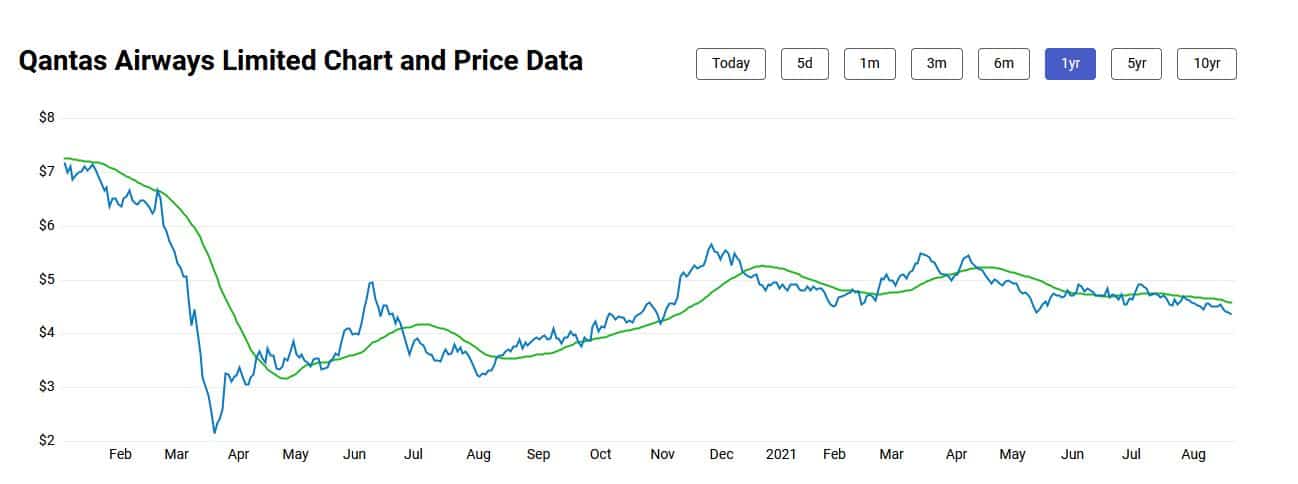
    To start things off, here is a graph of the Qantas share price since the start of the 2020 calendar year (right before the onset of the pandemic):


    Qantas share price

    As you can see, the largest and most dramatic move on this chart came during March and April 2020. That was when the entire ASX 200 experienced a nasty share market crash due to rapid lockdowns across the global economy. The ASX 200 peaked on February 21, 2020, and troughed on 23 March with a loss of roughly 34%. In contrast, the Qantas share price fell more than 65% over the same period.

    During the period from August to October 2020, Melbourne was under strict lockdown, albeit while the rest of the country was enjoying a relatively high level of freedom. This lockdown in the country’s second-largest state by population didn’t seem to have much of an impact on the Qantas share price at the time. As you can see, Qantas shares actually appreciated quite a lot over this period.

    But then we get to another outbreak – the December Sydney Northern Beaches scare of Christmas 2020. This outbreak began around mid-December 2020 and lasted until January. Over this difficult time, Qantas shares did take a hit, losing around 18.5% between 27 November 2020 and 29 January 2021.

    What about Delta in 2021?

    More recently, Qantas has also taken quite a substantial haircut in light of the multi-state Delta outbreak. Since the first ‘week-long lockdown’ for Sydneysiders that was announced on 25 June, Qantas shares have lost around 7.8% of their value. Ever since a prolonged lockdown became inevitable around the first few days of July, Qantas shares have lost more than 11%.

    And that brings us to the present day. Qantas is clearly a company that is heavily impacted by COVID restrictions, and it’s likely that we will continue to see the company under pressure until a national path out of this latest outbreak becomes clear.

    At the current Qantas share price, the airline has a market capitalisation of $8.3 billion.

    The post How does the Qantas (ASX:QAN) share price perform during lockdowns? appeared first on The Motley Fool Australia.

    Should you invest $1,000 in Qantas Airways right now?

    Before you consider Qantas Airways, you’ll want to hear this.

    Motley Fool Investing expert Scott Phillips just revealed what he believes are the 5 best stocks for investors to buy right now… and Qantas Airways wasn’t one of them.

    The online investing service he’s run for nearly a decade, Motley Fool Share Advisor, has provided thousands of paying members with stock picks that have doubled, tripled or even more.* And right now, Scott thinks there are 5 stocks that are better buys.

    *Returns as of August 16th 2021

    More reading

    Motley Fool contributor Sebastian Bowen has no position in any of the stocks mentioned. The Motley Fool Australia’s parent company Motley Fool Holdings Inc. has no position in any of the stocks mentioned. The Motley Fool Australia has no position in any of the stocks mentioned. The Motley Fool has a disclosure policy. This article contains general investment advice only (under AFSL 400691). Authorised by Bruce Jackson.

    from The Motley Fool Australia https://ift.tt/2Uu55qC