Ruchir Sharma says AI's explosive surge looks like a bubble that may burst in 2026.
Jonathan Raa/NurPhoto via Getty Images
Economist Ruchir Sharma says AI exhibits the signs of a bubble.
Big Tech's AI spending is soaring fast, mirroring the dot-com overbuild before the 2000 crash.
Sharma warns that higher interest rates could burst this bubble.
The AI frenzy that's driving markets and corporate spending may be heading for a hard landing in 2026.
In an interview with Norges Bank Investment Management CEO Nicolai Tangen, renowned economist Ruchir Sharma said that the AI surge now checks every box on his four-part bubble checklist. And a single trigger could bring it all crashing down in 2026 — higher interest rates.
Higher rates reduce the availability of cheap capital that's been fueling AI investment and put downward pressure on growth-stock valuations.
Sharma's 'four O's' playbook
To diagnose bubbles, Sharma uses what he calls the four O's. He said the AI boom is flashing red on all four: overinvestment, overvaluation, over-ownership, and over-leverage.
Sharma said that AI and tech spending in the US has surged at a rate that is comparable to past bubbles, such as the dot-com era. Valuations of major AI players are also approaching bubble territory when judged by long-term earnings and free cash flow.
At the same time, Americans are holding a record share of their wealth in equities, and most of those trades are AI-related, he said.
And after years of running cash-rich balance sheets, Big Tech is now issuing massive amounts of debt to fund the AI arms race.
Over the last few months, Meta, Amazon, and Microsoft have become "the biggest issuers of debt," Sharma said — a classic late-cycle bubble sign.
Sharma estimated that roughly 60% of US economic growth this year has been driven by AI, both through companies pouring money into new infrastructure and through the stock-market wealth effect lifting spending among high-income consumers.
But the underlying economy looks much weaker without it, he said — and that's exactly why Sharma thinks the AI trade has become so dangerously crowded.
"Outside of AI, there's a lot of weakness in the US economy," he said.
"This big bet on AI better work out for America — because if it doesn't work out, then I think there's a lot of trouble for this country ahead," he added.
Why 2026 could be the breaking point
Sharma doesn't pretend he can call the exact top. But he said one thing bursts every bubble, and that is interest rates going up.
He identified three conditions that are already building. First, inflation remains "sticky," and far from the Fed's 2% target, he said. Second, the Fed has missed its target for five consecutive years and may soon face pressure to halt its interest rate cuts. Thirdly, AI-driven investment has sustained strong growth, which could push inflation higher again.
"At the slightest sign that interest rates are going to go up, I think that's your sign that, 'Okay — this is done now,'" Sharma said.
That's because higher rates make borrowing costlier and slash the valuations of high-growth companies — the exact conditions that tend to burst bubbles.
He said he expects that moment to likely arrive in 2026 — a view shared by other veteran investors, but on different timelines.
Greg Jensen, co-chief investment officer at Bridgewater Associates, said on Tangen's podcast last week that "the bubble is ahead of us" without giving a timeline, while Mel Williams, cofounder and partner at TrueBridge Capital Partners, warned of "a lot of carnage" over the next 10 years.
A 'good bubble' — but still a bubble
Sharma said the AI boom could be a "good bubble" that could ultimately boost productivity — like past tech manias that overshot but left valuable infrastructure in their wake. But that doesn't mean investors won't get hurt.
Still, one area he thinks could shine after the correction is quality stocks — companies with high returns on equity, strong balance sheets, and consistent earnings.
That category has badly underperformed the market during the AI frenzy, creating what he called "the single best investment idea" heading into 2026.
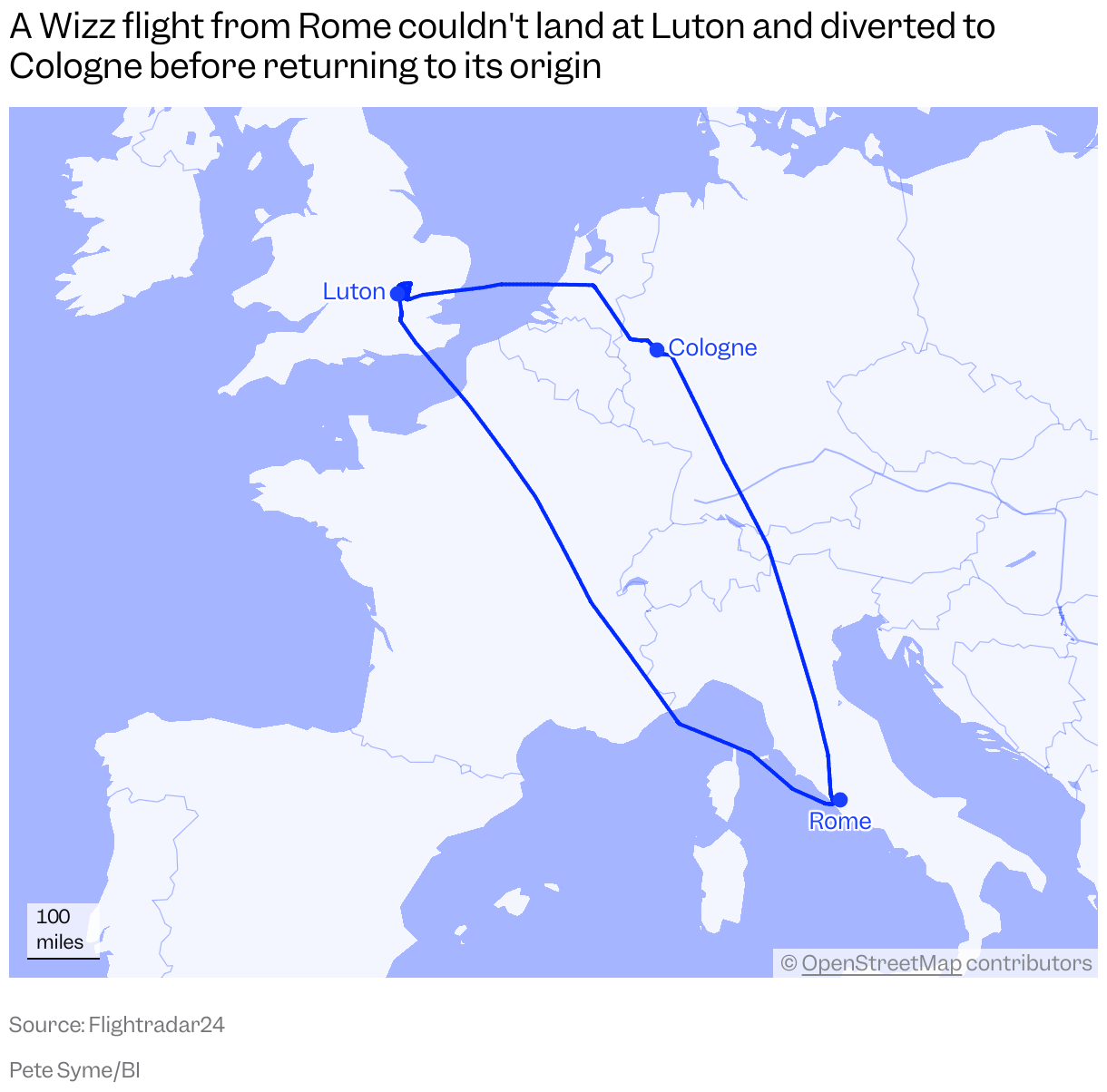
A flight from Rome to London tried and failed three times to land in high winds.
It diverted to Cologne, Germany, before going back to Rome.
The plane finally touched down at London Luton Airport 10 hours later than planned.
Passengers flying to London were delayed by 10 hours after high winds saw their plane diverted to Germany before returning to its origin, then eventually reaching the UK.
Wizz Air Flight 6003 took off from Rome on Monday evening, scheduled to fly for about two hours to London Luton Airport.
However, the Airbus A321neo was unable to touch down on its first attempt. At the time, wind gusts were up to 31 knots, or about 35 miles per hour.
Data from Flightradar24 shows the plane circled over nearby Stevenage before descending for a second aborted landing attempt. A third attempt at landing was also unsuccessful.
The pilots then turned the plane away from London, flying over the Netherlands before diverting to Cologne, Germany.
An airline spokesperson told Business Insider the flight diverted "due to high winds at Luton."
The Airbus A321neo landed there at 11:19 p.m. local time — over three and a half hours after leaving Italy.
However, that wasn't the end of the journey.
"The flight then returned to Rome, before departing on December 2 for London Luton later that morning," the Wizz spokesperson said.
Flight-tracking data shows the plane took off from Cologne around 1 a.m. local time and headed back to the Italian capital.
It departed Rome again at 5:43 a.m. before finally landing at London Luton Airport shortly before 7 a.m. local time — 10 hours later than initially scheduled.
The Wizz spokesperson said passengers were given meal vouchers for the airport and offered rebooking options if they preferred.
"We apologise for the inconvenience this may have caused some passengers," they added. "The safety of our passengers, crew, and aircraft is our utmost priority."
This isn't the first time that high winds have caused unusually long diversions. They're more common with European budget airlines that have bases across the continent, where it's easier for them to reroute passengers.
During a storm in 2024, a Ryanair flight from Manchester, England, to Dublin diverted to Paris — nearly 500 miles away. That turned what was supposed to be a 45-minute trip into one lasting some nine hours. During the same storm, another Ryanair flight, from Ireland to Scotland, diverted to Cologne.
XAI employee Parsa Tajik wrote that the 36-hour work stint left him "dead" but "super energized."
Nikolas Kokovlis/NurPhoto via Getty Images
XAI employee Parsa Tajik recently posted that he worked about 36 hours with no sleep. His colleagues celebrated the effort.
"Work life balance is great, in-fact we recommend it to all our competitors," one xAI employee responded.
Elon Musk's companies, such as xAI and Tesla, are known for their long hours and "hardcore" work cultures.
A 36-hour work sprint at xAI? Cue the applause from colleagues.
Elon Musk's companies have long been known for their intensive work cultures. During Tesla's production ramps, some employees slept in their cars or, in Musk's case, on the factory floor. When Musk took over Twitter, he said to embrace an "extremely hardcore" schedule or be laid off.
At xAI, one employee recently said that they worked for a day and a half straight, sparking responses from their colleagues — and Musk himself.
"Last night I left the @xAI office after ~36 hours of working with no sleep," xAI employee Parsa Tajik wrote alongside an image of himself inside his Tesla Cybertruck. "Although I was dead, I was also super energized. Incredibly grateful to be a part of this team. Happy Thanksgiving!"
Tajik's comments are full of fellow xAI employees voicing their support.
"And got 192 hours' worth of work done," one wrote. "Bro is a unicorn among unicorns."
"Incredibly grateful to be working with and learning from you," another wrote.
"Work life balance is great, in-fact we recommend it to all our competitors," Jaiswal wrote. "Don't be angry with this post. You're free to disagree & let us cook."
XAI has had a busy autumn. Musk's AI company had mass layoffs and significant leadership changes. At a September all-hands meeting, a company leader told workers that the company had no further planned layoffs — before xAI cut more than 100 jobs.
The company has also moved quite quickly, possibly a product of its intense work culture. XAI released Grok-1 in November 2023 after four months of development. Though the company was founded just over three months after ChatGPT's launch, xAI has already grown to a July valuation of $113 billion, per PitchBook.
Musk's businesses have a history of late nights. The CEO has famously said he slept on the factory floor during theTesla's Model 3 "production hell." Twitter's former director of product management, Esther Crawford, posted a photo of herself sleeping on the floor after Musk's takeover. (The photo was staged, according to the book "Character Limit," and Crawford called it "cheeky.")
Tajik's post, which now has over 11,000 likes, also drew concern from some online users who wondered if he drove home while sleep deprived.
"This is like bragging that you drove home drunk," wrote Jason Ginsberg, Cursor's head of product engineering. "Being awake for 36 hours is equivalent to a BAC of 0.16%. The legal limit is 0.08%."
In a reply three days later, Tajik wrote that he apologized to "nobody," and that his Tesla FSD carpool with two other engineers took him safely home.
"I've been working long hours for many years," Tajik wrote. "This is how I got to @xAI from practically being homeless in 2020. Exceptional results require exceptional effort. Now is not the time to slow down."
A growing number of older homeowners are subject to the capital gains tax on home sales.
Some baby boomers say they're holding onto their homes so their kids can inherit them tax-free.
This article is part of "The Great Transfer," a series that highlights the mechanics of wealth transfer and the human priorities behind them.
Duane Flemming and his wife, Chris Currie, would like to downsize.
The retired couple has spent 41 years in their four-bedroom house in a suburban community 30 miles east of San Francisco. The two-story home has gotten too big for them, and the stairs are more difficult to navigate these days. Plus, they'd like to avoid expensive renovations and upkeep. But Flemming, an 81-year-old retired veterinarian, is worried about the hefty tax they'd have to pay on their home sale profits.
"We don't use three-quarters of the rooms we've got," he said. "We don't need it, and we would love to be able to get rid of it in an easy fashion, without having all of those huge expenses that are going to cost us down the line."
Since 1997, home sellers have faced a federal capital gains tax on home sales with profits over $500,000 for married couples and $250,000 for single filers. The tax can be as high as 20% of the profits over the threshold, and is determined by income. That doesn't include potential state taxes.
Flemming estimates that his house has appreciated about $800,000 over the last four decades, and that he'd have to pay between $30,000 and $60,000 in capital gains taxes on his home sale. He worries that the remaining cash won't be enough to buy a new home and pay for rising long-term care costs on a fixed income.
"When you don't know what the future holds, and you've got a limited ability to increase your income, you start to be a little bit more cautious," Flemming said.
Duane Flemming, 81, says the capital gains tax on home sales has discouraged him from selling his home and downsizing.
Photo Courtesy of Duane Flemming
The share of home sales subject to the capital gains tax has more than doubled in the past few years, in large part because home values have soared. About 34% of US homeowners could exceed the $250,000 cap for single filers if they were to sell, and 10% could exceed the $500,000 threshold, the National Association of Realtors found in a 2025 report. That's up from 1.3% of US sellers in 2003 and 3% in 2019, the property data firm CoreLogic found.
If the capital gains tax had been adjusted for inflation when it was implemented, the $250,000 cutoff for individual home sellers in 1997 dollars would be about twice as high — $496,000 — in 2024 dollars.
If Flemming and Currie hold onto their home until they die, their two adult children will be able to inherit it with what's called a stepped-up tax basis, meaning they'd only have to pay capital gains taxes on the amount the home appreciates after they inherit it, erasing the tax burden on the increased value over their parents' lives. Federal estate taxes would only apply if their children inherit at least $28 million in assets — far more than the value of their parents' home.
These tax policies are incentivizing some older homeowners to hang onto their homes for the rest of their lives, making it harder for younger families to buy larger homes.
The growing burden of the capital gains tax, particularly on empty nesters, has long created a so-called "lock-in effect," discouraging older homeowners from moving into homes that better suit their needs. As more people have been affected, it's caused a "gumming up of the market," said Jim Parrott, a nonresident fellow at the Urban Institute who served as a housing policy advisor in the Obama White House.
The real-estate company Redfin reported that as of 2022, empty-nest boomers owned twice as many homes with three or more bedrooms as millennials with kids owned. This "giant mismatch," as Parrott called it, between the homes people are living in and where they'd like to live, is having ripple effects across the housing market, particularly in the most in-demand and expensive places. "The knock-on effects for what's a completely reasonable decision for empty nesters is utterly unreasonable in its macro impact on the housing market," he said.
The pros and cons of reform
There's some bipartisan support in Washington for reforming the capital gains tax for real-estate sales. President Donald Trump has even said his administration is looking into eliminating it entirely.
Rep. Jimmy Panetta, a California Democrat whose district includes several pricey coastal regions, has introduced legislation to double the tax exclusion to $500,000 for individuals and $1 million for joint-filing couples and index it to inflation.
Because the tax disproportionately impacts wealthier people, offering relief could be regressive. But some liberals support reforming it in a targeted way to relieve some of the lock-in effect. Parrott has proposed a more modest reform: doubling the exemption for the tax and indexing it to inflation for sellers who are 65 and older or who've owned their homes for at least a decade.
Other tax policy experts don't think another tax break for affluent Americans is strategic or would move the needle on housing affordability.
Tax relief would mean less revenue for the federal government at a time when the US debt is soaring, and wealthy households are already benefiting from a slew of tax breaks pushed through under Trump. "From a national debt perspective, this seems like the worst possible time to deliver a big capital gains tax cut," said Daniel Hemel, a professor of tax law at New York University.
Hemel also isn't convinced that reforming the tax would do much to loosen up the market and cool home prices. The tax causes a delay in sales, but eventually homeowners die and their kids put the houses on the market, he said.
"You get a delay in the time of sale, but people don't live forever," Hemel said. "We're seeing some houses on the market now that wouldn't have been on the market now, but for capital gains taxes. And then there are also some houses that would have been on the market now that aren't on the market now because of capital gains taxes."
Of course, one way to avoid the tax while simultaneously downsizing is to move out and rent the place.
Patrick G., a 74-year-old retiree based in Colorado, is considering doing just that. His wife died in 2023, and those who lose a spouse are eligible for the $500,000 tax exemption for just two years following their death. Patrick said he's more likely to rent out his four-bedroom home so that his kids can inherit it with the stepped-up basis.
"If it becomes inevitable that the home in Colorado is no longer feasible, then most certainly, I would probably turn it over to a property manager and let it become either an income stream or an appreciating asset for my kids when I pass," said Patrick, who requested partial anonymity to discuss his personal financial situation.
Collin Goodall, an artist who lives in Rumson, New Jersey, is in a similar position. His wife recently died, and he's deciding whether or not to sell the house he's owned and lived in for the last three decades. If Zillow's estimate is accurate, the home is worth about $1.2 million more than he bought it for. He's considering moving and renting his home, or just renting out a room while he lives there.
"I would not like to make a decision about downsizing, driven by, am I going to save a bunch in taxes. That shouldn't be what I'm thinking about," he said.
Parrott conceded that reforming the capital gains tax is far from a silver bullet for housing affordability. It's a "modest solution that will have a modest impact," he said. But he noted that fixing the housing supply shortage requires "a heterogeneous set of solutions" to a bunch of different problems.
/* .insider-raw-embed + p { display: none; } */
// The Great Transfer
const seriesTitle = “The Great Transfer”;
// Presented by
const text = “Presented by”;
// 68dc0f771c1f80efbec49b06
const sponsorLogoID = “68dc0f771c1f80efbec49b06”;
// Edward Jones 2
const altText = “Edward Jones 2”;
//https://www.businessinsider.com/category/the-great-transfer
const hubOrCatURL = “https://www.businessinsider.com/category/the-great-transfer”;
I'm always excited to see how Las Vegas finds new ways to dazzle and delight me in December.
Jill Schildhouse
I go to Las Vegas often, and love visiting in the weeks between Thanksgiving and Christmas.
The city goes all-out with holiday decorations, especially MGM's Bellagio, which has epic displays.
It also has unique seasonal activities, like ice skating on a rooftop rink below fake-snow showers.
The desert seems like an unlikely place to visit for some of the best holiday displays in the country, but the Las Vegas Strip is full of surprises.
I've been on dozens of trips to Vegas, but one of my favorite times to visit is still the period between Thanksgiving and Christmas.
There's something extra special about exploring a city fully decked out in holiday cheer while daytime temperatures are still pleasantly high.
Here's why visiting Vegas during the holidays is a tradition that brings me joy each year.
Las Vegas has some of the most incredible holiday decor and displays that I've seen
MGM's Bellagio usually has some of my favorite holiday displays.
Jill Schildhouse
Sin City glitters year-round, but it puts its best foot forward during the holiday season with lights, trees, garlands, and more.
My favorite property this time of year is MGM's Bellagio, which typically hosts the most spectacular holiday displays.
Last year, the resort's botanical gardens ran a themed exhibit called "'Twas," and visiting felt like exploring a poem that's been brought to life.
I was mesmerized by the towering 45-foot tree dressed with over 35,000 mini LED lights and 8,700 ornaments and crowned with a glistening Swarovski star.
MGM's Bellagio has themed displays during the holiday season.
Jill Schildhouse
My other favorite vignettes here included a miniature train, a gilded sleigh pulled by reindeer made of botanical elements, Drum Major Dolly (the Bellagio Bear) covered in 7,500 preserved red and black roses, and a carousel of giant horses.
Last year, I found another beautiful spot while having brunch at Veranda at the Four Seasons Hotel Las Vegas (housed within Mandalay Bay).
The decorated spiral staircase I found while crunching at Four Seasons Hotel Las Vegas blew me away.
Jill Schildhouse
I was obsessed with the space's wintry colors and dreamy grand staircase, and I hope to visit it again soon.
The city has unique festive activities
The Cosmopolitan of Las Vegas has been creating an epic rooftop ice rink for years.
Jill Schildhouse
I never miss the ice rink at The Cosmopolitan of Las Vegas.
The rooftop Boulevard Pool undergoes a magical transformation into the ultimate winter wonderland featuring a 4,200-square-foot ice rink with amazing views of the Strip.
I enjoy watching classic holiday films on the 65-foot marquee, toasting s'mores over a fire pit, sipping festive cocktails at The Chalet (a reimagined mountaintop village), and watching the enchanting faux-snow showers held every half hour most evenings.
I love grabbing a cocktail at The Chalet.
Jill Schildhouse
If you're traveling with little ones, stop by Mandalay Bay for the Santa in the Shipwreck at Shark Reef Aquarium.
With each paid admission, children 12 and under receive a complimentary photograph with Santa Claus. He's known to put on scuba gear and plunge into the exhibit, too.
I also love getting spa treatments in Vegas, and ones with added holiday flair really get me in the spirit of the season.
Some highlights include the peppermint body polish at Voie Spa & Salon at Paris Las Vegas, and the wintery massage at The Spa at Flamingo Las Vegas that uses notes of cinnamon, pine, and clove.
Vegas also has tons of places for holiday shopping
The Forum Shops at Caesars are often festively decorated for the holidays.
I found no shortage of holiday cheer at The Forum Shops at Caesars, where over 150 retail stores featured Black Friday sales against a backdrop of seasonally decorated statues and columns.
The Miracle Mile Shops at Planet Hollywood also have over 150 shops offering sales all month long.
When I visit Vegas around the holidays, I even pack an extra tote bag, so I have room to fly my new purchases home.
This story was originally published on December 8, 2024, and most recently updated on December 2, 2025.
We like to shop at Trader Joe's for delicious ingredients to make quick, easy meals.
Robert Rice
My wife and I are nurses who drive about 35 miles at least once a month to shop at Trader Joe's.
We love to buy ingredients that help us make quick, easy meals, like pesto chicken and Italian orzo.
We also like to make Greek-style gyros using Trader Joe's beef and lamb gyro slices and pita.
As busy nurses, my wife and I know that finding time to cook can be difficult. So, we like to look for easy-to-make meals that are both quick and delicious to feed our family of eight.
Although most of our children are picky and would usually prefer chicken nuggets or plain pasta, we're more adventurous with our palates.
Despite the roughly 35-mile drive, one of our favorite places to shop for groceries is Trader Joe's. We love that the store has foods inspired by global cuisines, made accessible for busy people like us who don't always have the time to make much from scratch.
Here are four of our favorite meals to prepare, featuring ingredients from Trader Joe's.
Trader Joe's gyro slices, pita bread, and tzatziki are a winning combination
We've found that gyros are very easy to make with Trader Joe's beef and lamb gyro slices.
Robert Rice
Trader Joe's precooked beef and lamb gyro slices take less than a minute to heat on a griddle or in a frying pan.
We like to take a few slices of the meat and layer them on a piece of pita bread with spinach, tomato, and onion. I prefer the original pita bread, and my wife likes the whole-wheat kind.
Then, we top off the gyros with Trader Joe's tzatziki, which also makes an excellent dip for crunchy pita chips.
One of our favorite lunches includes Trader Joe's rice, carne-asada burritos, and roasted corn
We like to prep this meal the night before and reheat it for lunch.
Robert Rice
For an easy lunch we can prep the night before, we each add a Trader Joe's carne-asada burrito and some rice from Trader Joe's Cuban-style citrus-garlic bowl to a microwavable glass container.
Then, we add roasted corn. It pairs well with the spicy carne asada — the roasted poblano chiles give it a slick kick — and the sweetness of the rice.
The best part of this meal is that all three items can be prepared using only a microwave oven.
We love pairing Trader Joe's pesto chicken with Italian orzo and grape tomatoes
Trader Joe's pesto chicken breasts are boneless and skinless.
Robert Rice
For a taste of Italy, we enjoy preparing Trader Joe's pesto chicken and Italian orzo with Lipman grape tomatoes.
We season the tomatoes with olive oil, salt, pepper, and garlic powder, then place them in the center of a baking dish surrounded by the pesto chicken, and let it cook for 25 minutes at 400degrees Fahrenheit.
Next, we add the orzo and two cups of chicken broth. After about 10 to 12 minutes, the orzo should be tender, and all the broth should be absorbed.
To finish, we top the dish with freshly grated Parmesan and pair it with crusty Italian bread and olive oil.
Trader Joe's beef bulgogi and Japchae help us make Korean barbecue at home
Trader Joe's vegetable spring rolls include kale, edamame, mushrooms, and shredded tofu.
Robert Rice
Our oldest son loves Korean barbecue, and Trader Joe's beef bulgogi lets us have a delicious taste of it at home.
First, we heat the bulgogi in the microwave and add it to a wok. Then, we defrost two packages of Trader Joe's Japchaein the microwave and add them to the wok as well.
The light, thin glass noodles absorb all the flavor of the bulgogi broth after simmering for a few minutes.
Trader Joe's vegetable spring rolls also make an excellent appetizer for this meal. To prepare, we defrost them in the microwave, then briefly pan-fry them in a light oil until they're crispy on the outside.
If I drove cross-country again, I'd return to spots like the Ozark National Forest but skip others.
Driving cross-country is an ambitious journey that always sounded a bit more romantic to me in theory than in practice.
But when my partner convinced me to expand my horizons a few years ago, we started planning with the Ralph Waldo Emerson adage "it's not the destination, it's the journey," as our guiding principle.
We drove a total of 6,036 miles cross-country from New York to my hometown of San Diego and back — and I figured we might as well see as many cool and quirky things along the way as possible.
Here are the places we stopped that I would go to again and the spots I'd skip next time.
After leaving New York, our first stop was in Pittsburgh, where we ate pizza and visited The Andy Warhol Museum.
The Andy Warhol Museum is a must-visit to witness more than seven stories of some of Warhol's most seminal works of art.
Michelle Gross
I married a Pittsburgher and have visited the Steel City many times.
So, first, we made a requisite stop at the Strip District to try Pizzeria Davide, then headed over to the Andy Warhol Museum.
After touring the exhibits, I thought it was an absolute must-visit for anyone in Pittsburgh to witness more than seven stories of some of Warhol's (a Pittsburgh native) most seminal works of art.
The museum was also well-placed to follow with a stroll to The Point downtown where the Monongahela and Allegheny Rivers merge into the Ohio River.
We left Pittsburgh en route to Cincinnati, stopping at Buckeye Lake State Park to stretch and grab lunch.
Buckeye Lake wasn't exactly what we'd expected.
Michelle Gross
A halfway point between Pittsburgh and Cincinnati, Buckeye Lake State Park is touted as Ohio's oldest state park.
It's also home to a local winery, brewery, and beer pier, which sounded intriguing and looked to be an ideal spot to stop and refuel.
We didn't find a wide range of food options in the area and weren't particularly impressed, although we did enjoy getting out here and stretching our legs.
Next time, we'd try stopping at a different park.
From Cincinnati, we drove to Nashville, where we had drinks at a Dolly Parton-themed restaurant.
We had Nashville hot chicken sandwiches at White Limozeen, a Dolly Parton-themed rooftop restaurant.
Michelle Gross
The road to Nashville was peppered with many cool pit stops, but due to bad weather, we bypassed places we'd been looking forward to, like Louisville and Bowling Green, Kentucky.
Instead, we went straight for Nashville, arriving hungry and ready for a drink at White Limozeen, a Dolly Parton-themed rooftop restaurant located just off the Vanderbilt University campus.
We sat alfresco overlooking a giant Dolly Parton bust and didn't miss a chance to try the signature champagne Jell-O shots, which come topped with sprinkles. We also had Nashville hot chicken sandwiches.
Along with the pink décor and convivial rooftop vibes, the stop was a pleasant and completely unexpected surprise.
It was definitely worth a visit, but next time, I'd come here just for drinks and save dinner for The Pharmacy Burger Parlor and Beer Garden, where we ate the best burger of our trip.
Next, we stopped at one of my favorite barbecue joints in Memphis before driving through Ozark National Forest to a memorable hotel.
We loved the hometown pride on display at the Graduate Fayetteville hotel.
Michelle Gross
After a quick stop at one of my all-time favorite barbecue joints, The Rendezvous in Memphis, we headed through the wilds of Arkansas' Ozark National Forest — one of the greenest and most scenic stretches of our drive.
Along the way, we paid a last-minute visit to Fayetteville, a charming college town tucked away in the northwest pocket of the state.
There, we enjoyed a casual dinner on the patio of a former post office called Cheers at the OPO (for Old Post Office) and decided to tuck in for the night next door at a quirky local hotel, the Graduate.
The Fayetteville-themed lobby, complete with camouflage carpets and Arkansas ephemera displayed all over the walls, was a fun touch. We loved the hometown pride that this place had to offer.
We continued along Route 66 and spotted an unusual roadside attraction on the way to Oklahoma City.
In Tulsa, we made a pit stop at The Blue Whale of Catoosa, a unique waterside sculpture off Route 66.
Michelle Gross
The ride through the plains of Oklahoma provided a stark contrast to the lush and wild landscapes in Arkansas.
We made our way through Tulsa, home to architectural marvels such as The Philbrook Museum of Art and one of the largest collections of Art Deco architecture in the country.
However, our stop at The Blue Whale of Catoosa off of Route 66 was a tiny bit underwhelming.
We learned that this giant 80-foot sperm whale was built as a diving platform and slide for kids in the early '70s and has been basically marooned ever since.
Though I can see the appeal if you have young kids in tow — and we did see several families with children who could not have been more delighted by this unique sculpture — it wasn't a must-stop spot for us.
Just off Interstate 40, Cadillac Ranch outside Amarillo, Texas, was an Instagram-worthy surprise.
At the Cadillac Ranch you can use spray paint to tag the cars.
Michelle Gross
It was windy and dusty the day we visited Cadillac Ranch, a free public art display that's well worth a quick visit to walk around and snap some photos.
It's comprised of a colorful collection of upended Cadillacs covered in paint. You can bring your own spray paint or buy some from one of the local vendors just outside the entry point to tag the cars if you're so inclined.
Though we didn't partake, I'm glad we stopped to check it out for the photos alone. For us, a single visit was sufficient. We didn't feel the need to return on our way back to New York.
When we drove through Texas on our return, we stopped in Odessa to see a replica of Stonehenge.
The University of Texas' "mini-Stonehenge,"made up of 19-foot tall slabs of limestone, doesn't live up to the original.
Michelle Gross
Set on the University of Texas at the Permian Basin Stonehenge campus, the Stonehenge replica is made up of 19-foot-tall slabs of limestone and was assembled in the early 2000s.
It's designed to serve as a teachable moment for students and visitors here, but because I've visited the original Stonehenge, a UNESCO World Heritage Site that dates back some 5,000 years, when I was traveling across the UK, I would skip this next time.
Nothing can truly compare to the original.
We skipped Dallas in favor of Fort Worth, Texas, where we saw dozens of longhorn cattle walking through town.
Experiencing the Fort Worth cattle drive felt like being in old western Texas town.
Michelle Gross
The daily cattle drive in Fort Worth happens twice a day and was one of the coolest things we witnessed on our trip.
It also made us feel like we were front and center in an old Texas Western, as Fort Worth is full of honky-tonk restaurants and old-timey boutiques, plus Stockyard Station, which is lined with fun shops.
There's also the Cowtown Coliseum, which is home to the country's only year-round rodeo. Although we didn't get to visit it on this trip, we would definitely check it out in the future.
After Texas, we continued west to Santa Fe, New Mexico, where we stopped at a thermal spa.
Ojo Santa Fe Spa is one of the country's oldest natural health spas, dating back to 1868.
Michelle Gross
Tucked in the foothills just outside Santa Fe, New Mexico, Ojo Santa Fe Spa is known as one of the country's oldest natural health spas, dating back to 1868.
Between its spa and spring-fed thermal pools, it was a much-needed stop for a little rest and relaxation.
The spa was closed during our visit, but we still enjoyed soaking in the geothermal mineral water, which is said to have healing properties. After spending a full day here, I'm a believer in the healing powers of that water and would definitely stop here again.
In Santa Fe, we also paid homage to the Georgia O'Keeffe Museum before checking out the galleries and boutiques found along Canyon Road, both of which were worthwhile stops.
Along Route 66, Petrified Forest National Park in Arizona was a last-minute stop that I wouldn't hesitate to visit again.
The Petrified Forest is more than 200 million years old.
The Mars-like landscapes, featuring red and beige sandstone rock formations, were utterly surreal and one of the best unplanned stops we made along the way.
Said to be more than 200 million years old, the park offers numerous places to stop and explore throughout its grounds.
We decided on The Painted Desert Inn, an adobe building dating back to the 1930s, and Newspaper Rock, which features the park's largest concentration of petroglyphs carved into boulders by the ancestral Puebloan population that dates back thousands of years.
The carvings at Newspaper Rock can best be seen through binoculars or a telephoto lens, the latter of which I was glad to have on hand.
It's definitely worth a visit to witness this awe-inspiring landscape.
On the home stretch, we couldn't leave Arizona without seeing the Pillar at Cathedral Rock in Sedona up close.
We were not prepared for the intensity of the Cathedral Rock hike.
Michelle Gross
There's no shortage of ways to see and experience Sedona's vast landscapes, but one place we couldn't leave without seeing was the view of Sedona from the summit of Cathedral Rock.
I will admit, we were not well-prepared for the intensity of this 1.2-mile out-and-back hike. It's labeled as "moderate-to difficult" by AllTrails.com and "popular for hikers of all ages," but the nearly vertical climb and slippery rocks were challenging for a lot of people on the trail that day, ourselves included.
However, the views from the top were out of this world. I would definitely stop here again, although I would plan accordingly and bring more water and better shoes next time.
On our way out of Sedona, we stopped at Yavapai Apache Fry Bread & Jewelry.
The sweet and savory made-to-order fry bread was topped with powdered sugar.
Michelle Gross
Yavapai Apache Fry Bread & Jewelry is just off Route 17 outside Sedona. Its selection of Native American jewelry, crafts, crystals, and sweet and savory fry bread made this a great place for a quick break.
Located outdoors under a tent, there were tons of unique souvenirs, including a dream catcher that I now have hanging above my bed.
The made-to-order fry bread topped with powdered sugar that we got was delicious, and an added bonus.
The final stop of our road trip was in Temecula, California, to try chocolate wine.
Thornton Winery is known for their old-world method of winemaking, along with their coffee and chocolate wine.
Michelle Gross
The Temecula Valley is a burgeoning wine region in Southern California.
Although it's often overlooked in favor of the wineries to the north in Napa and Paso Robles, its Italian and French grape varietals and tasting experiences are definitely worth checking out.
We stopped by Thornton Winery for a very special case of wine and a quick tasting.
Considered "the original champagne house," Thornton is known for its old-world champenoise method of winemaking, along with its coffee and chocolate wine flights.
After driving more than 3,000 miles across the country, my horizons had been broadened, and a case of wine called Milk Chocolate Kiss was the very sweet cherry on top.
This story was originally published on January 22, 2022, and most recently updated on December 1, 2025.
Gen Z actors Siena Agudong and Noah Beck star in Tubi's new football rom-com, "Sidelined 2: Intercepted." The free streamer is responding to second-screen viewing by getting brands to sponsor ad breaks.
Tubi
Second-screen viewing, where audiences scroll while watching the TV, is common.
Advertisers could shift spending away from streamers if they think their ads are being ignored.
Tubi is adjusting to multitasking with shoppable ads, which ad industry observers are bullish on.
TVs no longer have the audience's undivided attention.
Nearly 70% of US social media users scroll their feeds while consuming other media like TV, the market research firm YouGov found in a spring 2025 survey. Millennials were most likely to multitask, followed by Gen Zers.
However, Tubi marketing chief Nicole Parlapiano said she views it as an "additive" opportunity rather than something "disruptive" to the business.
Young people were most likely to scroll on their phone, tablet, or laptop while they watch TV or listen to a podcast, a YouGov survey published in August found.
YouGov
One way Tubi is trying to capitalize is with shoppable ads. The free streamer has interactive spots with call-to-actions like QR codes that allow viewers to point their phone camera at their TV screen to learn more about an ad. Other streamers have implemented similar ad tech, including Disney+ and Hulu.
"When someone's watching something, they're able to tap into their phones and access and shop," Parlapiano said.
About 42% of marketers use interactive ads in their connected TV or social media ad strategies, Business Insider sister company EMARKETER found in October. Ads with QR codes or gamified elements were 36% more likely to be remembered unprompted by audiences. Interactive ads also significantly improved brand affinity, or the emotional bond that viewers have with a brand, according to data from the ad research firm BrightLine cited by EMARKETER.
Shoppable ads are a benefit of second-screen viewing
Parlapiano isn't alone in her optimism about shoppable ads in the age of second-screen scrolling.
"Advertisers shouldn't see Gen Z's second-screen behavior as a threat," said Ian Sharpe, the chief operating officer of media at travel tech company NextTrip. Instead, Sharpe called shoppable ads "one of the biggest opportunities in modern media."
Why?
"This generation is uniquely comfortable watching TV while browsing, searching, and buying on their phone, which means the ad experience naturally becomes shoppable," Sharpe said. "Rather than hoping a viewer remembers an ad later, brands can now trigger immediate action through QR codes, social extensions, and direct commerce hooks."
Shoppable ads are a broad opportunity, since it's not just teenagers who scroll while they watch, said Alicia Weaver, the vice president of media activation at media buying firm Mediassociates.
"This isn't an issue unique to Gen Z," Weaver said. She said she can find herself on her phone during commercials, sports games, or while texting friends during a reality show.
Weaver said that besides shoppable ads, another way to take advantage of second-screen viewing is cross-device retargeting data that lets marketers put ads on other devices or platforms.
"With this kind of usage likely here to stay, it becomes a matter of being savvy and innovative in how we reach audiences," Weaver said. "We're not going to change consumer behavior, but we can absolutely innovate around it."
While some states' coldest temperatures were recorded recently, others were documented decades ago.
Hawaii remains the only state in the US yet to report a temperature below zero degrees Fahrenheit.
The coldest temperature ever recorded in the US was -80 degrees in Alaska in 1971.
Despite record-breaking temperature drops across the US over the last century, the world continues to get hotter. In fact, only three states have recorded their lowest-ever temperatures in the 21st century.
It doesn't mean, however, that the US hasn't experienced some excruciatingly low temperatures in recent years. This week, a winter storm is barreling across states, dumping snow and ice, and potentially inflicting daily record lows in the Plains, Midwest, and Northeast, The Weather Channel reported on Tuesday.
The coldest temperature ever recorded in the US was -80 degrees in Alaska in 1971. And since records began, all but one of the 50 states has reported a temperature below zero. What's the holdout? Hawaii, which recorded its lowest temperature of 12 degrees Fahrenheit at the Mauna Kea Observatory on May 17, 1979.
Melissa Wells contributed to a prior version of this story.
Alabama's lowest recorded temperature was -27 degrees Fahrenheit at New Market on January 30, 1966.
Snowy winter road in Alabama.
Melissa Bobo/Shutterstock
On this snowy January day, it was Lucille Hereford, the postmaster and town volunteer weather observer, who recorded the -27-degree temperature, calling it a "terribly cold" morning in a 1988 interview with an Alabama State climatologist.
Per a 2021 news report by WHNT, a local news outlet, the official story comes with a caveat: The temperature was initially erroneously recorded as warmer than the -24 degrees Fahrenheit reported at Russellville the same day. It wasn't until years later that a Birmingham reporter uncovered the truth, and the National Climatic Data Center finally issued a correction in its records.
Alaska's lowest recorded temperature was -80 degrees Fahrenheit at Prospect Creek Camp on January 23, 1971.
A dramatic sunset illuminates the clear waters of Phelan Creek in early spring in the Alaska Range.
Troutnut/Shutterstock
The Anchorage Daily News reported in 2013 that there have been unofficial measurements of even lower temperatures. On the National Weather Service Alaska website, Phil Schaefer said it hit -84 degrees Fahrenheit in Coldfoot in 1989, and Joe Cochran said the temperature in Hughes dropped to -85 degrees Fahrenheit in the '90s, The Daily News reported.
However, the Prospect Creek Camp temperature is the only one that's been verified.
This is the lowest temperature ever recorded in the US.
Arizona's lowest recorded temperature was -40 degrees Fahrenheit at Hawley Lake on January 7, 1971.
Arizona after a heavy snow storm.
Alexey Stiop/Shutterstock
Hawley Lake isn't a town so much as a remote weather station, but it's important in Arizona's meteorological history. In addition to setting a state record for 91 inches of snow in 1968, the overseer of Hawley Lake, Stan Bryte, recorded the state's lowest temperature of -40 degrees Fahrenheit in 1971, per AZCentral.
In fact, on the morning of January 7, 1971, Bryte's chief meteorologist told him, "You need to get up to Hawley Lake. I have a suspicion this is going to be a real record."
Arkansas' lowest recorded temperature was -29 degrees Fahrenheit in Brook Farm Pond near Gravette on February 13, 1905.
Early morning sunrise in Arkansas.
Michael t. Morrison/Shutterstock
Brook Farm Pond is near the town of Gravette, which has just over 3,500 residents, according to census data.
It is located in Benton County, which has the motto "The Heart of Hometown America." At one time, it also bore the name of "Gate Community" for serving as a gateway to northwest Arkansas from Kansas, Missouri, and Oklahoma.
California's lowest recorded temperature was -45 degrees Fahrenheit in Boca on January 20, 1937.
View of Truckee river and Boca Hill in snow near interstate 80 at the California-Nevada state line.
AJ9/Shutterstock
The Los Angeles Times reported in 1937 that the low temperatures had brought "influenza, frozen toes, broken water pipes and automobile radiators, icy streets and traffic disruption."
Colorado's lowest recorded temperature was -61 degrees Fahrenheit in Maybell on February 1, 1985.
Teri Virbickis/Shutterstock
CBS News reported in January 2023 that Maybell, located 25 miles west of Craig, is home to just 76 people.
Maybell resident of 56 years Georgia McIntyre told 9News in 2015, "You don't think about how cold it is. You just put all the clothes you've got on, and we even put newspapers in our shoes because we didn't have all these fancy things you have now."
Connecticut has recorded temperatures of -32 degrees Fahrenheit twice: First in Falls Village on February 16, 1943, and then again in Coventry on January 22, 1961.
Winter in Connecticut.
Michael Macsuga/Shutterstock
In 1943, a National Weather Service observer noted February was a "relatively mild month" in Connecticut, only for the state to record its coldest temperature in the state's history 16 days into the month, per a 2023 CT Insider article.
A freezing day in January just 18 years later would hit that same low temperature.
Delaware's lowest recorded temperature was -17 degrees Fahrenheit in Millsboro on January 17, 1893.
Beautiful view near the river after a snowstorm in Delaware.
Khairil Azhar Junos/Shutterstock
Thirty-seven years later, a Millsboro weather station recorded a temperature of 110 degrees Fahrenheit on a scorching July day, according to the National Weather Service.
Florida's lowest recorded temperature was -2 degrees Fahrenheit in Tallahassee on February 13, 1899.
Sunrise in Florida in the Winter.
Jesse Kunerth/Shutterstock
WTXL Tallahassee reported in 2020 that in Tallahassee 124 years ago, an inch of snow coated the city (its third biggest snowfall ever), and a record low of -2 degrees Fahrenheit was recorded.
Headlines at the time read "All Previous Records Broken," and editors were calling the storm, "The Snow King," "The Ice King," and "the Great Blizzard of 1899," Tallahassee Democrat reported in 2018.
Georgia's lowest recorded temperature was -17 degrees Fahrenheit in CCC Fire Camp F-16 near Beatum on January 27, 1940.
The snow-filled mountains in Georgia.
PaulDaniel5010/Shutterstock
Not even 12 years later, on July 24, 1952, Georgia recorded its highest temperature at 112 degrees Fahrenheit in Louisville and again on August 20, 1983, in Greenville, according to NOAA's State Climate Extremes Committee.
Hawaii's lowest recorded temperature was 12 degrees Fahrenheit at the Mauna Kea Observatory on May 17, 1979.
Sunset at the summit of Mauna Kea in Hawaii.
Alexey Kamenskiy/Shutterstock
Forecasters think this record may have changed because, on February 11, 2019, several sensors at the Mauna Kea Observatory reported temperatures between 8 and 11 degrees Fahrenheit, Khon2 reported in 2022, but it has yet to be confirmed.
Idaho's lowest recorded temperature was -60 degrees Fahrenheit in Island Park Dam on January 18, 1943.
Winter Shoreline in Idaho.
Grimm Film/Shutterstock
Island Park Dam is located in the Targhee National Forest in the northeast corner of the state. It's tied for the eighth coldest temperature ever recorded in the US.
Illinois' lowest recorded temperature was -38 degrees Fahrenheit in Mount Carroll on January 31, 2019.
Old Train Bridge over a Canal in Winter (Illinois).
Randy R/Shutterstock
Frigid temperatures across Illinois in late January 2019 led to a startling discovery: On the morning of January 31, the weather observer at Mount Carroll in Carroll County recorded a temperature drop to -38 degrees Fahrenheit.
Only after an extensive review did the State Climate Extremes Committee collectively validate the reading as the new state record low temperature, The State Journal-Register reported in 2019.
Indiana's lowest recorded temperature was -36 degrees Fahrenheit in New Whiteland on January 19, 1994.
Winter in Indiana.
Waldos photo/Shutterstock
ABC57 reported in 2020 that all temperatures across Indiana dropped below zero on the morning of January 19, 1994.
In a newscast from 1994 for WRTV Indianapolis, a mail carrier told former Channel 6 meteorologist David James, "Well, I'll tell you, it's better today than it was yesterday, 'cuz there's not that wind. So, I don't mind this at all."
Iowa's lowest recorded temperature was -47 degrees Fahrenheit in Elkader on February 3, 1996. Previously, it was in Washta on January 12, 1912.
Iowa winter garden on full display.
Lisa J Loewen/Shutterstock
Iowa was one of many states in the Midwest that experienced the "1996 Cold Wave," as KCRG-TV9 described it in 2016.
Kansas' lowest recorded temperature was -40 degrees Fahrenheit in Lebanon on February 13, 1905.
Pedestrians walk down snow-swept streets in Kansas.
Julie Denesha /Getty Images
The winter of 1905 was reportedly so bitterly cold that "it was impossible for one to face the storm," according to "Reno County Kansas, Its People, Industries, and Institutions," by B.F. Bowen & Co. Inc. of Indianapolis, published in 1917 and reported in 2014 by The Kansas City Star.
Kentucky's lowest recorded temperature was -37 degrees Fahrenheit in Shelbyville on January 19, 1994.
Beautiful winter morning on a small lake in Kentucky.
Alexey Stiop/Shutterstock
According to meteorologist John Belski, January 19, 1994, "was certainly a day for the history books."
"Those who were not around in 1994, it was the only time I can remember when grocery stores in parts of Louisville ran out of food and gas stations ran out of gas that week since no deliveries were able to be made for several days. It was so strange to see people walking in the middle of Bardstown Road and also Broadway," he recalled for WLKY News in 2020.
Louisiana's lowest recorded temperature was -16 degrees Fahrenheit in Minden on February 13, 1899.
Minden, Louisiana.
Logan Rhoads/Shutterstock
Over two weeks in February 1899, freezing weather swept over the US, with record-low minimum temperatures recorded in 12 states. According to weather historian David Ludlum in "The Great Arctic Outbreak and East Coast Blizzard of February 1899," this was "the greatest arctic outbreak in history" at the time.
Maine's lowest recorded temperature was -50 degrees Fahrenheit in Big Black River on January 16, 2009.
Maine saw the highest share of inbound movers in 2023, for reasons that could include access to nature and more living space.
Andrew Siegel/Shutterstock
After a month of scrutinizing weather data, scientists said in February 2009 that Maine had reached a record low: 50 below freezing.
After much evaluation by the State Climate Extreme Committee, "It turned out [the -50 reading] was spot on," Bob Lent, Maine director of the US Geological Survey, said, as reported by NBC News in 2009.
Maryland's lowest recorded temperature was -40 degrees Fahrenheit in Oakland on January 13, 1912.
Muddy Creek Falls in Swallow Falls State Park in Oakland, Maryland.
Richard Bizick/Shutterstock
Oakland, Maryland, is home to 1,851 people, according to census data. It was established in 1849 and became a well-known tourist spot when the Baltimore and Ohio Railroad built a rail line that traveled through the town, according to Britannica.
Massachusetts's lowest recorded temperature was -35 degrees Fahrenheit in Chester on January 12, 1981; in Coldbrook on February 15, 1943; and in Taunton on January 5, 1904.
Winter-time hiking to the Sanderson Brook Falls in Chester, Massachusetts.
scott conner/Shutterstock
The same temperature was previously recorded in Coldbrook on February 15, 1943, and in Taunton on January 5, 1904.
Michigan's lowest recorded temperature was -51 degrees Fahrenheit in Vanderbilt on February 9, 1934.
Sunrise over frozen lake in Michigan.
John McCormick/Shutterstock
Only 11 states have recorded colder temperatures than Michigan: Alaska, Colorado, Idaho, Minnesota, Montana, New York, North Dakota, Oregon, South Dakota, Wisconsin, and Wyoming.
Minnesota's lowest recorded temperature was -60 degrees Fahrenheit in Tower on February 2, 1996.
Minnesota.
JordanSchopper/Shutterstock
The average low in this sparsely populated former mining town is usually around 4 degrees Fahrenheit in February, according to WorldClimate.com.
Mississippi's lowest recorded temperature was -19 degrees Fahrenheit in Corinth on January 30, 1966.
Trees on snow-covered field during winter in Mississippi.
Barbara Windham / 500px/Getty Images
By contrast, Mississippi's highest recorded temperature was recorded 36 years prior on July 29, 1930, when the mercury in Holly Springs hit 115 degrees Fahrenheit.
Missouri's lowest recorded temperature was -40 degrees Fahrenheit in Warsaw on February 13, 1905.
Table Rock Lake, Branson, Missouri.
Tara Ballard/Shutterstock
Interestingly enough, the coldest and hottest temperatures recorded in Missouri have both been in Warsaw, according to the University of Missouri Climate Center. The hottest temperature was a whopping 118 degrees Fahrenheit on July 14, 1954.
Montana's lowest recorded temperature was -70 degrees Fahrenheit in Rogers Pass on January 20, 1954.
Mountain at Rogers Pass in Glacier National Park in Montana.
Urban Images/Shutterstock
"It's a day that will probably live in American history forever," Corby Dickerson, a National Weather Service meteorologist, said of the record, NBC Montana reported in February 2023. "It was the coldest day ever observed in the lower 48 states."
Nebraska's lowest recorded temperature was -47 degrees Fahrenheit in Oshkosh on December 22, 1989. Previously, it was in Bridgeport on February 12, 1899.
Sunrise over the Platte River after a snowstorm in Nebraska.
Diana Robinson Photography/Getty Images
The biggest snowstorm on the southeast US coast was known as the "Christmas Snowstorm of 1989," according to The National Weather Service, and it was felt all the way to Nebraska. It broke snowfall records in several states, and unheard-of temperatures followed.
Nevada's lowest recorded temperature was -50 degrees Fahrenheit in San Jacinto on January 8, 1937.
Nevada winter landscape with cloud inversion.
Neil Lockhart/Shutterstock
Fifty-seven years after the state's cold temperature, a weather station in Laughlin recorded a temperature of 125 degrees Fahrenheit in June, per data from NOAA's State Climate Extremes Committee.
New Hampshire's lowest recorded temperature was -50 degrees Fahrenheit in Mount Washington on January 22, 1885.
View from Boott Spur Trail, towards Huntington Ravine and Raymond Cataract on Mount Washington, New Hampshire.
Ed Dods/Shutterstock
More recently, sensors on Mount Washington logged the US' coldest windchill on record: -108. The Weather Service office serving Mount Washington posted in February 2023 that its recording software refused to log the reported low number.
New Jersey's lowest recorded temperature was -34 degrees Fahrenheit in River Vale on January 5, 1904.
A road just plowed after a large snowfall in rural Central New Jersey.
Andrew F. Kazmierski/Shutterstock
"That was a very cold morning in northeastern New Jersey," David Robinson, a New Jersey State Climatologist, told NJ.com in 2019.
"A deep fresh snow cover, the valley location, adjacent to a pond that was used to make ice, and a generally treeless landscape near the station all helped contribute to the excessive cold."
New Mexico's lowest recorded temperature was -50 degrees Fahrenheit in Gavilan on February 1, 1951.
Snow-covered mountains in New Mexico.
Roschetzky Photography/Shutterstock
Conversely, the hottest temperature in New Mexico was recorded on June 27, 1994, at the Waste Isolation Pilot Plant near Loving, where it reached a blazing 122 degrees Fahrenheit.
New York's lowest recorded temperature was -52 degrees Fahrenheit in Old Forge on February 18, 1979.
Winter Sunrise from Bald Mountain in Old Forge, New York in the Adirondack Mountains.
PureADK/Shutterstock
Jane Tormey, the official weather watcher for Old Forge for CNY Central, recalled in 2013, "People were saying their milk froze on the way home from the store to home. A lot of cars obviously couldn't get started. My car window driver's side was shattered."
North Carolina's lowest recorded temperature was -34 degrees Fahrenheit in Mount Mitchell on January 21, 1985.
Fresh snow covers trees at crest of Mount Mitchell in North Carolina.
Bonita R. Cheshier/Shutterstock
One of the past century's most extreme arctic outbreaks occurred between January 18 and January 22, 1985. According to the National Weather Service, newspapers at the time reported at least 165 deaths related to the weather.
North Dakota's lowest recorded temperature was -60 degrees Fahrenheit in Parshall on February 15, 1936.
Driving on state Highway 85 north of I-94 in North Dakota.
CJ Cagney/Shutterstock
Coincidentally, both the hottest and coldest temperatures recorded in North Dakota's history happened in the same year, with Steele hitting 121 degrees Fahrenheit on July 6, 1936, KYFR-TV reported in 2023.
Ohio's lowest recorded temperature was -39 degrees Fahrenheit in Milligan on February 10, 1899.
A snowy winter sunrise scene in Ohio with the snow clinging to the trees.
Michael Shake/Shutterstock
Ohio was another state affected by the unprecedented cold of February 1899. The US Weather Bureau reported 105 fatalities between January 29 and February 13 from the arctic temperatures and avalanches brought on by "the Great Arctic Outbreak."
Oklahoma's lowest recorded temperature was -31 degrees Fahrenheit in Nowata on February 10, 2011.
Street full with snow in Oklahoma.
Wichakorn Kitrungrot/Shutterstock
2011 was reportedly Oklahoma's third snowiest year, and the state's record for most snowfall in 24 hours was reached in Spavinaw, with 27 inches, FOX23 News reported in 2020.
Oregon's lowest recorded temperature was -54 degrees Fahrenheit in Ukiah on February 9, 1933, and in Seneca on February 10, 1933.
A winter sun sets over the Cascade Mountain Range in Central Oregon.
Wasim Muklashy/Shutterstock
Ukiah and Seneca are occasionally known as "Oregon's Icebox" due to their icy winter conditions. That said, Meacham residents have said the temperature once plummeted to -62 degrees Fahrenheit, but it has never been proven officially, The Oregonian wrote in 2010.
Pennsylvania's lowest recorded temperature was -42 degrees Fahrenheit in Smethport on January 5, 1904.
Winter landscape in Pennsylvania.
Marcello Sgarlato/Shutterstock
By contrast, in Phoenixville, Pennsylvania, two consecutive days of 111 degrees Fahrenheit were recorded on July 9, 1936 and July 10, 1936, in the hottest temperature ever recorded in the state.
Phoenixville is five hours from Smethport, where the coldest temperature was recorded 32 years prior.
Rhode Island's lowest recorded temperature was -28 degrees Fahrenheit in Wood River Junction on January 11, 1942.
Winter sunrise in Rhode Island.
JonPeckham/Shutterstock
According to NOAA's State Climate Extremes Committee, -25 degrees Fahrenheit was previously reported at Greene, Rhode Island, on February 5, 1996, but it could not be verified.
South Carolina's lowest recorded temperature was -19 degrees Fahrenheit in Caesar's Head on January 21, 1985.
Winter in South Carolina.
Casual Creation/Shutterstock
In 1985, in the Carolinas, the coldest temperatures ever recorded were dubbed "The Coldest Day," WMBF News reported in 2020.
South Dakota's lowest recorded temperature was -58 degrees Fahrenheit in McIntosh on February 17, 1936.
Girl standing under frozen waterfall in South Dakota.
Byron Banasiak/Shutterstock
McIntosh was home to just 111 people in 2020. It is the county seat of Corson County.
Tennessee's lowest recorded temperature was -32 degrees Fahrenheit in Mountain City on December 30, 1917.
Snow Panorama in Tennessee.
RichardBarrow/Shutterstock
The two days of 113 degrees Fahrenheit were recorded in Perryville on July 29, 1930, and August 9, 1930, making them the hottest temperatures ever recorded in Tennessee.
Texas' lowest recorded temperature was -23 degrees Fahrenheit in Seminole on February 8, 1933. The same temperature was also recorded in Tulia 6NE on February 12, 1899.
Winter sunrise on the face of a rock outcropping in the caprock canyons of West Texas.
Chris Jeans/Shutterstock
Texas is known for its heat, but even this state has seen severe drops in temperatures — the best known was during the Great Blizzard of 1899.
Some unofficial reports even claim temperatures reached -30 degrees Fahrenheit in February 1899 at Wolf Creek, Texas. Either way, the Concho Valley Homepage reported in 2022 that newspapers in 1899 described the temperatures as "the worst freeze ever known in the state."
Utah's lowest recorded temperature was -50 degrees Fahrenheit in Strawberry Tunnel (East) on January 5, 1913.
A hiker ventures along the snowy trails of Utah in the winter.
Ashley Hadzopoulos/Shutterstock
By contrast, the city of St. George has been home to the state's record for hottest temperature — twice. A temperature of 117 degrees Fahrenheit was recorded in July 1985 and again in July 2021.
Vermont's lowest recorded temperature was -50 degrees Fahrenheit in Bloomfield on December 30, 1933.
Winter morning in Vermont.
andrew12832/Shutterstock
Bloomfield, a town in Essex County, had a population of 217 in the 2020 US census. The weather station existed from 1906 to 1968, according to Century 21 Farm & Forest.
Virginia's lowest recorded temperature was -30 degrees Fahrenheit in Mountain Lake Biological Station on January 21, 1985.
Winter landscape in Virginia.
mbell/Getty Images
Centered in the Allegheny Mountains is Mountain Lake, one of only two freshwater lakes in Virginia, according to the Virginia Department of Wildlife Resources.
Just a year after this temperature was recorded in 1985, Mountain Lake was made famous again for "Dirty Dancing," which is where the movie was filmed.
Washington's lowest recorded temperature was -48 degrees Fahrenheit on December 30, 1968, in two different towns: Mazama and Winthrop.
North Cascades National Park near Winthrop, Washington.
Marina Poushkina/Shutterstock
On June 29, 2021, Hanford, Washington, reached 120 degrees Fahrenheit, the hottest recorded temperature in that state.
West Virginia's lowest recorded temperature was -37 degrees Fahrenheit in Lewisburg on December 30, 1917.
Snow on a frigid December day in a patch of woods and fields in West Virginia.
Malachi Jacobs/Shutterstock
Just 13 years later, the highest temperature recorded was 112 degrees Fahrenheit in Moorefield, West Virginia, on August 4, 1930.
Wisconsin recorded the lowest temperature in the state's history on February 2, 1996, in Couderay. Two days later, it broke its own record at -55 degrees.
Stream running through a snow covered Wisconsin forest with snow covering the trees in January.
Michael Tatman/Shutterstock
The coldest temperature recorded in Wisconsin ranks ninth in the nation.
Wyoming's lowest recorded temperature was -66 degrees Fahrenheit in Riverside Ranger Station in Yellowstone National Park on February 9, 1933.
Yellowstone National Park in Wyoming.
Bruce Beck/Shutterstock
Although Yellowstone's temperatures in Wyoming haven't plummeted to the levels they once did in 1933, "since most of the park lies at an elevation of 6,000 feet above sea level or higher, unpredictability characterizes Yellowstone's weather," the National Park Service has said.
Correction: January 9, 2024 — An earlier version of this story included an image that was mislabeled as Minden, Louisiana. The photo has been replaced with one of Minden.
The people who will excel in these new AI roles will understand how both humans and AI work.
Ole_CNX/Getty Images
New AI-driven jobs like decision designer and AI Experience Officer are emerging rapidly.
These roles blend AI expertise with psychology, ethics, and organizational design skills.
This article is part of "How AI is Changing Talent", a series exploring how AI is reshaping hiring, development, and retention.
Decision designer. Digital ethics advisor. AI experience officer.
The titles might sound futuristic, and for now, they mostly are. But in the Age of AI, new categories of jobs are emerging that don't fit neatly into existing org charts. They center on human-AI collaboration, and combine machine learning expertise with psychology, organizational design, and workflow management.
For most companies, figuring out just how people and AI should work together is a key challenge, says Sabari Raja, a managing partner at JFFVentures, an early-stage fund that invests in startups focused on low- and mid-wage workers.
"These new roles involve designing that collaboration — training teams for it, and determining where human judgment comes in," Raja says.
Sabari Raja
JFFVentures, LLC
The individuals who will excel in these roles understand how humans work: their cognitive limits, where trust breaks down, and how people make decisions under pressure. They also understand how AI models reason, where they fail, and how they handle uncertainty.
The key is designing around both, she says. "It's about seeing AI as a teammate and collaborator," Raja adds. "AI is powerful, but it needs direction."
Roles built for the native AI era
For the past few years, organizations have primarily approached AI adoption by adding tools to existing roles or expanding what workers were already doing. Often, new positions were simply repackaged engineering or technical roles.
However, as companies move from pilot to production, the focus is starting to shift, says Marinela Profi, global AI and generative AI market strategy lead at SAS, an AI and software analytics company.
"We've moved beyond retrofitting AI into existing roles," Profi says. "Now we're seeing signs of companies building them for a native AI Era."
Headshot of Marinela Profi.
SAS
Some jobs center on governance to manage AI safely and strategically. Take, for instance, the role of AI decision designer.
As companies get more comfortable letting AI make high-stakes calls, like detecting fraud, approving loans, and determining credit scores, they'll need someone to shape how those decisions get made, Profi says.
Right now, data scientists and engineers typically handle that work as part of building the systems, but in the near future, someone will need to sit between the algorithms and the outcome. Enter the AI decision designer.
They'd create the frameworks and maintain accountability as automation scales. "This role would be a way to keep the human in the loop and at the center," she says.
Meanwhile, other roles focus on ensuring the company's AI aligns with its stated values and business goals. To address that need, Profi says we're likely to see more C-suite positions focused on AI strategy. Behold: the AI experience officer.
Unlike the chief AI officer, who tends to focus on product development, governance, and implementation, the AI experience officer is "explicitly responsible for how AI feels and behaves in the human moment," she says. "It shifts the conversation from, 'Are we using AI?' to 'How are people living and working with AI?'"
Profi says that while few organizations have publicly posted for such roles, certain types of companies and industries are prime candidates for introducing them.
For instance, in healthcare, where AI health assistants and wellness bots frequently interact with patients, an AI experience officer would ensure the technology feels empathetic, trustworthy, and safe.
Education tech companies are another example. "AI will redefine how humans learn and how educators teach," she says. "Education is emotional: It's social and deeply human. That's exactly why how AI shows up — not just what it does — needs to be designed with care."
'A complete reconfiguration'
Companies will also need workers focused on creating AI ethics frameworks and setting guardrails. It's no small task.
Building ethical AI is messy and complicated, says Shahab Samimi, chief executive officer of Humanoid Global, a holding company that invests in robotics and AI businesses.
Headshot of Shahab Samimi.
Humanoid Global Holdings
That's why he predicts roles like digital ethics advisor will become more common. These jobs would build safety systems for AI and robotics with enough checkpoints and feedback loops to catch issues early on. They'd also be responsible for staying on top of industry standards and regulatory requirements.
There's no governing body yet for AI safety standards, he notes. Until there is, companies look to groups like the International Organization for Standardization (ISO), which sets widely used safety and quality guidelines for machines that operate in human environments. But even then, the ISO can't prevent every issue.
"When you have machines interacting with humans, something is bound to go wrong," he adds. "Companies need someone focused on safety."
Of course, these emerging roles represent just a small slice of the broader changes AI is bringing to the workplace. Beyond eliminating some jobs and creating others, AI is redesigning how organizations get work done.
But experts say that even as AI takes on more tasks, human-in-the-loop oversight will remain critical. "Many companies think of AI adoption as an IT project, but it's a workforce transformation," says Raja, of JFFVentures.
"Most don't yet realize the scale of what's coming and the changes we'll see to workflows, skill sets, and management structures. It's a complete reconfiguration," Raja says.
/* .insider-raw-embed + p { display: none; } */
// How AI is Changing Talent
const seriesTitle = “How AI is Changing Talent”;
// Presented by
const text = “Presented by”;
// 6667548ce07904901817825a
const sponsorLogoID = “6667548ce07904901817825a”;
// Indeed Transparent Logo
const altText = “Indeed Transparent Logo”;
//https://www.businessinsider.com/category/how-ai-is-changing-talent
const hubOrCatURL = “https://www.businessinsider.com/category/how-ai-is-changing-talent”;