• Is the FAR (ASX:FAR) share price really up 12,000% today?

    surprised asx investor appearing incredulous at hearing asx share price

    Investors may be wondering what’s going on with the FAR Limited (ASX: FAR) share price on Friday.

    This morning, trading platforms show that the oil and gas explorer’s shares are up a whopping 12,000% to $1.32.

    To put that in context, if you invested $10,000 into an ASX share and it gained 12,000%, your investment would be worth a cool $1.2 million.

    Is the FAR share price actually minting millionaires today?

    The answer to this question, unfortunately, is a resounding no.

    The reason the FAR share price is showing as being up 12,000% on Friday is that it has now completed its share consolidation.

    Share consolidations are not very common on the Australian share market. In fact, share splits are far more common.

    A share split is often undertaken by a company when they want to boost share liquidity or make share prices more attractive. For example, Berkshire Hathaway has resisted calls for years to undertake a share split. As a result, you need a massive US$417,800 to buy a single Berkshire Hathaway Class A share. This is unattainable for most investors.

    Pushpay Holdings Ltd (ASX: PPH) is an example of a company that has split its shares recently. It did this to boost liquidity.

    It is important to note that although the share price may change during a split, the value of a holding does not. If you had 1,000 shares at $1 per share (total value of $1,000), you would have 2,000 shares at 50 cents per share (still with a total value of $1,000) following a 2-1 split.

    What is FAR doing?

    FAR has undertaken a share consolidation or reverse share split to bring its share price up to a more tradable level.

    Prior to the consolidation, the FAR share price was trading at 1.1 cents. This means that a move to 1.2 cents would result in a 9% gain and vice versa if it went the other way. These sorts of swings are not ideal for investors and it appears as though management felt the same way.

    As a result, it has consolidated the issued capital of FAR on the basis of one share for every one hundred shares.

    This means that if you owned 100 shares yesterday, you would now own a single share at the current FAR share price. And except for intra-day movements, the value of your holding would have remained the same.

    The post Is the FAR (ASX:FAR) share price really up 12,000% today? appeared first on The Motley Fool Australia.

    Should you invest $1,000 in FAR right now?

    Before you consider FAR, you’ll want to hear this.

    Motley Fool Investing expert Scott Phillips just revealed what he believes are the 5 best stocks for investors to buy right now… and FAR wasn’t one of them.

    The online investing service he’s run for nearly a decade, Motley Fool Share Advisor, has provided thousands of paying members with stock picks that have doubled, tripled or even more.* And right now, Scott thinks there are 5 stocks that are better buys.

    *Returns as of May 24th 2021

    More reading

    Motley Fool contributor James Mickleboro has no position in any of the stocks mentioned. The Motley Fool Australia’s parent company Motley Fool Holdings Inc. owns shares of and has recommended PUSHPAY FPO NZX. The Motley Fool Australia owns shares of and has recommended PUSHPAY FPO NZX. The Motley Fool has a disclosure policy. This article contains general investment advice only (under AFSL 400691). Authorised by Bruce Jackson.

    from The Motley Fool Australia https://ift.tt/3hXYnST

  • Bigtincan (ASX:BTH) share price jumps 9% on quarterly results

    Businessman cheering at desk with arms in the air

    The Bigtincan Holdings Ltd (ASX: BTH) share price is soaring today after the company delivered its June quarter results.

    Bigtincan shares opened at $1.07 before pushing 8.96% higher to $1.15 at the time of writing.

    Bigtincan share price rallies

    The sales enablement platform provider reported customer cash receipts for the June quarter of $14.7 million. This is a 40% increase on the prior corresponding period (pcp).

    The company said “overall the quarter showcased a seasonally strong quarter with cash receipts up 20% from Q3 FY21, as Bigtincan continued to see strength in its enterprise-focused business model”.

    Overall cash receipts for FY21 increased 29% on pcp to $41.9 million (adjusted for multi-year payments/contracts).

    Pleasingly, the $41.9 million in FY21 cash receipts represents a 117% conversion against the company’s initial annual recurring revenue (ARR) of $35.8 million. The company cites this as a “strong execution of cash collection as well as the creditworthiness of our enterprise customers”.

    Bigtincan reported ARR of $53.1 million at the end of FY21, or a 48% increase against the pcp. This growth was underpinned by “a combination of the company’s organic growth engine with top of the pipeline lead generation returning to pre-pandemic levels, and successful M&A adding new customers with increasing cross sell and upsell opportunities”.

    FY21 revenue expectations

    Reporting season is typically an exciting time for the Bigtincan share price. The 1H21 and FY20 results witnessed a significant -8.7% and 14.3% move in Bigtincan shares.

    According to today’s announcement, the company is expecting audited revenue for FY21 to be in excess of $43.5 million.

    This figure is in line and towards the upper end of its guidance of $41 million to $44 million.

    Major customer wins

    High-profile wins have been a driver of the Bigtincan share price in the past. Contract wins include US telco giant T-Mobile, and US based global financial services company, John Hancock.

    In today’s announcement, the company highlighted notable customer wins for the June quarter include Fujitsu, AirFrance and Uber Eats.

    In addition, Bigtincan said it continued to experience the “benefits of the land and expand business model with expansions in key customers including Allurion, BT Openreach, Genentech, Peter’s Surgical, Sage Publishing, and WL Gore”.

    Management commentary

    Commenting on another quarter of growth and acquisitions, Bigtincan CEO David Keane said:

    This quarter the team executed globally to deliver strong results demonstrating the progress of our business model, strong underlying unit economics, and benefits of our organic growth engine combined with smart M&A to continue our mission of creating the buying experience of the future for our customers’ customers.

    Bigtincan share price up in 2021

    The Bigtincan share price is up 5% year-to-date.

    Despite underperforming the S&P/ASX 200 Index (ASX: XJO), which is up 10.07% this year, Bigtincan’s performance is better than the broader tech sector.

    The S&P/ASX 200 Info Tech (INDEXASX: XIJ) index has surprisingly slipped almost 4% in 2021.

    The post Bigtincan (ASX:BTH) share price jumps 9% on quarterly results appeared first on The Motley Fool Australia.

    Should you invest $1,000 in Bigtincan right now?

    Before you consider Bigtincan, you’ll want to hear this.

    Motley Fool Investing expert Scott Phillips just revealed what he believes are the 5 best stocks for investors to buy right now… and Bigtincan wasn’t one of them.

    The online investing service he’s run for nearly a decade, Motley Fool Share Advisor, has provided thousands of paying members with stock picks that have doubled, tripled or even more.* And right now, Scott thinks there are 5 stocks that are better buys.

    *Returns as of May 24th 2021

    More reading

    Motley Fool contributor Kerry Sun has no position in any of the stocks mentioned. The Motley Fool Australia’s parent company Motley Fool Holdings Inc. owns shares of and has recommended BIGTINCAN FPO. The Motley Fool Australia owns shares of and has recommended BIGTINCAN FPO. The Motley Fool has a disclosure policy. This article contains general investment advice only (under AFSL 400691). Authorised by Bruce Jackson.

    from The Motley Fool Australia https://ift.tt/3eHJ1jh

  • A record high for the ASX in the middle of a lockdown?

    stock market gaining

    Half the country is in lockdown.

    And yet, the ASX hit an all time high yesterday.

    What gives?

    Don’t they know about COVID?

    Haven’t they seen the retail sales numbers?

    Don’t they know many economists are now predicting the economy to shrink this quarter?

    (And that a small handful of them have dared say ‘double dip recession’ out loud?)

    Even the PM felt it necessary to tell us we wouldn’t go into recession, answering a question no-one actually asked.

    And — I repeat — the ASX hit an all time record close yesterday afternoon.

    Whatever the market’s on, I want some!

    Except that, yep, I jest.

    I know what the market’s on.

    I’m on it too.

    The good news? It’s legal.

    And far from having negative side effects, I reckon these are side effects you should line up for.

    Now, we know investors tend to be way too short-term in nature. So I want to share some maths, to help you avoid the groupthink that often derails markets.

    Those maths were spelled out, clearly, by one of the doyens of investing; Wharton professor, Jeremy Siegel in a podcast last year:

    “I even said, let’s go terrible, this is so bad, it wipes out hundred percent of S&P earnings. But let’s assume in 2021 we get back to only 2019 levels, stock market should go down five, six percent. I think that’s what the math shows.”

    That fall in profits — spoiler alert — didn’t happen.

    That didn’t stop the market falling a ridiculous 38% at one point, of course. I told you to stay the course, and even keep buying.

    I hope you did.

    But that is in the past.

    I tell the story to explain the current highs.

    It seems an almost-certainty that, despite current lockdowns impacting half of the country, life will again return to normal at some point.

    Not as soon as we’d like, of course.

    But it’ll get there.

    And when it does?

    You really reckon the economy will be permanently harmed, never again to grow?

    Nah, me either.

    And so, with a little hindsight to help, investors seem to be getting this one roughly right.

    And that’s why the ASX is hitting new highs.

    Those side effects I mentioned earlier?

    Well, optimism, for a start. The benefit of history, for those who care to learn from it.

    The reminder that, every single time in modern history, ‘this too shall pass’ has lead to larger economies, more profitable companies and, well, human progress.

    How are those for some positive side effects?

    Of course, while many worried when markets were falling, there’s the ‘equal and opposite’ reaction when markets are high: “Shouldn’t we wait for a fall?”

    I hope, dear reader, you see the problem here.

    If you’re not going to buy when markets are falling, and not going to buy unless markets are falling… well, that doesn’t give you much, does it?

    In the meantime?

    In the meantime, the ASX has gained around 9% per annum, over the last 30 years, according to fund manager Vanguard.

    While people were worried about tops and bottoms, rises and falls, booms and busts… the bigger picture shows a slow, steady grind — punctuated with short bursts of excitement and despair — higher.

    And higher.

    And higher.

    One hypothetical $10,000 investment, made 30 years earlier, was worth $130,000 on June 30 last year. (The market is up even more, since then, but we’ll have to wait for Vanguard’s updated chart, hopefully out in the next month or so, to see that impact!)

    And that $130,000 assumes you didn’t add a single, extra, dollar.

    If you did?

    Well, you can imagine what you might have today.

    Or, put another way, cast your mind back to 1990 (if you don’t remember 1990, you have my eternal envy!).

    It was the eve of the early 1990s recession. There were plenty of reasons not to invest.

    Indeed, in the first year or so of our 30 year period, shares fell.

    Hard.

    And yet, they recovered to turn $10,000 into $130,000.

    Oh sure, with hindsight, I can tell you exactly when you should have invested, and not.

    But I know this with absolute certainty.

    Had I been doing this gig in 1990, I would have told you to invest.

    Would I have been wrong?

    In the short term, it might have seemed so.

    In the fullness of time?

    Well, if you’d invested $10,000 at the time, and didn’t want that $120,000 profit over the subsequent three decades, I’d have happily taken it off your hands.

    If that’s ‘wrong’, then I hope I’m wrong a lot more.

    Oh, people will tell me to time the market.

    They’ll say I should wait for this indicator or that.

    They’ll tell me the market is too high (I know… it’s happened every year of the past 10 I’ve been in this job!).

    They’ll assume they’re smarter than me.

    Than the market.

    Than history.

    That’s okay. They’re welcome to it.

    Me?

    I’m going to remain fully invested.

    I’m going to ride the waves.

    I’m going to cop losses on the chin (but I’ll be adding regularly, so I’ll get some bargains at the same time!).

    I’m not going to try to outsmart the market.

    I’m not going to try to predict the unpredictable. (Even the very idea is crazy, when you think through the logic.)

    I’m just going to invest.

    And keep investing.

    I’m going to look for attractive businesses at attractive prices.

    (If you prefer to just add money regularly to broad market ETFs, that’s cool, too.)

    I’m going to add money regularly.

    And I’ll watch the pundits with equal measures of amusement and exasperation.

    The former, because it’s just funny.

    The latter, because I know it’ll often lead people astray.

    If this reminds you of the Tortoise and the Hare, you’re on the right track, by the way.

    Oh, and I’ll keep writing these pieces.

    Because I’ve benefited from the very same knowledge.

    And I want to pay it forward.

    Have a great weekend.

    Fool on!

    The post A record high for the ASX in the middle of a lockdown? appeared first on The Motley Fool Australia.

    Wondering where you should invest $1,000 right now?

    When investing expert Scott Phillips has a stock tip, it can pay to listen. After all, the flagship Motley Fool Share Advisor newsletter he has run for more than eight years has provided thousands of paying members with stock picks that have doubled, tripled or even more.*

    Scott just revealed what he believes could be the five best ASX stocks for investors to buy right now. These stocks are trading at near dirt-cheap prices and Scott thinks they could be great buys right now.

    *Returns as of May 24th 2021

    More reading

    Motley Fool contributor Scott Phillips has no position in any of the stocks mentioned. The Motley Fool Australia’s parent company Motley Fool Holdings Inc. has no position in any of the stocks mentioned. The Motley Fool Australia has no position in any of the stocks mentioned. The Motley Fool has a disclosure policy. This article contains general investment advice only (under AFSL 400691). Authorised by Bruce Jackson.

    from The Motley Fool Australia https://ift.tt/3rxilXM

  • TGA approves Pfizer vaccine for kids aged 12-15 years old

    Female patient receives Pfizer covid vaccine administered by female doctor

    The Pfizer Inc. (NYSE: PFE) COVID-19 vaccine has been approved for use in children aged 12-15 years in Australia.

    The Therapeutics Goods Administration (TGA) made the decision late last night. Previously, COVID vaccines were only approved for those over the age of 16.

    The TGA said in a statement:

    “(Approval) has been made following careful evaluation of the available data supporting safety and efficacy, including clinical studies with adolescents 12 to 15 years of age.”

    The highly infectious delta variant is spreading in Australia, including in children. This is unlike previous strains, so today’s news will provide options for worried parents.

    However, the TGA says:

    “Continued approval depends on the evidence of longer-term efficacy and safety from ongoing clinical trials and post-market assessment.”

    Pfizer replaces AstraZeneca as vaccine du jour

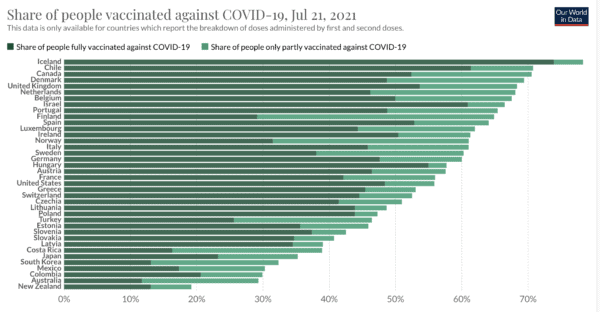
    Australia is ranked last for the percentage of people fully vaccinated in the Organisation for Economic Co-operation and Development (OECD), and second last for people who have just one dose of the vaccine.

    https://ourworldindata.org/covid-vaccinations

    The federal government was relying on the bulk of supply to come from locally CSL Limited (ASX: CSL) manufactured AstraZeneca plc (LON: AZN).

    However, emerging evidence of an extremely rare blood clotting disorder caused by the vaccine led to the government’s expert advisory body, ATAGI, to recommend only those aged over 50, later 60, should take the vaccine.

    Large swathes of Australians, including older residents, are reluctant to take the vaccine. Instead, they are waiting for more Pfizer vaccine.

    The problem is we have too much AstraZeneca and not enough Pfizer vaccine.

    The government acted to double the supply of Pfizer, as well as order Moderna Inc (NASDAQ: MRNA) vaccine as well. The bulk of this additional supply will arrive in the fourth quarter of this year.

    The federal government has indemnified GPs who administer AstraZeneca in an attempt to get more jabs in arms.

    It is available to those under 40 years who choose to take the jab at their doctor’s office.

    While today’s news is positive, there is no expectation that children will be able to get inoculated any time soon.

    Federal Health Minister, Greg Hunt said:

    “Our plans are in place to roll out what is more likely, on the early advice I have, is that they will fast-track vaccines for 12- to 15-year-olds for the immunocompromised children or those with underlying health conditions,” Hunt told Channel 7.

    Other children will need to wait, along with adults, for more supply of Pfizer most likely in September or October.

    The post TGA approves Pfizer vaccine for kids aged 12-15 years old appeared first on The Motley Fool Australia.

    Our TOP healthcare stock is trading at a 15% discount to its highs

    If there’s one thing for sure, 2020 was the year we embraced sanitisation. Scott Phillips has discovered a little-known Australian healthcare company could be set to reap the rewards of the post-covid world.

    Better yet, this fast-growing company is currently trading at a 15% discount from its highs. Scott believes in this stock so much, he’s staked $209k of our own company money on it. Forget ‘buy now pay later’, this stock could be the next hot stock on the ASX.

    Scott and his team have published a detailed report on this tiny ASX stock. Find out how you can access our TOP healthcare stock today!

    As of 15.02.2021

    More reading

    The Motley Fool Australia’s parent company Motley Fool Holdings Inc. owns shares of and has recommended CSL Ltd. The Motley Fool Australia’s parent company Motley Fool Holdings Inc. has recommended Moderna Inc. The Motley Fool Australia has no position in any of the stocks mentioned. The Motley Fool has a disclosure policy. This article contains general investment advice only (under AFSL 400691). Authorised by Bruce Jackson.

    from The Motley Fool Australia https://ift.tt/2UBJNY4

  • Zip share price falls, Pilbara Minerals flies. And the BHP share price gets a Tesla bounce. Scott Phillips on Nine’s Late News

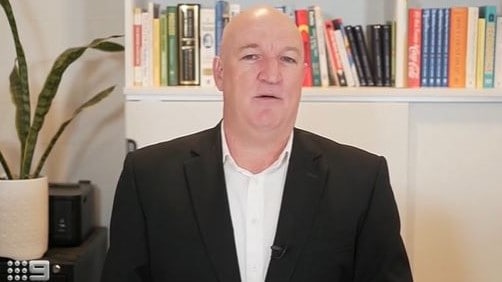
    Scott Phillips on Nine News 22 July 2021.

    Motley Fool Australia Chief Investment Officer Scott Phillips joined Nine’s Late News on Tuesday night to discuss the fall of Zip Co Ltd (ASX: Z1P), despite triple-digit growth, the continued surge of the Pilbara Minerals Ltd (ASX: PLS) share price, BHP Group Ltd (ASX: BHP)’s deal with Tesla Inc (NASDAQ: TSLA) and a surge in our trade balance, while payroll numbers drop.

    The post Zip share price falls, Pilbara Minerals flies. And the BHP share price gets a Tesla bounce. Scott Phillips on Nine’s Late News appeared first on The Motley Fool Australia.

    Wondering where you should invest $1,000 right now?

    When investing expert Scott Phillips has a stock tip, it can pay to listen. After all, the flagship Motley Fool Share Advisor newsletter he has run for more than eight years has provided thousands of paying members with stock picks that have doubled, tripled or even more.*

    Scott just revealed what he believes could be the five best ASX stocks for investors to buy right now. These stocks are trading at near dirt-cheap prices and Scott thinks they could be great buys right now.

    *Returns as of May 24th 2021

    More reading

    Motley Fool contributor Scott Phillips has no position in any of the stocks mentioned. The Motley Fool Australia’s parent company Motley Fool Holdings Inc. owns shares of and has recommended Tesla and ZIPCOLTD FPO. The Motley Fool Australia has no position in any of the stocks mentioned. The Motley Fool has a disclosure policy. This article contains general investment advice only (under AFSL 400691). Authorised by Bruce Jackson.

    from The Motley Fool Australia https://ift.tt/3wW5BuF

  • Why the Evolution (ASX:EVN) share price is charging higher today

    ASX gold share price

    The Evolution Mining Ltd (ASX: EVN) share price has returned from its trading halt and is pushing higher.

    At the time of writing, the gold miner’s shares are up 3% to $4.20.

    Why is the Evolution share price pushing higher?

    Investors have been bidding the Evolution share price higher today after responding positively to its acquisition announcement yesterday.

    That announcement revealed that the company has signed an agreement with Northern Star Resources Ltd (ASX: NST) to acquire its assets in the Eastern Goldfields of Western Australia for $400 million.

    These assets include a 100% interest in the Kundana Operations, a 51% interest in the East Kundana Joint Venture, a 100% interest in certain tenements comprising the Carbine Project, and a 75% interest in the West Kundana Joint Venture.

    Management believes the assets represent an important strategic opportunity for Evolution to consolidate the region, optimise the value of its existing infrastructure, and capture significant operational synergies. It highlights that the main acquisition assets are within 8km of Evolution’s Mungari Operations.

    Why were its shares in a trading halt?

    The Evolution share price was placed in a trading halt so that the company could launch an equity raising to fund the acquisition.

    According to an update today, Evolution has successfully completed a $400 million fully underwritten institutional placement at a price of $3.85 per new share. This represents a discount of 5.4% to where the Evolution share price was trading prior to its halt.

    A share purchase plan will now be undertaken, aiming to raise a further $50 million. This will be at the lower of the placement price or a 2.5% discount to its five-day volume weighted average price at the closing date.

    What else?

    Evolution also notes that ministerial approval has now been received under the WA Mining Act. This will allow Northern Star to transfer legal title of the assets to Evolution, which means the transaction is now unconditional. As a result, management expects completion to occur in late August.

    Evolution’s Executive Chairman, Jake Klein said: “We are delighted with the level of support from shareholders for the Institutional Placement, reflecting their endorsement of this pivotal transaction that will transform Mungari to establish the operation as the fourth cornerstone asset in the Evolution portfolio.”

    One broker that was pleased with the acquisition is Credit Suisse. This morning the broker upgraded Evolution’s shares to an outperform rating with an improved price target of $4.70. It has made double digit earnings per share estimate upgrades to reflect the acquisition.

    The post Why the Evolution (ASX:EVN) share price is charging higher today appeared first on The Motley Fool Australia.

    Should you invest $1,000 in Evolution right now?

    Before you consider Evolution, you’ll want to hear this.

    Motley Fool Investing expert Scott Phillips just revealed what he believes are the 5 best stocks for investors to buy right now… and Evolution wasn’t one of them.

    The online investing service he’s run for nearly a decade, Motley Fool Share Advisor, has provided thousands of paying members with stock picks that have doubled, tripled or even more.* And right now, Scott thinks there are 5 stocks that are better buys.

    *Returns as of May 24th 2021

    More reading

    Motley Fool contributor James Mickleboro has no position in any of the stocks mentioned. The Motley Fool Australia’s parent company Motley Fool Holdings Inc. has no position in any of the stocks mentioned. The Motley Fool Australia has no position in any of the stocks mentioned. The Motley Fool has a disclosure policy. This article contains general investment advice only (under AFSL 400691). Authorised by Bruce Jackson.

    from The Motley Fool Australia https://ift.tt/3hWURrC

  • Pendal Group (ASX:PDL) share price edges lower despite positive update

    bars showing share price dip

    The Pendal Group Ltd (ASX: PDL) share price is in negative territory today despite a positive update in relation to its recent acquisition.

    At the time of writing, the fund manager’s shares are down 0.50% to $8.

    Let’s take a closer look at what the company announced to the ASX this morning.

    What did Pendal announce?

    According to the release, Pendal advised it has completed the strategic acquisition of Thompson, Siegel & Walmsley LLC (TSW).

    Founded in 1969, TSW is an investment management and advisory firm, headquartered in the United States. The group operates primarily in the long-only equity and fixed income asset classes for its diverse client base.

    Following the early acquisition achieved, Pendal revealed this is a result of the cultural and commercial alignment of both companies.

    Pendal expects that its United States Funds Under Management (FUM) will now more than double to $62.5 billion. This brings the total group FUM to $139.3 billion, a 31% increase as a result of the takeover.

    Earnings per share (EPS) is forecasted to be double digit accretive within the first full-year of running operations.

    TSW CEO, John Reifsnider has been appointed to lead Pendal’s consolidated business as well as joining its Global Executive Committee.

    Pendal group CEO, Nick Good commented:

    We are thrilled to welcome the TSW team and its clients to Pendal Group. Client support has been incredibly strong, with 96% TSW client consent received in just 11 weeks. It is testament to the compatibility and drive of the two organisations and their teams that we have completed the acquisition well ahead of original expectations.

    This acquisition significantly broadens the range of product solutions we can offer clients via an expanded distribution network, and we are focused on providing our combined investment strategies to our enlarged client base as soon as possible.

    As complementary businesses, with almost no overlap of investment strategies, together, we will be better placed to take advantage of the growth opportunities we see in the US market.

    Pendal share price summary

    The last 12 months have been positive for Pendal shareholders, with the company’s shares rising by 30%. In 2021 alone, Pendal shares are up by more than 22%.

    Pendal presides a market capitalisation of roughly $3 billion, with approximately 379 million shares on its books.

    The post Pendal Group (ASX:PDL) share price edges lower despite positive update appeared first on The Motley Fool Australia.

    Should you invest $1,000 in Pendal right now?

    Before you consider Pendal, you’ll want to hear this.

    Motley Fool Investing expert Scott Phillips just revealed what he believes are the 5 best stocks for investors to buy right now… and Pendal wasn’t one of them.

    The online investing service he’s run for nearly a decade, Motley Fool Share Advisor, has provided thousands of paying members with stock picks that have doubled, tripled or even more.* And right now, Scott thinks there are 5 stocks that are better buys.

    *Returns as of May 24th 2021

    More reading

    Motley Fool contributor Aaron Teboneras has no position in any of the stocks mentioned. The Motley Fool Australia’s parent company Motley Fool Holdings Inc. has no position in any of the stocks mentioned. The Motley Fool Australia has no position in any of the stocks mentioned. The Motley Fool has a disclosure policy. This article contains general investment advice only (under AFSL 400691). Authorised by Bruce Jackson.

    from The Motley Fool Australia https://ift.tt/3kNd78E

  • Santos (ASX:STO) share price down amid concerns over bidding war

    Miner with thumbs down

    The Santos Ltd (ASX: STO) share price is falling today amid reports experts expect its merger bid for Oil Search Ltd (ASX: OSH) to get messy.

    Santos made an under-the-table proposal that would have seen it merge with Oil Search in late June. Santos’ proposal went public on Tuesday when Oil Search rejected the bid.

    Right now, the Santos share price $6.64, 1.48% lower than its previous close.

    It has also fallen 2.7% this week, despite announcing positive quarterly results yesterday.

    The market seemingly expects Santos to increase its bid but some analysts say Oil Search’s board is preparing for battle. Let’s take a closer look.

    Is a bidding war brewing?

    With oil prices back in focus and its bid for Oil Search rejected, the Santos share price is having a tough week.

    Santos’ bid for Oil Search and its following rejection was announced on Tuesday.

    The all-scrip offer put forward was 0.589 new Santos shares for every Oil Search share.

    Santos’ offer implied a value of $4.25 per share – a 12.3% premium on the Oil Search share price as of 24 June. Oil Search said Santos’ offer undervalued its shares.

    The proposal offered Oil Search’s shareholders a 37% holding in the resulting company.

    Word on the street today is Santos is preparing to put forward an increased offer, and Oil Search’s board is ready to toss it out.

    According to reporting by The Australian, Wood Mackenzie senior analyst Daniel Toleman believes Oil Search’s shares have surpassed the offer’s premium. Toleman was quoted as saying:

    The Oil Search board will likely believe that a merger with Santos would not provide full value to Oil Search shareholders. As a result, we expect the board to fight off the merger attempt.

    MST Marquee analyst Mark Samter said Oil Search, and its share price, isn’t in a good position to fight off Santos’ proposal:

    I do think for Oil Search we need to remember the alternate scenario, where no deal happens, and we are back to a world with no CEO, likely a few less board members and clearly greater challenges on progressing Alaska…

    Clearly, as I have discussed before, I think there are far greater opportunities to extract value than the market may realise in this deal, both through asset optimisation in [Papua New Guinea]… and in being willing to sell operator-ship in Alaska.

    Santos share price snapshot

    Despite this week’s poor performance, the Santos share price is doing well.

    It has gained 3.5% year to date. It’s also 19% higher than it was this time last year.

    The post Santos (ASX:STO) share price down amid concerns over bidding war appeared first on The Motley Fool Australia.

    Should you invest $1,000 in Santos right now?

    Before you consider Santos, you’ll want to hear this.

    Motley Fool Investing expert Scott Phillips just revealed what he believes are the 5 best stocks for investors to buy right now… and Santos wasn’t one of them.

    The online investing service he’s run for nearly a decade, Motley Fool Share Advisor, has provided thousands of paying members with stock picks that have doubled, tripled or even more.* And right now, Scott thinks there are 5 stocks that are better buys.

    *Returns as of May 24th 2021

    More reading

    Motley Fool contributor Brooke Cooper has no position in any of the stocks mentioned. The Motley Fool Australia’s parent company Motley Fool Holdings Inc. has no position in any of the stocks mentioned. The Motley Fool Australia has no position in any of the stocks mentioned. The Motley Fool has a disclosure policy. This article contains general investment advice only (under AFSL 400691). Authorised by Bruce Jackson.

    from The Motley Fool Australia https://ift.tt/3eOKZOL

  • Crown (ASX:CWN) shares fall after Star (ASX:SGR) ends merger talks

    A woman crosses her hands a defensive stance,

    The Star Entertainment Group Ltd (ASX: SGR) share price is on the move today after providing an update on its merger proposal with rival Crown Resorts Ltd (ASX: CWN).

    At the time of writing, the Star share price is up 1% to $3.58 and the Crown share price is down 3% to $9.94.

    What did Star announce?

    Investors have been selling down the Crown share price after Star revealed that it has withdrawn its conditional, non-binding, indicative merger proposal.

    That proposal outlined significant strategic and value accretion benefits for the shareholders of both companies, including estimated cost synergies of between $150 million to $200 million per annum. It also highlighted the potential to create significant value from a sale and leaseback of the enlarged property portfolio.

    However, it appears as though recent developments, including concerns that Crown could lose its Melbourne casino licence, have spooked Star’s management team. It notes that these developments have the potential to materially impact the value of Crown.

    What now?

    Star advised that it remains interested in merging with Crown, but not while there is so much uncertainty.

    It explained: “We continue to believe substantial benefits could be unlocked by a merger, however the uncertainty surrounding Crown is such that The Star is unable to continue at the present time with its Proposal in the form as announced on 10 May 2021.”

    “The Star remains open to exploring potential value enhancing opportunities with Crown. The Star will continue to closely monitor the Victorian Royal Commission and Perth Casino Royal Commission, with final findings expected later this year,” it added.

    In the meantime, Star remains focused on its growth initiatives. This includes the development of its world-class multi-billion dollar Queen’s Wharf Brisbane integrated resort due to open in late 2022 and its Gold Coast masterplan.

    Crown responded, saying that it remains willing to engage with Star in the future in relation to a potential merger.

    The post Crown (ASX:CWN) shares fall after Star (ASX:SGR) ends merger talks appeared first on The Motley Fool Australia.

    Should you invest $1,000 in Crown right now?

    Before you consider Crown, you’ll want to hear this.

    Motley Fool Investing expert Scott Phillips just revealed what he believes are the 5 best stocks for investors to buy right now… and Crown wasn’t one of them.

    The online investing service he’s run for nearly a decade, Motley Fool Share Advisor, has provided thousands of paying members with stock picks that have doubled, tripled or even more.* And right now, Scott thinks there are 5 stocks that are better buys.

    *Returns as of May 24th 2021

    More reading

    Motley Fool contributor James Mickleboro has no position in any of the stocks mentioned. The Motley Fool Australia’s parent company Motley Fool Holdings Inc. has no position in any of the stocks mentioned. The Motley Fool Australia has no position in any of the stocks mentioned. The Motley Fool has a disclosure policy. This article contains general investment advice only (under AFSL 400691). Authorised by Bruce Jackson.

    from The Motley Fool Australia https://ift.tt/3xUqfN7

  • Are Netflix’s growth days over?

    This article was originally published on Fool.com. All figures quoted in US dollars unless otherwise stated.

    netflix billboard

    This article was originally published on Fool.com. All figures quoted in US dollars unless otherwise stated.

    For years, Netflix (NASDAQ: NFLX) was one of the most reliable growth stocks on the market. The video streamer would regularly deliver brisk subscriber and revenue growth every quarter as it disrupted the massive video entertainment industry.

    That’s starting to change now. In its second-quarter earnings report, Netflix reported its slowest quarterly subscriber growth in the streaming era with just 1.5 million new member additions. In North America, it actually lost 430,000 members, showing it may be reaching a saturation point in its biggest, oldest, and most valuable market. Management blamed the COVID hangover as Netflix had record sign-ups in the first half of 2020 due to the pull-forward effect of the pandemic, and COVID-related production delays have slowed down new content in the first half of this year.

    Revenue growth came in at just 19.4% to $7.34 billion, the first time top-line growth was below 20% in nearly a decade. Moreover, the company’s third-quarter guidance indicates that revenue growth will continue to decelerate, with management forecasting just 16.2% top-line growth for the current quarter.

    Are Netflix’s growth days over?

    With more than 200 million subscribers on its platform and five years since it completed its global launch, Netflix is unlikely to put up the kind of percentage growth it did through much of the last decade as it became a global entertainment powerhouse.

    Netflix is still capable of adding 30 million new subscribers a year as it has essentially done for the last three years, but with its subscriber base now over 200 million, that alone wouldn’t even grow its total membership by 15%.

    Despite that slowdown, there are still reasons to be optimistic about the company’s future.

    1. Room for growth in Asia

    Asia, or APAC (Asia Pacific), is the youngest of the company’s four geographic segments. It launched in most of the continent in 2016, including in India, the biggest market it competes in. More than half of the world’s population lives in Asia, though that includes China, where Netflix is blocked; yet it’s Netflix’s smallest region as it finished the second quarter with 27.9 million paid subscribers in APAC.

    The good news is that APAC recorded the highest subscriber increase last quarter with 1 million subscriber additions. Over the last four quarters, it added 5.4 million new members, making it the company’s second-fastest-growing region behind Europe. Netflix had previously added a low-cost, mobile-only plan in India and a handful of other countries, and it said it would expand the concept to 78 countries in Southeast Asia and sub-Saharan Africa, parts of the world where potential subscribers might have a smartphone but not a TV. That move should help drive growth in those regions.

    Additionally, as Netflix invests further in its local content strategy, it should gain traction in Asian markets, especially in populous countries like India, Japan, South Korea, Indonesia, and the Philippines.

    2. Profits are soaring

    To an extent, Netflix’s slowing revenue growth doesn’t really matter. The company is no longer the cash-burning enterprise it was a few years ago when it earned jeers from critics who said it would never be profitable. Management says it’s on track to post break-even free cash flow (FCF) this year after $1.9 billion in FCF in 2020. Better yet, on a generally accepted accounting principles (GAAP) basis, Netflix is delivering profits hand over fist. Through the first half of the year, the company has posted nearly $4 billion in operating profit, and it’s targeting an operating margin of 20% for 2021. In the years ahead, it expects the operating margin to increase by 3 percentage points each year, meaning it should reach 29% by 2024.

    Profit growth is inherently tied to revenue growth, but Netflix’s subscription model means that margins should naturally expand as it adds more members, as the incremental cost for those subscribers is almost nothing.

    As Netflix has become more profitable, the stock is also starting to look much more affordable. Currently, it trades at a price-to-earnings (P/E) ratio of 55, which is only slightly higher than the S&P 500‘s P/E at 46. When you factor in the company’s profitability and valuation, the slowdown in revenue growth seems less concerning.

    3. Video games offer a new frontier

    For the first time in its history, Netflix is moving beyond traditional video entertainment in TV and films. The company said that it was in the “early stages” of expanding into gaming, initially focusing on mobile devices. Games will be included at no additional cost for subscribers, showing that, for now, the company sees games as a way to increase retention and grow its subscriber base, not as a separate revenue stream.

    Last week, Bloomberg reported that Netflix hired video game veteran Mike Verdu, a former executive with Electronic Arts and Facebook, as vice president of gaming development to head up the new gaming operation.

    While Netflix is arriving late to the video game fray, the company does have more than 200 million subscribers around the world, many of whom already have its app installed on their smartphones and tablets. If it can put out some appealing games, they should get solid traffic.

    The move into gaming isn’t that surprising, as video games are one of the closest substitutes for video entertainment. As Netflix said in its letter to shareholders, “Our goal is to be everyone’s first choice for entertainment because of the variety and quality of our titles.” There’s no reason video games shouldn’t be part of that equation.

    As the company matures, Netflix’s biggest growth days may be behind it, but with profit margins ramping up and opportunities in Asia, video games, and optionality with things like advertising, slowing revenue growth is no reason to give up on the stock.

    This article was originally published on Fool.com. All figures quoted in US dollars unless otherwise stated.

    The post Are Netflix’s growth days over? appeared first on The Motley Fool Australia.

    Should you invest $1,000 in Netflix right now?

    Before you consider Netflix, you’ll want to hear this.

    Motley Fool Investing expert Scott Phillips just revealed what he believes are the 5 best stocks for investors to buy right now… and Netflix wasn’t one of them.

    The online investing service he’s run for nearly a decade, Motley Fool Share Advisor, has provided thousands of paying members with stock picks that have doubled, tripled or even more.* And right now, Scott thinks there are 5 stocks that are better buys.

    *Returns as of May 24th 2021

    More reading

    Jeremy Bowman owns shares of Facebook and Netflix. Randi Zuckerberg, a former director of market development and spokeswoman for Facebook and sister to its CEO, Mark Zuckerberg, is a member of The Motley Fool’s board of directors. The Motley Fool Australia’s parent company Motley Fool Holdings Inc. owns shares of and has recommended Facebook and Netflix. The Motley Fool Australia’s parent company Motley Fool Holdings Inc. has recommended Electronic Arts. The Motley Fool Australia has recommended Facebook and Netflix. The Motley Fool has a disclosure policy. This article contains general investment advice only (under AFSL 400691). Authorised by Bruce Jackson.

    This article was originally published on Fool.com. All figures quoted in US dollars unless otherwise stated.

    from The Motley Fool Australia https://ift.tt/3iAUgv3