• 5 reasons to hold onto your investments during a recession

    This article was originally published on Fool.com. All figures quoted in US dollars unless otherwise stated.

    woman in wheelchair happy while investing online

    This article was originally published on Fool.com. All figures quoted in US dollars unless otherwise stated.

    Recessions can be tough on investors. A weak economy strains corporate profit-making, and share prices take a hit. You’re left watching your portfolio decline in value, feeling powerless to stop it.

    The stress of that could drive you to sell your stocks mid-recession, figuring that you can always buy them back when share prices start to rebound. If that sounds like a solid plan, you’re in for an unpleasant surprise, because that strategy rarely plays out as investors hope. For most people, the right thing to do is hold onto your investments the whole way through a recession. Here are five reasons why.

    1. You won’t have to time your return to the market

    The biggest challenge of selling your stocks to limit your losses when the economy goes south is deciding when to start investing again.

    How do you expect to know when it’s safe to move back into your stocks? When share prices start rising? If you’ve been through market down cycles before, you know that share prices can rise and fall dramatically throughout a recession — such that a recovery in its early stages will look a lot like a continuation of the volatility. Even the experts can’t pinpoint when a recovery actually started until some time has passed. And by the time the market’s new direction is clear, some of the biggest recovery gains will already be in the books.

    Here’s what it comes down to. If you wait to buy back in until you’re certain a recovery is underway, share prices may be higher than they were when you sold — and selling low and buying high is not the formula for turning a profit.

    An alternative strategy is to get back into the market before you’re certain, but that’s guesswork. And if you’re going to guess, well, why bother selling at all? It’s easier to leave your money invested and deal with some temporary uncertainty. That way, at least you’ll be poised to benefit from recovery gains, whenever they may appear.

    2. Recessions and bear markets aren’t the same thing

    Although recessions and bear markets can happen at the same time, they are two different things. A recession is a decline in economic growth as measured by gross domestic product (GDP). A bear market is a period of falling stock prices, marked by a drop of 20% or more in the major market indexes.

    When the economy slows, investors often assume corporate profits will also decline. That leads to falling stock prices. However, share prices can recover long before the recession ends because investors are an optimistic bunch. They’ll often start bidding stocks up again when the economy looks like it’s about to turn around. Market momentum can thus pick up before GDP numbers confirm a return to growth, and long before the National Bureau of Economic Research (NBER) declares that the recession has ended.

    As an example, the stock market recouped the steep losses incurred in February and March of 2020 by midsummer. Meanwhile, the NBER still hasn’t officially announced an end date for the 2020 recession, even though U.S. GDP has grown in recent quarters.

    The mismatch between economic cycles and stock market cycles adds more confusion to the question of when to start investing again. If your plan is to buy back your stocks after the recession ends, you’ll likely miss a large fraction of the rebound’s share price gains. But if you stay invested throughout, you don’t have to worry about it.

    3. You will avoid realizing losses

    Recessions don’t last forever. If a recession is pushing your share prices down, that’s a temporary issue — if you hold onto your investments. Selling makes the loss permanent.

    Respect the difference between unrealized and realized losses. You can own stock that’s currently worth less than what you paid for it. That’s an unrealized loss, meaning you’d lose money if you sold the stock right now. But tomorrow, the share price may rise again, turning your unrealized loss into an unrealized gain.

    Once you sell, your unrealized position becomes a realized one. If you sell for less than you paid, you book a loss. The share price could still rise the next day, but you won’t benefit.

    Realizing a loss isn’t always a bad thing. You might choose to accept a loss on an investment that no longer suits your needs, or if your investment thesis for buying that company in the first place no longer applies. Or, you might take a loss for tax reasons. But think carefully before you choose to take a loss on a quality stock during a recession. You’ll kick yourself if the share price rebounds and you end up buying it back later at a higher price.

    4. You will benefit from recovery gains

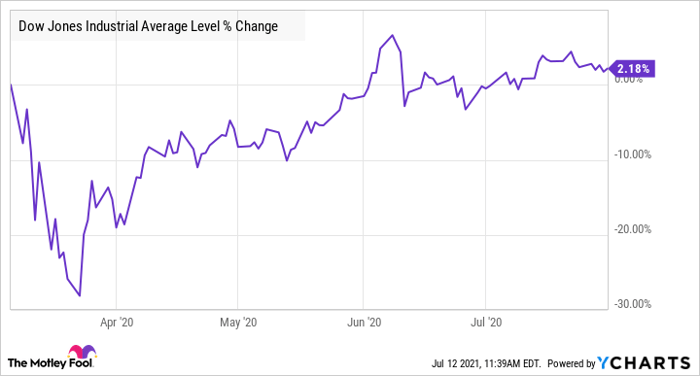
    The U.S. stock market has a history of putting up some of its best daily performances shortly after crashes and corrections. Take a look at the chart below, showing the Dow Jones Industrial Average (DJINDICES: ^DJI) through the coronavirus crash of 2020.
    ^DJI Chart

    ^DJI data by YCharts

    Take note:

    • The index did not fall straight down nor rise straight up.
    • The most dramatic gains in the recovery happened just after the Dow hit its cyclical low point in the second half of March.
    • The index was back into positive territory by the end of July.

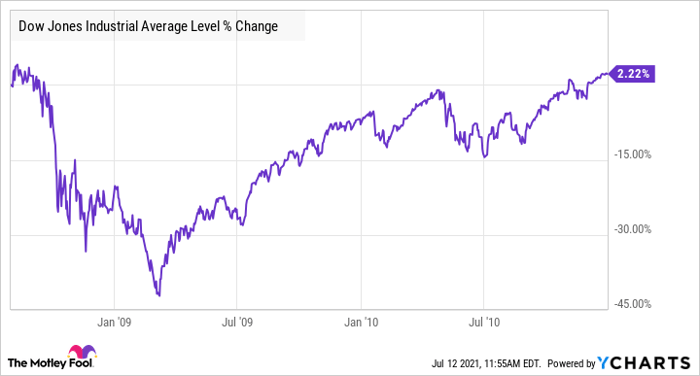
    This second chart shows the Dow during the Great Recession.
    ^DJI Chart

    ^DJI data by YCharts

    While this recovery took longer than the 2020 recovery, it shows a similar pattern — steep drops followed by sharp gains. Those continue but get less dramatic over time. Mentally, draw a straight line between the low point in March 2009 to the end of 2010. That trend line would show growth, even though it presented itself as a series of gains and losses.

    5. You have an emergency fund

    There will always come times when you need large quantities of extra cash. You could lose your job, wreck your car, or get injured playing an impromptu game of beach volleyball. If your investment portfolio is only the source you can tap for the funds you need, you may not have the luxury of waiting to sell stocks until a recession or bear market has ended.

    You can hedge against this scenario by keeping a cash emergency fund. How much you stash in it is up to you. An amount sufficient to cover three to six months of living expenses should protect you in case of a job loss. Or, you could stash enough to cover your insurance deductibles for health, auto, and homeowners coverage.

    Hold on tight

    Selling your investments in a recession will prevent you from losing more when the market is sinking. But the price you’ll pay for that immediate comfort can be high. You’re likely to suffer a long-term setback in the growth of your portfolio as you miss out on some of the recovery’s most dramatic gains.

    For those reasons, holding your investments during a recession is usually the better approach. Assuming you own quality stocks, they should rebound — often before you can tell that the recession has ended. And when that happens, the sting of those temporary and unrealized losses will fade quickly.

    This article was originally published on Fool.com. All figures quoted in US dollars unless otherwise stated.

    The post 5 reasons to hold onto your investments during a recession appeared first on The Motley Fool Australia.

    Wondering where you should invest $1,000 right now?

    When investing expert Scott Phillips has a stock tip, it can pay to listen. After all, the flagship Motley Fool Share Advisor newsletter he has run for more than eight years has provided thousands of paying members with stock picks that have doubled, tripled or even more.*

    Scott just revealed what he believes could be the five best ASX stocks for investors to buy right now. These stocks are trading at near dirt-cheap prices and Scott thinks they could be great buys right now.

    *Returns as of May 24th 2021

    More reading

    Catherine Brock has no position in any of the stocks mentioned. The Motley Fool Australia’s parent company Motley Fool Holdings Inc. has no position in any of the stocks mentioned. The Motley Fool Australia has no position in any of the stocks mentioned. The Motley Fool has a disclosure policy. This article contains general investment advice only (under AFSL 400691). Authorised by Bruce Jackson.

    This article was originally published on Fool.com. All figures quoted in US dollars unless otherwise stated.

    from The Motley Fool Australia https://ift.tt/36P8Au8

  • The Perenti (ASX:PRN) share price is falling on Monday

    Looking down on two African workers shaking hands over an agreement in an open pit mine.

    The Perenti Global Ltd (ASX: PRN) share price is in the red today despite the release of a positive update.

    At the time of writing, the diversified mining company’s shares are travelling 1.5% lower to 85.2 cents.

    New major contract award

    Perenti shares briefly hit a two-month high during morning trade as investors weighed in on the company’s latest announcement.

    In a statement to the ASX, Perenti advised that its joint venture business, AMAX, has been awarded a significant contract.

    AMAX is a joint venture between Perenti’s surface mining business in Africa, African Mining Services (AMS), and Ghanaian mining services company, MAXMASS. The companies hold a 60% and 40% interest respectively.

    The deal, worth around $470 million, will see AMAX conduct works over a five-year period at the Iduapriem gold mine. Situated in the western region of Ghana, AngloGold Ashanti CDI (ASX: AGG) owns the open-pit gold mine. 

    Expected to commence immediately, Perenti’s work in hand will increase by roughly $280 million over the contract term.

    This builds on AMS’ mining activity at the site for open-pit mining services, equipment supplies and maintenance.

    Perenti managing director and CEO Mark Norwell commented:

    We’re delighted to be extending our relationship with our long-standing client, AngloGold Ashanti. AMS has a reputation for delivering excellence while generating enduring value and certainty for stakeholders and the award of this new contract at a site where AMS has previously operated for AngloGold Ashanti provides further support for that reputation.

    Perenti mining CEO Paul Muller went on to add:

    We have provided surface mining services at the Iduapriem gold mine since 2012, establishing a successful partnership with AngloGold Ashanti.

    … Under this contract, and through the AMAX joint venture, we expect to continue to support the many local businesses that have become important suppliers and contractors to our operations under previous contracts.

    The joint venture also expects to employ more than 475 Ghanaians with approximately 40% of the workforce employed from the surrounding local communities and the remaining 60% from other regions within Ghana.

    About the Perenti share price

    Established in 1987, Perenti is one of the world’s largest companies that provides surface and underground mining and support services. The group is headquartered in Australia, and has operations and offices across 11 countries.

    Over the past 12 months, the Perenti share price has dropped over 20%, with year-to-date performance also down around 35%. The company’s shares reached a 52-week high of $1.55 in February before the release of its half-year results. Since then, Perenti shares plummeted following a poor H1 FY21 scorecard and disappointing trading update in May.

    On valuation grounds, Perenti commands a market capitalisation of roughly $602 million, with about 704 million shares on issue.

    The post The Perenti (ASX:PRN) share price is falling on Monday appeared first on The Motley Fool Australia.

    Should you invest $1,000 in Perenti right now?

    Before you consider Perenti, you’ll want to hear this.

    Motley Fool Investing expert Scott Phillips just revealed what he believes are the 5 best stocks for investors to buy right now… and Perenti wasn’t one of them.

    The online investing service he’s run for nearly a decade, Motley Fool Share Advisor, has provided thousands of paying members with stock picks that have doubled, tripled or even more.* And right now, Scott thinks there are 5 stocks that are better buys.

    *Returns as of May 24th 2021

    More reading

    Motley Fool contributor Aaron Teboneras has no position in any of the stocks mentioned. The Motley Fool Australia’s parent company Motley Fool Holdings Inc. has no position in any of the stocks mentioned. The Motley Fool Australia has no position in any of the stocks mentioned. The Motley Fool has a disclosure policy. This article contains general investment advice only (under AFSL 400691). Authorised by Bruce Jackson.

    from The Motley Fool Australia https://ift.tt/3hLUyzN

  • The CBA (ASX:CBA) share price slips on COVID home loan support

    unhappy investor, sad investor, nervous investor, financial stress, unhappy work from home

    The Commonwealth Bank of Australia (ASX: CBA) share price is sliding in morning trade, down 1.5%.

    This comes after CommBank reported it will increase its support for home loan customers in New South Wales impacted by the new COVID-19 lockdown measures.

    Over the weekend, the New South Wales government mandated new restrictions for 3 local government areas – Fairfield, Liverpool and Canterbury-Bankstown. Following a surge in coronavirus infections, non-essential retail and construction activities will be shuttered until further notice.

    What extra support is CommBank offering?

    As the Australian Financial Review reports, CBA is offering 2-month deferrals on home loans to customers in the 3 highly-impacted local government areas and in the construction and retail sectors.

    “I want to assure all of our customers across Australia who are today facing tighter restrictions that support is available right now,” CBA’s CEO Matt Comyn said.

    The 2-month deferral offer is available to impacted customers as of today. According to the AFR, CBA already offers “fee waivers, refunds and three-month deferrals for businesses with loan facilities of less than $3 million and turnover of less than $5 million…”

    The new wave of infections could put pressure on the CBA share price and that of the other big banks. Investors will be keenly watching to see if the share buyback many have been expecting – which would offer a tailwind to CBA’s share price – will go forward.

    CBA share price snapshot

    Up 34% over the past 12 months, CBA’s share price has outpaced the 21% gains posted by the S&P/ASX 200 Index (ASX: XJO).

    Year-to-date, the CBA share price has continued to outperform, up 17% so far in 2021.

    CommBank also pays a 2.5% dividend yield, fully franked.

    The post The CBA (ASX:CBA) share price slips on COVID home loan support appeared first on The Motley Fool Australia.

    Should you invest $1,000 in CBA right now?

    Before you consider CBA, you’ll want to hear this.

    Motley Fool Investing expert Scott Phillips just revealed what he believes are the 5 best stocks for investors to buy right now… and CBA wasn’t one of them.

    The online investing service he’s run for nearly a decade, Motley Fool Share Advisor, has provided thousands of paying members with stock picks that have doubled, tripled or even more.* And right now, Scott thinks there are 5 stocks that are better buys.

    *Returns as of May 24th 2021

    More reading

    The Motley Fool Australia’s parent company Motley Fool Holdings Inc. has no position in any of the stocks mentioned. The Motley Fool Australia has no position in any of the stocks mentioned. The Motley Fool has a disclosure policy. This article contains general investment advice only (under AFSL 400691). Authorised by Bruce Jackson.

    from The Motley Fool Australia https://ift.tt/3kwvezz

  • ASX construction shares fall on worksite shutdowns in NSW

    sad construction worker in front of half built house

    ASX construction shares like Brickworks Limited (ASX: BKW) are having a rough day on the open market. The price falls come after the NSW government imposed a two-week ban on construction in Sydney in an attempt to curb the spread of COVID-19.

    At the time of writing, shares in Brickworks are down 2% to $24.47, Reece Ltd (ASX: REH) shares are falling 2.06% to $22.84, and the CSR Limited (ASX: CSR) share price is 2.52% lower to $5.41. The S&P/ASX 200 Index (ASX: XJO) is 1.13% lower.

    Let’s take a closer look at the news.

    ASX construction shares fall on NSW ban

    On Saturday, NSW Premier Gladys Berejiklian announced from Monday (today) all non-urgent construction, renovations, and related works would stop in the Greater Sydney Area until at least 31 July. The state is averaging 100 cases per week on the latest figures.

    There has been coronavirus transmission on construction sites in the state. The government hopes it will lead to a sizable fall in daily cases.

    According to the Sydney Morning Herald (SMH), the ban on construction will cost the state economy $700 million a week. Construction is the fourth-largest employer in the country and NSW is the largest economy of all the states. The ban is being felt across the industry, as seen by the steep falls in the price of ASX construction shares.

    The whole market is taking a beating today

    It’s not just ASX construction shares that are suffering today. The whole market is down – most likely due to lockdowns in NSW and Victoria in Australia and the falling US markets.

    The ASX 200 is down over a full percentage point, the steepest fall in the market in over a month. Outside of construction materials, the biggest fallers are in mining and retail.

    Healthcare shares are bucking the trend and are up today.

    ASX construction share price snapshot

    ASX construction shares have held up pretty well during the pandemic up until this point.

    Companies like Brickworks and CSR hit all-time highs over the past year as construction was one of a few industries to be allowed to operate during outbreaks (until today). These companies also benefited from the property boom in Australia’s two largest cities, which fuelled construction activity.

    The post ASX construction shares fall on worksite shutdowns in NSW appeared first on The Motley Fool Australia.

    These 5 Cheap Shares Could Be Set For Huge Gains (FREE REPORT)

    We hear it over and over from investors, “I wish I had bought Altium or Afterpay when they were first recommended by The Motley Fool. I’d be sitting on a gold mine!” And it’s true.

    And while Altium and Afterpay have had a good run, we think these 5 other stocks are screaming buys. And you can find out the names of these stocks in the FREE stock report.

    *Extreme Opportunities returns as of February 15th 2021

    More reading

    The Motley Fool Australia’s parent company Motley Fool Holdings Inc. has no position in any of the stocks mentioned. The Motley Fool Australia owns shares of and has recommended Brickworks. The Motley Fool has a disclosure policy. This article contains general investment advice only (under AFSL 400691). Authorised by Bruce Jackson.

    from The Motley Fool Australia https://ift.tt/3xPup90

  • Evolution Mining (ASX:EVN) share price downgrade from four brokers

    plummeting gold share price

    The Evolution Mining Ltd (ASX: EVN) share price is down 6% this morning.

    The fall follows several analysts trimming their price targets on Evolution Mining shares before today’s open.

    Currently, Evolution shares are exchanging hands at $4.38 apiece, ~6% into the red from the market open.

    Let’s take a closer look at how it went down today.

    Quick recap on Evolution

    Evolution is a gold mining company that sits on the podium as one of Australia’s premier gold producers.

    It has interests in key gold hubs dotted along the eastern seaboard of Australia and also in Canada.

    At the time of writing, Evolution has a market capitalisation of $7.5 billion.

    Downgrades to Evolution’s price target

    Several investment banking firms have trimmed their targets on Evolution’s share price this morning, Bloomberg LP reports.

    Analysts from Macquarie Group and Credit Suisse each cut their outlook on Evolution shares.

    Macquarie analysts cut the recommendation on Evolution to underperform, whilst Credit Suisse assigned a neutral rating.

    Analysts at both firms set new price targets of $4.90 and $4.45 respectively.

    Meanwhile, Canaccord Genuity and Morgan Stanley also revised their outlook on the company’s share price.

    Canaccord assigned a new sell rating with a new price target of $4, whereas Morgan Stanley revised its figure by 7% to arrive at the same target.

    These moves follow the release of Evolution’s FY 2021 production update on 16 July.

    In its release, Evolution stated production came in at 681,000 ounces of gold for the financial year.

    This number came in below upgraded guidance figures from April that forecasted 695,000 to 710,000 ounces.

    Investors have since punished the Evolution shares, which have fallen 9% into the red since the market open on 16 July.

    Evolution share price snapshot

    The Evolution share price has had a choppy year to date, posting a loss of ~11% since January 1. This has extended the previous 12 months’ loss of ~27%.

    These returns have lagged the S&P/ASX 200 Index (ASX: XJO)’s 12-month return of 23%.

    Evolution shares are trading 33% off their 52-week high of $6.59 at the time of writing.

    The post Evolution Mining (ASX:EVN) share price downgrade from four brokers appeared first on The Motley Fool Australia.

    Wondering where you should invest $1,000 right now?

    When investing expert Scott Phillips has a stock tip, it can pay to listen. After all, the flagship Motley Fool Share Advisor newsletter he has run for more than eight years has provided thousands of paying members with stock picks that have doubled, tripled or even more.*

    Scott just revealed what he believes could be the five best ASX stocks for investors to buy right now. These stocks are trading at near dirt-cheap prices and Scott thinks they could be great buys right now.

    *Returns as of May 24th 2021

    More reading

    The author Zach Bristow has no positions in any of the stocks mentioned. The Motley Fool Australia’s parent company Motley Fool Holdings Inc. has no position in any of the stocks mentioned. The Motley Fool Australia has no position in any of the stocks mentioned. The Motley Fool has a disclosure policy. This article contains general investment advice only (under AFSL 400691). Authorised by Bruce Jackson.

    from The Motley Fool Australia https://ift.tt/3hNCVQ6

  • Broker: Sydney Airport (ASX:SYD) share price won’t hit $8.25 for awhile

    Travel bags sit by an airport lounge window overlooking a grounded plane on the tarmac

    The Sydney Airport Holdings Pty Ltd (ASX: SYD) share price probably won’t bounce back to its pre-COVID levels until Australia’s borders are re-opened, a senior analyst at Morgans has told media.

    The call follows Sydney Airport’s rejection of an $8.25 per share 100% takeover offer put to it by a consortium of infrastructure and super investors.

    Currently, the Sydney Airport share price is $7.94, having gained 0.38% today.

    The Sydney Airport said the consortium’s offer undervalued it and took advantage of the challenges brought about by COVID-19.

    However, Mogans’ senior analyst Nathan Lead told the Australian Financial Review the airport’s share price likely won’t reach the offered figure until international travel is back on the cards.

    Brokers predict Sydney Airport will sell for higher offer

    Sydney Airport acknowledged the likelihood its share price won’t reach $8.25 soon when it rejected the bid. It said:

    [T]he security price is likely to trade below the consortium proposal’s indicative price in the short term, however Sydney Airport will only progress a change in control transaction on terms that deliver and recognise appropriate long term value for Sydney Airport securityholders.

    The Sydney Airport share price’s highest close of 2020 was $8.18, which it hit in January. It then fell 33% over February and March. That was just 16 cents less than the airport’s share price’s all-time highest close of $8.97. It set the record in November 2019.

    Lead also stated that, when one takes into account the $2 billion capital raise conducted by Sydney Airport last year, $8.25 is near the airport’s pre-COVID trading price.

    He was quoted as saying that rejecting the consortium’s offer was “brave” of the airport.

    However, Credit Suisse analyst Paul Butler told the publication that the consortium likely didn’t post its best bet. Butler expects to see a higher offer given to the airport shortly.

    Citigroup analyst Suraj Nebhani agrees with Butler. Nebhani expects the airport will be taken over at a higher price.

    Sydney Airport share price snapshot

    After gaining 33% on the back of the consortium’s takeover offer, Sydney Airport shares are back in the green.

    Right now, they’re 23% higher than they were at the start of the year. They have also gained 50% since this time last year.

    The airport has a market capitalisation of around $21.3 billion, with approximately 2.7 billion shares outstanding.

    The post Broker: Sydney Airport (ASX:SYD) share price won’t hit $8.25 for awhile appeared first on The Motley Fool Australia.

    Should you invest $1,000 in Sydney Airport right now?

    Before you consider Sydney Airport, you’ll want to hear this.

    Motley Fool Investing expert Scott Phillips just revealed what he believes are the 5 best stocks for investors to buy right now… and Sydney Airport wasn’t one of them.

    The online investing service he’s run for nearly a decade, Motley Fool Share Advisor, has provided thousands of paying members with stock picks that have doubled, tripled or even more.* And right now, Scott thinks there are 5 stocks that are better buys.

    *Returns as of May 24th 2021

    More reading

    Motley Fool contributor Brooke Cooper has no position in any of the stocks mentioned. The Motley Fool Australia’s parent company Motley Fool Holdings Inc. has no position in any of the stocks mentioned. The Motley Fool Australia has no position in any of the stocks mentioned. The Motley Fool has a disclosure policy. This article contains general investment advice only (under AFSL 400691). Authorised by Bruce Jackson.

    from The Motley Fool Australia https://ift.tt/3rhbkdk

  • Brokers using the lockdown to upgrade earnings forecasts on these ASX 200 shares

    ASX 200 shares COVID upgrade asx 200 share price upgrade to buy represented by hand drawing line under the word upgrade

    The COVID-19 lockdowns of our two biggest cities have prompted brokers to upgrade their earnings calls on several ASX 200 shares.

    While the protracted lockdowns in Sydney and Melbourne are weighing on the S&P/ASX 200 Index (Index:^AXJO), every crisis produces winners and losers.

    It’s easy to see who the losers are with economists predicting that Australia’s GDP could shrink in the current quarter.

    ASX 200 shares getting a lockdown upgrade

    But these are boom times for ASX 200 shares that undertake COVID testing. In fact, Goldman Sachs reckons that the market is underestimating the upside for the sector.

    “Following the recent increase in COVID-19 cases in Australia, PCR testing volumes have increased significantly, with daily records being surpassed frequently through recent weeks (current peak: 163k, set on 2-Jul),” said the broker.

    “The current trailing 30-day average of 98k is the highest level achieved so far.”

    To put that in context, the 30-day average during August last year when infections hit a peak in Australia was 64,000 tests.

    Earnings tailwinds to last a while longer

    The more infections nature of the Delta-variant of the virus is driving the demand for tests. It doesn’t help that only around 13% of the population in Australia is fully vaccinated.

    It’s going to take many more months before we get to “herd immunity” levels, which experts believe is north of 60%.

    In the meantime, the Healius Ltd (ASX: HLS) share price, Sonic Healthcare Limited (ASX: SHL) share price and Australian Clinical Labs Ltd (ASX: ACL) share price are set to benefit.

    Focus on fundamentals

    “Given the materiality of COVID-19 testing for the ASX-listed pathology providers SHL, HLS and ACL (GSe: 17-28% of FY21E revenues), our new PCR volume estimates drive +6-10% EBIT upgrades in FY21E and +9-47% in FY22E,” said Goldman.

    “Whilst significant uncertainty remains, we continue to expect a sharp tapering in COVID-19 testing demand through FY22-23E, but also a greater degree of investor focus on base business fundamentals through this period.”

    Goldman is recommending investors buy the Healius share price and Australian Clinical Labs share price. It rates the Sonic share price as “neutral”.

    Lower claims to lift earnings of these ASX 200 shares

    Another group of ASX 200 shares that got an earnings upgrade are general insurers. Jarden estimates that the lockdowns will lead to significantly lower vehicle accident claims. Insurers could save around $20 million to $30 million.

    That’s good news for the Insurance Australia Group Ltd (ASX: IAG) share price and Suncorp Group Ltd (ASX: SUN) share price.

    Savings of up to $30m

    “Our analysis of prior lockdowns indicates IAG and SUN enjoyed motor claims savings of 1.5% of impacted GWP per week of restrictions in CY20,” said Jarden.

    “Overlaying similar metrics for estimated Greater Sydney motor GWP implies potential claims benefits of $30m for IAG and $20m for SUN if the lockdown ends on 30 July as planned.

    “With Victoria also entering another snap five-day lockdown, this could add a further $4-5m pre-tax benefit for IAG/SUN.”

    ASX 200 shares to buy today

    The earnings boost isn’t as significant as for COVID testing ASX 200 shares, but at least the outlook for these insurers isn’t looking bleaker.

    Jarden is recommending the IAG share price as a “buy” and Suncorp share price as “overweight”.

    The post Brokers using the lockdown to upgrade earnings forecasts on these ASX 200 shares appeared first on The Motley Fool Australia.

    Wondering where you should invest $1,000 right now?

    When investing expert Scott Phillips has a stock tip, it can pay to listen. After all, the flagship Motley Fool Share Advisor newsletter he has run for more than eight years has provided thousands of paying members with stock picks that have doubled, tripled or even more.*

    Scott just revealed what he believes could be the five best ASX stocks for investors to buy right now. These stocks are trading at near dirt-cheap prices and Scott thinks they could be great buys right now.

    *Returns as of May 24th 2021

    More reading

    Motley Fool contributor Brendon Lau has no position in any of the stocks mentioned. Connect with me on Twitter @brenlau.

    The Motley Fool Australia’s parent company Motley Fool Holdings Inc. has no position in any of the stocks mentioned. The Motley Fool Australia owns shares of and has recommended Insurance Australia Group Limited. The Motley Fool Australia has recommended Sonic Healthcare Limited. The Motley Fool has a disclosure policy. This article contains general investment advice only (under AFSL 400691). Authorised by Bruce Jackson.

    from The Motley Fool Australia https://ift.tt/3irhfIG

  • Why the Altium (ASX:ALU) share price is crashing 14% on Monday

    ASX shares skills shortage downgrade arrow causing the ground to crack symbolising a recession

    The Altium Limited (ASX: ALU) share price has come under significant pressure on Monday morning.

    In early trade, the electronic design software company’s shares sank as much as 14% to $31.47.

    The Altium share price recovered slightly to be down 10.5% to $32.73 before being paused.

    Why is the Altium share price sinking?

    The Altium share price was sold off this morning amid speculation that the company has rejected another takeover offer from Autodesk. This follows the rejection of a $38.50 per share offer from the US software giant in June.

    According to the AFR, on this occasion, Autodesk returned with an improved offer of $40.00 per share with the same conditions from its previous approach. These conditions include the granting of formal due diligence and board recommendation.

    However, the increase of 3.9% to $40.00 per share was reportedly deemed insufficient by the Altium board, leading to its rejection.

    Judging by the Altium share price reaction today, it appears as though investors believe this marks the end of Autodesk’s interest and no higher offer will be made.

    Why did Altium reject the offer?

    Altium has yet to confirm the receipt of this offer. However, if it did receive and subsequently reject the offer, it will most likely be for the same reasons as its previous rejection.

    At that point, the Altium Board revealed that it believed the proposal significantly undervalued Altium’s prospects.

    It commented: “Altium has a unique position in the electronics ecosystem and in the past unsolicited acquisition interest has developed from partnership dialogues with others in the ecosystem. As consistent with past unsolicited acquisition interest, the Altium Board will engage with interested parties in the context of an appropriate valuation of Altium and it will continue to review all potential strategic alternatives for the Company.”

    “Altium’s strong track record of setting ambitious long-term goals and achieving them, gives the Altium Board confidence in the Company’s ability to pursue its transformative strategy for the electronics industry and to achieve its 2025 financial goals. Having successfully pivoted to the cloud, Altium is now well positioned to pursue market dominance and industry transformation. The adoption of Altium’s cloud platform is transforming Altium’s business model from maintenance based subscription to capability-based SaaS subscription,” it added.

    It is worth noting that although the $40.00 per share offer is a large premium to the Altium share price pre-approach, it is still a discount to pre-pandemic 2020 highs of ~$42.00.

    The post Why the Altium (ASX:ALU) share price is crashing 14% on Monday appeared first on The Motley Fool Australia.

    Should you invest $1,000 in Altium right now?

    Before you consider Altium, you’ll want to hear this.

    Motley Fool Investing expert Scott Phillips just revealed what he believes are the 5 best stocks for investors to buy right now… and Altium wasn’t one of them.

    The online investing service he’s run for nearly a decade, Motley Fool Share Advisor, has provided thousands of paying members with stock picks that have doubled, tripled or even more.* And right now, Scott thinks there are 5 stocks that are better buys.

    *Returns as of May 24th 2021

    More reading

    Motley Fool contributor James Mickleboro has no position in any of the stocks mentioned. The Motley Fool Australia’s parent company Motley Fool Holdings Inc. owns shares of and has recommended Altium. The Motley Fool Australia owns shares of and has recommended Altium. The Motley Fool has a disclosure policy. This article contains general investment advice only (under AFSL 400691). Authorised by Bruce Jackson.

    from The Motley Fool Australia https://ift.tt/3euRLsO

  • 4 signs you’re ready to graduate from ETFs to picking stocks

    This article was originally published on Fool.com. All figures quoted in US dollars unless otherwise stated.

    students graduating from university

    This article was originally published on Fool.com. All figures quoted in US dollars unless otherwise stated.

    Remember your high school graduation? You threw that cap up in the air, ready to take on the world with your new status as a legal adult. Now you’re about to cross a different graduation milestone, only there are no final stock-picking exams to confirm you’re ready.

    Moving from ETF investing into stock-picking can be an exciting and profitable change of pace. But as with all of life’s big moves, there’s risk involved and it’s wise to proceed with caution. Here are four signs to test your readiness to shift from ETFs to a portfolio of individual stocks.

    1. ETFs aren’t giving you what you need

    ETFs are very popular, among both novice and experienced investors — and for good reason. They’re diversified, accessible, and easy to manage. The minimum investment threshold is low, and they often have low fees. There’s also no rule, stated or unspoken, that every investor eventually outgrows ETFs.

    If you’re thinking about making the leap into stock-picking, evaluate your motivation for the change. Push past any vague feelings that you should be picking stocks and get specific. Maybe your portfolio has a gap you need to fill. Or, you’re an ESG investor who’s motivated to limit the drag of higher ESG fund expense ratios. Or perhaps you’re attracted to the challenge of picking stocks and then watching their performance unfold.

    Any of those reasons are valid, but each requires a different approach. Clarify the goal now so you can pursue it with focus and precision.

    2. You have time to manage a stock portfolio

    ETFs don’t demand much of your time and attention. You can pick an index ETF in minutes when you know what type of exposure you need. You might quickly compare expense ratios and sizes of similar funds, but you probably won’t read any earnings reports or analyst opinions.

    Even after you buy an ETF, there’s not much to do but check in and rebalance periodically. That’s a quick process when you only have a handful of funds in your portfolio.

    With individual stocks, you’ll spend time researching various industries and companies before you buy. After you buy, you’ll monitor your investments to ensure they remain suitable for you. You’ll read the earnings reports and the analyst opinions, plus news releases and industry reporting. Any of those information releases could reveal something that changes your opinion of that company going forward.

    3. You are comfortable with volatility

    Individual stocks are more volatile than ETFs. A stock’s share price can swing up and down based on any one headline from the company, its competitors, the analyst community, or industry regulators. And sometimes a stock’s price can move without any identifiable reason, other than an unexplained shift in investor demand.

    Most investors manage that volatility by diversifying into at least 20 different stocks. You could also hold a few individual stocks alongside your ETFs to start. You’ll still see volatility in your stocks, but your overall portfolio won’t move as much.

    4. You like to learn

    Investing is a discipline for the information-hungry mind. If you don’t like to read, analyze, and form conclusions, you might find stock-picking to be tedious — when it should feel like an exciting challenge. The challenge lies in the depth of things you can learn. If you wanted to, you could pursue expertise in investing strategies and technical analysis as well as in industries and specific companies.

    That’s not to say you need an in-depth knowledge base to start picking stocks. What you need is an open mind and a willingness to learn. Those traits foster better investing decisions. They also help you adjust when you make mistakes — something all investors do now and then.

    Fall forward

    Can you hear “Pomp and Circumstance” playing in your head? Then you could be ready to expand your investing skill set into stock-picking. Start with a goal in mind, put in the work, learn all you can along the way, and be ready for some surprises.

    As actor Denzel Washington said to University of Pennsylvania graduates in 2011, “I’ve found that nothing in life is worthwhile unless you take risks. Fall forward. Every failed experiment is one step closer to success.”

    This article was originally published on Fool.com. All figures quoted in US dollars unless otherwise stated.

    The post 4 signs you’re ready to graduate from ETFs to picking stocks appeared first on The Motley Fool Australia.

    Wondering where you should invest $1,000 right now?

    When investing expert Scott Phillips has a stock tip, it can pay to listen. After all, the flagship Motley Fool Share Advisor newsletter he has run for more than eight years has provided thousands of paying members with stock picks that have doubled, tripled or even more.*

    Scott just revealed what he believes could be the five best ASX stocks for investors to buy right now. These stocks are trading at near dirt-cheap prices and Scott thinks they could be great buys right now.

    *Returns as of May 24th 2021

    More reading

    The Motley Fool Australia’s parent company Motley Fool Holdings Inc. has no position in any of the stocks mentioned. The Motley Fool Australia has no position in any of the stocks mentioned. The Motley Fool has a disclosure policy. This article contains general investment advice only (under AFSL 400691). Authorised by Bruce Jackson.

    This article was originally published on Fool.com. All figures quoted in US dollars unless otherwise stated.

    from The Motley Fool Australia https://ift.tt/2TpvuWc

  • Why the Ioneer (ASX:INR) share price is on the rise today

    digitised image of electrical vehicle being charged

    The Ioneer Ltd (ASX: INR) share price is moving higher in morning trade, up 2%.

    Below we take a look at the latest announcement from the ASX lithium share.

    What did Ioneer announce?

    Ioneer’s share price is gaining after the company reported it had secured a Water Pollution Control Permit for its Rhyolite Ridge Lithium-Boron Project in the US state of Nevada.

    Alongside the Class II Air Quality Permit Ioneer received for the project last month, it has now received both of the crucial permits needed to commence construction at Rhyolite Ridge.

    On completion, the project will produce lithium carbonate and boric acid end products. Covering some 3.8 square kilometres, it will include a process plant, quarry, overburden storage facility, and a spent ore storage facility.

    According to the release, evaporation ponds and tailings dams will not be incorporated due to its engineering design. As the project recycles its own water, Ioneer estimates it will use 30 times less water than the only other existing US domestic lithium production operation.

    The company reported it has already acquired all the water it needs via agreements with local farmers. It said the impact on local water resources will be net-zero.

    Commenting on the latest permit approval, Ioneer’s managing director Bernard Rowe said:

    The grant of the Water Pollution Control and Air Quality Permits represents a significant milestone for the Rhyolite Ridge Lithium-Boron Project and further demonstrates that our unique lithium-boron ore allows for the production of end products with minimal environment impact, including surface footprint, air quality and water conservation…

    [W]e are pleased that Rhyolite Ridge is the first developmental lithium project in Nevada to receive both Water Pollution Control and a Class II Air Quality permits. As the most advanced lithium development project in the US, we are committed to ensuring Rhyolite Ridge is a sustainable, environmentally sensitive operation that also delivers significant positive economic impact in the state of Nevada.

    Rowe said that with both permits secured, Ioneer can continue its work toward construction of the project.

    Ioneer share price snapshot

    Ioneer’s share price has been a strong performer over the past 12 months, up 246%. By comparison the All Ordinaries Index (ASX: XAO) is up 25% in the same period.

    Year-to-date, the Ioneer share price has continued to outperform, up 48% so far in 2021.

    The post Why the Ioneer (ASX:INR) share price is on the rise today appeared first on The Motley Fool Australia.

    Wondering where you should invest $1,000 right now?

    When investing expert Scott Phillips has a stock tip, it can pay to listen. After all, the flagship Motley Fool Share Advisor newsletter he has run for more than eight years has provided thousands of paying members with stock picks that have doubled, tripled or even more.*

    Scott just revealed what he believes could be the five best ASX stocks for investors to buy right now. These stocks are trading at near dirt-cheap prices and Scott thinks they could be great buys right now.

    *Returns as of May 24th 2021

    More reading

    The Motley Fool Australia’s parent company Motley Fool Holdings Inc. has no position in any of the stocks mentioned. The Motley Fool Australia has no position in any of the stocks mentioned. The Motley Fool has a disclosure policy. This article contains general investment advice only (under AFSL 400691). Authorised by Bruce Jackson.

    from The Motley Fool Australia https://ift.tt/2TjR7ad