• GM doubles down on electric vehicles

    This article was originally published on Fool.com. All figures quoted in US dollars unless otherwise stated.

    car being made

    This article was originally published on Fool.com. All figures quoted in US dollars unless otherwise stated.

    Virtually all legacy automakers have started to invest in electric vehicles (EVs) over the past decade. In recent years, General Motors (NYSE: GM) has been one of the most aggressive with respect to EV investments.

    At its EV day in early 2020, GM revealed that it would invest over $20 billion in EVs and autonomous vehicles (AVs) through 2025. Despite the shock of the COVID-19 pandemic last year, the General has increased its investment plan — twice. This highlights General Motors’ determination to improve its competitive position in the auto industry as the EV revolution plays out.

    An ambitious agenda

    General Motors has big plans for EVs and AVs, captured in its vision of “zero crashes, zero emissions, and zero congestion.” Its Cruise subsidiary is one of the leading AV developers and is on track to commercialize self-driving taxis within a few years.

    Earlier this month, Cruise became the first company authorized to offer fully autonomous ride-hailing (i.e., with no safety driver) to the public in California. And in April, Dubai selected Cruise as the exclusive provider of self-driving taxis for the city through 2029.

    As for EVs, GM plans to introduce 30 new EV models globally by 2025. More than two-thirds of those will be available in North America. General Motors is betting on vertical integration — similar to Tesla — to give it a competitive advantage over other legacy automakers. It has created a flexible battery platform called Ultium that will serve as the foundation for its future EV models. GM is designing electric motors, batteries, and cell chemistries in house and manufacturing battery cells through a joint venture with LG Chem.

    GM projects that its second-generation Ultium batteries — which will become available in the mid-2020s — will have double the energy density of today’s batteries and cost 60% less. That could get the company’s EVs close to price parity with traditional internal combustion engine (ICE) vehicles.

    To accelerate its EV roadmap, GM increased its investment plans last November, telling investors it would spend over $27 billion on EVs and AVs through 2025. Yet it wasn’t done.

    Boosting investment plans again

    On Wednesday, GM announced another huge increase to its investment plans. It now intends to spend a whopping $35 billion on engineering, capital spending, and other development costs for EVs and AVs through 2025. This will far outpace its spending on ICE vehicles over that period.

    The incremental investments will allow GM to build and open two additional U.S. battery cell manufacturing plants by mid-decade, for a total of four. The first Ultium Cells plant is slated to start production in early 2022, and GM announced its plans for the second Ultium Cells plant just two months ago. The latest investment shows that GM is more worried about being short of battery production capacity than having too much.

    General Motors is also ramping up investments in its HYDROTEC fuel cell platform. Moreover, it is looking for opportunities to expand beyond its core passenger auto business. It plans to develop its own electric commercial trucks, and it has struck agreements to supply fuel cells and battery systems for the heavy truck, railroad, and aviation industries.

    GM can cover the bill

    In conjunction with announcing its increased EV and AV investment plans, General Motors formally raised its guidance for the first half of 2021.

    Earlier this month, the automaker told investors that it expected its results for the first half of the year to be “significantly better” than its earlier forecast. Last week, GM put firm numbers on that guidance increase. It expects to generate an adjusted operating profit between $8.5 billion and $9.5 billion for the period, up from its previous estimate of $5.5 billion.

    CFO Paul Jacobson noted that GM will face ongoing headwinds from the industrywide chip shortage in the second half of 2021, along with significant commodity cost increases. As a result, the company hasn’t updated its full-year forecast yet. Nevertheless, General Motors is likely to beat its original full-year outlook by a wide margin, thanks to its stellar first-half results.

    In short, GM’s core business is firing on all cylinders. As chip availability improves and commodity costs normalize — or get passed through to consumers — profitability could improve further. That will give the General abundant earnings power to fund its aggressive investments in EVs and AVs, paving the way for a smooth transition to the next generation of transportation.

    This article was originally published on Fool.com. All figures quoted in US dollars unless otherwise stated.

    The post GM doubles down on electric vehicles appeared first on The Motley Fool Australia.

    Wondering where you should invest $1,000 right now?

    When investing expert Scott Phillips has a stock tip, it can pay to listen. After all, the flagship Motley Fool Share Advisor newsletter he has run for more than eight years has provided thousands of paying members with stock picks that have doubled, tripled or even more.*

    Scott just revealed what he believes could be the five best ASX stocks for investors to buy right now. These stocks are trading at near dirt-cheap prices and Scott thinks they could be great buys right now.

    *Returns as of May 24th 2021

    More reading

    Adam Levine-Weinberg owns shares of General Motors. The Motley Fool Australia’s parent company Motley Fool Holdings Inc. has no position in any of the stocks mentioned. The Motley Fool Australia has no position in any of the stocks mentioned. The Motley Fool has a disclosure policy. This article contains general investment advice only (under AFSL 400691). Authorised by Bruce Jackson.

    This article was originally published on Fool.com. All figures quoted in US dollars unless otherwise stated.


    from The Motley Fool Australia https://ift.tt/3qbHIh3

  • SILK Laser (ASX: SLA) share price climbs on equity raise update

    woman holding up a rising red graph

    The SILK Laser Australia Ltd (ASX: SLA) share price has come out of a trading halt today. This follows the laser, skincare, and cosmetic injections company’s update to its recent capital raising efforts.

    At the time of writing, SILK Laser shares are bucking the ASX trend, up 3.75% to $4.70. In comparison, the All Ordinaries Index (ASX: XAO) is down 1.3% to 7,522 points.

    SILK Laser completes placement

    One catalyst for today’s gain in the SILK Laser share price could be investor optimism over the company’s progressive plans.

    According to its release, SILK Laser announced it has completed a fully underwritten placement to raise $20 million. The company received support from a number of sophisticated and institutional investors.

    The offer will see approximately 4.7 million ordinary new shares, at a price of $4.30 apiece, allocated to participating investors. This represents a 5.1% discount on the issued shares prior to when the company went into a trading halt on 17 June 2021.

    SILK Laser will use the proceeds from the capital raise to partly fund the entire acquisition of Beauty Services Holdings Pty Ltd, LMD2 Pty Ltd and its broader group of entities. Together this group operates Australian Skin Clinics in Australia and The Cosmetic Clinic in New Zealand.

    It is expected that the acquisition will be completed at the end of August 2021.

    The new shares are scheduled to settle this Wednesday 23 June, with allotment on the ASX on 24 June 2021.

    SILK Laser CEO, Martin Perelman commented:

    We are pleased with the success of this equity raising. We are grateful to our existing shareholders, welcome our new shareholders and thank them all for their support, as we deliver on our growth strategy and solidify our market position in the non-surgical aesthetic industry.

    About the SILK Laser share price

    Since the start of June, SILK Laser shares have strongly rebounded after hitting a low of $3.80 on 4 June. As a result, the company’s share price is registering a 26% gain over the last 6 months.

    SILK Laser has a market capitalisation of around $213 million, with more than 47 million shares outstanding on its books.

    The post SILK Laser (ASX: SLA) share price climbs on equity raise update appeared first on The Motley Fool Australia.

    Wondering where you should invest $1,000 right now?

    When investing expert Scott Phillips has a stock tip, it can pay to listen. After all, the flagship Motley Fool Share Advisor newsletter he has run for more than eight years has provided thousands of paying members with stock picks that have doubled, tripled or even more.*

    Scott just revealed what he believes could be the five best ASX stocks for investors to buy right now. These stocks are trading at near dirt-cheap prices and Scott thinks they could be great buys right now.

    *Returns as of May 24th 2021

    More reading

    Motley Fool contributor Aaron Teboneras has no position in any of the stocks mentioned. The Motley Fool Australia’s parent company Motley Fool Holdings Inc. has no position in any of the stocks mentioned. The Motley Fool Australia has no position in any of the stocks mentioned. The Motley Fool has a disclosure policy. This article contains general investment advice only (under AFSL 400691). Authorised by Bruce Jackson.

    from The Motley Fool Australia https://ift.tt/3xB6xFI

  • Integrated Research (ASX:IRI) share price jumps 5% on trading update

    rising asx share price represented by woman jumping in the air happily

    The Integrated Research Limited (ASX: IRI) share price will be in investors sights this morning.

    A trading update from the company regarding its FY21 second-half performance is the latest news from the provider of user experience and performance management solutions.

    Prior to market open, the Integrated Research share price was sitting at $1.90. At the time of writing, the company’s shares are swapping hands at $2.02, up 5%.

    For better and worse

    According to the release, the company expects its second-half performance for FY21 to be significantly improved on the first half.

    Integrated Research is anticipating second half revenue to fall between $40 million and $45 million. This would be higher than the $34.1 million in revenue reported during the front half of the financial year.

    Likewise, profit after tax is expected to be somewhere in the ballpark of $4 million to $7 million, compared to $0.1 million in the first half.

    However, it’s not all sunshine and rainbows for the company. While the updated revenue and earnings guidance is ahead of the first half, it remains lower than the prior corresponding period in FY20.

    For that reason, despite the improvement in the last half of trading, Integrated Research reckons its full year performance will be down on the last year. On the top line, the range is $74.1 million to $79.1 million – compared to $110.9 million in FY20.

    On the earnings side, the company is forecasting $4.1 million to $7.1 million – compared to $24.1 million in FY20.

    Influencing the numbers

    Integrated Research has experienced a few speed bumps recently that is slowing down the performance of its IT solutions business.

    The uncertain environment created by COVID-19 has led to customers requiring shorter-term contracts, tight budget conditions and approval processes, and delays to purchasing decisions. These hurdles have stifled performance in recent trading.

    However, on a positive note, the company stated, “License fee revenue recognised in 2H to date already exceeds 1H with June being the strongest revenue month for the company.”

    Integrated Research share price recap

    The last year has been a tough one for Integrated Research shareholders. After quickly rebounding out of its depressed COVID lull, the Integrated Research share price reversed again.

    As of today, the Integrated Research share price is down 45% for the past 12 months. This compares to the S&P/ASX 200 Index (ASX: XJO), which has surged 23% during the same timeframe.

    The post Integrated Research (ASX:IRI) share price jumps 5% on trading update appeared first on The Motley Fool Australia.

    Wondering where you should invest $1,000 right now?

    When investing expert Scott Phillips has a stock tip, it can pay to listen. After all, the flagship Motley Fool Share Advisor newsletter he has run for more than eight years has provided thousands of paying members with stock picks that have doubled, tripled or even more.*

    Scott just revealed what he believes could be the five best ASX stocks for investors to buy right now. These stocks are trading at near dirt-cheap prices and Scott thinks they could be great buys right now.

    *Returns as of May 24th 2021

    More reading

    Motley Fool contributor Mitchell Lawler has no position in any of the stocks mentioned. The Motley Fool Australia’s parent company Motley Fool Holdings Inc. owns shares of and has recommended Integrated Research Limited. The Motley Fool Australia has no position in any of the stocks mentioned. The Motley Fool has a disclosure policy. This article contains general investment advice only (under AFSL 400691). Authorised by Bruce Jackson.

    from The Motley Fool Australia https://ift.tt/2TPIrbw

  • Mayne Pharma (ASX:MYX) share price lower despite positive updates

    Bag of white pills spilled onto a blue surface

    The Mayne Pharma Group Ltd (ASX: MYX) share price is trading lower today amid broad market weakness.

    At the time fo writing, the pharmaceutical company’s shares are down 1.5% to 34.5 cents.

    What did Mayne Pharma announce?

    Investors have been selling the pharmaceutical company’s shares despite the release of a couple of promising announcements this morning.

    According to the first release, the company has expanded its Australian dermatology portfolio by licensing the Australian rights to Solaraze and the Actikerall topical solution from Almirall. Both products are approved by the Australian Therapeutic Goods Administration (TGA).

    Solaraze and Actikerall are indicated for the treatment of actinic keratosis (AK), which affects approximately 40% to 60% of Australians over the age of 40. Australia has the highest incidence of AK globally, with the main cause being long-term sun exposure.

    In addition to this, Mayne Pharma revealed that it has filed Fabior foam with the TGA. Fabior was acquired from GlaxoSmithKline and re-launched into the US dermatology market in 2016. It is a topical retinoid indicated in the US for the treatment of acne in patients aged 12 years or older.

    Combined, the three products have a $30 million market opportunity in Australia.

    Mayne Pharma’s CEO Scott Richards said, “We are pleased to partner with Almirall, a global biopharmaceutical company focused on skin health and expand our Australian portfolio with these new differentiated dermatology products. Solaraze and Actikerall will be promoted by the existing Australian sales team focusing on dermatologists and general practitioners that specialise in skin cancer.”

    Nextstellis update

    According to the second release, Mayne Pharma and Mithra Pharmaceuticals have announced the US commercial launch of its Nextstellis product.

    Nextstellis is a new oral contraceptive which was approved by the FDA in April. It is the first and only pill containing E4, a natural estrogen produced during pregnancy that is now synthesised from a plant source. E4 is the first new estrogen introduced in the US in over 50 years.

    The product will compete in the short-acting combination hormonal contraceptive market which is valued at US$3.5 billion.

    Mr Richards commented; “We are delighted to launch Nextstellis, a new birth control option for women and their healthcare providers. Every woman’s body reacts differently to hormones and so from today, American women will now have a new choice of estrogen to consider when thinking about birth control options.”

    “Our key priorities with this launch are to educate the market on the benefits of Nextstellis and the new estrogen E4, gain broad payor acceptance and reimbursement, and ultimately become the preferred branded oral contraceptive in the market. The launch is supported by a highly experienced national Women’s Health sales team that is now actively promoting Nextstellis to healthcare providers,” he concluded.

    The post Mayne Pharma (ASX:MYX) share price lower despite positive updates appeared first on The Motley Fool Australia.

    Wondering where you should invest $1,000 right now?

    When investing expert Scott Phillips has a stock tip, it can pay to listen. After all, the flagship Motley Fool Share Advisor newsletter he has run for more than eight years has provided thousands of paying members with stock picks that have doubled, tripled or even more.*

    Scott just revealed what he believes could be the five best ASX stocks for investors to buy right now. These stocks are trading at near dirt-cheap prices and Scott thinks they could be great buys right now.

    *Returns as of May 24th 2021

    More reading

    James Mickleboro does not own any shares mentioned. The Motley Fool Australia’s parent company Motley Fool Holdings Inc. has no position in any of the stocks mentioned. The Motley Fool Australia has no position in any of the stocks mentioned. The Motley Fool has a disclosure policy. This article contains general investment advice only (under AFSL 400691). Authorised by Bruce Jackson.

    from The Motley Fool Australia https://ift.tt/3qbxqNZ

  • Will Microsoft’s Xbox game lineup match Sony’s PlayStation dominance?

    This article was originally published on Fool.com. All figures quoted in US dollars unless otherwise stated.

    xbox and playstation consoles

    This article was originally published on Fool.com. All figures quoted in US dollars unless otherwise stated.

    Microsoft (NASDAQ: MSFT) recently unveiled what it’s pitching as its “biggest exclusive games lineup ever” for Xbox. The lineup features 30 exclusive titles as Microsoft tries to bolster its first-party game library to attract more subscribers to its a la carte gaming service, Xbox Game Pass. 

    It’s a long overdue move for the software giant, which has operated in the shadow of Sony‘s (NYSE: SONY) PlayStation dominance over the last few decades. In the previous generation, PlayStation 4 outsold Xbox One by more than two to one, according to data from VGChartz. 

    Microsoft has spent the last few years acquiring studios to match Sony’s in-house studio count to crank out more first-party titles. While it’s uncertain whether these moves will lead to the Xbox Series X/S outselling the PlayStation 5, Microsoft might be on to something given the tremendous lead Xbox Game Pass has over Sony’s PlayStation Now subscription service.

    Getting value out of recent acquisitions

    It was expected that Microsoft would expand its game roster after scooping up ZeniMax Media, which operates one of the top game studios in the industry — Bethesda Softworks — for $7.5 billion last year. 

    Microsoft is packing a punch with its exclusive games. Besides the usual suspects like the new Halo Infinite and Forza Horizon 5, which have long been Xbox staples, Microsoft announced a few that will surely create buzz over the next year.

    There is Redfall, a new multiplayer open-world first-person shooter from the makers of well-regarded titles Prey and Dishonored. Another standout on the list is an upcoming role-playing game called Starfield, coming in late 2022. Both of these upcoming games are from the teams at Bethesda. 

    Bethesda is the studio behind two blockbuster franchises, The Elder Scrolls and Fallout. The addition of this studio to Xbox Game Studios will no doubt pull a lot of weight for the Game Pass subscription service.

    Microsoft’s gaming business reported a revenue increase of 50% year over year in the fiscal third quarter and made up 9.6% of Microsoft’s total business through the nine-month period ending in March. 

    Microsoft now has 23 first-party studios — nine more than PlayStation Studios. But it’s uncertain whether surpassing Sony on studio count and therefore allowing Xbox to potentially release more games, will help Microsoft beat Sony in console sales.

    In the console war, Microsoft is facing an uphill battle. PlayStation continues to rank high on brand value with consumers. The 2021 Prophet Brand relevance index shows PlayStation ranking up there with the likes of Apple and Amazon

    Early sales estimates show the PlayStation 5 outselling the Xbox Series X/S by a wide margin. Through the end of 2020, research from Ampere Analysis had PlayStation 5 selling 4.2 million units, compared to 2.8 million for Xbox Series X/S. Microsoft doesn’t disclose specific unit sales, but in May Sony said it had sold 7.8 million PS5 units.

    Keep in mind, both consoles have been consistently sold out due to supply chain issues, so it’s possible that Microsoft is suffering more from component shortages than Sony is right now.

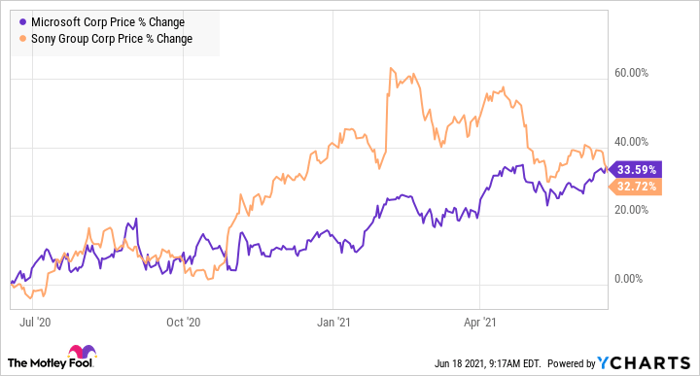
    Nonetheless, investors are high on Sony’s growth prospects, with the stock up 32% over the last year. Gaming contributes 35% of Sony’s operating profit, and is much more valuable to the Japanese company than Xbox is to Microsoft. Sony reported a 43% increase in operating profit from its game and network services segment in fiscal 2020.

    MSFT Chart

    MSFT data by YCharts

    Microsoft values subscribers, not hardware sales

    The thing is, Microsoft doesn’t appear to be measuring its Xbox success on console unit sales. CEO Satya Nadella is applying the same playbook to the Xbox business as he did to the rest of Microsoft’s business in recent years. The Xbox is turning into a ubiquitous platform, where players can access games on different devices without owning a console. While Sony continues to highlight its total sold units of the PS5, Microsoft is touting its subscriber growth.

    Sony’s PlayStation Now, which lets users play a selection of titles on console and PC for $10 per month, had 3.2 million subscribers at the end of fiscal 2020. That’s up from 1.8 million in fiscal 2019. 

    Cloud gaming with the Xbox Game Pass Ultimate lets users play games on Android devices, in addition to consoles and Windows PCs. Game Pass had over 18 million subscribers through the fiscal second quarter ending in December, and that’s up from over 15 million in fiscal Q1. At that pace, Xbox Game Pass is on track to have approximately 30 million subscribers within the next year.

    Sony may continue to dominate hardware sales, but Microsoft’s stellar lineup of 30 titles, 27 of which are going to Game Pass, could keep the software king far ahead in subscribers. 

    The long-term opportunity in gaming looks bright for both companies, with 3 billion people expected to play video games by 2023, representing a mid-single-digit increase per year. But it’s a much easier path to convince a prospective gamer to try an affordable subscription service than drop hundreds of dollars on new hardware, so Microsoft might have the upper hand.

    Sony is a force to reckon with in gaming, and it has plenty of exclusive titles that will draw a big crowd to the PlayStation. But Microsoft may do more to expand the audience for gaming in this console cycle than its rival.

    This article was originally published on Fool.com. All figures quoted in US dollars unless otherwise stated.

    The post Will Microsoft’s Xbox game lineup match Sony’s PlayStation dominance? appeared first on The Motley Fool Australia.

    Wondering where you should invest $1,000 right now?

    When investing expert Scott Phillips has a stock tip, it can pay to listen. After all, the flagship Motley Fool Share Advisor newsletter he has run for more than eight years has provided thousands of paying members with stock picks that have doubled, tripled or even more.*

    Scott just revealed what he believes could be the five best ASX stocks for investors to buy right now. These stocks are trading at near dirt-cheap prices and Scott thinks they could be great buys right now.

    *Returns as of May 24th 2021

    More reading

    John Ballard owns shares of Amazon and Microsoft. John Mackey, CEO of Whole Foods Market, an Amazon subsidiary, is a member of The Motley Fool’s board of directors. Teresa Kersten, an employee of LinkedIn, a Microsoft subsidiary, is a member of The Motley Fool’s board of directors. The Motley Fool Australia’s parent company Motley Fool Holdings Inc. owns shares of and has recommended Amazon, Apple, and Microsoft. The Motley Fool Australia’s parent company Motley Fool Holdings Inc. has recommended the following options: long January 2022 $1,920 calls on Amazon, long March 2023 $120 calls on Apple, short January 2022 $1,940 calls on Amazon, and short March 2023 $130 calls on Apple. The Motley Fool Australia has recommended Amazon and Apple. The Motley Fool has a disclosure policy. This article contains general investment advice only (under AFSL 400691). Authorised by Bruce Jackson.

    This article was originally published on Fool.com. All figures quoted in US dollars unless otherwise stated.


    from The Motley Fool Australia https://ift.tt/3gIj7xf
  • Why the PointsBet (ASX:PBH) share price could jump 32% from here

    A group of happy young people watching sport on a laptop celebrate, indicating a win for sports betting.

    The PointsBet Holdings Ltd (ASX: PBH) share price is tumbling lower with the market on Monday morning.

    At the time of writing, the sports betting company’s shares are down 3% to $13.07.

    Is this a buying opportunity?

    One leading broker that appears to see today’s weakness in the PointsBet share price as a buying opportunity is Goldman Sachs.

    This morning the broker retained its buy rating and $17.20 price target on the company’s shares.

    Based on the current PointsBet share price, this implies potential upside of 32% over the next 12 months.

    Why is Goldman bullish on the PointsBet share price?

    According to the note, the broker recently hosted a virtual meeting with PointsBet management. It came away from the meeting incrementally more confident in the company’s US market execution and positioning.

    Commenting on recent trends, Goldman said: “Whilst May was generally a quiet month for the industry given the sporting calendar, management was pleased with the overall performance and trends. Into June, momentum seems to have picked up given the NBA playoffs and Euro 2020, and with respect to CAC [customer acquisition costs], suggested similar if not better trends than 3Q given the generally quieter period of acquisitions.”

    Market position

    The broker also spoke to management about the company’s market position in the United States.

    It explained: “Overall, PBH sees the US market over the medium term as supportive for 7 or 8 good sized operators (PBH is a clear top 4/5 operator currently), and is not entirely convinced that it would end up being a 4 operator market per some peer comments. Further, management believes near term M&A will likely continue to be bolt-on technology related acquisitions, though note that a lot of the low hanging fruit that peers are looking out for are largely gone.”

    Legislation and expansion

    Goldman notes that New York is a key market the company wants to expand into.

    “On the reg/legislation front, with respect to NY, PBH noted that it remains absolutely keen to push for a license in the state and expects the process to be run like a reverse Dutch auction, whilst it remains to be seen as to where the tax rates will land, 50% is still OK in the context of a market where there might only be a few operators and everyone is on a level playing field. Further, they reiterated that there is minimal media asset overlap between NY and PA, albeit some overlap between NJ and NY,” it commented.

    The broker also sees scope for PointsBet to be operating in a number of other markets in the near future, including Canada.

    It explained: “Looking ahead, other states worth monitoring include Arizona and Ohio, whilst there remains the possibility of Canada opening up in early CY22, or even potentially as early as late CY21. Canada will operate different to the US (more like untethered states or AUS), without the need to access licenses through Brick and Mortar casinos. Overall, they continue to target being operational in 18 US states by end of CY22.”

    In light of the above, Goldman Sachs continues to forecast explosive sales growth from PointsBet in the coming years.

    For example, it is expecting revenue of $179.6 million in FY 2021, which is more than double FY 2020’s revenue of $75.2 million. And by FY 2023, PointsBet’s revenue is expected to have more than doubled again to $484.2 million.

    Despite today’s decline, the PointsBet share price is still up 10.5% year to date.

    The post Why the PointsBet (ASX:PBH) share price could jump 32% from here appeared first on The Motley Fool Australia.

    Wondering where you should invest $1,000 right now?

    When investing expert Scott Phillips has a stock tip, it can pay to listen. After all, the flagship Motley Fool Share Advisor newsletter he has run for more than eight years has provided thousands of paying members with stock picks that have doubled, tripled or even more.*

    Scott just revealed what he believes could be the five best ASX stocks for investors to buy right now. These stocks are trading at near dirt-cheap prices and Scott thinks they could be great buys right now.

    *Returns as of May 24th 2021

    More reading

    James Mickleboro does not own any shares mentioned. The Motley Fool Australia’s parent company Motley Fool Holdings Inc. owns shares of and has recommended Pointsbet Holdings Ltd. The Motley Fool Australia has recommended Pointsbet Holdings Ltd. The Motley Fool has a disclosure policy. This article contains general investment advice only (under AFSL 400691). Authorised by Bruce Jackson.

    from The Motley Fool Australia https://ift.tt/3gIiCmR

  • Bank of Queensland (ASX:BOQ) share price lower despite ME Bank acquisition approval

    The Bank of Queensland Limited (ASX: BOQ) share price is trading lower today after broad market weakness offset the release of a positive announcement.

    At the time of writing, the regional bank’s shares are down 2.5% to $9.00.

    What did Bank of Queensland announce?

    This morning Bank of Queensland announced that the Treasurer of the Commonwealth of Australia has provided it with approval to hold a controlling stake of 100% in Members Equity Bank (ME Bank).

    This follows the company’s announcement in February, which revealed that it had entered into an agreement to acquire ME Bank for a cash consideration of $1.325 billion.

    Positively, the approval of the acquisition by the Treasurer was the only condition precedent to completion of the transaction. As a result, completion is now expected to take place on 1 July 2021.

    Bank of Queensland’s Chairman, Patrick Allaway, believes the acquisition will help the bank compete against the big four.

    He said: “The acquisition of ME Bank is a key step in our strategy to be a compelling alternative to the big banks. It is a defining moment in the transformation of BOQ Group, which will benefit our shareholders, customers and people.”

    This sentiment was echoed by the company’s Managing Director and CEO, George Frazis.

    He commented: “The addition of ME Bank to the BOQ Group will further strengthen our multi-brand strategy, deliver material scale, broadly double the size of our Retail bank, and provide us with geographic diversification. We look forward to the ME Bank team formally joining the BOQ Group very soon.”

    The release notes that prior to completion, Bank of Queensland and ME Bank will continue to operate as separate businesses with no immediate changes expected for customers of either business.

    The post Bank of Queensland (ASX:BOQ) share price lower despite ME Bank acquisition approval appeared first on The Motley Fool Australia.

    Wondering where you should invest $1,000 right now?

    When investing expert Scott Phillips has a stock tip, it can pay to listen. After all, the flagship Motley Fool Share Advisor newsletter he has run for more than eight years has provided thousands of paying members with stock picks that have doubled, tripled or even more.*

    Scott just revealed what he believes could be the five best ASX stocks for investors to buy right now. These stocks are trading at near dirt-cheap prices and Scott thinks they could be great buys right now.

    *Returns as of May 24th 2021

    More reading

    James Mickleboro does not own any shares mentioned. The Motley Fool Australia’s parent company Motley Fool Holdings Inc. has no position in any of the stocks mentioned. The Motley Fool Australia has no position in any of the stocks mentioned. The Motley Fool has a disclosure policy. This article contains general investment advice only (under AFSL 400691). Authorised by Bruce Jackson.

    from The Motley Fool Australia https://ift.tt/3xEzlwL

  • CBA (ASX:CBA) share price on watch after insurance business sale

    woman looking up as if watching asx share price

    The Commonwealth Bank of Australia (ASX: CBA) share price will be one to watch when trading resumes this morning. Australia’s largest retail bank comes into focus after announcing the sale of its general insurance division to Hollard Group.

    At close of trade Friday, CBA shares were trading at $103.69 – down 2.1%. The S&P/ASX 200 Index (ASX: XJO) ended the trading day 0.13% higher.

    Let’s take a closer look at today’s news.

    CBA share price in focus

    In a statement to the ASX, Commonwealth Bank confirmed it would be selling its Australian general insurance business to underwriter Hollard Group. CommInsure General Insurance currently has around 800,000 policies on its books.

    Hollard Group’s proprietary insurance brands in Australia include Real Insurance among others. It is also the underwriter for many retail insurance products such as those offered by Woolworths Group Ltd (ASX: WOW) and Medibank Private Ltd (ASX: MPL).

    CommBank did not disclose the full amount of the transaction – only that $625 million will be paid in upfront considerations, with the rest to be paid “upon achieving certain business milestones.” The deferred amount was not specified.

    Hollard Group will also enter a “15-year strategic alliance” with CommBank to sell home and motor insurance policies exclusively to the bank’s customers. CBA says it will continue to earn income from this arrangement.

    Subject to APRA approval, CommBank believes the transaction should be finalised sometime in the middle of next year. As well, the company says the sale will deliver a $400 million increase in its CET1 capital, which will improve its capital ratio by “approximately 9 basis points”.

    CBA also claims it should see a post-tax gain of $90 million from the sale, “which includes estimated post-tax separation and transaction costs of approximately $130m.”

    It will be interesting to see whether the bank’s latest news impacts the performance of the CBA share price today.

    Management commentary

    Commonwealth Bank CEO Matt Comyn said:

    The transaction is consistent with CBA’s strategy to deliver differentiated customer propositions and the best integrated digital experiences. CBA and Hollard will coinvest in innovative, market-leading products and services that anticipate and meet the changing needs of our customers.

    Hollard Australia managing director Richard Enthoven added:

    We are incredibly excited by today’s announcement. The synergies between CBA and Hollard extend well beyond strategy and market segmentation. We have a shared vision for the future of home insurance, the potential for better customer outcomes, and an exciting role for digital innovation along our entire value chain.

    CBA share price snapshot

    Over the past 12 months, the CBA share price has increased by almost 51%. Last week, the bank reached an all-time high of $106.57, before slightly retreating. CBA shares cracked $100 per unit for the first time at the end of last month.

    Commonwealth Bank has a market capitalisation of around $184 billion.

    The post CBA (ASX:CBA) share price on watch after insurance business sale appeared first on The Motley Fool Australia.

    Wondering where you should invest $1,000 right now?

    When investing expert Scott Phillips has a stock tip, it can pay to listen. After all, the flagship Motley Fool Share Advisor newsletter he has run for more than eight years has provided thousands of paying members with stock picks that have doubled, tripled or even more.*

    Scott just revealed what he believes could be the five best ASX stocks for investors to buy right now. These stocks are trading at near dirt-cheap prices and Scott thinks they could be great buys right now.

    *Returns as of May 24th 2021

    More reading

    The Motley Fool Australia’s parent company Motley Fool Holdings Inc. has no position in any of the stocks mentioned. The Motley Fool Australia has no position in any of the stocks mentioned. The Motley Fool has a disclosure policy. This article contains general investment advice only (under AFSL 400691). Authorised by Bruce Jackson.

    from The Motley Fool Australia https://ift.tt/3cXCuQr

  • These are the 10 most shorted shares on the ASX

    most shorted ASX shares

    At the start of each week I like to look at ASIC’s short position report to find out which shares are being targeted by short sellers.

    This is because I believe it is well worth keeping a close eye on short interest levels as high levels can sometimes be a sign that something isn’t quite right with a company.

    With that in mind, here are the 10 most shorted shares on the ASX this week according to ASIC:

    • Kogan.com Ltd (ASX: KGN) remains the most shorted share on the ASX with short interest of 11.8%. This was down slightly week on week. Significant inventory issues and a slowdown in sales have been weighing heavily on this ecommerce company’s shares.
    • Resolute Mining Limited (ASX: RSG) has seen its short interest remain flat at 10.4%. Short sellers have been targeting this gold miner due to a number of operational issues and the weakening gold price. It was also just kicked out of the ASX 200 index.
    • Webjet Limited (ASX: WEB) has seen its short interest edge lower to 10.4%. This online travel agent’s shares continue to be a favourite of short sellers. They may believe it is overvalued, particularly given the stuttering travel market recovery.
    • Flight Centre Travel Group Ltd (ASX: FLT) has seen its short interest remain flat at 9.4%. As with Webjet, recent lockdowns and border closures are threatening to push back this travel agent’s recovery.
    • Electro Optic Systems Hldg Ltd (ASX: EOS) has 8.7% of its shares held short, which is down week on week. Short sellers may be targeting this communications, defence, and space company due to concerns that supply chain issues could impact its performance.
    • Inghams Group Ltd (ASX: ING) has 8.7% of its shares held short, which is up sharply week on week. Short sellers may have concerns over risks associated with an upcoming major contract renewal with a supermarket giant. Unfortunately, the poultry producer’s shares hit a 52-week high on Friday, much to the dismay of short sellers.
    • Tassal Group Limited (ASX: TGR) has short interest of 8.5%, which is flat week on week. Weak salmon prices have been weighing on the company’s performance. However, Goldman Sachs believes that Tassal is set for a stronger FY 2022 with a recovery in demand well underway.
    • Temple & Webster Group Ltd (ASX: TPW) has seen its short interest ease to 8.4%. Short sellers were targeting the online furniture and homewares retailer due to its plans to sacrifice profit growth to increase its market share.
    • Zip Co Ltd (ASX: Z1P) has short interest of 7.1%, which is down week on week. Fears that a US bank will enter the BNPL market and undercut its Quadpay business appear to be weighing on sentiment.
    • Megaport Ltd (ASX: MP1) has short interest of 7.1%, which is down week on week once again. Short sellers may be closing positions after investors began to switch from value stocks back into growth again.

    The post These are the 10 most shorted shares on the ASX appeared first on The Motley Fool Australia.

    Wondering where you should invest $1,000 right now?

    When investing expert Scott Phillips has a stock tip, it can pay to listen. After all, the flagship Motley Fool Share Advisor newsletter he has run for more than eight years has provided thousands of paying members with stock picks that have doubled, tripled or even more.*

    Scott just revealed what he believes could be the five best ASX stocks for investors to buy right now. These stocks are trading at near dirt-cheap prices and Scott thinks they could be great buys right now.

    *Returns as of May 24th 2021

    More reading

    James Mickleboro has no position in any of the stocks mentioned. The Motley Fool Australia’s parent company Motley Fool Holdings Inc. owns shares of and recommends MEGAPORT FPO. The Motley Fool Australia’s parent company Motley Fool Holdings Inc. owns shares of Kogan.com ltd, Temple & Webster Group Ltd, and ZIPCOLTD FPO. The Motley Fool Australia owns shares of and has recommended Electro Optic Systems Holdings Limited and Webjet Ltd. The Motley Fool Australia has recommended Flight Centre Travel Group Limited, Kogan.com ltd, MEGAPORT FPO, and Temple & Webster Group Ltd. The Motley Fool has a disclosure policy. This article contains general investment advice only (under AFSL 400691). Authorised by Bruce Jackson.

    from The Motley Fool Australia https://ift.tt/3iVhM7D

  • Now’s a very small window to buy tech shares: analyst

    man waking up in bed in a tiny room next to a small window

    High-growth technology shares have been excessively oversold and there’s now a very small window to take advantage.

    That’s according to Frazis Capital Partners portfolio manager Michael Frazis, who said mutual funds are now “chronically underweight” on tech.

    “Fund managers are now overexposed to late cyclicals,” he said in a memo to clients.

    “Professionals have swung from overallocated to technology to underallocated.”

    He took the example of this week’s suggestion from the US Federal Reserve that interest rises could come sooner than previously expected.

    “[It] was met with a rally in growth stocks,” said Frazis.

    “The market is crowded on the other side of the trade, whatever ‘crowded’ means.”

    Punters often ask Frazis when’s a good time to buy. He usually avoids answering, but couldn’t help himself this time.

    He noted, however, the opportunity is only fleeting.

    “This looks like a decent setup. It’s rare that investing in technology is a contrarian thing to do, and these moments can pass quickly.”

    Long-term growth rubs out share price corrections

    There are many reasons Frazis is confident about the explosive-growth shares held in his fund.

    Firstly, he noted, long-term growth will effectively rub out a temporary price correction.

    “In fact, stocks can suffer a material 75% multiple contraction and still post exceptional long term returns,” he said.

    “When modelling each portfolio company, we assume a substantial multiple contraction and slow-down in growth.”

    Internal rate of return
        10-year growth rate

    Enterprise value
    to sales multiple
    change

    0% 10% 20% 30% 40% 50%
    (75%) (4%) 4% 13% 22% 31%
    (50%) 3% 12% 21% 31% 40%
    (25%) 7% 17% 26% 36% 46%
    Source: Michael Frazis; Table created by author

    Regarding the prospect of rising inflation, Frazis claimed his stocks have “exceptional” pricing power.

    “E-commerce platforms obviously transfer price increases through directly. But there’s something more interesting going on,” he said.

    “The coronavirus e-commerce boom of 2020 has morphed into a broader consumer boom. In the United States, people are selling second-hand cars for more than they bought them new. I can’t remember even reading about a situation like that.”

    How about higher input and labour costs?

    Higher commodity input prices are a small part of tech and pharmaceutical companies, so inflation doesn’t whack them as hard as other sectors.

    “Think of a heavily leveraged factory employing thousands of workers, that converts steel and raw materials into widgets for other factories higher in the supply chain. That is where inflation hurts,” said Frazis.

    “Ironically it is precisely those kinds of companies that have outperformed recently.”

    Frazis admitted higher inflation would see wages rise.

    “Staff costs are very relevant for technology companies, but the high cost of each employee is more than matched by efficiency,” he said. 

    “A salesperson or software engineer can generate very significant revenue compared to say, a retail or factory worker.”

    The post Now’s a very small window to buy tech shares: analyst appeared first on The Motley Fool Australia.

    Wondering where you should invest $1,000 right now?

    When investing expert Scott Phillips has a stock tip, it can pay to listen. After all, the flagship Motley Fool Share Advisor newsletter he has run for more than eight years has provided thousands of paying members with stock picks that have doubled, tripled or even more.*

    Scott just revealed what he believes could be the five best ASX stocks for investors to buy right now. These stocks are trading at near dirt-cheap prices and Scott thinks they could be great buys right now.

    *Returns as of May 24th 2021

    More reading

    Tony Yoo has no position in any of the stocks mentioned. The Motley Fool Australia’s parent company Motley Fool Holdings Inc. has no position in any of the stocks mentioned. The Motley Fool Australia has no position in any of the stocks mentioned. The Motley Fool has a disclosure policy. This article contains general investment advice only (under AFSL 400691). Authorised by Bruce Jackson.

    from The Motley Fool Australia https://ift.tt/2TTTLUg