• Make up for lost time…

    Sydney airport share price represented by hand placing a clock into a piggy bank

    I got a message from a colleague on Slack the other day:

    “Just read this and instantly thought of you…”

    You just know at that point, either it’s going to be good news or, well, it won’t be flattering.

    In this case, thankfully, the message was followed by:

    “The fact that it struck a chord must mean I’m learning from all that Foolish wisdom!!”

    Bullet. Dodged.

    And gave me a great opportunity to share the following with you.

    See, the line he highlighted came from a story in The Australian:

    “McKell Institute executive director Michael Buckland said using the early super access scheme to get quick money when the pandemic hit was “worse than using a payday lender”.”

    Buckland isn’t wrong.

    And he went on to explain:

    “$4.7 billion dollars that could have been invested in the retirement savings of thousands of Australians has gone missing,” Mr Buckland said.

    “If you took out the maximum $20,000 you were allowed to, then that’s cost you $3600 so far. Of course that loss only compounds over time.

    “Of all the many ways the government could have helped people get through 2020, this had to be among the most costly.

    “Instead of using its own borrowing capacity to help people, the government forced desperate citizens to miss out on an investment windfall they would otherwise be enjoying now.”

    I hope, dear reader, those sentiments sound familiar.

    It was the very same argument I was running during the worst of the pandemic, when the government encouraged us to raid our retirement savings.

    First: It’s terrible financial advice. Unless you really, really need it, stopping compounding dead in its tracks will cost you a small fortune in retirement.

    And the younger you are, the more it’ll cost you, because you had longer to compound the money if you’d left it alone.

    Second, as Buckland points out, it was remarkably irresponsible from a government that was already spending more than $100 billion anyway, and could borrow at a tiny interest rate to help out those who genuinely needed it.

    It was, in a word, atrocious.

    And, because politics is notoriously short term and retirement savings the ultimate in long-term thinking, by the time those chickens come home to roost, the current Parliament will be a distant memory.

    I called it #retirementwrecker.

    I railed against it in my articles, emails and on social media.

    I railed against it on television.

    I hope you saw.

    I hope you paid attention.

    I hope you held the line.

    I heard from some of you who did.

    I heard from one bloke who, as a caring employer, took the time to let his staff know just what the cost might be. It wasn’t financial advice, of course, but he’s done those employees a greater favour than they’ll realise, perhaps for decades.

    One of my favourite quotes is an old Greek proverb:

    “A society grows great when old men [and women] plant trees in whose shade they know they shall never sit.”

    Perhaps it is also true that a society grows weaker when old men and women encourage you to cut down young trees and use them for firewood, when better, cheaper sources were otherwise available.

    No, that won’t fit on a t-shirt, but you know it’s true.

    (As an analogy it fits more than just this example, too, by the way. But that’s for another day. Or over a beer.)

    The lesson from Michael Buckland, and from me, is simple.

    Compounding works.

    And it is summarised beautifully by no less than Warren Buffett’s right hand man, Charlie Munger:

    “The first rule of compounding: Never interrupt it unnecessarily.”

    Was it necessary for some people, given the circumstances?

    Unfortunately, because the government chose not to support them, yes.

    Was it necessary for many, many others?

    Nope. Not even close.

    Some did it because they didn’t know the implications. Or couldn’t resist the temptation.

    Or because a bird in the hand might be worth two in the bush.

    But Super was potentially offering 3, 5, or 10 birds in future, depending how old you are.

    That’s compounding.

    And that’s the tragedy of the whole thing.


    A quick public service announcement: We’ve just unveiled a new weekly video series on YouTube. It’s called — accurately, if somewhat unimaginatively — Stock Of The Week.

    Hosted by yours truly, and featuring some of The Motley Fool’s crack investing team, each week we’ll cover a current Buy recommendation from one (or more) of our services.

    The aim is to give you a look at a company we like, while also helping you learn a little more about how we invest.

    Click here to watch the very first one, released yesterday.

    And don’t forget to like the video, subscribe to our channel, and hit the ‘notification’ bell to be alerted when we publish more content to the channel!

    Okay, back to my email…


    Now, if you avoided the temptation and/or didn’t end up in dire circumstances, congratulations on both your discipline and knowledge, and your luck.

    If you didn’t, I want to create a sense of urgency for you.

    You have potentially, by choice or necessity, significantly dented your retirement nest egg.

    But what’s done is done.

    What matters is what happens from here.

    And this is where it starts to apply to all of us — whether you used the Super Early Access program, or not.

    Because a dollar saved today has the same potential future yearly gain for all of us.

    We don’t all have the same number of years to retirement. Or in retirement.

    But money saved, and invested, today, is likely, if history is any guide, to be worth more in a few years’ time. 

    And potentially more a few years after that.

    And more again, after more years.

    Yes, you could spend that dollar today.

    Or you could save and invest it, and have potentially many more dollars in the future.

    Yes, I know you know that.

    But — and this is the tough love part — most people reading this aren’t doing enough about it.

    Some are doing nothing at all.

    So, let me ask you:

    Do you really need that shiny new toy?

    The new threads?

    The night out?

    Am I being a killjoy?

    You bet I am. And I’m not even sorry.

    But not entirely.

    All work and no play makes Scott a dull boy.

    It’s probably the same for you, too.

    I’m not saying live a life of poverty.

    You don’t have to join a convent or a monastery.

    Just make sure you’re putting enough away for tomorrow. And that goes doubly if you’ve raided your Super, savings or both over the last 15 months.

    I hope, at a societal level, we have lots of old people planting trees for future generations.

    But in the meantime, don’t end up relying on the kindness of strangers. 

    Make sure you’re planting enough trees of your own.

    Fool on!

    Where to invest $1,000 right now

    When investing expert Scott Phillips has a stock tip, it can pay to listen. After all, the flagship Motley Fool Share Advisor newsletter he has run for more than eight years has provided thousands of paying members with stock picks that have doubled, tripled or even more.*

    Scott just revealed what he believes are the five best ASX stocks for investors to buy right now. These stocks are trading at dirt-cheap prices and Scott thinks they are great buys right now.

    *Returns as of February 15th 2021

    More reading

    The post Make up for lost time… appeared first on The Motley Fool Australia.

    from The Motley Fool Australia https://ift.tt/3v7C0ym

  • Ethereum vs. Bitcoin: Which is the better buy?

    This article was originally published on Fool.com. All figures quoted in US dollars unless otherwise stated.

    US 100 dollar note with a usb plug-in

    This article was originally published on Fool.com. All figures quoted in US dollars unless otherwise stated.

    Beyond the incredible run in technology stocks and the head-scratching success of meme stocks, the appreciation of cryptocurrencies will be one of the signature stories when market historians look back on the pandemic. With opinions polarized about the concept itself, debating it doesn’t often change minds. 

    Instead, let’s take a look at Bitcoin (CRYPTO: BTC) and Ethereum (CRYPTO: ETH), the two most prominent digital assets, to determine which is the better buy right now. Despite the similarities, some key differences set one apart.

    Serving different purposes

    The first thing to note when comparing Bitcoin and Ethereum is that they aren’t actually both cryptocurrencies. At this point, most people are familiar with Bitcoin, which was launched in 2009 by the mysterious person or group called Satoshi Nakamoto. Its purpose was to make transactions anonymous and eliminate the need for a trusted third party to secure payments across a network.

    Although Ethereum is referred to as a cryptocurrency, it is actually the network itself. Ether is the actual currency used to purchase goods and services on the Ethereum network. Although the names are used interchangeably, the difference is important. The network lets users create their own applications and establish “smart” contracts that automatically enforce the terms. More on that in a bit.

    To the moon

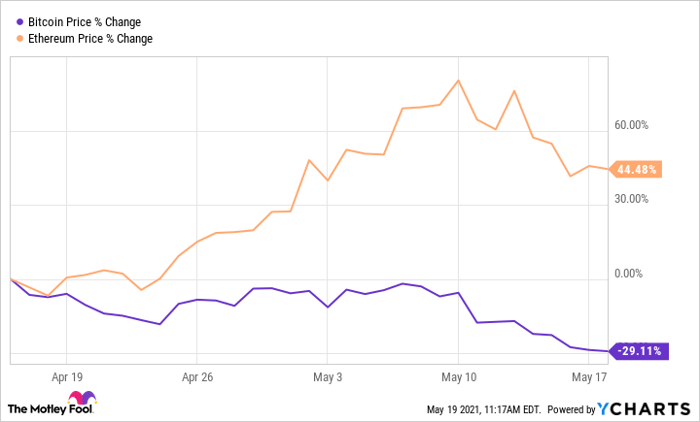
    The price of both Bitcoin and Ether have leapt over the past year, up 335% and 1,460%, respectively. Over the last month, they’ve gone in opposite directions.

    Bitcoin Price Chart

    Bitcoin Price data by YCharts

    Most are familiar with Elon Musk and Jack Dorsey’s support of Bitcoin, but some well-known figures like Gweneth Paltrow and Snoop Dogg are also longtime fans. Unfortunately, celebrity endorsements aren’t always what they seem. In 2017, the Securities Exchange Commission (SEC) ruled that many promoting cryptocurrencies may be doing so illegally, failing to disclose the fact they are being paid for it. That mostly applied to obscure coins trying to gain traction, but it does raise an important issue.

    Ethereum lacks both celebrity endorsements and the mysterious beginnings of Bitcoin. Instead, it has a relatively transparent history. Vitalik Buterin was born in Russia and raised in Toronto. In 2004, at the age of 20, he was awarded the Thiel Fellowship. Named after Peter Thiel of Paypal and Palantir Technologies fame, the award goes to young people to enable them to pursue interests other than attending college. A year later he co-founded what morphed into the Ethereum network. Earlier this month he became the world’s youngest crypto billionaire.

    Imagining the future

    Aside from the hype and speculation, there are legitimate reasons some decentralized digital currency could take hold in the future. Cryptocurrencies offer networks for transactions that could eliminate the friction of financial middlemen. In the simplest example, getting rid of brokerage fees and commissions in large transactions provides a strong incentive for an alternative payment system. 

    Further, programmable contracts would also cut out layers of complexity and uncertainty. Imagine purchasing a ticket to an outdoor event that automatically issues a refund when weather data shows the event will be cancelled. Of course, Ethereum’s vision is broader. The ultimate goal is to create a decentralized internet, running on many small computers around the globe, rather than relying on third parties like Microsoft and Alphabet‘s Google.

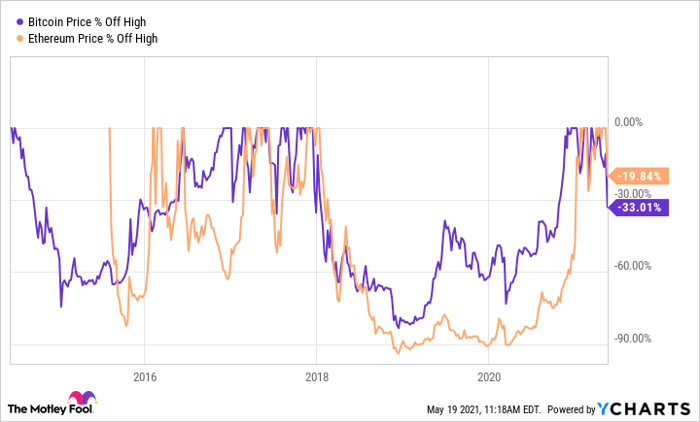
    One problem with the adoption of either asset is price volatility. Although Ether has outperformed recently, historically it has had longer and steeper drawdowns when sentiment turns on the crypto market. 

    Bitcoin Price Chart

    Bitcoin Price data by YCharts

    Although proponents often tout anonymity and security as features, the truth is more complicated. Both currencies offer pseudonymity. That means all transactions are stored on the blockchain with a crypto address of the transacting party, not a name. It’s similar to writing a book under a different name. As long as no one knows who owns the address, the transaction is in effect anonymous. However, if the owner of the address does become known, the entire financial history of that person is available to everyone on the network.

    To avoid this risk, the original Bitcoin white paper suggests using a different address for every transaction. As far as security, the Bitcoin protocol itself may be secure, but the online wallets that store keys, as well as various sites and services, may offer no such protection. There have been numerous breaches related to both Bitcoin and Ether in the past few years: See here and here.

    Choosing one

    It’s hard to choose a potential replacement for government-backed currency, but as with investing in biotech stocks or trying to cure cancer, it’s probably best to diversify across a few that seem to have potential. That said, there are three characteristics that have me leaning toward Ethereum.

    The first is the support of developers. A recent report showed that in the third quarter of 2020, an average of nearly 2,300 developers per month was working on Ethereum. That number was slightly less than 400 for Bitcoin. Second, the interest (and promotion) of celebrities makes it difficult to determine which incentives are really driving activity around the largest cryptocurrency. In other words, are people actually using Bitcoin, or are they just getting paid to talk about it? Finally, price appreciation. Although the recent drop in prices has affected all crypto assets, this is clearly a market driven by speculation. In such cases, choosing the asset with the most momentum always seems like the better bet. In this case, that’s Ethereum.

    This article was originally published on Fool.com. All figures quoted in US dollars unless otherwise stated.

    Where to invest $1,000 right now

    When investing expert Scott Phillips has a stock tip, it can pay to listen. After all, the flagship Motley Fool Share Advisor newsletter he has run for more than eight years has provided thousands of paying members with stock picks that have doubled, tripled or even more.*

    Scott just revealed what he believes are the five best ASX stocks for investors to buy right now. These stocks are trading at dirt-cheap prices and Scott thinks they are great buys right now.

    *Returns as of February 15th 2021

    More reading

    The post Ethereum vs. Bitcoin: Which is the better buy? appeared first on The Motley Fool Australia.

    This article was originally published on Fool.com. All figures quoted in US dollars unless otherwise stated.


    from The Motley Fool Australia https://ift.tt/2T9LcEj
  • The Freedom Foods (ASX:FNP) share price is frozen. Here’s why

    A man on a phone call points his finger, indicating a halt in trading on the ASX share market

    Shares in Freedom Foods Group Ltd (ASX: FNP) are in a trading halt as the company prepares to announce news of its capital raise. The battered Freedom Foods share price is paused at 43 cents, which is 2.38% higher than yesterday’s close.

    Today’s pause in trading comes months after news from Freedom Foods that is undergoing what it hopes will be a $265 million recapitalisation to pay off its debts.

    The capital raise will consist of subordinated secured convertible notes priced at $1 apiece.

    The company hopes the capital raise will include a $200 million leg up from the Perich family, the company’s largest shareholder.

    To make it up to $265 million, the company will also offer up to $130 million worth of notes to wholesale investors. Priority will be given to the company’s existing shareholders.

    Let’s take a closer look at what the food distributer has been up to lately.

    Fresh capital

    The question on many investors’ lips today is likely to be whether the Perich family will make the offered $200 million investment.

    According to the Australian Financial Review, today’s trading halt will be followed by news of whether the family’s investment vehicle, Arrovest, will fork out the entire sum.

    By purchasing $200 million worth of notes, Arrovest could hold an 80% stake in the company by 2024. That’s a significant increase from its current 51.5% stake.

    Freedom Foods is planning to use between $183 million and $233 million of the raised capital to pay off its debts. The rest will go towards corporate costs and fees from the capital raise.

    Freedom Foods returned to trading on the ASX after a 9-month suspension due to significant accounting issues in March 2021.

    On their return, Freedom Foods shares fell a whopping 84% to 53 cents each. On the day of its suspension, the Freedom Foods share price was trading at $3.01.

    While its share price was in suspension, Freedom Foods faced a number of class actions, which are still ongoing. It also entered into a dispute with one of its suppliers.

    Furthermore, the company offloaded its cereal and snacks business to The Arnott’s Group for $20 million.

    Freedom Foods share price snapshot

    Since the Freedom Foods share price resumed trading on the ASX in March, it has plummeted a further 18.87%. It’s also down 89.76% over the last 12 months – 9 months of which, it was in suspension.

    The company has a market capitalisation of around $116 million, with approximately 277 million shares outstanding.

    Where to invest $1,000 right now

    When investing expert Scott Phillips has a stock tip, it can pay to listen. After all, the flagship Motley Fool Share Advisor newsletter he has run for more than eight years has provided thousands of paying members with stock picks that have doubled, tripled or even more.*

    Scott just revealed what he believes are the five best ASX stocks for investors to buy right now. These stocks are trading at dirt-cheap prices and Scott thinks they are great buys right now.

    *Returns as of February 15th 2021

    More reading

    The post The Freedom Foods (ASX:FNP) share price is frozen. Here’s why appeared first on The Motley Fool Australia.

    from The Motley Fool Australia https://ift.tt/3yr8hCw

  • Why Appen, Kogan, Nufarm, & Red 5 shares are sinking

    Scared, wide-eyed man in pink t-shirt with hands covering mouth

    In afternoon trade, the S&P/ASX 200 Index (ASX: XJO) is on course to end the week on a subdued note. At the time of writing, the benchmark index is down slightly to 7,015.4 points.

    Four ASX shares that are falling more than most today are listed below. Here’s why they are tumbling lower:

    Appen Ltd (ASX: APX) 

    The Appen share price is down 4% to $13.29. This decline appears to have been driven by a combination of profit taking and a broker note out of Macquarie Group Ltd (ASX: MQG). The latter has seen the broker retain its neutral rating but cut its price target to $14.70. Macquarie notes that the company is facing headwinds that could make achieving its guidance difficult.

    Kogan.com Ltd (ASX: KGN)

    The Kogan share price has crashed 13% to $8.83. Investors have been selling the ecommerce company’s shares following the release of a trading update. That update reveals that inventory issues, promotional activities, and cost inflation are weighing on its performance. As result, it expects to report adjusted EBITDA of $58 million to $63 million in FY 2021. This is well short of the market’s expectations.

    Nufarm Ltd (ASX: NUF)

    The Nufarm share price has fallen 7% to $4.71. This decline appears to have been driven by a broker note out of Morgan Stanley this morning. According to the note, the broker has downgraded the agricultural chemicals company’s shares to an equal weight rating and with a $5.30 price target. It made the move on valuation grounds.

    Red 5 Limited (ASX: RED)

    The Red 5 share price has sunk 13% to 17 cents. Investors have been selling the gold miner’s shares after it downgraded its production guidance. According to the release, the company expects production from the Darlot Gold Mine to be 74,000–78,000 ounces in FY 2021. This is down from the previous estimate of 80,000­–85,000 ounces. It also increased its cost guidance to $2,240–$2,290 per ounce, up from its previous guidance of $2,150–$2,280 per ounce.

    Where to invest $1,000 right now

    When investing expert Scott Phillips has a stock tip, it can pay to listen. After all, the flagship Motley Fool Share Advisor newsletter he has run for more than eight years has provided thousands of paying members with stock picks that have doubled, tripled or even more.*

    Scott just revealed what he believes are the five best ASX stocks for investors to buy right now. These stocks are trading at dirt-cheap prices and Scott thinks they are great buys right now.

    *Returns as of February 15th 2021

    More reading

    The post Why Appen, Kogan, Nufarm, & Red 5 shares are sinking appeared first on The Motley Fool Australia.

    from The Motley Fool Australia https://ift.tt/3oxIqo0

  • Why the Cimic share price (ASX:CIM) is rising today

    The Cimic Group Ltd (ASX: CIM) share price is rising during afternoon trade. This comes after the company announced an issuance of Eurobonds.

    At the time of writing, the engineering company’s shares are up 1.24% to $21.16.

    The Cimic Group provides a range of services to the infrastructure, resources and property markets. These include construction, mining, mineral processing, engineering, concessions, and operation and maintenance services.

    The Cimic Eurobond issuance

    The Cimic share price rise came on the back of the company’s latest update.

    In a statement to the ASX this morning, Cimic advised it has issued a €500 million corporate Eurobond.

    The offer received broad interest from investors, which led to an oversubscription of more than double the orderbook.

    The fixed-rate notes, with a maturity of 8 years, were priced at a yield of 1.593%.

    CIMIC group executive chair and CEO, Juan Santamaria commented:

    “This successful transaction represents CIMIC’s debut issue in the European Debt Capital Markets and achieves a substantial extension of CIMIC’s long-term debt maturity profile.”

    The proceeds from the issuance will be put towards general working purposes, including refinancing the company’s existing bank facilities.

    Moody’s and S&P Global Ratings bond award

    Bond rating agencies are firms that evaluate the creditworthiness of both the debt securities and the issuing company. These agencies provide ratings, commentary and research on businesses. The ratings are then used by investment professionals to determine the likelihood of the debt being repaid.

    Bond ratings range from an investment grade of ‘AAA’, meaning a very strong capacity to meet financial commitments, and minimal credit risk. The speculative grade of ‘C’ or ‘D’ indicates likely payment default on financial commitments, and bankruptcy.

    Credit ratings agencies Moody’s and S&P Global Ratings (formerly Standard & Poor’s) will award the bonds with solid ratings of Baa2 and BBB, respectively. This is in the mid-range of the bond credit ratings, stating “adequate capacity to meet financial commitments, moderate credit risk”.

    About the Cimic share price

    Over the last 12 months, the Cimic shares have sunk more than 10%, with year-to-date performance around 15% lower. The company’s share price reached a 52-week high of $28.72 last June, before moving in circles.

    More recently, Cimic shares hit a 52-week low of $16.86 last month, and have slowly bounced back higher.

    Based on valuation grounds, Cimic commands a market capitalisation of roughly $6.5 billion, with approximately 311 million shares outstanding.

    Where to invest $1,000 right now

    When investing expert Scott Phillips has a stock tip, it can pay to listen. After all, the flagship Motley Fool Share Advisor newsletter he has run for more than eight years has provided thousands of paying members with stock picks that have doubled, tripled or even more.*

    Scott just revealed what he believes are the five best ASX stocks for investors to buy right now. These stocks are trading at dirt-cheap prices and Scott thinks they are great buys right now.

    *Returns as of February 15th 2021

    More reading

    The post Why the Cimic share price (ASX:CIM) is rising today appeared first on The Motley Fool Australia.

    from The Motley Fool Australia https://ift.tt/3hJ9UFB

  • Why the Afterpay (ASX:APT) share price is up 10% this week

    hand on touch screen lit up by a share price chart moving higher

    The Afterpay Ltd (ASX: APT) share price has been looking awfully bearish, setting lower highs and lower lows after its February peak.

    However, the leading ASX buy now, pay later (BNPL) company has bounced off lows with conviction, rallying up to 10% higher this week. What’s behind Afterpay’s recent sign of strength?

    Why is the Afterpay share price rallying this week?

    Broader BNPL sector bouncing back

    ASX-listed BNPL shares have largely bounced off near-term lows, with strong performances this week despite broader market volatility.

    The Zip Co Ltd (ASX: Z1P) share price hit a 5-month low of $6.48 last Thursday, and has rallied almost 20% since.

    US-based rival, Sezzle Inc (ASX: SZL) also bounced off 1-month lows of $7.00 last Friday, and is up 12%.

    BNPL shares with a smaller market capitalisation and lack of international expansion were the most hard-hit when the sector started selling off. The likes of Laybuy Group Holdings Ltd (ASX: LBY), Openpay Ltd (ASX: OPY) and Splitit Payments Ltd (ASX: SPT) have all slumped more than 50% in the last 6 to 12 months.

    The Laybuy share price has slipped lower this week, but understandably so after a $35 million capital raising at 50 cents per share, or a 26.5% discount to the closing price before the announcement. Openpay and Laybuy have both pushed higher this week.

    Over on Wall Street in the US, the Affirm Holdings Inc (NASDAQ: AFRM) share price also staged a strong rally last night, perhaps setting precedence for ASX-listed BNPL shares on Friday. Affirm bounced strongly off lows, surging 8.80% to close at US$54.89.

    Afterpay shares stand tall amid Wednesday’s selloff

    Wednesday was a sea of red for the S&P/ASX 200 Index (ASX: XJO), with a sharp fall of almost 2%.

    Typically, such a significant decline in the broader market would drag the Afterpay share price lower. However, its shares managed to withstand the selloff, closing the day almost 1% higher.

    Love coming back to tech shares

    The S&P/ASX 200 Info Tech (INDEXASX: XIJ) has taken a beating in recent weeks, down 20% between 15 April and 13 May. The large cap movers for the tech index include Afterpay, Xero Ltd (ASX: XRO) and WiseTech Global Ltd (ASX: WTC), all of which have slumped to near-term lows.

    This week, the ASX200 tech index has managed to find its footing and climbed 7.4%.

    Where to invest $1,000 right now

    When investing expert Scott Phillips has a stock tip, it can pay to listen. After all, the flagship Motley Fool Share Advisor newsletter he has run for more than eight years has provided thousands of paying members with stock picks that have doubled, tripled or even more.*

    Scott just revealed what he believes are the five best ASX stocks for investors to buy right now. These stocks are trading at dirt-cheap prices and Scott thinks they are great buys right now.

    *Returns as of February 15th 2021

    More reading

    The post Why the Afterpay (ASX:APT) share price is up 10% this week appeared first on The Motley Fool Australia.

    from The Motley Fool Australia https://ift.tt/3f66iMp

  • Should ASX investors be fearful of greed in the face of inflation?

    person with a magnifying glass with four blocks of letters spelling out risk on top of each other

    ASX investors are turning their attention from the potential risks and rewards thrown up by the pandemic to how best to play rising inflation fears.

    Fear sets in when the wider financial news narrative indicates that the resurgent inflation witnessed across much of the developed world could be entrenched. Meaning central banks may be forced to raise official interest rates from their rock bottom lows. A move many shares on the ASX almost certainly won’t like.

    Greed sets in when the narrative, widely supported by the central bankers themselves, shift to indicate that the current price rises are only transitory. Meaning inflation over the coming few years will remain subdued. Interest rates will remain at record lows. And shares on the ASX will continue to enjoy that welcome easy money tailwind.

    Inflation’s outlook for the ASX

    For a better idea of how to position your ASX investment portfolio as inflation re-emerges following a lengthy hibernation, we turn to the experts.

    According to UBS Global Wealth Management’s Chief Investment Officer Mark Haefele (quoted by Bloomberg):

    Investors should brace for further bouts of volatility, driven by inflation data along with other risks, such as setbacks in curbing the pandemic. But we don’t see inflation concerns ending the rally in stocks, which we expect to be led by cyclical parts of the market as the global economic reopening broadens.

    Inflation’s impact on the ASX was a hot topic at yesterday’s Stockbrokers and Financial Advisers Association conference as well.

    Jun Bei Liu, portfolio manager at Tribeca Investment Partners, said (quoted by the Australian Financial Review):

    It’s too early to call if inflation is structural, it seems like it’s transitory but we have to take another six months before we know if it’s long standing. In this environment, you want to be in companies that can pass on that inflation and these are the leaders of the sectors – pick them up as they get sold off because we don’t know how long this inflation will last.

    Andrew Smith, head of smaller companies at Perennial Value Management added:

    Inflation does influence the cost and price of money and naturally pushes people towards cash flows that are more near-term, so yes, it pushes people towards more value style investments. But it can be dangerous for some value stocks too. Value stocks sometimes have low margins, low pricing power and that’s where inflation will kill your earnings.

    Which shares are looking promising in 2021?

    Tribeca’s Liu has a broadly bullish outlook for the ASX this year. She points to Treasury Wine Estates Ltd (ASX: TWE) and Xero Limited (ASX: XRO) as companies that look particularly well-positioned.

    The market is looking really strong towards the end of the year so you want to buy businesses where its share price doesn’t reflect its strong business model such as Treasury Wine Estates and growth leaders such as Xero.

    Where to invest $1,000 right now

    When investing expert Scott Phillips has a stock tip, it can pay to listen. After all, the flagship Motley Fool Share Advisor newsletter he has run for more than eight years has provided thousands of paying members with stock picks that have doubled, tripled or even more.*

    Scott just revealed what he believes are the five best ASX stocks for investors to buy right now. These stocks are trading at dirt-cheap prices and Scott thinks they are great buys right now.

    *Returns as of February 15th 2021

    More reading

    The post Should ASX investors be fearful of greed in the face of inflation? appeared first on The Motley Fool Australia.

    from The Motley Fool Australia https://ift.tt/3f6nPnx

  • Here’s why the Appen (ASX:APX) share price is sinking 6% today

    asx share price fall represented by woman shrugging

    The tech sector may be performing positively today, but the same cannot be said for the Appen Ltd (ASX: APX) share price.

    In afternoon trade, the artificial intelligence (AI) data annotation products and solutions provider’s shares are down 6% to $13.02.

    Despite this decline, the Appen share price is still up 19% since the end of last week.

    Why is the Appen share price sinking today?

    There appear to be a couple of catalysts for the weakness in the Appen share price today.

    The first is profit taking. Prior to today, the Appen share price was up a massive 26% week to date. This strong gain was driven by improving sentiment in the tech sector and the release of a restructure and trading update.

    The restructure will see Appen align its business with its product-led growth strategy and distinct customer propositions. This will mean four customer-facing business units – Global, Enterprise, China, and Government. Management believes the changes will provide greater visibility of the drivers and performance of the business.

    Whereas the latter revealed that Appen is on course to achieve its FY 2021 guidance. Appen is forecasting underlying earnings before interest, tax, depreciation and amortisation (EBITDA) of US$83 million to US$90 million in FY 2021. This represents growth of 18% to 28% year on year.

    What else is weighing on its shares?

    In addition to profit taking, a broker note out of the Macquarie Group Ltd (ASX: MQG) equities desk appears to have taken the wind out the sails of the Appen share price.

    According to the note, the broker has retained its neutral rating but trimmed its price target down to $14.70.

    Macquarie believes that Appen is still facing a battle to achieve its reiterated guidance for FY 2021. It also fears the market may be a little too optimistic at this point.

    In light of this, the broker isn’t in a rush to change its rating just yet and appears to believe investors should keep their powder dry for the time being.

    Where to invest $1,000 right now

    When investing expert Scott Phillips has a stock tip, it can pay to listen. After all, the flagship Motley Fool Share Advisor newsletter he has run for more than eight years has provided thousands of paying members with stock picks that have doubled, tripled or even more.*

    Scott just revealed what he believes are the five best ASX stocks for investors to buy right now. These stocks are trading at dirt-cheap prices and Scott thinks they are great buys right now.

    *Returns as of February 15th 2021

    More reading

    The post Here’s why the Appen (ASX:APX) share price is sinking 6% today appeared first on The Motley Fool Australia.

    from The Motley Fool Australia https://ift.tt/3oBzYnI

  • The ANZ (ASX:ANZ) share price leads the ASX 200 banks this week

    outperforming asx share price represented by row of white eggs with cartoon sad faces with one gold egg with happy face and crown

    Shares in the Australia and New Zealand Banking Group Ltd (ASX: ANZ) have outperformed all other S&P/ASX 200 Index (ASX: XJO) banks this week. At the time of writing, the ANZ share price has gained 2% since last Friday’s close and is trading at $27.97.

    In comparison, the ASX 200 has gained 0.25% in the same time frame.

    The other big ASX 200 banks are on ANZ’s tail today. Shares in Commonwealth Bank of Australia (ASX: CBA) are closing in with a gain of 1.69% across the course of the week.  While National Australia Bank Ltd (ASX: NAB) and Westpac Banking Corp (ASX: WBC) shares are up 0.74% and 1.06% respectively.

    Other ASX 200 banks posting share price gains this week include Bendigo and Adelaide Bank Ltd (ASX: BEN). It’s up 0.59%. While shares in the Bank of Queensland Ltd (ASX: BOQ) have fallen 0.91%.

    Let’s take a look at the ANZ share price performance lately.

    Leader of the pack

    This week has been volatile for the ASX 200, and the ANZ share price wasn’t immune to the madness. But, despite the volatility, the ANZ share price recorded a strong gain, helped by a few key pieces of good news.

    The Motley Fool Australia reported on Monday that Macquarie Group Ltd (ASX: MQG) analysts have pegged ANZ as potentially the better big bank to buy shares in.

    According to Macquarie, ANZ was the only bank that didn’t experience a revenue (excluding markets income) decline in its half-year results.

    Its analysts stated the bank has continued to be better value compared to others and opted to maintain its $30.50 target price.

    Also making news throughout the week was the expectation that ASX bank’s dividends may soon return to pre-COVID-19 normal.

    On Wednesday, The Motley Fool Australia reported that co-portfolio manager of the Investors Mutual Australian Share Fund Daniel Moore believes 2021 will be a great year for banking dividends. Moore was quoted by the Australian Financial Review (AFR) as saying:

    We now have a strong platform going forward for economic activity and company earnings. All this indicates that the outlook for dividends in 2021 and beyond is strong, and payout ratios are likely to improve.

    ANZ share price snapshot

    The ANZ share price having more than a great week on the ASX.

    Currently, the ANZ share price is 21.05% higher than it was at the start of 2021. It’s also gained 81.22% since this time last year.

    The bank has a price-to-earnings (P/E) ratio of 16.50. Its market capitalisation is around $79 billion, with approximately 2.8 billion shares outstanding.

    Where to invest $1,000 right now

    When investing expert Scott Phillips has a stock tip, it can pay to listen. After all, the flagship Motley Fool Share Advisor newsletter he has run for more than eight years has provided thousands of paying members with stock picks that have doubled, tripled or even more.*

    Scott just revealed what he believes are the five best ASX stocks for investors to buy right now. These stocks are trading at dirt-cheap prices and Scott thinks they are great buys right now.

    *Returns as of February 15th 2021

    More reading

    The post The ANZ (ASX:ANZ) share price leads the ASX 200 banks this week appeared first on The Motley Fool Australia.

    from The Motley Fool Australia https://ift.tt/3bIvKW7

  • Kogan (ASX:KGN) share price sinks 12% on profit downgrade

    watching asx share price represented by surprised investor reading newspaper

    The Kogan.com Ltd (ASX: KGN) share price is plummeting today after the company provided a subdued business update for FY21.

    During early afternoon trade, the e-commerce company’s shares are fetching $8.98, down a sizeable 11.53%.

    What is happening with the Kogan share price?

    Investors are driving Kogan shares well into the red today after digesting the company’s latest trading update.

    According to this morning’s release, Kogan is reporting a number of issues that has led it to cut its guidance for the current financial year.

    The business advised that, despite doubling in growth over the first half of FY21, operational challenges have been encountered. These relate to excess inventory holdings which have had a profound impact on storage costs. In addition, the company has experienced supply chain and logistical issues, setting back its FY21 financial targets.

    Kogan stated that, in responding to the rapid increase in customer demand, it expanded its logistics capability to 31 facilities over the last 5 months. However, this has imposed higher warehouse costs for unused stock left sitting on the floor. To manage this, the company has discounted products and increased promotional marketing spend. Consequently, this has weakened Kogan’s near-term gross margin.

    Furthermore, price inflation on many consumer products is being noticed as the company orders ahead for the busy Christmas period later this year. Kogan stated that the cause is due to ‘COVID-19 market dislocations’ along with rising international shipping costs.

    The company also highlighted that demurrage fees incurred in April have now been resolved. This imposed a significant cost to the business since the start of the calendar year.

    As a result, Kogan has dropped its earnings guidance for FY21, which sent investors heading for the hills. Kogan said its underlying operating performance is continuing to face short-term challenges.

    FY21 adjusted earnings before interest, tax, depreciation and amortisation (EBITDA) is projected to come in the range of $58 million to $63 million. This is a substantial fall from the previous $67 million to $72 million in EBITDA previously indicated. In percentage terms, this equates to a fall of 11% to 18% on market expectations.

    However, Kogan did highlight it expects current inventory levels to reduce progressively over the coming few months.

    On another positive note, the company said that its future prospects remain upbeat. Kogan highlighted that its position in the Australian and New Zealand online retail markets is strong. Currently, its online sales division only accounts for a small percentage of the total retail sales market in both countries. This potentially provides the company with an attractive opportunity to pursue and expand its digital footprint.

    More about Kogan

    Kogan operates a portfolio of retail and services businesses that includes Kogan Retail, Kogan Marketplace, Kogan Mobile, Kogan Broadband, Kogan Insurance and Kogan Travel. The parent company is a leading Australian consumer brand renowned for price competitiveness through its digital offering.

    According to Kogan, the company is focused on making in-demand products and services more affordable and accessible to everyday consumers.

    Over the past 12 months, Kogan shares have had an interesting run, moving initially higher before heading downward. In this timeframe, the company’s shares have recorded a loss of around 5% and a year-to-date decline of around 53%. Kogan shares hit a 52-week high of more than $25 in October last year.

    Based on valuation metrics, Kogan has a market capitalisation of around $1 billion, with roughly 106 million shares outstanding.

    Where to invest $1,000 right now

    When investing expert Scott Phillips has a stock tip, it can pay to listen. After all, the flagship Motley Fool Share Advisor newsletter he has run for more than eight years has provided thousands of paying members with stock picks that have doubled, tripled or even more.*

    Scott just revealed what he believes are the five best ASX stocks for investors to buy right now. These stocks are trading at dirt-cheap prices and Scott thinks they are great buys right now.

    *Returns as of February 15th 2021

    More reading

    The post Kogan (ASX:KGN) share price sinks 12% on profit downgrade appeared first on The Motley Fool Australia.

    from The Motley Fool Australia https://ift.tt/3hPcoCm