• 2 blue chip ASX dividend shares to buy today

    man handing over wad of cash representing microsoft dividend

    ASX dividend shares have rarely been of more importance to investors. With interest rates at virtually zero, there are few other asset classes that will deliver a real, inflation-beating yield. Term deposits, you might ask? Good luck finding one that’s offering anything close to 1% per annum today. Something like 0.6% is more likely. 

    With that in mind, here are 2 ASX dividend shares that today offer yields far higher than those paltry rates of return.

    Woolworths Group Ltd (ASX: WOW)

    Woolworths probably needs little introduction as the largest supermarket chain in the country. The company also owns a vast network of national bottle shops as well, including the popular BWS and Dan Murphy’s chains. It also owns the oft-overlooked Big W discount chain.

    Woolies shares have been drifting sideways for months now, and are trading at $39.56 at the time of writing. That’s still nearly 10% off of the all-time highs the company was asking in February though.

    Unlike many ASX blue chips, Woolworths has kept the dividends flowing in 2020. The company paid out an interim dividend of 46 cents per share back in April, and a final dividend of 48 cents per share in October.

    At the current share price, that gives Woolies shares a trailing dividend yield of 2.38%, or 3.4% grossed-up with full franking credits.

    Telstra Corporation Ltd (ASX: TLS)

    Telstra is another ASX blue chip that has managed to keep the dividend taps open in 2020. This company is the ASX’s largest telco, with a formidable market position in both fixed-line and mobile telecommunications services. Yes, Telstra has been struggling through the impact of the nbn rollout over the past few years. This has seen its share price crater from almost $6 back in 2016 to the current price of $3.04.

    Saying that, Telstra has recently all-but-committed to keeping its current annual dividend at 16 cents a share going into 2021. That 16 cents per share consisted of 10 cents in ordinary dividends, as well as 6 cents in special dividend payments that are funded through nbn payments. Telstra has said it will aim for this payout going forward, even if it means temporarily exceeding Telstra’s payout ratio target of 75% of earnings.

    On current pricing, that would give Telstra a trailing (and forward) dividend yield of 5.26%, or a whopping 7.51% when grossed-up with Telstra’s full franking credits.

    These Dividend Stocks Could Be Your Next Cash Kings (FREE REPORT)

    Motley Fool Australia’s Dividend experts recently released a brand-new FREE report revealing 3 dividend stocks with JUICY franked dividends that could keep paying you meaty dividends for years to come.

    Our team of investors think these 3 dividend stocks should be a ‘must consider’ for any savvy dividend investor. But more importantly, could potentially make Australian investors a heap of passive income.

    Don’t miss out! Simply click the link below to grab your free copy and discover these 3 high conviction stocks now.

    Returns As of 6th October 2020

    More reading

    Motley Fool contributor Sebastian Bowen owns shares of Telstra Limited. The Motley Fool Australia owns shares of and has recommended Telstra Limited. The Motley Fool Australia owns shares of Woolworths Limited. The Motley Fool has a disclosure policy. This article contains general investment advice only (under AFSL 400691). Authorised by Bruce Jackson.

    The post 2 blue chip ASX dividend shares to buy today appeared first on The Motley Fool Australia.

    from The Motley Fool Australia https://ift.tt/3r0vjfH

  • Are ASX energy shares the best pandemic recovery play in 2021?

    a man raise his arms to the sun as it rises with the year 2021 in the background, indicating a bright future on the ASX share market

    We’re not out of the global pandemic woods just yet.

    But with Moderna Inc‘s (NASDAQ: MRNA) vaccine given the green light by United States’ regulators, it could gain emergency authorisation clearance within days.

    That will see Moderna’s vaccine join the jab developed by Pfizer Inc. (NYSE: PFE) and BioNTech SE (NASDAQ: BNTX). And it will give the world 2 highly effective vaccines in the last month of the same year that spawned the coronavirus outbreak.

    Of course, it will still be many months before those vaccines, and others, are delivered to the billions of people waiting to be immunised. The Australian government is now forecasting its vaccine rollout will commence in February.

    But with the light at the end of the COVID tunnel growing steadily brighter, investors are increasingly looking ahead to which shares are likely to see the biggest gains as the world reopens.

    “The cheapest of all reflation assets”

    According to Amrita Sen, co-founder of London-based consultant Energy Aspects Ltd (as quoted by Bloomberg): “Oil is the cheapest of all reflation assets. With vaccines slowly rolling out, we expect investors to start returning to the oil sector and for prices to continue firming.”

    Indeed, optimism on the eventual lifting of global travel restrictions has seen Brent crude oil hit US$50.75 (AU$67.20) per barrel at time of writing. That’s the highest price for the international crude benchmark since 4 March. And it’s up 163% from the 21 March low of US$19.33 per barrel.

    Here’s more, from Bloomberg:

    The enormous glut of fuel that accumulated this year on everything from tiny barges to giant supertankers is being steadily depleted…  In a world that’s expecting to see travel recover sharply next year, crude has become a hot Covid-vaccine trade.

    Not that oil and gas demand is ramping up everywhere in the world just yet.

    With new infections surging, a number of European nations introduced strict lockdown measures this week, set to last through mid to end of January. And travel restrictions in some US states are also forecast to impact short-term petrol demand.

    Meanwhile, petrol consumption has returned to or even exceeded late 2019 levels in Japan and China. China consumes the world’s second largest amount of oil (behind the US), while Japan is the fourth largest consumer. And in the world’s second most populous nation, India, its largest refiner reported that its back to processing at full capacity.

    Brace for setbacks

    With the positive mid to longer-term outlook outlined above, investors in energy shares should be prepared for a bumpy ride. Particularly in the first half of 2020.

    Bart Melek, the head of global commodity strategy at TD Securities, cautions about the impact of the ‘second wave’ (quoted by Bloomberg):

    Oil’s reacting to pretty significant increases in risk appetite. But with the second wave probably continuing to damage demand growth and inventories likely staying at somewhat elevated levels, the market is having second thoughts about going materially higher.

    Stewart Glickman, energy equity analyst at CFRA Research points out that oil demand won’t rocket overnight:

    People are forgetting that there’s a couple of triggers that have to happen before oil demand really comes back. The first half of the year we’re going to see some resurgence of weakness in oil demand, because it’s going to take time before everybody feels comfortable enough for things to start reopening fully.

    Victor Shum, vice president of energy consulting at IHS Markit Ltd. in Singapore adds, “Right now, oil has priced in that promising future. While we have to deal with the immediate dark COVID winter.”

    Despite the spectre that a dark COVID winter is coming, long-term investors appear to be looking beyond that gloom to a time when vehicles, planes and boats will again move freely across state and international borders. As witnessed by the data from JPMorgan Chase & Co, indicating that energy contract holdings soared by US$3.6 billion through early December.

    Aussie gas piggybacks on rising crude prices

    And it’s not just crude oil prices rebounding to early March levels.

    As the Australian Financial Review reports:

    Prices for LNG – Australia’s second most valuable export – also rose at the end of last week, with demand due to the northern hemisphere winter pushing prices in Asia to their highest level in more than two years, according to Refinitiv.

    Citing trade sources, the average LNG price for January delivery into north-east Asia was estimated about $US11.10 per million British thermal units, Refinitiv said, up $US3 on the prior week, or 37 per cent.

    Two ASX energy shares closely tied to the price of oil and gas

    The ASX has no shortage of oil and gas shares.

    You’ll find the largest listed on the S&P/ASX 200 Index (ASX: XJO).

    With a market cap of near $22 billion, Woodside Petroleum Limited (ASX: WPL) is Australia’s largest oil and gas producer. It also pays an annualised dividend yield of 5.1%, fully franked.

    As you’d expect, Woodside’s share price took a beating when crude prices crashed. Shares tumbled more than 57% from late January through to mid-March. Since the first trading day of November, however, shares have leapt 31% higher. Year-to-date, Woodside’s share price remains down 33%.

    Then there’s Santos Ltd (ASX: STO). One of the leading independent oil and gas producers in the Asia-Pacific region, Santos has a market cap of roughly $13.3 billion and pays an annualised dividend yield of 1.6%, fully franked.

    Santos’ CEO Kevin Gallagher, for one, has no doubt that the demand for fossil fuels isn’t going away anytime soon, saying, “Electrification will grow, it may grow to 35 per cent but it ain’t going to go to 50 or 70 or 80 per cent. The world is going to need fuels for a very, very long time.”

    Despite a 132% surge since 19 March, the Santos share price remains down 22% year-to-date.

    Where to invest $1,000 right now

    When investing expert Scott Phillips has a stock tip, it can pay to listen. After all, the flagship Motley Fool Share Advisor newsletter he has run for more than eight years has provided thousands of paying members with stock picks that have doubled, tripled or even more.*

    Scott just revealed what he believes are the five best ASX stocks for investors to buy right now. These stocks are trading at dirt-cheap prices and Scott thinks they are great buys right now.

    *Returns as of June 30th

    More reading

    Motley Fool contributor Bernd Struben has no position in any of the stocks mentioned. The Motley Fool Australia has no position in any of the stocks mentioned. The Motley Fool has a disclosure policy. This article contains general investment advice only (under AFSL 400691). Authorised by Bruce Jackson.

    The post Are ASX energy shares the best pandemic recovery play in 2021? appeared first on The Motley Fool Australia.

    from The Motley Fool Australia https://ift.tt/2ISj8Au

  • ASX 200 rises 0.7% on Wednesday

    ASX 200

    The S&P/ASX 200 Index (ASX: XJO) went up by approximately 0.7% to 6679 points.

    Here are some of the highlights from the ASX today:

    Aussie Home Loans to merge with Lendi

    Commonwealth Bank of Australia (ASX: CBA) announced today it has agreed to merge mortgage broker Aussie Home Loans with Lendi, an online home loan portfolio.

    CBA said that the complementary capabilities of Aussie and Lendi are expected to support the growth of the existing businesses and to deliver a range of additional benefits over time for customers and brokers, including enhanced digital capabilities and improved operational efficiencies.

    Upon the deal’s completion, CBA will hold a 45% shareholding in the combined business, with existing Lendi shareholders holding the remaining 55% shareholding. CBA will also receive deferred consideration and a pre-completion dividend of $105 million in aggregate, subject to adjustments. CBA said the transaction is not expected to have a material financial impact on CBA’s capital position.

    Matt Comyn, the CEO of CBA said: “We believe that the combined business will have a stronger platform to offer enhanced digital capabilities for Aussie brokers and a superior experience.”

    David Hyman, the co-founder and CEO of Lendi said: “The role of digital technology in strengthening customer outcomes, compliance and operational agility is only growing in importance and by coming together with a robust and trusted business like Aussie, we will be able to drive even stronger outcomes for more homeowners and brokers alike.”

    This transaction is subject to ACCC approval and other conditions. It’s expected to occur by the middle of the 2021 calendar year.

    The CBA share price rose 0.9% today.

    Service Stream Limited (ASX: SSM)

    The network services business announced that it has secured a long-term agreement with NBN Co to provide service activations, operations and maintenance services to the multi-technology NBN.

    Under the new unified field operations agreement (Unity Services), Service Stream will be providing services across fibre to the node (FTTN), fibre to the premise (FTTP), fibre to the basement (FTTB), fibre to the curb (FTTC) and hybrid fibre coax (HFC).

    The agreement is for an initial period of four years, and two two-year extension options, each at the NBN’s election. The agreement replaces the existing operations and maintenance master agreement (OMMA) that has been held by Service Stream since it started in 2015.

    Unify Services is expected to generate approximately $70 million of revenue for Service Stream in the first year, with subsequent years dependent on annual work volumes.

    Service Stream Managing Director Leigh Mackender said: “As a leading provider of operations and maintenance across services to the telecommunications industry, we are pleased to secure another long-term maintenance agreement with NBN and to continue providing vital support to its customers.

    “Following the recent signing of the Unify Networks agreement in August across a similar term, Service Stream will effectively be providing nbn with operations and maintenance support across all mainland and territories under either the Unify Networks or Service agreements. We look forward to continuing to support NBN’s maintenance programs for many years to come.”

    The Service Stream share price fell 12% today. 

    APA Group (ASX: APA)

    Energy infrastructure business APA announced today that it was going to increase its FY21 interim distribution by 4.3% to 24 cents per security for the six months ending 31 December 2020.

    The APA distribution will be fully covered by operating cash flows. The components of the interim distribution including its tax deferred status and allocated franking credits will be confirmed after the finalisation of its half year results on 23 February 2021.

    The APA share price went up 1.2% today.

    Where to invest $1,000 right now

    When investing expert Scott Phillips has a stock tip, it can pay to listen. After all, the flagship Motley Fool Share Advisor newsletter he has run for more than eight years has provided thousands of paying members with stock picks that have doubled, tripled or even more.*

    Scott just revealed what he believes are the five best ASX stocks for investors to buy right now. These stocks are trading at dirt-cheap prices and Scott thinks they are great buys right now.

    *Returns as of June 30th

    More reading

    Tristan Harrison owns has no position in any of the stocks mentioned. The Motley Fool Australia owns shares of APA Group. The Motley Fool Australia has recommended Service Stream Limited. The Motley Fool has a disclosure policy. This article contains general investment advice only (under AFSL 400691). Authorised by Bruce Jackson.

    The post ASX 200 rises 0.7% on Wednesday appeared first on The Motley Fool Australia.

    from The Motley Fool Australia https://ift.tt/3r3WoP6

  • Costco’s big earnings beat points to further upside

    This article was originally published on Fool.com. All figures quoted in US dollars unless otherwise stated.

    Costco entrance

    This article was originally published on Fool.com. All figures quoted in US dollars unless otherwise stated.

    Costco Wholesale (NASDAQ: COST) has been one of the biggest retail winners during the COVID-19 pandemic. Its growth accelerated last quarter, as comparable sales skyrocketed 17.1%, excluding the impacts of currency fluctuations and gasoline price deflation.

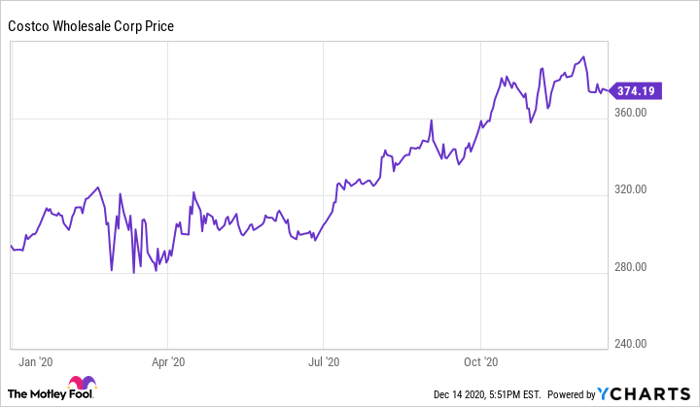
    For a second consecutive quarter, this double-digit sales growth drove a huge jump in Costco’s earnings. The company’s accelerating earnings growth suggests that Costco stock still has plenty of upside for long-term investors, despite carrying a lofty valuation after a 27% rally year to date.

    COST Chart

    Costco Wholesale year-to-date stock performance, data by YCharts.

    Margin expansion continues

    In the fourth quarter of fiscal 2020 — the period ending in late August — Costco posted adjusted comp sales growth of 14.1%. The uptick in sales allowed the company to leverage its normal operating expenses, while higher sales of fresh foods led to higher labor productivity and reduced spoilage. This drove substantial margin expansion, notwithstanding $281 million of incremental wage and cleaning costs related to the pandemic. Operating income jumped 31.9% on a 12.4% increase in total revenue.

    Costco’s results followed a similar trajectory last quarter. Total revenue increased 16.7% to $43.2 billion. Gross margin improved by approximately 0.5 percentage points, driven primarily by the same tailwinds of higher labor productivity and lower spoilage for fresh foods. Selling, general, and administrative expenses also declined modestly as a percentage of sales.

    As a result, operating income surged 34.8% year over year to $1.43 billion, even though Costco incurred another $212 million of pandemic-related premium pay. Adjusted earnings per share reached $2.30, excluding various one-time tax benefits: up from $1.73 a year earlier. On average, analysts had expected adjusted EPS of $2.05.

    Are Costco’s gains sustainable?

    Management has acknowledged that some of Costco’s 2020 sales gains may prove temporary. With many restaurants offering limited service (or closed altogether), people are cooking more at home. That’s boosting food-related sales at Costco. Meanwhile, high-income shoppers make up a substantial proportion of Costco’s customer base. Many of these people have dramatically increased their spending on home-related items, using money they might have otherwise spent on vacations. Lastly, Costco is benefiting from its status as a one-stop shop where people can buy a wide variety of essentials and discretionary items in a single trip.

    That said, Costco has cultivated extremely high customer loyalty. Membership renewal rates routinely exceed 90% in the U.S. and Canada (Costco’s mature markets). The uptick in sales during the pandemic also appears to be encouraging more customers to upgrade to Costco’s executive membership, which costs twice as much but offers 2% cash back on most purchases.

    Thus, the retail giant has a good chance to retain many of the new members who have signed up this year, while the 2% cash reward will encourage newly minted executive members to shift more spending to Costco over time. Looking ahead, Costco will also benefit from an eventual revival in its hard-hit ancillary businesses, including its food courts, gas stations, and travel business. The March acquisition of logistics company Innovel Solutions should also help Costco increase its sales of big-ticket items in the years ahead.

    A terrific business worth its premium valuation

    Despite the strong Q1 results, Costco stock has barely budged since the earnings report. It now trades for a little more than 37 times Costco’s projected fiscal 2021 earnings. That’s certainly pricey: The S&P 500 as a whole is valued at 26 times forward earnings.

    However, the 2021 analyst consensus implies EPS growth of just 11% for the rest of fiscal 2021. That seems extremely conservative in light of Costco’s recent earnings trend. Furthermore, Costco’s industry-leading prices should help it continue to gain market share for many years, driving strong sales growth. And with a pre-tax margin of just 1.2% excluding membership fee income last year, even modest margin improvements over time could turbocharge Costco’s earnings growth.

    Costco stock may not be a bargain anymore. But considering the company’s massive long-term growth opportunities, it still holds plenty of potential for patient investors.

    This article was originally published on Fool.com. All figures quoted in US dollars unless otherwise stated.

    Where to invest $1,000 right now

    When investing expert Scott Phillips has a stock tip, it can pay to listen. After all, the flagship Motley Fool Share Advisor newsletter he has run for more than eight years has provided thousands of paying members with stock picks that have doubled, tripled or even more.*

    Scott just revealed what he believes are the five best ASX stocks for investors to buy right now. These stocks are trading at dirt-cheap prices and Scott thinks they are great buys right now.

    *Returns as of June 30th

    More reading

    Adam Levine-Weinberg has no position in any of the stocks mentioned. The Motley Fool Australia’s parent company Motley Fool Holdings Inc. owns shares of and recommends Costco Wholesale. The Motley Fool Australia has no position in any of the stocks mentioned. The Motley Fool has a disclosure policy. This article contains general investment advice only (under AFSL 400691). Authorised by Bruce Jackson.

    The post Costco’s big earnings beat points to further upside appeared first on The Motley Fool Australia.

    This article was originally published on Fool.com. All figures quoted in US dollars unless otherwise stated.

    from The Motley Fool Australia https://ift.tt/34gPsog

  • Why the BSA (ASX:BSA) share price has surged 7% higher today

    The BSA Limited (ASX: BSA) share price is climbing higher today on news of a new significant contract with NBN Co.

    At the time of writing, the BSA share price is trading up 6.9% at an intraday high of 31 cents. In comparison, the All Ordinaries Index (ASX: XAO) is up 0.8% to 6,922 points.

    New multi-year contract

    In today’s release, BSA advised it has secured a major contract with nbn to provide activation and assurances services.

    The unified field operations agreement will see BSA work on fibre to the premise (FTTP), fibre to the node (FTTN), fibre to the basement (FTTB), fibre to the curb (FTTC), and hybrid fibre coax (HFC) network infrastructure.

    Scheduled to begin in early March 2021, the new deal will see BSA increase its base market share. Revenue generated in the first year of the contract is estimated to be in the range of $85 million. However, the company noted that further opportunities could arise in the future, allowing it to increase its earnings.

    The initial term of the deal will be for a 4-year period. This can be extended on nbn’s behalf for an additional two 2-year options.

    Furthermore, under nbn’s regional allocation model, BSA will be able to operate in regional areas across New South Wales and Victoria. Additional regions will be assigned at nbn’s discretion.

    What did management say?

    Commenting on the deal, BSA managing director Tim Harris said:

    We are extremely proud to have secured this contract and continue our long-standing collaborative partnership with nbn. This contract positions BSA ideally to be able to assist nbn deliver on their strategic goals moving forward, utilising our exceptional track record of service delivery and customer experience.

    How has the BSA share price performed?

    This has been a turbulent year for the BSA share price, reflecting ups and downs throughout the year. The company’s shares reached a 52-week high of 41 cents in February before falling to a low of 23 cents in March.

    Where to invest $1,000 right now

    When investing expert Scott Phillips has a stock tip, it can pay to listen. After all, the flagship Motley Fool Share Advisor newsletter he has run for more than eight years has provided thousands of paying members with stock picks that have doubled, tripled or even more.*

    Scott just revealed what he believes are the five best ASX stocks for investors to buy right now. These stocks are trading at dirt-cheap prices and Scott thinks they are great buys right now.

    *Returns as of June 30th

    More reading

    Motley Fool contributor Aaron Teboneras has no position in any of the stocks mentioned. The Motley Fool Australia has no position in any of the stocks mentioned. The Motley Fool has a disclosure policy. This article contains general investment advice only (under AFSL 400691). Authorised by Bruce Jackson.

    The post Why the BSA (ASX:BSA) share price has surged 7% higher today appeared first on The Motley Fool Australia.

    from The Motley Fool Australia https://ift.tt/3gOA5IK

  • Ex-ASX company exec jailed for blocking ACCC investigation

    Judges gavel and handcuffs

    Former general manager at BlueScope Steel Limited (ASX: BSL) Jason Ellis has been sentenced to 8 months’ prison.

    Ellis had pleaded guilty earlier this year to inciting colleagues to give false evidence to an Australian Competition and Consumer Commission (ACCC) investigation.

    The competition authority was probing whether BlueScope and Ellis had been involved in cartel behaviour between 2013 and 2014, which has resulted in a separate Federal Court case.

    Ellis, as BlueScope’s general manager of sales and marketing, had instructed 2 staff members to give false evidence to ACCC officials.

    The false testimony involved conversations he and the colleagues had with other steel companies about fixing prices.

    On the obstruction conviction, Magistrate Jennifer Atkinson this week said “a person needs to allow investigations to run properly, without any attempt to hinder”.

    Conviction makes history

    According to ACCC chair Rod Sims, Ellis was the first person to be charged and convicted of “inciting the obstruction of an ACCC investigation”.

    “The conviction and sentence reflect the seriousness of this conduct and should send a strong message to anyone contemplating obstructing or inciting someone else to obstruct ACCC officers,” he said.

    “We take any attempts to prevent the ACCC from obtaining full and truthful accounts of conduct under investigation extremely seriously and won’t hesitate to prosecute any similar cases in the future.”

    After handing down the jail sentence, Atkinson released Ellis upon entering into a recognizance conditional on 2 years of good behaviour. She also ordered Ellis to pay a penalty of $10,000.

    The conviction was liable to a maximum sentence of 2 years’ jail. A guilty plea in the local court, which Ellis took, carries a maximum of 1 year imprisonment.

    The Motley Fool contacted BlueScope for comment but had not heard back at the time of writing.

    Sims said Ellis’ efforts to stop the investigation didn’t deter his team.

    “Not only did we continue our investigation and take legal action against BlueScope and Mr Ellis for alleged cartel behaviour… we also referred the obstruction conduct to the [Commonwealth Director of Public Prosecutions] to consider prosecuting Mr Ellis.”

    BlueScope’s share price was up 2.55%, trading at $17.28 at 3.15pm AEDT. It has been on a spectacular rally recently, rising 26% since the start of October.

    These 5 Cheap Shares Could Be Set For Huge Gains (FREE REPORT)

    We hear it over and over from investors, “I wish I had bought Altium or Afterpay when they were first recommended by The Motley Fool. I’d be sitting on a gold mine!” And it’s true.

    And while Altium and Afterpay have had a good run, we think these 5 other stocks are screaming buys. And you can find out the names of these stocks in the FREE stock report.

    *Extreme Opportunities returns as of November 14th 2020

    More reading

    Motley Fool contributor Tony Yoo has no position in any of the stocks mentioned. 

    The post Ex-ASX company exec jailed for blocking ACCC investigation appeared first on The Motley Fool Australia.

    from The Motley Fool Australia https://ift.tt/34hCTsV

  • Why the NAB (ASX:NAB) share price climbed higher today

    NAB bank share price

    The National Australia Bank Ltd (ASX: NAB) share price was a positive performer on Wednesday.

    The banking giant’s shares rose 1% to end the day at $23.61.

    Why did the NAB share price push higher?

    The big four banks were all on form on Wednesday and helped drive the S&P/ASX 200 Index (ASX: XJO) higher.

    This appears to have been down to improving investor sentiment following news that another COVID-19 vaccine was likely to be given emergency use approval in the United States this week.

    In addition to this, an announcement out of NAB appears to have also given its shares a boost this afternoon.

    What did NAB announce?

    NAB has announced that it has entered into an agreement to sell its New Zealand life insurance business, BNZ Life, to leading New Zealand life insurance provider Partners Life.

    According to the release, the two companies have agreed a fee of NZ$290 million for the business.

    Management notes that the asset sale is consistent with its strategy to focus on its core banking businesses across Australia and New Zealand.

    BNZ’s CEO, Angela Mentis, commented: “Ensuring BNZ customers continue to access insurance remains important to us. We’re confident that this sale will provide the best outcome for our insurance customers and that they will continue to receive a high standard of customer service from a New Zealand insurance provider with a strong local reputation.”

    What now?

    NAB has advised that it expects the sale to complete in late 2021. Though, it remains subject to regulatory and other approvals.

    Upon completion, the sale of BNZ Life is expected to result in an increase in NAB’s Common Equity Tier 1 (CET1) ratio by 6 basis points. This is based on the bank’s risk weighted assets as of 30 September 2020.

    As part of the sale, BNZ will also enter into an exclusive 10-year agreement for the referral of BNZ’s customers with life insurance needs to Partners Life. This remains subject to Partners Life continuing to meet agreed operating standards.

    This Tiny ASX Stock Could Be the Next Afterpay

    One little-known Australian IPO has doubled in value since January, and renowned Australian Moonshot stock picker Anirban Mahanti sees a potential millionaire-maker in waiting…

    Because ‘Doc’ Mahanti believes this fast-growing company has all the hallmarks of genuine Moonshot potential, forget ‘buy now pay later’, this stock could be the next hot stock on the ASX.

    Doc and his team have published a detailed report on this tiny ASX stock. Find out how you can access what could be the NEXT Afterpay today!

    Returns as of 6th October 2020

    More reading

    Motley Fool contributor James Mickleboro has no position in any of the stocks mentioned. The Motley Fool Australia has no position in any of the stocks mentioned. The Motley Fool has a disclosure policy. This article contains general investment advice only (under AFSL 400691). Authorised by Bruce Jackson.

    The post Why the NAB (ASX:NAB) share price climbed higher today appeared first on The Motley Fool Australia.

    from The Motley Fool Australia https://ift.tt/389uGrz

  • Here’s why this fundie thinks Lovisa (ASX:LOV) share price will rise

    A young woman wearing a silver bracelet raises her sunglasses in amazement, indicating positive share price movement in jewellery shares

    Australian fashion jewellery company Lovisa Holdings Ltd (ASX: LOV) could be the next H&M or Zara, according to L1 Capital co-founder and chief investment officer, Mark Landau.

    The fund manager believes Lovisa’s recent acquisition of Beeline in Europe will generate a strong return on investment for the company over the next 1 to 2 years. 

    The Lovisa share price is currently trading 4.73% higher at $11.29, amid a broader rise in retail shares on the ASX today.

    One of the “most exciting” Australian retail shares

    Describing Lovisa as “one of the most exciting retail stocks in Australia”, Landau says the Beeline acquisition will become the foundation of its future growth.

    “Lovisa has established itself as a truly global, high growth, fast-fashion business selling affordable jewellery to fashion-conscious young females,” he said.

    Landau believes this low-cost growth move will be earnings accretive in the short term, saying the buyout of Beeline was “for basically nothing”. 

    The total consideration for Beeline was a mere 60 Euros (A$96.6) – yes 60 Euros, not 60 million – allowing Lovisa to accelerate its store rollout in a low cost manner across Europe.

    With such a low acquisition cost and modest capex requirements going forward, Landau thinks the transaction will generate a strong return on investment over the next 1 to 2 years.

    In the medium term, Landau believes Lovisa has the potential to become a major global fashion brand, “like H&M or Zara”. This due to its strong customer loyalty, attractive margins, high returns on capital and a relatively weak set of competitors.

    More on Lovisa’s Beeline acquisition

    The acquisition of the European retail store network of German wholesaler Beeline GmbH, for just 60 Euros will see Lovisa’s retail store count jump by a quarter.

    It is expected to add more than 80 stores to the Lovisa global store network across seven European countries.

    The Beeline Group operates 114 fashion jewellery and accessories stores across Germany, Switzerland, the Netherlands, Belgium, Austria, Luxembourg, and France, under the brands Six and I Am.

    Lovisa’s largest markets meanwhile are Australia, where it operates approximately 152 stores, and South Africa, with 62 stores.

    About the Lovisa share price in 2020 

    The Lovisa share price has lost about 6% in value this year. It started the year at $12, before plunging to $2.34 at the height of the pandemic in March – its 52-week lows.

    The company commands a market cap of $1.15 billion.

    Where to invest $1,000 right now

    When investing expert Scott Phillips has a stock tip, it can pay to listen. After all, the flagship Motley Fool Share Advisor newsletter he has run for more than eight years has provided thousands of paying members with stock picks that have doubled, tripled or even more.*

    Scott just revealed what he believes are the five best ASX stocks for investors to buy right now. These stocks are trading at dirt-cheap prices and Scott thinks they are great buys right now.

    *Returns as of June 30th

    More reading

    Motley Fool contributor Eddy Sunarto has no position in any of the stocks mentioned. The Motley Fool Australia has no position in any of the stocks mentioned. The Motley Fool has a disclosure policy. This article contains general investment advice only (under AFSL 400691). Authorised by Bruce Jackson.

    The post Here’s why this fundie thinks Lovisa (ASX:LOV) share price will rise appeared first on The Motley Fool Australia.

    from The Motley Fool Australia https://ift.tt/385BsyN

  • Why the REA Group (ASX:REA) share price just hit a new record high

    shares record high

    The REA Group Limited (ASX: REA) share price has continued its positive run on Wednesday.

    In fact, at one stage the property listings company’s shares were up almost 3% to a new record high of $149.47.

    When the REA Group share price reached that level, it meant it was up an impressive 42% since the start of the year.

    Why is the REA Group share price at a record high?

    There have been a couple of catalysts for the outperformance of the REA Group share price in 2020.

    One of those was the company’s solid performance during the pandemic. Despite the disruption caused by COVID-19, REA Group delivered a relatively robust FY 2020 result and has built on this in FY 2021.

    For example, in FY 2020, REA Group experienced a sizeable 12% reduction in national listings. However, it only reported a 6% decline in revenue to $820.3 million and a 5% decline in earnings before interest, tax, depreciation and amortisation (EBITDA) to $492.1 million.

    Pleasingly, national residential listings recovered to almost pre-COVID levels during the first quarter of FY 2021 and were down just 2% on the prior corresponding period.

    This improvement, combined with a meaningful reduction in its cost base, led to REA Group delivering an 8% increase in first quarter EBITDA compared to the corresponding period to $123.8 million.

    And with listing volumes improving further early in the second quarter and many experts tipping a strong rise in house prices next year, things are looking positive for REA Group in FY 2021.

    Bullish brokers.

    Another catalyst for the strong performance of the REA Group share price was a recent broker note out of Morgan Stanley.

    Its analysts believe the company is well-placed for growth due to improving property listing volumes, larger than normal price increases next year, and its flat costs

    This led to Morgan Stanley putting an overweight rating and $150.00 price target on its shares last month.

    However, with the REA Group share price now trading within touching distance of this price target, the potential upside from here could be limited.

    This Tiny ASX Stock Could Be the Next Afterpay

    One little-known Australian IPO has doubled in value since January, and renowned Australian Moonshot stock picker Anirban Mahanti sees a potential millionaire-maker in waiting…

    Because ‘Doc’ Mahanti believes this fast-growing company has all the hallmarks of genuine Moonshot potential, forget ‘buy now pay later’, this stock could be the next hot stock on the ASX.

    Doc and his team have published a detailed report on this tiny ASX stock. Find out how you can access what could be the NEXT Afterpay today!

    Returns as of 6th October 2020

    More reading

    Motley Fool contributor James Mickleboro has no position in any of the stocks mentioned. The Motley Fool Australia has recommended REA Group Limited. The Motley Fool has a disclosure policy. This article contains general investment advice only (under AFSL 400691). Authorised by Bruce Jackson.

    The post Why the REA Group (ASX:REA) share price just hit a new record high appeared first on The Motley Fool Australia.

    from The Motley Fool Australia https://ift.tt/3mn6Spr

  • Amazon stock: Buy, sell, or hold going into 2021?

    This article was originally published on Fool.com. All figures quoted in US dollars unless otherwise stated.

    Amazon cardboard box

    This article was originally published on Fool.com. All figures quoted in US dollars unless otherwise stated.

    Following an enormous run-up in Amazon.com Inc‘s (NASDAQ: AMZN) stock price during the first seven months of the year, shares have failed to gain any meaningful momentum since then. The stock is currently at the same level it was on 1 August 2020. Does the stock’s underwhelming performance in recent months give investors a buying opportunity as we head into a year that may benefit from a reaccelerating U.S. economy as vaccines potentially begin suppressing COVID-19?

    To answer this question, let’s take a look at Amazon’s business momentum and the growth stock’s valuation.

    Soaring sales and improved profits

    2020 has undoubtedly been a spectacular year for Amazon. After wrapping up 2019 with 20% year-over-year sales growth, no one would have guessed the acceleration that would be in store for the company in 2020. First, second, and third-quarter revenue jumped 26%, 40%, and 37% year over year. Coronavirus-related lockdowns meant consumers all over the world flocked to the e-commerce company’s website to order goods without having to leave their homes.

    Importantly, however, the boost these lockdowns provided Amazon benefitted more than the e-commerce giant’s top line. Trailing-12-month free cash flow for the period ending 30 September was $29.5 billion, up from $23.5 billion in the same period one year earlier. This occurred even as operating expenses surged as Amazon hired aggressively and incurred increased costs related to operating during a pandemic. Operating expenses for the nine-month period ending 30 September were $244 billion, up from $182 billion in the same period one year earlier.

    Capturing how Amazon was able to demonstrate a scalable business even as expenses jumped, the company’s trailing-12-month operating margin was 5.7% at the end of Q3. That compares to 5.4% at the end of the year-ago period.

    Handling the coronavirus pandemic in stride, it’s not surprising that the stock is up a total of 70% this year.

    What about Amazon stock’s valuation?

    But has Amazon stock’s big move higher during the first seven months of the year already priced in the company’s strong potential over the long haul? Even more, are investors fully considering the risks of a possible significant deceleration in the company’s top-line growth as the economy reopens and consumers resume some of their brick-and-mortar shopping habits?

    Amazon stock certainly doesn’t appear cheap at first glance. The company has a $1.6 trillion market capitalisation and trades at 92 times earnings. But here’s what investors should keep in mind: analysts are convinced that there’s still significant room for earnings-per-share (EPS) growth as strong revenue growth continues and the company’s operating margin expands further. For instance, consider that analysts are currently modeling for Amazon to achieve earnings per share of approximately $63 in 2021 — up from an estimated $39 in 2020 and about $23 in 2019. With revenue growing rapidly and Amazon’s operating margin expanding, earnings could soar in the coming years.

    Amazon stock: buy, sell, or hold?

    So, is Amazon stock too expensive to buy? Not necessarily. Earnings per share growth like this suggests shares may be worth their current price tag.

    Investors should still exercise caution when it comes to Amazon stock. 2020 was an unprecedented year in many ways. It’s possible that in 2021 the e-commerce specialist has a tough time living up to strong year-ago revenue comparisons (thanks to lockdowns that boosted sales in 2020). Currently, analysts are modeling for 18% sales growth in 2021. If analysts are overly optimistic, however, the market could punish the stock. 

    Despite this near-term risk, the company’s strong business momentum and the impressive scalability its business model demonstrated in 2020 ultimately make the stock a buy at this level, in my opinion. For investors interested in buying the stock, it would be wise to keep the position small relative to the total value of their overall portfolio in order to help diversify away from some of the risks of any unforeseen challenges.

    This article was originally published on Fool.com. All figures quoted in US dollars unless otherwise stated.

    Where to invest $1,000 right now

    When investing expert Scott Phillips has a stock tip, it can pay to listen. After all, the flagship Motley Fool Share Advisor newsletter he has run for more than eight years has provided thousands of paying members with stock picks that have doubled, tripled or even more.*

    Scott just revealed what he believes are the five best ASX stocks for investors to buy right now. These stocks are trading at dirt-cheap prices and Scott thinks they are great buys right now.

    *Returns as of June 30th

    More reading

    Daniel Sparks has no position in any of the stocks mentioned. John Mackey, CEO of Whole Foods Market, an Amazon subsidiary, is a member of The Motley Fool’s board of directors. The Motley Fool Australia’s parent company Motley Fool Holdings Inc. owns shares of and recommends Amazon and recommends the following options: short January 2022 $1940 calls on Amazon and long January 2022 $1920 calls on Amazon. The Motley Fool Australia has recommended Amazon. The Motley Fool has a disclosure policy. This article contains general investment advice only (under AFSL 400691). Authorised by Bruce Jackson.

    The post Amazon stock: Buy, sell, or hold going into 2021? appeared first on The Motley Fool Australia.

    This article was originally published on Fool.com. All figures quoted in US dollars unless otherwise stated.

    from The Motley Fool Australia https://ift.tt/2IW79C4