• The banks are playing silly buggers with your savings

    banker with calculator tries to make sense of the Big Four banks, indicating tough time ahead for banking shares

    I received a question on social media the other day, from Ash.

    It’s a good one.

    Hi Scott,

    I have my savings in CommBank Goalsaver right now and the interest rate is only 0.4%. I told them ING is 1.35%, but they said there’s not much they can do.

    Should I move some to ING?

    I buy shares and still looking at a house later in the year, but my savings aren’t doing much at all anymore with CommBank in the meantime.

    Thanks if you can help me at all, appreciate your advice

    Ash

    It’s a good question on a few levels.

    First, while we obsess over interest rates, much of the reporting is done through the prism of home mortgages, and occasionally the impact on business.

    That’s understandable – those are the areas that are probably most sensitive to changes in rates, and where the RBA’s decisions have most economic impact.

    But it’s not even close to the full story.

    After all, only about one-third of us have a mortgage. A similar proportion rent and another similar proportion own their own homes, outright.

    And yes, most of us work for a business, but relatively few businesses will change their hiring or firing decisions based on 0.25% (or less!) change in the official cash rate.

    But what about self-funded retirees, who’ve seen their bank interest plummet?

    And savers, who are trying to get ahead with money in the bank, often trying desperately to cobble together a deposit?

    Yes, shares are actually a pretty good alternative (I would say that, but I happen to also think it’s true), but they’re not always practical, usually because the volatility doesn’t suit the needs for which the money is earmarked (you don’t want a sudden drop in the market three weeks before you planned to cash out for a house deposit or a new car, for example).

    So, I’m glad Ash is looking around. And I’m glad Ash is asking the question.

    Look, I know banks want to make a buck. And fair enough. Turns out Ash’s bank, CBA, actually made less money last year, in part because of lower interest rates.

    But, in this instance at least, that’s CBA’s problem, not Ash’s.

    Accepting a piddly rate, just because CBA can’t or won’t do better would be a terrible outcome.

    After all, using just the rates quoted in the question, there might be more than three times the interest on offer, just by switching.

    No, 1.35% doesn’t seem like much, does it?

    But let’s do the numbers: 

    If Ash has $10,000 in that account, the CBA rate will deliver $40 in interest. At 1.35%, that’s $135.

    If Ash is well on the way to a deposit, with, say $50,000, that’s $675 to $200. And you can (obviously) double that amount if you have 100 grand.

    No, the interest won’t buy you a sheep station, but it’s better in your pocket than the banks.

    Now, the Australian Securities and Investments Commission (ASIC) is pretty strict on what you have to know before you can give someone personal advice.

    So I can’t tell Ash what to do.

    But I can comment generally. And my thoughts are pretty clear.

    As I’ve said in other contexts, if your bank is your favourite charity, then by all means accept a crappy interest rate for your loyalty.

    But, if not, switch!

    Yes, #getabetterrate

    Would I change banks if I only had $1,000 in my bank account? Probably not. The difference in interest is (unfortunately) less than a dollar a month.

    But any more than that – particularly if you can do it online, from home in your pyjamas? Yep, I’d be getting out of there.

    Where to?

    Well, this is where it gets tricky. And Ash’s example is a good one. See, the Barefoot Investor himself, Scott Pape, sent an email to his readers only this week, in which he mentioned that there were some new conditions being set by ING.


    A brief, important, interlude:

    Before we go any further, a disclosure: I was paid a small sum by ING in the middle of last year to take part in an online ad campaign where I talked about the importance of Super and investing. It was to be a ‘branded’ campaign, but I didn’t talk about, nor endorse, ING products.

    In the event, ING didn’t run the campaign, but I was still paid for my time.

    I told the agency any payment wouldn’t change my view – or how I expressed it – of ING then or in the future. And it hasn’t. They had one of the best savings products in the business, but now it’s come right back to the pack, as I lay out below.

    I’ve never pulled any punches, and I’m not about to, now. But you deserve to know that background, as you continue to read my thoughts, below.

    Now, back to the show…


    So I looked up the ING website:

    “Add Orange Everyday to your Savings Maximiser, deposit your pay of $1,000+ each month and make 5+ settled card purchases (not pending) each month.

    “Additionally from 1st March 2021, grow your nominated Savings Maximiser balance so that there’s more in it at the end of the current month (excluding interest) than there was at the end of the previous month. Then the following calendar month, this rate’s yours.”

    Bloody hell. That’s got more steps than a military parade.

    All they need to add is “last, subtract your age”, and Copperfield would be proud.

    Let’s just break down the last bit of those conditions:

    1. You have to know your last month’s balance.

    2. Then make sure there’s more at the end of the current month.

    3. But don’t forget to subtract any interest you earned.

    4. And then – if you’ve followed all the rules – you’ll get more interest… next month!

    And if you don’t?

    Well, the advertised (conditional) 1.35% drops to…

    … wait for it …

    0.05%

    Yep – that’s a 96.3% reduction.

    Cop that!

    Oh, I’m sure ING have their reasons. In fact, I’m sure there’s an FAQ ready to go which talks about costs and planning and prevailing interest rates and all sorts of other important things.

    I’m not even sure any of it would be wrong, as such.

    But it doesn’t mean it’s particularly user-friendly. 

    Remember the old ING ads with Billy Connolly?

    The ones he finished with “… and make the buggers work for your money!”

    Yep.

    Feels like ING is making us do all the work this time around, doesn’t it?

    The bad news?

    ING probably did it because the other banks do, too!

    I jumped onto Canstar this morning, to compare interest rates.

    Frankly, they all give terrible ‘base rates’, with higher rates only if you jump through hoops:

    • HSBC: “Increase balance by $300 p/m, not including interest.”
    • 86 400: “Deposit $1000+ per month, either Pay or Save.”
    • Australian Unity: “Min $250 dep and no withdrawals.”
    • BOQ: “Deposit $1000 + 5 eligible transactions in linked Day2Day Plus Account.”

    Seriously…

    And those that don’t have conditions seem to be largely the ‘honeymoon’ rate variety – you get the higher rate for the first few months before it drops back to essentially zero!

    Do I think ING is bad? No, I don’t. At least, no worse than the others. But they’re less easy to deal with – and to understand – than they used to be, and that’s a shame.

    So I’ve gotta say, Ash, my first answer is easy.

    Should you switch? Yes, absolutely.

    But to what?

    Unfortunately, you’re going to have to trawl through the various options (using something like Canstar can make the process easier – just make sure you ‘untick’ the “Only show results which link to a provider’s website” button so you get the biggest range of options).

    The good news is that I’m pretty sure you’ll be able to secure a much, much better rate, that suits your circumstances and your spending and saving patterns.

    Either with one of these ‘high return savings’ accounts or, if it suits your circumstances (say, you won’t be adding, but also not needing the cash), the good old fashioned term deposit account might be worth considering.

    Just –  as always – make sure that you understand all of the conditions before plonking down your cash!

    That’s how you #getabetterrate

    Fool on!

    Where to invest $1,000 right now

    When investing expert Scott Phillips has a stock tip, it can pay to listen. After all, the flagship Motley Fool Share Advisor newsletter he has run for more than eight years has provided thousands of paying members with stock picks that have doubled, tripled or even more.*

    Scott just revealed what he believes are the five best ASX stocks for investors to buy right now. These stocks are trading at dirt-cheap prices and Scott thinks they are great buys right now.

    *Returns as of June 30th

    More reading

    Motley Fool contributor Scott Phillips has no position in any of the stocks mentioned. The Motley Fool Australia has no position in any of the stocks mentioned. The Motley Fool has a disclosure policy. This article contains general investment advice only (under AFSL 400691). Authorised by Bruce Jackson.

    The post The banks are playing silly buggers with your savings appeared first on The Motley Fool Australia.

    from The Motley Fool Australia https://ift.tt/3db0H75

  • 2 ASX 200 shares to buy for growth

    group of hands all giving thumbs up gesture

    The two S&P/ASX 200 Index (ASX: XJO) shares in this article could be worth considering for the growth that they are generating right now.

    Here they are:

    Bapcor Ltd (ASX: BAP)

    Bapcor describes itself as the leading Australasian business for auto parts. It has various divisions including trade businesses (including Burson Auto parts), retail (including Autobarn), specialist wholesale (including AAD and Commercial Truck Parts Group) and services (including Midas and ABS).

    The company has national networks across Australia and New Zealand. It also has a growing network of locations in Thailand.

    The ASX 200 share is delivering higher levels of growth during these strange times.

    FY20 saw Bapcor deliver 12.8% growth of revenue to $1.46 billion. FY21 has seen growth driven higher.

    In the first five months of FY21 to the end of November 2020, revenue grew by 26% with net profit after tax (NPAT) achieving operating leverage from lower expenses in areas such as travel and other areas of discretionary expenditure.

    For the first half of FY21, Bapcor is expecting to achieve revenue growth of at least 25% over the prior corresponding period and net profit after tax (NPAT) growth of at least 50% compared to the first half of FY20.

    Bapcor’s CEO said that he was very pleased with the performance. Some of the changes implemented has helped the retail performance where revenue went up 40%, such as the recently launched new Autobarn store format and improvements in the online capabilities.

    One thing that Bapcor is looking forward to is the completion of its Victorian distribution centre, which is expected this month. The automated picking system will be operational in the next six months. Bapcor said that this development should lead to “significant operational benefits.”

    A few months ago Bapcor said that the automotive aftermarket is a resilient industry and historically has performed strongly in difficult economic circumstances. The CEO said that recent trading is another example of its resilience assisted by the increase in sales of second hand cars, reduction in use of public and shared transport modes as well as government stimulus. The ASX 200 share also said that it expects increased domestic tourism and increased use of vehicles will continue to drive the Bapcor businesses.

    According to Commsec, the Bapcor share price is trading at 20x FY23’s estimated earnings.

    Xero Limited (ASX: XRO)

    Xero is another ASX 200 share that is delivering a high level of growth, including through the last year of difficult conditions.

    This companies is a cloud accounting business for small and medium businesses. Business owners and their accountants and advisors can access the Xero system anytime, anywhere.

    In November the software business reported its FY21 half-year result to 30 September 2020. It said that its operating revenue went up 21% to NZ$410 million with its subscriber numbers rising by 19% to 2.45 million.

    Xero reported that its annualised monthly recurring revenue rose by 15% to NZ$877.5 million.

    Earnings before interest, tax, depreciation and amortisation (EBITDA) increased by 86% to NZ$120.7 million. Net profit after tax (NPAT) rose by around NZ$33 million to NZ$34.5 million and free cash flow jumped by NZ$49.4 million to NZ$54.3 million.

    One of the areas that Xero excels is the gross profit margin, it was 85.7% at 30 September 2020, which was an increase from 85.2% in the prior year.

    Xero said that it’s a long-term oriented business with ambitions for high-growth. It continues to operate with disciplined cost management and targeted allocation of capital. Xero said this allows it to remain agile so we can continue to innovate, invest in new products and customer growth, and respond to opportunities and changes in the operating environment.

    Where to invest $1,000 right now

    When investing expert Scott Phillips has a stock tip, it can pay to listen. After all, the flagship Motley Fool Share Advisor newsletter he has run for more than eight years has provided thousands of paying members with stock picks that have doubled, tripled or even more.*

    Scott just revealed what he believes are the five best ASX stocks for investors to buy right now. These stocks are trading at dirt-cheap prices and Scott thinks they are great buys right now.

    *Returns as of June 30th

    More reading

    Motley Fool contributor Tristan Harrison has no position in any of the stocks mentioned. The Motley Fool Australia owns shares of and has recommended Bapcor. The Motley Fool Australia owns shares of Xero. The Motley Fool has a disclosure policy. This article contains general investment advice only (under AFSL 400691). Authorised by Bruce Jackson.

    The post 2 ASX 200 shares to buy for growth appeared first on The Motley Fool Australia.

    from The Motley Fool Australia https://ift.tt/36YXqn4

  • GameStop lessons for ASX investors

    A young entrepreneur boy catching money at his desk, indicating growth in the ASX share price or dividends

    Adam Smith, CEO at Saxo Capital Markets Australia, says the GameStop Corp (NYSE: GME) phenomenon has been “lighting a fire under the growing retail investor sector”.

    You’ve most likely heard of the so-called Reddit army. They’re the unofficially affiliated group of retail investors, recently linked together via Reddit’s WallStreetBets and other social media.

    In mid-January, the group took exception to certain hedge funds shorting certain stocks. (That’s where you make money when a company’s share price falls.) To squeeze out the short-sellers, the Reddit army snapped up shares of some of the most shorted stocks in the US markets.

    Two of the shares that got the most media attention, due to their wild price gains and subsequent losses, were gaming vendor GameStop, and movie and entertainment company AMC Entertainment Holdings Inc (NYSE: AMC).

    And the results were spectacular.

    On 27 January, AMC’s share price leapt 301%. That same day, GameStop’s shares closed up enough to notch a 1,915% gain in 2021.

    Then the party began to sour.

    Since 27 January, the AMC share price is down 72%. And the GameStop share price has shed 86%. Though both shares are still well up for 2021, mind you.

    So, was this just a 21st-century social media statement?

    Making money and having fun

    Not according to Saxo’s Adam Smith.

    “The idea Redditors were buying GameStop simply to make a social statement is a narrow interpretation. The rush on GameStop was driven by retail investors who saw this stock as an opportunity to make money while having some fun, with their peers soon following,” he says.

    If you’re wondering if the same thing could happen on the All Ordinaries Index (ASX: XAO), I was too.

    So I asked Adam if we could see a similar phenomenon in Australia, noting that Unibail-Rodamco-Westfield‘s (ASX: URW) share price was swept up a bit on the ASX, but really via its shorted European listing.

    According to Adam:

    Never say never but I don’t think we’ll see a similar occurrence here in Australia – the breadth of listed stocks and the liquidity in the US market (and other international markets) compared to the ASX means opportunities of this kind are more likely to occur overseas than in the Australian market.

    ASX investors keen to trade GameStop and similar US shares

    If you were watching the meteoric share price rise of some of the stocks targeted by the Reddit army, you might have been keen to get in on the action. If so, you’re not alone.

    Even after the subsequent share price retreat of stocks like GameStop and AMC, ASX investor interest in trading these types of shares is on the rise.

    Adam explains what’s been happening at Saxo:

    What we’ve seen since at Saxo is the GameStop headline lighting a fire under the growing retail investor sector, with the majority of inbound inquiries over the past week being investors looking to trade GameStop and other stocks fitting a similar profile.

    Appetite is particularly geared toward international stocks given that markets like the US have the breadth and liquidity required to facilitate successful trading from either the long or short side.

    Investor education is paramount

    One of the significant potential pitfalls for ASX retail investors here is focusing on the big early gains without considering the wild price swings, even when the shares were broadly trending higher. Not to mention the later huge reversals.

    Adam says this puts the onus on brokers to educate their clients:

    This trend should also raise questions for investors when they are considering their choice of broker. Market access – especially in international markets – as well as client service, platform stability and the financial robustness of the broker should be paramount when making this decision.

    There is a huge responsibility for brokers to educate green investors at times like this. The worry is the GameStop narrative has positioned this as an easy way to make money without making it clear the principles of risk management still apply. Brokers must offer education as well as access. 

    Retail investors should therefore be looking for a broker that’s in their corner in terms of giving them the tools, insights and technology to mitigate risk. Forgoing a couple of basis points on execution costs for a broker that’s reliable and keeps your money safe is ultimately worth it. If it seems too good to be true, it may well be – you get what you pay for.

    I pointed out to Adam that trading via a broker appears to run counter to the whole Reddit army and Robinhood investor creed.

    He was unswayed, saying “Education is paramount. The right broker will provide you with the information, research and risk management tools to facilitate sound decision-making, thereby ensuring that you do not lose more than you had intended to when you placed your trade.”

    Could the Reddit army turn to short selling shares?

    One of the fears circulating among analysts who watched the Reddit army’s huge impact on select share prices was that this same group could turn to shorting shares. As options markets are involved, that could precipitate some rapid and drastic share price collapses.

    I asked Adam for his thoughts. Here’s what he said:

    I think the risk of this happening is small. Investors that are drawn to this type of trading opportunity typically possess a long bias when it comes to stock investing and trading. They are looking to buy shares that are on a strong upward price trajectory rather than looking to short sell stocks they see as overvalued.

    Trading a share from the short side is more difficult as it requires a fuller understanding of the products available and is a totally different mindset for the retail investor.

    Finally, I wanted to get Adam’s take on the current US Securities and Exchange Commission (SEC) investigation into some of the share price movements driven by the Reddit army. Investors who got in early and out on time made a mint. Others who were late to the party and overstayed lost their shirts.

    Is this akin to a social media-driven ‘pump and dump’?

    Adam said that it was legally too early to make a decisive call, as all the participants’ actions have yet to be thoroughly investigated.

    He added:

    When events such as what we witnessed with GameStop arise, there are inevitably two sides to the story. On one hand, there are the retail investors and traders who believe that social media is a fantastic platform to share trade ideas with a like-minded peer group. On the other are the short sellers who believe their actions are contributing to an efficient market by aiding price discovery.

    Neither group would accept their actions represent market manipulation as they will argue that the forces of supply and demand ultimately restore equilibrium in the stock price.

    There you have it.

    Happy and educated investing.

    Where to invest $1,000 right now

    When investing expert Scott Phillips has a stock tip, it can pay to listen. After all, the flagship Motley Fool Share Advisor newsletter he has run for more than eight years has provided thousands of paying members with stock picks that have doubled, tripled or even more.*

    Scott just revealed what he believes are the five best ASX stocks for investors to buy right now. These stocks are trading at dirt-cheap prices and Scott thinks they are great buys right now.

    *Returns as of June 30th

    More reading

    Motley Fool contributor Bernd Struben has no position in any of the stocks mentioned. The Motley Fool Australia has no position in any of the stocks mentioned. The Motley Fool has a disclosure policy. This article contains general investment advice only (under AFSL 400691). Authorised by Bruce Jackson.

    The post GameStop lessons for ASX investors appeared first on The Motley Fool Australia.

    from The Motley Fool Australia https://ift.tt/3a6Zc7P

  • ASX 200 rises 0.5%, CBA reports, Crown deemed unsuitable for Sydney

    ASX 200

    The S&P/ASX 200 Index (ASX: XJO) went up by around 0.5% today to 6,857 points.

    Here are some of the highlights from the ASX:

    Crown Resorts Ltd (ASX: CWN)

    The Crown Resorts share price fell by more than 3% today after the casino operator was deemed to be unsuitable to operate the new casino in Sydney.

    Commissioner Patricia Bergin delivered a 750 page report that made recommendations about various leadership figures that should leave the business, as well as other changes such as improved business operations relating to crime. 

    Some directors have already left the business. Crown announced earlier today that both Guy Jalland and Michael Johnston have resigned from Crown.

    One of the issues identified by the review was the power that the Packer family wielded as a major shareholder.

    Commonwealth Bank of Australia (ASX: CBA) FY21 half-year result

    The CBA share price fell 1.5% today after the major bank reported its FY21 half-year result.

    For the six months to 31 December 2020, the big bank generated $4.88 billion of statutory net profit after tax (NPAT). Cash NPAT was $3.89 billion, down 10.8% compared to the prior corresponding period.

    The big four bank explained that NPAT was supported by strong business outcomes but impacted by the low interest rate environment and COVID-19. The statutory NPAT includes the gains on the sale of divestments, including the completion of BoComm Life.

    CBA said that its loan impairment expense increased by $233 million compared to the prior corresponding period to $882 million. The provision coverage ratio to credit risk weighted assets was 1.81%. This was increased to reflect the uncertain economic outlook and emerging industry risks, in particular for the aviation and entertainment, leisure and tourism sectors.

    In terms of consumer arrears, CBA said that arrears on home loans and consumer finance remain low, and are currently being insulated by COVID-19 support measures. APRA’s regulatory approach is that loans currently in deferral as part of COVID-19 support packages are not included in arrears. At 31 January 2021, approximately 25,000 home loans were in deferral (with a balance of $9 billion), down from 145,000 homes loans at 30 June 2020 which represented a balance of $51 billion.

    The bank’s operating income was down slightly, though the net interest income was flat with strong volume growth across core banking businesses helping to offset the impact on the net interest margin (NIM) of lower interest rates and heightened competition. The NIM decreased by 10 basis points compared to the prior corresponding period, due to higher liquid assets and the impact of the low rate environment on deposit margins and earnings on capital.

    Operating expenses increased by 2.3% excluding $241 million of remediation costs. There was a higher investment spend, with an increase of 34%, with continued investment across the business driven primarily by increased investment in digital areas.

    Turning to the common equity tier 1 (CET1) capital ratio, it was 12.6%, up 100 basis points from 30 June 2020. This was above APRA’s ‘unquestionably strong’ benchmark of 10.5%. This increased from organic capital generation from profit generation as well as from the proceeds from the sales of businesses like BoCommLife and CommInsure Life.

    The CBA board of directors decided to declare an interim dividend of $1.50 per share, fully franked. That was a 25% decrease on the FY20 half-year dividend, but it was a 53% increase on the second half of FY20.

    Megaport Ltd (ASX: MP1)

    The Megaport share price went up around 7% after reporting its FY21 half-year result.

    The cloud technology business said that its monthly recurring revenue (MRR) increased by 11% to $6.3 million, with annualised revenue also increasing by 11% to $75 million.

    Megaport’s total number of customers rose by 11% to 2,043, the total number of ports went up 16% to 6,691, the total number of services went up 15% to 19,278 and the total installed data centres increased 5% to 386.

    Globally, revenue went up 39% to $36 million, with North America revenue growing 51% to $17.2 million Asia Pacific revenue increased 31% and European revenue rose 30% to $6.5 million.

    Megaport reported that its profit after direct network costs rose 38% to $18.2 million. With operating expenses only rising 15% to $27 million, normalised earnings before interest, tax, depreciation and amortisation (EBITDA) went up 15% to a loss of $8.67 million. However, the net loss after tax worsened by 103% to $38.4 million.  

    Where to invest $1,000 right now

    When investing expert Scott Phillips has a stock tip, it can pay to listen. After all, the flagship Motley Fool Share Advisor newsletter he has run for more than eight years has provided thousands of paying members with stock picks that have doubled, tripled or even more.*

    Scott just revealed what he believes are the five best ASX stocks for investors to buy right now. These stocks are trading at dirt-cheap prices and Scott thinks they are great buys right now.

    *Returns as of June 30th

    More reading

    Tristan Harrison has no position in any of the stocks mentioned. The Motley Fool Australia’s parent company Motley Fool Holdings Inc. owns shares of and recommends MEGAPORT FPO. The Motley Fool Australia has recommended Crown Resorts Limited and MEGAPORT FPO. The Motley Fool has a disclosure policy. This article contains general investment advice only (under AFSL 400691). Authorised by Bruce Jackson.

    The post ASX 200 rises 0.5%, CBA reports, Crown deemed unsuitable for Sydney appeared first on The Motley Fool Australia.

    from The Motley Fool Australia https://ift.tt/3qjtbik

  • Nasdaq at record high! Here’s what it means for the ASX 200

    ASX shares higher

    Early this morning (our time), the US Nasdaq Composite (INDEXNASDAQ: .IXIC) Index hit a new all-time high after a 0.14% bump. The new high watermark of 14,044.95 points was reached soon after the US markets opened.

    This latest rise means that the Nasdaq is now (get ready for some mind-blowing numbers) up 10.3% in 2021 so far, 45.48% over the past 12 months, 223% over the past 5 years, and up 103% since 23 March last year.

    Such staggering returns from an index are rather unusual – for comparison, the S&P/ASX 200 Index (ASX: XJO) is still 2.2% down from where it was 12 months ago.

    So how did this happen?

    Well, the Nasdaq is a rather unusual index in that it only holds some US shares. The Nasdaq is actually one of the 2 major stock exchanges in the US, the other being the New York Stock Exchange (NYSE).

    Since the Nasdaq is a newer institution and more accommodating in certain ways, newer companies tend to prefer listing on the Nasdaq over the NYSE. That means that the Nasdaq Index is dominated by tech companies.

    Let’s take the ASX-listed exchange-traded fund (ETF) that tracks the NASDAQ-100 (INDEXNASDAQ: NDX) – the BetaShares Nasdaq 100 ETF (ASX: NDQ). At the time of writing, BetaShares lists the following companies as its 10 largest holdings:

    Stock NDQ Weighting 12-Month Performance
    Apple Inc (NASDAQ: AAPL) 11.8% 69.19%
    Microsoft Corporation (NASDAQ: MSFT) 9.4% 29.18%
    Amazon.com Inc (NASDAQ: AMZN) 8.5% 54.88%
    Alphabet Inc (NASDAQ: GOOG)(NASDAQ: GOOGL) 6.7% 38.72% (GOOG)
    Tesla Inc (NASDAQ: TSLA) 5.1% 450.67%
    Facebook Inc (NASDAQ: FB) 3.3% 26.47%
    NVIDIA Corporation (NASDAQ: NVDA) 2.7% 116.96%
    Paypal Holdings Inc (NASDAQ: PYPL) 2.6% 136.71%
    Netflix Inc (NASDAQ: NFLX) 1.9% 50.66%
    Adobe Inc (NASDAQ: ADBE) 1.9% 34.07%

    As you can see, all of the major stocks in this index have enjoyed phenomenal gains over the past 12 months, despite the coronavirus-induced market crash last year.

    Apple in particular has had a huge impact on the performance of the overall index, thanks to its heavy weighting. Tesla didn’t hurt either.

    What does this mean for ASX 200 shares?

    Well, as we’ve discussed before, the ASX’s performance is heavily correlated to the performance of the US markets. We tend to rise and fall more or less in tandem.

    Even so, (as we noted earlier), the ASX has been trailing the performance of the US markets over the past 12 months. Even though the ASX 200’s recovery from the lows of the coronavirus crash would have been vastly assisted by the rising US markets, the Nasdaq, in particular, has still left the ASX in the dust.

    But since the Reserve Bank of Australia (RBA) indicated last week that its ultra-easy monetary policy probably looks set to continue until 2024, the ASX 200 might start playing catchup with the US markets.

    The ASX 200 does lack the kind of heavy-hitting tech stocks that have pushed the Nasdaq up so high. Even so, it’s possible that insatiable hunger for dividends and yield from ASX shares, in conjunction with a booming US stock market, may help push the ASX above its 2020 high watermark and beyond.

    That’s just a possible scenario. But the fact remains that higher US markets tend to mean higher ASX shares, so stay tuned to this one!

    Where to invest $1,000 right now

    When investing expert Scott Phillips has a stock tip, it can pay to listen. After all, the flagship Motley Fool Share Advisor newsletter he has run for more than eight years has provided thousands of paying members with stock picks that have doubled, tripled or even more.*

    Scott just revealed what he believes are the five best ASX stocks for investors to buy right now. These stocks are trading at dirt-cheap prices and Scott thinks they are great buys right now.

    *Returns as of June 30th

    More reading

    John Mackey, CEO of Whole Foods Market, an Amazon subsidiary, is a member of The Motley Fool’s board of directors. Suzanne Frey, an executive at Alphabet, is a member of The Motley Fool’s board of directors. Teresa Kersten, an employee of LinkedIn, a Microsoft subsidiary, is a member of The Motley Fool’s board of directors. Randi Zuckerberg, a former director of market development and spokeswoman for Facebook and sister to its CEO, Mark Zuckerberg, is a member of The Motley Fool’s board of directors. Sebastian Bowen owns shares of Alphabet (A shares), Facebook, and Tesla. The Motley Fool Australia’s parent company Motley Fool Holdings Inc. owns shares of and recommends Adobe Systems, Alphabet (A shares), Alphabet (C shares), Amazon, Apple, Facebook, Microsoft, Netflix, NVIDIA, PayPal Holdings, and Tesla. The Motley Fool Australia’s parent company Motley Fool Holdings Inc. owns shares of BETANASDAQ ETF UNITS and recommends the following options: long January 2022 $1920 calls on Amazon, short January 2022 $1940 calls on Amazon, and long January 2022 $75 calls on PayPal Holdings. The Motley Fool Australia has recommended Adobe Systems, Alphabet (A shares), Alphabet (C shares), Amazon, Apple, BETANASDAQ ETF UNITS, Facebook, Netflix, NVIDIA, and PayPal Holdings. The Motley Fool has a disclosure policy. This article contains general investment advice only (under AFSL 400691). Authorised by Bruce Jackson.

    The post Nasdaq at record high! Here’s what it means for the ASX 200 appeared first on The Motley Fool Australia.

    from The Motley Fool Australia https://ift.tt/3a87M6p

  • These 3 ASX shares invested in Bitcoin before Tesla (NASDAQ:TSL)

    big orange cryptocurrency bitcoin being held up by hand

    Yesterday, The Wall Street Journal noted that Bitcoin (CRYPTO: BTC) adoption continues to remain slow due to the historic volatility of the cryptocurrency market and the impracticality of executing day-to-day transactions.

    But with Elon Musk having just thrown a US$1.5 billion investment at Bitcoin via Tesla Inc (NASDAQ: TSL), the ‘B’ word is once again on many investors’ lips.

    While Tesla may be hogging all the limelight when it comes to investing in Bitcoin, these 3 ASX shares have been in the game for a while. Let’s take a closer look.

    3 ASX shares with exposure to Bitcoin

    RAIZ Invest Ltd (ASX: RZI)

    RAIZ Invest provides financial services and products through its micro-investing platform. Users can select from various investment options using the RAIZ mobile application or through the RAIZ website in Australia, Indonesia and Malaysia.

    One of RAIZ’s investment options is its Sapphire Portfolio which includes a 5% target allocation to Bitcoin.

    First announced in May 2020, CEO George Lucas commented:

    Although this latest portfolio offering from RAIZ is very high risk, feedback from many customers has clearly shown that they have an appetite for an investment strategy that has an exposure to cryptocurrencies, and the Sapphire portfolio has been designed with this in mind.

    The RAIZ share price has gained more than 150% over the past six months. Today, RAIZ shares jumped 1.75% higher to $1.74. The company has a current market capitalisation of around $127 million.

    DigitalX Ltd (ASX: DCC)

    DigitalX is a technology and investment company specialising in blockchain application development and digital asset management services.

    The company currently offers two cryptocurrency investment products, the DigitalX Bitcoin Fund and the DigitalX Digital Asset Fund.

    DigitalX promotes its 7-year track record of managing Bitcoin investments and other digital assets.

    According to its latest quarterly report, DigitalX held 215.95 Bitcoins as of 31 December 2020.

    The DigitalX share price has delivered gains of around 110% over the past six months and closed today’s session at 7.6 cents.

    Fatfish Group Ltd (ASX: FFG)

    Fatfish is a tech venture firm with investments in Australasia and Europe. The company has Bitcoin exposure via its Sweden-based subsidiary Abelco Investment Group.

    Through Abelco, Fatfish is invested in the cryptocurrency and blockchain ventures Minerium and Kryptos-X.

    Minerium is a crypto mining technology firm that runs large-scale crypto mining centres around the world. Launched in October 2017, Minerium is focused on improving crypto mining efficiency by operating in international locations, such as Mongolia and Canada, where low-cost energy is readily available.

    Kryptos-X is a Singapore-based digital asset trading platform and is a subsidiary of XBourse Global. 

    In addition to Bitcoin, Fatfish also has an investment in Singapore-based company Smartfunding. Smartfunding is in the process of launching a new online platform in the buy now, pay later (BNPL) space. Unlike other BNPL players such as Zip Co Ltd (ASX: Z1P)Sezzle Inc (ASX: SZL) and Afterpay Ltd (ASX: APT), Smartpay’s platform will primarily target corporate customers across Singapore and Southeast Asia. The platform will enable customers to pay for purchases of up to S$1 million over 12 to 24-month instalments. 

    Fatfish recently announced that Smartfunding will officially launch next Thursday 18 February.

    Closing today’s session at 3.6 cents, the Fatfish share price has gained 260% over the past six months.

    Foolish takeaway

    Blockchain technology, and the cryptocurrency market it gave life to, isn’t new. Digital currency investors like RAIZ, DigitalX, Fatfish, and many others around the world, have been buying Bitcoin long before Elon Musk tweeted about it.

    With Bitcoin presently trading at around $46,263, retail investors will need to form their own opinions on whether an investment here makes good long-term sense.

    Where to invest $1,000 right now

    When investing expert Scott Phillips has a stock tip, it can pay to listen. After all, the flagship Motley Fool Share Advisor newsletter he has run for more than eight years has provided thousands of paying members with stock picks that have doubled, tripled or even more.*

    Scott just revealed what he believes are the five best ASX stocks for investors to buy right now. These stocks are trading at dirt-cheap prices and Scott thinks they are great buys right now.

    *Returns as of June 30th

    More reading

    Gretchen Kennedy has no position in any of the stocks or cryptocurrencies mentioned. The Motley Fool Australia’s parent company Motley Fool Holdings Inc. owns shares of and recommends Tesla. The Motley Fool Australia’s parent company Motley Fool Holdings Inc. owns shares of ZIPCOLTD FPO. The Motley Fool Australia’s parent company Motley Fool Holdings Inc. recommends Sezzle Inc. The Motley Fool has no position in any cryptocurrencies mentioned. The Motley Fool Australia owns shares of AFTERPAY T FPO. The Motley Fool Australia has recommended Sezzle Inc. The Motley Fool Australia has no position in any cryptocurrencies mentioned. The Motley Fool has a disclosure policy. This article contains general investment advice only (under AFSL 400691). Authorised by Bruce Jackson.

    The post These 3 ASX shares invested in Bitcoin before Tesla (NASDAQ:TSL) appeared first on The Motley Fool Australia.

    from The Motley Fool Australia https://ift.tt/3707BYD

  • Activision Blizzard (NASDAQ: ATVI) earnings: Call of Duty is more than just a game

    This article was originally published on Fool.com. All figures quoted in US dollars unless otherwise stated.

    This article was originally published on Fool.com. All figures quoted in US dollars unless otherwise stated.

    Investors were looking forward to hearing Activision Blizzard Inc.‘s (NASDAQ: ATVI) fourth-quarter earnings report on Monday. The video game developer had trounced expectations through most of 2020 as it capitalized on spiking interest in at-home entertainment options. Its core Call of Duty franchise set new records for engagement and in-game spending in recent quarters, too.

    That positive investing story held up through the holiday season, with overall results again blowing past the short-term forecast that CEO Bobby Kotick and his team issued.

    Let’s dive right in and see what the latest report says about this game producer’s future.

    Strong momentum

    Sales landed at $2.4 billion, easily exceeding the $2 billion forecast that management issued back in late October. Growth was led by the Call of Duty franchise, which benefited from popular new releases and a robust ecosystem of content on mobile devices, PCs, and gaming consoles. Call of Duty: Black Ops Cold War, its latest major launch, attracted 70% more players than last year’s iteration. The brand grew in the mobile segment and in the free-to-play niche, too, all contributing to Activision reaching a record audience size over the holidays.

    Engagement is also setting new highs, according to the report, with average hours played rising and in-game purchasing spiking. “We saw the benefits of fundamental changes to our core franchises [in 2020],” management said, “including deeper and more consistent engagement with current and new players across platforms.

    Financial wins

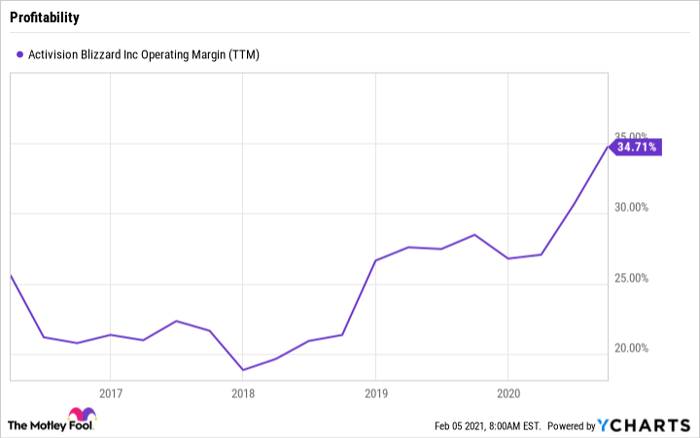
    The engagement translated directly into higher earnings. The Activision side of the business more than doubled its profits as operating margin jumped to 47% of sales in Q4. Blizzard had a weaker outing due to a slimmer release schedule, but World of Warcraft still logged growth. Video-game developer King Digital benefited from higher in-game spending and advertising revenue to allow Activision Blizzard to book solid earnings from its casual-gaming division.

    ATVI Operating Margin (TTM) Chart

    ATVI Operating Margin (TTM) data by YCharts

    All these wins translated into fourth-quarter earnings of $0.65 per share compared to the $0.44 per share that Wall Street was expecting. “As we expand the opportunities for fans to engage in our [intellectual property],” executives said, “we expect strong financial performance to follow.”

    Looking ahead

    The company issued a bullish outlook for 2021 that implies significant improvements over this past year’s record results. Activision also plans to send more cash to shareholders through stock buybacks and a dividend that was just hiked by 15%.

    The company’s strategy boils down to applying what its learned with Call of Duty to a few other franchises. Investors had worried in 2019 that the brand might be showing its age, but Activision poured resources into its development while extending its reach into new platforms and paying models. Those initiatives worked so well that they’re already being used on other brands. “We are accelerating our path to reach a billion people as we apply the Call of Duty framework to other franchises,” the company said.

    This approach has a good shot at producing several additional brands that consistently achieve at least $1 billion in annual revenue within the next few years.

    This article was originally published on Fool.com. All figures quoted in US dollars unless otherwise stated.

    Where to invest $1,000 right now

    When investing expert Scott Phillips has a stock tip, it can pay to listen. After all, the flagship Motley Fool Share Advisor newsletter he has run for more than eight years has provided thousands of paying members with stock picks that have doubled, tripled or even more.*

    Scott just revealed what he believes are the five best ASX stocks for investors to buy right now. These stocks are trading at dirt-cheap prices and Scott thinks they are great buys right now.

    *Returns as of June 30th

    More reading

    Demitri Kalogeropoulos owns shares of Activision Blizzard. The Motley Fool owns shares of and recommends Activision Blizzard. The Motley Fool has a disclosure policy.

    The Motley Fool Australia’s parent company Motley Fool Holdings Inc. owns shares of and recommends Activision Blizzard. The Motley Fool Australia has recommended Activision Blizzard. The Motley Fool has a disclosure policy. This article contains general investment advice only (under AFSL 400691). Authorised by Bruce Jackson.

    The post Activision Blizzard (NASDAQ: ATVI) earnings: Call of Duty is more than just a game appeared first on The Motley Fool Australia.

    This article was originally published on Fool.com. All figures quoted in US dollars unless otherwise stated.

    from The Motley Fool Australia https://ift.tt/3p7botA

  • Why the ResApp (ASX:RAP) share price is climbing higher

    The ResApp Health Ltd (ASX: RAP) share price is climbing higher today. This comes after the company provided an update of its prescription-only software application with the United States Food and Drug Administration (FDA).

    At the time of writing, shares in the digital health company are trading 1.4% higher at 6.8 cents.

    What did ResApp announce?

    In today’s release, ResApp advised it has sent a pre-submission package to the FDA for clearance on its smartphone-based medical software application. The company also requested a meeting with the FDA to discuss how to obtain regulatory approval and any other requirements.

    ResApp’s latest software application uses machine-learning algorithms to detect cough sounds recorded by a smartphone’s inbuilt microphone. This, in turn, will help healthcare professionals identify if a patient is suffering from lower respiratory tract illness.

    The company confirmed the benefits of the medical application’s technology in its SMARTCOUGH-C-2 and Breathe Easy clinical trials.

    If approved, ResApp said the prescription-only software would help users make informed decisions about their healthcare.

    Words from the CEO

    ResApp CEO and managing director Dr Tony Keating commented:

    Submitting this pre-submission package and meeting request is an important first step in our re-engagement with the FDA that will provide a valuable opportunity for the company to discuss the potential pathways for the clearance of our cough-based analysis technology for use in the US.

    We expect to have a number of meetings with the agency this year to ensure that the company is well positioned and to provide any additional details that might be required. ResApp looks forward to working cooperatively with the FDA over the coming months to delineate a path forward for its offering.

    About the ResApp share price

    The ResApp share price has tumbled more than 70% in the past 12 months, making it one of the poorer performers on the All Ordinaries Index (ASX: XAO). 

    ResApp has a market capitalisation of $51.5 million based on the current share price.

    Where to invest $1,000 right now

    When investing expert Scott Phillips has a stock tip, it can pay to listen. After all, the flagship Motley Fool Share Advisor newsletter he has run for more than eight years has provided thousands of paying members with stock picks that have doubled, tripled or even more.*

    Scott just revealed what he believes are the five best ASX stocks for investors to buy right now. These stocks are trading at dirt-cheap prices and Scott thinks they are great buys right now.

    *Returns as of June 30th

    More reading

    Motley Fool contributor Aaron Teboneras has no position in any of the stocks mentioned. The Motley Fool Australia has no position in any of the stocks mentioned. The Motley Fool has a disclosure policy. This article contains general investment advice only (under AFSL 400691). Authorised by Bruce Jackson.

    The post Why the ResApp (ASX:RAP) share price is climbing higher appeared first on The Motley Fool Australia.

    from The Motley Fool Australia https://ift.tt/3jBLaOH

  • Why the SEEK (ASX:SEK) share price just hit a new record high

    SEEK Share Price

    The SEEK Limited (ASX: SEK) share price was on form again on Wednesday.

    The job listings company’s shares rose 1% to hit a record high of $30.99.

    When the SEEK share price hit that level, it meant it was up a sizeable 34% since this time last year.

    Why is the SEEK share price at a record high?

    Investors have been buying SEEK shares after the job listings giant was tipped to positively surprise during earnings season.

    According to a note out of Goldman Sachs, SEEK was one of a handful of shares which it believes could be outperforming expectations.

    The broker is forecasting the company to deliver revenue of $816 million for the half, which will be down 7% on the prior corresponding period.

    In respect to earnings, Goldman has pencilled in earnings before interest, tax, depreciation and amortisation (EBITDA) of $199 million and net profit after tax of $28 million. This will be a 19% and 62% reduction, respectively, on the same period last year.

    Where is the positive surprise?

    The broker believes the positive surprise could be an upgrade to its full year EBITDA guidance.

    At present, the company is guiding to FY 2021 revenue of $1.6 billion, EBITDA of $400 million, and net profit of $50 million.

    Goldman explained: “We expect SEEK to have a solid 1H21 result, and further upgrade its FY21 guidance to a level well above current market expectations (i.e., GSe FY21 EBITDA A$420mn vs. consensus A$404mn, Guidance c.$400mn).”

    “We believe this upgrade will be a result of the continual improvement in macro trends (listings, unemployment etc.) relative to the October levels (which is what guidance was based on).”

    In addition to this, Goldman has suggested that SEEK shares could be given a boost by an update around the sale process for Zhaopin. It notes that this could help reduce its gearing and help to accelerate growth.

    Is the SEEK share price in the buy zone?

    Although Goldman Sachs is tipping SEEK to surprise, it isn’t tipping its shares as a buy at the current level.

    The broker has a neutral rating and $24.90 price target at present. Based on the current SEEK share price, this implies potential downside of almost 20%.

    Where to invest $1,000 right now

    When investing expert Scott Phillips has a stock tip, it can pay to listen. After all, the flagship Motley Fool Share Advisor newsletter he has run for more than eight years has provided thousands of paying members with stock picks that have doubled, tripled or even more.*

    Scott just revealed what he believes are the five best ASX stocks for investors to buy right now. These stocks are trading at dirt-cheap prices and Scott thinks they are great buys right now.

    *Returns as of June 30th

    More reading

    Motley Fool contributor James Mickleboro owns shares of SEEK Limited. The Motley Fool Australia has recommended SEEK Limited. The Motley Fool has a disclosure policy. This article contains general investment advice only (under AFSL 400691). Authorised by Bruce Jackson.

    The post Why the SEEK (ASX:SEK) share price just hit a new record high appeared first on The Motley Fool Australia.

    from The Motley Fool Australia https://ift.tt/3p9NptA

  • The real reason the Afterpay (ASX:APT) share pirce is at a record high

    afterpay share price

    The Afterpay Ltd (ASX: APT) share price has continued its positive run on Wednesday.

    In afternoon trade the payments company’s shares are up 5% to a new record high of $159.50.

    This latest gain means the Afterpay share price is now up an impressive 34% since the start of the year.

    Why is the Afterpay share price racing higher?

    Investors have been fighting to get hold of Afterpay shares this month thanks largely to a bullish broker note out of Bell Potter.

    According to the note, the broker has retained its buy rating and lifted the price target on Afterpay’s shares to $168.50.

    The broker made the move after looking deeper into the company’s collaboration with Westpac Banking Corp (ASX: WBC).

    “CBA should be worried”

    Bell Potter believes that the Afterpay-Westpac collaboration should be worrying Commonwealth Bank of Australia (ASX: CBA).

    It explained: “We see this as a step change in APT’s product offering, and as a deliberate strategy for WBC to break CBA’s stranglehold on the millennial banking market. We believe CBA should be worried, and perhaps is, which is seen with comments from their CEO Matt Comyn at the Banking Summit in November last year, who noted Afterpay as a potential threat to the banking sector over time.”

    “It perhaps also explains CBA’s over $100m investment in Afterpay’s competitor, Klarna. If APT is successful in launching white labelled WBC banking products in Australia it is likely the market will have confidence in APT rolling out a similar offering in all its jurisdictions, providing meaningful valuation upside,” the broker added.

    Will Afterpay stop at transaction accounts?

    Bell Potter doubts that Afterpay will stop at just transaction accounts and has gone through potential options. This includes credit cards, personal loans, home loans, and investments.

    In respect to credit cards, the broker believes it is unlikely Afterpay will move into credit cards. It notes that the company “has been a champion in its users avoiding a debt spiral.”

    It sees personal loans as a possibility, commenting: “We see personal loans, which are integrated with budgeting tools for specific purchases as a possibility. However, again, see it as too similar to credit cards and perhaps not a high priority.”

    Bell Potter believes home loans could be where Afterpay goes next. It explained: “We believe, over time, this is the logical next step. The economics and structure already exists for APT to create home loans via a white label arrangement, and to match it with savings products to help them reach their goal.”

    Finally, it also sees investment products likes those offered by RAIZ Invest Ltd (ASX: RZI) as an option. Bell Potter notes: “We see a balanced index fund with small investments as a possible option APT may explore overtime. This may be similar to what is offered by listed provided RZI (Raiz Invest).”

    Given the huge market opportunity it would have in these markets, it isn’t overly surprising to see the Afterpay share price scaling new heights.

    Where to invest $1,000 right now

    When investing expert Scott Phillips has a stock tip, it can pay to listen. After all, the flagship Motley Fool Share Advisor newsletter he has run for more than eight years has provided thousands of paying members with stock picks that have doubled, tripled or even more.*

    Scott just revealed what he believes are the five best ASX stocks for investors to buy right now. These stocks are trading at dirt-cheap prices and Scott thinks they are great buys right now.

    *Returns as of June 30th

    More reading

    Motley Fool contributor James Mickleboro owns shares of Westpac Banking. The Motley Fool Australia owns shares of AFTERPAY T FPO. The Motley Fool has a disclosure policy. This article contains general investment advice only (under AFSL 400691). Authorised by Bruce Jackson.

    The post The real reason the Afterpay (ASX:APT) share pirce is at a record high appeared first on The Motley Fool Australia.

    from The Motley Fool Australia https://ift.tt/2N9SRQ6