• 5 things to watch on the ASX 200 on Tuesday

    Worried young male investor watches financial charts on computer screen

    On Monday the S&P/ASX 200 Index (ASX: XJO) started the week in a positive fashion and recorded a small gain. The benchmark index rose 0.25% to 6,660.2 points.

    Will the market be able to build on this on Tuesday? Here are five things to watch:

    ASX 200 expected to edge higher.

    The Australian share market looks set to start the day slightly higher. According to the latest SPI futures, the ASX 200 is poised to open the day 3 points higher this morning. This follows a reasonably mixed start to the week on Wall Street. In late trade the Down Jones is down slightly, the S&P 500 is up 0.1%, and the Nasdaq has risen a solid 0.9%.

    Tech shares on watch.

    It could be a positive day for Australian tech shares such as Afterpay Ltd (ASX: APT) and Nearmap Ltd (ASX: NEA) on Tuesday after their US counterparts stormed higher. The local tech sector has a tendency to follow the lead of the Nasdaq index, which is up a sizeable 0.9% in late trade on Wall Street.

    Oil prices rise.

    Energy producers including Beach Energy Ltd (ASX: BPT) and Woodside Petroleum Limited (ASX: WPL) could push higher today after oil prices rose overnight. According to Bloomberg, the WTI crude oil price is up 0.4% to US$46.75 a barrel and the Brent crude oil price has risen 0.3% to US$50.11 a barrel. Vaccine hopes and a ship explosion in Saudi Arabia were behind the rise.

    Gold price tumbles.

    Gold miners such as Newcrest Mining Limited (ASX: NCM) and St Barbara Ltd (ASX: SBM) could come under pressure after the gold price tumbled lower. According to CNBC, the spot gold price has fallen 0.65% to US$1,831.10 an ounce. Gold prices softened after the rollout of a COVID-19 vaccine in the United States drove optimism of a swift economic recovery.

    Altium rated neutral.

    The Altium Limited (ASX: ALU) share price is fully valued according to analysts at Goldman Sachs. In response to its decision to offload its TASKING business, the broker has retained its neutral rating and $36.35 price target. This compares to the current Altium share price of $36.03.

    Where to invest $1,000 right now

    When investing expert Scott Phillips has a stock tip, it can pay to listen. After all, the flagship Motley Fool Share Advisor newsletter he has run for more than eight years has provided thousands of paying members with stock picks that have doubled, tripled or even more.*

    Scott just revealed what he believes are the five best ASX stocks for investors to buy right now. These stocks are trading at dirt-cheap prices and Scott thinks they are great buys right now.

    *Returns as of June 30th

    More reading

    James Mickleboro has no position in any of the stocks mentioned. The Motley Fool Australia’s parent company Motley Fool Holdings Inc. owns shares of and recommends Altium. The Motley Fool Australia’s parent company Motley Fool Holdings Inc. owns shares of Nearmap Ltd. The Motley Fool Australia owns shares of AFTERPAY T FPO. The Motley Fool Australia has recommended Nearmap Ltd. The Motley Fool has a disclosure policy. This article contains general investment advice only (under AFSL 400691). Authorised by Bruce Jackson.

    The post 5 things to watch on the ASX 200 on Tuesday appeared first on The Motley Fool Australia.

    from The Motley Fool Australia https://ift.tt/2LBJmby

  • Better Buy: Square vs. Visa

    This article was originally published on Fool.com. All figures quoted in US dollars unless otherwise stated.

    Female cafe employee accepting a card as payment

    This article was originally published on Fool.com. All figures quoted in US dollars unless otherwise stated.

    There’s a clear trend toward a cashless society, not only in the United States, but all over the world. While cash isn’t likely to go away entirely, at least not anytime soon, an increasing amount of financial transactions are taking place through credit and debit cards, mobile apps, and other non-cash methods.

    When there’s a clear trend like this, there are often interesting opportunities for long-term investors to take advantage of. And that’s especially true when we’re talking about a $185 trillion market opportunity, which is the current estimated volume of payments flowing around the globe.

    Two particularly interesting companies that investors might want to take a look at are fast-growing fintech company Square (NYSE: SQ) and payment processing leader Visa (NYSE: V). However, while both are great companies, these are two very different investments. So here’s a quick look at each one to help decide which is the better buy for your portfolio.

    Square: A massive disruptor with lots of growth potential

    To call Square a major disruptor would be like calling Amazon.com (NASDAQ: AMZN) a pretty successful retail company. The company has transformed the financial landscape by making it practical for all businesses, regardless of size, to seamlessly accept credit and debit card payments.

    However, Square has evolved dramatically since it started selling those little card readers sticking out of merchants’ smartphones. Its payment processing hardware is used by businesses of all sizes, and there is more than $100 billion in annualized payment volume flowing through its systems. The Square Capital business lending division has originated billions of dollars in small business loans, and the company has created a small business ecosystem.

    The personal finance side of Square’s business is becoming even more impressive. The company’s Cash App now has 30 million active users and in addition to its core person-to-person payment functionality, Cash App now enables users to buy and sell bitcoin, invest in stocks, and much more. But Square isn’t done yet — its vision is to be a one-stop shop for its users financial needs. It could add things like personal loans, high-yield savings, insurance products, and more to the ecosystem over time, just to name a few.

    Visa: The largest payment network in the world

    If you’re reading this, there’s a good chance that there’s at least one credit or debit card in your wallet that bears the Visa logo. The largest payment network in the world, there are nearly 3.5 billion Visa cards in existence and the company has about $9 trillion of annualized payment volume flowing through its network.

    However, don’t think because Visa is such a massive company that it is as big as it’s going to get. For one thing, while most payment transactions in the U.S. are now cashless, that isn’t the case in many parts of the world. Credit card acceptance isn’t nearly as universal in many places, and it is estimated that as many as 80% of payment transactions around the world still take place in cash.

    What’s more, the $185 trillion global payments market includes things like person-to-person and business-to-business transfers, areas where Visa hasn’t really tapped into yet. A few months ago, I wrote that Visa could become a $1 trillion market cap company in the not-too-distant future (currently it’s less than half of that), and my opinion hasn’t changed.

    Don’t think it has to be either-or

    One of the most common questions I’m asked about the fintech world is to the effect of “should Visa be worried about having Square and other disruptors take their business?” And the answer is no. Square provides the systems that facilitate payment transactions and Visa runs the network that processes them. Both are needed for a transaction. And there’s plenty of room for both to benefit from the cashless trend.

    The biggest question you should ask as an investor is how much volatility you’re willing to deal with and what your risk tolerance is. Square has tremendous growth potential, but is also a richly valued stock that is priced for significant growth going forward. On the other hand, Visa essentially dominates payment processing along with Mastercard (NYSE: MA) and is a much better fit for investors who are looking for steady and predictable gains.

    In a nutshell, both are great stocks and you probably won’t go wrong with either. As more of a growth-focused investor, I’d probably go with Square if I had to add one to my portfolio today (In full disclosure, I’ve been a Square shareholder since shortly after the IPO), but there’s a solid argument to be made for both.

    This article was originally published on Fool.com. All figures quoted in US dollars unless otherwise stated.

    Where to invest $1,000 right now

    When investing expert Scott Phillips has a stock tip, it can pay to listen. After all, the flagship Motley Fool Share Advisor newsletter he has run for more than eight years has provided thousands of paying members with stock picks that have doubled, tripled or even more.*

    Scott just revealed what he believes are the five best ASX stocks for investors to buy right now. These stocks are trading at dirt-cheap prices and Scott thinks they are great buys right now.

    *Returns as of June 30th

    More reading

    John Mackey, CEO of Whole Foods Market, an Amazon subsidiary, is a member of The Motley Fool’s board of directors. Matthew Frankel, CFP owns shares of Square and has the following options: short September 2022 $155 calls on Square. The Motley Fool owns shares of and recommends Amazon, Mastercard, Square, and Visa and recommends the following options: short January 2022 $1940 calls on Amazon and long January 2022 $1920 calls on Amazon. The Motley Fool Australia has no position in any of the stocks mentioned. The Motley Fool has a disclosure policy. This article contains general investment advice only (under AFSL 400691). Authorised by Bruce Jackson.

    The post Better Buy: Square vs. Visa appeared first on The Motley Fool Australia.

    This article was originally published on Fool.com. All figures quoted in US dollars unless otherwise stated.

    from The Motley Fool Australia https://ift.tt/3meifzJ

  • Why ASX oil stocks could replace the ASX tech boom in 2021

    boom in technology shares represented by race track strating line printed with the words 'are you ready'

    You might think it’s a bid of a bold call, but some experts believe ASX oil-exposed stocks could be the next ASX tech stars.

    While its tech stocks like the rocketing Afterpay Ltd (ASX: APT) share price and Xero Limited (ASX: XRO) share price that have been soundly beating the S&P/ASX 200 Index (Index:^AXJO), oil stocks may replace the tech rally in 2021.

    ASX energy stocks have underperformed this year as the oil price crashed. Many are also shunning the sector due to environmental concerns.

    ESG investing clashes with ASX energy stocks

    The snub that Prime Minister Scott Morrison had to endure at the UN Climate Summit will motivate even more investors to embrace Environmental, Social, and Corporate Governance (ESG) investing.

    Even the big banks are getting in on the act with Australia and New Zealand Banking GrpLtd (ASX: ANZ) recently promising not to fund any fossil fuel projects. This coming from an industry that isn’t known to have a conscience!

    Meanwhile, several high-profile global fund managers, including BlackRock, Inc. (NYSE: BLK), are moving away from investing in carbon polluting companies.

    Why ASX energy stocks could replace the tech boom

    But some experts believe there are undervalued investments in the energy sector, even for ESG conscious investors, reported the Australian Financial Review.

    “Oil is still a big part of the index, industrials is still a big part, materials, chemicals, steel, all these things,” the AFR quoted Janus Henderson portfolio manager, Tom O’Hara.  

    “You’re going to have to start owning these things in order to protect your portfolio and deliver performance.”

    How to pick the best ASX energy stocks for 2021

    The point he was making is that one shouldn’t paint all energy stocks with the same brush. To do so means missing out on ASX stocks that can deliver outsized returns in 2021.

    So how can ESG investors have their cake and eat it? The key here is to look for stocks that are transitioning to a cleaner future or those that are developing lower carbon projects.

    European oil and gas giants are moving with the times and bolstering their green credentials. Examples are the Royal Dutch Shell Plc (LON: RDSA) share price, the BP plc (LON: BP) share price and Total SE (EPA: FP) share price.

    There are two ASX stocks that also stand out in this regard, reported the AFR. These are the Santos Ltd (ASX: STO) share price and Woodside Petroleum Limited (ASX: WPL) share price.

    Where value investing meets ESG

    Both stocks enjoyed a robust bounce in November as the oil price recovered from the COVID‐19 meltdown. But the WPL share price is still nursing a 33% loss and the STO share price an 18% loss since the start of 2020.

    This leaves them plenty of room to rally. Thrown in the fact that there’s a limited pool of ESG friendly ASX energy stocks to pick from, chief investment officer at Bell Asset Management, Ned Bell, told the AFR he thinks there could be a scramble in 2021 to snap up such stocks.

    Where to invest $1,000 right now

    When investing expert Scott Phillips has a stock tip, it can pay to listen. After all, the flagship Motley Fool Share Advisor newsletter he has run for more than eight years has provided thousands of paying members with stock picks that have doubled, tripled or even more.*

    Scott just revealed what he believes are the five best ASX stocks for investors to buy right now. These stocks are trading at dirt-cheap prices and Scott thinks they are great buys right now.

    *Returns as of June 30th

    More reading

    Brendon Lau owns shares of Australia & New Zealand Banking Group Limited. Connect with me on Twitter @brenlau.

    The Motley Fool Australia’s parent company Motley Fool Holdings Inc. owns shares of Xero. The Motley Fool Australia owns shares of AFTERPAY T FPO. The Motley Fool has a disclosure policy. This article contains general investment advice only (under AFSL 400691). Authorised by Bruce Jackson.

    The post Why ASX oil stocks could replace the ASX tech boom in 2021 appeared first on The Motley Fool Australia.

    from The Motley Fool Australia https://ift.tt/380gdhM

  • Shopify stock’s 166% rally in 2020 isn’t sustainable

    This article was originally published on Fool.com. All figures quoted in US dollars unless otherwise stated.

    Amazon ecommerce package delivery

    This article was originally published on Fool.com. All figures quoted in US dollars unless otherwise stated.

    The COVID-19 pandemic has devastated many businesses around the world. However, it has been a huge positive catalyst for Shopify (NYSE: SHOP). The pandemic forced retailers – including many mom-and-pop stores – to shift their focus to e-commerce. Shopify helped these businesses set up online stores so that they could continue generating revenue, even with little or no traffic to their physical stores.

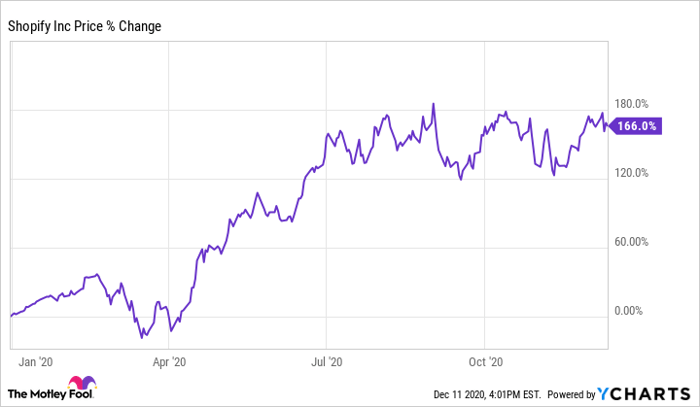
    Shopify stock has responded accordingly. The stock had already surged more than 1,400% between 2016 and 2019, but it has rallied another 166% in 2020. Despite a recent pullback, Shopify stock sits within 10% of its all-time high of $1,146.91.

    SHOP Chart

    Data source: YCharts.

    The pandemic-fuelled rally in Shopify stock isn’t likely to last, though. Shopify bulls appear to be overestimating the company’s long-term growth and earnings prospects.

    Two conflicting megatrends

    One of the biggest megatrends of the century is the transition of much of retail to e-commerce. That transition is still in the early innings. Last quarter, e-commerce accounted for just 14% of U.S. retail sales. It’s not clear what the long-term balance between brick-and-mortar retail and e-commerce will be, but it will clearly involve more e-commerce than today. Shopify will benefit from this megatrend for many years to come.

    However, a cross-cutting megatrend is far more troublesome for Shopify: the growing concentration of the retail industry. The top 10 U.S. retailers are on track to ring up at least $1.5 trillion of gross merchandise volume (GMV) this year. (The total GMV of all retailers with over $10 billion of domestic sales will easily exceed $2 trillion.) For comparison, U.S. retail sales will likely wind up near $4 trillion this year, excluding auto and gasoline sales.

    Amazon.com (NASDAQ: AMZN) is virtually certain to increase its already-high market share significantly over the next decade. Investors are also pricing shares of big-box retail giants like Walmart, Target, Costco Wholesale, and even Best Buy for significant future growth. Based on their low costs, broad store networks, and omnichannel offerings, it seems like a good bet that this expected growth will pan out.

    A lot of Shopify’s 2020 growth has come from helping smaller merchants make the transition to e-commerce. The risk is that in many cases, this may be a last-ditch attempt to stay in business – one that ultimately fails as Amazon and other megaretailers continue steamrolling less efficient competitors.

    Shopify does offer tools to help merchants on its platform sell through Amazon as well. In theory, that means Shopify could participate partially in Amazon’s rapid GMV growth. However, as Amazon becomes increasingly dominant in the U.S. retail landscape, merchants may find that virtually all of their sales come from that channel, reducing the value of Shopify’s services.

    Massive multiple contraction is inevitable

    Shopify has reported incredible results in 2020. Last quarter, revenue surged 96% on a 109% increase in GMV. That helped Shopify swing to a profit after losing money in the prior-year period. Revenue is on track to reach nearly $3 billion this year, and analysts expect Shopify to add almost $1 billion to its top line in 2021. Jefferies analyst Samad Samana thinks revenue could surge to $10 billion by 2025. Yet even if Shopify lives up to that aggressive forecast, it might not lift Shopify stock.

    Right now, Shopify stock trades for an eye-popping 45 times projected 2020 sales. That might make sense for an ultra-high-growth software company. However, lower-margin merchant solutions are driving the bulk of Shopify’s growth. Last quarter, subscription solutions revenue grew 48%, compared to a 132% surge in merchant solutions revenue. Subscription solutions carried a gross margin of 78.7%, compared to 40.6% for merchant solutions.

    Shopify’s investments in areas like robotics and fulfillment make sense. But as lower-margin revenue streams become an even bigger proportion of the business, Shopify’s revenue multiple is likely to shrink significantly. Later on, as the business matures and growth slows, its multiple is bound to contract even further.

    Shopify stock has flown too high

    When Shopify finally reaches maturity, many years down the road, it will probably merit a modest revenue multiple of around three times sales. (Oracle – a mature software company with extremely high margins – trades for less than five times sales.) Even if Shopify were to grow revenue at a 20% compound annual growth rate over the next two decades to around $100 billion by 2040, the company’s market cap would be just $300 billion at that valuation: only 135% above its current level.

    Moreover, I suspect that Shopify’s long-term revenue opportunity is even lower. Over the next decade, the percentage of retail sales going to massive corporations with over $10 billion of annual sales will continue rising. Unless Shopify can convince some of the largest retailers in the world to adopt its platform, it is ultimately playing in a shrinking market: one that isn’t big enough to justify Shopify stock’s lofty valuation.

    This article was originally published on Fool.com. All figures quoted in US dollars unless otherwise stated.

    Where to invest $1,000 right now

    When investing expert Scott Phillips has a stock tip, it can pay to listen. After all, the flagship Motley Fool Share Advisor newsletter he has run for more than eight years has provided thousands of paying members with stock picks that have doubled, tripled or even more.*

    Scott just revealed what he believes are the five best ASX stocks for investors to buy right now. These stocks are trading at dirt-cheap prices and Scott thinks they are great buys right now.

    *Returns as of June 30th

    More reading

    Adam Levine-Weinberg has no position in any of the stocks mentioned. John Mackey, CEO of Whole Foods Market, an Amazon subsidiary, is a member of The Motley Fool’s board of directors. The Motley Fool Australia’s parent company Motley Fool Holdings Inc. owns shares of and recommends Amazon and Shopify and recommends the following options: short January 2022 $1940 calls on Amazon and long January 2022 $1920 calls on Amazon. The Motley Fool Australia has recommended Amazon. The Motley Fool has a disclosure policy. This article contains general investment advice only (under AFSL 400691). Authorised by Bruce Jackson.

    The post Shopify stock’s 166% rally in 2020 isn’t sustainable appeared first on The Motley Fool Australia.

    This article was originally published on Fool.com. All figures quoted in US dollars unless otherwise stated.

    from The Motley Fool Australia https://ift.tt/37fJQwv

  • The Cellnet (ASX:CLT) share price has rocketed up 21% today. Here’s why.

    A happy woman pointing to her big smile, indicating a surge in share price

    The Cellnet Group Limited (ASX: CLT) share price is soaring today after the company released a positive trading update for November. During morning trade, the Cellnet share price reached an intra-day high of 8.5 cents. However, its shares have pulled back to 7.5 cents at the time of writing, up 20.9%.

    Quick take on Cellnet

    Formed in 1992, Cellnet sources and distributes lifestyle tech products to retail, business and online channels across Australia and New Zealand. The company specialises in mobile phones, AV and IT equipment, audio, gaming accessories and software.

    Cellnet is also involved in services to the mobile telecommunications and retail industries.

    What’s driving the Cellnet share price higher?

    The Cellnet share price is marching higher today after the company advised it was continuing to see strong momentum in the month of November.

    Cellnet said that revenue for last month saw a 27% year-on-year increase to $14.78 million. This was underpinned by robust retail sales that included the iPhone 12 launch and console gaming accessories.

    Following an uplift in revenue, net profit before tax rose to $1.19 million, reflecting a 174% year-on-year surge. During the July to October period, the company reported net profit before tax of $1.6 million.

    For the 11 months so far, favourable trading conditions have led Cellnet to a net profit before tax of $2.79 million. This compares to the $2.04 million achieved on the same period last year.

    Management commentary

    Cellnet chief executive Dave Clark welcomed the strong recent performance, saying:

    We continue to be positive about the current financial year, with the business performing very well across all categories and strong demand being experienced in the lead-up to Christmas.

    About the Cellnet share price

    While the company appears to be making tailwinds, the Cellnet share price has dropped heavily over the past year. Reaching 17.5 cents last December, the current share price represents a decline of almost 60%.

    While COVID-19 significantly impacted the retail industry in 2020, Cellnet is beginning to see an uptick on sales post-pandemic.

    Where to invest $1,000 right now

    When investing expert Scott Phillips has a stock tip, it can pay to listen. After all, the flagship Motley Fool Share Advisor newsletter he has run for more than eight years has provided thousands of paying members with stock picks that have doubled, tripled or even more.*

    Scott just revealed what he believes are the five best ASX stocks for investors to buy right now. These stocks are trading at dirt-cheap prices and Scott thinks they are great buys right now.

    *Returns as of June 30th

    More reading

    Motley Fool contributor Aaron Teboneras has no position in any of the stocks mentioned. The Motley Fool Australia has no position in any of the stocks mentioned. The Motley Fool has a disclosure policy. This article contains general investment advice only (under AFSL 400691). Authorised by Bruce Jackson.

    The post The Cellnet (ASX:CLT) share price has rocketed up 21% today. Here’s why. appeared first on The Motley Fool Australia.

    from The Motley Fool Australia https://ift.tt/3a6PcM6

  • ASX 200 rises on Monday

    ASX 200

    The S&P/ASX 200 Index (ASX: XJO) rose by around 0.30% today to 6,660 points.

    Here are some of the highlights from the ASX:

    Altium Limited (ASX: ALU)

    Altium, the electronic design software company, announced it is going to sell its TASKING business to FSN Capital for US$100 million up front and another US$10 million conditional upon achieving revenue targets in FY21 after the sale.

    Mr Aram Mirkazemi, the CEO of Altium, said: “The strategic divestment of TASKING combined with our recent organisational changes and hard pivot to the cloud marks an inflection point for Altium in its pursuit of industry transformation. While TASKING is a great business, it does not play a central role in our design to realisation strategy for the electronics industry, which is being delivered through our new cloud platform Altium 365. The divestment of TASKING will free up organisational capacity and allow Altium leadership to focus on our main game, which is to expand Altium 365 and accelerate the adoption.”

    Altium explained that the transaction will have a one-off positive impact to earnings per hare (EPS) in the 2021 financial year which reflects the profit on the sale of the business.

    The FY21 first half result will include TASKING as the transaction will close in the second half.

    Management stated that the first half performance remains solid, however the effect of the transaction combined with the ongoing COVID-19 lockdowns in the US will have a “marked” impact on its usual revenue split of 45% in the first half and 55% in the second half. However, Altium remains confident about achieving full year guidance when adjusted for the sale of TASKING because its revenue and earnings won’t be included in the second half of FY21.

    IOOF Holdings Limited (ASX: IFL)

    The diversified financials business welcomed the ACCC’s decision not to oppose IOOF’s acquisition of MLC from National Australia Bank Ltd (ASX: NAB).

    IOOF CEO Renato Mota said: “The ACCC decision is a key milestone in achieving approvals to complete the MLC acquisition. MLC is a highly complementary wealth management business which is a natural fit with IOOF. It presents a unique opportunity to create Australia’s leading wealth manager along with significant benefits through simplification and transformation for clients, members and shareholders.

    “Combining IOOF and MLC creates a common purpose and culture of community spirit and supporting people to achieve their financial goals. This combination brings wide-ranging capabilities, technical expertise to enable improved choice, accessibility and client outcomes.”

    The ACCC’s review indicated that, after the acquisition, IOOF would be competing with and constrained by several other large firms along with a number of smaller firms for the supply of retail platforms.

    IOOF isn’t expecting any change to its estimated completion date of before 30 June 2021.

    New Zealand travel bubble

    New Zealand Prime Minister Jacinda Ardern announced today that the country will let Australians travel quarantine-free into the country by the end of March. This will still require the Australian government to allow it to happen and for COVID-19 case number to remain low.

    New Zealanders are currently able to travel to Australia without quarantining.

    There was a mixed reaction to this news. The Sydney Airport Holdings Pty Ltd (ASX: SYD) share price went up 0.3%. However, the Flight Centre Travel Group Ltd (ASX: FLT) share price fell around 2%, the Webjet Limited (ASX: WEB) share price dropped 1.1%, the Qantas Airways Limited (ASX: QAN) share price fell 0.6%, the Serko Limited (ASX: SKO) share price rose 1% and the Helloworld Travel Ltd (ASX: HLO) share price fell 1.5%.

    Where to invest $1,000 right now

    When investing expert Scott Phillips has a stock tip, it can pay to listen. After all, the flagship Motley Fool Share Advisor newsletter he has run for more than eight years has provided thousands of paying members with stock picks that have doubled, tripled or even more.*

    Scott just revealed what he believes are the five best ASX stocks for investors to buy right now. These stocks are trading at dirt-cheap prices and Scott thinks they are great buys right now.

    *Returns as of June 30th

    More reading

    Tristan Harrison owns shares of Altium. The Motley Fool Australia’s parent company Motley Fool Holdings Inc. owns shares of and recommends Altium. The Motley Fool Australia’s parent company Motley Fool Holdings Inc. owns shares of Serko Ltd. The Motley Fool Australia owns shares of and has recommended Helloworld Limited and Webjet Ltd. The Motley Fool Australia has recommended Flight Centre Travel Group Limited and Serko Ltd. The Motley Fool has a disclosure policy. This article contains general investment advice only (under AFSL 400691). Authorised by Bruce Jackson.

    The post ASX 200 rises on Monday appeared first on The Motley Fool Australia.

    from The Motley Fool Australia https://ift.tt/37caExw

  • Wesfarmers (ASX:WES) share price is on fire, up 3% to reach all-time high

    ASX share new high represented by ladder climbing to higher target

    The Wesfarmers Ltd (ASX: WES) share price reached an all-time record high today, touching $51.29 this afternoon before retreating slightly to $51.12, up 3.09% at the time of writing.

    The company’s share price has been on fire since March, when it fell to a 52-week low of $29.75 during the height of the coronavirus pandemic.

    The shares have since rebounded strongly and steadily, gaining more than 70% from the March lows.

    What’s been driving the Wesfarmers share price?

    The Wesfarmers conglomerate has performed well this year despite pandemic-related challenges, with the company announcing in November that sales continued to grow in fiscal-year 2021 after a strong second-half in 2020.

    At the time, the company reported that its retail businesses continued to grow higher than pre-coronavirus levels.

    The key Bunnings business is the star of the show, with sales up 25.2% over the prior corresponding period. The K-mart business also performed well despite widespread store closures, delivering 3.7% sales growth year to date. 

    Meanwhile, the company’s Officeworks business continued its strong form and reported year to date sales growth of 23.4%, supported by strong demand for technology and home office furniture products.

    More about Wesfarmers

    Wesfarmers is arguably Australia’s best-known conglomerate. The company earns around 80% of revenue from its flagships Bunnings, K-mart, and Officeworks – with Bunnings earning half of the group’s revenue.

    Through Bunnings, Wesfarmers has the largest market share (25%) in a highly growing home improvement sector. Meanwhile, K-mart and Target stores combined have the largest market share in the discount department store sector. 

    Bunnings’ scale in particular generates bargaining power with suppliers when sourcing products, and when negotiating rents with landlords. Compared with other retail categories, analysts say that home improvement players have some defences against the encroachment of e-commerce. This is because the sizes and weights of products purchased at home improvement stores prohibit cost-effective shipping. In addition, the specialised knowledge that its employees offer in-store is difficult to replicate online.

    In its industrials business, Wesfarmers is also on the verge of making a big bet on lithium. Specifically, it’s about to make a decision in early 2021 whether to invest in building a plant in Kwinana WA, that would process lithium from its Mount Holland project owned jointly with Chilean miner Sociedad Quimica y Minera.

    Wesfarmers share price compared to competitors

    The Wesfarmers share price has gained 24% in 2020. This compares with Coles Group Ltd (ASX: COL) share price which has so far risen by 22% year-to-date. Meanwhile, the Woolworths Group Ltd (ASX: WOW) share price has only risen by 8% during the same period.

    Where to invest $1,000 right now

    When investing expert Scott Phillips has a stock tip, it can pay to listen. After all, the flagship Motley Fool Share Advisor newsletter he has run for more than eight years has provided thousands of paying members with stock picks that have doubled, tripled or even more.*

    Scott just revealed what he believes are the five best ASX stocks for investors to buy right now. These stocks are trading at dirt-cheap prices and Scott thinks they are great buys right now.

    *Returns as of June 30th

    More reading

    Motley Fool contributor Eddy Sunarto has no position in any of the stocks mentioned. The Motley Fool Australia owns shares of COLESGROUP DEF SET, Wesfarmers Limited, and Woolworths Limited. The Motley Fool has a disclosure policy. This article contains general investment advice only (under AFSL 400691). Authorised by Bruce Jackson.

    The post Wesfarmers (ASX:WES) share price is on fire, up 3% to reach all-time high appeared first on The Motley Fool Australia.

    from The Motley Fool Australia https://ift.tt/347LRZm

  • Why the BCI Minerals (ASX:BCI) share price reached a multi-year high today

    asx share price making all time highs represented by cartoon man flying high on a paper plane

    The BCI Minerals Ltd (ASX: BCI) share price has surged higher today. This came after the company announced the approval of a loan for its Mardie Salt & Potash Project. During morning trade, the BCI Minerals share price reached a multi-year high of 30.5 cents. By the market’s close, the company’s shares had slightly retraced back to 30 cents, up 7.1% for the day.

    What’s driving the BCI Minerals share price higher?

    The BCI Minerals share price was on the move today after investors digested the company’s positive announcement.

    According to BCI Minerals, the Northern Australia Infrastructure Facility (NAIF) board has approved a $450 million loan facility for the company’s Mardie Salt & Potash Project.

    The agreement follows 18 months of ongoing discussions between both parties, which included a feasibility study in July 2020.

    The Mardie Project, located in the Pilbara region of Western Australia, contains salt and sulphate of potash (SOP). BCI Minerals plans to develop the site with construction of large ponds and crystallisers over a 100sq km area. In addition, the company will build two process plants and a new port facility to export the minerals.

    It’s estimated the life of the project will be 60 years, and it will become a tier 1 salt and SOP project.

    Terms of the loan

    Under the terms, the borrowing of the loan will be under BCI Minerals’ subsidiary, Mardie Minerals Pty Ltd, which owns the Mardie project. The loan will be senior secured on an equal footing with a commercial bank, including any senior secured debt tranches.

    The loan, pending various conditions to be fulfilled, will be used to fund the construction of the Mardie Project. This will allow BCI Minerals to bring the development up to speed while covering financing fees and costs. While draw down isn’t expected until the second half of FY22, the company will use capital to initially fund future works.

    What did management say?

    BCI Minerals managing director Mr Alwyn Vorster commented on the positive news, saying:

    We are pleased to receive conditional NAIF Board approval for a A$450 million long tenor loan. This loan will be the largest NAIF allocation to a WA based company to date and recognises the potential long-term benefits which Mardie will bring to the region, including new port infrastructure available to third party users.

    Importantly, the loan will also provide significant momentum for BCI to secure the remaining debt and equity funding components required for Mardie’s development. We acknowledge the strong support from various Federal and WA State Government ministers and departments.

    Further adding to his comments, BCI Minerals CEO Mr Chris Wade said:

    We are delighted to be able to support the development of the Mardie Salt & Potash Project which by supplying agricultural and chemical industries across Asia offers exciting export opportunities. Locally, the Project will also bring significant economic benefits to the Karratha, Dampier and Onslow areas.

    BCI Minerals share price summary

    The BCI Minerals share price has been trekking higher over the past 12 months, up more than 76% from the 17 cents level at which it finished 2019.

    The company’s shares reached a 52-week low of 9.7 cents during March 2020, before surging upwards to today’s multi-year high.

    BCI Minerals has a market capitalisation of $176.5 million and a price-to-earnings (P/E) ratio of 311.

    Where to invest $1,000 right now

    When investing expert Scott Phillips has a stock tip, it can pay to listen. After all, the flagship Motley Fool Share Advisor newsletter he has run for more than eight years has provided thousands of paying members with stock picks that have doubled, tripled or even more.*

    Scott just revealed what he believes are the five best ASX stocks for investors to buy right now. These stocks are trading at dirt-cheap prices and Scott thinks they are great buys right now.

    *Returns as of June 30th

    More reading

    Motley Fool contributor Aaron Teboneras has no position in any of the stocks mentioned. The Motley Fool Australia has no position in any of the stocks mentioned. The Motley Fool has a disclosure policy. This article contains general investment advice only (under AFSL 400691). Authorised by Bruce Jackson.

    The post Why the BCI Minerals (ASX:BCI) share price reached a multi-year high today appeared first on The Motley Fool Australia.

    from The Motley Fool Australia https://ift.tt/3nbHMuR

  • 2 high quality ASX shares for your retirement portfolio

    asx investor daydreaming about US shares

    If you’re currently in retirement or approaching it, you’ll probably be looking for ways to boost your income in this low interest rate environment.

    But which ASX shares should you turn to? Two top options for retirees to look at are listed below. Here’s what you need to know about them:

    BWP Trust (ASX: BWP)

    BWP is a commercial real estate company with a focus on warehouses. The majority of the company’s properties are leased to hardware giant Bunnings Warehouse. Given how Bunnings is regarded as the highest quality retailer in Australia, it is not surprising to learn that BWP continued its positive form during the pandemic and collected rent largely as normal.

    In fact, the company’s portfolio is seen as so strong thanks to its blue chip tenant, that it appreciated in value even during the pandemic. 

    And with Bunnings continuing to perform well and likely to maintain this positive form in 2021 thanks to tax cuts and government stimulus, the future looks positive for BWP.

    While analysts at Ord Minnett only have a hold rating on its shares, their price target of $4.40 is marginally higher than where its shares trade today. In addition to this, the broker estimates that it offers an attractive 4.1% FY 2021 yield and 4.35% FY 2022 yield.

    Coles Group Ltd (ASX: COL)

    This supermarket giant is regarded by many as a top option for retirees. This is because it has many of the qualities that investors would look for in a core holding for a retirement portfolio. Coles has a strong market position, solid growth prospects, a favourable dividend policy, and defensive earnings.

    You only need to look at how well the company is performing during the pandemic to see how defensive its earnings are. After delivering a strong result in FY 2020, it is on course to do the same in FY 2021. At the end of October, Coles released its first quarter update and revealed a 10.5% increase in total sales revenue over the prior corresponding period to $9.6 billion.

    One broker that was impressed by this was Goldman Sachs. In response to this update, the broker put a buy rating and $20.50 price target on it shares. It is also forecasting a ~63.6 cents per share fully franked dividend in FY 2021. Based on the current Coles share price, this represents an attractive 3.5% yield.

    Where to invest $1,000 right now

    When investing expert Scott Phillips has a stock tip, it can pay to listen. After all, the flagship Motley Fool Share Advisor newsletter he has run for more than eight years has provided thousands of paying members with stock picks that have doubled, tripled or even more.*

    Scott just revealed what he believes are the five best ASX stocks for investors to buy right now. These stocks are trading at dirt-cheap prices and Scott thinks they are great buys right now.

    *Returns as of June 30th

    More reading

    Motley Fool contributor James Mickleboro has no position in any of the stocks mentioned. The Motley Fool Australia owns shares of COLESGROUP DEF SET. The Motley Fool has a disclosure policy. This article contains general investment advice only (under AFSL 400691). Authorised by Bruce Jackson.

    The post 2 high quality ASX shares for your retirement portfolio appeared first on The Motley Fool Australia.

    from The Motley Fool Australia https://ift.tt/2LyCXhj

  • Why the Webjet (ASX: WEB) share price is climbing higher

    asx share price rise represented by red paper plane flying away from other white paper planes

    The Webjet Limited (ASX: WEB) share price is among the ASX travel shares moving higher towards the end of Monday’s trade.

    Shares in the Aussie travel company are down 1.2% for the day but have climbed 3.6% since midday.

    Why is the Webjet share price surging higher?

    The big news pushing travel shares higher was the announcement of a potential Trans-Tasman travel bubble. New Zealand Prime Minister Jacinda Ardern on Monday confirmed an in-principle agreement to open up a bubble with Australia in early 2021.

    The move comes with Australia already allowing many New Zealand travellers into the country in recent months. However, today’s announcement paves the way for a potential two-way opening of the regional borders.

    That’s good news for ASX travel companies like Webjet which have been surging higher this afternoon. Opening borders means more potential travel routes and demand for travel companies’ services.

    Flight Centre Travel Group Ltd (ASX: FLT) shares are up 3.8% since midday with Corporate Travel Management Ltd (ASX: CTD) shares climbing 1.01% this afternoon.

    It hasn’t been all smooth sailing to start the week, with all three major ASX travel shares still in the red at the time of writing.

    Which other shares are surging higher?

    Some of the biggest fish in the market are climbing higher to start the trading week. That includes the likes of Afterpay Ltd (ASX: APT)Xero Limited (ASX: XRO) and Wesfarmers Ltd (ASX: WES).

    The S&P/ASX 200 Index (ASX: XJO) has jumped 0.7% higher to 6,687 points on the back of strong gains.

    The Afterpay share price has rocketed 9.7% higher to a new all-time high of $110.83 per share. Fellow large-caps Wesfarmers and Xero have also hit their own all-time highs in a positive start to the week.

    Foolish takeaway

    ASX travel shares stumbled in early trade but are rebounding strongly on the back of a potential Trans-Tasman travel bubble.

    This Tiny ASX Stock Could Be the Next Afterpay

    One little-known Australian IPO has doubled in value since January, and renowned Australian Moonshot stock picker Anirban Mahanti sees a potential millionaire-maker in waiting…

    Because ‘Doc’ Mahanti believes this fast-growing company has all the hallmarks of genuine Moonshot potential, forget ‘buy now pay later’, this stock could be the next hot stock on the ASX.

    Doc and his team have published a detailed report on this tiny ASX stock. Find out how you can access what could be the NEXT Afterpay today!

    Returns as of 6th October 2020

    More reading

    Ken Hall has no position in any of the stocks mentioned. The Motley Fool Australia’s parent company Motley Fool Holdings Inc. owns shares of Xero. The Motley Fool Australia owns shares of and has recommended Corporate Travel Management Limited and Webjet Ltd. The Motley Fool Australia owns shares of AFTERPAY T FPO and Wesfarmers Limited. The Motley Fool Australia has recommended Flight Centre Travel Group Limited. The Motley Fool has a disclosure policy. This article contains general investment advice only (under AFSL 400691). Authorised by Bruce Jackson.

    The post Why the Webjet (ASX: WEB) share price is climbing higher appeared first on The Motley Fool Australia.

    from The Motley Fool Australia https://ift.tt/37dGp9h