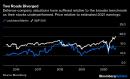
 (Bloomberg Opinion) — Add the lackluster performance of defense stocks to the long list of puzzling inequities in the pandemic stock market. A custom basket of top U.S. defense contractors within the S&P 500 Index is down about 20% for the year, even as the broader benchmark pushed into the green this week. Even excluding Boeing Co., whose commercial aerospace travails are more of a focus for investors, the group is still down about 16%. That’s significantly worse than the performance for S&P 500 railroads, restaurants, foot-wear makers and soft-drink companies, all of which are more immediately exposed to the volatility of economic reopenings and behavioral shifts than makers of missiles, fighter jets and radar systems that rely on government contracts sealed years earlier. Lockheed Martin Corp., which reported second-quarter earnings on Tuesday, displayed the sector's resilience amid the pandemic upheaval. Earnings, sales and cash flow were all higher than the year-earlier period, with cash balances helped in part by accelerated progress payments from the Department of Defense that were then passed on to suppliers. At a time when most companies are hesitant to make any concrete predictions about the immediate future, Lockheed touted a record $150.3 billion backlog and actually raised its guidance on all fronts. And yet even after a respectable 2.6% gain on Tuesday's earnings report, Lockheed still trades at roughly 14 times its estimated earnings in 2021. The valuation discount to the broader S&P 500 is just shy of the widest spread in at least five years.Fellow defense contractors Raytheon Technologies Corp., General Dynamics Corp. and Northrop Grumman Corp. are scheduled to report results next week, as is Boeing.The reason for the defense sector’s underperformance appears multi-fold. For one, defense contractors don’t really fit with the technology-focused bent of the recent upswing in stocks and because their business didn’t crash and burn as much as many others did, there’s less room for that mythical, V-shaped recovery many still hope will occur. Second, as Congress debates injecting at least $1 trillion more in stimulus funds into the pandemic-stricken economy, the deficit is set to explode and the government will likely have to make up some of that spending elsewhere. The worry is that the U.S.’s gargantuan defense budget will be a prime target, particularly if former Vice President Joe Biden succeeds in unseating President Donald Trump in this year's presidential election.Any hit to defense spending isn’t likely to be as bad as what’s suggested by current valuations, though. While the deficit may put a cap on defense spending growth, the volatile geopolitical situation likely creates a floor. Historically, there's a weak correlation between deficit-related economic variables — whether that’s business cycles or changes in tax policy — and defense spending, Melius Research analyst Carter Copeland noted on a call earlier this month. Material shifts in budgets tend to be more a reflection of changes in national-security posture, he said, such as President Barack Obama’s withdrawal from Iraq or President Ronald Reagan’s more aggressive stance toward Russia during the early part of his administration. And there’s not much room for that kind of rethink right now, regardless of who gets elected. Tensions are still running hot with the likes of Iran and North Korea, while Russia and China have taken increasingly aggressive postures. Copeland pointed to a Gallup poll published in March that found half of Americans view the current level of defense spending as “about right,” the highest percentage in more than 50 years. Asked on Lockheed’s earnings call Tuesday if the defense budget would decline, new CEO Jim Taiclet declined to “speculate on the behavior of people that are going to make independent decisions that we can’t predict,” but said the company’s divisions are planning for a wide range of scenarios to be prepared for any outcome. He made a point of citing a downturn as a potential opportunity for Lockheed to take advantage of depressed asset prices through strategic M&A. At the end of the day, “sentiment is fickle, while fundamentals are facts,” Vertical Research Partners analyst Rob Stallard wrote in a report last month. “While we think defense companies can’t do much about the slowing Department of Defense budget outlook, they are still growing and have good visibility, good cash flow and good valuations.” What more do you want? This column does not necessarily reflect the opinion of the editorial board or Bloomberg LP and its owners.Brooke Sutherland is a Bloomberg Opinion columnist covering deals and industrial companies. She previously wrote an M&A column for Bloomberg News.For more articles like this, please visit us at bloomberg.com/opinionSubscribe now to stay ahead with the most trusted business news source.©2020 Bloomberg L.P.
from Yahoo Finance https://ift.tt/2OKmFA3
 Software company Jamf made a stellar debut on the Nasdaq on Wednesday, with the stock soaring over 70% on its first day. Jamf CEO Dean Hager joins Yahoo Finance’s Zack Guzman to discuss.

 Galileo Russell, Hyperchange Founder & CEO joins the On the Move panel to discuss Tesla stock and how it’s moving in the markets.
 Yahoo Finance’s Adam Shapiro breaks down the stocks to watch Wednesday.
 Yahoo Finance’s Alexis Christoforous , Brian Sozzi and Ines Ferre break down what investors should keep a lookout for in Tesla’s second quarter earnings report.