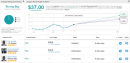
 Amid the recent surge of new COVID-19 cases, do stocks still have more room to climb? J.P. Morgan says yes. According to strategist Marko Kolanovic, who correctly called stocks’ March bottom, there are several reasons to remain squarely in the bull camp.First and foremost, he argues “positioning remains light around macro and systematic investors.” So, summer seasonality could “help the volatility spike continue to fade,” which means that investors may be looking to snap up shares as the summer continues. Additionally, the unprecedented stimulus brought about by the pandemic as well as the fact that the latest wave of COVID-19 cases is mainly affecting younger people also contribute to his bullish outlook.On top of this, should Biden win the U.S. presidential election in November, the market may get a boost. “Given the current economic weakness, business recovery and job growth are likely to be prioritized over policies that could dampen economic growth and perhaps even jeopardize the desired 2022 midterm election outcome… As such, the degree of corporate tax reversal may ultimately be lower than currently discussed,” J.P. Morgan chief U.S. equity strategist Dubravko Lakos-Bujas commented.Taking all of this into consideration, we used TipRanks’ database to take a closer look at three stocks flagged by J.P. Morgan analysts for their solid growth prospects. We’re talking about over 30% upside potential here. As it turns out, each ticker has also scored enough praise from the rest of the Street to earn a “Strong Buy” consensus rating.Rocket Pharmaceuticals (RCKT)Using an integrated multi-platform approach, Rocket Pharmaceuticals wants to develop innovative gene and cell therapies that could potentially cure serious diseases. Based on the strength of its technology, J.P. Morgan recently gave the company its stamp of approval.Writing for the firm, analyst Eric Joseph told clients, “In our view, Rocket is advancing a differentiated gene therapy platform, well-positioned against multiple rare pediatric diseases with either first- or best-in-class product candidates. Built around two delivery modalities (LVV for bone marrow affected disorders and AAV for systemic conditions), the company's pipeline boasts multiple shots on goal, the majority of which offering rapid timelines to commercialization.”Looking at its lead asset, RP-L102, which is now in pivotal development for Fanconi anemia (FA), Joseph points out that unlike stem cell transplant treatment, it drastically reduces the risk of conditioning therapy. As a result, he believes the therapy reflects a “breakthrough approach”. Should approval come at the beginning of 2024, the analyst estimates there’s a peak sales opportunity of $900 million in the U.S. and the EU, with the worldwide opportunity landing at over $1.5 billion.As for its RP-A501 candidate, Joseph also sees a major opportunity given that “Danon disease is one of the most prevalent life-threatening, monogenic disorders.” Just how large is the opportunity for this indication? More than $4.5 billion.With several potential catalysts, including preliminary histology and functional follow up from RPA501 in Danon disease, longer-term Phase 1 follow-up data from RP-L102 in FA and preliminary and follow up Phase 1 updates for RP-L301 and RP-L201, respectively, slated for the next six to twelve months, Joseph thinks the share price “under reflects risk the adjusted commercial potential of the pipeline.” Everything that RCKT has going for it prompted Joseph to rate the stock an Overweight, while setting a $38 price target. This target implies shares could climb 71% higher in the next year. (To watch Joseph’s track record, click here)Turning now to the rest of the Street, other analysts are on the same page. Only Buy ratings, 6, in fact, have been issued in the last three months, so the consensus rating is a Strong Buy. The $37 average price target puts the upside potential at 67%. (See RCKT stock analysis on TipRanks)Legend Biotech Corporation (LEGN)Like RCKT, Legend Biotech also focuses on developing cell therapies, with its candidates targeting cancer and other serious diseases. Given the robust clinical data that’s already available, it’s no wonder J.P. Morgan is on board.The potential of its lead development candidate is a key component of 5-star analyst Cory Kasimov’s bullish thesis. “To put it mildly, data from lead candidate LCAR-B38M / JNJ-4528 (BCMA-directed CAR T) have been very impressive,” he stated.Developed as part of a collaboration with Johnson & Johnson, the therapy was designed using a dual targeted BCMA autologous CAR T approach in relapsed/refractory multiple myeloma. “As of the last update at ASCO 2020, ‘4528 appears on track to have a best-in-class profile, demonstrating a 100% ORR and 2x the complete response rate of its nearest competitor. A pivotal data update in 2H20 will be key to confirm this,” Kasimov commented.Should the pivotal update remain on schedule, the candidate’s potential approval and launch could come in 2021. Even though CD19 CAR T launches have been lackluster in the past, Kasimov argues that they have opened the door for ‘4528.The analyst added, “This, along with the best-in-class clinical profile and a partnership JNJ, supports our bullish outlook, with robust initial uptake expected in the r/r multiple myeloma setting (we see $2.6 billion in worldwide peak sales in 2026)… If ‘4258 is able to maintain a CR rate that’s roughly 2x higher than any later-stage competitor, it could earn the edge in the commercial marketplace.”If that wasn’t enough, LEGN also has several other candidates that were developed using both auto and allogenic CAR T approaches. For its CAR T candidate, LB1901, in T cell lymphoma, the IND is slated for the second half of 2020.Based on all of the above, it’s clear why Kasimov is singing LEGN’s praises. In addition to kicking off his coverage with a bullish call, he put a $50 price target on the stock. (To watch Kasimov’s track record, click here) Other analysts also take a bullish approach. LEGN’s Strong Buy consensus rating breaks down into 3 Buys and zero Holds or Sells. With a $50.67 average price target, the upside potential lands at 31%. (See LEGN stock analysis on TipRanks)Kiniksa Pharmaceuticals (KNSA)As for the last stock on our list, Kiniksa Pharmaceuticals develops medicines designed to modulate immunological pathways for patients suffering from debilitating diseases with significant unmet medical need. On the heels of its recent data readout, KNSA has been on the receiving end of significant analyst attention. On June 29, the company published positive top-line results from the pivotal Phase 3 trial of rilonacept in patients with recurrent pericarditis. Weighing in on the development for J.P. Morgan, 5-star analyst Anupam Rama calls the results “clean/very encouraging”, with the data de-risking the regulatory pathway for the candidate.When it came to the primary endpoint of time-to-first adjudicated pericarditis recurrence, rilonacept generated a superior result when compared to the placebo. “Major secondary endpoints (maintenance of clinical response, proportion with absent or minimal symptoms at week 16) in the trial were all also highly stat sig, and rilonacept was well-tolerated (AEs injection site reaction was most common and overall was in line with those on the CAPS label),” Rama added.The robust data makes Rama even more confident in the therapy’s prospects, with the analyst having already ascribed a high probability of success to the program due to strong Phase 2 data.Expounding on this, the analyst noted, “Importantly, based on highly statistically significant results on median time-to-first adjudicated pericarditis recurrence (median was not reached in the rilonacept arm due to low event rate), we believe duration of therapy could be on the longer end of the previously assumed ~6-12 months (i.e., potentially a more chronic type therapy). We now estimate peak sales of rilonacept of ~$700 million-plus (prior ~$600 million-plus), driven by increased duration.”Adding to the good news, Rama argues that the Phase 2 mavrilimumab data readout in giant cell arteritis, which is on track for the fourth quarter, represents a significant catalyst that’s currently undervalued by the Street.In line with his optimistic take, Rama reiterated an Overweight rating. Additionally, the price target was lifted from $26 to $36. This new target conveys his belief that KNSA shares can jump 51% in the next year. (To watch Rama’s track record, click here) Judging by the consensus breakdown, other analysts also like what they’re seeing. 4 Buys and no Holds or Sells add up to a Strong Buy consensus rating. Based on the $36.75 average price target, the upside potential comes in at 54%. (See KNSA stock analysis on TipRanks)To find good ideas for stocks trading at attractive valuations, visit TipRanks’ Best Stocks to Buy, a newly launched tool that unites all of TipRanks’ equity insights.
from Yahoo Finance https://ift.tt/3gFBkZn






 Blink Charging CEO Michael Farkas joins the On the Move panel to discuss the company’s plan to bring touchless electric vehicle chargers to market.
 Vertex Pharmaceuticals broke out today. Volume light but that has been an issue as of late. Buy Point 295.65 was lost and now found.