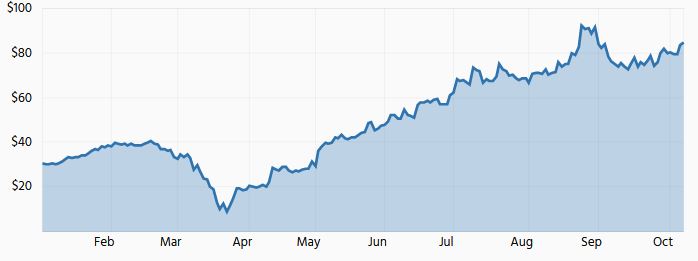
Intel Corporation (NASDAQ:INTC) stock is about to trade ex-dividend in three days. Ex-dividend means that investors…
from Yahoo Finance https://ift.tt/3gpkn5J
COVID-19 has changed the rules, yet growth is still the name of the game. Sure, it’s a strange time for growth investors. On the one hand, the Commerce Department just announced that in Q2 2020, real gross domestic product (GDP) decreased at an annual rate of 32.9%, with unemployment remaining at alarmingly high levels. On the other, stocks have been firing on all cylinders, with the S&P 500 bouncing back from March lows and turning positive year-to-date. That said, there are names that have positioned themselves for growth to the upside, according to the Street’s pros. Already notching some serious gains since the start of 2020, these companies have solid footings within their respective industries, with their growth prospects set to remain strong through the back half of the year and beyond. Past performance certainly doesn’t guarantee future results, but it’s an important factor to consider when searching for high-growth plays. Bearing this in mind, we used TipRanks’ database to pinpoint three stocks that have not only exhibited impressive year-to-date performances, but are also primed to rip even higher. All three tickers have received rave reviews, with analysts noting each appears undervalued. Ballard Power Systems (BLDP) Providing fuel cell (FC) power, Ballard Power Systems gives its clients access to innovative clean energy solutions that deliver a better performance at a reduced operating cost. Its year-to-date gain comes in at a whopping 98%, and some analysts believe there’s still plenty of fuel left in the tank. Four-star analyst Craig Irwin, of Roth Capital, counts multiple near-term catalysts as the reason for his optimistic approach, noting that they could “materially impact the revenue trajectory, and extend Ballard's leadership in fuel cell technology for heavy-duty and light-duty vehicles.” What are these catalysts? First and foremost, Irwin points to more clarity regarding Chinese, German, and UK FC subsidy programs. So far, the company has already delivered more than 700MW of FC products including modules and stacks for over 760 FC buses and 2,200 FC trucks that are currently in service, and 12,000 stacks for FC forklifts in operation. With Chinese subsidies potentially getting resolved, Irwin believes revenue from the Weichai JV could increase from $35-$40 million in 2020 to $135-$195 million per year, as production is slated to accelerate to 2,000-3,000 HD modules. Although there’s less certainty when it comes to the Bits road-Ocean/Synergy relationship, the analyst argues “it has similar potential to Weichai.” As for the Audi/VW opportunity, Irwin reminds investors that BLDP was approached for its development services back in 2013, with Audi/VW already spending over $110 million to date. “We estimate the contract has $15-$54 million in remaining capacity, and have always expected a commercial endpoint,” he commented. To this end, Irwin thinks his 2025 estimate “could easily be satisfied by delivery of modules for 2,500 U.S. and European FC buses and 6,000 kits for Chinese JV partners serving the HD market.” Adding to the good news, he said, “We believe Ballard is fully capitalized for the business plan through 2025, where potential for a more aggressive slate of customer deployments might be the most likely thing to require additional capital needs.” It’s clear why Irwin continues to take a bullish stance. In addition to keeping a Buy recommendation on the stock, he lifted the price target from $20 to $25. A twelve-month gain of 76% could be in store, should the analyst’s thesis play out in the year ahead. (To watch Irwin’s track record, click here) Turning now to the rest of the Street, opinions are split almost evenly. 3 Buys and 2 Holds add up to a Moderate Buy consensus rating. In addition, the $20.20 average price target brings the upside potential to 42%. (See Ballard Power Systems stock analysis on TipRanks) Plug Power (PLUG) Moving on to another fuel cell company, Plug Power offers hydrogen fuel cell (FC) systems designed to replace traditional batteries in electrically-powered vehicles and equipment. Even though it has already posted a year-to-date gain of 144%, several members of the Street believe this is just the beginning for PLUG. On July 16, the company launched its line of zero-emission stationary fuel cell systems called GenSure HP (high power). The products were built for large-scale, high-power backup power applications including data centers, energy storage systems, microgrids and other high-power commercial facilities. Digging deeper into the details, the platform’s product lineup will boast power configurations ranging from 500 kW to 1.5 MW, and the GenSure HP units will be configured using the modular 125 kW ProGen fuel cell engines that PLUG released in February of this year. PLUG is expected to kick off production of these units in December 2020, and they will be available for purchase in 2021. Adding to the good news, management stated it will offer GenSure HP as part of its turnkey packages that include power, fuel, installation, permitting and aftermarket service. Weighing in on this development for H.C. Wainwright, four-star analyst Amit Dayal tells clients that there are big implications. With an addressable market opportunity of roughly $15 billion, the move demonstrates the “leverage the company has with respect to its fuel cell and hydrogen platform.” Expounding on this, Dayal stated, “Though this is a competitive market, we believe the company's ability to offer a full-stack solution that includes servicing and maintenance, should provide an edge. We believe existing relationships with customers such as Amazon with respect to data center opportunities could prove beneficial. We believe material contribution from this new product line should begin in 2021. We expect more color on this initiative to be provided in the company's 2Q20 earnings call.” Dayal is a bit conservative when it comes to PLUG’s net revenues. The analyst estimates the figure could reach $1.1 billion in 2024, compared to the company’s guidance of $1.2 billion. However, from 2020 to 2028, he thinks revenues could increase from $278.8 million to $2.6 billion, at an eight-year CAGR of 32%. “We believe that the company should be able to grow its gross margins (excluding effect of warrants) from 14.3% in 2020 to 36.3% in 2028 as revenues rise. We expect the company to begin generating net profits in 2023,” Dayal added. Everything that PLUG has going for it keeps Dayal with the bulls. To this end, he maintained a Buy rating and $14 price target. What does this mean for investors? Upside potential of 82% is on the table. (To watch Dayal’s track record, click here) The bulls represent the majority on this one. Out of 10 total reviews published in the last three months, 8 analysts rated the stock a Buy, while 2 said Hold. So, the word on the Street is that PLUG is a Strong Buy. The $9.87 average price target implies shares could rise 28% in the next twelve months. (See Plug Power stock analysis on TipRanks) Zai Lab Ltd. (ZLAB) Switching to the healthcare sector, Zai Lab develops innovative and potentially transformative therapies for cancer, autoimmune and infectious diseases. Given its new deal with Turning Point Therapeutics and its 83% year-to-date gain, it’s no wonder ZLAB has scored praise from the analyst community. Among the healthcare name’s fans is Guggenheim’s Seamus Fernandez. The five-star analyst tells clients the recently inked deal could mean big things. As per the terms of the agreement, ZLAB will get the exclusive development and commercialization rights for repotrectinib in Greater China (mainland China, Hong Kong, Macau, Taiwan) for $25 million upfront. There’s also a possible $151 million in milestones and mid-to-high teen percentage royalties on net repotrectinib sales in Greater China. On top of this, Fernandez points out that ZLAB will open additional trial sites for the ongoing pivotal Phase 2 TRIDENT-1 study in Greater China and has the right of first negotiation for the next two Turning Point pipeline products that seek similar partnership opportunities in the region. He added, “We note the current estimated patent life is to 2034-35; we believe ZLAB could file in China at or around the same time (2022-23) as TPTX files repotrectinib assuming relatively quick turnaround to update the existing IND with Chinese authorities.” According to Fernandez, the deal is “another example of ZLAB's continued best-in-class licensing strategy in oncology.” Going further, he explained, “As a pioneer advancing the in-licensing business model in China, ZLAB management has partnered with several biopharma companies… we note that ZLAB's business development strategy, which targets overlapping areas of promotion within oncology, should add significant ‘operating leverage’ to the P&L with each new product launch.” Speaking to the therapy’s potential, repotrectinib’s efficacy and safety was in line with Rozlytrek’s, which is currently the preferred drug for ROS1m+ NSCLC. Therefore, it could address the unmet need of the 20,000-30,000 NSCLC patients with ROS1 as the driver mutation. It should also be noted that combination study updates for ZLAB and MacroGenics’ MGD013 are set to be presented at a scientific conference in 2H20, with this potentially reflecting an important aspect of HER2 therapy development plans, in Fernandez’s opinion. “The preliminary results for margetuximab in combination with MGD013 in HER2+ positive tumors (~43% ORR in HER2+ tumors), which compares to a ~12% ORR for margetuximab in HER2+ tumors (3 median prior lines) and the pembrolizumab + trastuzumab combination, which showed a ~15% ORR in PD-L1 positive breast cancer and no response in PD-L1 negative breast cancer (PANACEA trial), were compelling. The results were fascinating given that the ~43% ORR were in patients that were low expressers of PD-L1,” Fernandez commented. Based on all of the above, Fernandez reiterated a Buy rating. He also bumped up the price target from $75 to $105, suggesting 38% upside potential. (To watch Fernandez’s track record, click here) Do other analysts agree with Fernandez? They do. Only Buy ratings, 3, in fact, have been issued in the last three months, so the consensus rating is a Strong Buy. At $94.67, the average price target implies shares could surge 24% in the next year. (See Zai Lab stock analysis on TipRanks)
from Yahoo Finance https://ift.tt/3k2efmf
The coronavirus recession began with the sharpest economic contraction on record—a 32.9% drop in second quarter GDP. Yahoo Finance’s Rick Newman joined The Final Round to discuss why he thinks the V-shaped recovery is gone and gives this week’s Trumpometer reading.
from Yahoo Finance https://ift.tt/3fkeDJl
from Yahoo Finance https://ift.tt/2EJjHKz
Investing in penny stocks is primarily the domain of highly risk-averse market participants. The risk profile of penny stocks is, of course, a double-edged sword: investors could lose a lot of money on them, yet could also reap massive returns. Many investors do consider penny stock purchases, but there are significant differences between trading them and higher-priced stocks. We reached out to Finance Professor Andrei Simonov at the Eli Broad College of Business at Michigan State University. We wanted to know whether he believes penny stocks to be a worthwhile investment, or if they are simply too risky to merit a position within one's respective portfolio. Simonov wrote:InvestorPlace – Stock Market News, Stock Advice & Trading TipsBy 'Penny Stocks', different people understand different things. Mostly, it is the term used for "microcaps" or "nanocaps" sometimes not listed on any national exchange, mostly illiquid with high trading cost (Bid-Ask Spread) and high price impact of the trade. That would be OK, but in many cases, this is paired with a lack of verifiable fundamental information. That makes Penny Stocks prone to manipulation and different kinds of fraud. I believe that most small individual investors should avoid those stocks. However, there are other examples. In 2009, Citigroup was formally a penny stock. Granted, it was a highly speculative investment at a time. But "fallen angels" like that are worth looking at.Professor Simonov clearly falls nearer the conservative end of the investor spectrum, which is understandable given his position. It's true that penny stocks often lack the transparency and long financial track records of large-cap stocks. And yes, penny stocks will remain subject to unscrupulous businessmen who maliciously issue penny stocks with fraudulent intent. Thus, investors do need to tread carefully and conduct as much due diligence as possible in this asset class. With common sense and due diligence penny stock investors can succeed.Volatility is high across markets. Interest rates are low. Investors are facing risk no matter where they look, and the investment landscape isn't what it was a few years ago. It may be time to give penny stocks another look. Nevertheless, there are not only 'fallen angels' as Simonov suggests, but also emerging champions within the sector also worthy of investor speculation. For the risk-averse investor here is a list of seven penny stocks worth the risk: * Boxlight Corporation (NASDAQ:BOXL) * Biocept Inc. (NASDAQ:BIOC) * Ampio Pharmaceuticals (NYSEAMERICAN:AMPE) * eMagin Corporation (NYSEAMERICAN:EMAN) * Lynas Corporation Limited (ASX:LYC) * Ucore Rare Metals Inc (OTCQX:UURAF) * Byrna Technologies (CNSX:BYRN) * 7 Dividend Stocks to Buy for Beginners to Income Investing Bear in mind that these stocks all have catalysts making them worth a look. In many cases, a single macroeconomic catalyst alone will trump all other factors when evaluating penny stocks. For example, the stock of a company that benefits from a new federal mandate may provide massive returns after years of lackluster performance. Therefore, an appetite for risk, some luck, and calculated hedging of bets can equate to massive windfalls in penny stocks. Boxlight Corporation (BOXL)Source: Shutterstock Education is undergoing a big transformation around the world. And technology has been the darling of the pandemic. Fotunately, EdTech sits squarely at the confluence of these two sectors. Investors are curious to know what stocks exist therein. Boxlight Corporation is one such company. Like most small-cap stocks, they aren't a household name. The company develops and services eLearning software for the classroom. Essentially, this firm will seek to establish itself as a leader in this burgeoning sector. Their solutions include interactive digital software, 3D printing and robotics STEM-related assets, and certifications to name a few. Among them is its MimioConnect cloud platform for remote teaching and learning.In early July the company announced the appointment of two board members who should provide great direction. They have multiple decades of experience at highly respected forms in the industry. The firm also recently won two excellence awards from Tech & Learning magazine. Boxlight corporation has developed a lot of software and resources which give it many avenues to rise. BOXL shares eclipsed $4 per share in early July after having traded around $1 for the previous year. Current shares are near $2.65. Biocept Inc. (BIOC)Source: Shutterstock Given the search for a Covid-19 vaccine, this list could have easily been all biotech penny stocks. There are many exciting sectors and stocks elsewhere, but here I will focus on two of them.Biocept is a company involved with a Covid-19 vaccine. Primarily, the company deals with cancer diagnostics. The firm is undertaking a vote in order to do a reverse split of its stock to raise its price above the NASDAQ $1 minimum closing bid requirement. It will be delisted if shareholders vote against the reverse split. Clearly it is a volatile stock, yet it serves a noble cause in an important market. * 10 Gaming Stocks That Will Power Through the New Normal Biocept's involvement with a vaccine is bound to pique the interest of speculative investors. The company has assembled a Covid-19 testing kit which will be available in Q3 2020. It is clear the company is attempting to remain relevant with these two latest moves. Ampio Pharmaceuticals Inc. (AMPE)Source: Iryna Imago / Shutterstock.com Ampio Pharmaceuticals is another biotech company that is throwing its hat in the Covid-19 ring. Its primary business is the development of anti-inflammatory drugs against disorders including osteoarthritis and diabetic eye issues. Ampio Pharmaceuticals has been active in the news in the last week as it relates to the pandemic. Additionally, Ampio's drug Ampion is being touted as a treatment against inflammatory syndromes related to Covid-19. The company published a study to that effect on July 20. On July 23 it enrolled patients into its Ampion Covid-19 Program. Should the results prove positive, this stock could rocket upwards from its current $1.17 price. eMagin Corporation (EMAN)Source: Shutterstock eMagin produces OLED microdisplay technology. Its organic light emitting diodes have application in military, consumer, medical, and industrial markets. The company's share price has been marching solidly upward in a consistent channel pattern for the past year, having risen from 32 cents to roughly $1.20. Such a 300% price increase is certain to entice more investors. * 7 Cybersecurity Stocks Hard At Work While We Work From Home Unlike some other penny stocks, EMAN shares have lots of financial information with which to conduct due diligence. Lynas Corporation Limited (LYC)Source: Shutterstock Lynas Corporation is a rare earths miner. There are many such companies, but what sets Lynas apart is one powerful catalyst: its strategic partnership with the U.S. Government. The U.S. Government is worried about its ability to produce strategically important minerals. It is particularly worried about its over-reliance on China for strategic minerals used across industries. To that end it has given a contract to Lynas, an Australian company with significant operations in Malaysia. The contract will allow Lynas to begin building a heavy rare earth separation facility in Texas. When completed, the facility will be the only plant which can separate such metals outside of China. This should make clear the strategic importance of the contract. This looks like a potentially huge business with massive growth potential. Shares currently trade in the $2.50 range but jumped on the news. The Texas facility design will be ready sometime in 2021. U.S.-China tensions will dominate headlines perhaps for several decades. Thus, shares in companies like Lynas, which benefit from that reality, have great potential to grow for a long period. Ucore Rare Metals Inc. (UURAF)Source: Shutterstock Ucore Rare Metals may rise for the same reason that Lynas has risen. However, this seems to be much more speculative. Lynas is clearly a legitimate company with real operations. Ucore has much less transparency behind it. Its website is very thin on information. Nevertheless, it is a stock to keep an eye on. * 10 Gaming Stocks That Will Power Through the New Normal The company has supposedly developed a new, efficient process for separating and purifying rare earth elements. If it indeed aligns itself with U.S. national defense and can deliver, it should rise exponentially. Byrna Technologies (BYRN)Source: Shutterstock Byrna Technologies is attempting to fill a void in the self-defense market. The company produces what looks like a gun that fires bullets but actually fires chemical irritant projectiles. Basically, pepper spray paint balls. The company is trying to fill the void between close-range pepper spray, and longer-range guns which fire lethal bullets. Further, the projectiles are non-lethal and are intended to disarm attackers, or give users ample time to flee. Byrna may have cornered a large market of American self-defense consumers. Many Americans do not want the responsibility and potential liability associated with gun ownership. However, they do want to protect themselves. Byrna's products neatly provide a solution for these consumers. Therefore Byrna may have identified a lucrative revenue base. Byrna's shares have traded below 50 cents CAD since 2013. Shares only recently rose to around 1.70 CAD in June. It may be time to give a few of these penny stocks a serious look. Investors are facing volatility with most any stock. Therefore, now may be as good a time as any to take a risk. These shares are a good place to start.As of this writing, Alex Sirois did not own shares of any of the stocks above. More From InvestorPlace * Why Everyone Is Investing in 5G All WRONG * America's 1 Stock Picker Reveals His Next 1,000% Winner * Revolutionary Tech Behind 5G Rollout Is Being Pioneered By This 1 Company * Radical New Battery Could Dismantle Oil Markets The post 7 Penny Stocks Worth the Danger as Pandemic Catalyzes Growth appeared first on InvestorPlace.
from Yahoo Finance https://ift.tt/39Q0vGv
As expected, General Electric's (NYSE:GE) second-quarter earnings were dismal, sending GE stock lower by 4.35% on July 29, the day the report was delivered.Source: Sergey Kohl / Shutterstock.com The industrial conglomerate lost 15 cents a share in the June quarter though revenue of $17.75 billion beat Wall Street estimates of $17.12 billion. Although revenue was better than expected, these numbers represent regression from a company that desperately needs to show it can make progress. A year earlier, GE earned 16 cents a share on sales of $23.41 billion. Its Q2 2020 operating loss ballooned to $2.14 billion from $115 million.Broadly speaking, the industrial sector is a dud this year. The S&P 500 Industrial Index, a basket of large-cap industrial names, including GE, is lower by almost 11% year-to-date. The S&P 500 is up 1%.InvestorPlace – Stock Market News, Stock Advice & Trading TipsBy any measure, GE is an industrial offender with a 2020 loss of almost 41%.Yes, there could be sequential improvements in the third and fourth quarters for GE. But there are also reasons to be leery of the stock and strongly consider deploying elsewhere. * 7 Dividend Stocks to Buy for Beginners to Income InvestingLet's explore some of the potential pitfalls GE faces. GE Stock Beset by Boeing WoesSome analysts and market observers insist on being bullish on GE stock, noting that the second-quarter results could have been worse. "Could have been worse" or "less bad" generally aren't reasons to buy a stock. But, there are credible explanations behind the woeful April through June results delivered by GE.Put simply, Boeing (NYSE:BA), a prime customer of the GE aviation business, is still struggling. The aerospace giant reported a second-quarter loss of $4.79 a share on revenue of $11.81 billion. Analysts expected a loss of $2.54 on turnover of $13.16 billion. A supplier, whether it's selling widgets or jet engines, doesn't want numbers from one of its most important customers to look like that."We're working closely with our customers, suppliers and global partners to manage the challenges to our industry, bridge to recovery and rebuild to be stronger on the other side," Boeing CEO Dave Calhoun said in a statement.One way of interpreting that statement is Boeing is having difficulty forecasting when demand for passenger aircraft will rebound. Worse yet for Boeing, and thereby GE's aviation business, is the dreadful second quarter may not be the worst stretch for Boeing. Translation: things could get worse before they get better.Boeing said manufacturing volume will be reined in, which some analysts believe is a sign that cash flow margins could be crimped in the coming quarters.Boeing and GE are right to be concerned about the state of the airline industry. Any ebullience accrued following the U.S. economic reopening is gone because of surges of the novel coronavirus. This scenario is pressuring airlines, which are cutting summer routes. And with conserving cash the order of the day for the industry, adding new jets while so many are grounded is out of the question over the near term. Looking for Good News?If an investor is desperate for good news regarding GE, the company's cash burn rate declined in the June quarter.Being cash flow negative at $2.1 billion, which GE was, was far better than the $3.29 billion cash flow negative mark analysts expected the company to post.GE could be cash flow positive again sometime in 2021.To get there, costs have to be reduced. The company already divested an array of businesses, so the easiest way to boost cash is to lower headcount. That means thousands of job cuts could be on the way. Bottom Line on GE StockBottom line: Covid-19 is a hurdle for plenty of companies across myriad industries, but it's especially burdensome for GE.Here's why. Prior to the pandemic, the company was working on shoring up two units – GE Power and GE Capital. Now, aviation is another issue for a management team dealing with problems that plagued the stock for several years.Todd Shriber has been an InvestorPlace contributor since 2014. As of this writing, he did not hold a position in any of the aforementioned securities. More From InvestorPlace * Why Everyone Is Investing in 5G All WRONG * America's 1 Stock Picker Reveals His Next 1,000% Winner * Revolutionary Tech Behind 5G Rollout Is Being Pioneered By This 1 Company * Radical New Battery Could Dismantle Oil Markets The post The Worst May Not Be Over for General Electric appeared first on InvestorPlace.
from Yahoo Finance https://ift.tt/31h0nMu