• Coronavirus vaccine race: 7 key things you’ll want to know

    This article was originally published on Fool.com. All figures quoted in US dollars unless otherwise stated.

    Hand in blue glove picks out a vial labelled 'covid-19 vaccine' from a row of vials

    This article was originally published on Fool.com. All figures quoted in US dollars unless otherwise stated.

    Since the beginning of the COVID-19 pandemic, high hopes have been placed on the potential for a vaccine. The U.S. government established Operation Warp Speed, a program with the goal of accelerating the development of safe and effective novel coronavirus vaccines. Biopharmaceutical companies both large and small shifted resources to focus on COVID-19 vaccine research.

    Today, these efforts are closer to paying off than ever before. But what’s the real state of the coronavirus vaccine race? Here are seven key things you’ll want to know.

    1. Who the leaders are right now

    There are currently 180 COVID-19 vaccine programs in development, according to the World Health Organization (WHO). Thirty-five of those vaccine candidates are being evaluated in clinical studies with the rest in preclinical testing. Nine of the 35 clinical-stage COVID-19 vaccine candidates are in late-stage testing.

    Chinese drugmakers Cansino Biologics, Sinopharm, and Sinovac Biotech are developing four of the late-stage coronavirus vaccine candidates. Russia is already allowing a COVID-19 vaccine developed by Moscow’s Gamaleya Research Institute of Epidemiology and Microbiology to be administered to some individuals, although the vaccine is still in late-state testing.

    There are 4 late-stage COVID-19 vaccine candidates targeting the U.S. market:

    • Pfizer (NYSE: PFE) partnered with BioNTech (NASDAQ: BNTX) to develop BNT162b2, a vaccine that uses modified messenger RNA (mRNA) to spur the body to produce antibodies to the novel coronavirus SARS-CoV-2.
    • Moderna (NASDAQ: MRNA) is also developing an mRNA vaccine candidate, mRNA-1273. 
    • AstraZeneca (NYSE: AZN) teamed up with the University of Oxford to develop AZD1222, which delivers genetic material from the SARS-CoV-2 spike protein using a weakened version of the adenovirus (a common cold virus).
    • Johnson & Johnson (NYSE: JNJ) is starting its late-stage testing of Ad26.COV2.S this month.

    2. When a vaccine will likely be available

    There’s no way to be completely sure when a COVID-19 vaccine will be available. It’s possible that problems could arise in clinical studies. For example, AstraZeneca recently paused its late-stage clinical trial of AZD1222 due to a serious adverse reaction in a participant.

    However, the chances appear to be reasonably good that a coronavirus vaccine will receive FDA emergency use authorization (EUA) before the end of 2020. Pfizer and BioNTech expect to seek authorization for BNT162b2 in October if late-stage testing goes well. AstraZeneca and Moderna might not lag too far behind.

    It’s possible that there will be a phased roll-out of early COVID-19 vaccines. One potential scenario would be for healthcare workers and high-risk individuals to receive the vaccine first, followed by the rest of the population.

    3. How safe and effective the vaccines will be

    We won’t know how safe and effective individual COVID-19 vaccines will be until they’ve completed late-stage testing. However, to secure an EUA the FDA must determine that the benefits of the vaccine outweigh the risks. The agency has stated that it will review “the target population, the characteristics of the product, the preclinical and human clinical study data on the product, and the totality of the available scientific evidence relevant to the product” before granting an EUA. 

    To win full FDA approval, a COVID-19 vaccine will have to demonstrate at least 50% efficacy in a placebo-controlled clinical study. It will also need to meet the general safety requirements for previously approved vaccines for infectious diseases. 

    4. How many doses will be required

    Most of the coronavirus vaccines in late-stage testing require two doses, typically administered four weeks apart. Johnson & Johnson’s investigational COVID-19 vaccine, however, requires only one dose.

    5. How much a coronavirus vaccine will cost

    Coronavirus vaccines will be provided to all Americans at no cost. Healthcare providers, though, could charge insurers for the cost of administering the vaccines.

    6. Which vaccines could be in the second wave

    Three COVID-19 vaccines are currently in phase 2 clinical testing, according to the WHO. These include vaccines developed by Novavax (NASDAQ: NVAX), German biotech CureVac (NASDAQ: CVAC), and Chinese drugmaker Anhui Zhifei Longcom. Inovio Pharmaceuticals (NASDAQ: INO) is awaiting FDA approval to begin phase 2 testing of its coronavirus vaccine candidate as well.

    7. Which stocks are poised to win the most

    Any of the stocks of companies that win FDA EUA or approval for their respective COVID-19 vaccines will likely perform well. However, the smaller biotech stocks would almost certainly enjoy bigger gains than the big pharma stocks. This could mean that BioNTech and Moderna could be the biggest winners among the leaders in the coronavirus vaccine race.

    Keep in mind, though, that there’s still a risk that the vaccine candidates will stumble in clinical testing. The safer stocks to buy, therefore, will be those of large drugmakers such as AstraZeneca and Pfizer since the companies have enough product diversification to withstand a setback in their COVID-19 vaccine programs.

    This article was originally published on Fool.com. All figures quoted in US dollars unless otherwise stated.

    Man who said buy Kogan shares at $3.63 says buy these 3 ASX stocks now

    When investing expert Scott Phillips has a stock tip, it can pay to listen. After all, the flagship Motley Fool Share Advisor newsletter he has run for more than eight years has provided thousands of paying members with stock picks that have doubled, tripled or even more.*

    In this FREE STOCK REPORT, Scott just revealed what he believes are the 3 ASX stocks for the post COVID world that investors should buy right now while they still can. These stocks are trading at dirt-cheap prices and Scott thinks these could really go gangbusters as we move into ‘the new normal’.

    *Returns as of 6/8/2020

    More reading

    Keith Speights owns shares of Pfizer. The Motley Fool Australia’s parent company Motley Fool Holdings Inc. recommends Johnson & Johnson. The Motley Fool Australia has no position in any of the stocks mentioned. We Fools may not all hold the same opinions, but we all believe that considering a diverse range of insights makes us better investors. The Motley Fool has a disclosure policy. This article contains general investment advice only (under AFSL 400691). Authorised by Scott Phillips.

    The post Coronavirus vaccine race: 7 key things you’ll want to know appeared first on Motley Fool Australia.

    This article was originally published on Fool.com. All figures quoted in US dollars unless otherwise stated.

    from Motley Fool Australia https://ift.tt/3kfCoVD

  • 2 cheap small cap stocks

    pile of one dollar coins representing asx small cap stocks

    Cheap small cap stocks can be hard to find. Typically, they have a market capitalisation of between $50 million and $500 million. These smaller companies can get a bad rap for being more volatile than their larger ASX counterparts. However, there are a couple of great reasons to look at small cap stocks to add to your portfolio.

    Firstly, they offer some potentially higher speculative returns. Secondly, they don’t always move with the main market, such as the S&P/ASX 200 Index (ASX: XJO). This can sometimes be a blessing in disguise.

    The ASX 200 Index is looking a little flat right now. So, while it decides which direction it wants to move in, take a look at these two cheap small caps that are showing potential.

    2 cheap small cap stocks to consider buying

    BSA Limited (ASX: BSA)

    About BSA

    BSA Limited is a technical services organisation. It provides solutions to help clients implement the physical assets in the areas of building services, infrastructure and telecommunications. BSA runs its business and services through three main divisions – BSA Build, BSA Connect and BSA Maintain.

    Additionally, BSA provides consulting services through its BSA Think arm. Consulting helps clients realise solutions by enabling them to tap into a knowledge and innovative ideas database in the following areas:

    • Asset management
    • Design and building information modelling (BIM)
    • Energy management and sustainability
    • Cost planning
    • Project management
    • Compliance and certification

    BSA has a market cap of around $116 million. 

    Opportunity

    The BSA share price is currently selling for 27 cents at the time of writing. This is a substantial discount of more than 40% to its September 2019 highs of 46 cents. One thing I noticed about the BSA share price is that it has bounced higher several times before after reaching levels of 23 to 27 cents.

    We are currently in that area of value again and, I believe, it’s an opportunity to pick up this small cap stock at a great price. A bounce here could see it back at levels higher than 40 cents, resulting in potential returns of 40% or more.

    Financially, BSA is in a healthy position with assets exceeding liabilities. Consider BSA as one of the cheap small cap stocks for your portfolio.

    Ava Risk Group Ltd (ASX: AVA)

    About Ava

    Ava Risk Group is a leading provider of risk management services and technologies. It services clients in the commercial, industrial, military and government sectors.

    This company delivers solutions that are high tech and complex. It helps clients tackle risk management threats to perimeters, pipelines and data networks. Using bio metrics, card access control and locking, as well as secure international logistics, storage of high value assets and risk consultancy services, Ava delivers a suit of solutions. 

    A point to note about Ava is that it actually has a group of companies with specialist skills under its brand:

    • Future Fibre Technologies – a fibre optic, intrusion detection and location system specialist.
    • BQT Solutions – a security card, bio metric reader and electromagnetic lock developer, manufacturer and supplier.
    • Ava Global Logistics – a risk management specialist firm targeting the international logistics market.

    Ava has a market cap of around $73 million. 

    Opportunity

    The Ava share price had been largely sitting in the range of 10 to 20 cents for around three years. In 2020 however, the Ava Risk Group share price has risen more than 100% to currently trade at 33 cents at the time of writing. Interestingly, the last time the Ava share price tried to break past the 30 to 36 cents range in 2016, it failed and fell back down to lows of around 15 cents. So we now have another opportunity to try and break past this resistance level. Breaking up and above 36 cents could see the share price attempt to revisit the previous lofty heights of more than $1.00 it saw in 2015.

    Financially, Ava is in a healthy position with assets exceeding liabilities. 

    Foolish takeaway

    Cheap, small cap stocks can sometimes bring a world of trouble with them. These companies are often new or struggling financially.

    The difference with these two companies is that they are financially healthy with asset bases exceeding their liabilities. Additionally, they have established businesses and client bases.

    Buying small caps is no different to buying larger companies in that investors still need to do the appropriate research before jumping in. However, investors do need to be aware that smaller companies can often be more volatile than large caps. But having a small amount of exposure to cheap small caps in your portfolio can prove very rewarding if they perform well.

    These 3 stocks could be the next big movers in 2020

    When investing expert Scott Phillips has a stock tip, it can pay to listen. After all, the flagship Motley Fool Share Advisor newsletter he has run for more than eight years has provided thousands of paying members with stock picks that have doubled, tripled or even more.*

    In this FREE STOCK REPORT, Scott just revealed what he believes are the 3 ASX stocks for the post COVID world that investors should buy right now while they still can. These stocks are trading at dirt-cheap prices and Scott thinks these could really go gangbusters as we move into ‘the new normal’.

    *Returns as of 6/8/2020

    More reading

    Motley Fool contributor glennleese has no position in any of the stocks mentioned. The Motley Fool Australia has no position in any of the stocks mentioned. We Fools may not all hold the same opinions, but we all believe that considering a diverse range of insights makes us better investors. The Motley Fool has a disclosure policy. This article contains general investment advice only (under AFSL 400691). Authorised by Scott Phillips.

    The post 2 cheap small cap stocks appeared first on Motley Fool Australia.

    from Motley Fool Australia https://ift.tt/3c2PGlC

  • Why now is a good time to buy ASX defence shares

    piggy bank next to miniature army tank

    As geopolitical tensions rise among global powerhouses, there has never been a better time to invest in ASX defence shares. And demand is increasing for breakthrough technologies and specialist equipment from Australian defence contractors.

    Here’s why I believe these 4 ASX defence shares are undervalued and their share price could shoot higher in the coming years.

    Austal Limited (ASX: ASB)

    The shipbuilding giant designs and manufactures high performance vessels for commercial and defence customers worldwide. Most notably, Austal builds and services warships for the Australian Royal Navy and the United States Navy.

    Early this month, the Australian shipbuilder delivered its expeditionary fast transport, USNS Newport to the US Navy. This brings the total number of ships built for the US Navy to 24, including 3 combat ships this year.

    The Austal share price has sunk almost 16% after reporting its strong full-year results for 2020. The company has an order book of $4.3 billion to be fulfilled with 10 new ships to be built. As maritime relations become frosty between nations, I think the $3.16 Austal share price could be seen as a bargain in a few years.

    Electro Optic Systems Hldg Ltd (ASX: EOS)

    Electro Optic Systems is Australia’s largest aerospace entity. It’s also the largest defence exporter in the Southern Hemisphere, focusing on defence, space, and communications technology. Key applications include telescopes and dome enclosures, laser satellite tracking systems and fire control systems.

    The defence company recently reported that it had resumed delivery of a major overseas contract worth $150 million. Electro Optic noted this was a key step in restoring cash flow that was disrupted by COVID-19.

    The Electro Optic share price has misfired since reporting its FY20 results in late August, falling 17% to $5.13. As international borders start to reopen, the defence contractor is working towards clearing its $610 million worth of backlog products. In my opinion, this in-turn could lead the Electro Optic share price to dramatically rise.

    DroneShield Ltd (ASX: DRO)

    A leader in drone security technology, DroneShield designs and develops detection systems to protect people, organisations and critical infrastructure from drones.

    The DroneShield share price has been making tailwinds in the past month thanks to a raft of positive announcements. Last week, the company secured funding from the US Defence Department to develop its DroneSheild Complete Command-and-Control (C2) system. The worldwide leader in drone security technology also received an order from a major Southeast Asian country.

    The DroneShield share price is up 56% in the last 4 weeks from Friday’s market close of 20.5 cents. With a market capitalisation of $79 million, the company should reward shareholders if it can secure meaningful contracts in the future.

    Orbital Corporation Ltd (ASX: OEC)

    Advanced aerospace manufacturer, Orbital provides integrated engine systems for tactical unmanned aerial vehicles (UAV). Its tier 1 client base includes Insitu (a Boeing company), Northrop Grumman, Textron Systems and a large Singapore defence company.

    Engine development works are under way as Orbital seeks to build a hybrid propulsion system for the next generation of vertical take-off and landing UAVs. The company hopes to improve earnings and profitability on the sale of its flight critical components under the Insitu long-term agreement. In addition, Orbital is targeting new customer contracts and involvement in defence UAV programs.

    The Orbital share price has dropped more than 35% from its 52-week high to $1.05. The underlying importance of drone technology could be a major benefactor to Orbital’s bottom line. In light of this, I believe the Orbital share price is great value.

    These stocks could rocket in a Post-COVID world (FREE STOCK REPORT)

    When investing expert Scott Phillips has a stock tip, it can pay to listen. After all, the flagship Motley Fool Share Advisor newsletter he has run for more than eight years has provided thousands of paying members with stock picks that have doubled, tripled or even more.*

    In this FREE STOCK REPORT, Scott just revealed what he believes are the 3 ASX stocks for the post COVID world that investors should buy right now while they still can. These stocks are trading at dirt-cheap prices and Scott thinks these could really go gangbusters as we move into ‘the new normal’.

    *Returns as of 6/8/2020

    More reading

    Aaron Teboneras owns shares of Electro Optic Systems Holdings Limited. The Motley Fool Australia’s parent company Motley Fool Holdings Inc. owns shares of Austal Limited, Electro Optic Systems Holdings Limited, and Orbital Limited. The Motley Fool Australia has recommended Electro Optic Systems Holdings Limited. We Fools may not all hold the same opinions, but we all believe that considering a diverse range of insights makes us better investors. The Motley Fool has a disclosure policy. This article contains general investment advice only (under AFSL 400691). Authorised by Scott Phillips.

    The post Why now is a good time to buy ASX defence shares appeared first on Motley Fool Australia.

    from Motley Fool Australia https://ift.tt/33oOqW2

  • Here are the 10 most shorted ASX shares

    most shorted ASX shares

    Every Monday I like to look at ASIC’s short position report to find out which shares are being targeted by short sellers.

    This is because I believe it is well worth keeping a close eye on short interest levels as high levels can sometimes be a sign that something isn’t quite right with a company.

    With that in mind, here are the 10 most shorted shares on the ASX this week according to ASIC:

    • Webjet Limited (ASX: WEB) remains the most shorted share on the ASX by some distance after experiencing another increase in its short interest. Almost 15.8% of its shares are held short at present. Short sellers appear to believe Webjet’s shares are overvalued given current trading conditions.
    • Speedcast International Ltd (ASX: SDA) has seen its short interest remain flat at 10.6%. The communications satellite technology provider’s shares remain suspended whilst it completes its chapter 11 recapitalisation.
    • Myer Holdings Ltd (ASX: MYR) has seen its short interest reduce materially to 9.4%. Last week the department store operator’s shares crashed lower following the release of its full year results. Myer posted a 41.6% decline in earnings before interest, tax, depreciation and amortisation (EBITDA) to $305.3 million.
    • InvoCare Limited (ASX: IVC) has short interest of 9.2%, which is up week on week once again. Short sellers continues to increase their positions following a weak half year result by the funerals company.
    • IOOF Holdings Limited (ASX: IFL) has entered the top ten with 8.5% of its shares held short. Short sellers don’t appear convinced by the company’s plan to acquire the National Australia Bank Ltd (ASX: NAB) wealth business, MLC Wealth for $1,440 million.
    • Inghams Group Ltd (ASX: ING) has 8.2% of its shares held short, which is up slightly week on week. Short sellers aren’t giving up on the poultry company despite a high level of insider buying recently.
    • CLINUVEL Pharmaceuticals Limited (ASX: CUV) has also seen its short interest increase slightly to 8.1%. However, last week the biopharmaceutical company’s shares stormed higher after it announced plans to extend the use of its SCENESSE product to treat xeroderma pigmentosum.
    • FlexiGroup Limited (ASX: FXL) has 7.7% of its shares held short, which is flat week on week. This morning the financial services company’s shares are pushing higher after it announced plans to expand its buy now pay later platform into New Zealand.
    • Bank of Queensland Limited (ASX: BOQ) has seen its short interest rebound to 7.3%. Short sellers have been going after the regional bank this year after it warned that trading conditions were expected to remain tough for some time to come.
    • Nearmap Ltd (ASX: NEA) has entered the top ten with 7% of its shares held short. Much to the delight of short sellers, last week the aerial imagery technology and location data company’s shares crashed lower following a surprise capital raising.

    Finally, instead of those most shorted shares, I would be buying the exciting shares recommended below…

    These stocks could rocket in a Post-COVID world (FREE STOCK REPORT)

    When investing expert Scott Phillips has a stock tip, it can pay to listen. After all, the flagship Motley Fool Share Advisor newsletter he has run for more than eight years has provided thousands of paying members with stock picks that have doubled, tripled or even more.*

    In this FREE STOCK REPORT, Scott just revealed what he believes are the 3 ASX stocks for the post COVID world that investors should buy right now while they still can. These stocks are trading at dirt-cheap prices and Scott thinks these could really go gangbusters as we move into ‘the new normal’.

    *Returns as of 6/8/2020

    More reading

    James Mickleboro has no position in any of the stocks mentioned. The Motley Fool Australia’s parent company Motley Fool Holdings Inc. owns shares of Nearmap Ltd. The Motley Fool Australia owns shares of and has recommended Webjet Ltd. The Motley Fool Australia has recommended FlexiGroup Limited, InvoCare Limited, and Nearmap Ltd. We Fools may not all hold the same opinions, but we all believe that considering a diverse range of insights makes us better investors. The Motley Fool has a disclosure policy. This article contains general investment advice only (under AFSL 400691). Authorised by Scott Phillips.

    The post Here are the 10 most shorted ASX shares appeared first on Motley Fool Australia.

    from Motley Fool Australia https://ift.tt/2Fp567C

  • Did Apple and Tesla stock splits signal the stock market top?

    This article was originally published on Fool.com. All figures quoted in US dollars unless otherwise stated.

    Banknote ripped in half

    This article was originally published on Fool.com. All figures quoted in US dollars unless otherwise stated.

    Last month, Tesla (NASDAQ: TSLA) and Apple (NASDAQ: AAPL) carried out 5-for-1 and 4-for-1 splits respectively. Leading into the splits, both stocks furiously rallied to new highs on the news.

    With investors treating both split decisions so bullishly, it’s important to highlight the splits’ influence on market fluctuations in the past, and if this is truly an investable event. Let’s take a closer look.

    What is a stock split?

    Stock splits occur when a company decides to expand its existing share count by a certain number. Every shareholder receives additional shares for each share they previously held. For example, Tesla’s 5-for-1 split resulted in shareholders receiving 5 shares for every 1 share previously held.

    The new price per share is determined by dividing the previous share price by the factor by which the share float grew. This event has zero impact on a company’s valuation or future prospects. Instead of 1 share at $2000, you have 5 shares at $400.

    Some historical context

    Stock split popularity coincided with two noticeably troubling stock market crashes. The concept of a split was invented in 1927 where it was liberally used until the Great Depression ravaged markets in 1929.

    Splits can make it easier for inexperienced investors to try their hand in investing, thinking they are getting compelling deals. Some investors in 1929, however, didn’t have access to investing resources and didn’t fully grasp the lack of effect a stock split has on value. The pain was quite real for some in the years that followed with stock market averages dropping by 80% by 1932.

    What about the Dot-com bubble? Since 1980, markets have averaged 44 stock splits per year. From 1998-2000 — the peak of the Dot-com bubble — that number more than doubled to 91 average annual splits.

    That noticeable bump again coincided with the market peaking and later experiencing a painful crash. Just like in 1929, stock splits were taken — by some — as an event making stocks more affordable and valuable to shareholders. That is simply not the case. For hot Dot-com stocks like Qualcomm it took until last year to reclaim its all-time highs of $89.66 — nearly 2 decades after the technology bubble popped.

    Splits today

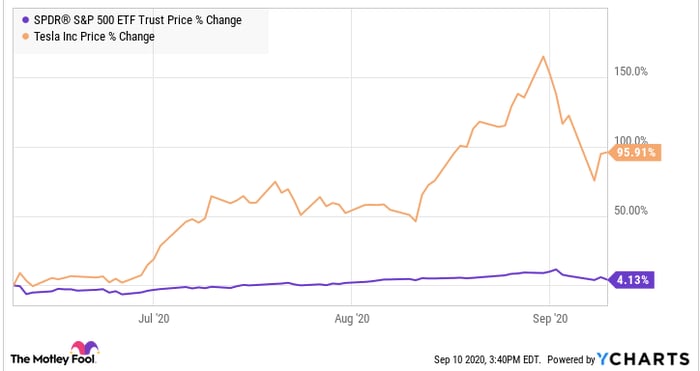
    This year, Apple’s and Tesla’s share prices rocketed higher in the weeks leading up to the announced splits. For example, in the 2 weeks prior to the event Tesla’s equity value jumped 81% with no other news. The chart below clearly depicts the notable outperformance Tesla has enjoyed over the S&P 500 since the announcement was made August 11th. It has since given back over half of that equity bump, but the stock is still far outperforming the S&P 500, as shown below. Apple’s price action has been slightly less volatile but similar. While the wildly swinging charts of Apple and Tesla do look eerily similar to split stocks in 1929 and 2000, there is reason to believe this time is different. Why?

    S&P 500 and Tesla stock charts over the last three months

    Image source: YCharts

    Today, cautionary resources on the irrelevant nature of a stock split are more readily accessible. Furthermore, the advent of fractional shares removed some of the demand for cheaper shares. Now investors can buy a small piece of an Apple share, rather than having to shell out well over $100 to do so. This essentially removes any unique benefit from splitting a stock. Fractional shares foster the same affordability for investors starting out that splits do, without all of the drama.

    Another interesting difference between this period of high-profile stock splits vs. prior periods? A 2020 federal funds rate that is below 1% versus over 5% in 1929 and 2000. Today’s historically low interest rates provide weaker direct competition to equity.

    With a Federal Reserve explicitly telling you it’s committed to higher inflation in recent meetings, that rate should continue to stay low and be a boon to equity valuations (raising rates is deflationary). While Apple and Tesla may be enjoying share returns due to a less-than-meaningful stock split, the returns could stick around amid monetary policy that is far more favorable than in 1929 or 2000.

    So what? 

    While I would totally avoid chasing parabolic stock price rises in response to stock splits, I do not believe this round of splits is depicting a market peak like it has in the past. Readily accessible resources on how little stock splits actually matter, fractional shares, and a Fed fixated on boosting inflation all provide a more comfortable setup for stock markets to continue pushing higher. Still, investors would be well-served tune out the noise associated with splits altogether.

    This article was originally published on Fool.com. All figures quoted in US dollars unless otherwise stated.

    These stocks could rocket in a Post-COVID world (FREE STOCK REPORT)

    When investing expert Scott Phillips has a stock tip, it can pay to listen. After all, the flagship Motley Fool Share Advisor newsletter he has run for more than eight years has provided thousands of paying members with stock picks that have doubled, tripled or even more.*

    In this FREE STOCK REPORT, Scott just revealed what he believes are the 3 ASX stocks for the post COVID world that investors should buy right now while they still can. These stocks are trading at dirt-cheap prices and Scott thinks these could really go gangbusters as we move into ‘the new normal’.

    *Returns as of 6/8/2020

    More reading

    Bradley Freeman owns shares of Qualcomm. The Motley Fool Australia’s parent company Motley Fool Holdings Inc. owns shares of and recommends Apple and Tesla. The Motley Fool Australia has recommended Apple. We Fools may not all hold the same opinions, but we all believe that considering a diverse range of insights makes us better investors. The Motley Fool has a disclosure policy. This article contains general investment advice only (under AFSL 400691). Authorised by Scott Phillips.

    The post Did Apple and Tesla stock splits signal the stock market top? appeared first on Motley Fool Australia.

    This article was originally published on Fool.com. All figures quoted in US dollars unless otherwise stated.

    from Motley Fool Australia https://ift.tt/3hm7Hwc

  • Is the Sydney Airport (ASX:SYD) share price a cheap buy?

    hand holding miniature plane suspended by face mask representing sydney airport share price

    It’s been a tough year for Sydney Airport Holdings Pty Ltd (ASX: SYD) shares. The travel industry has been hammered by the coronavirus pandemic and the Sydney Airport share price has slumped 34.3% lower.

    However, I think there is still a lot to like about Sydney Airport shares. Here are a few things I’m weighing up to decide if they represent a good value buy today.

    Why the Sydney Airport share price could be good value

    I think you have to look at Sydney Airport shares as a long-term buy. Clearly, the company’s earnings will be significantly hampered until at least mid-next year but potentially for many years.

    It’s best to look at Sydney Airport as an infrastructure company rather than a travel company. The group operates the busiest airport in the country and is underpinned by a blue chip asset base.

    Sydney Airport just completed a $1.3 billion capital raising to maintain its balance sheet strength. Shareholders supported the raising with a 93% uptake rate at a 1.7% share price discount.

    That flexibility will be the key to managing the COVID-19 impact and preparing for a rebound in coming years.

    Traffic numbers have plummeted as state and international borders have been slammed shut. That means any hopes for short-term cash flow are probably misguided.

    But if you look ahead, domestic and international travel will return. That means the Sydney Airport share price could be worth a look given the steep discount it’s trading at right now.

    No doubt there are risks to buying any travel-related ASX shares right now. However, the company’s assets and operations are vital from an economic and national security standpoint.

    Sydney Airport has historically paid a very healthy dividend as well. The long-term outlook still remains solid in my view.

    With a market capitalisation of over $14.0 billion, I think Sydney Airport could be a buy. It has the size, strength and strong shareholder backing to withstand short-term challenges.

    Foolish takeaway

    I think it’s foolish to bet on the Sydney Airport share price as a short-term dividend play. The group’s shares are paying 6.9% on paper but I wouldn’t bank on that in 2020.

    Instead, I look at Sydney Airport shares as a long-term infrastructure play. With a strengthened balance sheet and steep share price discount, the Aussie airport company could be in the buy zone.

    These 3 stocks could be the next big movers in 2020

    When investing expert Scott Phillips has a stock tip, it can pay to listen. After all, the flagship Motley Fool Share Advisor newsletter he has run for more than eight years has provided thousands of paying members with stock picks that have doubled, tripled or even more.*

    In this FREE STOCK REPORT, Scott just revealed what he believes are the 3 ASX stocks for the post COVID world that investors should buy right now while they still can. These stocks are trading at dirt-cheap prices and Scott thinks these could really go gangbusters as we move into ‘the new normal’.

    *Returns as of 6/8/2020

    More reading

    Motley Fool contributor Ken Hall has no position in any of the stocks mentioned. The Motley Fool Australia has no position in any of the stocks mentioned. We Fools may not all hold the same opinions, but we all believe that considering a diverse range of insights makes us better investors. The Motley Fool has a disclosure policy. This article contains general investment advice only (under AFSL 400691). Authorised by Scott Phillips.

    The post Is the Sydney Airport (ASX:SYD) share price a cheap buy? appeared first on Motley Fool Australia.

    from Motley Fool Australia https://ift.tt/2Ro3P37

  • Why the De Grey Mining (ASX:DEG) share price tumbled 13% lower today

    shares lower

    The De Grey Mining Limited (ASX: DEG) share price has returned from its trading halt and is tumbling lower today.

    In early trade the gold-focused mineral exploration company’s shares were down as much as 13% to $1.25.

    They have since recovered from most of this decline but are currently still down 4% to $1.38.

    Why is the De Grey share price tumbling lower?

    Investors have been selling De Grey’s shares this morning after it announced a $100 million capital raising.

    According to the release, the company has received commitments for a placement of approximately 83.4 million shares priced at $1.20 per share to raise $100 million before costs. This placement price represents a sizeable 16.4% discount to the last close price.

    Management advised that the placement was in high demand and was more than three times overbid. It feels this provides a strong endorsement of its assets.

    The company experienced high levels of institutional participation in the placement. This includes many Australian funds and global precious metals and other specialist resource funds from the Northern Hemisphere.

    Major shareholder DGO Gold Ltd (ASX: DGO) has committed to invest a further $12 million. This will result in a holding of 15.8% at completion. The company’s non-executive director, Peter Hood, has also committed to a further investment of $360,000. Though, these remain subject to shareholder approval.

    Why is De Grey raising funds?

    The proceeds of the placement will be used to fund a number of operational activities.

    These include ongoing extension and definition drilling of the Hemi discovery, testing of mineralised intrusions close to Hemi, regional exploration of intrusion and shear-hosted targets, enhanced site infrastructure, and early stage project de-risking studies.

    The company’s Managing Director, Glenn Jardine, commented: “The Hemi discovery in the Mallina Basin is rapidly moving towards our goal of defining a Tier 1 project with true district-scale potential. Mineralisation in the Hemi area has been identified over an area spanning +2,500m north-south and +2,000m east-west, with depths of +400m in areas tested.”

    “We already have 2.2 million ounces of Mineral Resources from our shear hosted deposits and expect to add substantially to this through the delivery of a maiden Mineral Resource Estimate for the Hemi discovery by mid-2021,” he added.

    Before concluding: “De Grey has never been better placed to achieve our goal of realising a Tier 1 gold project at Hemi.”

    Man who said buy Kogan shares at $3.63 says buy these 3 ASX stocks now

    When investing expert Scott Phillips has a stock tip, it can pay to listen. After all, the flagship Motley Fool Share Advisor newsletter he has run for more than eight years has provided thousands of paying members with stock picks that have doubled, tripled or even more.*

    In this FREE STOCK REPORT, Scott just revealed what he believes are the 3 ASX stocks for the post COVID world that investors should buy right now while they still can. These stocks are trading at dirt-cheap prices and Scott thinks these could really go gangbusters as we move into ‘the new normal’.

    *Returns as of 6/8/2020

    More reading

    Motley Fool contributor James Mickleboro has no position in any of the stocks mentioned. The Motley Fool Australia has no position in any of the stocks mentioned. We Fools may not all hold the same opinions, but we all believe that considering a diverse range of insights makes us better investors. The Motley Fool has a disclosure policy. This article contains general investment advice only (under AFSL 400691). Authorised by Scott Phillips.

    The post Why the De Grey Mining (ASX:DEG) share price tumbled 13% lower today appeared first on Motley Fool Australia.

    from Motley Fool Australia https://ift.tt/35x043N

  • Can IDP Education bounce back stronger after COVID-19?

    Despite a recent blip, the share price of IDP Education Limited (ASX: IEL) has rallied strongly over the last few weeks. Since the beginning of August, shares in the company have surged well over 40% higher to $19.21 as at the time of writing. And while this is still well short of the 52-week high of $25.17 IDP’s shares posted back in February, it is a reassuring sign for a company that has been hit hard by COVID-19 travel restrictions.

    IDP Education organises study placements for international students. Prior to the COVID-19 pandemic, IDP was on an exciting growth trajectory. By February, FY20 year-to-date revenue had already surged 22% higher year-on-year to $480 million, driven by increasing student volumes. The company was also strengthening its sales pipeline, with applications up 42% year-on-year.

    All this meant that FY20 was shaping up to be a breakout year for IDP. And the market agreed: in the 2 weeks after its first half results announcement in February, IDP shares skyrocketed almost 50%.

    But then COVID happened, and just as it seemed like things were really starting to get going, the wheels fell off. In April, the company was forced to admit that the measures governments were putting in place to halt the spread of coronavirus were having a material impact on its operations. Schools and universities in its destination markets (like Australia, the UK and the US) were closing, and international travel was being severely restricted.

    Despite reassurances by the company that it was cutting costs and making efforts to strengthen its balance sheet, the share price collapsed – dropping as low as $9.90 by mid-March. A year that was shaping up to be the best in the company’s history was fast turning into one it would sooner forget.

    So, what changed?

    Investors responded favourably to IDP’s full year results announcement, released to the market in the second half of August. The company reported an 11% year-on-year uplift in earnings before interest and tax to $107.8 million, while net profit after tax and amortisation rose 3% to $70.4 million.

    Additionally, IDP delivered on the promises it had made to shareholders back in March. The company ended FY20 with over $300 million in cash, thanks to a $254 million equity raise and a $175 million working capital facility. It also slashed overhead costs by $35 million over the second half of the financial year.

    IDP also boosted its online and digital presence in response to COVID-19. Many of its International English Language Testing System (IELTS) in-person centres were closed due to the pandemic, so IDP rolled out an online alternative that still allowed students to progress their study applications during lockdowns.

    Should you invest?

    With restrictions on international travel still likely to persist well into 2021 – not to mention the stop-start way many economies are trying to emerge from COVID-19 lockdowns – the road ahead could still be very bumpy for IDP, particularly over the near-term.

    However, the company is flush with cash at the moment and it is managing its costs responsibly. It also still has a strong sales pipeline with demand for overseas study from international students remaining robust throughout the pandemic. So, although there is still plenty of risk, IDP Education is doing everything it can to position itself for a strong rebound once international travel restrictions ease.

    These stocks could rocket in a Post-COVID world (FREE STOCK REPORT)

    When investing expert Scott Phillips has a stock tip, it can pay to listen. After all, the flagship Motley Fool Share Advisor newsletter he has run for more than eight years has provided thousands of paying members with stock picks that have doubled, tripled or even more.*

    In this FREE STOCK REPORT, Scott just revealed what he believes are the 3 ASX stocks for the post COVID world that investors should buy right now while they still can. These stocks are trading at dirt-cheap prices and Scott thinks these could really go gangbusters as we move into ‘the new normal’.

    *Returns as of 6/8/2020

    More reading

    Rhys Brock has no position in any of the stocks mentioned. The Motley Fool Australia’s parent company Motley Fool Holdings Inc. owns shares of Idp Education Pty Ltd. The Motley Fool Australia has no position in any of the stocks mentioned. We Fools may not all hold the same opinions, but we all believe that considering a diverse range of insights makes us better investors. The Motley Fool has a disclosure policy. This article contains general investment advice only (under AFSL 400691). Authorised by Scott Phillips.

    The post Can IDP Education bounce back stronger after COVID-19? appeared first on Motley Fool Australia.

    from Motley Fool Australia https://ift.tt/32ohMEC

  • Why stock market crash round 2 could be a rare opportunity to get rich and retire early

    hand holding four leaf clover against backdrop of sun setting over lake

    The chances of a second market crash could remain elevated over the coming months. Rising unemployment coupled with weak GDP growth may cause investor sentiment to decline.

    While this may cause paper losses for investors, it could also present a rare buying opportunity. Sharp stock market declines are relatively uncommon, and have historically been followed by sustained bull markets.

    As such, buying cheap stocks in a bear market may improve your long-term financial prospects, and could even help you to retire early.

    A second stock market crash

    Considerable risks remain in place that could cause a second market crash. As well as the prospect of a further rise in coronavirus cases, other threats could derail the financial performances of companies and cause investor sentiment to weaken.

    For example, the US election later this year may lead to fiscal policy changes that cause investors to adopt a more cautious attitude towards equities. Similarly, Brexit could lead to reduced business confidence that acts as a short-term drag on investor sentiment.

    Therefore, investors may yet experience another opportunity this year to buy stocks at extremely low prices due to a market crash.

    A rare event

    Even though the prospects for a second market crash may be relatively high, history shows that bear markets are uncommon. In fact, the last major decline in stock prices occurred over a decade ago. Therefore, most investors are only likely to experience a handful of bear markets during their lifetimes.

    This means that taking advantage of the low prices created by a stock market decline could be very important to your retirement prospects. They may enable you to buy high-quality businesses at relatively low prices. History shows that no bear market has ever lasted in perpetuity – even if at the time it felt as though a bull market was unlikely to ever return. Therefore, through buying a diverse range of stocks during rare opportunities when they are cheap, you could improve your prospects of retiring early.

    Retirement prospects

    While stock prices could be volatile for some time after the recent market crash, equity prices are likely to rally over the long run. With most investors having a number of years left until they plan to retire, they are likely to have sufficient time for their holdings to recover – even if there is a second downturn this year.

    Therefore, if a high-quality stock is trading at a low price today, buying it for the long run could be a shrewd move. Certainly, a second market decline could make it even cheaper. But, in many cases, that outcome has been priced in by investors through lower valuations. Therefore, building a portfolio over the coming months, and continuing to add to it even if there is a further bear market, could be a sound overall strategy.

    These 3 stocks could be the next big movers in 2020

    When investing expert Scott Phillips has a stock tip, it can pay to listen. After all, the flagship Motley Fool Share Advisor newsletter he has run for more than eight years has provided thousands of paying members with stock picks that have doubled, tripled or even more.*

    In this FREE STOCK REPORT, Scott just revealed what he believes are the 3 ASX stocks for the post COVID world that investors should buy right now while they still can. These stocks are trading at dirt-cheap prices and Scott thinks these could really go gangbusters as we move into ‘the new normal’.

    *Returns as of 6/8/2020

    More reading

    Motley Fool contributor Peter Stephens has no position in any of the stocks mentioned. The Motley Fool Australia has no position in any of the stocks mentioned. We Fools may not all hold the same opinions, but we all believe that considering a diverse range of insights makes us better investors. The Motley Fool has a disclosure policy. This article contains general investment advice only (under AFSL 400691). Authorised by Scott Phillips.

    The post Why stock market crash round 2 could be a rare opportunity to get rich and retire early appeared first on Motley Fool Australia.

    from Motley Fool Australia https://ift.tt/35xZdQj

  • Macquarie (ASX:MQG) share price sinks lower on FY 2021 guidance update

    business man looking tired and frustrated at desk surrounded by empty coffee cups

    The Macquarie Group Ltd (ASX: MQG) share price has come under pressure on Monday following the release of an update.

    At the time of writing the investment bank’s shares are down 4.5% to $120.60.

    What did Macquarie announce?

    Ahead of its appearance at the virtual Jefferies Asia Forum this week, Macquarie released an update on its short term outlook.

    According to the release, Macquarie expects market conditions to remain challenging in the near term. Especially given the significant and unprecedented uncertainty caused by the COVID-19 pandemic and the uncertain speed of the global economic recovery.

    And while the company acknowledges that these trading conditions make short-term forecasting extremely difficult, it is providing guidance for FY 2021 this morning.

    Macquarie currently anticipates its first half result to be down approximately 35% on the prior corresponding period. And although it expects an improvement in the second half of FY 2021, it is still guiding to a second half decline of 25% over the second half of FY 2020.

    However, this remains subject to a large number of factors. These predominantly include the duration and severity of the COVID-19 pandemic, the speed of the global economic recovery, and global levels of government economic support.

    In addition, other more traditional factors include the completion rate of transactions and period-end reviews, the impact of foreign exchange, potential regulatory changes and tax uncertainties, market conditions, and the impact of geopolitical events.

    What does this mean for the full year?

    In the first half of FY 2020 Macquarie posted net profit after tax of $1,457 million. For the full year it recorded a net profit after tax of $2,731 million, which implies a second half profit of $1,274 million.

    Based on this, in FY 2021 Macquarie looks set to deliver a first half profit of $948 million and a second half profit of $955 million. This will bring its full year profit to $1,903 million, down 30.3% year on year.

    One positive is that its capital position appears strong. Management advised that it continues “to maintain a cautious stance, with a conservative approach to capital, funding and liquidity that positions us well to respond to the current environment.”

    Man who said buy Kogan shares at $3.63 says buy these 3 ASX stocks now

    When investing expert Scott Phillips has a stock tip, it can pay to listen. After all, the flagship Motley Fool Share Advisor newsletter he has run for more than eight years has provided thousands of paying members with stock picks that have doubled, tripled or even more.*

    In this FREE STOCK REPORT, Scott just revealed what he believes are the 3 ASX stocks for the post COVID world that investors should buy right now while they still can. These stocks are trading at dirt-cheap prices and Scott thinks these could really go gangbusters as we move into ‘the new normal’.

    *Returns as of 6/8/2020

    More reading

    Motley Fool contributor James Mickleboro has no position in any of the stocks mentioned. The Motley Fool Australia owns shares of and has recommended Macquarie Group Limited. We Fools may not all hold the same opinions, but we all believe that considering a diverse range of insights makes us better investors. The Motley Fool has a disclosure policy. This article contains general investment advice only (under AFSL 400691). Authorised by Scott Phillips.

    The post Macquarie (ASX:MQG) share price sinks lower on FY 2021 guidance update appeared first on Motley Fool Australia.

    from Motley Fool Australia https://ift.tt/32p2FLc