• Why is this ASX mining stock crashing 27% today?

    The market may be pushing higher on Tuesday but the same cannot be said for the Red Hill Minerals Ltd (ASX: RHI) share price.

    The ASX mining stock is the worst performer on the All Ordinaries index today by some distance.

    In fact, at one stage today the Red Hill Minerals share price was down as much as 27% to $5.68.

    It has recovered a touch since then but remains down 22% to $6.19 at the time of writing.

    Why is this ASX mining stock crashing?

    The good news for shareholders of Red Hill Minerals is that this decline isn’t anything to be worried about. Rather, it could be something to get very excited about.

    That’s because the ASX mining stock is crashing today after trading ex-dividend for an upcoming special dividend.

    When a share trades ex-dividend, it means the rights to an upcoming dividend are now settled and new buyers will not be entitled to receive the payout on pay day.

    A dividend forms part of a company’s valuation. And if you’re not going to receive it, then you don’t want to pay for it when buying shares. This means that a share price tends to drop to reflect this.

    But why such a big decline? Well, that’s simply because the company is paying out an extremely large dividend.

    Big dividend

    This West Pilbara-based iron ore, gold, and base metals explorer recently announced the sale of a 40% interest in the Onslow Iron Project via the Red Hill Iron Ore joint venture to Mineral Resources Ltd (ASX: MIN).

    And with the Onslow Iron Project recently reporting its first shipment of ore to China Baowu Steel Group, this triggered the second payment of $200 million to the ASX mining stock from Mineral Resources.

    Last week, the company revealed that it would be returning proceeds from the sale to shareholders. It said:

    The Board of Directors of Red Hill Minerals Limited is pleased to advise that it has resolved to pay a special dividend of $1.50 per ordinary share, fully franked at 25%. The dividend will be sourced from the second of two $200 million payments received from Mineral Resources Limited for the sale of the Company’s 40% interest in the Red Hill Iron Ore Joint Venture.

    Based on its share price at the close of play on Monday, this represents a sizeable 19.2% dividend yield.

    Eligible shareholders can now look forward to receiving this dividend next week on 19 July.

    The post Why is this ASX mining stock crashing 27% today? appeared first on The Motley Fool Australia.

    Should you invest $1,000 in Red Hill Iron Limited right now?

    Before you buy Red Hill Iron Limited shares, consider this:

    Motley Fool investing expert Scott Phillips just revealed what he believes are the 5 best stocks for investors to buy right now… and Red Hill Iron Limited wasn’t one of them.

    The online investing service he’s run for over a decade, Motley Fool Share Advisor, has provided thousands of paying members with stock picks that have doubled, tripled or even more.*

    And right now, Scott thinks there are 5 stocks that may be better buys…

    See The 5 Stocks
    *Returns as of 24 June 2024

    More reading

    Motley Fool contributor James Mickleboro has no position in any of the stocks mentioned. The Motley Fool Australia’s parent company Motley Fool Holdings Inc. has no position in any of the stocks mentioned. The Motley Fool Australia has no position in any of the stocks mentioned. The Motley Fool has a disclosure policy. This article contains general investment advice only (under AFSL 400691). Authorised by Scott Phillips.


  • South32 shares whipsawed in FY24. Here’s the FY25 outlook

    two men in hard hats and high visibility jackets look together at a laptop screen that one of the men in holding at a mine site.

    South32 Ltd (ASX: S32) shares had a cyclical year in FY24.

    The stock began the year trading at $3.76 apiece before consolidating to its yearly low of $2.89 by February.

    Then, as commodity prices began to lift again, so too did South32 shares, reclaiming all of the prior losses from earlier in the year.

    They now trade at $3.71 apiece just after market open on Tuesday, after finishing FY24 at $3.66.

    Given the volatility in commodities – which has seen significant price fluctuations impact the metals and mining sector in the past 12 months – here’s a look at what’s in store for South32 in FY25.

    South32 shares whipsaw in FY24

    Investors saw their South32 shares trade in a range of 87 cents across the last financial year.

    As February rolled around, investors started buying South32 en masse. This can largely be attributed to favourable market conditions for its primary commodities.

    For instance, in the past year, South32 has benefitted from increased demand for materials like aluminium and manganese, which are crucial for green technologies and electric vehicles.

    The aluminium price is up from US$2,170 per tonne in February to US$2,528 per tonne currently.

    This is the highest aluminium price range since 2018, except for 2021-2022, when prices briefly rocketed to US$3,838 per tonne as economies reopened from COVID-19.

    In its quarterly update from April, South32 reported reasonably strong output from its aluminium and manganese operations.

    Aluminium production was up 1% year over year, underscored by record production at its Hillside Aluminium project. Meanwhile, the company’s manganese production in South Africa achieved an 8% growth production, equating to a record production run for the quarter.

    These results, combined with stronger pricing for the underlying metals, saw South32 shares rally from April to their 6-month highs of $3.96 apiece on 4 June.

    What’s in store for South32 in FY25?

    Analysts have reacted positively to South32’s recent developments. UBS, for instance, upgraded the miner to a buy, adjusting its price target to $4.15, which represents a 12% upside potential from the current price.

    The upgrade comes as UBS forecasts a rise in South32’s earnings by 13% to 34% over the next three years, driven by higher expected prices for manganese and alumina.

    Goldman Sachs rates South32 shares a buy, projecting $4.00 per share for the miner in the coming 12 months. The company forecasts up to US$550 million in free cash flow from South32 in its full-year results.

    Macquarie is also on this list of brokers positive on the stock with its $4.25 per share valuation.

    According to CommSec, South32 shares are rated a buy from 9 of the 15 brokers covering the stock. The remainder say it’s a hold.

    Foolish takeaway

    South32 shares whipsawed in a wide range throughout FY24. This is typical for an ASX mining stock, given the sensitivity of sales and earnings to the prices of commodities it mines and produces.

    Brokers nonetheless remain bullish on the company for FY25. Time will tell if their estimates are right. As always, consider current market conditions and perform your own due diligence.

    The post South32 shares whipsawed in FY24. Here’s the FY25 outlook appeared first on The Motley Fool Australia.

    Should you invest $1,000 in South32 Limited right now?

    Before you buy South32 Limited shares, consider this:

    Motley Fool investing expert Scott Phillips just revealed what he believes are the 5 best stocks for investors to buy right now… and South32 Limited wasn’t one of them.

    The online investing service he’s run for over a decade, Motley Fool Share Advisor, has provided thousands of paying members with stock picks that have doubled, tripled or even more.*

    And right now, Scott thinks there are 5 stocks that may be better buys…

    See The 5 Stocks
    *Returns as of 24 June 2024

    More reading

    Motley Fool contributor Zach Bristow has no position in any of the stocks mentioned. The Motley Fool Australia’s parent company Motley Fool Holdings Inc. has positions in and has recommended Goldman Sachs Group and Macquarie Group. The Motley Fool Australia has positions in and has recommended Macquarie Group. The Motley Fool has a disclosure policy. This article contains general investment advice only (under AFSL 400691). Authorised by Scott Phillips.
  • Is Nvidia stock a buy now?

    A man casually dressed looks to the side in a pensive, thoughtful manner with one hand under his chin, holding a mobile phone in his hand while thinking about something.

    This article was originally published on Fool.com. All figures quoted in US dollars unless otherwise stated.

    Rockstar artificial-intelligence (AI) stock Nvidia (NASDAQ: NVDA) likely has many investors tied in knots right now. Those who have thus far avoided shares of the company, which makes computer chips critical in AI’s development, have missed out on 200% returns over the past year alone. Now, shares have fallen a bit from their highs, which may leave investors wondering if the run is over or if this is just a pause before the stock’s next leg higher.

    Unfortunately, nobody can tell you the answer. However, this Fool has done the due diligence to prepare you for what might happen. Is Nvidia a stock to buy now? Here is what you need to know.

    Nvidia stock remains cheap at first glance

    The investment thesis for Nvidia is straightforward. Technology companies building massive data centers to run powerful artificial intelligence (AI) models are choosing Nvidia’s chips — so much so that experts estimate Nvidia’s market share for AI chips is as high as 90%. Nvidia has won this war with a quality product and proprietary software that helps developers easily configure the chips for AI applications.

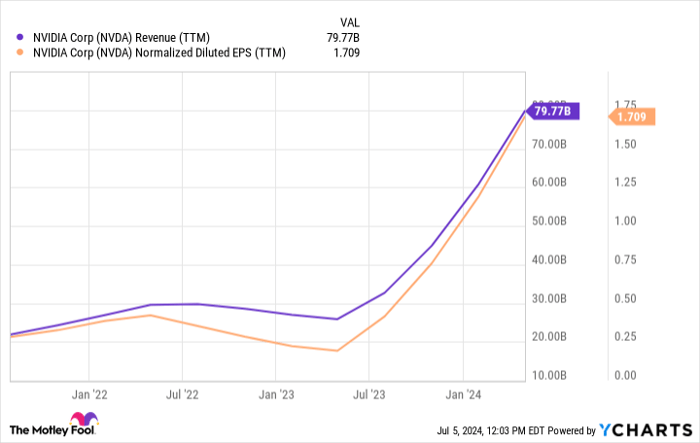
    The result has been eye-popping growth that has fueled the stock’s meteoric rise over the past few years:

    NVDA Revenue (TTM) Chart

    NVDA Revenue (TTM) data by YCharts

    Money could continue flowing into AI. Experts predict that America’s data center footprint could double by 2030. Lisa Su, CEO of rival company AMD, expects the AI chip market to grow to over $400 billion over the next few years. Better AI models may require increasingly better chips. CEO Jensen Huang has stated that Nvidia is aiming for annual AI chip releases.

    Analysts believe continued AI chip demand will drive Nvidia’s earnings growth by an average of 38% annually for the next three to five years. The stock’s forward P/E is 48 today. That’s a steep price tag, but it is one that Nvidia could easily grow into if it performed up to analysts’ expectations.

    There are potential risks in this promising tale

    It’s a hopeful story, but things could get ugly if it doesn’t go according to plan. Nvidia has grown remarkably fast; total revenue has more than doubled in short order. Maintaining that revenue (and growing it) requires that AI chip demand lives up to the hype and that Nvidia continues owning the lion’s share of that market.

    There are several realistic scenarios in which this might not happen. Nvidia gets a large chunk of its AI sales from a few large technology companies. What if those companies decide to design custom in-house chips instead? Or, what if these companies reach a point where they’re not getting a good enough return on investment on these chips? This isn’t for fun; AI must make these companies a ton of money to justify spending billions of dollars.

    None of these questions even factor in the reality that AMD, Intel, and others will all be gunning for Nvidia’s market share. Nvidia could retain its market share but face pricing pressure if competitors dramatically undercut its pricing with comparable chips.

    How should investors approach Nvidia stock?

    Everyone buying Nvidia stock now is banking on future growth, not what has already happened. Ultimately, the risk to investors is that Nvidia fails to deliver for whatever reason. And because of how giant Nvidia’s leap has been so far, going backward could be especially painful.

    That doesn’t mean investors should avoid the stock entirely. As shown above, the stock could still perform well if the company’s growth continues. The key is not chasing the stock, and keeping Nvidia to a small percentage of a diversified portfolio.

    Nvidia is the perfect opportunity for dollar-cost averaging, building an investment with small, repeated purchases. Slowly accumulating shares means you won’t be all-in to the stock too soon. You can steadily increase your investment as Nvidia shows it can maintain its growth. Let the company earn your investment dollars. It also would be less costly to pull your investment and move on if Nvidia gets in trouble.

    In this scenario, it’s heads-you-win, tails-you-win. That’s smart investing.

    This article was originally published on Fool.com. All figures quoted in US dollars unless otherwise stated.

    The post Is Nvidia stock a buy now? appeared first on The Motley Fool Australia.

    Should you invest $1,000 in Nvidia right now?

    Before you buy Nvidia shares, consider this:

    Motley Fool investing expert Scott Phillips just revealed what he believes are the 5 best stocks for investors to buy right now… and Nvidia wasn’t one of them.

    The online investing service he’s run for over a decade, Motley Fool Share Advisor, has provided thousands of paying members with stock picks that have doubled, tripled or even more.*

    And right now, Scott thinks there are 5 stocks that may be better buys…

    See The 5 Stocks *Returns as of 24 June 2024

    More reading

    Justin Pope has no position in any of the stocks mentioned. The Motley Fool Australia’s parent company Motley Fool Holdings Inc. has positions in and has recommended Advanced Micro Devices and Nvidia. The Motley Fool Australia’s parent company Motley Fool Holdings Inc. has recommended Intel and has recommended the following options: long January 2025 $45 calls on Intel and short August 2024 $35 calls on Intel. The Motley Fool Australia has recommended Advanced Micro Devices and Nvidia. The Motley Fool has a disclosure policy. This article contains general investment advice only (under AFSL 400691). Authorised by Scott Phillips.

  • What’s going on with the Mesoblast share price today?

    The Mesoblast Ltd (ASX: MSB) share price is having a disappointing session on Tuesday.

    In morning trade, the biotechnology company’s shares are down 4.5% to $1.07.

    As a comparison, the ASX 200 index is up 0.65% at the time of writing.

    What’s going on with the Mesoblast share price?

    Investors have been selling the allogeneic cellular medicines developer’s shares this morning despite the release of an announcement relating to its Ryoncil (remestemcel-L) product.

    According to the release, the company has resubmitted its biologic license application (BLA) for the approval of Ryoncil in the treatment of children with steroid-refractory acute graft-versus-host disease (SR-aGVHD).

    Management notes that the filing of this resubmission comes after Mesoblast was informed by the United States Food & Drug Administration (FDA) at the end of March that, following additional consideration, the available clinical data from the Phase 3 study MSB-GVHD001 appears sufficient to support submission of the proposed BLA for remestemcel-L for treatment of paediatric patients with SRaGVHD.

    It also highlights that the new filing addresses remaining CMC (Chemistry, Manufacturing, and Control) items.

    Commenting on the resubmission, Mesoblast’s CEO, Dr. Silviu Itescu, said:

    We have worked closely with the agency and thank them for their ongoing guidance, facilitating the potential approval of RYONCIL and addressing the urgent need for a therapy that improves the dismal survival outcome in children with SR-aGVHD.

    What now?

    The US FDA previously granted remestemcel-L Fast Track designation. This is a process to facilitate the development and expedited review of therapies for serious conditions that fill unmet medical needs.

    In addition, it has been granted Priority Review designation, which is given to drugs that treat a serious condition and provide a significant improvement in safety or effectiveness over existing treatments.

    As a result, the BLA resubmission is expected to have a review period of between two and six months from receipt once accepted.

    Why are its shares falling?

    Today’s weakness in the Mesoblast share price could be a case of buy the rumour and sell the news.

    In addition, there could be some profit taking going on from some investors that aren’t keen to stick around for up to six months to get a response from the US FDA.

    After all, over the past six months the Mesoblast share price has risen an enormous 285%. This means that investors buying in January would have almost quadrupled their money.

    Here’s hoping for good news in the coming months for its remaining shareholders.

    The post What’s going on with the Mesoblast share price today? appeared first on The Motley Fool Australia.

    Should you invest $1,000 in Mesoblast Limited right now?

    Before you buy Mesoblast Limited shares, consider this:

    Motley Fool investing expert Scott Phillips just revealed what he believes are the 5 best stocks for investors to buy right now… and Mesoblast Limited wasn’t one of them.

    The online investing service he’s run for over a decade, Motley Fool Share Advisor, has provided thousands of paying members with stock picks that have doubled, tripled or even more.*

    And right now, Scott thinks there are 5 stocks that may be better buys…

    See The 5 Stocks
    *Returns as of 24 June 2024

    More reading

    Motley Fool contributor James Mickleboro has no position in any of the stocks mentioned. The Motley Fool Australia’s parent company Motley Fool Holdings Inc. has no position in any of the stocks mentioned. The Motley Fool Australia has no position in any of the stocks mentioned. The Motley Fool has a disclosure policy. This article contains general investment advice only (under AFSL 400691). Authorised by Scott Phillips.

  • Telstra share price lifts off alongside its mobile pricing plans

    A female executive smiles as she carries out business on her mobile phone.

    The Telstra Group Ltd (ASX: TLS) share price is marching higher today.

    Shares in the S&P/ASX 200 Index (ASX: XJO) telco closed flat yesterday at $3.65. In morning trade on Wednesday, shares are swapping hands for $3.72 apiece, up 1.8%.

    For some context, the ASX 200 is up 0.6% at this same time.

    This comes as the company announces a boost to its mobile pricing plans.

    Telstra share price gains on mobile pricing increase

    ASX 200 investors are bidding up the Telstra share price after the telco said it will be amending the prices of its postpaid mobile plans commencing on 27 August and its pre-paid mobile plans as of 22 October.

    Most customers can expect to see their Telstra mobile plans go up between $2 and $4 a month.

    The company said the price increases reflect an approach that attempts to balance customer cost of living pressures with its own need to invest in evolving technologies and support continued strong customer demand on its mobile network.

    Telstra noted that over the past five years, network traffic on its mobile network has increased by around 3.5 times and continues to grow by 20% a year. To help manage this demand growth, the company invested $1.3 billion in mobile spectrum in FY 2024 to support more data and faster speeds.

    As the company announced on 21 May, its mobile plan will no longer be linked to an inflation-linked annual review.

    Why the move away from CPI-linked price increases?

    The market had mixed reactions to the telco’s move away from inflation-linked mobile pricing reviews.

    In fact, the Telstra share price closed down 2.7% on the day of the announcement. Although that announcement also involved the reduction of its workforce by some 2,800 employees as part of its cost-cutting program.

    Commenting on the move away from CPI-linked pricing on the day, CEO Vicki Brady said, “This approach reflects there are a range of factors that go into any pricing decision and will provide greater flexibility to adjust prices at different times and across different plans based on their value propositions and customer needs.”

    Brady added:

    We will continue to review our pricing and any changes will be communicated to customers in a timely and transparent way.

    Our mobiles business continues to perform strongly, with growth in subscriber numbers for the first four months of this half consistent with the first half of FY24. This success has underpinned our EBITDA growth in FY24 … and reflects the high demand for our products and the value customers place on our differentiated network, its reliability and our flexible plans.

    With today’s intraday moves factored in, the Telstra share price is down 6% in 2024.

    The post Telstra share price lifts off alongside its mobile pricing plans appeared first on The Motley Fool Australia.

    Should you invest $1,000 in Telstra Corporation Limited right now?

    Before you buy Telstra Corporation Limited shares, consider this:

    Motley Fool investing expert Scott Phillips just revealed what he believes are the 5 best stocks for investors to buy right now… and Telstra Corporation Limited wasn’t one of them.

    The online investing service he’s run for over a decade, Motley Fool Share Advisor, has provided thousands of paying members with stock picks that have doubled, tripled or even more.*

    And right now, Scott thinks there are 5 stocks that may be better buys…

    See The 5 Stocks
    *Returns as of 24 June 2024

    More reading

    Motley Fool contributor Bernd Struben has no position in any of the stocks mentioned. The Motley Fool Australia’s parent company Motley Fool Holdings Inc. has no position in any of the stocks mentioned. The Motley Fool Australia has positions in and has recommended Telstra Group. The Motley Fool has a disclosure policy. This article contains general investment advice only (under AFSL 400691). Authorised by Scott Phillips.

  • Here’s the earnings forecast through to 2028 for Coles shares

    Happy couple doing grocery shopping together.

    How much earnings a business makes can significantly impact a stock’s ability to generate shareholder returns. Investors often value a business based on its profit, so an increase in profit can lead to a higher share price. And the projected profit could be very influential on Coles Group Ltd (ASX: COL) shares.

    Dividends are paid from profit, so rising earnings can also lead to a growing payout. However, Coles’ passive income is not going to be my focus today.

    Let’s instead examine where broker UBS sees Coles’ profit generation going over the next few financial years.

    FY24

    UBS was impressed by the company’s recent FY24 third-quarter sales update, which showed that supermarket sales growth of 5.1% was stronger than its peers, with growth in areas like exclusive brands and online sales. The broker also referred to trade feedback that Coles’ in-store execution is improving.

    The broker suggests that theft issues in 2023 provide a basis for gross margin recovery and expansion, the new Witron automated distribution centres can provide cost savings, and Coles’ other cost-saving efforts can lead to “improved earnings momentum”.

    For FY24, UBS predicts that the supermarket business will generate revenue of $43.8 billion, earnings before interest and tax (EBIT) of $1.97 billion, and net profit after tax (NPAT) of $1.07 billion.

    FY25

    UBS currently has a price target of $18.25 on Coles shares, which suggests there could be capital growth of 7.2% over the next year.

    The improvements that UBS mentioned will flow through in FY25, leading to (projected) increased profit margins. UBS suggests Coles could generate $44.3 billion in revenue, $2.1 billion in EBIT, and $1.15 billion in NPAT in FY25.

    If that happens, it would represent a sales increase of 1.2% and an NPAT rise of 8.2%, implying a sizeable rise in the NPAT margin.

    FY26

    Top line and bottom growth could continue into FY26 according to UBS’ projections, which could support Coles shares.

    The broker has predicted that the company could generate $45.9 billion in revenue, $2.3 billion in EBIT, and $1.28 billion in NPAT.

    Those numbers imply the revenue could increase by 3.6% year over year, and NPAT might rise by 10.9%.

    FY27

    In the 2027 financial year, UBS has projected yet another rise for Coles shares’ financial metrics.

    The broker has projected that the company could generate $47.55 billion in revenue, $2.45 billion in EBIT, and $1.36 billion in NPAT.

    These numbers suggest that Coles could see a 3.6% increase in revenue and a 6.25% growth in NPAT.

    FY28

    UBS thinks FY28 could be another positive year for Coles (shares), with projections of further growth.

    Coles is predicted to deliver $49.2 billion in revenue, $2.6 billion in EBIT, and $1.4 billion in NPAT.

    If the company delivers on those projections, it would translate into 3.6% revenue growth and 5.8% NPAT growth.

    If UBS is right with its estimates, then Coles shares seem likely to see multiple years of earnings growth, which could be positive for shareholders.

    The post Here’s the earnings forecast through to 2028 for Coles shares appeared first on The Motley Fool Australia.

    Should you invest $1,000 in Coles Group Limited right now?

    Before you buy Coles Group Limited shares, consider this:

    Motley Fool investing expert Scott Phillips just revealed what he believes are the 5 best stocks for investors to buy right now… and Coles Group Limited wasn’t one of them.

    The online investing service he’s run for over a decade, Motley Fool Share Advisor, has provided thousands of paying members with stock picks that have doubled, tripled or even more.*

    And right now, Scott thinks there are 5 stocks that may be better buys…

    See The 5 Stocks
    *Returns as of 24 June 2024

    More reading

    Motley Fool contributor Tristan Harrison has no position in any of the stocks mentioned. The Motley Fool Australia’s parent company Motley Fool Holdings Inc. has no position in any of the stocks mentioned. The Motley Fool Australia has positions in and has recommended Coles Group. The Motley Fool has a disclosure policy. This article contains general investment advice only (under AFSL 400691). Authorised by Scott Phillips.

  • Guess which ASX 200 stock is tumbling after rejecting a takeover offer

    The Bapcor Ltd (ASX: BAP) share price is having a tough time on Tuesday.

    In morning trade, the ASX 200 stock is down 4% to $4.85.

    What’s going on?

    Investors have been hitting the sell button today after the auto parts retailer released a couple of announcements.

    This first announcement, which isn’t the reason for the decline, revealed that Bapcor has finally appointed its new leader.

    According to the release, Angus McKay has been named as Bapcor’s new executive chair and chief executive officer. McKay will take the reins next month on 22 August 2024.

    The release notes that the company’s new CEO has more than 30 years of executive experience with a proven track record of improving operating performance and increasing shareholder value over a range of industries both nationally and internationally.

    Most recently, since 2016 Angus McKay led 7-Eleven Australia through a period of significant strategic focus. This includes through the implementation of new operating models both in stores and in the organisation’s supply chain. Bapcor highlights that he improved profitability by embedding strong financial control and operational discipline as well as transforming culture and sustainability practices.

    Prior to that, Angus McKay was the CEO of The Skilled Group, managing director of Pacific National Rail, and the chief financial officer of Asciano Limited.

    Commenting on the appointment, the ASX 200 stock’s chair, Margie Haseltine, said:

    Angus is a proven leader with extensive experience. Throughout his career he has brought a strategic approach to expansion and operational efficiency. Along with his focus on cultural change, Angus is well placed to drive results in Bapcor’s strategic endeavours and in turn for Bapcor’s shareholders.

    Why is this ASX 200 stock falling?

    The reason for the weakness today is news that Bapcor has rejected the unsolicited, indicative, conditional, and non-binding proposal from Bain Capital Private Equity that was announced last month.

    Bain Capital Private Equity offered to acquire 100% of the shares in the ASX 200 stock (on a fully diluted basis) by way of a scheme of arrangement for $5.40 in cash per share.

    Commenting on the rejection, the company stated:

    The Bapcor Board has considered the Bain Proposal and the outlook for Bapcor in detail. The Bapcor Board has concluded that the Bain Proposal does not represent fair value for Bapcor, is not in the best interests of Bapcor shareholders and therefore has rejected the Bain Proposal.

    The post Guess which ASX 200 stock is tumbling after rejecting a takeover offer appeared first on The Motley Fool Australia.

    Should you invest $1,000 in Bapcor Limited right now?

    Before you buy Bapcor Limited shares, consider this:

    Motley Fool investing expert Scott Phillips just revealed what he believes are the 5 best stocks for investors to buy right now… and Bapcor Limited wasn’t one of them.

    The online investing service he’s run for over a decade, Motley Fool Share Advisor, has provided thousands of paying members with stock picks that have doubled, tripled or even more.*

    And right now, Scott thinks there are 5 stocks that may be better buys…

    See The 5 Stocks
    *Returns as of 24 June 2024

    More reading

    Motley Fool contributor James Mickleboro has no position in any of the stocks mentioned. The Motley Fool Australia’s parent company Motley Fool Holdings Inc. has no position in any of the stocks mentioned. The Motley Fool Australia has recommended Bapcor. The Motley Fool has a disclosure policy. This article contains general investment advice only (under AFSL 400691). Authorised by Scott Phillips.

  • I lie about my age, and I don’t see anything wrong with that

    Side angle profile of a woman with two hourglass clocks on either side and a bright green background.
    Age is the only thing Nicola Prentis lies about when dating.

    • Nicola Prentis has lied about her age since she was in her 20s.
    • She thinks society judges women so much that age has become a loaded topic.
    • Men often don't respect her privacy and try to find it out anyway.

    I've lied about my age for so long that, on any given day, I forget exactly how old I am. I could do the math and work it out, but why would I want to do that?

    I don't celebrate my birthday, and until I was outed by their father, I lied to my kids or avoided answering the "How old are you, Mommy?" question. Their father knew I didn't want anyone to know because I'd avoided telling him my age when we got together. It was a subterfuge I'd have happily maintained indefinitely, but he accidentally saw a police form I was filling out for a stolen wallet. I'm half sure he told my sons out of spite once we'd split up.

    I was in my 20s when I started lying about my age

    When I started lying about my age, I was 24. That was when I first experienced negativity and judgment from other people when they asked how old I was.

    At 22, I graduated from university in the UK with a philosophy degree. Philosophy isn't exactly a major with a clear career progression, and I spent a couple of years aimlessly taking temporary jobs in local warehouse depots and backpacking in Mexico.

    For the first two years, when anyone asked me what I was planning to do with my life, I'd say I didn't know. "You're young, you'll work it out," they'd say encouragingly. But, at 24, that turned into comments basically saying, "It's time to grow up."

    As I got older, the pressures linked to my age morphed into expectations around marriage and having children. This was at its height when I lived in Turkey, and my Turkish ex-boyfriend's family said I was too old for him at 34. He was 34 too. In the subsequent relationship, when I did eventually have two babies without complications, they were labeled "geriatric" pregnancies because I was no longer under 35.

    Internet dating creates an unacceptable requirement to reveal your age

    Being on dating apps raised the issue again because you're required to list your age front and center on your profile — even, ridiculously, on apps where users typically use a handle that's not their actual name.

    In real life, that's not how we introduce ourselves to people even in a dating context. You'd find out where they're from, what they do, and about hobbies. The spark comes from a hundred other things than the number of years since you were born. So why should I have to reveal my number before we've even met?

    I combatted this by either paying for a profile so age was optional or I just registered with a fake birthdate. Nowadays, no longer internet dating, I just refuse to give a number rather than lie as it gets too difficult to remember who I told what to.

    I've heard people claim that lying about age is a huge red flag because it means you'll lie about other things too. That's simply not the case. That's the only thing I lie about in all my relationships, and I don't think there's anything wrong with that.

    Women are judged constantly about their age

    It's a sore point for me because age is none of anyone's business, just like my weight, diary, or latest PAP smear results. If people stopped asking this invasive question, I wouldn't have to lie about it. The wrong here is that people ask in the first place. We all know the question isn't a judgment-free inquiry.

    "How old are you?" is loaded with society's expectations of what you should look like, act like, or earn for your age. Your answer determines how worthy and how successful you are.

    This is especially the case for women. We're judged harshly for getting older, but somehow we are also at fault for not embracing it. Every day I am bombarded with headlines in the media criticizing celebrities who are aging as well as those who are trying to reverse aging with fillers or surgery. "Age gracefully" is shorthand for "don't look older but also don't try not to." Men who try to defy aging, on the other hand, are celebrated as "biohackers" and inspirational visionaries for what the human body can achieve.

    Far worse than my evasion or lie is how people, especially men, don't respect my privacy or boundaries even though I don't ask or care about their age. Several men have searched my social media profiles for clues or threatened to look for my passport. Would they do the same about my weight?

    I understand that it's impossible to keep my age a secret forever in a long-term relationship. There's simply too much life admin to do together to hide it. But until that point comes, I will continue to avoid the topic or choose an age I think I can get away with. My real age is no one's business.

    Got a personal essay about dating or life as a single parent that you want to share? Get in touch with the editor: akarplus@businessinsider.com.

    Read the original article on Business Insider
  • Overinvested in ASX-focused ETFs? Here are three alternatives

    ETF in written in different colours with different colour arrows pointing to it.

    ASX-focused exchange-traded funds (ETFs) are some of the most popular funds in Australia. But investors could be missing out if they are overinvested in funds that are focused on the ASX share market.

    Several of the biggest ASX ETFs aim to give investors exposure to 200 or 300 of the largest businesses on the ASX. I’m talking about funds like Vanguard Australian Shares Index ETF (ASX: VAS), SPDR S&P/ASX 200 ETF (ASX: STW), iShares Core S&P/ASX 200 ETF (ASX: IOZ) and BetaShares Australia 200 ETF (ASX: A200).

    However, the main ASX indices are heavily focused on just a few large blue chips, mainly from two sectors – ASX bank shares and ASX mining shares. We’re talking about names like BHP Group Ltd (ASX: BHP), Commonwealth Bank of Australia (ASX: CBA), National Australia Bank Ltd (ASX: NAB), Westpac Banking Corp (ASX: WBC), ANZ Group Holdings Ltd (ASX: ANZ), Rio Tinto Ltd (ASX: RIO) and Fortescue Ltd (ASX: FMG).

    However, the ASX only accounts for 2% of the global share market, and many of the world’s strongest businesses are listed outside of Australia. The global share market has outperformed the ASX thanks to the focus on growth of those large businesses like Microsoft, Alphabet and Nvidia.

    With that in mind, I’m going to name three international ETFs that could provide balance to portfolios that are too heavily weighted to ASX ETFs.

    Betashares Global Quality Leaders ETF (ASX: QLTY)

    This fund invests in a portfolio of 150 international companies that rate highly on quality metrics.

    Those rankings are based on a combined ranking of four factors – return on equity (ROE), debt-to-capital, cash flow generation ability and earnings stability. A business that strongly ticks all four of these boxes is rare and is often able to deliver good returns for shareholders.

    To me, it’s no surprise the QLTY ETF has returned an average of 14.2% per annum over the last five years, though past performance is not a guarantee of future performance.

    The holdings are fairly similarly weighted, with the largest position having a 2.4% weighting. The four positions with an allocation of more than 2% are Adobe, Intuit, Servicenow and Accenture.

    VanEck MSCI International Quality ETF (ASX: QUAL)

    This is another QUAL ETF that chooses its holdings based on certain quality metrics.

    Its portfolio includes around 300 holdings from around the world, with stocks from the US, Switzerland, the UK, Denmark, and the Netherlands each making up more than 3% of the fund.

    There are three factors that dictate whether a stock will make it into this portfolio: a high ROE, earnings stability and low financial leverage. A business that ranks highly on all three of these factors is likely to be a high-quality idea.

    Impressively, the QUAL ETF has returned an average of 17.1% in the last five years. Again, past performance is not a guarantee of future performance.

    Currently, there are four positions with a weighting of more than 5%: Nvidia, Apple, Meta Platforms and Microsoft.

    VanEck Morningstar Wide Moat ETF (ASX: MOAT)

    This ETF’s portfolio is decided by analysts at Morningstar, who are looking for US businesses with strong competitive advantages that are expected to endure for at least two decades. Economics moats can come in many different forms, such as brand power, cost advantages or patents.

    After that, the MOAT ETF only invests in these great businesses if they’re trading at an attractive valuation compared to what the Morningstar team think that business is worth.

    At the moment, the VanEck Morningstar Wide Moat ETF is invested in Adobe, International Flavours & Fragrances, Altria and Campbell Soup.

    In the last five years, the MOAT ETF has delivered an average return per annum of 14.75%.

    The post Overinvested in ASX-focused ETFs? Here are three alternatives appeared first on The Motley Fool Australia.

    Should you invest $1,000 in Vaneck Investments Limited – Vaneck Vectors Morningstar Wide Moat Etf right now?

    Before you buy Vaneck Investments Limited – Vaneck Vectors Morningstar Wide Moat Etf shares, consider this:

    Motley Fool investing expert Scott Phillips just revealed what he believes are the 5 best stocks for investors to buy right now… and Vaneck Investments Limited – Vaneck Vectors Morningstar Wide Moat Etf wasn’t one of them.

    The online investing service he’s run for over a decade, Motley Fool Share Advisor, has provided thousands of paying members with stock picks that have doubled, tripled or even more.*

    And right now, Scott thinks there are 5 stocks that may be better buys…

    See The 5 Stocks
    *Returns as of 24 June 2024

    More reading

    Randi Zuckerberg, a former director of market development and spokeswoman for Facebook and sister to Meta Platforms CEO Mark Zuckerberg, is a member of The Motley Fool’s board of directors. Suzanne Frey, an executive at Alphabet, is a member of The Motley Fool’s board of directors. Motley Fool contributor Tristan Harrison has positions in Fortescue. The Motley Fool Australia’s parent company Motley Fool Holdings Inc. has positions in and has recommended Accenture Plc, Adobe, Alphabet, Apple, Intuit, Meta Platforms, Microsoft, Nvidia, and ServiceNow. The Motley Fool Australia’s parent company Motley Fool Holdings Inc. has recommended the following options: long January 2025 $290 calls on Accenture Plc, long January 2026 $395 calls on Microsoft, short January 2025 $310 calls on Accenture Plc, and short January 2026 $405 calls on Microsoft. The Motley Fool Australia has recommended Adobe, Alphabet, Apple, Meta Platforms, Microsoft, Nvidia, ServiceNow, and VanEck Morningstar Wide Moat ETF. The Motley Fool has a disclosure policy. This article contains general investment advice only (under AFSL 400691). Authorised by Scott Phillips.

  • 5 reasons I’d throw Guzman y Gomez shares in the bin like a bad burrito

    Guzman Y Gomez Ltd (ASX: GYG) shares have been in the spotlight over the past few weeks following the quick service restaurant operator’s highly successful initial public offering (IPO).

    The Mexican food chain rocketed as much as 36% on day one to a high of $30.00 after listing on the Australian share market at $22.00.

    This gave the company a mouth-watering market valuation of $3 billion at the time.

    But while some investors may have a taste for Guzman Y Gomez shares, I am avoiding them like a bad burrito right now. Let’s take a look at five reasons why I think investors should put its shares in the bin.

    Reason 1: Guzman y Gomez shares are overvalued

    Guzman Y Gomez shares are trading on mind-boggling multiples.

    According to its prospectus, revenue is expected to be $339.7 million in FY 2024, with a profit after tax of $3.4 million. Then, revenue of $428.2 million is forecast for FY 2025, with a profit after tax of $6 million. The latter will mean a profit margin of just 1.4%.

    Based on its current market capitalisation of $2.93 billion, this means its shares are trading at ~488x estimated FY 2025 earnings.

    As a comparison, KFC restaurant operator Collins Foods Ltd (ASX: CKF) is trading at 16.8x estimated FY 2025 earnings, according to analysts at UBS.

    Reason 2: Guzman y Gomez has no moat

    I’m not afraid to invest in companies with high price-to-earnings multiples (P/E ratios).

    For example, one large holding in my portfolio is Pro Medicus Limited (ASX: PME). You will find that it trades on one of the highest P/E ratios. However, it has a wide moat, an unmatched platform, high margins, a huge market opportunity, and large long-term contracts with locked-in revenue.

    Guzman Y Gomez has no moat, lots of competition, tiny margins, and no guarantee that customers are going to come back week after week, let alone year after year. In light of this, I don’t believe for a second that it justifies trading on such high earnings multiples.

    Reason 3: Its growth plans look too ambitious

    Some investors argue that Guzman Y Gomez shares deserve to trade on high multiples because of its ambitious growth plans. But I would argue that these plans are too ambitious.

    The company has an aspiration to open 1,000 restaurants in Australia. This compares to the 185 restaurants that it operates across the country today.

    However, McDonald’s only has 970 restaurants in Australia today. I don’t believe Guzman Y Gomez could get anywhere near that number and still generate good returns on store openings. McDonald’s is a force of nature, with a menu that offers something to everyone at any time of the day. I don’t believe you can say the same for Guzman Y Gomez’s menu.

    While I think it still has a decent growth runway, I believe there will come a point (sooner than it thinks) when it starts to cannibalise sales.

    Reason 4: US expansion could be a flop

    Another reason that investors believe Guzman Y Gomez shares justify a premium valuation is its US expansion. But I think investors should be very wary about this expansion and place little to no value on it until it has demonstrated this in the highly competitive market.

    At present, it has a handful of stores in the US, and they are all loss-making. I have doubts they will be able to scale to a level that generates meaningful profits, especially given the competition it faces over there. Chipotle is essentially the Guzman Y Gomez of the United States and has approximately 3,400 restaurants across the country.

    And that’s just Mexican food competition. The United States has more fast food options for consumers than you can shake a fork at.

    Reason 5: Conflicted bullish broker?

    Guzman Y Gomez shares have been roaring higher in recent sessions after analysts at Morgans initiated coverage with an add rating and $30.80 price target.

    While Morgans was not named in the company’s prospectus, the AFR is reporting that the “broker quietly co-led the company’s IPO, with its junior sell-side analyst even getting his slice.”

    In light of this, I would not place much weight on this recommendation. Instead, I would focus more on Ord Minnett’s valuation of $15.00.

    Conclusion

    Overall, I think Guzman Y Gomez shares are vastly overvalued at current levels and could be destined to crash deep into the red once the hype dies down and if its growth plans start to falter.

    In light of this, I plan to wait until its shares are trading in or around the $7 to $10 mark before considering an investment.

    The post 5 reasons I’d throw Guzman y Gomez shares in the bin like a bad burrito appeared first on The Motley Fool Australia.

    Should you invest $1,000 in Guzman Y Gomez right now?

    Before you buy Guzman Y Gomez shares, consider this:

    Motley Fool investing expert Scott Phillips just revealed what he believes are the 5 best stocks for investors to buy right now… and Guzman Y Gomez wasn’t one of them.

    The online investing service he’s run for over a decade, Motley Fool Share Advisor, has provided thousands of paying members with stock picks that have doubled, tripled or even more.*

    And right now, Scott thinks there are 5 stocks that may be better buys…

    See The 5 Stocks
    *Returns as of 24 June 2024

    More reading

    Motley Fool contributor James Mickleboro has positions in Collins Foods and Pro Medicus. The Motley Fool Australia’s parent company Motley Fool Holdings Inc. has positions in and has recommended Chipotle Mexican Grill and Pro Medicus. The Motley Fool Australia has recommended Chipotle Mexican Grill, Collins Foods, and Pro Medicus. The Motley Fool has a disclosure policy. This article contains general investment advice only (under AFSL 400691). Authorised by Scott Phillips.