
• Why the CSL share price could be ‘undervalued’ at $293

    Donor donates blood in medical clinic. Beautiful European woman of 30 years sits in medical chair looking into camera and smiling.

    It’s been a fairly happy Wednesday for the S&P/ASX 200 Index (ASX: XJO) and many ASX 200 shares so far today. At the time of writing, the ASX 200 is up a decent 0.25%, trading at 7,737.30 points. But the CSL Ltd (ASX: CSL) share price is doing even better this hump day.

    CSL shares closed at $292.08 each yesterday evening. But today, the ASX 200 healthcare giant is up an enthusiastic 0.42% to $293.30.

    Now while that gain would obviously be a welcome one for CSL investors, it still leaves this company down by more than 4% from its February 52-week high of $306.42.

    But CSL owners would be used to a bit of stagnation by now.

    After all, this is a company that last saw an all-time high (over $340 a share) back in early 2020. since then, CSL has pretty much treaded water, barring an unfortunate episode last year that saw the company get down to under $230 a share. 

    Check that all out for yourself below:

    However, this CSL share price stagnation has caught the eyes of a few ASX experts.

    ASX experts rate CSL share price as a buy

    One such expert is Toby Grimm of Baker Young. Speaking to The Bull this week, Grimm gave CSL a ‘buy rating. Here’s what he said in full:

    This blood products company continues to screen as undervalued relative to its historic multiples and peers. New products and improving margins are expected to drive compound annual net profit growth of about 21 per cent over the next three years.

    No doubt CSL investors will find that view comforting.

    But Grimm isn’t the only one eyeing off CSL right now. As my Fool colleague James covered last month, ASX brokers Morgans and Macquarie both see value in the CSL share price at present.

    Morgans gave CSL an ‘add’ rating, as well as a 12-month share price target of $315.35:

    While shares have struggled of late, we continue to view CSL as a key portfolio holding and sector pick, offering double-digit recovery in earnings growth as plasma collections increase, new products get approved and influenza vaccine uptake increases around ongoing concerns about respiratory viruses, with shares trading at 25x, a substantial discount (20%) to its long-term average.

    Macquarie was even more bullish. It slapped the company with an ‘outperform’ rating, alongside a share price target of $330. Going even further, Macquarie also stated that it believes CSL might even be worth $500 a share by 2027, thanks to the strength of its Behring division.

    So, it seems that more than a couple of ASX experts see substantial value in CSL shares today. But let’s see what the next 12 months and beyond hold in store for this ASX 200 healthcare stock.

    The post Why the CSL share price could be ‘undervalued’ at $293 appeared first on The Motley Fool Australia.

    Should you invest $1,000 in CSL right now?

    Before you buy CSL shares, consider this:

    Motley Fool investing expert Scott Phillips just revealed what he believes are the 5 best stocks for investors to buy right now… and CSL wasn’t one of them.

    The online investing service he’s run for over a decade, Motley Fool Share Advisor, has provided thousands of paying members with stock picks that have doubled, tripled or even more.*

    And right now, Scott thinks there are 5 stocks that may be better buys…

    See The 5 Stocks
    *Returns as of 24 June 2024

    More reading

    Motley Fool contributor Sebastian Bowen has positions in CSL. The Motley Fool Australia’s parent company Motley Fool Holdings Inc. has positions in and has recommended CSL and Macquarie Group. The Motley Fool Australia has positions in and has recommended Macquarie Group. The Motley Fool Australia has recommended CSL. The Motley Fool has a disclosure policy. This article contains general investment advice only (under AFSL 400691). Authorised by Scott Phillips.


  • 2 ASX coal shares smashing new 52-week highs on Wednesday

    Three coal miners smiling while underground

    ASX coal shares had a volatile year in FY24. The price of coal sank to lows of around US$115 per tonne in February, before rebounding sharply and peaking at around US$147/tonne by May.

    They have since settled lower at US$132/tonne.

    This hasn’t stopped investors from lifting the bid on two Aussie coal giants on Wednesday.

    Whitehaven Coal Ltd (ASX: WHC) and Yancoal Australia Ltd (ASX: YAL) both touched new 52-week highs around lunchtime on Wednesday.

    Whitehaven shares hit highs of $8.95 shortly after midday, while Yancoal soared to $7.18 around the same time. Both have since cooled off slightly.

    Here’s a closer look at what may be behind the surge in these ASX coal shares.

    ASX coal shares hitting new highs

    We can likely attribute today’s rally to a combination of strong demand for coal, attractive dividends, and positive market sentiment.

    Despite no market-sensitive news since May, Yancoal shares have been on an upward ascent. On 1 May, they were trading at $5.54 apiece and are now at $7.14 — a 28.3% increase.

    According to my colleague Bernd, the recent forced halt in production at Anglo American‘s Grosvenor coking coal mine in Queensland due to an underground fire has also boosted investor interest.

    Production is expected to be down for several months, which has created a bullish sentiment for other ASX coal shares like Yancoal.

    Yancoal shares are up more than 50% over the past 12 months, outpacing the S&P/ASX 200 Index (ASX: XJO) by more than 43%.

    Whitehaven Coal (ASX: WHC)

    Whitehaven shares have also seen significant gains in recent weeks. The stock closed out trading in June at $7.65 per share before exploding to its yearly high on Wednesday.

    It has whipsawed around 29% into the green over the past 12 months.

    While the company has not released any market-sensitive news today, the rise also looks to be linked to strength in the basket of ASX coal shares, supported by strong global demand and favourable coal prices.

    Global demand for coal is expected to grow, particularly from major importers like India and China. China plans to add 70 gigawatts of coal capacity this year, while India’s coal imports increased by 25% in 2023.

    This robust demand could support higher coal prices and benefit Australian coal producers, which would be positive for ASX coal shares.

    The company’s robust performance over the past year, along with attractive dividends, has made it a standout performer on the ASX.

    Foolish takeaway

    Both Whitehaven Coal and Yancoal have hit new 52-week highs as ASX coal shares catch a bid today. Even at the yearly highs, Yancoal trades at a price-to-earnings (P/E) ratio of 5, while Whitehaven has a P/E ratio of 5.50.

    The post 2 ASX coal shares smashing new 52-week highs on Wednesday appeared first on The Motley Fool Australia.

    Should you invest $1,000 in Whitehaven Coal Limited right now?

    Before you buy Whitehaven Coal Limited shares, consider this:

    Motley Fool investing expert Scott Phillips just revealed what he believes are the 5 best stocks for investors to buy right now… and Whitehaven Coal Limited wasn’t one of them.

    The online investing service he’s run for over a decade, Motley Fool Share Advisor, has provided thousands of paying members with stock picks that have doubled, tripled or even more.*

    And right now, Scott thinks there are 5 stocks that may be better buys…

    See The 5 Stocks
    *Returns as of 24 June 2024

    More reading

    Motley Fool contributor Zach Bristow has no position in any of the stocks mentioned. The Motley Fool Australia’s parent company Motley Fool Holdings Inc. has no position in any of the stocks mentioned. The Motley Fool Australia has no position in any of the stocks mentioned. The Motley Fool has a disclosure policy. This article contains general investment advice only (under AFSL 400691). Authorised by Scott Phillips.

  • Russia’s war-driven economy is so hot that the World Bank upgraded it to a ‘high-income country’

    Russian President, Vladimir Putin makes a toast.
    Russian President Vladimir Putin.

    • Russia's economy, boosted by military activity, is now classified as high-income by the World Bank.
    • Russia's GDP grew 3.6% in 2023, with trade and financial sectors rebounding.
    • The World Bank also upgraded Bulgaria and Palau, while the West Bank and Gaza were downgraded.

    Russia's economy has defied sanctions in the two years since Moscow invaded Ukraine in February 2022 — so much so that the World Bank is now classifying Russia as a "high-income country."

    On Monday, the World Bank announced it has upgraded Russia from an upper-middle-income country to a high-income country, according to a report from the financial institution's economists.

    "Economic activity in Russia was influenced by a large increase in military-related activity in 2023," World Bank economists wrote in their report.

    Last year, Russians earned $14,250 per person on a gross national income basis.

    The World Bank's upgrade confirms reports from Russia that suggest the growth is primarily driven by wartime activities that generate demand for military goods and services, making some sectors winners in Russia's wartime economy.

    Russia's trade jumped by nearly 7% last year, while activities in the financial sector and construction grew by 6.6% and 3.6%, respectively.

    This boosted Russia's real GDP — which is economic growth adjusted for inflation — by 3.6%.

    The development has made some poor Russians better off financially, complicating any calculus over how to end the war.

    The World Bank upgraded seven countries, downgraded West Bank and Gaza

    Other than Russia, the World Bank also upgraded Bulgaria and Palau from upper-middle-income to high-income countries. Their upgrades came after several years of post-pandemic growth.

    Ukraine also moved up from a lower-middle-income country to upper-middle-income country as real GDP grew 5.3% — reversing a steep 28.8% slump in 2022.

    "While Ukraine's economy was significantly impaired by Russia's invasion, real growth in 2023 was driven by construction activity (24.6%), reflecting a sizable increase in investment spending (52.9%) supporting Ukraine's reconstruction effort in the wake of ongoing destruction," the World Bank added.

    In all, the World Bank upgraded the classification of seven countries this year and downgraded just one country: West Bank and Gaza.

    West Bank and Gaza became an upper-middle-income country in 2023, but its economy was significantly impacted by its war with Israel.

    "The conflict in the Middle East began in October 2023, and while the impact on West Bank and Gaza was limited to the fourth quarter, its scale was nonetheless sufficient to lead to a 9.2% drop in nominal GDP," the World Bank economists wrote. West Bank and Gaza's GDP declined 5.5% in real terms.

    Read the original article on Business Insider
  • Why AMP says share markets ‘can continue to rally’ in FY25

    happy investor, share price rise, increase, up

    Now that we’ve entered FY25, it’s time to think about where the general direction of the market is heading. The S&P/ASX 200 Index (ASX: XJO) has drifted less than 2% into the green this year to date.

    Meanwhile, AMP Ltd (ASX: AMP) shares have caught a bid this year and have held gains of 17.5%, despite trending lower since June.

    The firm remains optimistic about the continued rally in share markets in FY25.

    According to Dr Shane Oliver, Head of Investment Strategy and Chief Economist at AMP Investments, the past financial year saw robust returns for investors.

    These were driven by falling inflation, central banks cutting rates, and better-than-expected economic conditions.

    “There has been a wall of worry for investors over the last year, but as is often the case, share markets climbed it,” Oliver noted.

    Here’s the outlook for ASX shares in FY25 according to the AMP economist.

    AMP sees continued market optimism

    AMP identifies several key themes influencing the Aussie markets going forward. Firstly, inflation has been on a downward trend globally, which has supported global market rallies. Australian inflation meanwhile has lagged, but is expected to follow trend, Oliver says.

    Central bank policies are also playing a significant role. After slowing the pace of interest rate hikes, central banks worldwide – including in Europe and North America – have begun cutting rates, a trend that’s expected to continue and support market performance.

    AMP, therefore, expects more volatility in stocks but believes that markets will continue to rise amid improving economic data.

    As Dr Oliver explains:

    Central banks in Switzerland, Sweden, Canada and the Eurozone have now started to cut with the US and UK expected to start around September…

    …Our base case is that share markets can continue to rally as more central banks join in cutting rates as inflation continues to fall towards central bank targets, including the Fed from around September and the RBA from around February enabling bond yields to fall and investors to focus on stronger growth in 2025. 

    Also noting:

    Our base case is for more constrained returns in the current financial year of 6-7% down from the 9% or so seen over the last year. However, the risk of another correction in shares is high and investors should allow for a more volatile ride than seen over the last year.

    Global economic growth is also seen to be resilient, particularly in the US. This is despite regions like Europe and Japan “flirting with recession”. Additionally, AI developments have boosted tech stocks, particularly in the US, contributing to the market’s strength.

    We saw this very early in the year and then once again around the end of the first quarter when large tech and artificial intelligence (AI) shares – such as NVIDIA Corp (NASDAQ: NVDA) – reported bumper earnings.

    Oliver says that despite these positive trends, geopolitical risks remain high. The war in Ukraine, tensions in the Middle East, and the upcoming elections in France and the US all pose potential threats.

    Forecast for balanced growth super funds

    AMP suggests balanced growth superannuation funds could also return around 6%-7% in the coming year. This is around 3 percentage points lower than the previous year.

    This more conservative outlook considers the potential for market corrections and increased volatility.

    Many investors hold shares like AMP in their super funds.

    With short-term volatility, one might be tempted to hit the “sell” button on their brokerage accounts. Or, change investment strategy in their super.

    But critically, Oliver – like all the investing greats: Buffet, Munger, Dalio, and so on – advises investors to maintain a long-term view and not be swayed by short-term market movements.

    “The key is to adopt a long-term strategy and turn down the noise”, Dr Oliver said.

    “Short term forecasting and market timing is fraught with difficulty and it’s best to stick to sound long term investment principles.”

    The post Why AMP says share markets ‘can continue to rally’ in FY25 appeared first on The Motley Fool Australia.

    Should you invest $1,000 in Amp Limited right now?

    Before you buy Amp Limited shares, consider this:

    Motley Fool investing expert Scott Phillips just revealed what he believes are the 5 best stocks for investors to buy right now… and Amp Limited wasn’t one of them.

    The online investing service he’s run for over a decade, Motley Fool Share Advisor, has provided thousands of paying members with stock picks that have doubled, tripled or even more.*

    And right now, Scott thinks there are 5 stocks that may be better buys…

    See The 5 Stocks
    *Returns as of 24 June 2024

    More reading

    Motley Fool contributor Zach Bristow has no position in any of the stocks mentioned. The Motley Fool Australia’s parent company Motley Fool Holdings Inc. has no position in any of the stocks mentioned. The Motley Fool Australia has no position in any of the stocks mentioned. The Motley Fool has a disclosure policy. This article contains general investment advice only (under AFSL 400691). Authorised by Scott Phillips.
  • What are the average returns for balanced superannuation funds?

    Almost all of us have a superannuation fund. After all, in Australia almost all workers must have 11.5% of their paycheques diverted into a super account, quarantined for our retirements.

    Most Australians who don’t have a self-managed super fund (SMSF) will probably find that their super is going into something known as a ‘balanced’ fund.

    Super providers offer a range of different investment options for our super, graded by the risk and reward spectrum. You can opt to have your cash invested in purely growth assets like ASX shares, or else conservative options like cash and government bonds.

    Most super providers offer a happy medium though – the balanced fund. This option aims to balance the aim of achieving the best returns on investment possible with the desire of most Australians to limit volatility within their super funds.

    As such, your typical balanced fund will invest your money in a range of assets, including aggressive and conservative investments. This means a balanced fund will normally have a mix of ASX shares, international shares, bonds, and cash, amongst other assets within its portfolio.

    But how much does your typical balanced super fund return to you each year? That’s what we’ll be diving into today.

    Thanks to some analysis by superannuation research firm Chant West, we have a pretty good idea.

    What is the average return of a ‘balanced’ superannuation fund?

    According to Chant West, the average Australian balanced fund (41%-60% of growth assets) returned 9.4% over the 12 months to 31 May 2024.

    The average return over the three years to 31 May was 5.3% per annum. That grew to 6.7% per annum over five years and 7.2% over ten.

    The numbers do show though, that choosing a balanced fund and chasing a less volatile portfolio does have a cost. The same data shows that an ‘all-growth’ fund delivered a 13.7% return over the 12 months to 31 May. This fund type also delivered an average of 6.9% per annum over three years, 8.8% over five, and 8.7% over ten.

    That extra point or two can make a big difference over a working lifetime.

    In contrast, your typical conservative super fund returned just 5% over the year to 31 May and averaged 4.3% per annum over the prior ten years.

    Deciding on the type of super fund to go with should be a decision you and your financial advisor make, taking into account your individual circumstances. For example, if you are only a few years away from retirement, it is generally wise to take a conservative approach.

    But even so, this data makes for some interesting reading.

    The post What are the average returns for balanced superannuation funds? appeared first on The Motley Fool Australia.

    Wondering where you should invest $1,000 right now?

    When investing expert Scott Phillips has a stock tip, it can pay to listen. After all, the flagship Motley Fool Share Advisor newsletter he has run for over ten years has provided thousands of paying members with stock picks that have doubled, tripled or even more.*

    Scott just revealed what he believes could be the ‘five best ASX stocks’ for investors to buy right now. We believe these stocks are trading at attractive prices and Scott thinks they could be great buys right now…

    See The 5 Stocks
    *Returns as of 24 June 2024

    More reading

    Motley Fool contributor Sebastian Bowen has no position in any of the stocks mentioned. The Motley Fool Australia’s parent company Motley Fool Holdings Inc. has no position in any of the stocks mentioned. The Motley Fool Australia has no position in any of the stocks mentioned. The Motley Fool has a disclosure policy. This article contains general investment advice only (under AFSL 400691). Authorised by Scott Phillips.

  • Which ASX lithium shares are financially primed to survive this rut?

    woman and two men in hardhats talking at mine site

    Two years ago, ASX lithium shares were a hotbed for incredible returns. Today, the once dazzling sector is ground zero for some of the poorest performances on the Australian share market over the past year.

    The electrifying commodity lithium has experienced an unceremonious price collapse. From its peak in November 2022, the price of lithium carbonate is down roughly 85%, bringing it back in line with prices witnessed in 2021 — a change undoubtedly challenging the economic viability of many recent lithium developments.

    Booms and busts are common among commodities. However, the companies involved need to survive if investors are to benefit from lithium prices rising again.

    So, how financially insulated are some of the most popular lithium names?

    Financial fitness of ASX lithium shares

    There is no better position than being a company with positive free cash flows during distressing times — that is, more cash coming in than going out. Realistically, such companies can benefit from weak conditions by making strategic acquisitions while competitors struggle.

    Conversely, hard times are the enemy if a company is short on cash and has low cash flows. It can pay to understand which businesses are financially sound and which are possibly limping along.

    The table below briefly summarises the financial standing of several popular ASX lithium shares.

    ASX-listed company Cash and equivalents (millions) Free cash flow (millions) Cash runway (months) Debt-to-equity ratio
    Mineral Resources Ltd (ASX: MIN) $1,383.0 -$1,528.0 11 113.9%
    Pilbara Minerals Ltd (ASX: PLS) $2,144.0 $677.4 ∞ 14.1%
    IGO Ltd (ASX: IGO) $353.3 $1,047.0 ∞ 0.0%
    Liontown Resources Ltd (ASX: LTR) $516.9 -$519.1 12 38.4%
    Vulcan Energy Resources Ltd (ASX: VUL) $79.7 -$117.0 8 0.0%
    Core Lithium Ltd (ASX: CXO) $125.4 -$98.1 15 0.0%
    Patriot Battery Metals Inc (ASX: PMT) $73.0 -$107.8 8 0.0%
    Data as of 2 July 2024

    Western Australian mining giant Mineral Resources may look to be in a precarious financial position based on the above. As of 31 December 2023, the iron ore and lithium miner showed a highly indebted balance sheet and negative free cash flows, producing a forecast cash runway of 11 months.

    Since then, Mineral Resources has taken action by ceasing operations at its Yilgarn Hub and selling 49% interest in its Onslow Iron project for $1.3 billion. Core Lithium took a similar course of action in January, suspending mining at its Finnis mine to conserve capital.

    In comparison, Pilbara Minerals and IGO are still cash flow positive with little or no debt. This may suggest these two ASX lithium shares are better placed to weather extended weakness. However, it’s worth noting that even these miners are experiencing declines in their free cash flows.

    This year, companies like Liontown Resources, Vulcan Energy Resources, and Patriot Battery Metals have turned to debt and equity markets to shore up their balance sheets. In doing so, they have likely extended their cash runways beyond the figures above.

    Is the worst yet to come?

    If we can roughly estimate how long a company can sustain itself, the next question to consider is how long the tough times will last.

    Unfortunately, none of us are fortune tellers. Nevertheless, analysts have crunched the numbers to obtain a best guess, and the general consensus is bleak.

    Analysts from Citi, UBS, and Wood Mackenzie all expect lower lithium prices to come. For example, Wood Mackenzie thinks spodumene could hit rock bottom at around US$1,000 per tonne and stay suppressed until 2028.

    If true, even ASX lithium shares with the most fortified financials may face pressure.

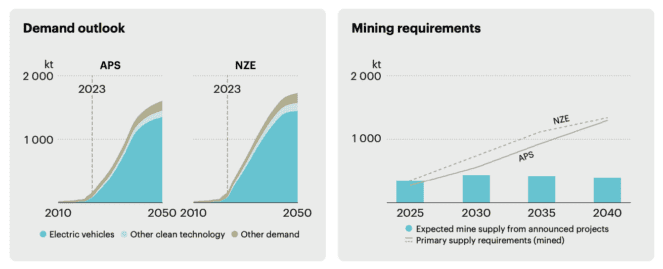
    Source: IEA Global Critical Minerals Outlook 2024

    However, if the International Energy Agency’s estimates are accurate, the ones that survive could flourish. According to its Global Critical Minerals Outlook 2024 report, a lithium supply deficit is expected by 2030 as demand for electric vehicles takes hold, as shown above.

    The post Which ASX lithium shares are financially primed to survive this rut? appeared first on The Motley Fool Australia.

    Should you invest $1,000 in Core Lithium Ltd right now?

    Before you buy Core Lithium Ltd shares, consider this:

    Motley Fool investing expert Scott Phillips just revealed what he believes are the 5 best stocks for investors to buy right now… and Core Lithium Ltd wasn’t one of them.

    The online investing service he’s run for over a decade, Motley Fool Share Advisor, has provided thousands of paying members with stock picks that have doubled, tripled or even more.*

    And right now, Scott thinks there are 5 stocks that may be better buys…

    See The 5 Stocks
    *Returns as of 24 June 2024

    More reading

    Motley Fool contributor Mitchell Lawler has no position in any of the stocks mentioned. The Motley Fool Australia’s parent company Motley Fool Holdings Inc. has no position in any of the stocks mentioned. The Motley Fool Australia has no position in any of the stocks mentioned. The Motley Fool has a disclosure policy. This article contains general investment advice only (under AFSL 400691). Authorised by Scott Phillips.

  • China can end the Ukraine war with a single phone call to Putin, says NATO member

    Russian leader Vladimir Putin (left) and Chinese leader Xi Jinping (right).
    Finland President Alexander Stubb told Bloomberg on Tuesday that Russia's dependence on China meant that Chinese leader Xi Jinping could end the Ukraine war if he wanted to.

    • China could end Russia's war on Ukraine if it wanted to, says Finland President Alexander Stubb.
    • "Russia is so dependent on China right now," Stubb told Bloomberg on Tuesday. 
    • But some analysts believe that China doesn't really want the war to end.

    China could hold the key to ending Russia's war in Ukraine, Finland President Alexander Stubb said in an interview with Bloomberg on Tuesday.

    China's influence on Russia, Stubb said, stemmed from the latter's growing reliance on the Asian giant as it grapples with crippling economic sanctions from the West.

    "I argue that Russia is so dependent on China right now that one phone call from President Xi Jinping would solve this crisis," Stubb said of the Chinese leader."If he were to say, 'Time to start negotiating peace.' Russia would be forced to do that."

    "They would have no other choice," he continued.

    Representatives for Russia's and China's foreign ministries did not immediately respond to requests for comment from BI sent outside regular business hours.

    [youtube https://www.youtube.com/watch?v=hgApYV8mz7Y?si=Fey8K-tbSAi7FeD4&w=560&h=315]

    Stubb, whose country joined the NATO military alliance in April last year, told the outlet that brokering a peaceful resolution to the Ukraine war would be in China's interest.

    "If China is genuinely interested in harmonious relations between nation states, it cannot allow a country like Russia to drive an imperial, at the end of the day, aggressive and colonial war against an independent nation state," Stubb said.

    "That is the right thing to do. And that would also show leadership from China," he added.

    To be sure, China has called for peace in Ukraine.

    In May, Xi hosted Russian leader Vladimir Putin in Beijing. He emphasized China's desire for an international peace conference involving Russia and Ukraine during the meeting.

    Notably, China did not attend a Ukrainian peace conference in Switzerland in June because Russia wasn't invited.

    "China has always insisted that an international peace conference should be endorsed by both Russia and Ukraine, with the equal participation of all parties, and that all peace proposals should be discussed in a fair and equal manner," Mao Ning, a spokesperson for China's foreign ministry, said of the Swiss effort on May 31.

    However, some analysts believe China doesn't want the war to stop.

    "Despite the fact that China has repeatedly called for a negotiated settlement in Ukraine, America's continued support for Kyiv — and hence Russia's inability to secure its gains in short order — is actually in Beijing's interest," Chels Michta, a non-resident fellow at the Center for European Policy Analysis, said in his analysis in May.

    In his article, Michta argued that an escalation of the war into "European NATO territory would pull the United States deeper in the theater."

    An escalation, Michta argued, would also limit the US' ability to "respond to a crisis in Asia," thus allowing China to attain "regional hegemony in the Indo-Pacific."

    "It must therefore be obvious that Ukraine is extremely important to China and that a continuing conflict is very much in its interests," Michta wrote.

    Read the original article on Business Insider
  • An influential Democratic donor says Biden has ‘misplaced trust’ in a ‘cabal’ of 3 top aides

    Joe Biden
    President Joe Biden.

    • Democratic megadonor John Morgan said that Biden has placed "misplaced trust" in his top aides.
    • Morgan said Biden needs to eliminate his "cabal," which includes Anita Dunn and Bob Bauer. 
    • He joins the camp of Biden supporters who have pinned blame on his aides for his poor debate show.

    Democratic megadonor John Morgan has joined the camp of people pointing fingers at President Joe Biden's top aides for his poor debate performance.

    Speaking to Politico, Morgan said he thinks the president has a "cabal" of his closest aides. That group includes Biden's senior advisor, Anita Dunn; her husband, Bob Bauer, Biden's personal attorney; and Biden's former chief of staff, Ron Klain.

    "I think he has misplaced trust in these three people, and I believe he has from the inception," Morgan told Politico.

    Morgan also took to X on Sunday to express his displeasure with the aides.

    "Biden has for too long been fooled by the value of Anita Dunn and her husband. They need to go… TODAY," he wrote.

    He added: "The grifting is gross. It was political malpractice."

    https://platform.twitter.com/widgets.js

    Morgan, who founded the law firm Morgan & Morgan, donated at least $355,000 to Biden's campaign in 2020 and helped raise some $1.7 million for it through a fundraiser at his home.

    Morgan echoes the sentiments of some Biden family members, who, behind closed doors, have argued that the aides should be demoted or fired, per Politico.

    Three anonymous sources told Politico that the Biden family begrudged these three top aides — all of whom helped train Biden for the primetime CNN debate — for not preparing him well enough to go on the offensive.

    Despite growing criticisms from his party and donors, the Biden-Harris campaign raised $127 million in June, including $38 million after Thursday's debate.

    From April to June, his campaign raised $264 million. However, the Trump campaign has outraised Biden's, amassing a $331 million war chest in 2024's second quarter, per Bloomberg.

    Despite the positive fundraising spike, donors have been spooked post-debate and remain unsure of Biden's ability to pull off a win in 2024.

    Another longtime Democratic donor, Whitney Tilson, said in a Saturday post on X that he felt "deceived" by Biden's performance.

    "If the man I saw at the debate is the real Joe Biden right now, then it would be a waste of my time and money to support him because he has almost no chance of beating Trump," Tilson wrote.

    Morgan and representatives for Biden didn't immediately respond to requests for comment from Business Insider sent outside regular business hours.

    Read the original article on Business Insider
  • Top brokers name 3 ASX shares to buy today

    Contented looking man leans back in his chair at his desk and smiles.

    Many of Australia’s top brokers have been busy adjusting their financial models and recommendations again. This has led to the release of a number of broker notes this week.

    Three ASX shares that brokers have named as buys this week are listed below. Here’s why their analysts are feeling bullish on them right now:

    BHP Group Ltd (ASX: BHP)

    According to a note out of Goldman Sachs, its analysts have retained their buy rating and $48.40 price target on this mining giant’s shares. The broker believes the Big Australian’s shares are attractively priced even though they trade at a premium to rival Rio Tinto Ltd (ASX: RIO). Goldman thinks this premium is justified due to its ongoing superior margins and operating performance, particularly in Pilbara iron ore where it maintains superior free cash flow per tonne compared to peers. In addition, the broker remains very positive on copper and met coal and likes the optionality of BHP’s US$20 billion+ copper pipeline. The BHP share price is trading at $43.41 today.

    Guzman Y Gomez Ltd (ASX: GYG)

    A note out of Morgans reveals that its analysts have initiated coverage on this quick service restaurant operator’s shares with an add rating and $30.80 price target. The broker is feeling positive about Guzman Y Gomez due to its strong long term growth potential and operating leverage. In respect to the former, the broker believes the company can achieve its aspirational target of 1,000 restaurants in Australia. This is by opening 30-40 restaurants each year. Though, it is worth noting that Guzman Y Gomez’s shares are trading at approximately 400x estimated FY 2025 earnings based on Morgans’ estimates. The Guzman Y Gomez share price is fetching $25.10 on Wednesday afternoon.

    Liontown Resources Ltd (ASX: LTR)

    Analysts at Bell Potter have retained their speculative buy rating and $1.85 price target on this lithium developer’s shares. This follows news that the company has secured funding through a five-year US$250 million convertible note to LG Energy Solution. The broker believes the funding is a sensible solution to remove the onerous terms associated with traditional bank debt. In light of this, it thinks the company is fully funded to free cash flow. Outside this news, Bell Potter is very positive on the 100% owned Kathleen Valley lithium project. It notes that it remains highly strategic with initial production imminent, a long mine life, and tier-one location. The Liontown share price is trading at 93 cents this afternoon.

    The post Top brokers name 3 ASX shares to buy today appeared first on The Motley Fool Australia.

    Should you invest $1,000 in Bhp Group right now?

    Before you buy Bhp Group shares, consider this:

    Motley Fool investing expert Scott Phillips just revealed what he believes are the 5 best stocks for investors to buy right now… and Bhp Group wasn’t one of them.

    The online investing service he’s run for over a decade, Motley Fool Share Advisor, has provided thousands of paying members with stock picks that have doubled, tripled or even more.*

    And right now, Scott thinks there are 5 stocks that may be better buys…

    See The 5 Stocks
    *Returns as of 24 June 2024

    More reading

    Motley Fool contributor James Mickleboro has no position in any of the stocks mentioned. The Motley Fool Australia’s parent company Motley Fool Holdings Inc. has positions in and has recommended Goldman Sachs Group. The Motley Fool Australia has no position in any of the stocks mentioned. The Motley Fool has a disclosure policy. This article contains general investment advice only (under AFSL 400691). Authorised by Scott Phillips.

  • Own NAB shares? Here’s how much you’re about to get paid in dividends

    Different Australian dollar notes in the palm of two hands, symbolising dividends.

    Investors who own ASX bank shares, like National Australia Bank Ltd (ASX: NAB), look forward to two dates on the financial calendar more than most. Bank stocks like NAB are well known for paying some of the largest, fattest, and most consistent dividends on the ASX.

    So it makes sense that bank shareholders would hold a special affinity for the day that they receive these fat, and usually fully franked, dividends.

    Well, luckily for NAB shareholders, today is one of the two days this year that they will receive a dividend payment.

    Back in May, we covered NAB’s latest earnings report, covering the half-year ended 31 March. As we went through at the time, these earnings were well-received, with NAB shares surging as a result. This surge was despite the bank reporting a 0.9% drop in operating income to $10.14 billion for the six months to 31 March. That was alongside a 12.8% decline in cash earnings to $3.55 billion.

    Despite these sobering metrics, NAB still announced an additional $1.5 billion share buyback program. As well as an increase to its interim dividend for 2024.

    How much is the latest NAB dividend worth?

    The bank revealed that its latest dividend would be worth 84 cents per share, fully franked. That’s a 1.3% rise over last year’s interim dividend, which was worth 83 cents per share. It’s also the same value as NAB’s last dividend. That was the final payment of 84 cents per share that we saw doled out back in December. Both of these payments came fully franked as well.

    As we warned back in May, the ex-dividend date for this latest NAB dividend was set for 7 May. So if you didn’t own NAB shares as of 6 May’s market close, you’ll miss out on this shareholder paycheque.

    But for eligible investors, the long wait for this dividend is finally over. Today is dividend payday. Yep, shareholders will be getting the proverbial cheque in the mail sometime this Wednesday. If someone owned 500 NAB shares right now (worth approximately $17,810 at current pricing), they can expect to receive $420 in dividend cash today.

    If shareholders instead selected the optional dividend reinvestment plan (DRP) by 9 May, they will receive additional NAB shares in lieu of the traditional cash payment.

    At the time of writing, NAB shares are down 0.17% at $35.63 each. At this pricing, NAB is currently trading on a dividend yield of 4.72%.

    The post Own NAB shares? Here’s how much you’re about to get paid in dividends appeared first on The Motley Fool Australia.

    Should you invest $1,000 in National Australia Bank Limited right now?

    Before you buy National Australia Bank Limited shares, consider this:

    Motley Fool investing expert Scott Phillips just revealed what he believes are the 5 best stocks for investors to buy right now… and National Australia Bank Limited wasn’t one of them.

    The online investing service he’s run for over a decade, Motley Fool Share Advisor, has provided thousands of paying members with stock picks that have doubled, tripled or even more.*

    And right now, Scott thinks there are 5 stocks that may be better buys…

    See The 5 Stocks
    *Returns as of 24 June 2024

    More reading

    Motley Fool contributor Sebastian Bowen has positions in National Australia Bank. The Motley Fool Australia’s parent company Motley Fool Holdings Inc. has no position in any of the stocks mentioned. The Motley Fool Australia has no position in any of the stocks mentioned. The Motley Fool has a disclosure policy. This article contains general investment advice only (under AFSL 400691). Authorised by Scott Phillips.