• People thought they might die when oxygen masks deployed on a United flight to Maui, passenger says

    Oxygen masks falling from ceiling, photo of Lesley Scott and her daughters.
    Ryan Scott was flying to Maui with his wife and their daughters when the oxygen masks deployed.

    • Oxygen masks deployed on a United flight from San Francisco to Maui last week.
    • A passenger said people on the plane were terrified, and he was planning what to do if it went down.
    • Another recent United flight, which was also a Boeing 777, had oxygen masks "inadvertently" deployed.

    Ryan Scott, a chef based in Marin County, California, was heading to a Hawaii vacation with his family of four when he suddenly found himself in a scene out of a nightmare.

    Scott, his wife, and their two young daughters were flying United from San Francisco to Maui on June 18 when, about two and a half hours in, the flight experienced minor turbulence — nothing out of the ordinary, he said — and oxygen masks deployed from the ceiling.

    "You could literally stop traffic with just the gasp of air in the plane," Scott told Business Insider, adding, "There was a lot of WTF and dead silence."

    Scott said his first thought was that they were not over land and wouldn't be near an airport to make an emergency landing.

    "When you are halfway over the Pacific Ocean, the worst goes through your head," he said.

    Scott quickly started planning with his wife. "People are going to be very pushy if we go down. Here's the deal," he said to her. He told her to grab their licenses and put them in her pocket, noted where the closest door was and how to grab the seat cushions, and said he'd grab the girls when it was time to go.

    He said some passengers quickly started to panic, with at least one person near him hyperventilating.

    "People were crying, people were very, very scared," he said.

    Scott's wife, Lesley Scott, said the flight attendants urgently asked passengers to put the oxygen masks on, which they thought meant this was not a mistake and that something was actually wrong.

    Scott said that his daughters had little headphones on and were on their iPads, so in order to prevent them from freaking out, his wife framed it as a game that they would now watch with the masks on too.

    He also said that he took a cue from the flight attendants, who remained seated during the ordeal and were calm and collected, adding that they deserved a lot of credit.

    They said about 20 minutes had passed without any updates. Eventually, the pilot came on and said they had descended to a lower altitude but to keep their masks on for now.

    Then they got another update that there had apparently been a "sensor malfunction" that caused the masks to fall, Scott said. He said the pilot said there was no need for a mask and that "he was going to climb back up, and then drinks were on United."

    "And that's when people were getting double vodka sodas," Scott added.

    Scott said after the flight the only communication he received from United were emails asking how their service was.

    He said United had "dropped the ball," adding, "People felt like they were going to die, and that's the truth."

    In a statement provided to Business Insider, United said: "A small number of oxygen masks inadvertently deployed during the flight. There were no pressurization issues, our pilots followed appropriate procedures in a situation like this, and the aircraft landed safely as scheduled at Kahului Airport. "

    The aircraft, a Boeing 777, had more than 360 passengers on board.

    About a week prior, oxygen masks also "inadvertently deployed" on a transatlantic United flight from Paris to Washington, DC. The aircraft in that incident was also a Boeing 777.

    It's unclear why the masks "inadvertently deployed" in either case.

    Boeing did not immediately respond to a request for comment from Business Insider sent outside regular hours.

    Similarly, in that incident, United said the air pressure in the cabin was normal and the flight landed safely.

    Scott said the experience was "like a weird dream" and that he feels blessed his family is safe.

    But he added that a lot of people on his flight "were clapping and kissing the ground when we got out, that's for sure."

    Read the original article on Business Insider
  • Are Fortescue shares a contrarian buy after falling 20% in a month?

    Man in yellow hard hat looks through binoculars as man in white hard hat stands behind him and points.

    Fortescue Ltd (ASX: FMG) shares have had a gloomy past month. The iron ore miner’s 2024 decline has deepened by a painful 19.67% over the last 30 days. The recent slump means the company’s share price is now almost 28% lower than at the end of 2023.

    The Fortescue share price is currently fetching $21.295, up 0.16% on yesterday’s closing value. Yet, today’s positivity is not contained solely to the Andrew Forrest-led miner. In fact, BHP Group Ltd (ASX: BHP) is basking in an even stronger showing, up 1.23% at the time of writing.

    Back to Fortescue. Does the market’s current disinterest in the company present an opportunity to buy? After all, Warren Buffett — a billionaire investor — has said, “Most people get interested in stocks when everyone else is. The time to get interested is when no one else is. You can’t buy what is popular and do well.”

    Fortescue shares certainly don’t appear too popular at the moment, but could it be warranted?

    Truckload of negativity

    Investors have refrained from ‘buying the dip’ on Fortescue shares as they hurtle towards the 52-week low. The lack of price support coincides with several factors keeping the buyers at bay recently.

    Firstly, the iron ore price is treading water. For nearly three years, prices have jumped momentarily, only to be magnetised back to around US$110 per tonne. Still, Fortescue can keep printing money at its US$18.93 per wet metric tonne C1 cost.

    The problem is analysts expect iron ore to drop to US$95 a tonne, a forecast shared by Citi. The broker notes that the outlook for new construction in China is on loose footing, posing the case for weak iron ore demand.

    Additionally, a major shareholder opted out of Fortescue shares last week. Capital Group Companies sold approximately $1.1 billion worth of the miner without providing any justification — the enormous sale adding to the market’s apprehension.

    Lastly, the iron giant is still struggling to retain its executives. Julie Shuttleworth — who led the company’s efforts in Gabon, Africa — joined the executive exodus a couple of weeks ago.

    The flip side to Fortescue shares

    Every story has two sides, and it’s worth reviewing some of Fortescue’s positive attributes.

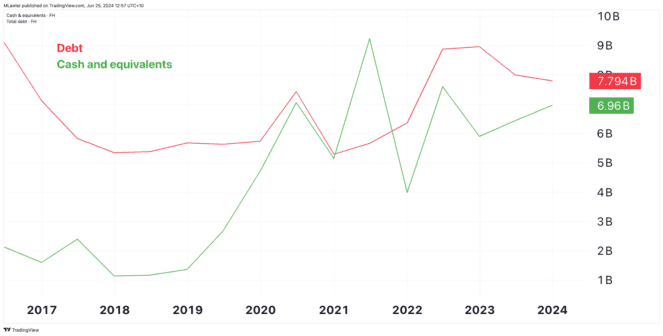
    Fundamentally, Fortescue is in solid shape.

    Data by Trading View.

    As shown above, the miner’s net debt has narrowed significantly compared to before 2020. This means Fortescue is financially healthier, better positioning the company to handle a downturn or fund growth initiatives.

    Furthermore, its 12-month trailing free cash flow yield equates to 12.6%. For context, a free cash flow yield of around 5% is often considered attractive.

    Likewise, the trailing dividend yield is a generous 9.6%, more than 6% greater than that offered by the S&P/ASX 200 Index (ASX: XJO). However, analysts expect this number to fall in line with reduced earnings in the coming years.

    Foolish takeaway

    Companies whose earnings are closely tied to the supply and demand of a commodity are difficult to value. You can’t simply extrapolate growth like you might with a candy bar or beverage maker. That’s not to say money can’t be made by investing in such businesses.

    Fortescue has a competitive advantage in being one of the lowest-cost iron ore producers in the world. If the price of iron ore continues to fall, Fortescue should be able to keep making profits where others cannot.

    Nevertheless, I’ll personally take my chances elsewhere than Fortescue shares.

    The post Are Fortescue shares a contrarian buy after falling 20% in a month? appeared first on The Motley Fool Australia.

    Should you invest $1,000 in Fortescue Metals Group right now?

    Before you buy Fortescue Metals Group shares, consider this:

    Motley Fool investing expert Scott Phillips just revealed what he believes are the 5 best stocks for investors to buy right now… and Fortescue Metals Group wasn’t one of them.

    The online investing service he’s run for over a decade, Motley Fool Share Advisor, has provided thousands of paying members with stock picks that have doubled, tripled or even more.*

    And right now, Scott thinks there are 5 stocks that may be better buys…

    See The 5 Stocks
    *Returns as of 24 June 2024

    More reading

    Citigroup is an advertising partner of The Ascent, a Motley Fool company. Motley Fool contributor Mitchell Lawler has no position in any of the stocks mentioned. The Motley Fool Australia’s parent company Motley Fool Holdings Inc. has no position in any of the stocks mentioned. The Motley Fool Australia has no position in any of the stocks mentioned. The Motley Fool has a disclosure policy. This article contains general investment advice only (under AFSL 400691). Authorised by Scott Phillips.

  • Why DroneShield, Paladin Energy, Red 5, and Synlait shares are falling

    In afternoon trade, the S&P/ASX 200 Index (ASX: XJO) is on course to record a solid gain. At the time of writing, the benchmark index is up 0.9% to 7,805.8 points.

    Four ASX shares that have failed to follow the market higher today are listed below. Here’s why they are falling:

    DroneShield Ltd (ASX: DRO)

    The DroneShield share price is down 2.5% to $1.49. This is the second consecutive day of declines for the counter drone technology company’s shares. This appears to have been driven by profit taking from investors following some very strong gains. For example, the DroneShield share price is still up 55% in a month and almost 300% over the past six months. Strong sales growth, major contract wins, and a very positive outlook have been behind this rise.

    Paladin Energy Ltd (ASX: PDN)

    The Paladin Energy share price is down almost 6% to $12.50. This follows news that the company has signed an agreement to acquire Fission Uranium Corp. (TSX: FCU). Paladin Energy will acquire 100% of Fission Uranium for 0.1076 shares for each Fission share. This implied an offer of approximately A$1.43 per share and valued the Canadian uranium company at A$1.25 billion. It seems that some investors aren’t overly convinced by the deal or feel that Paladin Energy is overpaying.

    RED 5 Limited (ASX: RED)

    The RED 5 share price is down 8% to 37.7 cents. Investors appear to be selling this gold miner’s shares after it reported some heavy insider selling. According to a notice, the company’s managing director and CEO, Luke Tonkin, offloaded almost half of its holding. Tonkin sold 5,388,000 shares through an on-market trade on 20 June for an average of 41.9 cents per share. This equates to a total consideration of approximately $2.25 million. The company’s CEO is left holding 6,276,766 Red 5 shares.

    Synlait Milk Ltd (ASX: SM1)

    The Synlait Milk share price is down 7% to 27.5 cents. This morning, the dairy processor announced a shareholder meeting to approve a $130 million loan from major shareholder Bright Dairy International. If approved, Synlait will fully draw down the loan to meet the $130 million payment due to its banks on 15 July 2024. Management warned that “if the $130 million payment is not made and the banks do not agree to alternative arrangements, the Board believes Synlait will need to cease trading or initiate a formal insolvency process.”

    The post Why DroneShield, Paladin Energy, Red 5, and Synlait shares are falling appeared first on The Motley Fool Australia.

    Should you invest $1,000 in Droneshield Limited right now?

    Before you buy Droneshield Limited shares, consider this:

    Motley Fool investing expert Scott Phillips just revealed what he believes are the 5 best stocks for investors to buy right now… and Droneshield Limited wasn’t one of them.

    The online investing service he’s run for over a decade, Motley Fool Share Advisor, has provided thousands of paying members with stock picks that have doubled, tripled or even more.*

    And right now, Scott thinks there are 5 stocks that may be better buys…

    See The 5 Stocks
    *Returns as of 24 June 2024

    More reading

    Motley Fool contributor James Mickleboro has no position in any of the stocks mentioned. The Motley Fool Australia’s parent company Motley Fool Holdings Inc. has positions in and has recommended DroneShield. The Motley Fool Australia has no position in any of the stocks mentioned. The Motley Fool has a disclosure policy. This article contains general investment advice only (under AFSL 400691). Authorised by Scott Phillips.

  • Nine-year highs: NAB share price glides to highest level since 2015!

    Man raising both his arms in the air with a piggy bank on his lap, symbolising a record high.

    The National Australia Bank Ltd (ASX: NAB) share price soared to new heights on Tuesday, up 2% and hitting $36.59 at the time of writing.

    The last time it traded at this level was in April 2015, making today’s mark the highest price NAB has exchanged hands in nine years.

    Over the past 12 months, NAB shares have surged by 43%, marking a strong run for the bank’s share price and catching the eye of investors. Here’s a closer look.

    What’s driving the NAB share price rally?

    The NAB share price has rallied hard in 2023/2024, potentially reflecting investor confidence in the bank’s future prospects.

    This is evidenced by the increase in the price-to-earnings ratio (P/E) from 15 times at the end of May to over 16 times at the time of writing. Investors are willing to pay more for every dollar of NAB’s earnings.

    Goldman Sachs maintains a neutral rating on NAB in a note from June, highlighting the bank’s solid fundamentals, but noting its high valuations at the same time.

    NAB’s current P/E ratio of 16.4 is one of the highest it has been in the past 15 years, meaning “the stock’s valuation is difficult to justify”, according to Goldman.

    But despite this, Goldman acknowledges NAB’s strengths in small to medium enterprise (SME) exposures and its 8.5 million customer base.

    Investors appear to agree and are looking past the higher-than-average P/E multiples in this latest rally.

    Is now a good time to buy NAB shares?

    Given NAB’s current performance, the key question for investors is whether this is a good time to buy.

    According to Goldman Sachs, the bank’s fundamentals remain solid, but valuations on the NAB share price may be stretched.

    The firm notes that NAB’s recent growth could also pose a challenge in maintaining productivity gains in the future.

    NAB is further through its productivity program than peers, and we believe it may become increasingly difficult to sustain its current pipeline of productivity benefits into outer years.

    UBS rates the NAB share price a sell with a price target of $30. Although today’s prices are well above this level, it’s important to remember that investing is a long-term game and that things can change.

    Meanwhile, according to CommSec, the consensus analyst rating on NAB is hold, and the distribution is two buys, nine holds, and six sells.

    What are the risks?

    While NAB’s performance has been impressive, there are potential risks to consider. NAB’s high P/E ratio might suggest that the stock may be nearing a fair value, which could limit further upside potential.

    Paying too high a price for an investment – measured by the P/E ratio – is the anathema to intelligent value investing. The mathematics also show that, for a given set of investment options, and all else being equal, paying lower P/E ratios can bolster returns.

    As the late Charlie Munger, Warren Buffett’s right-hand man, famously said: “A great business at a fair price is superior to a fair business at a great price”.

    The challenge is in identifying what’s “fair” and if that applies to the NAB share price right now. It appears the market thinks so.

    Conclusion

    The NAB share price reaching a nine-year high is a testament to investors’ views on the bank and its fundamentals. While high valuations pose some concerns, time will tell if management has laid a solid foundation for future growth.

    However, it’s crucial to remain cautious and consider potential risks. Always remember to consider your own personal financial circumstances.

    The post Nine-year highs: NAB share price glides to highest level since 2015! appeared first on The Motley Fool Australia.

    Should you invest $1,000 in National Australia Bank Limited right now?

    Before you buy National Australia Bank Limited shares, consider this:

    Motley Fool investing expert Scott Phillips just revealed what he believes are the 5 best stocks for investors to buy right now… and National Australia Bank Limited wasn’t one of them.

    The online investing service he’s run for over a decade, Motley Fool Share Advisor, has provided thousands of paying members with stock picks that have doubled, tripled or even more.*

    And right now, Scott thinks there are 5 stocks that may be better buys…

    See The 5 Stocks
    *Returns as of 24 June 2024

    More reading

    Motley Fool contributor Zach Bristow has no position in any of the stocks mentioned. The Motley Fool Australia’s parent company Motley Fool Holdings Inc. has no position in any of the stocks mentioned. The Motley Fool Australia has no position in any of the stocks mentioned. The Motley Fool has a disclosure policy. This article contains general investment advice only (under AFSL 400691). Authorised by Scott Phillips.

  • ResMed shares rebounding as investors rush to buy the dip

    ANZ ASX 200 banks capital return Group of investors madly grabbing for cash on city street.

    ResMed Inc (ASX: RMD) shares opened weaker on Tuesday following a dramatic price fall yesterday.

    The ResMed share price fell 13.08% yesterday to close at $27.74.

    Yesterday’s fall was the result of a United States medical study showing GLP-1 medicines directly reduced the rate of obstructive sleep apnoea (OSA) among obese patients.

    ResMed’s products treat sleep apnoea.

    This morning, the ASX 200 healthcare stock opened at $27.56 per share and fell to an intraday low of $27.35, down 1.4%. However, the stock is now rebounding.

    At the time of writing, ResMed shares are up 1.37% to $28.12, suggesting some investors may be seeing yesterday’s fall as a dollar-cost averaging or new-investment opportunity.

    Meantime, the S&P/ASX 200 Index (ASX: XJO) is up 0.82%.

    Let’s recap what drove ResMed shares down yesterday.

    ResMed shares dive on GLP-1 news

    As we reported yesterday, global pharmaceutical giant Eli Lilly And Co (NYSE: LLY) released detailed results from its SURMOUNT-OSA phase 3 clinical trials.

    The trials’ purpose is to measure the potential impact of Eli Lilly’s GLP-1 drug, Tirzepatide on obese patients with OSA.

    Tirzepatide’s brand names are Mounjaro for diabetes and Zepbound for obesity. It’s the main competitor to the first-ever GLP-1 drug, semaglutide, which is the main ingredient in Ozempic and Wegovy.

    Eli Lilly reported that up to half of the patients in the study experienced remission of their OSA.

    As reported in The Australian, top broker Citi has now cut its rating on ResMed shares to neutral because of the study. The broker has also slashed its 12-month share price target by 17% to $30 per share.

    ResMed stock is up around 10% in the year to date but it has been in a two-month lull over May and June.

    During this period, ResMed shares have been rangebound between about $31 and $33 per share.

    So, yesterday’s share price drop was pretty significant.

    Perhaps the most pertinent detail of this new study is that it looked specifically at the drugs’ impact on sleep apnoea.

    Previous studies that have made ResMed investors nervous focused on GLP-1s’ impact on reducing obesity, which is a common precursor to OSA.

    What did Citi say?

    Citi analyst Mathieu Chevrier said the study “indicates that GLP-1 are a viable treatment option for the 70 per cent of OSA patients that are obese”.

    Chevrier estimates that if half of those patients went into OSA remission, that could mean a 35% fall in the total addressable market (TAM) for continuous positive airway pressure (CPAP) machines.

    ResMed sells CPAP machines.

    However, Chevrier notes the adherence to GLP-1s for weight loss is only about 50% after 12 months, so it is still difficult to work on exactly what impact the drugs will have on ResMed’s revenue in the future.

    Unlike CPAP, it’s difficult to predict with certainty which patients on GLP-1 will see OSA remission.

    We also see potential legal risks for doctors around knowingly not treating a patient’s OSA with CPAP whilst they are going through the 20 weeks GLP-1 dose escalation.

    The impact of GLP-1s on CPAP devices and masks sales remains difficult to assess and will depend on GLP-1s uptake, adherence, and overall OSA market growth.

    Based on the study, Citi assumes a 15% fall in TAM for OSA from FY26 to FY28.

    As such, it has cut its forecast revenue growth for ResMed from 6% to 4% for FY26, from 4% to 3% for FY25 and held it steady at 2% for FY26.

    Haven’t we seen this sort of sell-off before?

    We sure have.

    Last year, ResMed shares collapsed to a four-year low of $21.14 in October due to fears that GLP-1s would impact the size of the company’s customer base.

    At the time, many brokers defended the company, placing buy ratings on ResMed shares and advising it was a rare opportunity to buy the dip on a blue-chip ASX 200 healthcare stock.

    They reasoned that the OSA market worldwide was huge, and GLP-1s were in their infancy in terms of development. Thus, even if GLP-1s reduced obesity and OSA significantly, there would still be a large total addressable market (TAM) available to ResMed given obesity is not the only cause of OSA.

    Investors slowly responded and the ResMed share price has been recovering ever since.

    Meantime, ResMed has also been monitoring the potential impact of GLP-1s on its business.

    It has released modelling to reassure investors, with CEO Mick Farrell quantifying the impact by stating the company’s worldwide OSA TAM would be 1.2 billion by 2050 after taking GLP-1s into account.

    That’s a significant number given ResMed’s market penetration is only 22.5 million people so far.

    Then in January, Farrell revealed further in-house research that found GLP-1s were actually increasing customer numbers for ResMed.

    The research showed a 10% increase in patients on GLP-1s buying sleep apnoea machines.

    The post ResMed shares rebounding as investors rush to buy the dip appeared first on The Motley Fool Australia.

    Should you invest $1,000 in Resmed Inc. right now?

    Before you buy Resmed Inc. shares, consider this:

    Motley Fool investing expert Scott Phillips just revealed what he believes are the 5 best stocks for investors to buy right now… and Resmed Inc. wasn’t one of them.

    The online investing service he’s run for over a decade, Motley Fool Share Advisor, has provided thousands of paying members with stock picks that have doubled, tripled or even more.*

    And right now, Scott thinks there are 5 stocks that may be better buys…

    See The 5 Stocks
    *Returns as of 24 June 2024

    More reading

    Citigroup is an advertising partner of The Ascent, a Motley Fool company. Motley Fool contributor Bronwyn Allen has no position in any of the stocks mentioned. The Motley Fool Australia’s parent company Motley Fool Holdings Inc. has positions in and has recommended ResMed. The Motley Fool Australia has positions in and has recommended ResMed. The Motley Fool has a disclosure policy. This article contains general investment advice only (under AFSL 400691). Authorised by Scott Phillips.

  • Where are we in the share market cycle?

    An older couple dance in their living room as they enjoy their retirement funded by ASX dividends

    Understanding where we stand in the share market cycle is crucial for making smart investment decisions.

    Sir John Templeton’s quote below perfectly captures how investor emotions influence the market’s ups and downs. He famously said:

    Bull markets are born on pessimism, grow on scepticism, mature on optimism, and die on euphoria.

    Similarly, Warren Buffett advises to be greedy when others are fearful and the vice versa, emphasising the importance of reading market expectations and participants’ emotions.

    In this article, I’ll use Howard Marks’ market cycle concept to determine where we might be in the share market right now. I’ll also examine what other famous investors are saying and positioning for the cycle.

    Second year of the bull market

    Howard Marks, co-founder of Oaktree Capital Management, uses several key indicators to understand the market cycle. These include investor sentiment, valuation levels, credit availability, risk appetite of investors, and market behaviour.

    To sum up, in his bestselling book Mastering the market cycle, he says opportunities for investment gains improve when:

    • The economy and company profits are more likely to swing upward than down
    • Investor psychology is sober rather than buoyant
    • Investors are conscious of risk or — even better — overly concerned about risk
    • Market prices haven’t moved too high.

    Based on these factors, it’s safe to say that we are no longer in a bear market, with the overall market sentiment being positive. So if we’re not in a bear market, where exactly are we in the share market cycle?

    Ken Fisher, Fisher Investments’ founder and a son of respected investor Philip Fisher, sees further upside in the US stock markets from here. In June, he said:

    Once a market that’s had a bear market has hit a bottom and gotten to become a one-year old, it almost always gets to be a two years old. We’re in that second year now from the bottom in October 2022.

    Another useful sentiment indicator is the VIX index (INDEXCBOE: VIX). Nicknamed the ‘fear gauge,’ the VIX Index measures how much the S&P 500 Index (SP: .INX) is expected to fluctuate over the next month.

    A high VIX indicates anticipated market changes due to uncertainty or fear, while a low VIX suggests stable conditions.

    The VIX index has ranged from 10 to 79 and is currently at 13.33, implying some investor optimism. For context, the VIX index hit 65.5 at the peak of the COVID-19 pandemic in March 2020.

    What does this all mean to investors?

    While we wouldn’t encourage anyone to dramatically change their share portfolios based on the market outlook alone, it’s worth noting that some market sectors may be starting to look expensive.

    Fisher suggests growth stocks tend to do better in the early bull cycle, and high-quality value stocks — such as energy shares or luxuries — outperform in the later part of the upcycle and into a downcycle. His latest trading history appears to confirm that he’s expecting this bull market to continue.

    According to the May 2024 filing to the US Securities and Exchange Commission (SEC), Fisher Asset Management’s top holdings were dominated by ‘big tech’ shares like Microsoft Corp (NASDAQ: MSFT), Apple Inc (NASDAQ: AAPL), and Nvidia Corp (NASDAQ: NVDA) as of the end of March 2024.

    It’s worth noting that the fund didn’t actively add to these positions, however. The fund also has positions in other value shares, including energy stocks.

    This is similar to Warren Buffett’s Berkshire Hathaway Inc (NYSE: BRK.B), which has also built a fairly large position in energy stocks, including Chevron Corp (NYSE: CVX) and Occidental Petroleum Corp (NYSE: OXY).

    In conclusion, some investors believe we haven’t yet reached the ‘euphoria’ phase. So, keep dancing, but always know where the exit is if the music suddenly stops.

    The post Where are we in the share market cycle? appeared first on The Motley Fool Australia.

    Should you invest $1,000 in Apple right now?

    Before you buy Apple shares, consider this:

    Motley Fool investing expert Scott Phillips just revealed what he believes are the 5 best stocks for investors to buy right now… and Apple wasn’t one of them.

    The online investing service he’s run for over a decade, Motley Fool Share Advisor, has provided thousands of paying members with stock picks that have doubled, tripled or even more.*

    And right now, Scott thinks there are 5 stocks that may be better buys…

    See The 5 Stocks
    *Returns as of 24 June 2024

    More reading

    Motley Fool contributor Kate Lee has positions in Microsoft, Nvidia, and Occidental Petroleum. The Motley Fool Australia’s parent company Motley Fool Holdings Inc. has positions in and has recommended Apple, Berkshire Hathaway, Chevron, Microsoft, and Nvidia. The Motley Fool Australia’s parent company Motley Fool Holdings Inc. has recommended Occidental Petroleum and has recommended the following options: long January 2026 $395 calls on Microsoft and short January 2026 $405 calls on Microsoft. The Motley Fool Australia has recommended Apple, Berkshire Hathaway, Microsoft, and Nvidia. The Motley Fool has a disclosure policy. This article contains general investment advice only (under AFSL 400691). Authorised by Scott Phillips.

  • After Nvidia’s 10-for-1 stock split, is it still a buy?

    A woman sits on sofa pondering a question.

    This article was originally published on Fool.com. All figures quoted in US dollars unless otherwise stated.

    It’s been a wild ride for Nvidia (NASDAQ: NVDA) investors. The stock is up 190% since this time last year as the company has positioned itself brilliantly as the dominant chip provider for the artificial intelligence (AI) market. Big tech players like Amazon, Microsoft, and Alphabet are all turning to Nvidia’s technology to power their AI offerings.

    The skyrocketing share price led Nvidia to split its stock 10-for-1, which it executed earlier this month. The move lowered the barrier of entry for investors, opening up the door for smaller investors and a larger portion of the retail market.

    Since the split announcement, the stock is up 33%, despite the fact shares have retreated from their peak over the last week. After one of the most incredible runs in stock market history, is Nvidia still a buy?

    Nvidia looks overvalued at first glance

    One of the most common ways to value a company is its price-to-earnings (P/E) ratio. Nvidia boasts a P/E multiple of 70 as of this writing. Compare that to the two tech giants it’s currently battling for the title of world’s largest company by market capitalization, Microsoft and Apple, which have P/E ratios of 39 and 33, respectively.

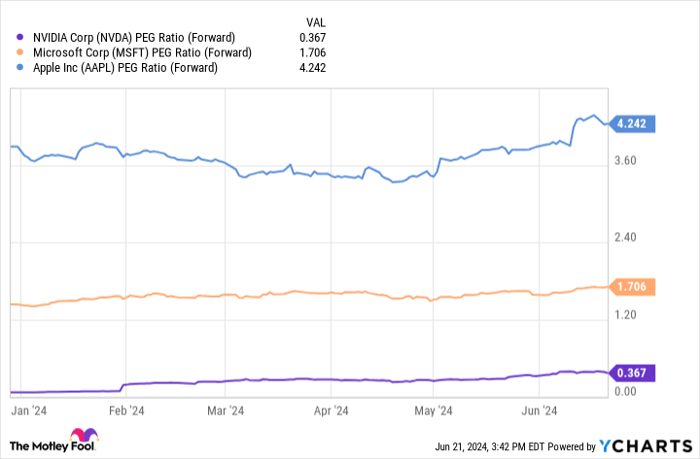
    Nvidia appears overvalued from this perspective, but here’s the thing: the P/E ratio isn’t the best metric when evaluating a company in hypergrowth mode. Despite Nvidia’s already massive size, it’s still growing at triple-digit rate.

    The price/earnings-to-growth ratio (PEG) can take this growth into account, and traditionally, a PEG ratio of less than 1 is considered undervalued.

    NVDA PEG Ratio (Forward) Chart

    Data by YCharts.

    Of this trio, Nvidia is the only stock with a PEG ratio below 1, meaning its current valuation is much more reasonable than P/E alone would show. Keep in mind, though, that no single metric will give you a complete picture. The PEG ratio relies on growth forecasts, which are far from guaranteed.

    So are analyst’s growth predictions reasonable?

    The bar is high for Nvidia, but there’s ample reason to believe it can deliver

    The company has already shown it can scale rapidly and grow revenue at a blinding pace. So while Wall Street’s expectations are high, Nvidia’s own guidance set its fiscal 2025 second-quarter revenue target at $28 billion. That’s an 8% increase from the previous quarter and a 107% increase year over year. Most companies would kill to see those kinds of numbers.

    These results are only possible because the demand for Nvidia’s chips is still incredibly high, and the company has yet to encounter true competition.

    Other companies, like AMD, are developing chips to cut into Nvidia’s market share, but at the moment, they have a lot further to go. Nvidia has been one step ahead and is promising a development cycle that AMD will struggle to keep up with for several reasons, not the least of which is that it spends nearly twice as much as AMD on research and development.

    The broader demand for AI that’s driving Nvidia’s success doesn’t seem to be slowing down as PwC believes AI can add $15.7 trillion to the global economy by 2030. That means there’s a long way to go until demand drops, and Nvidia stock still has room to run if it can defend its market share.

    This article was originally published on Fool.com. All figures quoted in US dollars unless otherwise stated.

    The post After Nvidia’s 10-for-1 stock split, is it still a buy? appeared first on The Motley Fool Australia.

    Should you invest $1,000 in Nvidia right now?

    Before you buy Nvidia shares, consider this:

    Motley Fool investing expert Scott Phillips just revealed what he believes are the 5 best stocks for investors to buy right now… and Nvidia wasn’t one of them.

    The online investing service he’s run for over a decade, Motley Fool Share Advisor, has provided thousands of paying members with stock picks that have doubled, tripled or even more.*

    And right now, Scott thinks there are 5 stocks that may be better buys…

    See The 5 Stocks *Returns as of 24 June 2024

    More reading

    Suzanne Frey, an executive at Alphabet, is a member of The Motley Fool’s board of directors. John Mackey, former CEO of Whole Foods Market, an Amazon subsidiary, is a member of The Motley Fool’s board of directors. Johnny Rice has no position in any of the stocks mentioned. The Motley Fool Australia’s parent company Motley Fool Holdings Inc. has positions in and has recommended Advanced Micro Devices, Alphabet, Amazon, Apple, Microsoft, and Nvidia. The Motley Fool Australia’s parent company Motley Fool Holdings Inc. has recommended the following options: long January 2026 $395 calls on Microsoft and short January 2026 $405 calls on Microsoft. The Motley Fool Australia has recommended Alphabet, Amazon, Apple, Microsoft, and Nvidia. The Motley Fool has a disclosure policy. This article contains general investment advice only (under AFSL 400691). Authorised by Scott Phillips.

  • Down 12% since Thursday, has the DroneShield share price topped out?

    drone stuck in a tree representing crashing Aerometrix share price

    The DroneShield Ltd (ASX: DRO) share price is catching more headwinds today.

    Shares in the All Ordinaries Index (ASX: XAO) drone defence company closed down 7.0% yesterday at $1.53. In late morning trade on Tuesday, shares are swapping hands for $1.50 apiece, down 1.6%.

    With shares having also lost 3.5% on Friday, the DroneShield share price has now shed 11.8% since Thursday’s closing bell.

    So, is the dream run over for this All Ords tech stock darling?

    Let’s have a look.

    Has the DroneShield share price topped out?

    To get a clearer picture of what’s ahead for the DroneShield share price, we need to take a step back to see what’s been happening with the stock in recent months.

    First, last Thursday’s closing price of $1.70 a share represented a new all-time high for the company. That saw the stock up 77% over one month and up an eye-popping 359% in 2024.

    With that kind of blazing success in the rearview mirror, a little shareholder profit-taking isn’t unexpected.

    Though I believe that investors who’ve been selling these past few days may well look back with some regret.

    The DroneShield share price could certainly go lower from here and remains vulnerable to a broader market pullback if the global tech rally fizzles. But there are good reasons investors have been sending the stock flying higher. And those reasons have not changed.

    Why the ASX All Ords tech stock could keep flying higher

    Investors have been bidding up the DroneShield share price on the back of the company’s tremendous growth achievements and an impressive pipeline indicating that growth looks set to continue.

    Thursday’s record-high closing price was achieved after the company reported on another $4.7 million order from a new non-government Swiss international customer. The company has been a frontrunner in incorporating AI technology into its systems.

    Commenting on the new Swiss order, DroneShield’s CEO, Oleg Vornik said:

    This order highlights DroneShield expertise not only as a maker of cutting-edge AI-based C-UAS sensor and effector technologies, but also a system integrator, for demanding applications that involve multiple sensor and effector modalities, operating in tough conditions.

    The company has been racking up new orders at an impressive level.

    How impressive?

    Well in the first quarter of FY 2024 the company reported revenue of $16.4 million, up a whopping 900% from Q1 FY 2023. Looking back to the prior year, DroneShield raked in $55 million in revenue in 2023, up 223% from the prior year.

    And the DroneShield share price looks set to keep on giving as that earnings growth is forecast to continue.

    According to CommSec analyst forecasts, earnings per share (EPS) will come out to 3.1 cents in 2024, up from 2.0 cents in 2023. EPS is forecast to grow to 4.5 cents in 2025 and then hit 6.3 cents in 2026.

    So, has the DroneShield share price topped out?

    In the short-term, perhaps.

    But longer term, I think the growth story remains in play, and this ASX All Ords tech stock can fly a lot higher.

    The post Down 12% since Thursday, has the DroneShield share price topped out? appeared first on The Motley Fool Australia.

    Should you invest $1,000 in Droneshield Limited right now?

    Before you buy Droneshield Limited shares, consider this:

    Motley Fool investing expert Scott Phillips just revealed what he believes are the 5 best stocks for investors to buy right now… and Droneshield Limited wasn’t one of them.

    The online investing service he’s run for over a decade, Motley Fool Share Advisor, has provided thousands of paying members with stock picks that have doubled, tripled or even more.*

    And right now, Scott thinks there are 5 stocks that may be better buys…

    See The 5 Stocks
    *Returns as of 24 June 2024

    More reading

    Motley Fool contributor Bernd Struben has no position in any of the stocks mentioned. The Motley Fool Australia’s parent company Motley Fool Holdings Inc. has positions in and has recommended DroneShield. The Motley Fool Australia has no position in any of the stocks mentioned. The Motley Fool has a disclosure policy. This article contains general investment advice only (under AFSL 400691). Authorised by Scott Phillips.

  • Is it time to give up on BrainChip shares?

    A woman holds her hand out under a graphic hologram image of a human brain with brightly lit segments and section points.

    BrainChip Holdings Ltd (ASX: BRN) shares have had a turbulent first half of the year. Despite showing a 16% gain this year to date, nearly all of this occurred in the first two months of the year.

    After reaching a 52-week high of 54 cents per share in February, BrainChip shares gradually descended to a series of new lows.

    They trade at just 20 cents apiece at the time of writing – a 63% decrease in market value from the February high.

    With the rapid wind-down in share price, many question whether speculation rather than solid business developments drove the surge earlier this year.

    Many are also wondering if it’s time to give up on the ASX tech stock. Here’s a closer look.

    What’s behind the drop in BrainChip shares?

    As a reminder, BrainChip is an Australian technology company. It has gained attention this past year, given its exposure to artificial intelligence (AI).

    BrainChip specializes in neuromorphic computing, which aims to mimic the human brain’s efficiency in processing information. The technology uses AI to analyse and interpret data.

    In February this year, BrainChip reported its full-year results for 2023. Investors were not impressed by the numbers.

    Revenues were down an eye-watering 95% year over year, which took many by surprise. The company produced a net loss of around $29 million on these sales, with reasonably flat growth in accounts receivable. During the year, it also released its second generation Akida technology.

    But the company also failed to secure royalty agreements for sales ties to its intellectual property (IP), instead turning its focus to customer engagement.

    As my colleague Bernd reported, investors weren’t “overly enthusiastic about those foundations”. The stock has fallen from 38 cents per share since that date.

    Expert opinion on BrainChip

    Experts are turning more cautious on BrainChip shares. Niv Dagan from Peak Asset Management suggests selling BrainChip. He points to the company’s disappointing financials and stock performance, as per The Bull. Dagan said:

    This artificial intelligence company ended the recent March quarter with US$13 million in cash compared to US$14.3 million in the prior quarter. Net operating cash outflows in the March quarter were higher than the prior quarter. Cash inflows from customers were lower in the March quarter compared to the prior quarter.

    The asset manager’s views reflect the concerns many investors have about BrainChip’s ability to turn its innovative technology into earnings growth (and higher stock prices).

    Dagan’s advice also underscores the importance of considering alternative investment options during uncertain markets. “We prefer other stocks at this stage of the cycle”, he concluded.

    What’s next for BrainChip Shares?

    At the company’s annual general meeting (AGM) in May, BrainChip CEO Sean Hehir acknowledged the disappointing revenue numbers but expressed optimism about future prospects.

    He cited ongoing licensing discussions with potential customers in its audio and microcontroller segments, which had been in evaluation for over a year at the time.

    For BrainChip to regain investor confidence, it needs to translate its “strong levels of interest” and “encouraging pipeline” into actual sales, according to my colleague Rhys’ recent analysis.

    As Rhys also reported, the company has a “huge addressable market and few viable competitors”, which could provide “a strong economic moat” if it successfully commercialises its technology. However, the challenge lies in convincing customers to adopt its technology.

    Foolish takeaway

    BrainChip shares have had a volatile year, and the road ahead remains uncertain. While the company’s innovative technology holds promise, it needs to deliver on its revenue potential to regain investor trust in my estimation.

    For now, cautious investors might want to consider whether the potential rewards outweigh the risks. Some experts certainly think they do currently.

    The post Is it time to give up on BrainChip shares? appeared first on The Motley Fool Australia.

    Should you invest $1,000 in Brainchip Holdings Limited right now?

    Before you buy Brainchip Holdings Limited shares, consider this:

    Motley Fool investing expert Scott Phillips just revealed what he believes are the 5 best stocks for investors to buy right now… and Brainchip Holdings Limited wasn’t one of them.

    The online investing service he’s run for over a decade, Motley Fool Share Advisor, has provided thousands of paying members with stock picks that have doubled, tripled or even more.*

    And right now, Scott thinks there are 5 stocks that may be better buys…

    See The 5 Stocks
    *Returns as of 24 June 2024

    More reading

    Motley Fool contributor Zach Bristow has no position in any of the stocks mentioned. The Motley Fool Australia’s parent company Motley Fool Holdings Inc. has no position in any of the stocks mentioned. The Motley Fool Australia has no position in any of the stocks mentioned. The Motley Fool has a disclosure policy. This article contains general investment advice only (under AFSL 400691). Authorised by Scott Phillips.

  • Why is short interest in Sayona Mining shares growing?

    It’s fair to say that Sayona Mining Ltd (ASX: SYA) shares are a firm favourite with one group of investors.

    But unfortunately for shareholders, it is a group that you really don’t want to show interest in your company’s shares.

    That group is of course short sellers.

    Short sellers are the opposite to regular investors. Instead of profiting when a share price rises, they profit when it falls.

    To do this, they sell borrowed shares on-market and then buy them back at a later date (at a cheaper price), pocket the difference, and return them to their owner.

    Sayona Mining shares have been targeted by short sellers for some time and they have done exceptionally well from it.

    For example, over the last 12 months, the lithium miner’s shares have lost over 80% of their value.

    Interestingly, despite profiting greatly, short sellers aren’t giving up on this one and continue to increase their positions. As I covered here earlier this week, its short interest increased week on week to 9.8%. This means that the miner is among the 10 most shorted ASX shares right now.

    Why are short sellers still targeting Sayona Mining shares?

    Firstly, it is worth noting that a good number of ASX lithium stocks are being targeted by short sellers. So, this isn’t an isolated case.

    The main reason for this is that there are forecasts for lithium to remain in surplus for the coming years. A surplus is never good news for the price of a commodity and is likely to mean that lithium prices remain at low levels for the foreseeable future.

    This could be particularly bad news for Sayona Mining. During the last quarter, it reported an 18% quarter on quarter increase in production to 40,439 dry metric tonnes (dmt).

    This was achieved with a unit operating cost of A$1,536 of dmt, which was up 10% quarter on quarter.

    However, during the period, its sales volumes more than doubled to 58,055 dmt with an average realised selling price of A$999 per dmt. This means that it lost over A$500 for every tonne of lithium that it sold.

    Core Lithium Ltd (ASX: CXO) opted to suspend mining activities indefinitely to avoid this scenario, but Sayona Mining continues to produce lithium and burn through its cash reserves.

    What’s next?

    In the coming weeks, shareholders and short sellers will no doubt be keeping a close eye on the company’s fourth quarter update.

    That will reveal if there have been improvements in its realised selling price and costs. But judging by its rising short interest, it seems that short sellers aren’t expecting any changes.

    The post Why is short interest in Sayona Mining shares growing? appeared first on The Motley Fool Australia.

    Should you invest $1,000 in Sayona Mining Limited right now?

    Before you buy Sayona Mining Limited shares, consider this:

    Motley Fool investing expert Scott Phillips just revealed what he believes are the 5 best stocks for investors to buy right now… and Sayona Mining Limited wasn’t one of them.

    The online investing service he’s run for over a decade, Motley Fool Share Advisor, has provided thousands of paying members with stock picks that have doubled, tripled or even more.*

    And right now, Scott thinks there are 5 stocks that may be better buys…

    See The 5 Stocks
    *Returns as of 24 June 2024

    More reading

    Motley Fool contributor James Mickleboro has no position in any of the stocks mentioned. The Motley Fool Australia’s parent company Motley Fool Holdings Inc. has no position in any of the stocks mentioned. The Motley Fool Australia has no position in any of the stocks mentioned. The Motley Fool has a disclosure policy. This article contains general investment advice only (under AFSL 400691). Authorised by Scott Phillips.