Tag: Motley Fool

  • Is Elon Musk really going to buy Twitter?

    Woman on her phone with diagrams of tech sector related elements linking with each other.Woman on her phone with diagrams of tech sector related elements linking with each other.

    Elon Musk is never too far away from the headlines, it seems. The Tesla Inc (NASDAQ: TSLA) CEO has recently been at the centre of tech investors’ attention over his guns blazing bid for total ownership of the social media giant Twitter Inc (NYSE: TWTR).

    Musk first indicated he was interested in playing a larger role at Twitter when he bought a large parcel of the company’s shares earlier this month, taking his Twitter stake to 9.2%.

    He subsequently declined a board seat and made an offer of US$54.2 per share in cash to acquire the entire company and take it private. In response, Twitter’s board has implemented what is known as a ‘poison pill’ strategy, which is a US mechanism that can help prevent a hostile takeover of a company by diluting the owner’s shareholder base.

    But now, another twist has emerged in this dramatic tale. According to reporting in the Australian Financial Review (AFR) this morning, Musk has revealed that he has secured the US$46.5 billion in funding he intends to buy Twitter with.

    In a listing with the US Securities and Exchange Commission (SEC), Musk reportedly listed three sources of this funding. The first two are investment loans from US banks, collectively worth US$25.5 billion. The remaining US$21 billion will be funded by Musk himself, presumably from the sale of Tesla and perhaps SpaceX stock. SpaceX is another private company that Musk helms as CEO and from which he derives a significant chunk of his net wealth.

    Musk has also reportedly been hinting that he will pursue a ‘tender offer’. This involves making a purchase offer available to all Twitter investors at a set price. If enough investors accept and sell their shares to Musk, he wouldn’t need board approval for a takeover. 

    Is Elon Musk about to buy Twitter?

    So is Elon Musk buying Twitter? Well, that’s basically all we know for now. But Musk’s actions certainly show he is at the very least seriously considering a full buyout of Twitter. Musk has taken to the platform in recent weeks to express his concerns over the platform and suggest improvements. Here’s one such Tweet:

    https://platform.twitter.com/widgets.js

    Of course, Musk will need a veritable army of Twitter shareholders behind him if he is to succeed in taking Twitter private, an army happy to accept a buyout price of US$54.2 a share no less. Since Twitter has traded as high as US$73 in just the past year alone, that could be a hard task.

    Musk has had doubters before, and he has a knack for proving them wrong, and for doing the unexpected.

    But Musk has also attempted to take one of his companies – Tesla – private before. And that ended up with Musk himself getting a slap on the wrist from the SEC over some of his Tweets on the matter. So who knows where this tale’s next chapter will take us.

    This morning (our time), Twitter stock closed at US$47.08 a share, giving the social media company a market capitalisation of US$35.95 billion.

    The post Is Elon Musk really going to buy Twitter? appeared first on The Motley Fool Australia.

    Should you invest $1,000 in Twitter right now?

    Before you consider Twitter, you’ll want to hear this.

    Motley Fool Investing expert Scott Phillips just revealed what he believes are the 5 best stocks for investors to buy right now… and Twitter wasn’t one of them.

    The online investing service he’s run for over a decade, Motley Fool Share Advisor, has provided thousands of paying members with stock picks that have doubled, tripled or even more.* And right now, Scott thinks there are 5 stocks that are better buys.

    *Returns as of January 13th 2022

    More reading

    Motley Fool contributor Sebastian Bowen owns Tesla. The Motley Fool Australia’s parent company Motley Fool Holdings Inc. owns and has recommended Tesla and Twitter. The Motley Fool Australia has no position in any of the stocks mentioned. The Motley Fool has a disclosure policy. This article contains general investment advice only (under AFSL 400691). Authorised by Bruce Jackson.

    from The Motley Fool Australia https://ift.tt/j5Q1CK7

  • Here’s why this ASX fintech share is rocketing 180% on Friday

    Man with rocket wings which have flames coming out of them.Man with rocket wings which have flames coming out of them.

    Entering the stratosphere today is the Way 2 Vat Ltd (ASX: W2V) share price.

    The leading global VAT refunds company delivered a positive announcement on the ASX this morning, exciting investors.

    At the time of writing, Way 2 Vat’s shares are up a massive 184.09% to 12.5 cents.

    Way 2 Vat launches world-first smart spend debit Mastercard

    Prior to the market opening this morning, the company advised it had launched the world’s first smart spend debit Mastercard.

    According to its release, Way 2 Vat has teamed up with Railsbank to bring a product to the market that simplifies payments and eliminates complex administrative tasks.

    Catered towards the small-to-medium business and enterprise market, the card fully automates VAT/GST returns from end-to-end.

    As such, companies can now submit spend receipts and capture invoices through Way2VAT’s technology platform.

    Once an employee spends their allocated amounts, the VAT/GST is automatically submitted with all relevant administration completed.

    Way 2 Vat explained that “new technology automatically analyses, reconciles, sorts and submits documentation to foreign tax authorities.”

    Furthermore, the card controls expenses per transaction by merchant, expense category, date, amount and frequency.

    Administrators can control budgets, place spending caps and limit payments to approved vendors using Way 2 Vat’s dashboard.

    In the initial phase, the smart spend debit Mastercard will be launched in the United Kingdom and across Europe. This will involve introducing 5,000 cards to 150 companies that have between 100 and 2,000 employees.

    Way 2 Vat will earn revenue through a software-as-a-service (SaaS) model consisting of monthly charges to card users, administration licenses and a percentage from each VAT/GST refund.

    In addition, the company will look at further expanding to Australia and North America in the near future.

    What did management say?

    Way 2 Vat CEO and co-founder, Amos Simantov commented:

    The Way2VAT Smart Spend Debit Mastercard is the first of its kind and a game-changer for finance and management teams. Many of our clients were asking for a product of this type. Our partnership with Railsbank can replace a company’s expense management system with a card that simplifies payments and eliminates complex administrative tasks.

    …The Smart Spend Debit Mastercard will be a key driver as it allows us to upsell to our existing SMB and enterprise clients and will drive strong sales in key markets such as the UK and Israel.

    About the Way 2 Vat share price

    Despite today’s euphoric gains, the Way 2 Vat share price is down 20% in 2022.

    The company’s shares have been on a downward trend since being listed on the ASX in September last year.

    Over the past 12 months, Way 2 Vat’s shares are down 40%.

    On valuation grounds, Way 2 Vat presides a market capitalisation of roughly $12.98 million.

    The post Here’s why this ASX fintech share is rocketing 180% on Friday appeared first on The Motley Fool Australia.

    Should you invest $1,000 in Way 2 Vat right now?

    Before you consider Way 2 Vat, you’ll want to hear this.

    Motley Fool Investing expert Scott Phillips just revealed what he believes are the 5 best stocks for investors to buy right now… and Way 2 Vat wasn’t one of them.

    The online investing service he’s run for over a decade, Motley Fool Share Advisor, has provided thousands of paying members with stock picks that have doubled, tripled or even more.* And right now, Scott thinks there are 5 stocks that are better buys.

    *Returns as of January 13th 2022

    More reading

    Motley Fool contributor Aaron Teboneras has no position in any of the stocks mentioned. The Motley Fool Australia’s parent company Motley Fool Holdings Inc. has no position in any of the stocks mentioned. The Motley Fool Australia has no position in any of the stocks mentioned. The Motley Fool has a disclosure policy. This article contains general investment advice only (under AFSL 400691). Authorised by Bruce Jackson.

    from The Motley Fool Australia https://ift.tt/EHk0Mi9

  • Zip share price hits new multi-year low after brokers turn even more bearish

    Model bear in front of falling line graph, cheap stocks, cheap ASX shares

    Model bear in front of falling line graph, cheap stocks, cheap ASX shares

    The Zip Co Ltd (ASX: ZIP) share price has continued its slide on Friday.

    In morning trade, the buy now pay later (BNPL) provider’s shares were down 6% to a new multi-year low of $1.08.

    Why is the Zip share price dropping today?

    Investors have been selling down the Zip share price on Friday after brokers responded overwhelmingly negatively to the company’s third quarter update.

    In case you missed it, Zip reported third quarter transaction volume growth of 27% to $2.1 billion and quarterly revenue growth of 39% to $159.2 million. While this is solid growth, it was still well short of the market’s expectations.

    In addition, softening usage metrics and worsening credit losses weighed heavily on investor sentiment.

    What has been the reaction?

    A number of brokers have given their verdict on the result and updated their recommendations accordingly. Here’s a summary of what analysts are saying:

    According to a note out of Jefferies, its analysts have retained their underperform rating and slashed their price target by 46% to a lowly $1.00. The broker was disappointed by Zip’s softening transaction volumes, which it feels will only get worse as it tightens its credit settings to combat its worsening credit losses.

    It was a similar over at Macquarie Group Ltd (ASX: MQG). It was also disappointed with Zip’s quarterly update. This has seen the broker retain its underperform rating and cut its price target by 43% to $1.05.

    Finally, over at Morgans, its formerly bullish analysts have downgraded the company’s shares from an add rating to a hold rating. The broker has also taken an axe to its price target, cutting it down to $1.26 from $3.94.

    Morgans commented: “Overall, Z1P is early in implementing its refreshed strategy focused on getting to profitability. However clear evidence of improvement in the bad debt charge, the most likely near term catalyst in our view, is still a couple of quarters away (1Q23).”

    “Clearly the global environment has changed significantly for the BNPL operators and for investors it’s not a space for the faint hearted. We ultimately do see a pathway for Z1P to get to profitability over the next few years benefitting from the scale provided by the Sezzle acquisition. However it remains a difficult journey with no shortage of risks and we move to a Hold recommendation,” it added.

    One small positive for shareholders is that with the Zip share price fetching $1.08, it is now trading within touching distance of even the lowest price target.

    The post Zip share price hits new multi-year low after brokers turn even more bearish appeared first on The Motley Fool Australia.

    Should you invest $1,000 in Zip right now?

    Before you consider Zip, you’ll want to hear this.

    Motley Fool Investing expert Scott Phillips just revealed what he believes are the 5 best stocks for investors to buy right now… and Zip wasn’t one of them.

    The online investing service he’s run for over a decade, Motley Fool Share Advisor, has provided thousands of paying members with stock picks that have doubled, tripled or even more.* And right now, Scott thinks there are 5 stocks that are better buys.

    *Returns as of January 13th 2022

    More reading

    Motley Fool contributor James Mickleboro has no position in any of the stocks mentioned. The Motley Fool Australia’s parent company Motley Fool Holdings Inc. has no position in any of the stocks mentioned. The Motley Fool Australia has no position in any of the stocks mentioned. The Motley Fool has a disclosure policy. This article contains general investment advice only (under AFSL 400691). Authorised by Bruce Jackson.

    from The Motley Fool Australia https://ift.tt/1NdHSGc

  • How do you value the Flight Centre share price in April 2022?

    Young boy wearing suit and glasses adds up on calculator with coins on tableYoung boy wearing suit and glasses adds up on calculator with coins on table

    The Flight Centre Travel Group Ltd (ASX: FLT) share price has been travelling higher over the past couple of months. Its shares reached a year-to-date high of $22.59 yesterday before slightly retracing.

    However, after a disappointing finish on Wall Street overnight, the ASX is heading south today.

    This has impacted the travel agent’s shares which are trading 3.08% lower at $21.86.

    Calculating the value

    The most common way to value an ASX share is to calculate the company’s price-to-earnings (P/E) ratio. Traditionally, this metric is used to provide more clarity if a company is overvalued or undervalued.

    A P/E ratio can be broken down as the relationship between a company’s share price and its earnings per share (EPS).

    Currently, Flight Centre has a negative P/E ratio of 11.41. The formula to work out the P/E ratio is the current share price divided by EPS (currently -1.977).

    Essentially, this means the company is losing money and has not made a profit over the last 12 months.

    Although, after two years of lockdowns and heavy restrictions, borders are now opening up as travel momentum builds.

    In Flight Centre’s half-year results released in February, management highlighted a much-improved performance since the COVID-19 ravaged years.

    Immediately after the Delta spike in late August and early September, the company recorded strong sales growth. This rebound, however, was short-lived, with the Omicron variant outbreak impacting demand in December.

    Overall, Flight Centre posted an underlying loss after tax of $188 million, up 4% on the prior corresponding period.

    Nonetheless, management remains optimistic about the near-term future, signalling a return to pre-Omicron profitability during FY22.

    Although, this is based on the expectation that international travel continues to gradually return to normalcy.

    Flight Centre share price snapshot

    Over the past 12 months, the Flight Centre share price has lifted by around 21%. However, it is up around 60% since hitting near COVID-19 lows in August.

    Currently, its share price is hovering around the upper middle of its 52-week range of $13.67 to $25.28.

    Based on valuation grounds, Flight Centre has a market capitalisation of around $4.45 billion, with 199.74 million shares on issue.

    The post How do you value the Flight Centre share price in April 2022? appeared first on The Motley Fool Australia.

    Should you invest $1,000 in Flight Centre right now?

    Before you consider Flight Centre, you’ll want to hear this.

    Motley Fool Investing expert Scott Phillips just revealed what he believes are the 5 best stocks for investors to buy right now… and Flight Centre wasn’t one of them.

    The online investing service he’s run for over a decade, Motley Fool Share Advisor, has provided thousands of paying members with stock picks that have doubled, tripled or even more.* And right now, Scott thinks there are 5 stocks that are better buys.

    *Returns as of January 13th 2022

    More reading

    Motley Fool contributor Aaron Teboneras has no position in any of the stocks mentioned. The Motley Fool Australia’s parent company Motley Fool Holdings Inc. has no position in any of the stocks mentioned. The Motley Fool Australia has recommended Flight Centre Travel Group Limited. The Motley Fool has a disclosure policy. This article contains general investment advice only (under AFSL 400691). Authorised by Bruce Jackson.

    from The Motley Fool Australia https://ift.tt/ceRm6UC

  • AMP share price sinks amid asset sale complications 

    Man with his hand on his face looking at a falling share price chart on a tablet.Man with his hand on his face looking at a falling share price chart on a tablet.

    The AMP Ltd (ASX: AMP) share price is falling on Friday. The dip comes as the company’s approximately $8 billion wholesale office fund faces a poaching attempt.

    Mirvac Group (ASX: MGR) is aiming to fight for control of the AMP Capital Whole Sale Office Fund (AWOF) ahead of the potential takeover of Collimate Capital.

    At the time of writing, the AMP share price is $1.06, 2.76% lower than its previous close.

    For context, the S&P/ASX 200 Index (ASX: XJO) is also struggling today, slipping 1.6%.

    Let’s take a closer look at today’s reports of the embattled financial services company.

    Is AMP facing another battle for AWOL?

    The AMP share price is in the red on Thursday. The dip comes amid Mirvac throwing a potential complication at what reportedly could be a $300 million takeover.

    An AMP spokesperson confirmed that Mirvac has proposed it take control of the fund.

    Mirvac has asked the fund’s trustee to engage with its proposal and allow it to conduct due diligence, reports The Australian.

    The fund’s trustee has asked the AWOF independent commission to consider Mirvac’s request.

    Mirvac was among the contenders for the management of AWOF when the fund’s management was questioned last year. AMP Capital’s private markets business – since renamed Collimate Capital – ultimately kept its grasp on AWOL in November.

    Until recently, AMP intended to simply demerge its private markets business. However, that plan has been flipped on its head, with the financial services company now in discussions to sell it.

    It announced it’s in talks with multiple parties interested in purchasing Collimate Capital, including Dexus Property Group (ASX: DXS), on Tuesday. The AMP share price rose 0.94% in response to the news.

    Mirvac’s proposed management of AWOL reportedly has the backing of major super funds and some AWOL investors. Though Dexus is said to be preferred by many investors.

    The super funds are reportedly discontent with the fund’s current management and the shifting future of Collimate Capital.

    The Motley Fool Australia reached out to Mirvac for comment but didn’t receive a response in time for publication.

    AMP share price snapshot

    AMP is recovering from a disastrous 2021 wherein its share price fell 35%.

    The company’s stock has gained 5% year to date. Though, it’s still 6% lower than it was this time last year.

    The post AMP share price sinks amid asset sale complications  appeared first on The Motley Fool Australia.

    Should you invest $1,000 in AMP right now?

    Before you consider AMP, you’ll want to hear this.

    Motley Fool Investing expert Scott Phillips just revealed what he believes are the 5 best stocks for investors to buy right now… and AMP wasn’t one of them.

    The online investing service he’s run for over a decade, Motley Fool Share Advisor, has provided thousands of paying members with stock picks that have doubled, tripled or even more.* And right now, Scott thinks there are 5 stocks that are better buys.

    *Returns as of January 13th 2022

    More reading

    Motley Fool contributor Brooke Cooper has no position in any of the stocks mentioned. The Motley Fool Australia’s parent company Motley Fool Holdings Inc. has no position in any of the stocks mentioned. The Motley Fool Australia has no position in any of the stocks mentioned. The Motley Fool has a disclosure policy. This article contains general investment advice only (under AFSL 400691). Authorised by Bruce Jackson.

    from The Motley Fool Australia https://ift.tt/HrlX6P4

  • Is this why the BHP share price is down 4% today?

    sad looking miner holding his head down

    sad looking miner holding his head down

    The BHP Group Ltd (ASX: BHP) share price is down 4% in early trading on Friday. What’s causing the decline?

    Could it be the latest reaction to production numbers?

    Earlier this week, BHP revealed its quarterly update to investors for the three months to 31 March 2022.

    Quarter on quarter, its iron ore production was down 10% because of temporary labour constraints due to COVID-19, train driver shortages and planned maintenance activities. Nickel production was down 13% quarter on quarter because of labour constraints. Energy coal production was down 13% because of wet weather and COVID-19 absenteeism.

    BHP reduced its full year copper production guidance and full year nickel production guidance.

    ASX 200 drops

    But it’s not just the BHP share price which is down. The S&P/ASX 200 Index (ASX: XJO) is down 1.6% at the time of writing.

    The US Federal Reserve Chair Jerome Powell commented overnight on the need to reduce inflation. While on an International Monetary Fund panel, Mr Powell said:

    It is appropriate in my view to be moving a little more quickly. I also think there is something to be said for front-end loading any accommodation one thinks is appropriate…I would say 50 basis points will be on the table for the May meeting.

    Our goal is to use our tools to get demand and supply back in synch, so that inflation moves down and does so without a slowdown that amounts to a recession. I don’t think you’ll hear anyone at the Fed say that that’s going to be straightforward or easy. It’s going to be very challenging. We’re going to do our best to accomplish that.

    It’s absolutely essential to restore price stability.

    Changing interest rates, and the expected rate of those changes can have an impact on asset prices. Warren Buffett once described interest rates as gravity on asset prices – the higher the interest rate, the stronger the downward pull on asset prices.

    The BHP share price isn’t the only one that is hurting. The Commonwealth Bank of Australia (ASX: CBA) share price is down 2% and the Fortescue Metals Group Limited (ASX: FMG) share price is down 2% as well. Larger businesses have a bigger impact on the ASX 200 than the smaller ones.

    The post Is this why the BHP share price is down 4% today? appeared first on The Motley Fool Australia.

    Should you invest $1,000 in BHP right now?

    Before you consider BHP, you’ll want to hear this.

    Motley Fool Investing expert Scott Phillips just revealed what he believes are the 5 best stocks for investors to buy right now… and BHP wasn’t one of them.

    The online investing service he’s run for over a decade, Motley Fool Share Advisor, has provided thousands of paying members with stock picks that have doubled, tripled or even more.* And right now, Scott thinks there are 5 stocks that are better buys.

    *Returns as of January 13th 2022

    More reading

    Motley Fool contributor Tristan Harrison owns Fortescue Metals Group Limited. The Motley Fool Australia’s parent company Motley Fool Holdings Inc. has no position in any of the stocks mentioned. The Motley Fool Australia has no position in any of the stocks mentioned. The Motley Fool has a disclosure policy. This article contains general investment advice only (under AFSL 400691). Authorised by Bruce Jackson.

    from The Motley Fool Australia https://ift.tt/zg2fK5E

  • What’s impacting the Vanguard MSCI Index International Shares ETF price in 2022?

    A woman looks shocked as she drinks a coffee while reading paper.A woman looks shocked as she drinks a coffee while reading paper.

    The Vanguard MSCI Index International Shares ETF (ASX: VGS) price has fallen in 2022. What has happened to the global share market for this to occur?

    For readers that don’t know, the VGS exchange-traded fund (ETF) seeks to give investors exposure to many of the world’s largest companies listed in major developed countries. It’s a globally-focused investment.

    Since the beginning of 2022, the VGS ETF price has fallen by more than 11%.

    Overnight, the NASDAQ-100 (NASDAQ: NDX) fell by 2%.

    What’s going on with the global share market?

    Interest rates are expected to increase, potentially in a big way, in 2022. Interest rates could keep rising beyond 2022.

    Overnight, the US Federal Reserve boss Jerome Powell indicated the US interest rate could increase by 50 basis points next month alone. That would be an increase of 0.50%.

    At an International Monetary Fund panel, Powell said, according to CNBC:

    It is appropriate in my view to be moving a little more quickly. I also think there is something to be said for front-end loading any accommodation one thinks is appropriate… I would say 50 basis points will be on the table for the May meeting.

    Traders also reportedly have priced in another 50 basis point hike in 2022, according to CNBC.

    Powell also said:

    It may be that the actual [inflation] peak was in March, but we don’t know that, so we’re not going to count on it.

    We’re really going to be raising rates and getting expeditiously to levels that are more neutral and then that are actually tight … if that turns out to be appropriate once we get there.

    The US Federal Reserve could also soon start reducing the number of bonds that it is holding, according to reporting.

    Why would this affect the VGS ETF?

    ETFs are investment vehicles that simply track the returns of their underlying holdings.

    The Vanguard MSCI Index International Shares ETF owns around 1,500 positions. Some of the biggest holdings include Apple Inc (NASDAQ: AAPL), Microsoft Corporation (NASDAQ: MSFT), Alphabet Inc (NASDAQ: GOOG) (NASDAQ: GOOGL), Amazon.com Inc (NASDAQ: AMZN), Tesla Inc (NASDAQ: TSLA), Nvidia Corporation (NASDAQ: NVDA), Meta Platforms Inc (NASDAQ: FB), Berkshire Hathaway (NYSE: BRK.A) (NYSE: BRK.B), UnitedHealth (NYSE: UNH), and Johnson & Johnson (NYSE: JNJ). Plenty of its holdings have seen declines in 2022.

    Why would changing interest rates affect asset prices? Warren Buffett once described interest rates as gravity on asset prices – the higher the interest rate, the stronger the ‘gravity’ can pull down on the asset price.

    Ray Dalio, the founder of Bridgewater Associates, once said about interest rates: “It all comes down to interest rates. As an investor, all you’re doing is putting up a lump sum payment for a future cash flow.”

    It’s still up over the long-term

    While the VGS ETF is seeing declines in 2022, it has gone up more than 50% over the last five years.

    Time will tell what happens next with the Vanguard MSCI Index International Shares ETF (and the global share market) amid all of this volatility.

    It has an annual management fee of 0.18% per annum.

    It continues to be a popular ETF, with $4.6 billion in net assets.

    The post What’s impacting the Vanguard MSCI Index International Shares ETF price in 2022? appeared first on The Motley Fool Australia.

    Wondering where you should invest $1,000 right now?

    When investing expert Scott Phillips has a stock tip, it can pay to listen. After all, the flagship Motley Fool Share Advisor newsletter he has run for over ten years has provided thousands of paying members with stock picks that have doubled, tripled or even more.*

    Scott just revealed what he believes could be the five best ASX stocks for investors to buy right now. These stocks are trading at near dirt-cheap prices and Scott thinks they could be great buys right now.

    *Returns as of January 12th 2022

    More reading

    John Mackey, CEO of Whole Foods Market, an Amazon subsidiary, is a member of The Motley Fool’s board of directors. Suzanne Frey, an executive at Alphabet, is a member of The Motley Fool’s board of directors. Randi Zuckerberg, a former director of market development and spokeswoman for Facebook and sister to Meta Platforms CEO Mark Zuckerberg, is a member of The Motley Fool’s board of directors. Motley Fool contributor Tristan Harrison has no position in any of the stocks mentioned. The Motley Fool Australia’s parent company Motley Fool Holdings Inc. owns and has recommended Alphabet (A shares), Alphabet (C shares), Amazon, Apple, Berkshire Hathaway (B shares), Meta Platforms, Inc., Microsoft, Nvidia, Tesla, and Vanguard MSCI Index International Shares ETF. The Motley Fool Australia’s parent company Motley Fool Holdings Inc. has recommended Johnson & Johnson and has recommended the following options: long January 2023 $200 calls on Berkshire Hathaway (B shares), long March 2023 $120 calls on Apple, short January 2023 $200 puts on Berkshire Hathaway (B shares), short January 2023 $265 calls on Berkshire Hathaway (B shares), and short March 2023 $130 calls on Apple. The Motley Fool Australia has recommended Alphabet (A shares), Alphabet (C shares), Amazon, Apple, Berkshire Hathaway (B shares), Meta Platforms, Inc., Nvidia, and Vanguard MSCI Index International Shares ETF. The Motley Fool has a disclosure policy. This article contains general investment advice only (under AFSL 400691). Authorised by Bruce Jackson.

    from The Motley Fool Australia https://ift.tt/7jgWh0O

  • Netflix looks to 100 million existing viewers to boost revenue

    This article was originally published on Fool.com. All figures quoted in US dollars unless otherwise stated.

    A TV remote in focus with a screen of Netflix options in the background.

    This article was originally published on Fool.com. All figures quoted in US dollars unless otherwise stated.

    Netflix (NASDAQ: NFLX) reported first-quarter results on Tuesday. The company shed subscribers for the first time in years. The streaming pioneer was a massive winner during the initial stages of the pandemic when billions of people were spending nearly all their time at home. 

    Now that demand for in-home entertainment is normalizing with economies reopening, Netflix looks to existing viewers to boost subscriber growth. Management estimates nearly 100 million people watch Netflix on shared accounts, and they should be paying for the service instead. 

    Netflix has more customers than its subscriber totals indicate

    As of March 31, Netflix boasted 221.6 million paying subscribers. That was down by 200,000 from the previous quarter, but still higher by 14 million from the same quarter a year ago. Interestingly, Netflix claims there are approximately 100 million people who are gaining access to Netflix through account-sharing. The company believes there is a massive opportunity to boost revenue growth by monetizing those users.

    Co-Founder and CEO Reed Hastings touched on the matter in the company’s conference call following the first-quarter earnings release:

    So on the 2 parts, we’re working on how to monetize sharing. We’ve been thinking about that for a couple of years. But when we were growing fast, it wasn’t the high priority to work on. And now, we’re working super hard on it. And remember, these are over 100 million households that already are choosing to view Netflix. They love the service. We just got to get paid at some degree for them.

    There are several tools at Netflix’s disposal to address account sharing. It’s a matter of how strictly the company wants to control unwanted sharing. For instance, it could implement a policy that requires users to register accounts on a restricted number of devices. That would work to limit sharing because the household paying for the service will be less likely to share the log-in information if it restricts their own usage. 

    Another method the company is currently testing in select countries is to get households to pay a small premium for sharing their account with family members living outside of the home. That policy may not increase subscriber growth, but it will boost average revenue per subscriber as existing members pay more for the privilege of sharing Netflix access with others. Nevertheless, it works toward Netflix’s goal of monetizing users already watching its content. 

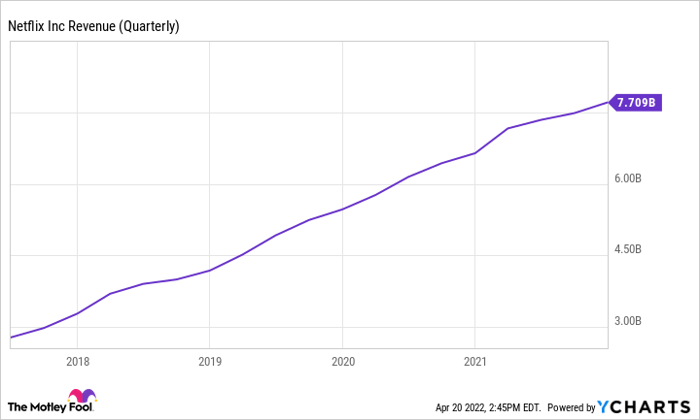
    Chart showing Netflix's quarterly revenue rising since 2018.

    NFLX Revenue (Quarterly) data by YCharts

    Netflix reported revenue of $7.9 billion in the quarter, which ended on March 31. That was 9.6% higher than the same quarter last year, and for the first time in a long while, it grew revenue by less than a double-digit percentage. Revenue fuels the flywheel for Netflix. It can spend the money that comes in on content, which could attract and retain existing customers, which boost revenue further, and so on. For that reason, monetizing shared accounts has become a top priority for management in the near term.

    The opportunity is genuinely massive

    If Netflix can generate a modest extra monthly payment of $3 per user from the estimated 100 million non-paying viewers, that would generate $3.6 billion per year in annualized revenue. To put that figure into context, Netflix earned $29.7 billion in revenue in the fiscal year 2021. Keep in mind that Netflix’s current average revenue per user is above $8 in all of its geographic regions, so a $3 per user increase is a conservative target.

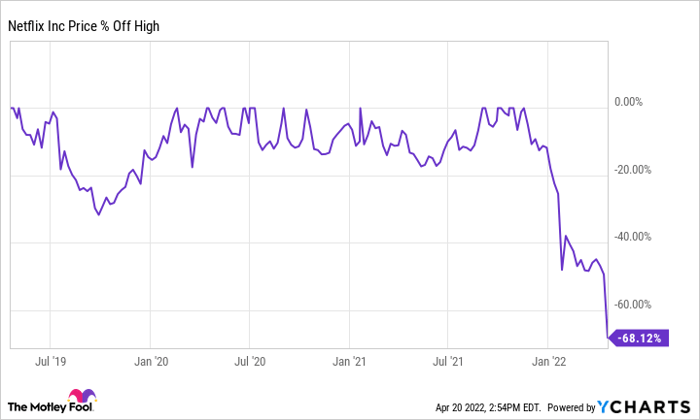
    Chart showing steep drop in Netflix's price percent off high since late 2021.

    NFLX data by YCharts

    It’s unclear whether achieving this goal will work to assuage investors who are concerned with Netflix’s slowing subscriber growth amid rising competition. Regardless of investor response, the company can use the additional funds to boost its content slate and increase its competitive advantage. It’s undoubtedly something long-term investors interested in Netflix should pay close attention to over the next several quarters. 

    This article was originally published on Fool.com. All figures quoted in US dollars unless otherwise stated.

    The post Netflix looks to 100 million existing viewers to boost revenue appeared first on The Motley Fool Australia.

    Should you invest $1,000 in Netflix right now?

    Before you consider Netflix , you’ll want to hear this.

    Motley Fool Investing expert Scott Phillips just revealed what he believes are the 5 best stocks for investors to buy right now… and Netflix wasn’t one of them.

    The online investing service he’s run for over a decade, Motley Fool Share Advisor, has provided thousands of paying members with stock picks that have doubled, tripled or even more.* And right now, Scott thinks there are 5 stocks that are better buys.

    *Returns as of January 13th 2022

    More reading

    Parkev Tatevosian owns Netflix. The Motley Fool Australia’s parent company Motley Fool Holdings Inc. owns and has recommended Netflix. The Motley Fool Australia has recommended Netflix. The Motley Fool has a disclosure policy. This article contains general investment advice only (under AFSL 400691). Authorised by Bruce Jackson. 

    This article was originally published on Fool.com. All figures quoted in US dollars unless otherwise stated.

    from The Motley Fool Australia https://ift.tt/1iLVr4H

  • Here’s why the OZ Minerals share price is sliding 5% today

    Miner looking at a tablet.Miner looking at a tablet.

    Shares in OZ Minerals Ltd (ASX: OZL) have stumbled at the open on Friday and are now trading 5.23% down at $24.84 apiece.

    Investors are selling off OZ Minerals shares following the company’s release of its quarterly update on operations for the three months ending 31 March 2022.

    TradingView Chart

    Copper, gold production slides for OZ Minerals

    OZ Minerals printed a decrease in total copper and gold production of 6% and 16%, respectively, from its unaudited financial statements.

    Meanwhile, the company’s all-in sustaining cost (AISC) on that production increased from US$1.596 per pound to US$1.744 per pound from Q4 2021 to Q1 2022, while cash costs also widened 30% to US$1.1181/pound.

    Nonetheless, copper and gold prices have been buoyant these last 12 months, with the bronze metal up 8% in that time while its yellow cousin has spiked more than 9%.

    Management commentary

    Speaking on the results, OZ Minerals managing director and CEO Andrew Cole said that strong market pricing continued “to support robust operating cash flow during a period of reinvestment back into the business”. He added:

    Our financial position remains strong with $210 million cash balance at the end of the quarter and significant liquidity available.

    The market outlook remains strong for renewable minerals like copper and nickel, with copper being a commodity with strong fundamentals underpinning economic growth and human development.

    Our focus for 2022 remains on safely delivering our operational targets, advancing our current growth projects and adding new growth options to the portfolio while we continue to strengthen and enable our unique company culture where people want to work with us to do the best work of their lives.

    What’s next for OZ Minerals?

    The company is projecting FY22 guidance of 127,000–149,000 tonnes of copper and 208–230 thousand tonnes of gold.

    It also expects AISC to reign in to US$1.35–$1.55 per pound, with C1 cash costs also tipped to narrow sharply by 19–27% by the end of FY22.

    “Despite the slower start to the year, group production and costs guidance remain on track for 2022 with a stronger operational performance expected over the balance of the year as COVID diminishes in the community,” Cole said.

    The OZ Minerals share price has climbed 3% in the last 12 months but is down more than 11% this year to date.

    The post Here’s why the OZ Minerals share price is sliding 5% today appeared first on The Motley Fool Australia.

    These 5 Cheap Shares Could Be Set For Huge Gains (FREE REPORT)

    We hear it over and over from investors, “I wish I had bought Altium or Afterpay when they were first recommended by The Motley Fool. I’d be sitting on a gold mine!” And it’s true.

    And while Altium and Afterpay have had a good run, we think these 5 other stocks are screaming buys. And you can find out the names of these stocks in the FREE stock report.

    *Extreme Opportunities returns as of February 15th 2021

    More reading

    Motley Fool contributor Zach Bristow has no position in any of the stocks mentioned. The Motley Fool Australia’s parent company Motley Fool Holdings Inc. has no position in any of the stocks mentioned. The Motley Fool Australia has no position in any of the stocks mentioned. The Motley Fool has a disclosure policy. This article contains general investment advice only (under AFSL 400691). Authorised by Bruce Jackson.

    from The Motley Fool Australia https://ift.tt/BVOxoyL

  • Can the Treasury Wine share price recover from its post-China hangover?

    a man sits alone in his house with a dejected look on his face as he looks at a glass of red wine he is holding in his hand with an open bottle on the table in front of him.a man sits alone in his house with a dejected look on his face as he looks at a glass of red wine he is holding in his hand with an open bottle on the table in front of him.

    Shares in Treasury Wine Estates Ltd (ASX: TWE) have traded sideways these past two months after taking a large hit back in January.

    Scaling back, and that appears to have been the trend for Treasury Wine Estates over the past 12 months. Market pundits continue to evaluate the fallout from a number of macroeconomic and structural challenges that’s ultimately sliced the company’s earnings palate to pieces.

    TradingView Chart

    Can Treasury Wine Estates share price recover?

    The company is still recovering from systemic challenges it faced in 2020 when the Chinese government put an end to its biggest export channel.

    Back then, it imposed heavy tariffs on Australian wine entering China, and there’s still a lot of uncertainty upon future sales into the country.

    Net profit after tax (NPAT) came down from a high of $408 million in 2019 to $245 million in 2020 and $250 million the year after – a 39% dip overall.

    Analysts at JP Morgan are in line with Treasury Wine’s share price movement lately – neutral. The broker reckons it’s a pivotal time in Treasury Wine’s history, with the fallout from China’s trade policy still taking effect.

    “There remains a risk to ANZ margins in commercial, and the broader impact across the price hierarchy, from a reallocation from China of commercial wine, yet the reallocation of the Penfolds bin and Icon range is the key EBITS contributor,” analysts wrote in a recent note.

    “The limited access to the large and high growth China market has moderated P/E multiple expansion, yet this headwind is moderated due to business balance.”

    JP Morgan is neutral on the company with a $12 valuation, a step behind Citi, which values it at $13.78 per share.

    Citi says that while Treasury Wines sales volumes have been down in the United States lately, the company has realised a 3% increase in average prices at the same time.

    That’s in-line with the company’s strategy to focus on selling luxury and/or premium brands ahead of lower-cost substitutes.

    Citi says to buy the stock, alongside 10 other brokers as per Bloomberg data. Meantime, 7 analysts reckon it’s a hold, whilst Barrenjoey Markets singularly urges its clients to sell on a $10 price target.

    Trading at $11.16 at the time of writing, the Treasury Wine Estates share price is still up almost 10% over the past 12 months.

    The post Can the Treasury Wine share price recover from its post-China hangover? appeared first on The Motley Fool Australia.

    Should you invest $1,000 in Treasury Wine Estates right now?

    Before you consider Treasury Wine Estates, you’ll want to hear this.

    Motley Fool Investing expert Scott Phillips just revealed what he believes are the 5 best stocks for investors to buy right now… and Treasury Wine Estates wasn’t one of them.

    The online investing service he’s run for over a decade, Motley Fool Share Advisor, has provided thousands of paying members with stock picks that have doubled, tripled or even more.* And right now, Scott thinks there are 5 stocks that are better buys.

    *Returns as of January 13th 2022

    More reading

    Motley Fool contributor Zach Bristow has no position in any of the stocks mentioned. The Motley Fool Australia’s parent company Motley Fool Holdings Inc. has no position in any of the stocks mentioned. The Motley Fool Australia has recommended Treasury Wine Estates Limited. The Motley Fool has a disclosure policy. This article contains general investment advice only (under AFSL 400691). Authorised by Bruce Jackson.

    from The Motley Fool Australia https://ift.tt/6lkUayr