Tag: Motley Fool

  • Why Netflix stock flopped again today

    This article was originally published on Fool.com. All figures quoted in US dollars unless otherwise stated.

    a group of young people sit together as though watching a television very intently with wide-mouthed, awed expressions while one holds a large bowl of popcorn with a bottle of beer in the foreground.

    This article was originally published on Fool.com. All figures quoted in US dollars unless otherwise stated.

    What happened

    One day after experiencing one of the worst trading sessions in its history, Netflix (NASDAQ: NFLX) stock took another fall on Thursday.

    At least this one wasn’t as bad; the streaming video bellwether’s shares closed “only” 3.5% lower. Some of this can be attributed to lingering pessimism following the company’s ugly first-quarter results, but it was also due to a top investor bailing on the stock, and a raft of analyst price-target cuts and downgrades.

    So what

    Like the ending of a mediocre film, we could have guessed the reaction of many analysts to Netflix’s first-quarter earnings report (in which it shockingly revealed a 200,000-count loss in streaming clients, with far more departures anticipated to come). The price target cuts and recommendation downgrades came thick and fast, even from longtime bulls.

    As of late Thursday afternoon, among the platoon of recommendation choppers were JPMorgan Chase, Stifel, Oppenheimer, and Edward Jones. The Netflix analysts at all these companies changed their views on the stock to the equivalent of neutral from their former buy.

    There were outliers, but they were very far and precious few between. One was Needham’s Laura Martin, who went in the opposite direction. She lifted her recommendation on the fallen streaming king to hold (neutral) from the preceding underperform (sell).

    Martin thinks a new company strategy could be one fix for what ails it. In a research note, she pointed out that “for the first time, the CEO stated [Netflix] will introduce a low-priced [advertising-supported] tier over the next 18-36 months.”

    Now what

    The occasional positive adjustment isn’t keeping people from selling out of the stock. One prominent seller was Pershing Square‘s Bill Ackman. On Thursday, it was reported that the high-profile hedge fund manager completely vacated his stake in Netflix, booking a queasy $400 million or so loss as he did so. According to media reports, Ackman had purchased around 3.1 million shares earlier this year. 

    This article was originally published on Fool.com. All figures quoted in US dollars unless otherwise stated.

    The post Why Netflix stock flopped again today appeared first on The Motley Fool Australia.

    Should you invest $1,000 in Netflix right now?

    Before you consider Netflix , you’ll want to hear this.

    Motley Fool Investing expert Scott Phillips just revealed what he believes are the 5 best stocks for investors to buy right now… and Netflix wasn’t one of them.

    The online investing service he’s run for over a decade, Motley Fool Share Advisor, has provided thousands of paying members with stock picks that have doubled, tripled or even more.* And right now, Scott thinks there are 5 stocks that are better buys.

    *Returns as of January 13th 2022

    More reading

    Eric Volkman has no position in any of the stocks mentioned. JPMorgan Chase is an advertising partner of The Ascent, a Motley Fool company. The Motley Fool Australia’s parent company Motley Fool Holdings Inc. owns and has recommended Netflix. The Motley Fool Australia has recommended Netflix. The Motley Fool has a disclosure policy. This article contains general investment advice only (under AFSL 400691). Authorised by Bruce Jackson. 

    This article was originally published on Fool.com. All figures quoted in US dollars unless otherwise stated.

    from The Motley Fool Australia https://ift.tt/xENyiIc

  • Broker says selloff of Bank of Queensland shares was unjustified

    An ASX shares broker analysing a chart tracking the A2 Milk share price

    An ASX shares broker analysing a chart tracking the A2 Milk share price

    The Bank of Queensland Limited (ASX: BOQ) share price is having a tough month.

    Since the start of April, the regional bank’s shares have fallen 8% to $7.96.

    Why is the Bank of Queensland share price down 8% this month?

    Investors have been selling down the Bank of Queensland share price in response to the bank’s half year results.

    While the bank reported stronger earnings than the market was expecting, this was driven largely by lower bad debts and thus the quality of its earnings were not as great as they first appeared.

    Nevertheless, the team at Citi remain positive on the company and continue to see significant value in the Bank of Queensland share price.

    According to a note, the broker has put a buy rating and $10.25 price target on its shares. This implies potential upside of 29% for investors over the next 12 months.

    In addition, Citi is forecasting a fully franked 49 cents per share dividend in FY 2022 and 56 cents per share dividend in FY 2023. This equates to yields of 6.1% and 7%, respectively, which stretches the total potential return to over 35%.

    What did the broker say?

    Citi doesn’t believe the selloff of the Bank of Queensland share price post-results was justified. It commented:

    “Was a ~6% share price sell-off justified for BOQ on 14th Apr after it delivered an inline 1H22 pre-provision profit result, with a ~9% beat at the cash earnings line?

    This result was compositionally weaker than expected, but we think investors are more concerned about 1) BOQ’s revenue growth compared to peers in a higher cash rate environment; 2) Cost base trajectory following the ME acquisition; and 3) the capital intensity of the business resulting in the need to use discounted DRPs to fund near-term growth.

    Despite our expectations for weaker than peer revenue growth as rates rise, we are maintaining a Buy recommendation for BOQ. The current P/BV of just 0.80x and dividend yield of >6% are too low for a bank that delivers ~9.0% cash ROE, which is in-line with its cost of equity, as well as being forecast to deliver a single-digit earnings and dividend growth profile.”

    The post Broker says selloff of Bank of Queensland shares was unjustified appeared first on The Motley Fool Australia.

    Should you invest $1,000 in Bank of Queensland right now?

    Before you consider Bank of Queensland, you’ll want to hear this.

    Motley Fool Investing expert Scott Phillips just revealed what he believes are the 5 best stocks for investors to buy right now… and Bank of Queensland wasn’t one of them.

    The online investing service he’s run for over a decade, Motley Fool Share Advisor, has provided thousands of paying members with stock picks that have doubled, tripled or even more.* And right now, Scott thinks there are 5 stocks that are better buys.

    *Returns as of January 13th 2022

    More reading

    Motley Fool contributor James Mickleboro has no position in any of the stocks mentioned. The Motley Fool Australia’s parent company Motley Fool Holdings Inc. has no position in any of the stocks mentioned. The Motley Fool Australia has no position in any of the stocks mentioned. The Motley Fool has a disclosure policy. This article contains general investment advice only (under AFSL 400691). Authorised by Bruce Jackson.

    from The Motley Fool Australia https://ift.tt/T3ljedU

  • Mineral Resources share price sinks despite strong Q3 update

    Two miners standing together.

    Two miners standing together.

    The Mineral Resources Limited (ASX: MIN) share price is on the slide on Friday morning.

    At the time of writing, the mining and mining services company’s shares are down 3.5% to $60.00

    Why is the Mineral Resources share price dropping?

    Investors have been selling down the Mineral Resources share price after broad market weakness offset the release of the company’s strong third quarter operational update.

    According to the release, the company’s Mining Services achieved production volumes of 63.4Mt for the three months. This was 16% higher than the prior corresponding period and means that it remains on target to meet its FY 2022 production guidance of 275Mt to 290Mt.

    Also on track to achieve guidance are its iron ore shipments. During the quarter, Mineral Resources reported a 22% increase in iron ore shipments to 4.7M wet metric tonnes (wmt).

    Management also expects to deliver on its iron costs guidance of A$96 to A$104 per wmt for the Yilgarn Hub and A$80 to A$88 per wmt for the Utah Point Hub.

    This compares to the average realised iron ore price for the quarter of US$101.31 per dry metric tonne (dmt), which was 60% higher quarter on quarter and represents a realisation of 72% against the Platts 62% Iron Ore Index.

    What about lithium?

    Mineral Resources’ Mt Marion Lithium Project produced 104k dmt and shipped 94k dmt of spodumene concentrate during the quarter.

    This means that Mt Marion remains on target to meet its FY 2022 guidance of 450kt to 475kt with costs of A$570 to A$615 per dmt (CFR ex-royalties). And with Mt Marion averaging a realised spodumene concentrate price of US$1,952 per dmt, which was up 69% quarter on quarter, the operation is generating significant free cash flow at present.

    Over at Wodgina, the company shipped 22k dmt of spodumene concentrate from existing stockpiles at an average price of US$2,200 per dmt. The first new spodumene concentrate from the Wodgina Train 1 is expected in May, with production from Train 2 expected in July.

    Despite this decline, the Mineral Resources share price is still up just 23% since this time last month.

    The post Mineral Resources share price sinks despite strong Q3 update appeared first on The Motley Fool Australia.

    Should you invest $1,000 in Mineral Resources right now?

    Before you consider Mineral Resources, you’ll want to hear this.

    Motley Fool Investing expert Scott Phillips just revealed what he believes are the 5 best stocks for investors to buy right now… and Mineral Resources wasn’t one of them.

    The online investing service he’s run for over a decade, Motley Fool Share Advisor, has provided thousands of paying members with stock picks that have doubled, tripled or even more.* And right now, Scott thinks there are 5 stocks that are better buys.

    *Returns as of January 13th 2022

    More reading

    Motley Fool contributor James Mickleboro has no position in any of the stocks mentioned. The Motley Fool Australia’s parent company Motley Fool Holdings Inc. has no position in any of the stocks mentioned. The Motley Fool Australia has no position in any of the stocks mentioned. The Motley Fool has a disclosure policy. This article contains general investment advice only (under AFSL 400691). Authorised by Bruce Jackson.

    from The Motley Fool Australia https://ift.tt/F1d3MCw

  • Dividend beasts: 5 ASX 200 shares with the highest dividend yield right now

    A happy woman holds a handful of cash dividendsA happy woman holds a handful of cash dividends

    When it comes to dividend income, there’s nothing quite like getting a good yield. That’s why we’re taking a look at the ASX 200 shares that are offering the highest dividend yield right now.

    These companies could be considered ‘dividend beasts’ – offering an attractive income stream of more than 5% yield. So, if you’re searching for some high-yielding stocks, these five companies are serving up the largest dividends in the entire S&P/ASX 200 Index (ASX: XJO).

    5 ASX 200 shares with juicy dividend yields

    Before we get started, keep in mind that a high dividend yield can result from a falling share price. Under these circumstances, it is not uncommon for companies to lower their future payouts. In the investing world, this is known as a dividend trap.

    BHP Group Ltd (ASX: BHP)

    Skyrocketing commodity prices have turned many ASX 200 mining shares into cash factories over the past 12 months. One of those companies is the world’s mining mammoth, BHP Group.

    Pumping out more than US$15.7 billion in net earnings during the last full year period, management raised the bar for dividends. Having produced US$3.50 in dividends per share (DPS) in a trailing 12-month period, BHP is showcasing a 9% dividend yield.

    Investors opted to sell BHP shares down today after its third-quarter update failed to impress analysts.

    Platinum Asset Management Ltd (ASX: PTM)

    The next ASX 200 share dishing out a downright shockingly high dividend yield is Platinum Asset Management. However, this asset management company’s high yield appears to be at the hand of a poorly performing share price.

    To the dismay of shareholders, Platinum shares have fallen 60% in a one-year timeframe. During this time, the fund manager has witnessed significant outflows, putting pressure on the company’s revenue and earnings.

    Based on the current share price, this dividend-paying share is fetching a yield of 11.7%.

    Rio Tinto Limited (ASX: RIO)

    Rio Tinto has managed to hold onto the podium in its descent from the second spot in our previous ‘dividend beasts’ standings earlier in the year.

    This ASX 200 mining share has been showered in increased earnings amid surging iron ore prices. In addition, the company’s share price has bounced back over the past few months, resulting in a reduced dividend yield.

    Nonetheless, Rio Tinto is carrying an impressive 12.2% yield, exceeding the industry average of 7.7%.

    Fortescue Metals Group Limited (ASX: FMG)

    Next on our list of ASX 200 shares that boast the highest dividend yield is yet another mining giant. Interestingly, Fortescue Metals Group took out the top spot back in January. However, the company has since provided a reduced interim dividend compared to the prior year.

    Accounting for the change, dividends for the trailing 12-month period now stand at $2.97 per share. This works out to be equivalent to a yield of 13.8%. There’s little doubt that shareholders will be upset about such an egregiously large yield.

    Magellan Financial Group Ltd (ASX: MFG)

    Finally, the king of the dividend hill takes its rightful spot. Formerly finding third place on our dividend beasts list, this ASX 200 share has boosted its yield even further since it was last covered.

    Magellan Financial Group is now parading a dividend yield of 14.1%. Though, there are a couple of things to note on this payout. Firstly, the Magellan share price has fallen roughly 13% since we last covered it. Furthermore, the fund manager raised its interim dividend by 13%, despite its payout ratio exceeding 100%.

    For now, Magellan reins over all other ASX 200 shares as the company with the highest dividend yield.

    The post Dividend beasts: 5 ASX 200 shares with the highest dividend yield right now appeared first on The Motley Fool Australia.

    Wondering where you should invest $1,000 right now?

    When investing expert Scott Phillips has a stock tip, it can pay to listen. After all, the flagship Motley Fool Share Advisor newsletter he has run for over ten years has provided thousands of paying members with stock picks that have doubled, tripled or even more.*

    Scott just revealed what he believes could be the five best ASX stocks for investors to buy right now. These stocks are trading at near dirt-cheap prices and Scott thinks they could be great buys right now.

    *Returns as of January 12th 2022

    More reading

    Motley Fool contributor Mitchell Lawler has no position in any of the stocks mentioned. The Motley Fool Australia’s parent company Motley Fool Holdings Inc. has no position in any of the stocks mentioned. The Motley Fool Australia has no position in any of the stocks mentioned. The Motley Fool has a disclosure policy. This article contains general investment advice only (under AFSL 400691). Authorised by Bruce Jackson.

    from The Motley Fool Australia https://ift.tt/xQHV8P7

  • The future looks bright: Here’s why this investment firm is doubling down on ASX shares in April

    A sunset scene though the fingers of two hands, indicating the bigger pictureA sunset scene though the fingers of two hands, indicating the bigger picture

    ASX shares have been outperforming many of their global counterparts in 2022, and one firm believes the party will continue for stocks listed down under.

    Global investment management firm T. Rowe Price has upped its position in Australian equities this month, moving it to ‘overweight’.

    So, what’s got the international investment firm feeling bullish about Australia? Let’s take a look.

    Why is this investment house bullish on ASX shares?

    The global market is struggling this year, but ASX shares are bucking the trend.

    As the chart below depicts, the S&P/ASX 200 Index (ASX: XJO) is outperforming both the S&P 500 (SPX) and the Nasdaq 100 (NDX) in 2022.

    TradingView Chart

    And, according to T. Rowe Price, the near future could bring even more gains for ASX investors.

    Its bullish sentiment for ASX shares is born from Australia’s location, its pandemic response, recent decisions made by the Reserve Bank of Australia, and the ASX’s weighty materials sector. The firm commented:

    By its geography, Australia is, first: isolated from the geopolitical tensions and, second: a beneficiary of the re-allocation of commodity trading activity.

    The domestic economy emerged from the last COVID lockdowns on a solid footing: unemployment is down, PMIs [purchasing managers’ index] still in expansionary mode, and business surveys suggest this should continue in the near term.

    While elevated, inflation is only slightly higher than the RBA target range, implying a lower burden to the economy relative to other developed economies.

    These positive drivers have been seen by the outperformance of the Australian stock markets year to date.

    Given optimism in recent earnings revisions, T. Rowe Price believes ASX shares could continue to outperform “in the near term”.

    T. Rowe Price is also overweight on Australian government bonds following their recent underperformance. Though, it’s dropped some of its holding in Australian yields, saying they might soon be over-extended.

    The firm’s also keeping an eye on business conditions lest they slump on supply and labour shortages.

    Finally, it’s wary the RBA’s “dovish” approach could be unsustainable. In fact, the firm warns of potential volatility when the RBA’s stance catches up with market expectations.

    T. Rowe Price dumped some of its holdings in Japanese and emerging markets to fund its new position in ASX shares.

    The post The future looks bright: Here’s why this investment firm is doubling down on ASX shares in April appeared first on The Motley Fool Australia.

    Wondering where you should invest $1,000 right now?

    When investing expert Scott Phillips has a stock tip, it can pay to listen. After all, the flagship Motley Fool Share Advisor newsletter he has run for over ten years has provided thousands of paying members with stock picks that have doubled, tripled or even more.*

    Scott just revealed what he believes could be the five best ASX stocks for investors to buy right now. These stocks are trading at near dirt-cheap prices and Scott thinks they could be great buys right now.

    *Returns as of January 12th 2022

    More reading

    from The Motley Fool Australia https://ift.tt/vdwurkY

  • 3 reasons Tesla’s monster earnings can help it keep crushing the Nasdaq in 2022

    This article was originally published on Fool.com. All figures quoted in US dollars unless otherwise stated.

    Tesla stock represented by tesla electric car driving along open road

    This article was originally published on Fool.com. All figures quoted in US dollars unless otherwise stated.

    Tesla (NASDAQ: TSLA) CEO Elon Musk is as polarizing of a figure as they come. On one hand, he has propeled the electric vehicle (EV) industry forward from a doubted concept to become a trend that legacy automakers are trying to ride. But he also receives criticism for actions like his online behavior and making a multi-billion-dollar offering to buy Twitter (NYSE: TWTR).

    However, there’s no denying that Tesla is a remarkable company. Tesla stock is up on the year while the Nasdaq Composite is down 13% and virtually every major carmaker to EV newcomer — from Toyota to Rivian Automotive, is down 5% to 66%. Here’s why Tesla continues to defy the Nasdaq’s gravity in 2022, and whether the stock is a good buy now. 

    1. Tesla is outperforming the competition

    Tesla tends to report its quarterly production and delivery numbers about two to three weeks prior to its earnings report. On April 2, Tesla reported quarterly production of 305,407 units and deliveries of 310,048 units, which was a big jump from Q1 2021 results of 180,338 units produced and 184,800 units delivered. However, the quarter-over-quarter growth marked a major slowdown compared to what investors were used to, as Tesla produced 305,840 units in Q4 2021 and delivered 308,600 units. Tesla attributed the slowdown to supply chain challenges and factory shutdowns. 

    However, Tesla’s growth outlook is favorable. The company began production and delivery from its Berlin factory in March and just started production from its Texas factory in April. The opening of the two new factories will alleviate pressure from Tesla’s Shanghai factory and could allow it to keep managing supply chain challenges and the global chip, material, and battery shortage better than its peers.

    In its recent investor presentation, Tesla said that it began deliveries of its crossover SUV, the Model Y, from its Texas factory and Germany factory — while also making an effort to move battery cell production in-house and diversify its supply chain and procurement process. 

    In sum, Tesla is showing resilience during an industrywide shortage while charting a path toward another record production and delivery year in 2022.

    2. Tesla is growing faster than ever

    Even with lower Q1 2022 production and delivery figures, it’s worth mentioning that Tesla’s revenue, earnings, and free cash flow growth continue to impress investors.

    The company recorded Q1 2022 automotive revenues of $16.86 billion, a year-over-year increase of 87%. In Q1 2022 alone, Tesla produced 36% of the automotive revenue it earned for all of 2021.Tesla cited its increased selling price as one of the reasons for higher revenue growth. 

    Despite the higher revenue, Tesla’s operating expenses were about the same at $1.86 billion compared to $1.62 billion in 2021 — just 15% higher despite total revenues being 81% higher. Similarly, Q1 2022 net cash provided by operating activities was 143% higher compared to Q1 2021 but capital expenditures were only 31% higher, while led to free cash flow of $2.23 billion — the second-highest quarterly performance ever. Tesla ended the quarter with $17.51 billion in cash and cash equivalents on its balance sheet. 

    3. Tesla is more profitable than ever

    One of Tesla’s most impressive stats is its operating margin. Unlike gross margin, which factors in the cost of goods sold, the operating margin also factors in operating expenses like utilities, wages, selling, general, and administrative expenses, sales and marketing, research and development, and other costs that are related to running the business. Tesla notched a record high operating margin of 19.2% in Q1 2022, meaning for every $1 it made in revenue it earned an operating profit of 19.2 cents. For comparison, here are the 2021 operating margins of major automakers, including Tesla.
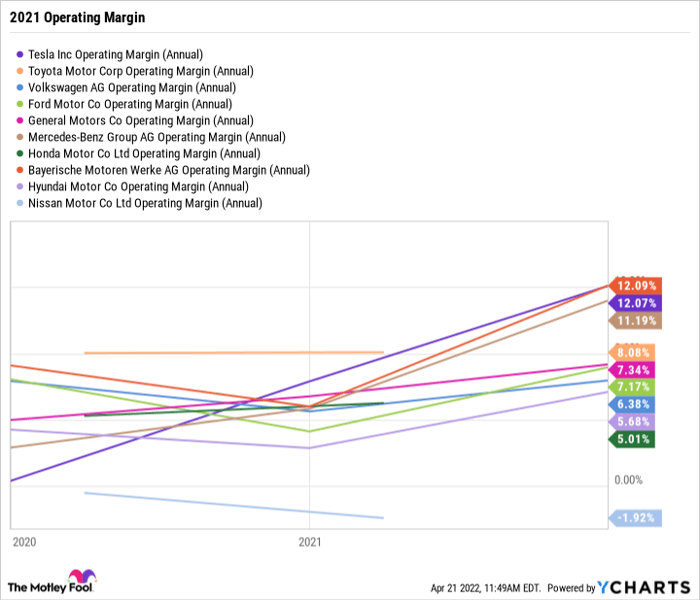
    TSLA Operating Margin (Annual) Chart

    TSLA Operating Margin (Annual) data by YCharts

    Tesla cited higher vehicle deliveries, increased average selling prices, reduced cost of goods sold, lower stock-based compensation, and increased regulatory credit sales as profitability drivers that offset higher raw material costs, commodity, logistics, and shipping costs and an increase in operating expenses. 

    In an industry constrained by rising raw material costs, rising parts and components costs, higher shipping and freight costs, and higher labor costs, it is impressive to see Tesla grow its operating margin when other major automakers will likely report lower operating margins in the quarters to come.

    Tesla is a phenomenal company but an expensive stock

    The investment thesis for Tesla remains intact. And in many ways, it is becoming harder to argue that Tesla isn’t the best global automaker. It has the greatest growth prospects, the best technology, and is ahead of the curve while the competition tries to catch up, it continues to deliver on its promises. Tesla is more profitable than ever and it has its own charging network plus investments in solar energy and energy storage. It also has a lean business model that doesn’t depend on the dealership network. But as Warren Buffett famously said, “you pay a very high price in the stock market for a cheery consensus.” Put another way, great companies are often expansive stocks. And that logic applies perfectly to Tesla.

    Tesla’s market cap is $1.08 trillion. It earned adjusted diluted non-GAAP earnings per share (EPS) of $3.22 in Q1 2022. So even if Tesla continues to grow earnings and earn, let’s say $15 in adjusted 2022 EPS, it would still have a forward price to earnings ratio of roughly 70. Tesla stock is by no means cheap. And it shouldn’t be — it’s a really really good business. For risk-tolerant investors who are optimistic about the growth of the EV industry, adding Tesla to a diversified basket of EV stocks isn’t the worst idea so long as it’s understood that Tesla stock is prone to sharp gyrations to the upside and downside. In the last year alone, Tesla stock has been as high as $1,243.49 per share and as low as $546.98 per share. 

    As with every business, it’s important to understand what you are buying and why you want to own it. With Tesla, the investment thesis is simple. It’s a bet on the long-term growth of EV adoption via buying the industry leader for a premium price. For some folks, that’s a thesis that makes sense. But for others, the electric car stock may simply be an impressive company that is just too expensive to consider now. 

    This article was originally published on Fool.com. All figures quoted in US dollars unless otherwise stated.

    The post 3 reasons Tesla’s monster earnings can help it keep crushing the Nasdaq in 2022 appeared first on The Motley Fool Australia.

    Should you invest $1,000 in Tesla right now?

    Before you consider Tesla , you’ll want to hear this.

    Motley Fool Investing expert Scott Phillips just revealed what he believes are the 5 best stocks for investors to buy right now… and Tesla wasn’t one of them.

    The online investing service he’s run for over a decade, Motley Fool Share Advisor, has provided thousands of paying members with stock picks that have doubled, tripled or even more.* And right now, Scott thinks there are 5 stocks that are better buys.

    *Returns as of January 13th 2022

    More reading

    Daniel Foelber has the following options: long May 2022 $705 puts on Tesla and short May 2022 $700 puts on Tesla. The Motley Fool Australia’s parent company Motley Fool Holdings Inc. owns and has recommended Tesla and Twitter. The Motley Fool Australia has no position in any of the stocks mentioned. The Motley Fool has a disclosure policy. This article contains general investment advice only (under AFSL 400691). Authorised by Bruce Jackson. 

    This article was originally published on Fool.com. All figures quoted in US dollars unless otherwise stated.

    from The Motley Fool Australia https://ift.tt/x73uED2

  • Wow! Here’s how much $5,000 of Woolworths shares bought 5 years ago would be worth now

    businessman handing $100 note to another in supermarket aisle representing woolworths share pricebusinessman handing $100 note to another in supermarket aisle representing woolworths share price

    The Woolworths Group Ltd (ASX: WOW) share price has continued to deliver wealth to investors over the past five years.

    Arguably, investing your money in the ASX’s safest and most reliable companies can reap some serious rewards over time.

    Below, we calculate how much you would have made if you’d bought $5,000 worth of Woolworths shares five years ago.

    How much would your initial investment be worth now?

    If you spent $5,000 on Woolworths shares exactly 5 years ago, you would have picked them up for $23.41 apiece. The purchase would deliver approximately 213 shares without topping up during down periods.

    Looking at yesterday’s closing price, the Woolworths share price finished at $39.47. This means those 213 shares would now be worth $8,407.11.

    When looking at percentage terms, this implies an average yearly return of 10.95%. In comparison, the S&P/ASX 200 Index (ASX: XJO) has given back roughly 5.34% over the same timeframe.

    And the Woolworths dividends?

    Over the course of the last five years, Woolworths has made a total of 12 dividend payments from 2017 to 2022. Its latest dividend distribution was significantly lower as the Omicron outbreak affected operations during the first half of FY22.

    Adding those 12 dividend payments gives us an amount of $5.30 per share. Calculating the number of shares owned against the total dividend payment gives us a figure of $1,128.90.

    When putting both the initial investment gains and dividend distribution, an investor would have $9,536.01 worth of Woolworths shares.

    As you can see from the above, investing in Woolworths shares would have almost doubled your initial investment.

    In comparison, investing the same amount in an ASX 200 index-tracking fund would have netted you a total figure of $6,485.02 (albeit excluding any dividends).

    Woolworths share price snapshot

    Over the past 12 months, the Woolworths share price has travelled 5% higher and is up 3% year to date.

    The company’s shares hit a 52-week low of $33.45 in January before rebounding higher in the following months.

    Woolworths presides a market capitalisation of roughly $47.91 billion and has more than 1.21 billion shares on its registry.

    The post Wow! Here’s how much $5,000 of Woolworths shares bought 5 years ago would be worth now appeared first on The Motley Fool Australia.

    Should you invest $1,000 in Woolworths right now?

    Before you consider Woolworths, you’ll want to hear this.

    Motley Fool Investing expert Scott Phillips just revealed what he believes are the 5 best stocks for investors to buy right now… and Woolworths wasn’t one of them.

    The online investing service he’s run for over a decade, Motley Fool Share Advisor, has provided thousands of paying members with stock picks that have doubled, tripled or even more.* And right now, Scott thinks there are 5 stocks that are better buys.

    *Returns as of January 13th 2022

    More reading

    Motley Fool contributor Aaron Teboneras has no position in any of the stocks mentioned. The Motley Fool Australia’s parent company Motley Fool Holdings Inc. has no position in any of the stocks mentioned. The Motley Fool Australia has no position in any of the stocks mentioned. The Motley Fool has a disclosure policy. This article contains general investment advice only (under AFSL 400691). Authorised by Bruce Jackson.

    from The Motley Fool Australia https://ift.tt/Ozt7cRG

  • Why this broker says Endeavour shares are a conviction buy

    A young couple snuggles together in a pub sitting at a table with friends and laughing

    A young couple snuggles together in a pub sitting at a table with friends and laughing

    The Endeavour Group Ltd (ASX: EDV) share price was out of form on Thursday.

    The alcohol retailer’s shares tumbled 3.5% to $7.61 following the release of its third quarter trading update.

    Is the Endeavour share price in the buy zone?

    One leading broker that believes the weakness in the Endeavour share price as a buying opportunity is Goldman Sachs.

    According to a note this morning, in response to its third quarter update, the broker has retained its conviction buy rating and lifted its price target to $8.30.

    Based on the current Endeavour share price, this implies potential upside of 9.1% for investors over the next 12 months.

    And with Goldman expecting a fully franked 2.5% dividend yield in FY 2022 and 3.1% in FY 2023, the total return on offer stretches to approximately 12%.

    The broker commented: “We update our TP to A$8.30/sh (vs prior A$8.00/sh, implying 9.1% TP upside) to reflect EDV’s 3Q22 sales update and a deep dive into the Hotels opportunity as the company begins to see accelerated recovery back to pre-COVID levels in 3Q22.”

    Why is Goldman bullish?

    A couple of the main reasons that Goldman Sachs is bullish on the Endeavour share price are the company’s digital capabilities and customer loyalty. The broker believes these leave it well-placed for growth in the future.

    Goldman explained:

    “We continue to be bullish on the digital consumer capabilities of EDV with 3Q22 Dan’s members at 6.4m (>4m of which was active in last 6mths) and online penetration remaining at 9.6% (though lower towards end of quarter as reversion back to in store gathered pace).

    We continue to believe that EDV is unrivaled in its capability to deliver a seamless omni-channel experience to consumers and can manage well through short-term cost volatilities with a less price-sensitive portfolio and high consumer loyalty. Retain Buy (on CL).”

    The post Why this broker says Endeavour shares are a conviction buy appeared first on The Motley Fool Australia.

    Should you invest $1,000 in Endeavour right now?

    Before you consider Endeavour, you’ll want to hear this.

    Motley Fool Investing expert Scott Phillips just revealed what he believes are the 5 best stocks for investors to buy right now… and Endeavour wasn’t one of them.

    The online investing service he’s run for over a decade, Motley Fool Share Advisor, has provided thousands of paying members with stock picks that have doubled, tripled or even more.* And right now, Scott thinks there are 5 stocks that are better buys.

    *Returns as of January 13th 2022

    More reading

    Motley Fool contributor James Mickleboro has no position in any of the stocks mentioned. The Motley Fool Australia’s parent company Motley Fool Holdings Inc. has no position in any of the stocks mentioned. The Motley Fool Australia has no position in any of the stocks mentioned. The Motley Fool has a disclosure policy. This article contains general investment advice only (under AFSL 400691). Authorised by Bruce Jackson.

    from The Motley Fool Australia https://ift.tt/0hz7aGE

  • Leading fund manager names these 2 small-cap ASX shares as buys

    A team of people giving the thumbs up sign representing a number of brokers backing the QBE share price to rise

    A team of people giving the thumbs up sign representing a number of brokers backing the QBE share price to rise

    Fund manager Wilson Asset Management (WAM) has identified two top small-cap ASX shares in its portfolio that could be ideas.

    WAM operates several listed investment companies (LICs). Some focus on larger companies like WAM Leaders Ltd (ASX: WLE) and WAM Capital Limited (ASX: WAM).

    There’s also one called WAM Microcap Limited (ASX: WMI), which focuses on small-cap ASX shares with a market capitalisation under $300 million at acquisition.

    WAM says WAM Microcap targets “the most exciting undervalued growth opportunities in the Australian microcap market”.

    These are the two small-cap ASX shares the fund manager outlined in its most recent monthly update:

    Myer Holdings Ltd (ASX: MYR)

    WAM noted that Myer operates 58 department stores across Australia.

    Last month, Myer announced its FY22 half-year earnings, which were reportedly better than the market had been expecting.

    The fund manager pointed out that the company grew sales by 8.5% to $1.52 billion year-on-year, despite spending 23% of in-store trading days under COVID-19 lockdowns.

    Myer’s half-year net profit after tax (NPAT) of $32.3 million increased 55.2% year-on-year after adjusting for the government JobKeeper allowance.

    WAM believes that the small-cap ASX share’s in-store sales will continue to recover as economies reopen and foot traffic returns to CBDs.

    The fund manager is positive on Myer’s medium-term outlook and believes that the company can continue to recover and generate double-digit earnings growth over the next few years.

    Objective Corporation Limited (ASX: OCL)

    Objective Corporation is an Australian-based business that provides “mission-critical” software providers to the public sector, working with more than 1,000 government organisations.

    Last month, the company announced plans to acquire Atlanta-based software company Simflofy and expand into North America. Simflofy provides more than 100 customers with software solutions targeted to all levels of the United States government, financial services, insurance and Fortune 500 companies.

    WAM expects the acquisition will add to the small-cap ASX share’s earnings while addressing the strong demand for ‘federated’ information technology governance structures.

    The fund manager believes that the ASX share has a positive outlook with a strong balance sheet which provides opportunities for more acquisitions that will add to earnings.

    The post Leading fund manager names these 2 small-cap ASX shares as buys appeared first on The Motley Fool Australia.

    Wondering where you should invest $1,000 right now?

    When investing expert Scott Phillips has a stock tip, it can pay to listen. After all, the flagship Motley Fool Share Advisor newsletter he has run for over ten years has provided thousands of paying members with stock picks that have doubled, tripled or even more.*

    Scott just revealed what he believes could be the five best ASX stocks for investors to buy right now. These stocks are trading at near dirt-cheap prices and Scott thinks they could be great buys right now.

    *Returns as of January 12th 2022

    More reading

    Motley Fool contributor Tristan Harrison owns WAM MICRO FPO. The Motley Fool Australia’s parent company Motley Fool Holdings Inc. owns and has recommended Objective Corporation Limited. The Motley Fool Australia has no position in any of the stocks mentioned. The Motley Fool has a disclosure policy. This article contains general investment advice only (under AFSL 400691). Authorised by Bruce Jackson.

    from The Motley Fool Australia https://ift.tt/2OAwaNs

  • Why is the Wesfarmers share price having such a rough trot in April?

    a woman with a sad face looks to be receiving bad news on her phone as she holds it in her hands and looks down at it.a woman with a sad face looks to be receiving bad news on her phone as she holds it in her hands and looks down at it.

    The Wesfarmers Ltd (ASX: WES) share price has gone down more than 2% in April. That compares to a 1.4% gain for the S&P/ASX 200 Index (ASX: XJO).

    However, before considering why this might have happened, it may be worth noting that this underperformance is only looking at one month of returns.

    Over the past five years, Wesfarmers shares have risen by around 60%, while the ASX 200 has risen by just under 30%.

    So, what’s going on with this underperformance in April?

    What could be impacting the Wesfarmers share price?

    It is being widely reported that local and global inflation is elevated. This has led to expectations that the Reserve Bank of Australia (RBA) is going to start increasing interest rates in June 2022.

    As reported by Reuters and other media outlets, the Westpac-Melbourne Institute index of consumer sentiment showed a decline for a fifth straight month because of rising inflation and the potential for higher interest rates, hurting spending intentions.

    Reuters reported that the “survey suggested the government’s budget in March had a limited impact on the national mood, even though it contained pre-election tax breaks and cuts to fuel excise”.

    Westpac chief economist Bill Evans was quoted as saying: “There is further evidence that interest rates, inflation and weather continued to unnerve consumers in the current survey.”

    The worst decline in sentiment occurred with households that had a home loan.

    However, Westpac also pointed out that mortgage borrowers have been accumulating a savings buffer during COVID-19 in mortgage offset accounts, with balances rising to 2.5% of disposable income over FY21 compared to around 1% in earlier years. Due to that, the median excess payment buffer is 21 months, according to Westpac, up from 10 months before the pandemic.

    However, Westpac has also noted that, by looking at RBA data, it is unsure how much of the buffer is available to the most vulnerable borrower groups. A fifth of variable-rate borrowers would face a 40% lift in average repayments if the RBA rate were to increase by 200 basis points, according to Westpac.

    How is the company planning to handle inflation for consumers?

    When Wesfarmers released its FY22 half-year result, it said that overall economic conditions in Australia remain favourable, supported by strong employment and high levels of accumulated household savings.

    It said it is actively managing increasing inflationary pressure and will leverage its scale to mitigate the impact of rising costs.

    Wesfarmers said its retail businesses will increase their focus on price leadership and are “well-positioned to provide customers with great value on everyday products as rising cost-of-living pressures impact household budgets”.

    COVID-19 continues to impact the business. It said that it’s experiencing stock availability impacts. Supply chain disruptions, elevated transport costs, and constraints in the domestic labour market are expected to continue in the second half.

    Is the Wesfarmers share price an opportunity?

    Many brokers are unconvinced.

    The broker Citi is ‘neutral’ on Wesfarmers, with a price target of just $50. That implies the Wesfarmers share price — which is currently $49.35 — may be almost flat over the next year.

    Credit Suisse is also ‘neutral’, but the price target is $55.19. That suggests a possible rise of more than 10%.

    On Citi’s numbers, the Wesfarmers share price is valued at 24 times FY22’s estimated earnings with a grossed-up dividend yield of 5.4%.

    The post Why is the Wesfarmers share price having such a rough trot in April? appeared first on The Motley Fool Australia.

    Should you invest $1,000 in Wesfarmers right now?

    Before you consider Wesfarmers, you’ll want to hear this.

    Motley Fool Investing expert Scott Phillips just revealed what he believes are the 5 best stocks for investors to buy right now… and Wesfarmers wasn’t one of them.

    The online investing service he’s run for over a decade, Motley Fool Share Advisor, has provided thousands of paying members with stock picks that have doubled, tripled or even more.* And right now, Scott thinks there are 5 stocks that are better buys.

    *Returns as of January 13th 2022

    More reading

    Motley Fool contributor Tristan Harrison has no position in any of the stocks mentioned. The Motley Fool Australia’s parent company Motley Fool Holdings Inc. has no position in any of the stocks mentioned. The Motley Fool Australia owns and has recommended Wesfarmers Limited. The Motley Fool has a disclosure policy. This article contains general investment advice only (under AFSL 400691). Authorised by Bruce Jackson.

    from The Motley Fool Australia https://ift.tt/kYEe0y5