Tag: Motley Fool

  • Why did the Rio Tinto share price (ASX:RIO) have such a lousy 2021?

    Worker in hard hat looks puzzled with one hand on chin

    The Rio Tinto Limited (ASX: RIO) share price came crashing down in 2021, despite a positive start to the year.

    The mining company’s share price fell from $113.83 to $100.11 during the year, shedding 12%. In comparison, the S&P/ASX 200 Index (ASX: XJO) gained around 13%.

    Let’s examine what may have impacted this ASX 200 share in 2021.

    Iron ore prices

    The Rio Tinto share price recorded gains in the first half of the year before collapsing from August to November. The company’s share price then picked up in late November to finish the year off in style.

    In the first six months of the year, Rio Tinto shares gained nearly 12%. Shares in the mining giant climbed 15% between market close on 5 February and 25 February. Strong iron ore prices, a record dividend payout from the company, and positive financial results all weighed positively with investors.

    The company reported a 3% increase in sales revenue to US$44,611 million and a 13.4% boost in iron revenue. Rio Tinto also rewarded shareholders by declaring a fully franked final dividend of US$4.02 (A$5.19) per share.

    March to May also saw the company’s share price explode on the back of record iron ore prices and well-received first-quarter production results. In the first quarter of FY 2021, the company shipped 77.8 million tonnes of Pilbara iron ore, a 7% increase. Rio Tinto shares surged more than 24% between 22 March and 10 May.

    However, from August to November the Rio Tinto share price came crashing down to earth. As Motley Fool Australia noted at the time, investors were selling down the mining company’s shares due to falling iron ore prices.

    The company also downgraded its production targets for 2021. A third-quarter trading update in mid-October slightly pushed the share price down, with the Covid-19 virus impacting production results. Between market close on 4 August and 5 November, the Rio Tinto share price dropped 30%. Iron ore prices fell 48% in this same time frame.

    Then came the bounce back. The Rio Tinto share price recovered nearly 12% between 18 November and 31 December. The iron ore price increased nearly 31% during this same time period, likely impacting investor sentiment.

    The company also announced two major lithium projects. Rio Tinto will acquire the Rincon lithium project in Argentina for $1.15 billion and the Jadar project in Serbia for $3.3 billion.

    Rio Tinto share price snapshot

    In the past month, the company’s shares have gained around 7%, while they are up 2% this week. At the time of writing, they are trading at $102.23, up 1.74%.

    Looking ahead, as my Foolish colleague James reported this week, opinion on the outlook for the company’s share price is divided.

    Macquarie Group Ltd (ASX: MQG) has a $135 price target, while Morgans has a hold rating and a $104 price target.

    The company has a mammoth market capitalisation of nearly $37 billion based on its current share price.

    The post Why did the Rio Tinto share price (ASX:RIO) have such a lousy 2021? appeared first on The Motley Fool Australia.

    Should you invest $1,000 in Rio Tinto right now?

    Before you consider Rio Tinto, you’ll want to hear this.

    Motley Fool Investing expert Scott Phillips just revealed what he believes are the 5 best stocks for investors to buy right now… and Rio Tinto wasn’t one of them.

    The online investing service he’s run for nearly a decade, Motley Fool Share Advisor, has provided thousands of paying members with stock picks that have doubled, tripled or even more.* And right now, Scott thinks there are 5 stocks that are better buys.

    *Returns as of August 16th 2021

    More reading

    The Motley Fool Australia’s parent company Motley Fool Holdings Inc. has no position in any of the stocks mentioned. The Motley Fool Australia has recommended Macquarie Group Limited. The Motley Fool has a disclosure policy. This article contains general investment advice only (under AFSL 400691). Authorised by Bruce Jackson.

    from The Motley Fool Australia https://ift.tt/3qS9yzx
  • Is Berkshire Hathaway headed for $1 trillion?

    This article was originally published on Fool.com. All figures quoted in US dollars unless otherwise stated.

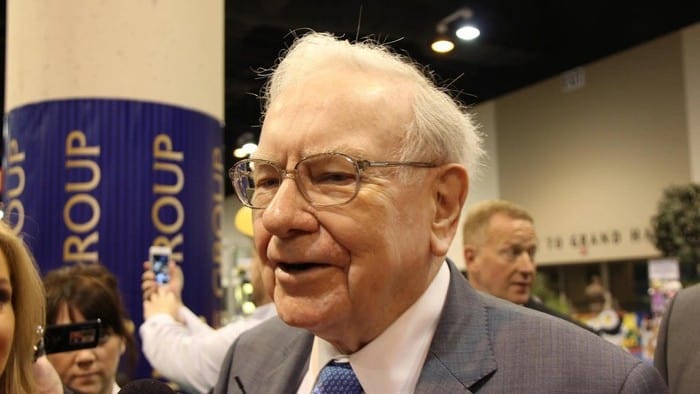
    Warren Buffett

    This article was originally published on Fool.com. All figures quoted in US dollars unless otherwise stated.

    Wall Street remained somewhat choppy on Wednesday morning, as investors remained divided in their views of the prospects of various industries within the stock market. As of 10 a.m. ET, the Dow Jones Industrial Average (DJINDICES: ^DJI) was up 18 points to 36,817, which would be a new record high if it holds onto those gains. However, the S&P 500 (SNPINDEX: ^GSPC) had fallen 3 points to 4,791, and the Nasdaq Composite (NASDAQINDEX: ^IXIC) had lost 67 points to 15,555.

    Evidence of a market rotation continues to pile up, and one of the clearest signs of the possible ascendancy of value investing came from Omaha, Nebraska. Berkshire Hathaway (NYSE: BRK.A) (NYSE: BRK.B) shares were up another 2% on Wednesday morning, bringing its gains in the first two and a half trading days of the year to nearly 5% and representing a record stock price level for Warren Buffett’s company. Given the gains that other stocks have seen, some investors wonder if Berkshire could finally make its way into the $1 trillion market capitalization club sometime in 2022.

    A tough few years

    Some investors in Berkshire Hathaway have been disappointed with the stock’s performance in recent years. A persistent preference from investors for higher-growth companies has contributed to underperformance from Berkshire stock, with its 91% total return over the past five years trailing the S&P 500’s 130%.

    Berkshire has also had its share of miscues. Buffett’s decision to sell out of airline stocks near their lows in March and April 2020 received widespread criticism, as it seemed to resemble a panic-driven sale and was soon followed by a massive rebound in the airline industry. Meanwhile, the stock didn’t seem to get much credit for Berkshire’s massive holding in shares of Apple, which have skyrocketed over the period.

    Growth-oriented investors also question why Berkshire keeps so much cash on hand. Even with the company making increasingly substantial repurchases of its own stock, Berkshire had nearly $150 billion in cash on its balance sheet as of its most recent quarterly report. That cash on the sidelines earning next to nothing was arguably a big drag on potential investment performance.

    Seeing value

    More recently, though, investors have seemed to recognize the intrinsic value of Berkshire’s businesses. Wholly owned companies in areas like energy and transportation are starting to show signs of strength, and even with Buffett having dramatically cut exposure to the banking sector, Berkshire’s holdings there are benefiting from the prospects for rising long-term interest rates that could bolster net interest income.

    Perhaps most importantly, many shareholders see Berkshire as a counter-trend play that offers portfolio diversification when combined with higher-growth stocks. Despite some recent purchases of positions in companies like data warehousing specialist Snowflake, Buffett’s conservative style is likely to remain in place at Berkshire even once he’s no longer able to lead the company.

    Is $1 trillion within reach?

    Berkshire’s market capitalization just topped the $700 billion mark, so it’d take a better-than-40% gain from here to reach $1 trillion. That’s a tall order for Berkshire in 2022 even after years of underperformance. However, some of the trends that have created big headwinds for the insurance conglomerate appear to be shifting, and that suggests that even if it doesn’t happen this year, Berkshire could put together the gains necessary to join the trillion-dollar club before too much longer. 

    This article was originally published on Fool.com. All figures quoted in US dollars unless otherwise stated.

    The post Is Berkshire Hathaway headed for $1 trillion? appeared first on The Motley Fool Australia.

    Wondering where you should invest $1,000 right now?

    When investing expert Scott Phillips has a stock tip, it can pay to listen. After all, the flagship Motley Fool Share Advisor newsletter he has run for more than eight years has provided thousands of paying members with stock picks that have doubled, tripled or even more.*

    Scott just revealed what he believes could be the five best ASX stocks for investors to buy right now. These stocks are trading at near dirt-cheap prices and Scott thinks they could be great buys right now.

    *Returns as of August 16th 2021

    More reading

    Dan Caplinger owns Apple, Berkshire Hathaway (B shares), and Snowflake Inc. The Motley Fool Australia’s parent company Motley Fool Holdings Inc. recommends the following options: long January 2023 $200 calls on Berkshire Hathaway (B shares), long March 2023 $120 calls on Apple, short January 2023 $200 puts on Berkshire Hathaway (B shares), short January 2023 $265 calls on Berkshire Hathaway (B shares), and short March 2023 $130 calls on Apple. The Motley Fool Australia has recommended Apple and Berkshire Hathaway (B shares). The Motley Fool has a disclosure policy. This article contains general investment advice only (under AFSL 400691). Authorised by Bruce Jackson.

    This article was originally published on Fool.com. All figures quoted in US dollars unless otherwise stated.

    from The Motley Fool Australia https://ift.tt/3EY0vCm

  • How the Vulcan (ASX:VUL) share price almost quadrupled in 2021

    A man has a surprised and relieved expression on his face.

    The Vulcan Energy Resources Ltd (ASX: VUL) share price was one of the best performers on the Australian share market in 2021.

    Over the 12 months, the lithium developer’s shares rose a massive 277%.

    This was despite the Vulcan share price ending the year at $10.36, which is almost 38% lower than its 52-week high of $16.65.

    Why did the Vulcan share price almost quadruple in 2021?

    Investors were buying Vulcan and other lithium shares last year amid the increasingly positive outlook for the battery making ingredient. This is due to the insatiable demand for the white metal from electric vehicle battery and renewable energy markets which is expected to significantly outstrip supply in the coming years.

    And while Vulcan is not yet producing lithium, it has signed away a large portion of its future production to automakers. This gives investors good visibility on its future earnings.

    Among the companies that have signed offtake agreements for lithium from the Zero Carbon Lithium Project in Germany are Renault, Volkswagen, and Stellantis. The latter may not be a familiar name, but its car brands will be. Stellantis is the world’s fourth largest automaker and the name behind brands including Alfa Romeo, Chrysler, Citroen, Fiat, Jeep, Maserati, and Peugeot.

    Where next for its shares?

    Incredibly, despite the Vulcan share price rocketing 277% higher in 2021, one leading broker believes it can more than double in 2022.

    A recent note out of Canaccord Genuity reveals that its analysts have retained their speculative buy rating and $21.00 price target on the company’s shares.

    This could make it well worth keeping a close eye on Vulcan’s shares again in 2022.

    The post How the Vulcan (ASX:VUL) share price almost quadrupled in 2021 appeared first on The Motley Fool Australia.

    Should you invest $1,000 in Vulcan right now?

    Before you consider Vulcan, you’ll want to hear this.

    Motley Fool Investing expert Scott Phillips just revealed what he believes are the 5 best stocks for investors to buy right now… and Vulcan wasn’t one of them.

    The online investing service he’s run for nearly a decade, Motley Fool Share Advisor, has provided thousands of paying members with stock picks that have doubled, tripled or even more.* And right now, Scott thinks there are 5 stocks that are better buys.

    *Returns as of August 16th 2021

    More reading

    Motley Fool contributor James Mickleboro has no position in any of the stocks mentioned. The Motley Fool Australia’s parent company Motley Fool Holdings Inc. has no position in any of the stocks mentioned. The Motley Fool Australia has no position in any of the stocks mentioned. The Motley Fool has a disclosure policy. This article contains general investment advice only (under AFSL 400691). Authorised by Bruce Jackson.

    from The Motley Fool Australia https://ift.tt/3zy5msS

  • Is the party over for ASX BNPL shares?

    Close up of a sad young Caucasian woman reading about Leigh Creek Energy's declining share price on her phone

    Tumbling share prices and industry consolidation: this probably isn’t how most ASX buy now, pay later (BNPL) investors pictured it playing out. In 2021, ASX BNPL shares such as Afterpay Ltd (ASX: APT) and Zip Co Ltd (ASX: Z1P) severely underperformed the broader Aussie market — so is the party over?

    The days when Australia’s BNPL companies were the market darlings of the ASX seem a distant memory now. Rather than gaining more excitement in the last year, the sector attracted heightened scepticism.

    For investors, the last year marked a clear shift in sentiment towards the once idolised credit disruptors. Afterpay recorded its first negative share price return since being listed, falling nearly 30%. Similarly, the Zip share price dealt shareholders their first negative return since 2017, shaving off 18%.

    What could be ahead for ASX BNPL shares?

    Despite the pullback in share prices, there are a number of experts who still aren’t so keen on ASX BNPL shares. This would suggest these companies remain stuck in a more pessimistic light currently.

    Morgans analyst Richard Coles is one of the numerous spectators that envisions tougher times ahead for BNPL companies. In a broker note, the analyst outlines several risk factors to Afterpay specifically. These include slowing sales momentum, margin compression from competition, overseas expansion risk, bad debts, increased funding costs, and regulatory pressure.

    For these reasons, Morgans slashed its price target on Australia’s biggest BNPL company to $91.49 from $132. Likewise, the broker revised its Zip price target to $7.54 from $8.56 on lower earnings per share (EPS) expectations.

    These concerns mirror those of payments industry expert Gran Halverson. As we covered back in December, the founder of payments consultancy company McLean Roche is mindful of a bumpy path ahead for ASX BNPL shares. In turn, Halverson suspects another challenging year for the payment companies in 2022.

    On the flip side

    According to a forecast published by Juniper Research, the long-term picture for ASX BNPL shares may not be so much doom and gloom. In its June 2021 Buy Now Pay Later: The Future of Ecommerce whitepaper, the research firm estimates that fixed instalment plans and flexible credit accounts will reach $995 billion globally in 2026. At present this figure sits around $266 billion.

    Unlike Coles and Halverson, Juniper believes regulations won’t stifle the appeal or growth of BNPL platforms. In fact, the whitepaper highlights that an expected 24% of global eCommerce transactions for physical goods will be conducted via BNPL services by 2026.

    At the time of writing, Afterpay shares are down 9.4% to $72.94. This follows an 8.2% fall in the Block Inc (NYSE: SQ) share price overnight.

    The post Is the party over for ASX BNPL shares? appeared first on The Motley Fool Australia.

    Wondering where you should invest $1,000 right now?

    When investing expert Scott Phillips has a stock tip, it can pay to listen. After all, the flagship Motley Fool Share Advisor newsletter he has run for more than eight years has provided thousands of paying members with stock picks that have doubled, tripled or even more.*

    Scott just revealed what he believes could be the five best ASX stocks for investors to buy right now. These stocks are trading at near dirt-cheap prices and Scott thinks they could be great buys right now.

    *Returns as of August 16th 2021

    More reading

    Motley Fool contributor Mitchell Lawler owns Afterpay Limited. The Motley Fool Australia’s parent company Motley Fool Holdings Inc. owns and has recommended Afterpay Limited, Block, Inc., and ZIPCOLTD FPO. The Motley Fool Australia owns and has recommended Afterpay Limited. The Motley Fool has a disclosure policy. This article contains general investment advice only (under AFSL 400691). Authorised by Bruce Jackson.

    from The Motley Fool Australia https://ift.tt/3n22j73

  • Is the Fortescue (ASX:FMG) share price on track to reach $50?

    mining worker making excited fists and looking excited

    One fund manager believes the Fortescue Metals Group Limited (ASX:  FMG) share price could have a 145% upside if the company is successful in its current endeavours.  

    Its foray into green hydrogen, through its renewable energy leg Fortescue Future Industries (FFI), teamed with its position as one of Australia’s largest iron ore producers could see its stock continuing to boom into the future.

    At the time of writing, the Fortescue share price is $20.28, 1.6% higher than its previous close.

    For context, the S&P/ASX 200 Index (ASX: XJO) is down 0.83% right now.

    Let’s take a look at what the portfolio manager of Tribeca Investment Partners’ Global Natural Resources Fund, Ben Cleary, thinks might be in store for the iron ore giant.

    Could the Fortescue share price have a 145% upside?

    Cleary recently told the Australian Financial Review (AFR) that, right now, Fortescue shares are coming with a free side of hydrogen, one that might be particularly valuable in the future. The AFR quoted him as saying:

    Fortescue is well ahead of peers in terms of hydrogen and ammonia production, and this could be worth $50 a share or more if they execute.

    However, what’s truly got Cleary bullish on ASX 200 giant is its iron ore business.

    The fundie is positive the price of iron ore will have another good year in 2022, and it might bring the Fortescue share price along with it. Cleary commented on his expectations for the coming 12 months:

    I think iron continues to rally in the first quarter to $US150 a tonne or higher, well above current consensus expectations of $US100 a tonne.

    China’s credit impulse is starting to expand after mostly contracting in 2021 and infrastructure demand for iron ore should be particularly strong.

    According to data from CNBC, iron ore is currently going for US$124.14 a tonne. That’s despite it reaching record highs of more than US$200 mid-last year.

    The commodity’s tumble might explain why the Fortescue share price fell 18% over the course of 2021. Still, it has gained 233% over the last 5 years, leaving long-term investors well and truly in the green.

    The post Is the Fortescue (ASX:FMG) share price on track to reach $50? appeared first on The Motley Fool Australia.

    Should you invest $1,000 in Fortescue Metals right now?

    Before you consider Fortescue Metals, you’ll want to hear this.

    Motley Fool Investing expert Scott Phillips just revealed what he believes are the 5 best stocks for investors to buy right now… and Fortescue Metals wasn’t one of them.

    The online investing service he’s run for nearly a decade, Motley Fool Share Advisor, has provided thousands of paying members with stock picks that have doubled, tripled or even more.* And right now, Scott thinks there are 5 stocks that are better buys.

    *Returns as of August 16th 2021

    More reading

    Motley Fool contributor Brooke Cooper has no position in any of the stocks mentioned. The Motley Fool Australia’s parent company Motley Fool Holdings Inc. has no position in any of the stocks mentioned. The Motley Fool Australia has no position in any of the stocks mentioned. The Motley Fool has a disclosure policy. This article contains general investment advice only (under AFSL 400691). Authorised by Bruce Jackson.

    from The Motley Fool Australia https://ift.tt/3JL2kWU

  • What’s happening with the IAG (ASX:IAG) share price today?

    Group of thoughtful business people with eyeglasses reading documents in the office.

    The Insurance Australia Group Ltd (ASX: IAG) share price is moving into the green in morning trade after opening down some 1%. At the time of writing, IAG shares are up 0.91% at $4.43.

    The S&P/ASX 200 Index (ASX: XJO) remains down just under 1% at this same time.

    Below we take a look at the Aussie insurance giant’s catastrophe reinsurance program update, released this morning.

    What did IAG announce?

    The IAG share price is edging higher after the company reported it has finalised its catastrophe reinsurance program for the 2022 calendar year. IAG’s gross reinsurance protection covers the company for losses of up to $10 billion, including one prepaid reinstatement, just as in 2021.

    Also in line with the previous year, the insurance group will retain the first $250 million of each loss, with second and third event drop-down covers of $50 million. IAG said this will reduce the cost of these events to $200 million.

    Commenting on the development, IAG chief financial officer Michelle McPherson said:

    Our catastrophe reinsurance program remains an intrinsic part of IAG’s capital management strategy. The structure of the new program is similar to that of prior years, and we received strong support from our reinsurance partners with whom we have long-term relationships.

    The credit quality of the reinsurance program increased from the previous year, with 90% of covering entities rated A+ or higher. Additionally, some 60% of the 2022 program is protected by multi-year coverage, which the company says provides it with the assurance of reinsurance coverage in the future.

    IAG noted that, after allowance for the quota share arrangements, “the combination of all catastrophe covers at 1 January 2022 results in IAG having a maximum event retention of $95 million”.

    IAG share price snapshot

    The IAG share price has been on a bit of a rollercoaster over the past 12 months, one that’s left shares down 6% since this time last year. By comparison, the ASX 200 is up almost 14% over that same time.

    Over the past month, IAG shares have gained 3%.

    The post What’s happening with the IAG (ASX:IAG) share price today? appeared first on The Motley Fool Australia.

    Should you invest $1,000 in IAG right now?

    Before you consider IAG, you’ll want to hear this.

    Motley Fool Investing expert Scott Phillips just revealed what he believes are the 5 best stocks for investors to buy right now… and IAG wasn’t one of them.

    The online investing service he’s run for nearly a decade, Motley Fool Share Advisor, has provided thousands of paying members with stock picks that have doubled, tripled or even more.* And right now, Scott thinks there are 5 stocks that are better buys.

    *Returns as of August 16th 2021

    More reading

    The Motley Fool Australia’s parent company Motley Fool Holdings Inc. has no position in any of the stocks mentioned. The Motley Fool Australia owns and has recommended Insurance Australia Group Limited. The Motley Fool has a disclosure policy. This article contains general investment advice only (under AFSL 400691). Authorised by Bruce Jackson.

    from The Motley Fool Australia https://ift.tt/3mZOnuc

  • Why the South32 (ASX:S32) share price is pushing higher again today

    Thumbs up for clean energy. A construction worker or miner in front of solar panels.

    The South32 Ltd (ASX: S32) share price has been a positive performer on Thursday.

    In morning trade, the mining giant’s shares are up almost 1% to $4.05.

    This leaves the South32 share price trading within touching distance of its multi-year high of $4.13.

    Why is the South32 share price rising?

    The catalyst for the rise in the South32 share price on Thursday has been an announcement relating to its Brazilian aluminium operations.

    According to the release, the company and its joint venture partner Alcoa have decided to restart the Alumar aluminium smelter (Brazil Aluminium). This follows over six years of being on care and maintenance mode.

    The smelter is expected to be generating its first production in the June quarter, with full capacity of 447ktpa forecast to be achieved by the March 2023 quarter. Once at full capacity, South32’s group wide annualised equity share of aluminium production is expected to lift by 16% or 179kt to 1,269kt.

    The company expects to invest ~US$70 million across FY 2022 and FY 2023 to support the smelter’s restart. This includes ~US$10 million in capital expenditure.

    Renewable energy shift

    South32 highlights that its 40% share of Brazil Aluminium will be powered by 100% cost efficient renewable power. This will place the smelter in the second quartile of the global aluminium site cost curve.

    Furthermore, with its energy requirements secured under long term contracts, South32’s alumina supply will be sourced from the co-located Brazil Alumina refinery (36% South32 share), offering substantial efficiencies.

    South32’s Chief Executive Officer, Graham Kerr, said: “We are excited to participate in the restart of the Alumar smelter using 100% renewable power. With the smelter benefitting from existing infrastructure, access to our own supply of alumina and long-term green energy sources, we expect our investment to deliver strong returns through the cycle.”

    “We see strong long-term market fundamentals for aluminium. By investing along our existing alumina-aluminium value chain with the smelter’s restart and the expected increase to our shareholding in Mozal Aluminium, we are further integrating our business and meaningfully increasing our share of metal produced utilising green energy.”

    Mr Kerr also notes that this agreement is further enhancing its portfolio overhaul.

    He explained: “With this decision we continue to make substantial progress in reshaping our portfolio, increasing our exposure to the base metals required for the critical transition to a low carbon future.”

    The post Why the South32 (ASX:S32) share price is pushing higher again today appeared first on The Motley Fool Australia.

    Should you invest $1,000 in South32 right now?

    Before you consider South32, you’ll want to hear this.

    Motley Fool Investing expert Scott Phillips just revealed what he believes are the 5 best stocks for investors to buy right now… and South32 wasn’t one of them.

    The online investing service he’s run for nearly a decade, Motley Fool Share Advisor, has provided thousands of paying members with stock picks that have doubled, tripled or even more.* And right now, Scott thinks there are 5 stocks that are better buys.

    *Returns as of August 16th 2021

    More reading

    Motley Fool contributor James Mickleboro has no position in any of the stocks mentioned. The Motley Fool Australia’s parent company Motley Fool Holdings Inc. has no position in any of the stocks mentioned. The Motley Fool Australia has no position in any of the stocks mentioned. The Motley Fool has a disclosure policy. This article contains general investment advice only (under AFSL 400691). Authorised by Bruce Jackson.

    from The Motley Fool Australia https://ift.tt/3HDAERU

  • How the Bendigo Bank (ASX:BEN) share price went in 2021

    A man and a woman sit in front of a laptop looking fascinated and captivated by ASX shares news articles

    The Bendigo and Adelaide Bank Ltd (ASX: BEN) share price lagged the benchmarks and other majors in 2021 and finished the year down approximately 2% down at $9.10.

    After a period of lumpy returns to fill the 1H 2021, shares in the bank then began consolidating and had nudged below 52-week lows by November.

    Bendigo Bank then bottomed in December, before regaining support at the $8.49 level. Any movement to the upside from here will be working off a low base – especially for those investors who entered a position at these lows.

    There were numerous inflection points littered throughout the year for the Bendigo Bank share price. These ranged from internal drivers like a uniform recycling program to external factors such as the bank’s “digital transformation roadmap” and various broker upgrades.

    Aside from this, Bendigo rewarded shareholders with a 53 cents per share dividend across the period. That’s slightly down on prior years but a recovery from 2020. At its current share price, the bank is now trading on a 5.7% trailing yield.

    Alas, shareholders with positions longer than 1 year realised a loss on their Bendigo Bank holdings in 2021, even when factoring in the total return from dividends.

    And while several majors are currently outperforming, Bendigo is lagging the S&P/ASX 200 Financials Index (ASX: XFJ)‘s return of 2.5% so far this year. It lagged the index’s return of approximately 22% substantially last year as well.

    What can investors expect for Bendigo Bank in 2022?

    The team at Goldman Sachs is neutral on the Bendigo Bank share price and values the bank at $9.90 per share. Although this implies a slither of upside potential, Goldman cautions investors over Bendigo’s earnings volatility due to pressures on its regional banking segment.

    While other majors have similar exposure here, Goldman notes Bendigo lacks the directives to hedge these pressures to profitability.

    The firm notes that Bendigo’s loan book is skewed to bias 72% and 78% towards Australian mortgages, whereas it has underwritten almost half of its new mortgages of fixed rates in 2H 2021.

    Bendigo Bank is also considered a price taker in the mortgage market, meaning it lacks the kind of pricing power of some of the larger banks.

    Goldman notes the company will have to rely on the large banks to “drive further fixed-rate mortgage repricing” in order to level out these headwinds.

    Meanwhile, JP Morgan also cautions investors on the bank as an investment in 2022. It remains neutral on the Bendigo Bank share price as well.

    Back in November, Jefferies raised its rating on the company to a buy from a hold, citing company-specific tailwinds outlined in its digital transformation roadmap.

    The broker noted Bendigo’s pathway to earning more than its cost of capital is murky and that it may lack the scale to fund its ambitions.

    How’s the Bendigo Bank share price faring so far this year?

    In the first week of trading in 2022, the bank’s share price has spiked.

    Even though it has lagged the broad indices, the bank is now trading back near its 3-month rolling averages again. Volume has also been fairly consistent in the last 4 weeks.

    Shares finished the session in the red yesterday, down less than 1% at $9.25. In early trading today, they are down 0.22% at $9.23. Many of Bendigo Bank’s peers have been choppy over the last month or so as well.

    However, shares have shot up to start the year and time will tell if momentum from the wider sector will spill over to Bendigo’s share price.

    The post How the Bendigo Bank (ASX:BEN) share price went in 2021 appeared first on The Motley Fool Australia.

    Should you invest $1,000 in Bendigo and Adelaide Bank right now?

    Before you consider Bendigo and Adelaide Bank, you’ll want to hear this.

    Motley Fool Investing expert Scott Phillips just revealed what he believes are the 5 best stocks for investors to buy right now… and Bendigo and Adelaide Bank wasn’t one of them.

    The online investing service he’s run for nearly a decade, Motley Fool Share Advisor, has provided thousands of paying members with stock picks that have doubled, tripled or even more.* And right now, Scott thinks there are 5 stocks that are better buys.

    *Returns as of August 16th 2021

    More reading

    The author has no positions in any of the stocks mentioned. The Motley Fool Australia’s parent company Motley Fool Holdings Inc. has no position in any of the stocks mentioned. The Motley Fool Australia owns and has recommended Bendigo and Adelaide Bank Limited. The Motley Fool has a disclosure policy. This article contains general investment advice only (under AFSL 400691). Authorised by Bruce Jackson.

    from The Motley Fool Australia https://ift.tt/3pXlCQP

  • Can these 3 ‘Ethereum Killers’ actually kill Ethereum in 2022?

    This article was originally published on Fool.com. All figures quoted in US dollars unless otherwise stated.

    A woman holds her hands to the side of her face as she sits back in shock at something she is reading or seeing on her computer screen.

    This article was originally published on Fool.com. All figures quoted in US dollars unless otherwise stated.

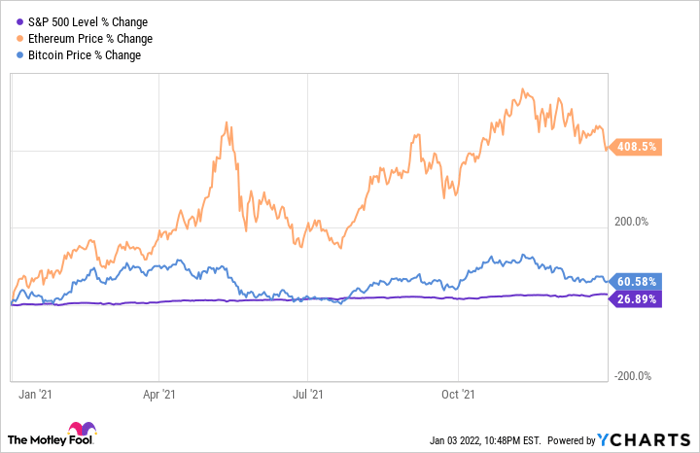
    Ethereum (CRYPTO: ETH), the second-largest cryptocurrency, sports a $445 billion market cap after a five-bagger performance in 2021 that made even Bitcoin (CRYPTO: BTC) look sleepy.

    ^SPX Chart

    ^SPX data by YCharts

    However, this blockchain network also faces a couple of technical challenges. Ethereum is known as a powerful decentralized computing platform, but its transactions are also seen as slow and costly. Therefore, several rival cryptocurrencies are challenging Ethereum’s market position by offering some combination of faster processing and lower transaction fees.

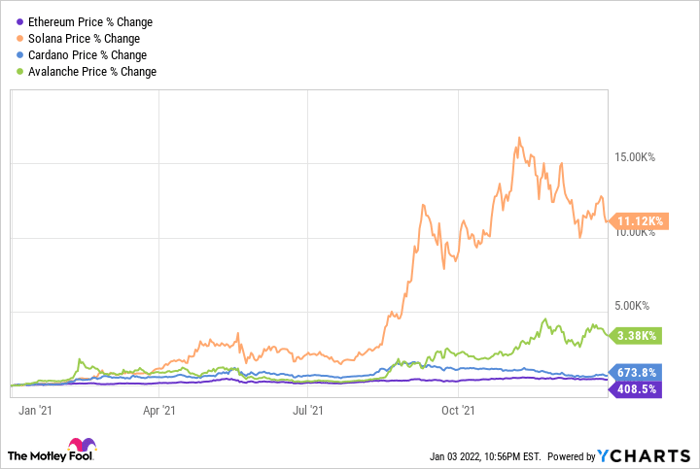
    Solana (CRYPTO: SOL), Cardano (CRYPTO: ADA), and Avalanche (CRYPTO: AVAX) are three of Ethereum’s strongest challengers. Their massive gains in 2021 left Ethereum eating buckets and buckets of dust.

    Ethereum Price Chart

    Ethereum Price data by YCharts

    Don’t sell your ether tokens just yet, though. As impressive as these Ethereum rivals may be, they don’t stand a chance to kill the old king in 2022 — or in the foreseeable future.

    The king of smart contracts

    The Ethereum blockchain can process approximately 20 transactions per second (TPS). The average transaction currently costs roughly 170 gwei, where 1 gwei equals one-billionth of an ether token. At today’s prices, that gas fee works out to $0.16 per Ethereum transaction. It takes about 5 minutes to receive the 20 confirmations required to complete that transaction, on average.

    To compare and contrast Ethereum’s figures with the market’s largest digital currency, the median Bitcoin transaction currently costs 23,000 satoshis (billionths of a bitcoin), or $10.66. This trade only requires four network confirmations, but Bitcoin’s slower system results in delays as long as 40 minutes — unless you pay a higher fee to earn a faster processing schedule. The system can only settle roughly five transactions per second these days.

    However, Bitcoin was never designed to churn through large numbers of transactions per second — this currency is meant to act like digital gold or cash. Security and stability are more important here than lightning-quick trade settlement.

    Ethereum, on the other hand, was intended to provide immutable blockchain ledgers to a variety of decentralized applications (dApps). In this case, low fees and fast transactions make a big difference.

    You should also know that both Ethereum and Bitcoin still use the energy-munching proof-of-work blockchain architecture. Millions of computers and specialized mining systems around the world are solving complex cryptography problems in order to settle transactions and earn tokens for the miners.

    Meet the Ethereum alternatives

    Each of the alternative smart contract blockchains has a unique set of attributes, though they all use a different blockchain system known as proof-of-stake. In this case, transactions are settled by consensus between proven holders of the cryptocurrency in question, resulting in lower energy consumption and a more scalable system. Here’s how this looks for various platforms:

    • Cardano separates its transaction settlement functions from its computational layer, allowing the network to process hundreds of TPS. Transaction fees are comparable to Ethereum’s at $0.22 per average transaction. Finalizing each transfer requires 15 third-party confirmations, which currently takes about 10 minutes. The Cardano project is managed as a highly decentralized open-source system.
    • Avalanche is optimized for low transaction fees and fast processing, hoping to attract many dApp developers. With three distinct blockchain networks at its service, Avalanche can churn through 6,500 transactions per second and the 20 transaction confirmations are typically collected in less than 1 minute. Transactions fees vary depending on what type of transaction you are executing on one of the Avalanche blockchain networks. The final cost tends to be roughly one-tenth of Ethereum’s fees for a similar transaction.
    • Solana relies on proof-of-stake processing, paired with a unique layer called proof-of-history. This network records and settles transactions based on ultra-precise timestamps rather than constantly communicating with other validators. Together, Solana’s solution can process a mind-boggling 50,000 transactions per second and each transaction is completed in real time. Fees will rise as developers, traders, investors, and end users scale up their transaction volumes but currently run at a forgettably small $0.00025 per transaction.

    But wait — things are changing!

    Ethereum’s developer team isn’t sitting still while upstarts and alternative solutions rush in to steal their lunch. Through a series of upgrades to the underlying blockchain systems, the digital currency is transforming into Ethereum 2.0 before our eyes.

    The Ethereum Foundation has already set up a proof-of-stake chain known as the Beacon Chain, which will merge with the current blockchain network later this year. The resulting hybrid should be able to process thousands of transactions per second while bringing costly Ethereum mining operations to a permanent halt. In 2023, the merged networks will add shard chains, spreading the processing load across 64 new blockchains.

    The flawed Ethereum system you see today will hardly bear any resemblance to the upgraded and retooled Ethereum 2.0, apart from the fact that smart contracts designed to run on the old network will continue to work just fine on the new platform.

    At that point, Ethereum will have erased most of the issues that Solana, Avalanche, and Cardano wanted to solve in the first place. Then, a cosmic game of ping-pong will ensue as the market leader and the usurpers take turns to develop game-changing system improvements.

    Everyone’s a winner

    None of the alternative smart contract networks stand any realistic chance of actually killing Ethereum — at least not in the next few years. Instead, we’re going to see healthy competition among projects with similar goals but different approaches, giving users and developers the opportunity to work with the best blockchain network for each end-market situation.

    I’m not saying that Ethereum (or any of its rivals) will be around forever, but this particular cryptocurrency has a huge leg up on the competition in the form of early adoption and a massive market share right out of the starting gate. A smart cryptocurrency investor should build a diverse portfolio of promising coins and tokens, expecting a couple of misses alongside a few big wins in the long run. I own three of the four smart contract cryptocurrencies discussed above, and I’ll probably add the missing link, Avalanche, soon enough.

    That’s no different from building a healthy stock portfolio for the long term. Investing is investing. The more you know, the better you’ll perform — and it’s OK to take a few risks along the way, as long as the potential upside is big enough. 

    This article was originally published on Fool.com. All figures quoted in US dollars unless otherwise stated.

    The post Can these 3 ‘Ethereum Killers’ actually kill Ethereum in 2022? appeared first on The Motley Fool Australia.

    Wondering where you should invest $1,000 right now?

    When investing expert Scott Phillips has a stock tip, it can pay to listen. After all, the flagship Motley Fool Share Advisor newsletter he has run for more than eight years has provided thousands of paying members with stock picks that have doubled, tripled or even more.*

    Scott just revealed what he believes could be the five best ASX stocks for investors to buy right now. These stocks are trading at near dirt-cheap prices and Scott thinks they could be great buys right now.

    *Returns as of August 16th 2021

    More reading

    Anders Bylund owns Bitcoin, Cardano, Ethereum, and Solana. The Motley Fool Australia’s parent company Motley Fool Holdings Inc. owns and recommends Bitcoin and Ethereum. The Motley Fool Australia has no position in any of the stocks mentioned. The Motley Fool has a disclosure policy. This article contains general investment advice only (under AFSL 400691). Authorised by Bruce Jackson.

    This article was originally published on Fool.com. All figures quoted in US dollars unless otherwise stated.

    from The Motley Fool Australia https://ift.tt/33bcUWo

  • Why the Aristocrat Leisure (ASX:ALL) share price is tumbling lower today

    a man clasps his hand to his forehead as he looks down at his phone and grimaces with a pained expression on his face as though receiving bad news.

    The Aristocrat Leisure Limited (ASX: ALL) share price is under pressure on Thursday.

    In morning trade, the gaming technology company’s shares are down 3.5% to $43.66.

    Why is the Aristocrat Leisure share price falling?

    The weakness in the Aristocrat Leisure share price today has been driven by a couple of reasons.

    One of course is a selloff on the tech-focused Nasdaq index overnight which is weighing heavily on the local tech sector today. So much so, the S&P ASX All Technology index is down 3.2% in early trade.

    Also putting pressure on the Aristocrat Leisure share price was the release of an update on its proposed acquisition of Playtech after the market close on Wednesday.

    Late last year, Aristocrat Leisure announced a deal to acquire London-listed leading global online gambling software and content supplier, Playtech, for an enterprise value of $5 billion.

    Playtech has two key business segments: Business-to-Business gambling (B2B) and Business-to-Consumer gambling (B2C). The company’s B2B gambling operations include the design, development, and distribution of software and services to the online and land-based gambling industry.

    Whereas the B2C gambling operations predominantly consists of Snaitech (Italy). It is a vertically integrated retail and online business leveraging Playtech’s proprietary technology and capabilities. Other B2C brands include HPYBET and SunBingo. HPYBET is Playtech’s retail sports betting B2C business, operating sports betting shops in Austria and Germany.

    What’s the latest?

    Playtech shareholders were due to vote on the takeover proposal at a meeting next week. However, this has now been pushed back until 2 February to allow time for rival JKO Play to make a firm competing offer.

    Management notes that Aristocrat’s proposal remains the only firm offer that has been made for Playtech. It also highlights that it provides attractive value in cash and enhanced regulatory and financial certainty for Playtech shareholders.

    Furthermore, Aristocrat notes that any other potential bidders have already had a substantial amount of time to make an alternative proposal for Playtech. Therefore, the decision to further delay the shareholder meeting only extends the period of uncertainty for all Playtech stakeholders.

    One positive, though, is that proxy advisers continue to recommend shareholders vote in favour of Aristocrat’s proposal. It also advised that regulatory approvals process remains well on track, and that it is committed to completing the acquisition as quickly as possible.

    The post Why the Aristocrat Leisure (ASX:ALL) share price is tumbling lower today appeared first on The Motley Fool Australia.

    Should you invest $1,000 in Aristocrat right now?

    Before you consider Aristocrat, you’ll want to hear this.

    Motley Fool Investing expert Scott Phillips just revealed what he believes are the 5 best stocks for investors to buy right now… and Aristocrat wasn’t one of them.

    The online investing service he’s run for nearly a decade, Motley Fool Share Advisor, has provided thousands of paying members with stock picks that have doubled, tripled or even more.* And right now, Scott thinks there are 5 stocks that are better buys.

    *Returns as of August 16th 2021

    More reading

    Motley Fool contributor James Mickleboro has no position in any of the stocks mentioned. The Motley Fool Australia’s parent company Motley Fool Holdings Inc. has no position in any of the stocks mentioned. The Motley Fool Australia has no position in any of the stocks mentioned. The Motley Fool has a disclosure policy. This article contains general investment advice only (under AFSL 400691). Authorised by Bruce Jackson.

    from The Motley Fool Australia https://ift.tt/3pVDcoq