• A group of emerging nations could soon start knocking down one key pillar of dollar dominance

    US dollar bill with glitch effect
    Some emerging nations are calling for a move away from the US dollar-denominated global financial system.

    • The BRICS bloc could pick up its de-dollarization agenda at its October summit in Kazan, Russia.
    • Expect more trade in alternative currencies, wrote one analyst.
    • Central bank digital currencies could weaken the greenback's role in payments.

    The BRICS group of emerging nations has been agitating for a move away from US dollar dominance.

    Last year, Brazilian President Luiz Inácio Lula da Silva called for a BRICS common currency. The economist who first gave the bloc its name called that idea "embarrassing."

    While the set-up of a common currency is practically challenging, the bloc — which comprises the countries of Brazil, Russia, India, China, and South Africa that make up its acronym, and new members Iran, Egypt, Ethiopia, and the United Arab Emirates — has called for more trade and lending in local currencies as a way to break up with the dollar.

    There may be more traction in ditching the dollar this year when the BRICS bloc meets in the Russian city of Kazan from October 22 to October 24, wrote Christopher Granville, the managing director of global political research at GlobalData.TS Lombard, in a Friday report.

    The summit would take place in the context of the US and its allies' increasingly aggressive stance toward Chinese exports, which they say are over capacity. And Washington is imposing secondary sanctions against banks processing payments to and from Russia, even if they are in local currencies, such as the Chinese yuan.

    Central banks eye digital currency transfers

    A more systemic solution is in the works: a Bank of International Settlement Central Bank Digital Currency platform that allows for the direct, peer-to-peer settlement of commercial invoices and foreign exchange trades in the central bank digital currencies of participating countries, wrote Granville. These currencies are similar to cryptocurrencies but are issued and backed by central banks.

    The central banks of China, Hong Kong, the UAE, and Thailand participated in a BIS trial of the digital currency system in 2022, but it's not live yet.

    Still, Russian foreign minister Sergey Lavrov also touted a digital currency-based settlement system to local media recently — a signal that central banks are eyeing the "US-insulated" solution, wrote Granville.

    "That Lavrov signal was unsurprising given Russia's own pressing need," wrote Granville. "While other countries outside the US alliance system will not feel the same urgency, this US-insulated CBDC solution still looks to be in their interests."

    Specifically, it would make sense for China amid its trade war with the US. China's central bank already has one of the most developed digital currencies, the digital Chinese yuan, that is used domestically, including to pay some public-sector salaries.

    The BIS suspended the Russian central bank's membership following the country's invasion of Ukraine in 2022, so it's unclear how the central bank-to-central bank digital currency-based platform and infrastructure would work for Russia.

    Central bank digital currencies could weaken the USD's role in international payments

    Even so, Granville wrote that the participation of other central banks in the CBDC system could weaken a key pillar of the US dollar's global reserve currency status: international payments outside the eurozone.

    The greenback accounted for 60% of international payments ex-eurozone in 2023, according to Granville's analysis. This is in contrast to its 80% share in trade finance — which covers a wide range of products banks and companies use for trade — and 60% of global foreign exchange reserves.

    As Business Insider reported recently, the West can't afford to totally isolate Russian banks from the SWIFT messaging network due to the disastrous knock-on impact on trade finance — a key pillar of international trade. As for global FX reserves, the greenback is still king.

    But, chipping away at the US dollar's share in international payments through a non-dollar CBDC platform "would weaken one of three planks of the US dollar's global reserve currency status," Granville wrote. The effect would hold even though the currency of choice for cross-border payments is less systemically important than the dollar's role in trade finance and FX reserves, Granville added.

    Despite the discussion over central bank digital currencies, there would inevitably be challenges in any implementation.

    Even China, which has one of the world's most advanced digital currencies, relies on a "two-tier" system involving banks as wallet-holding agents. That setup avoids excessively disrupting the financial institution's business model and creating financial instability, wrote Granville.


    Read the original article on Business Insider
  • ASX retail shares mixed amid modest April sales growth

    Woman smiling whilst shopping in a clothing store.

    ASX retail shares are mixed today after the release of the latest retail sales data from the Australian Bureau of Statistics (ABS). Shortly before market close, the ASX consumer discretionary sector is the third-worst performing of the day, with heavyweights like Wesfarmers Limited (ASX: WES) and JB Hi-Fi Limited (ASX: JBH) lagging the S&P/ASX 200 Index (ASX: XJO).

    Elsewhere in the sector, though, Harvey Norman Holdings Limited (ASX: HVN) is trading flat and Temple & Webster Group Ltd (ASX: TPW) is surging almost 3% on the back of share buyback news.

    The April numbers revealed a small increase in retail sales for April 2024. Seasonally adjusted, retail trade rose by 0.1% month-on-month and 1.3% compared to April 2023. 

    The combination of inflation and high interest rates is squeezing retail spending. Clothing, footwear, and personal accessory retailing saw a decline of 0.7% in April, and food retailing was down 0.5%. Sales of household goods, however, showed a positive trend rising by 0.7%. Department stores also experienced a modest increase of 0.1%, maintaining their positive trajectory over recent months. 

    Analysts have predicted sales will remain flat throughout 2024 due to rising living costs, high household debt, and economic uncertainty. This could dampen profit expectations for ASX 200 retail shares. JB Hi-Fi advised earlier this month that sales remained resilient, but cautioned that the retail market was “challenging and competitive”. Other major retailers like Wesfarmers, which owns Kmart and Target, could also be impacted by the insipid outlook.

    Online sales accelerate

    Overall retail sales may be down, but the portion of sales taking place online is accelerating. Data from the latest NAB Online Retail Sales Index reveals Australians spent $57.14 billion on online retail in the 12 months to April, making up about 13.4% of the total retail trade. The performance of online retail has consistently outpaced broader retail, leading to an increase in the online share of total retail sales.

    Retailers with a strong online presence and diversified product offerings have seen substantial benefits from the ongoing shift towards online shopping. Companies like JB Hi-Fi and Temple & Webster have invested heavily in their e-commerce infrastructure and have seen significant share price gains over the past few years.

    The accelerated shift to online could arguably further strengthen the market position of companies that have invested in their e-commerce infrastructure and allow them to stay ahead of competitors with less developed online capabilities.

    Foolish takeaway

    Despite mixed trading in ASX retail shares following modest retail sales growth in April, the accelerating shift to online shopping could present a silver lining. Retailers with strong e-commerce platforms may be well-positioned to navigate the challenging economic landscape and capitalise on the growing online retail market.

    The post ASX retail shares mixed amid modest April sales growth appeared first on The Motley Fool Australia.

    Should you invest $1,000 in Jb Hi-fi Limited right now?

    Before you buy Jb Hi-fi Limited shares, consider this:

    Motley Fool investing expert Scott Phillips just revealed what he believes are the 5 best stocks for investors to buy right now… and Jb Hi-fi Limited wasn’t one of them.

    The online investing service he’s run for over a decade, Motley Fool Share Advisor, has provided thousands of paying members with stock picks that have doubled, tripled or even more.*

    And right now, Scott thinks there are 5 stocks that may be better buys…

    See The 5 Stocks
    *Returns as of 5 May 2024

    More reading

    Motley Fool contributor Katherine O’Brien has no position in any of the stocks mentioned. The Motley Fool Australia’s parent company Motley Fool Holdings Inc. has positions in and has recommended Temple & Webster Group, and Wesfarmers. The Motley Fool Australia has positions in and has recommended Harvey Norman, and Wesfarmers. The Motley Fool Australia has recommended Jb Hi-Fi and Temple & Webster Group. The Motley Fool has a disclosure policy. This article contains general investment advice only (under AFSL 400691). Authorised by Scott Phillips.

  • Should I buy TechnologyOne shares before they trade ex-dividend on Thursday?

    You might have seen TechnologyOne Ltd (ASX: TNE) shares pop up on your radar recently. This ASX 200 tech stock reported its latest earnings covering the half-year ending 31 March a week ago today. And they caused quite a stir upon their release.

    As we covered last week, these earnings saw TechnologyOne report a 16% year-on-year rise in revenues to $244.8 million, as well as a 21% boost to the company’s annual recurring revenue to $423.6 million.

    This all helped TechnologyOne bring in $48 million in profits after tax, a 16% increase over the prior period.

    As a result, TechnologyOne was able to deliver a record interim dividend of 5.08 cents per share, partially franked at 65%. That’s a pleasing 10% hike over the 4.62 cents per share payout that shareholders enjoyed this time last year.

    Since these earnings results were made public, TechnologyOne shares have exploded higher. The company was going for $16.02 a share on the day before these results came out. But today, those same shares are asking $17.93 each after hitting a new record high of $18.22 last Wednesday.

    But this ASX 200 tech stock is due for a share price pullback this week. How do we know? Well, because TechnologyOne is scheduled to trade ex-dividend for this latest interim dividend this Thursday, 30 May.

    Should we rush out and buy TechnologyOne shares before Thursday?

    Yep, the ex-dividend date has been set for Thursday, which means that anyone who doesn’t own TechnologyOne shares as of Wednesday’s market close will not be eligible to receive said dividend. if one buys this company’s shares from Thursday onwards, they will miss out on this latest payment.

    As such, we should see a drop in the price of TechnologyOne shares on Thursday morning, reflecting this inherent loss of value.

    So should you get in and secure some shares of this ASX 200 tech stock before then?

    Well, probably not if you are just trying to grab a freebie. Buying a company’s shares before or after they trade ex-dividends in order to secure a financial gain is usually a fool’s errand. When a company trades ex-dividend, its share price normally falls by almost exactly what that dividend is worth.

    Upon TechnologyOne’s return to trade on Thursday, its share price is almost certainly just going to be 5.08 cents lower than where it otherwise would be trading.

    So you can buy the more expensive shares on Wednesday and nab the rights to the dividend, or wait until the shares are a little cheaper on Thursday and miss out. In all likelihood, it will be a zero-sum game – two paths leading to the same financial endpoint.

    As such, if you wish to invest in TechnologyOne as a long-term investment, it probably won’t make a lick of difference whether you buy on Wednesday or Thursday.

    ASX brokers say buy

    On that note, many ASX experts are telling investors to consider buying TechnologyOne shares in light of its recent results.

    Last week, we covered the views of ASX broker Bell Potter. Bell Potter slapped TechnologyOne with a buy rating. That was alongside a 12-month share price target of $19.

    We also took stock of what another broker in Morgans had to say. Morgans was also delighted by TechnologyOne’s results. It gave the tech stock an ‘add’ rating, as well as a share price target of $20.50.

    The post Should I buy TechnologyOne shares before they trade ex-dividend on Thursday? appeared first on The Motley Fool Australia.

    Should you invest $1,000 in Technology One Limited right now?

    Before you buy Technology One Limited shares, consider this:

    Motley Fool investing expert Scott Phillips just revealed what he believes are the 5 best stocks for investors to buy right now… and Technology One Limited wasn’t one of them.

    The online investing service he’s run for over a decade, Motley Fool Share Advisor, has provided thousands of paying members with stock picks that have doubled, tripled or even more.*

    And right now, Scott thinks there are 5 stocks that may be better buys…

    See The 5 Stocks
    *Returns as of 5 May 2024

    More reading

    Motley Fool contributor Sebastian Bowen has no position in any of the stocks mentioned. The Motley Fool Australia’s parent company Motley Fool Holdings Inc. has positions in and has recommended Technology One. The Motley Fool Australia has recommended Technology One. The Motley Fool has a disclosure policy. This article contains general investment advice only (under AFSL 400691). Authorised by Scott Phillips.

  • Russian experts were guiding North Korea’s space program ahead of Pyongyang blowing up its latest satellite: South Korean report

    People walk past a television showing file footage during a news report at a train station in Seoul on May 28, 2024, after North Korea said late Monday that the rocket carrying its "Malligyong-1-1" reconnaissance satellite exploded minutes after launch due to a suspected engine problem.
    People walk past a television showing file footage during a news report at a train station in Seoul on May 28, 2024, after North Korea said late Monday that the rocket carrying its "Malligyong-1-1" reconnaissance satellite exploded minutes after launch due to a suspected engine problem.

    • North Korea's latest satellite launch failed in a fireball in the sky on Monday evening.
    • That comes after South Korean media reported that Russia was helping Pyongyang's space program.
    • Yonhap reported that a "large number" of Russian experts entered North Korea ahead of the launch.

    North Korea announced on Monday that its latest spy satellite launch ended in the explosion of its rocket just minutes after liftoff — a third failure in its last four attempts to put a satellite into orbit.

    And that was despite Russian space experts recently arriving to guide North Korea's space program, South Korean news agency Yonhap reported a day before the failed launch, citing a senior defense official who was not named.

    Yonhap wrote that a "large number" of Russian technicians had entered North Korea after Russian leader Vladimir Putin last year offered to support Pyongyang with its satellite launches.

    It's unclear exactly how many technicians were sent to North Korea, when they might have arrived, or how they might have advised Pyongyang.

    The senior South Korean defense official told the agency that the Russian experts likely had high standards, causing a delay between North Korea's last satellite launch and preparations for Monday's attempt.

    Yonhap reported that North Korea's space rockets also likely face issues with their second and third-stage engines.

    That could forewarn even deeper problems in Pyongyang's space program; the explosion at Monday's launch occurred during the rocket's first stage of flight.

    North Korean state media cited a space official saying that preliminary investigations showed the rocket's new liquid oxygen and petroleum engine was to blame. However, he also said there may have been other reasons for the launch failure.

    Roscosmos, Russia's space agency, and the Russian Ministry of Foreign Affairs did not immediately respond to requests for comment sent outside regular business hours by Business Insider.

    Russia and North Korea's relationship has come under scrutiny in the past year after the US accused them of trading arms and materials deployed in the war in Ukraine.

    Per the accusations from the US and its allies, Moscow has been sending raw materials, food, and technical expertise to Pyongyang in exchange for shipments of artillery ammunition and missiles that Ukraine reports seeing on the battlefield.

    South Korea has for months said that North Korea's sole successful satellite launch of 2023 came off the back of Russian assistance.

    Pyongyang launched the Malligyong-1 in November and claims it is still functioning, though Seoul said in February that it detected the satellite is no longer communicating with the ground.

    Some international experts, however, said that month that they've seen signs of activity from the Malligyong-1.

    North Korea's repeated satellite launches come as a concern for the US and its allies, who have tried to limit its nuclear weapons and space programs through sweeping sanctions. Pyongyang's repeated testing of ballistics and space launches indicates that it's been able to persist despite the global restrictions.

    The US Indo-Pacific Command noted that Pyongyang's Monday launch appeared to use technology related to North Korea's ballistic missile program. It condemned the launch as a "brazen violation" of United Nations resolutions that could destabilize regional security.

    Read the original article on Business Insider
  • Guess which ASX All Ords share is diving 11% to record lows today

    A mechanic rests his arms on a car he's working on, looking under the bonnet with a glum look on his face..

    Around half of Australia’s top 500 listed companies are in the red today. However, none are doing it quite as tough as this ASX All Ords share.

    A trading update has prompted the Peter Warren Automotive Holdings Ltd (ASX: PWR) share price to shift into reverse. A 0.2% retreat across the S&P/ASX All Ordinaries Index (ASX: XAO) is less than ideal… but how about an 11% drop? That’s the punishment being administered to shareholders of this automotive dealership operator.

    Shares in this company have now set a new record low, hitting $1.85 apiece. The undesirable milestone means the Peter Warren Automotive share price has cascaded 38% since its 2021 ASX listing.

    So, what’s the exact cause of this deep laceration?

    Expected profits lose some horsepower

    Peter Warren Automotive may not achieve the earnings mileage expected by the market in FY24.

    Revenue is apparently not an issue, continuing to grow. However, underlying profit before tax is a different story. Several impactful factors have forced the company to adjust the market’s view of how the full-year results should look.

    The company’s full-year FY24 underlying profit before tax is now anticipated to be between $52 million and $57 million. For context, estimates already had down Peter Warren Automotive to generate $68.8 million in before-tax earnings.

    At the midpoint, the new guidance reflects a 20.8% downgrade from consensus expectations. Evidently, this is not doing any favours for this All Ords share today.

    Three key contributors were referenced as causes for the reduction, as follows:

    • More competition between dealerships due to increased supply from car manufacturers, weighing down on new vehicle gross margins
    • Subdued demand among customers for new vehicles in light of cost-of-living pressures
    • Higher interest rates producing increased interest costs compared to the prior year

    Despite the knock to earnings expectations, Peter Warren noted some positive items. These include growth in the number of vehicles sold and an increase in service and parts revenue.

    Finally, Peter Warren Automotive highlighted initiatives to reduce the pain of pressured margins. For example, the company is limiting its inventory levels, leaning on growth in its service, parts, and used car segments, and controlling costs.

    This All Ords share is not alone

    While the Peter Warren Automotive share price is copping the brunt of selling pressure today, other consumer discretionary shares are also feeling the pinch.

    In afternoon trading, the consumer discretionary sector is faring the worst on the ASX, down 0.79%. It might have a little to do with April retail trade data hitting the headlines.

    The Australian Bureau of Statistics showed a 0.1% month-on-month increase in retail trade last month. Unfortunately, the market expected a 0.2% strengthening after a shocking 0.4% slump in March.

    Investors may have interpreted it as another tough month for ASX retailers, including for our All Ords share, Peter Warren Automotive.

    The post Guess which ASX All Ords share is diving 11% to record lows today appeared first on The Motley Fool Australia.

    Should you invest $1,000 in Peter Warren Automotive Holdings Limited right now?

    Before you buy Peter Warren Automotive Holdings Limited shares, consider this:

    Motley Fool investing expert Scott Phillips just revealed what he believes are the 5 best stocks for investors to buy right now… and Peter Warren Automotive Holdings Limited wasn’t one of them.

    The online investing service he’s run for over a decade, Motley Fool Share Advisor, has provided thousands of paying members with stock picks that have doubled, tripled or even more.*

    And right now, Scott thinks there are 5 stocks that may be better buys…

    See The 5 Stocks
    *Returns as of 5 May 2024

    More reading

    Motley Fool contributor Mitchell Lawler has no position in any of the stocks mentioned. The Motley Fool Australia’s parent company Motley Fool Holdings Inc. has no position in any of the stocks mentioned. The Motley Fool Australia has no position in any of the stocks mentioned. The Motley Fool has a disclosure policy. This article contains general investment advice only (under AFSL 400691). Authorised by Scott Phillips.

  • Only 1 ASX 200 bank share delivers more capital growth than dividends. Which bank? (Clue: Not CBA)

    A woman shows her phone screen and points up.

    Investors tend to consider ASX 200 bank shares as dividend payers rather than growth investments, with two exceptions — Commonwealth Bank of Australia (ASX: CBA) and Macquarie Group Ltd (ASX: MQG).

    And there’s good reason for those exceptions, too.

    Which bank delivers more capital growth than dividends?

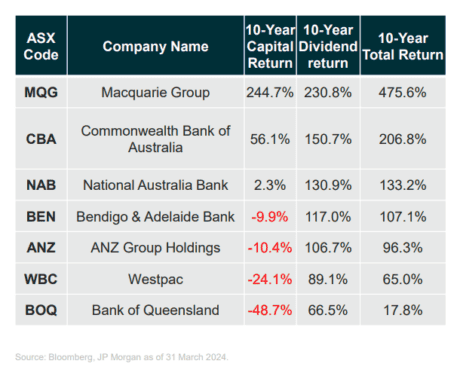
    At the recent ASX Investor Day in Sydney, investment strategist Marc Jocum from exchange-traded fund (ETF) provider Global X presented the following data on ASX 200 bank shares.

    Source: Global X investor presentation, ASX Investor Day, Sydney

    As you can see, Macquarie shares are the only ones that delivered more capital growth than dividend income among ASX 200 bank shares over the decade to 31 March 2024.

    The Macquarie share price rose 244.7% and dividend returns were 230.8%, providing a total 10-year return of 475.6%.

    When selecting shares for investment, Jocum emphasised the importance of a ‘total returns approach’ that takes dividend returns into account. This is important because they offset poor growth periods.

    According to his presentation:

    Most of the largest Australian banks have had negative capital returns. Dividends can add as an important source of returns and help cushion drawdowns.

    CBA shares delivered the second-best capital growth, but it was a sliver of Macquarie’s at just 56.1% over 10 years. However, a 150.7% dividend return contributed to a solid total 10-year return of 206.8%.

    What’s happening with ASX 200 bank shares today?

    Today, ASX 200 bank shares are lower amid the S&P/ASX 200 Index (ASX: XJO) losing 0.27% in value.

    • The Macquarie Group Ltd (ASX: MQG) share price is down 1.11%
    • Westpac Banking Corp (ASX: WBC) shares are down 0.79%
    • The Bendigo and Adelaide Bank Ltd (ASX: BEN) share price is down 0.32%
    • Commonwealth Bank of Australia (ASX: CBA) shares are down 0.27%
    • The National Australia Bank Ltd (ASX: NAB) share price is down 0.18%
    • The Bank of Queensland Ltd (ASX: BOQ) share price is down 0.17%
    • Australia and New Zealand Banking Group Ltd (ASX: ANZ) shares are down 0.035%

    Should you buy Macquarie shares?

    After Macquarie reported its FY24 full-year results earlier this month, top broker Goldman Sachs retained its neutral rating on the ASX 200 bank share and reduced its 12-month price target to $178.74.

    The broker noted that Macquarie’s better-than-expected FY24 performance was driven by a lower-than-expected tax rate rather than revenue growth. But it remains optimistic on the ASX 200 bank share.

    Goldman said:

    Despite this, we remain optimistic on the business’s medium term outlook, given i) an improving macro backdrop (we note GS now expects the rate cutting cycle to commence in November), and ii) MQG is well positioned to benefit from the global push towards decarbonisation, further infrastructure investment, and interest rates reaching their peak levels.

    Yesterday, Macquarie announced that Fitch Ratings has upgraded the long-term issuer default rating (IDR) of Macquarie Bank Limited.

    The long-term ratings of Macquarie entities are now A+ for Macquarie Bank Limited (up from A) and A for Macquarie Group Limited.

    The post Only 1 ASX 200 bank share delivers more capital growth than dividends. Which bank? (Clue: Not CBA) appeared first on The Motley Fool Australia.

    Should you invest $1,000 in Macquarie Group Limited right now?

    Before you buy Macquarie Group Limited shares, consider this:

    Motley Fool investing expert Scott Phillips just revealed what he believes are the 5 best stocks for investors to buy right now… and Macquarie Group Limited wasn’t one of them.

    The online investing service he’s run for over a decade, Motley Fool Share Advisor, has provided thousands of paying members with stock picks that have doubled, tripled or even more.*

    And right now, Scott thinks there are 5 stocks that may be better buys…

    See The 5 Stocks
    *Returns as of 5 May 2024

    More reading

    Motley Fool contributor Bronwyn Allen has positions in Anz Group, Commonwealth Bank Of Australia, and Macquarie Group. The Motley Fool Australia’s parent company Motley Fool Holdings Inc. has positions in and has recommended Goldman Sachs Group and Macquarie Group. The Motley Fool Australia has positions in and has recommended Bendigo And Adelaide Bank and Macquarie Group. The Motley Fool has a disclosure policy. This article contains general investment advice only (under AFSL 400691). Authorised by Scott Phillips.

  • 4 ASX growth shares to buy to supercharge your portfolio in June

    Are you looking to add some growth shares to your investment portfolio in June?

    If you are, then the four highly rated ASX growth shares listed below could be worth considering.

    Here’s what you need to know about them:

    Aristocrat Leisure Limited (ASX: ALL)

    The first ASX growth share that could be a buy is Aristocrat Leisure. It is one of the world’s leading gaming technology companies. It has a world class portfolio of pokie machines, a lucrative digital business, and a growing real money gaming business.

    Analysts at Citi are very positive on the company. Particularly given its strong performance in the first half of FY 2024 and management’s confidence in its outlook.

    Citi has a buy rating and $53.00 price target on Aristocrat Leisure’s shares.

    Pro Medicus Limited (ASX: PME)

    Goldman Sachs thinks Pro Medicus is a top ASX growth share to buy. It is a leading provider of radiology information systems (RIS), Picture Archiving and Communication Systems (PACS), and advanced visualisation solutions across the globe.

    Goldman is very positive on the company’s outlook. It notes that it sees “PME as the clear incumbent technology leader in a growing market with a strong financial profile and significant AI upside.”

    The broker has a buy rating and $136.00 price target on its shares.

    ResMed Inc. (ASX: RMD)

    A third ASX growth share that has been tipped as a buy is ResMed. It is a sleep treatment-focused medical device company.

    ResMed has been growing at a strong rate for over a decade. But if you thought its growth was coming to an end, think again. That’s because its industry-leading products have a massive market opportunity. Management estimates that there are 1 billion people impacted by sleep apnoea worldwide, with only ~20% of these sufferers currently diagnosed.

    Ord Minnett is bullish on ResMed and has an accumulate rating and $40.00 price target on its shares.

    TechnologyOne Ltd (ASX: TNE)

    A final ASX growth share for investors to look at in June is TechnologyOne. It is Australia’s largest enterprise software company with locations across six countries. It provides a global SaaS ERP solution that transforms business and makes life simple for users.

    Analysts at Morgans were impressed with the company’s half year results this month. In fact, the broker believes that the company’s profit growth is about to go up a gear. Particularly given its successful transition to a software-as-a-service business model.

    Morgans currently has an add rating and $20.50 price target on its shares.

    The post 4 ASX growth shares to buy to supercharge your portfolio in June appeared first on The Motley Fool Australia.

    Should you invest $1,000 in Aristocrat Leisure Limited right now?

    Before you buy Aristocrat Leisure Limited shares, consider this:

    Motley Fool investing expert Scott Phillips just revealed what he believes are the 5 best stocks for investors to buy right now… and Aristocrat Leisure Limited wasn’t one of them.

    The online investing service he’s run for over a decade, Motley Fool Share Advisor, has provided thousands of paying members with stock picks that have doubled, tripled or even more.*

    And right now, Scott thinks there are 5 stocks that may be better buys…

    See The 5 Stocks
    *Returns as of 5 May 2024

    More reading

    Citigroup is an advertising partner of The Ascent, a Motley Fool company. Motley Fool contributor James Mickleboro has positions in Pro Medicus, ResMed, and Technology One. The Motley Fool Australia’s parent company Motley Fool Holdings Inc. has positions in and has recommended Goldman Sachs Group, Pro Medicus, ResMed, and Technology One. The Motley Fool Australia has positions in and has recommended ResMed. The Motley Fool Australia has recommended Pro Medicus and Technology One. The Motley Fool has a disclosure policy. This article contains general investment advice only (under AFSL 400691). Authorised by Scott Phillips.

  • ASX 200 energy stock rockets 8% on ‘significant’ milestone

    The market may be edging lower today but the same cannot be said for the Strike Energy Ltd (ASX: STX).

    In afternoon trade, the ASX 200 energy stock is rocketing higher and is up 8% to 22.2 cents.

    Why is this ASX 200 energy stock rocketing?

    Investors have been scrambling to buy the company’s shares today after it achieved a “significant financial milestone” at the Walyering gas field development.

    According to the release, the Walyering gas field in the Perth Basin, which was brought online eight months ago, has now reached payback of its total development capital spend of approximately $30 million (plus operating costs, royalties and taxes incurred to date).

    Strike Energy advised that total gross income received to date from the Walyering project is approximately $47 million.

    Management notes that this payback profile would be one of the fastest in recent history for a greenfield Australian oil and gas project. It believes this demonstrates the inherent value of the ASX 200 energy stock’s conventional gas play in the Jurassic aged Sandstones within the Cattamarra Coal Measures.

    What’s next?

    Given the success of the Walyering project so far, investors will be pleased to learn that drilling activities continue on site.

    The company advised that Walyering-7 (W7), which commenced drilling 18 days ago, has reached its total planned depth of 4,035 metres (measured depth). This is five days ahead of target and has set a new time/depth record for its drilling performance within the Walyering gas field.

    Pleasingly, the ASX 200 energy stock revealed that the W7 well has passed through multiple sandstone reservoirs within the Cattamarra Coal Measures and has registered positive observations on both mud logs and logging while drilling tools. Management advised that it is now preparing to run a series of wireline logs and specialty tools and will evaluate those results before moving to the next stage of completion.

    It adds that the W7 well has been drilled from a surface location co-located with the Walyering gas processing facility directionally to the east into a fault compartment north-east of the producing Walyering-5 structure. The company intends to provide further updates as operations and evaluation concludes at the W7 well site.

    Despite today’s strong gain, the Strike Energy share price remains one of the worst performers on the ASX 200 index over the last 12 months. During this time, the ASX 200 energy stock is down approximately 53%.

    The post ASX 200 energy stock rockets 8% on ‘significant’ milestone appeared first on The Motley Fool Australia.

    Should you invest $1,000 in Strike Energy Limited right now?

    Before you buy Strike Energy Limited shares, consider this:

    Motley Fool investing expert Scott Phillips just revealed what he believes are the 5 best stocks for investors to buy right now… and Strike Energy Limited wasn’t one of them.

    The online investing service he’s run for over a decade, Motley Fool Share Advisor, has provided thousands of paying members with stock picks that have doubled, tripled or even more.*

    And right now, Scott thinks there are 5 stocks that may be better buys…

    See The 5 Stocks
    *Returns as of 5 May 2024

    More reading

    Motley Fool contributor James Mickleboro has no position in any of the stocks mentioned. The Motley Fool Australia’s parent company Motley Fool Holdings Inc. has no position in any of the stocks mentioned. The Motley Fool Australia has no position in any of the stocks mentioned. The Motley Fool has a disclosure policy. This article contains general investment advice only (under AFSL 400691). Authorised by Scott Phillips.

  • Why Boss Energy, Elders, Peter Warren, and Serko shares are sinking today

    The S&P/ASX 200 Index (ASX: XJO) is having a subdued session on Tuesday. In afternoon trade, the benchmark index is on course to record a small decline. It is currently down 0.25% to 7,768.7 points.

    Four ASX shares that are falling more than most today are listed below. Here’s why they are dropping:

    Boss Energy Ltd (ASX: BOE)

    The Boss Energy share price is down almost 10% to $4.82. This follows news that the uranium miner’s CEO and managing director Duncan Craib, chair Wyatt Buck, and director Bryn Jones have sold a significant portion of their personal holdings. In respect to its CEO, Duncan Craib sold 3.75 million shares at an average price of $5.63 per share between Tuesday and Friday last week. The company’s leader received a total consideration of over $21 million for the shares. Insider selling rarely goes down well with investors and is considered to be a bearish indicator by many.

    Elders Ltd (ASX: ELD)

    The Elders share price is down 3% to $8.21. This has been driven by the agribusiness company’s shares going ex-dividend on Tuesday. Last week, Elders released its half year results and reported a sharp profit decline. This led to the Elders board cutting its interim dividend by 22% to 18 cents per share. Eligible shareholders can now look forward to receiving this partially franked dividend in their bank accounts next month on 26 June.

    Peter Warren Automotive Holdings Ltd (ASX: PWR)

    The Peter Warren Automotive Holdings share price is down 12% to $1.88. This follows the release of a trading update from the automotive retailer this morning. Peter Warren advised that while revenue has continued to grow, it now expects its underlying profit before tax for FY 2024 to be in the range of $52 million to $57 million. Management notes that this is lower than market expectations and has been driven by a significant increase in vehicle supply, which has led to greater competition between dealerships and lower gross profit margins on new vehicles. In addition, customer demand for new vehicles has fallen due to cost-of-living pressures.

    Serko Ltd (ASX: SKO)

    The Serko share price is down 5.5% to $2.87. Investors have been selling this travel technology company’s shares following the release of its full year results. This was despite Serko reporting a 48% jump in total income to NZ$71.2 million and a 48% improvement in its net loss to NZ$15.9 million. Looking ahead, management is guiding to revenue of NZ$85 million to NZ$92 million in FY 2025. It also expects to become cashflow positive during the year.

    The post Why Boss Energy, Elders, Peter Warren, and Serko shares are sinking today appeared first on The Motley Fool Australia.

    Should you invest $1,000 in Boss Resources Limited right now?

    Before you buy Boss Resources Limited shares, consider this:

    Motley Fool investing expert Scott Phillips just revealed what he believes are the 5 best stocks for investors to buy right now… and Boss Resources Limited wasn’t one of them.

    The online investing service he’s run for over a decade, Motley Fool Share Advisor, has provided thousands of paying members with stock picks that have doubled, tripled or even more.*

    And right now, Scott thinks there are 5 stocks that may be better buys…

    See The 5 Stocks
    *Returns as of 5 May 2024

    More reading

    Motley Fool contributor James Mickleboro has no position in any of the stocks mentioned. The Motley Fool Australia’s parent company Motley Fool Holdings Inc. has positions in and has recommended Serko. The Motley Fool Australia has recommended Elders. The Motley Fool has a disclosure policy. This article contains general investment advice only (under AFSL 400691). Authorised by Scott Phillips.

  • Golden Goose, the luxury sneaker worn by Taylor Swift and other celebs, could go public this week

    Italian shoemaker, Golden Goose may be gearing up to go public.
    Italian shoemaker, Golden Goose may be gearing up to go public.

    • Golden Goose eyes a public listing in Milan this week, aiming for a $3.3 billion valuation.
    • The luxury sneaker brand is popular with celebrities and starts at about $364 per pair.
    • The IPO would help a weak European IPO market poised to bounce back this year.

    Luxury sneaker maker Golden Goose plans to go public in Milan as soon as this week.

    Golden Goose may start working on its initial public offering this week following positive feedback from potential investors, people familiar with the matter told Bloomberg.

    The Italian brand of pre-distressed sneakers is a hit with celebrities including Taylor Swift, Selena Gomez, and Hilary Duff. Investors are expected to value Golden Goose at about 11 times this year's estimated earnings. That would value the shoemaker at about $3.3 billion, according to Bloomberg.

    On its official web store, a pair of sneakers starts at about $364 and can go up to $2,598. The brand also sells clothing, beachwear, and accessories.

    The people told Bloomberg that discussions are ongoing, and details of the offering, including its size and timeline, are still flexible.

    The company is owned by European private equity firm Permira. The firm did not immediately respond to a request for comment from Business Insider.

    Talks of the listing come as Europe's lackluster IPO market looks for reinvigoration. Potential stock listings this year include Luxembourg-based private equity firm CVC Capital, Spanish fashion giant Puig Brands, and Swiss dermatological brand Galderma.

    However, Golden Goose's IPO could be hurt by slowing demand for luxury goods.

    Kering, the luxury retailer that owns brands including Gucci and Yves Saint Laurent, saw overall revenue decline by 10% in the first quarter of the year. Gucci saw a troubling 18% decline in sales, largely from decreased sales in China.

    The two other sneaker companies to go public in recent years are performance footwear brands On Holding and Allbirds, which both target a much lower price point than Golden Goose. Last month, Allbirds, which once held the title for "most comfortable shoe," received notice from Nasdaq that it risks delisting because its stock was trading below $1 for 30 consecutive days. On's stock, meanwhile, is up 47% in the past year.

    Read the original article on Business Insider