• Apple’s iPad calculator looks freaking awesome

    Apple WWDC 2024
    Calculator feature added to iPad revealed at Apple WWDC 2024.

    • Apple unveiled a new iPadOS 18 with Apple Intelligence at its Worldwide Developers Conference.
    • The update includes a long-awaited calculator app with Math Notes, a whiteboard-style tool.
    • Despite these updates, it's uncertain if the new features will boost iPad sales significantly.

    Apple's Worldwide Developers Conference was a big moment for the iPad, its less-loved flagship product.

    The tablets will come with iPadOS 18, which means they will include Apple Intelligence, a redesigned Photo app, new notes features, and new messaging functions. The new OS18 also brings a calculator app to the iPad — a feature the device never had.

    The app looks a lot like the iconic orange and white calculator users have long seen on the iPhone. But the app also comes with a new, iPad-only feature called Math Notes: It supports the use of the Apple Pencil and allows people to write down math problems and helps solve them.

    The app looks like it comes with some cool features.

    According to the tech giant, users can use the whiteboard-like tool to solve algebraic equations, calculate a budget, and create graphs from text "with just one tap." Math Notes will automatically be accessible in the preexisting Notes app.

    The app also has a history function to view past calculations and a feature to convert height, weight, and currencies.

    Apple WWDC 2024
    New calculator feature revealed at Apple WWDC 2024.

    The launch not only brings a much-awaited app to a bigger screen but also improves it, which may make the iPad popular with students and those in finance.

    But it is unclear if the new OS18 features will boost sales for the tablet, which can cost up to $3,000. iPads made up only 6% of Apple's sales, while the iPhone was more than half of sales, according to the company's last earnings report in May.

    The features may also do little to calm critics who say that Apple is playing catch-up with other Big Tech companies when it comes to AI. Apple's calculator seems less impressive than OpenAI's GPT-4o, which can look at a math problem and verbally talk the user through the solution step-by-step.

    But the overall conference and a list of other releases, including Apple Intelligence, impressed analysts.

    Apple "did exactly what they needed to do, which is show the world that they mean business when it comes to AI," Gene Munster, managing partner at Deepwater Asset Management, said.

    Read the original article on Business Insider
  • Here are the top 10 ASX 200 shares today

    A neon sign says 'Top Ten'.

    The S&P/ASX 200 Index (ASX: XJO) endured a horror return for the short trading week this Tuesday, crashing by a depressing 1.33%. By the time the market closed, the ASX 200 was sitting at just 7,755.4 points.

    This negative start to the ASX’s week followed a more upbeat night up on the American markets overnight (our time).

    The Dow Jones Industrial Average Index (DJX: DJI) started the US week off on the right note, rising by a decent 0.18%.

    The tech-heavy Nasdaq Composite Index (NASDAQ: .IXIC) did slightly better again, gaining 0.35%.

    But let’s grit our teeth and get back to the local markets with an examination of how the various ASX sectors rode out today’s selling pressure.

    Winners and losers

    It was carnage on the ASX boards this Tuesday, with only one sector emerging unscathed. But more on that later.

    The worst place to be today was in gold stocks… and by a country mile. The All Ordinaries Gold Index (ASX: XGD) had an absolute wipeout, tanking by a horrific 5.46%.

    Broader mining shares also got a wallop, with the S&P/ASX 200 Materials Index (ASX: XMJ) cratering by 2.58%.

    Real estate investment trusts (REITs) were getting sold off too, as you can see from the S&P/ASX 200 A-REIT Index (ASX: XPJ)’s 2.34% plunge.

    Utilities stocks got a serving from investors as well. The S&P/ASX 200 Utilities Index (ASX: XUJ) received a 2.03% lashing.

    Industrial shares did a little better, but no one will be celebrating the S&P/ASX 200 Industrials Index (ASX: XNJ)’s loss of 1.32%.

    Energy stocks were next up. The S&P/ASX 200 Energy Index (ASX: XEJ) had corrected 1.22% by the closing bell.

    Communications shares were just behind that, with the S&P/ASX 200 Communication Services Index (ASX: XTJ) getting 1.2% closer to earth.

    There was nothing healthy happening in the healthcare shares space today either. The S&P/ASX 200 Healthcare Index (ASX: XHJ) was slapped down by 1.04%.

    Financial stocks also had a day to forget, with the S&P/ASX 200 Financials Index (ASX: XFJ) giving back 0.85% of its value.

    Consumer staples shares suffered as well. The S&P/ASX 200 Consumer Staples Index (ASX: XSJ) retreated by 0.57% this Tuesday.

    Our final loser was the tech sector. The S&P/ASX 200 Information Technology Index (ASX: XIJ) slipped by 0.15%.

    Turning to the only winners today, consumer discretionary stocks. The S&P/ASX 200 Consumer Discretionary Index (ASX: XDJ) enjoyed a lift of 0.11%.

    Top 10 ASX 200 shares countdown

    Emerging out of today’s car crash of a trading session was automotive stock Bapcor Ltd (ASX: BAP). Bapcor shares comprehensively defied the market with a rollicking gain of 13.99% up to $4.97 a share.

    This rise comes after the embattled company received a $5.40 per share takeover offer from Bain Capital.

    Here’s how the rest of today’s winners panned out:

    ASX-listed company Share price Price change
    Bapcor Ltd (ASX: BAP) $4.97 13.99%
    Strike Energy Ltd (ASX: STX) $0.215 13.16%
    Audinate Group Ltd (ASX: AD8) $16.49 2.61%
    Fletcher Building Ltd (ASX: FBU) $2.85 1.79%
    Pro Medicus Limited (ASX: PME) $128.06 1.74%
    Eagers Automotive Ltd (ASX: APE) $10.27 1.28%
    SiteMinder Ltd (ASX: SDR) $4.80 1.27%
    Breville Group Ltd (ASX: BRG) $27.40 0.92%
    Flight Centre Travel Group Ltd (ASX: FLT) $19.53 0.77%
    NextDC Ltd (ASX: NXT) $17.92 0.67%

    Our top 10 shares countdown is a recurring end-of-day summary to let you know which companies were making big moves on the day. Check in at Fool.com.au after the weekday market closes to see which stocks make the countdown.

    The post Here are the top 10 ASX 200 shares today appeared first on The Motley Fool Australia.

    Should you invest $1,000 in Audinate Group Limited right now?

    Before you buy Audinate Group Limited shares, consider this:

    Motley Fool investing expert Scott Phillips just revealed what he believes are the 5 best stocks for investors to buy right now… and Audinate Group Limited wasn’t one of them.

    The online investing service he’s run for over a decade, Motley Fool Share Advisor, has provided thousands of paying members with stock picks that have doubled, tripled or even more.*

    And right now, Scott thinks there are 5 stocks that may be better buys…

    See The 5 Stocks
    *Returns as of 5 May 2024

    More reading

    Motley Fool contributor Sebastian Bowen has no position in any of the stocks mentioned. The Motley Fool Australia’s parent company Motley Fool Holdings Inc. has positions in and has recommended Audinate Group, Pro Medicus, and SiteMinder. The Motley Fool Australia has positions in and has recommended Audinate Group and SiteMinder. The Motley Fool Australia has recommended Bapcor, Eagers Automotive Ltd, Flight Centre Travel Group, and Pro Medicus. The Motley Fool has a disclosure policy. This article contains general investment advice only (under AFSL 400691). Authorised by Scott Phillips.


  • Gold is getting so expensive that even China’s central bank stopped buying the precious metal

    Gold bars in China
    Record gold prices are slowing appetite for the precious metal.

    • China's central bank has paused gold buying after prices reached record highs.
    • China's gold holdings were unchanged in May, halting an 18-month purchasing streak.
    • Gold prices are up 11% this year due to geopolitical tensions, but have softened from a record high.

    China's central bank gold-buying streak has been a major driver of prices that hit record highs recently.

    However, it looks like gold has gotten so expensive that even the People's Bank of China is taking a break.

    On Friday, official data showed China's gold holdings were unchanged in May from the prior month — which means the central bank did not buy gold.

    The PBOC's pause has left gold "vulnerable to more downside pressure," wrote Ewa Manthey, a commodities strategist at ING Bank, on Monday.

    The benchmark spot gold price is around $2,300 per ounce — about 6% lower than its record high of nearly $2,450 per ounce on May 20.

    Prices of gold, a traditional safe-haven asset, have been on a tear this year, gaining about 11% this year-to-date due to global geopolitical tensions. In China, people are also loading up on gold as a store of value amid economic uncertainties and a weak Chinese yuan.

    But "gold's record-breaking rally might dent demand for now," wrote Manthey.

    China's central bank gold buying had actually started to slow in April, when it bought just 60,000 troy ounces of the precious metal. That was down from 160,000 ounces in March and 390,000 ounces in February.

    Before its pause in purchases last month, the PBOC had been snapping up gold for 18 straight months, making it the world's largest institutional buyer. According to industry association World Gold Council, China's central bank purchased 225 tons of gold in 2023. In second place was Poland's central bank, which bought 130 tons of the yellow metal.

    David Tait, the council's CEO, told Reuters on Monday that China is "just waiting and watching. If prices correct to the $2,200 per ounce level, they will resume again."

    Read the original article on Business Insider
  • Will Apple stock be worth more than Nvidia by 2025?

    A little brother and big brother stare back at each other, both have their arms crossed.

    This article was originally published on Fool.com. All figures quoted in US dollars unless otherwise stated.

    Nvidia‘s (NASDAQ: NVDA) market cap exceeded Apple‘s (NASDAQ: AAPL) for the first time in more than two decades on June 5. The chipmaker’s market cap reached $3.01 trillion at the end of the day, compared with Apple’s market cap of $3.00 trillion, and made it the world’s second most valuable publicly listed company after Microsoft.

    As of this writing, Nvidia’s valuation has pulled back to $2.97 trillion as Apple’s valuation rose to $3.02 trillion. But based on Nvidia’s recent growth trajectory, it could easily overtake Apple again and close in on Microsoft’s $3.15 trillion valuation. So can Apple maintain its position as the world’s second most valuable company through 2025?

    Why is Apple’s growth slowing down?

    From fiscal 2013 to fiscal 2023, which ended in September of last year, Apple’s revenue grew at a compound annual growth rate (CAGR) of 8% as its earnings per share (EPS) increased at a CAGR of 16%.

    That growth was driven by its robust sales of iPhones (especially the iPhone 6 in 2014 and the 6S in 2015), the Apple Watch’s launch in 2015, and the expansion of its services ecosystem. It also bought back more than a third of its shares over the past ten years. But over the past two years, Apple’s growth engines gradually cooled off.

    In fiscal 2023, its revenue declined 3% as its EPS stayed nearly flat. That deceleration was caused by the end of the 5G upgrade cycle for its iPhones, sluggish sales of Macs and iPads in a post-pandemic market, and tough currency headwinds.

    For fiscal 2024, analysts expect Apple’s revenue and EPS to rise just 1% and 8%, respectively, as its iPhone sales stabilize, its Mac sales rise again, and it expands its services division. However, those are arguably tepid growth rates for a stock which trades at 27 times forward earnings. Its recovery could also be derailed by its market share losses in China, competitive challenges in India, and antitrust investigations of its services division in the U.S. and Europe.

    So for now, Apple’s valuation doesn’t seem to be supported by its near-term growth rates. Instead, investors still seem to be paying a premium for it as a safe haven stock in a high interest rate environment. With $162 billion in cash and marketable securities at the end of its latest quarter, Apple can easily weather the near-term headwinds, buy back more shares, raise its dividend, and continue to expand through smart investments and acquisitions. Its plans to integrate OpenAI’s generative artificial intelligence (AI) services into its own first-party services could also keep it in the AI race.

    But it could struggle to stay ahead of Nvidia

    Apple’s deceleration coincided with Nvidia’s acceleration. Back in fiscal 2023, which ended in January of that year, Nvidia’s revenue growth flatlined and its adjusted EPS fell 25%. That slowdown was mainly caused by its weak sales of gaming GPUs for PCs in a post-pandemic market and macro headwinds for the data center market.

    But in fiscal 2024, Nvidia’s revenue and adjusted EPS soared 126% and 288%, respectively. That acceleration was driven by its skyrocketing sales of data center GPUs for AI applications. The growing popularity of OpenAI’s ChatGPT and other generative AI platforms caused the market’s demand for those chips to quickly outstrip its available supply. Analysts expect its revenue and adjusted EPS to grow 98% and 109%, respectively, in fiscal 2025.

    Nvidia can’t maintain those hypergrowth rates forever — and it will probably face more competitive and regulatory headwinds over the next few years — but its stock still looks reasonably valued at 47 times forward earnings. So if its data center GPU business keeps firing on all cylinders, its stock could have a lot more upside potential than Apple’s.

    Apple probably won’t be worth more than Nvidia by 2025

    Analysts expect Apple’s earnings to grow 10% in fiscal 2026. If it’s still trading at 27 times forward earnings, its stock price could rise to $215 at the end of calendar 2025, which ends in September of that year. That would only boost its market cap to around $3.3 trillion.

    Nvidia’s adjusted earnings are expected to increase 33% in fiscal 2026. If it’s trading at 47 times forward earnings, its stock would be trading at about $170 with a market cap of nearly $4 trillion at the end of calendar 2025.

    So even if their valuations cool off, Nvidia has a clear shot at eclipsing Apple’s market cap again next year. That said, investors shouldn’t forget that Apple has a solid track record of recovering from its cyclical downturns and reinventing itself with fresh products and services — so it’s far too early to claim that its business has fully matured.

    This article was originally published on Fool.com. All figures quoted in US dollars unless otherwise stated.

    The post Will Apple stock be worth more than Nvidia by 2025? appeared first on The Motley Fool Australia.

    Should you invest $1,000 in Apple right now?

    Before you buy Apple shares, consider this:

    Motley Fool investing expert Scott Phillips just revealed what he believes are the 5 best stocks for investors to buy right now… and Apple wasn’t one of them.

    The online investing service he’s run for over a decade, Motley Fool Share Advisor, has provided thousands of paying members with stock picks that have doubled, tripled or even more.*

    And right now, Scott thinks there are 5 stocks that may be better buys…

    See The 5 Stocks *Returns as of 5 May 2024

    More reading

    The Motley Fool Australia’s parent company Motley Fool Holdings Inc. has positions in and has recommended Apple, Microsoft, and Nvidia. Leo Sun has positions in Apple. The Motley Fool Australia’s parent company Motley Fool Holdings Inc. has recommended the following options: long January 2026 $395 calls on Microsoft and short January 2026 $405 calls on Microsoft. The Motley Fool Australia has recommended Apple, Microsoft, and Nvidia. The Motley Fool has a disclosure policy. This article contains general investment advice only (under AFSL 400691). Authorised by Scott Phillips.

  • She’s a 27-year-old electrician — and she makes $200,000 a year off social media posts about her job

    Lexis Czumak-Abreu is an electrician and social media influencer.
    Lexis Czumak-Abreu is an electrician and social media influencer.

    • Lexis Czumak-Abreu is a full-time electrician who highlights her work on social media.
    • She's picked up 2.2 million social media followers since 2022 and makes $200,000 a year from the platforms.
    • More Gen Z Americans are opting for trade jobs over traditional college degrees.

    Lexis Czumak-Abreu graduated from college with a pre-med degree but decided it wasn't a good fit for her.

    Instead of taking up another job in healthcare or a science-related field, Czumak-Abreu became a full-time electrician, she told Business Insider last month.

    Since 2022, she has amassed 2.2 million followers on TikTok, Instagram, and Facebook, who watch her lug heavy gear and fix masses of wires — all part of the day-to-day of her electrician job.

    The big money doesn't come from her employer: She makes $200,000 a year from her social media pages, including from brand deals with companies, she told the Wall Street Journal. The average electrician makes about $70,000 a year in New York state, and the average social media influencer makes about $58,000, according to ZipRecruiter data.

    Despite the money she makes on social media, she decided not to cut her hours working as an employee for an electrical servicing company. Czumak-Abreu wants her company to know she's a reliable employee, she told the Journal. And working fewer hours would give her less material to post about, since a bulk of her feed follows her life as an electrician.

    She said that she films and edits all her videos herself, and spends her lunch breaks and nights editing footage.

    "There are definitely weeks when I crash and get completely overloaded," she told the Journal.

    @lexi_abreu

    Replacing the second 250a blown up breaker due to loose connections. Not sure if this was from initial install or lack of preventive maintenance at this place but while the switch gear was off I made sure all the connections were tight. Also paying an electrician to check tightness of lugs is a lot cheaper than paying for a huge breaker to be replaced… js lol #electrician #femaleelectrician #lextheelectrician

    ♬ original sound – LextheElectrician

    https://www.tiktok.com/embed.js

    "Unlike in an office job where you go to the same building daily, I work somewhere different every day. I experience different things and see different people every day," Czumak-Abreu previously told BI.

    The interest in trade work comes as more Generation Z Americans weigh the pros and cons of a four-year college degree.

    The cost of attending university is outpacing the rate of inflation, leaving young people to take student loans that weigh on them far after graduation. And degrees, even in top fields, are no longer a silver bullet to lucrative starter jobs. Only one in four Americans think it's very important to have a college degree for a high-paying job, per a Pew Research survey of 5,000 US adults released last month.

    The time and monetary costs of a conventional degree are compelling young people to ditch diplomas for tool belts. The National Student Clearinghouse reported that enrollment in vocational-focused community colleges rose about 16% last year — its highest level since the educational nonprofit began tracking the data in 2018.

    Elaina Farnsworth, cofounder of SkillFusion, a credentialing program for electric vehicle technicians, told BI last month that she noticed a significant increase in Gen Z workers applying for her program.

    Read the original article on Business Insider
  • An Austrian Airlines plane had its windscreen shattered and nose cone torn off after flying through a thunderstorm

    Austrian Airlines said flight OS434 was travelling from Palma de Mallorca, Spain, to Vienna on Sunday when it was "caught in a thunderstorm cell."
    Austrian Airlines said flight OS434 was travelling from Palma de Mallorca, Spain, to Vienna on Sunday when it was "caught in a thunderstorm cell."

    • An Austrian Airlines plane flew through a thunderstorm on Sunday. 
    • The plane was pelted by hail, shattering its windscreen and tearing off its nose.
    • All 173 passengers and six crew members were unharmed and made a safe landing in Vienna.

    An Austrian Airlines plane traveling from Spain to Austria was left severely damaged after flying through a thunderstorm on Sunday.

    "Airbus A320 aircraft was damaged by hail on yesterday's flight OS434 from Palma de Mallorca to Vienna," the airline said in a statement to CNN on Monday.

    "The aircraft was caught in a thunderstorm cell on approach to Vienna, which according to the cockpit crew was not visible on the weather radar," Austrian Airlines said, adding that pilots had made a mayday emergency call during the flight.

    According to the airline, the plane's two front cockpit windows, nose, and some paneling were "damaged by the hail," per CNN. All 173 passengers and six crew members were unharmed and made a safe landing in Vienna.

    Photos going around social media detail the extent of the plane's damage. Besides having a large portion of its nose peeled off, the aircraft's front cockpit windows appeared to be shattered as well.

    https://platform.twitter.com/widgets.js

    One of the flight's passengers, Emmeley Oakley, told ABC News that the plane ran into "a cloud of hail and thunderstorm" when it was "about 20 minutes from landing."

    "We could definitely feel the hail coming down on the plane, and it was quite loud and super rocky for a minute," Oakley said. "It wasn't until we exited that we saw the nose was missing! The pilots really did an excellent job keeping things as smooth and safe as they could."

    Austrian Airlines said in a statement to Fox Business that their technical team has been "tasked with assessing the specific damage to the aircraft."

    "The safety of our passengers and crews is the top priority," the airline added. 

    Representatives for Austrian Airlines did not immediately respond to a request for comment from BI sent outside regular business hours.

    The incident comes after several flights were hit by severe turbulence last month.

    On May 20, a Singapore Airlines flight that was traveling from London to Singapore was flying over the south of Myanmar when turbulence sent the plane plunging 178 feet in four seconds.

    A 73-year-old passenger died of a suspected heart attack, and dozens of passengers were left injured in the incident.

    A Qatar Airways flight from Doha to Dublin encountered a similar problem just days later, on May 26. Six passengers and six crew members sustained injuries when the plane ran into turbulence while flying over Turkey.

    Read the original article on Business Insider
  • Why are ASX gold shares being trashed on Tuesday?

    A woman wearing a gold top and carrying a gold bar gives the thumbs down signal as she leans against a wall with a sombre look on her face as the Kingsgate share price goes lower

    ASX gold shares are taking a beating today, with significant declines across the board. Northern Star Resources Ltd (ASX: NST), Chalice Mining Ltd (ASX: CHN), and Newmont Corp (ASX: NEM) are all down, reflecting weaker gold prices this week.

    Before this week’s slump, gold was on a tear. It rallied for the last 18 months, reaching numerous all-time highs.

    Several catalysts are thought to be behind the buying spree. Among them, the People’s Bank of China (PBOC) increasing its reserves was one lever, according to BNN Bloomberg.

    The PBOC has been a major buyer of gold bullion since before the rally in gold prices started. It held 72.8 million Troy ounces of gold at the end of May, an increase of 16% or 9.2 million Troy ounces since it began accumulating the metal en masse, BNN Bloomberg notes.

    At the time of publication, the spot gold price is AUD$3,489 per ounce, down from all-time highs of nearly $3,600 per ounce last week. Meanwhile, the S&P/ASX 200 Index (ASX: XJO) is down nearly 1.5% in afternoon trade on Tuesday.

    Here’s a look at what’s unfolded and what it means for ASX gold shares.

    ASX gold shares fall amid slump

    Last Friday, gold recorded one of its worst trading sessions since 2020. It finished the day 2% lower after closing the previous session at all-time highs.

    A strong US jobs report has reduced expectations for near-term interest rate cuts, strengthening the US dollar and weakening gold, The Wall Street Journal reported on Friday.

    Additionally, the PBOC looks to have slowed its gold purchases in May. It didn’t buy any new gold, momentarily pausing an 18-month buying streak. This added to the bearish sentiment, the reporting says.

    Although traders bought gold on Monday, it wasn’t enough to calm investors’ nerves today. The S&P/ASX All Ordinaries Gold Index (ASX: XGD) is down more than 5%, dragging ASX gold shares like Northern Star, Chalice and Newmont along with it.

    Northern Star shares have slipped around 5% today amid the broader trend impacting gold stocks and now trade at $13.85 apiece.

    Meanwhile, Newmont shares are down more than 3% today and are currently swapping hands at $61.64 apiece.

    It looks as if investors are reacting to the diminished appeal of bullion, resulting in share price declines for the ASX basket of gold stocks.

    Chalice Mining shares study update

    Chalice Mining shares are also down nearly 8% today amid the broader segment weakness.

    But the company also released an update on its metallurgical test work and pre-feasibility study (PFS) this morning for its Gonneville nickel-cobalt, copper and palladium project.

    Chalice’s management indicated a potential upside for overall metal recoveries but noted that further tests are needed to quantify the impact. As my colleague James reported, the market’s response has been negative, likely due to the extended timeline, with production not expected to start until 2029.

    This wasn’t enough to overcome the negative sentiment in ASX gold shares today. Coupled with the general decline in mining stocks today, Chalice shares have taken a significant hit and are now down nearly 79% in the last 12 months.

    Takeaway: Fools gold

    ASX gold shares remain under pressure today, with Northern Star, Chalice Mining and Newmont all experiencing notable drops. The broader decline in the gold market, influenced by strong US economic data and The PBOC’s halt in gold purchases, looks to have significantly impacted this basket.

    Investors in ASX gold shares should keep a close eye on these economic indicators and market trends moving forward.

    The post Why are ASX gold shares being trashed on Tuesday? appeared first on The Motley Fool Australia.

    Should you invest $1,000 in Chalice Gold Mines Limited right now?

    Before you buy Chalice Gold Mines Limited shares, consider this:

    Motley Fool investing expert Scott Phillips just revealed what he believes are the 5 best stocks for investors to buy right now… and Chalice Gold Mines Limited wasn’t one of them.

    The online investing service he’s run for over a decade, Motley Fool Share Advisor, has provided thousands of paying members with stock picks that have doubled, tripled or even more.*

    And right now, Scott thinks there are 5 stocks that may be better buys…

    See The 5 Stocks
    *Returns as of 5 May 2024

    More reading

    Motley Fool contributor Zach Bristow has no position in any of the stocks mentioned. The Motley Fool Australia’s parent company Motley Fool Holdings Inc. has no position in any of the stocks mentioned. The Motley Fool Australia has no position in any of the stocks mentioned. The Motley Fool has a disclosure policy. This article contains general investment advice only (under AFSL 400691). Authorised by Scott Phillips.

  • 3 ASX All Ords shares raised to ‘strong buy’ status in May

    Man smiling at a laptop because of a rising share price.

    S&P/ASX All Ordinaries Index (ASX: XAO) shares rose by 0.49% in May, clawing back a sliver of their 2.72% fall in April.

    Never-ending speculation as to what will happen next with interest rates is keeping volatility high.

    Meantime, market analysts on CommSec see buying opportunities with three ASX All Ords shares.

    Based on consensus forecasts, these stocks were raised to ‘strong buy’ status last month.

    3 ASX All Ords shares lifted to strong buy ratings in May

    Paladin Energy Ltd (ASX: PDN)

    According to CommSec, the consensus rating for Paladin shares rose to a strong buy on 20 May.

    Paladin Energy is a uranium miner operating various projects in Africa and Australia.

    The Paladin share price is currently $14.43, up 5.87% today and up 2.85% over the past year.

    The ASX All Ords share hit a 52-week high of $17.98 last month. Since then, it has fallen steeply.

    Mader Group Ltd (ASX: MAD)

    The consensus rating on Mader shares was upgraded to a strong buy on 31 May.

    Mader Group is a maintenance services company contracting to the mining sector. The company provides specialised labour to maintain and repair heavy mobile and plant equipment. 

    The Mader share price is currently $6.10, up 0.33% today and up 17.3% over the past year.

    There was no official news from the ASX All Ords company last month.

    DroneShield Ltd (ASX: DRO)

    The consensus rating for this ASX All Ords share rose to a strong buy on 20 May.

    DroneShield develops and sells hardware and software systems capable of detecting and defending against military drones.

    The DroneShield share price is $1.31, up 0.77% today and up a staggering 444% over the past year.

    Bell Potter upgraded its rating on DroneShield to buy at the beginning of the month. It put a 12-month share price target of $1 on the stock. At the time, the ASX All Ords share was trading for just 83 cents.

    The broker said:

    DroneShield is now well placed to capitalise on the growing demand for C-UAS solutions in response to current global tensions and the evolution of modern warfare. Our forecasts likely remain conservative relative to the current sales pipeline, however the risk of government delay remains prevalent in contracts of this nature. With the SP now trading near the issue price, we upgrade our recommendation to BUY.

    If you had followed the broker’s advice and bought DroneShield shares at the time, you would have made some very handsome short-term profits.

    Over the month of May, the ASX All Ords share skyrocketed 36%, largely due to a major contract win announced on 22 May.

    DroneShield told the market it had received a repeat order worth A$5.7 million from a United States Government customer for several of its CUxS (Counter-UxS) systems.

    That news set off a steep and ongoing increase in the share price that is continuing this month.

    The post 3 ASX All Ords shares raised to ‘strong buy’ status in May appeared first on The Motley Fool Australia.

    Should you invest $1,000 in Droneshield Limited right now?

    Before you buy Droneshield Limited shares, consider this:

    Motley Fool investing expert Scott Phillips just revealed what he believes are the 5 best stocks for investors to buy right now… and Droneshield Limited wasn’t one of them.

    The online investing service he’s run for over a decade, Motley Fool Share Advisor, has provided thousands of paying members with stock picks that have doubled, tripled or even more.*

    And right now, Scott thinks there are 5 stocks that may be better buys…

    See The 5 Stocks
    *Returns as of 5 May 2024

    More reading

    Motley Fool contributor Bronwyn Allen has no position in any of the stocks mentioned. The Motley Fool Australia’s parent company Motley Fool Holdings Inc. has positions in and has recommended DroneShield and Mader Group. The Motley Fool Australia has positions in and has recommended Mader Group. The Motley Fool has a disclosure policy. This article contains general investment advice only (under AFSL 400691). Authorised by Scott Phillips.

  • 3 lessons my seven-bagger ASX 200 stock has taught me

    A grey-haired mature-aged man with glasses stands in front of a blackboard filled with mathematical workings as he holds a pad of paper in one hand and a pen in the other and stands smiling at the camera.

    One of my early investments in an ASX 200 stock is now up 618%, increasing sevenfold. It’s been a five-year journey that has provided a wealth of teachings along the way.

    I’m a huge advocate of learning through doing. Nothing comes closer to the velocity and quality of education than what is gained by a baptism of fire. Hence, diving head-first into investing is, in my opinion, the best way to learn the art.

    Reading is the second-best way. You can save (or make) a lot of money by applying the lessons learned by others. While I won’t claim to be any Warren Buffett, a few educational treasures from my experience might help the next person land a multi-bagger stock pick of their own.

    Teachings from an ASX 200 healthcare stock

    Pro Medicus Limited (ASX: PME) has become one of Australia’s greatest home-grown corporate success stories. The medical imaging software company was listed on the ASX in 2000 for $1.15 per share. Today, shares are worth north of $127.

    I bought roughly $1,000 worth of this ASX 200 stock at a price of $17.75 in 2019.

    Here’s what holding those 58 shares in Pro Medicus for a 600%+ gain has taught me.

    Selling on valuation is a weak reason

    There are many reasons to part ways with an investment — being ‘expensive’ is arguably the worst. Now, there’s a caveat here. Actions that erode the quality of the business can turn it into an overpriced asset. However, a large price tag in isolation shouldn’t make a company too expensive by default.

    Warren Buffett, the world’s eighth richest person, once said, “Price is what you pay. Value is what you get.” Put differently, it matters what you’re getting for your money, not how much it is.

    Amazon share price and price-to-earnings (P/E) ratio. Data by Trading View.

    As shown above, Amazon.com Inc (NASDAQ: AMZN) shares traded on a price-to-earnings (P/E) ratio of about 300 times in late 2017. Yet, if an investor had sold on the premise of it being overvalued, they would have forgone the 217% rally since.

    Quality matters more than price. Selling Pro Medicus shares based on its high P/E multiple — above 200 at times — never crossed my mind because the quality remained intact.

    Don’t underestimate scalability

    I didn’t fully appreciate the value of a scalable business until investing in this ASX 200 stock. Pro Medicus is a perfect example of how valuable a scalable product can be to a company and its shareholders.

    The beauty of software, such as Pro Medicus’ Visage Imaging solution, is its incremental cost, which is oftentimes negligible. Furthermore, there’s no physical limitation to supplying increasing demand. If 50 new healthcare organisations wanted the software tomorrow, it would be nowhere near as difficult as supplying 50 companies with a fleet of Ford Rangers.

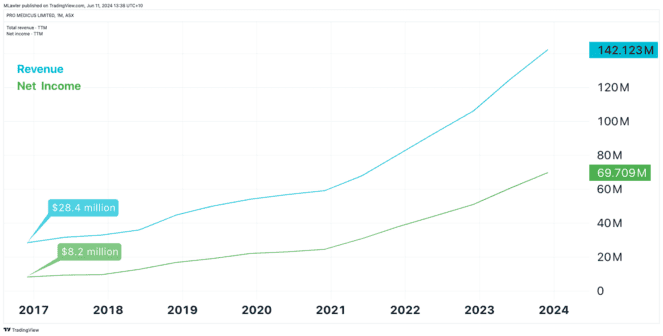
    This is at the core of what makes scalable companies so appealing. Scalable companies can grow from a small business into a big-timer in a short window of time. For example, Pro Medicus’ revenue and net income have increased fivefold and nearly ninefold in less than a decade, as shown below.

    Pro Medicus revenue and net income history. Data by Trading View.

    You don’t need lottery tickets to win big

    I know many aspiring investors who believe ‘taking a punt’ on a no-name company is the only way to achieve large gains in the stock market. Admittedly, I was one of them in my early days.

    Such thinking might lead one to believe that Pro Medicus was an unheard-of, probably unprofitable, company when I first invested in it. Yet, that couldn’t be any further from the truth.

    By March 2019, the ASX 200 stock generated $17.5 million in net profit after tax (NPAT) for the trailing 12 months at a 37.4% margin. It also had $32.3 million in cash (no debt) on its balance sheet. This is hardly reminiscent of a speculative mining explorer or drug developer.

    The lesson here is you don’t need to dumpster dive for tomorrow’s great companies. You can buy the great companies of today and save yourself the added risk of an unproven business.

    The post 3 lessons my seven-bagger ASX 200 stock has taught me appeared first on The Motley Fool Australia.

    Should you invest $1,000 in Pro Medicus Limited right now?

    Before you buy Pro Medicus Limited shares, consider this:

    Motley Fool investing expert Scott Phillips just revealed what he believes are the 5 best stocks for investors to buy right now… and Pro Medicus Limited wasn’t one of them.

    The online investing service he’s run for over a decade, Motley Fool Share Advisor, has provided thousands of paying members with stock picks that have doubled, tripled or even more.*

    And right now, Scott thinks there are 5 stocks that may be better buys…

    See The 5 Stocks
    *Returns as of 5 May 2024

    More reading

    John Mackey, former CEO of Whole Foods Market, an Amazon subsidiary, is a member of The Motley Fool’s board of directors. Motley Fool contributor Mitchell Lawler has positions in Pro Medicus. The Motley Fool Australia’s parent company Motley Fool Holdings Inc. has positions in and has recommended Amazon and Pro Medicus. The Motley Fool Australia has recommended Amazon and Pro Medicus. The Motley Fool has a disclosure policy. This article contains general investment advice only (under AFSL 400691). Authorised by Scott Phillips.

  • Russia says it’s working with a group of countries to build a platform that doesn’t need the dollar

    dollar dominance
    Russia is keen to move its trading partners away from the dollar.

    • A group of emerging countries are planning a payments platform to bypass the US dollar, Lavrov announced.
    • The initiative follows a BRICS summit call for trade in national currencies.
    • The platform may use digital currency, with more details expected at the Kazan BRICS meeting.

    A group of major emerging countries is working on a way around the dollar — but they face an uphill battle to diminish the greenback's dominance.

    On Monday, Russian Foreign Minister Sergey Lavrov said BRICS countries are developing a payments platform that will allow them to bypass the US dollar, per TASS, a state news agency.

    The initiative came from a summit of the BRICS countries in Johannesburg last year where the group — which includes the key members of Brazil, Russia, India, China, and South Africa — called for more trade and lending in their national currencies.

    Lavrov said on Monday that the platform will improve the international monetary system and allow payment in national currencies for mutual trade. Russia is keen to move its trading partners away from the dollar because it faces significant sanctions from the US and its allies.

    Details on the platform are scarce, including which countries could use it and when it could be adopted.

    Lavrov was speaking at the two-day BRICS Foreign Ministers Meeting, just days after Russia's flagship St. Petersburg International Economic Forum. There, Russian President Vladimir Putin doubled down on his call to phase out the use of the US dollar and other "toxic" currencies.

    There may be more traction on this front when the BRICS bloc meets in Kazan, Russia from October 22 to October 24, according to Christopher Granville, the managing director of global political research at GlobalData TS Lombard.

    The new BRICS payments system could come in the form of a digital-currency system that allows for central banks to deal with local currency transactions directly, Granville wrote in a May report.

    Lavrov himself touted a digital-currency-based settlement system to local media in April.

    'Impossible to replace something with nothing'

    Countries around the world have been working at diversifying their assets and chipping away at the dominance of the US dollar over fears that — like Russia — they could be shut out of the world's greenback-based financial system should sanctions hit.

    Russia, a commodities powerhouse, has been using more rubles for trade. Putin said last week that the ruble now accounts for 40% of Russia's import and export transactions.

    However, king dollar is so entrenched and pervasive in the world's financial system that very few people think it can be dethroned.

    There are "real geoeconomic headwinds to the dollar," Jared Cohen, the president of global affairs at Goldman Sachs wrote in Foreign Policy on Monday.

    Cohen acknowledged a "marginal" move toward de-dollarization but wrote that the world is far from an inflection point where there's a concerted effort to change the dollar-based global financial system.

    "The two most significant problems for those advocating wholesale de-dollarization are that it is impossible to replace something with nothing and the United States' competitors do not currently have the capability or will to replace the dollar, even if their rhetoric at times suggests otherwise," he wrote.

    Still, Cohen warned that the dollar's supremacy should not be taken for granted. He cited developments in the US, such as fiscal brinksmanship and "unnecessary tariffs," that could erode confidence in the greenback.

    On Monday, two American think tank analysts wrote in the Financial Times that "American dysfunction" — political and fiscal — is the real threat to dollar dominance.

    Read the original article on Business Insider