
• The US Navy botched the design of its new $1 billion frigates: report

    Navy guided-missile frigate USS Underwood
    US Navy guided-missile frigate USS Underwood in the Pacific Ocean in May 2012.

    • US Navy's guided missile frigate project faces delays due to a flawed design.
    • The $22 billion project started construction before completing the design, causing issues.
    • GAO recommends prioritizing design quality and testing systems on land to mitigate risks.

    A congressional report published Wednesday found that the US Navy's designs for its guided missile frigate project are flawed, stalling construction and delaying the delivery of the first frigate.

    "The Navy had good reason to be optimistic that the frigate program was positioned to deliver capabilities on the schedule it promised," the report said. "Subsequent missteps, however, have jeopardized the Navy's ability to achieve these goals."

    In order to accomplish its ambitious goal of acquiring and delivering up to 20 Constellationclass guided missile frigates over the course of 20 years — an endeavor projected to cost over $22 billion — the US Navy began building the first frigate before its design was complete. But that was a big mistake, a congressional watchdog found.

    The US Government Accountability Office reported that this misstep resulted in design challenges that paused construction on the first ship, which began in August 2022, and will cause the frigate to be delivered to the service three years late.

    "To reduce technical risk, the Navy and its shipbuilder modified an existing design to incorporate Navy specifications and weapon systems," the report said. "However, the Navy's decision to begin construction before the design was complete is inconsistent with leading ship design practices and jeopardized this approach."

    In addition to scheduling delays and the halting of ship construction, the Navy has yet to demonstrate frigate propulsion and machinery control systems.

    However, the report suggests that scheduling delays coupled with changes made to the frigate testing process may allow the Navy to test these two unproven systems on land. By doing this testing, there may be fewer problems once the ship is at sea.

    The future frigate was designed to be a multimission workhorse that carries air defense and strike missiles, as well as torpedoes to attack submarines. It is being built by Fincantieri Marinette Marine in Wisconsin.

    The report proposed five recommendations including that the Navy prioritize measuring the quality of ship designs over the quantity of design deliverables as well as complete and assess the design before moving on to building the second frigate.

    The Navy agreed to accept four of the recommendations and one of them partially, which involved updating testing.

    Read the original article on Business Insider
  • Trump hush money trial: Jury reaches verdict on Day 2 of deliberations

    Donald Trump walking off a gavel platform
    • The Manhattan jury in Donald Trump's hush-money trial has reached a verdict.
    • The jurors gave a note to the judge at 4:20 p.m. It'll be announced shortly.
    • The verdict follows the first-ever criminal trial of a former American president.

    The jury in former President Donald Trump's criminal hush-money trial has reached a verdict.

    Trump, the 77-year-old presumptive Republican presidential nominee, may soon be found guilty — or acquitted — of criminal charges related to a hush-money payment made to a porn star.

    The Manhattan jury in Trump's historic trial deliberated over whether to find him guilty of 34 felony counts of falsifying business records to cover up a $130,000 hush-money payment to adult film actor Stormy Daniels just 11 days before the 2016 election. They deliberated for less than 10 hours over two days, telling the judge that they had reached a verdict on Thursday afternoon.

    At the heart of the criminal case against Trump was a payment prosecutors said was designed to influence the 2016 election.

    Michael Cohen, Trump's longtime personal lawyer and fixer, bought Daniels' silence over a sexual encounter the porn star says she had with Trump at a Lake Tahoe hotel suite in 2006 during a celebrity golf tournament, according to prosecutors. Trump repaid Cohen with a series of checks in 2017, once he was already president, prosecutors alleged.

    Trump has denied having sex with Daniels and has attacked the Manhattan district attorney office's case against him as a political "witch hunt" and a "scam."

    The former president has also repeatedly slammed New York Supreme Court Justice Juan Merchan, who presided over the trial, as "totally conflicted" and "corrupt."

    If convicted, Trump faces a sentence of anywhere from zero jail time up to a maximum of four years in prison.

    Merchan would sentence Trump at a later date. Over the course of the trial, he has held Trump in contempt of court 10 times for violating his gag order, which may become a factor in the sentence. But the odds of Trump spending any time behind bars are still low, with probation a more likely outcome.

    The verdict follows the first-ever criminal trial of a former American president.

    It comes after a marathon 11-hour day of closing arguments, where lawyers from each side presented their competing versions of events to the jury.

    Jurors heard testimony from 20 prosecution witnesses — including Daniels and Cohen — for more than five weeks in a packed and chilly 15th-floor downtown Manhattan courtroom.

    Cohen, the prosecution's star witness, testified how Trump was the one who directed him to make the hush-money payment to Daniels just before the 2016 election.

    And Daniels, in graphic detail, told jurors about the sex she says she had with the then-"Apprentice" star.

    Trump's lawyers presented a brief — but tumultuous — defense case. They put Robert Costello, a criminal defense lawyer who had previous dealings with Cohen, on the witness stand. Costello called Cohen untrustworthy, but his testimony may have backfired after the judge erupted at him for scoffing at his rulings.

    Prosecutors alleged that Trump falsified 34 business documents throughout 2017, including in his first week as president, when they say he reimbursed Cohen for paying Daniels the hush money.

    Trump paid Cohen back, prosecutors said, in a series of 11 checks, nine of them bearing Trump's handwritten signature — and the jury got to see those records at trial.

    Much of Cohen's most damning testimony in the trial came when he quoted what he described as Trump's own words.

    "Just take care of it," Cohen said Trump told him in ordering him to quash Daniels' sex story.

    Trump "wasn't thinking about Melania — this was all about the campaign," Cohen told jurors.

    In opening statements at the trial, prosecutor Matthew Colangelo described the case against Trump as being about a "criminal conspiracy," while Trump's lead defense attorney, Todd Blanche, likened hush money to "democracy."

    While Merchan kept the inside of his courtroom moving briskly and professionally, Trump and protesters politicized the atmosphere on the outside. In almost-daily hallway press conferences and Truth Social posts, he attacked the proceedings as unfair and alleged without evidence that the case was orchestrated by President Joe Biden.

    In the park across the street from the courthouse, the tone occasionally veered into delirium, with his political allies hosting press conferences that were pranked by protesters, supporters floating vulgar balloons into the air, and a press conference from Biden supporter Robert De Niro during closing arguments.

    Trump still has three remaining criminal cases. Two of them — in Washington, DC and Georgia — are over his efforts to overturn the results of the 2020 presidential election. The other, in Florida, concerns him taking classified government documents to Mar-a-Lago after leaving the presidency.

    None of those other cases are expected to go to trial before the 2024 election.

    Read the original article on Business Insider
  • If you were born in the 1970s or later, your superannuation is delivering the best returns

    A mother and her two adult daughters embrace outdoors.

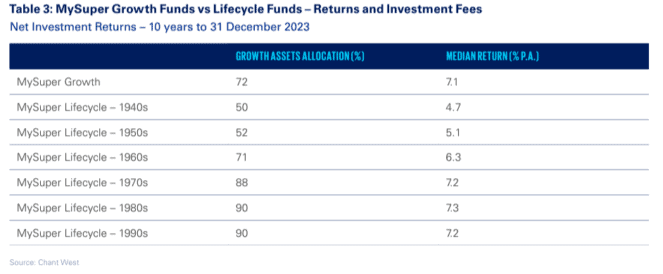
    Australians born in the 1970s or later who have chosen lifecycle superannuation products have achieved the best annual rates of return over the past decade, according to a new report.

    The KPMG report compared the median annual return of the traditional single-diversified MySuper Growth fund with the returns of different age groups typical of lifecycle superannuation accounts.

    If you have a lifecycle superannuation account, your fund manager will automatically arrange your asset allocations in an age-appropriate way as time goes on.

    The moneysmart.gov.au website explains: “With this option, your fund will typically move your money from growth investments when you’re young to more conservative investments when you’re older.”

    Single diversified MySuper funds are low-fee default funds selected by employers if an employee does not nominate a preferred fund.

    Better returns for those born in the ’70s or later

    The following table published in the KPMG report uses Chant West data showing net investment returns per annum over the 10 years to 31 December 2023.

    Source: Super Insights 2024

    As you can see, lifecycle products suited to those born in the 1970s or later performed better. They had higher median returns per annum at either 7.2% or 7.3%.

    KPMG says these higher returns reflected these lifecycle products containing a higher asset allocation in growth investments. This is because account holders were younger.

    Growth investments typically include ASX shares and international equities.

    Older account holders received lower median returns. They ranged from 4.7% among those born in the 1940s to 5.1% for those born in the 1950s and 6.3% for those born in the 1960s.

    The returns were lower because the account holders were older and closer to retirement.

    Therefore, their lifecycle funds allocated more of their money to conservative or defensive assets, such as cash and bonds, to try to achieve more capital preservation.

    KPMG commented:

    The older lifestyle cohorts missed out on some of the performance as they reduced risk over a period where there were generally strong returns, although they did have greater downside protection in the Covid-induced downturn in 2020 – important if they needed access to their super at that time or soon after.

    Your choice of superannuation fund REALLY matters

    The importance of choosing your superannuation fund carefully was apparent in the data.

    Many Australians do not understand that some retail superannuation funds routinely fail to beat the market’s annual benchmark returns (i.e., those of indexes like the S&P/ASX 200 Index (ASX: XJO)).

    This means many super account holders pay hefty management fees in the belief they are benefitting from their fund’s superior stock-picking services when, in fact, many funds fail to outdo or match benchmark returns. And once fees are paid, account holders’ returns are reduced even further.

    KPMG commented that the superior 10-year returns of the 1970s, 1980s, and 1990s lifecycle products barely exceeded the single-option MySuper Growth Fund.

    The 10-year period saw relatively strong returns from growth assets so we would expect the younger lifecycle portfolios with higher growth assets to do much better, but they were only slightly ahead of the median single option MySuper Growth fund.

    This was due to the underlying assets of these lifecycle products (mainly from retail funds) not performing as well as the underlying assets of the single option MySuper products.

    Compare the performance of your current super fund

    Retail funds are usually run by banks or investment firms. The Federal Government provides a comparison tool so you can compare your current super fund’s performance against others.

    This tool is designed to help you select a superannuation fund, with funds forced to disclose their returns.

    At the time of writing, HostPlus MySuper is the top-performing fund among MySuper products with balances over $50,000. It has a 7.96% average annual return net of fees over a 9-year investment period.

    The worst performer was returning 5.25%, with the Federal Government rating it ‘underperforming’.

    KPMG noted that lifecycle superannuation asset allocations today were different from those in the original models dating back to 2014, “some of which were far more conservative at older ages”.

    Superannuation outflows grow amid wave of retiring boomers

    As we recently reported, new figures from the Australian Prudential Regulation Authority (APRA) out this week showed greater growth in superannuation outflows than inflows over the year to 31 March 2024.

    This was largely due to more benefit payments going out as more baby boomers entered retirement.

    Baby Boomers were born between 1945 and 1964, making the youngest Aussies in this cohort 60 years of age this year.

    This means every baby boomer has now reached preservation age. That’s the age at which we can all begin accessing our superannuation savings.

    The data shows $112.9 billion was paid out, up 18.1% annually. Inflows totalled $177 billion, up 11.3%.

    APRA said the increased outflows were directly linked to more lump sum and pension payments:

    This increase was the result of lump sum payments rising by 18.4 per cent to $63.0 billion and pension payments increasing by 17.7 per cent to $49.8 billion.

    The post If you were born in the 1970s or later, your superannuation is delivering the best returns appeared first on The Motley Fool Australia.

    Maximise Your Super before June 30: Uncover 5 Strategies Most Aussies Overlook!

    With the end of the financial year almost upon us, there are some strategies that you may be able to take advantage of right now to save some tax and boost your savings…

    Download our latest free report discover 5 super strategies that most Aussies miss today!

    Download Free Report
    *Returns 28 May 2024

    More reading

    Motley Fool contributor Bronwyn Allen has no position in any of the stocks mentioned. The Motley Fool Australia’s parent company Motley Fool Holdings Inc. has no position in any of the stocks mentioned. The Motley Fool Australia has no position in any of the stocks mentioned. The Motley Fool has a disclosure policy. This article contains general investment advice only (under AFSL 400691). Authorised by Scott Phillips.

  • Is this ASX 200 energy stock a buy at a P/E of 4.5?

    A woman holds her finger to the side of her lips in contemplation as she looks upwards to an array of graphic images of light bulbs above her head, one of which is on and glowing.

    It’s not too often that an ASX share, even an ASX 200 energy stock, trades on a price-to-earnings (P/E) ratio of 4.5. After all, the average P/E ratio on the ASX right now is closer to 20. 

    A company that is asking an earnings multiple of 4.5 is effectively asking investors to pay $4.50 for every $1 of earnings it brings in. That’s a compelling equation for any value investor to contemplate.

    So today, let’s take a look at this ASX 200 energy stock in question and see if there’s anything to like.

    The stock is none other than AGL Energy Ltd (ASX: AGL). AGL is one of the oldest names on the ASX and one of the most famous energy stocks on the market. It has had a rough trot in recent years, falling from over $21 a share in early 2020 to a multi-decade low of under $4 a share in late 2021.

    Today, AGL shares have recovered substantially, but are still trading at half of what they were just four years ago – asking $10.20. Check all of that out for yourself below:

    Yet despite this recovery, this ASX 200 energy stock remains at an arguably cheap share price. For some ASX shares, including some energy stocks, low earnings multiples are the norm. But for others, it could indicate that a company might be trading at a bargain price. So which is it for AGL?

    Is this ASX 200 energy stock a buy at 4.5 times earnings?

    Well, one ASX expert thinks it’s the latter.

    Rafi Lamm is the co-founder of fund manager L1 Capital. Speaking to the Australian Financial Review (AFR) this week, Lamm noted AGL’s quality and future-proof nature, noting that the company was “well positioned to benefit from strong long-term electricity demand with the lowest cost baseload generation in NSW and Victoria”.

    Lamm also views the current AGL share price as cheap, noting that its “multiple of 4.5 times earnings before interest and tax” is “well below its historic multiple of six times”.

    The fund manager argued that AGL is set for “a solid recovery” in terms of earnings from FY2026 onwards thanks to rising wholesale electricity futures pricing:

    Strong medium term free cash flow will enable solid dividends as well as a substantial investment in the energy transition, for example, in high returning battery storage.

    No doubt this opinion will delight shareholders of this ASX 200 energy stock. But let’s see if Lamm’s call proves accurate.

    At the current AGL share price, this ASX 200 energy stock has a market capitalisation of $6.86 billion, with a dividend yield of 4.80%.

    The post Is this ASX 200 energy stock a buy at a P/E of 4.5? appeared first on The Motley Fool Australia.

    Should you invest $1,000 in Agl Energy Limited right now?

    Before you buy Agl Energy Limited shares, consider this:

    Motley Fool investing expert Scott Phillips just revealed what he believes are the 5 best stocks for investors to buy right now… and Agl Energy Limited wasn’t one of them.

    The online investing service he’s run for over a decade, Motley Fool Share Advisor, has provided thousands of paying members with stock picks that have doubled, tripled or even more.*

    And right now, Scott thinks there are 5 stocks that may be better buys…

    See The 5 Stocks
    *Returns as of 5 May 2024

    More reading

    Motley Fool contributor Sebastian Bowen has no position in any of the stocks mentioned. The Motley Fool Australia’s parent company Motley Fool Holdings Inc. has no position in any of the stocks mentioned. The Motley Fool Australia has no position in any of the stocks mentioned. The Motley Fool has a disclosure policy. This article contains general investment advice only (under AFSL 400691). Authorised by Scott Phillips.

  • 5 things to watch on the ASX 200 on Friday

    On Thursday, the S&P/ASX 200 Index (ASX: XJO) had another poor session and dropped into the red. The benchmark index fell 0.5% to 7,628.2 points.

    Will the market be able to bounce back from this on Friday and end the week on a high? Here are five things to watch:

    ASX 200 poised to rebound

    The Australian share market looks set to end the week on a positive note despite a poor session on Wall Street. According to the latest SPI futures, the ASX 200 is expected to open 50 points or 0.65% higher this morning. On Wall Street, the Dow Jones was down 0.85%, the S&P 500 fell 0.6%, and the NASDAQ was 1.1% lower.

    Oil prices fall

    ASX 200 energy shares Beach Energy Ltd (ASX: BPT) and Karoon Energy Ltd (ASX: KAR) could have a tough finish to the week after oil prices tumbled overnight. According to Bloomberg, the WTI crude oil price is down 1.7% to US$77.87 a barrel and the Brent crude oil price is down 2% to US$81.97 a barrel. Traders were selling oil in response to weak gasoline demand.

    Buy Xero shares

    The Xero Ltd (ASX: XRO) share price could be good value according to analysts at Goldman Sachs. In response to price increases in the UK, the broker has reiterated its conviction buy rating and $164.00 price target on the cloud accounting platform provider’s shares. It said: “Although we believe this pricing update was somewhat expected following the Australian plan announcement, we view it as another incremental positive for Xero and very supportive of our FY25/26 revenue forecasts.”

    Gold price softens

    ASX 200 gold shares including Evolution Mining Ltd (ASX: EVN) and Northern Star Resources Ltd (ASX: NST) could have a subdued finish to the week after the gold price edged lower overnight. According to CNBC, the spot gold price is down 0.1% to US$2,362.8 an ounce. The precious metal appears to be in a holding pattern ahead of the release of US inflation data.

    Pro Medicus shares rated hold

    Analysts at Bell Potter have been impressed with the contract wins announced by Pro Medicus Limited (ASX: PME) this week. As a result, the broker has upgraded the health imaging technology company’s shares to a hold rating with an improved price target of $115.00 (from sell and $75.00). It said: “The announcement of recent contract wins provides a heightened degree of certainty for FY25 revenues and earnings, accordingly there is minimal risk of downgrades to consensus for FY25 following the FY24 earnings announcement.”

    The post 5 things to watch on the ASX 200 on Friday appeared first on The Motley Fool Australia.

    Should you invest $1,000 in Beach Energy Limited right now?

    Before you buy Beach Energy Limited shares, consider this:

    Motley Fool investing expert Scott Phillips just revealed what he believes are the 5 best stocks for investors to buy right now… and Beach Energy Limited wasn’t one of them.

    The online investing service he’s run for over a decade, Motley Fool Share Advisor, has provided thousands of paying members with stock picks that have doubled, tripled or even more.*

    And right now, Scott thinks there are 5 stocks that may be better buys…

    See The 5 Stocks
    *Returns as of 5 May 2024

    More reading

    Motley Fool contributor James Mickleboro has positions in Pro Medicus and Xero. The Motley Fool Australia’s parent company Motley Fool Holdings Inc. has positions in and has recommended Goldman Sachs Group, Pro Medicus, and Xero. The Motley Fool Australia has positions in and has recommended Xero. The Motley Fool Australia has recommended Pro Medicus. The Motley Fool has a disclosure policy. This article contains general investment advice only (under AFSL 400691). Authorised by Scott Phillips.

  • These buy-rated ASX dividend stocks offer 6%+ yields (and plenty of upside)

    There are a lot of options for income investors to choose from on the Australian share market.

    To narrow things down, I have picked out three ASX dividend stocks that analysts rate as buys and are forecasting 6%+ dividend yields. Here’s what you need to know about them:

    APA Group (ASX: APA)

    The first ASX dividend stock for income investors to consider buying is APA Group.

    It is an energy infrastructure business that owns and operates a $27 billion portfolio of gas, electricity, solar and wind assets. This includes 15,000 kilometres of natural gas pipelines that connect sources of supply and markets across mainland Australia.

    Analysts at Macquarie are feeling positive about the company’s outlook and expect its long run of dividend increases to continue. The broker is forecasting dividends of 56 cents per share in FY 2024 and then 57.5 cents per share in FY 2025. Based on the current APA Group share price of $8.29, this equates to 6.75% and 6.9% dividend yields, respectively.

    Macquarie has an outperform rating and $9.40 price target on its shares.

    Dalrymple Bay Infrastructure Ltd (ASX: DBI)

    Over at Morgans, its analysts think that Dalrymple Bay Infrastructure could be an ASX dividend stock to buy. It is the long-term operator of the Dalrymple Bay Coal Terminal, which has been Queensland’s premier coal export facility since 1983.

    The broker currently has an add rating and $3.05 price target on its shares.

    As for income, the broker is forecasting dividends per share of 22 cents in FY 2024 and then 23 cents in FY 2025. Based on the latest Dalrymple Bay Infrastructure share price of $2.76, this will mean yields of 8% and 8.3%, respectively.

    HomeCo Daily Needs REIT (ASX: HDN)

    Morgans is also expecting some big dividend yields from HomeCo Daily Needs shares. It is a property company focused on neighbourhood retail and large format retail assets.

    The broker likes the company due to the resilience of its cashflows and its exposure to accelerating click and collect trends. Combined with its development pipeline, Morgans feels the company is well-positioned for growth.

    It expects this to underpin dividends per share of 8 cents in FY 2024 and then 9 cents in FY 2025. Based on the current HomeCo Daily Needs share price of $1.21, this will mean yields of 6.6% and 7.4%, respectively.

    Morgans currently has an add rating and $1.37 price target on the ASX dividend stock.

    The post These buy-rated ASX dividend stocks offer 6%+ yields (and plenty of upside) appeared first on The Motley Fool Australia.

    Should you invest $1,000 in Apa Group right now?

    Before you buy Apa Group shares, consider this:

    Motley Fool investing expert Scott Phillips just revealed what he believes are the 5 best stocks for investors to buy right now… and Apa Group wasn’t one of them.

    The online investing service he’s run for over a decade, Motley Fool Share Advisor, has provided thousands of paying members with stock picks that have doubled, tripled or even more.*

    And right now, Scott thinks there are 5 stocks that may be better buys…

    See The 5 Stocks
    *Returns as of 5 May 2024

    More reading

    Motley Fool contributor James Mickleboro has no position in any of the stocks mentioned. The Motley Fool Australia’s parent company Motley Fool Holdings Inc. has positions in and has recommended Macquarie Group. The Motley Fool Australia has positions in and has recommended Apa Group and Macquarie Group. The Motley Fool Australia has recommended HomeCo Daily Needs REIT. The Motley Fool has a disclosure policy. This article contains general investment advice only (under AFSL 400691). Authorised by Scott Phillips.

  • Target fans can find their favorite private label products for half price from this salvage seller on Poshmark

    Cat & Jack clothing for sale at Target
    Several Target-owned brands, like Cat and Jack, do over a billion dollars in sales each year.

    • A seller specializing in Target products has amassed a considerable following on eBay and Poshmark.
    • Bullseye Deals sources salvage merch from Target, including from the company's private label brands.
    • Off-price sellers have long been part of retail, but few feature store brands so prominently.

    A seller has amassed a considerable following, offering huge deals on Target products to buyers on eBay, Poshmark, and Facebook Marketplace.

    Bullseye Deals, which launched on eBay in 2013 and Poshmark in 2022, is a reseller that sources merchandise from Target's salvage inventory, much like the bin stores and liquidation centers that are scattered across the the country.

    Modern Retail reported that Target is aware of the business but not officially connected to it. A spokesperson confirmed that to Business Insider.

    Bullseye Deals did not respond to a request for comment, but the store's Facebook page says it is run by Liquidity Services, a publicly traded company that helps a wide range of businesses deal with returned or excess inventory. The company identifies Target as a client, as well as Walmart, Amazon, and several other major retailers.

    What makes this store different from most is the emphasis on Target's private labels, like its Threshold household line, All in Motion activewear, or the supremely popular Cat and Jack kid's clothing brand.

    Off-price sellers have long been part of retail — think T.J. Maxx and Marshalls, among others — but most of those tend to sell national brands or lesser-known independent labels.

    That a robust resale market exists for Target-owned brands is a testament to their reach and popularity with consumers.

    Target attributes roughly one-third of its sales to private label products — that's over $35 billion last year. In addition, several of Target's top-performing brands do over a billion dollars in sales a year. Cat & Jack sold enough children's apparel last year for every kid in the United States under 12 to have eight items.

    In that context, it's no wonder that there would be a shop focused on surplus Bullseye brands. It's a big business.

    Read the original article on Business Insider
  • Delhi hits record 127 degrees as residents struggle to secure water

    Delhi, India, hit a record 127 degrees Fahrenheit amid a water shortage. At least 11 people have died, and hospitals are seeing spikes in patients.

    Read the original article on Business Insider
  • Amazon’s delivery drone gets the green light to fly beyond a pilot’s direct supervision, allowing expanded operations

    An Amazon drone flies in front of the company logo.
    An Amazon drone flies in front of the company logo.

    • The FAA will allow Amazon to fly its drones beyond a pilot's direct line of sight.
    • That means Amazon can now expand its delivery services with its MK-27 drones, the company announced.
    • Amazon's drone delivery program has been delayed in recent years due to field test crashes.

    Amazon's package delivery drones are expanding their horizons following a nod of approval from the FAA, the company announced on Thursday.

    "We're excited to share that the FAA has given Prime Air additional permissions that allow us to operate our drones beyond visual line of sight, enabling us to now serve more customers via drone and effectively expand and scale our drone delivery operations," Amazon said in a press release.

    The FAA requires companies to get approval to operate drones beyond a pilot's visual line of sight, something Amazon said it accomplished after developing "detect-and-avoid technology."

    "We've spent years developing, testing, and refining our onboard detect-and-avoid system to ensure our drones can detect and avoid obstacles in the air," the company said, including "real planes, helicopters, and a hot air balloon."

    Now, Amazon plans to scale the use of its MK-27 drone to "reach customers in more densely populated areas," the company said.

    The FAA's permission comes after delays in the company's drone ambitions over the last few years due to field test crashes, one of which involved a drone that fell 180 feet and "just blew apart when it hit the ground," Business Insider previously reported.

    The company began executing drone deliveries in 2022 in its distribution areas in College Station, Texas, and Lockeford, California — the latter of which the company closed in April to focus on other locations across the nation, CNBC reported.

    Earlier this year, an Amazon executive boasted that one of its drones in College Station managed to deliver a box of cookies less than 16 minutes after it was ordered.

    Read the original article on Business Insider
  • The dress code is changing for Silicon Valley tech workers this summer

    A hat over a laptop
    It's time for tech workers to transition into their summer styles.

    • Tech bosses are getting noticed for their style in 2024.
    • As the weather heats up, tech workers should consider updating their wardrobes as well.
    • Fashion experts suggested brighter colors and more accessories to make an impression this summer.

    Tech's top players are switching over to their summer styles — and workers should follow suit if they want to dress to impress.

    Whether accessorizing more like Mark Zuckerberg and Jeff Bezos or opting for sporty outfits like Bill Gates and Sergey Brin, there are more ways to express personal style than the stereotypical tech uniform of jeans and a t-shirt.

    Unlike finance workers — who typically have to keep it a bit more professional — the tech industry is known for its looser dress code and emphasis on an open work culture (though that's shifting in recent years).

    Still, tech workers have begun hiring stylists to help them dress better for work. Some pay tens of thousands to improve their look, but others aren't so quick to give up their beloved t-shirts, stylists told The San Francisco Standard.

    "If you can get them to try something new, and they get a compliment from someone soon thereafter, that makes it much easier for them to continue updating their wardrobe," image consultant Eddie Hernandez told SF Standard.  

    With Meta and others calling their workers back into the office over the past year, employees will have to update their wardrobes for in-person work.

    Here's what fashion experts believe tech workers should be wearing this summer.

    Ditch the grey tones for colors

    Composite image of t-shirts
    The Norse Project t-shirt (left) is $80, the Uniqlo henley (top right) is $30, and the Abercrombie & Fitch t-shirt (bottom right) is $19.

    No more black, white, or grey.

    Hernandez told the SF Standard that he's discouraging clients from going for the drab shades "that are dominant in SF," and asking them to reach for colorful options instead in 2024.

    As the temperature heats up, workers might want to put their shackets away and go for the more typical techy t-shirt.

    For his clients who want more luxurious options, Hernandez recommended the $80 Niels Standard t-shirt from Norse Project. Entry level employees who want to save money can shop similar styles at Uniqlo and Abercrombie & Fitch for cheaper.

    It looks like Gates got the memo and opted for sporty, breathable shorts and Adidas sneakers while off-duty at Zuckerberg's 40th birthday.

    Find chic ways to stay cool

    composite image of jumpsuit and dress shirt set
    The Good American shirt (left) is $140, and the Cider jumpsuit (right) is $33.

    Wearing jean shorts and a tank top to work might not go over well — even at the most laid-back tech firms.

    Save that for the weekend, and instead, find ways to stay cool during your commute and still look fashionable around the office. In its round-up of summer office outfits, Cosmopolitan included mostly maxi dresses, wide-leg jumpsuits, and light-weight dress shirts.

    Loose, breathable clothes catch the wind and keep your body cool while also adhering to a corporate dress code.

    Don't be afraid of accessorizing

    composite image of a rolex, necklace, and bracelet
    The Rolex Explorer (left) starts at $7,000, the Ritani tennis necklace (top right) is $7,030, and the gold bracelet (bottom right) is $970.

    Tech workers can take notes from Zuckerberg on how jewelry can elevate their look. The Meta CEO has been the subject of viral memes since adding a necklace to his outfits.

    "Heading into the summer season, I can see the entry-level tech crowd wearing something clean and understated," Carol Altieri, COO of Bob's Watches told Business Insider.

    Altieri suggested a Rolex Explorer for a high-earner starting their watch collection if they want a "clean, low-profile look." The timepiece starts at around $7,000.

    To pair with the watch, jewelry brand Ritani told BI that tennis bracelets and necklaces are trendy ways to elevate an outfit.

    Ria Papasifakis, vice president of e-commerce at Ritani, said that X CEO Linda Yaccarino is an example of the trend of wearing white gold accessories and putting on chunky bracelets.

    "We like to call it the 'powerhouse' look," Papasifakis told BI.

    Read the original article on Business Insider