
• 3 ASX shares I’d buy for instant diversification

    Two funeral workers with a laptop surrounded by cofins.

    If we look at the ASX share market, around half of the weighting consists of ASX bank shares and ASX mining shares. Therefore, I think it could be a good idea to diversify by investing in different industries.

    Ideally, we want to choose investments that can diversify and grow. I don’t think investing in something with a high chance of not delivering any long-term growth is ideal. Hence, that’s why I like the potential of the below three ASX shares.

    Propel Funeral Partners Ltd (ASX: PFP)

    Propel is the second-largest funeral operator in Australia and New Zealand. It’s a morbid industry, but it’s a necessary service. Indeed, as the saying goes, there are two things certain in life – death and taxes.

    The company describes how a “death boom” is expected in the next two decades. The number of deaths in Australia is expected to grow at a compound annual growth rate (CAGR) of 2.5% between 2024 to 2030 and then 2.9% between 2031 to 2040.

    Propel’s average revenue per funeral continues to grow – in the first half of FY24, it saw a 4.5% year-over-year increase, driven by inflation. The average revenue per funeral has increased every year since FY14, at a CAGR of around 3.1%.

    Revenue is growing at a fast rate organically, and the company is also regularly making acquisitions to expand geographically.

    HY24 revenue was up 22.8% and operating earnings before interest, tax, depreciation and amortisation (EBITDA) increased 18.5%.

    In the long-term, this business could make stronger profits with Australia’s growing and ageing population.

    Corporate Travel Management Ltd (ASX: CTD)

    This ASX share describes itself as a leader in business travel management services in Australia, New Zealand and beyond. It also has a presence in North America, Asia and Europe.

    It has done a good job of growing its market share over the years, partly due to its very high client retention rate of 97%. The return of travel after COVID-19 has been very beneficial for its earnings.

    The business has a goal of delivering revenue growth of at least 10% per annum over the next five years, partly by winning new clients. Any acquisitions would be an extra. It’s aiming to grow its EBITDA by an average of 15% per annum in the next five years.

    Corporate Travel Management is aiming to maintain a 50% dividend payout ratio, invest in high-performing projects, use excess cash for share buybacks, and make acquisitions.

    According to Commsec, the Corporate Travel Management share price is valued at under 13x FY26’s estimated earnings.

    VanEck MSCI International Quality ETF (ASX: QUAL)

    This ASX exchange-traded fund (ETF) is all about investing in high-quality global shares that score well on a few different quality metrics – high return on equity (ROE), earnings stability and low financial leverage. When you combine those metrics, you’re left with a group of strong businesses.

    In total, this fund is invested in 300 businesses, so that’s more diversification (in terms of the number of stocks) than the S&P/ASX 200 Index (ASX: XJO).

    Banking and mining make up half of the ASX but account for less than 10% of this fund. Instead, it has large allocations to stocks like Nvidia, Microsoft, Meta Platforms, Apple, Eli Lilly, Alphabet, Novo Nordisk and Visa.

    The QUAL ETF has performed well over the long term, and I’m optimistic it can beat the ASX 200 share index over time because of the screening process for quality.

    The post 3 ASX shares I’d buy for instant diversification appeared first on The Motley Fool Australia.

    Wondering where you should invest $1,000 right now?

    When investing expert Scott Phillips has a stock tip, it can pay to listen. After all, the flagship Motley Fool Share Advisor newsletter he has run for over ten years has provided thousands of paying members with stock picks that have doubled, tripled or even more.*

    Scott just revealed what he believes could be the ‘five best ASX stocks’ for investors to buy right now. We believe these stocks are trading at attractive prices and Scott thinks they could be great buys right now…

    See The 5 Stocks
    *Returns as of 5 May 2024

    More reading

    Suzanne Frey, an executive at Alphabet, is a member of The Motley Fool’s board of directors. Randi Zuckerberg, a former director of market development and spokeswoman for Facebook and sister to Meta Platforms CEO Mark Zuckerberg, is a member of The Motley Fool’s board of directors. Motley Fool contributor Tristan Harrison has no position in any of the stocks mentioned. The Motley Fool Australia’s parent company Motley Fool Holdings Inc. has positions in and has recommended Alphabet, Apple, Corporate Travel Management, Meta Platforms, Microsoft, Nvidia, and Visa. The Motley Fool Australia’s parent company Motley Fool Holdings Inc. has recommended Novo Nordisk and has recommended the following options: long January 2026 $395 calls on Microsoft and short January 2026 $405 calls on Microsoft. The Motley Fool Australia has positions in and has recommended Corporate Travel Management. The Motley Fool Australia has recommended Alphabet, Apple, Meta Platforms, Microsoft, and Nvidia. The Motley Fool has a disclosure policy. This article contains general investment advice only (under AFSL 400691). Authorised by Scott Phillips.

  • Both of these excellent ASX ETFs are on my buy list

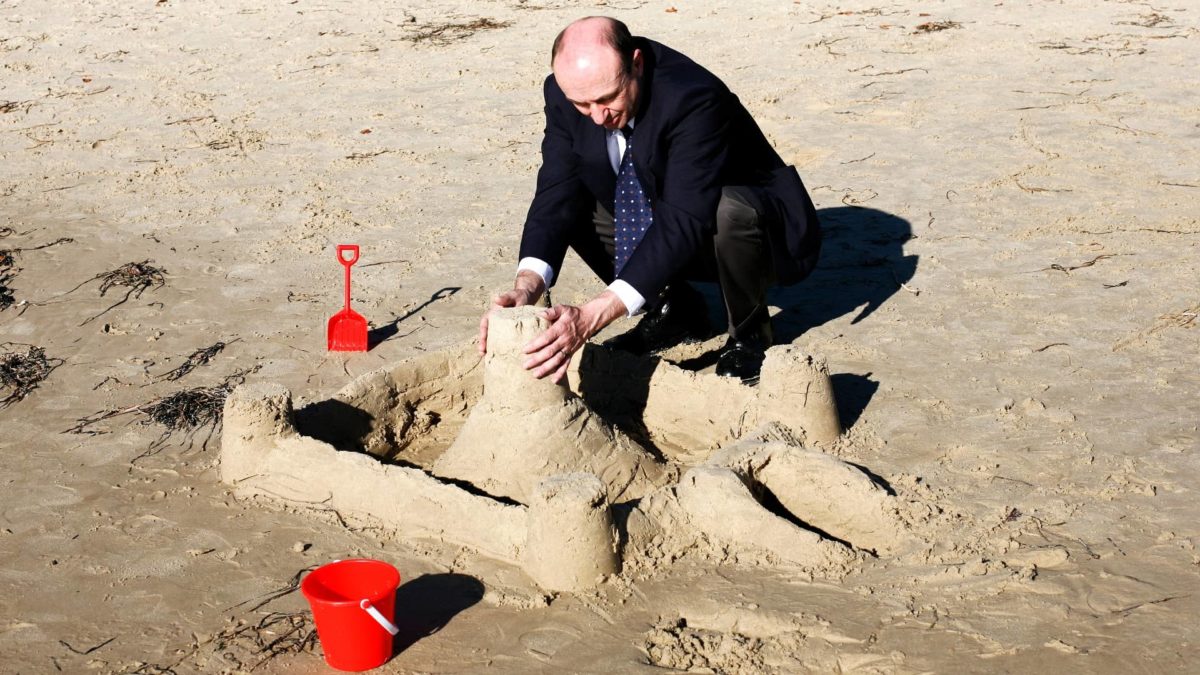
    Businessman at the beach building a wall around his sandcastle, signifying protecting his business.

    I love owning good investments in my portfolio. There are great ASX shares, but there are plenty of compelling businesses outside of the ASX too. My portfolio is quite focused on ASX shares because that’s where I spend my time researching.

    But it’d be good for me to get more diversification without necessarily reducing my returns. That’s where exchange-traded funds (ETFs) come in. Good ETFs can provide diversification as well as solid returns.

    The two ETFs I’m going to discuss below offer quality and exposure to different industries that largely aren’t available in Australia.

    VanEck MSCI International Quality ETF (ASX: QUAL)

    The QUAL ETF owns a portfolio of 300 global businesses that rank well on quality metrics.

    Compared to the ASX, which is weighted to ASX bank shares and ASX mining shares, which largely make their profit in Australia (and New Zealand), this ASX ETF offers a much better spread of investments.

    It does have the biggest weighting to IT (with a 33.8% allocation), which I think is a good thing because that’s usually where good returns can often be found due to the strong economics of software. Four other sectors have a weighting of more than 9%  – healthcare (18.2%), industrials (12.7%), communication services (10.2%) and consumer staples (9.3%).

    Geographic diversification is also good. The portfolio includes several countries with a weighting of more than 1%, including the US (75.2%), Switzerland (5%), the UK (3.7%), Denmark (3.2%), Japan (3%), the Netherlands (3%), France (2%), and Canada (1.1%).

    But, I don’t just want diversification for the sake of it if it were to reduce my returns materially. This ASX ETF only invests in businesses that score well on having a high return on equity (ROE), earnings stability, and low financial leverage.

    In other words, it makes good profit for shareholders, the profit doesn’t usually experience sizeable declines, and the balance sheet is in good shape.

    Past performance is not a guarantee of future performance, but the quality focus has led the QUAL ETF to deliver an average return per annum of 14.9% over the three years to April 2024.

    VanEck Morningstar Wide Moat ETF (ASX: MOAT)

    Morningstar analysts choose the MOAT ETF’s portfolio, which looks at US companies with strong and durable economic moats or competitive advantages.

    Competitive advantages can come in many different forms, such as patents, brand power, network effects, cost advantages and switching costs. This ASX ETF is targeting businesses where the competitive advantage is expected to almost certainly endure for the next decade or two.

    There’s quite a mixture of different businesses at the top of the holdings, including Alphabet, International Flavors & Fragrances, Teradyne and Rtx (which have a weighting of between 3.1% and 2.9%). The smallest position in the portfolio has a weighting of 1%.

    The sector allocation within this ASX ETF can change as the investments shift, but at the moment, there are five industries with a double-digit weighting – healthcare (20.8%), industrials (17.9%), IT (15%), financials (14.3%) and consumer staples (11.6%). I like the mixture of businesses here.

    Since its inception in June 2015, the MOAT ETF has delivered an average annual return of 15.6%.

    I think both ASX ETFs can play a good part in my portfolio, and there’s a good chance I’ll own at least one of them by the end of 2024.

    The post Both of these excellent ASX ETFs are on my buy list appeared first on The Motley Fool Australia.

    Wondering where you should invest $1,000 right now?

    When investing expert Scott Phillips has a stock tip, it can pay to listen. After all, the flagship Motley Fool Share Advisor newsletter he has run for over ten years has provided thousands of paying members with stock picks that have doubled, tripled or even more.*

    Scott just revealed what he believes could be the ‘five best ASX stocks’ for investors to buy right now. We believe these stocks are trading at attractive prices and Scott thinks they could be great buys right now…

    See The 5 Stocks
    *Returns as of 5 May 2024

    More reading

    Suzanne Frey, an executive at Alphabet, is a member of The Motley Fool’s board of directors. Motley Fool contributor Tristan Harrison has no position in any of the stocks mentioned. The Motley Fool Australia’s parent company Motley Fool Holdings Inc. has positions in and has recommended Alphabet. The Motley Fool Australia’s parent company Motley Fool Holdings Inc. has recommended RTX and Teradyne. The Motley Fool Australia has recommended Alphabet and VanEck Morningstar Wide Moat ETF. The Motley Fool has a disclosure policy. This article contains general investment advice only (under AFSL 400691). Authorised by Scott Phillips.

  • Is the Woodside share price at a stretched valuation right now?

    A little girl stands on a chair and reaches really, really high with her hand, in front of a yellow background.

    The Woodside Energy Group Ltd (ASX: WDS) share price has drifted around 10% lower this year to date, continuing its slide from last year and hitting 52-week lows earlier this month.

    Meanwhile, the broader S&P/ASX 200 Energy Index (ASX: XEJ) is down just 1.8% so far this year.

    But, as Warren Buffett says, “price is what you pay – value is what you get“.

    So, is the Woodside share price attractively valued, or not?

    What impacts Woodside’s valuation?

    Woodside produces oil and gas. That means it does not have the luxury of setting its prices. Instead, it must accept the current market price for oil and gas. It is a “price taker”.

    Brent crude oil currently trades at around US$83 per barrel, down from the highs above $90 per barrel seen early last month.

    Oil prices have cooled since April on the prospect of even higher interest rates, “which could dampen growth and hit fuel demand in the world’s top oil consumer [the USA]”, per Trading Economics.

    Analysts at Morgans, however, don’t see this as a headwind for the Woodside share price. The broker is bullish on the oil and gas giant’s stock and sees the decline in oil prices as “moderating”.

    If oil prices do, in fact, remain stable, the broker sees the current Woodside share price “as a good time to add” and targets $36 per share for the energy player in the next 12 months.

    Should this target price materialise, a $10,000 investment in Woodside shares today would be valued at around $12,700 – a 27% return, not including dividends.

    Is the Woodside share price overvalued?

    The company’s shares currently sell at a price-to-earnings (P/E) ratio of 21.6 times. That means, investors are paying $21.60 for every $1 of the company’s profits.

    For this, Morgans expects the company to pay dividends of $1.25 per share in FY 2024 – a forward dividend yield of around 4.5% as I write.

    Meanwhile, competitors Santos Ltd (ASX: STO) and Origin Energy Ltd (ASX: ORG) trade at P/E multiples of around 12 times and 11 times respectively.

    Okay, so we know investors are paying a higher price for Woodside shares than their peers relative to the earnings of the respective businesses.

    Why would this be so? Does it mean Woodside is overvalued?

    Morgans doesn’t think so. The broker says Woodside has “a healthy balance sheet and healthy dividend profile” as two factors in the value equation.

    Its price target of $36 per share implies a P/E multiple of around 41 times Woodside’s last reported earnings per share of $0.87.

    The broker ultimately believes the Woodside share price is undervalued. Time will tell.

    The post Is the Woodside share price at a stretched valuation right now? appeared first on The Motley Fool Australia.

    Should you invest $1,000 in Woodside Petroleum Ltd right now?

    Before you buy Woodside Petroleum Ltd shares, consider this:

    Motley Fool investing expert Scott Phillips just revealed what he believes are the 5 best stocks for investors to buy right now… and Woodside Petroleum Ltd wasn’t one of them.

    The online investing service he’s run for over a decade, Motley Fool Share Advisor, has provided thousands of paying members with stock picks that have doubled, tripled or even more.*

    And right now, Scott thinks there are 5 stocks that may be better buys…

    See The 5 Stocks
    *Returns as of 5 May 2024

    More reading

    Motley Fool contributor Zach Bristow has no position in any of the stocks mentioned. The Motley Fool Australia’s parent company Motley Fool Holdings Inc. has no position in any of the stocks mentioned. The Motley Fool Australia has no position in any of the stocks mentioned. The Motley Fool has a disclosure policy. This article contains general investment advice only (under AFSL 400691). Authorised by Scott Phillips.

  • Meet the students stacking internships and battling each other to get a foot in Goldman Sachs’ and JPMorgan’s doors

    Channon Loh (left) and Goldman Sachs (right).
    Channon Loh, 22, is in the thick of the internship hunger games, and he thinks he's winning.

    • College students in Singapore are pulling out all stops in pursuit of careers in investment banking.
    • Some say that padding their résumés with multiple internships is their best shot at getting the job.
    • An ex-banker told BI that snagging a job in investment banking has gotten "super, super intensive."

    Channon Loh, 22, is a man on a mission.

    The freshman at the National University of Singapore, or NUS, is on his third finance internship, but he says he's just getting started.

    Loh told Business Insider he plans to complete nine to 10 internships before he graduates. All this, the business administration student says, is part of his quest to land a job with a big bank like Goldman Sachs or JPMorgan.

    In addition to clocking multiple internships, Loh said he's striving to maintain a perfect GPA every semester.

    "I have to grind a lot for academics and then do internships on top of that," Loh said. "But I think that's the kind of trade-off that most high finance people would make."

    Committing to the grind

    JPMorgan headquarters at Canary Wharf financial district on 15th August 2023 in London, United Kingdom.
    Loh told BI that he wanted to work at banks like JPMorgan because of their strong corporate culture and opportunities to engage with C-suite executives.

    Working at a top bank like Goldman Sachs or JPMorgan has long been the ultimate goal for those who want to make their mark in finance. Besides six-figure starting salaries, staffers may get the opportunity to work on mega-deals and interact with C-suite clients.

    But getting your foot into the door is a major undertaking.

    Landing a summer internship at Goldman Sachs is even harder than getting into Harvard. Goldman's internship acceptance rates globally were about 1.5% in 2022, way lower than Harvard's 3.19% acceptance rate in the same year.

    And while landing a job at Goldman Sachs or JPMorgan is hard anywhere, in Singapore, there's the added societal pressure of "kiasu" — a colloquial term that roughly translates to "fear of losing" and is often used to describe the nation's cultural ethos.

    This is, after all, the land of Crazy Rich Asians luxury and tiger moms. Though efforts have been made to level the playing field, grinding one's way into an elite school and a plush, high-paying job is still a marker of success.

    Many Singapore students have adopted a similar playbook to Loh's, padding their résumés with stacks of internships in the hopes of landing a spot at a top bank.

    Eric Sim, a former managing director at UBS Investment Bank and the author of the career book, "Small Actions," told BI that snagging a job at an investment bank has gotten "super, super intensive."

    "Previously, you could get an offer with one good internship. Now, you have to do multiple internships," Sim said.

    It's also about networking, he said: "Now it's not just about applying and getting a job, you need to get to know the working professionals out there so they will put in a good word for you and refer you to openings."

    Peer pressure is a huge driver

    Adnan Hussain (left), 25, is a senior at the National University of Singapore.
    Adnan Hussain (left), 25, is a senior at the National University of Singapore. Hussain told BI that he has secured a full time job offer to do sales and trading at a bulge bracket bank.

    Adnan Hussain, 25, is currently a senior at NUS. He said he and his friends had a hard time landing their first internships as freshmen.

    "We applied for a lot of roles and cold-emailed, like, over 100 companies," Hussain told BI.

    Hussain ended up doing five internships throughout his college career, including stints at a hedge fund and a private bank. He says he has accepted a full-time job offer in sales and trading at a top European bank.

    Hussain said his internships have ranged from summer programs that run for 10 weeks to off-cycle positions that can run for five to six months.

    Hussain added that peer pressure fueled the rat race for many of his peers.

    "There's so much stress seeing friends taking a whole semester off to do an internship. If you are not taking the semester off, you'll be like, 'Oh, am I doing something wrong?'" Hussain said.

    Consider Nicholas Tan, 24, a final-year student at Singapore Management University, or SMU. Tan is slated to join a top European bank as an investment banking analyst this summer.

    Tan said he took a leave of absence, or LOA, for one semester in his sophomore year to intern at an investment firm.

    "I did one LOA, but I know of juniors who have done two or three LOAs just to polish up their résumés and ensure they have a better chance of getting their dream jobs. It's becoming more and more common," said Tan.

    Duo Geng Goh, who cofounded CareerSocius, a social enterprise that provides career advisory services to local universities in Singapore, said it has "become increasingly common for students to take on more internships."

    While most students would have completed about two internships five to ten years ago, Goh said it's not unusual for investment banking aspirants to take time off school to complete as many as seven internships these days — it's just a matter of finding enough time to do so.

    Besides tapping on their summer and winter breaks, students can take one or two LOAs to complete internships as well — which would add up to seven or eight internships throughout college.

    But the race to complete multiple internships, Goh says, doesn't apply to banking in general.

    "The students that want to get into commercial banking or corporate banking don't have to do as many internships as those aspiring to do investment banking," said Goh, who is also the strategy and people director at Glints, an online job portal.

    The grind isn't for everyone

    Nicholas Tan, 24, is a senior at the Singapore Management University.
    Nicholas Tan, 24, a senior at the Singapore Management University.

    Of course, not everyone buys into the grind.

    Yen Chi Ang, 21, an NUS sophomore, said while she is gunning for a career in sales and trading, the rat race isn't everything.

    "I think it's important to hedge your risks. If you do six or seven internships when you're in university and you land a great job, that's wonderful," said Ang.

    "But what if you don't? You just ended up spending the best years of your youth chasing something, only to end up with nothing," she added.

    Students like Ang have a point, said Adrian Choo, the CEO and cofounder of a Singapore-based career strategy consultancy, Career Agility International.

    Students need to think about what exactly they want to get out of an internship, Choo said.

    "If you're doing it just for the sake of beating the guy next to you, I don't think that's what hiring managers are looking for. It's not a numbers game," he added.

    And students can probably pick up technical skills and important soft skills from just one internship, said Sim, the former banker. Sim said hiring managers also care about candidates' soft skills.

    "What I look out for is whether you have the social skills to talk to customers. Banking is really a sales job. You need to win the mandate from the customers," Sim said.

    But for some students like NUS' Loh, forging ahead remains the goal, no matter what it takes.

    "I think effort-wise, there really is no limit for me. Would I rather enjoy now but be mediocre in life or, worse, suffer later? Or would I rather grind now but gain the potential to succeed in the future? The latter resonates with me infinitely more," Loh said.

    Read the original article on Business Insider
  • The biggest bombshells from Michael Cohen’s testimony were all in Trump’s own words

    Michael Cohen en route to testify against Donald Trump at the hush-money trial in New York.
    Michael Cohen en route to testify against Donald Trump at the hush-money trial in New York

    • Michael Cohen gave his long-awaited testimony Monday in Trump's hush-money trial.
    • Much of his most damning testimony came when he quoted what he described as Trump's own words.
    • Trump knew exactly what was going on when Cohen paid hush-money to Stormy Daniels, Cohen testified.

    When Michael Cohen was arranging hush-money payments for Stormy Daniels, he tried very hard to keep Donald Trump's name out of it.

    But in his under-oath testimony for Trump's criminal trial Monday, Cohen placed Trump firmly in the room where it happened.

    Trump's attorney-turned-nemesis quoted his former boss extensively, telling jurors about key moments when the billionaire-turned-candidate participated fully in the plot to keep Daniels quiet ahead of the 2016 election.

    The Manhattan district attorney's office has accused Trump of falsifying 34 different documents — including checks bearing Trump's signature — to hide an election-influencing, $130,000 hush-money payment that silenced the porn star 11 days before the vote.

    Trump's legal team has cast all the blame on Cohen, suggesting he went rogue and came up with the hush-money scheme without the former president's approval.

    On the witness stand, Cohen spoke cautiously, walking jurors through his long history as Trump's sometimes bullying "fixer." Trump, having heard much of the story before, appeared almost bored at the defense table. For minutes at a time, he closed his eyes and leaned back in his chair without moving.

    Here are nine key moments in Cohen's testimony when he did the greatest damage to his former boss simply by quoting what he said were Trump's own words.

    A composite image of Karen McDougal, Donald Trump, and Stormy Daniels.
    Karen McDougal, Donald Trump, and Stormy Daniels.

    1. "You know what? Just be prepared — there's going to be a lot of women coming forward."

    Cohen, who began working for Trump in 2007, talked to Trump for years about running for president. Cohen testified that the real-estate mogul had considered a campaign in 2011 but ultimately decided against it, resolving to run in the "next election cycle."

    In 2015, Trump told Cohen he would run for president.

    "You know when this comes out," Cohen said, quoting Trump talking about the announcement, "just be prepared there's going to be a lot of women coming forward."

    It was in that context, Cohen said, that he met with American Media Inc. publisher David Pecker in Trump Tower to discuss pushing positive stories about Trump in publications like the National Enquirer, and to get a heads-up about stories that could damage the campaign.

    "What he said was that he could keep an eye out for anything negative about Mr. Trump and that he would be able to help us know in advance what was coming out and to try to stop it from coming out," Cohen said.

    2. "That's fantastic. That's unbelievable."

    The meeting with David Pecker was a success.

    The National Enquirer ran a series of positive articles about Trump. And it ran sensationalistic articles attacking his opponents — claiming that Hillary Clinton wore "very thick glasses" to bolster a conspiracy theory of some brain injury, a photograph of Ted Cruz's father hanging out with Lee Harvey Oswald, and a theory that Marco Rubio participated in a "drug binge" with a group of men in a swimming pool.

    Trump was over the moon, Cohen testified.

    "That's fantastic. That's unbelievable," Trump said, according to Cohen.

    Pecker was happy, too, Cohen said. Trump's celebrity overlapped with the National Enquirer's target audience of grocery store checkout magazine buyers.

    Trump's knowledge of how Cohen was working with the National Enquirer bolsters the prosecutors' theory that all these machinations were about supporting Trump's campaign. Personal issues — like keeping news of an alleged affair away from Melania Trump — were secondary.

    3. "She's really beautiful… Make sure it doesn't get released."

    In June of 2016, Cohen got a call from AMI telling him that a former Playboy playmate, Karen McDougal, was shopping around a story about having sex with Trump.

    When Cohen told Trump about it, his response was, "She's really beautiful," Cohen said.

    "Okay. But there is a story that's right now being shopped," Cohen said he replied.

    Trump instructed Cohen to "Make sure it doesn't get released" and work with Pecker and National Enquirer editor to purchase the rights to McDougal's story — and then make sure it never got to see the light of day, he said.

    Pecker came back to Cohen and said it would cost $150,000 to "control the story," Cohen testified.

    "No problem. I will take care of it," Trump said, according to Cohen.

    4. "Do it. Take care of it."

    In 2011 — long before Trump ran for president on the Republican ticket — Cohen was involved in convincing another gossip website to pull an article involving Daniels and Trump.

    TheDirty.com ran an interview with Daniels where she talked, in broad strokes, about a fling with Trump at a celebrity golf tournament in 2006. Trump wanted the story taken down.

    "I said I'll take care of it," Cohen testified Monday. "He said, 'Absolutely, do it, take care of it.'"

    Cohen said he threatened to sue TheDirty.com's publisher, and the story disappeared from the website.

    Perhaps most damningly is what Trump didn't say to Cohen.

    Cohen said he asked, but Trump would not say whether he and Daniels really had sex.

    "He turned around and said that she was a beautiful woman," as he walked out of the room, Cohen said.

    5. "Women will hate me. Guys, they'll think it's cool."

    Daniels dropped out of Trump's life, again, between 2011 and much of 2016.

    Weeks before the election, she returned with the force of a hurricane.

    It was just after The Washington Post published the "Access Hollywood" tape, which Trump believed hurt his reputation among women voters.

    Keith Davidson, her lawyer, was in talks with The National Enquirer about the rights to her story, where she could share all the vivid details about what she said was a sexual encounter with Trump.

    Trump was livid, Cohen said.

    "I thought you had this under control. I thought you took care of this," Trump said, according to Cohen.

    "Just take care of it," Trump then commanded, according to Cohen, saying he was too busy with other parts of the campaign.

    Cohen said Trump acknowledged his polling with women was poor and understood the damage that Daniels' story could do to his candidacy — a key detail for prosecutors, who want to show jurors that Trump wanted to suppress Daniels's story for his own campaign.

    "This was a disaster. A total disaster. Women are going to hate me," Trump said, according to Cohen. "This is a real disaster. Women will hate me. Guys, they'll think it was cool."

    Trump ordered Cohen to work with Pecker to get the story under control.

    "Get control over this. Get the life rights," Trump said, according to Cohen. "We needed to control this from coming out."

    Trump ex-CFO Allen Weisselberg in handcuffs at Manhattan Criminal Court.
    Trump ex-CFO Allen Weisselberg in handcuffs at Manhattan Criminal Court.

    6. "Meet up with Allen Weisselberg and figure this whole thing out."

    In mid-October 2016, when discussing the idea of cutting a hush-money deal with Daniels, Trump told Cohen to get Allen Weisselberg, the then-Trump Organization CFO, on the case to figure it out, Cohen testified.

    "Meet up with Allen Weisselberg and figure this whole thing out," Cohen said Trump ordered.

    "Just pay it," Cohen testified Trump also told him. "There's no reason to keep this thing out there."

    7. "If I win, it has no relevance because I'm president. And if I lose, I don't even care."

    But when the time came to cut an actual check, Trump — ever the penny-pincher — didn't actually want to pay Daniels anything, Cohen testified.

    According to Cohen, Trump's goal was to postpone the payment until after the November 2016 election, at which point he didn't think it would matter.

    "If I win, it has no relevance, because I'm president," Trump said, according to Cohen. "And if I lose, I don't even care."

    "He wasn't thinking about Melania," Cohen added of Trump.

    "This was all about the campaign."

    Cohen would wind up borrowing the money on a home equity loan and paying personally. He would wire the money to Daniels' lawyer just 11 days before the election, according to records in evidence at the trial.

    8. "Good. Good. Don't worry you'll get it back"

    When Trump learned from Cohen and Weisselberg that his then-fixer would foot the $130,000 payment to Daniels, he assured Cohen he'd get the money back.

    "Allen and I spoke to Mr. Trump," Cohen said. "And we expressed to him that I was going to front the money for it." Trump "was appreciative," Cohen testified.

    "Good. Good," Trump said, according to Cohen. "Don't worry you'll get it back."

    With Trump unwilling to pay himself, it was the only way to silence Daniels and protect "the boss," Cohen said.

    Weisselberg had floated the idea of tapping the money from someone who was about to pay for a golf club membership, or to see if someone wanted credit for a bar mitzvah or wedding.

    But that would mean using Trump money, Cohen noted, and the whole point was keeping the boss' name off things.

    Cohen suggested to Weisselberg that he pay, noting of the then-CFO's salary, "you have seven figures."

    "Michael, as you know, I have my four grandkids at prep school," Weisselberg demurred, according to Cohen. "And I have summer camps I'm paying for them, and I just can't do it."

    "I ultimately said, OK, I'll pay it," Cohen told jurors.

    9. "Don't worry about that other thing."

    Cohen said he was livid in December 2016, when the then-president-elect stiffed him on his expected holiday bonus.

    "I used quite a few expletives," complaining to Weisselberg, Cohen told jurors. "I was, even for myself, unusually angry."

    Word must have got back to Trump, who was spending the holiday at Mar-a-Lago.

    "Did Mr. Trump call you while you were on vacation?" prosecutor Susan Hoffinger asked.

    "He did," Cohen answered. After a few tense pleasantries, Trump assured Cohen, "Don't worry about that other thing. I'm going to take care of it when I get back" from Florida, Trump promised, according to Cohen.

    "We'll take care of it when we all get back," he said Trump promised.

    Read the original article on Business Insider
  • I saw the northern lights during the historic solar storm. I was surprised by how misleading the photos are.

    purple starry sky above treetops
    Some of my pictures turned out purple for some reason.

    • I saw the northern lights just outside San Francisco on Friday during a rare geomagnetic storm.
    • I was surprised that my phone camera captured a vibrant pink explosion, while I saw a dull red glow.
    • Photos of the aurora borealis can be misleading, but it's still worth seeing.

    I saw the northern lights glowing in the California skies last weekend — but just barely.

    I couldn't miss the historic opportunity to see the aurora borealis, the dancing, colorful lights that usually only shimmer in Arctic skies.

    A giant cluster of sunspots and a series of solar eruptions caused an extreme geomagnetic storm on Friday — the first one since 2003.

    Over the weekend, this solar activity brought the northern lights south, as far as Arkansas, and gave us a rare chance to see it in California.

    So late Friday night, my friends and I drove to Mount Tamalpais State Park, about 40 minutes north of San Francisco. It was the darkest spot on a hill within an hour's drive, according to an online light pollution map we checked.

    As soon as we got out of the car, two of us pointed at a patch of sky above the parking lot trees and said "Is that it?"

    The night sky had a faint reddish tinge. The color was so subtle that we thought we might be imagining it. So as we walked up the path toward the top of the hill, we paused to take some photos. That's when we knew we were seeing the northern lights.

    northern lights night sky with pink and purple glow above silhouette of treetops
    My first solid glimpse of the northern lights came through my iPhone camera.

    With the naked eye, we wouldn't have noticed the aurora if we didn't know it was there. But the photos we took with our iPhones made it seem like the sky was an explosion of bright pink.

    Why photos make the northern lights look more colorful than they are

    pink starry night sky with silhouette of hillside and trees in the foreground
    The skies looked fully pink in my photos.

    The aurora occurs when activity on the sun sends a flood of solar material washing over Earth.

    This supercharged solar wind is packed with electrically charged particles and magnetic fields. Our planet's own magnetic field channels all that solar stuff toward the North and South poles, where the electrons heat up the gases in our atmosphere and cause them to glow like fluorescent lightbulbs.

    The solar storm on Friday bombarded the planet's magnetic field so much that its particles flooded further south, past the Arctic, to create the northern lights I saw.

    night sky with gradation from white city lights up to blue to pink to black above a dark tree hill silhouette
    This was the most realistic photo I got, and even it shows a much pinker sky than I saw.

    But cameras are more sensitive to the whole range of light than our eyes are, especially in the dark, when our eyes tend to tune out color.

    For example, my iPhone has an automatic long-exposure mode for dark settings. When I take a photo at night, it takes multiple snapshots for three seconds, then stitches them together, allowing the camera to capture even more light, which is why my aurora photos look more spectacular than what I was seeing.

    It also matters where you are. I was near a major source of light pollution — the city of San Francisco — which probably drowned out a lot of the aurora.

    night sky with pink and blue glow above city lights peeking above the dark silhouette of a hill with a person on it looking out
    The city was covered by the hillside, but you could still see its light in the sky.

    Compare that to the below picture that astrophotographer Dan Bartlett took about 200 miles east of me, in June Lake, California, near Yosemite. He was at roughly the same latitude but under much darker skies.

    northern lights pink glow with spikes and green rim along the horizon in the night sky above a tree-lined lake
    The aurora came through much more clearly, with more structure, under the dark skies of June Lake, California.

    While he told me he spotted spikes and waves changing second by second with his naked eye, all I could see was a diffuse glow.

    Cameras might also lie to you about the aurora's colors

    Another pitfall of seeing the aurora through a phone is that the colors aren't always true.

    The color of an aurora indicates its altitude, as well as the type of molecules in the atmosphere that are creating it. Green, for example, usually comes from oxygen atoms at lower altitudes in the atmosphere. Pink or red can indicate high-altitude oxygen or nitrogen at very low altitudes.

    My phone also picked up a field of purple in some images, which could indicate low-altitude nitrogen — but that could have been a trick of the pixels.

    purple starry sky above treetops
    Some of my pictures turned out purple for some reason.

    "Obviously, screens do not always reproduce the natural colours reliably," Maria Walach, a space plasma physicist who researches auroras at Lancaster University, told BI in an email. "Additionally, you can get all sorts of colours from mixing and different viewing angles, which sometimes makes it tricky to tell."

    And, of course, photos you see online could always be edited after the fact.

    "Don't be misled. I mean, the camera does its own processing but you know that you could go in and change that processing level to your tastes," Bartlett said. "You could saturate the colors and make it grotesque, you could do anything you want with it."

    Go see the aurora, just know it might be faint

    This rare event isn't over. More eruptions on the sun are sending electromagnetic material our way, meaning much of the northern US could get the aurora again on Monday night.

    There may be even more opportunities this year. After all, the sun is close to the maximum activity level that it reaches every 11 years, meaning there will probably be more solar eruptions that bring the aurora to unusual latitudes.

    I think it's absolutely worth seeing, even if it's faint like mine was. I'm glad I stayed out until 3 a.m. to catch it.

    But if you're in the middle of the US or at a similar latitude elsewhere on Earth, don't expect to see the bright pink and green glow that photos all over social media are showing. They can be a bit misleading.

    Read the original article on Business Insider
  • Brokers name 2 rapidly growing ASX 200 tech stocks to buy

    A young man talks tech on his phone while looking at a laptop. A financial graph is superimposed across the image.

    Looking for some exposure to the tech sector? Then read on!

    That’s because two high-quality ASX 200 tech stocks have recently been tipped as buys by top brokers.

    Here’s what they are saying about these rapidly growing companies:

    Life360 Inc (ASX: 360)

    This location technology company’s shares are trading within touching distance of a record high.

    Investors have been scrambling to buy the Life360 app owner’s shares after its sales growth went into overdrive. This has been underpinned by the company’s enormous global monthly active users (MAU). They increased by 4.9 million during the first quarter to 66.4 million.

    This growth impressed analysts at Bell Potter. In response, the broker retained its buy rating and boosted its price target to $17.75. This implies potential upside of 15% over the next 12 months. The broker commented:

    We have increased the multiple we apply in the EV/Revenue valuation from 5.5x to 6.5x given the proposed US listing and potential re-rating of the stock given the higher multiples of comps like Reddit (NYSE: RDDT). There is, however, no change in the 9.3% WACC we apply in the DCF. The net result is a 9% increase in our PT to $17.75 which is >15% premium to the share price so we maintain our BUY recommendation. Key potential catalysts for the stock include another strong quarter of paying circle growth in Q2 (April was another good month), a potential upgrade to the 2024 guidance sometime in H2 and a US listing at some stage in the next 12 months.

    Xero Ltd (ASX: XRO)

    Another ASX 200 tech stock that is highly rated by brokers is Xero. It is a fast-growing cloud accounting platform provider.

    Much like Life360, it has a very large user base. At the last count, the company had 3.95 million subscribers using its core accounting, payroll, workforce management, expenses, and projects solutions.

    However, this is only a fraction of its addressable market, which gives Xero a multi-decade runway for growth. It is for this reason that Goldman Sachs currently has a conviction buy rating and $156.00 price target on its shares. It said:

    Xero is a Global Cloud Accounting SaaS player, with existing focuses in ANZ, UK, North American and SE Asian markets. We see Xero as very well-placed to take advantage of the digitisation of SMBs globally, driven by compelling efficiency benefits and regulatory tailwinds, with >100mn SMBs worldwide representing a >NZ$100bn TAM. Given the company’s pivot to profitable growth and corresponding faster earnings ramp, we see an attractive entry point into a global growth story with Xero our preferred large-cap technology name in ANZ – we are Buy rated (on CL).

    The post Brokers name 2 rapidly growing ASX 200 tech stocks to buy appeared first on The Motley Fool Australia.

    Wondering where you should invest $1,000 right now?

    When investing expert Scott Phillips has a stock tip, it can pay to listen. After all, the flagship Motley Fool Share Advisor newsletter he has run for over ten years has provided thousands of paying members with stock picks that have doubled, tripled or even more.*

    Scott just revealed what he believes could be the ‘five best ASX stocks’ for investors to buy right now. We believe these stocks are trading at attractive prices and Scott thinks they could be great buys right now…

    See The 5 Stocks
    *Returns as of 5 May 2024

    More reading

    Motley Fool contributor James Mickleboro has positions in Life360 and Xero. The Motley Fool Australia’s parent company Motley Fool Holdings Inc. has positions in and has recommended Goldman Sachs Group, Life360, and Xero. The Motley Fool Australia has positions in and has recommended Xero. The Motley Fool has a disclosure policy. This article contains general investment advice only (under AFSL 400691). Authorised by Scott Phillips.

  • Images show what it’s like to fall into a black hole

    Illustration of a black hole obliterating a planet.
    Illustration of a black hole obliterating a planet.

    • A NASA video reveals in stunning detail what falling into a black hole would look like.
    • A NASA astrophysicist used Einstein's general theory of relativity to simulate the wild ride. 
    • The black hole's gravity warps light around it, making for a trippy experience. See for yourself. 

    NASA recently released a series of trippy videos showing what it would look like if you plunged into a black hole.

    But not just any black hole — a supermassive black hole with 4.3 million times the mass of our sun. That's about the size of the giant black hole that lurks at the center of our Milky Way galaxy.

    Black holes are extreme cosmic environments where gravity, time, and light act differently from what we're used to on Earth.

    That's what Albert Einstein predicted with his general theory of relativity in 1915: that massive objects, like black holes, warp the fabric of space-time.

    Under those extreme conditions, things get weird: time ticks by differently than on Earth and light travels on strange paths, warping your view of reality.

    Einstein may have had an idea of what that would look like, but now using the theory of general relativity, NASA astrophysicist Jeremy Schnittman can actually show you.

    Approaching a supermassive black hole
    a black hole surrounded by a red disc of light
    Black holes trap ultra-heated gas in their orbit that then forms an accretion disc, like what you see here.

    Schnittman begins his simulation with a distant view of a supermassive black hole surrounded by a glowing ring of gas.

    Black holes, by definition, are invisible because their gravitational pull is so great that nothing can escape — not even light.

    However, if a star or gas cloud ventures too close to a black hole, the black hole's gravitational grip can shred it apart.

    The result is the gas ends up orbiting the black hole, forming what's called an accretion disc, which is the red ring you see around the black hole in this illustration.

    Inching closer to oblivion
    a black hole with an elongated band of light stretching above it
    You can see where your spacechip would be at this point in the journey by looking at the small key in the lower right of this image. Right now, it's still outside the photon ring.

    As the camera inches closer, you can see a dark band within the accretion disc followed by a thin ring of light closer to the black hole's center. This ring is called a photon ring.

    A photon ring is the last feature of a black hole you can see before entering the point of no return, called the event horizon.

    Once you pass the event horizon, you're permanently trapped within the black hole's gravitational hold. There is no escape.

    And that dark band just outside the photon ring? That's called the event horizon shadow. It's a peculiar trick of the light that the distorted space-time around the event horizon plays on our eyes.

    Rapidly accelerating to your doom
    red and yellow band of light warped around a black hole
    Your spaceship is closer to the photon ring, approaching the event horizon — the point of no return.

    As your spaceship travels closer to the event horizon, the black hole's gravity grows stronger, accelerating you to tremendous speeds approaching the speed of light.

    As a result, the light you can see is amplified and appears brighter, "much the same way as the sound of an oncoming racecar rises in pitch," NASA said in a press release describing the videos.

    Light also becomes increasingly distorted because the space-time region you're entering is warped more by the black hole's gravity.

    10 minutes and counting
    ring of yellow light above a black hole
    Your spaceship has passed the photon ring and is now falling toward the black hole's center at colossal speeds.

    Once you've passed the photon ring, you're only 10 minutes away from reaching the event horizon, according to NASA's calculations.

    In those 10 minutes, you continue to see the light from the accretion disc and photon ring warp in a repeated cycle of growing and shrinking distorted ovals.

    After the countdown reaches zero, "once the camera crosses the horizon, its destruction by spaghettification in just 12.8 seconds away," Schnittman said in the NASA press release.

    Spaghettification is the term to describe how the black hole's gravity would stretch your body to as thin as a piece of spaghetti, killing you in the process.

    The point of no return
    thin ring of red light around a black hole
    Your spaceship has passed the event horizon and is now trapped inside the black hole forever. Death is imminent.

    At this point, you'd probably be too worried about your body spaghettifying to look outside. But if you did, you'd see only a faint, thin red line of light as you plummeted toward the black hole's center.

    Once you pass the event horizon, it's only 79,500 miles to the very center of this black hole. A black hole's center is what's called the singularity. It's a mysterious place where gravity is so extreme that our laws of physics break down and we don't know what happens.

    We do know, however, that you'd be dead before you reached it.

    How black holes spaghettify their prey
    animation of a yellow star being sucked into a black hole
    Black holes have the strongest gravitational pull of any object in our universe, capable of stretching your body as thin as a piece of spaghetti.

    The reason death by black hole is also sometimes called death by spaghettification is because of the black hole's immense gravity.

    Black holes have the strongest gravitational pull of any object in our universe. That's why they can easily take an entire star and shred it to pieces if the star ventures too close.

    Let's say you could stand on the surface of a black hole. Your feet would feel a stronger gravitational pull than your head because your feet would be closer to the black hole's center, where gravity is greatest.

    As a result, the black hole would pull your feet toward the center faster than your head, stretching you out little by little, inch-by-inch, until you were as thin as spaghetti.

    What a real black hole looks like
    blurry red circle around a black center which represents the first photo of the supermassive black hole in our galaxy's center
    Real photo of the supermassive black hole that lives at the center of our Milky Way galaxy called Sagittarius A*.

    NASA's simulation is based on a supermassive black hole the same size as the one at the center of our galaxy: Sagittarius A*. Here's an image of what Sagittarius A* really looks like.

    Scientists released this image of Sagittarius A* taken by Event Horizons Telescope in 2022. It's not as clear as NASA's simulation, but you can still see some of the telltale features: an accretion disc of light surrounding a black center.

    While it might not look that amazing at first, this photo of a black hole becomes far more impressive when you realize that Sagittarius A* is about 26,000 light-years from Earth.

    Simulating black holes with Einstein's help
    Photo of Albert Einstein on his porch at home in Princeton, New Jersey.
    Photo of Albert Einstein on his porch at home in Princeton, New Jersey.

    Einstein's greatest theory was his theory of general relativity. Without it, scientists could not understand gravitational waves, the expansion of the universe, time dilation, and black holes.

    "Simulating these difficult-to-imagine processes helps me connect the mathematics of relativity to actual consequences in the real universe," Schnittman, who created the visualizations, said in NASA's press release.

    Schnittman created these beautiful simulations using the Discover supercomputer at the NASA Center for Climate Simulation. They took just 5 days to generate whereas it would have taken over 10 years if he'd used a typical laptop.

    Watch the full video
    [youtube https://www.youtube.com/watch?v=chhcwk4-esM?si=4E68wEGS8UVxVF2q&w=560&h=315]
    Read the original article on Business Insider
  • See aboard USS George Washington, an aircraft carrier with a checkered recent history

    Sailors aboard a rigid hull inflatable boat stand watch during a swim call while the Nimitz-class aircraft carrier USS George Washington (CVN 73) is underway in the Atlantic Ocean.
    Sailors with the USS George Washington observe from a boat while their shipmates swim in the Atlantic Ocean.

    • USS George Washington departed for South America before heading to its new homeport in Japan.
    • It was deployed for the first time in nearly a decade to replace USS Ronald Reagan in Yokosuka.
    • Nine sailors died by suicide while the ship underwent a major overhaul that took nearly six years.

    USS George Washington, the Nimitz-class nuclear-powered aircraft carrier, departed Naval Station Norfolk in Virginia last month for its new homeport in Japan.

    On April 25, the GW was deployed to participate in maritime exercises in the US Southern Command area of operations, marking the vessel's first deployment in nearly a decade after its midlife refueling.

    The GW is finally operational after an extended and troubled time going through a major overhaul.

    'Team Warfighter is ready to go'
    The Nimitz-class aircraft carrier USS George Washington
    The USS George Washington (CVN 73) departs Norfolk for a deployment to the US Southern Command.

    The Washington is set to replace USS Ronald Reagan at the US Navy's naval base in Yokosuka as the service's only forward-deployed aircraft carrier. The Reagan is heading to the Bremerton shipyard in Washington for maintenance.

    "Team Warfighter is ready to go," Capt. Tim Waits, commanding officer of George Washington, said in a statement, "not only for the adventure that awaits in South America but ready to serve as the nation's forward-deployed naval forces carrier in Yokosuka."

    Southern Seas 2024
    Arleigh-burke class guided-missile destroyer USS Porter conducts a replenishment-at-sea with Nimitz-class aircraft carrier USS George Washington
    Destroyer USS Porter (DDG 78) conducts a replenishment-at-sea with USS George Washington in the Atlantic Ocean.

    Along with the Washington, guided-missile destroyer USS Porter and replenishment oiler USNS John Lenthall are scheduled to conduct exercises and operations at sea with other allied maritime forces in South America for Southern Seas 2024.

    Fourth US Navy ship named after the first US president
    An F-35C Lightning II prepares for takeoff on the Nimitz-class aircraft carrier USS George Washington (CVN 73).
    An F-35C Lightning II prepares for takeoff on the George Washington (CVN 73).

    Built by Huntington Ingalls Industries' Newport News Shipbuilding, the GW is the Navy's sixth Nimitz-class aircraft carrier and the fourth vessel to bear the name of the first US president. The 1,092-foot-long steel vessel accommodates more than 6,000 crewmembers.

    The Washington can carry up to 90 fixed-wing and rotary-wing aircraft, including F-35 Lightning and F/A-18 Super Hornet fighter jets.

    Armed seagoing airbase
    A Gunner's Mate aboard Nimitz-class aircraft carrier USS George Washington (CVN 73) fires an MK-38 25mm gun mount.
    A gunner's mate aboard USS George Washington (CVN 73) fires an MK-38 25mm gun mount.

    In addition to its primary purpose as a seagoing airbase, the vessel is also equipped with a 20mm radar-guided air-defense gun, a Sea Sparrow surface-to-air missile launcher, and two RIM-116 Rolling Airframe Missile launchers.

    First nuclear-powered warship permanently stationed outside the US
    A front view of the Nimitz-class aircraft carrier USS George Washington with sailors lining the edge of the flight deck.
    A front view of the USS George Washington with sailors manning the rails.

    Since its commission in 1992, the GW has played key roles in several operations over the last three decades. The ship was deployed to provide air support to New York City following the 9/11 attacks and later to the Mediterranean Sea and the Persian Gulf as part of the US campaign against terrorism.

    In 2008, it replaced the first-in-class USS Kitty Hawk as the forward-deployed carrier at Yokosuka, becoming the first nuclear-powered surface warship to be permanently stationed outside the US.

    A troubled stay at the shipyard
    An aerial view of the flight deck of the Nimitz-class aircraft carrier USS George Washington (CVN 73)
    An aerial view of the flight deck of the USS George Washington during a swim call.

    Last May, the Washington was redelivered to the Navy after a challenging nearly six years in the shipyard.

    In 2017, the ship began its midlife refueling and complex overhaul (RCOH) at Newport News Shipbuilding in Virginia, which normally takes four years to repair and upgrade nearly every system and space on the vessel. This includes the time-consuming tasks of removing the reactor's spent core and replacing it with one that has rods fresh with enriched uranium.

    The refitting process was delayed amid supply chain issues and staffing shortages brought on by the COVID-19 pandemic, as well as other higher-priority shipbuilding projects taking precedence over the Washington's maintenance.

    An unprecedented streak of suicides
    Sailors participate in saltwater washdown on Nimitz-class aircraft carrier USS George Washington
    Sailors participate in saltwater washdown on the George Washington.

    During the almost six-year-long maintenance period, an unprecedented string of suicides — a number of whom were junior sailors — occurred among the Washington's crew.

    Following several complaints from the crew and the deaths of three sailors by suicide within a week, the Navy launched a series of investigations into the quality of life aboard the carrier in April 2022.

    While the monthlong investigation concluded that the deaths were "not related or connected," it found it was a result of "unique and individualized" challenges they faced aboard the GW during the major overhaul.

    Months turn into years
    Sailors and inspectors observe saltwater washdown on Nimitz-class aircraft carrier USS George Washington
    Sailors and inspectors observe saltwater washdown on the GW's flight deck.

    Investigators found Navy leadership failed to address uninhabitable living conditions for sailors who moved back aboard the ship prematurely due to housing shortages at the shipyard.

    A crew usually returns to reside on their assigned ship within six to nine months before it is redelivered to the Navy. When sailors moved back aboard the Washington, the expected redelivery was August 2022, but shipyard delays led to crews living aboard the ship for nearly two years.

    Crewmembers assigned to vessels in the shipyard reside in Huntington Hall, a 149-unit residence building operated by HII. The Navy spends more than $4 million to provide housing for eligible personnel.

    Uninhabitable living conditions
    Sailors raise the crash barrier during a training exercise on the flight deck of Nimitz-class aircraft carrier USS George Washington (CVN 73).
    Sailors raise the crash barrier on the GW's flight deck.

    But as shipbuilding and repair projects at Newport News piled up, so did the number of crew who needed accommodation. Lower-ranking sailors who were not given a basic housing allowance to help pay for off-base apartments were forced to live aboard the ship before it was ready, lacking hot water and privacy, facing power outages, and enduring unbearable temperatures.

    One of the Navy's investigations found that sailors who weren't living aboard the ship resorted to sleeping in their cars or paying for rent in the Norfolk area. Some sailors faced complicated commutes lasting up to three hours, involving unpredictable traffic, catching shuttle buses, and mile-long walks.

    "Collectively, Navy senior leadership, officer and civilian, let our standards slip — and in doing so, we let our people down," Navy Secretary Carlos Del Toro and then-Chief of Naval Operations Adm. Michael Gilday in a memo.

    'Reduced quality of life in the shipyard'
    Sailors conduct air traffic control operations in the air traffic control center aboard the Nimitz-class aircraft carrier USS George Washington (CVN 73).
    The air traffic control center on the GW.

    Surveys conducted while the vessel was in the shipyard found that the crew had the highest number of suicidal ideation and suicide attempts compared to all aircraft carriers on the East Coast from 2017 to 2019.

    Despite a sharp rise in "awareness of suicidal ideations" while the Washington underwent the overhaul, the Navy's report found that leadership missed the warning signs.

    "It is safe to say that generations of Navy leaders had become accustomed to the reduced quality of life in the shipyard and accepted the status quo as par for the course for shipyard life," Rear Adm. John Meier, now-retired commander of Naval Air Force Atlantic, said in an October 2022 investigation report. "As senior sailors, it is easy to forget our Navy life in the beginning."

    The ship's assigned officers receive housing allowances and typically only stay aboard the ship for duty or overnight maintenance projects.

    'Shipyard environment is always a challenge'
    An E-2C Hawkeye descends on an aircraft elevator on the Nimitz-class aircraft carrier USS George Washington (CVN 73)
    An E-2C Hawkeye descends on an aircraft elevator on the GW.

    According to USNI News, of the 42 sailors assigned to aircraft carriers who died by suicide from 2017 to 2022, nine of them were assigned to the GW.

    Cmdr. Dawn Stankus, a spokesperson for Naval Air Force Atlantic, told Military.com that the "shipyard environment is always a challenge."

    "When you're in a shipyard, you don't necessarily get to do what you signed up to do in the military," Stankus added.

    A 2023 Pentagon report found that the Navy had a suicide rate of 20.6 deaths per 100,000 sailors — the highest in four years.

    More mental health resources
    Sailors depart for small boat operations in a rigid-hull inflatable boat assigned to the Nimitz-class aircraft carrier USS George Washington (CVN 73).
    Sailors depart for small boat operations in a rigid-hull inflatable boat assigned to the Nimitz-class aircraft carrier USS George Washington (CVN 73).

    The Navy is taking strides to improve the quality of life for sailors aboard the Washington.

    Kellylynn Zuni, the GW's clinical psychologist, told Health News Florida that the permanent mental health staff on the ship has doubled, allowing them to see any sailor who needs immediate help. The Navy is also creating a psychiatrist intervention team to provide mental health care in emergencies.

    In February, the ship also opened a new rest and recreation area for sailors that includes a library, TV, videogames, computers, and phones to stay in contact with their families.

    "The underlying theory there is by improving quality of service — which is the combined effort of quality of life and quality of work — we believe that that reduction in friction in a sailor's life will be one less thing in their rucksack if you will," Adm. Daryl Caudle, commander of Fleet Forces, told USNI News in October.

    Caudle continued: "But the premise is if I can lower that stress and lower what's on sailors by making their quality of life and quality of work more efficient, more effective, more desirable, then the propensity to actually think about completing suicide will not be on the table."

    If you or someone you know is experiencing depression or has had thoughts of harming themself or taking their own life, get help. In the US, call or text 988 to reach the Suicide & Crisis Lifeline, which provides 24/7, free, confidential support for people in distress, as well as best practices for professionals and resources to aid in prevention and crisis situations. Help is also available through the Crisis Text Line — just text "HOME" to 741741. The International Association for Suicide Prevention offers resources for those outside the US.

    Read the original article on Business Insider
  • ChatGPT just made AI more human, and it should make its rivals nervous

    OpenAI writing I <3 ChatGPT
    When an OpenAI researcher showed ChatGPT the above message, it said "that's so sweet of you."

    • OpenAI revealed a GPT-4o update to ChatGPT that can reason across audio, vision, and text.
    • The upgraded chatbot has a human-like ability to mimic dictation, adding humor and voice inflection.
    • GPT-4o's elevated abilities put the pressure on its tech rivals to prove they can catch up.

    OpenAI CEO Sam Altman teased that the new ChatGPT update "feels like magic" — and he wasn't wrong.

    The AI company basically planted a flag in the sand emblazoned with two words aimed at its Big Tech rivals: your move.

    OpenAI CTO Mira Murati showed off the "Spring Update" to ChatGPT on Monday with a series of live demos. The newest version of the AI chatbot, powered by OpenAI's new flagship AI model GPT-4o, can reason across audio, vision, and text in real time.

    And it's surprisingly human-like.

    We're getting crazy close to the movie "Her"

    her joaquin phoenix

    For starters, ChatGPT's voice and conversational abilities took a huge leap forward thanks to GPT-4o, sounding capable of expressing emotion and varying its tone.

    The new AI has what sounded like the voice of an American female in the demo — think something like Scarlett Johansson in Spike Jonze's movie "Her" — although OpenAI researchers had it switch to a robot voice at one point. An OpenAI spokesperson said the audio output will be limited to a selection of preset voices at launch.

    The voice didn't just sound human-like. It also displayed an uncanny ability to mimic human dictation. The new ChatGPT giggles, adds humor, and moderates voice inflection depending on the prompts.

    It seems to also be capable of picking up on some human cues. When a researcher was hyperventilating while practicing deep breathing, the chatbot said, "Mark, you're not a vacuum cleaner."

    You can also interrupt the chatbot, which makes conversations feel more natural. You don't have to wait for the AI to finish its response before jumping in with a clarifying question or switching the topic.

    The response time was also lightning-fast. An OpenAI spokesperson said the chatbot can respond to audio inputs at a similar response rate to humans, taking 320 milliseconds on average.

    Following the event, OpenAI CEO Sam Altman posted on X, formerly Twitter, with the movie title that was on many people's minds after seeing the demos.

    ChatGPT's eyes also got an upgrade

    The chatbot demonstrated elevated abilities to interpret a graph, help with coding, interpret emotions, and essentially tutor users on math equations by viewing video or images shown to a phone's camera.

    All the while, the voice assistant maintained a lighthearted and cheerful tone.

    In a separate demo shared online, GPT-4o was even was able to analyze video of the space around a user, taking in that the person was wearing an OpenAI hoodie and surrounded by recording equipment, to guess that the person might be putting together some OpenAI-related announcement.

    https://platform.twitter.com/widgets.js

    While the chatbot appeared to have a couple of hiccups, such as when it misinterpreted an image prompt or inaccurately started responding before the question was complete, these moments almost made the chatbot seem more human.

    It all feels more human — and ahead of what we've seen from rivals

    In one instance, ChatGPT started responding to a prompt before the researcher showed the equation on the camera, and the researcher stopped the chatbot in its tracks.

    "Whoops, I got too excited," the chatbot responded. "I'm ready when you are."

    It also seemed to reply with responses that seemed to mimic feelings of appreciation. When the researcher showed the chatbot a picture of writing that said "I heart ChatGPT," it responded with, "aw" and said "that's so sweet of you."

    In another instance, ChatGPT said the researcher was making it blush when he said he was talking about how "useful and amazing" ChatGPT was.

    OpenAI made the announcements the day before Google's big summer conference, Google IO, which is expected to reveal the company's progress on its various AI products, like Gemini.

    But the timing of OpenAI's event — and its impressive demonstrations — will leave AI watchers curious to see if ChatGPT is ahead of Google's Gemini, or if Google has something up its sleeve.

    But for now, OpenAI's spring update once again demonstrates just how impressive ChatGPT can be, especially when you compare it to the existing voice assistant space.

    Amazon's Alexa, Apple's Siri, and Google are all on notice. Their voice assistants are known to give robotic and direct responses to questions — far from being truly conversational. The new ChatGPT powered by GPT-4o blows them out of the water with its human-like responses.

    Apple, for its part, seems aware of the gulf between even older versions of ChatGPT and Siri, with a recent report saying the decision was made to overhaul the iPhone voice assistant after Apple executives spent weeks playing around with ChatGPT and the company realized how behind it was. There's also rumors the two companies have been talking, and Apple could end up licensing OpenAI's model for some yet-to-be-announced iPhone features.

    Apple fans shouldn't have to wait long for more information. The company is expected to unveil its AI updates at Apple's annual Worldwide Developers Conference on June 10.

    Meanwhile, Amazon had plans to release an "Alexa Plus" paid version of the voice assistant that's powered by generative AI, Business Insider's Eugene Kim first reported. The assistant is supposed to offer more conversational and personalized responses, but a release date isn't clear.

    But, just like it did with the first version of Chat GPT, OpenAI once again highlighted just how impressive its tech can be — and is leaving the rest of the tech industry to prove it can play catch up.

    Read the original article on Business Insider