• REA share price tumbles on half year earnings miss

    Young couple smiling as they accept keys from their real estate agent for their new home

    Young couple smiling as they accept keys from their real estate agent for their new home

    The REA Group Limited (ASX: REA) share price is on course to end the week in the red.

    In morning trade, the property listings company’s shares are down 3% to $120.52.

    This follows the release of the realestate.com.au operator’s half year results this morning.

    REA share price falls on half year results

    • Revenue up 5% to $617 million
    • EBITDA down 2% to $359 million
    • Net profit after tax down 9% to $205 million
    • Interim dividend flat at 75 cents per share

    What happened during the half?

    For the six months ended 31 December, REA reported a 5% increase in revenue to $617 million. This was driven by 3% growth in Australia, with yield growth across advertising products more than offsetting the challenging market environment. The company’s India business also supported its top line growth, delivering a 48% increase in revenue year over year.

    However, with the company’s core operating costs increasing 7%, REA reported a 2% reduction in EBITDA to $359 million. The increased costs reflect higher employee costs from wage inflation and continued investment to deliver strategic initiatives, and increased marketing and travel costs.

    And although its net profit fell 9% to $205 million, that didn’t stop the REA board from maintaining its interim dividend at 75 cents per share.

    How does this compare to expectations?

    According to a note out of Goldman Sachs, its analysts were expecting REA to report a 3% decline in revenue to $606 million and a 6% decline in net profit to $208 million.

    So, with REA reporting revenue of $617 million and net profit after tax of $205 million, it has beaten on the top line but missed on the bottom line.

    The latter may explain the weakness in the REA share price today.

    Management commentary

    REA’s CEO, Owen Wilson, appeared pleased with the company’s performance given the tough operating conditions. He commented:

    The Australian property market was heavily impacted during the first half by unprecedented consecutive interest rate hikes. While underlying demand remained healthy, uncertainty around future interest rate movements caused some sellers to pause and buyers to re-calibrate as borrowing capacities fell.

    Despite these conditions, REA continued to deliver revenue and yield growth during the half. This performance underscores the strength of our products and audience, with customers increasingly relying on our premium products to maximise the impact of their campaigns.

    Mr Wilson also revealed that its flagship site, realestate.com.au, maintained its leadership position during the half. He adds:

    In a challenging market, the value of realestate.com.au’s unparalleled audience, engaging consumer experiences, and rich data-driven insights becomes increasingly important. We are the number one property portal in each of our markets and remain keenly focussed on building the engagement and loyalty of consumers throughout their property journey.

    The release reveals that 12.1 million people visited each month on average, or 55% of Australia’s adult population. Furthermore, its average monthly visits of 117.6 million is 3.3 times more than its nearest competitor.

    Outlook

    REA has warned that rapid successive interest rate increases and softening consumer sentiment have significantly impacted property prices and volumes in the Australian residential property market.

    This saw January national residential new listings falling 9% year over year.

    And while REA expects its Australian operating costs to decline in the second half, it has warned that its target of positive operating jaws may not be achieved. Group operating costs are expected to increase in the high-single digits.

    Mr Wilson concludes:

    REA is focussed on delivering value to our customers at every point in the property cycle. We are continuing our investment in innovation and the growth of our product portfolio. “The uncertainty caused by rising interest rates is likely to continue in the coming months but we do expect that when interest rates stabilise we will see increased activity in the property market. The Australian economy is strong, unemployment is low and immigration is increasing. Each of these underpin our property market.

    The post REA share price tumbles on half year earnings miss appeared first on The Motley Fool Australia.

    Should you invest $1,000 in Rea Group right now?

    Before you consider Rea Group, you’ll want to hear this.

    Motley Fool Investing expert Scott Phillips just revealed what he believes are the 5 best stocks for investors to buy right now… and Rea Group wasn’t one of them.

    The online investing service he’s run for over a decade, Motley Fool Share Advisor, has provided thousands of paying members with stock picks that have doubled, tripled or even more.* And right now, Scott thinks there are 5 stocks that are better buys.

    See The 5 Stocks
    *Returns as of February 1 2023

    (function() {
    function setButtonColorDefaults(param, property, defaultValue) {
    if( !param || !param.includes(‘#’)) {
    var button = document.getElementsByClassName(“pitch-snippet”)[0].getElementsByClassName(“pitch-button”)[0];
    button.style[property] = defaultValue;
    }
    }

    setButtonColorDefaults(“#0095C8”, ‘background’, ‘#5FA85D’);
    setButtonColorDefaults(“#0095C8”, ‘border-color’, ‘#43A24A’);
    setButtonColorDefaults(“#fff”, ‘color’, ‘#fff’);
    })()

    More reading

    Motley Fool contributor James Mickleboro has no position in any of the stocks mentioned. The Motley Fool Australia’s parent company Motley Fool Holdings Inc. has no position in any of the stocks mentioned. The Motley Fool Australia has recommended REA Group. The Motley Fool has a disclosure policy. This article contains general investment advice only (under AFSL 400691). Authorised by Scott Phillips.

    from The Motley Fool Australia https://ift.tt/fhyesmr

  • The top ASX 200 share on my watch list right now

    Young businessman standing on the top of the mountain punching fist in the air.

    Young businessman standing on the top of the mountain punching fist in the air.

    The S&P/ASX 200 Index (ASX: XJO) share Wesfarmers Ltd (ASX: WES) is a top-quality business in my opinion, which is why I’m watching it closely.

    There are few businesses on the ASX that are as old as Wesfarmers. It has a number of businesses within its portfolio, including Bunnings, Kmart, Priceline, Officeworks, Target, Catch, a chemicals, energy and fertiliser division (WesCEF) and industrial businesses.

    There are a number of reasons why I think Wesfarmers is one of the best ASX 200 shares around, and why I’d like to talk about it.

    At the current Wesfarmers share price, these are some of the reasons why I like it so much.

    Diversification

    Wesfarmers is known for having a number of retail businesses such as Bunnings, Kmart and Catch.

    But, I like that the business has been working on diversifying itself.

    It wasn’t too long ago that Wesfarmers acquired Australian Pharmaceutical Industries (API), the owner of Priceline and a couple of other businesses. I think that healthcare could provide defensive earnings for Wesfarmers, enabling it to hold up well.

    Wesfarmers has also been seeing a strong performance in its WesCEF business. In FY22, WesCEF generated earnings before tax (EBT) of $540 million (up 40.6%), which was more than $418 million from Kmart Group and more than $181 million from Officeworks.

    I like that the ASX 200 share is looking to diversify its portfolio further, such as the lithium projection at Mt Holland which is progressing.

    Quality earnings

    I think that Wesfarmers shares have high-quality earnings.

    Bunnings is the leader in the hardware sector. Kmart is a leading major retailer. Officeworks seems to be the category leader for office products. And so on.

    Being the biggest in a sector gives the scale advantages of buying power and other profit margin benefits. This enables Wesfarmers to sell products either at a cheaper price than competitors or sell at the same price and earn more profit.

    The biggest contributor to Wesfarmers’ profit is usually Bunnings. Not only does it make the most profit, but it’s very effective at making the profit. For example, in FY22 Bunnings generated $2.2 billion of EBT. Its return on capital was 77.2%, which was enormous. It was even higher in FY21 at 82.4%.

    Wesfarmers makes very good returns on the money that it has allocated to its businesses. If the ASX 200 share keeps re-investing then I think it gives it a very good chance of producing good profit growth.

    Expected resilient performance

    One of the main reasons why I think the Wesfarmers share price is looking more attractive is because it has dropped 25% since its peak in August 2021.

    But, I don’t think its profit is going to drop by 25%.

    Wesfarmers points out that names like Kmart and Bunnings are seen as leaders in low-cost retail. They could perform well relative to competitors during 2023 and beyond.

    I think it’s possible that WesCEF could produce another good result in FY23.

    At the moment, the forecast on Commsec suggests that Wesfarmers’ earnings per share (EPS) could rise from $2.08 to $2.22 in FY23 and then $2.27 in FY24. In other words, it’s expected not to even see a decline in profit.

    Strong dividend

    Whatever happens over the next year or two, the ASX 200 share could keep growing its dividend.

    Commsec numbers suggest that Wesfarmers could pay an annual dividend per share of $1.83 in FY23 and $1.93 in FY24. The cash returns could be solid, even if the share price moves up and down.

    In FY23, the grossed-up dividend yield could be 5.3%.

    I think that the combination of potential long-term profit growth and dividends could mean Wesfarmers is a solid long-term contender.

    The post The top ASX 200 share on my watch list right now appeared first on The Motley Fool Australia.

    Should you invest $1,000 in Wesfarmers Limited right now?

    Before you consider Wesfarmers Limited, you’ll want to hear this.

    Motley Fool Investing expert Scott Phillips just revealed what he believes are the 5 best stocks for investors to buy right now… and Wesfarmers Limited wasn’t one of them.

    The online investing service he’s run for over a decade, Motley Fool Share Advisor, has provided thousands of paying members with stock picks that have doubled, tripled or even more.* And right now, Scott thinks there are 5 stocks that are better buys.

    See The 5 Stocks
    *Returns as of February 1 2023

    (function() {
    function setButtonColorDefaults(param, property, defaultValue) {
    if( !param || !param.includes(‘#’)) {
    var button = document.getElementsByClassName(“pitch-snippet”)[0].getElementsByClassName(“pitch-button”)[0];
    button.style[property] = defaultValue;
    }
    }

    setButtonColorDefaults(“#43B02A”, ‘background’, ‘#5FA85D’);
    setButtonColorDefaults(“#43B02A”, ‘border-color’, ‘#43A24A’);
    setButtonColorDefaults(“#fff”, ‘color’, ‘#fff’);
    })()

    More reading

    Motley Fool contributor Tristan Harrison has no position in any of the stocks mentioned. The Motley Fool Australia’s parent company Motley Fool Holdings Inc. has no position in any of the stocks mentioned. The Motley Fool Australia has positions in and has recommended Wesfarmers. The Motley Fool has a disclosure policy. This article contains general investment advice only (under AFSL 400691). Authorised by Scott Phillips.

    from The Motley Fool Australia https://ift.tt/CZJDpAm

  • With no savings at 35, I’d buy this ASX 200 dividend stock to start earning monthly passive income

    A young female investor with brown curly hair and wearing a yellow top and glasses sits at her desk using her calculator to work out how much her ASX dividend shares will pay this yearA young female investor with brown curly hair and wearing a yellow top and glasses sits at her desk using her calculator to work out how much her ASX dividend shares will pay this year

    S&P/ASX 200 Index (ASX: XJO) dividend stocks can be a great way to earn passive income.

    But not every blue-chip, dividend-paying company is created equal.

    If I was 35 with little to no savings, I’d be sure to run my slide rule across the range of ASX 200 dividend stocks to avoid any potential dividend traps.

    That’s because the yields you see commonly quoted are trailing yields. Meaning they’re derived from the past 12 months of dividend payouts and calculated at the current share price.

    One way you can stumble into a dividend trap is if the share price has taken a big fall in recent months. That will make the yield from the past year’s payouts look more impressive than it may be.

    Dividend traps often arise when a company’s earnings and profits come under pressure. In that case, it may well slash its dividend payouts in the year ahead, atop seeing its share price retrace.

    Which, of course, we want to avoid.

    With that said…

    I’d buy this ASX 200 dividend stock to start earning monthly passive income

    Commonwealth Bank of Australia (ASX: CBA) has long been high on the list of investors seeking passive income from their ASX 200 dividend stocks.

    And for good reasons.

    CommBank is the biggest bank stock, with a lengthy track record of share price gains and twice-yearly, fully franked dividend payouts. Even during the pandemic addled year of 2020.

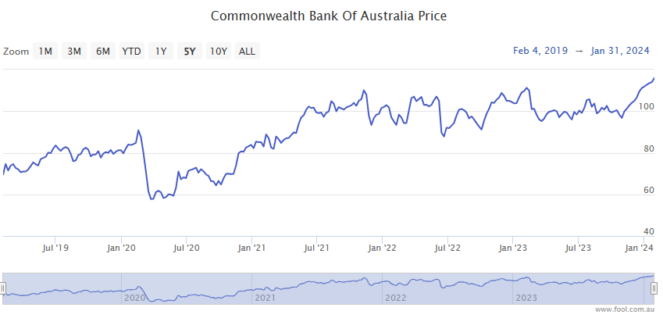
    On the share price front, as you can see in the graph below, CBA has managed to deliver a healthy 11% gain over the past full year. Longer term, shares in the big four bank are up 49% over five years.

    The share price outlook is important because I’d want to avoid investing in an ASX 200 dividend stock that’s losing value over time.

    As for the income stream, CBA shares currently pay a trailing dividend yield of 3.6%, fully franked.

    And that yield could well increase in the year ahead.

    According to analysts at Morgan Stanley, CBA looks set to increase its dividend payouts in the year ahead to $4.50 per share.

    That’s up 17% from the $3.85 per share paid out in the year gone by. It’s also the biggest boost in dividend payouts the analysts foresee from any of the big four banks.

    If I were to invest at yesterday’s closing price, that works out to a forecast, fully franked yield of 4.1%.

    Which is why this is the ASX 200 dividend stock I’d be buying at 35 to start earning monthly passive income and build up some savings.

    The post With no savings at 35, I’d buy this ASX 200 dividend stock to start earning monthly passive income appeared first on The Motley Fool Australia.

    Should you invest $1,000 in Commonwealth Bank of Australia right now?

    Before you consider Commonwealth Bank of Australia, you’ll want to hear this.

    Motley Fool Investing expert Scott Phillips just revealed what he believes are the 5 best stocks for investors to buy right now… and Commonwealth Bank of Australia wasn’t one of them.

    The online investing service he’s run for over a decade, Motley Fool Share Advisor, has provided thousands of paying members with stock picks that have doubled, tripled or even more.* And right now, Scott thinks there are 5 stocks that are better buys.

    See The 5 Stocks
    *Returns as of February 1 2023

    (function() {
    function setButtonColorDefaults(param, property, defaultValue) {
    if( !param || !param.includes(‘#’)) {
    var button = document.getElementsByClassName(“pitch-snippet”)[0].getElementsByClassName(“pitch-button”)[0];
    button.style[property] = defaultValue;
    }
    }

    setButtonColorDefaults(“#43B02A”, ‘background’, ‘#5FA85D’);
    setButtonColorDefaults(“#43B02A”, ‘border-color’, ‘#43A24A’);
    setButtonColorDefaults(“#fff”, ‘color’, ‘#fff’);
    })()

    More reading

    Motley Fool contributor Bernd Struben has no position in any of the stocks mentioned. The Motley Fool Australia’s parent company Motley Fool Holdings Inc. has no position in any of the stocks mentioned. The Motley Fool Australia has no position in any of the stocks mentioned. The Motley Fool has a disclosure policy. This article contains general investment advice only (under AFSL 400691). Authorised by Scott Phillips.

    from The Motley Fool Australia https://ift.tt/OsNnquo

  • Are ANZ shares a buy after the bank’s Q1 update?

    A man in a suit smiles at the yellow piggy bank he holds in his hand.

    A man in a suit smiles at the yellow piggy bank he holds in his hand.On Thursday, ANZ Group Holdings Ltd (ASX: ANZ) shares had a relatively flat session after the release of the bank’s first quarter update.

    And while the big four bank had a solid quarter, it appears that broad market weakness overshadowed this.

    What did brokers say about the update?

    Goldman Sachs has been running the rule over the ANZ update and was pleased with what it saw. It notes that the update implies that the banking giant is performing ahead of expectations in FY 2023. It commented:

    ANZ released its Pillar 3 disclosure for the quarter ended 31-Dec-22. Overall the update was slightly stronger that what was implied by prior 1H23 forecasts, driven by better volumes and asset quality remaining strong. 1Q23 CET1 ratio of 12.2% was 12 bp ahead of what was implied by our prior our forecasts.

    This has led to Goldman bumping its earnings forecasts higher for the coming years. It explained:

    We move our FY23E/FY24E/FY25E EPS by +4.5%/+2.5%/+2.4%, driven by i) stronger balance sheet momentum particularly in Australian housing and offshore institutional, ii) improved other operating income, and ii) and lower BDDs, partially offset by iv) higher expenses.

    Should you buy ANZ shares?

    While Goldman sees value in ANZ shares at the current level, it isn’t enough for a buy rating. Its analysts have responded to the update by retaining their neutral rating with an improved price target of $27.23.

    Based on the latest ANZ share price, this implies potential upside of 5% for investors over the next 12 months.

    Though, let’s not forget that ANZ is a big dividend payer. As a result, the total potential return increases by 6.3% to 11.3% if you include the $1.62 per share fully franked dividend the broker is now forecasting in FY 2023.

    Not bad for a neutral rating!

    The post Are ANZ shares a buy after the bank’s Q1 update? appeared first on The Motley Fool Australia.

    Should you invest $1,000 in Australia And New Zealand Banking Group right now?

    Before you consider Australia And New Zealand Banking Group, you’ll want to hear this.

    Motley Fool Investing expert Scott Phillips just revealed what he believes are the 5 best stocks for investors to buy right now… and Australia And New Zealand Banking Group wasn’t one of them.

    The online investing service he’s run for over a decade, Motley Fool Share Advisor, has provided thousands of paying members with stock picks that have doubled, tripled or even more.* And right now, Scott thinks there are 5 stocks that are better buys.

    See The 5 Stocks
    *Returns as of February 1 2023

    (function() {
    function setButtonColorDefaults(param, property, defaultValue) {
    if( !param || !param.includes(‘#’)) {
    var button = document.getElementsByClassName(“pitch-snippet”)[0].getElementsByClassName(“pitch-button”)[0];
    button.style[property] = defaultValue;
    }
    }

    setButtonColorDefaults(“#43B02A”, ‘background’, ‘#5FA85D’);
    setButtonColorDefaults(“#43B02A”, ‘border-color’, ‘#43A24A’);
    setButtonColorDefaults(“#fff”, ‘color’, ‘#fff’);
    })()

    More reading

    Motley Fool contributor James Mickleboro has no position in any of the stocks mentioned. The Motley Fool Australia’s parent company Motley Fool Holdings Inc. has no position in any of the stocks mentioned. The Motley Fool Australia has no position in any of the stocks mentioned. The Motley Fool has a disclosure policy. This article contains general investment advice only (under AFSL 400691). Authorised by Scott Phillips.

    from The Motley Fool Australia https://ift.tt/nTRuqmZ

  • Did you buy $1,000 of IGO shares 10 years ago? If so, here’s how much dividend income you’ve earned

    A mature aged man with grey hair and glasses holds a fan of Australian hundred dollar bills up against his mouth and looks skywards with his eyes as though he is thinking what he might do with the cash.A mature aged man with grey hair and glasses holds a fan of Australian hundred dollar bills up against his mouth and looks skywards with his eyes as though he is thinking what he might do with the cash.

    The IGO Ltd (ASX: IGO) share price has had a ripper decade, surging 208% since February 2013. But how much has the mining giant returned if we also factor in its dividends?

    If one were to have bought $1,000 of IGO shares 10 years ago, they probably would have ended up with 210 shares, paying $4.75 apiece.

    The value of that parcel has exploded over the years. The IGO share price currently trades at $14.64, leaving a 210-strong-parcel with a value of $3,074.40.

    For comparison, the S&P/ASX 200 Index (ASX: XJO) has risen around 51% in that time.

    But how much have those invested in the ASX 200 mining share received in dividends? Let’s take a look.

    All the dividends offered by IGO shares since 2013

    Here are all the dividends offered by IGO since early 2013:

    IGO dividends’ pay date Type Dividend amount
    September 2022 Final 5 cents
    March 2022 Interim 5 cents
    September 2021 Final 10 cents
    September 2020 Final 5 cents
    February 2020 Interim 6 cents
    September 2019 Final 8 cents
    March 2019 Interim 2 cents
    September 2018 Final 2 cents
    March 2018 Interim 1 cent
    September 2017 Final 1 cent
    March 2017 Interim 1 cent
    September 2016 Final 2 cents
    October 2015 Final 2.5 cents
    March 2015 Interim 6 cents
    September 2014 Final 5 cents
    March 2014 Interim 3 cents
    September 2013 Final 1 cent
    March 2013 Interim 1 cent
    Total:   66.5 cents

    As the chart above shows, those invested in IGO stock have likely received 66.5 cents of passive income per share they’ve held over the decade just been.

    That means our figurative $1,000 investment has probably yielded $129.15 of dividend income – a minuscule amount compared to the capital gains on the table in that time.

    Though, it is enough to boost our imaginary investor’s total return on investment (ROI) to around 221%, before considering any tax benefits potentially brought about by franking credits.

    Still, it’s likely little surprise that IGO shares aren’t typically heralded for their dividends. The stock currently offers a mere 0.68% dividend yield.

    The post Did you buy $1,000 of IGO shares 10 years ago? If so, here’s how much dividend income you’ve earned appeared first on The Motley Fool Australia.

    Should you invest $1,000 in Igo Ltd right now?

    Before you consider Igo Ltd, you’ll want to hear this.

    Motley Fool Investing expert Scott Phillips just revealed what he believes are the 5 best stocks for investors to buy right now… and Igo Ltd wasn’t one of them.

    The online investing service he’s run for over a decade, Motley Fool Share Advisor, has provided thousands of paying members with stock picks that have doubled, tripled or even more.* And right now, Scott thinks there are 5 stocks that are better buys.

    See The 5 Stocks
    *Returns as of February 1 2023

    (function() {
    function setButtonColorDefaults(param, property, defaultValue) {
    if( !param || !param.includes(‘#’)) {
    var button = document.getElementsByClassName(“pitch-snippet”)[0].getElementsByClassName(“pitch-button”)[0];
    button.style[property] = defaultValue;
    }
    }

    setButtonColorDefaults(“#43B02A”, ‘background’, ‘#5FA85D’);
    setButtonColorDefaults(“#43B02A”, ‘border-color’, ‘#43A24A’);
    setButtonColorDefaults(“#fff”, ‘color’, ‘#fff’);
    })()

    More reading

    Motley Fool contributor Brooke Cooper has no position in any of the stocks mentioned. The Motley Fool Australia’s parent company Motley Fool Holdings Inc. has no position in any of the stocks mentioned. The Motley Fool Australia has no position in any of the stocks mentioned. The Motley Fool has a disclosure policy. This article contains general investment advice only (under AFSL 400691). Authorised by Scott Phillips.

    from The Motley Fool Australia https://ift.tt/QF9zBpO

  • These are the best ASX 200 travel shares to buy right now: broker

    A cute young girl wears a straw hat and has a backpack strapped on her back as she holds a globe in her hand with a cheeky smile on her face.

    A cute young girl wears a straw hat and has a backpack strapped on her back as she holds a globe in her hand with a cheeky smile on her face.

    With the travel market rebounding strongly from the pandemic, many investors may be keen to add some travel and tourism exposure their portfolio.

    If that’s something that you want to do, then it could be worth looking at the ASX 200 travel shares that Morgans believes are the best ones to buy right now. Here’s what it is saying:

    Corporate Travel Management Ltd (ASX: CTD)

    The first ASX 200 travel share to consider is this corporate travel booker.

    Morgans has named it has a key pick in the travel sector and believes it is well-placed for growth in a post-pandemic world. Particularly given recent acquisitions and structural cost savings.

    The broker also sees plenty of value in the Corporate Travel Management share price with its add rating and $25.65 price target. The broker explained:

    Taking a longer term view, CTD remains as a key pick for the travel sector. We see substantial upside in its share price as the company recovers from the COVID affected travel downturn. In fact, CTD should be a materially larger business post COVID given it has made two highly accretive acquisitions during the downturn. The company has also won a lot of new business, implemented structural cost out opportunities and continued to develop its market leading technology offering which means that it will require less staff in the future. CTD is well managed and has a strong balance sheet (no debt).

    Qantas Airways Limited (ASX: QAN)

    Another ASX 200 travel share that could be in the buy zone is Qantas. In fact, the broker has named it as its top pick in the sector with an add rating and $8.50 price target.

    Morgans believes Qantas is well-placed in the current environment and sees a lot of value in its shares at the current level. It commented:

    QAN is now our preferred pick out of our travel stocks under coverage given it has the most near-term earnings momentum. Looking across travel companies globally, airlines are now in the sweet spot given demand is massively exceeding supply. QAN is trading at a material discount compared to pre-COVID multiples, despite having structurally higher earnings, a much stronger balance sheet, a better domestic market position, a higher returning International business and more diversification (stronger Loyalty/Freight earnings).

    The post These are the best ASX 200 travel shares to buy right now: broker appeared first on The Motley Fool Australia.

    Wondering where you should invest $1,000 right now?

    When investing expert Scott Phillips has a stock tip, it can pay to listen. After all, the flagship Motley Fool Share Advisor newsletter he has run for over ten years has provided thousands of paying members with stock picks that have doubled, tripled or even more.*

    Scott just revealed what he believes could be the ‘five best ASX stocks’ for investors to buy right now. These stocks are trading at near dirt-cheap prices and Scott thinks they could be great buys right now…

    See The 5 Stocks
    *Returns as of February 1 2023

    (function() {
    function setButtonColorDefaults(param, property, defaultValue) {
    if( !param || !param.includes(‘#’)) {
    var button = document.getElementsByClassName(“pitch-snippet”)[0].getElementsByClassName(“pitch-button”)[0];
    button.style[property] = defaultValue;
    }
    }

    setButtonColorDefaults(“#43B02A”, ‘background’, ‘#5FA85D’);
    setButtonColorDefaults(“#43B02A”, ‘border-color’, ‘#43A24A’);
    setButtonColorDefaults(“#fff”, ‘color’, ‘#fff’);
    })()

    More reading

    Motley Fool contributor James Mickleboro has no position in any of the stocks mentioned. The Motley Fool Australia’s parent company Motley Fool Holdings Inc. has no position in any of the stocks mentioned. The Motley Fool Australia has recommended Corporate Travel Management. The Motley Fool has a disclosure policy. This article contains general investment advice only (under AFSL 400691). Authorised by Scott Phillips.

    from The Motley Fool Australia https://ift.tt/otXZxYS

  • I’m listening to Warren Buffett and buying ASX shares at deep discounts

    A male investor sits at his desk looking at his laptop screen holding his hand to his chin pondering whether to buy Macquarie shares

    A male investor sits at his desk looking at his laptop screen holding his hand to his chin pondering whether to buy Macquarie shares

    Most investors know of the legendary Warren Buffett. Although Buffett is now well into his 90s, the performance of his company Berkshire Hathaway Inc (NYSE: BRK.A)(NYSE: BRK.B) continues to go from strength to strength. As does Buffett’s net worth. At current estimates, this is now sitting at US$107 billion and counting.

    So it goes without saying that this is a person we should all be taking lessons from on how to invest.

    I certainly am. And I’ll be using Buffett’s wisdom to try and buy ASX shares at deep discounts.

    One of Buffett’s fundamental principles of investing is that price and value aren’t the same things. Just because the share market is telling us that Commonwealth Bank of Australia (ASX: CBA) shares are worth roughly $110 today, doesn’t necessarily mean they have a value of $110.

    Let’s take another example that investors might be a little more envious over. Today (at the time of writing), one share of the US e-commerce giant Amazon.com Inc (NASDAQ: AMZN) is worth just over US$100. But back in February 2015, those same shares were worth just US$19. So are both prices ‘fair value’?

    I would argue that the pricing Amazon was commanding back then was extremely undervaluing the business. That’s why investors have enjoyed more than a 400% return in just eight years. That’s a compounded annual return of 23% per annum.

    Back in 2008, Buffett said the following in his annual letter to the shareholders of Berkshire Hathaway. Keep in mind that this was written in the midst of the global financial crisis:

    …the market value of the bonds and stocks that we continue to hold suffered a significant decline along with the general market.

    This does not bother Charlie and me. Indeed, we enjoy such price declines if we have funds available to increase our positions. Long ago, Ben Graham taught me that “Price is what you pay; value is what you get.” Whether we’re talking about socks or stocks, I like buying quality merchandise when it is marked down.

    Now, recessions and a stock market crash like we saw in 2008 don’t come along very often. But that doesn’t mean we can’t still employ this timeless wisdom today.

    How to buy ASX shares like Buffett

    Although the ASX share market has had a very positive start to the year, I still think there are many ASX 200 shares out there that are being priced well below what they are truly worth.

    Take the JB Hi-Fi Ltd (ASX: JBH) share price. It’s currently trading on a price-to-earnings (P/E) ratio of just 10. That gives the company a fully franked dividend yield of over 6.7%.

    Contrast that with CBA shares. CBA is presently boasting a P/E ratio of 20.45, with a dividend yield of just under 3.5%.

    Compared to CBA and the broader market, JB Hi-Fi looks like “merchandise that has been marked down” to me. Buffett has shown this method of value investing can reward investors handsomely. That’s why I’m still looking for ASX shares trading at deep discounts right now.

    The post I’m listening to Warren Buffett and buying ASX shares at deep discounts appeared first on The Motley Fool Australia.

    Are you ready for the shift from growth to value?

    Trends are showing growth stocks interest is declining. See why people are turning to value stocks and why Motley Fool has just released four value plays that could be great buying opportunities right now.

    Here’s how to get the full story…

    Learn more about our Value Stocks report
    *Returns as of February 1 2023

    (function() {
    function setButtonColorDefaults(param, property, defaultValue) {
    if( !param || !param.includes(‘#’)) {
    var button = document.getElementsByClassName(“pitch-snippet”)[0].getElementsByClassName(“pitch-button”)[0];
    button.style[property] = defaultValue;
    }
    }

    setButtonColorDefaults(“#0095C8”, ‘background’, ‘#5FA85D’);
    setButtonColorDefaults(“#0095C8”, ‘border-color’, ‘#43A24A’);
    setButtonColorDefaults(“#fff”, ‘color’, ‘#fff’);
    })()

    More reading

    John Mackey, former CEO of Whole Foods Market, an Amazon subsidiary, is a member of The Motley Fool’s board of directors. Motley Fool contributor Sebastian Bowen has positions in Amazon.com and Berkshire Hathaway. The Motley Fool Australia’s parent company Motley Fool Holdings Inc. has positions in and has recommended Amazon.com and Berkshire Hathaway. The Motley Fool Australia has recommended Amazon.com, Berkshire Hathaway, and Jb Hi-Fi. The Motley Fool has a disclosure policy. This article contains general investment advice only (under AFSL 400691). Authorised by Scott Phillips.

    from The Motley Fool Australia https://ift.tt/V9oBlKm

  • Cheap ASX shares: Is Zip worth the risk?

    A woman wearing glasses has an uncertain look on her face as she bites her lip, she's just read some news on her phone.A woman wearing glasses has an uncertain look on her face as she bites her lip, she's just read some news on her phone.

    There’s not much you can buy for 61.5 cents these days. Though, that amount of pocket change could see you owning a share of buy now, pay later (BNPL) company Zip Co Ltd (ASX: ZIP).

    Shares in the one-time market darling and former S&P/ASX 200 Index (ASX: XJO) constituent are currently trading for 96% less than their all-time high of $14.53 each, clocked in 2021.

    So, what went wrong for the BNPL stock, and could things improve from here? Let’s take a look.

    What sent the Zip share price spiralling?

    It’s been a rough few years for the ASX BNPL staple. Soaring inflation, resulting interest rate hikes, and concerns about bad debts all took their toll over the course of 2021 and 2022.

    Higher interest rates also saw the emergence of a noticeable distaste for unprofitable tech outfits. While Zip technically isn’t a tech share, it tends to trade in line with the broader tech sector.

    And, boy, did the tech sector suffer last year. The S&P/ASX All Technology Index (ASX: XTX) plummeted 33% in 2022. Meanwhile, the Zip share price tumbled a whopping 88%.

    But could the worst be behind it? Let’s take a look.

    Are things getting looking up?

    The Zip share price has bounced back from a low of 43.5 cents in recent months, and I think it has the potential to continue rising.

    Management is touting its growth strategy and profitability aspirations. And such aspirations appear to be showing up in its earnings.

    The company’s revenue lifted 12% year-on-year last quarter, coming in at $188 million, while it posted a record $2.7 billion in transactions. Its bottom line was also helped by a reduction in cash burn, brought about by the simplification of its business.

    Meanwhile, Zip announced its United States leg achieved cash earnings before interest, tax, depreciation, and amortisation (EBITDA) profitability.

    Not to mention, it may well be fully funded through to cash EBITDA profitability.

    That’s particularly good news as potential capital raising activities could dilute shareholders’ ownership – thereby likely draining the value of their investment.

    Of course, all that points to a potential rebound in the Zip share price.

    Are Zip shares worth the risk?

    However, I doubt the current economic environment will allow it to return to its previous heights. Particularly as struggling ASX BNPL players may have put a spotlight on the sector.  

    Openpay Group Ltd (ASX: OPY) entered receivership earlier this week while Laybuy Group Holdings Limited (ASX: LBY) is also attempting to abandon the ASX, saying — among other things — that the market appears to have failed to appropriately value its business.

    Not to mention, the factors seemingly dragging it down in recent years haven’t abated yet.

    For these reasons, I personally won’t be taking the risk on the Zip share price for the time being. Though, I expect the future could be brighter for the stock.

    The post Cheap ASX shares: Is Zip worth the risk? appeared first on The Motley Fool Australia.

    Should you invest $1,000 in Zip Co right now?

    Before you consider Zip Co, you’ll want to hear this.

    Motley Fool Investing expert Scott Phillips just revealed what he believes are the 5 best stocks for investors to buy right now… and Zip Co wasn’t one of them.

    The online investing service he’s run for over a decade, Motley Fool Share Advisor, has provided thousands of paying members with stock picks that have doubled, tripled or even more.* And right now, Scott thinks there are 5 stocks that are better buys.

    See The 5 Stocks
    *Returns as of February 1 2023

    (function() {
    function setButtonColorDefaults(param, property, defaultValue) {
    if( !param || !param.includes(‘#’)) {
    var button = document.getElementsByClassName(“pitch-snippet”)[0].getElementsByClassName(“pitch-button”)[0];
    button.style[property] = defaultValue;
    }
    }

    setButtonColorDefaults(“#43B02A”, ‘background’, ‘#5FA85D’);
    setButtonColorDefaults(“#43B02A”, ‘border-color’, ‘#43A24A’);
    setButtonColorDefaults(“#fff”, ‘color’, ‘#fff’);
    })()

    More reading

    Motley Fool contributor Brooke Cooper has no position in any of the stocks mentioned. The Motley Fool Australia’s parent company Motley Fool Holdings Inc. has positions in and has recommended Zip Co. The Motley Fool Australia has no position in any of the stocks mentioned. The Motley Fool has a disclosure policy. This article contains general investment advice only (under AFSL 400691). Authorised by Scott Phillips.

    from The Motley Fool Australia https://ift.tt/243KxTD

  • 2 ‘high quality’ ASX 200 shares to navigate a turbulent 2023: expert

    A businessman on a rowing boat in rough seas, indicating rocky share price movements on the ASX and better options offshoreA businessman on a rowing boat in rough seas, indicating rocky share price movements on the ASX and better options offshore

    Sure, 2022 was pretty rough. But it won’t be much easier in 2023 for ASX investors.

    That’s according to Datt Capital portfolio manager Emanuel Datt, who said that punters will be “muddling through” this year trying to keep their portfolios in the green.

    There are just a lot of mines to step around.

    “We expect lower than forecast GDP growth for Australia, continuing inflation, high energy prices and moves to increase taxation,” he said.

    “It’s an environment that will test investors.”

    Inflation fight is far from over

    The Reserve Bank of Australia, which was arguably late in fighting rampant inflation, hasn’t inspired much confidence either.

    “Investors can expect continuing price inflation going forward, given the inability of the RBA to set the requisite cadence in terms of normalising interest rates to quell inflationary pressures.”

    Datt added that “unemployment and underemployment rates remain extremely low by historical standards”, which would drive up wages.

    “Labour cost inflation has the potential to influence other major components of CPI, making the present, higher than usual, inflation environment likely to persist.”

    Datt predicts that commodity prices will head up, which might be great for ASX-listed resources companies, but will further fuel inflation going into 2024.

    The fund manager is also worried about a bigger government.

    “We also believe higher taxation and increased government intervention are also on the cards,” Datt said.

    “As a result, it’s likely that independent self-funded retirees who sit outside the government pension system could have their benefits slashed via further changes to dividend imputation and superannuation laws, given the treasurer has recently expressed views on traditional capitalism.”

    Energy crisis far from over

    The energy crisis is set to continue well into 2023, reckons Datt.

    “Energy prices are likely to remain escalated as energy commodities remain in short supply relative to 12 months ago,” he said.

    “Despite the tighter supply side, governments continue to ignore the very real risks that lie ahead in terms of energy security.”

    According to Datt, governments are enacting rules that are making the energy situation worse. For example, raising royalty rates that discourage new projects, stringent reservation policies, and slow approvals for new mines.

    That’s why Datt’s two top stock picks for 2023 are coal miners Whitehaven Coal Ltd (ASX: WHC) and New Hope Corporation Limited (ASX: NHC).

    Those who have held these stocks have done pretty well already. The Whitehaven share price has rocketed 170% upwards over the past 12 months while New Hope is 129.5% higher.

    “Both are exposed to high-quality export thermal coal markets and long-life assets, whilst being conservatively valued and heavily cash generative,” he said.

    “Both are expected to continue to return capital to shareholders via dividends and share buybacks going forward.”

    The two miners each pay out very tempting dividends. Whitehaven is currently at 6% yield while New Hope is a whopping 8.2%.

    The post 2 ‘high quality’ ASX 200 shares to navigate a turbulent 2023: expert appeared first on The Motley Fool Australia.

    Wondering where you should invest $1,000 right now?

    When investing expert Scott Phillips has a stock tip, it can pay to listen. After all, the flagship Motley Fool Share Advisor newsletter he has run for over ten years has provided thousands of paying members with stock picks that have doubled, tripled or even more.*

    Scott just revealed what he believes could be the ‘five best ASX stocks’ for investors to buy right now. These stocks are trading at near dirt-cheap prices and Scott thinks they could be great buys right now…

    See The 5 Stocks
    *Returns as of February 1 2023

    (function() {
    function setButtonColorDefaults(param, property, defaultValue) {
    if( !param || !param.includes(‘#’)) {
    var button = document.getElementsByClassName(“pitch-snippet”)[0].getElementsByClassName(“pitch-button”)[0];
    button.style[property] = defaultValue;
    }
    }

    setButtonColorDefaults(“#0095C8”, ‘background’, ‘#5FA85D’);
    setButtonColorDefaults(“#0095C8”, ‘border-color’, ‘#43A24A’);
    setButtonColorDefaults(“#fff”, ‘color’, ‘#fff’);
    })()

    More reading

    Motley Fool contributor Tony Yoo has no position in any of the stocks mentioned. The Motley Fool Australia’s parent company Motley Fool Holdings Inc. has no position in any of the stocks mentioned. The Motley Fool Australia has no position in any of the stocks mentioned. The Motley Fool has a disclosure policy. This article contains general investment advice only (under AFSL 400691). Authorised by Scott Phillips.

    from The Motley Fool Australia https://ift.tt/xbz7EiL

  • 4 top ASX 200 shares to pounce on for reporting season: Wilsons

    A black cat waiting to pounce on a mouse.A black cat waiting to pounce on a mouse.

    The ASX February reporting season has started in earnest, and it’s a critical one.

    With consumers and businesses starting to reel from nine months of interest rate rises, all eyes will be on whether ASX companies can survive the downturn in one piece.

    The team at Wilsons is upbeat.

    “We believe the reporting season will be relatively positive,” equity strategist Rob Crookston said in a memo to clients.

    “The cyclical sectors may provide more positive results than the market expects after continued strength in the global and domestic economies in the last half.”

    However, investors will need to be selective about the ASX shares they buy, with every word of outlook statements pored over.

    Fortunately, Crookston’s team has done the hard yards to come up with four stocks that they believe have the best prospects heading into their February updates:

    Advertising businesses could surprise 

    Late on Wednesday, Nine Entertainment Co Holdings Ltd (ASX: NEC) announced it had grabbed the Olympics off incumbent Seven West Media Ltd (ASX: SWM).

    The $315 million agreement gives Nine the broadcast and digital rights for the next five games, consisting of three summer and two winter events.

    Nine, due to report on 23 February, is one of Wilsons’ picks.

    “We may see upgrades in the sector over reporting season as higher-than-expected consumer spend corresponds to higher-than-expected ad spend,” said Crookston.

    “Nine should be a key beneficiary of this opportunity, especially as the stock derated over 2022 and currently sits on a relatively modest PE of ~11x.”

    Jobs classified site Seek Ltd (ASX: SEK) has stunningly rallied 23.5% year-to-date, but Crookston reckons “there is still room” for its 21 February to positively surprise.

    “We expect a strong showing from Seek as it benefits from a resilient jobs market.”

    The Wilsons team is looking for a confirmation of its previously stated full-year guidance and “continued strength in the ANZ labour market”. 

    “A strong interim result could lead to consensus earnings upgrades for FY23/FY24,” said Crookston.

    “We also like the structural story for Seek — significant upside from dynamic pricing model, strategic initiatives and growth fund — that should mitigate any fallout in a cyclical peak in the job market.”

    ‘Start of an earnings upgrade cycle’

    After years of underperformance, the share price for biotech giant CSL Limited (ASX: CSL) is finally starting to approach its pre-COVID highs.

    The post-pandemic era could not come fast enough for healthcare stocks, according to Crookston.

    “We expect CSL’s earnings recovery to be a beat, driven by better-than-expected plasma collections,” he said.

    “This, coupled with new product approvals, could lead to a possible guidance upgrade.”

    The signs point to a potential “start of an earnings upgrade cycle for CSL”, he added, revealing that his team is overweight on the stock.

    CSL will report Tuesday.

    The Qantas Airways Limited (ASX: QAN) share price is up 50% since June, but Wilsons reckons the party will continue into its 23 February results announcement. 

    “Qantas is set for a bumper earnings season. After being forced to postpone travel plans due to the pandemic, consumers are shrugging off 15-year high ticket prices,” said Crookston.

    “The business has the capacity to surprise the market positively, and we do not think the valuation is pricing a further upgrade.”

    Wilsons analysts suspect China’s post-COVID reopening could give the airline another tailwind to take off on.

    “We think the market underestimates the recovery in Chinese tourists as it did for domestic travel over the last 12 months. This could be discussed in trading updates of travel or international education stocks.”

    The post 4 top ASX 200 shares to pounce on for reporting season: Wilsons appeared first on The Motley Fool Australia.

    Wondering where you should invest $1,000 right now?

    When investing expert Scott Phillips has a stock tip, it can pay to listen. After all, the flagship Motley Fool Share Advisor newsletter he has run for over ten years has provided thousands of paying members with stock picks that have doubled, tripled or even more.*

    Scott just revealed what he believes could be the ‘five best ASX stocks’ for investors to buy right now. These stocks are trading at near dirt-cheap prices and Scott thinks they could be great buys right now…

    See The 5 Stocks
    *Returns as of February 1 2023

    (function() {
    function setButtonColorDefaults(param, property, defaultValue) {
    if( !param || !param.includes(‘#’)) {
    var button = document.getElementsByClassName(“pitch-snippet”)[0].getElementsByClassName(“pitch-button”)[0];
    button.style[property] = defaultValue;
    }
    }

    setButtonColorDefaults(“#43B02A”, ‘background’, ‘#5FA85D’);
    setButtonColorDefaults(“#43B02A”, ‘border-color’, ‘#43A24A’);
    setButtonColorDefaults(“#fff”, ‘color’, ‘#fff’);
    })()

    More reading

    Motley Fool contributor Tony Yoo has positions in CSL and Seek. The Motley Fool Australia’s parent company Motley Fool Holdings Inc. has positions in and has recommended CSL. The Motley Fool Australia has recommended Nine Entertainment and Seek. The Motley Fool has a disclosure policy. This article contains general investment advice only (under AFSL 400691). Authorised by Scott Phillips.

    from The Motley Fool Australia https://ift.tt/uaA6E9k