• Up 18% today. Is it too late to buy Deep Yellow shares?

    A young male ASX investor raises his clenched fists in excitement because of rising ASX share prices today

    A young male ASX investor raises his clenched fists in excitement because of rising ASX share prices today

    Deep Yellow Limited (ASX: DYL) shares are catching the eye on Friday.

    At the time of writing, the uranium developer’s shares are up 18% to $1.76.

    This latest gain means that its shares are at a 52-week high and up almost 120% over the last 12 months.

    What’s going on with Deep Yellow shares?

    Investors have been buying Deep Yellow and other ASX uranium shares today amid concerns over the supply of the chemical element.

    This follows news that the world’s largest producer of uranium, Kazatomprom, has warned that its 2025 production plans are likely to be impacted by construction delays and sulphuric acid shortages. The latter is used for extracting the uranium. It said:

    If the limited access to sulphuric acid continues throughout the current year and the Company does not succeed in reducing the delay in the construction schedule at the newly developed deposits in 2024, this could unfavourably influence Kazatomprom’s production plans for 2025.

    Given how demand is already tipped to outstrip supply, this has many believing that uranium prices are going to remain at sky high levels for some time to come.

    This will be good news for Deep Yellow and other uranium players.

    Is it too late to invest?

    Bell Potter is a fan of the company and currently has a buy rating on its shares.

    However, its price target of $1.81 is only a fraction ahead of where Deep Yellow shares trade today.

    Though, it is worth noting that this recommendation was made before today’s Kazatomprom news. So, it is possible that Bell Potter could boost its valuation in the coming days to reflect the development.

    Stay tuned for that.

    The post Up 18% today. Is it too late to buy Deep Yellow shares? appeared first on The Motley Fool Australia.

    Wondering where you should invest $1,000 right now?

    When investing expert Scott Phillips has a stock tip, it can pay to listen. After all, the flagship Motley Fool Share Advisor newsletter he has run for over ten years has provided thousands of paying members with stock picks that have doubled, tripled or even more.*

    Scott just revealed what he believes could be the ‘five best ASX stocks’ for investors to buy right now. These stocks are trading at near dirt-cheap prices and Scott thinks they could be great buys right now…

    See The 5 Stocks
    *Returns as of 10 November 2023

    (function() {
    function setButtonColorDefaults(param, property, defaultValue) {
    if( !param || !param.includes(‘#’)) {
    var button = document.getElementsByClassName(“pitch-snippet”)[0].getElementsByClassName(“pitch-button”)[0];
    button.style[property] = defaultValue;
    }
    }

    setButtonColorDefaults(“#0095C8”, ‘background’, ‘#5FA85D’);
    setButtonColorDefaults(“#0095C8”, ‘border-color’, ‘#43A24A’);
    setButtonColorDefaults(“#fff”, ‘color’, ‘#fff’);
    })()

    More reading

    Motley Fool contributor James Mickleboro has no position in any of the stocks mentioned. The Motley Fool Australia’s parent company Motley Fool Holdings Inc. has no position in any of the stocks mentioned. The Motley Fool Australia has no position in any of the stocks mentioned. The Motley Fool has a disclosure policy. This article contains general investment advice only (under AFSL 400691). Authorised by Scott Phillips.

    from The Motley Fool Australia https://ift.tt/dRm1aks

  • Pinnacle share price leaps 9% as funds swell above $100 billion

    Man pointing at a blue rising share price graph.Man pointing at a blue rising share price graph.

    The Pinnacle Investment Management Group Ltd (ASX: PNI) share price is charging higher today.

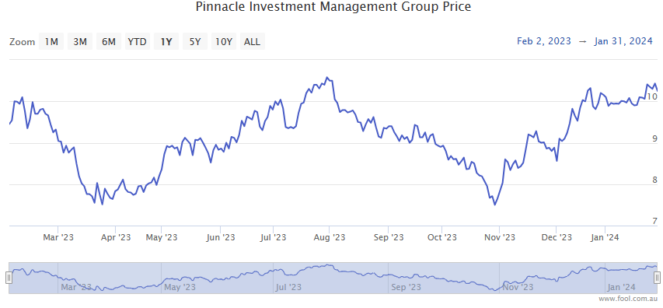
    Shares in the S&P/ASX 200 Index (ASX: XJO) financial services company closed yesterday trading for $9.98. At the time of writing on Friday morning, shares are changing hands for $10.87, up 8.9%

    For some context, the ASX 200 is up 0.8% at this same time.

    The Pinnacle share price is racing ahead of the ASX 200 following the release of the company’s half-year results for the six months ended 31 December (1H FY2024).

    Read on for the highlights.

    What’s piquing ASX 200 investor interest?

    ASX 200 investors are bidding up the Pinnacle share price today after the company reported strong growth in its funds under management (FUM).

    Pinnacle announced that its aggregate affiliates’ FUM increased by 9% ($8.2 billion) over the six months period, reaching $100.1 billion.

    The company’s aggregate retail FUM came in at $25.9 billion. That was up $3.2 billion or 14% from 30 June 2023.

    Also likely helping lift the Pinnacle share price today was the $4.5 billion in reported net inflows for the half year. That’s a big improvement from the $1.5 billion in net outflows in 1H FY 2023.

    In other key metrics, the ASX 200 financial stock reported net profit after tax (NPAT) of $30.2 million, down 1% from the $30.5 million in 1H FY 2023.

    And passive income investors should be pleased with the fully franked interim dividend of 15.6 cents per share. That’s in line with the interim dividend paid out for 1H FY 2023.

    The company also highlighted the ongoing medium-term outperformance of its affiliates, noting that 81% of five-year affiliate strategies have outperformed their respective benchmarks. Management said this “consistent alpha generation underpins the ongoing performance fee contributions” from its affiliates.

    As at 31 December, Pinnacle had net cash and principal investments of $51.1 million.

    Pinnacle share price snapshot

    With today’s big lift factored in, the Pinnacle share price is up 16% over the past 12 months. And that’s not including the two fully franked dividend payments.

    The post Pinnacle share price leaps 9% as funds swell above $100 billion appeared first on The Motley Fool Australia.

    Wondering where you should invest $1,000 right now?

    When investing expert Scott Phillips has a stock tip, it can pay to listen. After all, the flagship Motley Fool Share Advisor newsletter he has run for over ten years has provided thousands of paying members with stock picks that have doubled, tripled or even more.*

    Scott just revealed what he believes could be the ‘five best ASX stocks’ for investors to buy right now. These stocks are trading at near dirt-cheap prices and Scott thinks they could be great buys right now…

    See The 5 Stocks
    *Returns as of 10 November 2023

    (function() {
    function setButtonColorDefaults(param, property, defaultValue) {
    if( !param || !param.includes(‘#’)) {
    var button = document.getElementsByClassName(“pitch-snippet”)[0].getElementsByClassName(“pitch-button”)[0];
    button.style[property] = defaultValue;
    }
    }

    setButtonColorDefaults(“#0095C8”, ‘background’, ‘#5FA85D’);
    setButtonColorDefaults(“#0095C8”, ‘border-color’, ‘#43A24A’);
    setButtonColorDefaults(“#fff”, ‘color’, ‘#fff’);
    })()

    More reading

    Motley Fool contributor Bernd Struben has no position in any of the stocks mentioned. The Motley Fool Australia’s parent company Motley Fool Holdings Inc. has positions in and has recommended Pinnacle Investment Management Group. The Motley Fool Australia has positions in and has recommended Pinnacle Investment Management Group. The Motley Fool has a disclosure policy. This article contains general investment advice only (under AFSL 400691). Authorised by Scott Phillips.

    from The Motley Fool Australia https://ift.tt/WpOiVjQ

  • Brokers name 3 ASX shares to buy now

    ASX shares Business man marking buy on board and underlining it

    ASX shares Business man marking buy on board and underlining it

    It has been another busy week for Australia’s top brokers. This has led to the release of a number of broker notes.

    Three broker buy ratings that you might want to know more about are summarised below. Here’s why brokers think these ASX shares are in the buy zone:

    Champion Iron Ltd (ASX: CIA)

    According to a note out of Goldman Sachs, its analysts have retained their buy rating on this iron ore miner’s shares with an improved price target of $9.40. This follows the release of a strong quarterly update with record production and earnings and cash flow comfortably ahead of expectations. The Champion Iron share price is trading at $8.51.

    CSL Limited (ASX: CSL)

    A note out of Citi reveals that its analysts have retained their buy rating and $325.00 price target on this biotechnology company’s shares. Citi highlights that a number of the company’s rivals have released positive updates that support its bullish view. This includes strong overall demand for immunoglobulins and potential market share gains for CSL. The CSL share price is fetching $299.83 on Friday.

    Capricorn Metals Ltd (ASX: CMM)

    Analysts at Bell Potter have retained their buy rating on this gold miner’s shares with an improved price target of $5.95. This follows the release of a quarterly update from the Karlawinda Gold Project which revealed a slight production beat and costs that were effectively in line with forecasts. Outside this, the broker highlights that Capricorn is a sector leading gold producer with a strong balance sheet and a management team with an excellent track record of delivery. The Capricorn share price is trading at $4.65 this morning.

    The post Brokers name 3 ASX shares to buy now appeared first on The Motley Fool Australia.

    Wondering where you should invest $1,000 right now?

    When investing expert Scott Phillips has a stock tip, it can pay to listen. After all, the flagship Motley Fool Share Advisor newsletter he has run for over ten years has provided thousands of paying members with stock picks that have doubled, tripled or even more.*

    Scott just revealed what he believes could be the ‘five best ASX stocks’ for investors to buy right now. These stocks are trading at near dirt-cheap prices and Scott thinks they could be great buys right now…

    See The 5 Stocks
    *Returns as of 10 November 2023

    (function() {
    function setButtonColorDefaults(param, property, defaultValue) {
    if( !param || !param.includes(‘#’)) {
    var button = document.getElementsByClassName(“pitch-snippet”)[0].getElementsByClassName(“pitch-button”)[0];
    button.style[property] = defaultValue;
    }
    }

    setButtonColorDefaults(“#0095C8”, ‘background’, ‘#5FA85D’);
    setButtonColorDefaults(“#0095C8”, ‘border-color’, ‘#43A24A’);
    setButtonColorDefaults(“#fff”, ‘color’, ‘#fff’);
    })()

    More reading

    Citigroup is an advertising partner of The Ascent, a Motley Fool company. Motley Fool contributor James Mickleboro has positions in CSL. The Motley Fool Australia’s parent company Motley Fool Holdings Inc. has positions in and has recommended CSL and Goldman Sachs Group. The Motley Fool Australia has recommended CSL. The Motley Fool has a disclosure policy. This article contains general investment advice only (under AFSL 400691). Authorised by Scott Phillips.

    from The Motley Fool Australia https://ift.tt/0kMXBrD

  • 1 ASX dividend stock down 65% to buy right now

    A woman sets flowers on a side table in a beautifully furnished bedroom.A woman sets flowers on a side table in a beautifully furnished bedroom.

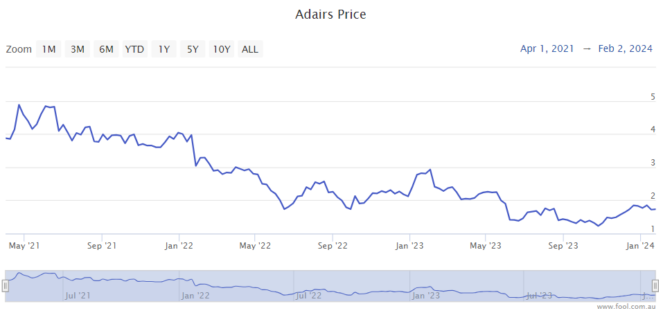
    The Adairs Ltd (ASX: ADH) share price is down over 40% in the past year and it has sunk 65% from its peak in April 2021. This could be the right time to invest in the ASX dividend stock with a possible large payout and the prospect of potential capital gains.

    Adairs operates three different businesses – Adairs, Mocka and Focus on Furniture.

    Many ASX retail shares have quite cyclical earnings because of the way the economy can go through strength and weakness. Sometimes households don’t have as much money to spend and that is materially hurting demand and sales.

    The ASX dividend stock hasn’t exactly seen its sales sink, but a decline can lead to a huge loss of investor confidence.

    Weak FY24 expected

    At the company’s AGM, it said group sales in the first 21 weeks of FY24 were down 9%. It said the impact of higher interest rates and the cost of living pressures has seen a “significant” decline in traffic across each business of around 10%.

    It also said the outlook for the rest of FY24 is expected to remain “challenging” because of the economic headwinds and the business is being managed accordingly.

    With this in mind, it’s understandable that the Adairs share price has fallen. But, investing should be a long-term endeavour and what happens in one year won’t decide its long-term performance. It could be a good contrarian opportunity now with a possible economic rebound not too far away.

    The current estimate on Commsec is that the ASX dividend stock may generate earnings per share (EPS) of 16.2 cents.

    The potential recovery

    I’m not banking on interest rate cuts starting this year, nor do I think they’re going to go down to 2% in rapid succession. But, I do think the impending start of cuts could spur an earnings recovery and perhaps excite investors about the Adairs share price.

    On Commsec, the forecast suggests Adairs’ EPS could rise 36% in FY25 and then go up another 25% to 27.5 cents per share in FY26. That would put the company at 7.5x FY25’s estimated earnings and 6x FY26’s estimated earnings.

    No-one should focus too much on the specific forecast numbers for the ASX dividend stock, the actual numbers could be better or worse than the predictions.

    But, I’d point out that, generally, central banks won’t want to be restrictive forever and recent wage inflation may help household spending in the future when finances aren’t as tight.

    I think FY19 was a good example of weakness and then subsequent recovery for its performance, though history won’t necessarily repeat itself.

    When the company emerges from this period, it could be much more profitable than before.

    Adairs is working on a number of initiatives to grow profit such as opening larger stores that are more profitable and it can showcase more of its products. It’s also planning to keep opening new stores, with plans for a national rollout of Focus on Furniture stores. There’s also the possibility that Adairs’ (paying) membership numbers and online sales could keep growing over time.

    Costs have increased during this inflationary period, but Adairs has recently taken control (from DHL) of its national distribution centre which could make a material difference in the medium-term to margins and operational efficiency.

    ASX dividend stock forecast payouts

    In FY24, the Adairs dividend may only be 4.3 cents per share (according to Commsec) amid these difficult economic circumstances. It’s possible it may not even pay a dividend.

    But, in FY25 Adairs is forecast to pay an annual dividend per share of 14.5 cents if earnings rebound as predicted. That would be a grossed-up dividend yield of 12.5%.

    FY26 could see the business pay an annual dividend per share of 19.4 cents, which would be a grossed-up dividend yield of 16.8%.

    The short-term outlook is weak, but that’s why we’re being presented with a more attractive Adairs share price today, which could mean big dividend yields in the future.

    The post 1 ASX dividend stock down 65% to buy right now appeared first on The Motley Fool Australia.

    Wondering where you should invest $1,000 right now?

    When investing expert Scott Phillips has a stock tip, it can pay to listen. After all, the flagship Motley Fool Share Advisor newsletter he has run for over ten years has provided thousands of paying members with stock picks that have doubled, tripled or even more.*

    Scott just revealed what he believes could be the ‘five best ASX stocks’ for investors to buy right now. These stocks are trading at near dirt-cheap prices and Scott thinks they could be great buys right now…

    See The 5 Stocks
    *Returns as of 10 November 2023

    (function() {
    function setButtonColorDefaults(param, property, defaultValue) {
    if( !param || !param.includes(‘#’)) {
    var button = document.getElementsByClassName(“pitch-snippet”)[0].getElementsByClassName(“pitch-button”)[0];
    button.style[property] = defaultValue;
    }
    }

    setButtonColorDefaults(“#0095C8”, ‘background’, ‘#5FA85D’);
    setButtonColorDefaults(“#0095C8”, ‘border-color’, ‘#43A24A’);
    setButtonColorDefaults(“#fff”, ‘color’, ‘#fff’);
    })()

    More reading

    Motley Fool contributor Tristan Harrison has no position in any of the stocks mentioned. The Motley Fool Australia’s parent company Motley Fool Holdings Inc. has positions in and has recommended Adairs. The Motley Fool Australia has positions in and has recommended Adairs. The Motley Fool has a disclosure policy. This article contains general investment advice only (under AFSL 400691). Authorised by Scott Phillips.

    from The Motley Fool Australia https://ift.tt/zEusINq

  • How big will the Flight Centre dividend be in 2024?

    Happy couple looking at a phone and waiting for their flight at an airport.

    Happy couple looking at a phone and waiting for their flight at an airport.

    Flight Centre Travel Group Ltd (ASX: FLT) shares used to be very popular with income investors.

    The travel agent giant would regularly pay big (and growing) dividends to its shareholders each year.

    However, these payouts have not recovered fully yet from the pandemic.

    For example, the Flight Centre dividend that was paid out in FY 2023 was just a modest 18 cents per share.

    This equates to a 0.85% dividend yield at current prices, which is hardly anything to get excited about.

    But will that change for investors in FY 2024? Let’s take a look and see what analysts are predicting from Flight Centre.

    How big will the Flight Centre dividend be in 2024?

    According to a note out of Citi, its analysts expect the Flight Centre dividend to become more attractive this year.

    And while the broker isn’t necessarily expecting a big yield, it will be close to resembling what investors became accustomed before COVID ruined the party for them.

    The note reveals that Citi has pencilled in a fully franked 49 cents per share dividend for the year, which represents a 2.3% yield for investors.

    In addition, the broker sees decent upside for its shares from current levels. It has a buy rating and $23.60 price target on Flight Centre’s shares.

    This implies potential upside of 11% for investors over the next 12 months, which brings the total potential return to beyond 13%.

    And if you’re willing to be patient, Citi thinks you will be rewarded with some bigger dividends in the coming years.

    The broker is expecting an increase to 77 cents per share in FY 2025 and then another increase to 84 cents per share in FY 2026. If this proves accurate, it will mean fully franked yields of 3.6% and 3.9%, respectively.

    The post How big will the Flight Centre dividend be in 2024? appeared first on The Motley Fool Australia.

    Wondering where you should invest $1,000 right now?

    When investing expert Scott Phillips has a stock tip, it can pay to listen. After all, the flagship Motley Fool Share Advisor newsletter he has run for over ten years has provided thousands of paying members with stock picks that have doubled, tripled or even more.*

    Scott just revealed what he believes could be the ‘five best ASX stocks’ for investors to buy right now. These stocks are trading at near dirt-cheap prices and Scott thinks they could be great buys right now…

    See The 5 Stocks
    *Returns as of 10 November 2023

    (function() {
    function setButtonColorDefaults(param, property, defaultValue) {
    if( !param || !param.includes(‘#’)) {
    var button = document.getElementsByClassName(“pitch-snippet”)[0].getElementsByClassName(“pitch-button”)[0];
    button.style[property] = defaultValue;
    }
    }

    setButtonColorDefaults(“#0095C8”, ‘background’, ‘#5FA85D’);
    setButtonColorDefaults(“#0095C8”, ‘border-color’, ‘#43A24A’);
    setButtonColorDefaults(“#fff”, ‘color’, ‘#fff’);
    })()

    More reading

    Citigroup is an advertising partner of The Ascent, a Motley Fool company. Motley Fool contributor James Mickleboro has no position in any of the stocks mentioned. The Motley Fool Australia’s parent company Motley Fool Holdings Inc. has no position in any of the stocks mentioned. The Motley Fool Australia has recommended Flight Centre Travel Group. The Motley Fool has a disclosure policy. This article contains general investment advice only (under AFSL 400691). Authorised by Scott Phillips.

    from The Motley Fool Australia https://ift.tt/2UdjaRw

  • Will Nvidia stock be worth more than Microsoft by 2030?

    This article was originally published on Fool.com. All figures quoted in US dollars unless otherwise stated.

    A woman sits at her computer with her hand to her mouth and a contemplative smile on her face as she reads about the performance of Allkem shares on her computer

    This article was originally published on Fool.com. All figures quoted in US dollars unless otherwise stated.

    Microsoft (NASDAQ: MSFT) is the world’s second-largest company in terms of market capitalization, valued at $3 trillion as of this writing. The stock’s impressive 67% jump in the past year — fueled by its artificial intelligence (AI) prospects — has played a key role in helping the tech giant reach that position.

    However, Nvidia (NASDAQ: NVDA) has witnessed a much bigger jump in its market cap over the same period. It is now the sixth-largest company in the world, valued at $1.5 trillion, up from less than $500 billion a year ago. Microsoft, for comparison, was valued at $1.8 trillion a year ago. The following chart shows the magnitude by which Nvidia’s market cap jump has outpaced Microsoft’s over the past year.

    NVDA Market Cap data by YCharts.

    Just like Microsoft, Nvidia is reaping the benefits of growing AI adoption, though in a much bigger way. The semiconductor giant has been growing much faster than Microsoft, which explains why its stock price growth has outpaced the latter. However, can Nvidia sustain its faster growth and become more valuable than Microsoft by 2030? Let’s find out.

    Microsoft’s AI business has gained impressive traction

    Microsoft is providing AI-enabled software and services to customers. These include generative AI-powered web search through Bing, an AI-enabled web browser in the form of Edge, and an AI companion known as Copilot that aims to boost productivity through numerous tools, such as allowing users to create images from text prompts, draft documents, create presentations, and summarize emails, among other things.

    Additionally, Microsoft is looking to capitalize on the growing demand for cloud-based AI services. The tech giant’s Azure OpenAI service gives its customers access to multiple large language models on a pay-as-you-go model. As a result, Microsoft customers can develop generative AI applications without investing in expensive hardware.

    The good part is that Microsoft’s Azure OpenAI service has already gained solid traction. The company points out that “more than 18,000 organizations now use Azure OpenAI service, including new-to-Azure customers.” This puts the company in a nice position to capitalize on the fast-growing and lucrative AI cloud computing market, which is expected to generate annual revenue of $274 billion in 2029, compared to $67 billion in 2024.

    It is worth noting that Microsoft’s cloud business has started growing at a faster pace than its rivals. The company’s Azure cloud service recorded 29% growth in the third quarter of 2023, outpacing Google Cloud’s jump of 22% and Amazon Web Services’ 12% growth. Microsoft management pointed out that it saw an acceleration of 3 percentage points in Azure revenue thanks to AI. So, it won’t be surprising to see the company gain more share of this fast-growing market.

    In all, the rollout of AI across multiple Microsoft services could help the company generate an additional $100 billion in annual revenue by 2027, according to investment banking firm Evercore. That would be a big boost for Microsoft, given that it has generated $218 billion in revenue in the trailing 12 months. However, investors should note that the company believes its AI-focused business will scale up gradually.

    What’s more, a look at consensus growth estimates suggests that Microsoft’s revenue is anticipated to increase in the mid-teens over the next couple of fiscal years.

    MSFT Revenue Estimates for Current Fiscal Year data by YCharts.

    AI is driving much stronger growth at Nvidia

    While Microsoft is a play on the software side of the AI market, Nvidia sells the hardware on which the services that the former is selling are trained. For instance, OpenAI used an estimated 30,000 graphics cards from Nvidia to train ChatGPT. Market research firm Omdia estimates that Microsoft purchased an estimated 150,000 units of Nvidia’s flagship H100 AI-focused graphics card in 2023.

    Given that each of these graphics processing units (GPUs) is priced at an average of $40,000, Microsoft would have paid Nvidia an estimated $6 billion for these chips last year. Microsoft, however, is not the only customer in line for Nvidia’s AI processors. Other tech giants, such as Meta Platforms, Amazon, Alphabet, Oracle, and Baidu, are also procuring Nvidia’s AI chips to train AI models.

    As it turns out, the demand for Nvidia’s H100 processors is so strong that they reportedly command a waiting period of 36 weeks to a year. That’s not surprising as Nvidia controls an impressive 85% of the market for AI chips, according to investment bank Raymond James. Given that the AI chip market is anticipated to grow at an annual pace of 38% through 2032 and generate annual revenue of roughly $384 billion, Nvidia’s dominant position in this market explains why analysts are upbeat about the company’s long-term growth.

    According to Japanese investment bank Mizuho, Nvidia may even generate annual revenue of $300 billion by selling AI chips in 2027. Even though that estimate seems quite ambitious, it shows just how big of an impact AI will likely have on its business compared to Microsoft, whose AI-focused revenue in 2027 could be a third of Nvidia’s, as per Evercore. This also explains why Nvidia’s earnings are anticipated to grow much faster than Microsoft’s.

    Can Nvidia indeed be worth more than Microsoft?

    According to consensus estimates, Nvidia’s earnings could increase at an annual rate of 102% over the next five years. The company ended fiscal 2023 with earnings of $3.34 per share, meaning its bottom line could jump to $107 per share if it keeps doubling each year for the next five years. Using the Nasdaq-100 index’s forward earnings multiple of 29 as a proxy for tech stocks, Nvidia’s stock price could hit $3,100 in five years. That would be 5x the company’s current stock price.

    Microsoft, on the other hand, is predicted to clock annual earnings growth of 15% for the next five years. Using its fiscal 2023 earnings of $9.81 per share as the base, Microsoft’s bottom line could increase to $19.73 per share after five years. That points toward a stock price of $572, using the Nasdaq-100’s forward earnings multiple, an increase of just 41% from current levels.

    So, Nvidia could become a bigger company than Microsoft before 2030 in terms of market cap, given the much faster growth it may achieve because of its dominant position in the AI chip market. 

    This article was originally published on Fool.com. All figures quoted in US dollars unless otherwise stated.

    The post Will Nvidia stock be worth more than Microsoft by 2030? appeared first on The Motley Fool Australia.

    Wondering where you should invest $1,000 right now?

    When investing expert Scott Phillips has a stock tip, it can pay to listen. After all, the flagship Motley Fool Share Advisor newsletter he has run for over ten years has provided thousands of paying members with stock picks that have doubled, tripled or even more.*

    Scott just revealed what he believes could be the ‘five best ASX stocks’ for investors to buy right now. These stocks are trading at near dirt-cheap prices and Scott thinks they could be great buys right now…

    See The 5 Stocks
    *Returns as of 10 November 2023

    (function() {
    function setButtonColorDefaults(param, property, defaultValue) {
    if( !param || !param.includes(‘#’)) {
    var button = document.getElementsByClassName(“pitch-snippet”)[0].getElementsByClassName(“pitch-button”)[0];
    button.style[property] = defaultValue;
    }
    }

    setButtonColorDefaults(“#0095C8”, ‘background’, ‘#5FA85D’);
    setButtonColorDefaults(“#0095C8”, ‘border-color’, ‘#43A24A’);
    setButtonColorDefaults(“#fff”, ‘color’, ‘#fff’);
    })()

    More reading

    Harsh Chauhan has no position in any of the stocks mentioned. Randi Zuckerberg, a former director of market development and spokeswoman for Facebook and sister to Meta Platforms CEO Mark Zuckerberg, is a member of The Motley Fool’s board of directors. Suzanne Frey, an executive at Alphabet, is a member of The Motley Fool’s board of directors. The Motley Fool Australia’s parent company Motley Fool Holdings Inc. has positions in and has recommended Alphabet, Baidu, Meta Platforms, Microsoft, Nvidia, and Oracle. The Motley Fool Australia has recommended Alphabet, Meta Platforms, and Nvidia. The Motley Fool has a disclosure policy. This article contains general investment advice only (under AFSL 400691). Authorised by Scott Phillips.

    This article was originally published on Fool.com. All figures quoted in US dollars unless otherwise stated.

    from The Motley Fool Australia https://ift.tt/f2RI5x7

  • Meta stock pops 15% after profits triple

    A group of young kids, aged 12-13, sit together side by side on a window ledge with all looking at their mobile phones in their hands with sombre, serious expressions on their faces as if they are engaged in social media.

    A group of young kids, aged 12-13, sit together side by side on a window ledge with all looking at their mobile phones in their hands with sombre, serious expressions on their faces as if they are engaged in social media.

    Meta Platforms Inc (NASDAQ: META) stock has popped in after-hours trade on Wall Street.

    At the time of writing, the Facebook and Instagram owner’s shares are up a massive 15% to US$453.01.

    Investors have been scrambling to buy the tech behemoth’s shares following the release of its quarterly update.

    Meta stock pops on quarterly update

    For the three months ended 31 December, Meta reported a 25% increase in revenue to US$40,111 million. This brought its revenue for 2023 to US$134,902 million, which represents an increase of 16% year on year.

    Key drivers of its fourth quarter growth were an 8% increase in Family Daily Active People (DAP) to 3.19 billion, a 21% jump in ad impressions across its Family of Apps, and a 2% lift in the average price per ad.

    Another positive was that its total costs and expenses reduced 8% during the fourth quarter to US$23.73 billion. This reduced its full year increase in costs to just 1%.

    The sum of the above was earnings per share of US$5.33 for the quarter (up 203%) and US$14.87 for 2023 (up 73%).

    Meta founder and CEO, Mark Zuckerberg, commented:

    We had a good quarter as our community and business continue to grow. We’ve made a lot of progress on our vision for advancing AI and the metaverse.

    First ever dividend

    A big surprise from the result was the announcement of the company’s maiden dividend. Meta has declared a cash dividend of US$0.50 per share, which will be payable on 26 March.

    This won’t be the last dividend, with management stating that it “intend[s] to pay a cash dividend on a quarterly basis going forward, subject to market conditions and approval by our board of directors.”

    How does this compare to expectations?

    As you might have guessed from the way that Meta stock has jumped this morning, this result was ahead of expectations.

    According to CNBC, the market was expecting revenue of US$39.18 billion and earnings per share of US$4.96.

    Whereas Meta delivered revenue of US$40.1 billion and earnings per share of US$5.33. In addition, its daily active users and average revenue per user metrics were also stronger than expected.

    Outlook

    Meta expects first quarter 2024 total revenue to be in the range of US$34.5 billion to US$37 billion.

    This guidance assumes foreign currency is neutral to year-over-year total revenue growth, based on current exchange rates.

    The post Meta stock pops 15% after profits triple appeared first on The Motley Fool Australia.

    Wondering where you should invest $1,000 right now?

    When investing expert Scott Phillips has a stock tip, it can pay to listen. After all, the flagship Motley Fool Share Advisor newsletter he has run for over ten years has provided thousands of paying members with stock picks that have doubled, tripled or even more.*

    Scott just revealed what he believes could be the ‘five best ASX stocks’ for investors to buy right now. These stocks are trading at near dirt-cheap prices and Scott thinks they could be great buys right now…

    See The 5 Stocks
    *Returns as of 10 November 2023

    (function() {
    function setButtonColorDefaults(param, property, defaultValue) {
    if( !param || !param.includes(‘#’)) {
    var button = document.getElementsByClassName(“pitch-snippet”)[0].getElementsByClassName(“pitch-button”)[0];
    button.style[property] = defaultValue;
    }
    }

    setButtonColorDefaults(“#0095C8”, ‘background’, ‘#5FA85D’);
    setButtonColorDefaults(“#0095C8”, ‘border-color’, ‘#43A24A’);
    setButtonColorDefaults(“#fff”, ‘color’, ‘#fff’);
    })()

    More reading

    Randi Zuckerberg, a former director of market development and spokeswoman for Facebook and sister to Meta Platforms CEO Mark Zuckerberg, is a member of The Motley Fool’s board of directors. Motley Fool contributor James Mickleboro has no position in any of the stocks mentioned. The Motley Fool Australia’s parent company Motley Fool Holdings Inc. has positions in and has recommended Meta Platforms. The Motley Fool Australia has recommended Meta Platforms. The Motley Fool has a disclosure policy. This article contains general investment advice only (under AFSL 400691). Authorised by Scott Phillips.

    from The Motley Fool Australia https://ift.tt/SVy9J4C

  • Why Lovisa could become one of the top ASX 200 shares for dividend income

    A young woman's hands are shown close up with many blingy gold rings on her fingers and two large gold chains around her neck with dollar signs on them.A young woman's hands are shown close up with many blingy gold rings on her fingers and two large gold chains around her neck with dollar signs on them.

    The S&P/ASX 200 Index (ASX: XJO) share Lovisa Holdings Ltd (ASX: LOV) could grow to become a leading ASX dividend share in the coming years.

    A low-cost jewellery retailer may not sound like the sort of business that can deliver piles of cash, but I think it’s one that all investors should take note of.

    Dividends have soared

    The past isn’t necessarily going to be repeated again, but I think Lovisa’s dividend trajectory is compelling and suggests ongoing growth could be useful.

    In FY23, Lovisa paid an annual dividend of 69 cents per share, compared to 33 cents per share in FY19, which is an increase of 109%.  

    I wouldn’t expect the ASX 200 share’s dividend to double again by FY27, but it could keep rising strongly if the net profit after tax (NPAT) keeps growing and the dividend payout ratio stays quite generous.

    Payouts expected to keep growing

    On Commsec, Lovisa is estimated to pay an annual dividend per share of 91 cents in FY26, which would be growth of 32% from FY23. Excluding the effect of franking credits, that would translate into a forward dividend yield of 4%, or 5.1% at the same franking rate as the last dividend.

    The broker UBS has forecast the Lovisa dividend could rise to $1.32 per share, which would be a rise of 91% over five years between FY23 to FY28. That means in FY28, the dividend yield could be 5.9%, or 7.5% at the same franking rate.

    Lovisa ended FY19 with 390 stores and in FY23 it finished with 801 stores, an increase of 105%. Perhaps it’s unsurprising that Lovisa has grown its dividend at almost exactly the same pace as its store growth.

    The more stores the ASX 200 share has, the more profit it can make and then the bigger dividends it can pay.

    At the company’s AGM, it said in the first 20 weeks of FY24 that total sales had increased 17% year over year and opened another 35 net new stores.

    To me, one of the most exciting things about Lovisa is that it has only just entered a number of markets including Vietnam, mainland China, Hong Kong, Taiwan, Mexico, Canada, Spain, Italy and Ecuador.

    Australia has a population of around 27 million, while many of the markets I just mentioned have much bigger populations. That doesn’t necessarily mean they’re all going to have the same store-to-population ratio as Australia (which has around 170 stores). I think there’s plenty of scope for Lovisa to double its store count in the next five or six years, which could mean Lovisa is able to double its dividend.

    Lovisa share price valuation

    In the last five years, Lovisa shares have risen to 210%. At the current share price, Lovisa is valued at just 15x FY28’s estimated earnings, according to UBS.

    If the ASX 200 share’s profit can keep growing, I think the Lovisa dividend and (hopefully the Lovisa share price) can keep rising.

    The post Why Lovisa could become one of the top ASX 200 shares for dividend income appeared first on The Motley Fool Australia.

    Wondering where you should invest $1,000 right now?

    When investing expert Scott Phillips has a stock tip, it can pay to listen. After all, the flagship Motley Fool Share Advisor newsletter he has run for over ten years has provided thousands of paying members with stock picks that have doubled, tripled or even more.*

    Scott just revealed what he believes could be the ‘five best ASX stocks’ for investors to buy right now. These stocks are trading at near dirt-cheap prices and Scott thinks they could be great buys right now…

    See The 5 Stocks
    *Returns as of 10 November 2023

    (function() {
    function setButtonColorDefaults(param, property, defaultValue) {
    if( !param || !param.includes(‘#’)) {
    var button = document.getElementsByClassName(“pitch-snippet”)[0].getElementsByClassName(“pitch-button”)[0];
    button.style[property] = defaultValue;
    }
    }

    setButtonColorDefaults(“#0095C8”, ‘background’, ‘#5FA85D’);
    setButtonColorDefaults(“#0095C8”, ‘border-color’, ‘#43A24A’);
    setButtonColorDefaults(“#fff”, ‘color’, ‘#fff’);
    })()

    More reading

    Motley Fool contributor Tristan Harrison has positions in Lovisa. The Motley Fool Australia’s parent company Motley Fool Holdings Inc. has positions in and has recommended Lovisa. The Motley Fool Australia has recommended Lovisa. The Motley Fool has a disclosure policy. This article contains general investment advice only (under AFSL 400691). Authorised by Scott Phillips.

    from The Motley Fool Australia https://ift.tt/3jYpwzD

  • Why Goldman Sachs thinks QBE shares are a top buy

    A man holding a cup of coffee puts his thumb up and smiles while at laptop.

    A man holding a cup of coffee puts his thumb up and smiles while at laptop.QBE Insurance Group Ltd (ASX: QBE) shares could be a top buy right now.

    That’s the view of analysts at Goldman Sachs, which believe the insurance giant’s shares could offer big returns over the next 12 months.

    What is Goldman saying about QBE?

    Goldman has been looking over the quarterly update of industry peer Chubb Ltd (NYSE: CB) and was pleased with what it saw.

    The broker highlights the following from Chubb’s update:

    Ex CATs, the current accident year COR was 79% which improved by 1.8% on pcp – driven by a 2.2% improvement in the loss ratio and a 0.4% increase in the expense ratio – positive read for QBE. […] Chubb comments on rate and strength of loss reserves read positively for QBE. […] Chubb’s confidence in book growth (pricing / volume) as well as margin improvement into FY24 – is a positive read for QBE.

    Buy rating reaffirmed on QBE shares

    According to the note, the broker has reaffirmed its buy rating and $18.52 price target on QBE’s shares.

    Based on the current QBE share price of $16.02, this implies potential upside of 15.6% for investors over the next 12 months.

    In addition, the broker is forecasting a 59 US cents per share dividend in FY 2024. This equates to a very attractive 5.6% dividend yield.

    Goldman commented:

    We are Buy rated on QBE because 1) QBE has the strongest exposure to the commercial rate cycle. 2) QBE’s achieved rate increases continue to be very strong. 3) QBE is also growing volumes: QBE is currently getting strong top line growth on a constant currency basis ex rate increases. 4) North America on a pathway to improved profitability. 5) Valuation not demanding.

    The post Why Goldman Sachs thinks QBE shares are a top buy appeared first on The Motley Fool Australia.

    Wondering where you should invest $1,000 right now?

    When investing expert Scott Phillips has a stock tip, it can pay to listen. After all, the flagship Motley Fool Share Advisor newsletter he has run for over ten years has provided thousands of paying members with stock picks that have doubled, tripled or even more.*

    Scott just revealed what he believes could be the ‘five best ASX stocks’ for investors to buy right now. These stocks are trading at near dirt-cheap prices and Scott thinks they could be great buys right now…

    See The 5 Stocks
    *Returns as of 10 November 2023

    (function() {
    function setButtonColorDefaults(param, property, defaultValue) {
    if( !param || !param.includes(‘#’)) {
    var button = document.getElementsByClassName(“pitch-snippet”)[0].getElementsByClassName(“pitch-button”)[0];
    button.style[property] = defaultValue;
    }
    }

    setButtonColorDefaults(“#0095C8”, ‘background’, ‘#5FA85D’);
    setButtonColorDefaults(“#0095C8”, ‘border-color’, ‘#43A24A’);
    setButtonColorDefaults(“#fff”, ‘color’, ‘#fff’);
    })()

    More reading

    Motley Fool contributor James Mickleboro has no position in any of the stocks mentioned. The Motley Fool Australia’s parent company Motley Fool Holdings Inc. has positions in and has recommended Goldman Sachs Group. The Motley Fool Australia has no position in any of the stocks mentioned. The Motley Fool has a disclosure policy. This article contains general investment advice only (under AFSL 400691). Authorised by Scott Phillips.

    from The Motley Fool Australia https://ift.tt/8rQtOHy

  • 2 top ASX growth shares to buy right now and hold for the long term

    Person pointing at an increasing blue graph which represents a rising share price.Person pointing at an increasing blue graph which represents a rising share price.

    Australia is fortunate to host a huge group of excellent dividend stocks, but I still prefer investing in ASX growth shares.

    That’s not necessarily because dividend shares don’t perform. It’s just more about the enjoyment of the investment process.

    There are two facets to this.

    First is that I find growth shares less maintenance. With dividend stocks, you need to worry about reinvesting the income, which adds time and effort for more research and the tax implications.

    The second advantage is that I derive pleasure in watching businesses I have invested in growing to the next stage. It’s exciting.

    If you agree with my arguments, there are a couple of ASX growth shares that are looking pretty good to pick up right now.

    But if you commit, just be prepared to be in it for the long haul:

    How about a 1,500% return in 5 years?

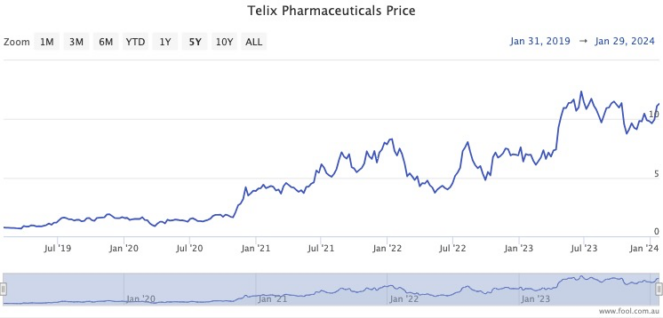
    Telix Pharmaceuticals Ltd (ASX: TLX) is an Australian company developing diagnostic and therapeutic products for different types of cancer.

    I like its long-term prospects because the business is at a sweet spot in its life cycle.

    In 2022, Telix released its first product into the commercial market, thereby generating its first flow of real revenue.

    Since then, that income has allowed it to progress future products through the arduous testing and approval pipeline and head towards profitability.

    The next few years could see the fruits of those activities, which could put a rocket under the share price.

    Professional investors are bullish, with all eight analysts surveyed on CMC Invest currently rating Telix as a buy.

    Telix shares have returned an incredible 1,494% over the past five years.

    These ASX growth shares have tripled in 19 months 

    Life360 Inc (ASX: 360) sounds like a creepy mobile app, but it seems to be popular in the US.

    It’s a “family locator” app that allows parents to track the whereabouts of their children. Similarly, it can also be used for family members to monitor their elderly relatives.

    There are also safety features such as car crash detection, calling for roadside assistance, and SOS alerts.

    According to a company presentation made at a conference in November, about 10% of families in the US use the app.

    What about the business though?

    After tech shares started selling off in 2022 due to inflation fears, the management declared that it would turn from a cash-burning startup to a more mature business focused on profitability.

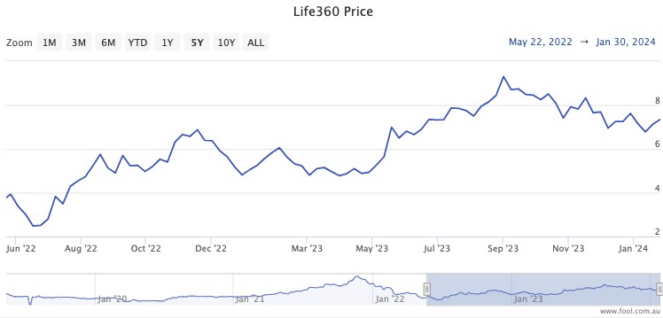
    The market has appreciated the pivot, sending the Life360 share price tripling since June 2022.

    Co-founder and chief executive Chris Hulls said in a quarterly update in November that Life360 continues to improve its cash flow.

    “We continue to carefully balance expense management with investment in the significant long term growth opportunities available to us.

    “Excluding commissions, operating expenses increased by $1.2 million or 2.4% YoY, compared with a $21.5 million or 38% uplift in revenue, demonstrating the operating leverage of Life360’s business model.”

    Just like Telix, this one’s popular with those who invest for a living.

    According to CMC Invest, seven out of eight analysts rate the tech stock as a buy.

    The post 2 top ASX growth shares to buy right now and hold for the long term appeared first on The Motley Fool Australia.

    Wondering where you should invest $1,000 right now?

    When investing expert Scott Phillips has a stock tip, it can pay to listen. After all, the flagship Motley Fool Share Advisor newsletter he has run for over ten years has provided thousands of paying members with stock picks that have doubled, tripled or even more.*

    Scott just revealed what he believes could be the ‘five best ASX stocks’ for investors to buy right now. These stocks are trading at near dirt-cheap prices and Scott thinks they could be great buys right now…

    See The 5 Stocks
    *Returns as of 10 November 2023

    (function() {
    function setButtonColorDefaults(param, property, defaultValue) {
    if( !param || !param.includes(‘#’)) {
    var button = document.getElementsByClassName(“pitch-snippet”)[0].getElementsByClassName(“pitch-button”)[0];
    button.style[property] = defaultValue;
    }
    }

    setButtonColorDefaults(“#0095C8”, ‘background’, ‘#5FA85D’);
    setButtonColorDefaults(“#0095C8”, ‘border-color’, ‘#43A24A’);
    setButtonColorDefaults(“#fff”, ‘color’, ‘#fff’);
    })()

    More reading

    Motley Fool contributor Tony Yoo has positions in Life360 and Telix Pharmaceuticals. The Motley Fool Australia’s parent company Motley Fool Holdings Inc. has positions in and has recommended Life360 and Telix Pharmaceuticals. The Motley Fool Australia has recommended Telix Pharmaceuticals. The Motley Fool has a disclosure policy. This article contains general investment advice only (under AFSL 400691). Authorised by Scott Phillips.

    from The Motley Fool Australia https://ift.tt/TZrAmlU